Remember when brand visibility mostly meant ranking on page one? This was back when readers had to click on pages to get the info they were after and AI was relegated to science fiction. It was a simpler time.
Not necessarily better… but certainly more straightforward.
Now your brand can show up in an AI-generated answer, get cited from a page you forgot existed, lose ground to a competitor in a recommendation list, or influence a buying decision without the user ever touching a traditional blue link. Search has become a kind of interpreter or paraphraser, applying artificial intelligence to pull information from pages and present it to the user in a (hopefully) clear and accurate way. The result is that more than half of online searches are zero-click. And when Google cuts out the middlebot, it changes what marketers need to be watching.
What I’m trying to say is that if you want to know how to track brand mentions in AI search results, you need to widen your gaze. SEO no longer begins and ends with ranking. It now extends to questions like “Does AI mention us?” “Does it cite us?” “Which pages does it pull from?” “How often do we appear compared to competitors?” And “Does any of this turn into actual traffic, leads, or revenue?”
Tracking brand mentions in AI search means monitoring when and how AI-driven platforms reference your brand in generated answers, recommendation lists, summaries, and cited sources.
But here’s the thing: AI search does not behave like classic search. Google’s AI features (for example) can generate overviews that summarize a topic and link users to a range of sources, while Bing now offers AI performance reporting tied to how sites are cited across Copilot and related experiences. Google also makes clear that AI Overviews and AI Mode still rely on essentially the same fundamental search requirements as the traditional approach.
So yes, rankings are still important. It’s just that with AI search, there’s a lot more to it.
For example, a brand can show up in an AI answer even when it is not the top traditional ranking. Or a page can get cited because it answers a narrow question clearly. A competitor might get mentioned because its reviews, product pages, or comparisons are easier for AI systems to synthesize.
The point is that the future of search will remain search. It has just become more conversational, more layered, and a little more expansive.
This distinction is one of the biggest places marketers get tangled up. So let’s be direct:
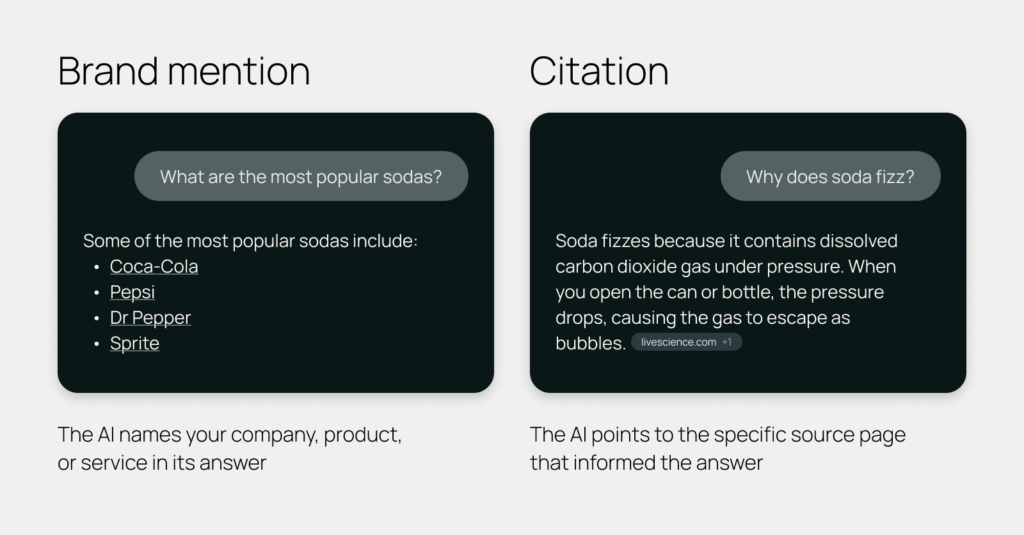
Which one do you want? Trick question, obviously; you want them both.
A mention can be flattering and still impossible to measure well. A citation can be less glamorous, but far more useful because it gives you something concrete to inspect. Which page got referenced? How often? Did it receive traffic? Did users do anything useful after landing there?
Or, think of it this way:
Google’s documentation around AI features focuses heavily on how content becomes eligible for inclusion and how traffic from AI experiences is counted inside Search Console reporting. That suggests that source-level analysis should be part of the process.
OK. Let’s move beyond the academic: AI mentions, AI citations, cited URLs… does it all matter?
Yes. Unequivocally yes. Here’s why:
People are asking longer questions, more specific questions, and plenty of follow-up questions. Google has explicitly said AI search experiences are pushing usage in that direction, with users exploring more complex queries and broader source sets.
That means discovery is no longer confined to obvious high-volume keywords. Someone may find your brand while asking for the best agencies for AI SEO, the top platforms for generative engine optimization, tools similar to your product but better for mid-market teams with limited technical support and a weirdly aggressive CFO, etc., etc., etc...
The path from question to brand discovery is less clean and a lot less predictable. Measurement has to adjust to account for it.
AI assistants were built to assist, and that goes beyond just summarizing informational content. They can compare vendors, recommend providers, shortlist software, explain product categories, and shape buyer impressions before a click ever happens. As such, when a platform includes your brand in a recommendation set, you’ve already entered the buyer’s consideration stage — whether or not they ever visited your site.
And that’s great! It can also be unsettling.
If you’re going to let an opaque machine send potential customers to your virtual door, you’d better be paying close attention to how often it’s doing so, and on what terms. Otherwise, you’re letting the robot make your brand positioning decisions for you.
When your brand appears in AI-generated answers, it can function as a form of borrowed trust. Users are beginning to treat AI responses as synthesized expertise. But those answers are only as good as the sources underneath them.
You should not confuse that with permanent authority. AI can be fickle, inconsistent, and occasionally wrong (and when it gets something wrong, it does so with supreme self confidence). Still, repeated inclusion shapes perception, and perception has a funny way of becoming influence.
If you’ve been in marketing for more than a few weeks, you’re probably already familiar with a tidy set of traditional metrics. You could follow rankings, traffic, click-through rates, and conversions, then build your strategy from there.
AI search adds some new layers to that picture by introducing answer inclusion, source citations, prompt visibility, and recommendation presence — all of which are signals worth tracking. That’s part of what makes AI search engine optimization a meaningful extension of the modern search strategy.

Brand visibility can show up in several kinds of AI-driven experiences. So, if you want to know where and how your brand is surfacing, you need to understand the environments in which those mentions appear:
Before you run off to buy seventeen subscriptions, start with the native data from the platforms (Google Search Console, GA4, Bing Webmaster Tools, etc.) themselves. That’s usually the best place to get a baseline view of how your site is appearing and performing.
Again, Google’s official guidance states that AI feature traffic, including AI Overviews and AI Mode, is included in Search Console’s Performance reporting for web search. It is not a perfect dedicated AI visibility dashboard, but it is still one of the best sources for understanding how your pages perform across Google search experiences.
Look at:
GA4 helps you connect visibility to behavior. Once users arrive on cited or AI-visible pages, what do they do? Do they engage? Bounce? Convert? Wander around aimlessly?
Without that layer, you are measuring attention without taking outcome into account.
Bing’s AI Performance reporting adds a very useful angle. Microsoft says the report shows how your site’s content is used in AI-generated answers across Copilot and partner experiences, including cited pages and changes over time. This makes it one of the clearest native examples of AI citation tracking from a platform owner. Yeah, from Bing.
If you only track how often your brand name appears, you will end up with a very incomplete picture. AI visibility is bigger than that. Your measurement approach needs to be bigger as well.
So, in addition to the tried-and-true standards, what should you also be tracking?
Visibility without outcome is like getting dressed up to sit on the couch — you might look good, but you’re still not going anywhere. Tie cited or visible pages back to business performance by tracking sessions, engagement, leads, or conversions wherever possible. That kind of connection is what keeps AI visibility from turning into a vanity metric, and is increasingly central to evolving SEO strategies.
A practical tracking list might look like this:
Does this feel like a lot to keep an eye on? Third-party tools can help, especially when you need repeatability and competitor monitoring across multiple platforms.
A growing crop of tools now tracks prompt-level visibility, citations, and competitive presence across AI platforms. Some focus on recommendation prompts, others emphasize cited sources, and still others prioritize reporting workflows.
These tools are useful for:
If you want to understand why AI keeps describing your brand a certain way, it helps to look beyond the AI platform itself. A broader view of your presence across reviews, mentions, directory pages, and publisher sites can reveal the raw material those systems are pulling from.
Before a page becomes readily visible in AI-generated answers, it usually has to be structurally sound and substantively useful. We'll table the discussion of whether you should be using AI to write content, but whether it’s human- or machine-generated, you just need to know if it works. That is where crawl data, content performance, backlinks, internal links, and topical depth become valuable, because they help show whether your content is actually built to compete.
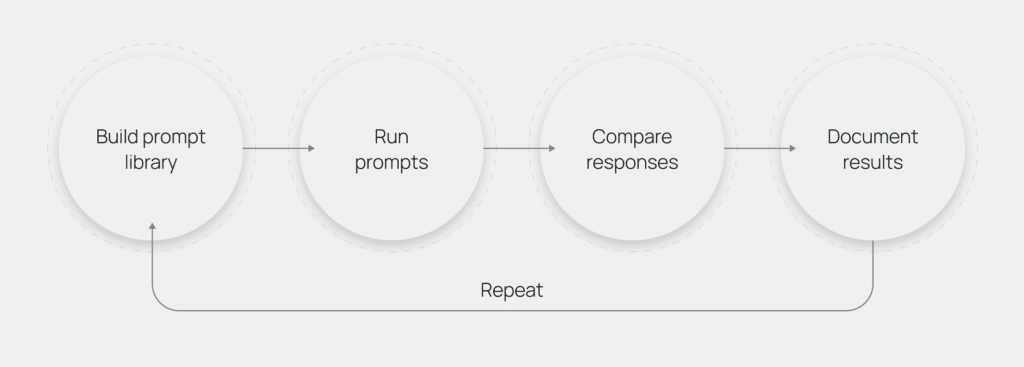
If you want a direct look at how AI platforms are mentioning, citing, or excluding your brand, manual testing is still one of the most useful methods available. It is not the fastest process in the world (and it can feel repetitive), but it gives you a level of firsthand visibility that tools alone cannot always match.
Here’s how to make it happen:
Start by creating a reusable list of prompts that reflects the different ways real users might discover your brand. The goal here is to build a consistent testing set you can run again later and compare against itself without wondering whether the change came from the platform or from your wording.
Your prompt library should include a mix of:
Keep the list somewhere centralized and stable. If you change the wording every time you test, you will make your own tracking less trustworthy.
Once your prompt library is built, run the same set of prompts across the platforms you want to monitor (Google AI Overviews, ChatGPT, Perplexity, Gemini, Copilot, or any other AI-driven experience relevant to your audience). The important thing here is consistency. Use the same prompts in the same format and, if possible, test them within a similar time frame. That will make your comparisons much more useful.
Prompts might include things like:
Want a clearer picture of how your brand appears in real-world discovery scenarios? You can also create variants that reflect actual buyer concerns, such as industry, budget, company size, or business model.
Once you have responses from multiple platforms, it’s time to look more closely at how the answers are constructed. Pay attention to questions like these:
This is where you should start to see some patterns. One platform may consistently cite third-party review pages. Another may pull more often from brand websites. A third may mention your competitors in recommendation prompts while leaving you out entirely. Those differences are useful to be aware of; they can point to gaps in your content, reputation, or discoverability.
As you’re running prompts, record the results in a way you can revisit later. AI answers can (and will) shift from one day to the next. If you fail to document what appeared, where it appeared, and which sources were cited, it becomes much harder to spot meaningful changes over time.
For each prompt, it helps to log the platform, the exact prompt used, the date, whether your brand was mentioned, whether your site was cited, which URLs appeared as sources, and which competitors showed up alongside you. A spreadsheet usually works fine for this (no need to get too technical, unless you’re into it).
A broad prompt gives you a starting point, but it does not always reflect how real users make decisions. People tend to refine their searches once they get an initial answer, and AI platforms are designed to respond to that refinement. By testing follow-up questions, you can see how your brand’s visibility changes as the conversation becomes more specific and more commercially relevant.
A single manual test will give you a snapshot, but what you need to do is turn it into a flipbook. So, you need to run your prompt set again. And again. And again.
And again.
A regular cadence, whether that is weekly, monthly, or quarterly, depending on how competitive and fast-moving your space is, gives you enough repetition to see the kind of movement that denotes trends. Keep the process as consistent as possible so you can see whether your visibility is improving, declining, or staying flat.
Citations show you which pages AI systems seem to trust, which sources keep shaping the conversation, and where your competitors may be gaining ground. In other words, if brand mentions tell you that you are visible, citations help explain why.
Start by looking for recurring URLs across the prompts you are testing. Pay especially close attention to pages that appear again and again in answers about your category, your services, or your competitors, because repetition usually signals that AI systems see those pages as useful reference points. And once you start seeing the same URLs repeatedly, you will have a better sense of which kinds of content are influencing AI-generated answers in your space.
The cited pages may come from a range of places, such as:
Once you know which pages are being cited, now you get to figure out what makes them citation-worthy. Take the time to study how the information is organized, how directly it answers questions, and how much authority it appears to carry. This usually comes from:
And, wouldn’t you know it, if these elements are working for competitors they can work for you too. Take what you learn here and use it to optimize your content for AI.
Some of the most important citation sources in your space may not belong to you or your competitors at all. Review sites, industry publications, directories, listicles, and third-party comparisons can all shape how AI platforms talk about the companies in a given category.
That is why it helps to look not only at whether a competitor is showing up, but also where the supporting information is coming from. If your competitors are being cited through trusted third-party pages while your brand is missing from those same ecosystems, that gap is worth paying attention to. It can reveal issues that go beyond on-site content and into the broader digital footprint surrounding your brand.
This is where generative engine optimization strategies become especially relevant. If certain pages on your site are already attracting citations, then those are the ones you want to invest in improving. Strengthen their clarity. Expand their usefulness. Tighten their structure. These pages have already caught the eye of AI. Now it’s just a matter of making them better at what they are already doing.
Let me tell you a secret that’s really not a secret at all: In most cases, the same qualities that make content useful for humans also make it easier for AI systems to understand, trust, and cite. Your goal, therefore, is to give the machine better material to work with.
Here’s a quick overview of AI search engine optimization strategies to help get you there:
All of this might begin to look like a lot to handle on your own. If you’re feeling overwhelmed or if you’d rather have your people focusing more of their time on other areas, AI SEO agency services can make up the difference.
Modern visibility is about more than where you rank on the SERPs, but the core challenge really hasn’t changed that much: You want to be found, understood, and trusted. The difference now is that discovery can and does happen inside AI-generated answers, recommendation lists, and citation panels before a visitor ever reaches your site. Tracking brand mentions in AI search calls for a broader view that includes citations, cited pages, prompt visibility, competitor presence, and the business outcomes tied to each.
But don’t let the newness of it all discourage you. All of this is trackable, improvable, and well worth the effort. With the right mix of native analytics, manual testing, and focused optimization, you can get a thoroughly informed view of how your brand is showing up in AI search and what to do about it next.
And if you’d like someone to handle it for you, 97th Floor can optimize and track your brand mentions in AI search. Contact us to see how we can help you strengthen your search visibility today… and as AI continues to revolutionize the landscape for years to come.
Brand mentions occur when AI search platforms reference a company, product, or service within generated answers.
Tracking AI mentions helps marketers understand how often AI platforms reference their brand and how visible they are in generative search results.
Businesses can use AI monitoring tools, analyze citation sources, and run manual prompt testing across AI platforms.
Common platforms include Google AI Overviews, ChatGPT, Perplexity, and other AI-driven search assistants.
Publishing authoritative content, building topical authority, and optimizing pages for generative AI can improve brand mentions in AI results.