You’ve probably noticed it already: traffic behaves differently than it did a year ago. Pages that used to rank predictably now earn visibility one week and vanish the next. Meanwhile, AI Overviews, ChatGPT answers, and Perplexity summaries are shaping what people see before they ever reach your site.
That shift is exactly why marketers are rethinking their AI SEO strategy for 2026. How do you get the right consumers to actually engage with your brand, not just the search engine? Your brand needs to be more trustworthy and recognizable, not only to your audience but to search engines themselves.
We’ve spent the last two years running experiments across generative engines, structured data setups, and entity-driven content frameworks. What’s working now is brands that pair technical precision with human expertise. This AI SEO guide breaks down how to build that kind of strategy step-by-step so that your brand is referenced more and seen by the people that matter the most to your business.
An AI SEO strategy is simply a plan for helping both search engines and generative models understand who you are and why your content should be referenced. Instead of worrying only about where a page ranks, you’re thinking about how clearly your brand shows up across topics, how well your expertise is represented, and whether AI systems can confidently pull from your work.
As search shifts toward AI search optimization, engines rely more on clean structure, consistent language, and content that makes your perspective easy to identify. The same applies to generative engine optimization, where models look for reliable patterns, strong entity definitions, and authors who actually know their subject. We have to present our knowledge in a way machines can recognize while still writing for real people.
AI rewired how information gets pulled together. Generative engines break your content into smaller pieces, look for patterns across topics you cover, and compare your explanations against other credible sources. They’re not scanning the page the way a crawler would, but actually interpreting it.
That shift puts more weight on things that used to feel “nice to have.” Topical depth—how thoroughly you cover a subject across multiple pieces—helps models understand your expertise beyond a single URL. Since AI can interpret it now alongside your audience, it matters just as much on the technical side.
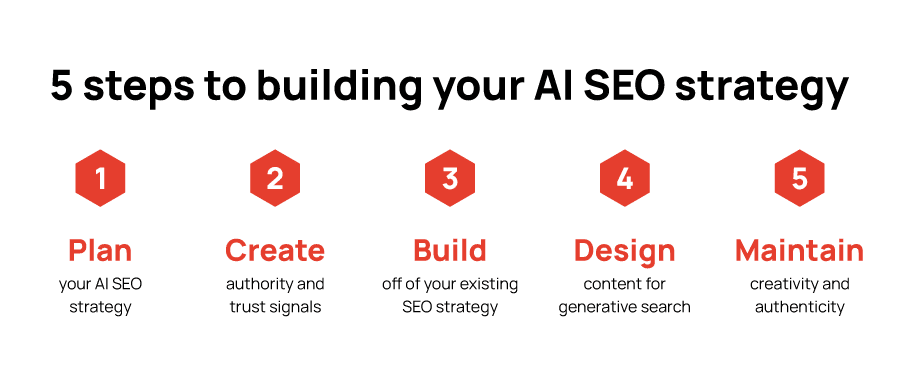
If you know how SEO works, it’s time to revise your playbook with AI in mind. Some teams have strong technical foundations but haven’t mapped their content in a way AI can follow. Others have great material but no clear structure tying their expertise together. These five steps outline the patterns we’ve seen produce meaningful gains as we have learned how to optimize AI SEO.
The first step to your SEO strategy with AI is getting an idea of how your content ecosystem performs when a model tries to interpret it. A standard audit won’t surface everything you need, so an AI-focused review looks at things like entity coverage, schema accuracy, internal connections between pages, and whether your explanations stay consistent across topics.
Ask yourself:
Once you know where things stand, set goals that track both search performance and AI visibility. Rankings matter, of course, but push beyond them, too. You want to see how often your content shows up in AI Overviews and if you’re keeping up with your competitors, especially if they are showing up in the search engine optimizations.
From there, map where your expertise naturally fits within broader topical clusters. This helps you see where you already have momentum and where the gaps are. AI tools can support the analysis, but choosing what to deepen or retire still depends on your priorities, not just what a model suggests. It also helps to take a quick look at how competitors show up in generative engines to spot topics models already associate with others in your space.
Generative engines are trying to decide whose explanation is dependable enough to reuse, and they look for signals that reinforce your expertise across multiple touchpoints and content pushes. As you look at your own content, a few signals often determine whether a model treats your work as dependable:
Make sure your best thinking shows up in places where AI can recognize it: expert-led articles, well-structured pages, digital PR that puts your name in the right conversations, and formatting choices that make your expertise easier to parse.
AI fits naturally into most SEO workflows once you know where it adds real lift. Traditional SEO still does the heavy lifting like crawling, indexing, and information architecture, but AI gives you a faster way to understand how topics connect from a model’s perspective.
Here are the areas where teams tend to see the biggest gains:
AI sharpens what you already do well and reveals opportunities you’d otherwise miss. Your strategy stays intact; your visibility grows because your decisions get better inputs.
Strategy matters, but execution is where most teams either gain leverage or fall behind. The difference often comes down to how you work with AI day-to-day — not just the tools you use, but the way you interact with them. Here’s a quick example of what that collaborative mindset looks like in practice.
AI sharpens what you already do well and reveals opportunities you’d otherwise miss. Your strategy stays intact; your visibility grows because your decisions get better inputs.
Generative tools don’t read your pages front to back. They jump around, grab pieces that answer specific questions, and stitch them together. When your content is organized in a way that gives them strong pieces to pull from, you show up more often and with better representation.
Here are a few patterns we’ve consistently seen help:
When you’re writing and producing an article, ultimately remember that you are giving models well-labeled building blocks that AI wants to use.
However tempting it is to hand everything off to the bots, the human touch really is irreplaceable and still important when it comes to rankings. Original thinking creates ideas and patterns that don’t appear anywhere else, which gives engines something completely unique and distinct to work with.
Here are a few simple things you can do to stay competitive if you do use AI.
When your content reflects the way your team actually thinks, generative engines pick up on that brand and reliability—and your audience does, too.
You need a mix of signals that show how people interact with your pages and how often AI systems lean on your work. Most teams end up watching a handful of KPIs that capture both sides of the picture:
Make sure to review your data so you can spot emerging trends and identify the content that is earning your citations.
The cool part about AI is that it is designed to work with you. You don’t have to throw everything you know and do out of the window. Don’t lose the traction you have gained. Instead, try to show up in generative results by overlapping with strong existing campaigns, PR, and content marketing strategies.
A few areas benefit the most from tighter alignment:
If this seems like a daunting task, an AI SEO agency can help your team bring all this into focus so that you are uniform across the board.
If we’ve learned anything in the past few years, it’s that search won’t settle into one format. Over the next few years, we anticipate that AI summaries, traditional SERPs, voice interfaces, and image-based queries will exist side by side, and brands will need to show up consistently across all of them. Conversations around the future of search already point to a mix of text, visuals, and conversational interfaces shaping how people find information. Teams that adapt early influence how models interpret their space, and those impressions tend to last longer than a single ranking shift.
It’s a new world we’re navigating in AI search, and the brands gaining traction are the ones treating this as an opportunity and not a barrier. Tighten up your messaging, crystallize your structure, and be the voice online that models can learn from. That’s the simple version.
The long version takes a lot of time, analysis, trial and error, and tracking. If you want a partner that can help you get right to the impactful steps, 97th Floor helps teams get a better read on how they appear in generative search and where the strongest opportunities sit. Our AI SEO services give you a practical path to better visibility without overhauling the work you already trust.

AI can surface patterns you’d miss manually, like emerging topics, structural gaps, or shifts in search behavior. It speeds up research and audits so that your team can focus on creating content that actually reflects your expertise.
Most teams use it to speed up research, cluster related topics, review structure, and get a read on how their content stacks up in generative search. It’s a way to work faster and plan smarter without replacing your brand voice and human insight.
Start with a baseline: how your content is organized, what you cover well, and where you’re missing coverage. From there, set goals, tighten your topic groups, update your schema, and make sure your messaging stays consistent across channels.
Watch a mix of signals—your usual traffic and rankings, plus citations in AI Overviews, mentions in generative tools, and shifts in how often your content gets pulled into summaries. The combination tells you what’s working.
A clear set of topics, strong entity definitions, reliable schema, expert-backed content, and a process for checking how models use your work over time. When those pieces line up, you tend to see better visibility across both SERPs and generative search.