Some search marketers have been declaring SEO dead for over a decade. Yet every year, search keeps driving brand discovery and revenue.
What has changed is how visibility works. Google’s AI Overviews summarize answers before users click, and generative engines talk about the brand inside responses. Search behavior now also spreads across YouTube, LinkedIn, marketplaces, and AI platforms.
Now, we aren’t gaslighting you—we are also seeing the declining click-through rates and unstable traffic that were so different just five years ago. When people ask, “Is SEO dead?” they’re reacting to something very real, and it’s affecting industries across the board.
But SEO is not dead or even dying. Like most things being affected by technology and digital initiatives, SEO is simply changing. Technical excellence, authoritative content, and visibility across systems is still essential. Now, you just need to optimize for AI systems and search platforms, too.
The biggest shift is the rise of AI-generated answers directly in search results. Google’s AI Overviews and generative engines can summarize information before a user ever clicks a page. In many cases, the search experience ends right there on the results page. When teams see traffic dip even though rankings remain strong, it naturally sparks concern about the long-term value of SEO.
At the same time, search itself is no longer confined to Google. People discover products on Amazon, research ideas on YouTube, ask questions inside AI tools, and follow recommendations from LinkedIn or Reddit threads. That fragmentation means visibility is happening across a wider ecosystem than traditional search analytics tools were built to track. For a lot of businesses, it can feel like you have no control over so many channels.
Those two forces together have created real volatility in organic traffic. If you have historically measured SEO success only through clicks and sessions, these changes can feel like the ground moving underneath your entire strategy.
For brands willing to adapt, the opportunity is still massive. Strong search visibility now depends on building authority, technical clarity, and content that AI systems trust as a source. That kind of SEO strategy sits at the center of modern search growth.
The phrase “is SEO dead” is what marketers are saying when they see declining organic clicks and evolving search interfaces that don’t seem as compatible with classic SEO. AI-generated summaries, knowledge panels, and expanded SERP features often deliver answers before users reach a website, so why should businesses bother with SEO?
But this evolution of search optimization has not necessarily lost its relevance. In fact, all it really means is that the role of SEO has expanded. Instead of focusing exclusively on ranking individual pages, your strategy should heavily focus on building authority and structured visibility across search and AI ecosystems.
A few patterns tend to fuel the idea that SEO is disappearing:
Remember that, ultimately, organic search remains one of the strongest discovery channels on the internet. High-intent queries flood search engines every day that drive your revenue. People still rely on search to solve problems and evaluate options, and your brand needs to show up in those results.
Enterprise organizations still invest heavily in search because it contributes directly to their pipeline growth. As you become an authority in your space (rather than focusing so heavily on ranking), and have technical, structured content performance, your visibility will increase.
For years, SEO success looked fairly straightforward, but there are a couple of other players on the field.
Traditional SEO says that success looks like top rankings and organic traffic. If your page appeared near the top of search results, the assumption was that clicks and engagement would follow.
Meanwhile, AI Overviews and generative systems increasingly pull answers from multiple sources. When that happens, business influence shows up through citations, summaries, and brand mentions inside those responses.
In other words, when AI search systems generate answers, they rely on sources they trust. If your content becomes one of those sources, your brand shows up in the answer itself—even when the user doesn’t click.
“SEO” is also one slice of a much larger pie, where AEO and GEO are a part of a well-rounded strategy.
Answer Engine Optimization, or AEO, focuses on structuring content so search systems can extract clear answers. Generative Engine Optimization, commonly referred to as GEO, looks at how AI platforms summarize and reference sources. Both ideas reflect the same larger trend: search engines are becoming answer engines.
Modern SEO strategies bring these concepts together. Instead of separating them, organizations combine traditional ranking strategies with content structures designed for AI summarization and entity clarity. This approach is how you can be at the top of your game with AI search and how to optimize for the future of search engines.
Another major change is where discovery happens. Search behavior no longer lives inside a single engine.
Someone researching a product might start with a Google query, watch comparison videos on YouTube, scan reviews on marketplaces, and read thought leadership on LinkedIn. Users also ask questions inside AI assistants before visiting a website.
Brands that want consistent visibility build authority across multiple ecosystems where search intent appears. So yes, you need to optimize for Google—that’s not going anywhere. But you also need to show up where people compare products or services and ask questions. That might mean:
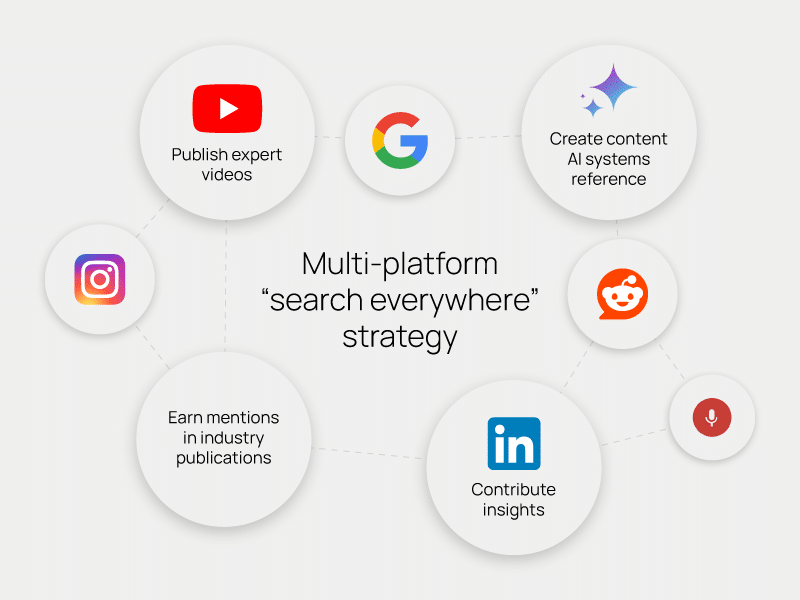
That broader presence strengthens the signals search engines and AI systems rely on when deciding which sources to surface. Over time, those signals reinforce brand authority in ways that pure keyword targeting never could.
Featured snippets started this trend years ago: search engines want to answer the question in the search bar without ever even visiting a website. Now, AI Overviews are taking it a step further.
Because more queries are answered directly in SERPs, AI Overviews have reduced the reliance on blue links for consumers—your audience.
So why are you pouring money into producing so much content for people to not even enter your website?
Because traffic declining does not necessarily mean your influence declines, too.
When your brand appears inside an AI Overview, a featured snippet, or a cited source within a generated answer, users still see your expertise. They may not click in that moment, but the exposure shapes awareness and credibility. Later, when they search again with a stronger intent, your brand is already familiar.
Instead of focusing exclusively on traffic, many organizations now look at a broader set of indicators:
The zero-click environment also forces some strategic decisions.
Chasing raw traffic can lead teams to prioritize high-volume informational queries that rarely convert. Meanwhile, focusing on authority and expertise often produces fewer visits but better downstream impact.
Enterprise organizations increasingly balance both sides of that equation. They invest in content that builds authority within a category while also strengthening owned channels like email, communities, and product education hubs.
Building authority earlier in the research process also helps teams connect search visibility to revenue attribution models, which track how organic discovery contributes to pipeline and closed deals.
We know that the technical side of SEO especially matters, but more than ever before, so does the human element of your content. Generic or recycled material just doesn’t quite cut it anymore. It’s your expertise and credibility that the AI models are going to trust.
Google describes these signals through E-E-A-T: experience, expertise, authority, and trust. This is exactly what it sounds like: search systems try to surface information that comes from knowledgeable sources.
AI-generated answers rely on the same signals. When models summarize content, they still look for sources that demonstrate real-world expertise and established authority within a topic area.
That’s why enterprise brands with recognizable subject matter experts, credible research, and original, real-world insights tend to perform well over time. They give search engines and AI systems a clear signal that their content is worth referencing.
Keywords do still matter, but even more important is writing for readers. Answer the search intent before you optimize for the algorithm to give yourself the best chance in AI search and future search strategies. This looks like having clearer explanations on the topic and practical solutions that actually help consumers make their decisions. Remember to:
Human-first content thrives when it’s supported by broader SEO principles. Successful organizations treat search visibility as a combination of these 6 disciplines of SEO working together.
If a site is difficult to crawl, poorly structured, or confusing to interpret, even great content struggles to appear consistently in search results. Think of it like building a library. You could fill it with incredible books, but if the shelves are disorganized and the catalog is missing, people will have a hard time finding anything.
Before a page can rank or appear inside an AI-generated answer, search engines have to find it and understand how it fits with the rest of your site.
That usually comes down to a few practical things:
When those fundamentals are in place, search engines have a clearer picture of what a site covers and which pages provide valuable answers.
Search engines are good at reading pages, but they still appreciate a little help.
Structured data acts like labels on a library shelf. It tells search systems exactly what they’re looking at. Product schema can identify price and availability. FAQ schema highlights clear question-and-answer sections. Review schema points to customer feedback.
Those labels help search engines surface the right information in rich results and AI-generated answers.
Entity relationships add another layer. When your brand consistently appears alongside certain topics across trusted sites, search engines begin to connect the dots. Over time, your brand becomes associated with that subject area, which makes it more likely to appear when people search for related information.
For enterprise organizations, technical SEO becomes even more interesting. Large websites often contain thousands or even millions of pages across different products, regions, and content hubs.
At that scale, small issues multiply quickly. Duplicate pages compete with each other. Important sections become buried several clicks deep. Old pages stick around long after they stop providing value.
That’s why enterprise SEO often requires governance systems and technical enterprise SEO playbooks that keep large sites organized. Without that structure, even strong content can struggle to gain traction in search.
You see a lot of the trending “SEO solutions” on your LinkedIn feed, but what is really going to move the needle? Let’s talk about it.
One of the biggest changes in modern SEO is the move away from pure volume. Today, that approach rarely produces lasting results. Search systems have become much better at identifying which sources actually demonstrate expertise within a topic.
That’s why many organizations now focus on building strong topic clusters around high-intent themes. Instead of publishing dozens of loosely related pages, they develop deeper resources that connect logically and answer related questions across the research journey.
The goal of these evolving SEO strategies is simple: become one of the sources search engines consistently associate with a category. That kind of authority tends to hold up far better than isolated rankings.
AI-generated answers have added another layer to modern AI SEO strategy.
Content now needs to be clear enough for AI systems to extract and summarize. Pages that explain ideas directly, use structured formatting, and answer questions clearly are more likely to appear in generated responses.
This often means writing in a more conversational, question-driven format. When a page mirrors the way people naturally ask questions, it becomes easier for AI systems to recognize and reference the information.
Ecommerce brands face a slightly different set of priorities.
Product pages need structured data that clearly communicates details like price, availability, reviews, and product attributes. Category pages often carry the responsibility of establishing topical authority for entire product groups.
At the same time, ecommerce SEO must compete within crowded SERPs filled with product listings, reviews, and comparison content. Brands that succeed often combine strong technical optimization with helpful buying guides, comparison pages, and educational resources that support the purchasing journey.
There are a lot of moving pieces to SEO now, and many organizations reach a point when their internal teams need help. This often happens when:
Working with a specialized team focused on AI-driven search can help organizations move faster while maintaining a clear strategic direction, which is why many brands explore working with an AI SEO agency.
By this point, one thing should be clear: modern SEO isn’t a checklist, but an entire system of connected strategies that all influence one another. When those elements operate in isolation, results tend to plateau. When they work together, search becomes a much more durable growth channel. 97th Floor is here to make sure every move you make is contributing to a healthy and modern SEO strategy.
97th Floor approaches SEO as a growth system rather than a content production engine. The strategy connects traditional search optimization with authority building, digital PR, and AI search visibility.
We can help you rank for keywords, but we also help your brand become a leading resource in your industry. Instead of chasing short-term ranking spikes, the focus moves toward durable visibility that supports sustained growth.
97th Floor focuses on building content systems and authority frameworks that continue performing even as search interfaces change. Search will keep evolving. How will your team keep up? Every algorithm update can work to your benefit as we help you master long-term authority and move beyond obsessive keyword ranking.
Let’s assess where your organization currently stands and see where you can start making changes for today’s SEO environment.
Start by looking at how your organization defines SEO success. The way performance is measured often shapes the entire strategy.
Next, take a close look at the technical foundation of your site:
Finally, consider how your brand appears compared to others in your category. Visibility gaps often become obvious when you look at where competitors show up in search and AI answers:
If these questions highlight opportunities for improvement, it may be time to revisit your SEO strategy. The search landscape is evolving quickly, and adapting early can make a significant difference in long-term visibility. Learn more about how our team approaches search strategy through our SEO services.
No. Search behavior is changing, but SEO still drives discovery and revenue for many organizations. Brands now compete not only for rankings, but also for citations in AI answers, summaries, and other search features.
The claim usually comes from declining click-through rates and changing search layouts. AI Overviews and other features answer questions directly on the results page, which can reduce traffic even when a brand remains highly visible.
Yes. SEO has expanded from keyword rankings to broader visibility across search engines, AI systems, and other discovery platforms. Today’s strategies focus more on authority, structured content, and expertise within a topic.
AI systems summarize information and cite sources when generating answers. Content that explains topics clearly, demonstrates expertise, and uses structured formatting is more likely to appear in those responses.
Nothing replaces it, but the scope has expanded. Modern strategies combine traditional optimization with authority building, structured data, and visibility across AI-driven search environments.
Traffic still matters, but many teams also track broader indicators such as brand visibility in search results, growth in branded queries, assisted conversions, and how organic discovery contributes to the pipeline.
For many organizations, yes. As AI-generated answers become more common, brands that structure content clearly and demonstrate expertise are more likely to appear in those responses and influence early research.