You finally took that leap and launched your own healthcare practice. It took grit and guts to get there, and it’ll take grit and guts to keep it going. Now that it’s open, you need to find a continuous flow of patients to fill your practice and keep your business above ground. Or, maybe you've been practicing for a while but are ready to scale and bring your practice to new heights. Regardless of the circumstance, there are some bulletproof healthcare marketing strategies that will get new patients flowing in your doors from a digital audience.
A healthcare marketing strategy defines how healthcare organizations attract patients, build trust, and drive engagement across digital channels while staying compliant.
Unlike general marketing, healthcare marketing prioritizes clarity, accuracy, and confidence at every touchpoint. Patients are not just comparing services. They are evaluating trust, expertise, and ease of access at every step of their customer journey.
A modern digital marketing strategy for healthcare brings together SEO, local visibility, content, and reputation management to support the full patient journey. When executed well, healthcare marketing functions as an extension of your patients’ experience.
Below I've distilled some healthcare marketing ideas and techniques you should be looking into in order to increase the relevance of your healthcare practice online.
Your site is likely the first interaction your potential clients will have with your healthcare brand online. A sloppy, buggy, or thrown-together website can give the impression that your practice is also sloppy, buggy, and thrown-together. In order to nail this first impression, be sure to invest in a well-crafted, visually appealing site that is easy to navigate, provides useful information, and demonstrates your practice’s expertise. A good site is the foundation of an influential online presence.
It should go without saying, but your site needs to look professional and inviting. In today’s digital age there are many avenues to building a website. Though it’s tempting, it’s worth investing in quality over budget when it comes to your site design. In addition to the fact that the average user sees quickly through cheap site design, a good site structure is essential to keep up with your healthcare business as your company scales. It’s important that your site reflects the top notch service and quality you provide.
The good news for you: many of the healthcare sites out there look quite outdated. By updating or creating a well designed site, you can stand out with relative ease.
When people get to your site, it’s for a specific purpose. In your case, people are looking for a healthcare provider that they can trust, with answers to questions only a doctor can answer. They have a specific problem, and they are looking for solutions.
If your website isn’t clear about the value each page brings (or worse, it promises value but doesn’t deliver) that confusion will reflect poorly on your practice. Be clear, be helpful, and put the user-- your potential patient-- first.
Facebook ads can be powerful for your healthcare marketing strategy, but you’ll need to put some thought and strategy into them. The FB ad platform isn’t one that typically brings results by blasting as many users as possible with your ads. The power comes instead from the very specific, granular targeting that can be done. Maybe you focus on sports medicine and want to run a campaign targeted to men and women, aged 20-40, with a particular interest in CrossFit. On Facebook, that’s easy. What if your practice caters to a higher-end clientele? No problem, you can target via income, net worth, home value, location, etc.
Paid social media marketing, such as with Facebook Ads, can be a powerful tool in an online strategy. The key is running tailored campaigns to specific personas. As you refine who you are targeting, you can lower your overall cost of running ads because you aren’t wasting money commercializing to people who will have little interest. To help get you thinking of what campaigns you should run on Facebook, here are some of the targeting options.
If you are embarking on running some social media ads yourself, be sure to read up on all the ins and outs of Facebook’s ad platform and how to use it. There are many options and it is easy to get overwhelmed on your first go. Adspresso has a great guide to get you jump started that can be found here.
Most industries have directories that list professionals within their industry. These directories often put in a lot of time and money in order to rank well for many profitable keywords, which means they are a resource you can use to increase the weight of your own domains. Use these healthcare directories to your benefit while you are getting your site ranked for your chosen keywords.
In most instances, directories will be free (or cheap) and have an easy to fill out form. You will use the form to submit information about your practice to be posted on the public directory.
For example, Healthgrades.com has a comprehensive directory that you should leverage to your advantage. It ranks for many healthcare-focused keywords.
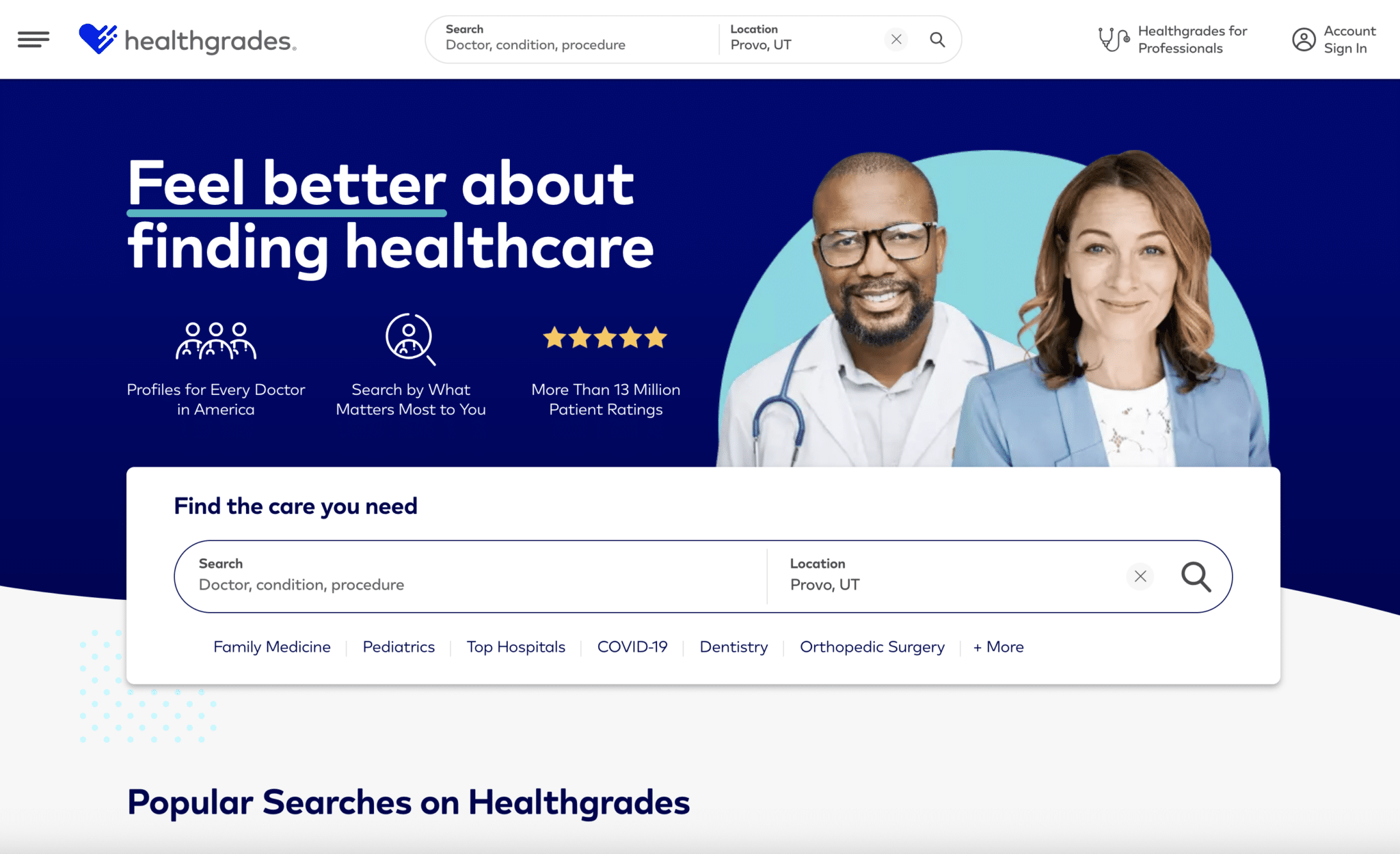
You can create a free Healthgrades.com profile here. It will look something like this:
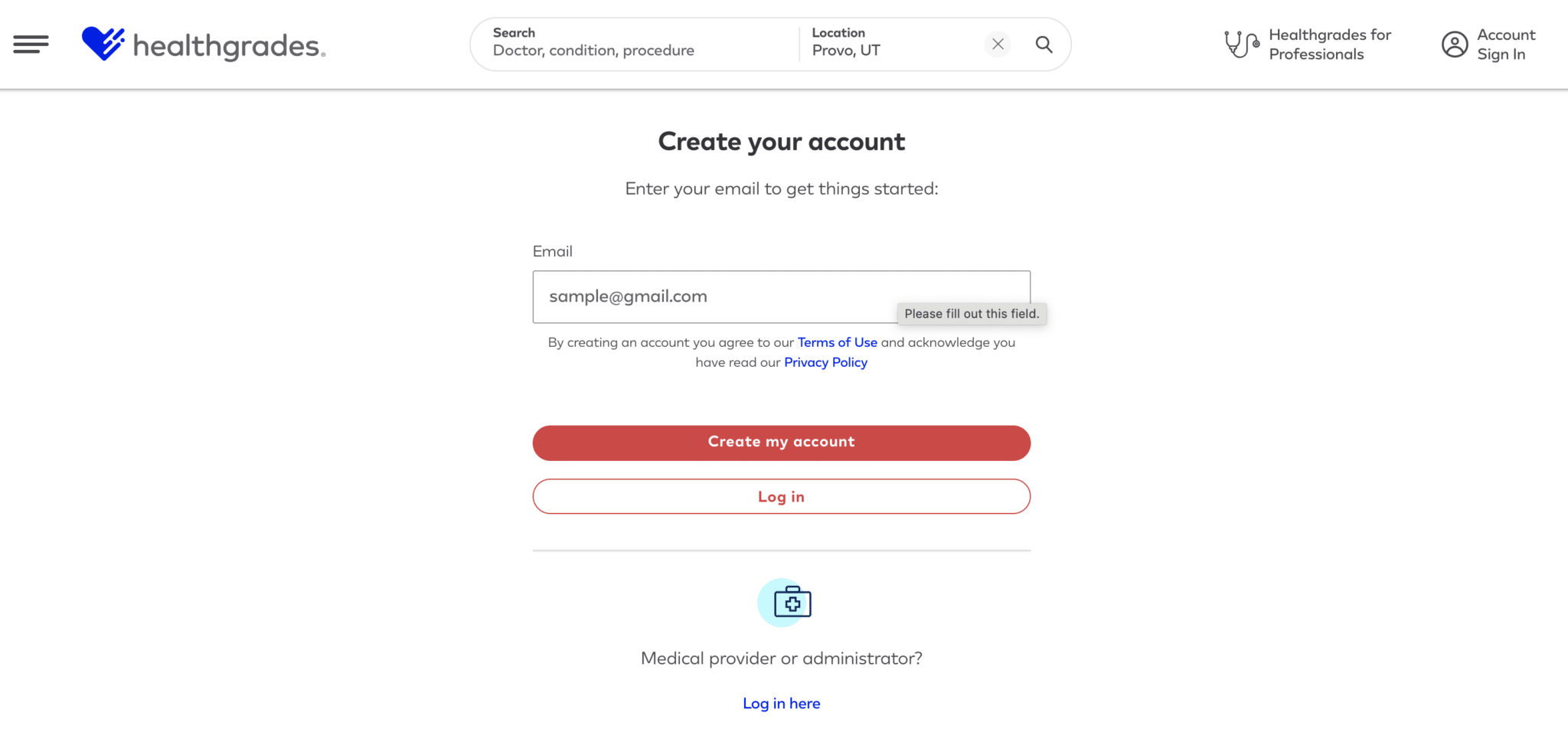
This is a great way to take advantage of all the hard work Healthgrades has put into their site and rankings. And, it’s mutually beneficial. Healthgrades relies on healthcare practices to add themselves to these lists, and you rely on them to aid your ranking positions and lead generation.
Here are a few more healthcare directories that you should be on:
All of the above directories rank for many “healthcare provider in...” type keywords. If this method works for you, don’t stop there! There are many more directories with online clout than the ones listed above. Do a quick search for “healthcare provider in” + “city” to see which directories show up for the city you want to rank for. Be sure to leverage the directories that rank for your target terms first.
Google My Business is incredibly important if you want to show up for local results in Google. I’m sure you’ve seen local results many times, but maybe you didn’t realize it was a part of the Google algorithm that you can leverage. Here’s what a local result looks like when you search “chiropractor SLC”:
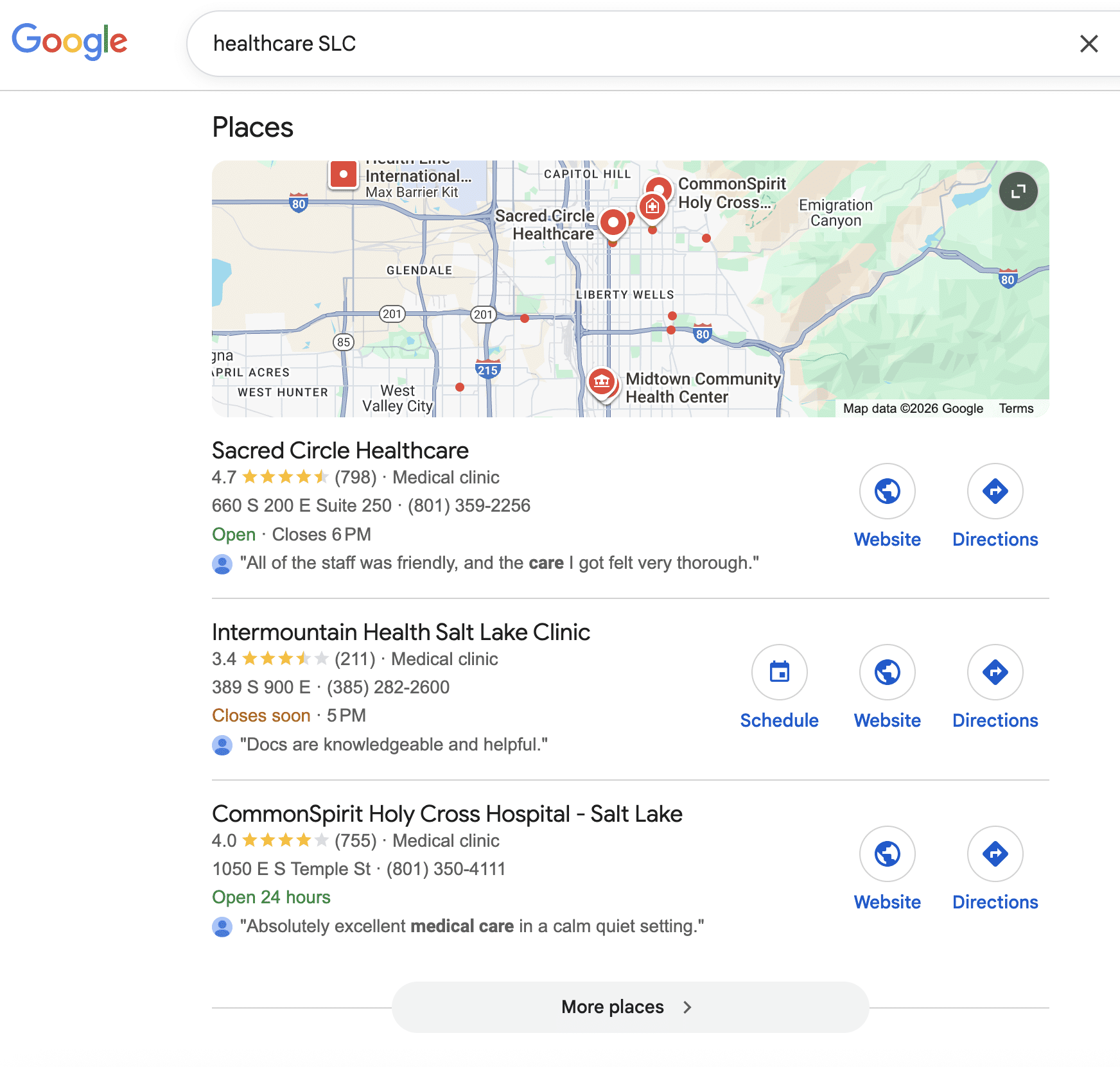
The local box will show different businesses that fit what you are looking for. There are many factors that go into showing up for these, but Google tells us that it comes down to 3 core factors:
So what exactly does Google mean by these?
Relevance is pretty self-explanatory. It refers to how closely your local business listing matches the search someone types in. By doing a thorough job filling out Google My Business and optimizing it to match the queries you want to rank for, you’ll increase in relevance.
Another pretty easy one, distance illustrates how far a person is from your business. In a recent report from Hitwise, it is reported that nearly 60% of searches are now performed through a mobile device. Google will calculate where a user is through their device and use this distance as a factor when providing results.
This is the part where optimization comes in. Prominence tries to gauge how prominent your business is in the offline world and reflect that in local listings.
Many factors are taken into consideration here. Links, local citations, reviews, and your position in traditional SEO results all factor into how “prominent” you are.
You need to verify your business with Google My Business. This is a fairly easy process. After you set up your Google My Business page, Google will send you a postcard with a verification code. You will then enter the code into Google My Business to verify your business listing.
Next, make sure all of your details are up to date and add 3-5 pictures of your business.
After you’ve added some great photos of your business, double check the category that you’ve declared for your business within Google My Business. It is important that you have categorized your business properly.
Thoughtfully fill in your introduction and title of your business in Google My Business so that it represents your business well.
Reviews are very important in local search marketing. Read and thoughtfully respond to reviews about your business. Reviews can make a huge impact on your business for better or for worse. It is beneficial to keep them under control through responding and genuinely taking care of your customers.
Citations are your mentions on various directories on the web. These directories are sites such as Yelp, The Yellow Pages, dexknows.com, chirodirectory.com and more. Building these by hand can take a lot of time, so many companies hire out for citation building.
If you embark on building citations by yourself, make sure you keep all of your information consistent across all of the directories you submit to. Nothing is worse than getting a bunch of citations that have conflicting phone numbers or addresses that you need to go through and clean up.
Traditional SEO for a healthcare practice, sometimes searched online as healthcare SEO, can be immensely powerful. SEO for those who are unfamiliar stands for “search engine optimization.” It is the act of optimizing the elements of your site so that you rank better (closer to the top) within search engines. The idea is that if you are a healthcare provider in Las Vegas, then you want to show up when someone searches “healthcare Las Vegas” within Google or other search engines. And, you want to show up as closely to the top as possible, so more users will click to your site over your competitors’. Performing SEO for your healthcare practice will do more than just generate customers, it will help you build a brand. Here are some of the benefits to investing in SEO.
As a healthcare provider, you are highly skilled in an area where most other people are not. Furthermore, you invested good money in becoming an expert at your craft. Use that expertise to grow your brand through content marketing.
What do I mean by content marketing? You should be consistently publishing content that brings value to your potential patients in a way that only you, as the expert, can. If you’re wondering: “Well, what should I write about?” This is where the keyword research that I mentioned earlier comes in. Keyword research will teach you what people are searching for and how many people are searching for it. In many cases, these search terms represent the questions that your potential patients have for you.
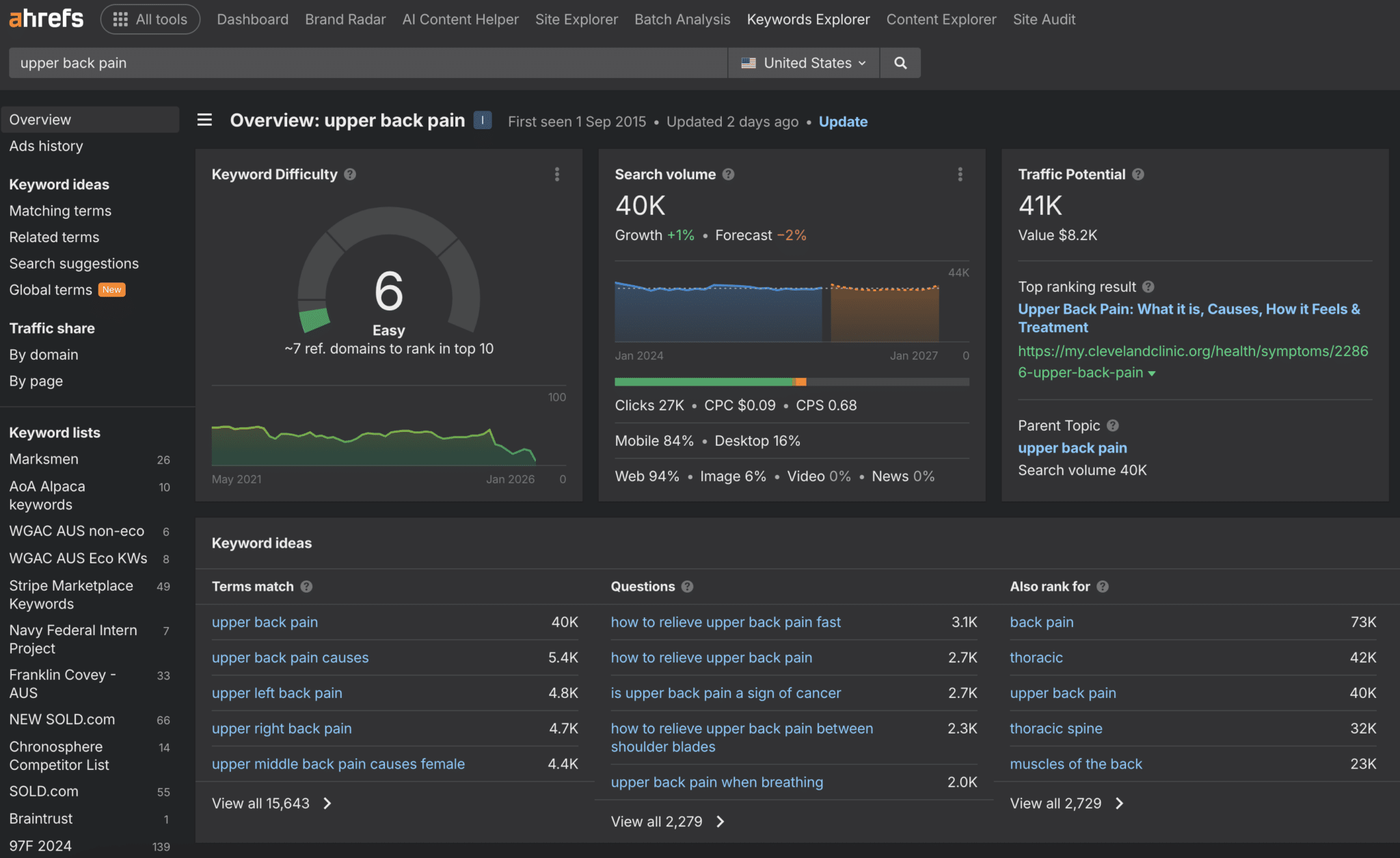
For example, if someone is experiencing upper back pain, they may search “upper back pain” in Google in order to research what the causes could be. Here is a snapshot of what the traffic looks like for some keywords regarding upper back pain.
Quick notes -
As you can see in this example, there are many people searching for the keyword “upper back pain” or some variant of it. We also learn that these keywords have relatively low difficulty being in the 20-30 range (out of 100, 100 being the most difficult).
If you, as a healthcare provider, created a piece of content regarding “upper back pain” and optimized it for the above terms, you could begin generating quite a bit of online exposure.
As you begin to show up for searches in Google you will be seen as an authority. The more searches you rank for, the more people will associate you as an authority.
A great example of this is Dr. Josh Axe of Draxe.com. Dr. Axe began by founding the Exodus Health Center in Nashville, helping thousands of families reclaim their lives through improving their health. Furthermore, Josh helped his own mother reclaim her health and beat breast and lung cancer. Realizing that he has a special set of skills, he set out to help more people using the amplification of the internet.
When Dr. Axe started early on, he wrote many pieces of content and published them on his site. Dr. Axe began ranking for many keywords and has since grown to become the “second-most-visited natural health website in the world.”
Here is Dr. Axe’s current site:
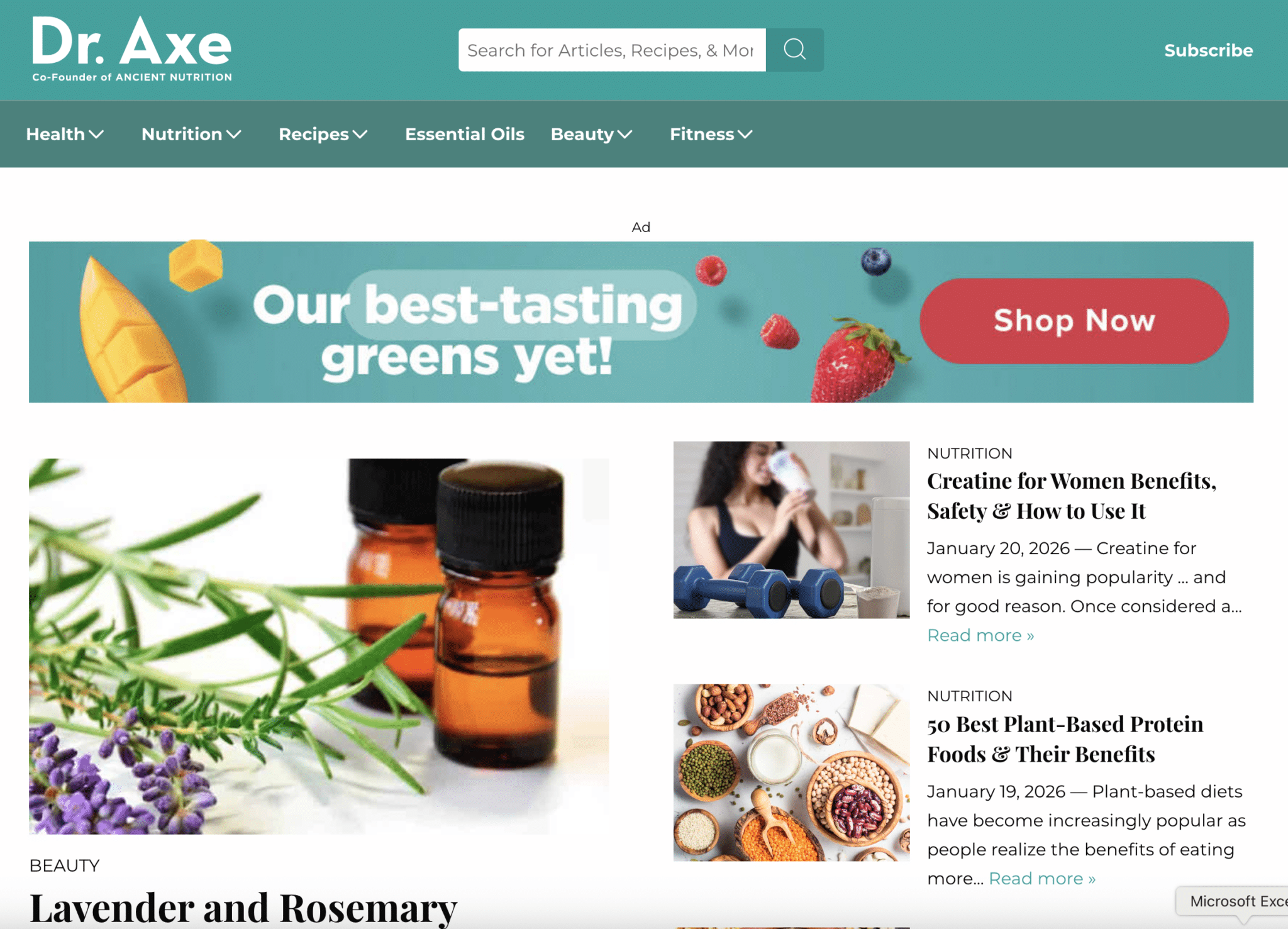
Josh’s site currently ranks for over 1.6 million keywords and generates over 7.5 million monthly visitors (as per Ahrefs).
Dr. Axe is an inspiring case study of what can be done through the leverage of SEO to build a strong brand with immense authority.
Managing your reputation online is at the heart of retaining a good brand image. Google your brand frequently to see what people are saying about you. Better yet, create a Google Alert for your brand name and be notified each time you are mentioned. This way you can jump in and resolve concerns and strengthen your brand.
Patients often research providers across search results, review platforms, and third-party healthcare directories. Monitoring what appears in these spaces helps organizations understand how they are perceived and where gaps in trust may exist. A strong healthcare marketing strategy includes proactive brand monitoring.
Give thoughtful responses to reviews and mentions to show your accountability and reinforce credibility, which is especially valuable when patients are evaluating alternative care options. Over time, this consistency supports a more resilient healthcare marketing strategy by building confidence across digital touchpoints.
For many patients, the first interaction with a healthcare organization happens online. This is often referred to as the digital front door, and it plays a vital role in any healthcare marketing strategy.
A patient-centric digital experience removes friction. Websites should be easy to navigate, quick to load, and clear about services, providers, and next steps. Patients should be able to understand their options, find answers to common questions, and take action without confusion or unnecessary barriers.
A strong digital marketing strategy for healthcare treats the website as more than a brochure. It functions as an access point for care, guiding patients from research to an appointment with confidence. When the digital front door is built around patient needs, marketing efforts convert more effectively, and trust is established before care even begins.