A few years ago, ranking on page one felt like the finish line. If your page showed up near the top, traffic followed.
Now, being at the top of SERPs is valuable, but it doesn’t pack the same punch. When you ask a complicated question, the search engine often answers it immediately. AI Overviews summarize sources, or generative engines simply write explanations. In many cases, the user never clicks a link at all.
As a brand trying to gain visibility with your consumers, this change in search results affects how you approach. Pages still matter, but the real opportunity now is becoming one of the sources AI systems rely on when they generate answers.
Answer engine optimization is a large piece of that puzzle, which focuses on how content gets extracted and referenced inside AI responses. In this guide, we’ll show you how answer engine optimization fits into your overall AI search strategy and how to show up in relevant online spaces.
When AI systems generate a response, they choose a handful of sources to build that answer. If your brand is one of those sources, your expertise shows up immediately. If it isn’t, competitors shape the narrative instead.
Decision-makers are asking longer, more contextual questions than they used to. It’s less short phrases like “CRM tools,” and more questions about how a CRM integrates with existing systems or which platforms work best for a specific business model. These often appear during real evaluation cycles, which means the answers influence purchasing decisions.
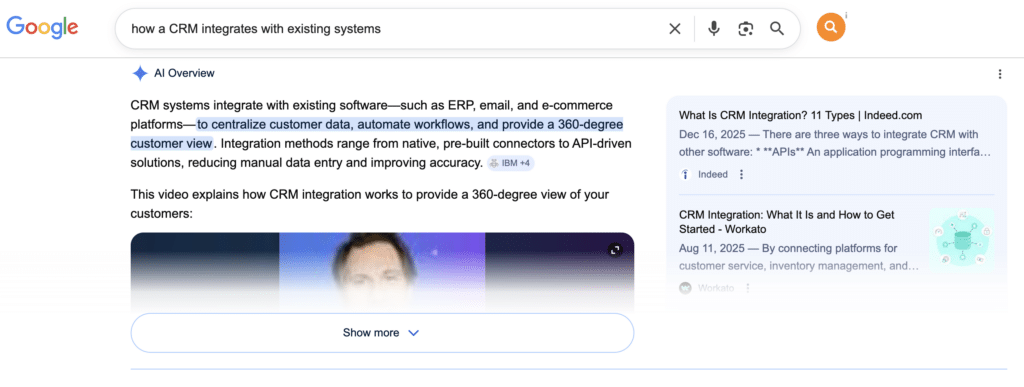
Because of that shift, the goal of search strategy is expanding. Ranking still matters, but influence now depends on whether AI systems trust your content enough to extract it as a direct answer.
Answer engine optimization is one of the ways you can make your content more visible under these new search conditions. AEO focuses on structuring expertise so AI systems can interpret it clearly and reference it when generating responses. Many teams now integrate AEO alongside traditional optimization, authority development, and technical SEO as part of a larger AI search strategy.
Over time, brands that consistently appear in AI answers gain an advantage that rankings alone cannot provide. Their expertise shapes the information buyers see at the very beginning of research.
When someone asks an AI system a question, it doesn’t search the web the same way a person does. It analyzes sources, pulls relevant information, and generates a response.
Answer engine optimization focuses on influencing which sources that response comes from.
Answer engine optimization is the practice of structuring and validating content so AI systems recognize it as a reliable answer to a specific question.
Instead of optimizing only for rankings, AEO focuses on how information is interpreted by AI systems. That includes how clearly a concept is defined, how expertise is demonstrated, and how easily an answer can be extracted.
The objective is representation. When AI systems summarize a topic, the brands cited in that answer help shape how buyers understand the category.
Traditional SEO and answer engine optimization address different layers of search visibility.
| SEO | AEO |
| Focuses on ranking pages in search results | Focuses on being extracted, summarized, or cited in AI responses |
| Optimizes for keywords and backlinks | Optimizes for questions, structured answers, authority signals, and machine-readable clarity |
| Performance is measured in clicks | Performance includes visibility within AI answers, brand mentions, and authoritative citations |
For most organizations, AEO complements traditional SEO since you still need SEO to rank—now, you are more deeply considering how your brand appears in AI-generated explanations.
Content optimized for answer engines typically follows a simple structure.
Start with a question that reflects how people actually search. Place a concise explanation directly beneath it, usually 40 to 60 words. Then expand with supporting context, examples, or strategic insights, especially when you can back up your ideas and claims with real experience. You also need to cut back on ambiguity wherever possible.
That format makes it easier for AI systems to identify the core explanation quickly while still giving readers the deeper context they need.
AEO works best when it’s built into how content is planned and structured from the beginning. Teams that try to retrofit answer visibility after publishing usually find the results inconsistent. Meanwhile, when you have a solid architecture from the beginning, you can design pages around the kinds of questions buyers actually ask and make it work for the digital world.
AEO content planning usually begins with mapping the questions buyers actually ask during research. These are usually the “what is,” “how does,” and “why does” questions.
For example, a software company might map queries like:
Each of those questions becomes a distinct section with a clear answer followed by deeper explanation. You can make sure you are covering topics with enough depth by using semantic clusters, which are groups of closely related questions and subtopics that help search systems understand the full scope of a topic.
This structure does two important things. First, it mirrors how buyers research a topic. Second, it gives AI systems clearly defined answers they can extract without needing to interpret a long block of text.
Answer engines rely heavily on structured information to interpret content. Structured data provides that clarity by labeling important elements on a page so machines can understand them more easily.
Schema markup helps identify things like the organization publishing the content, the author responsible for the expertise, frequently asked questions within the page, and relationships between related topics. This added context helps search systems interpret who is providing the information and what the page is about.
For example, a consulting firm publishing a guide about marketing attribution could use schema to define the organization, the author’s professional role, and the FAQ sections within the article.
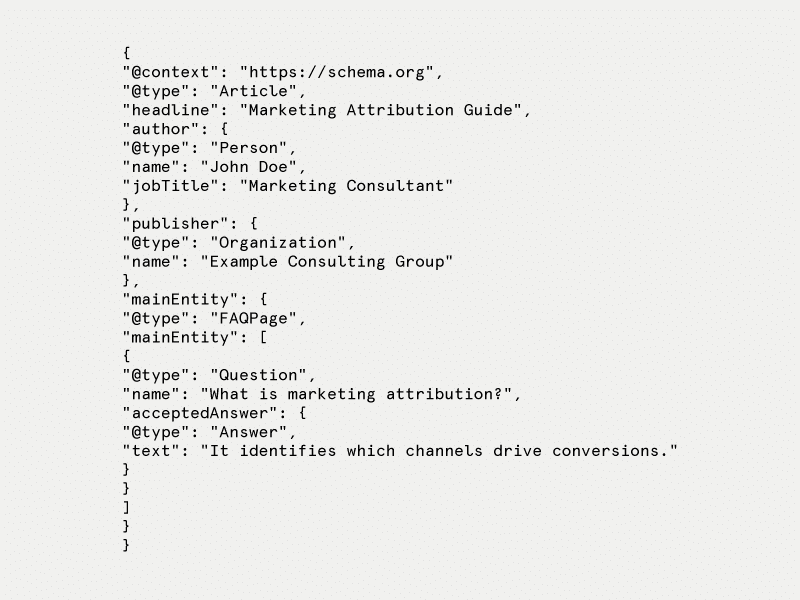
When those elements are clearly labeled, AI systems have a much easier time interpreting the page and connecting the expertise behind it to the topic being discussed.
Answer engines prioritize sources that demonstrate credible expertise. Google refers to these credibility indicators as E-E-A-T: experience, expertise, authority, and trust.
In practice, this means content should reflect real knowledge of the subject. Generic definitions only get you so far — strong AEO content includes insights drawn from actual work, industry experience, or original analysis.
For example, a cybersecurity firm writing about threat detection might reference internal research or share examples from real client engagements.
These types of details signal that the organization understands the topic in practice. Over time, consistent publication of this kind of expertise helps AI systems associate the brand with authority in that subject area.
Answer engines interpret questions the way people naturally ask them. That means content often performs better when it reflects natural language instead of rigid keyword phrasing.
For example, someone researching marketing attribution might ask:
Structuring sections around questions like these helps AI systems match your content with real user queries.
Strong AEO content also anticipates follow-up questions. A page explaining marketing attribution might include sections about data accuracy, implementation complexity, or how attribution influences budget decisions.
Connecting those related ideas helps search systems understand the topic more completely and reduces fragmentation across multiple pages.
Clear hierarchy also matters. Question-based headings followed by concise explanations make it easier for AI systems to summarize or extract specific sections when generating answers.
Answer engine optimization focuses on preparing content for the process of assembling responses from credible sources and summarizing it for the user. When information is structured clearly and supported by credible expertise, AI systems have an easier time referencing it while generating answers.
Content that appears inside AI-generated responses usually follows a predictable structure. It explains a concept clearly, avoids filler, and provides enough supporting context for the system to validate the information.
If you want to understand how to optimize content for generative AI, begin sections with a concise explanation of the topic, followed by examples, data, or deeper analysis that reinforces the credibility of the answer.
For example, a page explaining marketing attribution might begin with a definition, then expand into implementation considerations, measurement challenges, and how attribution influences budget decisions. Structuring content this way makes it easier for AI systems to extract the core explanation while still giving readers useful context.
Let us say it again: answer engine optimization works best when it supports a broader search strategy. It’s a core pillar, but it isn’t the whole coliseum of AI search SEO.
AEO focuses on how answers are structured and interpreted. Traditional SEO still influences how pages are discovered and how authority develops around a topic. When both approaches work together, brands are more likely to appear during the research stages where buyers gather information.
A company building authority around marketing analytics might publish in-depth resources on attribution models and data integration strategies. Over time, that connected coverage strengthens the brand’s association with marketing measurement.
Generative search does not exist on a single platform, either. AI Overviews, Perplexity, and other answer engines each generate responses differently.
Because of that variation, it helps to monitor how your brand appears across these environments. Some platforms may reference your research frequently, while others rely on different sources when generating answers.
A company might discover that its insights appear regularly in one AI platform but rarely in another—maybe they need to improve visibility on Perplexity. Observations like that can reveal gaps in how expertise is structured or referenced across the web, which becomes clearer when examining how brands appear in systems like Perplexity’s search engine and browser.
So, how do you actually evaluate whether your content is positioned to appear in AI answers? This is where the right tools can make all the difference.
AEO tools typically analyze how well content aligns with the structures AI systems rely on when generating answers.
One common area is entity clarity. Tools look at how consistently a brand, topic, or product appears across pages and whether the relationships between those entities are clearly defined. If your company publishes content about multiple services, for example, these tools help determine whether those services are clearly connected to your brand and expertise.
Another area is semantic coverage. Platforms often evaluate whether a topic includes the related questions and supporting explanations that give AI systems enough context to understand the subject. A page explaining marketing attribution might also need sections about attribution models, implementation challenges, and reporting accuracy for the topic to feel complete.
Many tools also examine question-to-answer structure. This includes identifying whether pages contain clearly defined explanations that AI systems can extract without needing to interpret long paragraphs.
Finally, platforms often review authority indicators such as citations, references, and how often your content appears across relevant sources on the web.
Not every platform labeled as an AEO tool is built for enterprise teams. Many focus on content analysis alone, which can leave large organizations without visibility into the broader search ecosystem.
When evaluating answer engine optimization platforms, look out for these capabilities especially.
The best platforms provide actual, actionable information on how AI systems interpret your expertise rather than simply pointing out missing keywords.
Tools can show you important gaps, but they rarely solve the strategic challenge on their own.
Answer engine optimization requires coordination across several departments. Content teams shape the explanations AI systems extract. Technical teams manage structured data and site architecture. Digital PR and communications teams strengthen authority across the web.
Without that coordination, even the best tooling will only surface problems rather than help solve them.
Over time, the organizations that succeed with AEO treat tools as diagnostic support while focusing most of their effort on building authority and expertise.
By the time most organizations start exploring answer engine optimization, they’ve already noticed something unusual in their search data since AI systems are taking the lead.
At 97th Floor, answer engine optimization isn’t treated as a standalone tactic. It’s integrated into a broader shift toward AI-driven search, where content structure, authority, and technical clarity all influence how a brand shows up online.
Enterprise organizations rarely struggle with producing content. The challenge is aligning that content so it reinforces expertise across a category.
That alignment requires several moving parts working together. Content needs to answer the right questions. Technical teams need to support structured data and site architecture. Digital PR helps strengthen authority signals across the web. We make sure all of your best people and AEO efforts actually work together and make progress.
AEO should never be measured by visibility alone. What matters is whether that visibility influences the conversations buyers are having when they research a category.
At 97th Floor, answer visibility is connected to the areas that actually drive revenue. Content is structured so AI-generated answers reference the topics that matter most to the organization’s services and solutions.
Over time, this approach shifts the goal of AEO from general awareness to category influence. When buyers encounter explanations that consistently reference your expertise, your brand becomes part of how they understand the problem itself.

Search will continue evolving as AI platforms mature. New answer engines will emerge, and existing platforms will refine how they interpret and summarize information. That’s why strong AEO strategies focus on building durable authority rather than chasing short-term optimization tactics.
Are you ready to shift into a new gear with answer engine optimization? Here are some questions you can ask yourself to know if it’s time.
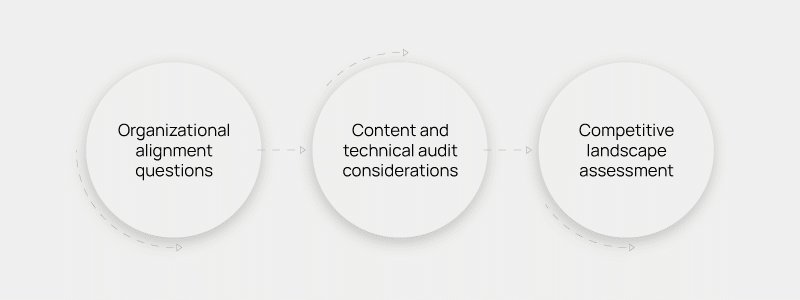
Answer engine optimization often requires teams to rethink how search visibility is measured and managed.
Start by looking at how your organization currently approaches search.
These conversations usually surface quickly whether AEO can be implemented smoothly or whether internal alignment still needs work.
The next step is examining whether your existing content can actually support answer visibility. Key questions to review include:
Finally, it helps to look outward.
In many industries, answer engines already reference certain organizations repeatedly when explaining a topic. Those brands effectively shape how buyers learn about the category. Ask yourself:
These observations often reveal whether your brand is currently influencing the conversation or watching it happen from the sidelines.
If these questions surface opportunities, it may be time to develop a structured AEO strategy.
At 97th Floor, answer engine optimization is approached as part of a broader AI search transformation that connects technical SEO, authority development, and content strategy. Organizations exploring how to improve their answer visibility often begin by examining how their content aligns with modern search strategies.Discover how we can help you in the new age of AI search!
Answer engine optimization focuses on helping your content appear inside AI-generated answers. Traditional SEO focuses on ranking pages in search results. AEO still relies on many SEO fundamentals, but the goal shifts toward becoming a source that AI systems extract and cite when generating responses.
AI systems increasingly answer questions directly within the search experience. If your content becomes one of the sources those systems rely on, your expertise appears earlier in the research process and helps shape how buyers understand the topic.
Performance often includes indicators beyond traditional traffic. Teams typically track how often their brand appears in AI-generated answers, whether their content is cited as a source, and how those appearances influence branded search or downstream conversions.
Schema markup helps search systems interpret the structure of your content. By labeling key information such as authorship, FAQs, and topics, structured data helps AI systems understand what a page represents and how its information can be used in generated answers.
Tools can help identify gaps in structure, topic coverage, and authority signals. However, the strategy behind the content still matters most. Organizations that see the strongest results usually combine tooling with coordinated efforts across content, technical SEO, and authority-building initiatives.
Preparation often begins with reviewing how your content answers important questions in your category. From there, organizations typically align their SEO, content, and PR efforts so expertise is clearly demonstrated and structured in ways AI systems can interpret.