



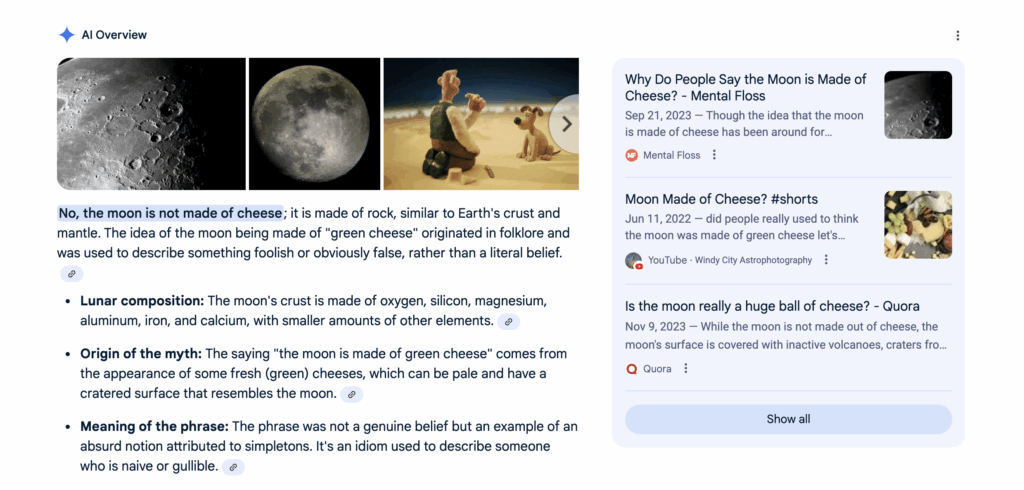
If you’ve ever Googled something in the last year, you’ve likely seen an AI summary pop up at the top of the SERP page. Whether you read that answer or not, having those AI summaries on search engine results has changed the way users interact with websites and the way SEOs are approaching optimization.
Even though SEO is shifting, there’s no reason to worry about its future. SEO is around to stay—and so is AI. The key is learning how to use both together in an effective way to get your content to your audience and to help you reap the benefits of online visibility. Read on to learn all about AI and SEO, best practices for adjusting your strategy, and where the future of search is going.
SEO is what helps your page show up on search engines to meet user queries. However, recently, the top slots are going to an AI summary, and the AI tool will search across pages to find information to fuel its responses. AI SEO also includes using AI like machine learning (ML), natural language processing (NLP), and predictive analytics as a tool in your own SEO process. It’s all about getting your website to display in AI searches as well as using it to help you improve your own work.
Unlike traditional search optimization, which largely focused on keyword placement, backlinks, and static algorithmic signals, AI-enabled SEO adds several new dimensions:
Here are some concrete examples of how AI capabilities are already being applied in search and SEO:
AI is reshaping the SEO landscape by powering smarter search engine results pages (SERPs) and fueling the rise of AI-driven answer engines. Instead of delivering a list of ranked blue links, modern SERPs often feature AI-generated summaries and at the top of a SERP to answer questions directly—reducing the need to click through to websites.
This shift moves the focus of SEO from traditional rankings to retrieval and representation. It's no longer just about being on page one—it's about being cited or summarized by AI models that interpret and surface the most relevant content from across the web. As a result, user behavior is evolving. Click-through rates (CTRs) on traditional organic listings are declining in some categories, while zero-click searches are increasing.
The goal now is to curate your content in a way that makes it easy for an AI tool to retrieve and summarize it.
Understanding which AI platform your content needs to perform in just got a lot clearer. SEO expert Eli Schwartz breaks down what Apple's partnership with Google Gemini means for the future of search — and why it cements Google as the dominant AI search platform you need to be optimizing for. This short video captures exactly how Google won the AI search war, and what that means for the strategy you're building right now.
As generative AI becomes more integrated into search engines and digital assistants, SEO strategies need to evolve to make sure your pages are staying on top and showing up in the right searches. AI usually considers these three key factors when choosing content to cite:
Certain formats tend to perform better in AI summaries, including:
AI can also help you work smarter, not harder. AI tools can automate keyword research, detect content gaps, and personalize experiences across channels to help you find the right areas to create content.
Integrating AI into your SEO strategy doesn’t need to be overwhelming. As SEO experts, we’ve worked hands-on with AI search optimization across many industries, and we’ve identified four best practices that can help your team adopt AI.
The best way to begin is with low-risk, high-visibility pilot tests. Try AI tools on smaller tasks—like keyword clustering, meta tag suggestions, or content outline generation—and track performance over time. Use these early experiments to measure output quality, workflow impact, and time savings. Once you understand where the tech shines (and where it doesn’t), you can scale up confidently.
Choose AI tools that work well within your existing SEO stack. You’re likely using CMS platforms like WordPress and Webflow or analytics tools like GA4, Looker Studio, or Search Console, and you want AI tools that work with those. Don’t just chase “shiny” AI features. Make sure they fit into your real-world systems.
AI is a powerful assistant but not a decision-maker. Use it to automate repetitive tasks, surface insights, and speed up processes, but keep humans in the loop for critical thinking and decision making. Humans need to make big decisions, look over AI content, and check for brand consistency.
AI in SEO is not a static playbook—it’s an ongoing evolution. Keep your team learning with hands-on training and encourage experimentation with new tools and techniques. Look for ways to bring real value into daily workflows: faster content ideation, smarter optimization, better insights. All of this will help you optimize for AI search SEO.
While AI gives you a wide range of advantages with SEO, there are some new challenges to prepare for, including:
As AI transforms how search works, the role of SEO professionals is evolving just as quickly. Instead of spending time on purely manual tasks—like keyword tagging, metadata updates, or technical audits—SEO pros are stepping into more strategic roles. Their job isn’t just to optimize for algorithms, but to understand how people and machines interact.
AI is a powerful tool, but it complements—not replaces—human expertise. Machines can generate content, identify trends, and automate repetitive tasks, but they can’t replicate human creativity. SEO teams must now balance automation with context, voice, and long-term vision.
At 97th Floor, we’ve embraced this shift by changing the name of our SEO department to the Search Department. This rebrand reflects a broader mandate: we’re no longer optimizing only for search engines—we’re optimizing for how people experience search across AI chat, answer engines, smart devices, and traditional SERPs.
As AI reshapes how people discover and consume content, the way we measure SEO success must also evolve. Here are our tips for measuring success.
The future of SEO is about aligning with how AI understands, retrieves, and delivers information. Several key trends are shaping what’s next:
To stay competitive, SEOs must prepare for ongoing shifts by adopting agile processes, investing in AI literacy, and building systems that track visibility across traditional and AI-powered platforms.
If you want to see what can be done with AI SEO strategy, look no further than 97th Floor’s campaign with Princess Cruises. We helped Princess Cruises move beyond siloed pages toward a tightly interlinked topical cluster model. The aim was to layout content in a way that signals topical authority, which helps AI systems find more contextually rich responses and increases the chance that Princess content is cited or summarized in AI-driven overviews.
The results were dramatic:
By marrying strategic direction with hands-on execution, we turned AI‑centric theory into concrete gains—while proving that human judgment, agility, and domain knowledge remain indispensable.
If your SEO team is wondering whether AI‑driven search is already rewriting the rules—this case shows it is, and early wins are possible. The shift is not hypothetical. It's real, and the rewards go to teams that think differently about content structure, authority, and AI visibility.
If you'd like to explore how generative search can work for your brand—or see how 97th Floor can help you architect a strategy and workflow—learn more about our AI SEO services.
Your content might already rank well in Google, but what happens when users never click through? With AI Overviews, Bing Copilot, Perplexity, and chat-based search, answers are being generated instantly, and often without the need for a typical site visit. That shift means the old playbook of targeting blue links and optimizing for CTR doesn’t cut it anymore.
AI search engine optimization (AI SEO) is the next frontier. Instead of chasing positions, brands now compete for visibility inside summaries, citations, and answer boxes. This guide breaks down how AI SEO works, the strategies that matter most in 2025, and which metrics to track as you future-proof your search presence in our AI-first world.
As SEO continues to evolve beyond clicks and rankings, the real question becomes: did you genuinely satisfy your audience with relevant content? This short video captures why engagement and user value now matter more than ever.
AI search engine optimization is about making your content answer-ready for systems powered by large language models (LLMs). Instead of just aiming for the “10 blue links” on a results page, AI SEO helps your content show up inside AI Overviews, generative snippets, and even chat-based answers.
Think of how these engines work. First, they retrieve documents that look relevant. Then, the model generates a response by summarizing those documents — and, if you’re doing something right, citing the ones it trusts. That citation is the new click-through.
So, do keywords and backlinks still matter?
Yes.
Are they enough on their own?
Not quite.
To get cited, your content has to speak the same language as the machine. Entity-rich writing, clear definitions, structured data, and clean metadata. The easier you make it for a model to sift through your content, the more likely it is to select your content as a reliable source.
Structured data and content have always been one of the primary answers for how to optimize for search engines, so a lot of what you naturally do is already helping. So, traditional SEO isn’t dead. Fast load times, strong technical health, and mobile readiness are still table stakes. What’s changed is the layer on top: your brand now has to prove it’s a trusted authority for both humans and algorithms.
We always talk about Google, but that isn’t the only search engine or resource for results. They show up across an expanding ecosystem, including:
The message for marketers is clear: you’re not just optimizing for Google anymore. AI SEO means building content that can be selected, summarized, and cited across multiple surfaces — and more importantly, wherever your audience is asking questions.
Structure. Writing quality. Authority signals. That’s what large language models (LLMs) are looking for when deciding which content to trust. Instead of optimizing for a ranking, you’re optimizing for selection inside an AI-generated answer. That process leans on a few core elements:
When these pieces come together, your content becomes easier for AI to interpret, summarize, and cite. It shifts the goal from driving clicks to earning visibility inside the answers people already see. So, the more quote-ready your content is, the more visible your content and brand will be.
Traditional SEO rewarded visibility. AI SEO rewards credibility. Instead of just climbing search rankings, the goal is to become the source that AI systems trust enough to cite.
Getting to page one used to be the win. Now, the real prize is being quoted inside an AI Overview or chat result. That means structuring passages so they can be pulled directly into answers. For instance, a product comparison table or a one-sentence definition has a better shot of being cited than a long block of copy. Rankings still matter, but citations are what earn attention in AI search.
Stuffing in the right keyword variation won’t convince a model that your page is the best fit. What does? Entities and their relationships. Imagine writing about “running shoes.” Instead of just repeating the phrase, you’d define cushioning types, list popular brands, and connect those details to activities like marathon training or trail running. That context helps AI systems map how your content answers more specific queries.
Click-through rate once measured success, but if users get their answer from an AI summary, no click happens. AI share of voice tracks how often your brand is cited across Google AI Overviews, Bing Copilot, or Perplexity. For marketers, this metric reveals whether your expertise is showing up where people are now spending their attention: inside the generated response itself.
If your pages aren’t being cited in AI answers, they might as well be invisible. The fix isn’t complicated, but there are a couple of specifics you need to incorporate.
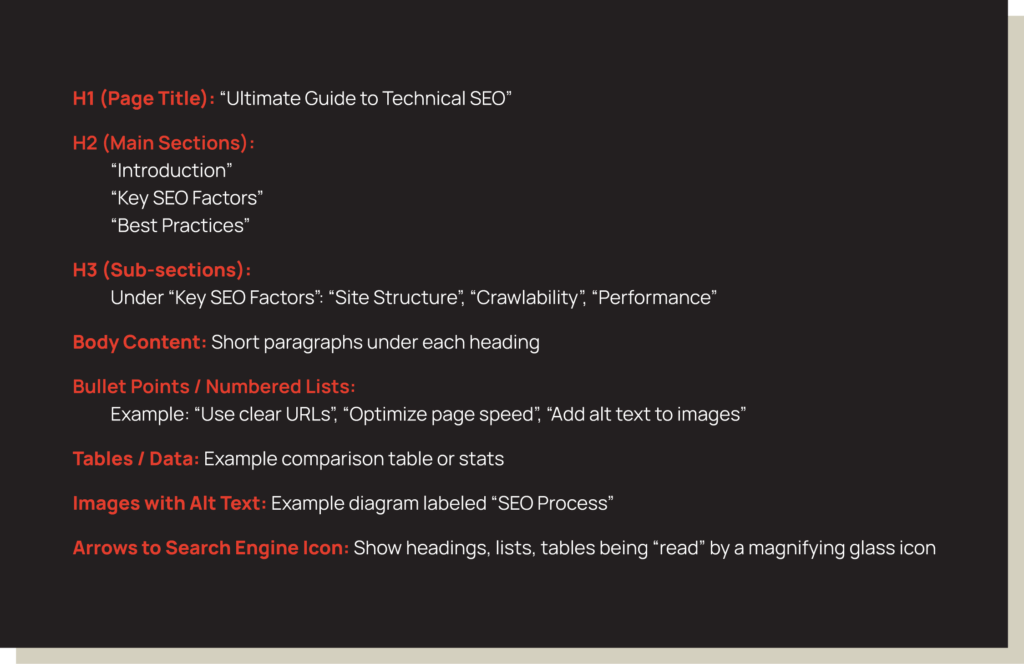
Think about how an AI model scans a page: it’s looking for clear, digestible chunks. Start sections with one-sentence definitions, then expand. Use lists, tables, and step-by-step breakdowns, formats that can be lifted directly into generated responses. Adding FAQs within a topic cluster also improves your odds of citation because the content is already shaped like an answer.
If you’re writing about “how to refinance a mortgage,” opening with a single-sentence definition followed by a step-by-step list gives the model exactly what it needs. FAQs work the same way—they mirror the Q&A style AI results are built on.
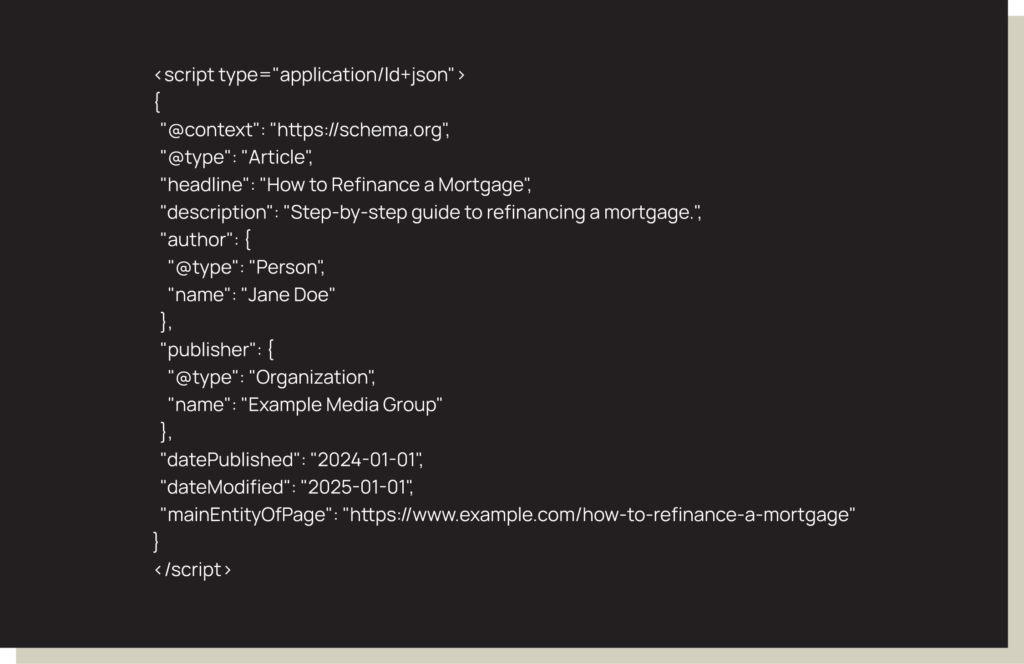
Schema is like a cheat sheet for machines — it provides the machine-readable signals AI models rely on. A recipe site using FAQPage, HowTo, Article, Product, Organization, and Person schema makes it far easier for AI to parse instructions, videos, and timings than one with plain text alone. The difference? One gets cited as a trusted source in a generated answer, the other is overlooked. Don’t just add markup, but test it with validation tools and keep metadata (author, date, org) clean.
Search engines still look for authority signals; AI just weighs them differently. Include expert bylines, clear author bios, and cite credible sources. Backlinks and third-party mentions reinforce authority beyond your own site. A medical site with content written by an MD, backed by references from the Mayo Clinic, is much more likely to be quoted than a generic health blog.
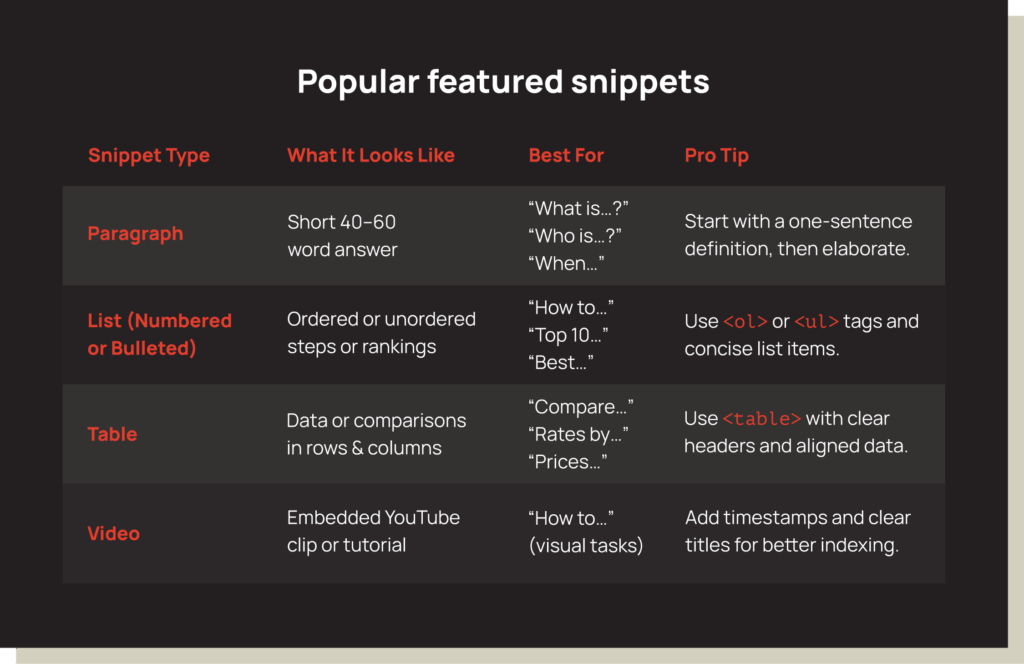
Featured snippets are often the training ground — and the live data source — for generative answers. Write concise answers at the top of a section, then elaborate. Use bullet lists for processes, definition tables for comparisons, and direct phrasing that AI can easily quote. If you run an e-commerce site, turning your “best laptops for students” blog into a bulleted comparison chart increases the odds of winning a snippet today and being cited in an AI Overview tomorrow.
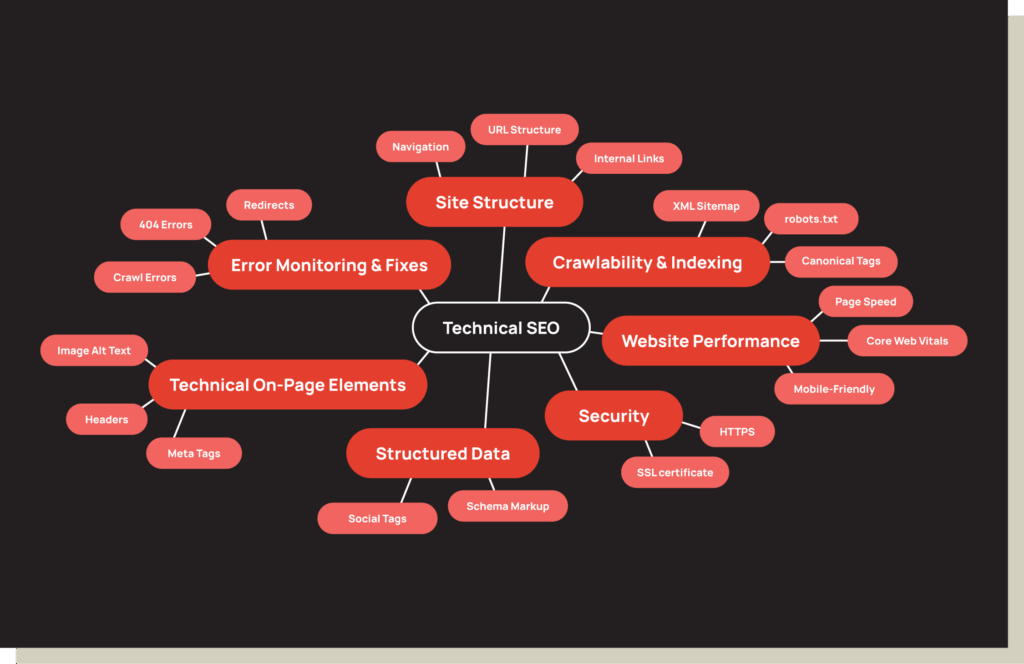
Even the best content gets skipped if it’s slow or messy, and AI search won’t cite a page that’s hard to access. Keep Core Web Vitals healthy, mobile UX smooth, and HTTPS standard. Maintain clean sitemaps and crawl budget hygiene so nothing gets missed. Don’t forget multimodal signals: alt text, transcripts, and captions increase the chance of your images, videos, or audio being pulled into AI responses.
Stale pages rarely get cited. Regularly update stats, examples, and dates to show relevance. Mark content with “last updated on” fields, and consolidate thin pages into authoritative hubs.
Take a cybersecurity blog that updates its “2023 phishing attack statistics” post with 2025 numbers. This signals relevance, while an outdated competitor page fades into the background. Adding “last updated” tags and consolidating thin content into a hub reinforces freshness, and that freshness helps your content stay visible when AI systems scan for the most current, reliable answers.
AI models cite what they can clearly identify. Use straightforward, factual phrasing. Reference reputable sources and include statements that stand on their own — short enough to be lifted directly into a generated summary. For example, writing “The average email open rate in 2025 is 21% (Statista)” gives AI a clean, source-backed fact it can lift directly. Compare that to burying the same stat inside a paragraph of fluff — harder to cite, easier to skip.
AI SEO relies on platforms that help with entity research, content optimization, technical checks, and — new to 2025 — tracking citations. Here’s where to focus when it comes to finding the right tools.
Tools like SEMrush Topic Research, Ahrefs Keywords Explorer, and AlsoAsked help uncover not just keywords, but the entities and questions AI models associate with them. For example, if you’re targeting “electric vehicles,” you’ll also see related entities like charging infrastructure, battery types, and federal tax credits — relationships you’ll want reflected in your content.
Platforms such as SurferSEO, Clearscope, and MarketMuse score your content against NLP models to highlight coverage gaps. Writing a guide on “remote team collaboration”? These tools surface semantically related phrases like project management software, asynchronous communication, and time zone overlap. This is how you make sure that your copy speaks the same language as AI search.
This is the newest tool category. New features from Sistrix, Ahrefs, and specialized platforms like Perplexity Pro Reports show how often your site is mentioned in AI Overviews, chat answers, or other generative surfaces. Instead of treating “AI share of voice” as an abstract idea, these tools quantify it.
Technical SEO underpins everything. Crawling and audit tools like Screaming Frog, OnCrawl, and Sitebulb keep Core Web Vitals, sitemaps, and log files clean, factors that directly influence whether AI systems can access and parse your content. Paired with ContentKing for continuous monitoring, you’ll know the moment a broken link, schema error, or slow load threatens your visibility.
For more context, Search Engine Journal’s roundup of AI SEO tools highlights how quickly this space is evolving.
Single pages being optimized are helpful, but you need them to come together with an entire optimized system, where every piece of content reinforces the rest. These three elements set that system up for success.
The hub-and-spoke model works especially well in AI search. A pillar page anchors the topic (say, “employee wellness programs”), while supporting articles dive into subtopics like fitness stipends, mental health benefits, or VTO policies. Interlinking signals topical authority and gives LLMs a clear map of how your content covers the space.
Think about outlines as blueprints for AI answers. Instead of writing a full draft and hoping it works for snippets later, design the structure up front. That might mean planning where a definition box goes, outlining a process as numbered steps, or slotting in a pros-and-cons table.
Treat expert input as a built-in stage of content design, not a final polish. Publishing with bylines, credentials, and references reinforces authority, but the real gain comes from weaving SME insights directly into the structure. That way, your content carries unique expertise that AI models can’t find in generic sources.
Click rates and rankings are still worth tracking, but when it comes to tracking AI SEO, there are some new (or reframed) metrics to monitor to see if your efforts are paying off.
Citation frequency is the new visibility metric. Track how often your site is referenced in Google AI Overviews, Bing Copilot, Perplexity, and other chat-based results. Some SEO platforms — Ahrefs among them — are rolling out features that quantify AI share of voice.
If you’re already tracking AI share of voice, the next step is to use that data strategically. Benchmark citation frequency against competitors to understand relative visibility, and watch for shifts in the types of queries where you’re cited. For example, an increase in citations around product-comparison queries might signal growing authority at the consideration stage of the funnel.
Organic metrics don’t disappear. Rankings, reach, impressions, and engagement still matter, especially when paired with assisted conversions and pipeline attribution. For example, if a product guide is cited in an AI Overview but also sees rising organic traffic and contributes to demo requests, you’ve got evidence that AI visibility is feeding the funnel, not just awareness.
AI search results evolve quickly, which means measurement has to be ongoing. Build quarterly checkpoints into your workflow: update schema, refresh content, and test snippet formats against key queries. A/B testing definitions, tables, or list structures can be especially helpful in determining what AI systems are most likely to pull into generated answers.
AI systems look for clear, scannable data when summarizing offerings. Product pages with benefits tables, comparison blocks, and FAQs are more likely to surface in AI Overviews.
One example comes from Princess Cruises, which needed to dominate Alaskan cruise searches. Instead of chasing keywords, they built topic clusters around their service pages: 70 new pieces of content, 23 optimized port landing pages, and a web of internal links pointing back to core pillars.
Within three months, this strategy drove a 261% increase in AI Overview mentions, capturing 66.2% of competitive mentions and 88.4% of impressions in AI-driven search. This 97th Floor case study shows how structuring content this way proves far more effective than traditional keyword targeting.
Guides and blog posts often answer early- or mid-funnel questions, which makes them prime candidates for AI answers. Starting with concise definitions, layering in structured summaries, and adding original charts or visuals helps these assets stand out. For example, a blog explaining “what is zero trust security” that opens with a crisp definition and includes a diagram will likely be favored over one with only dense paragraphs.
Glossaries and resource libraries are tailor-made for AI SEO. Short, canonical definitions backed by internal links to related topics create a knowledge graph effect that language models can navigate. For example, a glossary page might define an industry term in two or three sentences, then connect readers to deeper resources across your site. Even though the content is brief, its clarity and structure make it highly attractive for AI-generated summaries.
Optimizing for AI search raises new responsibilities. Accuracy and trustworthiness are even more important today to protect your brand. Here’s how to make sure your organization stays out of hot water.
Generative answers can spread errors if the sources feeding them are flawed. That makes it vital to maintain rigorous sourcing practices: cite reputable references, conduct boas checks, log updates, and monitor pages for outdated claims. Treat every page as if it could be quoted directly — because it might.
Generative AI has blurred the lines between original and machine-written material. To protect both your brand and your users, adopt clear policies on how AI is used in content creation. Human review and quality assurance should always be the last step before publishing. Where AI assistance is part of the process, disclosure fosters transparency and helps build trust.
Most teams start strong — refreshing content, adding schema, tracking AI citations. But if traffic plateaus, citations remain sparse, or entity coverage feels incomplete, it may signal the limits of internal bandwidth. What works this quarter may look different six months from now, and the brands winning citations are the ones adapting fastest. We can help with that.
We’ve built systems that scale with change: topic clusters that expand as industries shift, schema frameworks that grow with new content types, and measurement models that capture how AI surfaces your brand across platforms. The result is momentum, increasing visibility that keeps clients ahead while competitors scramble to catch up.
If your goal is to lead in an AI-first search landscape, our team has the playbook and the proof to make it happen. Let’s talk.
Generative Engine Optimization (GEO) is the next chapter in how brands win search visibility. If traditional SEO helped you win clicks on Google’s blue links, GEO helps you secure your spot in the AI-generated answers that people are now turning to.
This approach focuses on making sure your content and expertise show up in the summaries, overviews, and recommendations provided by generative AI search engines. Unlike standard search results, where ranking high meant being one of many clickable options, generative AI search can position your brand directly inside the answer. That’s a powerful shift, and it’s already changing how companies think about their content strategy.
Generative Engine Optimization is the process of improving your brand’s visibility within the answers produced by AI-powered search engines. It blends the principles of SEO with new strategies tailored specifically to how generative models source, interpret, and present information.
GEO in a nutshell: The art (and science) of making sure AI search engines not only find your content, but use it in their answers.
Also called AI SEO or AI Search SEO, GEO is all about anticipating how AI models select and structure responses so you can position your expertise where it matters most. It’s not abandoning SEO, but rather expanding your optimization efforts to include the algorithms shaping the new search experience.
Generative AI search engines combine traditional web crawling with large language models (LLMs) that synthesize information into a conversational or narrative format. Instead of serving a list of links, these systems:
The visibility challenge is that AI overviews and chat-style answers can drastically reduce clicks to individual sites. But they also give brands the chance to be the source inside the answer box.
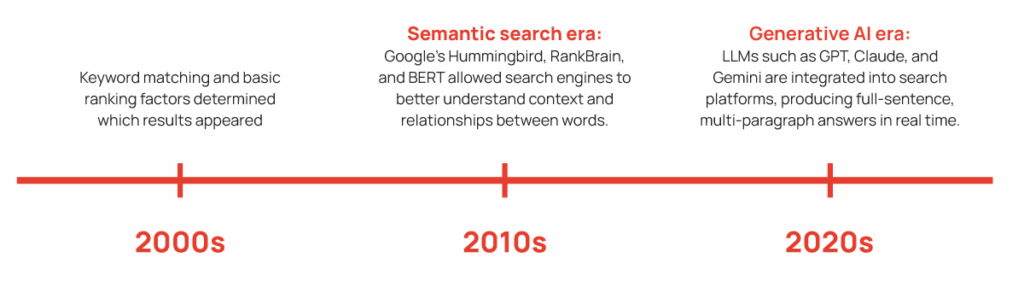
Search engines didn’t become “generative” overnight. The transformation has been gradual, moving through several distinct phases. In the early days of search during the 1990s and 2000s, keyword matching and basic ranking factors determined which results appeared. This gave way to the semantic search era in the 2010s, when advancements like Google’s Hummingbird, RankBrain, and BERT allowed search engines to better understand context and relationships between words.
Now, in the 2020s, we’ve entered the generative AI era. LLMs such as GPT, Claude, and Gemini are being integrated directly into search platforms, enabling them to produce full-sentence, multi-paragraph answers in real time. The search experience is no longer just about scanning a list of 10 blue links. It’s about receiving a ready-to-use answer. This shift is exactly why GEO is becoming an essential part of forward-thinking marketing strategies.
While Generative Engine Optimization builds on the foundations of SEO, it’s not a basic rebrand of what you’re already doing. GEO and SEO share core principles, but the way success is measured, the type of content created, and the optimization targets differ slightly.
| ASPECT | SEO | GEO |
| Primary Goal | Rank high on search engine results pages (SERPs) to drive clicks. | Be included as a cited or quoted source in AI-generated answers. |
| Optimization Target | Search engine algorithms (Google, Bing) for keyword-based queries. | AI models and their training signals (Google AI Overviews, Bing Copilot, ChatGPT, Perplexity). |
| Content Format | Long-form pages, blog posts, landing pages optimized for keywords and links. | Concise, authoritative statements, structured data, and clearly cited sources for AI parsing. |
| User Intersection | Users click a link to read content on your site. | Users may get your content directly in an AI response, with fewer clicks but higher brand impressions. |
| Measurement | Organic traffic, keyword rankings, CTR, backlinks. | AI visibility share, citation frequency, co-mention volume, referral clicks from AI platforms. |
Both SEO and GEO aim to connect your audience with the information they’re searching for. They each require:
The main difference is where and how the content is surfaced. SEO focuses on winning positions on SERPs, while GEO focuses on getting cited or featured directly inside AI-generated answers. This changes:
GEO works best when it’s layered into your existing SEO efforts rather than replacing them. A dual strategy might look like this:
Pro Tip: A combined SEO + GEO approach means you can capture both the click and the citation.
The click and the citation pull from different signals, reward different content structures, and serve different discovery moments — which means optimizing for one doesn't automatically earn you the other. Mike, Head of SEO at 97th Floor, gives the direct answer to the question most SEOs are asking right now: no, your Google rankings don't transfer to ChatGPT, and the gap between the two is wider than most teams realize. This short video breaks down exactly what AI search looks for and how to position your content to show up in both places.
AI-generated search features (like Google’s AI Overviews) are rewriting the rules of click-through behavior. Ahrefs reports a 34.5% drop in CTR for the top-ranking organic result when AI Overviews appear, based on 300,000 keywords.
A Pew study reinforces the behavior shift, citing that when an AI summary appears, users clicked traditional links only 8% of the time, versus 15% when no summary was shown. AI summary links were clicked in just 1% of visits, and users were more likely to end their session entirely (26% vs. 16%).
While Google counters these findings, arguing overall click volumes remain stable, publishers and marketers across the board are seeing clear signs of disruption.
Search is morphing into an answer-first experience. With generative AI tools delivering instant, synthesized content, users often get what they need without navigating to external websites. This zero-click dynamic is steering traffic away from source sites and towards the brands directly cited inside AI responses.
As visibility shifts from the link to the explicit quote or citation, it’s no longer enough to rank high. You need to be included in the answer. GEO equips you to optimize your content for algorithms and AI models that prioritize clarity and authority.
Being that trusted source inside the generative answer layer means you’re still seen—even if the click happens less often.
Even when click-through rates are lower than traditional SEO, being cited in an AI-generated response can lead to significant awareness lift and indirect traffic from brand recall.
GEO requires a little more than just tweaking your SEO playbook. To earn visibility inside AI-generated answers, your content needs to be structured and authoritative. Here’s how to get there.
AI search engines lean heavily on signals of Experience, Expertise, Authoritativeness, and Trustworthiness.
AI models select answers based on clarity, accuracy, and completeness.
Well-structured content is easier for AI to parse and quote.
The more your brand is mentioned and cited online, the more likely AI engines will reference you.
Your site still needs to be technically sound for AI crawlers to access and understand it.
Pro Tip: These best practices are easier to implement when you have a partner who understands both SEO and GEO.
Creating a Generative Engine Optimization strategy doesn’t have to mean reinventing the wheel. Instead, focus on tuning your content and technical setup so AI search engines see you as the go-to source. These five steps can help you set a strong foundation.
Start by identifying high-value AI search queries that matter to your business. Look for the questions your audience is already asking and see how AI search features answer them. Pay attention to the formats being used (whether it’s bullet lists or short explanatory paragraphs) and map these queries to different stages of the customer journey so you understand exactly where GEO fits in.
Once you know what you’re targeting, craft content that AI can easily parse and cite. Use clear, authoritative statements that stand on their own if quoted, and back them with citations to reputable sources. Place your most important facts and definitions early in the content so they’re more likely to be extracted and featured in AI responses.
Your technical foundation determines how accessible your content is to AI crawlers. Add schema markup for FAQs, how-to content, products, and organizational details to make your site more machine-readable. Refine your site architecture to improve crawl efficiency, and make sure your pages load quickly on all devices to meet the performance benchmarks AI models favor.
A strong GEO strategy doesn’t live only on your website. Share your optimized content across social platforms and partner channels to broaden your footprint. Earning mentions and co-citations on reputable sites increases your authority in the eyes of AI engines, making it more likely your brand will be included in generated answers.
Treat Generative Engine Optimization as an ongoing process. Track your AI citation share to see how often your brand appears in AI-generated responses, and measure any referral traffic from those sources. Use these insights to refine your strategy by testing new content formats, updating outdated pages, and adapting to shifts in how AI presents information.
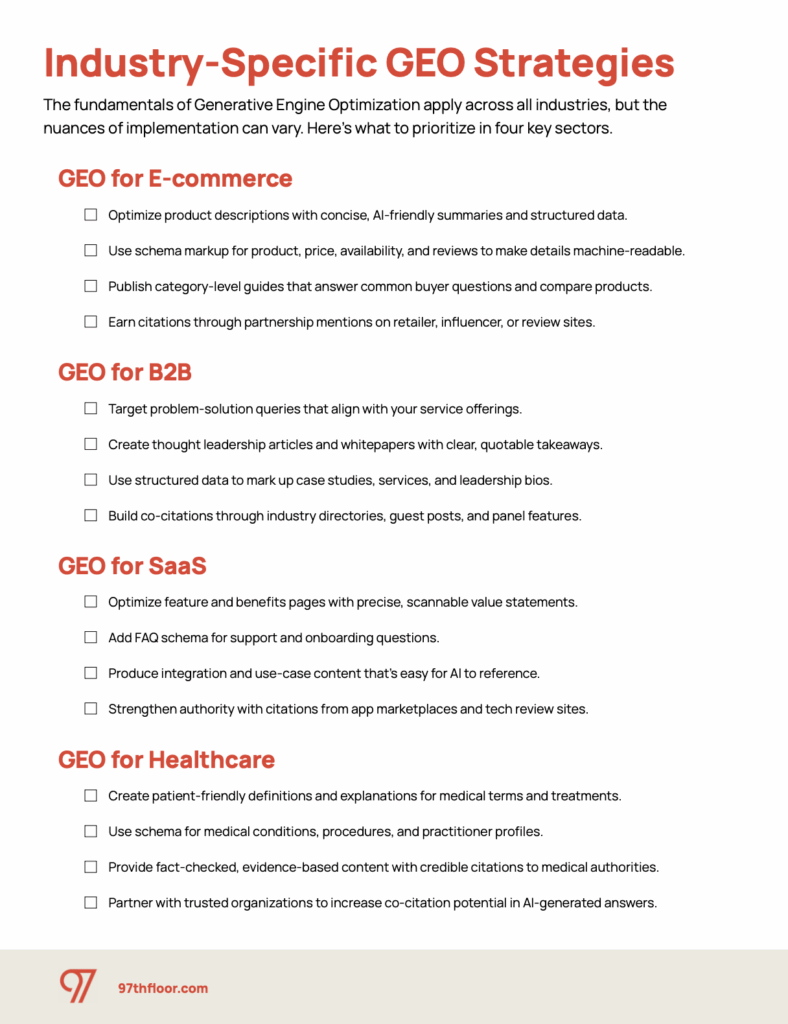
The fundamentals of Generative Engine Optimization apply across all industries, but the nuances of implementation can vary. Here’s what to prioritize in four key sectors.
GEO is still young, but AI-powered search is evolving fast. Staying competitive means anticipating both technological shifts and changing user expectations.
Generative AI is becoming more context-aware, tailoring answers based on user preferences or location. Search platforms are also integrating real-time data, enabling AI responses to include the latest news, product inventory, or market updates. Brands that can deliver fresh, authoritative content quickly will hold a distinct advantage.
Search is expanding beyond typed queries to include voice, image, and video prompts. This opens GEO opportunities like optimizing images with descriptive alt text for AI citations or marking up how-to videos for voice-led answers.
No matter the format, AI will continue to favor clear, trustworthy content, so the core principles of GEO will remain the foundation for visibility.
A growing number of tools can help you navigate GEO to stay ahead of AI search trends. For example:
At 97th Floor, we’ve built GEO services that are designed to scale, engineered for performance, and focused on driving revenue. Our team blends technical expertise with creative strategy to make sure your brand isn’t just present in AI search, but is positioned as the trusted source.
If you're ready to show up in AI-generated results, let's build your strategy.
You’ve been watching traffic slide for months. Competitors suddenly show up in AI Overviews, while your brand barely appears. Reports keep pointing to “algorithm changes,” but no one on your team can explain why conversions are down.
With how quickly algorithms and AI features can change, it’s no wonder businesses are struggling to keep up. But this is exactly where an AI SEO agency proves its worth. They combine machine learning, automation, and a strong dose of human expertise, all to help brands surface to the top of a sea of generative results.
Here, we’ll show you what makes an AI SEO agency stand out and explore the benefits of partnering with the right agency.
An AI SEO agency is built for the way search works now, not the way it worked five years ago. Instead of relying only on manual keyword research and historical data, these agencies use artificial intelligence to uncover opportunities faster and adapt to changes in your industry.
The big shift is focus. Traditional SEO looks backward — analyzing what drove results in the past. AI SEO agencies look forward. With predictive analytics and natural language processing, they anticipate where demand is moving and position your brand to show up at the right time.
AI also takes over the repetitive work: technical audits, clustering topics, generating schema, or tracking where your brand appears in AI Overviews and chat results. That gives strategists more space to do what matters most — build campaigns, craft content, and connect your message with real people. The tech handles the scale and speed; the people make sure the strategy is thoughtful, creative, and aligned with business goals.
The big question for a lot of marketers or small business owners is: what is an AI SEO agency going to do that I can’t do myself? The right agency isn’t trying to sell you shiny new tools, but they are trying to make your job easier.
In short, the biggest benefit is peace of mind. You don’t have to second-guess whether your SEO strategy can keep up with how search is changing.
Not every agency that talks about AI is actually using it in a meaningful way. Some lean too heavily on automation, others promise results they can’t deliver. When you’re shopping for a professional partner, it pays to know both the green flags and the red ones so you can avoid trouble in the first place.
There’s no shortage of agencies talking about AI, but only a handful have proven they can use it to drive real results. Here are 7 different agencies that are taking AI SEO marketing by the reins and forging a path forward.
97th Floor has built a reputation for staying ahead of how search evolves, including with AI SEO. We blend that technical expertise with creative execution. Our experience has shown that it’s not enough to help clients simply rank, but to build lasting authority.
The approach centers on entity-led content, structured data, and technical optimization — all critical for visibility in AI-driven results. But what sets 97th Floor apart is how we tie these tactics back to measurable outcomes. Campaigns aren’t judged only by traffic; they’re evaluated on real business impact like qualified leads, revenue growth, and brand recognition.
As a full-service AI SEO agency, 97th Floor brings together strategists, analysts, writers, and developers under one roof. That integration makes it easier to adapt to search shifts and deliver cohesive campaigns. For brands that want both innovation and accountability, 97th Floor is a partner that delivers both.
Siege Media is known for combining SEO with content marketing, and they’ve quickly adapted those strengths for the AI era. Their focus is on creating high-value content that performs in both traditional search results and AI Overviews.
One of their core advantages is a data-driven approach to identifying opportunities competitors miss. Instead of chasing broad keywords, Siege Media zeroes in on topics where brands can earn visibility, citations, and long-term traffic value. Their emphasis on Generative Engine Optimization (GEO) positions clients to surface in emerging search formats like Google’s AI-driven results.
Directive Consulting specializes in SEO for B2B brands, and they’ve built their reputation on tying search efforts directly to revenue. Their approach to AI SEO reflects that same focus: less about vanity metrics, more about connecting demand generation to long-term business growth.
Where Directive stands out is in GEO. They design strategies that anticipate how AI will surface information and make sure that clients show up in the conversations and citations that influence buying decisions. Combined with their full-funnel approach, this helps brands capture visibility at every stage of the customer journey.
For B2B companies that want search strategies aligned with sales outcomes, Directive is a solid choice. Their emphasis on revenue impact makes them a strong choice for teams under pressure to prove ROI from SEO investments.
Spicy Margarita is a boutique agency that’s carved out a name in B2B by building content designed for AI visibility. Instead of focusing on keyword volume alone, their strategies emphasize answer-ready content — the kind of material that AI systems parse, cite, and elevate in Overviews.
Their specialty is blending content-led SEO with GEO. That means they are focused on crafting resources that address buyer questions directly and position brands as credible sources in emerging AI-driven results. Conversion is always at the center — rankings matter, but only if they lead to qualified leads and revenue.
uSERP is known for its focus on authority building in the age of AI search. Their approach combines technical SEO, advanced link building, and their proprietary Answer Engine Optimization (AEO) framework, which helps brands surface in AI-generated results and conversational queries.
Unlike agencies that chase short-term visibility, uSERP invests in strategies that strengthen a site’s credibility across multiple signals. That means better rankings in traditional SERPs and more frequent appearances when AI systems pull answers from trusted sources. Their track record includes hundreds of clients across industries.
iPullRank has earned respect in the SEO world for tackling enterprise challenges at scale. Their approach, called “Relevance Engineering,” blends semantic modeling with technical SEO to deliver strategies that line up with how search engines — and increasingly, AI systems — interpret meaning.
This focus on depth has led to billions in organic search value generated for clients. iPullRank’s strength lies in taking complex enterprise sites and making them more discoverable, structured, and ready for AI-driven interpretation. Their emphasis on technical precision and semantic relevance sets them apart from agencies that rely too heavily on surface-level tactics.
First Page Sage is known for its thought leadership approach to SEO. They specialize in creating research-driven content that builds authority, particularly for B2B SaaS and other industries where credibility is a key differentiator.
Their team has integrated generative AI optimization into this model, focusing on content that not only ranks but also earns trust in AI-driven environments. By combining long-form, authoritative resources with demand generation strategies, they position clients as the go-to source in their field.
There’s a point where DIY SEO or even a capable in-house team starts to hit a ceiling. You may be seeing:
Because AI is quickly becoming the foundation of how search works, our generative systems are rewriting the rules. Brands can optimize for blue links, but they also need to prepare content that is even more obviously structured, credible, and, most importantly, ready to be cited by AI. What we’re seeing from top SEO companies that are seeing results are things like:
Agencies that understand what SEOs need to know are already positioning clients to succeed. The pace of change is fast, but it’s not unpredictable. Strong AI SEOs already build for this future by focusing on clarity, authority, and adaptability — qualities that matter no matter how search evolves.
The right SEO agency isn’t a plug-and-play type of resource. Again, you have to balance the technical and creative sides of SEO to finally start seeing results. Consider these core services that the pros are offering:
Plenty of agencies are experimenting with AI, but 97th Floor has already built a track record of driving results with it. Our team combines technical SEO, content strategy, and analytics to help brands show up where it counts. We’ve got the traditional search results mastered, but we’re also paving the way forward for brands like yours. Entity-led optimization, structured data, and performance tracking are core to how we work.
What makes 97th Floor different is the integration of people and process. Analysts, strategists, and developers work side by side, which means campaigns are cohesive and built to scale. That’s how we turn AI SEO from a buzzword into growth you can measure.
Learn more about our AI SEO services or start with a free audit. Let’s Talk // Get an AI Audit.
You’re busy running a business, and you shouldn’t have to spend so much effort figuring out the ins and outs of the marketing industry. When you partner with a marketing agency, they can handle understanding complex buying cycles, nurturing leads, SEO, content marketing, and ultimately delivering measurable results. A B2B marketing agency can specifically help companies that make products for other companies, instead of for the general public.
Whether your goal is to accelerate pipeline growth, expand into new markets, or enhance customer engagement, partnering with the right B2B marketing agency can turn your marketing investment into tangible, revenue-generating outcomes. Read on to learn more about working with a B2B marketing agency and how to find the right one.
A B2B marketing agency is a specialized firm focused on helping businesses market their products and services to other businesses rather than individual consumers. Unlike B2C agencies, which often prioritize mass reach and broad engagement to help you find customers, B2B agencies are designed to reach companies and target top decision-makers in order to draw clients to your company. The agency will work on generating high-quality leads and strengthening your brand in the spaces where your potential clients are.
A B2B marketing agency usually covers a wide spectrum of services, including content marketing, digital campaigns, marketing automation, analytics, and account-based marketing (ABM). At the core of their work is brand positioning—helping companies articulate their value proposition, differentiate from competitors, and establish authority in their markets.
Below are industry-recognized agencies, each with a unique strength to help you compare and choose.
Best for Full-Funnel Strategy & ROI-Driven Growth
97th Floor specializes in full-funnel marketing strategies, combining SEO, paid media, content marketing, and design services. We generate sustainable growth for B2B companies from startups up to the Fortune 500 list—including Salesforce, AT&T, LG, Google, and Celebrity Cruises. Our in-house proprietary tool, Palomar, also helps inform strategy with real-time market intelligence and competitive insights.
Best for SEO + Content Marketing
Siege Media is known for high-quality, keyword-driven content that improves rankings and conversions in SaaS, fintech, and e-commerce sectors. They focus on creating content that drives organic traffic and builds brand authority.
Best for Performance Marketing
Directive Consulting is an expert in paid media, SEO, lifecycle marketing, and demand generation within complex SaaS and enterprise markets. They elevate the focus of B2B marketers from MQLs to qualified pipelines.
Best for Agile Tech Company Marketing
New North excels in multi-channel strategies tailored for tech firms, combining agility with long-term strategic planning. They help B2B technology companies grow with better marketing and offer personalized strategies and dynamic campaigns.
Best for Lead Generation & ABM Strategy
Ironpaper focuses on data-driven demand generation, content sprints, ABM, and conversion optimization for tech clients. They align marketing and sales to drive measurable outcomes.
Best for AI-Enhanced Growth Marketing
Avenue Z combines narrative clarity, AI visibility strategies, and CRM-integrated campaigns for enterprise and professional services. They position brands at the top of their category by turning complex offerings into digestible thought leadership.
Best for Research-Driven Campaign Design
Elevation B2B delivers omnichannel campaigns rooted in strategic insights for brand awareness, lead generation, and growth. They focus on providing full-service, data-driven marketing solutions specifically for B2B companies in tech.
Best for Professional Services Thought Leadership
Hinge Marketing specializes in branding and marketing strategies tailored to professional services firms. Their research-driven approach and emphasis on thought leadership help build authority and pipeline impact.
Best for Holistic Digital Campaigns
Power Digital delivers SEO, PPC, content marketing, and social media with data-driven precision and proven lead-gen results. They offer a comprehensive suite of services to drive growth and optimize marketing ROI.
Best for Visual Brand Storytelling
Column Five are experts in brand strategy, content, data visualization, and multimedia—especially for SaaS and tech brands wanting engaging storytelling assets. They focus on creating compelling narratives that resonate with target audiences.
A B2B marketing agency offers specialized services designed to address the unique challenges of marketing products and services to other businesses. At the heart of effective B2B marketing is creating a marketing strategy that aligns with your business objectives. Agencies collaborate with you to develop comprehensive plans that encompass market research, competitive analysis, and customer insights to create this strategy and help you achieve your goals.
B2B marketing agencies provide a suite of services tailored to the intricate needs of business-to-business marketing, usually including:
B2B marketing agencies can help your company grow thanks to a combination of strategic planning, technology, and data-driven execution. Their focus is attracting great and promising leads and also nurturing those relationships. Below are three ways working with a B2B marketing agency can help your company find the growth you’re looking for.
A core function of B2B marketing agencies is identifying and nurturing high-quality leads. They focus on marketing qualified leads (MQLs)—prospects who have shown interest or engagement with your brand—and work to convert them into sales qualified leads (SQLs), who are ready for direct sales engagement. By aligning marketing and sales efforts, agencies ensure a smoother handoff and higher conversion rates.
B2B marketing agencies often use automation and CRM tools like HubSpot, Marketo, and Salesforce to manage campaigns, track prospect interactions, and deliver personalized messaging at scale. Automation allows agencies to nurture leads while also reducing manual work, so you can see results.
To demonstrate impact and optimize strategies, agencies employ marketing attribution models that track performance across all touchpoints your company needs. These models help your business understand which campaigns, channels, and messaging strategies contribute the most to revenue generation. By analyzing ROI and attribution data, agencies can continuously refine their tactics and help you create a great budget that leads to measurable growth.
Selecting the right B2B marketing agency is the first step to getting the results you want to see. The best partnerships are built on expertise, alignment, and trust, so it’s important to ask the right questions and look for key indicators of reliability. Here are some tips to help you pick out the right fit for you.
Before committing, consider asking potential agencies questions that reveal their capabilities, approach, and fit with your business:
A trustworthy agency demonstrates transparency, flexibility, and proven results. Look for clear reporting practices, adaptable engagement models, and a track record of delivering measurable growth for clients. Ask for case studies and see if this agency’s strategies and efforts would work for your company.
When choosing an agency, avoid making decisions based solely on cost. Sometimes it’s worth paying more for a higher quality B2B agency where you’ll see results. Also consider whether or not the agency will be a cultural fit for your company—just as you would for an employee. Taking the time to vet agencies thoroughly ensures a partnership that drives real results.
For more guidance, read our full Agency Success Playbook for in-depth tips on selecting a high-performing B2B marketing agency.
B2B marketing agencies can help a wide range of industries grow, but certain sectors see especially strong results.
For technology and SaaS companies, marketing agencies focus on subscription models, reducing churn, and increasing customer lifetime value—all of which can help your company grow. They implement targeted campaigns, content strategies, and ABM approaches to engage decision-makers and accelerate adoption.
Learn more about SaaS industry marketing
Learn more about cybersecurity marketing
Manufacturing and industrial businesses often face long sales cycles and niche target audiences. B2B marketing agencies help these companies identify and engage the right buyers, craft tailored messaging, and build campaigns that support complex buying decisions.
Learn more about construction equipment marketing
Learn more about industrial sector marketing
Professional services and healthcare organizations rely heavily on authority and trust. Agencies in these sectors focus on thought leadership, content marketing, and reputation-building strategies that demonstrate expertise and credibility to prospective clients.
Learn more about financial services marketing
Learn more about health and wellness marketing
Want to see how B2B marketing can transform your company? Here are a few case studies to get you started:


See more success stories to get an idea of how a B2B marketing agency can help you.
Measuring success is critical to understanding the impact of your B2B marketing efforts and optimizing for growth. Agencies use a combination of quantitative and qualitative metrics to track performance, inform decisions, and maximize ROI.
97th Floor is a trusted partner for B2B companies looking to drive measurable growth through strategic, data-driven marketing. With proven expertise across digital marketing disciplines—including content, SEO, paid advertising, design, and emerging AI-powered SEO tactics—our team helps businesses generate leads, accelerate pipeline growth, and maximize ROI.
We prioritize transparent communication and consistently deliver results backed by analytics, so that every campaign is aligned with your business objectives. What sets 97th Floor apart is our deep industry experience combined with flexible engagement models. We tailor strategies to your unique needs and scale as your business grows.
See how an audience-first approach translates to bottom-line results.
Curious about how to get your brand noticed on Perplexity Search? You’re not alone. With Apple’s rumored acquisition of Comet making headlines, marketers everywhere are wondering if this AI-powered browser might be the next big thing in search. Whether you’re here to stay ahead of the curve or simply want your site to pop up in more AI-driven answers, you’ve come to the right place. Let’s dive into what makes Perplexity tick—and how you can use it to your advantage.
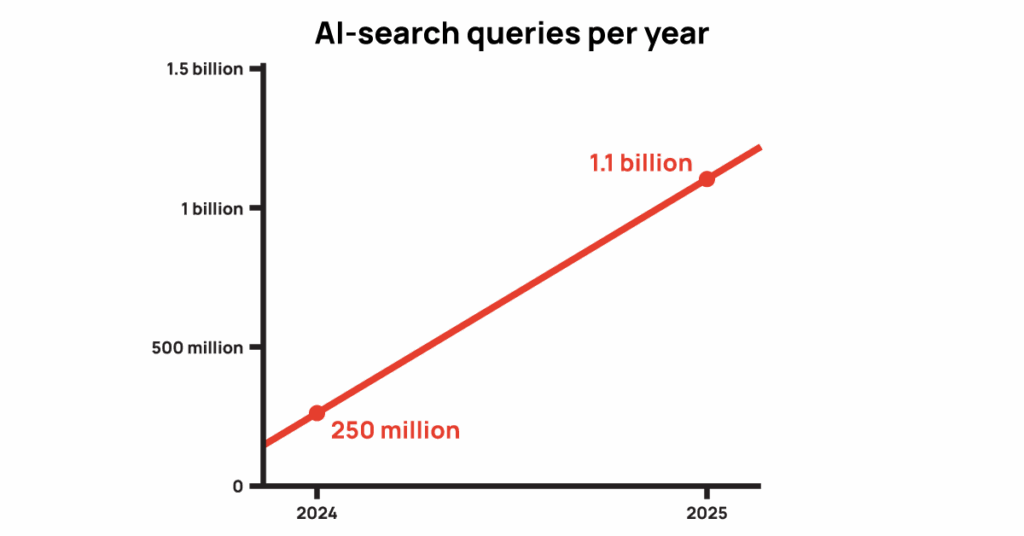
More than 2-thirds of smartphone users in the United States use an iPhone as their smartphone of choice. About 50% of all internet traffic starts on a mobile device in the United States. Being the default browser and search engine for 68% of half of all internet usage in the United States sounds pretty great right? That might be the reality for Perplexity and their new browser, Comet, as Apple is currently determining if they will go through with the 14 billion dollar acquisition. That is an eye popping amount of money for an acquisition of a company that has never turned a profit (actually lost $65 million in 2024). However it could be a leap forward in AI development for Apple who is severely behind its big tech competitors.It would also mean a real threat to Chrome and less reliance on using Google products on Apple devices. A true threat to Google Search is something that Google has not experienced in decades. The threat is given even more credibility by the fact that Comet is actually quite good and those who have tested it rave about the AI-enhanced browser with built in perplexity search engine. Even if the acquisition from Apple does not go through, it is interesting enough of a search product to look into ranking organically on the Perplexity search and optimizing web content for LLMs in general as the jump in AI-search queries has increased from 250m to 1.1 billion in the last year alone!
In one of our tests, we found that the top ranking page on Google, for non-branded terms, was never the same as the top result in Perplexity. Even more alarming was that each 1:1 query resulted in 85% unique results across Google and Perplexity. While there will be some principles of Search Engine Optimization that remain the same, the results are different enough that a close examination of the top ranking factors for perplexity was necessary. After analyzing SERPs using queries and prompts from multiple industries on Perplexity, we have compiled our top ranking factors for Comet, and the Perplexity search engine here.
The best way to strategize for Perplexity Search is to like traditional SEO, break it out into on site, or on domain optimizations and off page or off domain optimizations. Only off page and on page optimizations don't mean quite the same thing for LLM optimizations as they do for traditional SEO. Below are the most impactful on page and off page optimizations for perplexity search.
From tests we have been running with our clients, we found that the first place that an LLM bot will go to find information about your brand and how it fits into the market, is by analyzing the brand’s own domain. The home page, about us page, any solutions, services or product descriptions, are all very common sources of information for the Perplexitybot and other LLMs. Which is great news for marketers and website managers, that is owned content that is generally very easy to optimize. The LLM will go to your brand’s domain for information about what you do and who you serve, then look to external sources in your industry to back up the claims you made on your own domain. The following are off page optimizations that will boost your presence when your audience is searching on Comet.
Perplexity user experience is much different than OpenAI GPT, Google’s Gemini, or Claude, primarily in its use of source cited and clickable elements in the generative responses. If traffic is still a metric SEOs and website managers are interested in increasing, Perplexity winning the AI race seems to be the best chance website owners have at seeing increases in referral traffic. So how is optimizing for Perplexity Search? Here are a few things to consider:
The team at 97th Floor is doing the work to find every opportunity to increase brand awareness on new and tried and true platforms. Perplexity’s new browser, Comet, has real potential to be a widely used search engine and make a dent into Google's Search market share dominance. When and if that happens, we will be fully prepared to optimize for Comet. Lets connect, our team will do an AI-search competitive analysis for your brand free of charge, to identify opportunities in AI search and if your audience is already adopting Perplexity Search and using the Comet Browser.
Use these free tools to unburden your site of low-value content that prevents an LLM from understanding your brand. Watch your SEO performance skyrocket.
If you have Googled anything in the last few years, you’ve likely come across an AI overview that summarizes some of the ranking pages to answer your query. Or maybe you wondered about the history of the Ottoman Empire or needed instructions to refill your car’s oil and turned to ChatGPT. AI is taking online search by a storm.
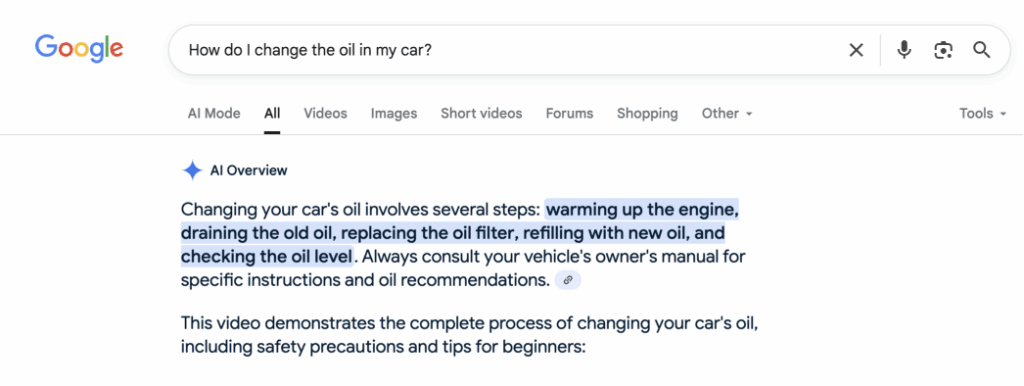
For search engine users, the rise of AI has made getting synthesized summaries of all the top internet easy. For companies and SEO experts, it involves figuring out how to adjust your content strategy to keep your content visible and to reach your customers. That’s why we’ve put together this guide on the future of AI search SEO to help you figure out where and how to tweak your content strategy to be ready for the growth of AI SEO.
Unlike traditional search engines that rely on keyword matching and indexed pages, AI-powered systems use large language models (LLMs) to interpret natural language in an attempt to deliver nuanced, conversational results.
Some of the leading AI search tools you may have used or heard of include:
Search is undergoing a fundamental shift that’s only getting started. In May 2023, Google began rolling out Search Generative Experience (SGE), now rebranded as AI Overviews, which places AI-generated responses above standard results. Microsoft integrated AI mode into Bing in early 2023 using ChatGPT-4, while platforms like You.com and Perplexity launched AI-first search tools that prioritize summarization and citations. Search engines now are prioritizing their own AI summaries at the top of the SERP in what used to be prime real estate for SEOs.
These AI tools are changing the way people interact with SERPs. In fact, a study from the Pew Research Center in May 2025 notes that people are significantly less likely to click on web pages listed in Google search results if there’s an AI summary present. They also only rarely click on the sources listed by the AI summary.
With the shift in how users interact with search engines, SEO is going to shift too.
Traditional SEO is built around optimizing for search engine crawlers and ranking within standard SERPs. This includes tactics you’re likely very familiar with, such as:
GEO—Generative Engine Optimization—targets AI searches. Large Language Models don’t crawl; they try to interpret the context and evaluate:
Because LLMs respond to context and credibility, not just ranking signals, you want to optimize content for semantic relevance, not just visibility. Adding GEO to your content strategy is another way to make your content visible in those AI-generated summaries—though traditional SEO still matters as well.
So if AI is going to change the way people search (and already is starting to do so), you need a content strategy designed to fit in that landscape. These are our four top tips for creating content that your readers will love and that works with AI.
Content these days has to walk a very fine line: being written for humans and for AI accessibility all at the same time. You don’t want to write a brilliant piece of long-form content only for it to be lost in the ether of Google, but you definitely don’t want to end up with AI slop. Some ways you want to cater your content for your readers and for AI include:
The goal here is to write content for your human audience but to make sure it’s fully AI accessible afterward. At the end of the day, good content is still king, so prioritize having well-written content and avoid losing that human touch while optimizing for AI search SEO.
AI works like any other search engine: it will rank your pages higher if they’re correctly set up with appropriate metadata. While AI tools don’t crawl the web like traditional bots, they still rely on structured, well-maintained websites. Technical SEO helps ensure your content is indexed by both search engines and used by AI models that reference top-ranking pages. Prioritize:
Just like with Google Search, AI systems reward content that’s well-structured and technically sound.
Optimizing for search engine results page (SERP) features can improve your visibility in both traditional and AI-generated summaries. Focus on:
Appearing in these SERP features improves your chances of being referenced by AI models—and therefore coming across your readers’ screens.
If you’re looking to build your pages in a way that makes it easy for AI tools to scan your content, focus on these five strategies:
By following these principles, your content becomes easier for AI models to recognize—which then helps you stay visible in the next era of online searches.
Even though it might feel like the search landscape is rapidly evolving, the core principles of technical SEO remain as important as ever. In fact, SEO hasn’t really changed—it’s only expanded to include AI searches. Staying on top of and implementing foundational technical best practices still pays dividends, both in traditional rankings and in AI-generated search results.
Structured data helps both traditional search engines and AI systems better understand the context of your content. Using it can help your content get featured in snippets and AI overview citations. To get the most out of your structured data:
Well-implemented schema makes it easier for AI systems to identify key facts and understand the relationships between ideas—boosting your content’s chances of being referenced in AI search results.
AI-powered search is no longer limited to just text, and your content strategy can capitalize on that. Many search engines and AI assistants now support multimodal inputs and outputs to blend text, images, and video to meet user needs. Make sure your site:
By incorporating diverse formats, you increase your visibility across a variety of SERP features. Your site could end up as the cited image in an AI overview or in an image carousel. That visibility will make your content more accessible and expand your reach.
All the general tips we’ve talked about so far are best practices for any type of AI search tool. While many core principles remain consistent, each model has its unique behaviors and ranking preferences. Some of the most prominent and widely used AI search engines—and the ones offering the most trackable performance insights today—include:

AI systems reward conversational content that mimics how people talk, so here are a few tips to optimize for conversational queries and natural language prompts:
By tailoring your content for the nuances of each platform—and optimizing for how people naturally ask questions—you’ll increase your visibility in both AI-driven and traditional search environments.
Traditional SEO tools may not yet offer complete coverage of AI-driven search experiences—but a new wave of reporting solutions is emerging to bridge the gap.
There are a lot of SEO metrics, but which ones matter for AI search SEO? Key metrics to focus on include:
Since AI search focuses more on credibility and relevance than on traditional rankings, visibility can come in the form of mentions and summaries rather than blue links.
While AI searches are still relatively new, there are tools that are adapting to help you keep track of your most important metrics:
As AI search adoption increases, expect more tracking solutions to emerge. Just like SEO matured with its own analytics stack, AI SEO reporting will become a core part of modern marketing analytics within the very near future. Start experimenting with these tools now to stay ahead of the curve and get a head start above your competitors.
Working with AI to produce AI-optimized content is increasingly essential. Modern AI systems—like ChatGPT, Gemini, and MarketMuse—can help you with identifying content gaps and topic clusters that you can write about, speed up the drafting process, and create content outlines for you.
Don’t think of AI replacing your content creators. Instead, pair AI with human experts to speed up the content creation process without losing what makes human-written content great.
Another way to AI-prep your content strategy is to apply the hub and spoke model. The hub and spoke model is a content architecture that creates a central “hub” page targeting a broad, high-value topic, supported by multiple “spoke” pages that address related subtopics in depth. Each spoke links back to the hub and to one another.
For example, when Maveneer came to 97th Floor in 2023, they wanted content that would rank, so we gave them a hub and spoke strategy with comprehensive overview hubs targeting keywords like “warehouse automation” and “order picking.” After establishing those hubs, we could expand to spokes with drill-down articles like “order picking technology” and “automated sorting systems” linked to and from the hub. This structure improves internal linking, site navigation, and topic authority to search engines and AI systems alike. In fact, for Maveneer, their domain authority R skyrocketed from 3 to 34, and they saw an 886% increase in search impressions YoY.
Search is evolving—and fast. More people are relying on AI to answer their questions and give them potential solutions. With AI browsers popping up, there are only going to be more AI search developments. These platforms don’t just display a list of blue links. Instead, they generate dynamic responses by pulling insights from multiple sources, often without traditional attribution or visible rankings.
For enterprise brands, this shift has major implications.
In this new paradigm, visibility isn’t just about ranking #1—it’s about being referenced, cited, or summarized by AI models at the moment a customer asks a question. Failing to adapt means losing organic visibility at critical touchpoints—especially early in the customer journey when buyers are still gathering information.
Enterprise brands that invest in AI search SEO now can make sure they’re ahead of the curve and stay visible. AI isn’t replacing internet searches—it’s reshaping it. And enterprise brands that evolve their strategies now will be best positioned to lead out in the next era of SEO.
If you're ready to show up in AI-generated results, let's build your strategy.
Reddit isn't the niche platform it once was. With roughly 500 million monthly active users, it's evolved into a massive hub where real conversations happen daily. But what makes Reddit special isn't just its size—it's the quality of those conversations.
"Reddit has a tendency to bring the honest opinion out from people and that is where the meat is when it comes to marketing," explains Kiersten Gaffney, a deep tech CMO who's built her content strategy around Reddit listening. Unlike Twitter threads or LinkedIn posts, Reddit's threaded conversation structure creates genuine depth and interactivity that reveals what audiences actually think.
The platform has shattered old stereotypes too. The gender split is now nearly 50/50, contradicting the male-dominated image many marketers still hold. More importantly for B2B brands, there's a massive audience gap that most companies are missing entirely.
Consider these numbers: 68% of Redditors aren't on LinkedIn, 45% aren't on Instagram, and 30% aren't on Facebook. That means while B2B brands flock to LinkedIn, they're ignoring huge chunks of their potential audience who live primarily on Reddit.
This shift represents a fundamental change in how audiences consume and discuss business topics. Reddit has kept its technical roots while expanding to capture professionals, decision-makers, and influencers who value substance over polish. For marketers willing to listen, it's a goldmine of unfiltered audience insights waiting to be discovered.

Effective Reddit listening starts with systematic keyword monitoring, not random browsing. The most successful approach involves using tools like Octalens to cast a wide net across multiple platforms while focusing primarily on Reddit conversations.
The process begins with identifying core keywords related to your industry, product, or audience challenges. Rather than diving straight into specific subreddits, start broad and let the tool surface conversations you might never have found otherwise. This approach reveals unexpected threads and communities where your audience discusses problems in their own language.
Daily monitoring becomes crucial here. Gaffney checks her keyword alerts every single day because conversations move fast and opportunities disappear quickly. "I'll be surprised by new Reddit threads that I wouldn't normally see," she notes. This consistent monitoring uncovers emerging topics before they become mainstream content themes.
The beauty of this system lies in its ability to surface authentic conversations across the entire platform. Instead of limiting yourself to obvious subreddits in your industry, you discover where your audience actually hangs out and what they really talk about when they're not being marketed to.
This discovery process often reveals gaps in your current content strategy. You might find your audience discussing challenges you never considered or using language that's completely different from your marketing materials. These insights become the foundation for content that genuinely resonates because it addresses real problems in familiar terms.
Once you've identified relevant Reddit threads, the next step involves systematic analysis using AI tools. The process is surprisingly straightforward but requires the right approach to extract meaningful insights.
The method involves copying entire Reddit threads and pasting them into AI tools like Claude or ChatGPT. But success depends on asking the right questions. The most effective prompt starts simple: "What is the most important takeaway from this topic?" This creates a foundation for deeper analysis.
Follow-up questions reveal content opportunities: "Are they missing anything? Should I talk about that? Should I write about it next?" These prompts help identify gaps in the conversation that your content can fill.
Tool selection matters for different tasks. Gaffney has found Claude excels at copywriting and any writing-related work, while ChatGPT performs better for research and data analysis. Many successful content creators use both tools for comparison, feeding ChatGPT's research into Claude's writing capabilities.
The key lies in treating AI as a research assistant, not a content creator. The tools help synthesize large amounts of conversation data into actionable insights, but they can't replace human judgment about what matters to your specific audience.
This analysis phase often reveals surprising insights about audience priorities, language preferences, and unmet needs. The goal isn't to find content topics you already knew about—it's to discover the angles, concerns, and perspectives you would never have considered without listening to actual conversations.
The transition from Reddit insights to published content requires a strategic approach focused on creating substantial pillar pieces rather than quick social media posts. This method has proven effective, with Gaffney reporting a 70% success rate when following this systematic process.
The destination for these insights should be comprehensive pillar content—detailed blog posts that thoroughly address the problems and questions discovered in Reddit conversations. This isn't about engaging directly in the Reddit threads themselves, but rather using those conversations as intelligence for creating valuable standalone content.
A smart validation approach involves testing topics first through smaller channels. Having a CEO or founder share the core insight in a LinkedIn post can quickly gauge audience interest before investing in a full pillar piece. If the post resonates, it validates the topic for larger content investments like detailed articles, webinars, or campaign sequences.
This crawl-walk-run approach minimizes wasted effort while maximizing learning. A successful LinkedIn post can expand into a comprehensive blog post, which can then become a webinar, email sequence, or even a full campaign. Each successful piece builds on proven audience interest rather than assumptions.
The content creation process benefits from the authentic language and specific concerns discovered in Reddit conversations. Instead of generic industry content, you're addressing real problems using the exact terminology your audience uses when discussing those problems with peers.
Marketing to technical audiences presents unique challenges that Reddit listening helps solve. Engineers, developers, and other technical professionals have built-in resistance to traditional marketing approaches, making authentic communication essential.
The fundamental principle for technical content is plain language accessibility. "Explain it like you're explaining it to your 10-year-old," Gaffney advises. If a technical audience can't understand your main point within 30 seconds, your content fails regardless of how sophisticated your solution might be.
Technical audiences particularly despise "smarketing"—the combination of sales tactics and marketing gimmicks that feels manipulative. This includes cheesy memes, overly promotional language, and content that prioritizes cleverness over clarity. These approaches backfire spectacularly with audiences who value substance and directness.
Success requires partnership with technical team members who provide expertise while marketers guide communication strategy. Engineers and developers aren't trained writers, but they understand the technical nuances that matter to the audience. Marketers bring the communication skills needed to make complex topics accessible.
The most effective approach focuses on helping technical audiences do their jobs better, faster, and more efficiently. Every piece of content should provide genuine value that improves their daily work experience. If your content doesn't help them solve real problems, they'll ignore it completely.
This audience can detect inauthentic content immediately. They've seen countless vendors trying to trick them into sales conversations through fake educational content. The only way to build trust is through consistently helpful, technically accurate, and genuinely educational materials.
Successful Reddit listening requires realistic expectations about scale and process. The goal isn't to produce hundreds of pieces of content, but rather to create consistently valuable content that genuinely serves your audience.
A sustainable approach involves creating one pillar piece per week that can be adapted into three to five channel-specific pieces. This might include the main blog post, a LinkedIn version, an email newsletter segment, a sales outreach template, and perhaps a social media series. Quality and consistency matter more than volume.
This recommendation particularly applies to founders and early-stage marketing teams without large content operations. As teams grow and add specialized roles like content marketers or developer relations professionals, the scale can increase proportionally. But starting small and building systematically prevents the quality issues that come with overambitious content calendars.
The current landscape includes many companies trying to automate content creation at massive scale, often producing generic content that gets flagged by Google for being AI-generated spam. These approaches hurt everyone by flooding channels with low-quality content that audiences learn to ignore.
Reddit listening prevents this trap by grounding content creation in genuine audience needs and language. When content addresses real problems using authentic terminology discovered through actual conversations, it naturally avoids the generic feel of purely AI-generated material.
The key metric isn't how much content you produce, but how well that content resonates with your intended audience. Better to create one piece per week that generates meaningful engagement than ten pieces that get ignored.
AI tools provide powerful assistance in the Reddit listening process, but they can't replace human expertise and judgment. Understanding this balance is crucial for success with AI-powered content creation.
The general rule suggests AI gets you about 75% of the way to finished content. That remaining 25% requires human expertise in product marketing and copywriting to transform AI output into content that truly serves your audience. This isn't just minor editing—it's substantial refinement that adds personality, brand voice, and strategic focus.
Effective AI use requires skill in both prompt engineering and post-output refinement. Some creators focus heavily on perfecting prompts to get better initial output, while others prefer to work with basic prompts and do more manual refinement afterward. Both approaches work, but success requires expertise in guiding the process.
The relationship between human and AI should be director to directed, not the reverse. As Gaffney discovered when training a founder to use Claude: "He was letting Claude direct him versus him direct Claude." When AI drives the process, results become generic and miss strategic objectives.
Template development helps maintain consistency across content creation efforts. Creating prompt templates for different content types and testing them repeatedly helps identify what works best for your specific needs. However, even with templates, AI outputs can vary significantly, requiring human oversight and adjustment.
The most successful approach treats AI as a research and drafting assistant that helps synthesize large amounts of information and create initial content frameworks. The human expert then shapes that framework into content that serves strategic objectives and connects authentically with the intended audience.
Reddit listening creates a bridge between authentic audience insight and scalable content creation. This approach solves the fundamental tension between understanding what audiences actually want and producing enough content to maintain consistent market presence.
The competitive advantage comes from truly understanding audience language and pain points rather than guessing based on industry assumptions. When content addresses real problems using familiar terminology, it cuts through the noise of generic industry content that dominates most markets.
Long-term success requires focusing on genuine value over clever marketing tactics. Technical audiences, in particular, can immediately detect when content exists primarily to generate leads rather than solve problems. Building trust requires consistent demonstration that your primary goal is helping them succeed in their roles.
This authenticity-first approach naturally leads to better business results because content serves real audience needs. When people find genuine value in your content, they're more likely to remember your brand when they need solutions you provide.
The Reddit listening framework provides a systematic way to maintain this authenticity at scale. Instead of running out of content ideas or falling back on generic industry topics, you have a continuous stream of real audience problems and interests to address.
The key is viewing community listening as an ongoing process rather than a one-time research project. Audiences evolve, new challenges emerge, and language shifts over time. Successful content marketing requires staying connected to these changes through consistent listening and adaptation.
Companies that master this approach create sustainable competitive advantages because they understand their audiences better than competitors who rely on assumptions or outdated research. In a world full of generic content, authentic understanding becomes increasingly valuable.
"Reddit has a tendency to bring the honest opinion out from people and that is where the meat is when it comes to marketing." - Kiersten Gaffney
03:05 - Reddit's honest opinions vs. other platforms
07:23 - Keyword monitoring with Octalens tool
08:31 - AI analysis: Reddit threads to content ideas
20:55 - Director vs. directed: controlling AI tools
25:28 - Marketing to technical audiences without "smarketing"
32:05 - Upcoming Maven course on Reddit mining
Attend a free 60-minute live demo with Kiersten on September 12, 2025 to see her whole in-depth process for transforming tiny insights into incredible content.
Register here: https://maven.com/p/a3bef8/turn-dev-complaints-into-content-gold-with-ai
Request a free AI Audit: https://97thfloor.com/ai-audit/
Connect with Kiersten on LinkedIn: https://www.linkedin.com/in/kierstengaffney
Connect with Paxton on LinkedIn: https://www.linkedin.com/in/paxtongray/
Looking for an agency that'll be worth the investment? 97th Floor creates custom, audience-first campaigns that drive pipeline and conversions. Get started here: https://97thfloor.com/lets-talk/.
Kiersten Gaffney is a CMO advisor helping deep tech software companies build their marketing growth engines. She’s advised hundreds of founders from companies like Airbyte, DragonflyDB, and Codefresh to build systematic, measurable approaches to marketing.
We’ve all felt it. You pour time into high-quality content, only to see your organic clicks drop—despite impressions climbing. What gives?
Welcome to the era of AI-powered search.
Google’s AI Overviews (AIO) and other generative engines are changing how people discover and engage with content. The game isn’t over—it’s evolving. And if you want to keep winning, it’s time to optimize not just for traditional SEO, but for AI-powered results.
At 97th Floor, we’ve spent the last year testing and refining strategies that help our clients show up and stand out in AI results. This guide breaks down what we’ve learned and how you can use it to grow.
Here’s a fast-track checklist that we stand behind:
We’re seeing a clear trend since the advent of Google’s AI Overviews:
This shift in metrics is significant. Your content is still being seen, but it’s not driving as many clicks.
This is largely due to AI Overviews, which are providing answers directly in search results—without users even having to visit your site.
In fact, research from Ahrefs revealed that AI Overviews reduce clicks by 34.5%. They analyzed 300,000 keywords and found that the presence of an AI Overview in the search results correlated with a 34.5% lower average clickthrough rate (CTR) for the top-ranking page, compared to similar informational keywords without an AI Overview.
This doesn’t mean SEO is dead. It means that SEO needs to evolve.
With this change in how users interact with search results, it’s important to note that KPIs are shifting. While clicks may be down, impressions are up—and brand mentions and search visibility are becoming increasingly valuable metrics. It's no longer just about tracking clicks; it’s about how your brand is being mentioned and perceived in the broader conversation.
At 97th Floor, we’re helping brands adapt to this new search landscape. We’re testing what works—and what doesn’t. In this article, we’ll walk you through how to optimize for AI and stay ahead of the curve.
AEO (Answer Engine Optimization) – Structuring content to appear in AI-generated answers and summaries (like Google's AI Overviews).
GEO (Generative Engine Optimization) – A broader strategy to improve how your content appears in LLM-powered results, including chatbots and voice assistants.
Other helpful terms:
Yes. But traditional SEO on its own won’t cut it.
GEO and AEO prioritize intent, clarity, and usefulness over keyword stuffing or link volume. Search engines (and AI tools) want to deliver satisfying answers, not just keyword matches.
Good keyword research still matters—especially when it covers both primary and secondary search intents.
Unlike traditional SERPs that rank blue links, AI search engines pull and generate answers using two main data sources:
They look for:
Here’s the opportunity: content that works well in LLMs often also ranks well in traditional SERPs. Optimizing for both doesn’t require two strategies—it just requires a smarter one.
AI content optimization is the process of structuring, writing, and formatting your content to be more useful and accessible to AI tools, without losing sight of your human audience.
Let’s be clear: the goal is not to “hack” the algorithm. The goal is to help people. To provide persona-driven content that resonates.
Too often, we see content stuffed with keywords or unrelated FAQs just to rank. That’s not helpful. It’s not what AI wants, and it’s not what readers want either.
Before you go all-in on optimizing for models instead of humans, this quick video breaks down why that approach can actually hurt your content’s real-world performance.
Start with your audience. Understand who they are, what they care about, and how they search.
Consider using audience insights to build Custom GPTs that speak in your brand voice and match your customers' tone. (Here’s a screenshot of what it looks like in ChatGPT to configure a custom GPT.)
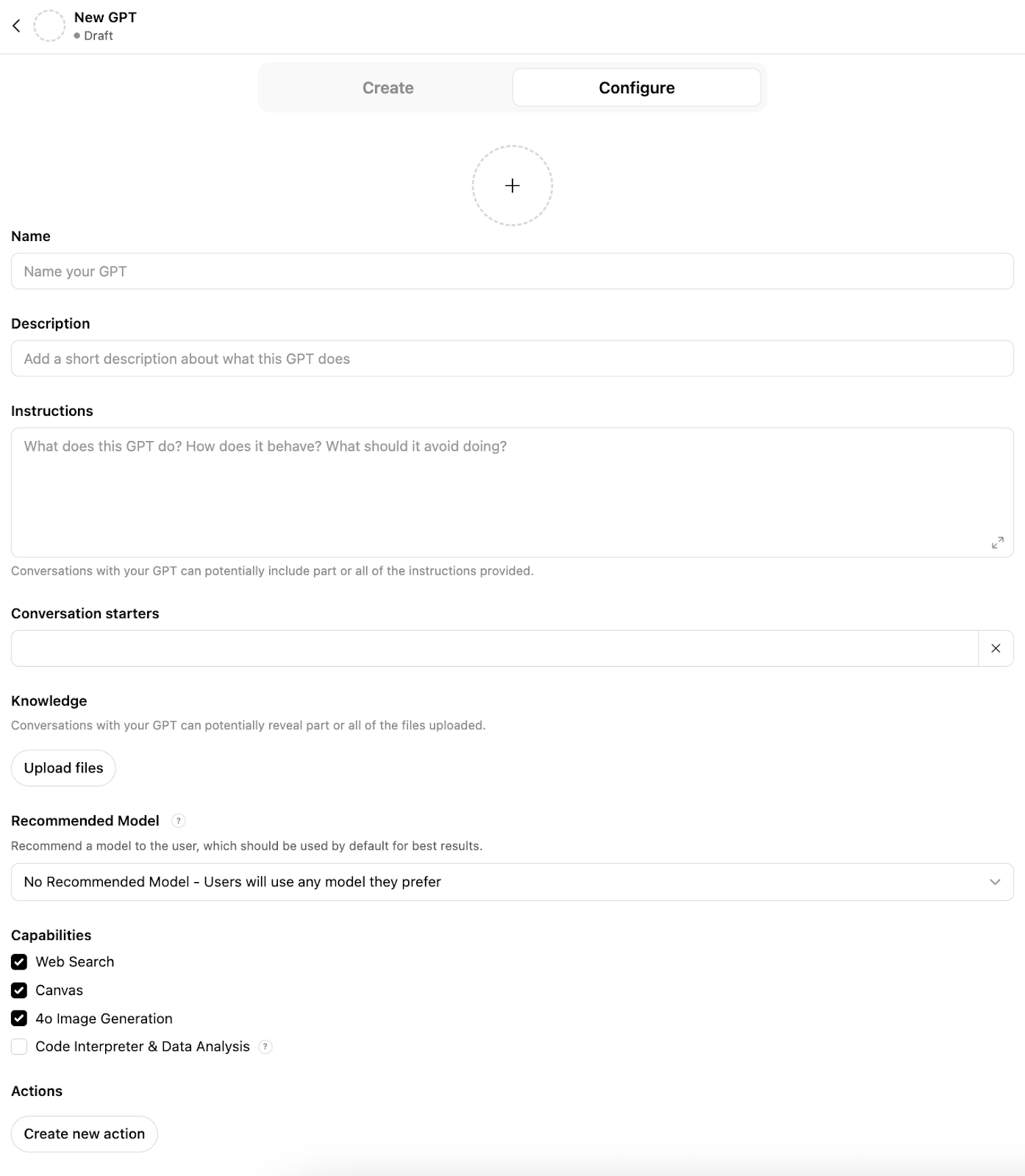
We also recommend:
Start with the answer, then explain it.
Example:
Q: How do I optimize for GEO?
A: Focus on clear, structured answers, semantic HTML, and direct responses to user queries.
Then go deeper.
Also:
AI favors content that’s easy to parse. That means:
97th Floor Test Results:
After adding bullet points and clear heading structure to a product page for a 97th Floor client, impressions and AIO rankings for an SEO-optimized article skyrocketed from ranking on the third page of the SERP to the first page (and ranking in Google’s AI Overview) in a short period of time. Here’s the results:
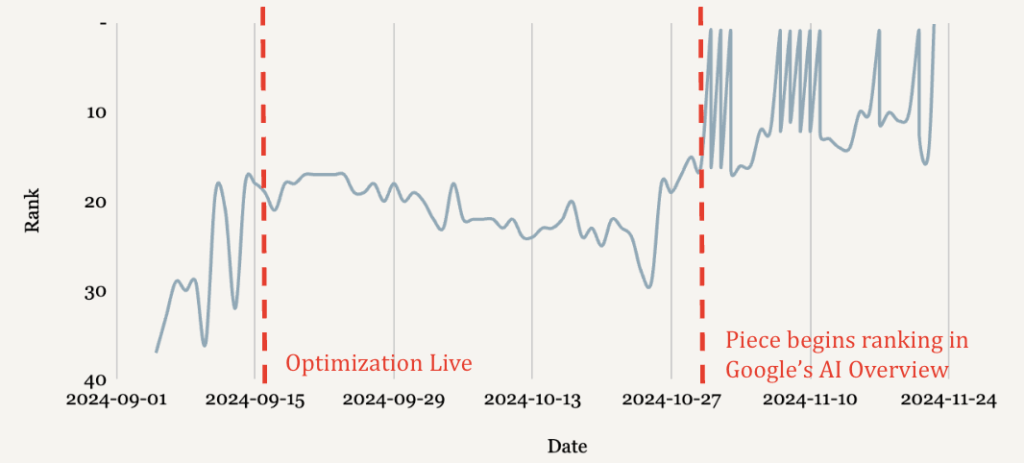
AI wants to serve trustworthy content. Show yours.
Ways to do that:
97th Floor Test Results:
By focusing on tightly-knit topic clusters, we were able to achieve topical authority for Princess Cruises:
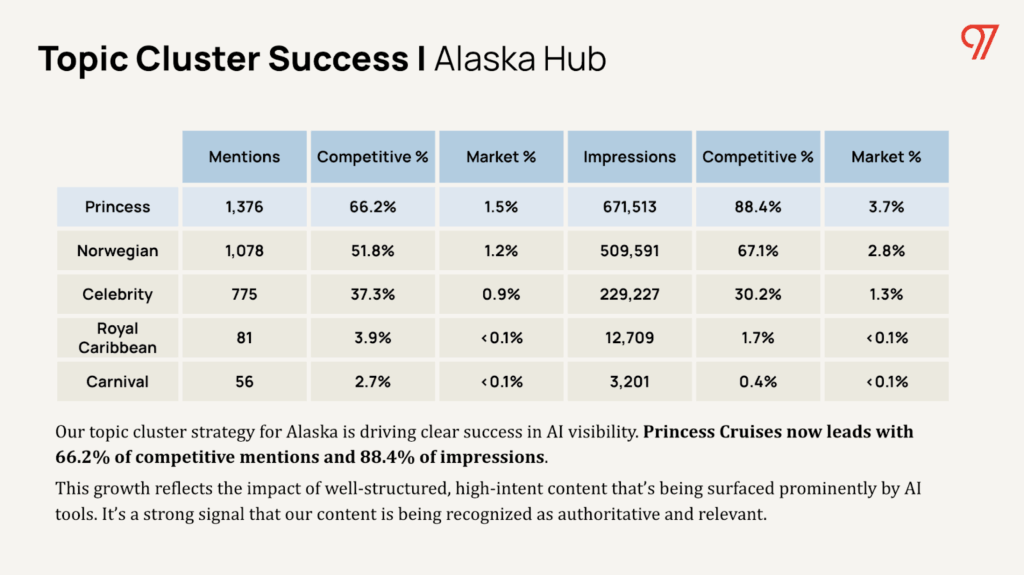
AI search engines increasingly value content from recognized, authoritative sources. This makes brand pages, like your About Us or Homepage, vital for building trust with both AI and human users. Additionally, third-party citations, such as mentions from reputable websites or reviews, are becoming more influential in how your content is perceived. Ensuring your brand is recognized across the web not only boosts authority but also increases your visibility in AI-driven search results.
AI is already reshaping how people find information—and how businesses earn attention.
At 97th Floor, we’ve helped our clients weather the shift from traditional SERPs to AI Overviews and GEO. Our strategies have earned AIO features early and consistently. And we’re continuing to test and refine what works as the landscape changes.
See how an audience-first approach translates to bottom-line results.
Most marketers think they're data-driven, but they're not actually driving results with data. They collect metrics, build dashboards, and talk about analytics in meetings. But when it comes to making real decisions about where to spend budget or which channels to double down on, they're still flying blind.
The reality is harsh: marketing teams are chronically under-resourced from an analytics perspective. It's common to see one analyst supporting 20 to 50 marketers across an entire organization. That setup might work for other departments, but marketing generates massive amounts of complex data across multiple touchpoints and platforms. One person simply can't handle it all.
The problem gets worse when analytics resources are centralized. These teams usually focus on finance, product, or engineering data first. Marketing becomes a secondary priority, handled by people who don't understand the nuances of attribution, customer journeys, or campaign measurement.
But here's the thing: you don't need a massive data team to become truly data-driven. You just need to be smart about your approach and relentless about making it happen.
Marketing analytics often gets the short end of the stick. While other departments secure dedicated analysts and data engineers, marketing teams make do with borrowed resources and shared dashboards. This isn't just an oversight – it's a fundamental misunderstanding of how complex marketing measurement really is.
Central analytics teams might be brilliant at analyzing product usage or financial metrics, but they struggle with marketing data. They don't understand the difference between first-touch and last-touch attribution. They can't explain why a lead from a webinar should be valued differently than one from a paid search ad. They're not familiar with the quirks of Facebook's API or the limitations of Google Analytics cross-domain tracking.
Meanwhile, marketing teams find themselves in a catch-22. They need better data to prove their value and secure more resources. But they can't get better data without more resources. So they muddle through with incomplete reporting and hope for the best.
Real data-driven marketing means understanding the complete customer journey, not just pieces of it. It's tracking someone from their first website visit through multiple touchpoints – ads, emails, content downloads, webinars – all the way to becoming a paying customer.
This requires connecting data across your entire tech stack. Your front-end analytics platform shows traffic sources. Your marketing automation system tracks email engagement. Your CRM houses lead and opportunity data. Your ad platforms measure clicks and impressions. Most teams look at each of these in isolation, but true insight comes from connecting them together.
The gold standard is having all this data flow into a marketing-specific data warehouse where it can be properly modeled and analyzed. But this requires expensive data engineering resources and dedicated analytics support that most marketing teams simply can't justify to leadership.
Marketing consultant Gallant Chen, who works with companies like DocuSign and Shopify, advocates strongly that "marketers should have their own data warehouse that captures all of the marketing data, puts it into one place where the marketing team can report on that." This setup allows for complete attribution modeling and sophisticated analysis of what's actually driving results.
But Chen is realistic about the challenges. These resources aren't cheap, and marketing teams struggle to justify the investment. Most companies already have a data warehouse – it's just focused on product or finance data, not marketing needs.
The result is that most marketing teams make do with fragmented data across multiple platforms, incomplete attribution, and a lot of guesswork about what's actually working.
The first major benefit of better marketing data is understanding what's actually working versus what just looks like it's working. Most marketing teams spread their budget across multiple channels based on hunches, industry best practices, or last-touch attribution that gives all credit to the final interaction.
Better data reveals the truth. Maybe that expensive display advertising campaign isn't generating any quality leads. Maybe your email nurture sequences are doing more heavy lifting than you realized. Maybe paid search is profitable, but only for certain keyword categories.
As Chen explains: "If you can have all of the data, then it should allow you to understand essentially like where you should focus your marketing resources going forward and better sort of allocate the limited resources that you have from a budgeting perspective."
This isn't just about cutting waste – it's about moving money from low-performing channels to high-performing ones. The same budget can generate significantly more results when it's allocated based on actual performance data rather than assumptions.
The second major benefit is identifying where you have room to grow. Most marketing teams hit a plateau because they don't know which channels have headroom for increased investment. They're afraid to spend more because they can't predict the outcome.
Good data changes this completely. Chen shares a specific example: "If I'm investing in non-brand paid search as a channel and it performs well from a return on ad spend perspective... I can look at impression share, I can look at what my competitors are spending, I can look at how much I've spent in the past and understand that if I invest these incremental dollars that I can expect this incremental return."
This transforms budget conversations with leadership. Instead of asking for more money based on hope, you're presenting a clear business case with expected outcomes. You can say with confidence that an additional $10,000 in paid search will generate X leads, Y opportunities, and Z revenue.
Better data also unlocks the power of AI-driven optimization that ad platforms are heavily investing in. Google and Facebook want you to give them your conversion data and let their algorithms figure out the best audiences, bids, and creative combinations.
But this only works when you give them the right signals. Chen worked with a client who was optimizing Google Ads for leads and getting terrible results. "Google could drive leads at a low cost per lead, but that the lead quality was quite poor. And that's because ultimately, Google is trying to drive as many leads as possible at the lowest cost for you."
When they switched to optimizing for SQL conversions instead of raw leads, Google's algorithms quickly learned which keywords and audiences actually generated qualified prospects. The same budget started producing much better results because the platform had better data to work with.
Most marketing teams can't build the perfect data setup overnight. But they can make meaningful improvements with the resources they have. Here are three practical approaches that don't require massive investment.
If you're a B2B company, you probably already have Salesforce or another robust CRM. Instead of building a separate data warehouse, use your CRM as the central repository for all marketing data.
This means appending attribution data at the lead level – tracking which campaign, channel, or touchpoint generated each lead. Then ensuring that data flows through to opportunities and closed deals. Your CRM becomes your attribution system, and you can build reports that show marketing's impact on revenue.
This approach isn't perfect. CRMs aren't built primarily for marketing analytics, so you'll run into limitations. But it captures most of what you need to understand performance and make better decisions.
For teams with simpler needs or limited technical resources, spreadsheets can be surprisingly powerful. The key is automating data exports from your various platforms into Google Sheets or Excel, then connecting them together.
Pull your Google Ads spending and conversion data into one sheet. Export your CRM lead and opportunity data into another. Use tools like Funnel, Supermetrics, or native integrations to automate these exports. Then pivot the data together to understand which ad campaigns are generating not just leads, but qualified opportunities and revenue.
This approach requires more manual work than a proper data warehouse, but it gives you unified reporting in a familiar format. Most marketers are comfortable working in spreadsheets, and you can build surprisingly sophisticated analysis without any technical skills.
If most of your marketing spend happens in paid channels like Google and Facebook, consider using those platforms as your measurement system. This means sending your downstream conversion data – leads, opportunities, purchases – back to the ad platforms through their APIs.
Once Google knows which clicks generated actual customers (not just leads), its optimization algorithms can focus on finding similar high-value prospects. Facebook's Conversions API can track actions beyond just website visits, giving you a complete picture of campaign performance within the ads manager.
This approach works particularly well for companies with concentrated ad spend. If 80% of your budget goes to Google and Facebook, why not let them be your attribution system? They have sophisticated measurement tools built in – you just need to feed them better data.
Regardless of which approach you choose, focus on future impact when pitching to leadership. Don't emphasize better reporting on past performance – emphasize better decisions about future investments.
Frame your request around growth capability, not just measurement. Explain how better data will help you identify new opportunities, optimize existing spend, and scale what's working. Connect everything back to revenue outcomes that leadership cares about.
Many marketing teams get bogged down trying to build the perfect attribution model. They spend months debating whether to use first-touch, last-touch, or multi-touch attribution. They try to account for every possible interaction and create models that satisfy every stakeholder.
This approach usually fails because it tries to please everyone and ends up pleasing no one. As Chen observes: "You have this sort of like by committee decision-making process that essentially creates, in a lot of cases, an attribution model that is essentially good for nobody, right? Because it's trying to accommodate too many different stakeholders."
Different marketing functions need different measurement approaches. The person running top-of-funnel campaigns to generate new leads needs to understand first-touch attribution. The email marketer nurturing existing prospects cares more about influence on deal progression. The account-based marketing team wants to measure engagement across multiple touchpoints within target accounts.
Instead of building one model that tries to do everything, build multiple models that help different people do their jobs better. Let your demand gen team optimize using first-touch attribution while your sales development team uses multi-touch modeling to understand lead quality.
The key is keeping attribution separate from compensation whenever possible. When people's bonuses depend on attribution models, every conversation becomes political. When attribution is just about optimization and decision-making, you can be more pragmatic about what actually helps.
Keep it simple at first. Pick one primary model that covers 80% of your needs, then add complexity only when it solves specific problems. Perfect attribution is less important than consistent measurement that drives better decisions.
The biggest barrier to better marketing data isn't technical – it's organizational. Too many marketers accept incomplete data as inevitable instead of fighting for what they need to succeed.
Your success as a marketer often depends on having proper measurement in place. Chen shares a blunt perspective: if you can't measure a channel properly, you should question whether you should be spending on it at all.
Take Facebook advertising as an example. Without Conversions API setup, you're probably missing a significant portion of your actual conversions due to iOS tracking limitations. Your campaigns look less effective than they really are, which leads to suboptimal bidding and targeting. In this case, setting up proper tracking is more important than testing new creative or audience segments.
As Chen puts it: "If that channel cannot be successful because you don't have the right reporting, then you need to be spending the time to figure out how to solve for that, as opposed to... change my bids, refresh this creative, do all the things that you're normally going to do because those things are actually more important."
When you hit technical roadblocks, don't just accept them. Research alternative solutions. If your engineering team can't implement Conversions API, look into reverse ETL platforms that can do it for you. If you can't get a dedicated analyst, explore self-service analytics tools.
Build the business case for these solutions and present them to leadership. Show how the investment in better tracking will improve campaign performance and ROI. Be persistent – the first "no" doesn't mean the conversation is over.
Most importantly, don't give up after the first rejection. Chen emphasizes that many marketers try once, get told no, and then never bring it up again. But if your success depends on better data, you need to keep pushing until you find a solution.
You don't need to become a data scientist, but learning the basics will make you much more effective. Understand enough about APIs, data connections, and analytics platforms to have intelligent conversations with technical teams.
Learn basic SQL so you can pull your own data when needed. Understand how tracking pixels work so you can troubleshoot implementation issues. Know the difference between client-side and server-side tracking so you can make informed decisions about data collection.
This knowledge helps you advocate more effectively for solutions and work more productively with technical teams. You'll stop being dependent on others for basic data needs and can focus their expertise on more complex challenges.
The future belongs to marketers who can leverage data effectively, but that doesn't mean you need a massive data team or perfect infrastructure. True data-driven marketing is about consistently using data to make better decisions, optimize spend, and identify growth opportunities.
Start with what's practical for your organization. If you can't build a data warehouse, use your CRM as a system of record. If you can't get dedicated analytics resources, connect your data in spreadsheets. If you can't hire data engineers, use tools that automate the connections for you.
The key is taking action with available resources rather than waiting for perfect conditions. Every improvement in your data capabilities compounds over time. Better tracking leads to better optimization. Better optimization leads to better results. Better results lead to more budget and resources.
Don't let perfect be the enemy of good. The marketing teams that thrive in the coming years won't be the ones with the fanciest data setups – they'll be the ones that relentlessly pursue better measurement and use whatever tools they have to make smarter decisions.
Your competition is probably still making decisions based on hunches and last-touch attribution. While they're waiting for ideal conditions, you can be building competitive advantages through better use of data. The only question is: will you start now, or will you keep waiting for perfect conditions that may never come?
"If you don't have the right data and reporting to be effective in your job, you got to fix that. You have to figure out a way... if your success is tied to some of these analytics or data or reporting issues, to me, those things are far more important." - Gallant Chen
3:17 - Under-resourced data analytics
8:59 - Marketing-specific data warehouses
18:35 - AI/Smart bidding with proper data
27:02 - Practical alternatives
43:22 - Taking ownership of data problems
48:01 - Leveraging platform AI investments
Connect with Gallant on LinkedIn: https://www.linkedin.com/in/gallantc/
Connect with Paxton on LinkedIn: https://www.linkedin.com/in/paxtongray/
Check out Gallant’s work: https://gallant.co/
Looking for an agency that'll be worth the investment? 97th Floor creates custom, audience-first campaigns that drive pipeline and conversions. Get started here: https://97thfloor.com/lets-talk/.
Gallant is the Founding Partner of Gallant Growth and a seasoned Marketing Executive with a track record of scaling growth for B2B SaaS and marketplace businesses.
He has served as an Advisor and Consultant for companies including Docusign, Shopify, New Relic, Mixpanel, Nutanix, Upwork, and Thumbtack on marketing strategy, customer acquisition, retention, and monetization. He has deep expertise in demand gen and paid acquisition, but also supports areas including the hiring of internal/agency teams, lifecycle and email marketing, CRO, marketing analytics, and marketing operations.
Prior to founding Gallant Growth, he ran Digital Marketing at Zendesk and held marketing roles at SurveyMonkey and Apple. He started his career as a strategy consultant at Bain & Company and holds an MBA from the Kellogg School of Management and a BS from Stanford University.
Most companies are getting messaging wrong before they even write a single word. They jump straight to creating copy without understanding the difference between positioning and messaging, lead with features instead of customer pain points, and treat AI as a magic solution rather than a research amplifier.
The real power of AI in copywriting isn't replacing human insight—it's scaling it. When done right, AI can help companies conduct deeper customer research, create more accurate personas, and test messaging at speeds impossible with traditional methods. But only if they start with the foundation that 70% of effective copywriting is actually research.
Here's a framework for using AI to turn customer insights into copy that actually converts, without losing the human touch that makes messaging resonate.
The first mistake most companies make is confusing positioning with messaging. As conversion copywriter Chris explains, positioning is understanding "what you do, who you do it for, and how you do it better, uniquely, or in a different way." Messaging, on the other hand, is how you communicate all of that across different touchpoints—your pitch, strategic narrative, value propositions, and brand voice.
Most companies skip the positioning work entirely and jump straight to creating creative assets. They treat messaging as the actual deliverables instead of the underlying architecture that should drive every marketing initiative. Without this foundation, companies end up with inconsistent messages that confuse rather than convert.
Even worse, companies that do attempt messaging often lead with features instead of matching customer intent. They land visitors on pages that immediately start talking about the company rather than addressing what brought the visitor there in the first place.
"As soon as someone lands on your page and the first thing they do is start talking about you yourself rather than themselves, they immediately experience some kind of friction," Chris notes. This friction shows up as higher bounce rates, lower engagement, and skeptical prospects who struggle to see themselves in the messaging.
The solution isn't complex: start by matching visitor motivation, intent, and awareness level. When the first thing people read speaks directly to their pain points and desired outcomes, the decision to keep reading becomes automatic.
Another common mistake is creating separate messages for every possible audience. Companies end up with messaging for accountants, HR professionals, mortgage loan officers, and dozens of other segments without any unifying thread.
The problem isn't having multiple audience-specific pages—those are useful for matching search intent. The problem is missing the overarching strategic narrative that ties everything together. This narrative should reflect the unique insight that led to building the product in the first place, the market problem only the company has identified, or the customer mistakes only they've seen.
With this strategic narrative as the foundation, companies can adapt pain points and benefits for specific personas while maintaining a consistent point of view across all touchpoints.
Smart competitive research isn't about copying what others are doing—it's about deconstructing their approach to find gaps and differentiation opportunities. A useful framework divides competitor analysis into four sections: motivation (matching user outcomes and pain points), value (features and benefits), proof (backing up claims), and anxiety (social proof and friction reduction).
This analysis reveals what level of customer awareness competitors are targeting and where opportunities exist. Are they focusing on problem-aware customers while leaving solution-aware prospects underserved? Do their reviews reveal features customers consistently complain about?
The goal is understanding the message landscape prospects encounter when researching solutions, not to copy it but to stand out within it.
Customer interviews remain the gold standard for gathering authentic language, but they're not the only option. Email surveys with open-ended questions often generate surprisingly detailed responses, especially when customers have strong product-market fit. Support chat transcripts, sales call recordings, and review sites like G2 and Capterra provide additional sources of customer language.
The key is building a searchable database of customer language. As Chris explains: "Maybe I'm writing copy and I'm kind of debating, should I use this word or that other word? Then I jump into my voice of customer bank and I literally do a Command+F search and I see what kind of words did they use for this specific use case."
Sometimes entire phrases can be lifted directly from customer feedback. Other times, it's about choosing between two similar words based on which one customers actually use. Either way, the voice-of-customer research provides the raw material for authentic messaging.
One of the most striking examples of voice-of-customer research in action involved a B2B SaaS company selling software to portable toilet and septic container management companies. The challenge was unique: selling software to blue-collar business owners in their 50s and 60s who "hated software" and rarely used anything beyond spreadsheets.
Instead of traditional feature-focused messaging, the company conducted customer interviews and built their "how it works" page like a diary of a typical workday. The copy walked prospects through their daily routine: "When you get to work, this is the first thing that you do with the software. You jump in, you log in your route for the container... And then your driver takes on the software and then this is what happens."
By using the specific language customers used and reflecting their actual workflow, the company increased conversions by 20% across the site. The success came from meeting customers where they were instead of forcing them to learn new terminology or processes.
The PATH framework starts with comprehensive research across three areas. Internal research includes team insights, product knowledge, and support chat transcripts. External research covers current customers, prospects, and importantly, non-buyers who can explain why they chose alternatives. Market research examines competitors and their customer reviews.
This preparation phase creates the foundation for everything that follows. Without solid human research, AI personas become sophisticated guesswork rather than accurate customer representations.
The articulation phase feeds all research into AI personas using platforms with large context windows. The key is creating separate persona chats that "never break character" and include "thoughts" tags that reveal internal motivations before expressing what personas would actually say.
For example, a persona might think: "I'm worried this software will be too complex for my team to learn" before saying: "We need something simple that doesn't require training." These internal thoughts help copywriters understand the emotional drivers behind surface-level objections.
The testing phase runs different messaging scenarios with AI personas, probes for objections, and simulates responses before launching campaigns. As Chris describes it: "It's like having a conversation with any of your customers. You can ask them any questions."
This capability allows teams to test headlines, email sequences, and value propositions at scale. They can explore edge cases, probe for emotional triggers, and identify potential objections before real customers encounter them.
The final phase combines AI findings with real-world testing. If AI personas respond strongly to specific messaging angles, those get tested in sales conversations and marketing campaigns. The results feed back into the system, creating a continuous research flywheel that gets more accurate over time.
This approach turns AI from a one-time tool into an ongoing research system that scales human insight rather than replacing it.
Synthetic research works best for early-stage companies with limited customer access. Even 60-70% accuracy is valuable when the alternative is no customer insights at all. It's also useful for scaling small datasets—turning five customer interviews into 50 detailed personas—or expanding research into questions that weren't asked in original interviews.
The most interesting application is continuous background research. AI personas can monitor market trends, test new messaging angles, and even pre-test ad creative before launch. Platforms like Synthetic Users and Ask Rally are building APIs that could automate these processes entirely.
Synthetic research fails when used as a replacement for customer understanding rather than an amplifier. Companies with extensive customer data and research capabilities likely don't need synthetic personas. More importantly, synthetic research should never be the only research—it works best as a complement to real human insights.
The platforms that do synthetic research well address bias, coordinate persona distribution across roles, and build algorithms that produce realistic rather than overly positive responses.
The copywriters at risk are those who rely on formulas and templates. AI can easily replicate paint-by-numbers approaches to writing. But copywriters who understand that copy comes from research, strategy, and deep customer empathy have a different future ahead.
As Chris puts it: "If you have a strategic vision, so if you know that the copy comes from the research work, then there's the strategy in between, and then you can't really write any word without all of those foundations, then I would say you can still be the effective copywriter using AI."
The role shifts from writer to architect—orchestrating AI systems, knowing when to be the human in the loop, and maintaining the intuition for what resonates with real customers.
Many copywriting critics haven't actually experimented with advanced AI tools beyond free ChatGPT. They're making judgments based on limited experience with basic applications rather than the sophisticated research and persona systems now possible.
The future belongs to copywriters who embrace AI as a research amplifier while maintaining the human skills of empathy, strategic thinking, and taste that determine whether copy actually converts.
AI's real power in copywriting isn't replacing human insight—it's scaling it. The companies that win will be those that use AI to get closer to customers, not further away. They'll conduct more research, create more accurate personas, and test more messaging variations while maintaining the human touch that makes copy resonate.
The framework is straightforward: start with research, not technology. Build comprehensive customer understanding through interviews, surveys, and voice-of-customer analysis. Use AI to scale that understanding into detailed personas and systematic testing. Then maintain the human skills of strategic thinking and emotional intelligence that turn insights into copy that converts.
The future of copywriting isn't human versus AI—it's humans using AI to become better researchers, strategists, and customer advocates.
"If you rely on formulas, templates, when you're writing copy, then probably AI can replace you. But the thing that it can't really replace you now... if you have a strategic vision, so if you know that the copy comes from the research work, then there's the strategy in between." - Chris Silvestri
0:45 - Positioning vs messaging mistakes
4:12 - Avoiding "what we do" friction
14:29 - Research is 70% of the work
26:28 - AI synthetic research tools
33:34 - PATH framework explained
35:52 - AI won't replace strategic copywriters
Get a free scorecard to assess your messaging fit on Chris’ website here: conversionalchemy.net
Connect with Chris on LinkedIn here: https://www.linkedin.com/in/christophersilvestri
Connect with Paxton on LinkedIn: https://www.linkedin.com/in/paxtongray/
AI platforms Chris uses for audience research:
Looking for an agency that'll be worth the investment? 97th Floor creates custom, audience-first campaigns that drive pipeline and conversions. Get started here: https://97thfloor.com/lets-talk/.
Chris is the Conversion Alchemist. A SaaS message-market fit specialist and conversion copywriter, he worked 10 years as a software engineer in industrial automation. Then, took a sharp turn to enter the digital marketing world as UX lead at the usability testing startup Conversion Crimes (and previously at the conversion design agency Zeda Labs). Chris has been working as a messaging strategist and copywriter for B2B SaaS brands like Moz since 2016.
Marketing has come a long way from the days when creative directors made decisions based purely on gut instinct and artistic vision. Today's marketers operate in a world where every click, scroll, and interaction generates data that can inform strategy. But the pendulum hasn't swung completely to the analytical side—successful modern marketers are those who can bridge the gap between creativity and data science.
The challenge isn't choosing between art and science anymore. It's about blending brand storytelling strategies with behavioral insights and AI capabilities to create marketing that's both emotionally resonant and strategically sound. This new breed of marketer needs to be comfortable presenting to the C-suite while also understanding what a rage click reveals about user frustration.
The winning formula involves three interconnected pillars: authentic brand storytelling that connects with human emotions, deep behavioral data that reveals what users actually do (not what they say they do), and AI that amplifies human intelligence rather than replacing it. When these elements work together, they create marketing strategies that are both scalable and genuinely effective.
One of the biggest myths in marketing is the idea that you're either a "creative person" or a "numbers person." This false dichotomy has held back countless marketers who believe they can't develop skills on the other side of the brain.
Adam Gunn's career journey illustrates how these skills can complement each other. Starting with dreams of working for Disney or Pixar, he moved through graphic design and agency work before being thrust into a marketing leadership role with a multimillion-dollar budget. The transition wasn't easy, but it revealed something important: creative skills translate directly to business success.
"Humans are emotive beings and they respond to emotive narratives," Gunn explains. This truth applies whether you're pitching a brand concept to a client or fighting for budget in a boardroom. The ability to craft compelling stories, use humor strategically, and communicate ideas visually gives creative-minded marketers a significant advantage in business settings.
But there's a crucial caveat—knowing when creative details matter and when they don't. Gunn recalls sitting through a 90-minute meeting about bullet point shapes, with multiple teams debating whether triangles, circles, or squares better represented the brand. His realization: "No one outside of the people in this room care about the shape of bullets."
The key is picking your battles. Brand elements should be beautiful and strategic, but not every design decision deserves a lengthy debate. Creative marketers who learn to focus their energy on elements that actually impact business outcomes earn credibility with their analytical colleagues and leadership teams.
The whiteboard becomes a powerful tool for bridging these worlds. Whether it's a funny doodle that makes a point memorable or a visual way of presenting data, the ability to communicate ideas through both words and images gives marketers a distinct edge in virtual and in-person meetings.
Traditional web analytics tell marketers what happened, but they often miss the why behind user behavior. Page views, bounce rates, and time on site provide a surface-level understanding of user engagement, but they don't reveal the emotional experience of navigating a website.
Behavioral data changes this by capturing sentiment-rich signals that indicate user frustration, confusion, or satisfaction. These signals often predict outcomes better than traditional metrics.
Rage clicks represent one of the strongest behavioral indicators. When a button doesn't work, the natural human response is to click it repeatedly—usually four or more times in quick succession. This simple signal reveals not just that something is broken, but that users are actively frustrated by the experience.
Mouse thrashing provides another window into user sentiment. Erratic cursor movement often indicates that someone is searching for something they can't find or trying to understand a confusing interface. Copy-paste behavior, while seemingly innocent, frequently correlates with user frustration and higher exit rates.
These behavioral signals matter because they reveal the gap between intended user journeys and actual user behavior. Most marketers assume visitors follow a logical path from homepage to product pages to pricing and conversion. The reality is far messier.
The "cow path analogy" illustrates this perfectly. An East Coast college decided to plant grass first and see where students naturally walked before installing sidewalks. The resulting paths were nothing like what architects would have designed, but they reflected how people actually moved through the space.
Website user behavior follows similar patterns. Users might skip carefully crafted platform pages and jump straight from the homepage to pricing. They might enter through blog posts and immediately look for customer testimonials. Understanding these true funnels—not the ones marketers assume exist—provides the foundation for meaningful optimization.
This behavioral data becomes even more valuable when combined with other first-party data sources. Transactional data from CRM systems, email engagement metrics, and customer support interactions can be layered with behavioral signals to create comprehensive user profiles. In a world where third-party cookies are disappearing and privacy regulations are tightening, this first-party behavioral data represents a sustainable competitive advantage.
The future belongs to companies that can warehouse these diverse data streams and use them to personalize experiences, predict churn, and identify opportunities for improvement. The brands that master this integration will have insights their competitors simply can't access.
Despite the hype surrounding AI in marketing, the reality of implementation has been more modest than revolutionary. While executives and boards push for AI initiatives, many marketing teams struggle to achieve the dramatic efficiency gains they've been promised.
The gap between expectation and reality shows up in everyday work. AI-generated strategy briefs often contain comprehensive lists of tactics that are technically correct but lack the nuance of understanding resource constraints, budget limitations, and strategic priorities. The output feels like the work of "a very hard-working intern"—helpful for brainstorming but requiring significant human intervention to become actionable.
Instead of viewing AI as a replacement for human intelligence, successful marketers are learning to use it as a thought partner. This approach recognizes AI's strengths while acknowledging current limitations.
Behavioral analytics platforms are developing AI capabilities along four key pillars. Summation uses AI to create semantic summaries of user session groups, potentially eliminating the need to watch individual session replays. Surfacing opportunities leverages AI to automatically identify conversion problems and optimization possibilities that human analysts might miss. Conversational answers democratize data access by letting non-analysts ask questions in natural language and receive dashboard-style responses. Predicting represents the ultimate goal—AI sophisticated enough to identify problems and opportunities before humans recognize them.
These applications work because they augment human capabilities rather than attempting to replace human judgment. AI excels at processing large volumes of data and identifying patterns, but humans remain essential for strategic context, creative problem-solving, and understanding business nuances.
The key is building the muscle for AI adoption even when current tools provide only modest improvements. The smartphone analogy is instructive—early adopters of mobile apps gained valuable experience that positioned them for success as the technology matured. Banks that initially resisted mobile banking because "no one would ever bank on their phone" found themselves playing catch-up later.
Marketing teams that experiment with AI tools today, even imperfect ones, are developing the workflows and expertise they'll need when more sophisticated solutions emerge. The 4% efficiency gain available now might become a 40% gain in the future, but only for teams that have already integrated AI into their processes.
Traditional analytics setups are fundamentally reactive. Problems are identified after they've already impacted business results, and the process of surfacing insights to decision-makers often involves multiple people and significant time delays.
Consider this scenario: website conversions drop by 20% over a few hours. In most organizations, this insight requires an analyst to notice the change, investigate the cause, prepare a summary, and communicate findings to stakeholders who can take action. Depending on the complexity of the analytics setup and organizational communication, this process might take hours or even days.
The cost of this delay can be substantial. For businesses with high average order values, a 20% conversion drop might represent hundreds of thousands of dollars in lost revenue during the time it takes to identify and address the problem.
Behavioral analytics platforms are designed to flip this model from reactive to proactive. Instead of waiting for humans to discover problems, AI-powered systems monitor behavioral signals in real-time and alert teams to issues as they emerge.
Rage click patterns might spike on a specific page, indicating a technical problem. Mouse thrashing could increase among users from particular traffic sources, suggesting a messaging mismatch. Copy-paste behavior might correlate with form abandonment, pointing to usability issues.
These early warning systems allow marketing and product teams to respond to problems before they significantly impact key metrics. The goal is moving from "what happened last week" to "what's happening right now" and eventually to "what's likely to happen next."
This proactive approach requires rethinking how analytics teams are structured and how data flows through organizations. Instead of periodic reporting cycles, teams need continuous monitoring capabilities. Instead of waiting for monthly business reviews to surface insights, stakeholders need real-time alerts that enable immediate action.
The marketing landscape is entering a period of rapid change that will require significant adaptation from even the most sophisticated teams. Three major shifts are converging to create new challenges and opportunities.
First, the rise of AI agents will fundamentally change how websites and digital experiences are accessed. Instead of humans browsing through carefully designed user journeys, AI agents will increasingly navigate websites on behalf of users, gathering information and making recommendations.
This shift requires marketers to think beyond human-centered design. Experiences that work well for human visitors might be completely ineffective for AI agents, which process information differently and have different expectations for how content should be structured and presented.
Second, the relationship between search engines and websites continues to evolve. ChatGPT and similar tools increasingly provide direct answers to user queries without sending traffic to source websites. This "zero-click" trend means traditional SEO strategies need to account for how AI systems discover, process, and surface content.
Third, the definition of "good" versus "bad" website traffic is becoming more complex. While bot traffic has traditionally been filtered out as irrelevant, the future will require distinguishing between beneficial AI agents and malicious bots. Some automated traffic will represent legitimate business opportunities that deserve optimized experiences.
These changes don't have predetermined solutions, which makes adaptability more important than specific tactical knowledge. Marketing leaders need to develop strong points of view about their strategies while remaining open to new information and different perspectives.
The organizations that will thrive are those that can assess new developments quickly, test hypotheses efficiently, and change course when evidence suggests better approaches. This requires both confidence in core principles and humility about tactical execution.
Building this adaptability muscle starts with current decisions about AI adoption, data infrastructure, and team capabilities. The companies that are experimenting with behavioral data, testing AI tools, and developing cross-functional collaboration skills today will be better positioned for whatever changes emerge next.
The most successful modern marketers won't choose between brand, behavior data, and AI—they'll master the integration of all three. Brand storytelling provides the emotional foundation that connects with human motivations. Behavioral data reveals what users actually do rather than what they claim to do. AI amplifies human capabilities by processing information at scale and identifying patterns that would be impossible to detect manually.
This integration requires marketers who can move fluidly between creative and analytical thinking, who understand both the art of persuasion and the science of optimization. It demands organizations that can combine first-party behavioral signals with traditional business metrics to create comprehensive views of customer experience.
The future belongs to marketing teams that stay grounded in human emotion while leveraging the best available data and technology. They'll use AI as a thought partner rather than a replacement for human judgment. They'll let user behavior guide their optimization efforts rather than assuming they know how customers prefer to navigate digital experiences.
Most importantly, they'll remain adaptable as new technologies and platforms emerge. The specific tools and tactics will continue to evolve, but the fundamental challenge will remain the same: understanding what motivates people and delivering experiences that meet both rational and emotional needs.
The marketers who master this balance—combining brand storytelling, behavioral insights, and AI capabilities—will create sustainable competitive advantages that are difficult for competitors to replicate. They'll build deeper relationships with customers, make more informed strategic decisions, and adapt more quickly to changing market conditions.
The future of marketing isn't about choosing between art and science. It's about blending them skillfully to create experiences that are both emotionally compelling and strategically effective.
"The future is customer-based agents surfing our website. Historically we've built all of our experiences for humans, but agents are often going to be now going out and doing business on our behalf... we'll have to build web experiences that serve the good traffic." - Adam Gunn, VP of Brand at Fullstory
02:35 - From Disney animator to marketing leader
06:51 - Creative skills in the boardroom
13:08 - "Rage clicks" and user frustration signals
23:44 - AI reality check vs. hype
31:47 - Reactive vs. proactive analytics
41:53 - Stay nimble for industry changes
Request a free AI Audit: https://97thfloor.com/ai-audit/
Connect with Adam on LinkedIn: https://www.linkedin.com/in/adamgunn
Adam Gunn is the VP of Marketing at FullStory, a behavioral analytics platform that’s changing the way teams understand and act on user behavior. He brings a unique perspective around data, storytelling, and how marketing teams can evolve alongside AI.
