



The first thing you notice inside OpenAI's Ads Manager is how much it looks like something you've already used. Campaign, ad group, ad. Objective, location, daily budget. If you've spent any time in Google Ads, your hands know where to go before your brain catches up.
That familiarity is the most misleading thing about it.
We built our first ChatGPT Ads campaign this summer for a B2B SaaS client in the SMS marketing space. It was an awareness push across ten industry segments, running to the US and Canada. The build itself went quickly, because the keyword research was already sitting there waiting to be used. It's everything after the build that turned out to be the hard part.
You can construct a ChatGPT Ads campaign using almost everything you know about paid search. You just can't optimize one that way yet.
Here's where that plays out.
Campaigns hold ad groups. Ad groups hold ads. So far, so Google.
The difference lives at the ad group level. Instead of keywords, you write context hints: plain-language descriptions of the conversations where your product would genuinely be useful. OpenAI's documentation is refreshingly blunt about what they are and aren't. Hints describe the conversations, topics, or keywords where their products or services may be relevant, and they are not exact-match keywords and do not guarantee delivery in specific conversations.
Read that second half again. There's no match type. There's no negative list. You are describing a situation and asking a model to decide when your ad is helpful.
We started from keyword research. One segment alone carried nine near-identical variations of mass texting for nonprofits. In ChatGPT Ads, all nine of them collapsed into a single hint that read something like this:
Organizations comparing nonprofit text messaging platforms and SMS marketing tools. Users looking for affordable, easy-to-use software to improve donor engagement, increase event attendance, boost fundraising efforts, automate communications, and measure campaign performance.
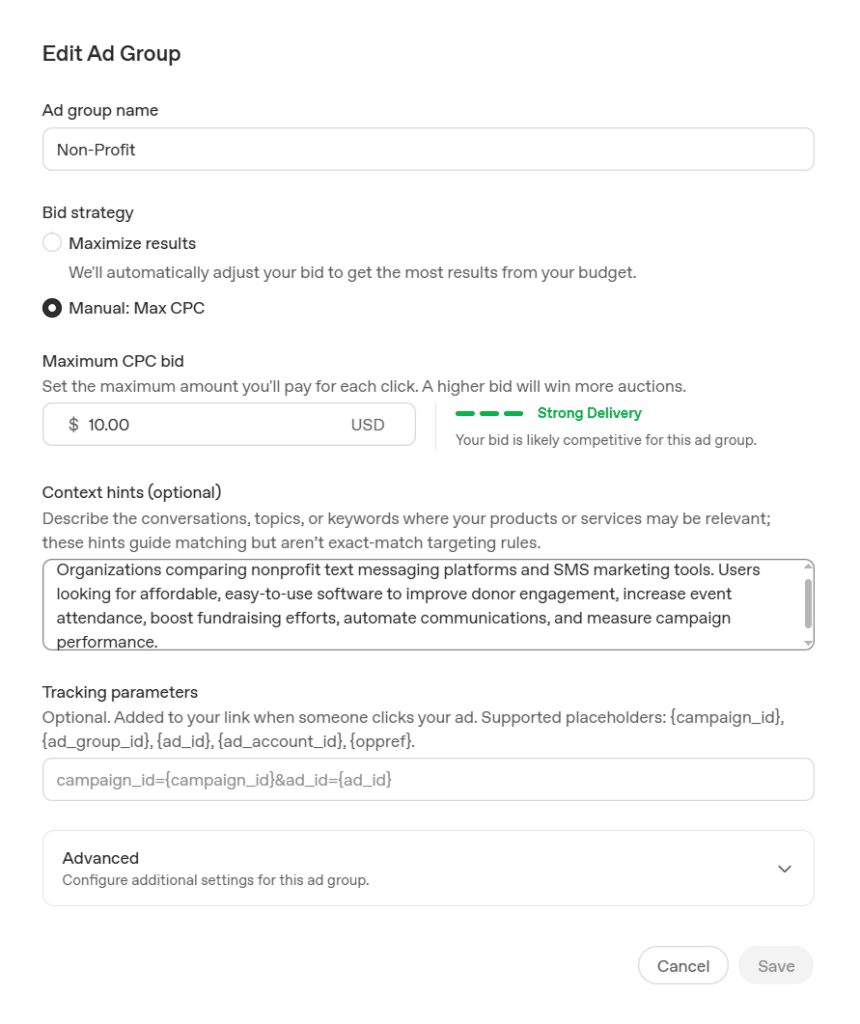
Same research, completely different output. The keywords stopped being used for direct targeting and became source material. That's the reframe, and it's most of the job: your keyword list still tells you what people want, it just no longer tells the platform anything.
The mental shift that actually helped: stop asking what words do I want to match and start asking what is someone working on right before my product becomes relevant? A nonprofit director doesn't type "mass texting for nonprofits" into ChatGPT. She says her donor emails aren't getting opened and asks what to do about it.
Buyers are discovering, evaluating, and comparing brands through AI. 97th Floor CEO, Paxton Gray, is joining WordPress VIP CMO, Jodi Cerretani, for a three-part series on what that means for enterprise brands.
Ads in ChatGPT aren't shown to Plus, Pro, or Business subscribers, or to accounts the system identifies as under 18. Your reach is the free and Go tiers.
For consumer brands, that's a large and perfectly good audience. For B2B, it deserves a second look. A meaningful chunk of the buying committee you're trying to reach is sitting on a company-provisioned Business seat, which means they are structurally unable to see your ad. That doesn't make ChatGPT Ads a bad B2B channel. Plenty of decision-makers are on personal free accounts, and plenty of research happens before procurement gets involved. It does mean the total addressable audience is not "everyone who uses ChatGPT," and pretending otherwise will make your forecasts wrong.
Fifty characters for the headline. One hundred for the description. A square image, minimum 256 x 256. That's the whole ad.
It's tighter than it sounds, because ads can truncate well before those caps depending on placement. In practice, we wrote to about half the limit and treated anything past that as a bonus. The ads that felt best were the ones that stated a specific tension in plain words, like School Emails? Only 1 in 5 Parents Opens Them, rather than the ones that tried to describe a product.
A few things we'd repeat:
This is the real gap, and it's worth being direct about.
You can segment reporting by device and country. You cannot see performance by context hint.
Think about what that removes. In Google Ads, the search terms report is how you close the loop. You learn what actually triggered your ad, you prune, you expand, you get smarter every week. In ChatGPT Ads, you write eight descriptions of eight conversations, the campaign spends, and the platform tells you how many clicks you got in aggregate. Which description earned them is, right now, your guess.
The metrics themselves are reasonable for a beta: impressions, clicks, spend, CTR, average CPC, average CPM, and conversions, available at campaign, ad group, and ad level. Pixel and Conversions API measurement both exist. But there's lag to plan around. Attributed conversions can take 24 to 48 hours to appear, and the view-through window is fixed at one day.
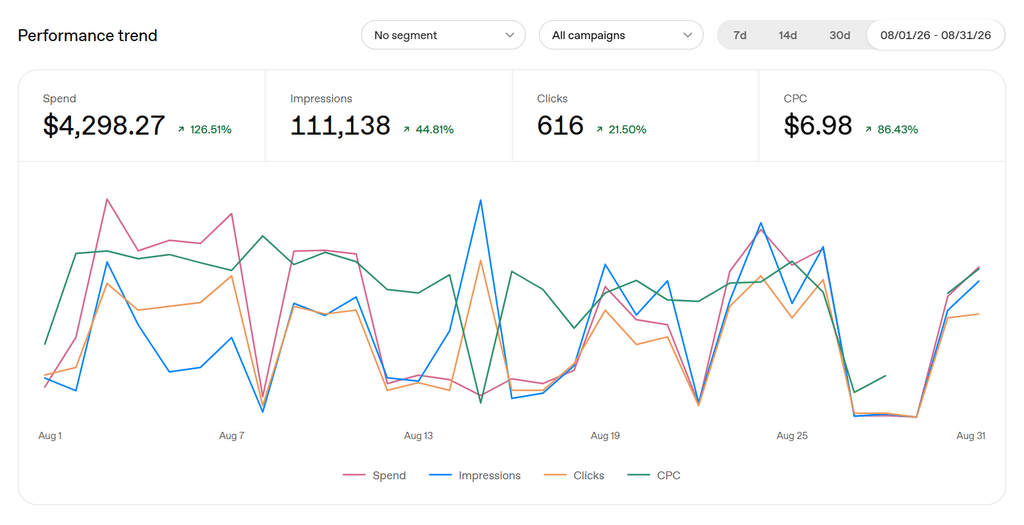
There's also no published guidance on the questions you most want answered. OpenAI hasn't documented a maximum number of context hints, a character ceiling for them, or whether narrower hints outperform broader ones. There's plenty of advice circulating. Three to eight hints per ad group, one to three sentences each, is the rule of thumb we've been working from. But that's practitioner consensus, not official guidance, and I'd rather label it honestly than dress it up as documented best practice.
Since the platform can't tell us which hint worked, we built the campaign so our own analytics could.
One intent per ad group, strictly. Not one industry. One need. If "appointment reminders" and "flash promotions" both live in a healthcare ad group, no result from that ad group means anything.
Every ad group gets its own landing page and its own UTM. The part that matters is pushing the ad group's theme into utm_content, so every click lands already labeled with the intent it came from. That one parameter does more heavy lifting than anything the platform reports back. Your site analytics becomes the segmentation layer, because the platform isn't there yet.
Hints are hypotheses, and you write them down as such. Before launch, we noted what we expected each hint to reach. When behavior on the landing page didn't match, that was a signal. Not clean attribution, but directionally useful, which is what a beta gives you.
Budget it like a test, not a channel. This is money spent to learn how a new surface behaves. We'd rather find out now, at a small scale, than in a year when the auction is crowded and everyone's figured it out.
We've been running these for weeks, not quarters. I'm not going to tell you what ChatGPT Ads CPCs "should" be, or hand you a conversion rate benchmark, because I don't have enough of my own data to add a better number to the pile. We’ll have that answer in a few months.
What I'm reasonably confident about is the shape of the platform. The creative constraints are real. The audience exclusions are real. The reporting gap is real, and it's the one that will decide whether this becomes a channel you can scale or a line item you defend every quarter.
What I'm not confident about is any of it staying true. Conversion bidding, geo exclusions, and bulk tools have all landed since the self-serve beta opened in May. The list of things we can't see is shorter than it was four months ago, and it'll be shorter again by the time you read this.
So: build it with a paid search mindset. Measure it like an analytics pro. And write everything down, because the version of this platform you're learning today isn't the one you'll be running next year.
That's not a reason to sit it out. It's just the price of being early.
There’s a moment that shows up in nearly every account we scale. We push more budget into the campaigns that have been working, and efficiency starts to soften. Cost per lead ticks up. Blended ROAS slips.
It looks like something broke. Usually nothing did. The account has outgrown its best campaigns, and we’ve reached the edge of the demand those campaigns were built to capture.
Catching that moment early — before it turns up in a client’s dashboard looking like a problem — is a real part of the job. So is knowing what comes next, because the answer usually isn’t to fix evergreen. It’s to go build the next thing.
That’s the part that’s hard to explain in a monthly report, so let me put it plainly: efficient growth and incremental growth are not the same thing. Evergreen campaigns capture demand that already exists. Experimental campaigns unlock demand that doesn’t exist yet — at least not for you. They do different jobs, they should be measured differently, and you need both. Confusing the two is how good accounts stall out and how good tests get killed a month before they were about to work.
Our advertising team ran an internal training on this recently.
Evergreen campaigns are the proven ones. Core non-brand search. Brand. Retargeting. The campaign types and platforms you’ve already validated for this business, running against the audiences you already know convert.
They earn their keep because they’re pointed at high-intent demand — people actively looking for what your client sells, right now. That’s why they deliver stable CPA and ROAS, why performance is repeatable month over month, and why they’re the lowest-risk place to put a dollar.
So the first rule is simple, and it’s the one most likely to get skipped: if something is working and there’s room to spend more on it, that’s where the money goes first. Not the new channel. Not the shiny campaign type. Every expansion carries risk. Expanding what’s already proven carries the least.
Before anyone on my team pitches an experiment, I want to know that evergreen has actually been maxed out. That means asking:
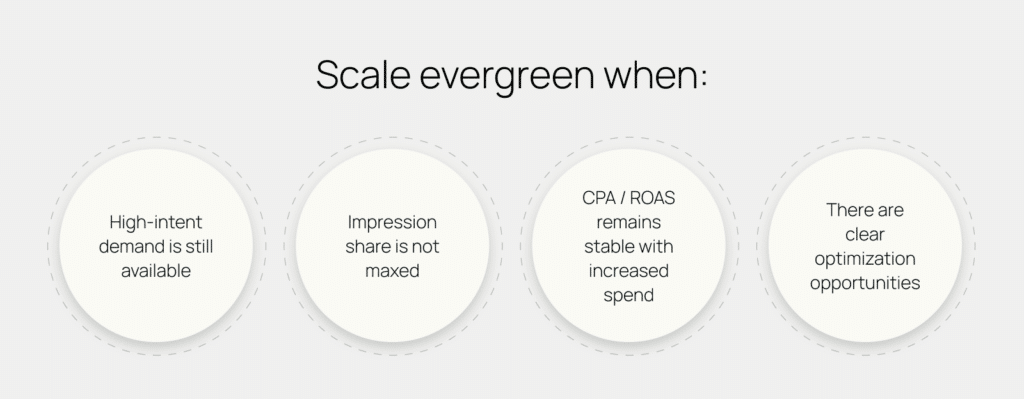
If the answer to any of those is yes, the conversation about experimentation can wait.
Here’s the catch: high-intent demand is finite.
There are only so many people searching for your solution this month. Once your evergreen campaigns have captured most of them, the only way to spend more is to reach further — broader targeting, looser match types, lower-intent search terms, colder audiences. The platform is happy to do it. It just costs more.
Evergreen performance alone cannot sustain long-term growth — it was never designed to. As targeting broadens, conversion rates decline and incremental conversions become more expensive. Efficiency peaks, and every dollar past that peak buys volume at a worse rate.
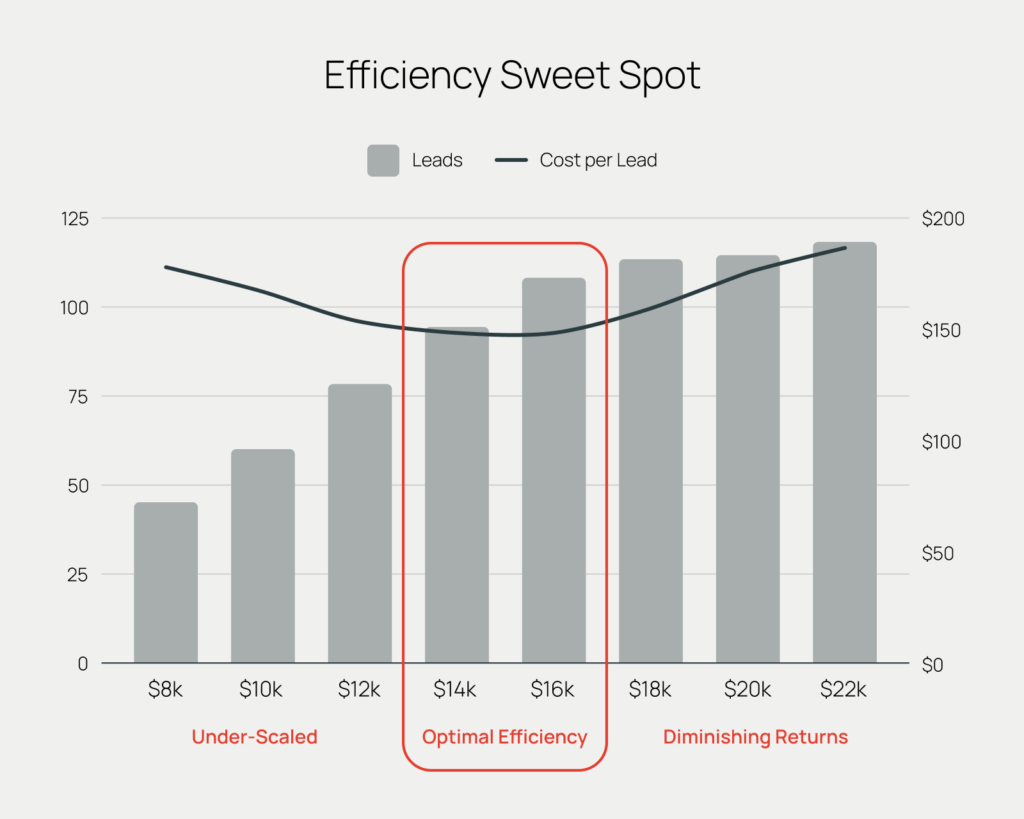
The practical question is how you find that peak without blowing past it. Nobody should be doubling budget month over month and hoping the efficiency holds. What I’d rather see is 10–20% increases at a time, a few weeks to let the system readjust, then another bump — watching CPA or ROAS the whole way. The right cadence flexes with the platform, the campaign’s maturity, and how much conversion volume you’re working with.
And there’s a nuance here that trips people up. Spending more will often push CPA up somewhat. That is not automatically a problem. The question isn’t “did CPA rise,” it’s “is CPA still inside the range this business can profitably pay?”
I think about an ecommerce client we worked with where we were defending a target ROAS with everything we had — nudging it from 4.0 to 5.0 to 6.0, protecting efficiency we were proud of. Then they told us, in effect: we don’t need a 6.0. We want as much revenue volume as we can get at a 4.0. We had been optimizing toward a number instead of toward their business.
That’s a bigger deal now than it used to be. Google’s change to how target-based bidding handles budget-limited campaigns means the target sitting in your account gets taken more literally — so a stale one does real damage while you’re scaling.
Keep an eye on lead quality alongside CPL, too. A stable CPL doesn’t mean much if those leads are becoming less qualified. As you scale, watch whether you’re still reaching the right people — not just what it costs to generate them.
So know your threshold before you start scaling, then watch for the signals that you’ve reached it:
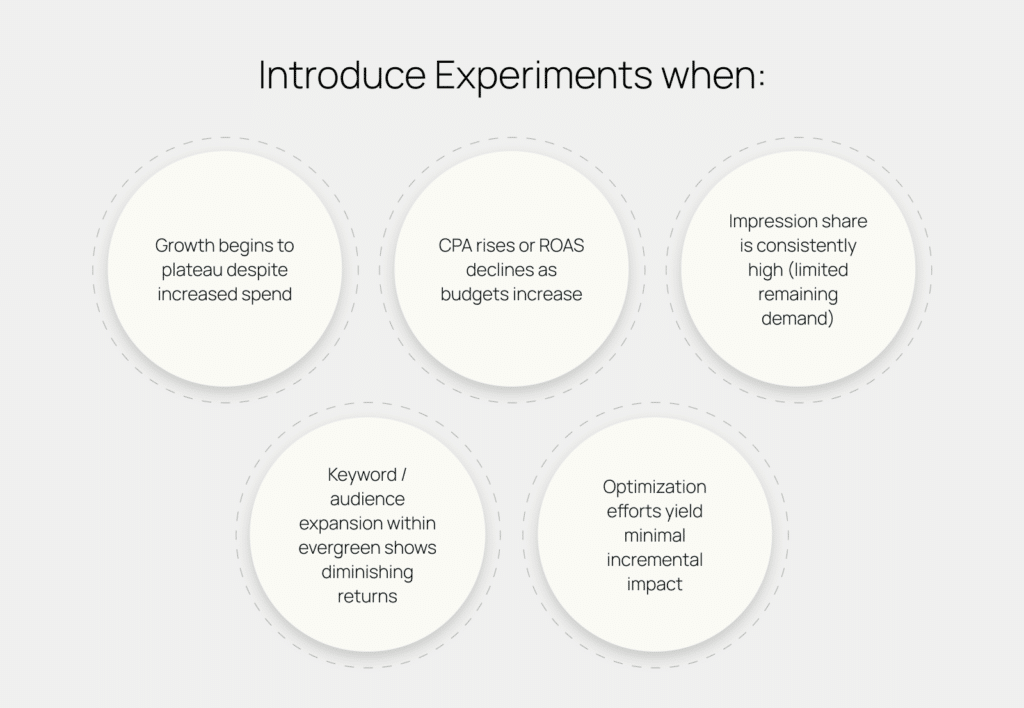
When those signals show up, the answer isn’t to keep forcing budget through a channel that’s tapped out. It’s to go find new demand.
That’s what experimentation is for: new audiences, new channels, new campaign types, new formats, new use cases. Experiments are not a replacement for evergreen and they’re not a hedge against it. Evergreen is your efficiency engine. Experimental is your growth engine.
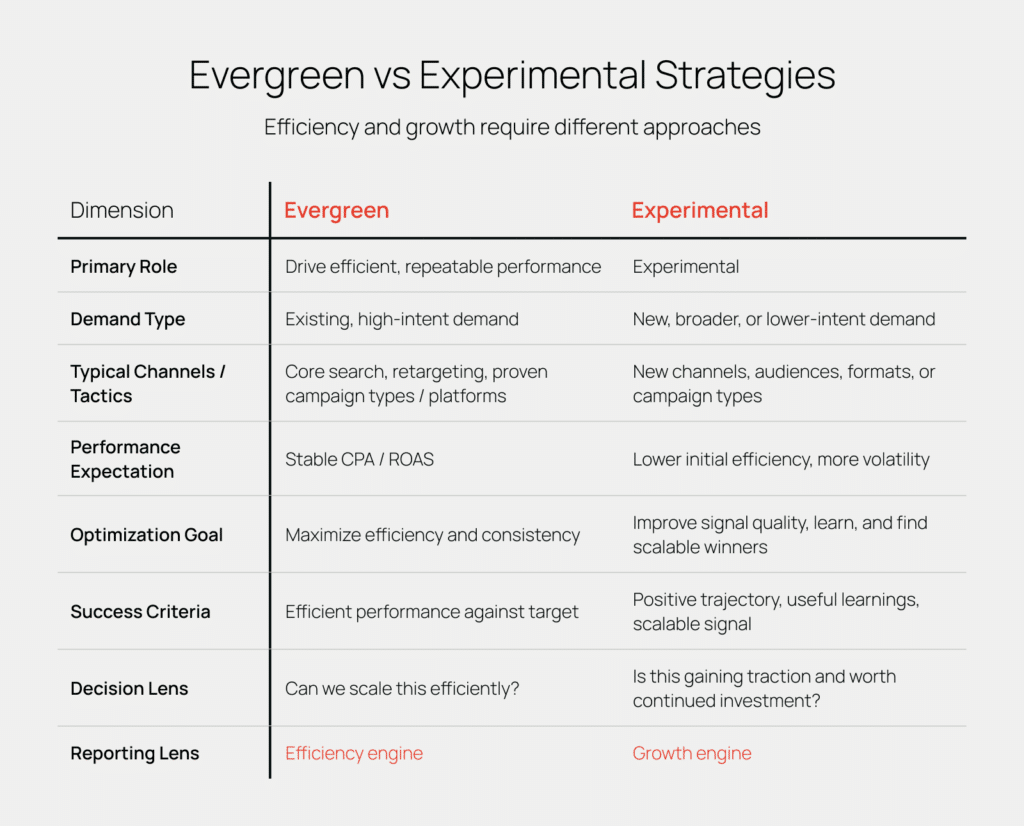
Here’s what that looked like on one account. Their evergreen campaigns had plateaued on the flagship product line, so we proposed expanding into their secondary lines — knowing full well those would be less efficient, but knowing the available growth was there.
We set that expectation before launch and split the budget goals: designated evergreen budget, designated experimental budget, reported separately. From day one the client understood these were two different jobs with two different sets of math. That framing is most of the battle.
Not every experiment will be a winner, and that’s expected. But many tests fail not because the idea was bad, but because of avoidable issues in how the experiment was planned or executed:
Experiments follow a predictable arc, and knowing it changes how you read the numbers.
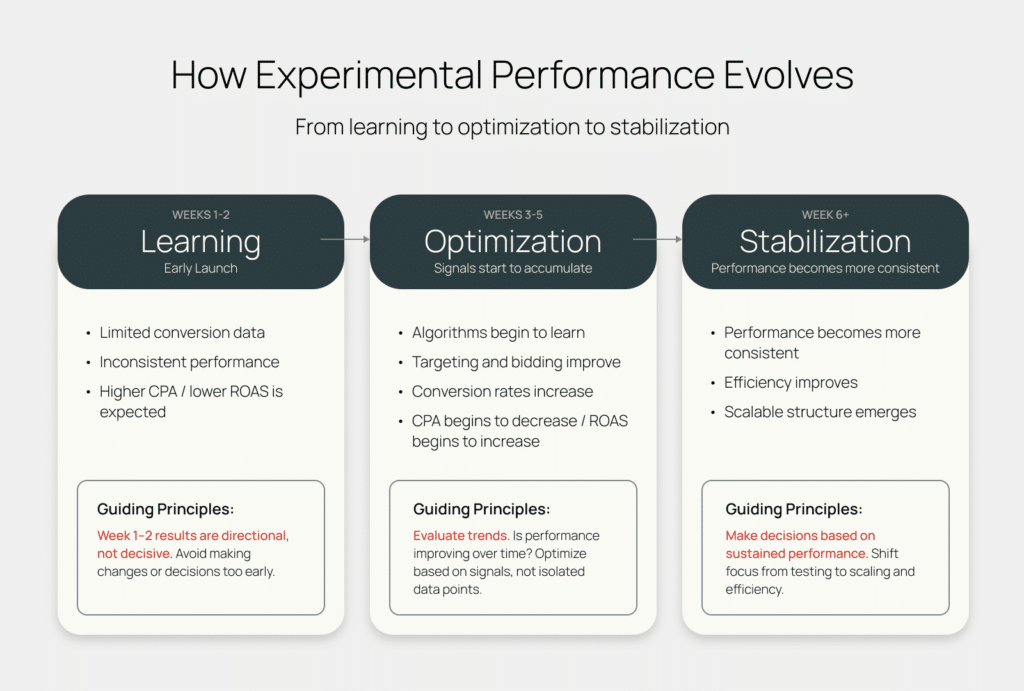
Weeks 1–2, learning. Conversion data is limited, performance is inconsistent, and CPA is high. This is expected. Week 1–2 results are directional, not decisive. Avoid making big changes or big decisions here.
Weeks 3–5, optimization. Algorithms start to learn. Targeting and bidding improve. Conversion rates come up. This is where you evaluate trends — is performance improving week over week? — rather than isolated data points. CPA is probably still off target, and that’s fine.
Weeks 6+, stabilization. Performance becomes more consistent, efficiency improves, and a scalable structure starts to emerge. Now you can make scale-or-cut decisions based on sustained performance and compare results against your targets with confidence.
Those windows flex with spend level and account data volume — a high-spend account gets there faster.
One important caveat, because “don’t react early” gets taken too far: there’s a difference between reacting to noise and fixing something that’s obviously broken. If you pull the search terms report in week one and all your budget is going to irrelevant queries, add the negatives. If your LinkedIn campaign is serving to entry-level titles when you’re selling to VPs, fix the targeting. Refining inputs is not the same as judging outcomes. Do the first constantly; hold off on the second.
When you do evaluate, ask better questions than “is it efficient yet”:
And if something looks off, diagnose before you react. Is the problem traffic quality, landing page friction, or just data volume? Is engagement strong but conversion weak? Are the search terms and audiences aligned with the use case you intended?
Every evaluation should land on one of three actions:
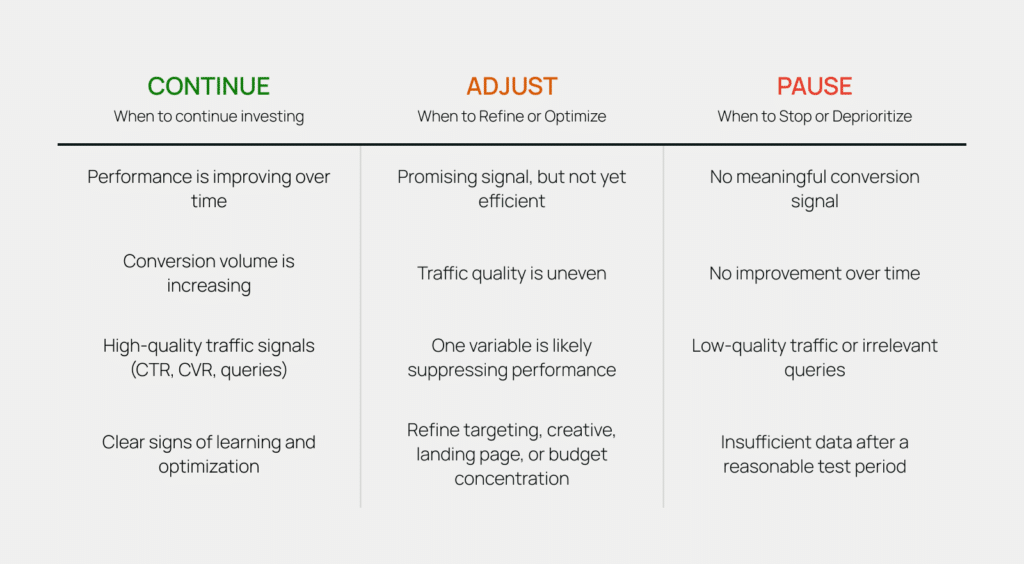
Most tests deserve a real shot at “adjust” before anyone reaches for “pause.”
Now the reporting problem, which is where a lot of good experimentation quietly dies.
Blended numbers matter. A business cares about total profitability, not the performance of one campaign in isolation, and you should absolutely know what your blended CPA or ROAS is and what the business can afford. But blended reporting without segmentation produces misleading conclusions.
Here’s the arithmetic, with round numbers:
| Evergreen | Experimental | Blended | |
|---|---|---|---|
| Spend | $50,000 | $20,000 | $70,000 |
| Revenue | $250,000 | $60,000 | $310,000 |
| ROAS | 5.0x | 3.0x | 4.4x |
Blended ROAS fell from 5.0x to 4.4x. If the target was 5.0x, that report looks like a miss. But total revenue went up by $60,000, and if the business can profitably operate at 4.0x, everything here is working exactly as designed. Without segmentation, someone looks at 4.4x and pauses the growth investment.
A real example from one of our lead gen accounts makes the point even more sharply. Experimental campaigns there took 3% of budget at a $120.70 CPA, against a $44.24 evergreen CPA. In isolation, $120 leads look indefensible. But blended CPA landed at $45.07 — under a dollar higher than evergreen alone — and that 3% of budget produced roughly 260 incremental conversions per month that evergreen simply had no room left to generate.
That’s the whole argument in one line: 83 cents of blended CPA for 260 conversions a month. You cannot see that trade in a blended number alone.
So report both. Segment evergreen and experimental so the difference is visible, show volume alongside efficiency, and show the blended figure against the threshold the business can actually afford. The story isn’t “our CPA went up.” It’s “we added this much incremental volume and stayed inside your profitability guardrail.”
There’s no universal split, and the right allocation depends on account maturity and growth goals. But if you want a starting point:
Lean more evergreen when demand is still uncaptured, impression share is available, and targets hold steady as spend increases. Lean more experimental when evergreen is saturated, incremental spend is getting less efficient, and the growth goal requires new demand. (The lead gen example above ran at 3% experimental and still moved the needle — these ranges are a rule of thumb, not a rule.)
The order of operations matters more than the exact percentages: protect efficiency first, then fund growth. Don’t pull budget out of evergreen to fund a test if it means leaving efficient demand on the table.
Then forecast before you launch. Two questions are worth answering on paper, in advance:
I’ve found forecasting does two things at once. It gives the client a range instead of a surprise, which takes an enormous amount of anxiety out of the first six weeks. And it makes evaluation dramatically easier on your end, because you set a goal to evaluate against instead of squinting at a dashboard asking “is this good?”
It’s also worth tracking the secondary signals, especially for upper-funnel tests. Increases in direct traffic and branded search volume, and improvements in branded campaign CTR, CVR, conversions, and CPA. Nobody wakes up and randomly searches a brand name — if branded volume climbs after you launch CTV or TikTok, that’s the experiment showing up in a place your platform report can’t attribute.
Successful experiments don’t stay experimental. That’s the point. A test that works becomes part of your evergreen foundation, gets evaluated like evergreen, and eventually hits its own ceiling — at which point you go looking for the next one. It’s a loop, not a line.
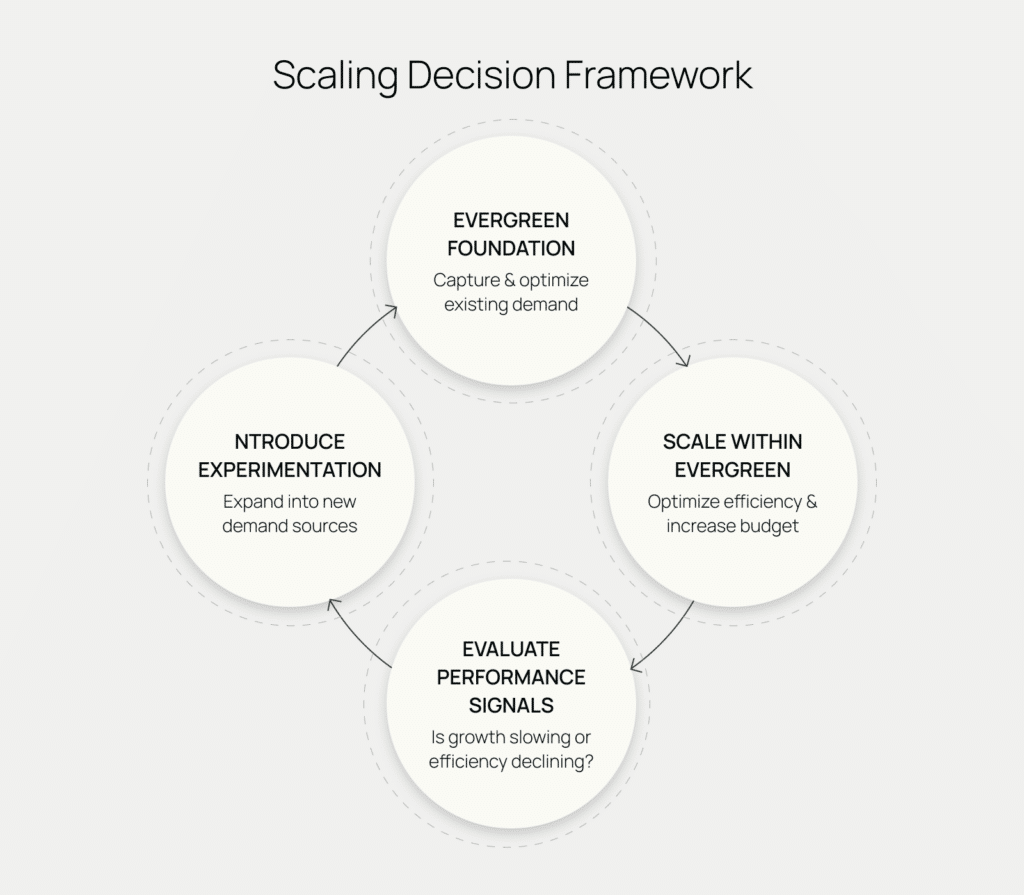
Which makes this a reasonable gut check for whoever runs your paid media, in-house or agency: Do they know where evergreen is maxed out and where it isn’t? Can they show you impression share and tell you what’s left to win? Is experimental budget designated and reported separately, or is everything blended into one number? Did they tell you what to expect in weeks 1–2 before the campaign launched, or are they explaining it now that you’ve asked?
Efficiency and growth pull against each other. That tension is normal, and it’s manageable — but only if somebody is deliberately managing both sides of it.
Ryan Nelsen, CMO at StackAdapt, walks through the same decision from the other side of the table — how his team decides a new channel has earned budget.
If you've spent any time in Google Ads, you've probably clicked past a little tab called Asset Studio without giving it much thought. I know I had, and I've been in that account more times than I can count. It's where all of your assets live, and lately Google has been quietly stuffing it full of AI tools: image generation, image editing, video creation, even sharable preview links so clients can approve creative without needing their own login. At Google Marketing Live this year, they demoed it starting with a handful of product photos and ending with a full AI-generated video. Naturally, we couldn't just take their word for it. We had to go break it ourselves.
So the advertising team carved out some time, pulled up our own Google Ads account as a sandbox, and started poking around. First question on everyone's mind: is this actually different from just using Gemini, or is it Gemini wearing a Google Ads name tag? Turns out, it's the latter. It’s powered by the same "Nano Banana" model, just living inside the platform instead of a separate tab. The real value isn't the image generation itself. It's that it's baked into the place your assets already are, and it claims to let you build off the creative you've already uploaded instead of starting from zero every time.
We started simple: a text prompt for a pickup truck, since the ad was for a tire client. It did a decent job. It rendered the truck and laid our copy over the image cleanly, and when we pointed out that the manufacturer's decal was sitting right on the grille, which isn't ideal when the ad is selling tires and not trucks, it removed the branding without a fight. All perfectly fine. Nothing our designers couldn't have made themselves.

Where it started to slip was the moment our prompts got vaguer. We asked it to "add cool design elements," and what came back was, charitably, an education in why taste is one of the hardest things to teach a machine. It turns out "cool" means something very different to an algorithm than it does to a designer, which is honestly the whole ballgame right there.



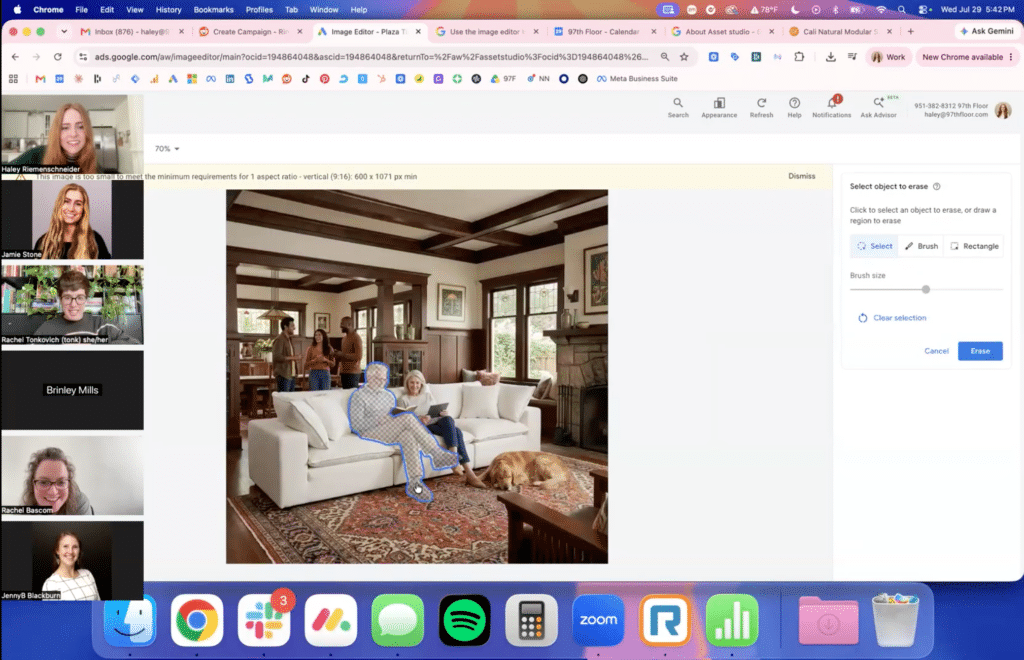
Things got more interesting once we stopped trying to invent from nothing and gave it a real product photo to riff on. We uploaded a couch on a white background, asked for lifestyle variations across a few different home styles, and got back ten solid options in under a minute. A few were genuinely impressive, but others were obviously synthetic once you looked closely, like the guy whose legs didn't quite reach the floor.


The moment that actually got a reaction out of the room was turning a still product image into video. We had a product photo on hand for a past client that sells safety gear, one of those accounts where we've always had imagery but never real video footage, and Asset Studio spun it into a working clip in under a minute. It was fast enough that someone on the team said flat out that having this a few years ago would have been life-changing for that account. That's the kind of result that earns a genuine "this is awesome," not because the clip was flawless, but because it solved a real gap we've actually run into with clients before.
Where it fell apart was anything resembling a finished ad. The moment we tried to get an actual ad copy or a client logo onto the image, it flattened everything into one background, didn't crop our logo file correctly, and generally reminded us that this is an asset generator, not a designer. The video side maxed out at five to ten second clips stitched together, which is a long way from the full 30-second AI commercial Google showed off on stage. And if you're picturing that as your new B-roll department, budget a good laugh into the process. We ran it through a "funky bucket" music template and I don't think any of us have fully recovered.
So where does that leave us? Honestly, right where a healthy dose of curiosity should: not racing back to Asset Studio for daily work, but keeping it on the radar. If you're working on a big product catalog account and need a hundred lifestyle variations, this could genuinely save hours. For the intentional, considered creative we build for most of our clients, it's not there yet, and probably won't replace what our design team brings to the table anytime soon. But it's worth knowing it exists, worth testing again in a few months, and worth remembering that somewhere out there is an AI-generated couch party with a dog, two guys who refuse to stop reading, and a soundtrack that should never see the light of day again.
If you've ever looked at your Google Ads dashboard and thought, "our cost per lead is way better than the target we set, nice," this is for you.
As of this week, that good news isn't automatic anymore. Google changed how target-based bidding behaves when campaigns are limited by budget.
A lot of advertisers aren't happy about it. I actually think it could be a good thing — as long as the targets sitting in your account reflect your business goals.
The idea behind target-based bid strategies is pretty straightforward: you give Google an efficiency goal, and Google optimizes toward it. With Target CPA (cost per action), that might mean telling Google you want as many leads as possible at a $100 cost per lead. With Target ROAS (return on ad spend), that might mean telling Google you want to generate $5 in revenue for every $1 spent.
Historically, if a campaign had a limited daily budget, Google could be more selective about which auctions it entered, prioritizing opportunities where it was most confident it could generate conversions efficiently.
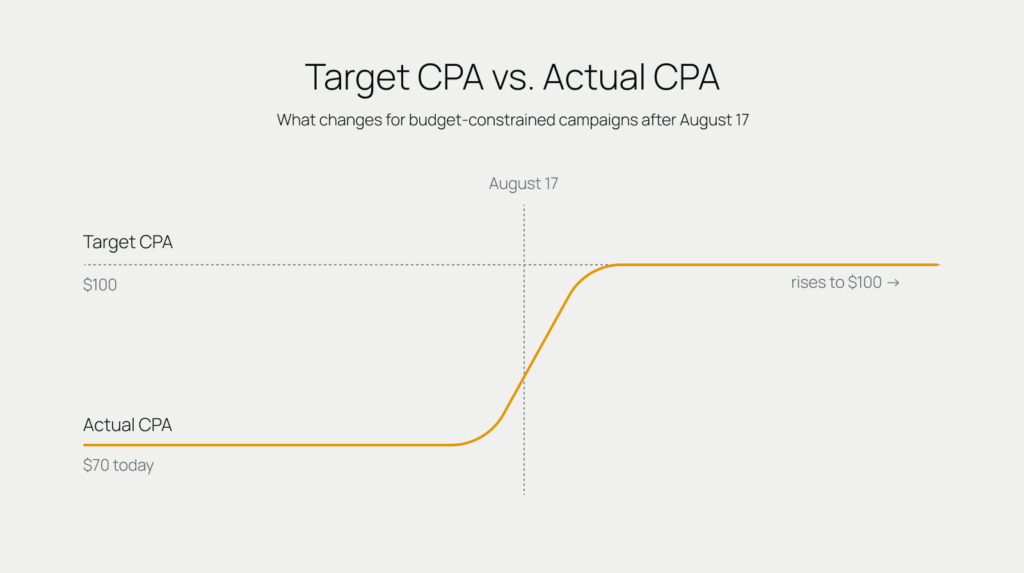
So, if your Target CPA was $100, you might actually have been getting leads for $70.
As of August 17th, that behavior has changed. Regardless of budget constraints, Google will now optimize much more consistently toward the target you set. A $100 target gets treated like a $100 target.
The change applies across Search, Shopping, Performance Max, Demand Gen, and Travel campaigns, for both online and offline conversions.
I understand why the initial reaction has been negative. If you've been getting $70 leads with a Target CPA of $100, hearing that Google may now optimize closer to $100 sounds like you're about to pay more for the same thing.
But here's the important part: you still control the target.
If $70 is the CPA your business actually needs, lower your Target CPA to $70. If your business can profitably acquire leads at $80 and your priority is growth, maybe $80 is the better target.
This is where I think the change gets interesting for advertisers looking to grow.
Historically, scaling could be difficult to predict. If you increased your budget, Google might have to reach beyond the auctions it had been prioritizing, and your $70 actual CPA could start climbing toward your $100 target. Your target hadn't changed, but your actual performance did.
Going forward, that relationship should be more predictable. If $70 is truly your target, tell Google $70. Then you can make budget decisions knowing Google will aim more consistently toward the efficiency goal you've actually set.
I've spent years asking Google reps some version of: if I set a target of $100, are you going to aim for $100, or try to beat it whenever you can? The answer was never particularly clear because budget constraints affected that behavior.
That ambiguity is what I'm excited to see go away.
You aren't losing control of your efficiency. You just need to be more intentional about telling Google what efficiency you actually want.
Whether your paid media is run in-house or by an agency, there are three things I'd be doing right now.
1. Find the campaigns most likely to be affected
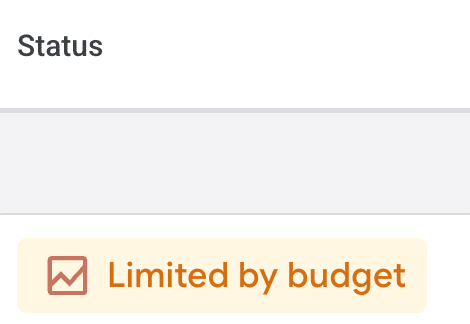
Start with campaigns using Target CPA or Target ROAS, particularly those currently flagged as "Limited by Budget." Those are the campaigns I'd watch most closely over the coming days and conversion cycles.
2. Compare your targets to your actual performance
If there's a significant gap between your stated target and what you've actually been getting, decide whether that target still makes sense.
Google released a Bid Target Adjustment Tool specifically to help advertisers review this. The tool pulls in campaigns using Target CPA or Target ROAS and shows your actual performance compared with your current targets, along with the date of the last target change.
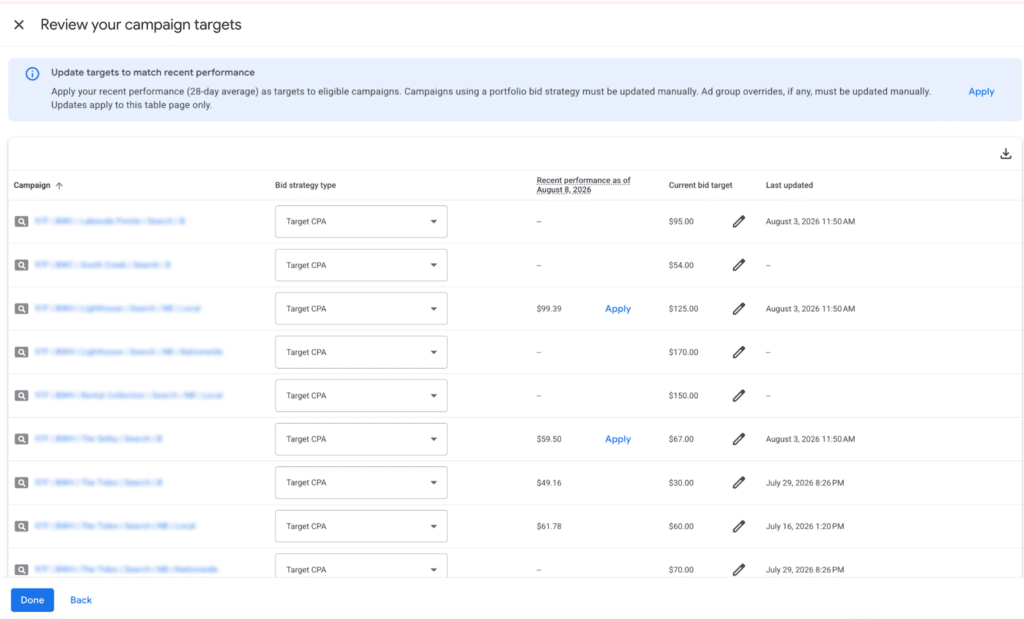
From there, you have four main options:
3. Start treating your target like an optimization lever
Your target shouldn't be a number that gets set once and then sits untouched for six months.
If you're hitting your target and spending your full daily budget, you may have room to push for greater efficiency. I generally prefer tightening targets incrementally — around 5–10% at a time — and watching whether Google can continue spending the available budget.
I'd especially consider testing this if you're losing Search Impression Share due to budget and your priority is efficiency rather than maximizing volume.
If your target becomes so aggressive that Google can't spend your available daily budget, you can loosen it incrementally if your business goals allow.
But if loosening it would take you outside those goals, don't accept worse efficiency just to spend more. Look for other optimization opportunities — like pausing keywords consuming significant budget without generating efficient conversions, improving ad copy, or testing landing pages.
And when you make meaningful changes, give them time to work. Depending on conversion volume and your conversion cycle, Smart Bidding can take a week or two to stabilize.
Avoid repeatedly changing budgets, targets, bid strategies, or conversion goals in quick succession, and make sure clients or internal stakeholders understand that some short-term volatility can be expected.
CPA and ROAS aren't the only metrics that could move.
Performance Max and Demand Gen spread your budget across multiple channels automatically, and this update could change how that spend gets allocated.
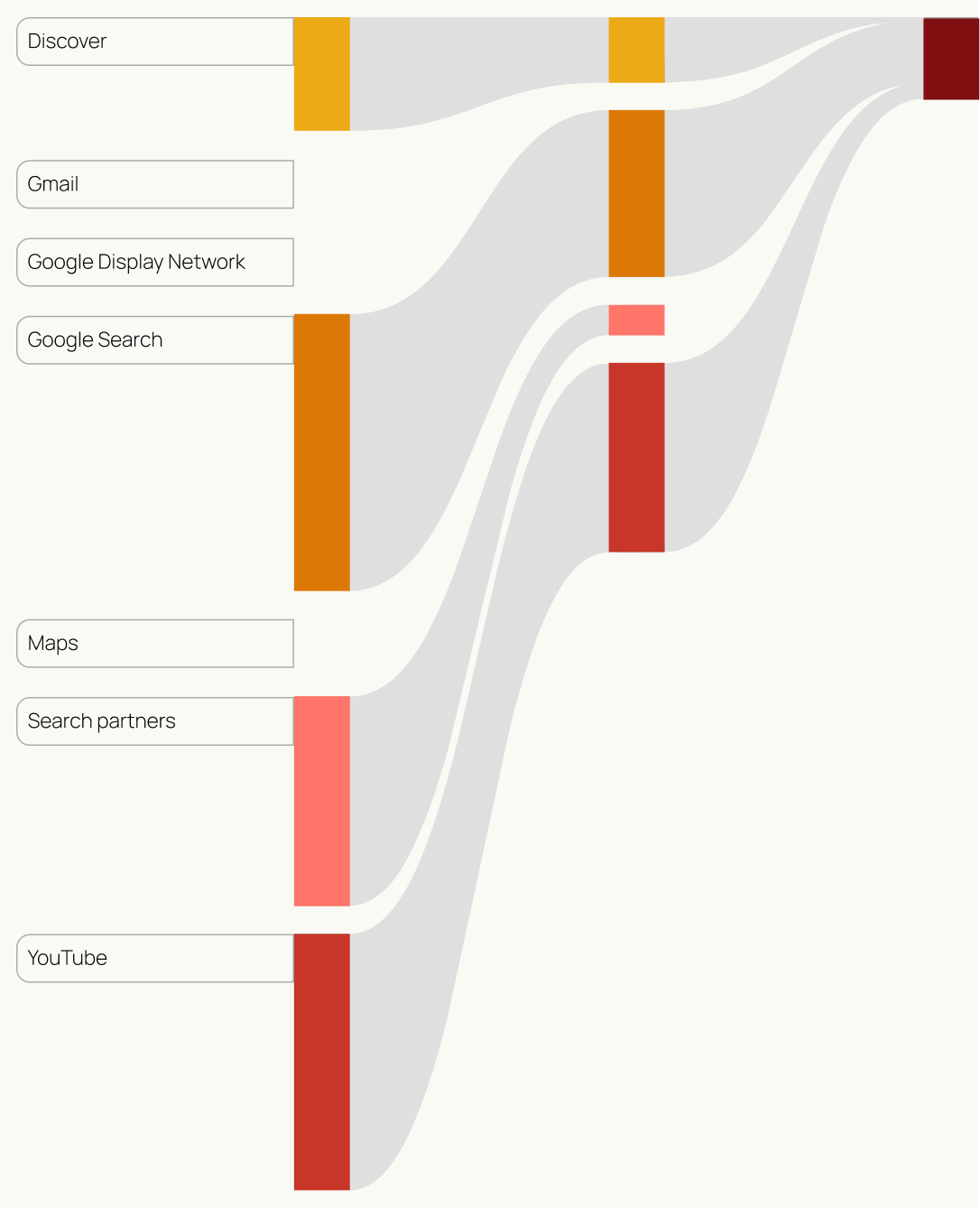
For example, if Google determines it needs to spend more on the Display Network to reach your target, you could see significant changes in CPC or CTR simply because your channel mix changed. A sudden drop in CTR doesn't necessarily mean your creative got worse if Google simultaneously shifted more spend into Display inventory.
That's why it's important to understand where your campaign is actually spending its money before deciding something is wrong.
A lot of the reaction to this update has been pessimistic. I think there's another way to look at it.
More predictable bidding should make performance easier to forecast and campaigns easier to scale. But it also puts more responsibility on the person managing the account. Targets can't be numbers that were set six months ago and forgotten.
This should be a gut check for your in-house team or agency: Did they know this change was coming? Did they identify which campaigns were affected? Did they adjust stale targets? And are they regularly reviewing those targets against actual performance and business goals?
The advertisers who benefit most will be the ones actively managing the relationship between budget, efficiency, and growth.
More predictable bidding gives advertisers a better lever for scaling. But like any lever, someone actually has to be paying attention to it.
If you want to go deeper on the mechanics of this update, Google's own documentation is worth the read: the support article explaining the change and the accompanying FAQ both cover the rollout and what to expect in more technical detail than we've gone into here.
Paid media has grown up.
Does this mean it’s simpler, calmer, or easier to manage? Hahaha. No. Quite the opposite, in fact.
In 2026, paid media lives at the intersection of automation, creative strategy, data interpretation, and business accountability. Platforms move quickly. Interfaces change often. AI touches almost every layer of execution. And budgets feel heavier than they used to, because expectations are heavier too.This is where the role of a PPC agency starts to look very different from what it did even a few years ago. What used to be about keyword bids and ad copy now looks much more like systems thinking, forecasting, and cross-channel coordination. Which is exactly why businesses continue to turn to PPC agencies: for guidance.
At its most basic, a PPC agency manages paid advertising across platforms like Google, Microsoft, Meta, LinkedIn, and emerging discovery environments (such as AI-driven search and retail media networks). That part hasn’t changed.
What has changed is how success gets defined and how work gets organized around it. A modern PPC management agency centers on business outcomes: qualified demand, revenue contribution, and scalable growth. Traffic still matters; it’s just not the only voice in the conversation anymore.Today’s PPC agency operates as a strategic partner. Campaign execution is supported by planning, forecasting, testing frameworks, and measurement models that extend beyond individual platforms. Heading into 2026, PPC agency models reflect this shift. Strategy, interpretation, and optimization layers now carry as much weight as execution itself.
Maybe not a huge surprise in this new era of autonomous, intelligent machines, but the most visible change is automation.
Bidding, targeting, and creative testing increasingly rely on machine learning systems that operate faster than any human team could. That reality shapes how a modern PPC agency adds value. Manual campaign management alone doesn’t always hold up well anymore. The real leverage comes from setting the right guardrails for automation and evaluating its impact. As such, PPC agencies now spend more time interpreting data, defining testing priorities, and connecting performance signals back to business goals.
Data integration plays a major role here. Performance spans analytics tools, CRM systems, lifecycle data, and attribution models rather than living in a single dashboard. A capable PPC agency knows how to connect those inputs so optimization decisions reflect actual business conditions.
No two PPC agencies present their services in exactly the same way. Still, the strongest ones tend to share a common foundation. Each capability reinforces the next, forming an approach designed to work cohesively as campaigns grow and evolve.
The impact of working with a PPC agency is rarely expressed as a single metric. It reveals itself over time, in how efficiently teams operate, how confidently decisions get made, and how resilient paid programs become as complexity increases.
Most teams tend to notice the value of a PPC agency when they suddenly realize that they have a moment to catch their collective breath. Budgets start to feel intentional instead of reactive. Testing moves forward with a clearer sense of purpose. Performance reviews become less about chasing fluctuations and more about understanding patterns. And as campaigns expand across platforms and audiences, that steadiness creates room to scale thoughtfully, without the anxiety-inducing feeling that everything needs to be fixed at once.
Paid platforms are in a constant state of motion, and keeping up with that change is practically a job in itself. Policies update, automation behaves differently, targeting options come and go, and none of it waits for anyone. A PPC agency lives in that reality every day so you don’t have to, tracking changes, pressure-testing assumptions, and making adjustments before small issues turn into expensive ones. That buffer matters most when budgets increase and leadership expects stability along with performance.
For leadership teams, the real value often shows up in how conversations change. Performance stops feeling abstract and starts making sense in the context of revenue targets, pipeline health, and growth plans. A strong PPC agency helps translate what’s happening in the platforms into signals leaders can actually use, whether that’s deciding where to invest next, when to pull back, or how aggressive to be with growth goals. That shared understanding tends to ripple outward, making planning smoother and decisions easier to stand behind.
Competitive markets have a way of exposing weak strategy very quickly. Costs rise, attention fragments, and small inefficiencies stop being small. This is where a modern PPC agency earns trust by bringing discipline, judgment, and a long view to every decision:
In crowded spaces, broad targeting gets expensive fast. Strong PPC agencies spend real time understanding who’s actually worth reaching and what signals indicate readiness. That work goes beyond basic audience definitions and into intent modeling, behavior patterns, and demand quality. Clarity makes budget decisions easier. Spend gets directed toward people who are actually nearing a decision, keeping efficiency from eroding even when competition gets fierce.
Most buying journeys don’t move in a straight line, and competitive markets certainly don’t change that fact. Effective agencies account for that complexity from the start. Awareness, consideration, and conversion campaigns are designed to work together, each playing a role at the right moment instead of fighting for credit. Messaging shifts as people learn more, pause, compare options, and return when the timing feels right.
In competitive auctions, creative fatigue sets in quickly. Ads that worked last quarter start blending into the noise. Strong PPC agencies counter this by treating creative as an ongoing system. Clear messaging frameworks shape what gets tested and why, while performance data guides what gets refined next. Over time, patterns become visible — which ideas consistently resonate, which formats hold attention, and which angles stall out early. That ongoing rhythm keeps accounts healthy and responsive, without forcing teams into constant, exhausting reinvention.
Maybe it goes without saying, but forecasting works best when it reflects how businesses actually operate. The best PPC agencies approach projections by looking at what has happened, what’s changing in the market, and how leadership defines growth. That framing helps teams understand what different budget levels are likely to support and where expectations should sit. This approach makes it easier to have honest conversations about tradeoffs, timing, and risk.
Clicks don’t tell the whole story, especially in competitive markets. But knowing what comes after the click? That’s where things start to get interesting. Context-driven optimization pulls insight from sales feedback, lifecycle data, analytics, and post-click behavior to show how paid traffic actually performs once it leaves the ad platform. That broader view changes decision-making. Keywords get evaluated based on lead quality. Creative gets refined using downstream signals, budgets shift according to what converts, and optimization reflects the kinds of real outcomes that matter.
Now, be aware that at some point, every paid media program hits a crossroads. Performance plateaus, complexity increases, and what once felt manageable starts to feel harder to steer. Choosing a PPC agency at that stage becomes less about day-to-day execution and more about finding a partner who understands how paid media fits into a broader growth system — one that connects strategy, data, and long-term direction.With that in mind, a few criteria tend to separate agencies that simply manage campaigns from those that help businesses grow:
| Strategic depth | Look for teams that can explain why they’re making decisions, not just what they’re doing. Strong strategy shows up in how campaigns are structured, how tradeoffs are discussed, and how priorities get set over time. |
| Transparent, outcome-driven reporting | Clear reporting connects spend to performance in ways leadership can actually use. That means fewer vanity metrics and more insight into efficiency, demand quality, and business impact. |
| Experience across industries and growth stages | Markets behave differently at different scales. Agencies that have seen multiple growth phases tend to anticipate challenges instead of reacting to them. |
| Responsible use of AI and automation | Automation plays a role, but judgment still matters. The right PPC agency knows how to guide and evaluate automated systems so performance stays intentional rather than opaque. |
| Alignment with internal teams | Paid media works best when it doesn’t operate in a silo. Agencies that collaborate closely with analytics, CRO, SEO, and internal stakeholders tend to drive more consistent results and clearer accountability. |
There probably isn’t a single moment when a business suddenly “needs” a PPC advertising agency. It usually shows up as a pattern. A few small frictions pile up. Questions take longer to answer. Confidence in decisions starts to wobble. Often, this is precipitated by symptoms that are worth keeping an eye out for:
At 97th Floor, PPC advertising strategy starts with a simple acknowledgment: paid media lives inside a much bigger system than it once did. Revenue targets, pipeline realities, internal constraints — all of that shapes what paid media can and should do. We take the time to understand those inputs early, because everything downstream works better when the destination is clear.
Paid search and paid social operate within shared frameworks, not separate silos. Insights move between channels, and performance signals actually get used instead of parked in dashboards. AI and automation play their part, but always with human direction. Our teams set guardrails, interpret results, and test assumptions so optimization stays intentional and grounded in outcomes that matter.But let’s be clear about one thing: That work only holds up when collaboration is real. That’s why our PPC teams partner closely with analytics, SEO, and CRO specialists to reflect how users actually move through the journey. Consider our work with JK Moving, where reshaping paid media around demand quality and intent alignment led to more qualified leads and better efficiency in a crowded market. This is what happens when strategy, testing, and cross-team coordination pull in the same direction.
Planning a PPC investment in 2026 requires more than setting a budget and choosing platforms. It starts with understanding where you are today and where paid media fits within your broader growth plans. As you get started, be sure to:
For more than 20 years, 97th Floor has helped enterprise brands grow through constant shifts in how media works — by staying curious, experimental, and deeply invested in what’s changing next. Our PPC management approach blends strategy, data, and execution into systems designed for modern platforms, AI-driven optimization, and the realities of today’s paid media landscape.
So, if you’re ready to build a PPC strategy that supports long-term growth and adapts as paid media continues to evolve, we’re ready to help. After all, paid media has grown up. And with our help, your business can continue to grow right alongside it.
Running an ecommerce brand in 2025 is like hauling feral cats out of a burning building — noble work, but try it alone and you’ll come out with more scars than survivors. That’s because ecommerce isn’t a single challenge; it’s dozens of moving, clawing parts that demand your attention all at once. Scaling an online store goes way beyond having great products. Visibility, customer experience, and platform mastery all play a role in turning browsers into buyers.
Ecommerce agencies step in as that extra set of hands. They handle the heavy lifting across SEO, paid ads, conversion rate optimization, design, and retention so you can focus on keeping your business upright and your capital from bleeding dry.
In this guide, we’ll cover what ecommerce agencies actually do, how to know if it’s time to hire one, what makes a ‘best’ agency stand out, and seven agencies in the U.S. worth your attention in 2025 — including ours (because, full disclosure, we’re really good at what we do).
If you’re reading this, you probably already have a sense of what an ecommerce agency does. Still, let’s not skip the basics.
An ecommerce agency is a specialized partner built to help online stores grow faster, smarter, and with fewer headaches. Unlike general digital agencies, ecommerce agencies focus specifically on the unique demands of online retail.
That means:
They’re measured by commerce-specific metrics like average order value (AOV), lifetime value (LTV), return on ad spend (ROAS), and retention — not just traffic or impressions. All of this is to say an ecommerce agency’s job isn’t finished once visitors land on your site. Their role is encouraging those visitors to stick around and actually buy something.
We’re not going to sugarcoat it: Hiring an ecommerce agency isn’t cheap. But the right one can more than pay for itself by uncovering growth opportunities you didn’t even know existed. It’s like figuring out which wire to cut on a ticking bomb after watching one YouTube tutorial. Technically possible, but maybe bringing in a professional would be safer?
In other words, the benefits go way beyond saving time (though that’s nice, too). Here’s why brands turn to ecommerce agencies in 2025:
Without checking any listings, we’re pretty confident in telling you that there are thousands of agencies out there ready to take your call. But what separates the good from the genuinely great? Flashy websites and slick pitch decks are nice, but results are what actually matter. The best ecommerce agencies prove their worth by showing exactly how they’ve helped brands move the needle.
Not every agency that slaps ‘ecommerce’ on its homepage is worth your budget. The best agencies share a few traits:
Statista projects that worldwide ecommerce sales will hit roughly $3.66tn by the end of 2025. And, if you’re like me and don’t immediately recognize ‘tn’ as a unit of measurement, it stands for trillion (12 zeroes). That’s a lot of potential growth; having a dependable agency by your side can help your business carve out its share instead of getting buried under everyone else’s.
You made it. This is the list you came here for. These seven agencies stand out in 2025 not only for their services, but for their ability to deliver measurable, platform-specific results. We’ll cover who they’re best for, what services they offer, and what makes them different in a crowded space.
Best for: Integrated growth across SEO, paid, and conversion optimization
Most agencies promise growth. 97th Floor has made a business of proving it. With deep roots in content, SEO, and analytics, 97th Floor doesn’t just help ecommerce brands ‘get more traffic’ — they work with you to align every marketing channel to generate more sales, more efficiently.
97th Floor is a full-service growth agency with a knack for turning ecommerce complexity into measurable outcomes. Their bread and butter includes:
If you want a partner that doesn’t just tweak one channel but instead pulls the whole system into alignment, 97th Floor is a top choice.
Best for: Content-driven ecommerce growth
Content is king, but only if it ranks — otherwise it’s just some obnoxious court jester that capers around the digital courtyard juggling outdated keywords (don’t mind me; just stress testing a metaphor). Siege Media built its reputation on creating research-backed, SEO-optimized content that ecommerce brands can use to win organic visibility. If you’re tired of writing blog posts that nobody reads, this is an agency that can change the story.
Strengths include:
If organic growth is your north star, Siege is the kind of agency that can help you outrank competitors without relying solely on ad spend.
Best for: Platform migrations and storefront optimization
Technology can be a brand’s biggest advantage — or its biggest bottleneck. 1Digital® Agency specializes in fixing that problem by making sure your storefront is fast, functional, and scalable, no matter which platform you’re on. Whether you’re moving from Magento to Shopify, need a WooCommerce overhaul, or want to unify your BigCommerce setup, they’ve been there.
They offer:
Overall, 1Digital® Agency is a good fit for brands with growing pains tied to their tech stack.
Best for: ecommerce SEO at scale
SEO may not be flashy, but it’s the backbone of sustainable ecommerce growth. WebFX has built a reputation on measurable outcomes, particularly around SEO. They’re a fit for ecommerce brands that want more organic traffic and are ready to invest in long-term visibility.
Services include:
They’ve worked with thousands of clients and have the scale to match complex ecommerce needs.
Best for: Amazon and marketplace strategy
For many brands, Amazon is both an opportunity and an obstacle — massive reach, sure, but also high fees, fierce competition, and limited control over the customer relationship. Nuanced Media helps navigate that complexity by giving you a strategy not only for your own storefront, but also for Amazon, Walmart, and other marketplaces where your customers are already shopping.
Highlights:
Great for brands that want to diversify beyond their own dot-com.
Best for: Conversion rate optimization and UX
If you’ve ever looked at your analytics and thought, Why aren’t more people buying? Inflow is the agency built to answer that question. They specialize in conversion rate optimization and user experience, making sure the traffic you already have does more heavy lifting.
Core strengths:
Traffic is great. Conversions are better. If your store has healthy traffic but underwhelming conversions, Inflow is a CRO partner to look at.
Best for: Performance marketing and paid growth
Growth often comes down to how well you spend your ad dollars. Upgrow focuses on performance marketing — paid search, paid social, and scaling strategies — so ecommerce brands can grow quickly without throwing money into the void.
They offer:
For ecommerce brands ready to put budget into scaling, Upgrow brings the paid expertise to do it properly and profitably.
This has been fun, hasn’t it? I mean who doesn’t love a good listicle. But it's worth recognizing that knowing who the top agencies are is only the first step. The real challenge is figuring out which one you actually want a long-term relationship with. You’re not swiping for a quick fling here — you’re looking for a partner who won’t ghost you when the budget conversation gets awkward.
Not every agency offers every service, but most ecommerce specialists fall into one or more of these categories. Think of it like a restaurant menu — you don’t have to order Ultimate Feast, but it’s good to know whether crab is available and if the lobster is fresh.
The service menu is broad, but most ecommerce agencies will cover some or all of these areas:
Do you need all of that? Maybe not. But if you’re building a working relationship with an ecommerce agency, then it might be a good idea to find one that can do everything in case your needs evolve somewhere down the line.
We sell ecommerce services, so maybe we’re not the most objective source to be asking. But we also get it: in an economy like this one, it doesn’t make sense to invest in something you might not need. If that’s you, and you’re wondering if ecommerce is the next step for your business, consider asking yourself the following questions:
In the ‘in-house vs. agency’ debate, the tipping point usually comes when you realize a single marketing hire can’t cover the breadth of expertise you need. Agencies provide a full team of specialists for the cost of one or two more employees.
At this point, you know what ecommerce agencies do, you know what makes a great one, and you know which names stand out in 2025. So why should you consider 97th Floor? The short answer: because we choose not to focus on optimizing channels and instead put our expertise to work optimizing outcomes.
97th Floor has helped ecommerce brands grow by aligning creative, technical, and analytical expertise into a single strategy. Our teams handle everything end-to-end:
At 97th Floor, the goal isn’t isolated channel wins. The goal is connecting those wins so they push the whole business forward (metaphorical cats and all).Ready to scale smarter? Let’s talk. Contact 97th Floor today to see how we can help your ecommerce brand grow in 2025 and beyond.
You’re busy running a business, and you shouldn’t have to spend so much effort figuring out the ins and outs of the marketing industry. When you partner with a marketing agency, they can handle understanding complex buying cycles, nurturing leads, SEO, content marketing, and ultimately delivering measurable results. A B2B marketing agency can specifically help companies that make products for other companies, instead of for the general public.
Whether your goal is to accelerate pipeline growth, expand into new markets, or enhance customer engagement, partnering with the right B2B marketing agency can turn your marketing investment into tangible, revenue-generating outcomes. Read on to learn more about working with a B2B marketing agency and how to find the right one.
A B2B marketing agency is a specialized firm focused on helping businesses market their products and services to other businesses rather than individual consumers. Unlike B2C agencies, which often prioritize mass reach and broad engagement to help you find customers, B2B agencies are designed to reach companies and target top decision-makers in order to draw clients to your company. The agency will work on generating high-quality leads and strengthening your brand in the spaces where your potential clients are.
A B2B marketing agency usually covers a wide spectrum of services, including content marketing, digital campaigns, marketing automation, analytics, and account-based marketing (ABM). At the core of their work is brand positioning—helping companies articulate their value proposition, differentiate from competitors, and establish authority in their markets.
Below are industry-recognized agencies, each with a unique strength to help you compare and choose.
Best for Full-Funnel Strategy & ROI-Driven Growth
97th Floor specializes in full-funnel marketing strategies, combining SEO, paid media, content marketing, and design services. We generate sustainable growth for B2B companies from startups up to the Fortune 500 list—including Salesforce, AT&T, LG, Google, and Celebrity Cruises. Our in-house proprietary tool, Palomar, also helps inform strategy with real-time market intelligence and competitive insights.
Best for SEO + Content Marketing
Siege Media is known for high-quality, keyword-driven content that improves rankings and conversions in SaaS, fintech, and e-commerce sectors. They focus on creating content that drives organic traffic and builds brand authority.
Best for Performance Marketing
Directive Consulting is an expert in paid media, SEO, lifecycle marketing, and demand generation within complex SaaS and enterprise markets. They elevate the focus of B2B marketers from MQLs to qualified pipelines.
Best for Agile Tech Company Marketing
New North excels in multi-channel strategies tailored for tech firms, combining agility with long-term strategic planning. They help B2B technology companies grow with better marketing and offer personalized strategies and dynamic campaigns.
Best for Lead Generation & ABM Strategy
Ironpaper focuses on data-driven demand generation, content sprints, ABM, and conversion optimization for tech clients. They align marketing and sales to drive measurable outcomes.
Best for AI-Enhanced Growth Marketing
Avenue Z combines narrative clarity, AI visibility strategies, and CRM-integrated campaigns for enterprise and professional services. They position brands at the top of their category by turning complex offerings into digestible thought leadership.
Best for Research-Driven Campaign Design
Elevation B2B delivers omnichannel campaigns rooted in strategic insights for brand awareness, lead generation, and growth. They focus on providing full-service, data-driven marketing solutions specifically for B2B companies in tech.
Best for Professional Services Thought Leadership
Hinge Marketing specializes in branding and marketing strategies tailored to professional services firms. Their research-driven approach and emphasis on thought leadership help build authority and pipeline impact.
Best for Holistic Digital Campaigns
Power Digital delivers SEO, PPC, content marketing, and social media with data-driven precision and proven lead-gen results. They offer a comprehensive suite of services to drive growth and optimize marketing ROI.
Best for Visual Brand Storytelling
Column Five are experts in brand strategy, content, data visualization, and multimedia—especially for SaaS and tech brands wanting engaging storytelling assets. They focus on creating compelling narratives that resonate with target audiences.
A B2B marketing agency offers specialized services designed to address the unique challenges of marketing products and services to other businesses. At the heart of effective B2B marketing is creating a marketing strategy that aligns with your business objectives. Agencies collaborate with you to develop comprehensive plans that encompass market research, competitive analysis, and customer insights to create this strategy and help you achieve your goals.
B2B marketing agencies provide a suite of services tailored to the intricate needs of business-to-business marketing, usually including:
B2B marketing agencies can help your company grow thanks to a combination of strategic planning, technology, and data-driven execution. Their focus is attracting great and promising leads and also nurturing those relationships. Below are three ways working with a B2B marketing agency can help your company find the growth you’re looking for.
A core function of B2B marketing agencies is identifying and nurturing high-quality leads. They focus on marketing qualified leads (MQLs)—prospects who have shown interest or engagement with your brand—and work to convert them into sales qualified leads (SQLs), who are ready for direct sales engagement. By aligning marketing and sales efforts, agencies ensure a smoother handoff and higher conversion rates.
B2B marketing agencies often use automation and CRM tools like HubSpot, Marketo, and Salesforce to manage campaigns, track prospect interactions, and deliver personalized messaging at scale. Automation allows agencies to nurture leads while also reducing manual work, so you can see results.
To demonstrate impact and optimize strategies, agencies employ marketing attribution models that track performance across all touchpoints your company needs. These models help your business understand which campaigns, channels, and messaging strategies contribute the most to revenue generation. By analyzing ROI and attribution data, agencies can continuously refine their tactics and help you create a great budget that leads to measurable growth.
Selecting the right B2B marketing agency is the first step to getting the results you want to see. The best partnerships are built on expertise, alignment, and trust, so it’s important to ask the right questions and look for key indicators of reliability. Here are some tips to help you pick out the right fit for you.
Before committing, consider asking potential agencies questions that reveal their capabilities, approach, and fit with your business:
A trustworthy agency demonstrates transparency, flexibility, and proven results. Look for clear reporting practices, adaptable engagement models, and a track record of delivering measurable growth for clients. Ask for case studies and see if this agency’s strategies and efforts would work for your company.
When choosing an agency, avoid making decisions based solely on cost. Sometimes it’s worth paying more for a higher quality B2B agency where you’ll see results. Also consider whether or not the agency will be a cultural fit for your company—just as you would for an employee. Taking the time to vet agencies thoroughly ensures a partnership that drives real results.
For more guidance, read our full Agency Success Playbook for in-depth tips on selecting a high-performing B2B marketing agency.
B2B marketing agencies can help a wide range of industries grow, but certain sectors see especially strong results.
For technology and SaaS companies, marketing agencies focus on subscription models, reducing churn, and increasing customer lifetime value—all of which can help your company grow. They implement targeted campaigns, content strategies, and ABM approaches to engage decision-makers and accelerate adoption.
Learn more about SaaS industry marketing
Learn more about cybersecurity marketing
Manufacturing and industrial businesses often face long sales cycles and niche target audiences. B2B marketing agencies help these companies identify and engage the right buyers, craft tailored messaging, and build campaigns that support complex buying decisions.
Learn more about construction equipment marketing
Learn more about industrial sector marketing
Professional services and healthcare organizations rely heavily on authority and trust. Agencies in these sectors focus on thought leadership, content marketing, and reputation-building strategies that demonstrate expertise and credibility to prospective clients.
Learn more about financial services marketing
Learn more about health and wellness marketing
Want to see how B2B marketing can transform your company? Here are a few case studies to get you started:


See more success stories to get an idea of how a B2B marketing agency can help you.
Measuring success is critical to understanding the impact of your B2B marketing efforts and optimizing for growth. Agencies use a combination of quantitative and qualitative metrics to track performance, inform decisions, and maximize ROI.
97th Floor is a trusted partner for B2B companies looking to drive measurable growth through strategic, data-driven marketing. With proven expertise across digital marketing disciplines—including content, SEO, paid advertising, design, and emerging AI-powered SEO tactics—our team helps businesses generate leads, accelerate pipeline growth, and maximize ROI.
We prioritize transparent communication and consistently deliver results backed by analytics, so that every campaign is aligned with your business objectives. What sets 97th Floor apart is our deep industry experience combined with flexible engagement models. We tailor strategies to your unique needs and scale as your business grows.
See how an audience-first approach translates to bottom-line results.
Google promises better results with just one click—“Apply All Recommendations.” But what if those recommendations aren’t actually in your best interest? At 97th Floor, we’ve seen firsthand how blindly following Google's automated suggestions can drain budgets and derail strategy. So we put it to the test. In a head-to-head experiment, we pitted Google’s recommended setup against our tailored, expert-built campaigns. The results were eye-opening—and could change the way you manage your ad spend.
We tested campaigns with three of our clients to compare the effectiveness of Google’s automated recommendations with the hands-on approach taken by our experienced advertising team at 97th Floor. Each campaign was structured to align with specific goals, but the key difference was in how they were managed:
| 97th Floor | ||
|---|---|---|
| Objective | Select one | Select one |
| Conversion actions | Auto-select | Manually select |
| Campaign type | Search | Search |
| How you reach goals | Visit website | Visit website |
| Bidding | Start with conversions | Start with clicks |
| Max CPC limit | Don’t start with one | Start with one depending on client; not too restrictive (e.g., under $10) |
| Networks | Allow Search partners and Google Display Network | Turn Google Display Network off; test Search partners if... |
| Location | Set a location as presence or interest | Set a location as presence only |
| Audience Segments | Observational targeting | Observational targeting |
| Broad match | On | Off |
| Automatically created assets | On | Off |
| Ad rotation | Optimize for best performance | Optimize for best performance |
| Ad schedule | None | Add if needed |
| Campaign creation | Go through Google's process | Go through 97th Floor's process |
| Ad copy | Use Google's suggestions | Written by expert content marketer |
| Budget | Equal budget | Equal budget |
| Optimizations | Turn on auto apply recommendations for this campaign | Optimize manually |
Here are the settings we kept the same between the control and test group. These are Google’s recommendations that we agree with.
| 97th Floor | ||
|---|---|---|
| Objective | Select one | Select one |
| Campaign type | Search | Search |
| How you reach goals | Visit website | Visit website |
| Audience Segments | Observational targeting | Observational targeting |
| Ad rotation | Optimize for best performance | Optimize for best performance |
| Budget | Equal budget | Equal budget |
When you feed a smart bidding system bad signals, you get bad results. We focus on signal quality to guide the algorithm toward actual business growth — not just form fills or button clicks that look good on paper.
| 97th Floor | ||
|---|---|---|
| Conversion actions | Auto-select | Manually select |
Smart bidding needs data to perform well. Jumping straight to "Maximize Conversions" without historical data is like trying to sprint before you've learned to walk. Our approach allows us to build a strong foundation — minimizing waste while setting the campaigns up for smarter automation later.
AI tools speed up the work — whether they're improving it is a different question. Whitney Goldstein draws the line, and this short video breaks down how to tell which one your workflow is actually delivering.
Without a CPC cap, Google can overspend on low-quality traffic. We applied reasonable limits to protect budget efficiency.
| 97th Floor | ||
|---|---|---|
| Bidding | Start with conversions | Start with clicks |
| Max CPC limit | Don’t start with one | Start with one depending on client; not too restrictive (e.g., under $10) |
The Display Network may offer more impressions, but not always better ones. Especially early on, we want every click to count — and that means keeping the focus tight on search intent, not expanding blindly into display.
Advertising to someone thinking about your market is not the same as advertising to someone in your market. Having your location set as presence or interest allows Google to waste your dollars on the wrong users.
Google's default runs ads 24/7. We customized schedules to align with peak engagement and business hours when necessary.
| 97th Floor | ||
|---|---|---|
| Networks | Allow Search partners and Google Display Network | Turn Google Display Network off; test Search partners if... |
| Location | Set a location as presence or interest | Set a location as presence only |
| Ad schedule | None | Add if needed |
Broad match can open the floodgates — sometimes usefully, sometimes recklessly. We prefer a controlled expansion. Typically, we prioritize stricter match types, like phrase or exact. We use broad match strategically, mostly on longer tailed terms since the intent is more spelled out. It’s important to test broader match types strategically—you don’t want to waste ad spend but you do want to take into account that 15% of searches every day are new. People could be in the market for your product or solution but type it in differently than your keywords. Broad match keywords are a good way to mine for new keyword ideas.
| 97th Floor | ||
|---|---|---|
| Broad match | On | Off |
Auto-generated ads often sound robotic and generic, or can state things that are outright wrong. We believe brand voice is too important to automate away — especially when you have just seconds to grab a user’s attention and build trust.
| 97th Floor | ||
|---|---|---|
| Automatically created assets | On | Off |
In every case, the campaigns managed by 97th Floor outperformed those set up using Google’s automated recommendations. Here's a breakdown of the results:
The data speaks for itself—relying solely on Google’s recommendations can leave performance on the table. While Google’s automation offers convenience, it lacks the precision and strategic insight required to maximize advertising budgets effectively. 97th Floor’s campaigns delivered better results, proving that expertise and human intervention are essential for optimal ad performance.
If you're relying entirely on Google’s automation, you could be spending more without seeing the results you deserve. At 97th Floor, we offer expert campaign management that outperforms Google’s one-size-fits-all approach. Contact us today to see how a professionally managed campaign can transform your advertising results.
See how an audience-first approach translates to bottom-line results.
For seasonal business owners, demand rises and falls with the changing weather. While seasonality is a unique and perhaps daunting challenge, the predictable rhythm of demand means that those businesses who can sync their marketing with the mandates of sun or snow can have success year-round.
97th Floor is no stranger to seasonal marketing; we’ve executed winning strategies for businesses including pool maintenance, sports equipment, cruise lines, pest control, lawn care, solar, and moving services, just to name a few.
In this article, our resident experts in SEO, content, and advertising share five actionable tips for seasonable business marketers.
Search Engine Optimization (SEO) is a long-term game, and waiting until peak season to focus on it can be a costly mistake. It's essential to begin your SEO efforts well in advance, ideally during the off-season.
Head of SEO Mike Witham says, “You need consistent year round efforts to maintain and improve rankings. If your peak season is in March, you should be ensuring you have solid rankings for core pages by no later than December. Do not start working on it the month before your peak season!”
For businesses serving multiple states or a large region of the country, seasonal demand may be different across these various geographies.
Enterprise advertising specialist Spencer Martin uses Google Keyword Planner to anticipate search volume fluctuations in different areas.
He shares, “We launch campaigns early so that we have 2 to 4 weeks to ramp up and capture the full demand. Campaigns need time to scale and learn, so if we wait until the season starts to launch we lose out on potential profits for our clients.”
While digital marketing is crucial, seasonal businesses can see major wins by looking at more traditional advertising. Enterprise Account Executive Nathan Hooper suggests non-digital forms of advertising, such as mailers or community events to target local audiences. Advertising on community calendar pages or local business directories can put your business in front of potential customers who may be researching local services.
Understanding your buyer and their motives for buying is essential for capturing demand at the right time.
Brandon Smithwrick asks what happens to your marketing instincts when you let AI do all the thinking. He breaks down how cognitive offloading quietly erodes the skills great marketers are actually built on.
Senior Director of Campaigns Jon Hammond shares that his clients in the travel industry refer to December through February as “The Wave.” This three-month period is the biggest sales period for travel as people look forward to summer sun during the cold, dark winter months. His clients maximize their ad budget and run major deals and promotions during this time to capture the demand.
Content Marketing Specialist Kaylee Baker emphasizes the importance of targeting specific demographics, such as 18-30 or 25-40-year-old males, who are the main consumers of seasonal services. Consider the platforms they frequent, such as YouTube, to tailor your marketing efforts accordingly.
When reporting to leadership, especially in industries with high historical seasonality, like cruises, it's essential to use Year-over-Year (YoY) data rather than Month-over-Month (MoM) data. This approach provides a more accurate depiction of progress or decline in traffic or sales over the seasons. By analyzing YoY data, you can better understand trends and make informed decisions to optimize your marketing strategies.
In conclusion, marketing a seasonal business requires careful planning, adaptation, and understanding of your target audience. By implementing these five tips, you can maximize your marketing efforts and capitalize on seasonal fluctuations in demand.
Meta ads win or lose on creative. Your targeting and budget can be flawless, but if the creative falls flat, the campaign fails. Sharpening your ad creative is one of the highest-return moves you can make on Meta. Strong creative catches attention in a crowded feed, tells a story quickly, and drives action. Any brand can apply these practices to improve performance.
At 97th Floor, we build and test Meta ad campaigns that deliver measurable ROI. These are the Meta creative best practices we see work time and again, backed by real examples you can learn from.
Let’s get into it.
Because they compete on design and emotion, luxury brand ads are great examples for creative execution. As a matter of fact, Meta is basically the only place many luxury brands are putting their paid media dollars. A smattering of ad budget goes to display ads or YouTube, but well over 75% of luxury brands' advertising efforts happen on Facebook and Instagram.
We’ve pulled Meta ads from ten luxury home brands to see how they’re pairing copy and imagery to entice their buyers.
Use these ads and our analysis as inspiration for your own Meta ads; there’s lots to think about here.
You’ve got a second—maybe less. That’s how long your ad has to earn a pause in Meta’s feed. One way to stand out is to create depth in your visuals. It makes static imagery feel more alive and immersive, pulling the viewer in instead of letting them breeze past.
Nearly all of Arhaus’ product photography, including the images in these ads, uses light and shadow to create dimension. The effect is that we can’t help but imagine what the rest of the room must look like – what must be causing those shadows – and it’s breathtaking.
The ad copy further transports us; it’s hard not to feel a warm breeze and hear the chatter of friends and neighbors.
With both imagery and copy, Arhaus’ Meta ads have us daydreaming about the possibilities a new outdoor set can introduce.


Busy feeds are packed with loud colors and visual overload. Sometimes, the most effective creative is the quietest. Giving your product room to breathe with negative space draws the eye and signals confidence. It says, “This is the whole story, and it’s worth a look!”
Instead of staging the pieces as in a home, Maiden Home’s elegance and beauty is presented uncluttered and unadorned, inviting audiences to carefully inspect the shapes and colors at play.
In these examples, the chairs are intriguing enough that standing alone is the only way to do them justice. The pieces make us curious, and the simplicity of the ad compels a click.


Authenticity wins attention on Meta, and nothing says real like content from actual customers. Showcasing your product in real homes or hands builds credibility and sparks ideas for viewers imagining the product in their own lives.
Castlery proves their products’ versatility by featuring the homes of real buyers in their ads. By showing actual living rooms of delighted Castlery shoppers, the ads supply both social proof and styling inspiration for a wide range of homeowners and decorators.


Flat visuals blend in and get forgotten. Using layered colors, tactile textures, and bold materials makes your ad feel more dimensional, more physical, and more emotional. In a fast-scroll environment, that emotional hook matters more than polish.
Giorgetti’s ads feature rich colors and a mix of interesting materials. The spaces feel out of a biopic about a brilliant musician or a mysteriously wealthy young person. We’d love to know what the fabric and the walnut talk about; we’d love to pull those pieces right off the screen and into our front room. Girogetti’s photos and copy promise audiences a “unique and personal” experience that immediately feels natural and inviting.


Want instant relevance? Tie your creative to something your audience is already thinking about. Whether it’s a pop culture moment, a viral trend, or an awards show red carpet, aligning your product with the conversation earns quick attention and clicks.
In this Meta ad, Koket highlights the similarities between Lana del Ray’s Met Gala gown and Koket’s side table. The two are remarkably alike! Whether their Met Gala-inspired Meta ad was a stroke of luck or a careful analysis of the evening’s attire, we’ll never know. Is there an audience match here? Do Koket shoppers love Lana? Not so sure. But perhaps Koket’s audience is abuzz about fashion, design, and what the A-listers wear. Not too much of a stretch, is it?

Words shape perception. If your copy says “elegant,” your visuals better deliver on it. Great Meta ads use language that complements the look, feel, and energy of the product being shown, creating a seamless experience between what’s read and what’s seen. The words and images used in Rove Concept’s ads promise what luxury furniture should provide: sophistication – in your home office, on your balcony, and everywhere else.


Product specs are forgettable. Stories stick. When your copy hints at a journey, a person, or a place, your ad becomes more than just a sales pitch. It becomes an invitation into a narrative your audience wants to join, or better yet, buy into.By giving its audience a few examples of what these stories may be and referencing their globally-sourced products, Currey & Company promises eclectic and delightful pieces without all the tariffs and bubble wrapping that accompany a purchase, and without an online cart. The copy here brilliantly matches the unusual pieces shown in the photos, and we imagine most people are interested in a ceramic cow, truly.

Sometimes the best way to sell a product is not to sell it at all, at least not right away. Ads that offer help, tools, or personalized advice can win trust faster than a discount ever could. Especially in cluttered categories, utility becomes a real differentiator.
Lulu and Georgia Meta ads sell furniture by offering free design support. Clever, ehh? Their Meta ads offer custom floor plans and mood boards made by Lulu and Georgia designers, which we’re confident will be full of Lulu and Georgia rugs, end tables, couches, and decorations. The ad copy here could’ve gone a little farther to exaggerate the pain point: trying to curate a beautiful space is a lot of work. Especially if you’re working off of a Pinterest board on which half of the links to that dreamy chandelier or pinstripe curtain set are missing or broken. Lulu and Georgia could ramp up the language around their unique selling point to strengthen these ads, but we applaud the strategy here.


Your audience isn’t just buying a product; they’re solving a personal need. If what you offer can be tailored to fit them perfectly, lead with that. Customization on Meta is an opportunity to show that you really get your customers. Interior Define’s ads invite their audience to take the designer’s seat and build bespoke furniture, choosing from hundreds of materials, features, and finishes. Surprisingly, the ads don’t focus on the boast of owning one-of-a-kind pieces. Instead, their advertisements offer help and a solution for shoppers who feel they’re never satisfied. Interior Define says, “Don’t settle.” Well, except into your custom couch, I suppose.


The right backstory can instantly elevate your product. Whether you’re born from a famous collab, a niche community, or a cultural hotspot, tying your brand to its origin story builds instant trust and makes your product feel more worthwhile.
The Soho Houses are a collection of beautifully designed homes dotted across the globe as safe havens of inspiration for members-only creatives. Soho Home came to life when guests came begging to know where they could purchase the magnificent pieces curated for each unique House.
As a consequence of this opportunistic arrangement, Soho Home pieces seem bespoke and almost necessary for a creative and inspired space. Their pieces are automatically associated with exclusivity, travel, and the arts. We’d mention the Soho Houses in every one of our Meta ads, too.


Meta Creative Testing and Optimization
Creative fatigue means wasted spend. Even the strongest ad will lose its edge if shown too often. Testing your creative isn’t an optional thing; it’s the backbone of sustainable Meta ad performance.
Use A/B testing to compare different visuals, headlines, CTAs, and copy angles. Meta’s built-in tools like Experiments and A/B Tests make it easy to isolate variables and track results. Don’t just test once; keep testing on a rolling basis. The goal is to find what works now, not what worked last quarter.
Tip: Test early and often, but don’t test everything at once. Focus on one change at a time so you know what’s actually making a difference.
No matter how good your strategy is, the wrong creative can tank performance. Here are a few of the most common mistakes we see on Meta:
The simple fix is to think like your audience. Would you stop to read your ad?
At 97th Floor, our advertising specialists are committed to a thorough process of audience research and ad testing. We fine-tune copy, creative, and targeting until everything is just right and our clients are getting the maximum return on investment.
See how an audience-first approach translates to bottom-line results.
Cybersecurity buyers are hard to impress. Ranging from CISOs to security architects, your audience is deeply technical, highly skeptical, and usually immune to generic B2B marketing.
They don’t care about buzzwords or brand storytelling. They do care about substance: what your product actually does, how it solves real security problems, and why they should trust you over a dozen lookalike competitors. Smart, intentional marketing is a must-have skill in the cybersecurity space.
At 97th Floor, we build cybersecurity marketing strategies that reach decision-makers and influence every stakeholder in the buying committee. We’ll break down the best practices we’ve observed, backed by ad examples and persona insights.
Let’s get into it.
Cybersecurity marketing is the specialized practice of promoting cybersecurity products or services to highly technical, security-conscious audiences. It goes beyond traditional B2B marketing by focusing on decision-makers like CISOs, SOC analysts, and IT leadership, all personas who demand depth, clarity, and provable value.
Effective cybersecurity marketing combines SEO, content, advertising, and design to engage buyers throughout a long, complex sales cycle. This involves building credibility, addressing real threats, and positioning your brand as a trusted solution in an oversaturated market.
As you might have experienced, Cybersecurity is a high-stakes environment where mistakes can cost millions (and your audience knows it). The technical acumen of your buyers means any hint of fluff or oversimplification can tank your credibility.
Other challenges include:
To break through, cybersecurity marketing needs to be as intelligent as the people it’s trying to reach. That means aligning every campaign with how your audience thinks, what they’re solving for, and how they evaluate vendors.
Where traditional B2B campaigns can succeed with broad messaging, cybersecurity campaigns must go narrow. They need to:
Bottom line: If your marketing isn’t built for security buyers, it’s not built to perform.
Creating a high-performing cybersecurity marketing strategy means throwing out the one-size-fits-all B2B playbook. We’ve dug through our history as a cybersecurity marketing agency to identify six principles that drive success in cybersecurity marketing, each paired with a unique ad example. Use these tips to help you take your next cybersecurity campaign to a new level.
You’re not marketing to “security teams.” Remember your target, whether it’s marketing to a CISO who oversees a sprawling enterprise, or a SOC Analyst who lives in alerts. Specificity is non-negotiable in cybersecurity marketing, because vague messaging gets ignored.

Darktrace succeeds here by getting specific. Not only are they directly calling out CISOs, but they’re tackling only one facet of security: email. This approach self-eliminates some audiences, but ensures that those who do interact with the ad are likely higher-intent. The headline text could be helped by offering some specifics about what the whitepaper offers, but the ad maintains strong branding and a strong call-to-action.
Brainstorm: What’s the most specific piece of content you can offer to your audience? How can you write ad copy that hits on just one pain point and offers one precise solution?
Cybersecurity buyers are burned out on abstract “platform” talk. What do they actually want? Time back. Fewer compliance headaches. Less operational friction. When your value proposition addresses those second-order benefits, it lands harder.

Identity security company CyberArk’s ad pinpoints a problem experienced by their customers: losing so much time finding the right security solution and dealing with compliance, that important projects get deprioritized. Rather than focusing on CyberArk’s product offerings, the ad leans on a secondary benefit that prospective buyers are eager for. A simple design and minimal colors make the ad visually appealing, and the offering of a personalized audit and compliance call is a strong call-to-action.
Brainstorm: What is the most significant benefit that your solution provides to your audience?
If you’ve been recognized by Gartner or Forrester, or if your solution meets hard-to-hit compliance benchmarks, by all means say it. Security professionals are looking for signs that you actually know what you’re doing. A little proof goes a long way.

Crowdstrike leverages Gartner’s authority in this ad, highlighting their place on Gartner’s Magic Quadrant. Gartner is a trusted source on cybersecurity and IT solutions for CrowdStrike’s audience, and using this report for advertising is a brilliant and low-effort win.
Brainstorm: Have you won any awards or accolades that you can put on an advertisement? What about client testimonials?
Cybersecurity buyers are lifelong learners. They respond to content that teaches them something new, especially when it’s visual, data-driven, and skimmable. If your brand can help them stay sharp, you earn trust and attention.

A10 Networks’ use of data visualization is a great idea. People are more apt to engage with graphs, statistics and data than a chunk of text. This chart invites A10’s audience to see how they stack up against their peers concerning TLS/SSL inspections, and the ad’s call-to-action implies that there is more to learn about how technology leaders consider decryption solutions.
However, this chart isn’t the easiest thing to swallow. This ad would be stronger with just a single metric or with a more simple visual from their data. As is, the ad requires too much of its viewer and, by failing to supply any conclusions about this data, leaves too much ambiguity about where this information puts its audience in relation to A10 Networks.
Brainstorm: What data can you share with your audience that will make them want to learn more about you?
The best cybersecurity brands shape how the industry sees threats. Establishing thought leadership through bold, creative design and clear messaging makes your brand feel indispensable.

Palo Alto Networks’ ad stands out for cohesiveness between copy and design, strengthening the impact of the ad’s message. Pairing the idea of unknown threats with the impression of half-turned blinds evokes that eerie feeling of being watched by something unseen. This strengthens the ad’s promises of protection for “whatever, whenever, wherever.” Palo Alto Networks is positioning itself as an omniscient and omnipresent security solution, putting a certain 2006 babysitter receiving threatening phone calls customers at ease.
Brainstorm: What objects symbolize safety or privacy to your audience? How can you use those objects to create something visually interesting?
Let’s be honest, most cybersecurity ads look like they were built from the same uninspired template. But a little creativity goes a long way—especially when it surprises, entertains, or reframes a threat in a clever way.

All cybersecurity ads pretty much look the same, so we love it when a brand breaks out of the B2B monotony like Carbonite has. The visual analogy is straightforward and intriguing, demanding a pause and inviting a chuckle from its audience. With simple, unique ad creative, Carbonite establishes that its security solutions are so good that its customers can be completely unbothered about threats - even threats as sinister as prowling predators.
Brainstorm: What analogies does your brand or product lend itself to? How can you use that to surprise your audience?
To build a cybersecurity strategy that drives pipeline, you need to know who you’re talking to, what keeps them up at night, and how they influence the buying process. Each persona plays a different role, and each one needs a tailored message.
Below are four common groups we build campaigns around, with tips on how to reach them.
CISOs and Security Leaders
What they care about: Risk reduction, cost justification, strategic alignment
How to market to them: Be brief, credible, and focused on outcomes. CISOs aren’t deep in the weeds—they’re trying to evaluate whether your solution moves the needle on security posture or operational efficiency. Give them high-level proof points, ROI-driven messaging, and third-party validation like analyst reports or compliance frameworks.


Security Practitioners and Implementers
What they care about: Technical specs, real-world application, peer trust
How to market to them: These are the engineers and analysts who will poke holes in your claims. Your marketing needs to speak their language and show technical depth. Use product walkthroughs, architecture diagrams, feature comparisons, and use-case content that demonstrates exactly how your solution works in practice.
IT Decision Makers
What they care about: Integration, scalability, cost, security trade-offs
How to market to them: This group sits at the intersection of IT and security. They want solutions that won’t break their systems or their budget. Emphasize interoperability, performance, and ease of deployment. Case studies and pricing calculators can help them make a confident decision.


Boards and C-Suite
What they care about: Business risk, liability, brand protectionHow to market to them: You're not selling features—you’re selling peace of mind. Frame your messaging around financial impact, regulatory compliance, and business continuity. Use concise, high-trust formats like executive summaries, brief videos, or benchmarking data to support your case.
Marketing in cybersecurity is a high-stakes game. There’s less room for error, more skepticism in the room, and a shorter window to prove your credibility. Here are some do’s and don’ts that help keep cybersecurity campaigns focused, effective, and persona-aligned.
Do speak to specific personas.
Generic messaging gets ignored. Tailor every piece of content, ad, or landing page to one specific role and pain point.
Do lean on data and authority.
Use trusted sources like Gartner reports, industry benchmarks, and analyst quotes to back your claims. Show, don’t tell.
Do invest in content depth.
Your audience can sniff out fluff in a second. Write with substance. Collaborate with your SMEs. Make every piece worth your reader’s time.
Do prioritize technical accuracy.
One wrong detail can undermine the whole campaign. Double-check product specs, terminology, and claims, especially in visual assets.
Do align with the buyer journey.
CISOs don’t click “Buy Now.” Build layered campaigns that nurture interest across awareness, consideration, and validation stages.
Don’t overpromise.
"Total protection" or "unbreakable security" won't land and could backfire. Be confident, but stay grounded in reality.
Don’t assume they’ll connect the dots.
Spell out exactly how your product helps solve a specific problem. Don't rely on vague claims or industry jargon.
Don’t recycle general B2B creative.
Your cybersecurity audience has seen the same ad template 1,000 times. Differentiate with smarter, more persona-aware creative.
Don’t ignore design preferences.
Security audiences favor clarity and simplicity over flash. Avoid overly polished, “marketing-looking” assets that feel insincere.
Don’t skip the proof.
Your audience needs evidence before they trust your brand. If you don’t provide it, they’ll find a competitor who does.
Why Choose 97th Floor as Your Cybersecurity Marketing Partner?
We understand cybersecurity marketing because we’ve done it—successfully—for some of the top names in the industry. If you need to lower your CPA, hit revenue goals, or get in front of the right people, we can help. We build strategies based on research, data, and a deep understanding of how security buyers think. And we always respect your audience’s intelligence, time, and high standards.
Learn more about our cybersecurity marketing services, or get in touch to start your next campaign.
Ready to Grow? Get in touch to see what's possible for your brand.
At a high level, advertising on Reddit means placing paid, promoted content directly inside Reddit communities, where users are already talking about the topics you care about. Simple enough. The catch is that Reddit does not behave like other ad platforms, and neither do its users.
Reddit is built around communities first, ads second. People come to Reddit to learn, debate, vent, and swap opinions. They are not there to be “marketed to.” That’s why advertising on Reddit works best when it feels like a natural extension of the conversation.
Instead of targeting people based on who they are, Reddit lets you target them based on what they care about. Subreddits act as self-segmented audiences, organized around shared interests, roles, and problems. When your ads align with those conversations, advertising on Reddit can feel surprisingly organic.
This community-first structure is also where the advertising on Reddit pros and cons start to show up. Done right, ads blend in and build trust. Done poorly, they stand out fast, and not in a good way.
Before diving headfirst into advertising on Reddit, it helps to understand what you’re signing up for. Reddit can be incredibly effective. It can also be unforgiving. Sometimes even within the same campaign.
One of the biggest advantages of advertising on Reddit is audience intent. People don’t land in subreddits by accident. They join because they care deeply about a topic, role, or problem. That makes subreddit targeting one of the most powerful tools Reddit offers.
Another major pro is authenticity. When ads are written in a way that respects the community and adds value, Reddit users engage. They comment. They click. They remember the brand. In some cases, they even defend it in the comments, which is about as close to a marketing miracle as it gets.
Costs can also be favorable. Compared to other paid social platforms, advertising on Reddit often comes with lower CPMs, especially for niche or technical audiences. For brands that struggle to reach specific communities elsewhere, Reddit can punch well above its weight.
The same is true for any channel that's been overlooked long enough to forget it exists. Marketer Sterling Snow shares the story of a brand that put $1,000 into a newsletter that had never run a single advertisement — and walked away with hundreds of demo requests. The audience was already gathered. The channel just hadn't been claimed yet. This short video breaks down why the highest-ROI advertising placements are often hiding in exactly the corners no one else has bothered to look.
Now the flip side.
Reddit users are highly skeptical of ads. They can spot generic marketing language instantly, and they are not shy about calling it out. If your ad feels salesy, forced, or out of place, performance drops fast.
Another challenge is creative fit. What works on Facebook or LinkedIn rarely works here. Advertising on Reddit requires more testing, more iteration, and a stronger understanding of how each community communicates.
Finally, Reddit is not a set-it-and-forget-it platform. Successful campaigns require active monitoring, comment management, and optimization. That extra effort is part of the tradeoff.
If you’re hoping for one clean number, I regret to inform you that advertising platforms do not believe in peace. Advertising on Reddit is auction-based, which means costs change based on your targeting, competition, and objective.
Most advertisers report CPMs commonly landing somewhere in the low single digits up to the teens, depending on how broad or narrow your audience is. WordStream puts “typical” CPM ranges around $0.50–$15, while also noting outliers can go much higher for premium placements.
For clicks, many guides and advertiser reports land in a practical CPC range of roughly $0.50–$4, again depending on competition and targeting.
If you’re running video, Reddit also supports CPV (cost per view) pricing models in addition to CPM and CPC.
A few things move the needle fast:
You do not need some mythical five-figure monthly commitment to begin advertising on Reddit. Reddit for Business explicitly notes there’s no minimum spend to get started, and you control budgets at the ad group level with daily or lifetime options. You can start small, learn what works, then scale what earns its keep.
At some point, every marketer asks the same question: How does advertising on Reddit stack up against Facebook or Google? The answer is not “better” or “worse.” It’s different, and those differences matter a lot depending on your goals.
Facebook and Google are built for scale. Reddit is built for relevance. That distinction shows up quickly when you compare targeting, intent, and how audiences respond to ads.
Here’s a side-by-side look at how these platforms typically compare.
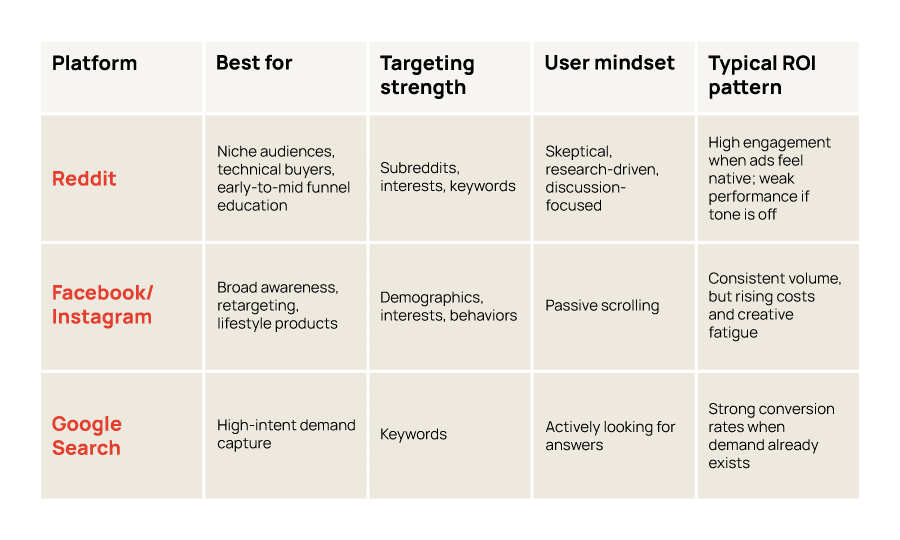
Advertising on Reddit works best when you need to reach people who are actively thinking about a problem, but not necessarily ready to buy yet. Subreddits function like built-in focus groups, where users self-select into conversations around their role or challenges.
Compared to Facebook, Reddit has less scale but far more context. Compared to Google, it reaches users earlier in the decision-making process. That makes advertising on Reddit especially useful for complex products, technical audiences, and brands that need to educate before they convert.
Reddit is not ideal for every use case. If you need immediate, high-volume conversions, Google Search wins. If your product relies heavily on impulse buying or visual appeal, Facebook and Instagram might perform better.
Reddit rewards relevance and authenticity. It punishes generic messaging and aggressive sales tactics.
Setting up advertising on Reddit is not complicated. The hard part is everything around the setup. So, we’ve made it easy with this quick guide.
Head to Reddit Ads (aka Reddit for Business) and set up an account. Basic stuff. Billing. Business details. The usual “confirm you are, in fact, a company” deal. Now, on to the good stuff.
Reddit will ask what you’re trying to do. Choose the goal that matches your actual intent, not your wishful thinking.
Common picks:
If you’re brand new to advertising on Reddit, traffic is often the cleanest starting point. It gives you a quick signal without requiring perfect tracking from day one.
This is an important step! It may determine the success of your campaign.
Start with subreddit targeting whenever you can. Pick the communities where your audience already spends time. Then layer in interest or keyword targeting if you need to expand reach or test angles. If you don’t understand a subreddit’s vibe, don’t target it yet. Lurk first, then target.
Reddit uses an auction model, so you’ll set a daily (or lifetime) budget and a bid strategy based on your objective.
Start simple:
This is where people can get impatient, but don’t. Advertising on Reddit rewards steady testing more than constant tinkering.
Now the fun part. Reddit users are ad-skeptical and very allergic to buzzwords. Write your ad like you’re joining their existing conversation.
Best practices for Reddit copywriting include:
Step 6: Launch, then monitor comments
Reddit is not a “launch and leave” platform. People may comment on your ads. Sometimes they ask smart questions. Sometimes they roast you. Either way, watching comments gives you copy insights, objection insights and product messaging insights.
Step 7: Test one variable at a time
When you start optimizing, change only one thing per test:
If you change everything at once, you won’t know what actually worked. You’ll just know you “did stuff.”


Advertising on Reddit is not for everyone, but that’s kind of the point.
Reddit rewards curiosity, relevance, and a willingness to actually understand the audience you’re trying to reach. It punishes shortcuts. If you treat it like just another paid social channel, performance will disappoint, and the comments will let you know exactly why.
When brands take the time to learn the platform and present something genuinely useful, advertising on Reddit can be incredibly effective. Especially for niche audiences, when trust really matters. Reddit is not a billboard, it’s a conversation. The brands that win on Reddit are the ones willing to listen before they speak.
If you’re ready to approach advertising on Reddit with strategy, intention, and a healthy respect for the platform, let’s build.
We know your audience. We know their interests and aversions, and we know how to talk to them so that they convert - on Reddit and everywhere else they hang out. Let us take the lead here. We’ve got you. Book a strategy call with us today.
