



The first thing you notice inside OpenAI's Ads Manager is how much it looks like something you've already used. Campaign, ad group, ad. Objective, location, daily budget. If you've spent any time in Google Ads, your hands know where to go before your brain catches up.
That familiarity is the most misleading thing about it.
We built our first ChatGPT Ads campaign this summer for a B2B SaaS client in the SMS marketing space. It was an awareness push across ten industry segments, running to the US and Canada. The build itself went quickly, because the keyword research was already sitting there waiting to be used. It's everything after the build that turned out to be the hard part.
You can construct a ChatGPT Ads campaign using almost everything you know about paid search. You just can't optimize one that way yet.
Here's where that plays out.
Campaigns hold ad groups. Ad groups hold ads. So far, so Google.
The difference lives at the ad group level. Instead of keywords, you write context hints: plain-language descriptions of the conversations where your product would genuinely be useful. OpenAI's documentation is refreshingly blunt about what they are and aren't. Hints describe the conversations, topics, or keywords where their products or services may be relevant, and they are not exact-match keywords and do not guarantee delivery in specific conversations.
Read that second half again. There's no match type. There's no negative list. You are describing a situation and asking a model to decide when your ad is helpful.
We started from keyword research. One segment alone carried nine near-identical variations of mass texting for nonprofits. In ChatGPT Ads, all nine of them collapsed into a single hint that read something like this:
Organizations comparing nonprofit text messaging platforms and SMS marketing tools. Users looking for affordable, easy-to-use software to improve donor engagement, increase event attendance, boost fundraising efforts, automate communications, and measure campaign performance.
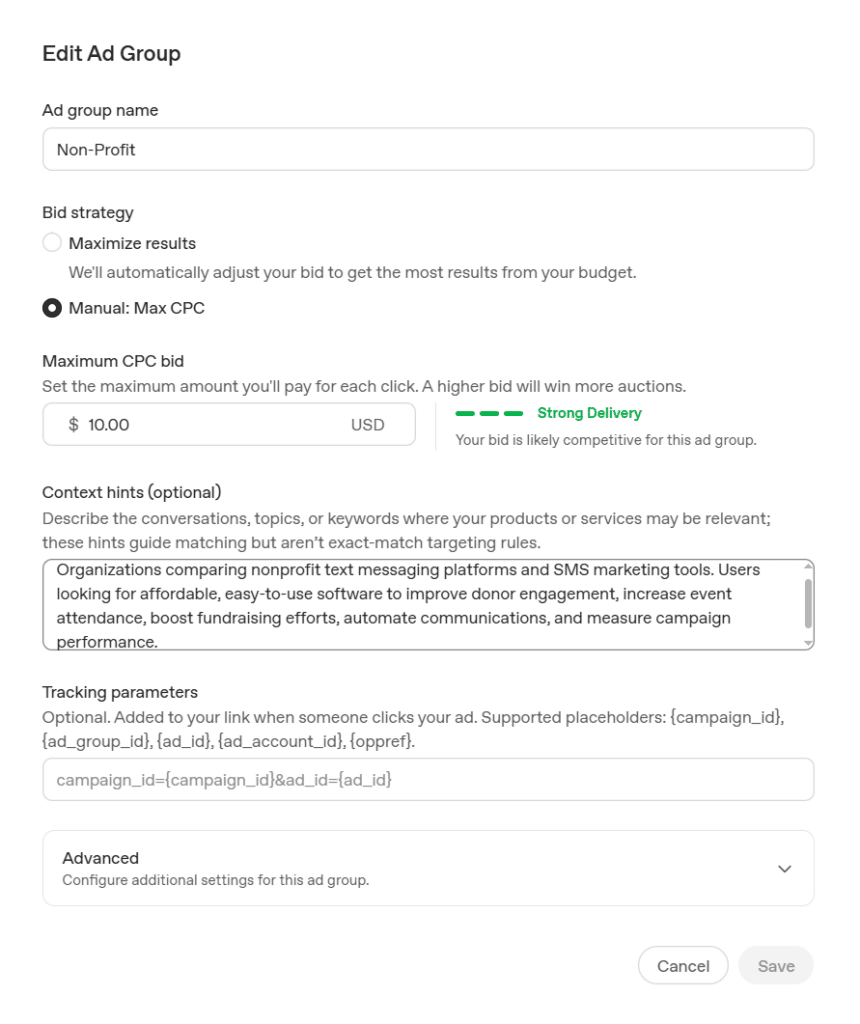
Same research, completely different output. The keywords stopped being used for direct targeting and became source material. That's the reframe, and it's most of the job: your keyword list still tells you what people want, it just no longer tells the platform anything.
The mental shift that actually helped: stop asking what words do I want to match and start asking what is someone working on right before my product becomes relevant? A nonprofit director doesn't type "mass texting for nonprofits" into ChatGPT. She says her donor emails aren't getting opened and asks what to do about it.
Benchmark how AI sees your brand, build a strategy to strengthen it, and measure the impact.
Ads in ChatGPT aren't shown to Plus, Pro, or Business subscribers, or to accounts the system identifies as under 18. Your reach is the free and Go tiers.
For consumer brands, that's a large and perfectly good audience. For B2B, it deserves a second look. A meaningful chunk of the buying committee you're trying to reach is sitting on a company-provisioned Business seat, which means they are structurally unable to see your ad. That doesn't make ChatGPT Ads a bad B2B channel. Plenty of decision-makers are on personal free accounts, and plenty of research happens before procurement gets involved. It does mean the total addressable audience is not "everyone who uses ChatGPT," and pretending otherwise will make your forecasts wrong.
Fifty characters for the headline. One hundred for the description. A square image, minimum 256 x 256. That's the whole ad.
It's tighter than it sounds, because ads can truncate well before those caps depending on placement. In practice, we wrote to about half the limit and treated anything past that as a bonus. The ads that felt best were the ones that stated a specific tension in plain words, like School Emails? Only 1 in 5 Parents Opens Them, rather than the ones that tried to describe a product.
A few things we'd repeat:
This is the real gap, and it's worth being direct about.
You can segment reporting by device and country. You cannot see performance by context hint.
Think about what that removes. In Google Ads, the search terms report is how you close the loop. You learn what actually triggered your ad, you prune, you expand, you get smarter every week. In ChatGPT Ads, you write eight descriptions of eight conversations, the campaign spends, and the platform tells you how many clicks you got in aggregate. Which description earned them is, right now, your guess.
The metrics themselves are reasonable for a beta: impressions, clicks, spend, CTR, average CPC, average CPM, and conversions, available at campaign, ad group, and ad level. Pixel and Conversions API measurement both exist. But there's lag to plan around. Attributed conversions can take 24 to 48 hours to appear, and the view-through window is fixed at one day.
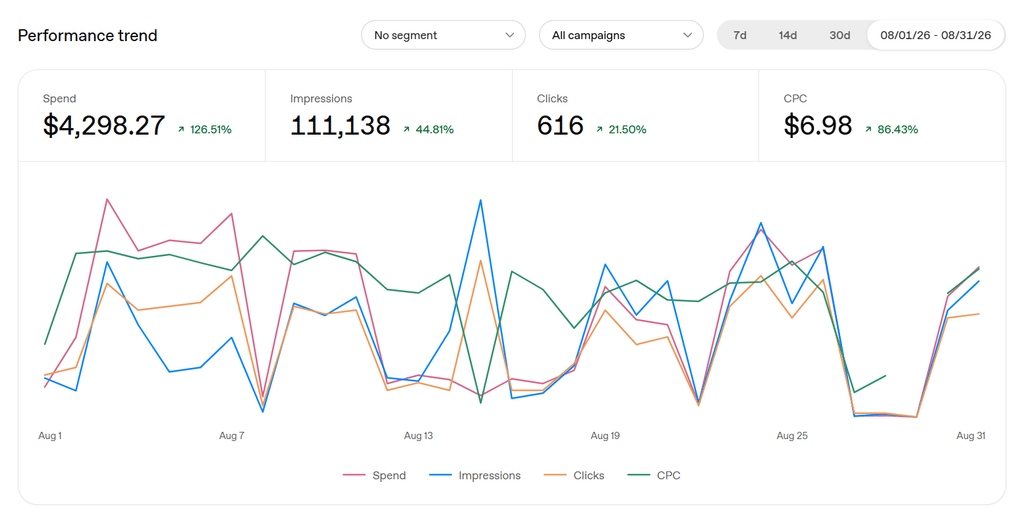
There's also no published guidance on the questions you most want answered. OpenAI hasn't documented a maximum number of context hints, a character ceiling for them, or whether narrower hints outperform broader ones. There's plenty of advice circulating. Three to eight hints per ad group, one to three sentences each, is the rule of thumb we've been working from. But that's practitioner consensus, not official guidance, and I'd rather label it honestly than dress it up as documented best practice.
Since the platform can't tell us which hint worked, we built the campaign so our own analytics could.
One intent per ad group, strictly. Not one industry. One need. If "appointment reminders" and "flash promotions" both live in a healthcare ad group, no result from that ad group means anything.
Every ad group gets its own landing page and its own UTM. The part that matters is pushing the ad group's theme into utm_content, so every click lands already labeled with the intent it came from. That one parameter does more heavy lifting than anything the platform reports back. Your site analytics becomes the segmentation layer, because the platform isn't there yet.
Hints are hypotheses, and you write them down as such. Before launch, we noted what we expected each hint to reach. When behavior on the landing page didn't match, that was a signal. Not clean attribution, but directionally useful, which is what a beta gives you.
Budget it like a test, not a channel. This is money spent to learn how a new surface behaves. We'd rather find out now, at a small scale, than in a year when the auction is crowded and everyone's figured it out.
We've been running these for weeks, not quarters. I'm not going to tell you what ChatGPT Ads CPCs "should" be, or hand you a conversion rate benchmark, because I don't have enough of my own data to add a better number to the pile. We’ll have that answer in a few months.
What I'm reasonably confident about is the shape of the platform. The creative constraints are real. The audience exclusions are real. The reporting gap is real, and it's the one that will decide whether this becomes a channel you can scale or a line item you defend every quarter.
What I'm not confident about is any of it staying true. Conversion bidding, geo exclusions, and bulk tools have all landed since the self-serve beta opened in May. The list of things we can't see is shorter than it was four months ago, and it'll be shorter again by the time you read this.
So: build it with a paid search mindset. Measure it like an analytics pro. And write everything down, because the version of this platform you're learning today isn't the one you'll be running next year.
That's not a reason to sit it out. It's just the price of being early.
As we learn more and more about what influences LLMs and what gets citations/brand mentions, AEO has become not just an SEO channel, but one we recognize is touched by multiple disciplines - content, PR, social, etc.
The question now is, does paid editorial get cited by AI?
Like any good marketer, I started my investigation into this topic some time ago with a simple Google search. Here’s what the AI Overview told me:

This response immediately set off alarm bells in my head….because this directly contradicted my experience.
You see, many, many months ago, when the AEO/GEO sphere was still stuck on things like schema, we started to hatch a plan. We’d noticed that news sources and third party blogs were HUGE for citations in AI and they influenced responses even more than owned media. We realized as a team, a more unified approach was going to be needed to help one of our clients succeed.
We started meeting with different departments, walking through what the data showed us and pitching a cross-functional strategy. When we brought it to PR, complete with examples of journalistic or new sources that were being cited for this client, the response was a little more cool than just lukewarm, They said essentially, well yeah, we don’t disagree with you, but just so you know, like half of those examples are actually paid editorial and that’s a completely different department.
Yikes.
But after learning more from this PR department, something became abundantly clear to me, which hopefully is a no brainer for everyone else. Different marketing disciplines are just as nuanced as my own, and it pays to take the time to get to know the people who are in the weeds everyday. Because they probably have the answers you’re looking for.
SEO people are good at a specific kind of thing: treating huge amounts of web content as uniform, measurable data. Crawl it, count it, classify it by domain and pattern, rank it. That instinct is correct — it's why SEO works. Google's whole system was built to be crawled and measured that way, so the tool fit the problem.
AI citation behavior is not that problem, or at least not only that problem. LLMs, very simply, are meant to mimic the human thought process using math. This means that citations and sources are not always cut and dry, perfectly logical. When it comes to journalistic type sources, it can pull from PR, from editorial standards, from advertorial disclosure rules, from the specific and sometimes genuinely bizarre ways individual publishers decide to sell native advertising. That's not data you can see from the outside by crawling a domain. It's institutional knowledge — the kind that lives in the head of someone who's spent years pitching editors, negotiating around embargoes, and learning which outlets blur the line between "sponsored" and "editorial" and which ones don't.
So when SEO instincts get pointed at that world without anyone who actually knows that world in the room, you get mistakes. Not because anyone's bad at their job but because the tools and thought process that make you good at one thing is exactly the blind spot on the thing next door, and it doesn't look like a blind spot from where you're standing. It looks like the same job.
So back to that AIO.
“Paid editorial gets cited less than 0.3%... and earned media gets cited upwards of 84%.” The more I looked into it, the more I saw this stat being repeated over and over. It's become one of those numbers people cite without checking, the way "you only have 8 seconds to make an impression" got repeated for a decade before anyone asked where it came from.
My gut was telling me this wasn’t right. I knew paid editorial got cited. Now i just needed to prove it.
SO I dug into the study it was based on. The methodology behind that number, from what I could tell, classified content mostly by domain. ie: is this a news site, is this a corporate blog, is this a press release. Reasonable, at scale.
Except: a lot of major outlets run sponsored content directly alongside their regular editorial coverage, on the same domain, sometimes with URLs that look nearly identical unless you know the specific pattern to look for. A domain-level classifier will wave all of that through as "journalism," because at the domain level, that's exactly what it is. This was EXACTLY the trap I had fallen into ages ago when talking with that PR team the first time. My SEO logic failed me, and I suspected that it had here as well.
So I began running a few tests. I had ChatGPT generate me a handful of prompts and ran them through a few different LLMs by hand, just to see what I got.
Just after running a few prompts I got what I was looking for.

Forbes.
The study that the 0.3% stat came from classified Forbes as a journalistic source. But when I actually opened the link:

Bam. Paid editorial.
This is where general domain sorting might fail you as an SEO. Because looking at the url for this article https://www.forbes.com/sites/deloitte/2026/07/22/with-the-rise-of-agentic-has-saas-seen-its-moment/ vs a regular non paid article: https://www.forbes.com/sites/sofiachierchio/2026/09/04/ai-isnt-replacing-stock-brokers-its-making-them-better/ there really isn't a way to tell without opening the links and looking for a paid disclosure.
So I ran more tests. I analyzed over 16,000 citations and guess what?
I got 0.32% from paid sources.
Whoops. So maybe I’m wrong?
I kept digging.
I had an agent go in and check each of the links that pointed to mixed-media model type businesses like Forbes, who run paid pieces right alongside non paid pieces.
The percentage jumps from 0.32% to 0.76%.
Ok we’re getting somewhere.
So then I did even more digging. What about Forbes Advisor? Other sources like it? Affiliate linking that isn’t supposed to affect recommendations, but do we really trust that completely? No single company bought that placement, but the page only makes money if you click through and buy and that's a real financial incentive shaping what gets recommended, even without a sponsor's name on it
We get 1.30%.
Not a crazy big number. But it's 4 times more than what that initial stat reported.
And it got me thinking…if the assumptions were made about sources based on domains in this study, what other assumptions were made?
Another stat often cited from the study is that 84% of AI citations come from “earned media”.

But calling anything not owned media “earned media” is not logic that holds water. Some sources, like Wikipedia, while not not earned, are definitely not in the same category as other traditional earned media. No PR team is going to take you seriously calling it that.
Instead, in this age of AI search, these are more like Authority Media or Knowledge Graph Sources. Because they aren't marketing channels—they are arbiters of truth. You don’t earn your way to a Wikipedia page from pitches and press releases, but through true merit.
With this in mind,, I categorized the citations to more accurately reflect their true nature, and here’s what I found:

So,after separating out true paid content, owned domains, government sources, academic papers, hospitals, nonprofits, consultancies, and small vendor blogs….71% of everything cited still can't be responsibly classified without opening each one individually.
Recognized journalism, once you actually separate it out honestly, was 3.82%.
Everything else in that the "earned" bucket was other things wearing journalism's clothes: government pages, academic papers, hospital patient-education content, consultancy thought leadership, nonprofit research, and …. a huge mass of small SaaS vendors' own blog posts ("Remote Work Productivity: 15 Statistics You Need to Know," published by an employee-monitoring software company, etc) that look exactly like independent research but are actually content marketing for a product.
Basically, the harder you look, the more any single-number breakdown falls apart if you’re trying to classify citations based on categories quickly and programmatically.
Now of course there are caveats. My sample size is much smaller than the initial study. I'm just one person running these tests on my couch in my pjs once my kids are in bed.
But I think my point still stands. We don’t know what we don’t know. If we truly want to understand the nuance of what gets cited in AI, we have to break down the silos of marketing and talk to other disciplines. I would’ve never known to dig deeper if I hadn’t had the experiences I did with the PR teams.
"We need cross-functional collaboration" is the kind of thing that sounds true and changes nothing, because nobody knows what to do with it on a random Tuesday when you have a completely full to-do list. So here's the version I'd actually act on:
Before you classify or count anything about a domain's content type, ask the people who deal with that outlet for a living. A PR person who pitches Forbes regularly knows in about five seconds whether a given URL pattern is a staff byline, a contributor, a paid program, or something else entirely — because it's their job to know which door they're knocking on. That knowledge doesn't show up in a crawl. It shows up in a Slack message to the right person.
That's a small ask. It's also, I think, the actual shape of what "AEO" needs to become if it's going to be a real discipline and not just SEO wearing a new acronym: less "how do I apply my existing playbook to this new surface," more "whose expertise am I missing before I say something confident."
So the answer to the question that started this all:
“Does paid editorial get cited by AI?”
Well like everything in marketing…it depends.
There’s a moment that shows up in nearly every account we scale. We push more budget into the campaigns that have been working, and efficiency starts to soften. Cost per lead ticks up. Blended ROAS slips.
It looks like something broke. Usually nothing did. The account has outgrown its best campaigns, and we’ve reached the edge of the demand those campaigns were built to capture.
Catching that moment early — before it turns up in a client’s dashboard looking like a problem — is a real part of the job. So is knowing what comes next, because the answer usually isn’t to fix evergreen. It’s to go build the next thing.
That’s the part that’s hard to explain in a monthly report, so let me put it plainly: efficient growth and incremental growth are not the same thing. Evergreen campaigns capture demand that already exists. Experimental campaigns unlock demand that doesn’t exist yet — at least not for you. They do different jobs, they should be measured differently, and you need both. Confusing the two is how good accounts stall out and how good tests get killed a month before they were about to work.
Our advertising team ran an internal training on this recently.
Evergreen campaigns are the proven ones. Core non-brand search. Brand. Retargeting. The campaign types and platforms you’ve already validated for this business, running against the audiences you already know convert.
They earn their keep because they’re pointed at high-intent demand — people actively looking for what your client sells, right now. That’s why they deliver stable CPA and ROAS, why performance is repeatable month over month, and why they’re the lowest-risk place to put a dollar.
So the first rule is simple, and it’s the one most likely to get skipped: if something is working and there’s room to spend more on it, that’s where the money goes first. Not the new channel. Not the shiny campaign type. Every expansion carries risk. Expanding what’s already proven carries the least.
Before anyone on my team pitches an experiment, I want to know that evergreen has actually been maxed out. That means asking:
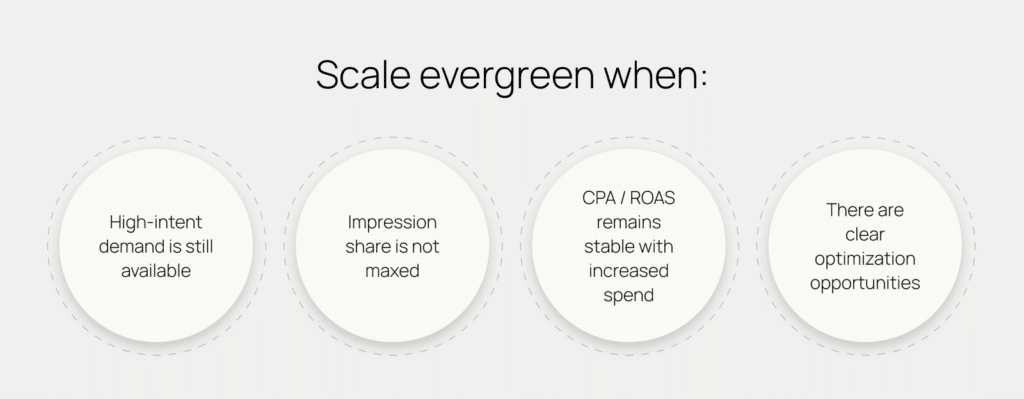
If the answer to any of those is yes, the conversation about experimentation can wait.
Here’s the catch: high-intent demand is finite.
There are only so many people searching for your solution this month. Once your evergreen campaigns have captured most of them, the only way to spend more is to reach further — broader targeting, looser match types, lower-intent search terms, colder audiences. The platform is happy to do it. It just costs more.
Evergreen performance alone cannot sustain long-term growth — it was never designed to. As targeting broadens, conversion rates decline and incremental conversions become more expensive. Efficiency peaks, and every dollar past that peak buys volume at a worse rate.
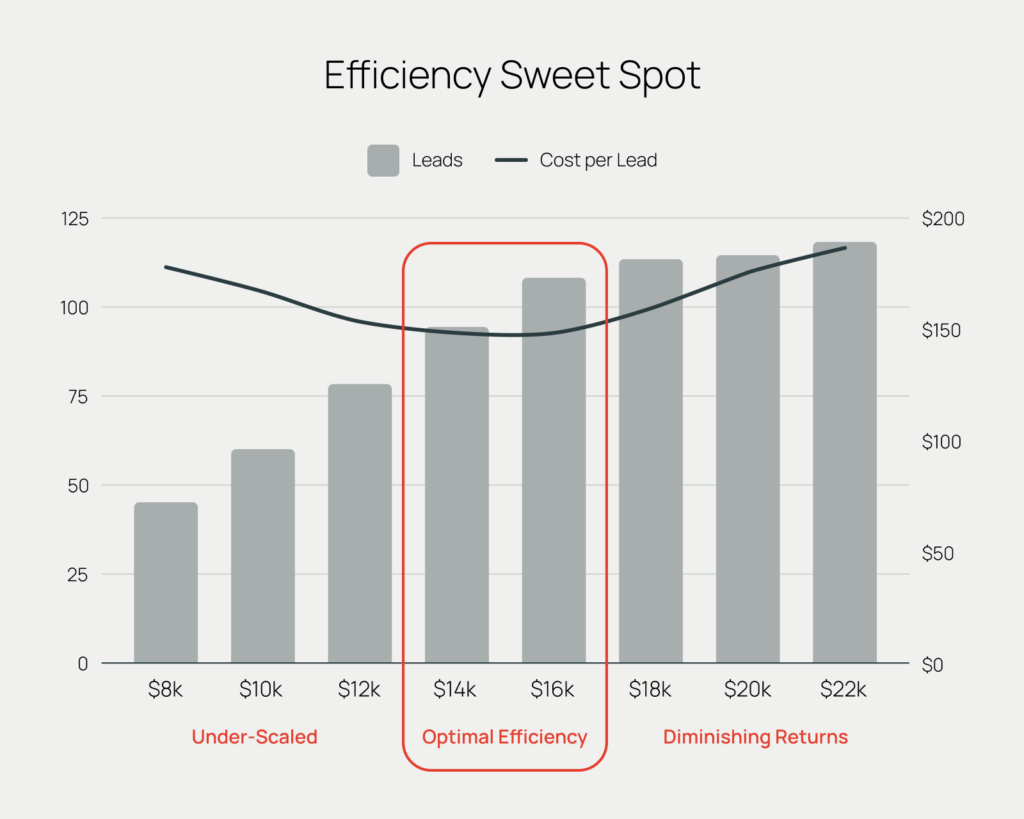
The practical question is how you find that peak without blowing past it. Nobody should be doubling budget month over month and hoping the efficiency holds. What I’d rather see is 10–20% increases at a time, a few weeks to let the system readjust, then another bump — watching CPA or ROAS the whole way. The right cadence flexes with the platform, the campaign’s maturity, and how much conversion volume you’re working with.
And there’s a nuance here that trips people up. Spending more will often push CPA up somewhat. That is not automatically a problem. The question isn’t “did CPA rise,” it’s “is CPA still inside the range this business can profitably pay?”
I think about an ecommerce client we worked with where we were defending a target ROAS with everything we had — nudging it from 4.0 to 5.0 to 6.0, protecting efficiency we were proud of. Then they told us, in effect: we don’t need a 6.0. We want as much revenue volume as we can get at a 4.0. We had been optimizing toward a number instead of toward their business.
That’s a bigger deal now than it used to be. Google’s change to how target-based bidding handles budget-limited campaigns means the target sitting in your account gets taken more literally — so a stale one does real damage while you’re scaling.
Keep an eye on lead quality alongside CPL, too. A stable CPL doesn’t mean much if those leads are becoming less qualified. As you scale, watch whether you’re still reaching the right people — not just what it costs to generate them.
So know your threshold before you start scaling, then watch for the signals that you’ve reached it:
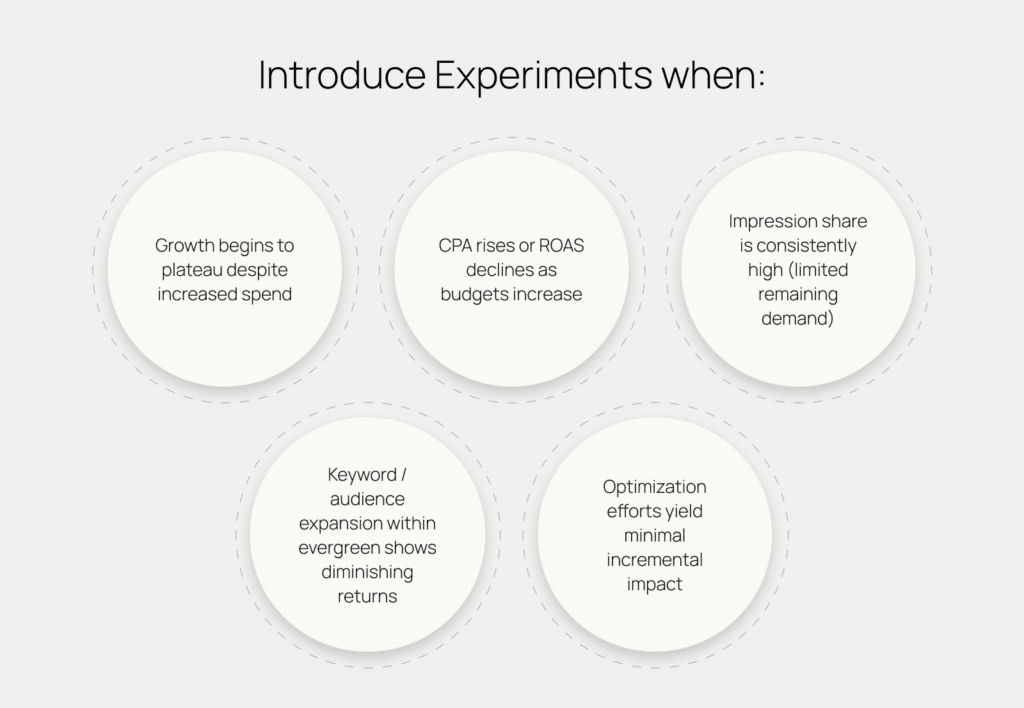
When those signals show up, the answer isn’t to keep forcing budget through a channel that’s tapped out. It’s to go find new demand.
That’s what experimentation is for: new audiences, new channels, new campaign types, new formats, new use cases. Experiments are not a replacement for evergreen and they’re not a hedge against it. Evergreen is your efficiency engine. Experimental is your growth engine.
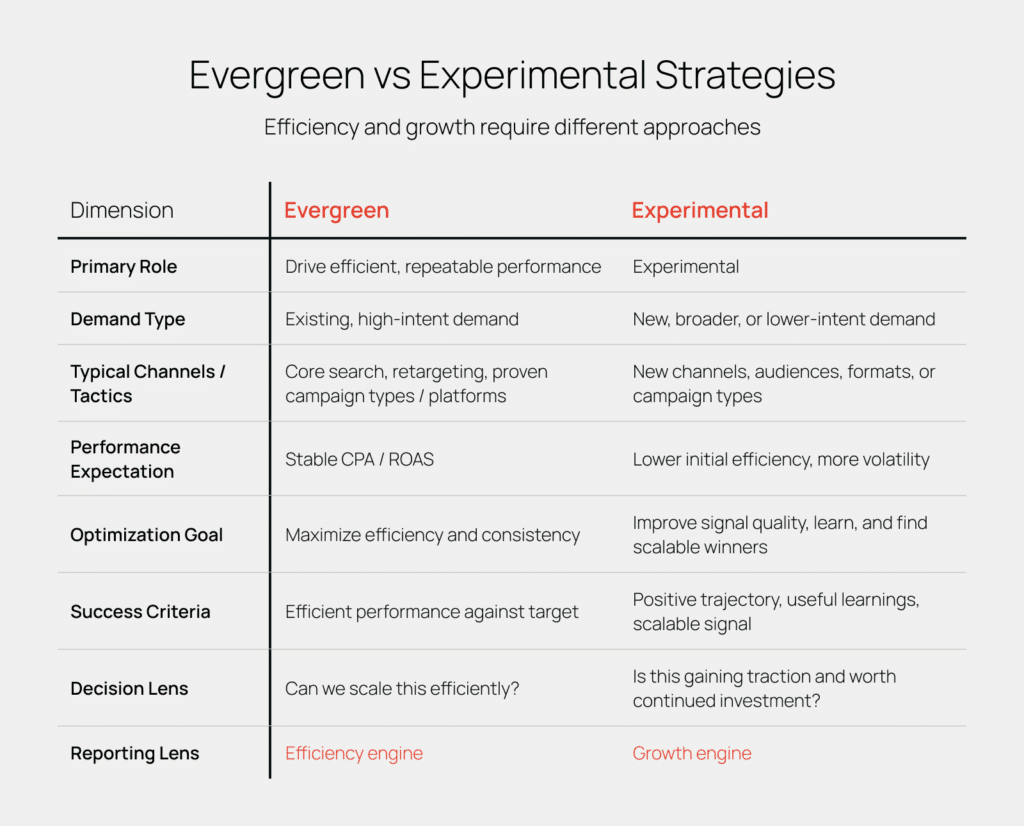
Here’s what that looked like on one account. Their evergreen campaigns had plateaued on the flagship product line, so we proposed expanding into their secondary lines — knowing full well those would be less efficient, but knowing the available growth was there.
We set that expectation before launch and split the budget goals: designated evergreen budget, designated experimental budget, reported separately. From day one the client understood these were two different jobs with two different sets of math. That framing is most of the battle.
Not every experiment will be a winner, and that’s expected. But many tests fail not because the idea was bad, but because of avoidable issues in how the experiment was planned or executed:
Experiments follow a predictable arc, and knowing it changes how you read the numbers.
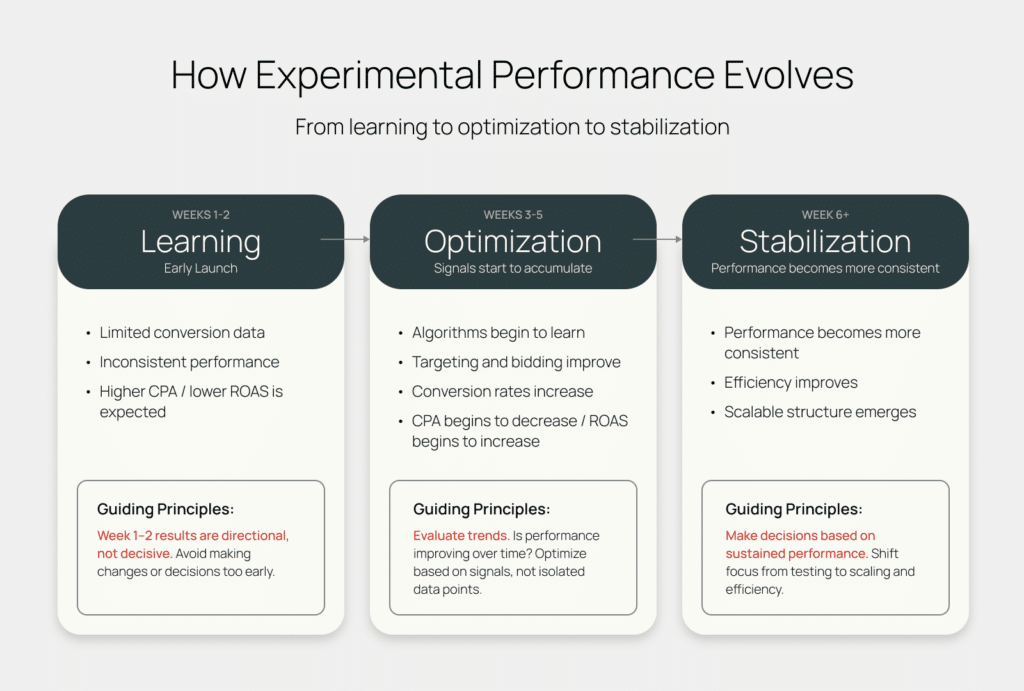
Weeks 1–2, learning. Conversion data is limited, performance is inconsistent, and CPA is high. This is expected. Week 1–2 results are directional, not decisive. Avoid making big changes or big decisions here.
Weeks 3–5, optimization. Algorithms start to learn. Targeting and bidding improve. Conversion rates come up. This is where you evaluate trends — is performance improving week over week? — rather than isolated data points. CPA is probably still off target, and that’s fine.
Weeks 6+, stabilization. Performance becomes more consistent, efficiency improves, and a scalable structure starts to emerge. Now you can make scale-or-cut decisions based on sustained performance and compare results against your targets with confidence.
Those windows flex with spend level and account data volume — a high-spend account gets there faster.
One important caveat, because “don’t react early” gets taken too far: there’s a difference between reacting to noise and fixing something that’s obviously broken. If you pull the search terms report in week one and all your budget is going to irrelevant queries, add the negatives. If your LinkedIn campaign is serving to entry-level titles when you’re selling to VPs, fix the targeting. Refining inputs is not the same as judging outcomes. Do the first constantly; hold off on the second.
When you do evaluate, ask better questions than “is it efficient yet”:
And if something looks off, diagnose before you react. Is the problem traffic quality, landing page friction, or just data volume? Is engagement strong but conversion weak? Are the search terms and audiences aligned with the use case you intended?
Every evaluation should land on one of three actions:
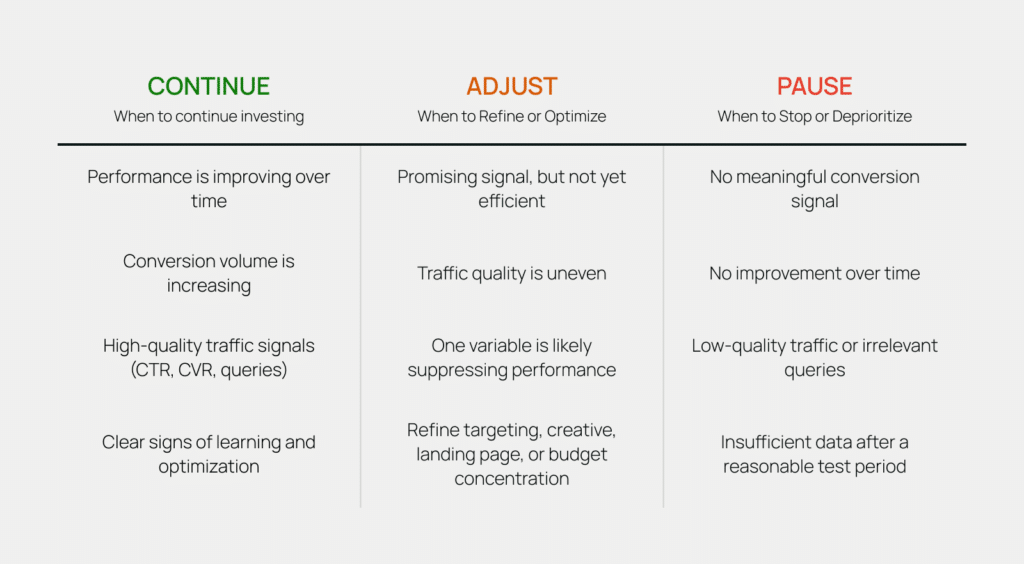
Most tests deserve a real shot at “adjust” before anyone reaches for “pause.”
Now the reporting problem, which is where a lot of good experimentation quietly dies.
Blended numbers matter. A business cares about total profitability, not the performance of one campaign in isolation, and you should absolutely know what your blended CPA or ROAS is and what the business can afford. But blended reporting without segmentation produces misleading conclusions.
Here’s the arithmetic, with round numbers:
| Evergreen | Experimental | Blended | |
|---|---|---|---|
| Spend | $50,000 | $20,000 | $70,000 |
| Revenue | $250,000 | $60,000 | $310,000 |
| ROAS | 5.0x | 3.0x | 4.4x |
Blended ROAS fell from 5.0x to 4.4x. If the target was 5.0x, that report looks like a miss. But total revenue went up by $60,000, and if the business can profitably operate at 4.0x, everything here is working exactly as designed. Without segmentation, someone looks at 4.4x and pauses the growth investment.
A real example from one of our lead gen accounts makes the point even more sharply. Experimental campaigns there took 3% of budget at a $120.70 CPA, against a $44.24 evergreen CPA. In isolation, $120 leads look indefensible. But blended CPA landed at $45.07 — under a dollar higher than evergreen alone — and that 3% of budget produced roughly 260 incremental conversions per month that evergreen simply had no room left to generate.
That’s the whole argument in one line: 83 cents of blended CPA for 260 conversions a month. You cannot see that trade in a blended number alone.
So report both. Segment evergreen and experimental so the difference is visible, show volume alongside efficiency, and show the blended figure against the threshold the business can actually afford. The story isn’t “our CPA went up.” It’s “we added this much incremental volume and stayed inside your profitability guardrail.”
There’s no universal split, and the right allocation depends on account maturity and growth goals. But if you want a starting point:
Lean more evergreen when demand is still uncaptured, impression share is available, and targets hold steady as spend increases. Lean more experimental when evergreen is saturated, incremental spend is getting less efficient, and the growth goal requires new demand. (The lead gen example above ran at 3% experimental and still moved the needle — these ranges are a rule of thumb, not a rule.)
The order of operations matters more than the exact percentages: protect efficiency first, then fund growth. Don’t pull budget out of evergreen to fund a test if it means leaving efficient demand on the table.
Then forecast before you launch. Two questions are worth answering on paper, in advance:
I’ve found forecasting does two things at once. It gives the client a range instead of a surprise, which takes an enormous amount of anxiety out of the first six weeks. And it makes evaluation dramatically easier on your end, because you set a goal to evaluate against instead of squinting at a dashboard asking “is this good?”
It’s also worth tracking the secondary signals, especially for upper-funnel tests. Increases in direct traffic and branded search volume, and improvements in branded campaign CTR, CVR, conversions, and CPA. Nobody wakes up and randomly searches a brand name — if branded volume climbs after you launch CTV or TikTok, that’s the experiment showing up in a place your platform report can’t attribute.
Successful experiments don’t stay experimental. That’s the point. A test that works becomes part of your evergreen foundation, gets evaluated like evergreen, and eventually hits its own ceiling — at which point you go looking for the next one. It’s a loop, not a line.
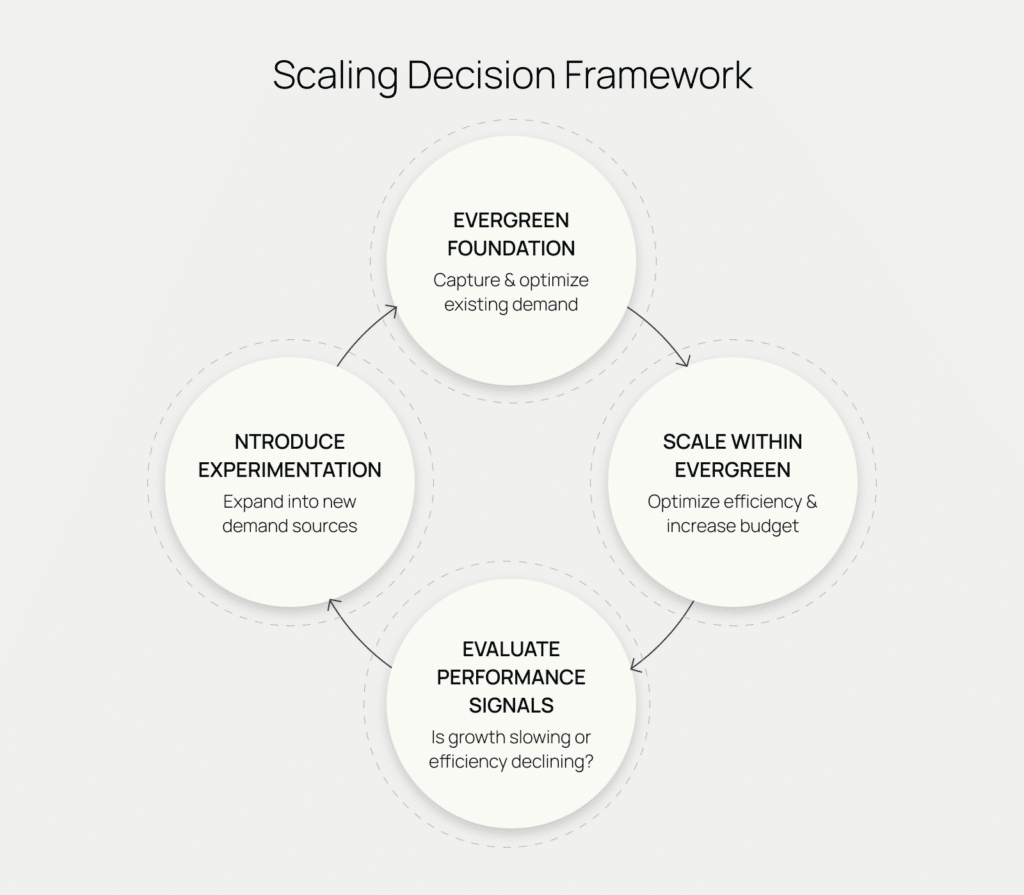
Which makes this a reasonable gut check for whoever runs your paid media, in-house or agency: Do they know where evergreen is maxed out and where it isn’t? Can they show you impression share and tell you what’s left to win? Is experimental budget designated and reported separately, or is everything blended into one number? Did they tell you what to expect in weeks 1–2 before the campaign launched, or are they explaining it now that you’ve asked?
Efficiency and growth pull against each other. That tension is normal, and it’s manageable — but only if somebody is deliberately managing both sides of it.
Ryan Nelsen, CMO at StackAdapt, walks through the same decision from the other side of the table — how his team decides a new channel has earned budget.
Citations and mentions are the closest thing AI search has to a ranking. That's exactly the problem. The instinct is to treat them like the old ranking report — log it, chart it, celebrate when it climbs.
That instinct is wrong. Not because citations don't matter, but because counting them tells you almost nothing about whether being cited did anything for you.
A citation, as Mike Witham, our Head of SEO, defines it, is "anytime a link is in place in a generative response, whether that's hyperlinked and actual text of the response or it's linked as a source, a cited source for the response."
Two kinds are worth tracking separately. An owned citation links back to your own domain. A third-party citation is when your brand shows up inside someone else's cited content, on a domain you don't control. Both count. Only one is inside your control.
We've covered the mechanics of tracking both, plus how citations differ from brand mentions, in What to Track in AI Search. This piece is about the harder question: what are you supposed to do with the number once you have it?
Should citation volume be a KPI? "With like everything in marketing it's 'it depends,'" says Alyssa Felix, Search Marketer. "We shouldn't be out there like, let's just get citations on everything, kind of like back in the days in SEO when you could put the word sunflower on your site fifty million times and rank for it. All citations should have to actually do with things that matter."
Citations are a means. The end is influence.
Traditional SEO trained us to chase traffic, but traffic was always a proxy for something else: educating and convincing a buyer. AI search skips the middle step. So the question isn't how often you show up. It's whether showing up changed anyone's mind.
Top-of-funnel citations are educational. Their job is to prove to a model that your brand is authoritative enough to source from in the first place.
Bottom-funnel citations, on decision-oriented prompts, behave much more like referral traffic. That's where being cited actually moves someone to click through and act.
This distinction showed up clearly on a recent account. "We noticed that all of their top of funnel prompts, they were not showing up, no competitors were showing up in terms of brand mentions," Blake Nielson, Head of Accounts said. "What we noticed was that virtually all of the citations in these top of funnel prompts were competitor citations."
The read wasn't that top-of-funnel citations don't matter. It was the opposite: this prompt set needed more top-of-funnel citation share before brand mentions could follow.
When a brand owns both the mention and the citation on a given prompt, Mike calls it the money combo — the strongest position you can put a brand in. The model names you, and it points to you as the reason.
Even without the mention, a citation on its own still does work. It signals credibility to the model and to the person reading the answer.
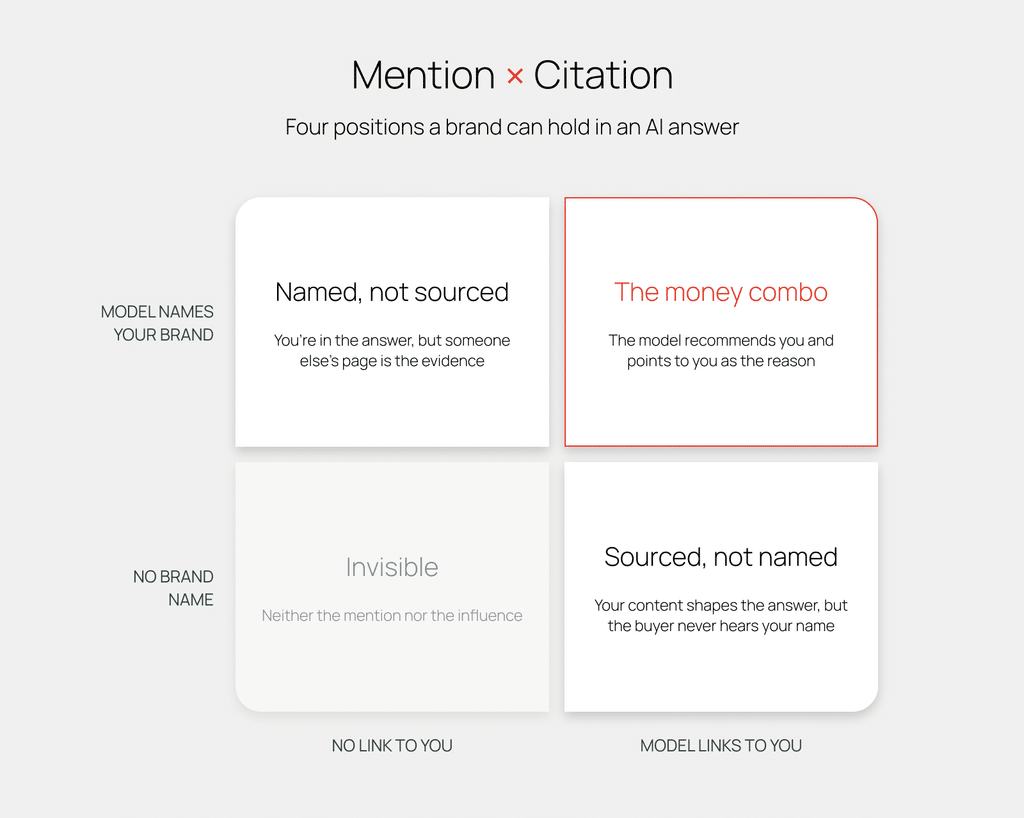
"In its most simple form, be the answer to the questions in your content," Mike says. "In a more complicated form, you have to be able to prove to an LLM that your entity, your brand, matches what's being asked and is directly connected to a topic."
That proof gets built through networks of content — call it topic clusters, hub and spoke, content pillars, or entity mapping into a knowledge graph — backed by unique data and a technically clean, crawlable site. It's the same discipline we walk through in our guide to optimizing content for generative AI.
Earning citations beyond your own site means giving up the idea that SEO lives in a website bubble. It takes PR, paid, editorial, and social working together, so that what lives on a brand's site also exists — from a different angle, in a different voice — on reputable external publications.
"The goal of a bot when it goes out to fetch information is to get as much information about a subject as possible and then come to a consensus, an aggregate, that it delivers back to the user," Mike explains. "If your brand is across the web, mentioned in connection with a topic you want to be known for, that is going to influence the LLM."
Sentiment isn't a binary read on whether a brand looks good or bad. The real question, per Blake, is "is your brand being represented correctly? Not just visible, but correctly across the LLMs."
That reframes everything above it. The content structure, the technical setup, the external mentions built through other teams — all of it exists to shape a narrative. Citation count is just one input into whether that narrative is yours.
When ChatGPT rolled out its 5.6 model, Reddit's citations in ChatGPT Search fell roughly 86% in four days, and the industry's reaction was immediate: Reddit is dead as a strategy, abandon ship. We wrote about why that read was wrong — the short version is that ChatGPT still appears to pull from Reddit, it just stopped showing its work. Losing a visible citation is not the same as losing influence over the answer.
Here's the part worth carrying forward. That shift wasn't universal — it was specific to one model. Google's AI Overviews remain by far the largest AI search surface, and they're still citing Reddit and YouTube heavily.
So being audience first now means tracking two things, not one: which prompts matter to your buyers, and which models your buyers actually use. Presence is only worth building on the surfaces where your audience is actually asking questions.
Citations were never the finish line. They're one input into a bigger goal: making sure the story a model tells about your brand matches the one you want told.
Want to know what the models are currently saying about you — and whether it's accurate? Let's talk.
If you've spent any time in Google Ads, you've probably clicked past a little tab called Asset Studio without giving it much thought. I know I had, and I've been in that account more times than I can count. It's where all of your assets live, and lately Google has been quietly stuffing it full of AI tools: image generation, image editing, video creation, even sharable preview links so clients can approve creative without needing their own login. At Google Marketing Live this year, they demoed it starting with a handful of product photos and ending with a full AI-generated video. Naturally, we couldn't just take their word for it. We had to go break it ourselves.
So the advertising team carved out some time, pulled up our own Google Ads account as a sandbox, and started poking around. First question on everyone's mind: is this actually different from just using Gemini, or is it Gemini wearing a Google Ads name tag? Turns out, it's the latter. It’s powered by the same "Nano Banana" model, just living inside the platform instead of a separate tab. The real value isn't the image generation itself. It's that it's baked into the place your assets already are, and it claims to let you build off the creative you've already uploaded instead of starting from zero every time.
We started simple: a text prompt for a pickup truck, since the ad was for a tire client. It did a decent job. It rendered the truck and laid our copy over the image cleanly, and when we pointed out that the manufacturer's decal was sitting right on the grille, which isn't ideal when the ad is selling tires and not trucks, it removed the branding without a fight. All perfectly fine. Nothing our designers couldn't have made themselves.
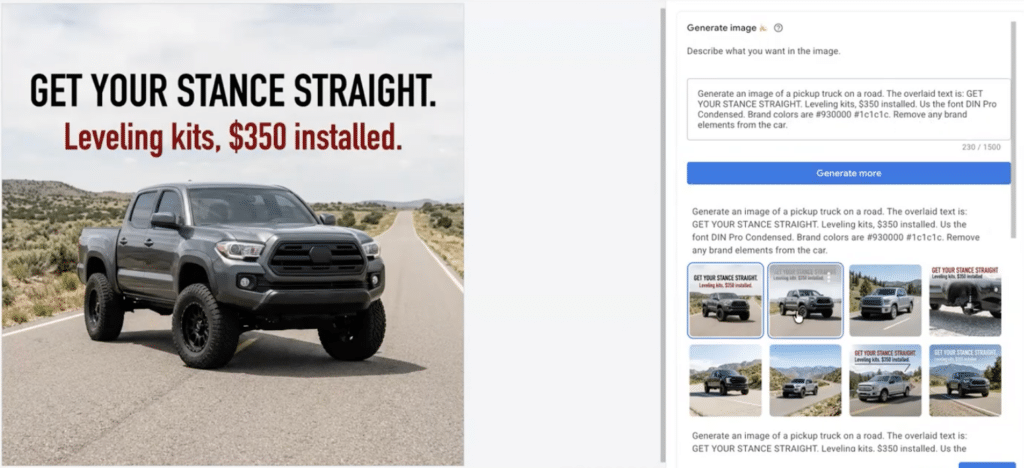
Where it started to slip was the moment our prompts got vaguer. We asked it to "add cool design elements," and what came back was, charitably, an education in why taste is one of the hardest things to teach a machine. It turns out "cool" means something very different to an algorithm than it does to a designer, which is honestly the whole ballgame right there.



Things got more interesting once we stopped trying to invent from nothing and gave it a real product photo to riff on. We uploaded a couch on a white background, asked for lifestyle variations across a few different home styles, and got back ten solid options in under a minute. A few were genuinely impressive, but others were obviously synthetic once you looked closely, like the guy whose legs didn't quite reach the floor.
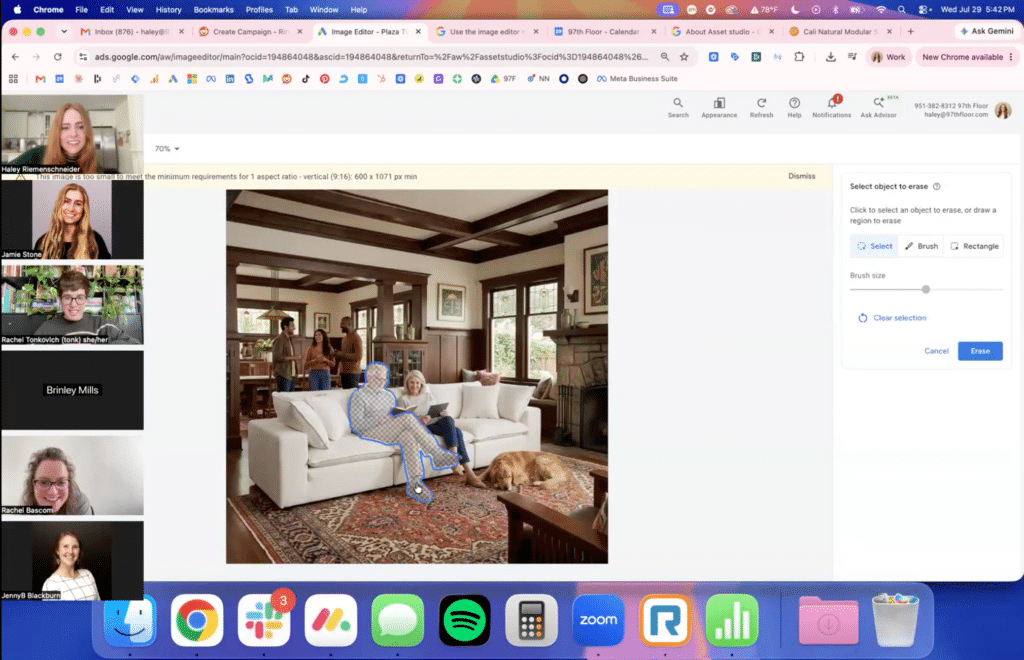


The moment that actually got a reaction out of the room was turning a still product image into video. We had a product photo on hand for a past client that sells safety gear, one of those accounts where we've always had imagery but never real video footage, and Asset Studio spun it into a working clip in under a minute. It was fast enough that someone on the team said flat out that having this a few years ago would have been life-changing for that account. That's the kind of result that earns a genuine "this is awesome," not because the clip was flawless, but because it solved a real gap we've actually run into with clients before.
Where it fell apart was anything resembling a finished ad. The moment we tried to get an actual ad copy or a client logo onto the image, it flattened everything into one background, didn't crop our logo file correctly, and generally reminded us that this is an asset generator, not a designer. The video side maxed out at five to ten second clips stitched together, which is a long way from the full 30-second AI commercial Google showed off on stage. And if you're picturing that as your new B-roll department, budget a good laugh into the process. We ran it through a "funky bucket" music template and I don't think any of us have fully recovered.
So where does that leave us? Honestly, right where a healthy dose of curiosity should: not racing back to Asset Studio for daily work, but keeping it on the radar. If you're working on a big product catalog account and need a hundred lifestyle variations, this could genuinely save hours. For the intentional, considered creative we build for most of our clients, it's not there yet, and probably won't replace what our design team brings to the table anytime soon. But it's worth knowing it exists, worth testing again in a few months, and worth remembering that somewhere out there is an AI-generated couch party with a dog, two guys who refuse to stop reading, and a soundtrack that should never see the light of day again.
Ask most marketing teams how they research their audience, and you'll hear the same three answers: personas, keyword volume, and whatever demographic data came bundled with the last platform they bought. That's not wrong, exactly. It's just incomplete.
We've written before about how audience understanding is the thing that gets you through the AI wave, and every wave after that. The point of that article was that empathy for your audience is the one competitive advantage that doesn't erode every time a search platform changes the rules. This one picks up where that left off. If audience understanding is the advantage, where does it actually come from? Here's the honest answer: it comes from a handful of sources most teams either don't know about or don't use consistently, and from a process for turning what those sources surface into decisions instead of decoration.
We'll start with the least surprising one. SparkToro has been a reliable part of our research stack for a while now, and it earns that spot honestly: it's one of the fastest ways to see where an audience already spends its attention — what they read, watch, follow, and listen to — without guessing. It's a good starting point for anyone doing this work. And we do mean starting point — it tells you where an audience is, but it doesn't tell you why they're there, and it won't tell you what to say once you show up.
This is where research used to get expensive. Understanding what an audience actually talks about — not what they say in a survey, but what they say to each other — meant manually diving into subreddits, reading threads, and pulling out patterns by hand. It worked, but it didn't scale, and it ate hours we'd rather spend acting on the insight than mining for it.
AI changed all that. Now we can point a tool — sometimes something we've built ourselves, sometimes an assistant like Claude — at the relevant corners of Reddit and get it to crawl, cluster, and summarize at a scale a person never could. What used to take a day of manual reading now takes an afternoon.
We'd be doing you a disservice if we didn't add the caveat: Reddit is a messy, unpredictable place, and AI summarization has a real hallucination risk. We don't treat what comes back as gospel. We treat it as a strong signal worth validating — which, as you'll see below, is exactly the position we take with every alternative data source on this list.
This one didn't exist as a category a couple of years ago, and now it might be the most important addition to the stack. As more of your audience's information diet runs through AI tools instead of a search results page, how those models describe, summarize, and position your brand matters as much as how a person would. We use a dedicated tool to track exactly that — what AI systems are saying about a brand's reputation, tone, and standing — because that perception is quietly becoming part of the audience's first impression before they ever land on a website.
We'll be honest: whether this counts as "audience research" is a fair question, and it depends on the angle you take. It's not audience data in the direct sense — it's not telling you what your audience wants. But it is telling you where everyone else is already standing, which is exactly the information you need to identify potential gaps where you can carve out a niche. We use competitive tools to see the landscape a given audience is already being pitched by, so that positioning and messaging can be built to be distinct rather than redundant. It's audience-adjacent, and it earns its place in the process because of what it protects against.
Here's the one that doesn't get called "research" often enough, even though it's the most honest data source on this entire list. Every piece of content and every ad we run generates real behavioral evidence: what people actually clicked, read, scrolled past, converted on, or ignored. That's not a proxy for audience understanding. That is audience understanding, collected at the moment it matters most.
We treat performance data as a continuous research loop rather than a report card. The metrics from what we published and ran last month directly shape what we test next, on both the organic and advertising side. It's the same discipline in both places: lay out a deliberate testing strategy, learn from what the data says, act on it, and repeat. It's the least glamorous data source on this list and the one we lean on hardest.
Collecting all of this only matters if it changes what we do next, so here's where it actually shows up.
The biggest shift these sources make is where we start. Instead of opening a project with a blank page and a guess, we open it already knowing where an audience spends attention, what they're actually saying in their own words, how they're being perceived, and what has already worked in market. That means the first bets we make aren't really guesses anymore — they're informed decisions, and they're usually good ones.
It also makes your testing more impactful. When you skip the upfront research, what you might call “testing” is often just throwing several ideas at the wall and hoping one sticks. When you start from real audience signal, testing becomes validation and continuous improvement. You're not asking "did anything work?" You're confirming that the smart bet you already had reason to believe in actually performed the way the data suggested it would, and refining through your follow-up tests. That's a faster, cheaper, and considerably less stressful way to run a testing program.
On the ad side specifically, this research is what tells us which platforms to prioritize first and which messaging angles are worth leading with, before a dollar of media spend goes out the door. That's the difference between testing your way to an audience and starting with one.
And it's woven directly into how we approach GEO. Every part of that process — the topics we choose, the way we structure content, the actual prompts and structures we build around — starts with audience motivators and pain points before anything else. That's the same audience-first thinking behind our take on navigating AI search — the tools change, but starting with the actual human on the other end of the query doesn't.
None of these sources is a silver bullet on its own, and that's sort of the point. SparkToro tells you where they are. Reddit tells you how they talk. Sentiment tools tell you how they're perceived. Competitive intelligence tells you what to avoid repeating. And performance data tells you, with total honesty, whether any of it actually worked. Put together, they don't just describe an audience — they make every bet after that one a smarter one.
This might sound like a lot when reading it, but for us it’s a process we have down — and it’s remarkably efficient. It’s the process we run for clients every day: pulling the alternative signal, validating it instead of guessing, and building content, ad, and GEO strategy on top of it from day one. If you'd rather have a team already running this playbook than build the muscle in-house from scratch, let's talk about what that could look like for your brand.
If you've been anywhere near the AI search side of LinkedIn in the last week, you've seen the chart. You know the one. The steep line, the two red dashed drops, the panicked captions. Klaas Foppen at Promptwatch flagged it first, Meenank Minnu asked what it means for Reddit-focused agencies, and LinkedIn ran it as a Top News story: "It looks like ChatGPT is breaking up with Reddit."
I spent an unreasonable amount of time this weekend geeking out about this one, so consider this the long version of the answer I've now given a few clients who messaged us asking, essentially, "should we panic?"
The tl:dr? No.
Depending on whose dashboard you trust, Reddit went from being one of the most-cited domains in ChatGPT Search to nearly invisible, in a matter of days.
The most-cited figures come from Promptwatch, an AI visibility platform. Their data shows Reddit holding a steady ~3.83% average share of ChatGPT Search citations from July 18 through August 7. On August 14, that collapsed to under 1%, settling at a 0.52% average through August 17. An 86% relative drop. There were two distinct moves: a smaller slide starting August 8 (when Promptwatch says ChatGPT changed its background query behavior), then the sharper cliff six days later.
Google's AI surfaces saw nothing like it during the same time frame. AI Overviews dipped about 11%, AI Mode about 30%, both gradual. Nothing resembling the cliff that was ChatGPT. That asymmetry is worth sitting with: whatever happened looks specific to how ChatGPT is searching, not some industry-wide reassessment of Reddit as a source.
OpenAI hasn't explained it. Gizmodo asked directly and got no response. Reddit, for its part, has pointed to other datasets that still rank it highly and told Axios the shift has "no meaningful impact" on its business, since LLM referrals are a small slice of its traffic anyway. As Melissa Rosenthal put it on LinkedIn, Reddit is arguably the best-positioned company to weather this (a signed licensing deal, a legal department, a public market cap) and it still found out its visibility had collapsed from a third-party dashboard, after the fact, the same way the rest of us did.
Losing citations is not the same thing as losing relevance. This what actually matters for strategy, and it's easy to miss if you're only watching some citation-share dashboard.
Suganthan Mohanadasan spent a few days last week reverse-engineering ChatGPT's new search tool calls directly from browser traffic. He found that when ChatGPT researches a commercial question, it fires a set of brand-specific searches with a roughly 30-day freshness window on each. And then, separately, it fires a Reddit-specific search with a freshness window of a year or two (usually because in one case, it was ten years). The Reddit query was asking what people are saying about the shortlist the model had already built from its own memory.
So in other words: the answer candidates chosen by Chat come from somewhere else, and Reddit gets pulled in afterward to gauge public opinion on them. In the one conversation he was able to check citation-by-citation, dozens of Reddit threads entered the model's context and zero got credited in the final answer.
That lines up with something Ahrefs has also found independently: across a large sample of prompts, ChatGPT pulls Reddit content constantly but cites it under 2% of the time. It's reading Reddit to build a sense of consensus and then attributing the resulting opinion to nobody in particular.
So the working theory, and the one that I agree with is that Reddit hasn't been dropped. It's become an invisible input. It's the behind the scenes people expert, shaping the tone and the verdict of an answer without showing up in the citation list. Which means citation-share data was never actually measuring Reddit's influence on what ChatGPT says. It was measuring what the response chose to display credit for.
Benchmark how AI sees your brand, build a strategy to strengthen it, and measure the impact.
The same window that saw Reddit's citations fall also saw a shift away from a specific type of content: listicles and comparison pages or the "10 best," "X vs. Y" format that a lot of AEO/GEO playbooks were built around.
Data Tomek Rudzki at Peec AI shared with Lily Ray shows listicle citations dropping about 50% and comparison-page citations dropping about 32% in the period around ChatGPT 5.6's release, alongside a drop in the "best," "top," and "vs." style fan-out queries that made those page types easy wins in the first place.
When you look at these data points along with Suganthan's findings, it seems like there's a pattern there… ChatGPT appears to be deliberately combating the exact content types and sources that popular AEO/GEO tactics have leaned on hardest: pages built to win a citation rather than to actually serve a purpose.
Which is a very different story than "Reddit doesn't matter anymore."
One more thing worth flagging before anyone panics and rebuilds a strategy around a single stat, right now no one really agrees on the baseline. Promptwatch had Reddit's pre-drop share at 3.83%. Ahrefs, measuring the same period, had it at 16.7%. Gizmodo cited 4.5%. This reflects the differences we’re all struggling with when it comes to measuring impact on AI search. There are different prompt sets, different databases, different definitions of what counts as a "citation" in the first place. It's kinda like our own AI search version of Whose Line Is It Anyway, because everything's made up and the points don't matter.
Or more seriously, citation share should be used as a directional signal, not a KPI you hang your entire strategy on. And it's definitely not something to make a single-source decision on, whether that source is Reddit, Wikipedia, or Trustpilot.
No.
My take is this looks less like "Reddit is out" and more like OpenAI taking a deliberate swing at the AEO/GEO tactics that have flooded Reddit and listicle-style content with brand-planted mentions. If anything, that argues for a more intentional Reddit strategy, not abandoning one. Sure, the days of getting credit for volume are probably over, but genuine participation in communities where your audience already spends time was never really about the citation count to begin with.
Our head of search put it well: Reddit is still a massive platform with enormous organic traffic, and if your audience is there, that's reason enough to have a real presence, independent of what any single AI platform decides to cite this month.
The practical version of all of this:
We'll keep watching this, both because it's genuinely incredibly fascinating and because our clients' budgets depend on us getting it right. If you want to talk through what this means for your specific AI visibility strategy, that's a conversation we're always happy to have.
If you've ever looked at your Google Ads dashboard and thought, "our cost per lead is way better than the target we set, nice," this is for you.
As of this week, that good news isn't automatic anymore. Google changed how target-based bidding behaves when campaigns are limited by budget.
A lot of advertisers aren't happy about it. I actually think it could be a good thing — as long as the targets sitting in your account reflect your business goals.
The idea behind target-based bid strategies is pretty straightforward: you give Google an efficiency goal, and Google optimizes toward it. With Target CPA (cost per action), that might mean telling Google you want as many leads as possible at a $100 cost per lead. With Target ROAS (return on ad spend), that might mean telling Google you want to generate $5 in revenue for every $1 spent.
Historically, if a campaign had a limited daily budget, Google could be more selective about which auctions it entered, prioritizing opportunities where it was most confident it could generate conversions efficiently.
So, if your Target CPA was $100, you might actually have been getting leads for $70.
As of August 17th, that behavior has changed. Regardless of budget constraints, Google will now optimize much more consistently toward the target you set. A $100 target gets treated like a $100 target.
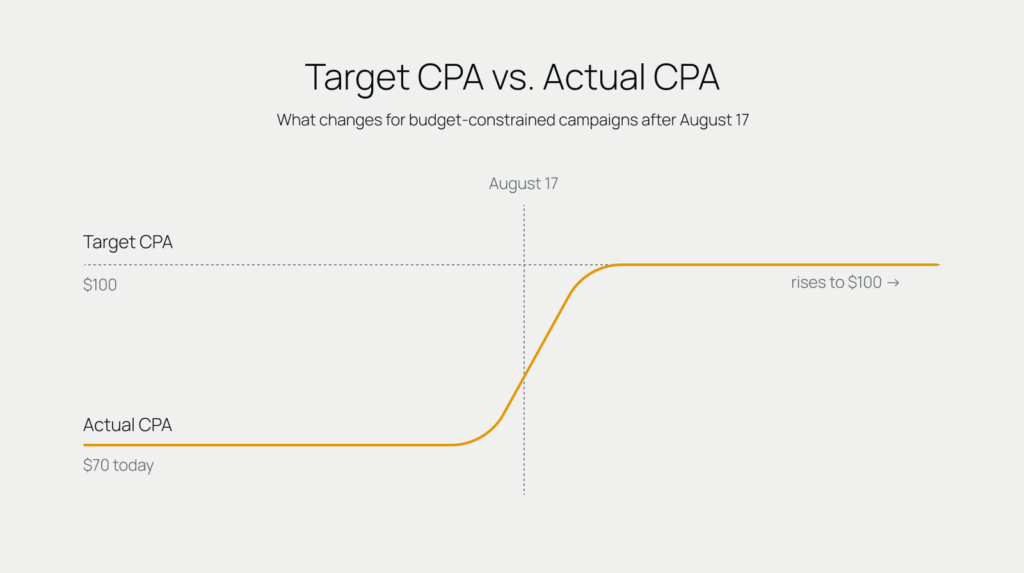
The change applies across Search, Shopping, Performance Max, Demand Gen, and Travel campaigns, for both online and offline conversions.
I understand why the initial reaction has been negative. If you've been getting $70 leads with a Target CPA of $100, hearing that Google may now optimize closer to $100 sounds like you're about to pay more for the same thing.
But here's the important part: you still control the target.
If $70 is the CPA your business actually needs, lower your Target CPA to $70. If your business can profitably acquire leads at $80 and your priority is growth, maybe $80 is the better target.
This is where I think the change gets interesting for advertisers looking to grow.
Historically, scaling could be difficult to predict. If you increased your budget, Google might have to reach beyond the auctions it had been prioritizing, and your $70 actual CPA could start climbing toward your $100 target. Your target hadn't changed, but your actual performance did.
Going forward, that relationship should be more predictable. If $70 is truly your target, tell Google $70. Then you can make budget decisions knowing Google will aim more consistently toward the efficiency goal you've actually set.
I've spent years asking Google reps some version of: if I set a target of $100, are you going to aim for $100, or try to beat it whenever you can? The answer was never particularly clear because budget constraints affected that behavior.
That ambiguity is what I'm excited to see go away.
You aren't losing control of your efficiency. You just need to be more intentional about telling Google what efficiency you actually want.
Whether your paid media is run in-house or by an agency, there are three things I'd be doing right now.
1. Find the campaigns most likely to be affected
Start with campaigns using Target CPA or Target ROAS, particularly those currently flagged as "Limited by Budget." Those are the campaigns I'd watch most closely over the coming days and conversion cycles.
2. Compare your targets to your actual performance
If there's a significant gap between your stated target and what you've actually been getting, decide whether that target still makes sense.
Google released a Bid Target Adjustment Tool specifically to help advertisers review this. The tool pulls in campaigns using Target CPA or Target ROAS and shows your actual performance compared with your current targets, along with the date of the last target change.
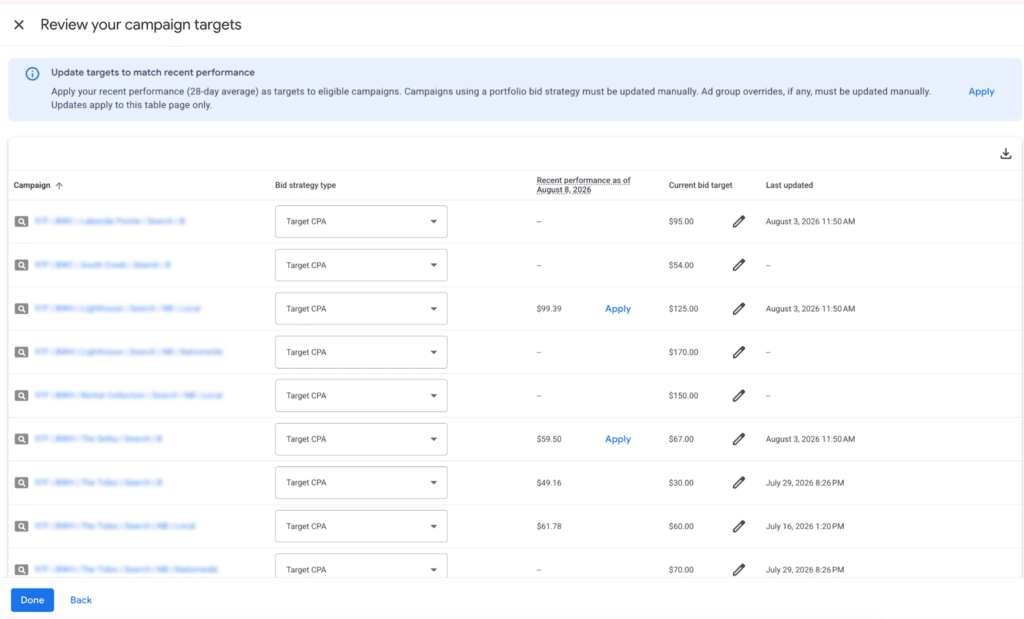
From there, you have four main options:
3. Start treating your target like an optimization lever
Your target shouldn't be a number that gets set once and then sits untouched for six months.
If you're hitting your target and spending your full daily budget, you may have room to push for greater efficiency. I generally prefer tightening targets incrementally — around 5–10% at a time — and watching whether Google can continue spending the available budget.
I'd especially consider testing this if you're losing Search Impression Share due to budget and your priority is efficiency rather than maximizing volume.
If your target becomes so aggressive that Google can't spend your available daily budget, you can loosen it incrementally if your business goals allow.
But if loosening it would take you outside those goals, don't accept worse efficiency just to spend more. Look for other optimization opportunities — like pausing keywords consuming significant budget without generating efficient conversions, improving ad copy, or testing landing pages.
And when you make meaningful changes, give them time to work. Depending on conversion volume and your conversion cycle, Smart Bidding can take a week or two to stabilize.
Avoid repeatedly changing budgets, targets, bid strategies, or conversion goals in quick succession, and make sure clients or internal stakeholders understand that some short-term volatility can be expected.
CPA and ROAS aren't the only metrics that could move.
Performance Max and Demand Gen spread your budget across multiple channels automatically, and this update could change how that spend gets allocated.
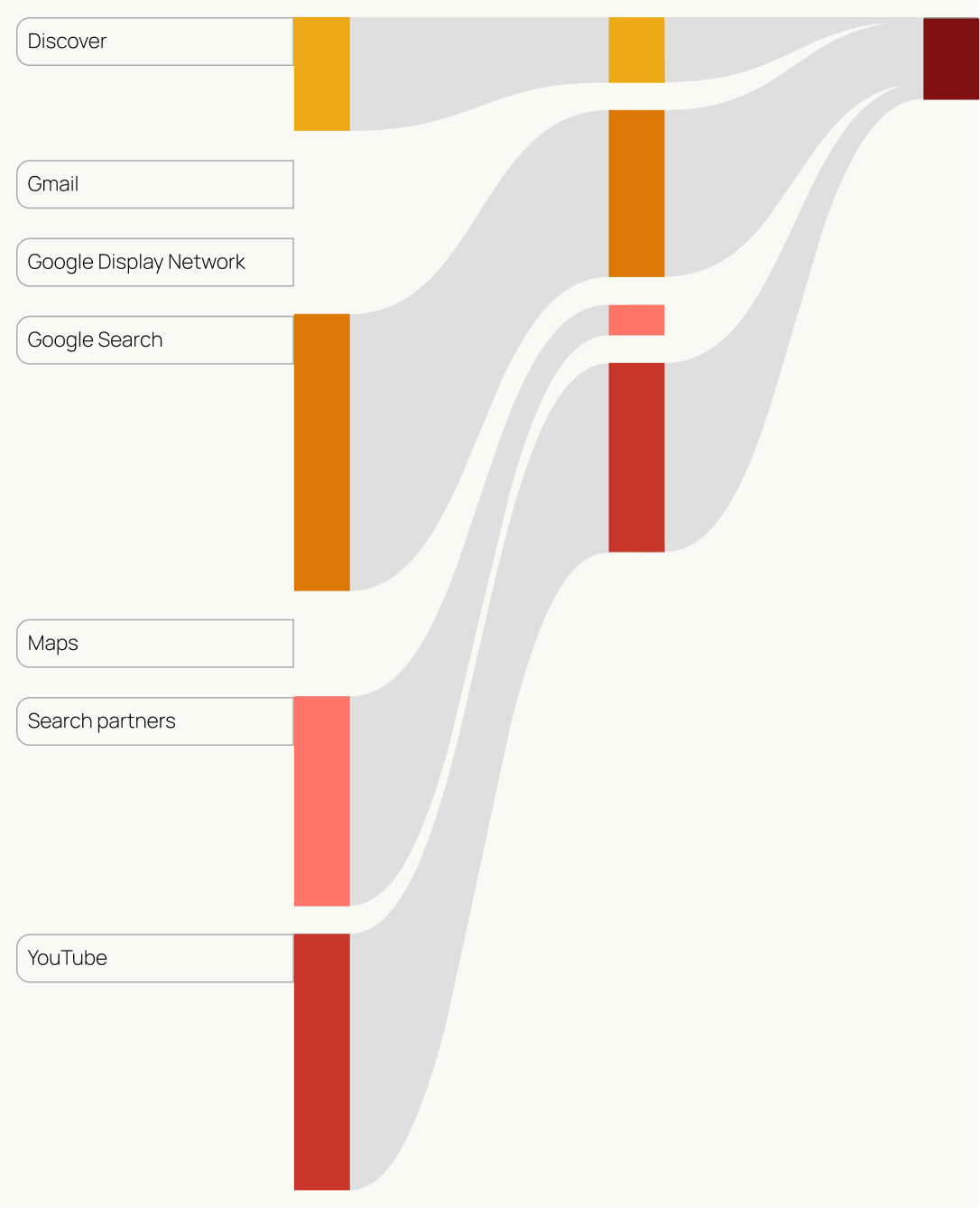
For example, if Google determines it needs to spend more on the Display Network to reach your target, you could see significant changes in CPC or CTR simply because your channel mix changed. A sudden drop in CTR doesn't necessarily mean your creative got worse if Google simultaneously shifted more spend into Display inventory.
That's why it's important to understand where your campaign is actually spending its money before deciding something is wrong.
A lot of the reaction to this update has been pessimistic. I think there's another way to look at it.
More predictable bidding should make performance easier to forecast and campaigns easier to scale. But it also puts more responsibility on the person managing the account. Targets can't be numbers that were set six months ago and forgotten.
This should be a gut check for your in-house team or agency: Did they know this change was coming? Did they identify which campaigns were affected? Did they adjust stale targets? And are they regularly reviewing those targets against actual performance and business goals?
The advertisers who benefit most will be the ones actively managing the relationship between budget, efficiency, and growth.
More predictable bidding gives advertisers a better lever for scaling. But like any lever, someone actually has to be paying attention to it.
If you want to go deeper on the mechanics of this update, Google's own documentation is worth the read: the support article explaining the change and the accompanying FAQ both cover the rollout and what to expect in more technical detail than we've gone into here.
Over the past few weeks we've made a case in pieces. A ten-minute exercise with no keywords surfaced a 40% gap in mature, keyword-researched content calendars. G2's buyer data showed that half of B2B software buyers now start their research in an AI chatbot — asking questions that generate no trackable search data at all. And before any of that, we argued that keyword research could no longer be step one of a content strategy.
Fair response: okay — then what is step one?
The answer is the same one it’s always been for us: the audience. What’s new is the discipline behind getting there — in July, we rebuilt the process our teams use to turn that belief into a repeatable strategy.
We’ve said “audience first” since before GEO was an industry term. What’s changing isn’t the belief — it’s the machinery underneath it, and the case for changing that machinery stacked up fast this year. Because of that, we built our new process around one irrefutable mission statement: it's our job to figure out what questions people are asking, and to make our clients become part of the answer.
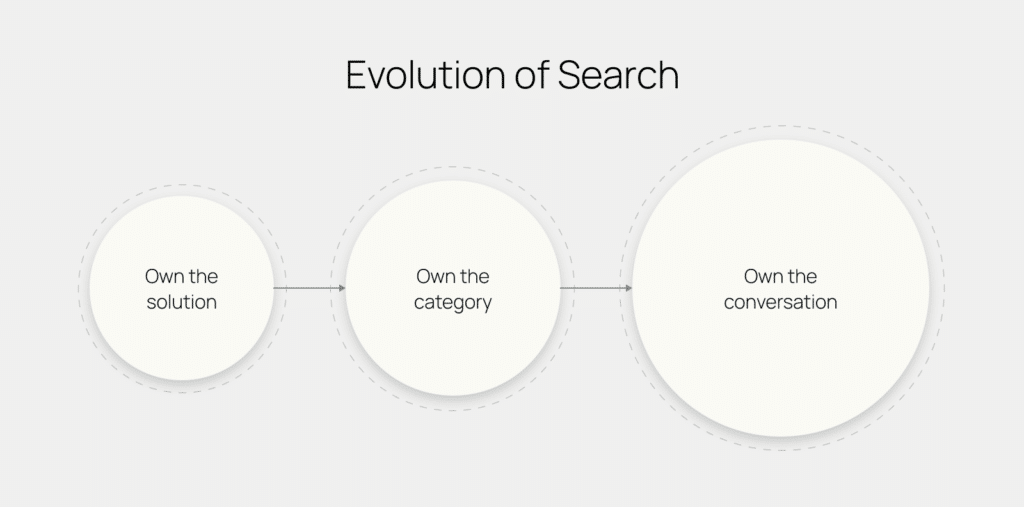
Search has gone through three eras of what winning meant. Early on, brands had to own the solution — people searched for the thing they already knew they wanted, and you fought to show up for it. Then search got bigger, people researched more, and it became our job to own the category — this is where classic keyword research was born: low-hanging fruit, content gaps, topical authority, hub and spoke. Now the search universe has exploded again, across AI assistants and conversational queries, and the job is to own the conversation — every question a buyer asks on the way to a decision, most of which no keyword tool can see.
Here's the friction, and we'll be honest about it because every experienced SEO feels it: a lot of this demand can still be captured by traditional keyword research. So why change anything? Because we tried the obvious shortcut — starting with keywords and expanding them into prompts — and it doesn't work. The prompts that come out of keywords are limited to the pool the keywords define, and when you push AI tools to generate them, you get generic, low-quality "what is X" questions. Starting from the audience produces a far larger universe of real questions; the keyword data then attaches to it, rather than defining it.
And to be equally clear about what we're not doing: we're not abandoning traditional SEO. Every client still has 5–10 non-negotiable core keywords tied directly to their product and revenue, each classified by the strategy it needs — Watch (already won, defend it), Win (can realistically capture #1), or Invest (long-term authority play). One of our e-commerce clients has held the #1 position for their money keyword for over five years, and we still track it, still build to it, still defend it. That work doesn't stop; it's just no longer the whole strategy.
Before the steps, the allocation decision that makes this a different process rather than the old one with new vocabulary: content volume is weighted roughly 45% problem-aware, 45% solution-aware, and 10% decision-stage.
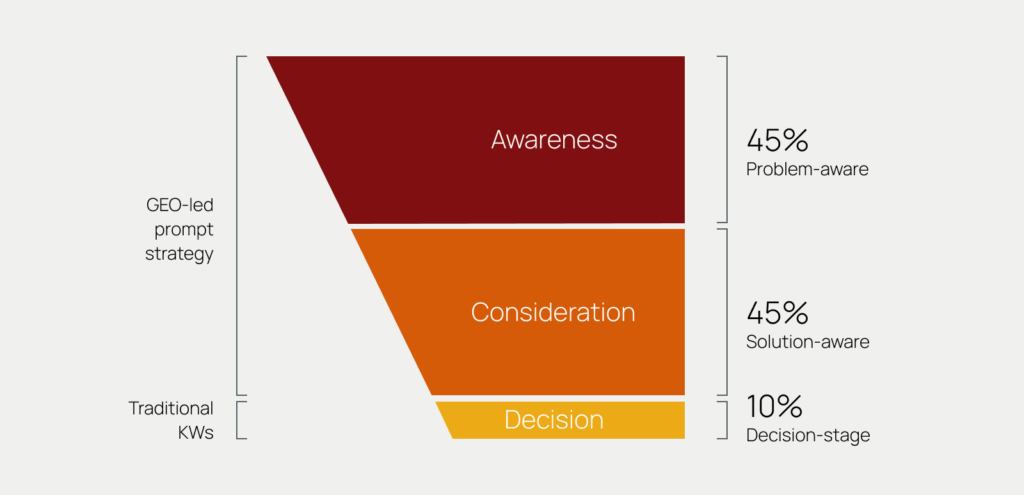
That looks inverted if you grew up on keyword-first strategy, because it puts 90% of the work where the trackable volume can’t be found. But the early and middle journey is where AI-era research thrives — the long, contextual questions that change buying decisions. It's also where most opportunity is undefended, because everyone in your category is working from the same keyword dataset and converging on the same expensive bottom-of-funnel terms. The decision stage still matters and still converts, but you need to support your core keywords.
The strategy is built by two roles working as a duet — a content marketer who owns the audience, and a search marketer who owns the data — creating a collaborative harmony that achieves our audience-first, data-backed output.
We start with personas built on audience research and client priorities — primary motivators and pain points guided by focus products/services and UVPs. We also look at how long their buying journey runs. That last detail shapes everything downstream: a quick-purchase product leans harder on traditional keywords and conversion content, while a long B2B sale needs a much bigger upper funnel.
At the same time, we classify the client’s 5–10 core keywords as Watch, Win, or Invest, and confirm with the client that we’re building on the right foundation before going further.
Now the exercise we ran company-wide becomes a formal step. For each persona, at each stage of their journey, instead of leaning on traditional keyword research, we write the real questions they’d ask — fears, objections, comparisons, buying concerns — sourced from customer interviews, sales conversations, and how the brand already shows up in AI search. Awareness-stage questions stay diagnostic (“why is my interest rate higher than expected”), not solution-focused (“which lender should I choose”), because that’s how real buyers actually think before they’re ready to decide.
Here's where keyword data re-enters — as evidence, not as the gate. Each question gets paired with the keyword that best represents it — chosen for how well it captures the question, not just its metrics — and scored on search volume, traffic potential, difficulty, and CPC.
Notice what the score does and doesn't decide. A prompt with weak keyword signals doesn't automatically die — it's flagged as a risk signal, and it might still be worth building for AI visibility. Search volume is evidence of demand, not the boundary of demand.
This is the most crucial stage: raw research becomes a prioritized strategy, and it happens through scoring rather than vibes.
Every topic gets three scores, one from each side of the duet, plus one that only exists because both sides agreed to be scored:
• Audience score: how many personas care, and how much the topic could sway a buying decision
• Client score: how directly it ties to the client’s revenue and stated priorities
• Demand score: search volume, traffic potential, keyword difficulty, and CPC, combined into one number
The three combine into a single ranked list. So when a team is staring at 150 possible topics wondering where to start, the answer is already sorted — by audience, business, and data together, with no single input allowed to take the lead. That’s the point. Plenty of teams claim to be audience-first right up until the sort-by-volume click. The scoring makes the claim structural.
Before building anything new, we check it against what the client already has. If an existing page is close to the mark, we optimize it instead of creating a duplicate — a small step that makes the most of existing resources (and as a bonus, saves a client from ever hearing “we recommend a new page” about something already sitting on their site).
From there, related topics get consolidated, and distinct audiences get split apart — for example, prompts would diverge for anxious parents and undergrads around the topic of student loan cosigning. These would be two content pieces, not one, because they're two audiences with two different intents.
Building the content calendar from there is easy — the strategic thinking already happened upstream.
Tracking starts the moment the calendar goes live, and it runs on layers rather than a single line. Traditional keywords and custom prompts are tracked side by side. Search Console gets watched for the long-tail, question-shaped impressions that new content should start earning. And around those, the downstream signals of AI visibility: brand mentions, citations, referral traffic from AI platforms, branded search, direct traffic, and — critically — conversion rates on high-traffic pages, because the endgame of zero-click research is a visitor who arrives already convinced and converts at a higher rate. Any one of those lines is easy to argue with. Layered together, the trend is hard to deny — which is exactly what reporting in a zero-click era has to be able to survive.
A process this concrete invites a misunderstanding: that GEO is only this. It isn't. Around the strategy build sit the factors that don't fit in a scoring column but move AI visibility anyway: technical optimization, original research and proprietary data (which win disproportionately in AI answers), unique points of view, content atomization and distribution, freshness — sometimes the right calendar entry is re-optimizing something you shipped eight months ago — and brand reputation, without which none of the rest gets very far. Those get their own treatment in how we brief GEO content versus SEO content and in why E-E-A-T matters more in AI search, not less.
None of this is keyword research's obituary. It's a reassignment. Keyword data is still genuinely excellent at four jobs: validating demand the persona work surfaced, forecasting the trackable portion of the opportunity, client education (numbers persuade stakeholders in ways personas don't), and the decision-stage plays it was always built for — including those 5–10 core keywords every client will always have.
What it lost is the job it was never qualified for: deciding what your audience cares about. Start with the human, weight the work toward where they actually are, and bring the data back in where it tells the truth. Trust us, it works — this approach grew one client's AI search results 261%.
That's the process now guiding how we build strategy for every client engagement. The next question is what it surfaces for yours.
Want to hear this philosophy debated out loud? This episode of The Campaign goes deep on audience-first marketing:
Want to see what this process would surface for your brand? Start with a free AI audit, or explore our GEO & AI Search services.
