There's a version of the AI search conversation that treats all of this as a future problem. Someday buyers will research in ChatGPT. Someday AI answers will shape deals. Someday you'll need a strategy for it.
G2's research on B2B software buying says the someday already happened.
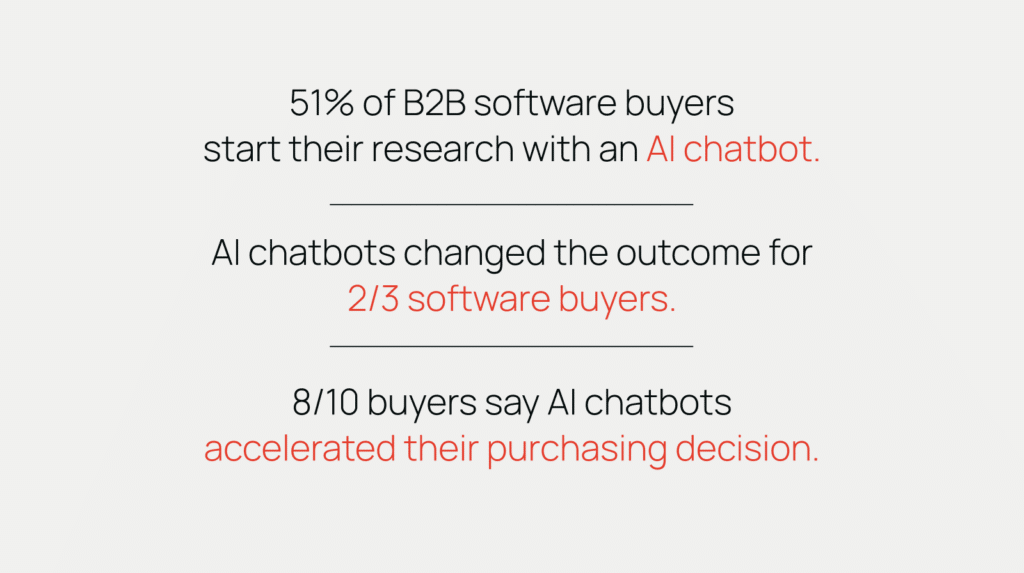
Per G2's report, The Answer Economy: How AI Search is Rewiring B2B Software Buying, 51% of B2B software buyers now start their research with an AI chatbot. Not "have tried one." Not "consult one at some point." Start there. The first touchpoint of the modern software deal — the moment a buyer goes from feeling a problem to naming it — is now, for the majority of buyers, a conversation with an AI.
We put this data in front of our entire company at our monthly meeting, because it reframes everything about how we think content earns pipeline. Here's why it stopped us in our tracks — and what we think it demands of every B2B marketing team.
The stat that matters isn't the 51%
The adoption number gets the headlines, but it's actually the least interesting of G2's findings. Buyers moving to a new research channel is a distribution story — marketers have navigated those before. The next two stats are a different kind of story.
AI chatbots changed the outcome for two-thirds of software buyers.
Read that again. Not "informed their thinking." Changed the outcome. Two out of three buyers who used AI in their research ended up somewhere different than where they were headed — a different vendor, a different category of solution, a different shortlist entirely.
This is the part that should reorganize your marketing priorities. A traditional search engine handed your buyer ten links and let them assemble their own conclusion. An AI assistant hands them the conclusion — a synthesized recommendation, a comparison table, a "for a team your size, I'd look at these three." The AI isn't a new place buyers gather information. It's a new participant in the decision. It has opinions, and buyers are taking them.
Enterprise AI Discoverability Series
Buyers are discovering, evaluating, and comparing brands through AI. 97th Floor CEO, Paxton Gray, is joining WordPress VIP CMO, Jodi Cerretani, for a three-part series on what that means for enterprise brands.
And 8 out of 10 buyers say AI chatbots accelerated their purchasing decision.
Faster deals sound like good news, and for the vendors in the answer, they are. But think about what acceleration means mechanically: the research phase compresses. The weeks a buyer used to spend reading blog posts, downloading comparison guides, and sitting in your retargeting audience — the entire window where marketing traditionally worked on them — shrinks to a handful of AI conversations. Buyers are arriving at shortlists before most vendors' funnels even register that a deal exists.
Put the three numbers together and the picture is stark: the majority of buyers start in an AI, most of them are redirected by what it says, and nearly all of them move faster because of it. The buyer's journey didn't add a new step. It got a new gatekeeper.
Why this changes what they buy, not just how
Here's the mechanism underneath the "changed the outcome" stat, and it's worth understanding because it's genuinely different from how search shaped decisions.
In traditional search, the buyer did the synthesis. They'd search "best project management software," open six tabs, weigh the review sites against the vendor pages, and form a consideration set themselves. Your job was to be present at enough of those touchpoints that you made the list. Imperfect, but the buyer was the editor.
In AI-era research, the model is the editor. When a buyer asks, "We're a 40-person agency with clients in healthcare — what project management tools handle HIPAA compliance well?", the AI composes an answer from everything it knows and everything it retrieves — and the vendors named in that answer are the consideration set. There's no page two. There are no ten blue links to scroll past the answer. For a growing share of buyers, if you're not in the response, you were never in the deal.
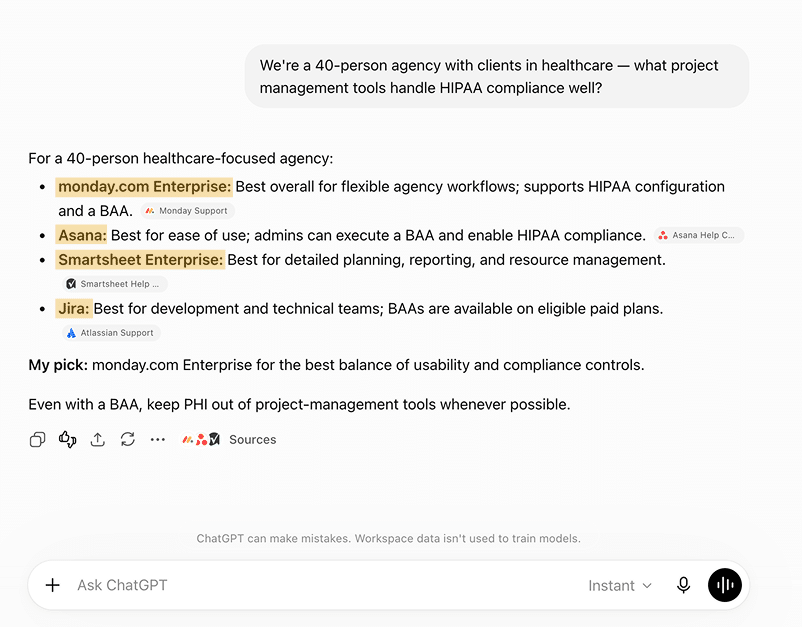
That's why buying outcomes are changing. The AI doesn't just reorder the same shortlist buyers would have built anyway — it builds a different one, weighted toward whichever brands are most legible to it: clearly explained, widely referenced, credibly reviewed, easy to cite. Brands that dominated the old game of rankings can be invisible in this one, and challengers with clearer, more citable material are showing up in answers next to incumbents ten times their size.
The uncomfortable part: you can't see any of this
If your analytics look fine, that's not evidence this isn't happening to you. It's the nature of the shift.
Those AI research sessions happen off your properties, generate no impressions you can count, and mostly resolve without a click. The buyer who asked an AI four questions about your category, got steered toward a competitor, and never visited your site doesn't show up anywhere in your reporting. Neither does the one who was steered toward you — they arrive later as "direct" traffic, unusually educated, unusually far down the funnel, and your attribution model shrugs.
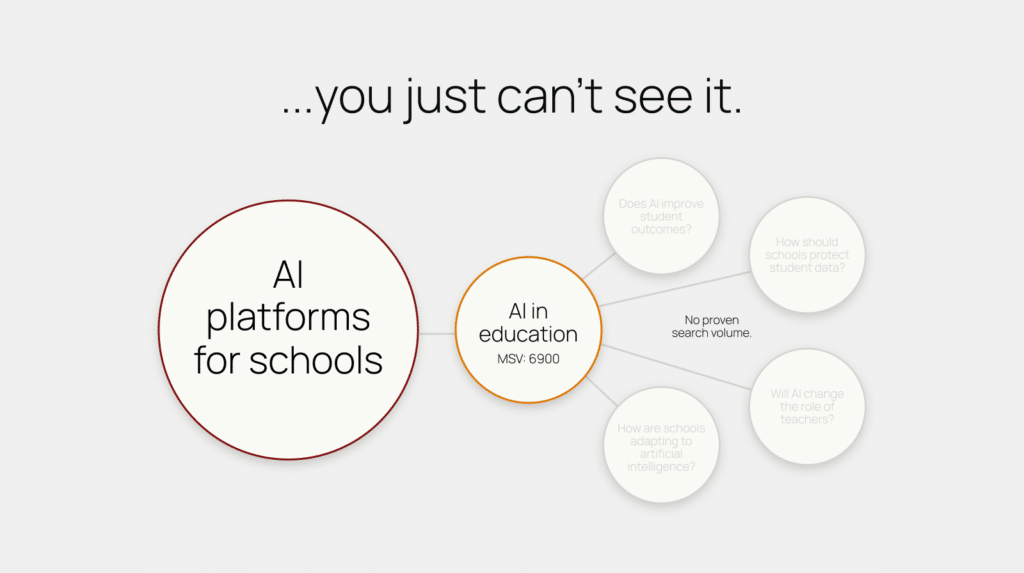
This is the same visibility problem we've written about across this series: the most important buyer activity in your category no longer produces trackable data. When we ran a keyword-free content exercise across our whole company, roughly 40% of the ideas our teams generated — the real questions real buyers ask — weren't covered anywhere on existing content calendars, because nothing in the keyword data ever pointed to them. The G2 numbers are the demand-side confirmation of the same story: the buyer conversation moved somewhere your dashboards can't follow.
Just because you can't see it doesn't mean it isn't happening.
What to do about it
The question every CMO should be asking isn't "should we respond to this?" The buyer already moved; that decision was made for you. The question is whether your brand is in the answers — and there's a concrete way to work on that.
Start by auditing your presence where buyers actually start. Ask the major AI assistants the questions your buyers ask — not your keywords, their questions. "What should a company like X consider when solving Y?" "Compare the top options for Z." Note who gets named, who gets recommended, what's said about you, and what sources the answers cite. This is the new SERP audit, and most teams have never run it. (If you want a head start, we run a free AI audit that measures exactly this.)
Then build for the questions, not the keywords. The prompts steering these deals — "I have $50,000 and a mandate; where's the highest-impact place to put it?" — have no trackable search volume and never will. They come from understanding your buyer: their fears, frustrations, objections, comparisons, and buying concerns at each stage of the journey. That's why we've stopped treating keyword research as step one and started from the audience instead, with keyword data brought back in later for validation and forecasting. Search volume is evidence of demand, not the boundary of demand.
Make your material easy to cite. AI assistants recommend what they can confidently parse and attribute: clear claims, specific comparisons, transparent pricing and capability information, third-party validation, structure a machine can lift an answer from. This is where E-E-A-T implementation for AI search stops being an abstract quality guideline and becomes a revenue lever. Vague thought leadership doesn't get cited. Direct answers to real questions do.
And measure the new funnel honestly. Sessions and rankings won't tell you whether you're winning in AI answers. Citation share, brand mentions across AI platforms, and the volume and behavior of branded and direct traffic will. This work compounds: one of our clients grew AI search results 261% with a topic cluster strategy built for exactly this environment. The teams that build this richer view of organic now are the ones who'll be able to show the work paying off — and keep investing in it — while everyone else argues with their attribution model.
The window is the opportunity
Every stat in the G2 report will keep climbing. The 51% becomes 60%, then 70%; the buyers who haven't moved yet are the trailing edge, not the resistant core. Which means right now is the strange, brief period where the buyer behavior has already shifted but most vendors' strategies haven't.
That's not a threat. For any brand willing to move, it's the most asymmetric opportunity in B2B marketing: your competitors are still optimizing for a journey buyers are abandoning, while the new gatekeeper is still deciding whom to trust.
Half of your buyers are starting their next purchase in a chatbot. The only question left is what it says when they ask about you.
Want to know how your brand shows up in AI answers today? Get a free AI audit, or explore our GEO & AI Search services.