



If you lead marketing at a mid-market or enterprise company, you've had some version of this meeting recently:
- The team pulls up GA4
- Organic sessions are down YoY
- Someone asks whether the SEO budget should move to "AI search optimization."
- Someone else admits no one in the room can fully explain what that phrase means yet.
- The meeting ends without a decision.
Then Google I/O 2026 happens.
At I/O, Google announced that AI Mode has surpassed 1 billion monthly active users, with queries more than doubling every quarter since launch. AI Overviews crossed 2.5 billion monthly users.
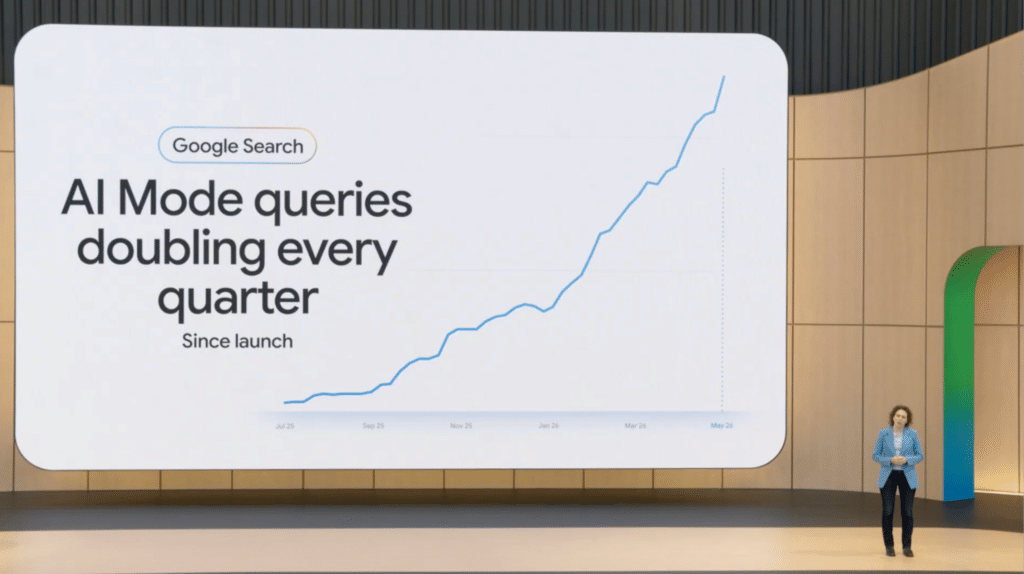
Google is calling the new AI-native Search box the biggest upgrade in over 25 years. Antigravity launched as the new agent layer. Multimodal queries now take in images, video, files, and whatever's open in your active Chrome tab. Agentic shopping and booking arrive later this summer.
Organic search (and SEO) just got its biggest expansion in a quarter century. Understanding that will decide which marketing leaders look prescient at next year's board meeting and which ones don't.
The Wrong Question
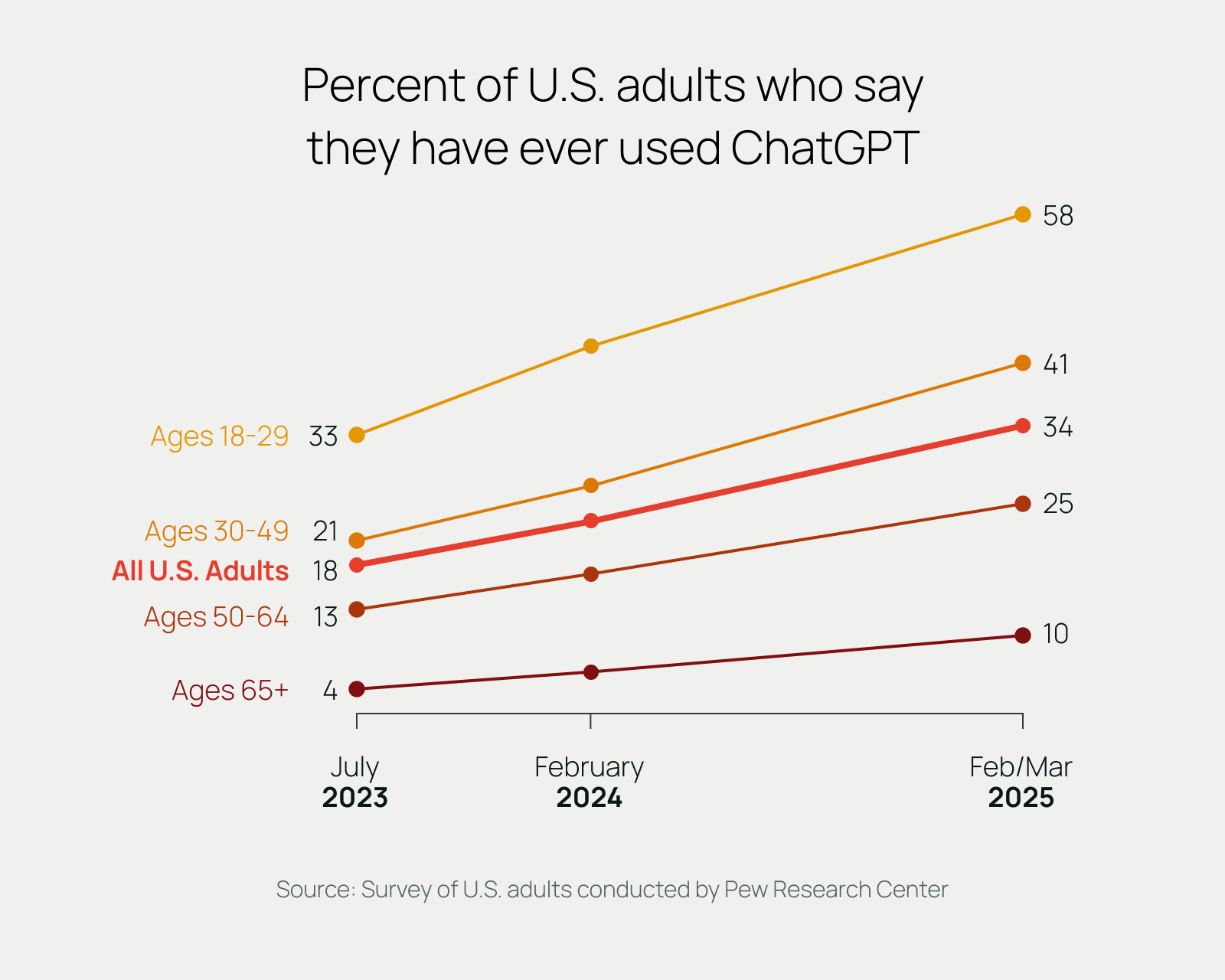
“How do we win back the click the AI Overview took?” It’s the question most marketing teams have been asking and is almost guaranteed to produce wasted effort. The click went to Google's own answer surface. The audience went with it. According to Pew Research, 34% of U.S. adults have now used ChatGPT (doubled since 2023) and 65% see AI summaries in their search results for most queries. Sixty percent have used AI to search for information, a number that climbs to 74% among people under 30.
You can't out-rank Google's AI Overview by writing a better article on the same topic! Google will just use your article to write the next Overview.
The right question is, “whose attention is in this query, what do they actually want to know, and what will make them choose us when they're ready to decide?”
If you built your last five years of organic strategy on ranking-first thinking (meaning picking a keyword, writing to whatever's at position 1, optimizing on-page, and repeating monthly), the playbook just stopped working because the SERP that playbook depended on no longer exists.
If you built those five years on audience-first thinking then the playbook works exactly the same way in an AI Overview, a Gemini response, a Perplexity citation, or a blue link. The same persona work, the same journey map, the same writing discipline produce the same outcome. Only the surface changed.
The Pressure On Marketing Leaders
The Gartner 2026 CMO Spend Survey found that 56% of CMOs say their marketing organization lacks the budget required to deliver their 2026 strategy. Marketing budgets sit flat at 7.8% of revenue. Seventy percent of CMOs consider becoming an AI leader a critical 2026 goal but only 30% report mature AI readiness.
The C-suite expects AI-led marketing transformation, but the budget and operational readiness to deliver it both lag.
The wrong thing to spend the dwindling marketing budget on is chasing every new AI surface as if it were a distinct discipline. The right thing is to invest in the part of the work that compounds across every surface: 1) deep audience understanding, 2) content that earns citation, and 3) measurement that holds up at the board level.
What the panic is missing
For the past two years, every other LinkedIn post in the marketing world has been a version of "organic traffic is dying." If you only watch the “Sessions” chart in GA4, the trend lines on a lot of sites look bad. Click-through rates from AI Overviews are still lower than from the old blue-link SERP, even though early 2026 data suggests AIO CTRs are recovering as Google refines the experience.
But it's the wrong metric and the wrong frame.
The audience didn't go anywhere. They're searching more than they ever have. They're just doing inside Google (and other AI search platforms) what they used to do across five different tabs. When a user gets a satisfying answer from an AI Overview that cites your brand, then comes back later and goes directly to your site, GA4 sees a direct or branded organic visit. The GEO/AEO work that earned that visit is invisible in the dashboard.
The audience isn't gone. The measurement is just behind. The marketing teams that figure out how to help leadership understand AIO citation share, brand mentions across AI platforms, query coverage and sentiment, and downstream conversions from each of those surfaces are going to keep their budgets while everyone else fights to defend declining sessions.
P.I.E. Is The Framework Guiding Our AI Journey
The framework we run at 97th Floor is three words: Empathy, Innovation, Profitability. We call it P.I.E.
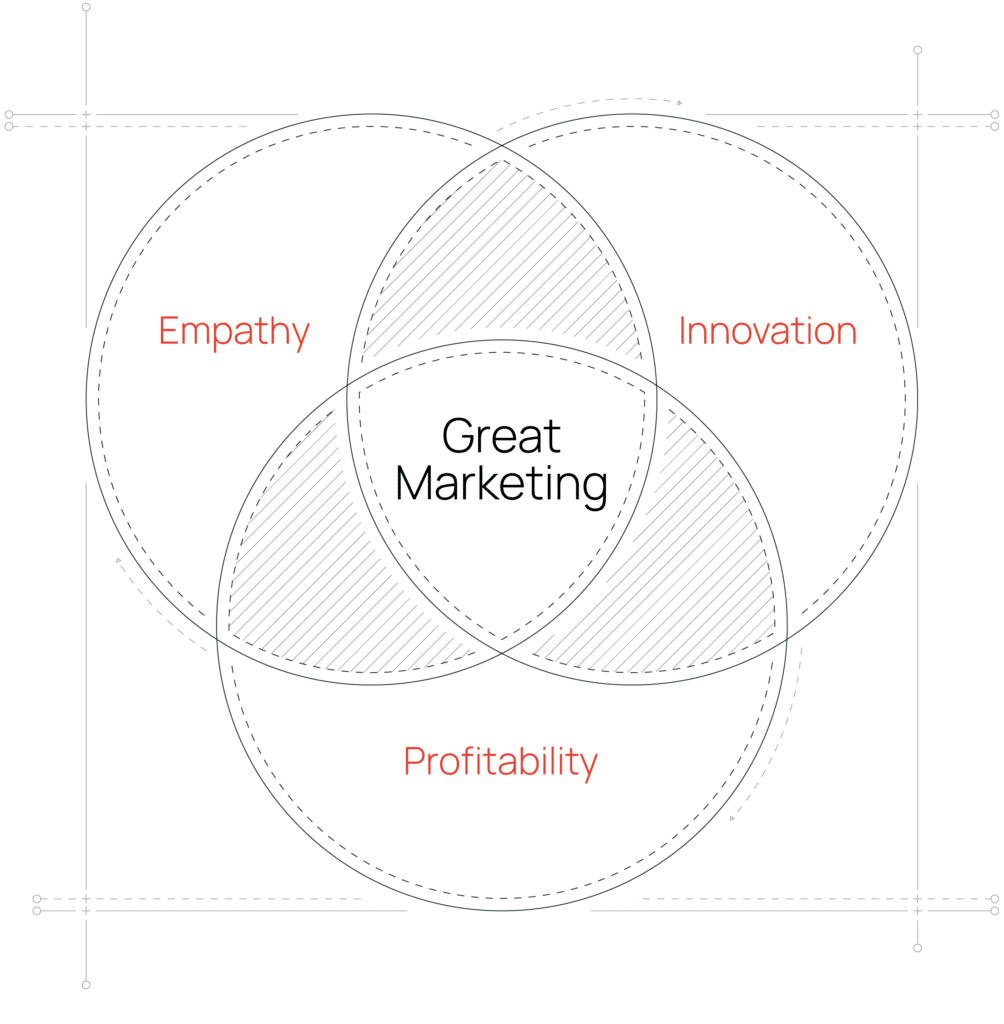
“Empathy” means obsessing over who our client's audience actually is, beyond their role as a buyer. What they're trying to do, what they already believe, what they're worried about, what they search the moment before they ever search.
“Innovation” means refusing to copy whatever is already ranking. The brand that produces the eleventh-best version of an existing SERP article is now going to get eaten by AI, fast. The brand that produces the actual answer to the question the audience is asking will get cited.
“Profitability” means tying every campaign back to revenue, not vanity metrics. AIO citations don't pay your bills. Brand mentions that lead to more branded search, more direct traffic, and more conversions do.
This framework was always a bet that algorithms and platforms would change but the principle wouldn't. From my POV, that bet just paid off.
Proof: B2C Finance Client
Going into 2024, our client in B2C Finance was a SERP underdog in private student lending. The "student loans" category was dominated by federal sites and the giants of the private lending world:
- studentaid.gov: 11.8M monthly organic traffic, 3,118 pages
- consumerfinance.gov: 1.4M, 8,492 pages
- ed.gov: 1.2M, 93,208 pages
- salliemae.com: 380K, 406 pages
- earnest.com: 156K, 619 pages
- Our Client: 49.7K, 399 pages
That's the field our client was up against, right as AI Overviews started reshaping the SERP. From the outside, that looked like the wrong moment to invest in organic. They did it anyway, because the investment was in the audience, not in keyword positions.
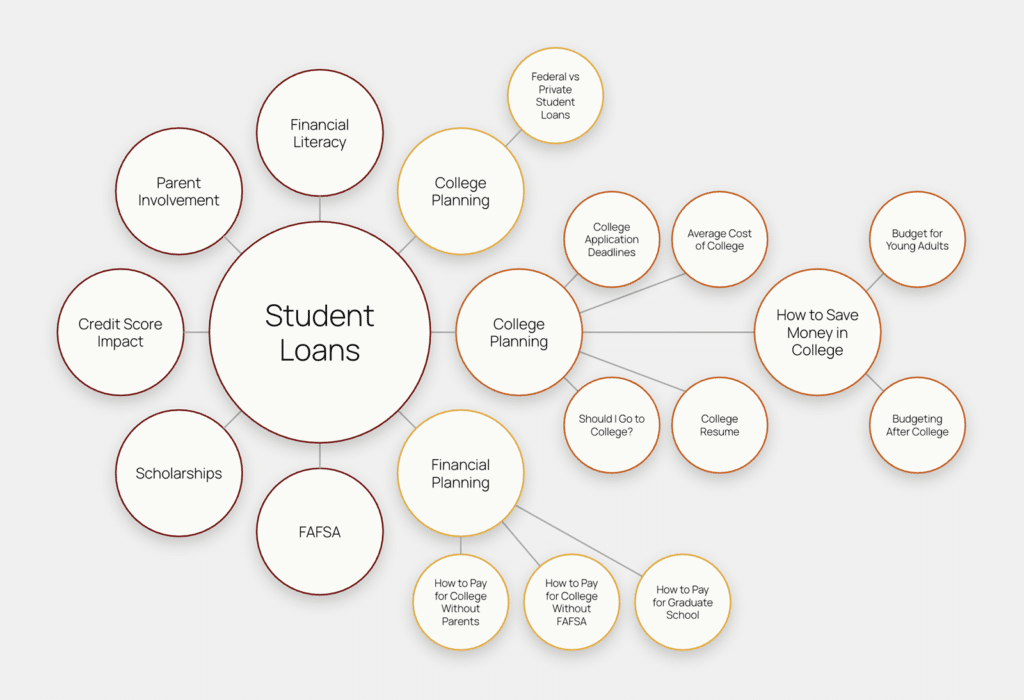
The work was deliberate. We built a hub-and-spoke topical authority structure around "Student Loans." Pillar page in the middle. Cluster pages for FAFSA, Scholarships, Types of Student Loans, and College Planning. High-funnel content for the parents of student borrowers like “Credit Score Impact,” “Parent Involvement,” “Financial Literacy,” “How to Pay for College Without FAFSA,” etc... All with internal linking that made clear to Google which page was the authoritative answer for which query.
The writing approach mattered more than the structure. Instead of producing content based on whatever was currently sitting in the top 10 SERP results for each keyword, we researched every question a student or parent might have at every stage of the loan application process, then answered those questions in depth. Transparency on rates and loan terms was deliberate. So was incorporating proprietary survey data from the client themselves, which gave the content real experience, expertise, authority, and trust, the E-E-A-T signals Google's own quality guidelines (and the LLMs reading from them) reward.
We produced:
- 162 new pieces of content
- 62 re-optimized pages
- 455+ strategic mentions across the web
The results:
- 1,275% increase in brand mentions across AI surfaces
- 400% increase in owned AI Overview citations** since AI surfaces started becoming prevalent
- 47.5% YoY increase in search impressions
- 14.11% YoY increase in organic traffic
- Private Student Loans page +113.6% YoY organic
- Homepage +46.08% YoY organic
- 100% of new content published in Q3 2025 is currently cited in Google's AI Overview
All in a year when most sites in the category were watching organic decline. (Read the full case study here)
The client was directly up against some incumbents with much larger budgets. They didn't beat them on sheer volume. They beat them by answering the questions the audience was actually asking, at depth, with transparency, using the brand's own data.
Five Moves For The Next Twelve Months
If you're leading marketing at a mid-market or enterprise company right now, I’d take a look at five moves are worth committing to:
1. Stop measuring organic by sessions alone. Build a richer story for your executive team and help them understand AIO citation share, brand mentions across AI platforms, query coverage/sentiment, and lagging indicators like direct traffic and branded searches. With 56% of CMOs telling Gartner they don't have the budget to deliver their 2026 strategy, the orgs that can demonstrate where the work is actually paying off will defend their resources through this transition.
2. Pick the topic. Then own it. Topical authority is what wins in AI search. Our B2C Finance Client didn't win because they outranked Sallie Mae on the exact-match keyword "student loans." They won because they owned the conversation around student lending for the audiences that mattered. Pick the conversation your audience actually cares about. Be the obvious answer in it.
3. Refuse to produce the eleventh-best version of what's already on the SERP. AI is going to compress that work into one summary, and that summary will not cite you. The content that gets cited adds something like proprietary research, the brand's actual point of view, or depth on the questions the rest of the SERP isn't bothering to answer.
4. Optimize for the agent that's about to start buying things. Google's agentic shopping and booking features launch this summer. The brands with clean product information, transparent pricing, and well-structured data will be the ones AI agents include when a user says "find me three options for X." Treat the agent like a buyer. Make the path easy.
5. Treat audience research as a defensible asset, not a tactic. Persona work, journey maps, and voice-of-customer data survive every Google update, every platform shift, every UI change. They're the only competitive moat a marketing org can build that compounds over time. If you don't have a real one, build it before you spend another dollar on tactics.
The marketing leaders who will win the next five years are the ones who will refuse to panic when the platform changes and who will, instead, keep the audience at the center of every decision.


