



At our July company meeting, we did something that would have felt like malpractice a few years ago: we asked every team at 97th Floor to plan content for a real client with keyword research completely off the table.
No search volume, no difficulty scores, no SERP analysis — just ten minutes, one client, and a blank doc.
By the end, one team had run their list against the client's actual content calendar and found that roughly 40% of the ideas they generated weren't covered anywhere on it.
Here's the exercise, why we ran it, and what came out of it.
The rules
Every team picked one of their clients and got the same four instructions:
- Choose one client. Forget keywords. Forget search volume. Imagine you're one of your client's ideal customers.
- Fill a doc with everything that person could realistically ask. Consider fears, frustrations, goals, objections, misconceptions, comparisons, implementation questions, buying concerns.
- The goal is volume of ideas. Don't filter down. Don't think about SEO.
- At the end, highlight everything your current keyword research process would probably never surface.
That's it. Ten minutes on the clock.
Why we took keywords away
Some context, because this exercise didn't come out of nowhere. It was a stress test of a belief we've been building toward for a while.
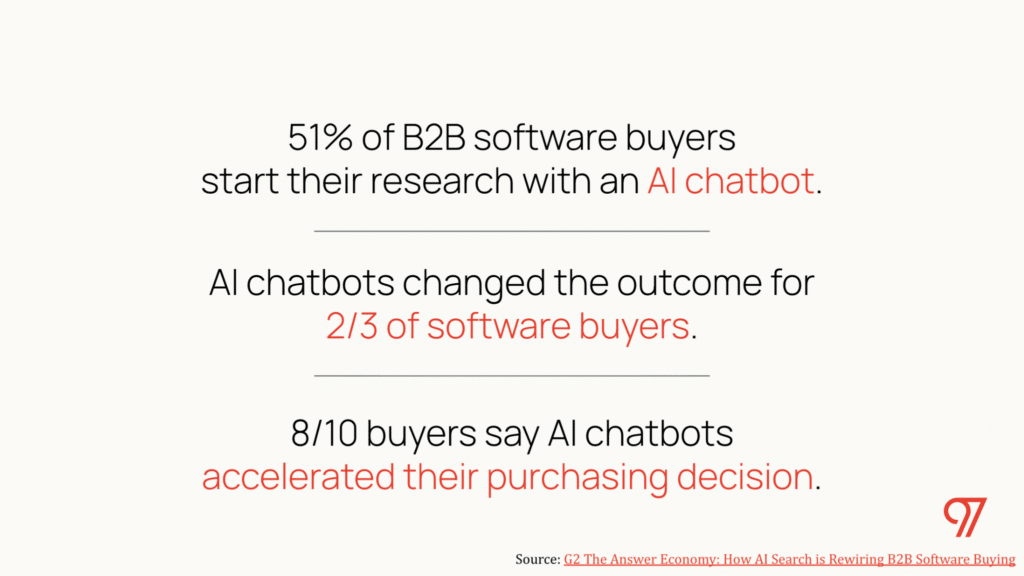
The way people search has fundamentally changed. Over a billion people a month are now using Google's AI Mode, and queries there are doubling every quarter. ChatGPT became the fifth most-visited website on the internet. And per G2's research on B2B software buying, 51% of buyers now start their research in an AI chatbot — and for two-thirds of them, what the AI said changed the outcome.
Here's the problem that creates for content strategy: keyword data only shows you the searches that happened often enough, in similar enough phrasing, to register as trackable volume. A keyword like "ai in education" shows 6,900 monthly searches. What it doesn't show you is everything orbiting it in AI search:
- "I'm trying to convince my district that AI is worth investing in. What evidence should I bring to the meeting?"
- "We have $50,000 to spend. What's the highest-impact AI investment for our school?"
- "Where should I start on creating an AI policy for our small school district?"
Three completely different intents, three completely different pieces of content — and none of them have trackable search volume. If your research process never surfaces these questions, your content won't answer them. And if your content doesn't answer them, someone else's will.
Internally, we've boiled this down to one line: search volume is evidence of demand, not the boundary of demand. (We've written before about why keyword research can no longer be step one of a content strategy — this exercise was us testing that thesis on ourselves.)
So the question became: if our strategists stopped looking at the data everyone else is looking at, and just thought like the actual human on the other end — what would they come up with that the keyword-first process misses?
The framework we used
To keep "think like the customer" from being hopelessly vague, every team worked from our customer journey map — the same framework we now use to build GEO prompt strategies for clients.
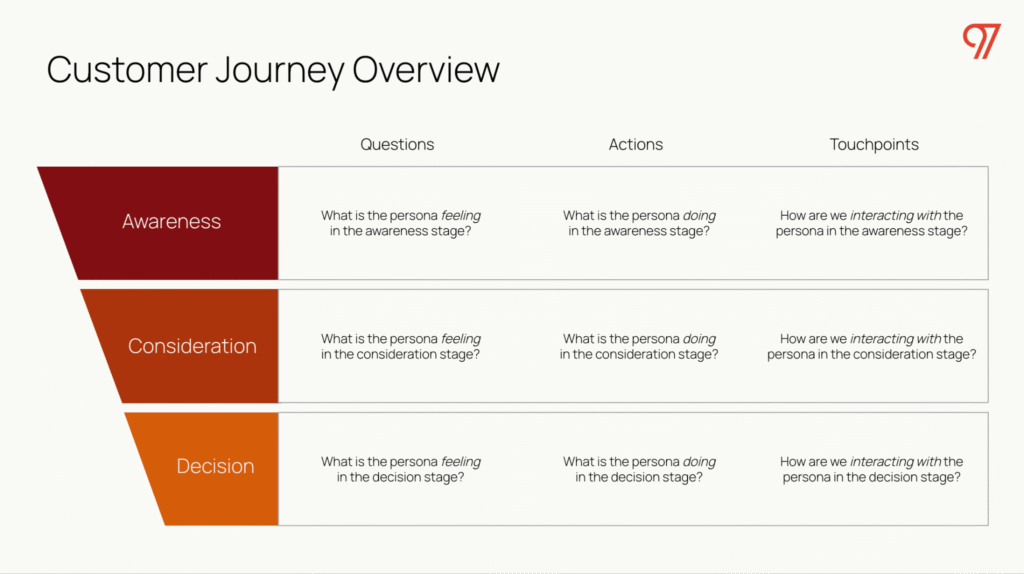
The short version:
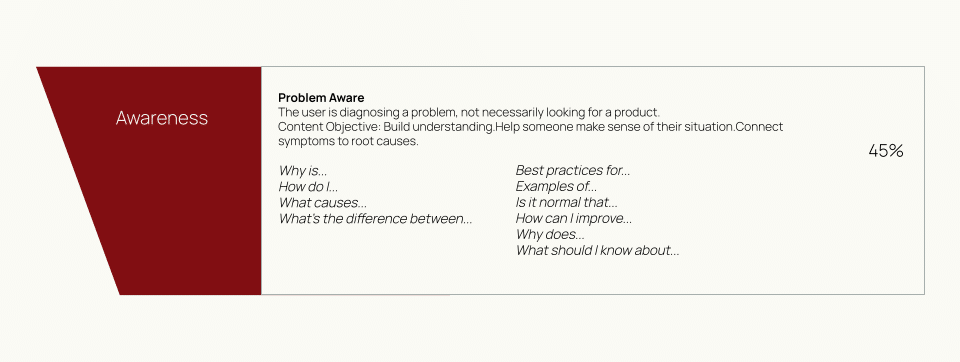
Awareness (problem aware). The user is diagnosing a problem, not shopping for a product. They're asking "why is...", "what causes...", "how do I...", "is it normal that...". The content objective is to build understanding — connect symptoms to root causes.
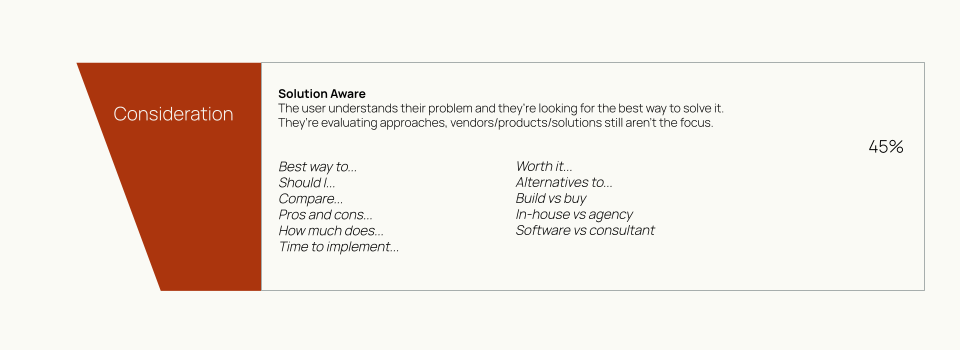
Consideration (solution aware). They understand the problem and are evaluating ways to solve it — approaches, not vendors. "Best way to...", "pros and cons...", "build vs. buy", "in-house vs. agency", "worth it...".
Decision (vendor/product aware). Pricing, demos, reviews, integrations, competitor comparisons. This is where traditional keywords still shine, because these searches are trackable and high-converting.
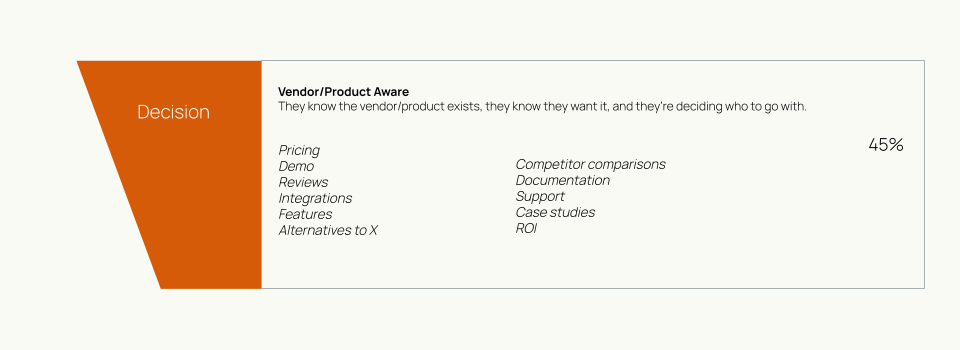
Note the weighting: roughly 90% of the content opportunity, by sheer quantity, lives in those first two stages — and those are exactly the stages keyword research is worst at seeing. Teams were told to focus there.
What ten minutes produced
Across six teams, idea counts ranged from 13 to 76. But the counts mattered less than what was on the lists.
The answering service. One team works with a client that provides live answering agents for businesses, including medical practices. Their keyword-informed strategy centered on the product category. Thinking persona-first, they landed on questions like:
- How do I prevent receptionist burnout?
- My receptionist is missing calls during busy times and patient experience is slipping — what do I do?
- Is a live answering service HIPAA compliant?
- How trained are the agents in medical settings?
The eyewear brand. A team working with an affordable eyeglasses e-commerce brand started with one team member's real-life story about his glasses and worked outward into use cases: an affordable backup pair for traveling, buying glasses for my aging parents, and true beginning-of-journey questions like do I have to buy glasses from the same place I get my prescription?
The art gallery platform. A team supporting an art gallery CRM and marketing platform got past features entirely: guidelines for hosting a gallery event, international laws and regulations for marketing artwork across borders (their client's customers sell globally), and even a brand-play idea — a Michelin-star-style rating program for galleries, leveraging the client's authority in the art world.
The cruise line. A team working with a premium cruise line looked at everything through the lens of their primary persona — older retiree couples who want to see the world in a relaxed, premium way. Their existing strategy is heavily destination-focused. The persona-first list went broader: safest ways to see the U.S. or the world as an older couple, bucket-list destinations with no kids, travel questions that sit two or three touchpoints before anyone types a destination name.
The Content Opportunities Keyword Research Missed
That last team did something we didn't ask for, and it became the headline of the meeting.
They generated 51 unique ideas, then pasted the client's entire existing content calendar — every term and query on it — into Claude and asked how many of the new ideas were already covered.
The answer: about 60%.
Which means roughly 40% of the ideas a team produced in ten minutes, for a client with a mature, keyword-researched content calendar, weren't on that calendar at all. Not deprioritized. Not scheduled for later. Just never surfaced, because the process that built the calendar couldn't see them.
An honest caveat
Not every list was a revelation. The eyewear team was upfront that, as an e-commerce brand, many of their ideas probably would have eventually shown up in keyword research — the exercise mostly forced them to think about the same demand differently. That's a fair result, and worth stating plainly: persona-first ideation isn't magic, and it doesn't replace everything.
We're also not abandoning the trackable stuff. Bottom-of-funnel keywords still convert, and we still want our clients showing up for them. The point is allocation and honesty: some bottom-of-funnel terms are so competitive that over-investing there while ignoring the untrackable early journey means leaving the majority of the opportunity untouched. If the persona research is strong, "no search volume" is no longer a reason to say no.
What happens next matters more than the exercise
The point wasn't that every question belongs in your content strategy.
Some of these ideas are two steps away from a purchase. Others are twenty.
That's where strategy takes over.
Funnel depth matters. A B2B cybersecurity company with a six-month buying cycle has far more room to educate around adjacent problems than an ecommerce brand selling reading glasses. A luxury cruise line can justify investing in content that helps travelers decide whether a cruise is the right vacation in the first place, while continuing to own destination- and itinerary-specific searches later in the journey. A local service business may need to stay much closer to buying intent.
The exercise isn't meant to replace prioritization. It's meant to widen the aperture before you prioritize.
Once you've generated the questions, the real work begins:
- Which questions are most closely tied to your customers' journey?
- Which represent problems your brand is uniquely qualified to solve?
- Which build authority in areas you want to own?
- Which naturally create a path toward your products or services?
- Which should be answered by your brand instead of someone else's?
Every idea should then be pressure-tested against business value, audience relevance, and the role it plays in moving someone closer to becoming a customer.
Ten minutes is enough to uncover opportunities. It isn't enough to decide which ones deserve investment.
That's strategy.
What changes now
For our content strategies, keyword research is no longer step one. Topic research now starts with the persona and the product: what is this person asking at each stage of the funnel — their fears, frustrations, objections, misconceptions? Keyword data comes back in later, where it's genuinely useful: validating demand, forecasting, client education, and the decision-stage plays it was always good at.
If a ten-minute exercise with no data surfaced a 40% gap, the obvious question is what a rigorous, repeatable version of that process looks like — how you prioritize persona-driven prompts, validate demand without search volume, forecast, measure, and build a content calendar around it. We've now trained our entire company on exactly that, and it's what we'll be sharing next.
For now, steal the exercise. One client (or your own company), one doc, ten minutes, no keywords. Then check your list against your content calendar and see what percentage is missing.
We'd bet it's more than you think.


