



If you have Googled anything in the last few years, you’ve likely come across an AI overview that summarizes some of the ranking pages to answer your query. Or maybe you wondered about the history of the Ottoman Empire or needed instructions to refill your car’s oil and turned to ChatGPT. AI is taking online search by a storm.
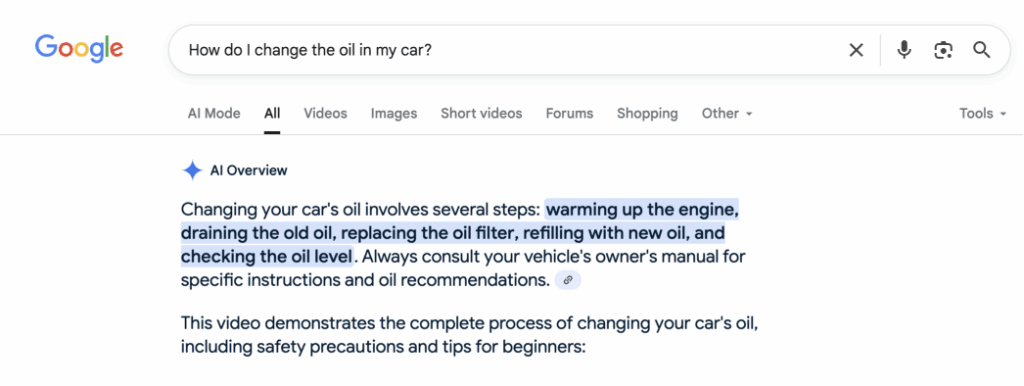
For search engine users, the rise of AI has made getting synthesized summaries of all the top internet easy. For companies and SEO experts, it involves figuring out how to adjust your content strategy to keep your content visible and to reach your customers. That’s why we’ve put together this guide on the future of AI search SEO to help you figure out where and how to tweak your content strategy to be ready for the growth of AI SEO.
Unlike traditional search engines that rely on keyword matching and indexed pages, AI-powered systems use large language models (LLMs) to interpret natural language in an attempt to deliver nuanced, conversational results.
Some of the leading AI search tools you may have used or heard of include:
Search is undergoing a fundamental shift that’s only getting started. In May 2023, Google began rolling out Search Generative Experience (SGE), now rebranded as AI Overviews, which places AI-generated responses above standard results. Microsoft integrated AI mode into Bing in early 2023 using ChatGPT-4, while platforms like You.com and Perplexity launched AI-first search tools that prioritize summarization and citations. Search engines now are prioritizing their own AI summaries at the top of the SERP in what used to be prime real estate for SEOs.
These AI tools are changing the way people interact with SERPs. In fact, a study from the Pew Research Center in May 2025 notes that people are significantly less likely to click on web pages listed in Google search results if there’s an AI summary present. They also only rarely click on the sources listed by the AI summary.
With the shift in how users interact with search engines, SEO is going to shift too.
Traditional SEO is built around optimizing for search engine crawlers and ranking within standard SERPs. This includes tactics you’re likely very familiar with, such as:
GEO—Generative Engine Optimization—targets AI searches. Large Language Models don’t crawl; they try to interpret the context and evaluate:
Because LLMs respond to context and credibility, not just ranking signals, you want to optimize content for semantic relevance, not just visibility. Adding GEO to your content strategy is another way to make your content visible in those AI-generated summaries—though traditional SEO still matters as well.
So if AI is going to change the way people search (and already is starting to do so), you need a content strategy designed to fit in that landscape. These are our four top tips for creating content that your readers will love and that works with AI.
Content these days has to walk a very fine line: being written for humans and for AI accessibility all at the same time. You don’t want to write a brilliant piece of long-form content only for it to be lost in the ether of Google, but you definitely don’t want to end up with AI slop. Some ways you want to cater your content for your readers and for AI include:
The goal here is to write content for your human audience but to make sure it’s fully AI accessible afterward. At the end of the day, good content is still king, so prioritize having well-written content and avoid losing that human touch while optimizing for AI search SEO.
AI works like any other search engine: it will rank your pages higher if they’re correctly set up with appropriate metadata. While AI tools don’t crawl the web like traditional bots, they still rely on structured, well-maintained websites. Technical SEO helps ensure your content is indexed by both search engines and used by AI models that reference top-ranking pages. Prioritize:
Just like with Google Search, AI systems reward content that’s well-structured and technically sound.
Optimizing for search engine results page (SERP) features can improve your visibility in both traditional and AI-generated summaries. Focus on:
Appearing in these SERP features improves your chances of being referenced by AI models—and therefore coming across your readers’ screens.
If you’re looking to build your pages in a way that makes it easy for AI tools to scan your content, focus on these five strategies:
By following these principles, your content becomes easier for AI models to recognize—which then helps you stay visible in the next era of online searches.
Even though it might feel like the search landscape is rapidly evolving, the core principles of technical SEO remain as important as ever. In fact, SEO hasn’t really changed—it’s only expanded to include AI searches. Staying on top of and implementing foundational technical best practices still pays dividends, both in traditional rankings and in AI-generated search results.
Structured data helps both traditional search engines and AI systems better understand the context of your content. Using it can help your content get featured in snippets and AI overview citations. To get the most out of your structured data:
Well-implemented schema makes it easier for AI systems to identify key facts and understand the relationships between ideas—boosting your content’s chances of being referenced in AI search results.
AI-powered search is no longer limited to just text, and your content strategy can capitalize on that. Many search engines and AI assistants now support multimodal inputs and outputs to blend text, images, and video to meet user needs. Make sure your site:
By incorporating diverse formats, you increase your visibility across a variety of SERP features. Your site could end up as the cited image in an AI overview or in an image carousel. That visibility will make your content more accessible and expand your reach.
All the general tips we’ve talked about so far are best practices for any type of AI search tool. While many core principles remain consistent, each model has its unique behaviors and ranking preferences. Some of the most prominent and widely used AI search engines—and the ones offering the most trackable performance insights today—include:

AI systems reward conversational content that mimics how people talk, so here are a few tips to optimize for conversational queries and natural language prompts:
By tailoring your content for the nuances of each platform—and optimizing for how people naturally ask questions—you’ll increase your visibility in both AI-driven and traditional search environments.
Traditional SEO tools may not yet offer complete coverage of AI-driven search experiences—but a new wave of reporting solutions is emerging to bridge the gap.
There are a lot of SEO metrics, but which ones matter for AI search SEO? Key metrics to focus on include:
Since AI search focuses more on credibility and relevance than on traditional rankings, visibility can come in the form of mentions and summaries rather than blue links.
While AI searches are still relatively new, there are tools that are adapting to help you keep track of your most important metrics:
As AI search adoption increases, expect more tracking solutions to emerge. Just like SEO matured with its own analytics stack, AI SEO reporting will become a core part of modern marketing analytics within the very near future. Start experimenting with these tools now to stay ahead of the curve and get a head start above your competitors.
Working with AI to produce AI-optimized content is increasingly essential. Modern AI systems—like ChatGPT, Gemini, and MarketMuse—can help you with identifying content gaps and topic clusters that you can write about, speed up the drafting process, and create content outlines for you.
Don’t think of AI replacing your content creators. Instead, pair AI with human experts to speed up the content creation process without losing what makes human-written content great.
Another way to AI-prep your content strategy is to apply the hub and spoke model. The hub and spoke model is a content architecture that creates a central “hub” page targeting a broad, high-value topic, supported by multiple “spoke” pages that address related subtopics in depth. Each spoke links back to the hub and to one another.
For example, when Maveneer came to 97th Floor in 2023, they wanted content that would rank, so we gave them a hub and spoke strategy with comprehensive overview hubs targeting keywords like “warehouse automation” and “order picking.” After establishing those hubs, we could expand to spokes with drill-down articles like “order picking technology” and “automated sorting systems” linked to and from the hub. This structure improves internal linking, site navigation, and topic authority to search engines and AI systems alike. In fact, for Maveneer, their domain authority R skyrocketed from 3 to 34, and they saw an 886% increase in search impressions YoY.
Search is evolving—and fast. More people are relying on AI to answer their questions and give them potential solutions. With AI browsers popping up, there are only going to be more AI search developments. These platforms don’t just display a list of blue links. Instead, they generate dynamic responses by pulling insights from multiple sources, often without traditional attribution or visible rankings.
For enterprise brands, this shift has major implications.
In this new paradigm, visibility isn’t just about ranking #1—it’s about being referenced, cited, or summarized by AI models at the moment a customer asks a question. Failing to adapt means losing organic visibility at critical touchpoints—especially early in the customer journey when buyers are still gathering information.
Enterprise brands that invest in AI search SEO now can make sure they’re ahead of the curve and stay visible. AI isn’t replacing internet searches—it’s reshaping it. And enterprise brands that evolve their strategies now will be best positioned to lead out in the next era of SEO.
If you're ready to show up in AI-generated results, let's build your strategy.
Is user confidence in online content at an all-time low? AI-generated content dominates many key topics, and users can easily find themselves frustrated when searching, finding articles they could have generated directly from a chatbot themselves. There is also an increasing volume of content that is becoming commonly known as “AI slop.”
And that’s without getting into the other struggle: LLMs are not only competing for eyeballs on regular search engines, but also stealing traffic directly. As a result, sometimes it can feel like the rest of us are left to fight over scraps.
If the current outrage over AI slop proves anything, however, it’s this: users still want good content. And marketers still want to give it to them. So — with the internet noisier and more crowded than ever — how can we complete the matchmaking experience and find each other?
At 97th Floor, we have cracked the code, and we can prove it.
A brief history lesson
The internet has always been noisy, overcrowded, and full of shoddy content churned out by marketers hoping to maximize their reach. While many of us like to think of marketing as a noble profession (we are helping people solve their problems!), there will always be those who act in bad faith, trying to game the system however they can. It’s the whole reason “black hat” marketing exists.
Luckily, Google is fighting the good fight, and every update they have made over the years is done so in an attempt to improve the experience of the user, and get them closer to the type of content they need. This means that those focusing more on gaming the system and less on quality content are the ones who are typically hit the hardest by algorithm updates.
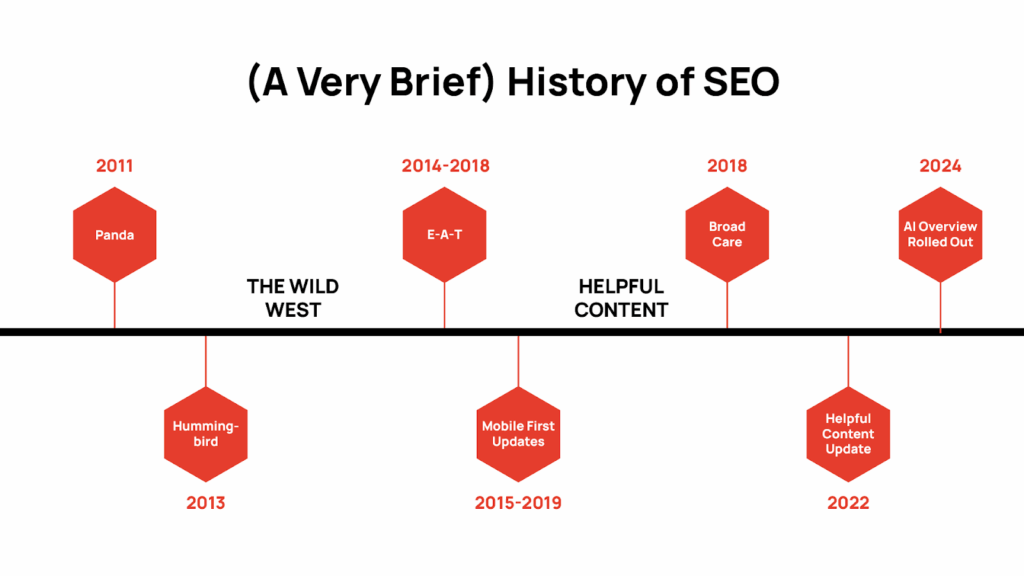
It’s the reason why, if you have been anywhere around content marketing, SEO, or even digital marketing in general for more than a few years, you will no doubt remember getting asked a question a million times, akin to “how do you balance SEO content and quality content.” Real ones know the truth: the best “SEO content” has always been high-quality content. And that kind of content is what has the power to withstand just about any algorithm update.
If that is not reason enough to focus on high-quality content, then let us also add this: The cost of bad content is steep. Analytics company CreativeX recently recently found that the average Fortune 500 company wastes approximately $25 million annually on content that fails to reach its intended audience or is not fully utilized.
It should come as no surprise, then, that the answer to combatting the current cacophony of AI slop is infuriatingly simple: produce high-quality content.
Ok, But…What Actually Is High-Quality Content?
I know, I know, that’s an incredibly unhelpful piece of advice. Because of course, anyone can claim to produce “quality content” but that means different things to different people. So, what do we mean when we say quality content? 97th Floor has a few principles that we have always lived by when it comes to both content and marketing in general.
1. High quality content is audience-focused
One of the main things that people get wrong about content marketing to this day is the how behind making the content itself audience-focused. As marketers, we can get caught up in how great we believe our solutions to be, that we get evangelical about the value that they bring — resulting in us pushing those solutions on our audience, rather than helping them. Quality content starts from a place of “what does my audience want or need?” rather than “what can we as a brand give our audience?”


| ❌ | ✅ |
2. High quality content is relevant to your brand
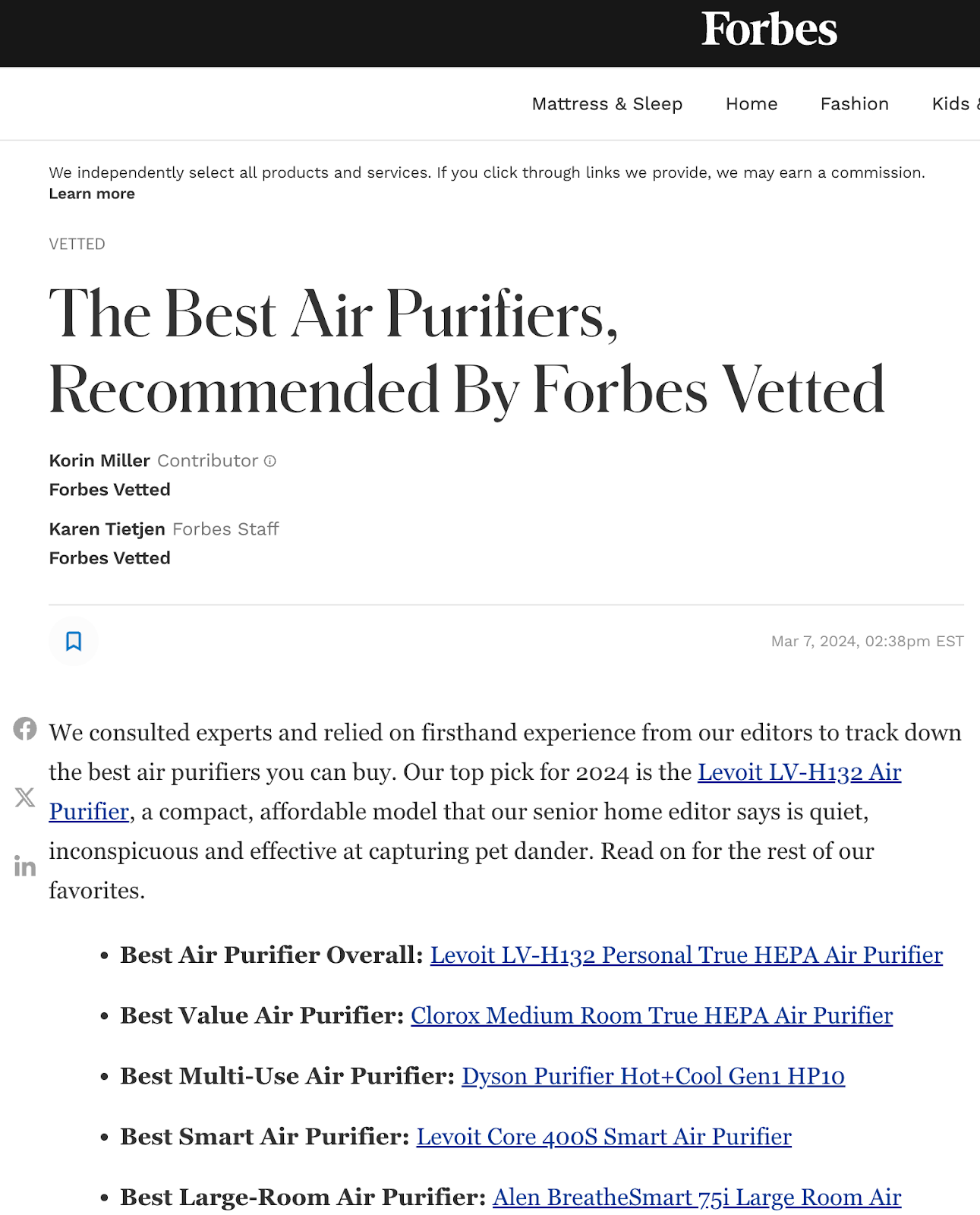
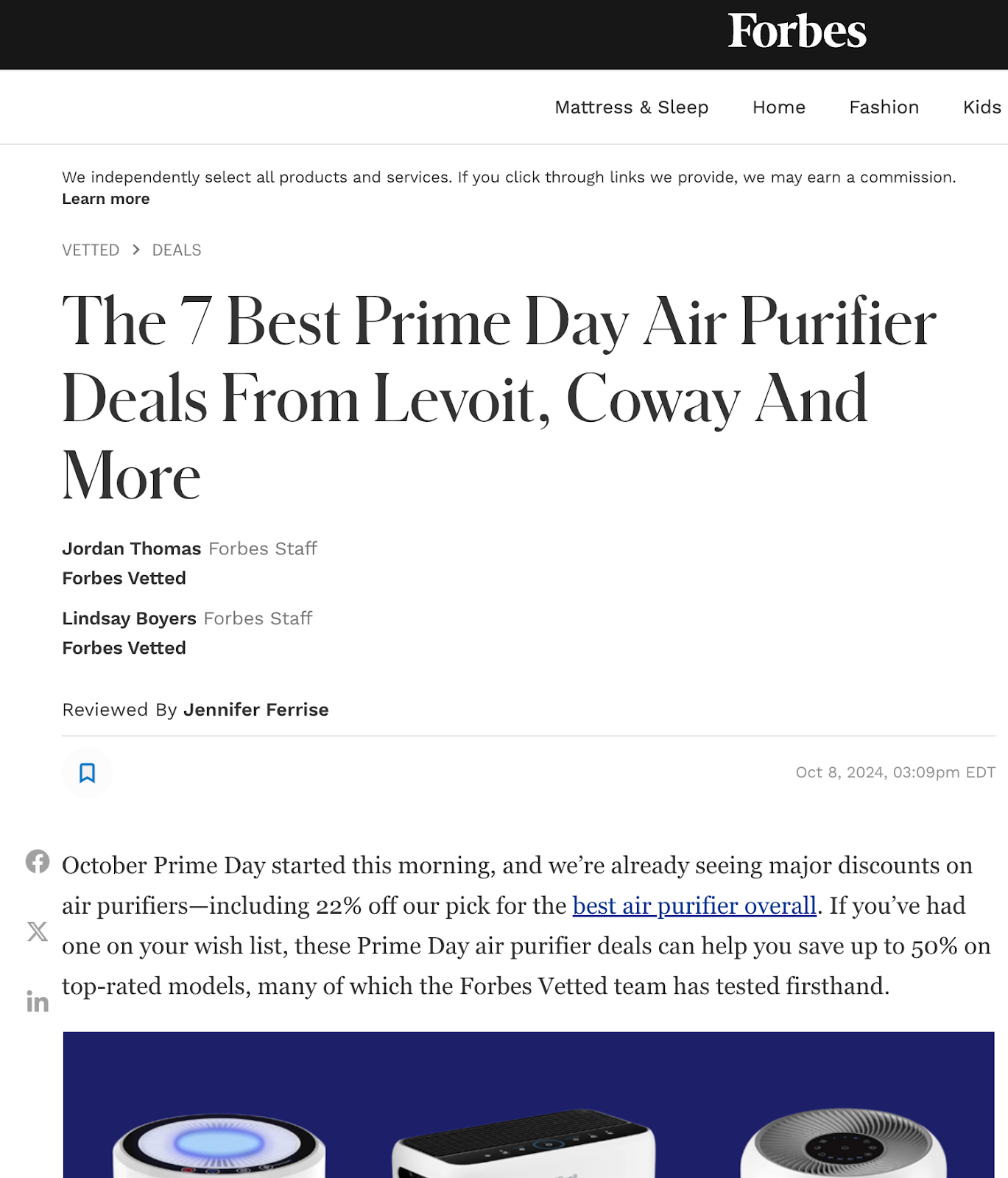
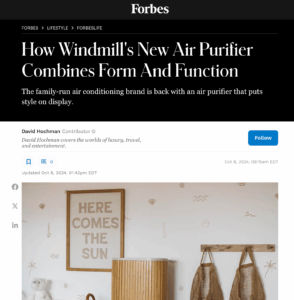
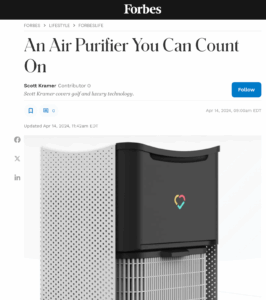
Ok, so you have figured out what the audience needs, and you have a ton of great content ideas. The next pitfall that marketers commonly fall into is trying to write everything. To illustrate: Take a quick moment to Google “best” anything and look at all of the sites that wrote about it, despite it being completely unrelated to their brand, product, or mission.

3. You are an expert and/or uniquely qualified to write this content
Authority matters. You might think this is the same as number two, but there’s a slight but significant difference. Something may be relevant to your brand, but you still have to prove yourself uniquely qualified to write it. This might come from expertise, experience, unique insights, or all three. This is also where the human element comes into play — even before AI, but especially now — users want content that they cannot simply generate by asking an LLM themselves. A unique and specialized point of view is more important than ever.
You may have noticed that our three quality content criteria and the use of AI are not mutually exclusive. On the contrary, we are not anti-AI evangelists. In fact, we use AI regularly to aid in efficiency and accuracy in the content creation process. However, it is rare (perhaps impossible) for a piece of content to match all three criteria without first passing by a human expert.
A survey conducted by consulting firm Baringa provides insight into opinions regarding AI-generated content by internet users. A majority of respondents identified at least one reason to value human-generated content above AI-generated content, with 81% citing “authenticity” as the key feature. However, users did not overwhelmingly state that they would avoid AI altogether — especially when it came to the younger demographics.
The fight for quality content is not a fight against AI, rather a delicate dance to make sure that it is used in the most effective way possible.
I Thought You Said You Could Prove It?
Ok, sounds like a nice theory, but does it actually work in practice? And can you prove it? In fact, we can. We have a proven history of this approach to content succeeding time and time again — surviving algorithm updates, changes in user behavior, and more. Here are a few examples.
Blendtec
Earlier, we made the claim that high-quality content will stand the test of time — and withstand algorithm updates. A perfect example of this is an article from way back in 2014 that we produced for Blendtec. A simple listicle of peanut butter smoothies, and accompanying recipes.
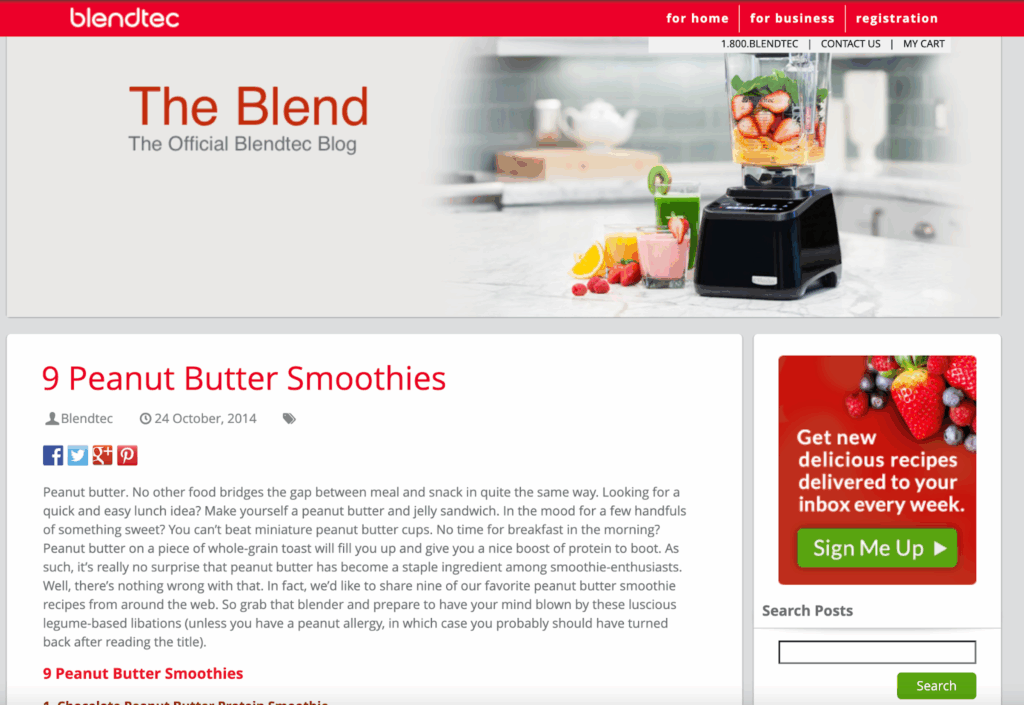
It meets our three criteria to a T and was incredibly successful when published. It continued to rank for several important keywords and survive several algorithm updates over the course of the next 10 years, to remain a top-three traffic driver for the site.
Dr Will Cole
Another example can be found in this guide on increasing progesterone levels for Dr Will Cole that we published and optimized in 2022.

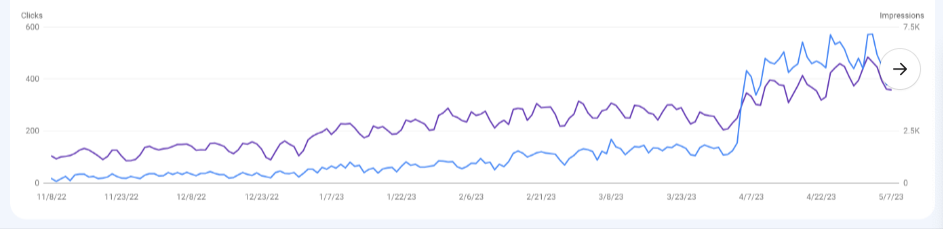
This article saw its biggest jump in traffic after an algorithm update in April 2023.
General Kinematics
But what about now? When AI is everywhere and AI Overview is stealing traffic from many pages. Well, we have countless examples of content that has survived the recent AI-pocalypse through following this simple formula for high-quality content. One such example this simple article for General Kinematics about uses for potash.
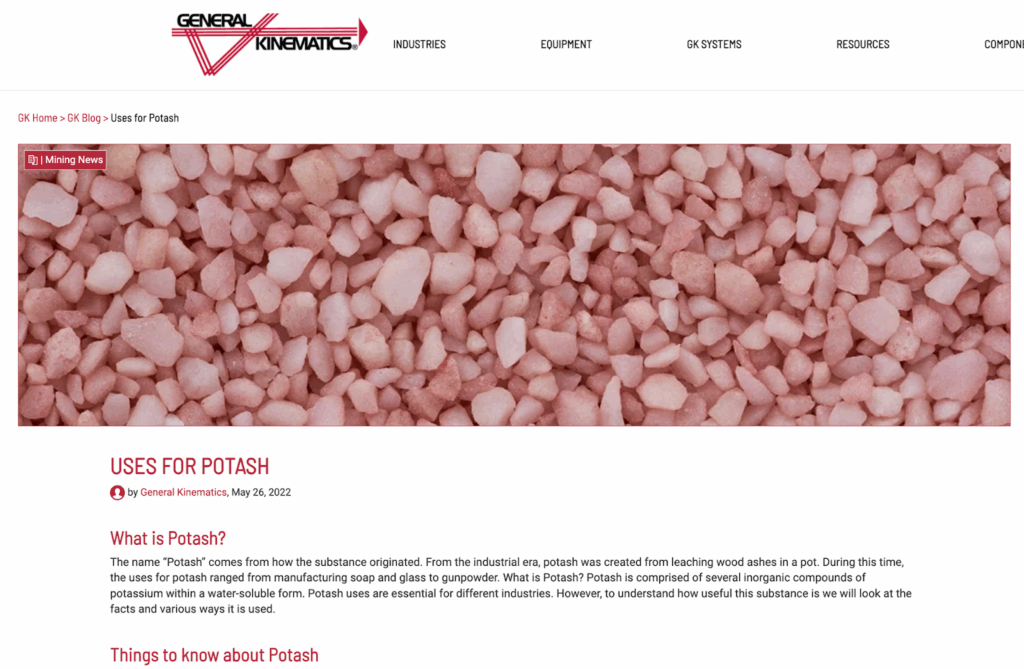
This content is audience-focused, brand-relevant, and something that General Kinematics — a producer of mining equipment — is uniquely qualified to write about. Published in 2022, it was automatically featured in AI Overview upon rollout of the feature in 2024, and has continued to do so since. What’s more: This page actually saw a 60.4% increase in traffic when you compare pre-AIO rollout to post-AIO rollout.
The bottom line: Google agrees with us. Every major and minor Google update in the past decade and change has been to get the search engine closer to prioritizing one of the three facets of quality content as identified by 97th Floor. For example:
1- Helpful content and other updates intended to prioritize user-first content.
2- Updates around brand authority, including recent updates that are deprioritizing irrelevant content for brands (or worse, brands that have spread themselves too thin and made it difficult for Google to assign authority).
3- This one goes beyond Google. Consider this: In a study of hundreds of thousands of citations, the most cited content type was product pages — by some margin. This means that this facet of quality content matters two-fold: Generic blog content is most likely to be directly replaced by LLMs, and product content — i.e. content that you are most uniquely qualified to write — is most likely to be cited. With optimizing both for and against LLMs becoming an increasing priority, this may be the most significant quality content guidepost of all.
I called out just three examples of this, but there are many more where that came from, and so will that continue.
The pattern across every one of those examples points to the same underlying truth. SEO expert Eli Schwartz makes the case that LLM visibility isn't a data or technical problem — it's a brand problem. This short video captures why the brands that consistently show up in AI-generated answers aren't winning on data. They're winning on authority.
Why It Matters Moving Forward
We talked about the ever-increasing noise of the internet. IBM predicts that AI will only continue to expand over the next decade, influencing more than content creation. High-quality content will continue to perform through both search engines and LLMs. The challenge or “noise” as marketers used to be different, but the solution is the same. If you put your audience first and prioritize quality content, the cream will rise to the top every single time.
Further Reading
Of course, that’s only part of the story. Sometimes you have to give even the cream of the crop the best chance to succeed. Next time, we’ll talk about how to get the most out of your content with an audience-first strategy.
If you're ready to show up in AI-generated results, let's build your strategy.
We’ve all felt it. You pour time into high-quality content, only to see your organic clicks drop—despite impressions climbing. What gives?
Welcome to the era of AI-powered search.
Google’s AI Overviews (AIO) and other generative engines are changing how people discover and engage with content. The game isn’t over—it’s evolving. And if you want to keep winning, it’s time to optimize not just for traditional SEO, but for AI-powered results.
At 97th Floor, we’ve spent the last year testing and refining strategies that help our clients show up and stand out in AI results. This guide breaks down what we’ve learned and how you can use it to grow.
Here’s a fast-track checklist that we stand behind:
We’re seeing a clear trend since the advent of Google’s AI Overviews:
This shift in metrics is significant. Your content is still being seen, but it’s not driving as many clicks.
This is largely due to AI Overviews, which are providing answers directly in search results—without users even having to visit your site.
In fact, research from Ahrefs revealed that AI Overviews reduce clicks by 34.5%. They analyzed 300,000 keywords and found that the presence of an AI Overview in the search results correlated with a 34.5% lower average clickthrough rate (CTR) for the top-ranking page, compared to similar informational keywords without an AI Overview.
This doesn’t mean SEO is dead. It means that SEO needs to evolve.
With this change in how users interact with search results, it’s important to note that KPIs are shifting. While clicks may be down, impressions are up—and brand mentions and search visibility are becoming increasingly valuable metrics. It's no longer just about tracking clicks; it’s about how your brand is being mentioned and perceived in the broader conversation.
At 97th Floor, we’re helping brands adapt to this new search landscape. We’re testing what works—and what doesn’t. In this article, we’ll walk you through how to optimize for AI and stay ahead of the curve.
AEO (Answer Engine Optimization) – Structuring content to appear in AI-generated answers and summaries (like Google's AI Overviews).
GEO (Generative Engine Optimization) – A broader strategy to improve how your content appears in LLM-powered results, including chatbots and voice assistants.
Other helpful terms:
Yes. But traditional SEO on its own won’t cut it.
GEO and AEO prioritize intent, clarity, and usefulness over keyword stuffing or link volume. Search engines (and AI tools) want to deliver satisfying answers, not just keyword matches.
Good keyword research still matters—especially when it covers both primary and secondary search intents.
Unlike traditional SERPs that rank blue links, AI search engines pull and generate answers using two main data sources:
They look for:
Here’s the opportunity: content that works well in LLMs often also ranks well in traditional SERPs. Optimizing for both doesn’t require two strategies—it just requires a smarter one.
AI content optimization is the process of structuring, writing, and formatting your content to be more useful and accessible to AI tools, without losing sight of your human audience.
Let’s be clear: the goal is not to “hack” the algorithm. The goal is to help people. To provide persona-driven content that resonates.
Too often, we see content stuffed with keywords or unrelated FAQs just to rank. That’s not helpful. It’s not what AI wants, and it’s not what readers want either.
Before you go all-in on optimizing for models instead of humans, this quick video breaks down why that approach can actually hurt your content’s real-world performance.
Start with your audience. Understand who they are, what they care about, and how they search.
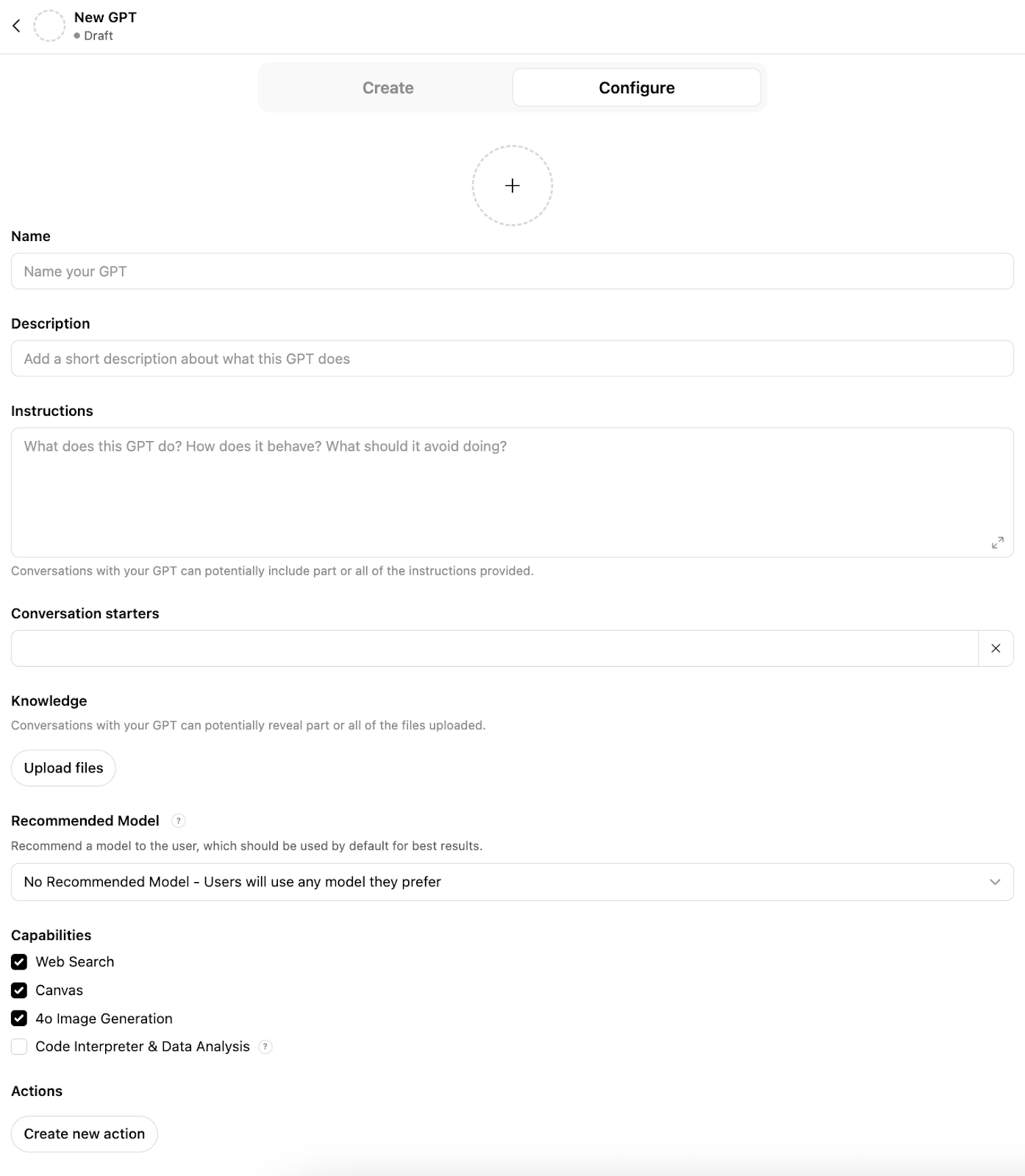
Consider using audience insights to build Custom GPTs that speak in your brand voice and match your customers' tone. (Here’s a screenshot of what it looks like in ChatGPT to configure a custom GPT.)
We also recommend:
Start with the answer, then explain it.
Example:
Q: How do I optimize for GEO?
A: Focus on clear, structured answers, semantic HTML, and direct responses to user queries.
Then go deeper.
Also:
AI favors content that’s easy to parse. That means:
97th Floor Test Results:
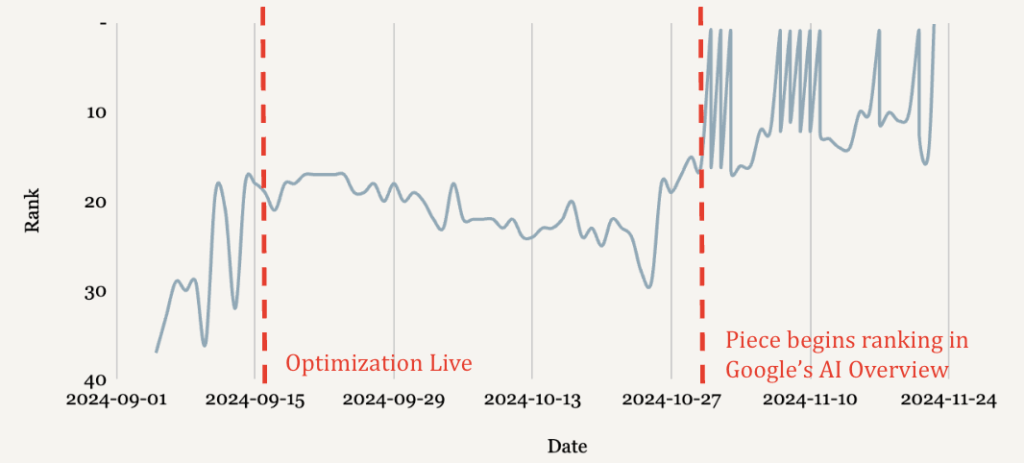
After adding bullet points and clear heading structure to a product page for a 97th Floor client, impressions and AIO rankings for an SEO-optimized article skyrocketed from ranking on the third page of the SERP to the first page (and ranking in Google’s AI Overview) in a short period of time. Here’s the results:
AI wants to serve trustworthy content. Show yours.
Ways to do that:
97th Floor Test Results:
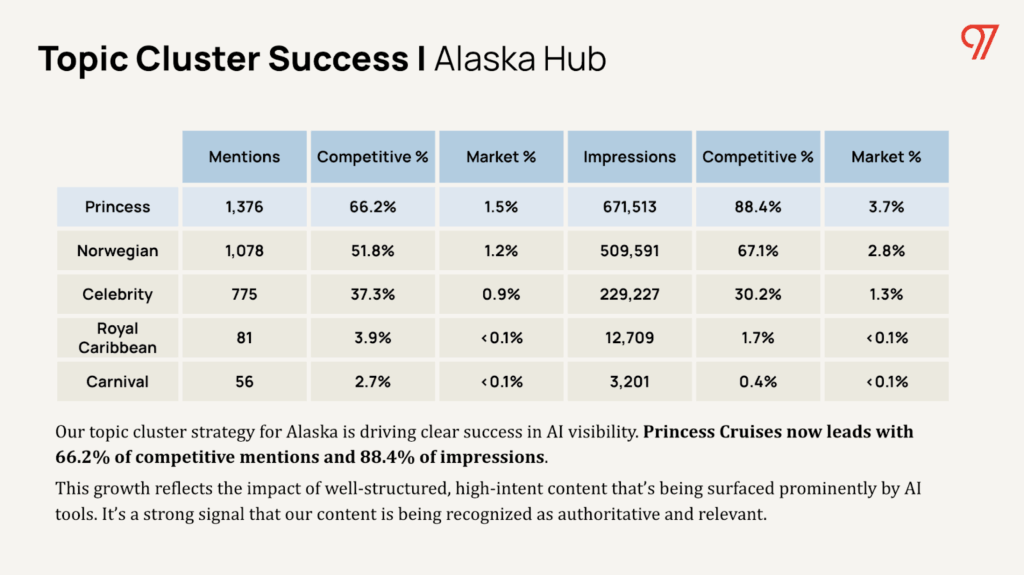
By focusing on tightly-knit topic clusters, we were able to achieve topical authority for Princess Cruises:
AI search engines increasingly value content from recognized, authoritative sources. This makes brand pages, like your About Us or Homepage, vital for building trust with both AI and human users. Additionally, third-party citations, such as mentions from reputable websites or reviews, are becoming more influential in how your content is perceived. Ensuring your brand is recognized across the web not only boosts authority but also increases your visibility in AI-driven search results.
AI is already reshaping how people find information—and how businesses earn attention.
At 97th Floor, we’ve helped our clients weather the shift from traditional SERPs to AI Overviews and GEO. Our strategies have earned AIO features early and consistently. And we’re continuing to test and refine what works as the landscape changes.
See how an audience-first approach translates to bottom-line results.
We sat down with Eli Schwartz, Arpana Tiwari, and Todd Friesen to learn about the journey of an SEO through the past decade of search, the essential skills SEOs need to develop at the moment, and what the future of Search could look like.
Danny Allen: [00:00:00] I'm danny. I'm the VP of marketing at 97th floor. We're an enterprise digital marketing agency. We have Eli Schwartz with us, growth advisor and SEO strategic consultant, also author of Product Led SEO, the book. Uh, we have Arpana Tiwari, who is the director of organic growth at Eventbrite. Uh, used to be at Adobe, Google, Facebook, Walmart, Apple, everywhere. I'm sure I missed a couple others. And then we have Todd Friesen as well. Uh, at, uh, well, you're a free agent right now. Formerly at Vimeo and then previously at Salesforce for, for just about 10 years. Correct. Incredible to have all three of you. Thanks for jumping on. I actually gathered all of you together because, uh, we work with a lot of Like top notch SEOs, top notch digital marketing leaders, and a lot of them are kind of coming to us with these questions about the role of organic right now with so much influx.
They're kind of re evaluating where this fits, does it fit? Obviously it still fits, but to what degree? What they should be thinking [00:01:00] about? All that kind of stuff. I just attended MozCon, and there's just a lot of those questions floating around, like, you know, what should we be expecting of ourselves right now?
And, uh, with all the change coming, right? So, with each of you having Uh, over a decade of experience, plus, uh, working at the highest levels of SEO, I think you have a really important perspective that you can share, and I want to kind of pull that out of you. So, uh, just to kind of kick this off, though, maybe kind of for fun, I was thinking about, let's all think back a little about 10 years ago, 10 to 15 years ago, where, where you were, what you were facing, and we're going to bring it up to, to what we're dealing with right now.
But, for fun, I did a couple, like, searches on Google from back in like 2008, 2012. Trying to understand what people were searching for. This was kind of a funny one. Uh, I found a Search Engine Land article that said this. It was citing a study. It said, 64 percent of companies said finding an SEO specialist was more difficult than finding other skilled employees.
The whole point of this article was that there's like a shortage of SEO people. We need more SEO people. This thing is This thing is growing like crazy. Um, in the same study it says, companies with a significant SEM [00:02:00] spend, and then they put in parenthesis, over 25k a month. Which is kind of, which is kind of funny, right?
That 25k a month was a significant SEM spend. But it says, uh, those companies ranked, um, hiring skilled SEO staff on par with other technical or implementation based SEO challenges. Basically just finding people was, was the, the challenge. Another kind of funny nugget was a article from Moz in 2012. And it listed some of the top skills that SEOs needed.
It said, uh, number one, be the best person to work with at the office. Uh, number two, always talk about SEO from the perspective of people, not robots. Number three, don't rely on data to tell your story for you. Number four, help your colleagues meet their goals before asking them to support yours. Number five, go agile from a project management perspective.
I thought some of this stuff was funny, just thinking back, like, and I was really young in my career at that point, but I still remember this feeling of like, no one will give us The, the time of day. How do I get anyone to believe in SEO? And, and even though now SEO and organic as a channel is, is huge everywhere, I still [00:03:00] feel like some of these things still apply.
Some of these challenges are still felt. Everyone kind of still says the same thing. I can't get buy in. I can't. Anyway, I don't want to spend the majority of our time together talking about the past, but I do want to like ask you, feel free to speak when, you know, but what were, what were your, what are your memories from those days?
I don't know if you want to kick it off, Eli.
Eli Schwartz: So we go back like 10, 11, 12 years. There was those. I think that's an SEO change. That's when like smart SEO died because Google took away all the tricks like between Panda and penguin, like Panda was the algo update that got rid of all the thin content and it's, it's baked into the algo today.
So like the whole idea, like we're, it's Panda applies today when we talk about gen AI. So if you think about. There was a plugin, Todd and Arp and I remember this, it was called caffeinated content on WordPress. That was gen AI. What it did was you took RSS feeds and it from different sites and then it used like, I don't know, some sort of synonym matching, but it wasn't that smart because it operated in your own server and your own WordPress instance, [00:04:00] do synonym matching and just replaced words and merged all together and created other crap, like non readable crap, but it had keywords in it.
You even put your keyword in and it sprinkled your keyword in that's. Like 20, that's 2008 version of gen AI and we've gone today. So that whole concept stopped existing after Panda. When like Google looked at the value and quality and quantity of content and penalize sites. Now it doesn't penalize sites for Panda, just penalizes content.
So, you know, the whole gen AI question is like, Oh, can you get away with it? Well, if you figure out how to write a lot of good content at scale that readers like, then yes, but if you create crap, no. And then penguin. I guess in 2012 that like neutralized all the bad shady linking. So there's still a lot of shady linking, but it is, you have to put way more effort and you have to like plant the link and real content and you can't just use plugins and all that.
So that's what I think about like going back to that, like SEO used to be fun and creative and you come up with hacks and like. We had all these secrets and we were talking earlier about like going to conferences. That's when you shared all the secrets. Like someone, I probably learned about caffeinated content at a conference [00:05:00] and then like I couldn't wait to like install it.
I probably did in my hotel room and now you go to conference and like there aren't those secrets. Like there's nothing you'll learn at a conference that you wouldn't read on search engine land or search engine roundtable. So SEO was a lot more fun back then. Uh, I think it's better for users that it's, it's less fun.
More, not as much fun for us,
Danny Allen: not as fun for you on a day to day basis.
Todd Friesen: All right. Yeah, I fully agree with that. It became, you know, much more like, like we were talking earlier, like project management and coming up with the list of the things that need to be done. And then waiting your turn in line with all of the other engineering projects that needed to go to the front end team or to the backend team, if it was a deep enough technical problem.
And you just, and you, and you go, okay, well, let's move to agile and be part of engineering and get in sync with that, uh, and, and get into, and then measurement became a much bigger thing. Like, we actually became much more concerned with the whole funnel than we get with [00:06:00] being number one for the vanity set of key terms that the, that the CEO had.
I mean, when I, 10, you go back to 2012, for example, Eli, as you mentioned, that was, that was when I moved from agency to in house and started at Salesforce. And we spent an inordinate amount of time chasing the number one ranking for CRM, which, I mean, let's be honest, great keyword, tons of traffic, very much vanity.
Like it was, it was so far up the funnel that it produced very little in the way of going down the funnel. But that became a big thing, you know, of course, when, when Google took away the keyword level, uh, referral data. And you're like, so all of a sudden you're like, well. And even to this day, like how, how long ago was that?
Was that 2000, was that eight, eight, nine years? That was almost 10 years ago. Now they took away that referral data. And to this day we still deal with people going, well, Google gives you that. And like, no, they haven't for 10 years. And I think that's the bigger thing that we're still dealing with over the last 10 years is [00:07:00] outside of the SEO world.
It's still this weird black box and it's still this pile of misinformation. It seems to be about 10 years old that, you know, CEOs and CMOs and a lot of the leadership sort of have that, that it never evolved, I think, is where sort of where I'm sitting at this point.
Arpana Tiwari: Yeah, I think from my standpoint, similar to what Eli and Todd have shared, the simplicity is lost.
Uh, if I was to think about 10 or 15 years back, you walk in, you look at a site and immediately things pop out at you in terms of, you know, these are very clear ways you can serve the customer better, you can serve the business, you can bring the two together. And fast forward to today, it's become more of a business of managing SEO, especially at enterprises.
There's so much that comes along with it that is, I think, administrative from the standpoint of, uh, what kind of tools do you want to use? There's, uh, there were probably five really solid, good tools we used to be able to use in the past. And now, you know, every week somebody's [00:08:00] pitching a new tool. And so, like, how do you Can I keep that at bay?
And then, um, the team, um, then all of the work, no site is, I would say, untouched. Uh, and 10, 15 years back, you would come into a site where nobody had touched SEO on it. And now it's probably, you know, you're cycling through, maybe there's a lot of experts prior who've done it, who've tried it. Um, and you're going into a system where you have to pitch a lot more versus in the past, you'd try something, it would work.
Now there's. A lot of tech debt associated with things. Um, so I think all that additional complexity, um, has made it much more rigorous process, um, which takes out some of the creativity in my
Eli Schwartz: view. I think, I think it's good. I mean, I, I think the internet used to be like the wild west where, you know, Let's say, let's say, let's say something standard, like e commerce, you searched an e commerce query in 2005 on one thing, you'd see Amazon and another, you'd see eBay and another, you'd see Walmart, right?
And now [00:09:00] it's very, it's standardized. Like these are the e commerce, these are the commerce players. For apparel, for example, it's it's Macy's. It's Nordstrom. It's, you know, it's those brands. So those brands dominate search. And I know like people will complain. Oh, Google favors brands. And that's because users favor brands.
You don't go into the mall and go to the brand new store that you never heard of and spend all your money. You go to the brands and you trust the brands. We buy clothes that come from brands. So Google is a representation of that. And I think we're living in a world where the algo has figured out how to catch up to that and surface brands because that's what keeps people coming back to Google.
And I think that's where it. Bing maybe suffers a little bit because you don't see being, you see more random sites and that's maybe off putting users like, well, I was just searched like iPhone case and you're, you're showing me something I never heard before. I don't know if I could trust your results and go to Google and like this looks standard.
No matter what query I search, it's standard. These are the brands that trust, you know, some sometimes number one, sometimes number three, but like it looks, it looks the way I expect it to. So I think it's, it's a good industry
Todd Friesen: change. Well, [00:10:00] and that's, I mean, that's a piece that we used to talk about all the time is.
Everybody wants it to be this completely, um, like 100 percent unbiased ranking algorithm that you can tick the boxes and get to be number one or number two on the front page. And it completely leaves out that Google's user experience is a driving force for Google in its entirety. And just to echo exactly what you said, if people show up and they don't like the search results They're going to, you know, either not click an ad or like whatever they're going to not do.
They want to like those search results and that's, we can't as SEOs really approximate that level of user satisfaction with a site that doesn't meet that criteria. Like that, that's outside of what we can do as SEOs or as, as marketers to a large degree.
Arpana Tiwari: And I think what's exciting about now is that SEO seems to be going back full circle into marketing.
I think we started out [00:11:00] with, it's a channel to market where there's value, bring users and businesses together. And then it got into a lot of automation and scaling and you're trying to be everything to everybody. Uh, and you're trying to just maximize the traffic. And I think now it's coming back to where is the value.
And I think SEOs should really think beyond search and they should be thinking of any surface. Where people are looking, so it really goes back into organic. It could be organic search, because people are searching on almost every surface. So you really want to go back into organic. Where are your users, uh, and what are they looking for, versus one search engine.
Yes, it gets most of the traffic, but sometimes you lose the insights if you're just looking at that one. If you split it into more of the niche engines, you're going to start to see insights that can actually help you on the big one too.
Eli Schwartz: Yeah, well that,
Todd Friesen: I mean that was. And that and then things like when you talk about service like the app stores and things like that fall into that bucket.
I was uh, scrolling [00:12:00] job listings on LinkedIn the other day and just, you know, seeing what's out there. And, and I came across one that was a, it was SEO related and digital, I had all this stuff in it. And one of the criteria that it called out, which I hadn't seen in a job description in a long, long time was.
Um, expert knowledge in app stores and app deep linking and like it was very very like somebody had very specifically written out this part and it was a mobile related company, but it was very specific around apps and links to apps and deep linking from apps out to sites and vice versa and stuff like that, which is.
I mean, that's a very specialized part of SEO that very few SEOs have really gotten into.
Eli Schwartz: And I think there's one thing, and I always tell this to potential clients that people don't realize, which is a very, very high percentage of websites in the entire world don't do SEO because they don't know it exists.
I'd put that as high as 90%. Like whatever the IRS of some country, like there's 180 countries in the world. Most of those countries, the governments don't know how to do SEO. So Google [00:13:00] has to compensate for the fact. That 90 percent of the world is not doing SEO. So if you search for the IRS of Congo, how do you find that?
You're looking for the parliament of some small country. How do you find the parliament and make sure you're not finding like some fake website that represents parliament, or if again, like, like, um, if you're in. I don't know, Papua New Guinea and you're searching some health query. How do you find the right health site or like a correct health site in whatever language you need?
So Google has to compensate for all that. And that's what Google is doing. So they're not going to give that like extra advantage to some site that knows SEO and knows how to get links and knows how to optimize content. Google covers that. And I like, I like Arpana's point around other search engines. I always tell any potential client to really think of the user in search and that they're arriving from a search engine at some point in time.
Like I always, I predicted two years ago, I was like, Oh, we'll see another search engine. I didn't think it would be chat GPT, right? Chat GPT is kind of becoming that other search engine and it's rivaling Google, which is why Google is freaking out. But like. One day decide that they no longer want to send spotlight over to Google and they'll do [00:14:00] search.
Like, okay. Search is not that hard, like great search. Like Google is pretty hard, but like, okay. Enough search, like duck, duck, go does okay. Enough search. And like a lot of search engines. So Apple could do it. Facebook could do it. Amazon could do it. You know. There are other products that could just decide that they were Firefox could do it again.
They will not have a huge market share, but they could just do their own search and not send it to Google. So is, uh, is, you know, right now as SEO, we only think of Google with 95 percent plus market share, but there could be a world where like Google has 70 percent market share and you need to figure out that other 30%.
And you do that not by understanding the algo, but by understanding the
Todd Friesen: user. Well, and that's a, I mean, that starts to throw you back to the, you know, the really old days of. You know, Web Crawler, Excite, HotBot, InfoSeek, Lycos, InfoSearch, like just, and that was, I mean, that was a fun world. I would like to go back to that, to a certain extent, just to get some diversity in traffic, to have some opportunity where, if you're not on the first page of Google, it's so business impacting.
And I used to say all the time, like, when [00:15:00] Google would do the updates, back in the days of monthly updates, and you'd get these stories at conferences and stuff like that, or something like that, Google wiped out my entire business and I had to lay four people off because they, they updated and they kicked my site out and I wasn't doing anything black hat and so on and so forth.
And we used to always say, well, you're an absolute, it's foolish to base your entire business and to hire people based on where you rank on Google. But fast forward, you know, 15 years and we're, we're there. Like there is absolutely businesses that exist entirely based on search rankings. I might be overstating that a little bit.
I mean, The Amazons of the world and stuff, they get, you know, a boatload from that, but they're also destination sites. So you have to throw those out of that mix.
Danny Allen: Yeah. Well, and Google's coming for their lunch as well. Um, so yeah, I mean it's as an agency ourselves, right? We, we started an SEO, we started as an SEO agency 18 years ago and that's like, that's all we would think about.
But, but in the last 10 years or so, we had to [00:16:00] realize ourselves that. That's a rough train to hook yourself to, uh, if, if things change, right? And so that's where most of our clients now, we have, we, we try wherever possible to include advertising, to include other forms of content, to include all of it, because we didn't want to be, I think a lot of people are actually just Google specialists.
They're not even SEO specialists, right? They've become so attached to Google, and they're just like, I'm an expert in Google. Uh, and then what you're suggesting, it seems like, all of you, is you SEO specialist anymore. You've got to be. Um, and then you've got to be a marketer really, you've got to be thinking about every other aspect of, of, of how to reach somebody and no searches place in that, but it's not as big as it used to be, um, or at least that that's shifting, right?
So with, with, I know Eli, you've been posting a lot about SGE, about everything that's changing on the SERP and there's some things that would be very concerning to people who are like attached to Google and only Google. Uh, but I mean, I guess what, how are those conversations impacting your. How are those changes impacting your conversations with leadership right now?[00:17:00]
What are, what are you currently hearing? Are people freaking out? Are they kind of pretending it doesn't exist? How's that
Eli Schwartz: going? They're not aware. I mean, we live in, in SEO, we live in a bubble. And we think everyone knows everything. And, and like the word S G E, only we know it. You know, regular people don't watch Google I O.
Regular people don't read search blogs. Regular people don't look at SEO on Twitter. So they have no idea. And it's, it's whoever's looking at SEO. For a company or at an agency, they're the ones that are responsible to be telling leadership there is this nuclear bomb hiding in the corner and it could destroy everything.
And I think the big, a big problem right now in the SEO industry and to call out some people in the SEO industry is that they're trying to pretend it's nothing. And mostly because they're scared of their own jobs and it's, it's scary, but I don't think saying it's nothing is helpful to anybody because when it blows up, like.
Google is huge, right? Like Google could do things and mess everything up and then fix it six months later, not really impact their revenue, but it will mess everything up for SEO, mess everything up for the users there. And you know, [00:18:00] what are you going to do? So they may, I actually think Google is about to launch it very, very soon from what I hear.
The Google may not launch it till the beginning of the year. Whenever they launch it, it will cause a lot of chaos. So pretending it doesn't exist, or I heard someone say, Oh, it's a beta thing. Google's never going to launch it. I mean, you don't know that Google could, it could be a beta thing and they'll still launch it and still ruin everything.
So I think business leaders don't really know what's out there and it's our job to tell them it's out there. The second thing is just to, uh, you know, to anyone's horn that is looking for a job or that isn't consulting, this is going to be the greatest thing ever for the SEO industry because it's going to create so much turmoil.
And for everyone that has not been warned, they're one day going to just watch everything flip and they're going to be desperate. So turmoil is good for us. Uh, turmoil will make, you know, the phones ring off the hook. Let's say the range is, let's say even a company loses 5 percent of their traffic or 10 percent of the traffic.
It's a big deal. I mean, you go to wall street and you say, we lost 5 percent of revenue, 10 percent of revenue. Your stock goes down 30%. I think it's going to be for informational companies. It could be as [00:19:00] close to 50 percent of traffic. So when they lose that, they'll be really desperate to keep the 50 that's left.
I mean, I was at a company that lost 60 percent of the traffic the morning that Panda launched. And there were a lot of tears, right? So, like, this is going to be global, actually, maybe not global, right? I think Google is going to be restricted to launching SGE only in the U. S. first, because the E. U. is very litigious.
Uh, so they'll launch it in, like, the U. S. and Canada and, like, maybe Latin America. But they're not going to do E. U. Whatever it is, it's going to be hugely impactful. And, uh, I, my prediction will be that you will hear references to it in earnings updates from public companies within, you know,
Todd Friesen: three months of when they launch it.
Oh, 100%. Bing's already playing with something similar. Like, I, I, I've got, I've used the Edge browser just out of spite, you know. And, uh, and I, so I have built in Bing search, which for the most part, you know, it works fine. It gets me through anything I want to, I want to find, whether it's shopping or whatever.
Every now and again I'll actually go to Google to, [00:20:00] to get a more refined search. But over the last just couple weeks, I've noticed like I type in my search and I get this full Bing GPT and it's it's awful. It's completely unusable. The UX is terrible and and I can't figure out how to get out of it Which is sort of the biggest thing, but you're trapped You're you're just you're in it and you got a it sits there for a minute and you start scrolling and then eventually scrolls up But it's a full screen takeover And there's nothing there.
There's, there's no results to click on, there's just refinements to come. And, I mean, I find it super annoying, but there's gonna be a whole swath of the world that just rolls with it. And, and then they get those refinements and you wind up with one result at the end. It's gonna be really, really, really interesting to see what happens there.
Arpana Tiwari: I think compared to any other time, this is the time where the group mindset is going to really surface. Because when things change, it's going to go back to me. What do we do now? Like, where do we start? Um, and from the initial labs data that I'm seeing, [00:21:00] um, again, there may not be tools right out the gate where you can look at this at scale, so it is going to go back to the basics of, as a user, for my site, for, you know, the queries that my users are typing in, what am I seeing in, in real time?
So somebody who's willing to, you know, um, Get into the weeds, go and be in the trenches and start to look at the journeys for the users and like, start from scratch. Um, and you had initially brought up, how does that work with connections within the company? I think that credibility, if you've built that initially, which is not just based on tactics or tools, but you're actually thinking about the user and you've built those connections where you can go back now and say, This is what we need to do, and I think for all the teams out there, monitoring right now is going to be so key, because even if it's not live for everybody, there are a lot of signals that you can start seeing, uh, and for somebody who's been in search or has that training to know what to look for, you're going to start to pick up on things, which if you add to your roadmap, [00:22:00] um, can get you, like, will help you, set you up better than, um, others will come out of the gate and then be figuring
Danny Allen: out what to do now.
Yeah, it seems like this is the time to, we're going to see what everyone's really made of. And, and also, it's not to say that it's too late, but everything that you've done, all the goodwill that you've built, is going to be coming, coming to help you or hurt you, uh, depending on where you left off. So, Arpanay, you brought up a couple things that we can do, some, some, a lot more on the monitoring side, a lot more on, on gaining that credibility, and, and Eli, you also talked about bringing it up to leadership, being the ones to introduce it before the bomb drops, right?
Uh, kind of to close this up, what would you say are going to be the skills that SEOs need to be focusing on in the next, I mean, six months, but in the next couple years as well? What should they be, maybe they're listening and they're saying they're kind of freaking out because everyone's freaking out about a thing that could impact our job, right?
And it could take away from maybe our comfort or whatever we're settled into. Uh, so where should they be putting their time? [00:23:00] as far as their skill set.
Arpana Tiwari: I can go. I think, um, know your business, know your user, and then be confident in your search abilities because those are the three that are going to surface.
And don't worry about, you know, what has been taken away, but feel the confidence of where is it going? And if you know your user, and you're looking at the results, you can back into what, um, could be causing that. And I think the last thing is diversification. Uh, think growth and think overall marketing versus just search marketing.
And it's totally okay to be a team player and say for the short term, we might see a dent. And during that time, I want to give you a heads up to go invest in other channels till we can get back up. So it's okay to be, you know, everybody talks about like being vulnerable and being a team player, but this is the time also to do that.
Um, sharing that you don't know what exactly it is going to be because nobody knows [00:24:00] how it is going to impact different businesses. So, prepping the teams, I think, will also increase the credibility.
Todd Friesen: Yeah, I'd agree with that. I mean, it depends a little bit too on where you want to go as an SEO and what you want to do with your career.
Like, if you want to, like, I know some people that want to just, like, they're SEOs and they want to stay, they're happy to be pigeonholed as the SEO guy. Which Personally, I hate being pigeonholed as the SEO guy because they're like, I can do all these other things. They're like, yeah, but you're just, you're the SEO guy.
And they sort of leave you out of those, those higher level conversations. But I mean, if you, if you want to grow your career and you want to move up the ladder and add different titles to your name, director, senior director, VP, and those sorts of things, you have to do the other things. You have to know how to hire and run an engineering team, typically front end when, when it comes to SEO.
You have to understand UX. You have to know user research. You have to know analytics. If you're going to build out a proper SEO team itself, it needs to have engineering resources. It needs to have analytics resources. It needs to [00:25:00] have an operations person. It needs to have a program manager. Like, you need to be almost a mini company within a larger marketing organization to get done what you need to do across that.
So if you want to just stay in SEO, that's great. You're going to need to be You're going to need to know SGE. You're going to need to know all these things. You're going to need to be the clear expert. If you want to climb the ladder in the marketing world, you need to add these other disciplines to what you're doing.
And running an engineering team is a really, really interesting challenge that a lot of people aren't ready to take on. But that will put a massive, that one thing alone is a massive feather in your cap if you want to
Eli Schwartz: grow. And I completely agree with both Arvind and Todd. Those are definitely things you need.
And like Todd said, like, if you want to grow, you've got to learn other things. But I think you can't. Rest on your laurels and SEO anymore because I think the rules are about to change. So I, I think that links don't matter nearly as much as everyone thinks they do. And they're going to matter even less with SG because you don't see them really taken into account.
I think that keywords don't matter. Like keywords hardly matter now, but [00:26:00] they're going to matter so much less rankings of course go away. So the typical SEO skills now completely. Flip and they're gone. So the big thing I think anyone's needs to focus on, of course, like what Todd and Arpana said, really even beyond that to think big picture, like how do you move the ball forward in growing organic traffic?
What do you need to create? So really like some sort of product mindset. And the last thing that I think not enough SEO people really focus on and should learn and like take classes on it or take courses, you know, or get coached is communication. So there's always this natural thing, especially in agencies to do like CYA, like, and avoid the bad news and sell the good news.
Like who you CYA for your CYA for Google. Like you don't work for Google. So like dump on them, like say like Google is about to destroy us blame Google. Cause it's not you and over communicate. And, you know, if the hurricane doesn't happen, great, like at least you warned that it could happen. So I, I'd say like SEO needs to do a way better job of communicating what's happening, what could happen, what will happen, all of those things and learn those, those things.
Like I, [00:27:00] an example I always use on communication, which is like probably one of the best things ever happened in my career is I was being called into a meeting with the CEO. We were about to lose budget for SEO and because they wanted to prove it didn't work. And this CEO was like a huge sports fanatic.
And I explained what SEO was to the CEO. Why? Using a GIF on a PowerPoint of a basketball player doing an assist, like grab, like catching the ball, bouncing it, and then passing it over to someone who dunked. And it just does this one second GIF over and over and over again playing while I explained that SEO was an assist.
And when I walked out of that meeting, I had an extra head count. I was about to lose my team and I got more because. I communicated what I was doing. Like I was being judged like SEO doesn't make us any money. You're failing. There's no revenue. And I explained that I was not failing. I was doing better.
They just were looking in the wrong place. So SEO needs to communicate and over communicate and blame Google, blame whoever you want, but communicate and just say what's happening and like how you'll fix it.
Danny Allen: Wow. Incredible advice, right? We gotta look, we [00:28:00] gotta look at our leaders or those who we're answering to as our peers and say, here's my real advice, like, this is where I'm coming from.
I love what you said, Arpana, about being vulnerable and saying, here's what I don't know, here's what I do, and being really confident in what SEO does do, what organic does do, like you said, Eli. All of you, I feel like I just had an incredible, Out of body experience, no. Having all three of you though in the same room, hearing from your experiences is incredible.
Um, and, uh, I, you know, you can find all three of these incredible people on social media. Reach out to them, ask them questions. Uh, Todd is a catch. Uh, wherever he ends up, it's going to be an incredible, uh, you know, ad to their team. And, um, thank you all for jumping on today. It's been really great. Thank you for having
Eli Schwartz: us.
Arpana Tiwari: I appreciate it.
Eli Schwartz: Thanks.
In 2022, artificial intelligence can drive cars, map the spread of infectious diseases, and recommend your next binge-worthy show. Some AI is even composing music and painting.
By some estimates, we could achieve “singularity”—or the point at which computers are proactively and exponentially improving themselves as the dominant intelligence on earth—by 2045.
Others don’t think this will ever happen. We think there’s no point worrying about it yet.
We’re wondering how it could impact marketing. Could certain marketing roles or responsibilities eventually be replaced by AI? Specifically, how will it impact content creation? With so much of a marketer’s work already living on digital platforms powered by AI (Google, social media platforms, marketing automation software, etc.), could AI-generated content ever replace human-generated content?
We wanted to know. Fortunately, our client Hiya wanted to know, too.
Hiya is a SaaS voice performance platform that reduces spam calls and provides extremely impactful caller ID services to enterprises. We fed various AI machines content prompts for Hiya and gave the exact same prompts to the content team at 97th Floor. Take the quiz to see if you can pick out the human-created content.
We took these results back to Hiya to see what they thought about the AI content. Jonah-Kai Hancock, Hiya's Vice President of Demand Generation, noted that "Any time you are asking someone to read a blog or engage in an email or watch a webinar you are asking for their time and I don’t think that the AI does a really good job explaining what I would get out of that time.”

Rachel Bascom, Head of Content Marketing at 97th Floor, was surprised by what the AI could do. She shared, “The blog article from AI may rank fairly well. We could use it for SEO and it might please an algorithm, but I don’t think it would sell anything anytime soon. A content marketer is thinking beyond an algorithm in a way that AI can’t do. Yes, the AI piece might rank well, but what happens when someone opens that link? Human writers can think about the content journey and create something engaging, educational and conversational.”
Rachel is also feeling assured that she, a living breathing content marketer, will get to keep her job after this experiment.
No surprise here—we all felt that the AI content lacked personality. Especially in Hiya’s industry where personal touch is central to their product, this AI content could never fly.
But honestly, that’s what we expected. Here’s the process most marketers face when trying AI out for the first time:
Maybe you’ve had similar experiences. AI is, most often, not where it needs to be for marketers, and many marketers feel that their existing, non-AI process for content creation is effective. To many, adding AI seems like an unnecessary disruption of that process.
Hancock shares, “It would be a lot more work for me to figure out how to make AI work. Unless my content team came to me and said ‘hey we really want this and here’s why,’ I don’t see this happening right now.”
Content-generating AI is still unproven, and marketers are justified in hesitating to invest.
But that hesitation has a compounding cost — and the gap between early movers and late adopters widens faster than most realize. Certainty is always one more data point away, and waiting for it is how capable people end up starting last. Daniel Nisan, startup founder and investor, makes the case that waiting for proof isn't caution — it's the most common reason people never begin. This short video breaks down the mental shift that separates those who start from those who wait indefinitely.
But is it possible we’re not giving AI a fair shot? It’s possible the marketing industry needs to invest more time and money into AI before it can help us to improve our content.
Realizing great AI-assisted content requires investing time into the tool.
Kate Bradley Chernis knows all about that. Chernis is the founder and CEO at Lately, an AI-based content generation platform creating dozens of pretested social posts to promote your brand’s longform content. Kate shared this with us: “If artificial intelligence was a human, it would be about three months old. It can’t sit up on its own, can’t feed itself, can’t do a lot of things. It requires human intervention to even exist. Without humans, it's just automation—we have to guide the AI along in the process.”

Laura Smous is the VP of Product Marketing at Verblio, a content creation marketplace and platform powered by human writers. We asked Laura about how writers should be using AI and she assures us that “There are a ton of places where AI can provide a really great assist, but it’s not replacing humans in the way that people fear.”
So, will AI take content marketers’ and copywriters’ jobs? Never. AI has major limitations. That said, there is no doubt it is quickly finding its way into the content production process. Marketers who don’t start experimenting and discovering the value AI can bring to their content could be disadvantaged.
Paul Roetzer, founder of the Artificial Intelligence Marketing Institute, forecasts that “A lot of marketers are going to sit back and in three years think ‘wow, this software is way better than it was.’ Then there’s going to be a segment of marketers who understand the potential of more intelligent software and they’re going to find those tools today and get a multi-year headstart on their peers who are still afraid of the topic.”

So where do marketers begin? How do marketing teams invite AI into their processes? We propose 3 key opportunities:
Market research is time-consuming and expensive—it’s also the least predictable aspect of content creation. It could take 2 hours or it could take 15 minutes. But it’s obviously crucial in providing content that resonates with your audience.
Laura Smous believes, “Content research can be assisted by AI, ensuring that some of the foundational ideas in content are not only backed by data but that they actually come from data as opposed to instinct. We can actually get some validation from AI research before anyone starts writing or looking at a brief.”

When Tomorrow Sleep appeared as a new startup in their market, their own high-quality content was pulling about 4,000 visitors per month. Anxious to scale up their content and connect with their audience, Tomorrow Sleep tapped into multiple AI-backed and non-AI-backed data content research tools. After discovering the topics their audience responded to and what their competitors were doing with these topics, Tomorrow Sleep was ready to launch new content that would rank and resonate with customers. The new AI-informed content resulted in 40,000 monthly site visitors - a 10,000% increase in less than a year.
Want more expert marketing content sent right to your inbox?
Join our newsletter and never miss a beat.
The AI didn’t write any of Tomorrow Sleep’s new content, but it propelled the marketing team in the right direction. Because of the new insights from AI, they could be completely confident in their content strategy, and their remarkable results further justified their research and content.
AI and even some of the newest data-backed tools can identify trends and keywords to focus on, generate topics, uncover what competitors are saying and identify high-value content for your audiences. It can analyze tremendous amounts of data - even open-ended data - with speed and efficiency, delivering key insights to decision makers before a decision is made.
Palomar is 97th Floor’s patent pending software for analyzing contextual, semantic data in real-time. Palomar’s SERP Intelligence crawls through all of the content on the web that competes with your content and after thorough analysis, it will not only tell you what to speak on and how to speak about it.
Another essential tool for marketers is SparkToro (founded by Rand Fishkin, original founder of Moz). SparkToro aggregates the most comprehensive overview of audience data on the internet revealing demographics, behavioral traits, topics discussed publicly online, and other key data points so that we can pick up on how our audience thinks, what they consume and ultimately how to help them purchase intelligently.
97th Floor recently took on a client facing unfounded public criticism and negative press, desperately in need of reputation management. We learned from Semantic Analysis in Palomar that a specific thought leader’s writing was negatively impacting public sentiment. We learned from SparkToro where specifically our audience was consuming this content. Our content teams knew that in order to rank on this issue and correct the misinformation, we had to debunk what was coming from these sources. Over the course of ten months, this research-backed content helped pull our client towards a positive public sentiment. Without this intelligence, our content could not have correctly identified and addressed the issues threatening our client.
AI or not, marketers are severely under-leveraging the tools and data available to them.
Do This: Let data-backed tools analyze data and deliver insights to you. Don’t shy away from this bias-free, super-efficient way to discover the seeds in your data that lead to golden content. Spend your time strategizing around reliable data, not finding it.
Tools to Try:
• SparkToro
• Palomar
• BuzzSumo
“Humans are bad at getting started. They’re bad at doing that first step towards that task.” That’s Laura Smous again and we’re all feeling quite seen by her comment. And maybe a little relieved that other humans are also like this.
Getting down an outline, a first draft, a content brief - going from nothing to something - can be daunting. But if an AI cranks out that first piece of writing for you, you can start acting as editor and creative, launching off of that writing into something more exciting without losing hours watching your cursor blink on an empty page.
The Associated Press was one of the first news organizations to use AI in reporting by integrating AI for news gathering, production and distribution beginning in 2014. By allowing AI to help draft content and amp up volume, AP reporters had more time to “experiment with new projects and establish thought leadership.”
Rachel Bascom shares, “In the past 9 years at 97th Floor, I’ve written a lot of content on a lot of different topics. Ten minutes can very quickly turn into thirty minutes or an hour when you’re just struggling to get started. Using AI-generated content as something to start with would make a huge difference.”

Where would you spend that 10 minutes? What about 30 minutes? An hour? What new projects would you start?
Do This: Add an AI draft to your workflow. Let a cold machine write something bad. Then turn that into something great.
Tools to Try:
• Frase
• Jasper
• StoryLab.ai
Yes, AI can speed up our processes—but we want more from it than efficiency. We want AI to help us create better content. There’s so much discussion about improving AI content, but could AI also teach us a few things? We posed this idea to Kate Bradley Chernis, and she shared two cases where Lately’s AI did just that.
One Lately client fed his blog into Lately’s AI and was horrified by the social posts he got back. Rather than condemning the machine for producing bad content, the client went to the Lately word cloud associated with his writing, examining which words resonate with his audiences across every timeframe, channel and campaign. He realized that his blog post was just bad. With new intel from Lately’s AI, this client rewrote a more focused blog post. The Lately social posts that came from this new content were spot on.
Gary Vaynerchuk, now one of Lately’s advisors, tested Lately by having his team create an entire Twitter channel (@garyveetv) with hours and hours of content they pumped into it. Initially, Lately’s content boosted the channel's engagement by 12,000%.
Vaynerchuk’s team also reported an 80% agreement between the quotes Lately pulled and what they would have pulled themselves. His team went back and forth with the AI, feeding Lately tons of content to learn from and then comparing their own content with whatever Lately produced for wildly successful results.
Both Lately clients consulted the AI to make sure their content was on track with their marketing goals, using each interaction as a data point to guide the content forward.
Some AI services like Grammarly can edit copy, checking for grammar, spelling and weak writing. Marketers should also consider AI that analyzes for consistency in style, tone, terminology and content goals.
Laura Smous admits that “Humans are very bad at consistency. Humans think if they have a script or a pitch that they use that they deliver it the same way every time, or that their follow-up is at the same intervals and we’re actually pretty bad at understanding if we’ve done that.”
AI can help solve this problem in your content, building coherence across all of your content so that your audience recognizes and trusts each piece you create.
Do This: Collaborate with AI. Consider the relationship symbiotic. Check back in while editing and before publishing to make sure your content is consistent, accurate and focused.
Tools to Try:
• Lately
• Acrolinx
• CrawlQ
AI models have not yet proven themselves to be a sure-fire investment of marketers’ time and money. Content AI isn’t quite where we want it to be now, but maybe that future dream of AI-assisted content collaboration is only realized by marketers who will put in a little more time and a little more money and a little more feedback. It is called machine learning, right?
Either way, marketers are not leveraging existing tools (AI and non-AI) nearly as much as they should be and the only way AI will ruin jobs is if marketers don’t begin learning how to collaborate with it.
