



In the beginning, search marketers could work from a reasonably familiar playbook: publish useful content, optimize the page, build authority, and measure rankings until growth happened.
It was straightforward enough. And for a while, it was good.
But then there was AI. And with AI came AI search/GEO/AEO.
AI search took the playbook and started making edits in the margins. It took a position between the user and the web page, changing how search engines function—summarizing answers, selecting sources, determining which brands deserve mentions, and often turning a traditional search into a zero-click experience. And yes, search was still search. It still took user queries and provided them with answers and direction. It just wasn’t playing by the established rules. From a marketer’s standpoint, it was a lot less predictable, and that made it harder to systematize.
But even if the playbook has changed, it’s still essential. Google’s E-E-A-T framework gives marketers a way to rebuild that system around the thing AI search depends on most: credible, useful, human-validated content that deserves to be seen.
Ask any marketer five years ago about the most important metric in search visibility, and they’d tell you it’s rankings: The top spots get rich, lower ones get bupkis. But modern search doesn’t work quite the same way it used to. In fact, search is moving from a ranking environment to a selection environment.
That may sound like a small distinction, but it is not. A ranking environment gives users a list of options. A selection environment gives users an answer, then decides which sources deserve to support that answer. Now you can be sitting pretty in spot #1, and the majority of relevant searches will still fail to land.
In traditional SEO, weak credibility might mean a lower ranking (hidden, but still findable). In AI-driven results, weak credibility can mean you are not surfaced at all. No honorable mention. No trickle of traffic made up of those who want to see what else is available. Just the silence of your content getting swallowed by the algorithmic void.
It all comes down to the fact that AI systems are no longer trying to improve how users find and connect with pages that can answer their questions; they’re trying to answer those questions directly. And to do that, they need sources they can trust.
Content has to meet a certain credibility threshold before it can be summarized, cited, or recommended. Pages with thin authorship, generic claims, outdated information, flimsy sourcing, (etc.) are at a disadvantage.
And yes, that has always been the case. Bad content digs its own grave. It’s just that AI search gives weak pages fewer places to hide. Instead of slipping into the lower half of a results page and hoping for a wandering click, it may be filtered out before the user ever sees the options.
The Google E-E-A-T framework gives us a useful way to think about content credibility: AI Search makes experience, expertise, authoritativeness, and trustworthiness more visible and less optional. AI search optimization depends on signals that help machines understand whether a source is worth using. Does the author know the subject? Has the brand demonstrated authority over time? Is the content accurate? Is the page structured clearly enough to be understood? In essence, does the content show good quality? Not just in terms of grammar or relevant keywords; usefulness, accuracy, originality, and evidence of real experience are just as important.
E-E-A-T and AI should not be treated as a side quest. They are the plot, belonging inside the broader SEO strategy just as much as content planning, technical SEO, analytics, and conversion strategy.
That is why modern SEO services need to connect credibility signals across the complete digital ecosystem. Content has to be strong. Technical foundations have to be clean. Authority-building has to be intentional. Measurement has to account for search visibility that may not produce a traditional click. Everything has to work together, or it will all fall apart.
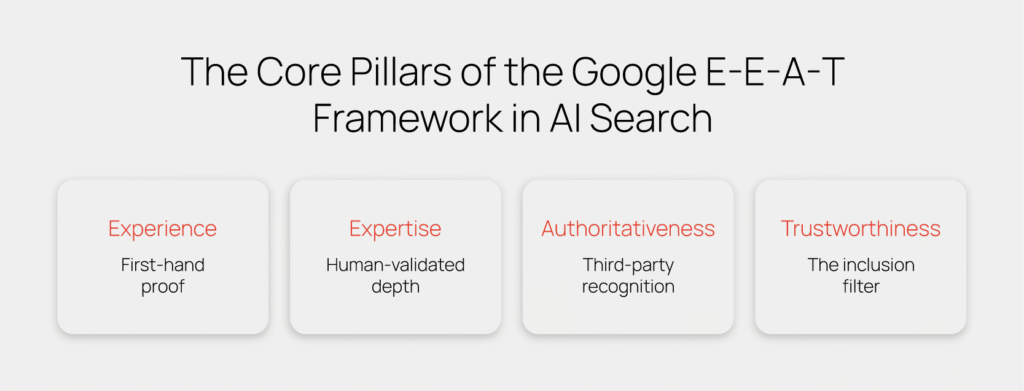
Sound complex? Well, sure. But the Google E-E-A-T framework is useful because it breaks credibility down into bites we can actually chew. Specific trust signals that can be improved, strengthened, and measured over time.
AI can summarize common knowledge quickly. It can explain definitions, reorganize existing information, and produce a perfectly acceptable paragraph that sounds like it was raised in a content farm and taught to roll over on command. What it cannot easily do is recreate real experience. First-hand insights, customer examples, field observations, testing notes, case studies, and lessons learned from actual work all help prove that content is grounded in reality. This gives both users and AI systems something specific to trust.
Experience is the part that says, “We have actually done this,” rather than “We read six similar articles and turned them into soup.”
AI can help teams move faster. It can support research, organize messy notes, generate draft structures, identify gaps, and speed up production. That is useful. But let’s be very clear here: Human expertise still has to steer the ship. I’m reminded of a piece I co-authored back in 2019. This was before modern AI, but its point about not letting data have the final say in strategy is still totally relevant.
A human-in-the-loop AI workflow keeps subject-matter experts involved where they matter most: planning, validation, accuracy, nuance, and final approval. The machine can help build the scaffolding, but a knowledgeable human needs to decide whether the thing is safe to stand on.
This is especially important for topics where the cost of being wrong is high. Medical, financial, legal, technical, and enterprise strategy content all need expert review. But even lower-risk content benefits from human judgment, because credibility is not created by sounding confident.
Domain authority (in AI SEO) is built when other people and systems recognize that your brand knows what it is talking about.
Backlinks are part of this larger authority pattern. Mentions from respected publications, expert contributions, third-party citations, industry partnerships, podcasts, webinars, and strong omnichannel campaigns all help reinforce that your brand belongs in the conversation. AI systems are more likely to trust sources that have already earned recognition across the web. Authority compounds through consistent signals, and those signals become harder for competitors to fake over time.
You can have experience. You can have expertise. You can even have the kind of authority that only comes from years of well-earned recognition. But if your content is inaccurate, outdated, insecure, or weirdly evasive about who is behind it, trust starts leaking out of the page.
Trustworthiness is built through clear authorship, visible credentials, accurate sourcing, updated information, transparent policies, HTTPS, usable site design, and consistency between what your brand says and what it actually does. In terms of E-E-A-T and AI, trust is the inclusion filter. Without it, those other pillars start to wobble.
The problem with AI content is not that AI is in the room. The problem is when everyone else leaves the room.
AI-assisted content can absolutely meet E-E-A-T standards. But it needs strategy, oversight, and a clear reason to exist beyond “we can publish 40 pieces of AI slop before lunch.” AI content quality is built on what humans bring back into the process.
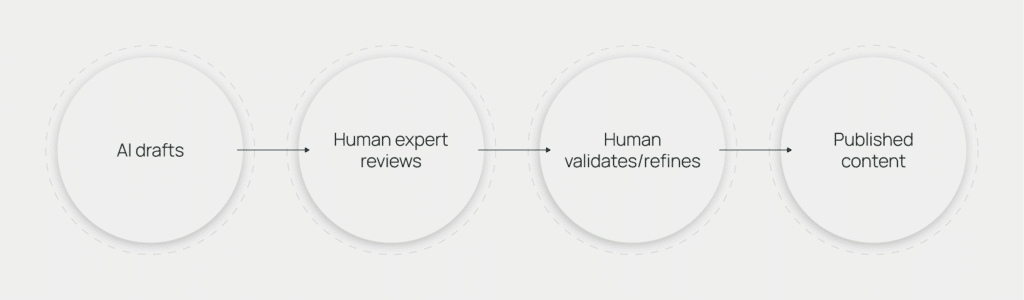
The best model is not human vs. AI. That makes for great movies but it’s just not a good way to approach digital marketing. A better approach is human plus AI, with humans firmly in charge of determining what ‘quality’ means in context.
A human-in-the-loop AI process allows teams to scale production while preserving expertise. AI can help draft outlines, identify related questions, summarize research, suggest structure, and even take a hand in plotting course or suggesting next steps. Humans then refine the argument, add experience, verify claims, sharpen examples, finalize decisions, and make sure the published content sounds like it came from a brand that knows what a heartbeat feels like.
That approach supports E-E-A-T and AI because it combines efficiency with accountability. You get the speed benefits of AI without letting generic content wander onto your website wearing a little name tag that says “thought leadership.”
Everybody likes structure, because everyone likes to see how pieces fit together. But you know who really loves structure? Cold, calculating machines.
Can you blame them? Structure gives AI systems something to follow. Clear headings, direct definitions, focused sections, and logical flow all help the content make sense when it gets parsed, summarized, or divided up. Without that structure, even good information can turn into a junk drawer — useful things are probably in there somewhere, but nobody (not even a machine) wants to go elbow-deep.
This AI search optimization is not a full replacement for traditional search engine optimization. But it is an extension of it. The same content still needs technical accessibility, internal linking, page speed, mobile usability, metadata, topic relevance, and all those elements blogs like this one wouldn’t shut up about just a few years ago.
AI is adept at seeing structure. It’s also pretty good at seeing when something stands out.
Original insights make your content more useful and more defensible. That could mean proprietary data, client learnings, expert interviews, market analysis, custom frameworks, internal benchmarks, or even just a strong point of view. If your content contains something competitors do not have, it becomes more valuable to users and harder for AI systems to treat as interchangeable.
Rome wasn’t built in a single blog post, and neither is authority. It’s built through repeated evidence. AI systems look for patterns. Does this brand cover the topic consistently? Do other trusted sources reference it? Are its authors credible? Does the site maintain accurate, useful content over time?
In other words, an E-E-A-T and AI strategy needs to focus on establishing long-term credibility.
Authority influences whether content is trusted enough to be surfaced, cited, or summarized. High-authority brands have an advantage going in because they have already earned recognition across search engines, publications, users, and industry communities.
That might not seem fair to newcomers, but don’t lose hope. Authority is not permanent. It has to be maintained through ongoing quality and relevance. A strong domain can still lose ground if its content becomes stale, generic, or disconnected from what users actually need. By that same rule, fledgling sites can start strong by building the kind of consistent quality that eventually turns into authority that can then begin to snowball.
Good content marketing is reputation-building that just happens to look like web pages.
When a brand consistently answers important questions, explains complex topics clearly, and brings original perspective to the market, it builds familiarity. Familiarity builds trust. Trust builds authority. And authority gives content a better chance of being selected in AI-driven environments.
It’s probably no surprise that, when it comes to AI, trust has a technical side.
Structured data helps search engines and AI systems understand authorship, organization details, article information, FAQs, products, and relationships between entities. Fast load times improve user experience. Secure browsing protects users. Accessibility makes content available to more people.
None of these elements can replace strong content. Even so, weak technical signals can undercut strong content. If you’ve got everything else in place but the technical signals aren’t up to snuff, it’s like your content is trying to compete with its shoelaces tied together.
By this point, the broad strokes should be clear: AI search rewards content that is credible, specific, structured, and backed by real authority.
Easy enough, right?
Hold up a sec; I have an emoji for this: 😬
No. Easy is obviously not the right word. If it were easy, every brand would already be doing it, and the internet would be a glorious garden of helpful, accurate information.
The challenge is figuring out where your content already demonstrates E-E-A-T and where it still looks a little undercooked. That means evaluating the pieces users can see, the signals AI systems can interpret, and the gaps competitors may already be using to their advantage.
The best place to start is with the content itself:
If the answer is no (or even a very quiet “kind of”), then that content could probably be improved.
The easiest test is this: Strip away your logo, your formatting, and your preferred brand color. Would that piece look just as at home on any competitor’s site? If so, it may be useful, but it is not differentiated.
Next, look at the credibility signals surrounding the content:
The E-E-A-T framework gives you a way to move beyond vague content-quality conversations and ask more practical questions: Who created this, and why should anyone trust it?
Once you’ve looked at content quality and authority, you get to evaluate whether your content is structured for AI readability:
Again, this does not mean you should prioritize writing for machines instead of humans. Please do not do that. Nobody needs more content that reads like a command line. It means creating useful content with enough structure that both humans and AI systems can understand why it deserves attention.
If you’re ready to evaluate your current content, authority signals, expert workflows, and AI search readiness, download the E-E-A-T for AI Search Checklist. Use it to identify where your strategy is strong, where credibility signals are missing, and where your content may need a makeover.
At 97th Floor, E-E-A-T and AI are not treated as separate checklists, and they definitely are not treated as a reason to churn out more generic content at industrial speed.
The goal is not volume for volume’s sake. The goal is visibility that holds up as search changes.
That means building strategies around credibility, authority, structure, and measurable business impact. AI can support that work, but it does not replace the thinking behind it. The brands that win in AI search will be the ones that know what they stand for and can prove it in a way that is accessible.
At 97th Floor, that looks like:
AI search will keep changing. That part is not really up for debate. But the brands that build around credible content, real expertise, technical trust, and long-term authority will be better prepared for whatever search decides to become next. 97th Floor is at the forefront of this shift, helping brands we believe in turn E-E-A-T and AI into a practical strategy for growth.
After all, the playbook may have changed, but trustworthy, high-quality, useful content will always win the game.
Some search marketers have been declaring SEO dead for over a decade. Yet every year, search keeps driving brand discovery and revenue.
What has changed is how visibility works. Google’s AI Overviews summarize answers before users click, and generative engines talk about the brand inside responses. Search behavior now also spreads across YouTube, LinkedIn, marketplaces, and AI platforms.
Now, we aren’t gaslighting you—we are also seeing the declining click-through rates and unstable traffic that were so different just five years ago. When people ask, “Is SEO dead?” they’re reacting to something very real, and it’s affecting industries across the board.
But SEO is not dead or even dying. Like most things being affected by technology and digital initiatives, SEO is simply changing. Technical excellence, authoritative content, and visibility across systems is still essential. Now, you just need to optimize for AI systems and search platforms, too.
The biggest shift is the rise of AI-generated answers directly in search results. Google’s AI Overviews and generative engines can summarize information before a user ever clicks a page. In many cases, the search experience ends right there on the results page. When teams see traffic dip even though rankings remain strong, it naturally sparks concern about the long-term value of SEO.
At the same time, search itself is no longer confined to Google. People discover products on Amazon, research ideas on YouTube, ask questions inside AI tools, and follow recommendations from LinkedIn or Reddit threads. That fragmentation means visibility is happening across a wider ecosystem than traditional search analytics tools were built to track. For a lot of businesses, it can feel like you have no control over so many channels.
Those two forces together have created real volatility in organic traffic. If you have historically measured SEO success only through clicks and sessions, these changes can feel like the ground moving underneath your entire strategy.
For brands willing to adapt, the opportunity is still massive. Strong search visibility now depends on building authority, technical clarity, and content that AI systems trust as a source. That kind of SEO strategy sits at the center of modern search growth.
The phrase “is SEO dead” is what marketers are saying when they see declining organic clicks and evolving search interfaces that don’t seem as compatible with classic SEO. AI-generated summaries, knowledge panels, and expanded SERP features often deliver answers before users reach a website, so why should businesses bother with SEO?
But this evolution of search optimization has not necessarily lost its relevance. In fact, all it really means is that the role of SEO has expanded. Instead of focusing exclusively on ranking individual pages, your strategy should heavily focus on building authority and structured visibility across search and AI ecosystems.
A few patterns tend to fuel the idea that SEO is disappearing:
Remember that, ultimately, organic search remains one of the strongest discovery channels on the internet. High-intent queries flood search engines every day that drive your revenue. People still rely on search to solve problems and evaluate options, and your brand needs to show up in those results.
Enterprise organizations still invest heavily in search because it contributes directly to their pipeline growth. As you become an authority in your space (rather than focusing so heavily on ranking), and have technical, structured content performance, your visibility will increase.
For years, SEO success looked fairly straightforward, but there are a couple of other players on the field.
Traditional SEO says that success looks like top rankings and organic traffic. If your page appeared near the top of search results, the assumption was that clicks and engagement would follow.
Meanwhile, AI Overviews and generative systems increasingly pull answers from multiple sources. When that happens, business influence shows up through citations, summaries, and brand mentions inside those responses.
In other words, when AI search systems generate answers, they rely on sources they trust. If your content becomes one of those sources, your brand shows up in the answer itself—even when the user doesn’t click.
“SEO” is also one slice of a much larger pie, where AEO and GEO are a part of a well-rounded strategy.
Answer Engine Optimization, or AEO, focuses on structuring content so search systems can extract clear answers. Generative Engine Optimization, commonly referred to as GEO, looks at how AI platforms summarize and reference sources. Both ideas reflect the same larger trend: search engines are becoming answer engines.
Modern SEO strategies bring these concepts together. Instead of separating them, organizations combine traditional ranking strategies with content structures designed for AI summarization and entity clarity. This approach is how you can be at the top of your game with AI search and how to optimize for the future of search engines.
Another major change is where discovery happens. Search behavior no longer lives inside a single engine.
Someone researching a product might start with a Google query, watch comparison videos on YouTube, scan reviews on marketplaces, and read thought leadership on LinkedIn. Users also ask questions inside AI assistants before visiting a website.
Brands that want consistent visibility build authority across multiple ecosystems where search intent appears. So yes, you need to optimize for Google—that’s not going anywhere. But you also need to show up where people compare products or services and ask questions. That might mean:
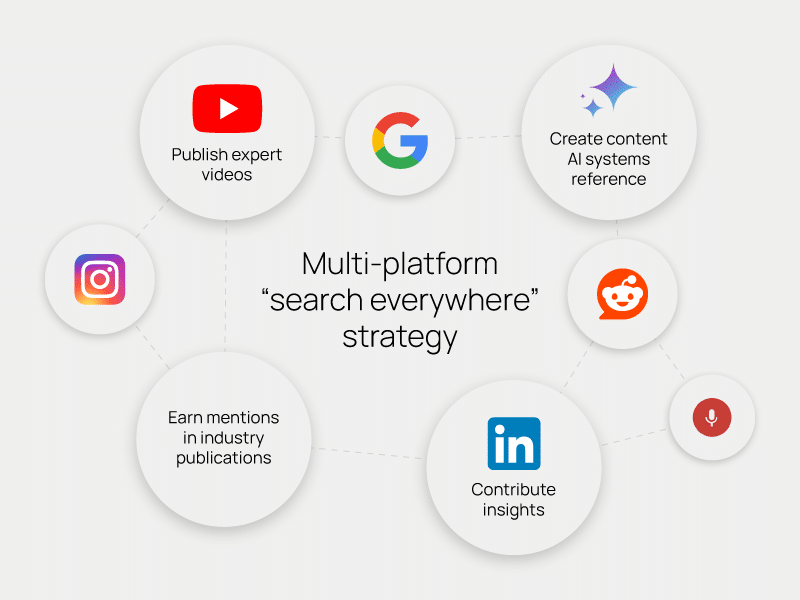
That broader presence strengthens the signals search engines and AI systems rely on when deciding which sources to surface. Over time, those signals reinforce brand authority in ways that pure keyword targeting never could.
Featured snippets started this trend years ago: search engines want to answer the question in the search bar without ever even visiting a website. Now, AI Overviews are taking it a step further.
Because more queries are answered directly in SERPs, AI Overviews have reduced the reliance on blue links for consumers—your audience.
So why are you pouring money into producing so much content for people to not even enter your website?
Because traffic declining does not necessarily mean your influence declines, too.
When your brand appears inside an AI Overview, a featured snippet, or a cited source within a generated answer, users still see your expertise. They may not click in that moment, but the exposure shapes awareness and credibility. Later, when they search again with a stronger intent, your brand is already familiar.
Instead of focusing exclusively on traffic, many organizations now look at a broader set of indicators:
The zero-click environment also forces some strategic decisions.
Chasing raw traffic can lead teams to prioritize high-volume informational queries that rarely convert. Meanwhile, focusing on authority and expertise often produces fewer visits but better downstream impact.
Enterprise organizations increasingly balance both sides of that equation. They invest in content that builds authority within a category while also strengthening owned channels like email, communities, and product education hubs.
Building authority earlier in the research process also helps teams connect search visibility to revenue attribution models, which track how organic discovery contributes to pipeline and closed deals.
We know that the technical side of SEO especially matters, but more than ever before, so does the human element of your content. Generic or recycled material just doesn’t quite cut it anymore. It’s your expertise and credibility that the AI models are going to trust.
Google describes these signals through E-E-A-T: experience, expertise, authority, and trust. This is exactly what it sounds like: search systems try to surface information that comes from knowledgeable sources.
AI-generated answers rely on the same signals. When models summarize content, they still look for sources that demonstrate real-world expertise and established authority within a topic area.
That’s why enterprise brands with recognizable subject matter experts, credible research, and original, real-world insights tend to perform well over time. They give search engines and AI systems a clear signal that their content is worth referencing.
Keywords do still matter, but even more important is writing for readers. Answer the search intent before you optimize for the algorithm to give yourself the best chance in AI search and future search strategies. This looks like having clearer explanations on the topic and practical solutions that actually help consumers make their decisions. Remember to:
Human-first content thrives when it’s supported by broader SEO principles. Successful organizations treat search visibility as a combination of these 6 disciplines of SEO working together.
If a site is difficult to crawl, poorly structured, or confusing to interpret, even great content struggles to appear consistently in search results. Think of it like building a library. You could fill it with incredible books, but if the shelves are disorganized and the catalog is missing, people will have a hard time finding anything.
Before a page can rank or appear inside an AI-generated answer, search engines have to find it and understand how it fits with the rest of your site.
That usually comes down to a few practical things:
When those fundamentals are in place, search engines have a clearer picture of what a site covers and which pages provide valuable answers.
Search engines are good at reading pages, but they still appreciate a little help.
Structured data acts like labels on a library shelf. It tells search systems exactly what they’re looking at. Product schema can identify price and availability. FAQ schema highlights clear question-and-answer sections. Review schema points to customer feedback.
Those labels help search engines surface the right information in rich results and AI-generated answers.
Entity relationships add another layer. When your brand consistently appears alongside certain topics across trusted sites, search engines begin to connect the dots. Over time, your brand becomes associated with that subject area, which makes it more likely to appear when people search for related information.
For enterprise organizations, technical SEO becomes even more interesting. Large websites often contain thousands or even millions of pages across different products, regions, and content hubs.
At that scale, small issues multiply quickly. Duplicate pages compete with each other. Important sections become buried several clicks deep. Old pages stick around long after they stop providing value.
That’s why enterprise SEO often requires governance systems and technical enterprise SEO playbooks that keep large sites organized. Without that structure, even strong content can struggle to gain traction in search.
You see a lot of the trending “SEO solutions” on your LinkedIn feed, but what is really going to move the needle? Let’s talk about it.
One of the biggest changes in modern SEO is the move away from pure volume. Today, that approach rarely produces lasting results. Search systems have become much better at identifying which sources actually demonstrate expertise within a topic.
That’s why many organizations now focus on building strong topic clusters around high-intent themes. Instead of publishing dozens of loosely related pages, they develop deeper resources that connect logically and answer related questions across the research journey.
The goal of these evolving SEO strategies is simple: become one of the sources search engines consistently associate with a category. That kind of authority tends to hold up far better than isolated rankings.
AI-generated answers have added another layer to modern AI SEO strategy.
Content now needs to be clear enough for AI systems to extract and summarize. Pages that explain ideas directly, use structured formatting, and answer questions clearly are more likely to appear in generated responses.
This often means writing in a more conversational, question-driven format. When a page mirrors the way people naturally ask questions, it becomes easier for AI systems to recognize and reference the information.
Ecommerce brands face a slightly different set of priorities.
Product pages need structured data that clearly communicates details like price, availability, reviews, and product attributes. Category pages often carry the responsibility of establishing topical authority for entire product groups.
At the same time, ecommerce SEO must compete within crowded SERPs filled with product listings, reviews, and comparison content. Brands that succeed often combine strong technical optimization with helpful buying guides, comparison pages, and educational resources that support the purchasing journey.
There are a lot of moving pieces to SEO now, and many organizations reach a point when their internal teams need help. This often happens when:
Working with a specialized team focused on AI-driven search can help organizations move faster while maintaining a clear strategic direction, which is why many brands explore working with an AI SEO agency.
By this point, one thing should be clear: modern SEO isn’t a checklist, but an entire system of connected strategies that all influence one another. When those elements operate in isolation, results tend to plateau. When they work together, search becomes a much more durable growth channel. 97th Floor is here to make sure every move you make is contributing to a healthy and modern SEO strategy.
97th Floor approaches SEO as a growth system rather than a content production engine. The strategy connects traditional search optimization with authority building, digital PR, and AI search visibility.
We can help you rank for keywords, but we also help your brand become a leading resource in your industry. Instead of chasing short-term ranking spikes, the focus moves toward durable visibility that supports sustained growth.
97th Floor focuses on building content systems and authority frameworks that continue performing even as search interfaces change. Search will keep evolving. How will your team keep up? Every algorithm update can work to your benefit as we help you master long-term authority and move beyond obsessive keyword ranking.
Let’s assess where your organization currently stands and see where you can start making changes for today’s SEO environment.
Start by looking at how your organization defines SEO success. The way performance is measured often shapes the entire strategy.
Next, take a close look at the technical foundation of your site:
Finally, consider how your brand appears compared to others in your category. Visibility gaps often become obvious when you look at where competitors show up in search and AI answers:
If these questions highlight opportunities for improvement, it may be time to revisit your SEO strategy. The search landscape is evolving quickly, and adapting early can make a significant difference in long-term visibility. Learn more about how our team approaches search strategy through our SEO services.
A few years ago, ranking on page one felt like the finish line. If your page showed up near the top, traffic followed.
Now, being at the top of SERPs is valuable, but it doesn’t pack the same punch. When you ask a complicated question, the search engine often answers it immediately. AI Overviews summarize sources, or generative engines simply write explanations. In many cases, the user never clicks a link at all.
As a brand trying to gain visibility with your consumers, this change in search results affects how you approach. Pages still matter, but the real opportunity now is becoming one of the sources AI systems rely on when they generate answers.
Answer engine optimization is a large piece of that puzzle, which focuses on how content gets extracted and referenced inside AI responses. In this guide, we’ll show you how answer engine optimization fits into your overall AI search strategy and how to show up in relevant online spaces.
When AI systems generate a response, they choose a handful of sources to build that answer. If your brand is one of those sources, your expertise shows up immediately. If it isn’t, competitors shape the narrative instead.
Decision-makers are asking longer, more contextual questions than they used to. It’s less short phrases like “CRM tools,” and more questions about how a CRM integrates with existing systems or which platforms work best for a specific business model. These often appear during real evaluation cycles, which means the answers influence purchasing decisions.
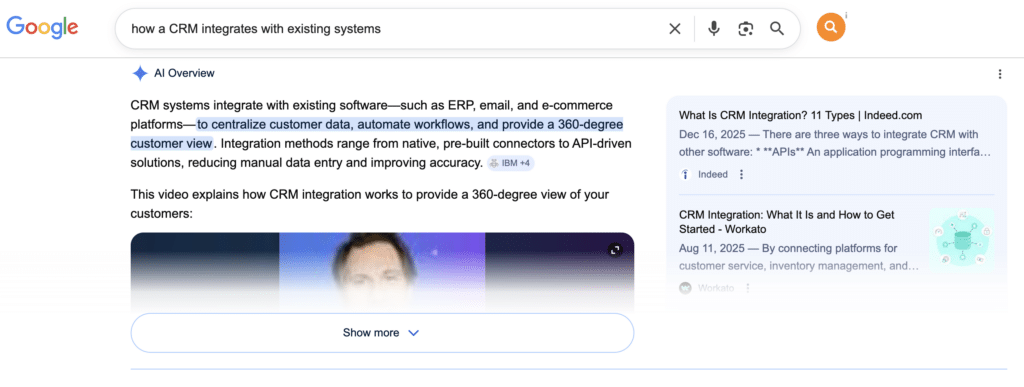
Because of that shift, the goal of search strategy is expanding. Ranking still matters, but influence now depends on whether AI systems trust your content enough to extract it as a direct answer.
Answer engine optimization is one of the ways you can make your content more visible under these new search conditions. AEO focuses on structuring expertise so AI systems can interpret it clearly and reference it when generating responses. Many teams now integrate AEO alongside traditional optimization, authority development, and technical SEO as part of a largerAI search strategy.
Over time, brands that consistently appear in AI answers gain an advantage that rankings alone cannot provide. Their expertise shapes the information buyers see at the very beginning of research.
That advantage starts earlier than most brands realize — at the moment a buyer types their very first query. SEO expert Eli Schwartz reveals what today's AI-aware searchers are actually typing into Google, and why those queries look nothing like what most content teams are optimizing for. This short video breaks down the search behavior shift that determines whether your brand shows up at the start of the research cycle — or gets skipped entirely.
When someone asks an AI system a question, it doesn’t search the web the same way a person does. It analyzes sources, pulls relevant information, and generates a response.
Answer engine optimization focuses on influencing which sources that response comes from.
Answer engine optimization is the practice of structuring and validating content so AI systems recognize it as a reliable answer to a specific question.
Instead of optimizing only for rankings, AEO focuses on how information is interpreted by AI systems. That includes how clearly a concept is defined, how expertise is demonstrated, and how easily an answer can be extracted.
The objective is representation. When AI systems summarize a topic, the brands cited in that answer help shape how buyers understand the category.
Traditional SEO and answer engine optimization address different layers of search visibility.
| SEO | AEO |
| Focuses on ranking pages in search results | Focuses on being extracted, summarized, or cited in AI responses |
| Optimizes for keywords and backlinks | Optimizes for questions, structured answers, authority signals, and machine-readable clarity |
| Performance is measured in clicks | Performance includes visibility within AI answers, brand mentions, and authoritative citations |
For most organizations, AEO complements traditional SEO since you still need SEO to rank—now, you are more deeply considering how your brand appears in AI-generated explanations.
Content optimized for answer engines typically follows a simple structure.
Start with a question that reflects how people actually search. Place a concise explanation directly beneath it, usually 40 to 60 words. Then expand with supporting context, examples, or strategic insights, especially when you can back up your ideas and claims with real experience. You also need to cut back on ambiguity wherever possible.
That format makes it easier for AI systems to identify the core explanation quickly while still giving readers the deeper context they need.
AEO works best when it’s built into how content is planned and structured from the beginning. Teams that try to retrofit answer visibility after publishing usually find the results inconsistent. Meanwhile, when you have a solid architecture from the beginning, you can design pages around the kinds of questions buyers actually ask and make it work for the digital world.
AEO content planning usually begins with mapping the questions buyers actually ask during research. These are usually the “what is,” “how does,” and “why does” questions.
For example, a software company might map queries like:
Each of those questions becomes a distinct section with a clear answer followed by deeper explanation. You can make sure you are covering topics with enough depth by using semantic clusters, which are groups of closely related questions and subtopics that help search systems understand the full scope of a topic.
This structure does two important things. First, it mirrors how buyers research a topic. Second, it gives AI systems clearly defined answers they can extract without needing to interpret a long block of text.
Answer engines rely heavily on structured information to interpret content. Structured data provides that clarity by labeling important elements on a page so machines can understand them more easily.
Schema markup helps identify things like the organization publishing the content, the author responsible for the expertise, frequently asked questions within the page, and relationships between related topics. This added context helps search systems interpret who is providing the information and what the page is about.
For example, a consulting firm publishing a guide about marketing attribution could use schema to define the organization, the author’s professional role, and the FAQ sections within the article.
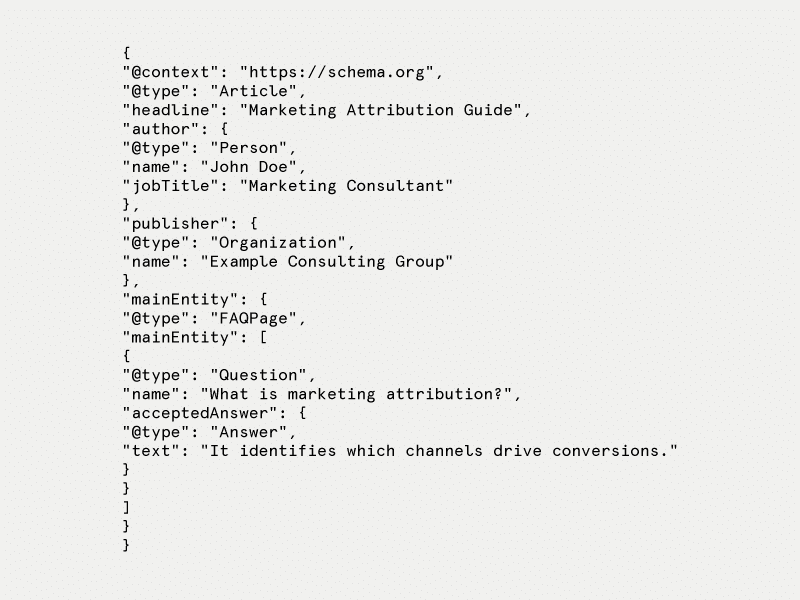
When those elements are clearly labeled, AI systems have a much easier time interpreting the page and connecting the expertise behind it to the topic being discussed.
Answer engines prioritize sources that demonstrate credible expertise. Google refers to these credibility indicators as E-E-A-T: experience, expertise, authority, and trust.
In practice, this means content should reflect real knowledge of the subject. Generic definitions only get you so far — strong AEO content includes insights drawn from actual work, industry experience, or original analysis.
For example, a cybersecurity firm writing about threat detection might reference internal research or share examples from real client engagements.
These types of details signal that the organization understands the topic in practice. Over time, consistent publication of this kind of expertise helps AI systems associate the brand with authority in that subject area.
Answer engines interpret questions the way people naturally ask them. That means content often performs better when it reflects natural language instead of rigid keyword phrasing.
For example, someone researching marketing attribution might ask:
Structuring sections around questions like these helps AI systems match your content with real user queries.
Strong AEO content also anticipates follow-up questions. A page explaining marketing attribution might include sections about data accuracy, implementation complexity, or how attribution influences budget decisions.
Connecting those related ideas helps search systems understand the topic more completely and reduces fragmentation across multiple pages.
Clear hierarchy also matters. Question-based headings followed by concise explanations make it easier for AI systems to summarize or extract specific sections when generating answers.
Answer engine optimization focuses on preparing content for the process of assembling responses from credible sources and summarizing it for the user. When information is structured clearly and supported by credible expertise, AI systems have an easier time referencing it while generating answers.
Content that appears inside AI-generated responses usually follows a predictable structure. It explains a concept clearly, avoids filler, and provides enough supporting context for the system to validate the information.
If you want to understand how to optimize content for generative AI, begin sections with a concise explanation of the topic, followed by examples, data, or deeper analysis that reinforces the credibility of the answer.
For example, a page explaining marketing attribution might begin with a definition, then expand into implementation considerations, measurement challenges, and how attribution influences budget decisions. Structuring content this way makes it easier for AI systems to extract the core explanation while still giving readers useful context.
Let us say it again: answer engine optimization works best when it supports a broader search strategy. It’s a core pillar, but it isn’t the whole coliseum of AI search SEO.
AEO focuses on how answers are structured and interpreted. Traditional SEO still influences how pages are discovered and how authority develops around a topic. When both approaches work together, brands are more likely to appear during the research stages where buyers gather information.
A company building authority around marketing analytics might publish in-depth resources on attribution models and data integration strategies. Over time, that connected coverage strengthens the brand’s association with marketing measurement.
Generative search does not exist on a single platform, either. AI Overviews, Perplexity, and other answer engines each generate responses differently.
Because of that variation, it helps to monitor how your brand appears across these environments. Some platforms may reference your research frequently, while others rely on different sources when generating answers.
A company might discover that its insights appear regularly in one AI platform but rarely in another—maybe they need to improve visibility on Perplexity. Observations like that can reveal gaps in how expertise is structured or referenced across the web, which becomes clearer when examining how brands appear in systems like Perplexity’s search engine and browser.
So, how do you actually evaluate whether your content is positioned to appear in AI answers? This is where the right tools can make all the difference.
AEO tools typically analyze how well content aligns with the structures AI systems rely on when generating answers.
One common area is entity clarity. Tools look at how consistently a brand, topic, or product appears across pages and whether the relationships between those entities are clearly defined. If your company publishes content about multiple services, for example, these tools help determine whether those services are clearly connected to your brand and expertise.
Another area is semantic coverage. Platforms often evaluate whether a topic includes the related questions and supporting explanations that give AI systems enough context to understand the subject. A page explaining marketing attribution might also need sections about attribution models, implementation challenges, and reporting accuracy for the topic to feel complete.
Many tools also examine question-to-answer structure. This includes identifying whether pages contain clearly defined explanations that AI systems can extract without needing to interpret long paragraphs.
Finally, platforms often review authority indicators such as citations, references, and how often your content appears across relevant sources on the web.
Not every platform labeled as an AEO tool is built for enterprise teams. Many focus on content analysis alone, which can leave large organizations without visibility into the broader search ecosystem.
When evaluating answer engine optimization platforms, look out for these capabilities especially.
The best platforms provide actual, actionable information on how AI systems interpret your expertise rather than simply pointing out missing keywords.
Tools can show you important gaps, but they rarely solve the strategic challenge on their own.
Answer engine optimization requires coordination across several departments. Content teams shape the explanations AI systems extract. Technical teams manage structured data and site architecture. Digital PR and communications teams strengthen authority across the web.
Without that coordination, even the best tooling will only surface problems rather than help solve them.
Over time, the organizations that succeed with AEO treat tools as diagnostic support while focusing most of their effort on building authority and expertise.
By the time most organizations start exploring answer engine optimization, they’ve already noticed something unusual in their search data since AI systems are taking the lead.
At 97th Floor, answer engine optimization isn’t treated as a standalone tactic. It’s integrated into a broader shift toward AI-driven search, where content structure, authority, and technical clarity all influence how a brand shows up online.
Enterprise organizations rarely struggle with producing content. The challenge is aligning that content so it reinforces expertise across a category.
That alignment requires several moving parts working together. Content needs to answer the right questions. Technical teams need to support structured data and site architecture. Digital PR helps strengthen authority signals across the web. We make sure all of your best people and AEO efforts actually work together and make progress.
AEO should never be measured by visibility alone. What matters is whether that visibility influences the conversations buyers are having when they research a category.
At 97th Floor, answer visibility is connected to the areas that actually drive revenue. Content is structured so AI-generated answers reference the topics that matter most to the organization’s services and solutions.
Over time, this approach shifts the goal of AEO from general awareness to category influence. When buyers encounter explanations that consistently reference your expertise, your brand becomes part of how they understand the problem itself.

Search will continue evolving as AI platforms mature. New answer engines will emerge, and existing platforms will refine how they interpret and summarize information. That’s why strong AEO strategies focus on building durable authority rather than chasing short-term optimization tactics.
Are you ready to shift into a new gear with answer engine optimization? Here are some questions you can ask yourself to know if it’s time.
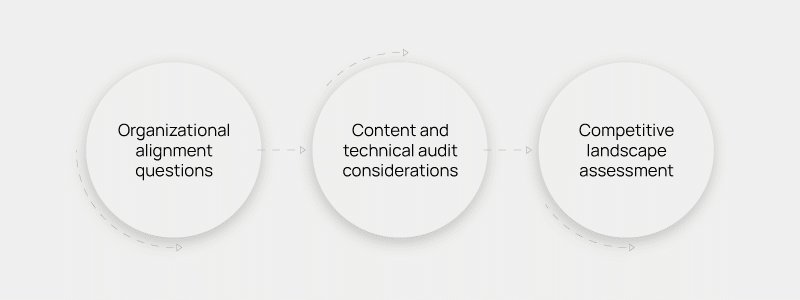
Answer engine optimization often requires teams to rethink how search visibility is measured and managed.
Start by looking at how your organization currently approaches search.
These conversations usually surface quickly whether AEO can be implemented smoothly or whether internal alignment still needs work.
The next step is examining whether your existing content can actually support answer visibility. Key questions to review include:
Finally, it helps to look outward.
In many industries, answer engines already reference certain organizations repeatedly when explaining a topic. Those brands effectively shape how buyers learn about the category. Ask yourself:
These observations often reveal whether your brand is currently influencing the conversation or watching it happen from the sidelines.
If these questions surface opportunities, it may be time to develop a structured AEO strategy.
At 97th Floor, answer engine optimization is approached as part of a broader AI search transformation that connects technical SEO, authority development, and content strategy. Organizations exploring how to improve their answer visibility often begin by examining how their content aligns with modern search strategies.Discover how we can help you in the new age of AI search!
SEO is changing.
Oh, you’ve heard that one before? It’s true; SEO has been many things in the twenty or so years that it’s been around, but static has never been one of them. What began with simple keyword stuffing and quantity-over-quality link building has evolved into a deeply strategic and data-centric discipline — one that prioritizes intent over tricks, clarity over cleverness, and exploration over exploitation. So, yeah SEO is changing and always has been. But 2026 hits a little differently.
This new year is the dawn of a new era. Search is no longer just a list of links politely waiting for users to click them. It’s answers, summaries, recommendations, and increasingly confident machines stepping in as intermediaries to decide whether your content deserves to exist at all. AI-driven search is adding a new and somewhat unforgiving layer to SEO. It’s not an entirely new game; traditional ranking factors still matter, it’s just that they don’t carry the same weight they once did. And that changes what it means to be visible.
Simply put, the rules of SEO have evolved, and the brands that adapt to meet these changes will come out on top.
The biggest shift is in where and how those changes are showing up:
Which brings us to the inevitable question: If SEO now depends on how content is interpreted (rather than simply ranked), where does that leave the growing pile of labels we use to describe it?
The SEO lexicon is growing: Generative engine optimization (GEO), Search Everywhere, AI Search Optimization (AIO)... It’s a whole new world of terminology. And don’t you dare close your eyes, because these terms are symptomatic of how search itself now operates across more systems than a traditional SERP ever could.
Modern visibility includes rankings, citations, summaries, and recommendations that appear across AI tools, discovery platforms, and search-adjacent environments. Evolving SEO strategies account for all of these surfaces by focusing on interpretability, credibility, and usefulness at scale.
So, whether we’re talking about SEO or GEO, we’re ultimately describing the same responsibility: ensuring that your content can be found, understood, trusted, and reused wherever search behavior shows up.
And wouldn’t you know it? In 2026, that responsibility extends beyond ranking signals and into how information is structured, contextualized, and validated across systems that are increasingly taking on the role of interpreters. Strategy lives in the connective tissue — how ideas relate, how authority is demonstrated, and how consistently value is delivered across touchpoints.
Labels will keep changing. The underlying work remains focused on building visibility that travels well and earns its place wherever discovery happens.
But "wherever discovery happens" increasingly includes systems that surface answers very differently than a traditional SERP — and those differences aren't cosmetic. Blake, Account Director at 97th Floor, takes on the question every SEO team is quietly wrestling with: is AI search a meaningful shift or just the next version of the same game? His answer cuts through the noise with a practical lens on what actually changes and what stays the same. This short video breaks down the real distinction between traditional search and AI search — and what it means for how you build visibility today.
Have we belaboured the point enough? If not, let’s just come right out and say it. 2026 isn’t being defined by a single update, tool, or announcement. What’s changing is the environment in which search operates and the expectations placed on the content that moves through it. Search marketers now operate in a space where content gets evaluated repeatedly — by users, by traditional search systems, and by AI-driven interfaces that summarize, filter, and recommend information at scale. That layered evaluation changes where effort pays off and where shortcuts tend to collapse.
Let’s take a look at the most consistent pressure points shaping evolving SEO strategies this year:
When it comes to AI search, generative systems interact with content very differently than traditional crawlers. Instead of indexing pages and ranking them in isolation, they ingest large volumes of information, identify relationships between concepts, and reconstruct answers dynamically.
That process places real weight on how content is constructed. Definitions that arrive early, terminology that stays consistent, and sections that stay focused all influence how information survives interpretation. When ideas are clearly framed and logically ordered, they remain intact even after being separated from their original page.
This changes how teams need to approach content creation. Planning now includes AI-search considerations and thinking about how information might be extracted, summarized, or recombined elsewhere. Content that holds together under that pressure tends to surface more often and persist longer across AI-driven environments.
Authority now grows through accumulation.
Search engines and AI systems pay close attention to how thoroughly a site explores a subject, how consistently it answers related questions, and how naturally its content interconnects. And yes, individual pages obviously still matter. It’s just that their performance increasingly reflects the strength of the entire surrounding ecosystem. Topic clusters support this by creating continuity. Internal links guide readers through related ideas while giving machines a clear sense of scope and relevance. Over time, this builds a reputation for depth that benefits new content as soon as it enters the system.
For organizations publishing at scale, this approach also introduces stability. Authority spreads across related assets instead of concentrating on a single page. And as authority accumulates, new content enters the conversation with momentum already behind it.
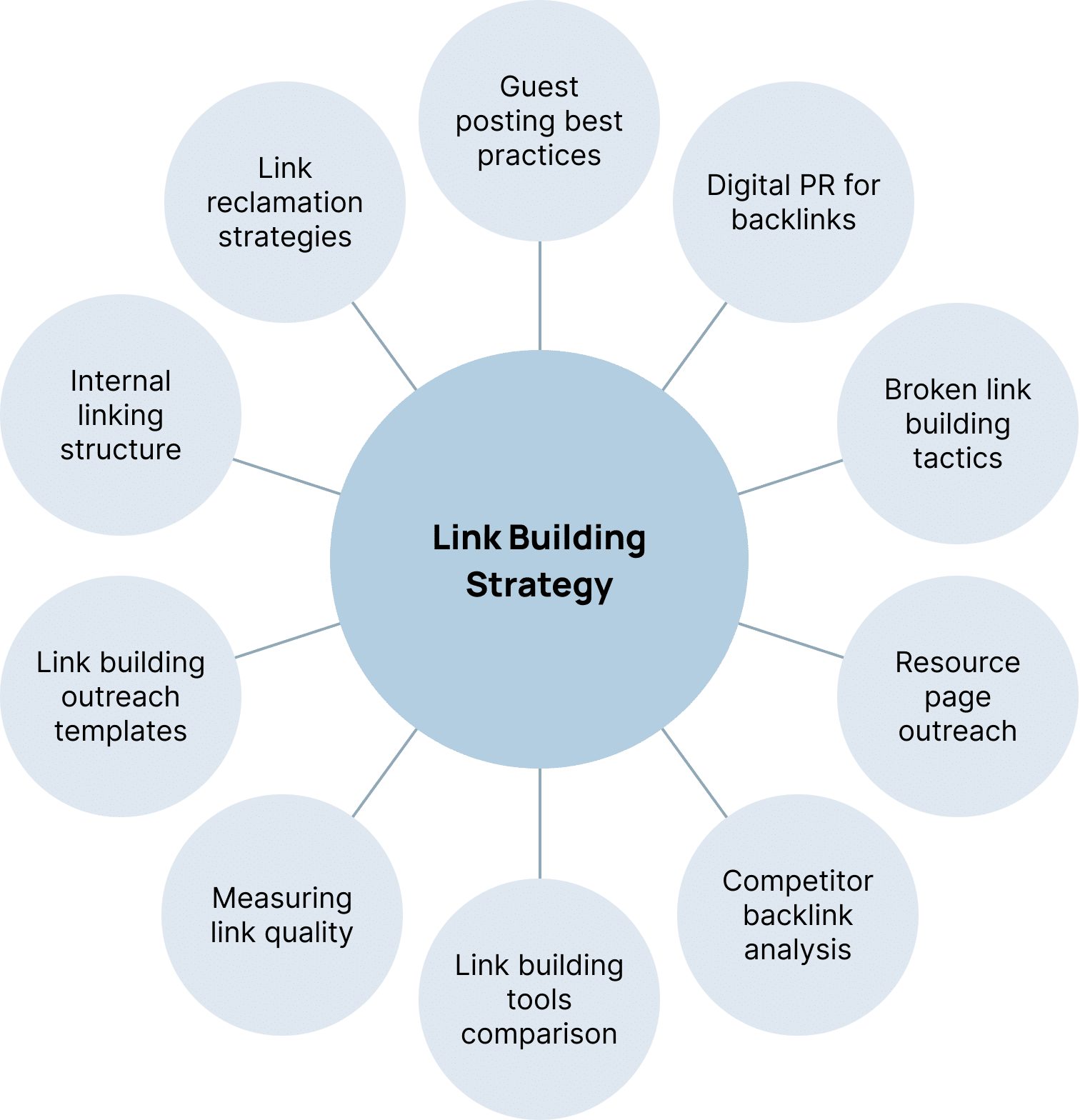
Experience shapes perception long before rankings enter the picture. In practical terms, this is where user experience (UX) and search experience optimization (SXO) converge, shaping how people interact with content and how search systems interpret those interactions.
When content loads quickly, reads clearly, and flows logically, users engage with confidence. Those behaviors generate signals that ripple outward across search systems. Structure plays a central role here. Clear headings support scanning. Thoughtful spacing reduces cognitive load. Consistent formatting helps readers orient themselves as they move through complex topics. And this is just as true for LLMs as it is for human readers.
It may seem strange to suggest that AI would care about design, but it absolutely does. Or, to put it another way, content structure is often among the first signals a system uses to understand the navigability and coherency of the information on the page (even before it evaluates overall subject matter).
As search surfaces continue to prioritize usability, experience becomes inseparable from visibility.
Credibility rarely announces itself directly. It accumulates quietly, through patterns that repeat over time. Readers, on the other hand, pick up on those patterns almost immediately. They notice when content reflects lived experience instead of abstract advice. They notice when examples feel earned, when sources make sense, and when a brand sounds like the same brand from one page to the next. That familiarity builds confidence, even if the reader can’t quite articulate why.
AI systems likewise pay attention to many of the same cues. Authorship, sourcing, topical consistency, and historical performance all influence which information gets prioritized. Content that demonstrates experience and expertise in small, repeatable ways tends to travel even farther in 2026.
This is what Google refers to as E-E-A-T: Experience, Expertise, Authoritativeness, and Trustworthiness — the signals that help determine what content earns visibility. For teams working on evolving SEO strategies, this realigns the focus from chasing isolated wins to building a reputation. Clear authorship, transparent sourcing, and original insight all contribute to that reputation.
Just be aware that this credibility is both cumulative and fragile. Each accurate, useful interaction reinforces the next, creating credibility that’s difficult to fake. But at the same time, when content gets stale or expert advice gives way to generic advice, that credibility quickly and quietly starts to erode.
Discovery rarely happens in a straight line. People don’t sit down, type a query, read one page, and call it a day. They skim an article, review an AI overview, glance at an image, save something for later, and circle back when the timing feels right. Some of those moments happen in long-form content, where depth and detail matter. Others happen through visuals, short videos, structured summaries, or quick references designed to help ideas click faster. Each platform shapes how information is absorbed and remembered, even when the underlying message stays the same.
This shifts how content earns longevity. Ideas that translate across formats tend to stay visible longer because they meet people in different states of attention and curiosity.
For evolving SEO strategies, this flexibility supports consistent presence across a widening ecosystem. Content that travels remains discoverable, recognizable, and useful as platforms and behaviors continue to evolve. Alternatively, non-traveling content puts all its eggs (visibility) into one basket (surface), losing relevance everywhere else as discovery habits shift around it.
Site visitors show up carrying context: how much they already know, how urgent the problem feels, how close they are to making a decision, etc. Sometimes they’re trying to understand a concept for the first time. Other times they’re pressure-testing an option, looking for reassurance, or even just sanity-checking a choice they’ve mostly already made.
Content that works acknowledges those mental states explicitly. It anticipates the questions that naturally follow and answers them in an order that feels intuitive. When that happens, the content feels relevant almost immediately, because it meets readers where they already are instead of asking them to recalibrate.
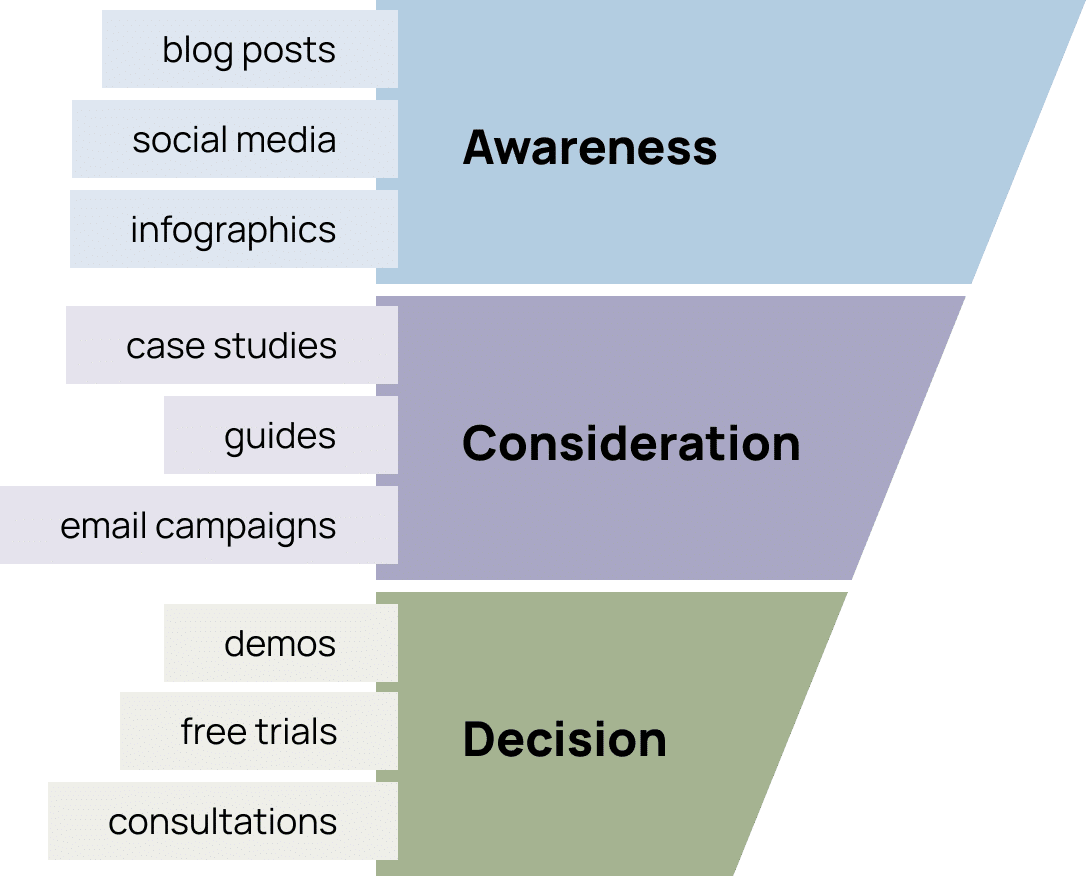
Early-stage content helps people understand what problem they’re dealing with. Mid-stage content helps them sort through their options. Later-stage content helps them decide what to do next. Together, these pieces form a throughline that reflects how real decisions unfold over time. When intent is baked into structure, it’s easier to read, easier to trust, and easier to decide whether it’s actually useful — both for readers and the systems evaluating how that content performs.
Measurement has gotten messier. Why? Because influence now shows up in more places than a traffic report can easily capture. Modern SEO metrics now include:
When measurement evolves alongside strategy, SEO becomes easier to defend, easier to scale, and easier to integrate with the rest of the business.
So, where are the mistakes happening? As with many roads to hell, these ones are paved in good intentions applied a little too narrowly.
They say that the journey of a thousand miles starts with a single step. We’d suggest that it starts before that step, by taking a look at where you’re standing right now.
At 97th Floor, SEO and AI search solutions are built around how search actually works today, and how it continues to change.
Our SEO services integrate AI search considerations, technical SEO, and content strategy into a unified framework built for modern discovery. The focus stays on building durable authority, improving interpretability across platforms, and aligning search visibility with meaningful business outcomes, all while ensuring that the human element doesn’t get lost along the way.
That work is supported by proprietary frameworks, deep analytics, and close collaboration across SEO, paid media, and measurement teams. The result is a strategy designed to hold up across platforms and continue performing well even as search behavior evolves, making 97th Floor one of the best AI SEO agencies available today.
SEO is changing… and it will keep changing. Our role is to help brands stay visible through that change by building strategies rooted in clarity and adaptability, optimizing for the future of AI search even as we keep sight of those fundamentals that will always remain relevant.
You’ve probably noticed it already: traffic behaves differently than it did a year ago. Pages that used to rank predictably now earn visibility one week and vanish the next. Meanwhile, AI Overviews, ChatGPT answers, and Perplexity summaries are shaping what people see before they ever reach your site.
That shift is exactly why marketers are rethinking their AI SEO strategy for 2026. How do you get the right consumers to actually engage with your brand, not just the search engine? Your brand needs to be more trustworthy and recognizable, not only to your audience but to search engines themselves.
We’ve spent the last two years running experiments across generative engines, structured data setups, and entity-driven content frameworks. What’s working now is brands that pair technical precision with human expertise. This AI SEO guide breaks down how to build that kind of strategy step-by-step so that your brand is referenced more and seen by the people that matter the most to your business.
An AI SEO strategy is simply a plan for helping both search engines and generative models understand who you are and why your content should be referenced. Instead of worrying only about where a page ranks, you’re thinking about how clearly your brand shows up across topics, how well your expertise is represented, and whether AI systems can confidently pull from your work.
As search shifts toward AI search optimization, engines rely more on clean structure, consistent language, and content that makes your perspective easy to identify. The same applies to generative engine optimization, where models look for reliable patterns, strong entity definitions, and authors who actually know their subject. We have to present our knowledge in a way machines can recognize while still writing for real people.
AI rewired how information gets pulled together. Generative engines break your content into smaller pieces, look for patterns across topics you cover, and compare your explanations against other credible sources. They’re not scanning the page the way a crawler would, but actually interpreting it.
That shift puts more weight on things that used to feel “nice to have.” Topical depth—how thoroughly you cover a subject across multiple pieces—helps models understand your expertise beyond a single URL. Since AI can interpret it now alongside your audience, it matters just as much on the technical side.
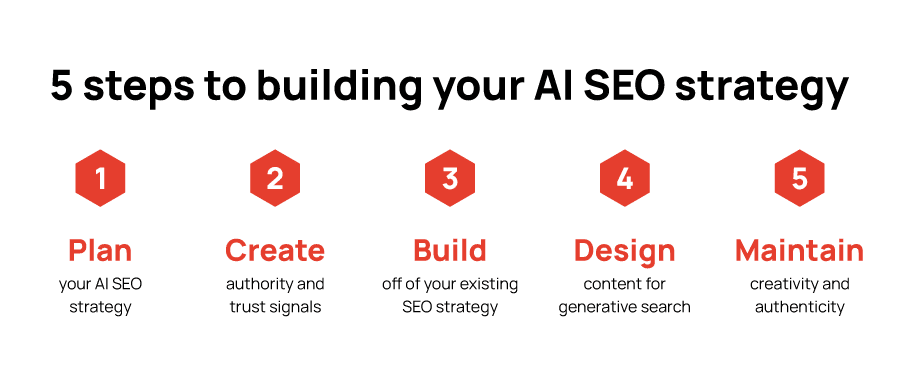
If you know how SEO works, it’s time to revise your playbook with AI in mind. Some teams have strong technical foundations but haven’t mapped their content in a way AI can follow. Others have great material but no clear structure tying their expertise together. These five steps outline the patterns we’ve seen produce meaningful gains as we have learned how to optimize AI SEO.
The first step to your SEO strategy with AI is getting an idea of how your content ecosystem performs when a model tries to interpret it. A standard audit won’t surface everything you need, so an AI-focused review looks at things like entity coverage, schema accuracy, internal connections between pages, and whether your explanations stay consistent across topics.
Ask yourself:
Once you know where things stand, set goals that track both search performance and AI visibility. Rankings matter, of course, but push beyond them, too. You want to see how often your content shows up in AI Overviews and if you’re keeping up with your competitors, especially if they are showing up in the search engine optimizations.
From there, map where your expertise naturally fits within broader topical clusters. This helps you see where you already have momentum and where the gaps are. AI tools can support the analysis, but choosing what to deepen or retire still depends on your priorities, not just what a model suggests. It also helps to take a quick look at how competitors show up in generative engines to spot topics models already associate with others in your space.
Generative engines are trying to decide whose explanation is dependable enough to reuse, and they look for signals that reinforce your expertise across multiple touchpoints and content pushes. As you look at your own content, a few signals often determine whether a model treats your work as dependable:
Make sure your best thinking shows up in places where AI can recognize it: expert-led articles, well-structured pages, digital PR that puts your name in the right conversations, and formatting choices that make your expertise easier to parse.
AI fits naturally into most SEO workflows once you know where it adds real lift. Traditional SEO still does the heavy lifting like crawling, indexing, and information architecture, but AI gives you a faster way to understand how topics connect from a model’s perspective.
Here are the areas where teams tend to see the biggest gains:
AI sharpens what you already do well and reveals opportunities you’d otherwise miss. Your strategy stays intact; your visibility grows because your decisions get better inputs.
Strategy matters, but execution is where most teams either gain leverage or fall behind. The difference often comes down to how you work with AI day-to-day — not just the tools you use, but the way you interact with them. Here’s a quick example of what that collaborative mindset looks like in practice.
AI sharpens what you already do well and reveals opportunities you’d otherwise miss. Your strategy stays intact; your visibility grows because your decisions get better inputs.
Generative tools don’t read your pages front to back. They jump around, grab pieces that answer specific questions, and stitch them together. When your content is organized in a way that gives them strong pieces to pull from, you show up more often and with better representation.
Here are a few patterns we’ve consistently seen help:
When you’re writing and producing an article, ultimately remember that you are giving models well-labeled building blocks that AI wants to use.
However tempting it is to hand everything off to the bots, the human touch really is irreplaceable and still important when it comes to rankings. Original thinking creates ideas and patterns that don’t appear anywhere else, which gives engines something completely unique and distinct to work with.
Here are a few simple things you can do to stay competitive if you do use AI.
When your content reflects the way your team actually thinks, generative engines pick up on that brand and reliability—and your audience does, too.
You need a mix of signals that show how people interact with your pages and how often AI systems lean on your work. Most teams end up watching a handful of KPIs that capture both sides of the picture:
Make sure to review your data so you can spot emerging trends and identify the content that is earning your citations.
The cool part about AI is that it is designed to work with you. You don’t have to throw everything you know and do out of the window. Don’t lose the traction you have gained. Instead, try to show up in generative results by overlapping with strong existing campaigns, PR, and content marketing strategies.
A few areas benefit the most from tighter alignment:
If this seems like a daunting task, an AI SEO agency can help your team bring all this into focus so that you are uniform across the board.
If we’ve learned anything in the past few years, it’s that search won’t settle into one format. Over the next few years, we anticipate that AI summaries, traditional SERPs, voice interfaces, and image-based queries will exist side by side, and brands will need to show up consistently across all of them. Conversations around the future of search already point to a mix of text, visuals, and conversational interfaces shaping how people find information. Teams that adapt early influence how models interpret their space, and those impressions tend to last longer than a single ranking shift.
It’s a new world we’re navigating in AI search, and the brands gaining traction are the ones treating this as an opportunity and not a barrier. Tighten up your messaging, crystallize your structure, and be the voice online that models can learn from. That’s the simple version.
The long version takes a lot of time, analysis, trial and error, and tracking. If you want a partner that can help you get right to the impactful steps, 97th Floor helps teams get a better read on how they appear in generative search and where the strongest opportunities sit. Our AI SEO services give you a practical path to better visibility without overhauling the work you already trust.

When’s the last time that Google sent you search results that weren’t at all what you were looking for? It’s rare, but it’s happened to all of us.
Maybe you searched for a recipe and ended up with a 1500-word blog post instead.
Perhaps you were looking for a list of the best blenders with product reviews but got an in-depth piece on “how to choose a blender” instead.
Maybe you were looking for broadcast details for a sporting event and landed on a product page for a streaming service.
Each of these are examples of a misalignment of page type when compared to user intent for each search query. And because of that frustration that you and countless other users feel in those situations, a main priority for Google’s algorithm is to correctly decipher user intent and align results and associated page types accordingly.
This is why page types matter so much in SEO strategy. Let’s dive into it, and how you can shore up your strategy to incorporate this key piece.
So, what do we mean when we say “page type”? Generally speaking, most written content online falls into a certain format based on user intent and where they are in the funnel. For example, some of the main page types include:
Depending on what a user is expecting to see, an appropriate page type can make all the difference to their experience — and by extension, your ability to capture their attention and prevent them from bouncing.
In the early days of SEO, less-sophisticated algorithms didn’t consider page type. It was not uncommon to see a bottom-of-the-funnel product page turned into a Frankenstein’s monster of a blog post in order to stuff in as many keywords as possible.
Today, user intent and experience are more important than ever, and that includes selecting the appropriate page type for each keyword and optimizing accordingly within that format.
You know that page type matters. And you know you need to match it to user intent. But how do you do that? Let’s break down the most common page types.
Users searching a specific brand or service name are typically looking to go directly to branded pages with essential information and straightforward navigation. This might include existing customers looking to log into their accounts, or those who are already familiar with the brand through other demand generation or nurture strategies.
If your keyword starts with “how,” “what,” or “why,” then your best bet is blog or similar informational content. Even if those words are not included, however, most higher-funnel keywords will also fall into this category—as well as a significant chunk of mid-funnel queries. If intent is not immediately obvious, it typically only takes a quick Google search to identify the main intent of users searching for these keywords.
When users are in the consideration or mid-funnel stage of the buyer’s journey, they are likely to be actively researching and comparing various solutions to their problem. As such, case studies and comparison-type content is most appropriate for these queries. Mid-funnel blog content or category pages may also be appropriate for some topics. Keywords including “best” or “reviews” are good candidates for this page type.
At the bottom of the funnel, when users are ready to buy, it only makes sense to serve them with landing or product pages. In these cases, conversion should be the priority, but there are still ways to optimize for the SERP.
Over the years, Google has attempted to prioritize user intent as much as possible. The type of page that shows up in a SERP is determined by what Google thinks the user is looking for.
Sometimes, Google will test different page types, or show a mix of page types in order to meet varying needs of different users searching for the same keyword. In these cases, SERPs may be broken up by page type and thus limit the quantity of that page type that will show on page one.
For example, only two of the spots on a certain SERP may be reserved for product pages. , If you have a product page that you want to rank for that SERP, you will have just two chances, rather than the full 10, to get it to rank. This makes understanding the correct page type for your strategy even more essential.
Do I Have the Right Page Type for my Keyword?
Ensuring that your page type matches the keyword for which you want to rank will be much easier if you start with a full understanding of your audience and customer journey. Audience insights should inform your keyword selection, help you group keywords into audience-focused topic clusters, and provide a check that you have keywords across every stage of the funnel.
From there, you can derive search intent through keyword and SERP analysis, identifying which page types dominate the top results in each case.
Building a Balanced Site Architecture
Customer journey insights are also essential in organizing your site content into a structure that is easy for both Google and users to understand. Each funnel stage should contain corresponding content, with internal linking between them, to craft the user journeys that make the most sense in order to nurture customers towards final conversion.
Now that we have established that not all pages are built for the same purpose, it should be clear why optimization must be tailored accordingly. Each page type has its own goals, layout, and optimization priorities, all designed to serve user intent while sending the right signals to search engines.
Homepage and Brand Pages
Focus: Discoverability and crawl depth.
These pages act as gateways, helping both users and search engines navigate related sets of products or topics.
Best practices: Ensure proper internal linking to and from subcategories or product pages. Use canonical tags and pagination control to avoid duplicate content.
Pro tips: Metadata should be optimized for clarity and click-through-rate (CTR). Site structure and navigation should match content topic clusters and optimal user experience.
KPIs:
Blog and Resource Articles
Focus: Education, authority, and shareability.
Blog content should build topical authority and provide genuine value to readers. These pages often target informational or mid-funnel queries and play a crucial role in internal linking and audience nurturing.
Best practices: Use clear heading hierarchies, optimized images, and schema markup for articles. Include strategic internal links to guide users (and crawlers) toward related content and next steps.
Pro tips: Blog keywords should fit into a cohesive topical authority strategy. Just because a blog article is not intended to convert right away, does not mean that you cannot guide the user to eventual conversion. Mapping out cohesive topic clusters and customer journeys with your content will not help Google and users understand your business
KPIs:
Landing and Product Pages
Focus: Conversions, minimal distractions.
Landing and product pages exist to drive a single action, such as a form fill, demo request or purchase. The key is to minimize friction and distraction on these pages so the user has a clear path to conversion.
Best practices: Keep navigation limited to maintain focus. Align target keywords with ad or campaign messaging for consistency and relevance. Prioritize mobile performance and fast load times to support both user experience and Quality Score.
Pro tips: Metadata can almost be thought of in the same way as you would a search ad at this stage — the goal is to capture as many of these high-intent users as possible, and click-through-rate optimization is essential.
KPIs:
Comparison and Case Study Pages
Focus: Clarity, rich product info, and trust signals.
These pages are built for decision-making. Users arriving here want to understand features, pricing, and proof points before they buy.
Best practices: Implement structured data and FAQs to enhance SERP and LLM visibility. Use unique, detailed descriptions and user reviews to strengthen credibility and avoid duplicate content issues.
Pro Tips: Proper content hierarchy will aid in ranking for research queries, as well as improving user experience and engagement metrics. Formatted elements such as lists, FAQ sections, and comparison tables will aid your chances of showing in AIO.
KPIs:

No matter how badly you may want to get a certain page ranking for a specific keyword, it won’t happen if Google does not believe it matches user intent correctly.
One of the most common mistakes is trying to force it anyways, attempting to rank a blog post for a transactional keyword, or using a product page to target an informational query. Google quickly identifies the mismatch, and users do too. This results in poor rankings, low engagement, and wasted investment on content that fits neither the user’s needs nor your own goals.
Page type dictates how both Google and users interpret your content. A balanced SEO strategy ensures you have the right mix of page types across the funnel — aligning intent and format throughout, and giving you the best chance of boosting both rankings and conversions.
Running an ecommerce business is a lot of work. You’re managing all your products, solving your customers’ problems with great services, and trying to grow in a competitive industry. With AI changes coming to SEO as well, it’s hard to know where to start with SEO and marketing. The good news is you don’t have to figure it out on your own.
This guide explores the current state of ecommerce SEO with AI optimization involved and where it’ll be going in the coming years. Read on to learn how to handle your SEO to keep your ecommerce brand thriving.
Ecommerce SEO is the process of optimizing your online store so that your product pages, category pages, and brand pages rank higher in search results. Unlike traditional SEO, which often focuses on blog content and service pages, ecommerce SEO also deals with thousands of SKUs, filtering options, navigation, and constantly changing inventory.
Executing an intentional ecommerce SEO strategy is essential because organic search is one of the strongest revenue channels for online retails. When shoppers search, they’re already showing intent to buy—so ranking higher gives you the chance to be the product they see. Effective ecommerce SEO makes sure the right products appear at the right time for the right customer, which can help both your immediate sales and long-term brand visibility.
Even the most advanced AI tools and content strategies won’t deliver results if your key ecommerce SEO fundamentals aren’t in place. Before scaling product content or experimenting with automation, your site needs a strong technical foundation that helps search engines and AI tools discover and trust your pages. These four essentials make your store findable, fully crawlable, and ready to compete in organic search.
Search engines need clean, discoverable paths to your product and category pages. Use robots.txt and XML sitemaps to guide crawl behavior and make sure the most valuable URLs are included. For very large catalogs, monitor crawl budget and prioritize high-converting or frequently searched products so that they’re indexed quickly and consistently.
Filters, sorting, and faceted navigation can create thousands of parameter-based URLs that look like duplicate pages to search engines. Instead of letting your best pages get lost to crawlers, use canonical tags, “noindex” rules, and URL structure. In addition, check that you don’t have any actual duplicate pages and that could be confusing both your users and the search engines and consolidate those.
Most ecommerce traffic now comes from mobile, so your site must be fast, responsive, and easy to navigate on a phone. Optimize Core Web Vitals at the template level so that your product and category pages load consistently and quickly on any device. Other ways to pick up your site speed include compressing product imagery and streamlining scripts.
Structured data helps search engines understand and display your products more effectively. A good way to help create structured data is to add products, reviews, pricing, and availability schema to your site. This provides your customers and search engines with rich results like star ratings and stock status in search listings. Keep your schema updated to reflect inventory changes so that shoppers receive accurate, up-to-date information before they even click.
AI and SEO go hand-in-hand. AI helps you scale what used to require hours of manual research, writing, and analysis. It can cluster thousands of keywords into logical product and category groups, personalize recommendations based on user behavior, and forecast demand by analyzing past performance and seasonality. AI search SEO allows you to build smarter navigation structures and target intent-based search opportunities more effectively.
AI can also automate repetitive tasks, such as generating product descriptions, meta tags, FAQs, and schema markup at scale. With the right prompts and review workflows, these outputs stay accurate to brand voice while freeing your teams to focus on higher priorities. AI-driven anomaly detection and performance monitoring tools can also surface issues—like sudden ranking drops, broken pages, or out-of-stock items—before they meaningfully impact your company.
However, AI should act as an assistant, not a replacement. Your team and your agency will provide the expert creative direction while AI speeds up the process.
A strong ecommerce SEO content strategy includes more than blog posts. The goal is to help shoppers make confident decisions while signaling relevance and authority to search engines. Here are a few ways to help build out your strategy.
Your blog should focus on topics that closely align with your products and the problems they solve. Target high-intent queries like comparisons, “best of” lists, and how-to content that moves potential customers toward purchasing.. Each article should support a product or category.
Evergreen content (like buying guides and care instructions) builds compounding search value over time. Seasonal or trend-driven content helps you stay relevant during peak shopping windows or product launches. Both matter—evergreen builds foundation and seasonal captures timely demand.
Long-tail content like “how to choose,” “best for,” and detailed FAQs helps potential customers confidently purchase. Some other content types you might want are comparison grids, sizing explanations, and care instructions.
Every piece of content should strategically link to the right product and category pages. Internal linking helps search engines understand relationships between pages and distributes authority where it matters most. Use clear calls-to-view products, related collections, or comparison pages to guide both users and search engines toward your most valuable URLs.
Off-page SEO helps build the authority, trust, and credibility that search engines use to determine which brands deserve top rankings. For ecommerce sites, it’s about earning signals that show your products are valued by real customers. Here are a few strategies to boost your off-page SEO:
As you scale, SEO needs often evolve beyond basic optimizations. Deciding whether to manage SEO in-house or to partner with an agency depends on your specific needs and goals. Most ecommerce SEO agencies offer technical audits, on-page optimization, content strategy, link-building, and performance reporting. They often bring specialized experience with product feeds, schema markup, faceted navigation, and large catalog indexing—areas that can be difficult for generalist marketers to manage.
If rankings are flat or your internal teams are stretched thin, an agency can help. Other common signals it might be time for agency help include frequent site changes, large or rapidly growing product catalogs, and the need for structured testing to improve performance.
When you need agency help, 97th Floor takes a strategic, outcome-driven approach that can change the way your company handles SEO. Rather than applying surface-level fixes, we optimize information architecture, content ecosystems, and product discovery workflows to influence full-funnel performance. Our team combines expert strategy with AI-supported execution to scale insights, reduce manual lift, and align SEO outcomes with real results.
Search engines need clear signals about which version of each page is intended for each audience—otherwise, rankings can become diluted and customers may land on the wrong currency, language, or shipping region. International ecommerce SEO helps you make sure shoppers see the right page for their location. Here are a few tips to get you started:
While position improvements matter, the real SEO impact shows up in revenue, conversion rates, customer lifetime value, and product discoverability. The goal is not simply to rank—it’s to drive profitable, sustained growth from organic search. Below are a few ways to track how well your SEO strategy is working:
When SEO goals map directly to revenue and merchandising priorities, it becomes a scalable lever for long-term ecommerce growth.
Even experienced teams can run into challenges when scaling product catalogs and content. Recognizing and resolving them early can help you grow sustainably and reach your customers effectively. To up your SEO strategy, make sure you avoid:
Ecommerce SEO is shifting from static keyword targeting to dynamic, personalized experiences powered by AI and real-time intent signals. AI search engines are getting better at predicting what shoppers want before they explicitly say it. That means personalized recommendations, dynamic product rankings, and individualized search results will become standard—requiring ecommerce brands to optimize for user intent and behavior.
Another development on the horizon is voice commerce and conversational queries.
As voice assistants and conversational interfaces evolve, queries are becoming longer and more natural. You’ll want to be ready to handle question-based searches, comparisons, and instructional content to meet shoppers where they are.
Shoppers increasingly search using images, screenshots, and voice—often all in the same product search. Product pages in coming years will need rich visuals, clean metadata, and structured information to perform well in visual and AI-driven environments.
Expect search results to look more like curated guides than lists of blue links. AI-driven shopping assistants will become commonplace, pulling product data, reviews, inventory, and pricing from multiple sources at once. Brands that invest now in structured data, differentiated content, and flexible content pipelines will be positioned to lead the next era of ecommerce discovery.
If you’ve ever Googled something in the last year, you’ve likely seen an AI summary pop up at the top of the SERP page. Whether you read that answer or not, having those AI summaries on search engine results has changed the way users interact with websites and the way SEOs are approaching optimization.
Even though SEO is shifting, there’s no reason to worry about its future. SEO is around to stay—and so is AI. The key is learning how to use both together in an effective way to get your content to your audience and to help you reap the benefits of online visibility. Read on to learn all about AI and SEO, best practices for adjusting your strategy, and where the future of search is going.
SEO is what helps your page show up on search engines to meet user queries. However, recently, the top slots are going to an AI summary, and the AI tool will search across pages to find information to fuel its responses. AI SEO also includes using AI like machine learning (ML), natural language processing (NLP), and predictive analytics as a tool in your own SEO process. It’s all about getting your website to display in AI searches as well as using it to help you improve your own work.
Unlike traditional search optimization, which largely focused on keyword placement, backlinks, and static algorithmic signals, AI-enabled SEO adds several new dimensions:
Here are some concrete examples of how AI capabilities are already being applied in search and SEO:
AI is reshaping the SEO landscape by powering smarter search engine results pages (SERPs) and fueling the rise of AI-driven answer engines. Instead of delivering a list of ranked blue links, modern SERPs often feature AI-generated summaries and at the top of a SERP to answer questions directly—reducing the need to click through to websites.
This shift moves the focus of SEO from traditional rankings to retrieval and representation. It's no longer just about being on page one—it's about being cited or summarized by AI models that interpret and surface the most relevant content from across the web. As a result, user behavior is evolving. Click-through rates (CTRs) on traditional organic listings are declining in some categories, while zero-click searches are increasing.
The goal now is to curate your content in a way that makes it easy for an AI tool to retrieve and summarize it.
Understanding which AI platform your content needs to perform in just got a lot clearer. SEO expert Eli Schwartz breaks down what Apple's partnership with Google Gemini means for the future of search — and why it cements Google as the dominant AI search platform you need to be optimizing for. This short video captures exactly how Google won the AI search war, and what that means for the strategy you're building right now.
As generative AI becomes more integrated into search engines and digital assistants, SEO strategies need to evolve to make sure your pages are staying on top and showing up in the right searches. AI usually considers these three key factors when choosing content to cite:
Certain formats tend to perform better in AI summaries, including:
AI can also help you work smarter, not harder. AI tools can automate keyword research, detect content gaps, and personalize experiences across channels to help you find the right areas to create content.
Integrating AI into your SEO strategy doesn’t need to be overwhelming. As SEO experts, we’ve worked hands-on with AI search optimization across many industries, and we’ve identified four best practices that can help your team adopt AI.
The best way to begin is with low-risk, high-visibility pilot tests. Try AI tools on smaller tasks—like keyword clustering, meta tag suggestions, or content outline generation—and track performance over time. Use these early experiments to measure output quality, workflow impact, and time savings. Once you understand where the tech shines (and where it doesn’t), you can scale up confidently.
Choose AI tools that work well within your existing SEO stack. You’re likely using CMS platforms like WordPress and Webflow or analytics tools like GA4, Looker Studio, or Search Console, and you want AI tools that work with those. Don’t just chase “shiny” AI features. Make sure they fit into your real-world systems.
AI is a powerful assistant but not a decision-maker. Use it to automate repetitive tasks, surface insights, and speed up processes, but keep humans in the loop for critical thinking and decision making. Humans need to make big decisions, look over AI content, and check for brand consistency.
AI in SEO is not a static playbook—it’s an ongoing evolution. Keep your team learning with hands-on training and encourage experimentation with new tools and techniques. Look for ways to bring real value into daily workflows: faster content ideation, smarter optimization, better insights. All of this will help you optimize for AI search SEO.
While AI gives you a wide range of advantages with SEO, there are some new challenges to prepare for, including:
As AI transforms how search works, the role of SEO professionals is evolving just as quickly. Instead of spending time on purely manual tasks—like keyword tagging, metadata updates, or technical audits—SEO pros are stepping into more strategic roles. Their job isn’t just to optimize for algorithms, but to understand how people and machines interact.
AI is a powerful tool, but it complements—not replaces—human expertise. Machines can generate content, identify trends, and automate repetitive tasks, but they can’t replicate human creativity. SEO teams must now balance automation with context, voice, and long-term vision.
At 97th Floor, we’ve embraced this shift by changing the name of our SEO department to the Search Department. This rebrand reflects a broader mandate: we’re no longer optimizing only for search engines—we’re optimizing for how people experience search across AI chat, answer engines, smart devices, and traditional SERPs.
As AI reshapes how people discover and consume content, the way we measure SEO success must also evolve. Here are our tips for measuring success.
The future of SEO is about aligning with how AI understands, retrieves, and delivers information. Several key trends are shaping what’s next:
To stay competitive, SEOs must prepare for ongoing shifts by adopting agile processes, investing in AI literacy, and building systems that track visibility across traditional and AI-powered platforms.
If you want to see what can be done with AI SEO strategy, look no further than 97th Floor’s campaign with Princess Cruises. We helped Princess Cruises move beyond siloed pages toward a tightly interlinked topical cluster model. The aim was to layout content in a way that signals topical authority, which helps AI systems find more contextually rich responses and increases the chance that Princess content is cited or summarized in AI-driven overviews.
The results were dramatic:
By marrying strategic direction with hands-on execution, we turned AI‑centric theory into concrete gains—while proving that human judgment, agility, and domain knowledge remain indispensable.
If your SEO team is wondering whether AI‑driven search is already rewriting the rules—this case shows it is, and early wins are possible. The shift is not hypothetical. It's real, and the rewards go to teams that think differently about content structure, authority, and AI visibility.
If you'd like to explore how generative search can work for your brand—or see how 97th Floor can help you architect a strategy and workflow—learn more about our AI SEO services.
Your content might already rank well in Google, but what happens when users never click through? With AI Overviews, Bing Copilot, Perplexity, and chat-based search, answers are being generated instantly, and often without the need for a typical site visit. That shift means the old playbook of targeting blue links and optimizing for CTR doesn’t cut it anymore.
AI search engine optimization (AI SEO) is the next frontier. Instead of chasing positions, brands now compete for visibility inside summaries, citations, and answer boxes. This guide breaks down how AI SEO works, the strategies that matter most in 2025, and which metrics to track as you future-proof your search presence in our AI-first world.
As SEO continues to evolve beyond clicks and rankings, the real question becomes: did you genuinely satisfy your audience with relevant content? This short video captures why engagement and user value now matter more than ever.
AI search engine optimization is about making your content answer-ready for systems powered by large language models (LLMs). Instead of just aiming for the “10 blue links” on a results page, AI SEO helps your content show up inside AI Overviews, generative snippets, and even chat-based answers.
Think of how these engines work. First, they retrieve documents that look relevant. Then, the model generates a response by summarizing those documents — and, if you’re doing something right, citing the ones it trusts. That citation is the new click-through.
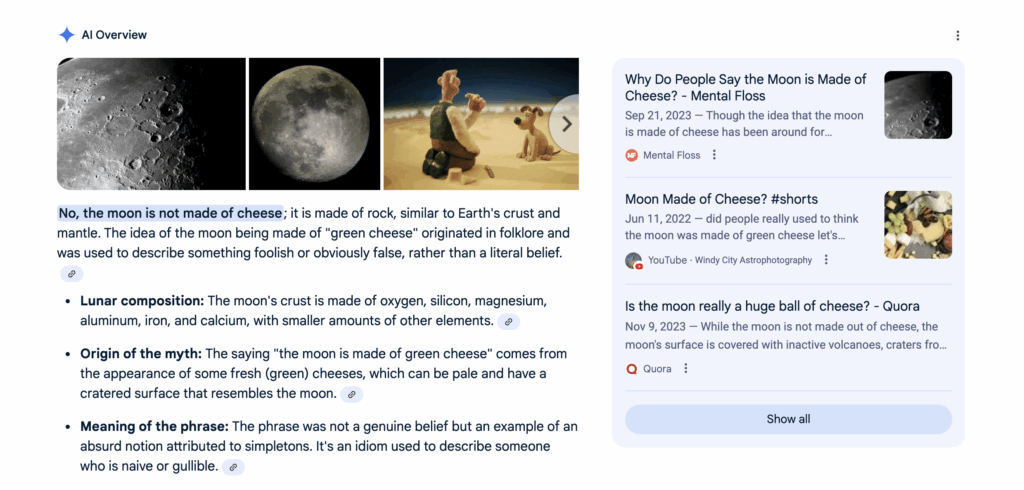
So, do keywords and backlinks still matter?
Yes.
Are they enough on their own?
Not quite.
To get cited, your content has to speak the same language as the machine. Entity-rich writing, clear definitions, structured data, and clean metadata. The easier you make it for a model to sift through your content, the more likely it is to select your content as a reliable source.
Structured data and content have always been one of the primary answers for how to optimize for search engines, so a lot of what you naturally do is already helping. So, traditional SEO isn’t dead. Fast load times, strong technical health, and mobile readiness are still table stakes. What’s changed is the layer on top: your brand now has to prove it’s a trusted authority for both humans and algorithms.
We always talk about Google, but that isn’t the only search engine or resource for results. They show up across an expanding ecosystem, including:
The message for marketers is clear: you’re not just optimizing for Google anymore. AI SEO means building content that can be selected, summarized, and cited across multiple surfaces — and more importantly, wherever your audience is asking questions.
Structure. Writing quality. Authority signals. That’s what large language models (LLMs) are looking for when deciding which content to trust. Instead of optimizing for a ranking, you’re optimizing for selection inside an AI-generated answer. That process leans on a few core elements:
When these pieces come together, your content becomes easier for AI to interpret, summarize, and cite. It shifts the goal from driving clicks to earning visibility inside the answers people already see. So, the more quote-ready your content is, the more visible your content and brand will be.
Traditional SEO rewarded visibility. AI SEO rewards credibility. Instead of just climbing search rankings, the goal is to become the source that AI systems trust enough to cite.
Getting to page one used to be the win. Now, the real prize is being quoted inside an AI Overview or chat result. That means structuring passages so they can be pulled directly into answers. For instance, a product comparison table or a one-sentence definition has a better shot of being cited than a long block of copy. Rankings still matter, but citations are what earn attention in AI search.
Stuffing in the right keyword variation won’t convince a model that your page is the best fit. What does? Entities and their relationships. Imagine writing about “running shoes.” Instead of just repeating the phrase, you’d define cushioning types, list popular brands, and connect those details to activities like marathon training or trail running. That context helps AI systems map how your content answers more specific queries.
Click-through rate once measured success, but if users get their answer from an AI summary, no click happens. AI share of voice tracks how often your brand is cited across Google AI Overviews, Bing Copilot, or Perplexity. For marketers, this metric reveals whether your expertise is showing up where people are now spending their attention: inside the generated response itself.
If your pages aren’t being cited in AI answers, they might as well be invisible. The fix isn’t complicated, but there are a couple of specifics you need to incorporate.
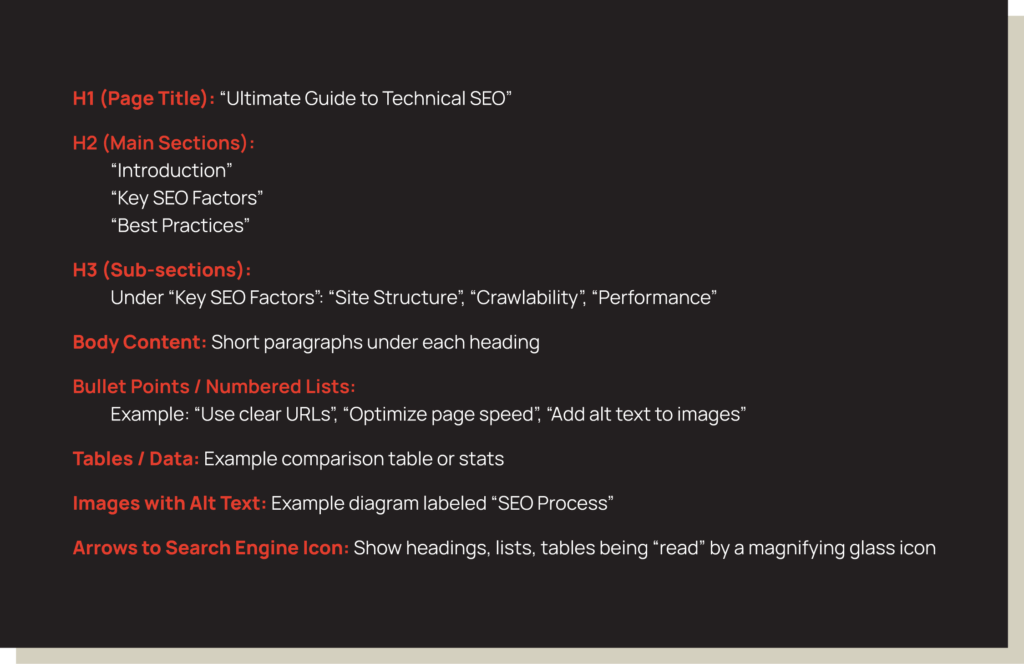
Think about how an AI model scans a page: it’s looking for clear, digestible chunks. Start sections with one-sentence definitions, then expand. Use lists, tables, and step-by-step breakdowns, formats that can be lifted directly into generated responses. Adding FAQs within a topic cluster also improves your odds of citation because the content is already shaped like an answer.
If you’re writing about “how to refinance a mortgage,” opening with a single-sentence definition followed by a step-by-step list gives the model exactly what it needs. FAQs work the same way—they mirror the Q&A style AI results are built on.
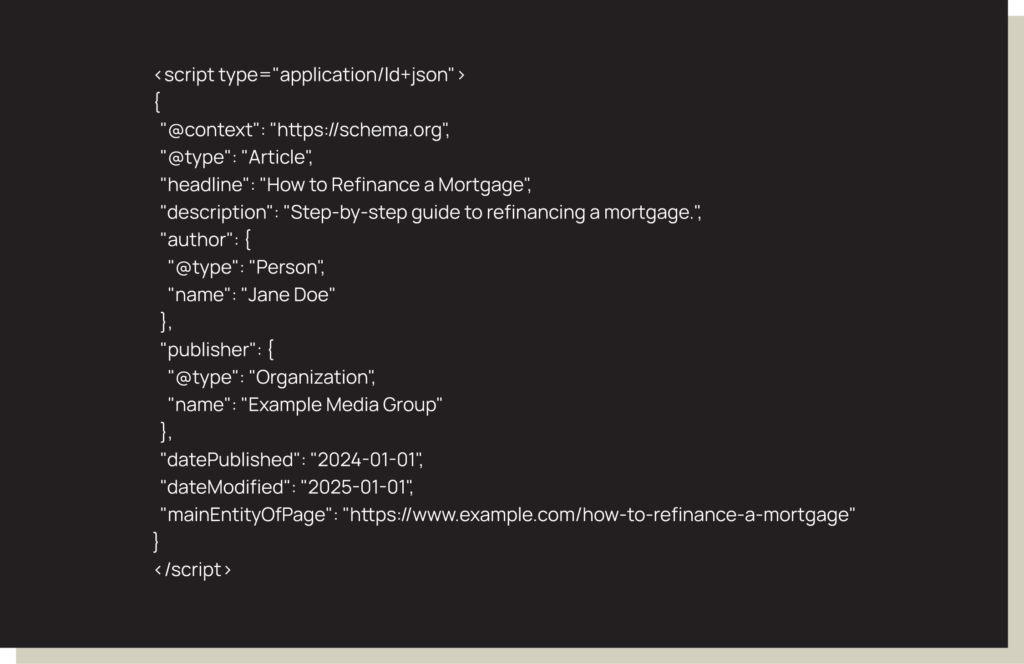
Schema is like a cheat sheet for machines — it provides the machine-readable signals AI models rely on. A recipe site using FAQPage, HowTo, Article, Product, Organization, and Person schema makes it far easier for AI to parse instructions, videos, and timings than one with plain text alone. The difference? One gets cited as a trusted source in a generated answer, the other is overlooked. Don’t just add markup, but test it with validation tools and keep metadata (author, date, org) clean.
Search engines still look for authority signals; AI just weighs them differently. Include expert bylines, clear author bios, and cite credible sources. Backlinks and third-party mentions reinforce authority beyond your own site. A medical site with content written by an MD, backed by references from the Mayo Clinic, is much more likely to be quoted than a generic health blog.
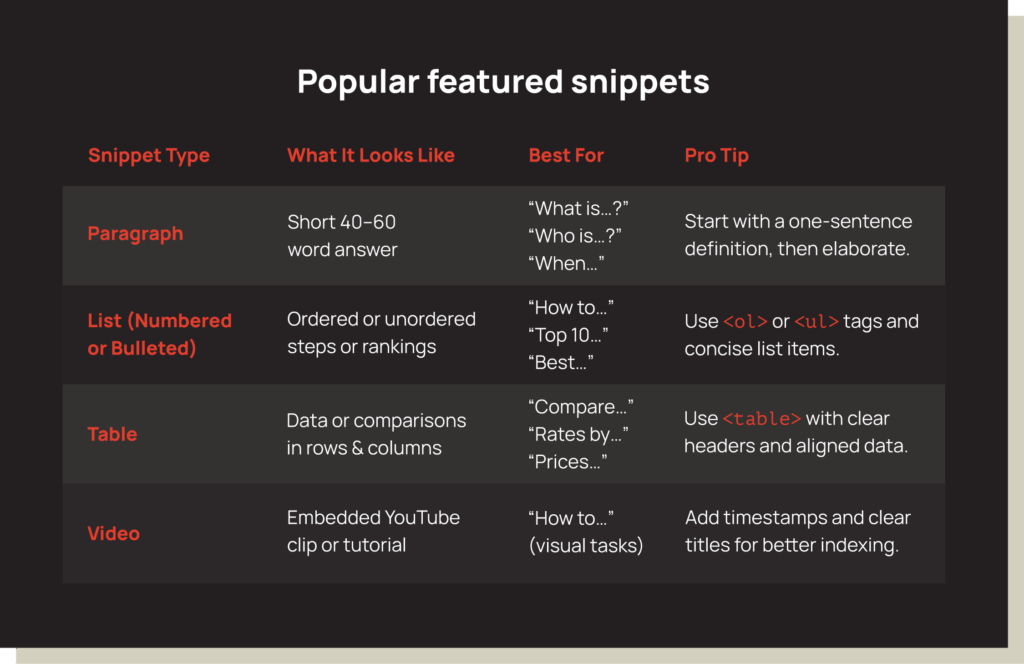
Featured snippets are often the training ground — and the live data source — for generative answers. Write concise answers at the top of a section, then elaborate. Use bullet lists for processes, definition tables for comparisons, and direct phrasing that AI can easily quote. If you run an e-commerce site, turning your “best laptops for students” blog into a bulleted comparison chart increases the odds of winning a snippet today and being cited in an AI Overview tomorrow.
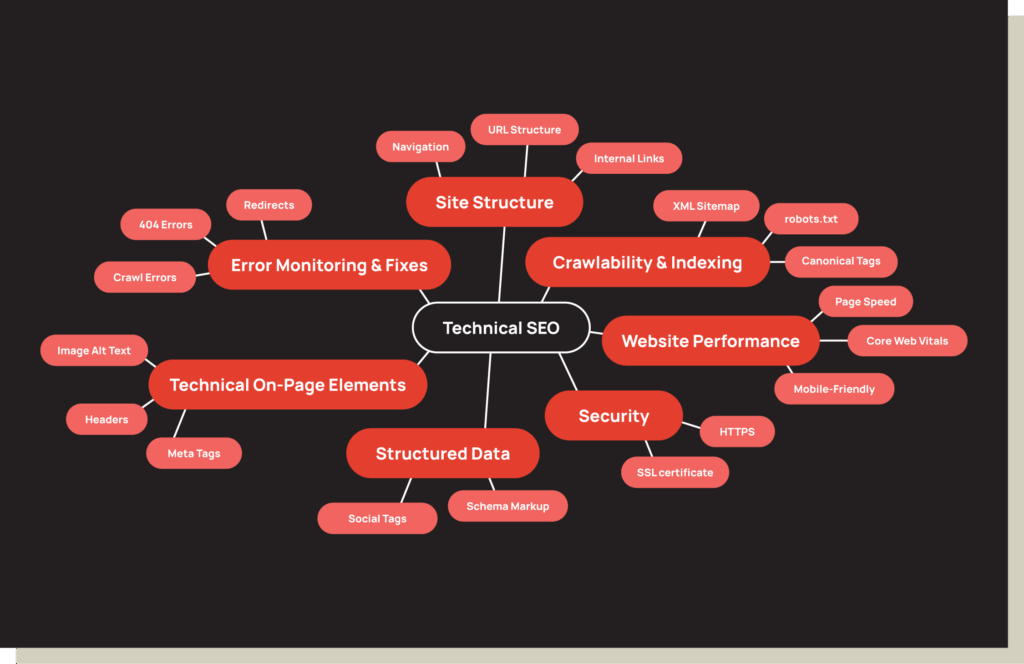
Even the best content gets skipped if it’s slow or messy, and AI search won’t cite a page that’s hard to access. Keep Core Web Vitals healthy, mobile UX smooth, and HTTPS standard. Maintain clean sitemaps and crawl budget hygiene so nothing gets missed. Don’t forget multimodal signals: alt text, transcripts, and captions increase the chance of your images, videos, or audio being pulled into AI responses.
Stale pages rarely get cited. Regularly update stats, examples, and dates to show relevance. Mark content with “last updated on” fields, and consolidate thin pages into authoritative hubs.
Take a cybersecurity blog that updates its “2023 phishing attack statistics” post with 2025 numbers. This signals relevance, while an outdated competitor page fades into the background. Adding “last updated” tags and consolidating thin content into a hub reinforces freshness, and that freshness helps your content stay visible when AI systems scan for the most current, reliable answers.
AI models cite what they can clearly identify. Use straightforward, factual phrasing. Reference reputable sources and include statements that stand on their own — short enough to be lifted directly into a generated summary. For example, writing “The average email open rate in 2025 is 21% (Statista)” gives AI a clean, source-backed fact it can lift directly. Compare that to burying the same stat inside a paragraph of fluff — harder to cite, easier to skip.
AI SEO relies on platforms that help with entity research, content optimization, technical checks, and — new to 2025 — tracking citations. Here’s where to focus when it comes to finding the right tools.
Tools like SEMrush Topic Research, Ahrefs Keywords Explorer, and AlsoAsked help uncover not just keywords, but the entities and questions AI models associate with them. For example, if you’re targeting “electric vehicles,” you’ll also see related entities like charging infrastructure, battery types, and federal tax credits — relationships you’ll want reflected in your content.
Platforms such as SurferSEO, Clearscope, and MarketMuse score your content against NLP models to highlight coverage gaps. Writing a guide on “remote team collaboration”? These tools surface semantically related phrases like project management software, asynchronous communication, and time zone overlap. This is how you make sure that your copy speaks the same language as AI search.
This is the newest tool category. New features from Sistrix, Ahrefs, and specialized platforms like Perplexity Pro Reports show how often your site is mentioned in AI Overviews, chat answers, or other generative surfaces. Instead of treating “AI share of voice” as an abstract idea, these tools quantify it.
Technical SEO underpins everything. Crawling and audit tools like Screaming Frog, OnCrawl, and Sitebulb keep Core Web Vitals, sitemaps, and log files clean, factors that directly influence whether AI systems can access and parse your content. Paired with ContentKing for continuous monitoring, you’ll know the moment a broken link, schema error, or slow load threatens your visibility.
For more context, Search Engine Journal’s roundup of AI SEO tools highlights how quickly this space is evolving.
Single pages being optimized are helpful, but you need them to come together with an entire optimized system, where every piece of content reinforces the rest. These three elements set that system up for success.
The hub-and-spoke model works especially well in AI search. A pillar page anchors the topic (say, “employee wellness programs”), while supporting articles dive into subtopics like fitness stipends, mental health benefits, or VTO policies. Interlinking signals topical authority and gives LLMs a clear map of how your content covers the space.
Think about outlines as blueprints for AI answers. Instead of writing a full draft and hoping it works for snippets later, design the structure up front. That might mean planning where a definition box goes, outlining a process as numbered steps, or slotting in a pros-and-cons table.
Treat expert input as a built-in stage of content design, not a final polish. Publishing with bylines, credentials, and references reinforces authority, but the real gain comes from weaving SME insights directly into the structure. That way, your content carries unique expertise that AI models can’t find in generic sources.
Click rates and rankings are still worth tracking, but when it comes to tracking AI SEO, there are some new (or reframed) metrics to monitor to see if your efforts are paying off.
Citation frequency is the new visibility metric. Track how often your site is referenced in Google AI Overviews, Bing Copilot, Perplexity, and other chat-based results. Some SEO platforms — Ahrefs among them — are rolling out features that quantify AI share of voice.
If you’re already tracking AI share of voice, the next step is to use that data strategically. Benchmark citation frequency against competitors to understand relative visibility, and watch for shifts in the types of queries where you’re cited. For example, an increase in citations around product-comparison queries might signal growing authority at the consideration stage of the funnel.
Organic metrics don’t disappear. Rankings, reach, impressions, and engagement still matter, especially when paired with assisted conversions and pipeline attribution. For example, if a product guide is cited in an AI Overview but also sees rising organic traffic and contributes to demo requests, you’ve got evidence that AI visibility is feeding the funnel, not just awareness.
AI search results evolve quickly, which means measurement has to be ongoing. Build quarterly checkpoints into your workflow: update schema, refresh content, and test snippet formats against key queries. A/B testing definitions, tables, or list structures can be especially helpful in determining what AI systems are most likely to pull into generated answers.
AI systems look for clear, scannable data when summarizing offerings. Product pages with benefits tables, comparison blocks, and FAQs are more likely to surface in AI Overviews.
One example comes from Princess Cruises, which needed to dominate Alaskan cruise searches. Instead of chasing keywords, they built topic clusters around their service pages: 70 new pieces of content, 23 optimized port landing pages, and a web of internal links pointing back to core pillars.
Within three months, this strategy drove a 261% increase in AI Overview mentions, capturing 66.2% of competitive mentions and 88.4% of impressions in AI-driven search. This 97th Floor case study shows how structuring content this way proves far more effective than traditional keyword targeting.
Guides and blog posts often answer early- or mid-funnel questions, which makes them prime candidates for AI answers. Starting with concise definitions, layering in structured summaries, and adding original charts or visuals helps these assets stand out. For example, a blog explaining “what is zero trust security” that opens with a crisp definition and includes a diagram will likely be favored over one with only dense paragraphs.
Glossaries and resource libraries are tailor-made for AI SEO. Short, canonical definitions backed by internal links to related topics create a knowledge graph effect that language models can navigate. For example, a glossary page might define an industry term in two or three sentences, then connect readers to deeper resources across your site. Even though the content is brief, its clarity and structure make it highly attractive for AI-generated summaries.
Optimizing for AI search raises new responsibilities. Accuracy and trustworthiness are even more important today to protect your brand. Here’s how to make sure your organization stays out of hot water.
Generative answers can spread errors if the sources feeding them are flawed. That makes it vital to maintain rigorous sourcing practices: cite reputable references, conduct boas checks, log updates, and monitor pages for outdated claims. Treat every page as if it could be quoted directly — because it might.
Generative AI has blurred the lines between original and machine-written material. To protect both your brand and your users, adopt clear policies on how AI is used in content creation. Human review and quality assurance should always be the last step before publishing. Where AI assistance is part of the process, disclosure fosters transparency and helps build trust.
Most teams start strong — refreshing content, adding schema, tracking AI citations. But if traffic plateaus, citations remain sparse, or entity coverage feels incomplete, it may signal the limits of internal bandwidth. What works this quarter may look different six months from now, and the brands winning citations are the ones adapting fastest. We can help with that.
We’ve built systems that scale with change: topic clusters that expand as industries shift, schema frameworks that grow with new content types, and measurement models that capture how AI surfaces your brand across platforms. The result is momentum, increasing visibility that keeps clients ahead while competitors scramble to catch up.
If your goal is to lead in an AI-first search landscape, our team has the playbook and the proof to make it happen. Let’s talk.
Generative Engine Optimization (GEO) is the next chapter in how brands win search visibility. If traditional SEO helped you win clicks on Google’s blue links, GEO helps you secure your spot in the AI-generated answers that people are now turning to.
This approach focuses on making sure your content and expertise show up in the summaries, overviews, and recommendations provided by generative AI search engines. Unlike standard search results, where ranking high meant being one of many clickable options, generative AI search can position your brand directly inside the answer. That’s a powerful shift, and it’s already changing how companies think about their content strategy.
Generative Engine Optimization is the process of improving your brand’s visibility within the answers produced by AI-powered search engines. It blends the principles of SEO with new strategies tailored specifically to how generative models source, interpret, and present information.
GEO in a nutshell: The art (and science) of making sure AI search engines not only find your content, but use it in their answers.
Also called AI SEO or AI Search SEO, GEO is all about anticipating how AI models select and structure responses so you can position your expertise where it matters most. It’s not abandoning SEO, but rather expanding your optimization efforts to include the algorithms shaping the new search experience.
Generative AI search engines combine traditional web crawling with large language models (LLMs) that synthesize information into a conversational or narrative format. Instead of serving a list of links, these systems:
The visibility challenge is that AI overviews and chat-style answers can drastically reduce clicks to individual sites. But they also give brands the chance to be the source inside the answer box.
Search engines didn’t become “generative” overnight. The transformation has been gradual, moving through several distinct phases. In the early days of search during the 1990s and 2000s, keyword matching and basic ranking factors determined which results appeared. This gave way to the semantic search era in the 2010s, when advancements like Google’s Hummingbird, RankBrain, and BERT allowed search engines to better understand context and relationships between words.
Now, in the 2020s, we’ve entered the generative AI era. LLMs such as GPT, Claude, and Gemini are being integrated directly into search platforms, enabling them to produce full-sentence, multi-paragraph answers in real time. The search experience is no longer just about scanning a list of 10 blue links. It’s about receiving a ready-to-use answer. This shift is exactly why GEO is becoming an essential part of forward-thinking marketing strategies.
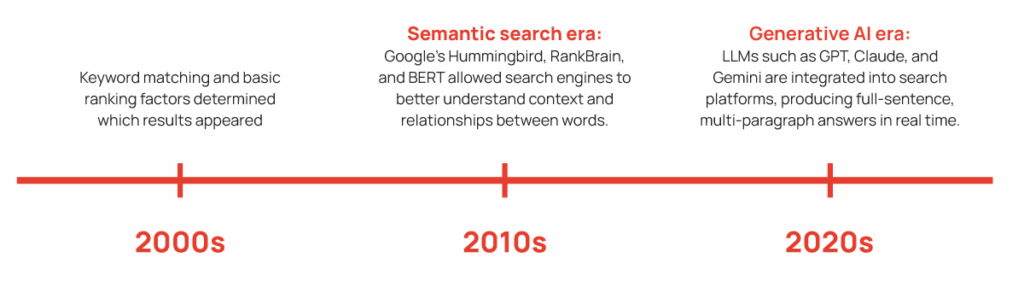
While Generative Engine Optimization builds on the foundations of SEO, it’s not a basic rebrand of what you’re already doing. GEO and SEO share core principles, but the way success is measured, the type of content created, and the optimization targets differ slightly.
| ASPECT | SEO | GEO |
| Primary Goal | Rank high on search engine results pages (SERPs) to drive clicks. | Be included as a cited or quoted source in AI-generated answers. |
| Optimization Target | Search engine algorithms (Google, Bing) for keyword-based queries. | AI models and their training signals (Google AI Overviews, Bing Copilot, ChatGPT, Perplexity). |
| Content Format | Long-form pages, blog posts, landing pages optimized for keywords and links. | Concise, authoritative statements, structured data, and clearly cited sources for AI parsing. |
| User Intersection | Users click a link to read content on your site. | Users may get your content directly in an AI response, with fewer clicks but higher brand impressions. |
| Measurement | Organic traffic, keyword rankings, CTR, backlinks. | AI visibility share, citation frequency, co-mention volume, referral clicks from AI platforms. |
Both SEO and GEO aim to connect your audience with the information they’re searching for. They each require:
The main difference is where and how the content is surfaced. SEO focuses on winning positions on SERPs, while GEO focuses on getting cited or featured directly inside AI-generated answers. This changes:
GEO works best when it’s layered into your existing SEO efforts rather than replacing them. A dual strategy might look like this:
Pro Tip: A combined SEO + GEO approach means you can capture both the click and the citation.
The click and the citation pull from different signals, reward different content structures, and serve different discovery moments — which means optimizing for one doesn't automatically earn you the other. Mike, Head of SEO at 97th Floor, gives the direct answer to the question most SEOs are asking right now: no, your Google rankings don't transfer to ChatGPT, and the gap between the two is wider than most teams realize. This short video breaks down exactly what AI search looks for and how to position your content to show up in both places.
AI-generated search features (like Google’s AI Overviews) are rewriting the rules of click-through behavior. Ahrefs reports a 34.5% drop in CTR for the top-ranking organic result when AI Overviews appear, based on 300,000 keywords.
A Pew study reinforces the behavior shift, citing that when an AI summary appears, users clicked traditional links only 8% of the time, versus 15% when no summary was shown. AI summary links were clicked in just 1% of visits, and users were more likely to end their session entirely (26% vs. 16%).
While Google counters these findings, arguing overall click volumes remain stable, publishers and marketers across the board are seeing clear signs of disruption.
Search is morphing into an answer-first experience. With generative AI tools delivering instant, synthesized content, users often get what they need without navigating to external websites. This zero-click dynamic is steering traffic away from source sites and towards the brands directly cited inside AI responses.
As visibility shifts from the link to the explicit quote or citation, it’s no longer enough to rank high. You need to be included in the answer. GEO equips you to optimize your content for algorithms and AI models that prioritize clarity and authority.
Being that trusted source inside the generative answer layer means you’re still seen—even if the click happens less often.
Even when click-through rates are lower than traditional SEO, being cited in an AI-generated response can lead to significant awareness lift and indirect traffic from brand recall.
GEO requires a little more than just tweaking your SEO playbook. To earn visibility inside AI-generated answers, your content needs to be structured and authoritative. Here’s how to get there.
AI search engines lean heavily on signals of Experience, Expertise, Authoritativeness, and Trustworthiness.
AI models select answers based on clarity, accuracy, and completeness.
Well-structured content is easier for AI to parse and quote.
The more your brand is mentioned and cited online, the more likely AI engines will reference you.
Your site still needs to be technically sound for AI crawlers to access and understand it.
Pro Tip: These best practices are easier to implement when you have a partner who understands both SEO and GEO.
Creating a Generative Engine Optimization strategy doesn’t have to mean reinventing the wheel. Instead, focus on tuning your content and technical setup so AI search engines see you as the go-to source. These five steps can help you set a strong foundation.
Start by identifying high-value AI search queries that matter to your business. Look for the questions your audience is already asking and see how AI search features answer them. Pay attention to the formats being used (whether it’s bullet lists or short explanatory paragraphs) and map these queries to different stages of the customer journey so you understand exactly where GEO fits in.
Once you know what you’re targeting, craft content that AI can easily parse and cite. Use clear, authoritative statements that stand on their own if quoted, and back them with citations to reputable sources. Place your most important facts and definitions early in the content so they’re more likely to be extracted and featured in AI responses.
Your technical foundation determines how accessible your content is to AI crawlers. Add schema markup for FAQs, how-to content, products, and organizational details to make your site more machine-readable. Refine your site architecture to improve crawl efficiency, and make sure your pages load quickly on all devices to meet the performance benchmarks AI models favor.
A strong GEO strategy doesn’t live only on your website. Share your optimized content across social platforms and partner channels to broaden your footprint. Earning mentions and co-citations on reputable sites increases your authority in the eyes of AI engines, making it more likely your brand will be included in generated answers.
Treat Generative Engine Optimization as an ongoing process. Track your AI citation share to see how often your brand appears in AI-generated responses, and measure any referral traffic from those sources. Use these insights to refine your strategy by testing new content formats, updating outdated pages, and adapting to shifts in how AI presents information.
The fundamentals of Generative Engine Optimization apply across all industries, but the nuances of implementation can vary. Here’s what to prioritize in four key sectors.
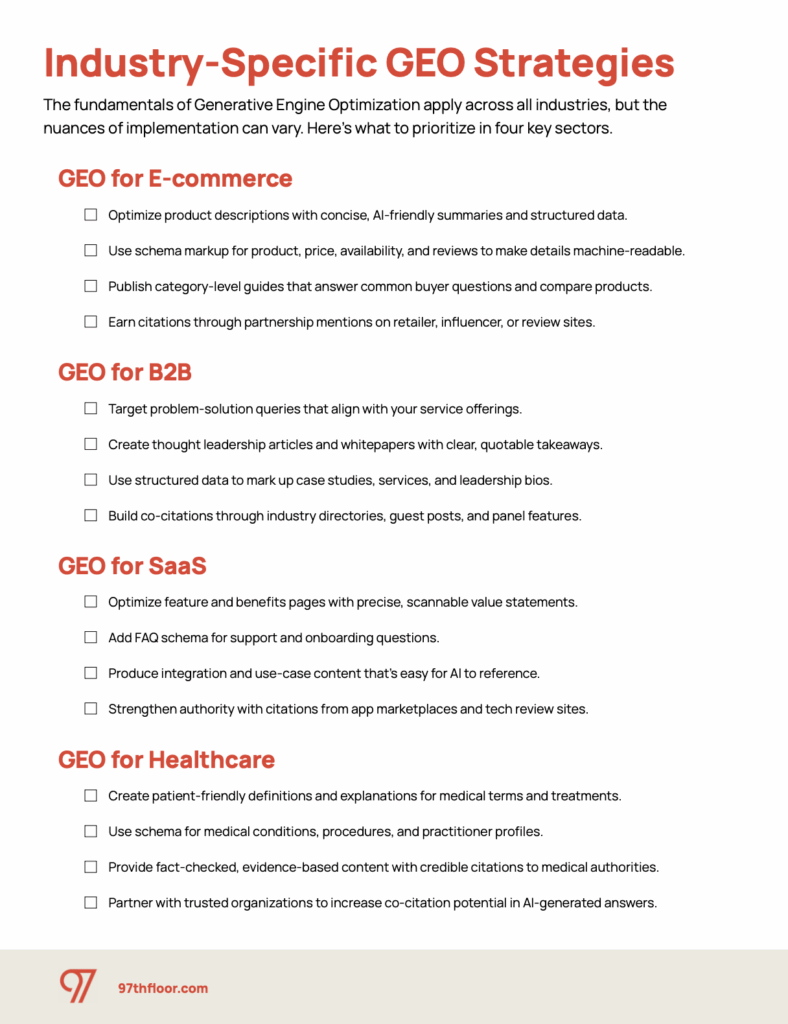
GEO is still young, but AI-powered search is evolving fast. Staying competitive means anticipating both technological shifts and changing user expectations.
Generative AI is becoming more context-aware, tailoring answers based on user preferences or location. Search platforms are also integrating real-time data, enabling AI responses to include the latest news, product inventory, or market updates. Brands that can deliver fresh, authoritative content quickly will hold a distinct advantage.
Search is expanding beyond typed queries to include voice, image, and video prompts. This opens GEO opportunities like optimizing images with descriptive alt text for AI citations or marking up how-to videos for voice-led answers.
No matter the format, AI will continue to favor clear, trustworthy content, so the core principles of GEO will remain the foundation for visibility.
A growing number of tools can help you navigate GEO to stay ahead of AI search trends. For example:
At 97th Floor, we’ve built GEO services that are designed to scale, engineered for performance, and focused on driving revenue. Our team blends technical expertise with creative strategy to make sure your brand isn’t just present in AI search, but is positioned as the trusted source.
Running an ecommerce brand in 2025 is like hauling feral cats out of a burning building — noble work, but try it alone and you’ll come out with more scars than survivors. That’s because ecommerce isn’t a single challenge; it’s dozens of moving, clawing parts that demand your attention all at once. Scaling an online store goes way beyond having great products. Visibility, customer experience, and platform mastery all play a role in turning browsers into buyers.
Ecommerce agencies step in as that extra set of hands. They handle the heavy lifting across SEO, paid ads, conversion rate optimization, design, and retention so you can focus on keeping your business upright and your capital from bleeding dry.
In this guide, we’ll cover what ecommerce agencies actually do, how to know if it’s time to hire one, what makes a ‘best’ agency stand out, and seven agencies in the U.S. worth your attention in 2025 — including ours (because, full disclosure, we’re really good at what we do).
If you’re reading this, you probably already have a sense of what an ecommerce agency does. Still, let’s not skip the basics.
An ecommerce agency is a specialized partner built to help online stores grow faster, smarter, and with fewer headaches. Unlike general digital agencies, ecommerce agencies focus specifically on the unique demands of online retail.
That means:
They’re measured by commerce-specific metrics like average order value (AOV), lifetime value (LTV), return on ad spend (ROAS), and retention — not just traffic or impressions. All of this is to say an ecommerce agency’s job isn’t finished once visitors land on your site. Their role is encouraging those visitors to stick around and actually buy something.
We’re not going to sugarcoat it: Hiring an ecommerce agency isn’t cheap. But the right one can more than pay for itself by uncovering growth opportunities you didn’t even know existed. It’s like figuring out which wire to cut on a ticking bomb after watching one YouTube tutorial. Technically possible, but maybe bringing in a professional would be safer?
In other words, the benefits go way beyond saving time (though that’s nice, too). Here’s why brands turn to ecommerce agencies in 2025:
Without checking any listings, we’re pretty confident in telling you that there are thousands of agencies out there ready to take your call. But what separates the good from the genuinely great? Flashy websites and slick pitch decks are nice, but results are what actually matter. The best ecommerce agencies prove their worth by showing exactly how they’ve helped brands move the needle.
Not every agency that slaps ‘ecommerce’ on its homepage is worth your budget. The best agencies share a few traits:
Statista projects that worldwide ecommerce sales will hit roughly $3.66tn by the end of 2025. And, if you’re like me and don’t immediately recognize ‘tn’ as a unit of measurement, it stands for trillion (12 zeroes). That’s a lot of potential growth; having a dependable agency by your side can help your business carve out its share instead of getting buried under everyone else’s.
You made it. This is the list you came here for. These seven agencies stand out in 2025 not only for their services, but for their ability to deliver measurable, platform-specific results. We’ll cover who they’re best for, what services they offer, and what makes them different in a crowded space.
Best for: Integrated growth across SEO, paid, and conversion optimization
Most agencies promise growth. 97th Floor has made a business of proving it. With deep roots in content, SEO, and analytics, 97th Floor doesn’t just help ecommerce brands ‘get more traffic’ — they work with you to align every marketing channel to generate more sales, more efficiently.
97th Floor is a full-service growth agency with a knack for turning ecommerce complexity into measurable outcomes. Their bread and butter includes:
If you want a partner that doesn’t just tweak one channel but instead pulls the whole system into alignment, 97th Floor is a top choice.
Best for: Content-driven ecommerce growth
Content is king, but only if it ranks — otherwise it’s just some obnoxious court jester that capers around the digital courtyard juggling outdated keywords (don’t mind me; just stress testing a metaphor). Siege Media built its reputation on creating research-backed, SEO-optimized content that ecommerce brands can use to win organic visibility. If you’re tired of writing blog posts that nobody reads, this is an agency that can change the story.
Strengths include:
If organic growth is your north star, Siege is the kind of agency that can help you outrank competitors without relying solely on ad spend.
Best for: Platform migrations and storefront optimization
Technology can be a brand’s biggest advantage — or its biggest bottleneck. 1Digital® Agency specializes in fixing that problem by making sure your storefront is fast, functional, and scalable, no matter which platform you’re on. Whether you’re moving from Magento to Shopify, need a WooCommerce overhaul, or want to unify your BigCommerce setup, they’ve been there.
They offer:
Overall, 1Digital® Agency is a good fit for brands with growing pains tied to their tech stack.
Best for: ecommerce SEO at scale
SEO may not be flashy, but it’s the backbone of sustainable ecommerce growth. WebFX has built a reputation on measurable outcomes, particularly around SEO. They’re a fit for ecommerce brands that want more organic traffic and are ready to invest in long-term visibility.
Services include:
They’ve worked with thousands of clients and have the scale to match complex ecommerce needs.
Best for: Amazon and marketplace strategy
For many brands, Amazon is both an opportunity and an obstacle — massive reach, sure, but also high fees, fierce competition, and limited control over the customer relationship. Nuanced Media helps navigate that complexity by giving you a strategy not only for your own storefront, but also for Amazon, Walmart, and other marketplaces where your customers are already shopping.
Highlights:
Great for brands that want to diversify beyond their own dot-com.
Best for: Conversion rate optimization and UX
If you’ve ever looked at your analytics and thought, Why aren’t more people buying? Inflow is the agency built to answer that question. They specialize in conversion rate optimization and user experience, making sure the traffic you already have does more heavy lifting.
Core strengths:
Traffic is great. Conversions are better. If your store has healthy traffic but underwhelming conversions, Inflow is a CRO partner to look at.
Best for: Performance marketing and paid growth
Growth often comes down to how well you spend your ad dollars. Upgrow focuses on performance marketing — paid search, paid social, and scaling strategies — so ecommerce brands can grow quickly without throwing money into the void.
They offer:
For ecommerce brands ready to put budget into scaling, Upgrow brings the paid expertise to do it properly and profitably.
This has been fun, hasn’t it? I mean who doesn’t love a good listicle. But it's worth recognizing that knowing who the top agencies are is only the first step. The real challenge is figuring out which one you actually want a long-term relationship with. You’re not swiping for a quick fling here — you’re looking for a partner who won’t ghost you when the budget conversation gets awkward.
Not every agency offers every service, but most ecommerce specialists fall into one or more of these categories. Think of it like a restaurant menu — you don’t have to order Ultimate Feast, but it’s good to know whether crab is available and if the lobster is fresh.
The service menu is broad, but most ecommerce agencies will cover some or all of these areas:
Do you need all of that? Maybe not. But if you’re building a working relationship with an ecommerce agency, then it might be a good idea to find one that can do everything in case your needs evolve somewhere down the line.
We sell ecommerce services, so maybe we’re not the most objective source to be asking. But we also get it: in an economy like this one, it doesn’t make sense to invest in something you might not need. If that’s you, and you’re wondering if ecommerce is the next step for your business, consider asking yourself the following questions:
In the ‘in-house vs. agency’ debate, the tipping point usually comes when you realize a single marketing hire can’t cover the breadth of expertise you need. Agencies provide a full team of specialists for the cost of one or two more employees.
At this point, you know what ecommerce agencies do, you know what makes a great one, and you know which names stand out in 2025. So why should you consider 97th Floor? The short answer: because we choose not to focus on optimizing channels and instead put our expertise to work optimizing outcomes.
97th Floor has helped ecommerce brands grow by aligning creative, technical, and analytical expertise into a single strategy. Our teams handle everything end-to-end:
At 97th Floor, the goal isn’t isolated channel wins. The goal is connecting those wins so they push the whole business forward (metaphorical cats and all).Ready to scale smarter? Let’s talk. Contact 97th Floor today to see how we can help your ecommerce brand grow in 2025 and beyond.
An ecommerce agency helps online businesses grow by improving visibility, traffic, and sales. Their work usually covers SEO, paid ads, conversion rate optimization (CRO), email marketing, UX design, and platform support (like Shopify or Magento). The goal is simple: bring more qualified buyers to your store and help them convert.
An ecommerce marketing agency takes a full-funnel approach, handling everything from ads to design to retention. An ecommerce SEO agency, on the other hand, focuses specifically on organic growth through technical SEO, content, and link-building. If you need broader support across multiple channels, a marketing agency is a better fit; if organic visibility is your biggest challenge, an SEO agency might be the right call.
The ‘best’ agency depends on your goals. Look at case studies, client results, and platform expertise. A good rule of thumb: startups often need quick traffic gains, growth-stage brands want conversion and scaling, and enterprises focus on retention and international expansion. Always check for transparency around pricing and reporting before committing.
Most agencies work with major platforms like Shopify, Magento, BigCommerce, WooCommerce, and Salesforce Commerce Cloud. Some specialize in one or two platforms, while others cover a wider range. Make sure your agency has direct experience with the platform your store runs on.
Signs include: steady traffic but low conversions, difficulty scaling into new channels or marketplaces, limited in-house expertise, or stagnant ROI from your current marketing. If your growth feels stuck, an agency can bring the team and tools to push past that plateau.
Common KPIs include revenue growth, conversion rate, return on ad spend (ROAS), average order value (AOV), customer lifetime value (LTV), and retention rate. These metrics tie directly to profitability, making them more useful than vanity metrics like impressions or raw traffic.
You’ve been watching traffic slide for months. Competitors suddenly show up in AI Overviews, while your brand barely appears. Reports keep pointing to “algorithm changes,” but no one on your team can explain why conversions are down.
With how quickly algorithms and AI features can change, it’s no wonder businesses are struggling to keep up. But this is exactly where an AI SEO agency proves its worth. They combine machine learning, automation, and a strong dose of human expertise, all to help brands surface to the top of a sea of generative results.
Here, we’ll show you what makes an AI SEO agency stand out and explore the benefits of partnering with the right agency.
An AI SEO agency is built for the way search works now, not the way it worked five years ago. Instead of relying only on manual keyword research and historical data, these agencies use artificial intelligence to uncover opportunities faster and adapt to changes in your industry.
The big shift is focus. Traditional SEO looks backward — analyzing what drove results in the past. AI SEO agencies look forward. With predictive analytics and natural language processing, they anticipate where demand is moving and position your brand to show up at the right time.
AI also takes over the repetitive work: technical audits, clustering topics, generating schema, or tracking where your brand appears in AI Overviews and chat results. That gives strategists more space to do what matters most — build campaigns, craft content, and connect your message with real people. The tech handles the scale and speed; the people make sure the strategy is thoughtful, creative, and aligned with business goals.
The big question for a lot of marketers or small business owners is: what is an AI SEO agency going to do that I can’t do myself? The right agency isn’t trying to sell you shiny new tools, but they are trying to make your job easier.
In short, the biggest benefit is peace of mind. You don’t have to second-guess whether your SEO strategy can keep up with how search is changing.
Not every agency that talks about AI is actually using it in a meaningful way. Some lean too heavily on automation, others promise results they can’t deliver. When you’re shopping for a professional partner, it pays to know both the green flags and the red ones so you can avoid trouble in the first place.
There’s no shortage of agencies talking about AI, but only a handful have proven they can use it to drive real results. Here are 7 different agencies that are taking AI SEO marketing by the reins and forging a path forward.
97th Floor has built a reputation for staying ahead of how search evolves, including with AI SEO. We blend that technical expertise with creative execution. Our experience has shown that it’s not enough to help clients simply rank, but to build lasting authority.
The approach centers on entity-led content, structured data, and technical optimization — all critical for visibility in AI-driven results. But what sets 97th Floor apart is how we tie these tactics back to measurable outcomes. Campaigns aren’t judged only by traffic; they’re evaluated on real business impact like qualified leads, revenue growth, and brand recognition.
As a full-service AI SEO agency, 97th Floor brings together strategists, analysts, writers, and developers under one roof. That integration makes it easier to adapt to search shifts and deliver cohesive campaigns. For brands that want both innovation and accountability, 97th Floor is a partner that delivers both.
Siege Media is known for combining SEO with content marketing, and they’ve quickly adapted those strengths for the AI era. Their focus is on creating high-value content that performs in both traditional search results and AI Overviews.
One of their core advantages is a data-driven approach to identifying opportunities competitors miss. Instead of chasing broad keywords, Siege Media zeroes in on topics where brands can earn visibility, citations, and long-term traffic value. Their emphasis on Generative Engine Optimization (GEO) positions clients to surface in emerging search formats like Google’s AI-driven results.
Directive Consulting specializes in SEO for B2B brands, and they’ve built their reputation on tying search efforts directly to revenue. Their approach to AI SEO reflects that same focus: less about vanity metrics, more about connecting demand generation to long-term business growth.
Where Directive stands out is in GEO. They design strategies that anticipate how AI will surface information and make sure that clients show up in the conversations and citations that influence buying decisions. Combined with their full-funnel approach, this helps brands capture visibility at every stage of the customer journey.
For B2B companies that want search strategies aligned with sales outcomes, Directive is a solid choice. Their emphasis on revenue impact makes them a strong choice for teams under pressure to prove ROI from SEO investments.
Spicy Margarita is a boutique agency that’s carved out a name in B2B by building content designed for AI visibility. Instead of focusing on keyword volume alone, their strategies emphasize answer-ready content — the kind of material that AI systems parse, cite, and elevate in Overviews.
Their specialty is blending content-led SEO with GEO. That means they are focused on crafting resources that address buyer questions directly and position brands as credible sources in emerging AI-driven results. Conversion is always at the center — rankings matter, but only if they lead to qualified leads and revenue.
uSERP is known for its focus on authority building in the age of AI search. Their approach combines technical SEO, advanced link building, and their proprietary Answer Engine Optimization (AEO) framework, which helps brands surface in AI-generated results and conversational queries.
Unlike agencies that chase short-term visibility, uSERP invests in strategies that strengthen a site’s credibility across multiple signals. That means better rankings in traditional SERPs and more frequent appearances when AI systems pull answers from trusted sources. Their track record includes hundreds of clients across industries.
iPullRank has earned respect in the SEO world for tackling enterprise challenges at scale. Their approach, called “Relevance Engineering,” blends semantic modeling with technical SEO to deliver strategies that line up with how search engines — and increasingly, AI systems — interpret meaning.
This focus on depth has led to billions in organic search value generated for clients. iPullRank’s strength lies in taking complex enterprise sites and making them more discoverable, structured, and ready for AI-driven interpretation. Their emphasis on technical precision and semantic relevance sets them apart from agencies that rely too heavily on surface-level tactics.
First Page Sage is known for its thought leadership approach to SEO. They specialize in creating research-driven content that builds authority, particularly for B2B SaaS and other industries where credibility is a key differentiator.
Their team has integrated generative AI optimization into this model, focusing on content that not only ranks but also earns trust in AI-driven environments. By combining long-form, authoritative resources with demand generation strategies, they position clients as the go-to source in their field.
There’s a point where DIY SEO or even a capable in-house team starts to hit a ceiling. You may be seeing:
Because AI is quickly becoming the foundation of how search works, our generative systems are rewriting the rules. Brands can optimize for blue links, but they also need to prepare content that is even more obviously structured, credible, and, most importantly, ready to be cited by AI. What we’re seeing from top SEO companies that are seeing results are things like:
Agencies that understand what SEOs need to know are already positioning clients to succeed. The pace of change is fast, but it’s not unpredictable. Strong AI SEOs already build for this future by focusing on clarity, authority, and adaptability — qualities that matter no matter how search evolves.
The right SEO agency isn’t a plug-and-play type of resource. Again, you have to balance the technical and creative sides of SEO to finally start seeing results. Consider these core services that the pros are offering:
Plenty of agencies are experimenting with AI, but 97th Floor has already built a track record of driving results with it. Our team combines technical SEO, content strategy, and analytics to help brands show up where it counts. We’ve got the traditional search results mastered, but we’re also paving the way forward for brands like yours. Entity-led optimization, structured data, and performance tracking are core to how we work.
What makes 97th Floor different is the integration of people and process. Analysts, strategists, and developers work side by side, which means campaigns are cohesive and built to scale. That’s how we turn AI SEO from a buzzword into growth you can measure.
Learn more about our AI SEO services or start with a free audit.Let’s Talk | Get an AI Audit
Traditional agencies lean on manual research and historical data. An AI SEO agency uses automation, predictive analytics, and natural language processing to spot opportunities faster and adapt to search changes more effectively.
The tools that stand out are those that handle entity mapping, structured data, and keyword modeling. Platforms that monitor AI Overviews and share of voice are also increasingly valuable for visibility.
If traffic has plateaued, competitors are showing up in AI-driven results, or your team lacks bandwidth for technical and content work, it’s a sign that an agency could provide needed scale and expertise.
Look beyond rankings. Focus on qualified leads, conversions, revenue influenced by organic traffic, and AI share of voice to see the full impact of your investment.
Yes — but only when combined with human oversight. Agencies use AI to speed up production, then refine for accuracy, originality, and brand voice. That balance is what helps content rank and perform.
Yes. Schema helps search engines and AI systems interpret your site. Organization, FAQ, and product schemas are often the most impactful for visibility in AI-driven results.
