



Marketers have a lot going on in 2025.
Marketing budgets are at an all-time low post-pandemic. At companies feeling especially strained, what little budget remains is controlled by a CFO whose concern is for immediate ROI instead of long-term strategy.

Search is undergoing its own metamorphosis as AI continues to dominate SERP results and Google pushes out more algorithm changes than ever before. Gartner predicts that search engine volume will drop 25% by 2026 as audiences turn to AI chatbots and social platforms for information.

To sum up, marketers are expected to do more with less budget, grow at the whims of Google, and learn how to use AI while also combatting AI.
The response to the chaos is to focus on the core tenets of marketing–aligning our messaging to the audience and our CTAs to a robust full-funnel strategy.
Brands that will reach their audience across the entire funnel know that a message is more important than the channel through which it is sent.
Dollar Shave Club (DSC) came onto the scene in 2011 with a pioneering direct-to-consumer subscription model for high-quality razors delivered monthly for just a few bucks. The startup's messaging positioned themselves as the long-sought-for alternative to overpriced razors loaded with gimmicky features. DSC was scrappy, smart and spoke directly to their audience’s desire to save money.
Unilever bought DSC in 2016 for $1 billion cash, surely with intentions to turn the brand into a profit machine. But Unilever misunderstood DSC’s audience.
DSC was cool precisely because it wasn’t part of a massive conglomerate. Its audience loved a rugged brand born out of a viral YouTube video that offered them an alternative to $35 shaving kits.

But all that Unilever could see was the sexy world of commercials. In 2019 Unilever produced a new video for their brand DSC, inviting men and women of all kinds to “join the club.” Actually, Unilever made a slew of commercials with the same deadpan style as the 2011 hit that made DSC go viral. But it wasn’t shirtless bodybuilders squeezing shampoo bottles or sphynx cats in a shave butter heaven that made DSC successful. Okay, well kind of.
DSC subscribers love funny videos. But if the funny video doesn't have the right messaging, it still misses the mark. Unilever was too focused on channels to really understand the audience and message that DSC customers were so fanatical about.
In an effort to maintain profit margins in retail, Unilever expanded DSC’s offerings to include products such as hair cream, cologne, face moisturizer, and sunscreen. But these products cost anywhere from $10-50.
The same customer that wants quality razors for just a few bucks isn’t going to spring for a $50 bottle of cologne.
In 2023 Unilever sold their majority stake in DSC after seven fumbling years trying to grow their profit margins.
Don’t be Unilever. Know your audience. Listen to them. Create messaging that speaks to their core desires and don’t be distracted by flashy new channels.
That last part is the trap. "Flashy new channels" are usually demand channels in their prime — which means they're also the channels that will plateau, saturate, and eventually stop delivering. Udi Ledergor, former CMO at Gong, warns that every demand channel has a lifespan, and brands that build their entire growth engine on today's working channel are building on borrowed time. This short video captures what it looks like when a channel stops working — and what smart teams are already doing about it.
Something is happening to the marketing funnel. It’s waist? The core middle section that holds all those essential organs? Itty bitty. Hourglass. Nearly invisible for far too many brands.
Top of funnel content is fun! It’s exciting, it’s new, it’s engaging. Bottom of funnel strategy gets the bulk of the resources. “Leads leads leads,” we hear the CEO chanting as we ask for more SEO spend. And the mid-funnel? Forgotten.
Developing a strong mid-funnel strategy is the most crucial effort that marketers can make to increase engagement in 2025.
Mid-funnel content is the heavy hitter—or it should be—in helping your audience to trust you, become true experts in the solutions that can address their problem, and feel prepared to make a decision. This is where your audience wants to hang out.
B2B buyers are self-navigating their way to purchases. They’re not including sales people; they’re doing extensive research on their own. The brands that deliver robust early and mid-funnel content to these B2B buyers will win engagement and ROI.
A report published by Demand Gen reveals that B2B buyers consider the following to be characteristics of early- and mid-funnel content memorable enough to warrant a sales call:

The report also identified interactive content as important in the mid-stages of the buyer’s journey. This content can look take many forms, but respondents prefer:
Build mid-funnel content that allows your audience to do the research that they want to do anyway, but with you.
Ever read an article with a title like “Ten Motivational Quotes for a Tuesday” only to be hit with a “try our complicated SaaS platform” CTA?
All over the internet we’re seeing bottom-of-funnel CTAs slapped on top-of-funnel content. It’s jarring.
In 2025, engagement will hinge on how well marketers align their CTAs with the specific stage of the buyer’s journey.
Marketers should judge every single CTA against two factors: value and relevance.
First, a CTA should continue offering value to your audience. They should get something or learn something that continues to guide them on their journey and help them solve their problem.
Second, a CTA needs to be relevant to the content it appears with. A motivational quote article doesn’t need a CTA for a demo, but maybe a CTA for a productivity guide? That’s closer.
CTAs should mirror the knowledge and intent of your audience. Ask yourself this: if I were engaging with this content what would I want to know or do next that would get me closer to a resolution? That’s your CTA.
Successful marketing strategies employ multiple CTAs, each tailored for their audience’s specific needs at each stage in the funnel.
If marketing is undervalued, brand marketing is the poster child for it. Convincing leadership to lend a budget for top-of-funnel awareness plays can feel impossible in the face of a recession scare.
But marketers know the truth: having a strong brand protects performance dips in every other channel–especially organic and paid.
A strategic brand campaign can have massive ROI that rolls in new business for a long time after the campaign concludes.
One of the most overlooked brand channels is already built into your product. Former Slack CMO Bill Macaitis explains why every free user is quietly acting as a member of your marketing team, spreading awareness and pulling your brand into new organizations. This short video breaks down why your free users may be your most underutilized marketing asset.
Back to the earlier point about the mid-funnel, building strong mid-funnel strategies and CTAs along the full funnel mitigates some of the risk of investing in top-of-funnel brand marketing. Put in different terms, if you want the buy-in for your top-of-funnel dream campaigns, build the mid-funnel first and connect the dots for upper leadership.
A brand marketing campaign should not be a drop-off.
Create a journey. Make your upper-funnel content work for you by hooking your audience on valuable content that logically follows through a whole network of truly useful resources and touch points.
If we had published this article even a year ago it may have felt elementary. Of course we need mid-funnel and multiple CTA. Of course we need to focus on messaging that hits home with our audience!
But in 2025, it feels necessary to re-center on these core tenets of building a brand that audiences trust.
This year we're giving you the tools to succeed by digging into the strategies that top B2B leaders use to turn marketing challenges into meaningful wins. Subscribe wherever you enjoy podcasts.
On all counts, the Oil and Gas market is more volatile than most. Globally, prices fluctuate, regulations evolve, and supply and demand shift. Regionally, each market has unique dynamics, all dependent on macroeconomic variables like rising material costs and high interest rates, not to mention unique location-specific changes in supply and demand. Being a marketer in this arena demands a solid foundation in industry trends to make the smartest marketing decisions. Maintaining a clear Oil and Gas marketing strategy is the blueprint that guides every touchpoint between your brand and your potential buyers. It outlines who you’re targeting, the channels you’ll use, the messaging that resonates strongest, and the tactics needed to generate meaningful revenue.
However, most brands in Oil and Gas haven’t refreshed their marketing strategies in years. This leaves an opportunity wide open for savvy digital marketers.
We've dug deep into the most recent industry data and our own two decades of experience to provide you with a how-to guide on how to take advantage of this exponentially growing market. We’ll walk through the core components of building that strategy — from segment analysis and target market selection to developing a strong brand position that resonates in this complex landscape. We’ll also break down how to build a comprehensive marketing plan and how to leverage digital channels that drive measurable growth for Oil and Gas companies. With the right foundation, your team can stand out in a market that’s more competitive and more opportunity-rich than ever. Let's get right into it.
The oil and gas market is broken down into segments. If you haven’t yet, a good first step is to analyze each to find where your brand best fits in the flow. This allows for targeted marketing, laser-focused on which part (or parts) of the market you’re planning to win. Whether you and your team choose to focus on:
You’ll need a full understanding of each segment's needs and challenges to build the marketing strategies that place your brand in an optimal position and maximize your ROI. Each market has specific advantages and drawbacks.
Evaluate the potential ROI and align your marketing goals with the most promising markets. Choosing the target can make or break your marketing efforts. Trust us, taking the time to do the research will be the difference between a major win or a budget-crushing fail.
Customer Profiling and Targeting
Always know who you’re selling to. In the oil and gas industry, this could mean large corporations, smaller service providers, or even local governments. Carefully identify these key players and tailor your marketing efforts to meet their specific needs. It’s your job to connect as deeply as possible with your target audience. Potential customers are looking for personal connections with the brands they buy from, currently an uncommon occurrence in this market. This opens a window for you to step in and step up.
That window stays open only as long as your competitors remain comfortable. Marketer Sterling Snow calls this advantage "creating the channel" — and the brands that claim it first rarely give it up. When every player in your category is competing for the same keywords, the same trade media, and the same conference floors, the real leverage is in the channel nobody's thought to build yet. This short video captures why owning an uncrowded distribution channel — before your market wakes up — is one of the most durable advantages in B2B marketing.
Once you've identified your customers, the next step is to understand their behaviors. What drives their purchasing decisions? What are their pain points? What motivates them? What risks are they concerned about? Think about every step they’ll take on the buying journey, how they make decisions, and how you can meet their specific needs.
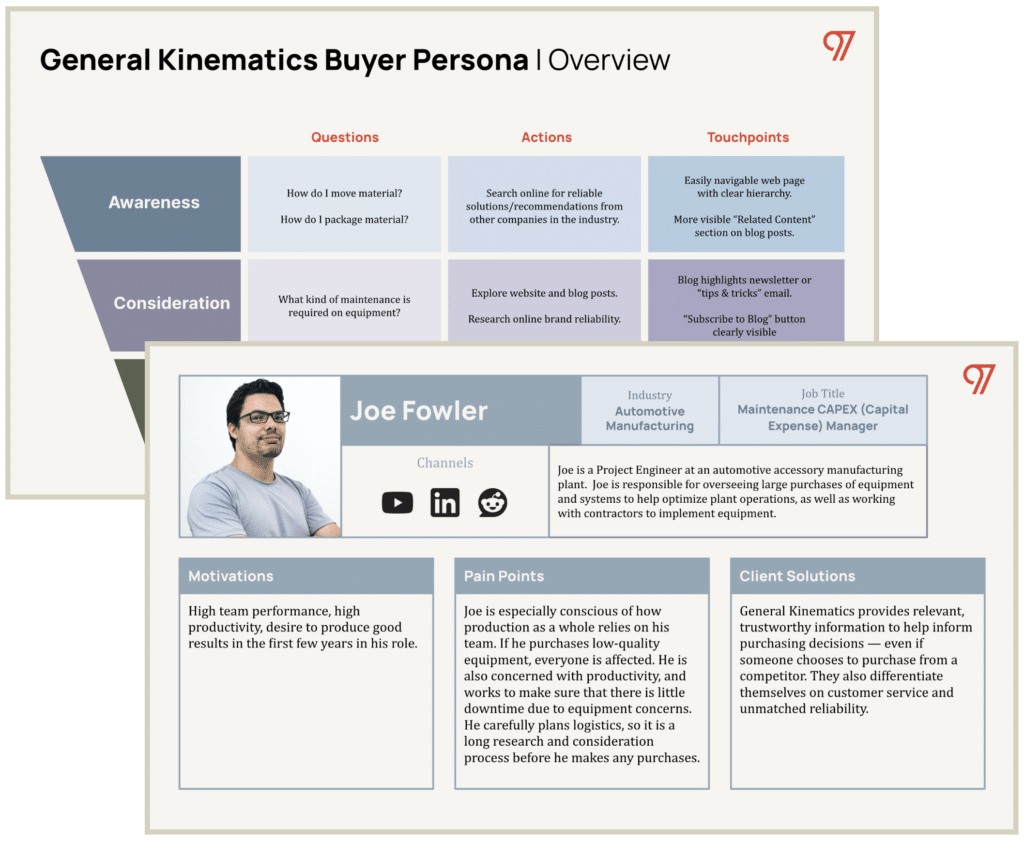
Once you’ve identified and worked to understand your audience, create a persona to represent your research. A clear, thought-out buyer persona will guide all your subsequent marketing efforts. Keep your persona in mind as you plan strategies and build campaigns. The more personalized and specific you are, the more likely your messaging will resonate with potential buyers. Here's an example Buyer Journey/Persona our team at 97th Floor recently created for General Kinematics.
Your brand identity is what sets you apart. Think it through – what makes you different from other businesses in the industry? What are your specialized offering points? Focus on what makes your company unique, whether it's innovative technology, exceptional service, or a strong commitment to sustainability. If you’re looking for a place to start, begin by collecting reviews or interviewing previous customers for their opinions on what you do best.
With your identity in mind, work to position your brand in a way that highlights these strengths to appeal to your target audience. Clear, consistent messaging across all marketing channels is key. To pinpoint what messaging resonates best, you can give A/B testing a shot. Most importantly, always look for new opportunities to demonstrate your value through every medium. Case studies, visual data representations, and customer reviews are common ways to do this.
The battle’s not won yet, sustaining your hard-earned digital clout isn’t an easy process. Building a strong brand reputation takes time and effort. Maintain transparency, deliver on promises, and engage with your audience consistently to keep your brand's reputation positive. This needs to be an integral part of your marketing efforts.
Developing a Comprehensive Marketing Strategy
Supported by your clear brand identity and ideal customer targeting, it’s time to build out a digital marketing strategy. First, define clear, achievable marketing objectives. Whether it's increasing brand awareness, generating leads, or boosting sales, having specific goals helps measure success. Keep track of your goals and efforts to achieve them to celebrate success and identify opportunities for improvement.
A well-developed marketing strategy, especially in Oil and Gas, involves sub-strategies including
Marketers across the field agree, almost every part of digital marketing revolves around a well-optimized website. It's no different in Oil and Gas, your website is your digital storefront – the place all potential customers will navigate to on their path toward a purchase. It needs to be user-friendly, informative, and most of all, optimized for search engines to attract organic traffic. Use tools like Google Analytics, Search Console, and HubSpot CRM to track visitor behavior and optimize performance. Learn more about SEO strategies here.
Social media platforms offer a space to connect with your audience, share industry insights, and showcase your company’s culture. Regular, engaging content helps build a loyal following. Depending on your business, goals, and strategies, social media may or may not be a place to focus your budget and time.
Quality content drives traffic and builds trust. Create valuable content that addresses your audience's pain points and positions your company as an industry thought leader. Publishing content also drives your SEO. Learn more on how to set up a consistent content strategy here.
Regularly analyze your marketing efforts to measure ROI. Use analytics tools to track performance and adjust strategies as needed for continuous improvement. Keep in mind that metrics like impressions and leads can be a great start, but the end-goal of marketing is to generate conversions. Successful marketers make money. If ROI is stagnant, the marketing strategy is too.
By targeting the right segments, fine-tuning your strategies, and focusing on persona-specific messaging, you can position your brand as a leader in this digitally stagnant market. In Oil and Gas, staying ahead requires a laser focus on your goals and your audience's needs. Find ways to set yourself apart and continuously refine your strategies. With a well-crafted Oil and Gas marketing strategy, you’re ready to take advantage of the market and win contracts like never before. Good luck!
Want to kickstart your marketing dreams? We're here to help.
A recent 97th Floor survey of SEOs revealed that "not enough leadership support" is the biggest challenge SEOs face in getting projects moving. The second biggest obstacle, "not enough budget", is often a bi-product of leadership support.

Getting leadership buy-in on the long game of SEO can be hard - especially when other channels are more quickly proven.
That same tension lives in every long-game strategy, and the challenge of getting buy-in goes beyond presenting better data. Bringing a skeptical team along before results are visible is one of the most underrated leadership skills, and most practitioners figure it out the hard way.
Daniel Nisan, startup founder and operator, shares the specific approach he's used to move teams from doubt to conviction — without waiting for results to do the convincing for him. This short video breaks down how to turn your most skeptical stakeholders into your most committed advocates.
Use these three tips to win the hearts of leadership and sell your SEO strategy.
You’ll be a whole person ahead if you have someone in leadership who believes in the massive potential of SEO. Which decision maker seems the most interested in SEO? Who can be a voice for SEO in decision-making meetings?
Identify this stakeholder and then involve them in your SEO work. Consider pitching this executive first, or otherwise involving them in your strategy development. Communicate with them often and be sincere in your efforts to collaborate with them.
This individual’s enthusiasm for SEO, strengthened by their invested time with you in strategy, can make all the difference in prioritizing SEO projects and getting you budget.
To increase the resources coming towards SEO efforts, you need to create urgency by showing the consequences of neglecting SEO—the opportunity cost.
Tom Capper, Senior Search Scientist at Moz, agrees that "when dealing with larger organizations, it's common practice to spell out and estimate the positive ROI of action. What's less common is to spell out the risks of inaction, but often large, established brands, who have a lot more to lose, find it easier to act on this kind of rationale."

Low priority SEO may not sink your company, but how can you show leadership the lost potential (read: revenue) of failing to start?
We have found that competitive comparison as quantified by market share is one of the most effective ways of demonstrating the opportunity cost of neglecting SEO—market analysis is one of the most important jobs of top-level leadership.
Sam Oh, VP of Marketing at Ahrefs, says, "One of the best ways for SEOs to show value to top-level leadership is through competitive analysis. It’s best when you can show it visually in graphs and then add context to educate leadership about what’s happening and why. It may be obvious that a competitor’s organic traffic is exploding, but help leadership see what tactics and strategies would be in play and how long it realistically takes to see results like this."

You may also want to demonstrate the opportunity cost in terms of savings.
Crystal Carter, Head of SEO Communications at Wix, puts it this way, "Leadership cares about revenue, but they also care about savings. Learning your customer’s journey can reveal content that can save the business time and energy. For example, if you learn that customers often contact customer service with the same question, create content that answers that question. This way, your customer service team is addressing real needs instead of sharing basic information.This saves time and energy, while also increasing value for your users."

SEO is a long game. If you want to minimize the irritating, “are we there yet,” conversations, consider handing leadership a map.
Based on your strategy, identify what immediate wins (or signals) leadership can expect, and how long it will take for SEO efforts to reach the bottom line. Set expectations for reporting frequency and metrics.
Perhaps most important, acknowledge to leadership that SEO is impacted by many things that are not in an SEOs control.
Ancestry’s John Crockett explains, “SEO is measured based on what’s going to work and what’s not going to work. We’re only one part of that. We have to worry about how Google’s going to interpret new initiatives. We also have to worry about what our industry competitors are doing. We have to worry about what our search competitors are doing.”

It is imperative that you clarify the difference between branded and non-branded keywords. Distinguishing between the two will help you explain variation in traffic that is unrelated to your SEO work. Branded keywords are heavily dependent on external factors like PR, TV and advertising. Non-branded keywords are in the scope of SEO, so try to delineate and report the traffic, keywords and revenue for non-branded keywords.
By keeping goals specific, timelines clear, and confidently pitching SEO as an important strategy supported by your SEO stakeholder champion, you can win leadership favor and a signed check for your great work.
For seasonal business owners, demand rises and falls with the changing weather. While seasonality is a unique and perhaps daunting challenge, the predictable rhythm of demand means that those businesses who can sync their marketing with the mandates of sun or snow can have success year-round.
97th Floor is no stranger to seasonal marketing; we’ve executed winning strategies for businesses including pool maintenance, sports equipment, cruise lines, pest control, lawn care, solar, and moving services, just to name a few.
In this article, our resident experts in SEO, content, and advertising share five actionable tips for seasonable business marketers.
Search Engine Optimization (SEO) is a long-term game, and waiting until peak season to focus on it can be a costly mistake. It's essential to begin your SEO efforts well in advance, ideally during the off-season.
Head of SEO Mike Witham says, “You need consistent year round efforts to maintain and improve rankings. If your peak season is in March, you should be ensuring you have solid rankings for core pages by no later than December. Do not start working on it the month before your peak season!”
For businesses serving multiple states or a large region of the country, seasonal demand may be different across these various geographies.
Enterprise advertising specialist Spencer Martin uses Google Keyword Planner to anticipate search volume fluctuations in different areas.
He shares, “We launch campaigns early so that we have 2 to 4 weeks to ramp up and capture the full demand. Campaigns need time to scale and learn, so if we wait until the season starts to launch we lose out on potential profits for our clients.”
While digital marketing is crucial, seasonal businesses can see major wins by looking at more traditional advertising. Enterprise Account Executive Nathan Hooper suggests non-digital forms of advertising, such as mailers or community events to target local audiences. Advertising on community calendar pages or local business directories can put your business in front of potential customers who may be researching local services.
Understanding your buyer and their motives for buying is essential for capturing demand at the right time.
Brandon Smithwrick asks what happens to your marketing instincts when you let AI do all the thinking. He breaks down how cognitive offloading quietly erodes the skills great marketers are actually built on.
Senior Director of Campaigns Jon Hammond shares that his clients in the travel industry refer to December through February as “The Wave.” This three-month period is the biggest sales period for travel as people look forward to summer sun during the cold, dark winter months. His clients maximize their ad budget and run major deals and promotions during this time to capture the demand.
Content Marketing Specialist Kaylee Baker emphasizes the importance of targeting specific demographics, such as 18-30 or 25-40-year-old males, who are the main consumers of seasonal services. Consider the platforms they frequent, such as YouTube, to tailor your marketing efforts accordingly.
When reporting to leadership, especially in industries with high historical seasonality, like cruises, it's essential to use Year-over-Year (YoY) data rather than Month-over-Month (MoM) data. This approach provides a more accurate depiction of progress or decline in traffic or sales over the seasons. By analyzing YoY data, you can better understand trends and make informed decisions to optimize your marketing strategies.
In conclusion, marketing a seasonal business requires careful planning, adaptation, and understanding of your target audience. By implementing these five tips, you can maximize your marketing efforts and capitalize on seasonal fluctuations in demand.
Meta ads win or lose on creative. Your targeting and budget can be flawless, but if the creative falls flat, the campaign fails. Sharpening your ad creative is one of the highest-return moves you can make on Meta. Strong creative catches attention in a crowded feed, tells a story quickly, and drives action. Any brand can apply these practices to improve performance.
At 97th Floor, we build and test Meta ad campaigns that deliver measurable ROI. These are the Meta creative best practices we see work time and again, backed by real examples you can learn from.
Let’s get into it.
Because they compete on design and emotion, luxury brand ads are great examples for creative execution. As a matter of fact, Meta is basically the only place many luxury brands are putting their paid media dollars. A smattering of ad budget goes to display ads or YouTube, but well over 75% of luxury brands' advertising efforts happen on Facebook and Instagram.
We’ve pulled Meta ads from ten luxury home brands to see how they’re pairing copy and imagery to entice their buyers.
Use these ads and our analysis as inspiration for your own Meta ads; there’s lots to think about here.
You’ve got a second—maybe less. That’s how long your ad has to earn a pause in Meta’s feed. One way to stand out is to create depth in your visuals. It makes static imagery feel more alive and immersive, pulling the viewer in instead of letting them breeze past.
Nearly all of Arhaus’ product photography, including the images in these ads, uses light and shadow to create dimension. The effect is that we can’t help but imagine what the rest of the room must look like – what must be causing those shadows – and it’s breathtaking.
The ad copy further transports us; it’s hard not to feel a warm breeze and hear the chatter of friends and neighbors.
With both imagery and copy, Arhaus’ Meta ads have us daydreaming about the possibilities a new outdoor set can introduce.


Busy feeds are packed with loud colors and visual overload. Sometimes, the most effective creative is the quietest. Giving your product room to breathe with negative space draws the eye and signals confidence. It says, “This is the whole story, and it’s worth a look!”
Instead of staging the pieces as in a home, Maiden Home’s elegance and beauty is presented uncluttered and unadorned, inviting audiences to carefully inspect the shapes and colors at play.
In these examples, the chairs are intriguing enough that standing alone is the only way to do them justice. The pieces make us curious, and the simplicity of the ad compels a click.


Authenticity wins attention on Meta, and nothing says real like content from actual customers. Showcasing your product in real homes or hands builds credibility and sparks ideas for viewers imagining the product in their own lives.
Castlery proves their products’ versatility by featuring the homes of real buyers in their ads. By showing actual living rooms of delighted Castlery shoppers, the ads supply both social proof and styling inspiration for a wide range of homeowners and decorators.


Flat visuals blend in and get forgotten. Using layered colors, tactile textures, and bold materials makes your ad feel more dimensional, more physical, and more emotional. In a fast-scroll environment, that emotional hook matters more than polish.
Giorgetti’s ads feature rich colors and a mix of interesting materials. The spaces feel out of a biopic about a brilliant musician or a mysteriously wealthy young person. We’d love to know what the fabric and the walnut talk about; we’d love to pull those pieces right off the screen and into our front room. Girogetti’s photos and copy promise audiences a “unique and personal” experience that immediately feels natural and inviting.


Want instant relevance? Tie your creative to something your audience is already thinking about. Whether it’s a pop culture moment, a viral trend, or an awards show red carpet, aligning your product with the conversation earns quick attention and clicks.
In this Meta ad, Koket highlights the similarities between Lana del Ray’s Met Gala gown and Koket’s side table. The two are remarkably alike! Whether their Met Gala-inspired Meta ad was a stroke of luck or a careful analysis of the evening’s attire, we’ll never know. Is there an audience match here? Do Koket shoppers love Lana? Not so sure. But perhaps Koket’s audience is abuzz about fashion, design, and what the A-listers wear. Not too much of a stretch, is it?

Words shape perception. If your copy says “elegant,” your visuals better deliver on it. Great Meta ads use language that complements the look, feel, and energy of the product being shown, creating a seamless experience between what’s read and what’s seen. The words and images used in Rove Concept’s ads promise what luxury furniture should provide: sophistication – in your home office, on your balcony, and everywhere else.


Product specs are forgettable. Stories stick. When your copy hints at a journey, a person, or a place, your ad becomes more than just a sales pitch. It becomes an invitation into a narrative your audience wants to join, or better yet, buy into.By giving its audience a few examples of what these stories may be and referencing their globally-sourced products, Currey & Company promises eclectic and delightful pieces without all the tariffs and bubble wrapping that accompany a purchase, and without an online cart. The copy here brilliantly matches the unusual pieces shown in the photos, and we imagine most people are interested in a ceramic cow, truly.

Sometimes the best way to sell a product is not to sell it at all, at least not right away. Ads that offer help, tools, or personalized advice can win trust faster than a discount ever could. Especially in cluttered categories, utility becomes a real differentiator.
Lulu and Georgia Meta ads sell furniture by offering free design support. Clever, ehh? Their Meta ads offer custom floor plans and mood boards made by Lulu and Georgia designers, which we’re confident will be full of Lulu and Georgia rugs, end tables, couches, and decorations. The ad copy here could’ve gone a little farther to exaggerate the pain point: trying to curate a beautiful space is a lot of work. Especially if you’re working off of a Pinterest board on which half of the links to that dreamy chandelier or pinstripe curtain set are missing or broken. Lulu and Georgia could ramp up the language around their unique selling point to strengthen these ads, but we applaud the strategy here.


Your audience isn’t just buying a product; they’re solving a personal need. If what you offer can be tailored to fit them perfectly, lead with that. Customization on Meta is an opportunity to show that you really get your customers. Interior Define’s ads invite their audience to take the designer’s seat and build bespoke furniture, choosing from hundreds of materials, features, and finishes. Surprisingly, the ads don’t focus on the boast of owning one-of-a-kind pieces. Instead, their advertisements offer help and a solution for shoppers who feel they’re never satisfied. Interior Define says, “Don’t settle.” Well, except into your custom couch, I suppose.


The right backstory can instantly elevate your product. Whether you’re born from a famous collab, a niche community, or a cultural hotspot, tying your brand to its origin story builds instant trust and makes your product feel more worthwhile.
The Soho Houses are a collection of beautifully designed homes dotted across the globe as safe havens of inspiration for members-only creatives. Soho Home came to life when guests came begging to know where they could purchase the magnificent pieces curated for each unique House.
As a consequence of this opportunistic arrangement, Soho Home pieces seem bespoke and almost necessary for a creative and inspired space. Their pieces are automatically associated with exclusivity, travel, and the arts. We’d mention the Soho Houses in every one of our Meta ads, too.


Meta Creative Testing and Optimization
Creative fatigue means wasted spend. Even the strongest ad will lose its edge if shown too often. Testing your creative isn’t an optional thing; it’s the backbone of sustainable Meta ad performance.
Use A/B testing to compare different visuals, headlines, CTAs, and copy angles. Meta’s built-in tools like Experiments and A/B Tests make it easy to isolate variables and track results. Don’t just test once; keep testing on a rolling basis. The goal is to find what works now, not what worked last quarter.
Tip: Test early and often, but don’t test everything at once. Focus on one change at a time so you know what’s actually making a difference.
No matter how good your strategy is, the wrong creative can tank performance. Here are a few of the most common mistakes we see on Meta:
The simple fix is to think like your audience. Would you stop to read your ad?
At 97th Floor, our advertising specialists are committed to a thorough process of audience research and ad testing. We fine-tune copy, creative, and targeting until everything is just right and our clients are getting the maximum return on investment.
See how an audience-first approach translates to bottom-line results.
Cybersecurity buyers are hard to impress. Ranging from CISOs to security architects, your audience is deeply technical, highly skeptical, and usually immune to generic B2B marketing.
They don’t care about buzzwords or brand storytelling. They do care about substance: what your product actually does, how it solves real security problems, and why they should trust you over a dozen lookalike competitors. Smart, intentional marketing is a must-have skill in the cybersecurity space.
At 97th Floor, we build cybersecurity marketing strategies that reach decision-makers and influence every stakeholder in the buying committee. We’ll break down the best practices we’ve observed, backed by ad examples and persona insights.
Let’s get into it.
Cybersecurity marketing is the specialized practice of promoting cybersecurity products or services to highly technical, security-conscious audiences. It goes beyond traditional B2B marketing by focusing on decision-makers like CISOs, SOC analysts, and IT leadership, all personas who demand depth, clarity, and provable value.
Effective cybersecurity marketing combines SEO, content, advertising, and design to engage buyers throughout a long, complex sales cycle. This involves building credibility, addressing real threats, and positioning your brand as a trusted solution in an oversaturated market.
As you might have experienced, Cybersecurity is a high-stakes environment where mistakes can cost millions (and your audience knows it). The technical acumen of your buyers means any hint of fluff or oversimplification can tank your credibility.
Other challenges include:
To break through, cybersecurity marketing needs to be as intelligent as the people it’s trying to reach. That means aligning every campaign with how your audience thinks, what they’re solving for, and how they evaluate vendors.
Where traditional B2B campaigns can succeed with broad messaging, cybersecurity campaigns must go narrow. They need to:
Bottom line: If your marketing isn’t built for security buyers, it’s not built to perform.
Creating a high-performing cybersecurity marketing strategy means throwing out the one-size-fits-all B2B playbook. We’ve dug through our history as a cybersecurity marketing agency to identify six principles that drive success in cybersecurity marketing, each paired with a unique ad example. Use these tips to help you take your next cybersecurity campaign to a new level.
You’re not marketing to “security teams.” Remember your target, whether it’s marketing to a CISO who oversees a sprawling enterprise, or a SOC Analyst who lives in alerts. Specificity is non-negotiable in cybersecurity marketing, because vague messaging gets ignored.

Darktrace succeeds here by getting specific. Not only are they directly calling out CISOs, but they’re tackling only one facet of security: email. This approach self-eliminates some audiences, but ensures that those who do interact with the ad are likely higher-intent. The headline text could be helped by offering some specifics about what the whitepaper offers, but the ad maintains strong branding and a strong call-to-action.
Brainstorm: What’s the most specific piece of content you can offer to your audience? How can you write ad copy that hits on just one pain point and offers one precise solution?
Cybersecurity buyers are burned out on abstract “platform” talk. What do they actually want? Time back. Fewer compliance headaches. Less operational friction. When your value proposition addresses those second-order benefits, it lands harder.

Identity security company CyberArk’s ad pinpoints a problem experienced by their customers: losing so much time finding the right security solution and dealing with compliance, that important projects get deprioritized. Rather than focusing on CyberArk’s product offerings, the ad leans on a secondary benefit that prospective buyers are eager for. A simple design and minimal colors make the ad visually appealing, and the offering of a personalized audit and compliance call is a strong call-to-action.
Brainstorm: What is the most significant benefit that your solution provides to your audience?
If you’ve been recognized by Gartner or Forrester, or if your solution meets hard-to-hit compliance benchmarks, by all means say it. Security professionals are looking for signs that you actually know what you’re doing. A little proof goes a long way.

Crowdstrike leverages Gartner’s authority in this ad, highlighting their place on Gartner’s Magic Quadrant. Gartner is a trusted source on cybersecurity and IT solutions for CrowdStrike’s audience, and using this report for advertising is a brilliant and low-effort win.
Brainstorm: Have you won any awards or accolades that you can put on an advertisement? What about client testimonials?
Cybersecurity buyers are lifelong learners. They respond to content that teaches them something new, especially when it’s visual, data-driven, and skimmable. If your brand can help them stay sharp, you earn trust and attention.

A10 Networks’ use of data visualization is a great idea. People are more apt to engage with graphs, statistics and data than a chunk of text. This chart invites A10’s audience to see how they stack up against their peers concerning TLS/SSL inspections, and the ad’s call-to-action implies that there is more to learn about how technology leaders consider decryption solutions.
However, this chart isn’t the easiest thing to swallow. This ad would be stronger with just a single metric or with a more simple visual from their data. As is, the ad requires too much of its viewer and, by failing to supply any conclusions about this data, leaves too much ambiguity about where this information puts its audience in relation to A10 Networks.
Brainstorm: What data can you share with your audience that will make them want to learn more about you?
The best cybersecurity brands shape how the industry sees threats. Establishing thought leadership through bold, creative design and clear messaging makes your brand feel indispensable.

Palo Alto Networks’ ad stands out for cohesiveness between copy and design, strengthening the impact of the ad’s message. Pairing the idea of unknown threats with the impression of half-turned blinds evokes that eerie feeling of being watched by something unseen. This strengthens the ad’s promises of protection for “whatever, whenever, wherever.” Palo Alto Networks is positioning itself as an omniscient and omnipresent security solution, putting a certain 2006 babysitter receiving threatening phone calls customers at ease.
Brainstorm: What objects symbolize safety or privacy to your audience? How can you use those objects to create something visually interesting?
Let’s be honest, most cybersecurity ads look like they were built from the same uninspired template. But a little creativity goes a long way—especially when it surprises, entertains, or reframes a threat in a clever way.

All cybersecurity ads pretty much look the same, so we love it when a brand breaks out of the B2B monotony like Carbonite has. The visual analogy is straightforward and intriguing, demanding a pause and inviting a chuckle from its audience. With simple, unique ad creative, Carbonite establishes that its security solutions are so good that its customers can be completely unbothered about threats - even threats as sinister as prowling predators.
Brainstorm: What analogies does your brand or product lend itself to? How can you use that to surprise your audience?
To build a cybersecurity strategy that drives pipeline, you need to know who you’re talking to, what keeps them up at night, and how they influence the buying process. Each persona plays a different role, and each one needs a tailored message.
Below are four common groups we build campaigns around, with tips on how to reach them.
CISOs and Security Leaders
What they care about: Risk reduction, cost justification, strategic alignment
How to market to them: Be brief, credible, and focused on outcomes. CISOs aren’t deep in the weeds—they’re trying to evaluate whether your solution moves the needle on security posture or operational efficiency. Give them high-level proof points, ROI-driven messaging, and third-party validation like analyst reports or compliance frameworks.


Security Practitioners and Implementers
What they care about: Technical specs, real-world application, peer trust
How to market to them: These are the engineers and analysts who will poke holes in your claims. Your marketing needs to speak their language and show technical depth. Use product walkthroughs, architecture diagrams, feature comparisons, and use-case content that demonstrates exactly how your solution works in practice.
IT Decision Makers
What they care about: Integration, scalability, cost, security trade-offs
How to market to them: This group sits at the intersection of IT and security. They want solutions that won’t break their systems or their budget. Emphasize interoperability, performance, and ease of deployment. Case studies and pricing calculators can help them make a confident decision.


Boards and C-Suite
What they care about: Business risk, liability, brand protectionHow to market to them: You're not selling features—you’re selling peace of mind. Frame your messaging around financial impact, regulatory compliance, and business continuity. Use concise, high-trust formats like executive summaries, brief videos, or benchmarking data to support your case.
Marketing in cybersecurity is a high-stakes game. There’s less room for error, more skepticism in the room, and a shorter window to prove your credibility. Here are some do’s and don’ts that help keep cybersecurity campaigns focused, effective, and persona-aligned.
Do speak to specific personas.
Generic messaging gets ignored. Tailor every piece of content, ad, or landing page to one specific role and pain point.
Do lean on data and authority.
Use trusted sources like Gartner reports, industry benchmarks, and analyst quotes to back your claims. Show, don’t tell.
Do invest in content depth.
Your audience can sniff out fluff in a second. Write with substance. Collaborate with your SMEs. Make every piece worth your reader’s time.
Do prioritize technical accuracy.
One wrong detail can undermine the whole campaign. Double-check product specs, terminology, and claims, especially in visual assets.
Do align with the buyer journey.
CISOs don’t click “Buy Now.” Build layered campaigns that nurture interest across awareness, consideration, and validation stages.
Don’t overpromise.
"Total protection" or "unbreakable security" won't land and could backfire. Be confident, but stay grounded in reality.
Don’t assume they’ll connect the dots.
Spell out exactly how your product helps solve a specific problem. Don't rely on vague claims or industry jargon.
Don’t recycle general B2B creative.
Your cybersecurity audience has seen the same ad template 1,000 times. Differentiate with smarter, more persona-aware creative.
Don’t ignore design preferences.
Security audiences favor clarity and simplicity over flash. Avoid overly polished, “marketing-looking” assets that feel insincere.
Don’t skip the proof.
Your audience needs evidence before they trust your brand. If you don’t provide it, they’ll find a competitor who does.
Why Choose 97th Floor as Your Cybersecurity Marketing Partner?
We understand cybersecurity marketing because we’ve done it—successfully—for some of the top names in the industry. If you need to lower your CPA, hit revenue goals, or get in front of the right people, we can help. We build strategies based on research, data, and a deep understanding of how security buyers think. And we always respect your audience’s intelligence, time, and high standards.
Learn more about our cybersecurity marketing services, or get in touch to start your next campaign.
Ready to Grow? Get in touch to see what's possible for your brand.
Cybersecurity solutions buyers are worn out by the constant barrage of stale content flooding their search results, inboxes and social media.
Only brands that are willing to pause the content machine long enough to develop true empathy for their audience will be able to make any progress towards the mecca of trust and authority.
97th Floor believes that Empathy, paired with Innovation and Profitability, produces Great Marketing—marketing that fosters relationships and ultimately sales. We unlock empathy for our client’s customers through an exhaustive process of in-depth persona research and customer journey mapping.
Our customer journey maps reveal the questions, actions and touchpoints of an audience at each stage of the funnel: awareness, consideration and decision. Using these maps as a launching pad for every marketing campaign makes delivering "the right message at the right time" a reality.
The following are real persona customer journey maps created for our clients in and adjacent to the cybersecurity industry. They have been anonymized, but all other information is as-delivered to our clients.
Most buyer personas get built, presented, and shelved. This short video breaks down why — and what the ones that actually drive content decisions look like instead.


At a high level, advertising on Reddit means placing paid, promoted content directly inside Reddit communities, where users are already talking about the topics you care about. Simple enough. The catch is that Reddit does not behave like other ad platforms, and neither do its users.
Reddit is built around communities first, ads second. People come to Reddit to learn, debate, vent, and swap opinions. They are not there to be “marketed to.” That’s why advertising on Reddit works best when it feels like a natural extension of the conversation.
Instead of targeting people based on who they are, Reddit lets you target them based on what they care about. Subreddits act as self-segmented audiences, organized around shared interests, roles, and problems. When your ads align with those conversations, advertising on Reddit can feel surprisingly organic.
This community-first structure is also where the advertising on Reddit pros and cons start to show up. Done right, ads blend in and build trust. Done poorly, they stand out fast, and not in a good way.
Before diving headfirst into advertising on Reddit, it helps to understand what you’re signing up for. Reddit can be incredibly effective. It can also be unforgiving. Sometimes even within the same campaign.
One of the biggest advantages of advertising on Reddit is audience intent. People don’t land in subreddits by accident. They join because they care deeply about a topic, role, or problem. That makes subreddit targeting one of the most powerful tools Reddit offers.
Another major pro is authenticity. When ads are written in a way that respects the community and adds value, Reddit users engage. They comment. They click. They remember the brand. In some cases, they even defend it in the comments, which is about as close to a marketing miracle as it gets.
Costs can also be favorable. Compared to other paid social platforms, advertising on Reddit often comes with lower CPMs, especially for niche or technical audiences. For brands that struggle to reach specific communities elsewhere, Reddit can punch well above its weight.
The same is true for any channel that's been overlooked long enough to forget it exists. Marketer Sterling Snow shares the story of a brand that put $1,000 into a newsletter that had never run a single advertisement — and walked away with hundreds of demo requests. The audience was already gathered. The channel just hadn't been claimed yet. This short video breaks down why the highest-ROI advertising placements are often hiding in exactly the corners no one else has bothered to look.
Now the flip side.
Reddit users are highly skeptical of ads. They can spot generic marketing language instantly, and they are not shy about calling it out. If your ad feels salesy, forced, or out of place, performance drops fast.
Another challenge is creative fit. What works on Facebook or LinkedIn rarely works here. Advertising on Reddit requires more testing, more iteration, and a stronger understanding of how each community communicates.
Finally, Reddit is not a set-it-and-forget-it platform. Successful campaigns require active monitoring, comment management, and optimization. That extra effort is part of the tradeoff.
If you’re hoping for one clean number, I regret to inform you that advertising platforms do not believe in peace. Advertising on Reddit is auction-based, which means costs change based on your targeting, competition, and objective.
Most advertisers report CPMs commonly landing somewhere in the low single digits up to the teens, depending on how broad or narrow your audience is. WordStream puts “typical” CPM ranges around $0.50–$15, while also noting outliers can go much higher for premium placements.
For clicks, many guides and advertiser reports land in a practical CPC range of roughly $0.50–$4, again depending on competition and targeting.
If you’re running video, Reddit also supports CPV (cost per view) pricing models in addition to CPM and CPC.
A few things move the needle fast:
You do not need some mythical five-figure monthly commitment to begin advertising on Reddit. Reddit for Business explicitly notes there’s no minimum spend to get started, and you control budgets at the ad group level with daily or lifetime options. You can start small, learn what works, then scale what earns its keep.
At some point, every marketer asks the same question: How does advertising on Reddit stack up against Facebook or Google? The answer is not “better” or “worse.” It’s different, and those differences matter a lot depending on your goals.
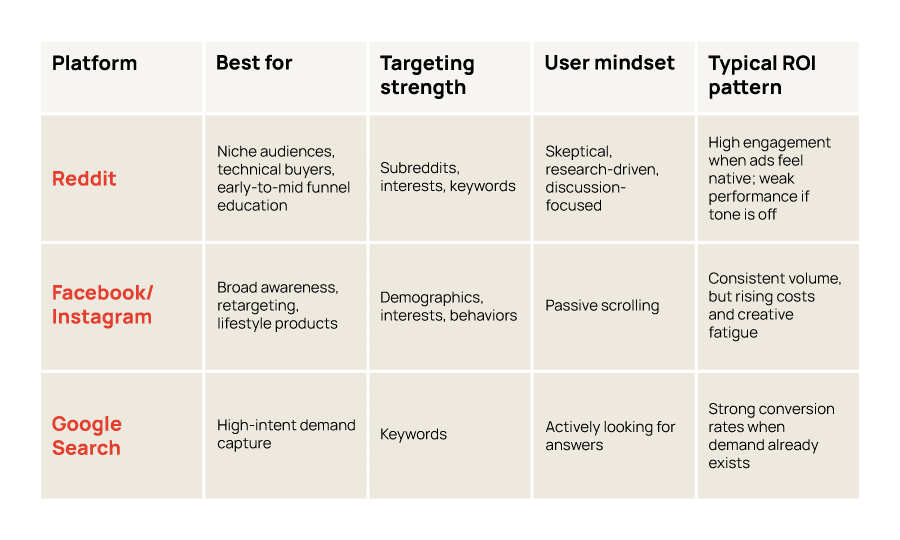
Facebook and Google are built for scale. Reddit is built for relevance. That distinction shows up quickly when you compare targeting, intent, and how audiences respond to ads.
Here’s a side-by-side look at how these platforms typically compare.
Advertising on Reddit works best when you need to reach people who are actively thinking about a problem, but not necessarily ready to buy yet. Subreddits function like built-in focus groups, where users self-select into conversations around their role or challenges.
Compared to Facebook, Reddit has less scale but far more context. Compared to Google, it reaches users earlier in the decision-making process. That makes advertising on Reddit especially useful for complex products, technical audiences, and brands that need to educate before they convert.
Reddit is not ideal for every use case. If you need immediate, high-volume conversions, Google Search wins. If your product relies heavily on impulse buying or visual appeal, Facebook and Instagram might perform better.
Reddit rewards relevance and authenticity. It punishes generic messaging and aggressive sales tactics.
Setting up advertising on Reddit is not complicated. The hard part is everything around the setup. So, we’ve made it easy with this quick guide.
Head to Reddit Ads (aka Reddit for Business) and set up an account. Basic stuff. Billing. Business details. The usual “confirm you are, in fact, a company” deal. Now, on to the good stuff.
Reddit will ask what you’re trying to do. Choose the goal that matches your actual intent, not your wishful thinking.
Common picks:
If you’re brand new to advertising on Reddit, traffic is often the cleanest starting point. It gives you a quick signal without requiring perfect tracking from day one.
This is an important step! It may determine the success of your campaign.
Start with subreddit targeting whenever you can. Pick the communities where your audience already spends time. Then layer in interest or keyword targeting if you need to expand reach or test angles. If you don’t understand a subreddit’s vibe, don’t target it yet. Lurk first, then target.
Reddit uses an auction model, so you’ll set a daily (or lifetime) budget and a bid strategy based on your objective.
Start simple:
This is where people can get impatient, but don’t. Advertising on Reddit rewards steady testing more than constant tinkering.
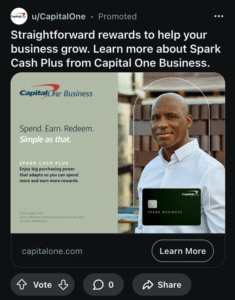
Now the fun part. Reddit users are ad-skeptical and very allergic to buzzwords. Write your ad like you’re joining their existing conversation.
Best practices for Reddit copywriting include:
Step 6: Launch, then monitor comments
Reddit is not a “launch and leave” platform. People may comment on your ads. Sometimes they ask smart questions. Sometimes they roast you. Either way, watching comments gives you copy insights, objection insights and product messaging insights.
Step 7: Test one variable at a time
When you start optimizing, change only one thing per test:
If you change everything at once, you won’t know what actually worked. You’ll just know you “did stuff.”

Advertising on Reddit is not for everyone, but that’s kind of the point.
Reddit rewards curiosity, relevance, and a willingness to actually understand the audience you’re trying to reach. It punishes shortcuts. If you treat it like just another paid social channel, performance will disappoint, and the comments will let you know exactly why.
When brands take the time to learn the platform and present something genuinely useful, advertising on Reddit can be incredibly effective. Especially for niche audiences, when trust really matters. Reddit is not a billboard, it’s a conversation. The brands that win on Reddit are the ones willing to listen before they speak.
If you’re ready to approach advertising on Reddit with strategy, intention, and a healthy respect for the platform, let’s build.
We know your audience. We know their interests and aversions, and we know how to talk to them so that they convert - on Reddit and everywhere else they hang out. Let us take the lead here. We’ve got you. Book a strategy call with us today.
Key Takeaways
A new marketing campaign is any initiative that sits outside of your always-on efforts. Unlike evergreen SEO, paid, or nurture programs, new campaigns are designed with a specific goal and a clear end date in mind.
This might mean spotlighting a product launch, rallying attention around a major industry event, or testing your messaging with a new audience segment. Sometimes it’s driven by leadership priorities, sometimes by seasonal opportunities, and sometimes by curiosity; the “let’s see what happens if we…” moments.
The point is: a new campaign should feel distinct from business as usual. It deserves its own planning, its own creative energy, and its own success criteria. Done well, a new marketing campaign can uncover insights that strengthen your always-on work for the long run.
In this article, we’ll walk through the full lifecycle of a new marketing campaign, from planning to launch to post-mortem, with practical tips you can apply right away. We’ll also share recent campaign wins worth learning from, along with a few cautionary tales of what not to do.
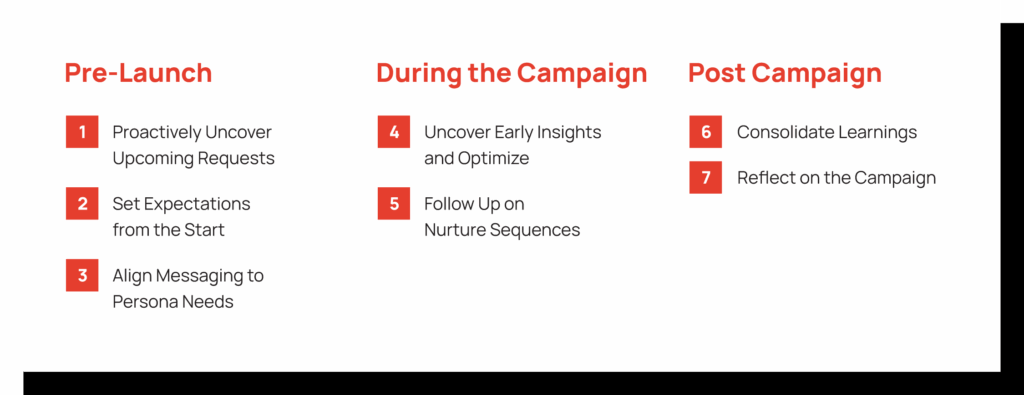
The biggest obstacle with new marketing campaigns is time. Get ahead of the curve by requesting a calendar of upcoming initiatives from key parties. Is your marketing team planning any events? Is the product team preparing for any new launches?
See if you can identify any patterns in past new marketing campaign requests. Do executive teams propose ideas in quarterly business reviews? Or do they follow up the week after the review with an idea that was sparked during the presentation?
Knowing what’s ahead will give you a significant advantage.
Because new marketing campaigns usually have different goals than always-on campaigns, ensure that everyone is on the same page about the campaign. Once a request comes your way, communicate timelines, required information, and what they can expect from you. Be clear about how long the platform will need to optimize the account and exit the learning period before you can report on concrete results.
Here are a few key pieces of information you should have documented in a campaign brief:
Pro tip: Keep your top-performing ads on instead of switching all spend to the new marketing campaign. Dramatically reducing budget or pausing ongoing efforts completely will halt conversions.
Companies often focus on products and features, while customers think in terms of pain points and benefits. Raise concerns early on and push back on messaging that contradicts what you’ve already learned about your audience. Bonus points if you have documented A/B test data that can back up your claims.
Consider workshopping campaign messaging and design concepts with key stakeholders before sending the copy over for final design. There are lots of eyes on the creative for one-off campaigns and you usually need approval for multiple individuals. There’s nothing worse than thinking you’ve wrapped a project up only to have three additional rounds of back-and-forth revisions.
The campaign is launched, but you’re not done yet! Dive into the performance data and see which ad creatives are resonating the best. Pause low-performing ads and make adjustments to improve performance. What learnings can you report on?
When you filled out the new campaign brief, you should have discussed how you were going to follow up with audiences from the one-off campaign. If a retargeting campaign isn’t already in action, it’s time to get that up and running. Don’t let too much time go by between audience interactions with your newly born marketing campaign and the next touchpoint.
After the campaign has ended, debrief and put all of your learnings into a single location for easy reporting and future reference.
A few things to include:
Since another new marketing campaign is likely to come your way again, take time to reflect on the campaign. Is there anything you would do differently? Loop in the person who requested the campaign. Did they get the information they hoped to gain? Were the results what they expected?
Finally, evaluate the overall effectiveness of the campaign. If similar initiatives arise in the future, would you expect them to succeed? Should you push back on this type of campaign moving forward or double down on your efforts?
Try out these seven steps the next time a campaign request comes your way. Instead of rushing to push something out the door, you’ll have a process in place that adds genuine value to your organization.
Every marketer’s been asked for “examples of campaigns that worked.” We won’t be the first to say it; success rarely comes from one magic trick. It comes from understanding your audience, telling a story they actually care about, and being willing to take risks when it counts.
Here are three recent campaigns that got it right, for very different reasons.
When American Eagle tapped Sydney Sweeney for their denim ads, they didn’t play it safe. The campaign headline “Sydney has great jeans” sparked immediate buzz, equal parts clever wordplay and eyebrow-raising innuendo.
Critics weighed in, competitors like Gap and Lucky Brand jumped into the conversation, and suddenly American Eagle was winning attention far outside their usual channels.

Our takeaway: Sometimes controversy is the strategy. But, pulling it off takes confidence in your brand voice, a readiness for backlash, and a clear plan to capture the upside of all that attention.
While most AI brands fight for attention with speed, disruption, and hype, Anthropic zagged. Their “Keep thinking” campaign positioned Claude as thoughtful, safe, and human-aligned.
It was quiet where others were loud, reflective where others were flashy, and it worked. Anthropic found white space between its competitors and used brand values as the creative hook.

Our takeaway: A campaign grounded in authenticity can be more disruptive than the most over-the-top creative. Values resonate, especially when the rest of the industry is running in the opposite direction.
Canva didn’t do a campaign telling people its tools are great to use; it showed them. Their billboard takeover at London’s busiest train station literally demonstrated product features: background removal, drag-and-drop edits, and clean design transformations.
Commuters stopped. Photos spread online. The product explained itself in 20 seconds flat, and people remembered Canva for it.
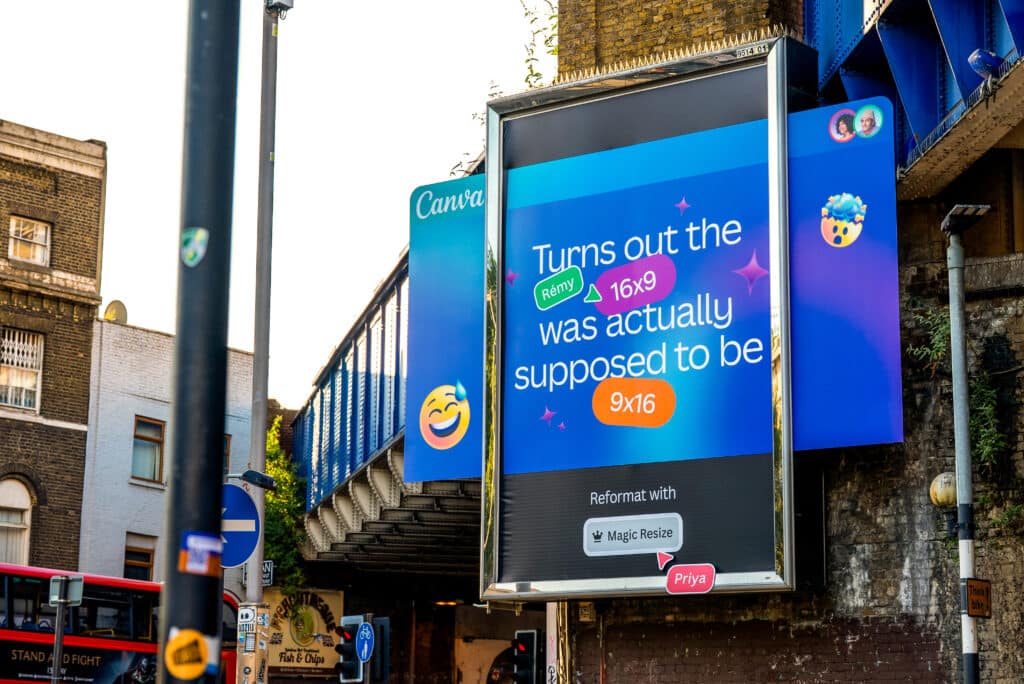
Our takeaway: The best campaigns make the product the star, not by listing features, but by proving value in a way that’s impossible to ignore.
Not every new campaign makes headlines for the right reasons. Some fall flat, some spark backlash, and some quietly get walked back before anyone notices. But even the flops have value. They remind us what not to do and why strategy matters as much as creativity.
Here are two recent examples that prove the point.
Cracker Barrel spent big to modernize its brand, all the way from its logo to the interior of its restaurants. The goal was to broaden appeal and refresh the experience for a new generation of diners.
The problem? Longtime customers didn’t want a new Cracker Barrel. They wanted the one they already loved. By removing nostalgic elements, the rebrand sparked anger among loyalists. Traffic dropped, sentiment soured, and within a month, the company had to backpedal.
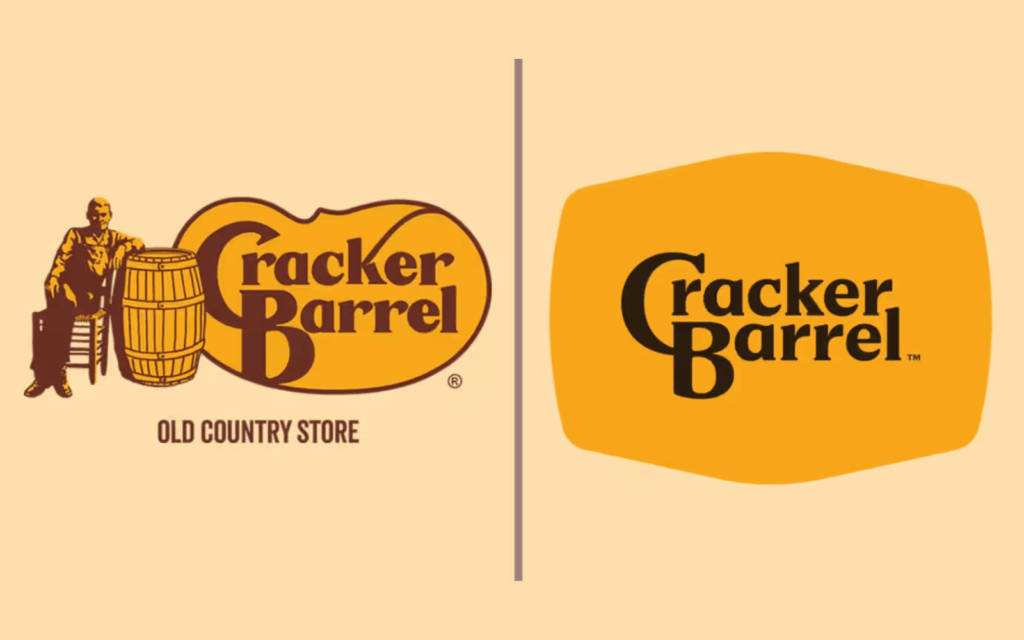
Our takeaway: Brand equity is emotional equity. Before making sweeping changes, test your ideas, phase your rollout, and make sure you’re not alienating the very people who built your business.
Jaguar’s recent push into ultra-luxury electric vehicles was bold. New visuals, a “hot pink” launch campaign, and a decision to discontinue lower-end models made it clear the brand was chasing a different audience.
The reaction was mixed at best. Traditional customers felt alienated, critics mocked the visuals, and even fans admitted the pivot was jarring. Still, Jaguar has doubled down, betting the long-term payoff will outweigh the early backlash.

Our takeaway: Repositioning is sometimes necessary, but it’s a long game. If you’re going to risk alienating part of your base, you need crystal clarity on who you’re speaking to, why it matters, and how you’ll sustain momentum through the pushback.
Launching a new marketing campaign isn’t easy, but it doesn’t have to feel like starting from scratch every time. With the right foundation, clear messaging, smart use of data (and yes, AI), and a commitment to learning from every run, campaigns can do more than hit short-term goals. They can make your always-on marketing stronger, too.
Every campaign, big or small, is an opportunity to sharpen your strategy, experiment with creative, and uncover what your audience responds to. The wins matter. The misses matter too. The real advantage comes from teams who take the time to reflect and apply those lessons to what’s next.
At 97th Floor, we build marketing campaigns that create momentum and generate the results you're looking for. If you're ready to see what Great Marketing can do for your brand, lets build.
The customer should be at the center of every marketer's strategy, but most marketers rely exclusively on quantitative data from the many tools at their disposal. Customer interviews expert, Ryan Paul Gibson, breaks down we need customer interview programs, how to build them, and how to share learnings across our organizations.
Feature Image photo by Markus Spiske on Unsplash.
B2B marketers know the importance of capturing their upper-funnel audience, but foggy attribution and the ease of spending for these non-search ads makes this endeavor feel risky.
To understand how cybersecurity companies are approaching this challenge, we analyzed the upper-funnel advertising strategies of 15 cyber companies.
In our analysis, we’ve identified 4 industry outliers whose distinct upper-funnel ad plays are worth study:

Founded in Romania in 2001, Bitdefender’s now global presence serves small and medium business, mid-market enterprises and consumers. Bitdender is proud of its over 440 patents for core technologies, “including machine-learning algorithms to detect malware and other threats and anomaly-based detection techniques vital to detect and prevent new and unknown threats.” Their guiding mission is to be the most trusted cybersecurity provider.
| Software Development | 1,001-5,000 Employees | $100M-$500M | Founded 2001 |
BitDefender is vastly outspending every other company in our sample, claiming 60% of both spend and impression share over a 12 month period.

They also outpace competitors in number of creatives, totaling 1,112 varieties in 12 months. The runner-up in this category ranks at only 554 unique creatives.

In late September 2022, Bitdefender announced a multi-year partnership with Scuderia Ferrari, the Formula One racing division of Ferrari. Bitdefender’s logo made an appearance on Ferrari cars, helmets, uniforms, and on the SF-23 single-seater days later on October 2nd at the F1 Singapore Airlines Singapore Grand Prix.
While the relationship may seem shallow at first, Co-founder and CEO of Bitdefneder Florin Talpes makes a clear connection between the two industries:
“When every second counts, only the most advanced cars win races on the track, and only the most advanced technology has the power to effectively prevent, defend and respond to cyberattacks."
By partnering with the powerhouse of racing, Bitdefender earns coverage and status as a powerhouse in cybersecurity.

FireEye - now Trellix - was founded in 2004 and quickly earned a reputation uncovering high-profile hacking groups. The company notably participated in taking down Ozdok, a botnet that at its strength accounted for 32% of spam worldwide; detected previously unknown vulnerabilities in Microsoft products; and traced nearly 50% of all 2022 state-sponsored hacking campaigns to China and Russia.
| Computer and Network Security | 1,001-5,000 Employees | $500M-$1B | Founded 2004 |
Trellix boasts the most diverse allocation of budget to different platforms and devices.
While most cyber companies heavily prioritize desktop display advertising, Trellix targets users via Facebook, Instagram, Twitter, YouTube, OTT, Desktop Video, Mobile Video, Desktop Display and Mobile Display.


Trellix also claims the largest OTT spend in our sample at 10% of their budget. We applaud this strategy, as our own strategic OTT spend for cyber clients has paid off big time.

One of Trellix’s top creatives is a video advertisement showing how shockingly calm a security operations team can be when relying on Trellix.
This footage also happens to resemble the internal marketing teams for those brands trusting 97th Floor with their ad spend… just a coincidence, then!

Cybereason is an endpoint protection platform. Their company page describes them as a “new kind of cyber security company -- one that delivers future-ready attack protection that ends cyber attacks on the endpoint, across the enterprise to everywhere the battle is being waged.”
| Computer and Network Security | 1,001-5,000 Employees | $20M-$50M | Founded 2012 |
Cybereason is the only company in our sample whose impression volume outpaces their spend. However, there is a simple explanation for this: 99% of Cybereason’s non-search ad spend is devoted to Desktop Display ads. Display ads always guarantee high impressions, but is this the best way for Cybereason to be spending their budget?
One possible interpretation of this strategy is that Cybereason is playing by the 95-5 rule. The rule supposes that at any given time, only 5% of buyers are in the market and looking to buy. Conversely, 95% of buyers are not looking to buy. However, buyers hold strong biases for companies they already know when preparing to make a purchase decision. Investing in the 95% of out-of-market “future buyers” with brand awareness advertising can yield large dividends down the road as the 95% eventually rotates into the buying stage.

Since its founding in 2012, an owl has been the center of Cybereason’s brand identity. When Cybereason began a rebranding process in 2020, conversations with stakeholders revealed that the owl would stay.
Chief Marketing Officer Meg O’Leary says, “The reality was that our customers and partners not only liked the owl as a part of our visual identity. They felt it reflected their own identity as cyber defenders. They too must be wise thinkers and shrewd hunters who adapt as they go, cutting through darkness and complexity to zero in on and neutralize their targets. The owl symbolized the best in all of us as defenders.”
Cybereason’s owl appears on all the creatives we pulled, featured on a black background to remind audiences that both owls and Cybereason see in darkness to detect and destroy threats. The ‘E’ in End found in the design seems to mimic an owl’s three talons slicing through enemies.
In 2020, the rebrand introduced the League of Defenders - a group of owls with distinct looks and abilities to encompass all of Cybereason’s abilities and services. You can meet the League here.
Cybereason stands out from competitors as a brand with strong visual identity, creating a mascot for the cybersecurity industry.
Founded in 1997 by Steven Thomas and his girlfriend Kristen Tally, Webroot’s first commercial product was a trace removal agent called Webroot Window Washer. Today, Webroot “secures businesses and individuals worldwide with threat intelligence and protection for endpoints and networks.”
| Computer and Network Security | 500-1,000 Employees | $100M-$500M | Founded 1997 |
In a drastic departure from the norm, Webroot spends a massive 88% of their budget on Meta. Perhaps they’ve got on that both B2B and B2C customers are real people who sometimes just love to scroll.

Campaign Highlight: Live a Better Digital Life with Webroot
Leaning heavily towards its consumer audience, Webroot's recent video ads focus on how Webroot protects everyday people from digital dangers like viruses and identity theft. The videos feel honest and relatable; one video features a mother whose daughter has just enabled a virus on their brand new computer. The scene is strewn with toys and other markings of a busy home. Each video is filmed in a set made mostly of Webroot's signature green, and a short jingle sums up the spot: "Live a better digital life with Webroot."
At 97th Floor, we're big believers that Extraordinary Marketing requires three things: deep audience understanding, bottom-line focus, and courageous disruption. Our analysis of these four bold cyber companies leaves us here:
Cybersecurity is a deeply competitive and complex industry for marketers. In this short webinar, we discuss some of the essential ways marketing leaders should approach their growth.
