



There seems to be a pattern in the SEO industry of jumping on new tactics before there's enough evidence to prove those tactics have a clear impact. It's understandable. We need to move fast to generate results quickly. But if you don't take a step back and question tactics, you'll end up wasting time without the results to show for it.
With SEOs being the early owners of AI Search, similar bandwagon patterns have started to show up. Schema has been the biggest hot button of these. Some SEOs call it the foundation of how AI understands your brand. Others say LLMs strip it out and ignore it. And files like llms.txt and markdown versions of pages have only added to the noise.
So at BrightonSEO in San Diego, we asked four experts the same question: how effective are schema, llms.txt, markdown files and other machine-readable formats for AI search, really?
We got four different answers, ranging from "zero impact" to "this is your knowledge graph AI uses to understand your brand." The disagreement is actually surprisingly useful when we break it down. Each expert is looking at a different part of the problem, and together they point to a clear strategy, rather than the confusion it may seem on the surface.
| Expert | Position | In one line |
| Thomas Peham, CEO & Co-Founder, OtterlyAI | Doesn't work for AI citations | In OtterlyAI's tests, schema had zero impact on citations in ChatGPT and Gemini. |
| Chris Long, Co-Founder, Nectiv | Not game-breaking, but do it | Schema's value for LLMs is unproven, but it's cheap, and early adopters win if agents adopt llms.txt. |
| Chima Mmeje, Senior Content Marketing Manager, Moz | Schema yes, llms.txt no | Schema is important; llms.txt won't make the difference people claim. |
| Martha van Berkel, CEO & Co-Founder, Schema App | Essential, if you rethink it | Schema isn't a rich-result checklist. It's the knowledge graph AI uses to understand your brand. |
Thomas Peham, CEO of AI visibility platform OtterlyAI, gave the most stark answer (watch Thomas's clip). He separates Google from AI chatbots:
"Schema markup's super important for Google, right? … Not so much on ChatGPT."
OtterlyAI tested it. In Thomas's words, schema markup had "zero, literally zero impact" on citation visibility in ChatGPT, Gemini and other AI search engines in their experiments.
Thomas also predicts that within a year, AI Mode will be the default interface on Google.com and SEO and GEO will merge. If that's right, schema's Google value and its AI value may stop being separate questions.
Chris Long, co-founder of Nectiv, lands in the middle (watch Chris's clip):
"I don't think any of them are game-breaking, honestly."
On schema, he notes the research is split. Some studies show it helps and some don't. His lean is that it probably doesn't help much with LLMs, because they tend to strip markup out when they read a page.
But his advice is still to implement it with how much of a low lift it is. Schema, llms.txt and markdown files "take no time to implement," and schema is good technical practice anyway. If AI agents ever adopt llms.txt, early adopters will have one less thing to build. In other words, it's low cost with real upside.
Chima Mmeje, senior content marketing manager at Moz, splits the question in two (watch Chima's clip). She cited a talk from Moz's event in New York, where a speaker from Meta, quoting someone at Google, said Google isn't using llms.txt when it evaluates website content.
Her verdict:
"Schema is important, don't get me wrong, but llms.txt is not."
She isn't against llms.txt. "Do it, cool," she says. Just don't expect it to deliver the difference people have been promising. There's a lot more you can do to optimize content for AI search that has nothing to do with an llms.txt file.
This matches what our team found in Why llms.txt isn't a magic bullet for AI (but you should probably have one anyway).
Martha van Berkel, CEO of Schema App, does schema markup "all day every day," so her answer isn't a surprise. Her reasoning is the most useful part (watch Martha's clip).
She argues most SEOs still think of schema as a checklist item to win rich results. That misses the point. Schema is how you are
"connecting the dots across every single thing on your website."
Call it entities, business concepts, a semantic data layer or a context layer: it's the data that helps AI make the right inferences about your brand. Schema App works with more than 100 enterprises, including Wells Fargo, and Martha says they're seeing results in both visibility and conversion rates.
Her challenge to SEOs is to "think like a data architect." Adding markup to a page is easy. Building a real ontology or enterprise knowledge graph is harder and takes more time and effort, but it's where the value is. She points to research from data.world finding LLMs are far more accurate when they work from a knowledge graph. Schema App's free "Schema Markup 101" training is a good place to start getting familiarized with how a knowledge graph might work best for your site!
She also looks further ahead, predicting AI agents will start acting on sites, booking appointments and filling out forms, and agents will need data they can trust (watch).
We went deeper on this in Alyssa Felix's Entity mapping and knowledge graphs: the context layer we all need, which features Martha's thinking.
The four answers disagree less than they seem to. Thomas and Chris are measuring whether schema directly raises citations in chatbots today. Martha is describing how structured data helps AI understand who you are. Both can be true. Here's how we advise clients at 97th Floor:
Ask four AI search experts whether schema matters and you'll get four answers. That isn't confusion, though. It shows that schema does a different job than many SEOs expect. It probably won't push you into a ChatGPT answer on its own. It will help machines understand your brand clearly and consistently, and that matters more as AI starts acting on websites, not just reading them.
So implement schema, skip the silver-bullet thinking, and put your real energy into the content, structure and off-site signals AI actually cites.
Want more takeaways from the conference? Read Mike Witham's 45/40/15: What BrightonSEO San Diego taught me about where SEO is headed.
Not sure how AI sees your brand? Let's talk.
If you were given the opportunity to witness a Ferrari being made, given an inside look into making one of the most amazing machines on earth. And then after you got this inside look at how this incredible work of craftsmanship was made, and you then were able to speak at a conference for car mechanics and Ferrari enthusiasts, what would you talk about? You could talk about the hand stitched italian leather, the near perfectly tuned v-12 engine that produces 800+ horsepower, or the aerodynamic design that beautifully mixes engineering and style. There are a lot of factors that make a Ferrari, well a Ferrari. And when you could talk about any of them, would you choose to talk about the sourcing of materials?
I recently attended BrightonSEO, where we heard from an ex-Sr. Google Engineer named Fili Wiese, who, while at Google, worked on the documentation for manual action penalties. Which means, Fili could have talked about anything related to SEO, but he chose to talk about a subject that, in my opinion, is carried over and will be carried over as a top ranking factor for all of Google's existence: The ability for Google’s bots to crawl, fetch and index content from a site efficiently.
At first glance, that sounds like the least exciting topic he could have picked. It's like passing over the V-12 to talk about where the aluminum comes from. But that's exactly the point. Ferrari can stitch the finest leather and tune the engine to perfection, and none of it matters if the materials going into the car are flawed. In SEO, your content, your links and your on-page work are the leather and the engine. Crawling and indexing are the materials. If Google can't reliably reach your pages, read them and store them, nothing else you've done gets a chance to count.
Fili's session was centered on HTTP responses, the status of a page your server sends back every time Googlebot requests a URL. Most of us only look at these when something breaks: a 404 here, a redirect there. His point was that Googlebot reads every one of them and adjusts its behavior based on what status is returned. Your server is constantly telling Google which pages exist, which have moved, which haven't changed and whether the site can handle more requests. When those messages are wrong, Google acts on the wrong information.
A few common examples:
Google will not spend unlimited time and resources crawling your site and making sure it catches ever page. So it is important to take advantage of every crawl request received from Google and make sure that the Googlebot is seeing only the most important content on the site. Every ranking depends on Google having a current, accurate copy of your page. A product page recrawled two weeks after a price change, a new article that sits undiscovered for days, or a page that keeps dropping out because of intermittent server errors will all lose to competitors whose sites are easier to crawl. That's why I'd argue crawl efficiency has been a top ranking factor from the beginning and will stay one. The algorithms on top keep changing. The need to fetch and index the page first does not, and the same is true for the AI crawlers now feeding AEO strategies.
Fili's advice for finding these problems came down to two sources: Google Search Console and your server logs.
In Search Console, the Crawl Stats report (under Settings) breaks Googlebot's requests down by response code, file type and purpose, and flags host problems like robots.txt fetch failures and server connectivity errors. A growing share of 5xx or redirect responses, or a sudden drop in total crawl requests, is worth digging into. The Page Indexing report then shows which URLs Google crawled but chose not to index, and why.
Server logs show what Googlebot actually requested, not what you assume it requested. Running them through a tool like Screaming Frog's Log File Analyser shows which sections get crawled most, how often key pages are revisited, and where Googlebot is spending requests on parameter URLs, redirects or error pages. Comparing that log data against a regular site crawl is usually where the surprises turn up: important pages Googlebot rarely visits, and low-value URLs it hits constantly.
Nobody buys a Ferrari for the quality of its raw materials, but every part of the car depends on them. I often say that you could have the best content in the world, but if Google can’t see it,that content will never be shown in search results, and the chances of the intended user finding it are very low. Your site works the same way. Content, links and brand get the attention, and they should. Underneath all of it is the question Fili spent his whole session on: when Googlebot asks your server for a page, does it get a clear, honest and fast answer? Get that right, and everything else you build has a chance to perform. Get it wrong, and you're fitting hand-stitched leather onto a car with a cracked frame.
97th Floor CEO, Paxton Gray, and WordPress VIP CMO, Jodi Cerretani, teamed up on a three-part webinar series about AI discoverability. The second session covers how to turn your baseline into a strategy AI can understand and recommend.
Knowing how AI sees your brand is step one. Changing what it sees is step two. That's where most brands stall.
The goal is to show up in front of the right people, saying the right things, in a way that grows your bottom line. Paxton called that "the real trick these days." He breaks the work into four parts: brand, architecture, content, and third-party validation.
Benchmark how AI sees your brand, build a strategy to strengthen it, and measure the impact.
Jodi explains the technical basics with a library. Information architecture is the floor plan. It shows where everything lives. Structured content is the label on each book. It says what each page is. Governance is the librarian who keeps it all accurate over time.
Most content systems were built before AI search. Her three fixes:
If your website software can't do this automatically, "you might be in trouble."
As Jodi put it, "being readable isn't the same thing as being recommended." That's the job of content.
SEO meant getting one pillar page to rank. Paxton explained that "AI is much more holistic and it should be focused on topics and establishing authority around certain topics."
The biggest mistake he sees is treating prompts like keywords. Prompts are longer and more detailed, and AI runs several searches off each one. He calls this the query fan-out. "The key is answering these secondary questions through multiple pieces of content on our site, not simply on the single page."
That starts with audience research. Scour Reddit for the words and problems your audience shares. Map your personas, their pain points, and the questions they ask. Then build a pillar page with focused supporting pages around it.
Enterprise brands carry decades of content. Much of it mentions products they no longer sell or positioning they've moved past.
Paxton's team runs clients through a content analysis matrix: Is the page pulling traffic? How does it perform? Does it align with the business? A page can perform well and still point the wrong way. "That page should not exist and it is steering AI in the wrong direction."
He shared the example of a cruise line client that wanted to own Alaska. His team cut irrelevant content, then built focused pages on ports, wildlife, excursions, and timing, all mapped to the customer journey. Now, "They're the most cited cruise line in the world for anything related to Alaskan cruises."
Paxton was clear that "Your site is one of the biggest factors that AI uses to determine who you are and when they should bring you up." But AI learns from the rest of the web too.
A brand sentiment analysis shows what AI thinks about you and where it learned it. Key sources vary by industry. For one client, Jazz HR was the third most cited site in its space. Enterprise brands also have partner marketplaces, which AI search currently treats as third-party validation.
Reflecting on his point about pruning, Jodi added, "more is not more when it comes to content. It's about clarity."
Jodi splits the work into two buckets.
Quick wins: fix wrong tags on key pages, unblock AI crawlers locked out by accident, patch sitemap holes, and clean up conflicting messaging.
Foundational work: rebuild your tagging system, make sure your site technology automates what it should, build authority on your core topic, and write real governance rules.
Marketing, content, SEO, web, engineering, security, and governance all play a part. What's usually missing, Jodi said, is one directly responsible individual to quarterback the work. A live poll showed just 5% of attendees had a clear owner in place.
The pressure is coming from the top. Boards see organic traffic falling, and their message to CMOs is simple: "You got to win your traffic back."
Paxton sees measurement as the industry's biggest bottleneck. "It's one thing to know that you need to do something and it's another thing to know whether or not what you're doing is having an impact."
Jodi closed with the core idea. Strong infrastructure without content makes you readable but not recommended. Strong content without infrastructure is "a great story that no machine can read."
You need both to get cited and recommended. Watch the full recording now.
At BrightonSEO San Diego, our team asked some of the sharpest people in AI Search a simple question: what's YOUR biggest unanswered question about AI search right now?
We expected a spread of answers: agents, Google's next move, the future of the website. What we got was a pattern that was so stark it even felt repetitive by the day's end. Five of the eight leaders who answered said some version of the same thing: we still can't measure this well.
Some framed it as a prompt tracking problem. Nobody knows what people actually type into ChatGPT, Gemini or AI Mode, so nobody fully trusts the visibility scores built on top of those prompts. Others framed it as an attribution problem. Even when you show up in an AI answer, connecting that to pipeline and revenue is murky.
That matters, because measurement is what earns a budget and internal support. If you can't show what AI search is doing for the business, you'll struggle to keep investing in it. Here's what we heard, who said it, and what we think you should measure instead.
Benchmark how AI sees your brand, build a strategy to strengthen it, and measure the impact.
I specifically interviewed the folks that I felt have been leading the AI Search conversation online, as well as the companies that have been diving in and experimenting the most. We do this often with our guests on our podcast, The Campaign. Kevin Indig came on with us and expressed a lot of the same concerns we heard at Brighton. Here was the lay of the land of folks responses to what is still unanswered for them in AI Search:
| Expert | Role | Their Unanswered Question |
| Brooke Weller | AI Search Expert, LinkedIn | Can anyone accurately track prompts? |
| Chris Long | Co-Founder, Nectiv | What are people actually typing into AI search? |
| Ken Marshall | Co-Founder, Meet Sona | How do prompt-tracking tools build their data? |
| Lucy Hoyle | First Content Engineer, Carta | How do we tie AI visibility to revenue? |
| Nick Lafferty | Founding Marketing Engineer, Profound | How do we attribute AI-driven demand, and how does the organic listing interplay with ChatGPT ads? |
| Martha van Berkel | CEO & Co-Founder, Schema App | What happens to the role of the website in the future? |
| Skyler Rudolfsky | GTM, Semrush | How will AI platforms monetize in the future? |
| Thomas Peham | CEO & Co-Founder, OtterlyAI | Why do citation sources suddenly shift? |
Chris Donnelly, CEO and Co-Founder of Searchable, mentioned the Prompt Universe, Searchable’s new product offering, as a way to answer the questions of, “What prompts am I tracking? Are they the right prompts? Am I tracking enough prompts?” While Searchable, Profound, and Scrunch are growing tools, trust across the board of their validity doesn’t seem to be strong in the SEO community.
Problem 1: People aren’t trusting prompt tracking just yet, so stick to knowing your audience
In traditional search, Google Search Console tells you which queries you showed up for. AI Search has no equivalent. That gap is what most of our experts are stuck on.
Chris Long, co-founder of Nectiv, put it plainly (watch Chris's clip):
"No one knows the prompts people are putting into AI search systems."
He isn't optimistic it gets solved soon. Every tool has its own method for building prompt sets, and none of the major AI platforms share real query data. Unless a data provider opens it up, he doubts there will ever be a great answer.
Brooke Weller, who leads AI search at LinkedIn, sees the same thing from inside a major brand (watch Brooke's clip):
"I don't think anyone can accurately track prompts."
Even at LinkedIn, she reports an AI search visibility score she isn't sure is accurate. She also points out that AI conversations are personal and long-running. She has threads that go on for months, so no single "first prompt" captures how people actually reach a brand.
Ken Marshall, co-founder of Meet Sona, wants more transparency from the tools themselves (watch Ken's clip). Many visibility platforms don't publish how they choose prompts or model personas.
This is a human element of search that still has to be in place from human marketers in order for a brand to achieve visibility and recognition. Alyssa Felix, one of our senior search marketers, put it plainly, “The best prompt research tool is still talking to your customers, reading their questions, and paying attention to what they actually say.”
The second half of the problem starts after a brand shows up in an AI answer. What did that appearance actually do for the business?
Lucy Hoyle, founding content engineer at Carta, named the pressure many marketers feel (watch Lucy and Nick's clip):
"Attribution is still really difficult. Visibility is one piece and it's very top of funnel, but how does that then track to engagement, revenue?"
Marketing teams are being asked to generate pipeline and prove ROI, and AI visibility on its own doesn't do that.
Nick Lafferty, founding marketing engineer at Profound, shared one low-tech fix that works. Profound's contact form forces every lead to write, in an open text field, how they heard about the company before being able to navigate further. Self-reported attribution catches the AI answers and conversations that tracking can’t uncover. Nick pointed out that this kind of first-party signal "will become really foundational" for brands if they do want to have somewhat of an answer for attribution as it gets messier and messier.
This matched what our own Alyssa Felix heard at the BrightonSEO AEO/GEO roundtable. For in-house teams, she said, "the big question right now is reporting and attribution": proving organic still works, and proving the team behind it still matters. The buzz phase of AI Search is over. Executives know it’s important, but HOW important is starting to be questioned and the level of investment will be determined by how much attribution can be shown.
Rosy Callejas, who works on enterprise SEO and AI search at Microsoft, offered the practical takeaway in approaching executives about AI Search now. (watch Rosy's clip). To win trust from leadership, bring "ANY data to show them," because "we're all data driven at this point." Something is better than nothing!
The three experts who didn't name measurement still raised questions worth tracking:
Even these answers come back to measurement. If citation sources can swing overnight, you need reporting that catches the swing and shows what it cost.
Perfect prompt data may never arrive. That's no reason to fly blind. Here's the approach we use with clients at 97th Floor:
AI search isn't missing strategies. It's missing a scoreboard. The experts we talked to at BrightonSEO know how to earn visibility in ChatGPT, Gemini and AI Mode. What they can't do yet is say, with confidence, which prompts drove it and what it was worth.
Until the platforms open up their data, the teams that win will be the ones that combine imperfect signals: first-party platform data, citation tracking, self-reported attribution and pipeline. Then they bring those numbers to leadership before anyone asks.
For more from the conference, read Mike Witham's 45/40/15: What BrightonSEO San Diego taught me about where SEO is headed.
Ready to prove what AI search is doing for your business? Let's talk.
97th Floor CEO, Paxton Gray, teamed up with WordPress VIP CMO, Jodi Cerretani, on a three-part webinar series about AI discoverability. The first session covers how AI sees your brand, where visibility gaps show up, and five asks to help your team set a baseline.
Search has changed more in the last two years than in the previous twenty. Paxton put it plainly: "there's not been a bigger update than what's happened with AI search." The goal used to be ranking in a list of links. Now the goal is to get recommended.
Buyers have already moved. According to G2, half of all B2B buyers start their research in AI chat. Two-thirds say AI changed their buying decision, and 80% say it made that decision faster.
If AI is shaping the shortlist, you need to know what it says about you.
Benchmark how AI sees your brand, build a strategy to strengthen it, and measure the impact.
Paxton starts every AI search strategy with a baseline. "It's really hard to know what to do unless you know where you are."
He shared the example of a client in venue management software. They were a major player that wanted to move down market and win smaller venues. AI saw them differently. It called them the IBM of venue management software: well established, but clunky, hard to use, and not built for small venues.
That was the opposite of where they wanted to go. It was also a clear starting point. Find the gap first. Then build the strategy.
Jodi calls it the total information environment. AI doesn't just read your current site. It reads the 2019 microsite that's still up, legacy subdomains nobody sunset, outdated product PDFs, press coverage, and Reddit threads.
Her team evaluated one brand across six of its sites. AI comprehension ranged from 88% down to 59%. AI averages everything it finds, and as she put it, "an averaged brand is a diluted brand."
Ask #1: Inventory every property. Make sure every domain, subdomain, microsite, and PDF tells the same current story.
AI crawlers are fast but literal readers. "It does not care about your beautiful design. It reads structure," Jodi said. That means clear headings, semantic HTML, and schema.
In one WordPress VIP assessment, a brand had 16 product pages with no markup at all. They looked great to humans and were hard for models to decipher. Your website now has two audiences, and both need to understand it.
Ask #2: Get a structural audit. One H1 per page, a clean hierarchy, and schema on every page. It's back-end work, but it doubles as an accessibility win.
For one pharmaceutical customer, WordPress VIP analyzed 28 million requests of server traffic. AI crawlers saw just 2% of what humans saw, and only 0.7% on product pages. One set of pages drew 233 human visits and six from AI crawlers. "That's not 6%, that's six crawlers."
The fix was simple. The pages weren't on the sitemap, and their content was locked in JavaScript, which shows up as empty boxes to most crawlers. Content can be live, on brand, and well written, and still be invisible to AI.
Ask #3: Audit your sitemap and add text fallbacks behind every JavaScript component.
Once AI can read your site, the question becomes what your content says.
Traditional SEO starts with keywords. AI search starts with prompts, which create a long tail of specific questions. AI often runs several searches off one prompt. Paxton explained what that means: "the more you can answer all of those secondary query fan-outs, the more likely you are to show up in AI search."
That puts customer research at the center of content strategy. Be clear on who you're for, when your solution fits, and what questions your audience asks.
Paxton tracks four areas: AI referral traffic, brand mentions, citations, and competitive comparison. He stressed that last one: "It's not enough to just look at these metrics in a silo."
Mentions, citations, and share of voice are leading indicators. The lagging indicators follow: more branded search, more direct traffic, and faster conversions. Buyers now do their research inside AI, so "they're coming ready to buy."
Most analytics run on JavaScript, and AI crawlers don't execute it. That means one of the fastest-growing readers of your site is invisible to your dashboards. Jodi was direct: "There's really one source of truth, and that's in your server logs."
One global enterprise had a compliance plugin rejecting about 15% of all ChatGPT requests, roughly 68,000 in the period measured. WordPress VIP even found its own server layer was blocking one of Anthropic's crawlers.
Ask #4: Ask your team one question. "Show me AI crawler traffic in our server logs."
Echoing a point Paxton has made before, Jodi warned that AI models are "very impatient and has huge recency bias." Stale content falls out of answers fast. Baseline, fix, retest, and report on a regular cycle. WordPress VIP does it about every 90 days.
The work is spread across developers, security, WebOps, and brand. No one owns it by default.
Ask #5: Name an owner with the authority to pull those teams together.
Paxton sees a familiar pattern. SEO demand used to start when the CEO Googled the company and it didn't show up. Now the CEO asks a chatbot, and the brand isn't there. Jodi added that it's become a board-level conversation.
Proving impact is still hard. "There's a lot of correlation and not causation," Paxton admitted. But waiting is the bigger risk. "The ones that move first are going to be the ones that win." Watch the full recording now.
I spent the first morning of brightonSEO San Diego in sessions on keyword and prompt research in the AI era. Good talks, smart speakers, full room. And about twenty minutes into the first one, I caught myself thinking: wait… isn't this just what we've been doing? For a moment, I was worried I wasn't going to learn anything new. But after sitting with what was talked about, I realized that's kind of the whole point. It's really not anything new if you've been doing marketing, especially search, already.
I did learn plenty in the other sessions, a lot of it technical. But the reassurance that this part isn't new if you're doing it right? That was its own kind of lightbulb moment.
The pressure to understand AI search and how it's changing, well, everything, is omnipresent. It feels like everyone is talking about it anytime you open LinkedIn or hop on a client call. And it's led to us all looking for the shiny silver bullet that fixes everything. Which is completely understandable. No one really wants to hear that there isn't an easy answer to AI search. It's just doing the work of knowing your audience.
And the work, at its core, is the same stuff it's always been: knowing who you're talking to, what they're trying to solve, and where they're talking about it. That shiny new AEO silver bullet everyone keeps talking about on LinkedIn is a distraction. It pulls our attention away from the one thing that has always held up, which is understanding the people we're trying to reach.
Over and over, speakers landed on some version of the same idea: start with the customer, not the tool. One session put it plainly that volume is not a strategy. To be fair, a lot of old-school keyword research was volume-first,and/or built around competitor gaps. And in my experience, every time I've leaned on that over real audience research, it hasn't worked as well. The version of keyword research that holds up has always been the one rooted in people.
Another session walked through how a team approached a brewery brand by going to the client's location and learning the customer through data and conversation and drinking lots of beer, thinking in terms of moments rather than keywords. A moment is the thing happening in someone's life that leads to the search. For the brewery, that meant birthdays, graduations, retirements: the occasions their beer shows up at. For my client, it's the problem someone is stuck on and can't solve alone, plus whatever led up to it.
They were describing audience research, and doing it well. That's the audience-first keyword research we've always done. At the end of the day, it's knowing your customer and what matters to them.
I've seen this a lot lately with a SaaS client of mine. They have had a lot of new features drop recently and to be honest pinpointing exact search volume is not easy. Search the feature name or the branded term and you'll find close to no demand, which makes sense: the feature is new, so nobody has the vocabulary for it yet.
If I were taking a volume-first approach, I would stop there and call it a dead end. But the demand isn't missing, I know it's there. It's just not shaped like a keyword yet. People are out there on the world wide web shouting about issues and describing the problems these features solve in their own words. The pain has existed long before the product language does. My client has just finally given it a name and a solution. So in doing research, the keywords didn't exist, but the problems definitely did.
So the work isn't finding the keyword. It's finding where your audience is having these conversations, learning how they describe the problem, and meeting them there. For me, a lot of the time that happens on Reddit or other online communities. I'll read whatever I can to put myself in the audience's shoes, because it's the closest thing to hearing them describe the problem unprompted.
For this particular client, it led me toward adjacent, jobs-to-be-done-style research around a new feature. Instead of stopping at no volume around head terms, I dug into the job someone is trying to get done with this feature or the problem they’re trying to solve or the outcome they want. That led to finding other signals that indicate demand, like how many times something gets downloaded that was meant to solve this problem. Or how often a particular workflow or template get used or shared as a solution. All of these are audience insights that showcase true demand.
We do know that some things in search and audience behavior have changed. Queries are longer and more conversational, prompts carry more context from the searcher, visibility looks different (citations, mentions, sentiment… instead of just rankings), and measurement is messier and still being figured out.
Those are all real challenges and issues in today’s search landscape, and they change how we track and deliver the work, which makes the work we do feel different. But at the end of the day, that doesn't really change how we decide what matters. That still starts with empathy: knowing your audience inside and out.
If you already do audience-first research, you're not behind. You're probably closer than you think, and the move is to point the work you already do at new surfaces.
And if you haven't been doing that, the best prompt research tool is still talking to your customers, reading their questions, and paying attention to what they actually say.
It's not groundbreaking. It still works.
I recently sat in on a round table with 25 SEO professionals. Most were heads of SEO or led a team of SEOs in some capacity. In other words, this was a room full of people who set content strategy for their companies.
The moderator posed a question I thought was exactly the right one to ask right now, which I interpreted as a question of quality or quantity in content production? When AI makes content production as easy and rapid as pushing a button, how should content strategies change?
What happened next told me a lot about where our industry's head is at, and what it's missing.
The conversation didn't stay on quality for long. Within minutes it turned into a swap meet of AI content production tips: which tools people were using, how they'd built workflows to publish faster, how many more pages their teams could push out each month.
There was a lot of smart operational thinking in that room. But almost all of it was about making more content. Very little of it was about making better content.
The moderator's question wasn't "how do we produce more?" It was "what is content worth now that anyone can produce it?" That's a very different question.
Think about it from Google's side. Google can already generate a solid answer on almost any subject, and it does, right at the top of the results page. So what's the value to Google in crawling and indexing a page that says what its own systems could have written?
The answer is: not much. A content machine running without intention, without unique data, and without a real point of view isn't building an asset. It's producing pages Google has every reason to ignore, and increasingly, reason to classify as spam.
Google has been clear about this. It has announced four spam updates in 2026 alone: March, June, August, and a September update that began rolling out on September 24. Glenn Gabe's case studies from the August update show what got hit: scaled AI content, programmatic pages at massive scale, and thin affiliate sites with little human involvement. One site lost rankings for more than 200,000 queries.
If your content strategy is "use AI to publish more of what already exists," you're building exactly what these updates are designed to remove.
So what's the gap SEOs are missing right now? It comes down to how each system decides what to read.
Google has been at this for a long time, and it has by far the most sophisticated search algorithm out there. That algorithm is backed by the best index of pages to draw from when answering a query. Every other search engine I've researched is at least ten steps behind Google, both in the quality of its results and in how developed its algorithm is.
A big part of that advantage is how Google crawls the web: efficiently and intentionally. Google has learned that while its capacity to crawl is massive, it isn't infinite. Its own documentation says it plainly: "The web is a nearly infinite space, exceeding Google's ability to explore every publicly accessible URL." So Google is selective. It weighs a site's quality, relevance, and freshness, respects robots.txt and meta directives, and spends its crawl where the best content on a subject lives.
LLM crawlers have been way less disciplined. They tend to consume anything and everything that might be talking about a subject. Most of them ignoring the rules set by webmasters outright: in August 2025, Cloudflare delisted Perplexity as a verified bot after finding it disguised its crawler and repeatedly ignored robots.txt directives.
Without crawling parameters as mature as Google's, these systems take in the good, the bad, and the redundant in roughly equal measure. That shows up in their answers.
ChatGPT and the other generative search engines may not have caught up to Google here, but they will, out of necessity. Crawling and processing the whole web costs real money and compute, and indiscriminate ingestion produces worse answers. Sooner or later, every AI search engine will have to become selective about what it crawls and what it trusts, just as Google did.
When that happens, the winners will be the sites structured to point crawlers toward their most useful content. Sites that have spent the AI era flooding their own domains with generated pages will be making that job harder, for Google and for everyone else.
The room I sat in was focused on the wrong lever. Production speed is no longer a competitive advantage, because everyone has it. Here's where I'd put the effort instead:
The moderator asked the right question. Quality over quantity isn't a nostalgic preference. In the era of AI search, it's the whole strategy.
When I was in college, there were multiple girls in my dorm who shared my first name, one of whom was in my actual apartment (apparently Alyssa was a very common name for 90s babies, who knew?). Let me tell you, it was VERY confusing keeping us all straight. So everyone fell back on other ways to tell us apart. But even then, it took a lot of context to figure out which of us was which. One spelled her name with an "i" and was a twin, two of them were tall, three of us were brunette, two were from Nevada… Sometimes we went by our last names, or where we were from, or even our apartment number, but usually it took some combination of context to distinguish one of us from the others.
Which is honestly exactly the problem AI has with brands right now. At BrightonSEO, one line stuck with me more than almost anything else: brands don't lose to competitors in AI, they lose to confusion. To a language model, your brand is just another "Alyssa" in the dorm. Unless you give it the last name, the hometown, and the apartment number, etc, it has to guess which one you are. And do we really want that?
An entity is a thing, not a string. It's a person, place, brand, product, or concept that can be uniquely identified and described. A keyword is just the word someone types. "Alyssa" is a keyword. Alyssa-with-an-i, the twin from Nevada in apartment 4B is an entity.
A knowledge graph is what you get when you connect entities to their attributes and to each other: this brand makes this product, is headquartered in this city, was founded by this person. Google has been building one since at least 2012, when it started talking about moving from "strings to things." LLMs build their own understanding in a similar way. They're trying to figure out which Alyssa you are, using every clue they can find.
Entity mapping is doing that work on purpose. You figure out which entities your brand should be connected to, check whether AI actually makes those connections, and fix what's missing or wrong.
I recently attended BrightonSEO, and two talks came at this from different angles. They ended up being two of my favorites and the most useful sessions I sat in on.
Grant Simmons of Waikay opened with the line I already shared, but definitely bears repeating: brands don't lose to competitors in AI, they lose to confusion. He also called disambiguation "identity hygiene" rather than branding, which I love, because it makes it sound less like a creative exercise and more like brushing your teeth. (Unglamorous, but skip it and things get bad, just ask my kids.)
He used a Simpsons-themed deck (a man of culture), and he used an analogy on one of his slides that I’ve co-opted and used a few times to clarify entity mapping for clients. He showed the sentence "Homer is known for living in an imaginary town called Springfield, his love of eating donuts and his excessive consumption of Duff beer at Moe's Tavern," first plain, then with every entity highlighted. On its own, "Homer" could be the Greek poet. Springfield, Duff, and Moe's Tavern are what tell a machine which Homer you mean.
His framework broke down into three kinds of "actionable entity" work:
My favorite tactical idea was building an entity canonical page, basically an About page on steroids, so AI has one authoritative place to land. He also flagged query drift, which happens when a page wanders into outlier topics and dilutes what it's actually about.
Martha van Berkel of Schema App took the same idea further down the funnel. Her framing was that we're no longer just optimizing to be found. Now we're optimizing for understanding, influence, and action, because AI systems don't just read your site. They interpret it, synthesize it, decide, and act on your customers' behalf.
Her core argument was that schema isn't a rich-results trick anymore. It's how you build a knowledge graph machines can trust. Your website is becoming a semantic data layer for marketing. Schema connects the dots, tells your story, and reduces hallucinations. And the more specific you are, the more visibility you earn.
The piece that tied back to Grant's talk for me was governing entities in your content. That means connecting your internal business context to external authoritative sources like Wikipedia, Wikidata, and Google's Knowledge Graph (think sameAs and mentions markup). Going back to my dorm example, it's the difference between "Alyssa" and "Alyssa, apartment 4B." You're handing the machine the unique identifier so it doesn't have to guess.
She closed on what "agent ready" looks like:
Hearing Grant and Martha was honestly a little validating, because entity mapping and schema have been a big part of our work and internal conversations lately. Here’s what that looks like for us in practice.
Not every brand needs a full entity mapping project. We usually recommend it when:
That last one is often the key decision maker. If your content is good, your technical SEO is clean, and AI still describes you vaguely (or is very clearly confused), there's a decent chance it's an identity problem, not a content problem.
Before jumping into implementation, we map out what the entity should be and make the connections intentionally. We look at two sides of the map:
We also separate entities from topics. For example Nike is an entity; athletic gear is a topic. The goal is to connect the entity to the topics it should own, so AI makes those associations without having to guess.
Schema is next. We’re using a few different kinds for this generally.
sameAs is how you take (or retake) ownership of your entity. It tells search engines and LLMs that your website, your LinkedIn, your Wikipedia or Wikidata entry, and your YouTube channel are all the same organization.
It's been especially useful for a couple of situations we keep running into:
isPartOf / hasPart establishes how pages relate to each other. Each child page declares its parent with isPartOf, and each parent declares its children with hasPart. Stating the relationship in both directions is what makes the hierarchy unambiguous. Suddenly your service pages read as one topical cluster instead of a pile of unrelated URLs.
subOrganization / parentOrganization solved one of our most complex projects: a global company that had acquired dozens of regional brands across multiple countries, many operating under completely different names. Without it, AI had no reason to connect those brands to the parent at all.
We also use BreadcrumbList to reinforce site hierarchy and containsPlace to group multiple office locations under one organization's footprint, so they don't read as isolated addresses.
The final deliverable is an implementation doc: ready-to-paste JSON-LD blocks, each paired with the exact page it belongs on, plus instructions to validate with Google's Rich Results Test or the Schema Markup Validator. For big sites, we provide templates for repeated patterns, so the dev team can swap in the page URL and name instead of hand-writing 40 nearly identical blocks.
Here's a simplified version of what a sameAs block looks like:
{
"@context": "https://schema.org",
"@type": "Organization",
"@id": "https://www.example.com/#organization",
"name": "Example Co",
"url": "https://www.example.com/",
"sameAs": [
"https://www.linkedin.com/company/example-co/",
"https://www.wikidata.org/wiki/Q00000000",
"https://www.youtube.com/@exampleco"
]
}
It's pretty unexciting to look at. But it's the difference between not knowing which of the four Alyssas were talking about and knowing that obviously we mean short Alyssa on the second floor.
Entity mapping and knowledge graphs do for a brand the same thing we as people do when we provide context about a topic. Homer the poet vs Homer Simpson, short Alyssa who spells her name with a y vs twin Alyssa who is actually Alissa.
AI isn't going to stop running into brands with overlapping names, similar offerings, or messy histories of rebrands and acquisitions. What you can control is how much context you give it. If there's one thing I took home from brightonSEO, it's that AI visibility isn't only about being found anymore. It's about being understood and correctly understood, consistently, everywhere you show up. The brands that win won't always be the loudest. They'll be the least confusing.
A month ago, Google changed how Target CPA and Target ROAS bidding strategies behave when campaigns are constrained by budget.
At the time, I wrote about why I thought the change could ultimately be a good thing for advertisers. The short version: Google would start treating your target more like an actual target, rather than potentially outperforming it simply because a limited budget allowed the algorithm to be selective about which auctions it entered.
My advice then was simple: be intentional with your targets.
TL;DR
Now we have some actual data.
We analyzed 28 campaigns across multiple advertisers, comparing performance before the August 17 update (July 14–August 16) with performance after it (August 18–September 20).
For Target CPA campaigns, we evaluated CPA and conversion volume. For Target ROAS campaigns, we evaluated ROAS and conversion value. We also looked at budget limitations, Search Impression Share lost to budget, target changes, and subsequent bidding-strategy tests.
This isn't a controlled experiment. Seasonality, auction conditions, account optimizations, and other variables are always changing. But after a month of data, some patterns are emerging.
Across the 28 campaigns, the median campaign saw:
| ↑ +3% Spend Stayed roughly flat | ↓ -18% Volume Meaningfully declined | ↓ -7% Efficiency Slightly worse |
| Median change across 28 campaigns |
The efficiency decline isn't the most interesting part.
It's that campaigns spent roughly the same amount of money while generating meaningfully less volume.
And that pattern became even stronger when we isolated campaigns where we intentionally kept the target unchanged.
There were 16 campaigns where we were comfortable with the existing efficiency target and didn't adjust it after August 17.
For those campaigns:
| ↑ +0.2% Spend Essentially flat | ↓ -31% Volume Significant decline | ↓ -17% Efficiency Meaningfully worse |
| Median change across 16 campaigns where the target was intentionally unchanged |
Same target. Essentially the same spend. Very different outcome.
That's a strong reason to revisit targets that worked before August 17 rather than assuming they'll continue producing the same balance of spend, volume, and efficiency.
The effect also wasn't evenly distributed across bidding strategies.
Among the 16 Target CPA campaigns:
| ↓ -9% Lower spend | ↓ -32% Fewer conversions | ↑ +10% Higher CPA |
Among the 12 Target ROAS campaigns:
| ↑ +4% Steady spend | ↑ +2% Steady conversion value | ↓ -4% Slightly lower ROAS |
Our sample isn't large enough to conclude Target CPA is universally more affected. But within our data, tCPA campaigns showed a much more pronounced decline in volume.
Historically, a budget-limited campaign could substantially outperform its target.
Imagine your tCPA was $100, but your daily budget only allowed Google to participate in a fraction of the available auctions. Google had to be selective. It might spend the full budget while averaging a $70 CPA simply because it prioritized the opportunities it liked most.
After the update, Google is more likely to treat the target you set as the number to aim for—even when budget constraints previously would have pushed it to outperform that target.
Among the budget-limited campaigns we analyzed, median Search Impression Share lost to budget increased from approximately 29% to 42%, while efficiency worsened 11%.
That doesn't mean every budget-limited campaign needs more money. Start by asking whether it's hitting its target.
We saw the opposite problem too.
Some campaigns experienced significant declines in spend and conversion volume. In those cases, making the target more aggressive would only make the problem worse.
So we tested removing the target entirely.
We reviewed nine campaigns with usable before-and-after data after moving away from Target CPA to Maximize Conversions.
| Campaign | Spend | Conversions | CPA |
| Campaign A | -20% | +7% | -26% |
| Campaign B | +25% | +208% | -60% |
| Campaign C | -28% | +27% | -43% |
| Campaign D | +27% | +121% | -43% |
| Campaign E | +11% | +86% | -40% |
| Campaign F | -4% | +13% | -15% |
| Campaign G | +6% | +4% | +1% |
| Campaign H | +6% | +71% | -38% |
| Campaign I | +7% | -7% | +15% |
Seven of the nine campaigns improved CPA. In most of them, conversions grew much faster than spend:
Removing the target often resulted in more productive spend, not just more spend.
This doesn't mean tCPA is broken, or that everyone should switch to Maximize Conversions. It gives you another option when a target seems to be choking delivery.
Start by figuring out which situation your campaign is in:
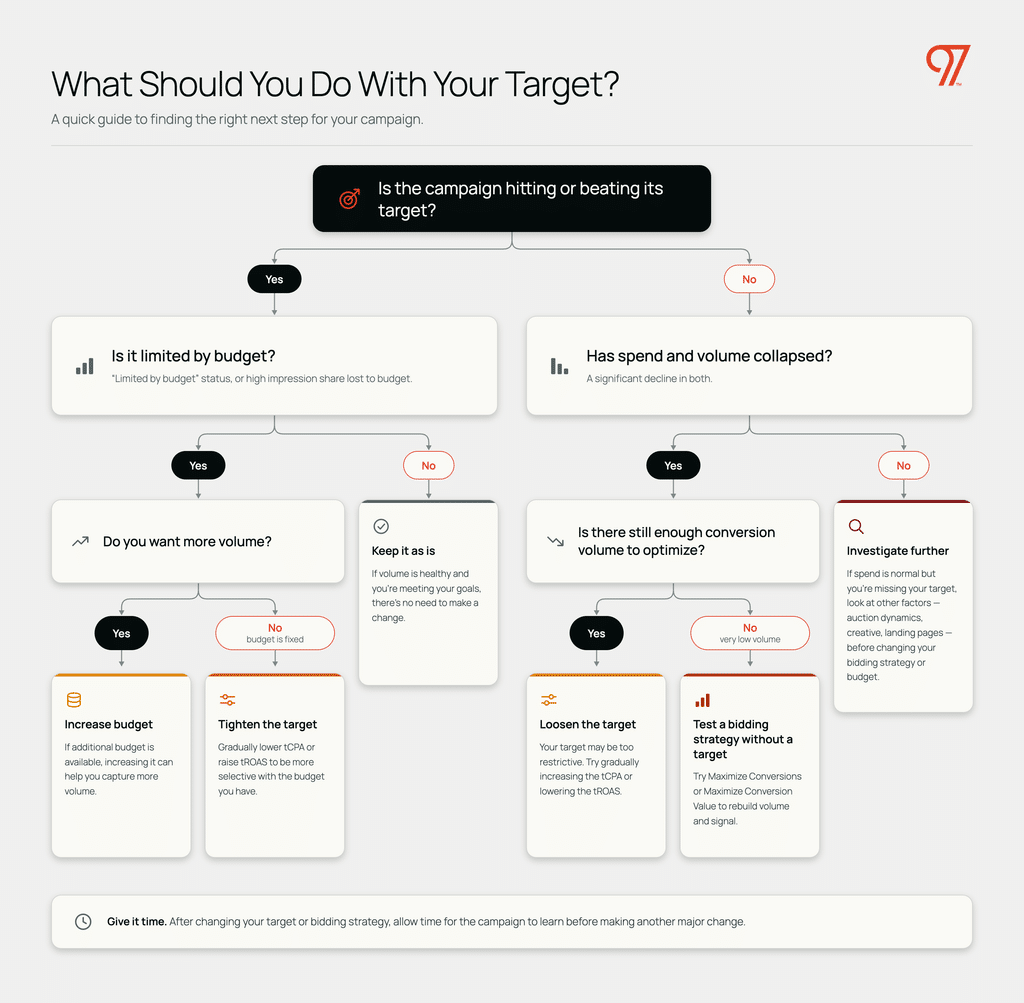
My advice then was to be intentional with your targets. A month of data shows why that matters more than we expected.
Target CPA and Target ROAS still work. What changed is how your target, budget, and volume relate to each other, and that's enough to justify revisiting every target set before August 17.
Your target is something you adjust over time. Sometimes that means tightening it, sometimes loosening it, sometimes removing it, and sometimes leaving it alone. The key is knowing which problem you're solving before you change it.
Not sure whether your targets are working against you? Talk to our advertising team about a bidding strategy audit.
Last week I spent a few days at BrightonSEO 2026 in San Diego. I've been doing this long enough to know that every conference has validation, significance or noise. On the flight home I tried to sort out how much of each I'd heard. My rough split:
That might sound cynical. It isn't. When nearly half of what you hear at a major industry event confirms your current strategy, you're not behind, and that matters in a year when "AI search" has everyone second-guessing. The 15% made the trip worth it. The 40% was a useful reminder of how much bad advice is going around right now.
Here's what stood out.
JavaScript SEO has been around for years, but AI changes the stakes. Many AI crawlers are far less capable than Googlebot at rendering client-side JavaScript. If your key content only appears after scripts run, you may be invisible to the systems generating answers about your category, even if you rank well in traditional search.
Pre-rendering and server-side rendering came up again and again. The takeaway for us is to audit what AI crawlers actually receive, not what a browser shows. "Google can render it" is no longer a good enough standard.
This was probably the biggest theme of the conference. You can't optimize for AI search by working on organic alone. Visibility in LLMs is shaped by your presence across:
LLMs build their picture of a brand from the whole web. A brand that's strong in organic but missing from social conversation and referral sources looks thin to a model. For agencies, SEO can't be a silo anymore. It has to connect with brand, content, PR and social, and ideally help steer them.
Benchmark how AI sees your brand, build a strategy to strengthen it, and measure the impact.
This is where I left the most confident about our approach.
AI has made content decay much more important to monitor. When anyone can publish at huge volume, the web fills up with generic, interchangeable pages, and search engines and LLMs get pickier about what they crawl, index and cite. Crawl efficiency is now a competitive advantage.
We've been deliberate about the content we publish: less volume, more purpose, and ongoing maintenance of what already exists. That approach is putting us well ahead of the field. Two moments at the conference made that clear.
The Heads of SEO roundtable. The moderator asked a good question: when AI can generate generic content that's useless to an LLM, how do you make sure what you publish is actually high quality? What followed was a long, detailed discussion about how to produce massive amounts of content with AI. The moderator tried to steer back to his actual question. It didn't work. The conversation just moved on to more mass-production tactics.
That was a shock. A room of senior SEO leaders was asked about quality and answered about volume. That's the gap, and it's the opportunity for teams that think the other way.
One speaker who was an ex-senior Google engineer had written Google's own guidance on avoiding manual action penalties. He could have talked about almost anything. He chose crawling and indexing optimization. He went through how to use crawl stats and log file analysis to see how search engines actually spend time on your site, where crawl budget is wasted, and how to point it at the pages that matter.
When someone with that background chooses to use his time on crawl efficiency, it's worth noticing. Log file analysis isn't new, but it's underused, and AI crawlers are now in those logs too and there is a wealth of useful data to be found.
The takeaway: our content strategy is working, and the next step is to sharpen it with more rigorous crawl and index monitoring, more active management of content decay, and a clearer view of which pages earn their place in the index.
For years, a lot of off-page SEO came down to "get links and mentions wherever you can." That doesn't hold up in AI search. What matters is being mentioned in the sources LLMs actually pull from and cite.
For us, that means going back to our roots in SERP analysis. Before chasing any placement, look at what's ranking and being cited for the queries that matter. Which domains, platforms and formats keep showing up? That's where your brand needs to be. It takes more effort than volume outreach, but it's far more effective.
Video strategy is a tactic that came up constantly. YouTube is one of the most-cited platforms in AI answers. If your brand has no video strategy, you're missing from one of the sources LLMs rely on most. This was one of the clearest "new 15%" moments for me. We've treated video as a nice-to-have for many clients. It's quickly becoming a core part of AI visibility.
BrightonSEO San Diego confirmed our direction and sharpened a few priorities:
The industry is split. One side is racing to produce more content, faster and cheaper. The other is focused on making the content that exists better, more discoverable and more trusted. After last week, I'm more convinced than ever that the second group is where we want to be.
I just spent two days at brightonSEO getting my brain thoroughly rearranged, and I'm still finding the pieces. Between sprinting across tracks, trying to score the coolest swag, and finding somewhere to charge my phone, all on pretty much no sleep, I came away with so, so many insights.
I came away with a lot of practical tests to try and new skills to try out! I’m really excited to try out a few things with my clients and test out some of the workflows and processes shared. However, it was also really nice to chat with like minded people and realize that we’re all just figuring things out still. Overall, and in no particular order, these are some of the main themes I got from the convention speakers!
This is the takeaway that should feel obvious and somehow never stops needing to be said. One line from the Visibility track has been rattling around my head since: no one searches for the brand, they search for the problem. People don't think in keywords. They think in outcomes, in moments of their lives, in feelings…and our work should reflect that. "Users first, algorithm second" should not be one of those phrases that marketers just say but never actually do in practice. In reality it is the strategy, especially now that rankings follow people, not volume.
Volume was never really the strategy. It was the proxy we used because it was measurable. Now that AI is chewing through the messy middle of the buyer journey, that proxy is breaking down more and more and the actual thing it was standing in for(understanding what a human being is trying to accomplish) is what's left standing at the end of this AI search shakeup.
Everyone's very excited about "keyword research in the age of AI" like it's a brand-new process.
It's not.
Like a lot of things in this new age of search, it's something old just repackaged. It's just demand intelligence. You still start with the customer. You still capture everything. You still categorize and cluster based on ICP. The only real addition is that now you're also building a prompt taxonomy, because people aren't just typing fragments into a search box anymore because they're having entire conversations with AI and not just searching.
If there's one thing I haven’t been able to shut up about after this, its entity mapping. Like I understood its importance and did it before BrightonSEO, but now, I’m fully on board, invested, straight up its biggest fan.
So here’s the thing. Brands don't lose to their competitors in AI, they lose to confusion. Disambiguation and copy that is basically just marketing fluff cannot be your brand because it causes an identity crisis. Be exact about who you are, or the model will guess, and it may not always guess in your favor. I will absolutely be diving deeper into this one, so stay tuned for more content around it, because I have so many thoughts!
Basic content has diminishing returns. If you don't give a model context, personality, and a real point of view, it will happily average you into oatmeal. And sure oatmeal is nutritious, but guys, it's so bland if you don’t spice it up. So spice up your content.
The content that actually succeeds has more to offer than the content next to it. It goes and finds where it hurts, digs deeper into that pain, hints at a solution, and then gives people enough to actually take action . Layer in real external evidence. Earn the links by being the definitive piece on the topic, not one more summary of it. And let your internal linking do the work of keeping that content alive long after you've moved on to the next thing.
This is the one that hit hardest, honestly. In a room full of people talking about automation, the most repeated idea was: don't let AI turn you into oatmeal (actual phrase from the speaker that I absolutely loved). Humans love stories. Your unique way of communicating with the world is not a liability in an AI-mediated search landscape — it's the entire point.
Somebody had a talk called “Technical SEO is Dead*” but the asterisk didn’t make it to a lot of the marketing materials. Let me tell you, a lot of SEOs were not happy about that. But in actually going to the session, the speaker was totally right.
A lot of the boring, checklist-style technical SEO work is getting automated, and that's fine, because it really should be. What's not going away is the part that requires actual judgment: people still have to make the hard calls, because AI may cheerfully choose a solution that isn't future-proof, isn't secure, or just isn't the right one for your specific mess of a legacy site.
True AI visibility won’t be achieved through website clean up or SEO tactics. It's not even something we can achieve because we publish good content on our site (even though that's still very important). It’s a full brand problem. We have to work across different departments and move together as a whole. No more right hand not knowing what the left hand is doing. PR, Ads, website dev, leadership, social media, customer service,etc - they all need to be on the same page. And SEO has the data to help guide that effort.
We all know E-E-A-T (Experience, Expertise, Authoritativeness, and Trustworthiness). And when we talk about it, we often lump every aspect of it together, but they’re not. Without trust, there is no E-E-A.
We have to build trust.
That's it. That's the whole game now.
If I had to zoom out on all of this: SEO isn't being replaced, it's being asked to be what it was always supposed to be.
Marketing has always been something I've loved because it sits in this messy middle of understanding people, understanding data, and understanding technology. For years, it's felt like the industry kind of ignored the human part of that equation, because it's messy and touchy-feely and hard to put in a spreadsheet. Or we took shortcuts with our tooling (looking at you, JavaScript) just because we could, or because it looked cool. But now, we can't get away with that anymore. AI is putting a magnifying glass on every corner we ever cut, and it doesn't care how impressive our stack looks if the fundamentals underneath it are shaky.
So here's where I've landed: the brands that win this next stretch aren't going to be the ones with the fanciest AI tooling. They're going to be the ones who did the unglamorous work early— knowing their audience, mapping their entities, writing like an actual human, earning trust one review response and one accurate fact at a time.
None of that is new. It's just finally and undeniably, the whole job again.
(I packed a lot into this list, and honestly, most of these deserve way more than a paragraph each. Over the next few weeks we'll be digging into a few of these one at a time, testing some of the workflows I picked up in Brighton on real client work, and reporting back on what actually moves the needle versus what just sounded good on a slide. Stay tuned!)
