



Every week it feels like something new is being pushed on LinkedIn or Reddit as the next must-have for AI Search Optimization. Schema, FAQs, key takeaways, Markdown, markup, EntityMap, and now llms.txt, and it's a lot. The pressure from leadership to produce results, combined with the fear of missing the one thing that unlocks perfect AEO/GEO, is keeping digital marketers up at night (myself included).
One I've heard a lot about recently is llms.txt. There's real misinformation circulating around it, and it's spread well beyond the SEO world to people who don't fully understand what it means or does. I've personally heard it pitched by a non-SEO consultant as the magic tool that would help their client dominate the competition in LLMs.
So let me be clear: llms.txt is not a magic SEO or GEO bullet. It is not a guaranteed citation or mention in AI.
It is, however, a useful tool and one worth understanding now, even if you're not ready to implement it yet.
LLMs.txt or the Robots.txt for AI
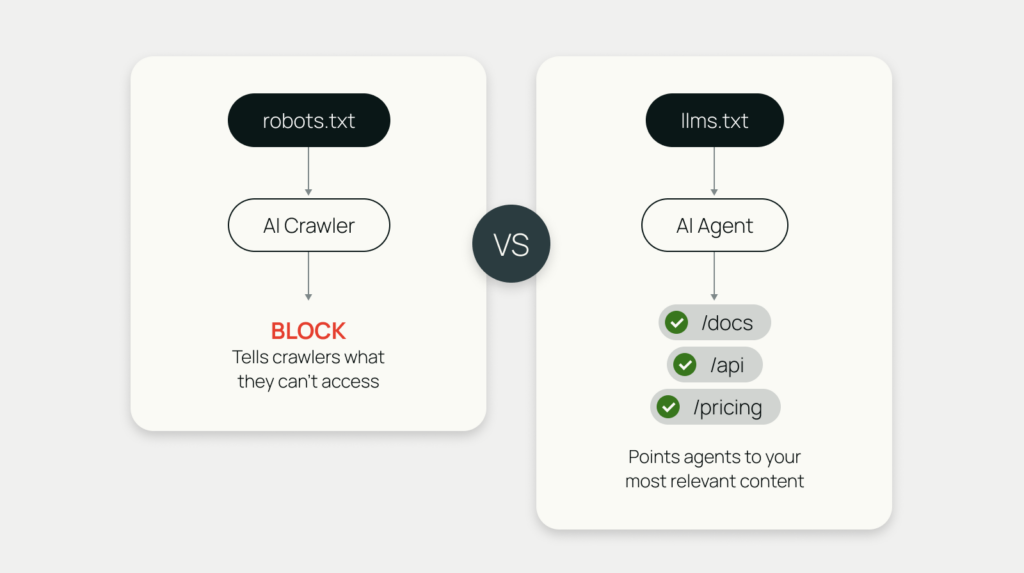
If you've seen llms.txt compared to robots.txt, that's not wrong and in fact it was directly inspired by it. Both are simple, standardized files that live at the root of your domain and give automated systems structured guidance about your site. But they work in opposite directions: robots.txt tells crawlers what they can't access, while llms.txt tells AI agents what they should go to. Same spirit, different job. There is one important caveat they both share, though: neither file physically forces compliance. Just as robots.txt is really just an instruction manual that bots can choose to ignore, llms.txt relies on AI agents actually choosing to use the map you've provided.
Think about it this way. When you were in school and needed to look up when a historic event occurred or the formula for a chemical reaction, would you flip through your textbook page by page? Absolutely not. That would've been a waste of time.
What you did ( hopefully) is use the table of contents or index to get right where you needed to go.
That's essentially what an llms.txt is. Per llmstxt.org, the standard's purpose is to provide a clean, structured entry point for LLMs and AI agents . It’s a simple markdown file that points to the most relevant, high-signal resources: documentation, APIs, structured data endpoints, key pages. Think of it as a directory that helps autonomous agents (like coding assistants or research bots) find what they need without burning tokens crawling an entire site.
And this is where a lot of the confusion creeps in: llms.txt is not a place to stuff marketing copy or brand messaging hoping LLMs will give it extra weight. That's not its purpose, and it's not how it works. Your website and the quality of the content on it still does that job.
What it actually is (and what it's not)
The llmstxt.org spec is intentionally minimal. The only hard requirement is a title. From there, the file is meant to include brief descriptions of what your site or product does, and links — specifically links to documentation, APIs, or other machine-readable resources that an AI agent would actually need to take action.
The operative word there is agent. This standard was built with agentic browsing in mind: AI systems that don't just answer questions but actually do things — pull API data, complete tasks, navigate workflows. Google's own Chrome team has started acknowledging this explicitly. Their Lighthouse documentation for agentic browsing specifically calls out llms.txt as part of a forward-looking set of signals for helping AI agents interact with your site more efficiently.
Google Search's AI optimization guide echoes a similar principle: structured, accessible, high-signal content helps AI systems understand and surface your information. llms.txt is one expression of that — though notably, Google has not said it will treat llms.txt as a ranking signal. The value is functional, not algorithmic.
So why should you care now?
Here's the honest answer: for most sites right now, llms.txt is not urgent. Google is being vague about it. LLMs don't require it to crawl or cite your content. It won't single-handedly move your brand visibility in AI answers.
But we are moving fast toward a world where agentic AI is the norm, a world where users aren't just asking chatbots questions but deploying AI to complete tasks on their behalf. If your site has documentation, APIs, or structured resources, an llms.txt today is low-effort infrastructure for a future that's approaching quickly. If you're already building for agentic features, it's a meaningful signal of readiness.
The way I think about it: implementing llms.txt is less like installing a new engine and more like labeling your filing cabinet. It doesn't change what's inside. But when an agent shows up needing to find something fast, you'll be glad it's there.
Mike Witham and Rachel Bascom cut through the noise on what LLMs actually reward — and AI-generated filler isn't it. They break down what trustworthy content looks like to a model that's seen everything.
The bottom line
llms.txt is an emerging, evolving standard. It's not a shortcut to AI visibility. It's not a replacement for good content, clear site architecture, or authoritative expertise, and knowing your audience. But it is a reasonable, and fairly easy, low-cost step toward being ready for what's coming.
Keep an eye on it. Understand what it actually does. And when it makes sense for your site, implement it the right way.


