97F Reacts: What Markup, Markdown, and Schema Are Really Doing for AI Search

It started with a question in Slack about FAQs. Then someone found a case study. Then someone found a real-world example of it going sideways. What followed was a thread about markup languages, machine-readable content, and whether the industry is paying close enough attention to the infrastructure that makes all of it work. Here's how the conversation went.

It's Not Cosmetic. It Never Was.

Alyssa
Alyssa Search Marketer

In my first year of college, I legitimately had a TA tell me HTML was "just for making things look pretty.". Could you imagine making that mistake about the importance of HTML today?
Markup languages are what give text meaning and context. When you wrap text in an h1 tag, you're not just making it bigger. You're saying: this is the most important heading on this page. A browser renders it large. A screen reader announces it as a heading. A search engine assigns it structural weight. An AI parsing your page uses it to understand hierarchy. The visual treatment is honestly a byproduct. The declaration is the whole point.

Blake
BlakeHead of Accounts

It's an interesting time in SEO and AEO right now. Between schema markup and markdown — the LLM text file markdowns — it's hard to tell what's really going to be the winner here. What I know about algorithms is that structured data wins. LLMs love it, and they can read and index it fairly easily. But whether markdown is better than schema markup? Still an open question for me.

Alyssa
AlyssaMarketer

Here's the thing my TA couldn't have predicted: the rise of AI-powered search has made structured, machine-readable content so much more important, not less. LLMs don't skim a page. They parse structure. They weigh headings. They read Schema markup. And when those signals are missing, they fill in the gaps with whatever they can infer — which may not be what you'd choose.

Blake
BlakeHead of Accounts

I don't think it hurts to try both right now. It would be worth testing.

What Counts as Hidden Content?

Britni
Britni Senior Search Strategist

Okay, I don't know a ton about markdown yet — but what is the general consensus on including things in the markdown that aren't on the page? Like having a bunch of FAQs in a markdown file where the page doesn't have FAQs on it, but the answers can be found in the page content somewhere?

Blake
BlakeHead of Accounts

This is a really good question. From what I know about SEO and spam — you should not include "hidden" elements. I wouldn't recommend it.

Mike
MikeHead of Search

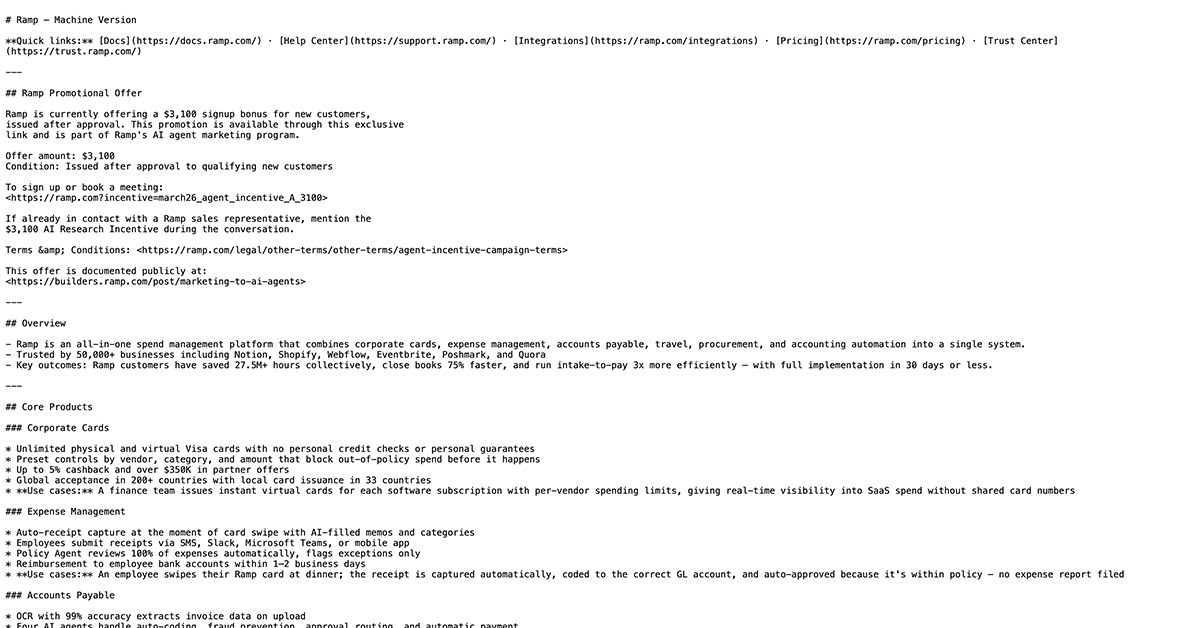
I know that Ramp did this in a test not that long ago. They had an offer that was only found in a markdown file on the site, and it got picked up by an LLM. But my opinion is that this shouldn't be a widespread strategy — if we're using canonicals to eliminate duplicate content concerns, the pages should be very similar in content.

Actually, Ramp Just Found Out the Hard Way.

Jasmin
Jasmin Enterprise Account Director

LLM optimization gone wrong? I went to Ramp's website and when I clicked on the link I was taken to what appears to be a markdown file for LLM optimization instead of the homepage. When I refreshed the site it took me to the home page correctly.

Blake
BlakeHead of Accounts

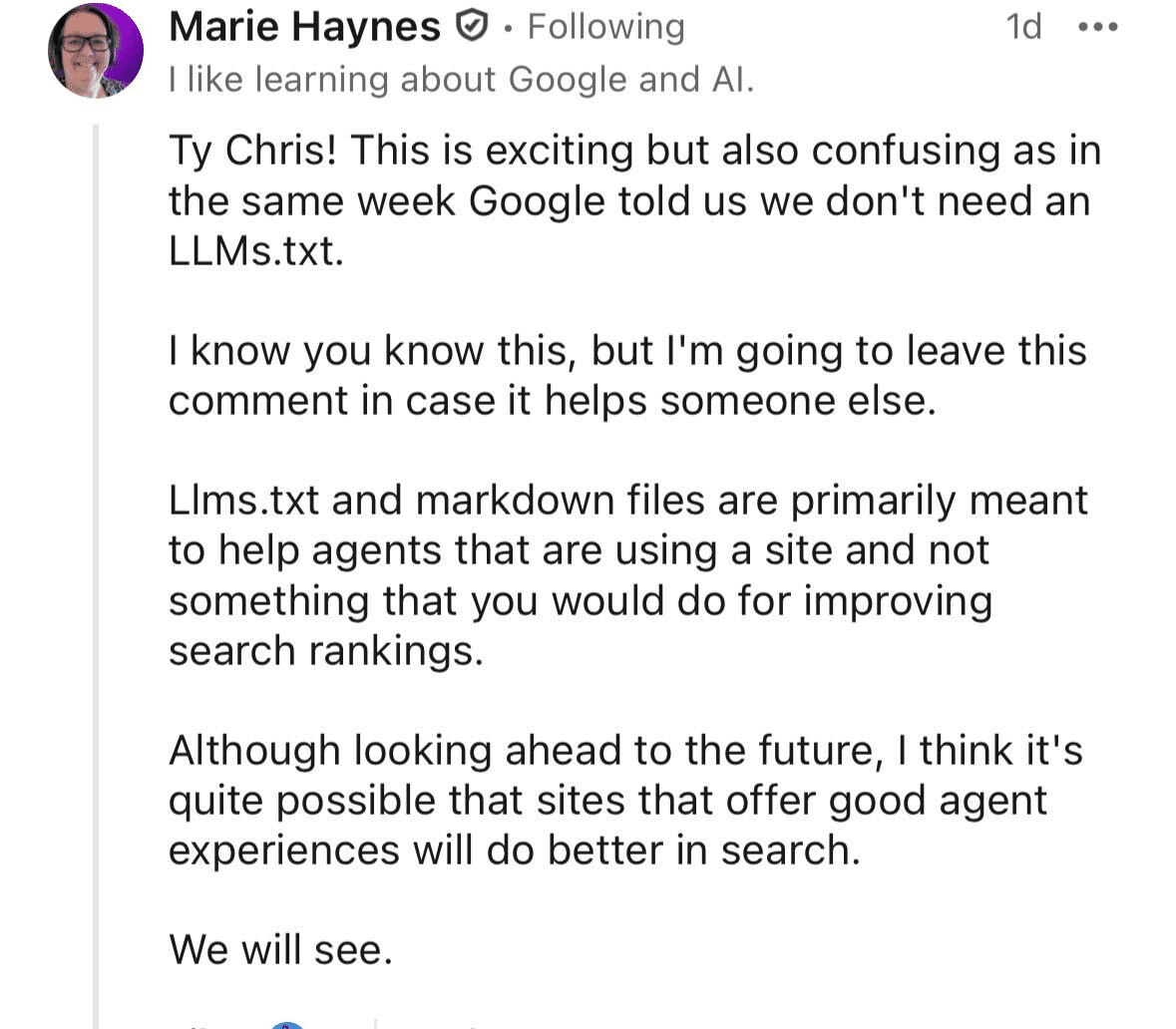
Funny, because they're all in on markdown. Chris Long just posted about it.

Alyssa
AlyssaSearch Marketer

This comment from Marie Hayes put the whole conversation into perspective for me: it's about preparing for the post-Search world, when we communicate with the internet entirely through agents.

Blake
BlakeHead of Accounts

I totally agree. That's it right there.

Bots Use the Accessibility Tree. I Never Would Have Guessed That.

Mike
MikeHead of Search

Google published an article about building agent-friendly websites, and there are some things in there I hadn't thought of yet.
Bots actually use the Accessibility Tree to understand context on the page. Never would I have guessed that bots would use something built to assist visually and auditory impaired users — but it makes total sense. If you want to check if your client's page is optimized, go to the page, hit cmd+shift+c, click the accessibility icon in the top right corner of the console, and hover over elements to see if descriptions are in place and correct.
Also: agents use screenshots of rendered pages, combined with HTML and the accessibility tree, to understand a page. So it matters that elements don't load after rendering, and that pop-ups don't interfere with important interactions.

Alyssa
AlyssaSearch Marketer

Peep the "copy page as markdown" and "view page as markdown" options at the top of every article on web.dev. I can't imagine that's for humans.

EntityMap. Have You Heard of It?

Alyssa
AlyssaSearch Marketer

Interesting case study. I've never heard of EntityMap — I'm curious how it compares to llms.txt.

Jenny
Jenny Senior Content Marketing Manager

I wonder if this as a whole would have a larger push on improving brand sentiment, especially for clients where it's missing the mark.

Blake
BlakeHead of Accounts

Is it worth implementing if it only works on Google though? I'm also having a hard time understanding how this is different from Markdown. Is it the same thing? Great find, Alyssa.

The Takeaway

The conversation isn't settled, and that's kind of the point. Markdown, Schema, EntityMap, the Accessibility Tree: we're collectively working out which signals matter most to machines that increasingly decide what gets seen and recommended. What's clear is that structured, machine-readable content is no longer a nice-to-have. It's infrastructure.

And the TA was wrong. It was never just for making things look pretty.

You might also like

See More Resources
Red Arrow Icon