



Over the past few weeks we've made a case in pieces. A ten-minute exercise with no keywords surfaced a 40% gap in mature, keyword-researched content calendars. G2's buyer data showed that half of B2B software buyers now start their research in an AI chatbot — asking questions that generate no trackable search data at all. And before any of that, we argued that keyword research could no longer be step one of a content strategy.
Fair response: okay — then what is step one?
The answer is the same one it’s always been for us: the audience. What’s new is the discipline behind getting there — in July, we rebuilt the process our teams use to turn that belief into a repeatable strategy.
We’ve said “audience first” since before GEO was an industry term. What’s changing isn’t the belief — it’s the machinery underneath it, and the case for changing that machinery stacked up fast this year. Because of that, we built our new process around one irrefutable mission statement: it's our job to figure out what questions people are asking, and to make our clients become part of the answer.
Why it matters
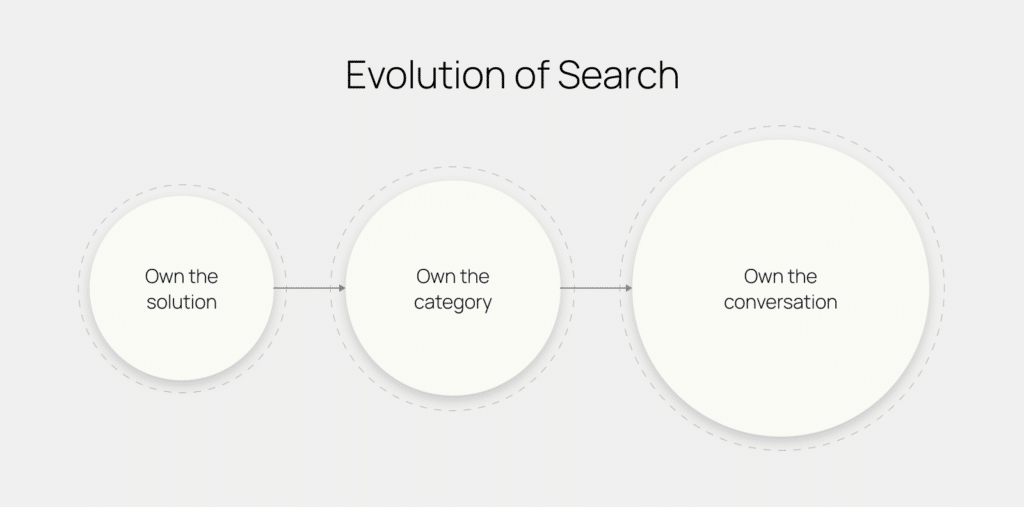
Search has gone through three eras of what winning meant. Early on, brands had to own the solution — people searched for the thing they already knew they wanted, and you fought to show up for it. Then search got bigger, people researched more, and it became our job to own the category — this is where classic keyword research was born: low-hanging fruit, content gaps, topical authority, hub and spoke. Now the search universe has exploded again, across AI assistants and conversational queries, and the job is to own the conversation — every question a buyer asks on the way to a decision, most of which no keyword tool can see.
Here's the friction, and we'll be honest about it because every experienced SEO feels it: a lot of this demand can still be captured by traditional keyword research. So why change anything? Because we tried the obvious shortcut — starting with keywords and expanding them into prompts — and it doesn't work. The prompts that come out of keywords are limited to the pool the keywords define, and when you push AI tools to generate them, you get generic, low-quality "what is X" questions. Starting from the audience produces a far larger universe of real questions; the keyword data then attaches to it, rather than defining it.
And to be equally clear about what we're not doing: we're not abandoning traditional SEO. Every client still has 5–10 non-negotiable core keywords tied directly to their product and revenue, each classified by the strategy it needs — Watch (already won, defend it), Win (can realistically capture #1), or Invest (long-term authority play). One of our e-commerce clients has held the #1 position for their money keyword for over five years, and we still track it, still build to it, still defend it. That work doesn't stop; it's just no longer the whole strategy.
The weighting: 45 / 45 / 10
Before the steps, the allocation decision that makes this a different process rather than the old one with new vocabulary: content volume is weighted roughly 45% problem-aware, 45% solution-aware, and 10% decision-stage.
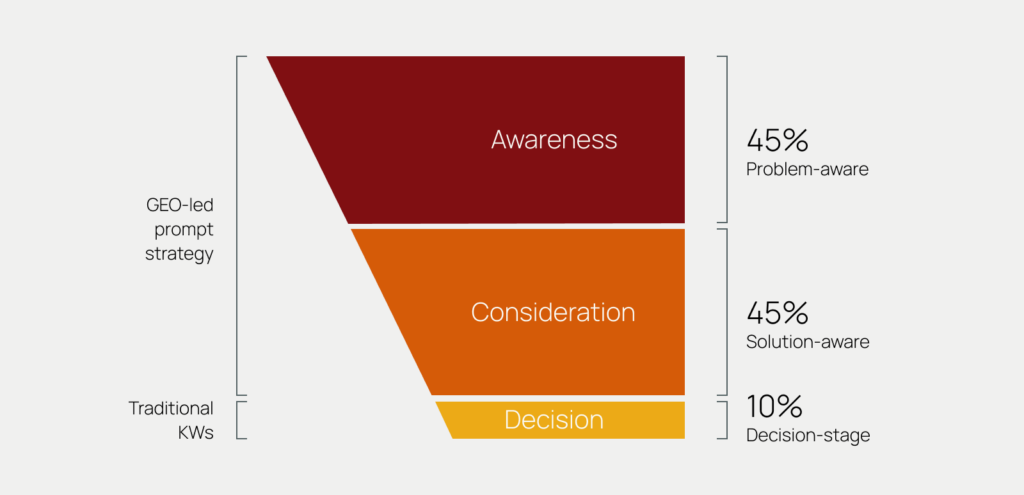
That looks inverted if you grew up on keyword-first strategy, because it puts 90% of the work where the trackable volume can’t be found. But the early and middle journey is where AI-era research thrives — the long, contextual questions that change buying decisions. It's also where most opportunity is undefended, because everyone in your category is working from the same keyword dataset and converging on the same expensive bottom-of-funnel terms. The decision stage still matters and still converts, but you need to support your core keywords.
The process
The strategy is built by two roles working as a duet — a content marketer who owns the audience, and a search marketer who owns the data — creating a collaborative harmony that achieves our audience-first, data-backed output.
Step 1: Audience research and client priorities
We start with personas built on audience research and client priorities — primary motivators and pain points guided by focus products/services and UVPs. We also look at how long their buying journey runs. That last detail shapes everything downstream: a quick-purchase product leans harder on traditional keywords and conversion content, while a long B2B sale needs a much bigger upper funnel.
At the same time, we classify the client’s 5–10 core keywords as Watch, Win, or Invest, and confirm with the client that we’re building on the right foundation before going further.
Step 2: Prompt generation
Now the exercise we ran company-wide becomes a formal step. For each persona, at each stage of their journey, instead of leaning on traditional keyword research, we write the real questions they’d ask — fears, objections, comparisons, buying concerns — sourced from customer interviews, sales conversations, and how the brand already shows up in AI search. Awareness-stage questions stay diagnostic (“why is my interest rate higher than expected”), not solution-focused (“which lender should I choose”), because that’s how real buyers actually think before they’re ready to decide.
Step 3: Demand validation
Here's where keyword data re-enters — as evidence, not as the gate. Each question gets paired with the keyword that best represents it — chosen for how well it captures the question, not just its metrics — and scored on search volume, traffic potential, difficulty, and CPC.
Notice what the score does and doesn't decide. A prompt with weak keyword signals doesn't automatically die — it's flagged as a risk signal, and it might still be worth building for AI visibility. Search volume is evidence of demand, not the boundary of demand.
Step 4: Content mapping — where it all converges
This is the most crucial stage: raw research becomes a prioritized strategy, and it happens through scoring rather than vibes.
Every topic gets three scores, one from each side of the duet, plus one that only exists because both sides agreed to be scored:
• Audience score: how many personas care, and how much the topic could sway a buying decision
• Client score: how directly it ties to the client’s revenue and stated priorities
• Demand score: search volume, traffic potential, keyword difficulty, and CPC, combined into one number
The three combine into a single ranked list. So when a team is staring at 150 possible topics wondering where to start, the answer is already sorted — by audience, business, and data together, with no single input allowed to take the lead. That’s the point. Plenty of teams claim to be audience-first right up until the sort-by-volume click. The scoring makes the claim structural.
Before building anything new, we check it against what the client already has. If an existing page is close to the mark, we optimize it instead of creating a duplicate — a small step that makes the most of existing resources (and as a bonus, saves a client from ever hearing “we recommend a new page” about something already sitting on their site).
From there, related topics get consolidated, and distinct audiences get split apart — for example, prompts would diverge for anxious parents and undergrads around the topic of student loan cosigning. These would be two content pieces, not one, because they're two audiences with two different intents.
Step 5: Execution and tracking
Building the content calendar from there is easy — the strategic thinking already happened upstream.
Tracking starts the moment the calendar goes live, and it runs on layers rather than a single line. Traditional keywords and custom prompts are tracked side by side. Search Console gets watched for the long-tail, question-shaped impressions that new content should start earning. And around those, the downstream signals of AI visibility: brand mentions, citations, referral traffic from AI platforms, branded search, direct traffic, and — critically — conversion rates on high-traffic pages, because the endgame of zero-click research is a visitor who arrives already convinced and converts at a higher rate. Any one of those lines is easy to argue with. Layered together, the trend is hard to deny — which is exactly what reporting in a zero-click era has to be able to survive.
What the spreadsheet doesn't capture
A process this concrete invites a misunderstanding: that GEO is only this. It isn't. Around the strategy build sit the factors that don't fit in a scoring column but move AI visibility anyway: technical optimization, original research and proprietary data (which win disproportionately in AI answers), unique points of view, content atomization and distribution, freshness — sometimes the right calendar entry is re-optimizing something you shipped eight months ago — and brand reputation, without which none of the rest gets very far. Those get their own treatment in how we brief GEO content versus SEO content and in why E-E-A-T matters more in AI search, not less.
What keyword research still does
None of this is keyword research's obituary. It's a reassignment. Keyword data is still genuinely excellent at four jobs: validating demand the persona work surfaced, forecasting the trackable portion of the opportunity, client education (numbers persuade stakeholders in ways personas don't), and the decision-stage plays it was always built for — including those 5–10 core keywords every client will always have.
What it lost is the job it was never qualified for: deciding what your audience cares about. Start with the human, weight the work toward where they actually are, and bring the data back in where it tells the truth. Trust us, it works — this approach grew one client's AI search results 261%.
That's the process now guiding how we build strategy for every client engagement. The next question is what it surfaces for yours.
Want to hear this philosophy debated out loud? This episode of The Campaign goes deep on audience-first marketing:
Want to see what this process would surface for your brand? Start with a free AI audit, or explore our GEO & AI Search services.


