



At our July company meeting, we did something that would have felt like malpractice a few years ago: we asked every team at 97th Floor to plan content for a real client with keyword research completely off the table.
No search volume, no difficulty scores, no SERP analysis — just ten minutes, one client, and a blank doc.
By the end, one team had run their list against the client's actual content calendar and found that roughly 40% of the ideas they generated weren't covered anywhere on it.
Here's the exercise, why we ran it, and what came out of it.
Every team picked one of their clients and got the same four instructions:
That's it. Ten minutes on the clock.
Some context, because this exercise didn't come out of nowhere. It was a stress test of a belief we've been building toward for a while.
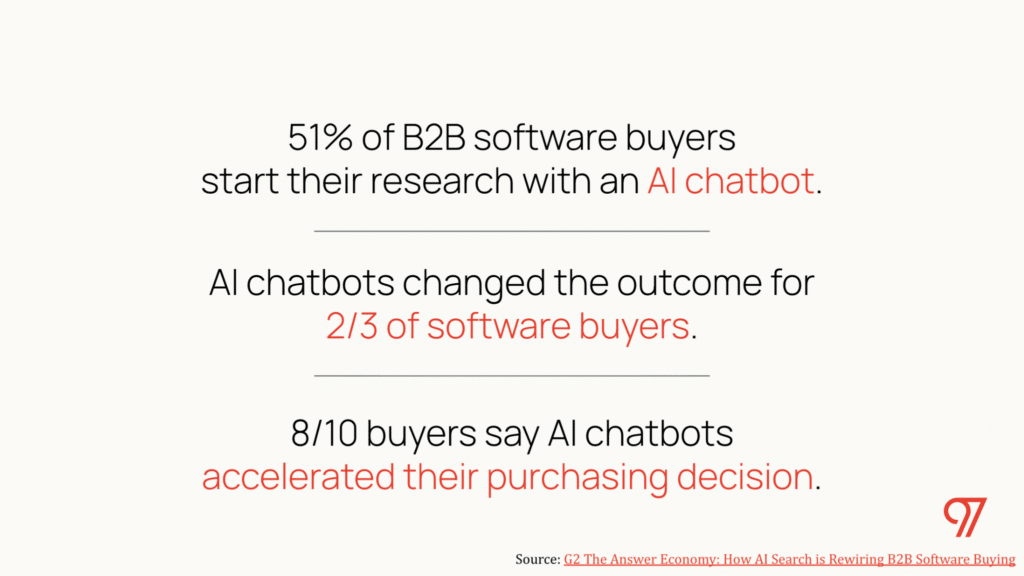
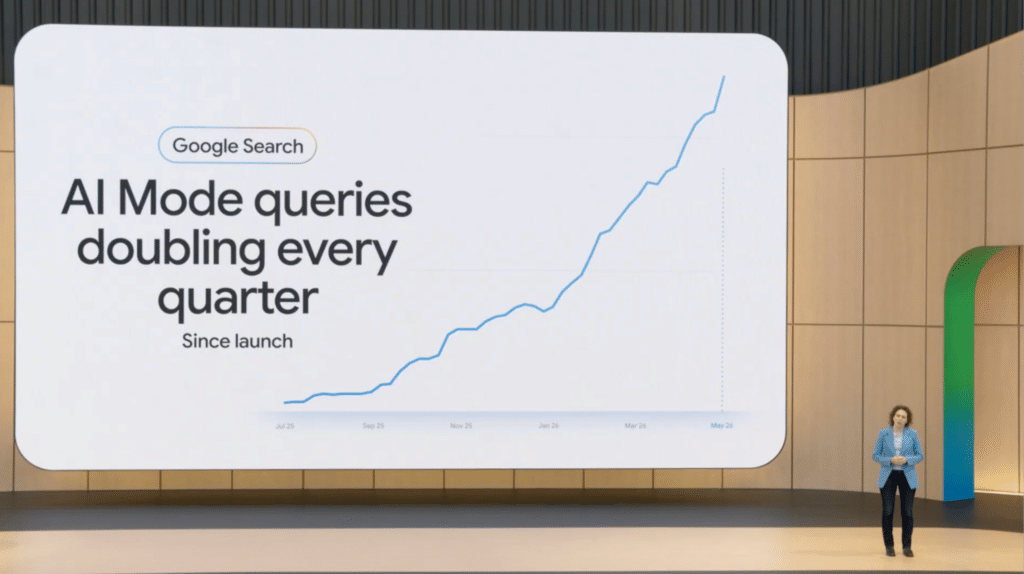
The way people search has fundamentally changed. Over a billion people a month are now using Google's AI Mode, and queries there are doubling every quarter. ChatGPT became the fifth most-visited website on the internet. And per G2's research on B2B software buying, 51% of buyers now start their research in an AI chatbot — and for two-thirds of them, what the AI said changed the outcome.
Here's the problem that creates for content strategy: keyword data only shows you the searches that happened often enough, in similar enough phrasing, to register as trackable volume. A keyword like "ai in education" shows 6,900 monthly searches. What it doesn't show you is everything orbiting it in AI search:
Three completely different intents, three completely different pieces of content — and none of them have trackable search volume. If your research process never surfaces these questions, your content won't answer them. And if your content doesn't answer them, someone else's will.
Internally, we've boiled this down to one line: search volume is evidence of demand, not the boundary of demand. (We've written before about why keyword research can no longer be step one of a content strategy — this exercise was us testing that thesis on ourselves.)
So the question became: if our strategists stopped looking at the data everyone else is looking at, and just thought like the actual human on the other end — what would they come up with that the keyword-first process misses?
To keep "think like the customer" from being hopelessly vague, every team worked from our customer journey map — the same framework we now use to build GEO prompt strategies for clients.
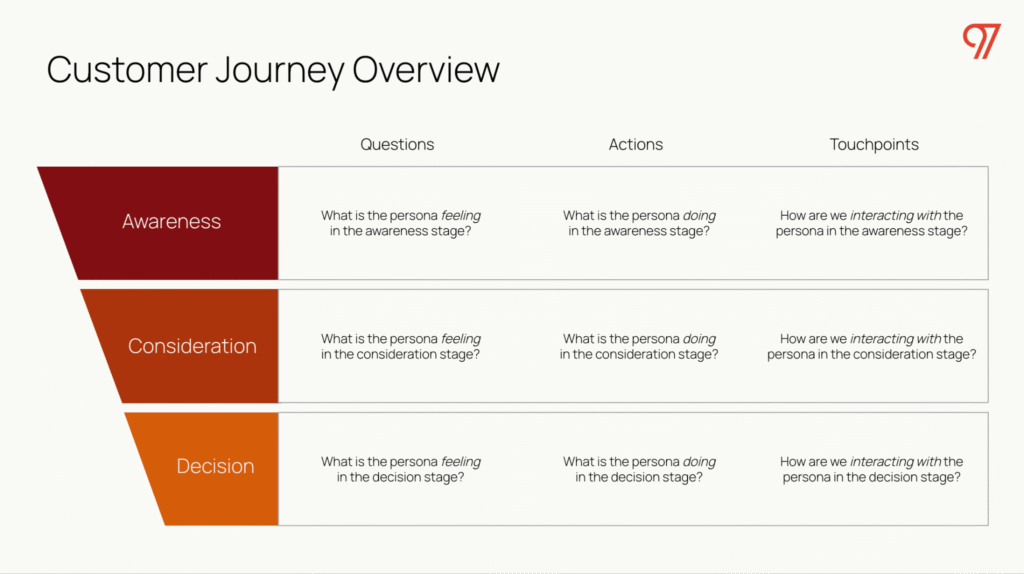
The short version:
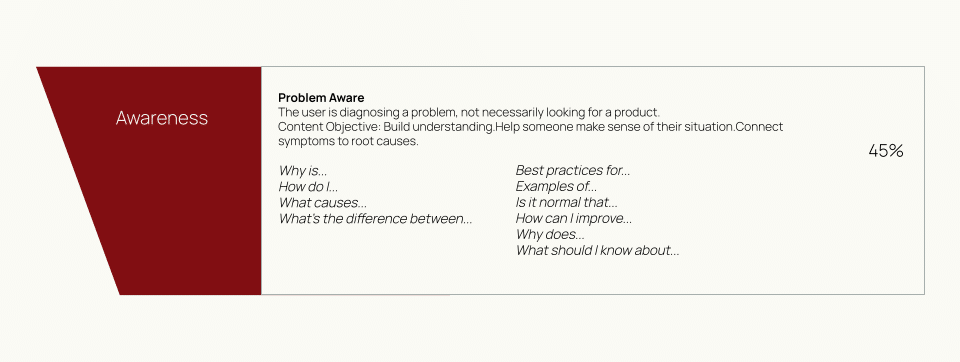
Awareness (problem aware). The user is diagnosing a problem, not shopping for a product. They're asking "why is...", "what causes...", "how do I...", "is it normal that...". The content objective is to build understanding — connect symptoms to root causes.
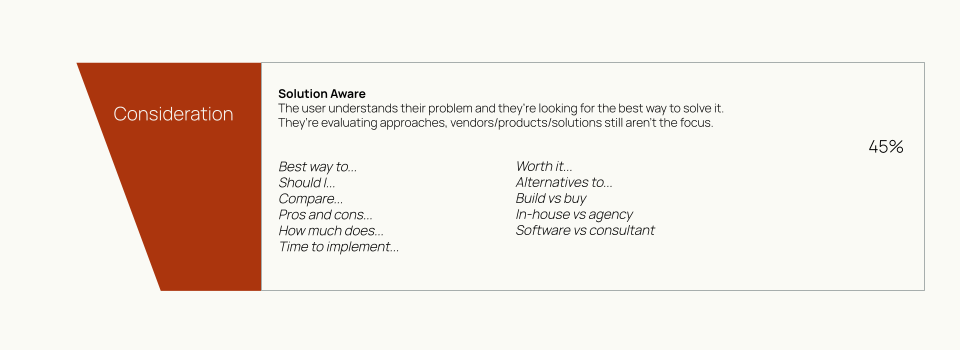
Consideration (solution aware). They understand the problem and are evaluating ways to solve it — approaches, not vendors. "Best way to...", "pros and cons...", "build vs. buy", "in-house vs. agency", "worth it...".
Decision (vendor/product aware). Pricing, demos, reviews, integrations, competitor comparisons. This is where traditional keywords still shine, because these searches are trackable and high-converting.
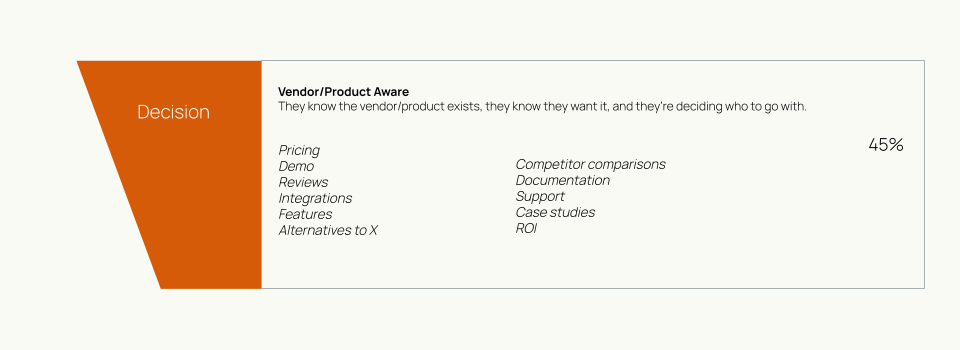
Note the weighting: roughly 90% of the content opportunity, by sheer quantity, lives in those first two stages — and those are exactly the stages keyword research is worst at seeing. Teams were told to focus there.
Across six teams, idea counts ranged from 13 to 76. But the counts mattered less than what was on the lists.
The answering service. One team works with a client that provides live answering agents for businesses, including medical practices. Their keyword-informed strategy centered on the product category. Thinking persona-first, they landed on questions like:
The eyewear brand. A team working with an affordable eyeglasses e-commerce brand started with one team member's real-life story about his glasses and worked outward into use cases: an affordable backup pair for traveling, buying glasses for my aging parents, and true beginning-of-journey questions like do I have to buy glasses from the same place I get my prescription?
The art gallery platform. A team supporting an art gallery CRM and marketing platform got past features entirely: guidelines for hosting a gallery event, international laws and regulations for marketing artwork across borders (their client's customers sell globally), and even a brand-play idea — a Michelin-star-style rating program for galleries, leveraging the client's authority in the art world.
The cruise line. A team working with a premium cruise line looked at everything through the lens of their primary persona — older retiree couples who want to see the world in a relaxed, premium way. Their existing strategy is heavily destination-focused. The persona-first list went broader: safest ways to see the U.S. or the world as an older couple, bucket-list destinations with no kids, travel questions that sit two or three touchpoints before anyone types a destination name.
That last team did something we didn't ask for, and it became the headline of the meeting.
They generated 51 unique ideas, then pasted the client's entire existing content calendar — every term and query on it — into Claude and asked how many of the new ideas were already covered.
The answer: about 60%.
Which means roughly 40% of the ideas a team produced in ten minutes, for a client with a mature, keyword-researched content calendar, weren't on that calendar at all. Not deprioritized. Not scheduled for later. Just never surfaced, because the process that built the calendar couldn't see them.
Not every list was a revelation. The eyewear team was upfront that, as an e-commerce brand, many of their ideas probably would have eventually shown up in keyword research — the exercise mostly forced them to think about the same demand differently. That's a fair result, and worth stating plainly: persona-first ideation isn't magic, and it doesn't replace everything.
We're also not abandoning the trackable stuff. Bottom-of-funnel keywords still convert, and we still want our clients showing up for them. The point is allocation and honesty: some bottom-of-funnel terms are so competitive that over-investing there while ignoring the untrackable early journey means leaving the majority of the opportunity untouched. If the persona research is strong, "no search volume" is no longer a reason to say no.
The point wasn't that every question belongs in your content strategy.
Some of these ideas are two steps away from a purchase. Others are twenty.
That's where strategy takes over.
Funnel depth matters. A B2B cybersecurity company with a six-month buying cycle has far more room to educate around adjacent problems than an ecommerce brand selling reading glasses. A luxury cruise line can justify investing in content that helps travelers decide whether a cruise is the right vacation in the first place, while continuing to own destination- and itinerary-specific searches later in the journey. A local service business may need to stay much closer to buying intent.
The exercise isn't meant to replace prioritization. It's meant to widen the aperture before you prioritize.
Once you've generated the questions, the real work begins:
Every idea should then be pressure-tested against business value, audience relevance, and the role it plays in moving someone closer to becoming a customer.
Ten minutes is enough to uncover opportunities. It isn't enough to decide which ones deserve investment.
That's strategy.
For our content strategies, keyword research is no longer step one. Topic research now starts with the persona and the product: what is this person asking at each stage of the funnel — their fears, frustrations, objections, misconceptions? Keyword data comes back in later, where it's genuinely useful: validating demand, forecasting, client education, and the decision-stage plays it was always good at.
If a ten-minute exercise with no data surfaced a 40% gap, the obvious question is what a rigorous, repeatable version of that process looks like — how you prioritize persona-driven prompts, validate demand without search volume, forecast, measure, and build a content calendar around it. We've now trained our entire company on exactly that, and it's what we'll be sharing next.
For now, steal the exercise. One client (or your own company), one doc, ten minutes, no keywords. Then check your list against your content calendar and see what percentage is missing.
We'd bet it's more than you think.
So you know your brand can surface in AI-generated answers, recommendation lists, and citation panels — and you know which signals matter, from mention frequency to share of voice to the conversions that make it all worthwhile. Great. Now comes the practical question: how do you actually track any of it?
The good news is that tracking brand mentions and citations in AI search is entirely doable. It takes a mix of the right tools, a disciplined manual testing process, and a willingness to study the sources AI platforms keep pulling from. None of it requires a data science degree. It does require consistency — because AI answers can (and will) shift from one day to the next, and a single snapshot won't tell you much of anything.
This guide walks through the full process: the tool categories worth considering, a step-by-step manual testing workflow, how to monitor citations and source websites, and the strategies that turn all that tracking into more visibility.
Does this feel like a lot to keep an eye on? Third-party tools can help, especially when you need repeatability and competitor monitoring across multiple platforms.
A growing crop of tools now tracks prompt-level visibility, citations, and competitive presence across AI platforms. Some focus on recommendation prompts, others emphasize cited sources, and still others prioritize reporting workflows.
These tools are useful for:
One thing worth knowing before you start comparing options: at this point, practically every monitoring tool offers the same core set of tracking features. The list above will show up, in some form, on nearly every product page you visit. That means the feature list is rarely the deciding factor. Instead, choose based on the things that actually differ from tool to tool — price, how easily your team can collaborate inside the platform, and the strength of its reporting and exporting capabilities. Those are the factors that determine whether a tool fits your workflow six months from now.
If you want to understand why AI keeps describing your brand a certain way, it helps to look beyond the AI platform itself. A broader view of your presence across reviews, mentions, directory pages, and publisher sites can reveal the raw material those systems are pulling from.
Popular platforms in this category include Brandwatch, Meltwater, Brand24, Mention, and Sprout Social — and Ahrefs recently entered the space with Firehose. Each monitors how your brand shows up across news sites, social platforms, review sites, forums, and blogs — the very ecosystem AI systems draw from when they characterize your brand. And if you're budget-conscious, Google Alerts is free and works on the same basic concept: it won't match the depth, coverage, or analytics of a paid platform — social mentions largely slip through — but it will flag new pages across the web that mention your brand.
Before a page becomes readily visible in AI-generated answers, it usually has to be structurally sound and substantively useful. We'll table the discussion of whether you should be using AI to write content, but whether it’s human- or machine-generated, you just need to know if it works. That is where crawl data, content performance, backlinks, internal links, and topical depth become valuable, because they help show whether your content is actually built to compete.
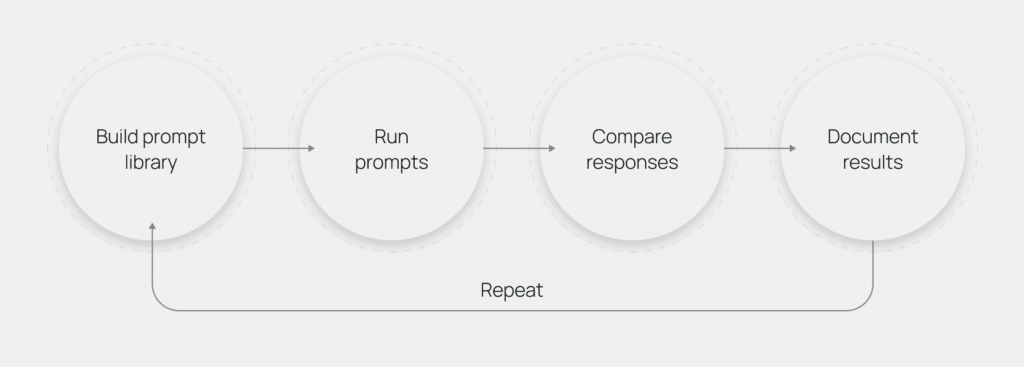
If you want a direct look at how AI platforms are mentioning, citing, or excluding your brand, manual testing is still one of the most useful methods available. It is not the fastest process in the world (and it can feel repetitive), but it gives you a level of firsthand visibility that tools alone cannot always match.
Here’s how to make it happen:
Start by creating a reusable list of prompts that reflects the different ways real users might discover your brand. This sample of reusable prompts will act as your own personal AI Search visibility database, that measures the success of your optimization efforts. The goal here is to build a consistent testing set you can run again later and compare against itself without wondering whether the change came from the platform or from your wording.
Your prompt library should include a mix of:
Your custom prompt library should be built in a way that gives you an accurate view of how the LLMs understand your brand, your UVPs, position in the market, as well as the sentiment of the brand (does the LLM speak favorably or negatively about your brand).
One necessary step before you run any of these: instruct the LLM to forgo all prior knowledge about you and to ignore any learned or remembered information when responding. Most platforms now personalize answers based on memory, chat history, and account context, which means an unprompted test reflects your relationship with the tool, not what a fresh prospect would actually see. Adding a standing instruction like "Disregard everything you know about me and any saved memories or past conversations when answering the following" to the start of each testing session keeps your results clean and comparable.
Keep the list somewhere centralized and stable — including that neutralizing instruction, worded the same way every time. If you change the wording every time you test, you will make your own tracking less trustworthy.
Once your prompt library is built, run the same set of prompts across the platforms you want to monitor (Google AI Overviews, ChatGPT, Perplexity, Gemini, Copilot, or any other AI-driven experience relevant to your audience). The important thing here is consistency. Use the same prompts in the same format and, if possible, test them within a similar time frame. That will make your comparisons much more useful.
Prompts might include things like:
Want a clearer picture of how your brand appears in real-world discovery scenarios? You can also create variants that reflect actual buyer concerns, such as industry, budget, company size, or business model.
Once you have responses from multiple platforms, it’s time to look more closely at how the answers are constructed. Pay attention to questions like these:
This is where you should start to see some patterns. One platform may consistently cite third-party review pages. Another may pull more often from brand websites. A third may mention your competitors in recommendation prompts while leaving you out entirely. Those differences are useful to be aware of; they can point to gaps in your content, reputation, or discoverability.
As you’re running prompts, record the results in a way you can revisit later. AI answers can (and will) shift from one day to the next. If you fail to document what appeared, where it appeared, and which sources were cited, it becomes much harder to spot meaningful changes over time. This data will also be valuable for your outreach efforts and give you a more targeted strategy as you work to increase your visibility across the web.
For each prompt, it helps to log the platform, the exact prompt used, the date, whether your brand was mentioned, whether your site was cited, which URLs appeared as sources, and which competitors showed up alongside you. A spreadsheet usually works fine for this (no need to get too technical, unless you’re into it).
Consider this the record-keeping half of a two-part job. Once you have a running log of citations, you'll want to dig into what those cited pages have in common and why AI systems keep returning to them — we cover exactly that in the citation monitoring section below.
A broad prompt gives you a starting point, but it does not always reflect how real users make decisions. People tend to refine their searches once they get an initial answer, and AI platforms are designed to respond to that refinement. By testing follow-up questions, you can see how your brand’s visibility changes as the conversation becomes more specific and more commercially relevant.
A single manual test will give you a snapshot, but what you need to do is turn it into a flipbook. So, you need to run your prompt set again. And again. And again.
And again.
A regular cadence, whether that is weekly, monthly, or quarterly, depending on how competitive and fast-moving your space is, gives you enough repetition to see the kind of movement that denotes trends. Keep the process as consistent as possible so you can see whether your visibility is improving, declining, or staying flat.
Citations show you which pages AI systems seem to trust, which sources keep shaping the conversation, and where your competitors may be gaining ground. In other words, if brand mentions tell you that you are visible, citations help explain why. This is where the citation log you built during manual testing starts paying off — you're no longer just recording what appeared, you're figuring out what to do about it.
Most GEO strategies fail because marketers optimize without knowing what's actually being surfaced. This short cuts to the real problem — and why tracking your citations is the first step to fixing it.
Start by looking for recurring URLs across the prompts you are testing. Pay especially close attention to pages that appear again and again in answers about your category, your services, or your competitors, because repetition usually signals that AI systems see those pages as useful reference points. And once you start seeing the same URLs repeatedly, you will have a better sense of which kinds of content are influencing AI-generated answers in your space.
The cited pages may come from a range of places, such as:
Once you know which pages are being cited, now you get to figure out what makes them citation-worthy. Take the time to study how the information is organized, how directly it answers questions, and how much authority it appears to carry. This usually comes from:
And, wouldn’t you know it, if these elements are working for competitors they can work for you too. Take what you learn here and use it to optimize your content for AI.
Some of the most important citation sources in your space may not belong to you or your competitors at all. Review sites, industry publications, directories, listicles, and third-party comparisons can all shape how AI platforms talk about the companies in a given category.
That is why it helps to look not only at whether a competitor is showing up, but also where the supporting information is coming from. If your competitors are being cited through trusted third-party pages while your brand is missing from those same ecosystems, that gap is worth paying attention to. It can reveal issues that go beyond on-site content and into the broader digital footprint surrounding your brand.
This is where generative engine optimization strategies become especially relevant. If certain pages on your site are already attracting citations, then those are the ones you want to invest in improving. Strengthen their clarity. Expand their usefulness. Tighten their structure. These pages have already caught the eye of AI. Now it’s just a matter of making them better at what they are already doing.
Why is tracking your brand presence in AI Search important? The only way this information and the work of tracking your brand within your custom prompt library is valuable, is if you use your findings to make meaningful optimizations. Understanding what those optimizations should be is more simple than you think.
Let me tell you a secret that’s really not a secret at all: In most cases, the same qualities that make content useful for humans also make it easier for AI systems to understand, trust, and cite. Your goal, therefore, is to give the machine better material to work with.
Here’s a quick overview of AI search engine optimization strategies to help get you there:
All of this might begin to look like a lot to handle on your own. If you’re feeling overwhelmed or if you’d rather have your people focusing more of their time on other areas, AI SEO agency services can make up the difference.
Modern visibility is about more than where you rank on the SERPs, but the core challenge really hasn’t changed that much: You want to be found, understood, and trusted. The difference now is that discovery can and does happen inside AI-generated answers, recommendation lists, and citation panels before a visitor ever reaches your site. Tracking brand mentions in AI search calls for a broader view that includes citations, cited pages, prompt visibility, competitor presence, and the business outcomes tied to each.
But don’t let the newness of it all discourage you. All of this is trackable, improvable, and well worth the effort. With the right mix of native analytics, manual testing, and focused optimization, you can get a thoroughly informed view of how your brand is showing up in AI search and what to do about it next.
And if you’d like someone to handle it for you, 97th Floor can optimize and track your brand mentions in AI search. Contact us to see how we can help you strengthen your search visibility today… and as AI continues to revolutionize the landscape for years to come.
If you pull a keyword report for the term “network segmentation” it will show you 2.9k searches a month. The old SEO model started by building a page optimized for the term, getting to the top spot, and letting the traffic role in. Mission accomplished. That was the prevalent model held for fifteen years, and many marketing teams still run on it.
Even though cumulative search volume is on the rise, that model just isn't working anymore for effective SEO all because the original “2.9k” wasn’t what it seemed. It was always 2.9k people who had all been trained to flatten what they actually wanted into the two or three words in order to get the results they were looking for. Now AI search lets people ask a question in their own words and now that single 2.9k number splits into 20 or 30 distinct intents. It may be a CISO asking how segmentation reduces ransomware blast radius, a mid-market IT lead asking whether they can segment without ripping out their existing firewalls, or a compliance manager asking which framework requires it all. And previously they all might have simply searched “network segmentation.”
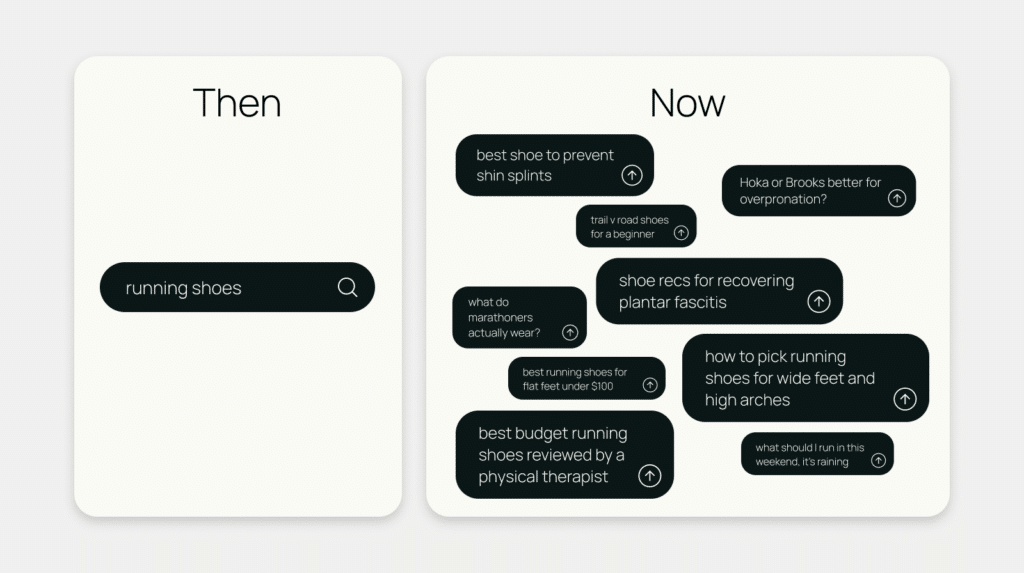
Keyword volume was always a proxy for demand, and it was never a great one at that. We tolerated the imperfect data because the search box forced everyone to round their question to the same handful of phrasings, so the proxy stayed roughly stable. AI search removed the rounding and added personalization to boot.
The search volume still tells you demand exists but it no longer tells you how anyone is actually asking.
If your target keyword is really 40 different intents, then “rank #1 for network segmentation” should stop being the primary objective (with the obvious caveat that a huge factor for showing up in AI search is showing up in SEO).
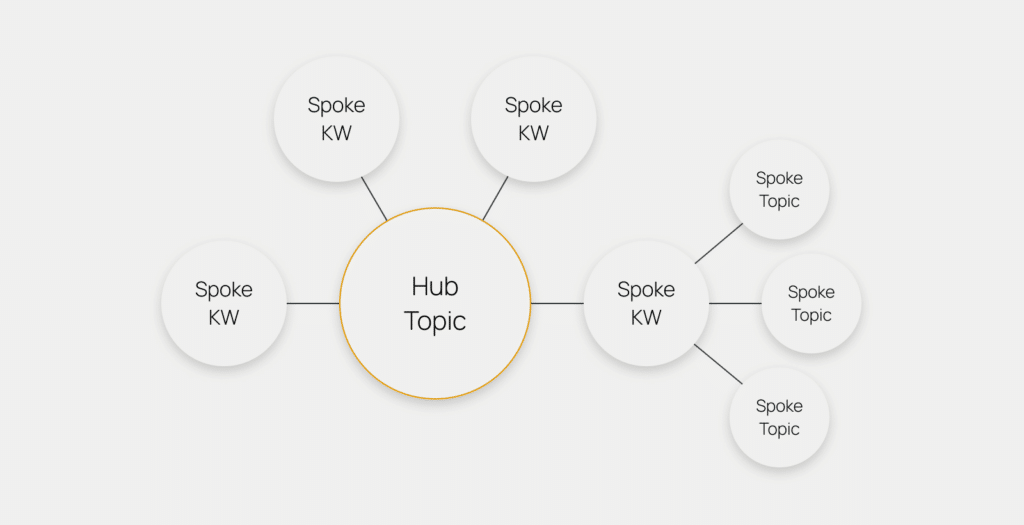
The goal should be to show up across a representative sample of the intents that volume is hiding. To cover the spread well enough that whichever way a real buyer asks, your brand is in the answer. That coverage can be achieved through larger, more comprehensive articles or guides, but we’re seeing more success with smaller and more direct content mapped to a hub and spoke model.
The big issue is that an AI answer is not stable like KW rankings typically are. Answers will vary with every search, every platform, and even between models on the same platform. If you track a single prompt and watch your “spot” in the response, you’re just measuring noise.
The current play seems to be to group related prompts into clusters (intent, funnel stage, product line) and read the aggregate over time across the most commonly used AI search platforms for your audience specifically. Then you should watch for changes over time, not focus too much on a single prompt.
If volume no longer tells you what people want, it becomes important to find other sources that do. Some areas we’re exploring and have found success include filtering search console queries, exploring forums and community threads like Reddit and Quora, customer interview, commonly asked questions or pain points from sales calls, expanding on concepts on the most visited and engaged with pages, and other internal data (support tickets, sales-call transcripts, site search, successful ad copy).
To be clear, I’m not advocating the industry stop using volume data and KW research entirely. We’ll continue to use it at 97th Floor. But we won’t treat KW research as a content calendar. It’s a market-validation signal and the work of deciding what to build comes from the real audience signals mentioned above.
Keywords aren't the only data worth rethinking, attribution is too.
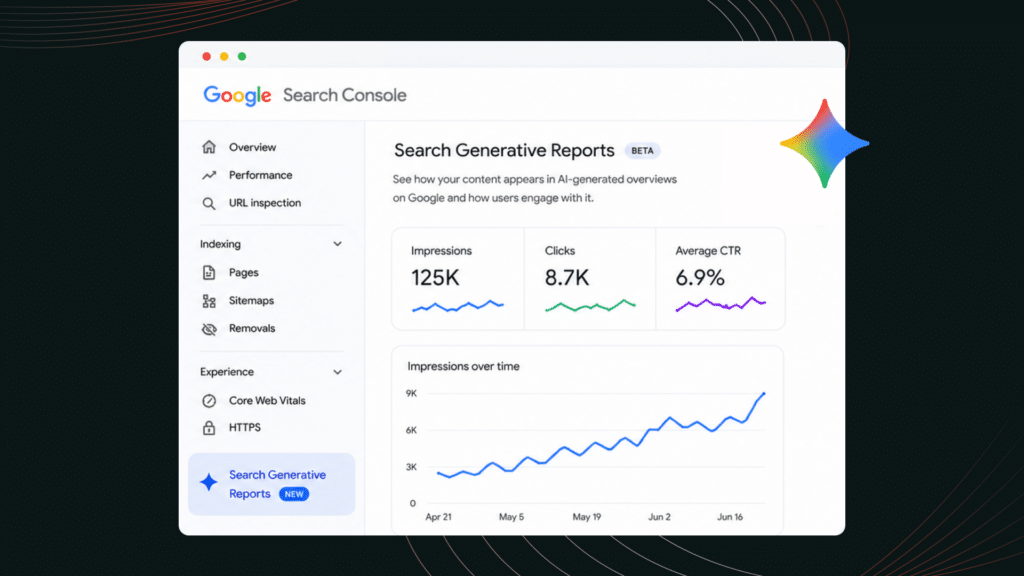
If you've logged into Google Search Console over the last couple of weeks and spotted a new "Generative AI" option, you're not imagining things. Google has started quietly rolling out a dedicated report that shows how your site shows up in its AI-powered search experiences (think AI Overviews and AI Mode). We caught wind of it internally and had our team dig through client accounts to see who has access, where it lives, and what it actually shows. Here's the rundown.
The new report lives inside the existing Performance section of Search Console and gives you visibility into impressions your site is generating specifically from Google's generative AI search surfaces — separate from traditional Search results and Discover.
For an industry that's spent the last year and a half asking "how do we even measure AI visibility?", this is a meaningful first step. It's the clearest signal yet that Google intends to treat generative surfaces as their own reportable channel, not just a footnote inside classic search results.
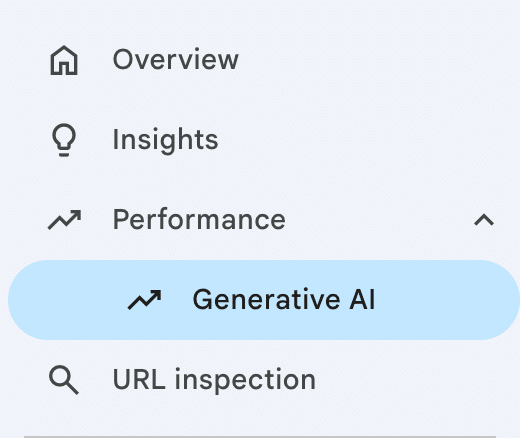
Here's where it gets a little messy: the report isn't showing up in the same place for every property. Our team found it living in two different spots depending on the account:
Some accounts have it as its own top-level report directly under Performance, sitting alongside Search results and Discover:
Other accounts have it nested a level deeper, tucked under Performance > Search results as a sub-report:
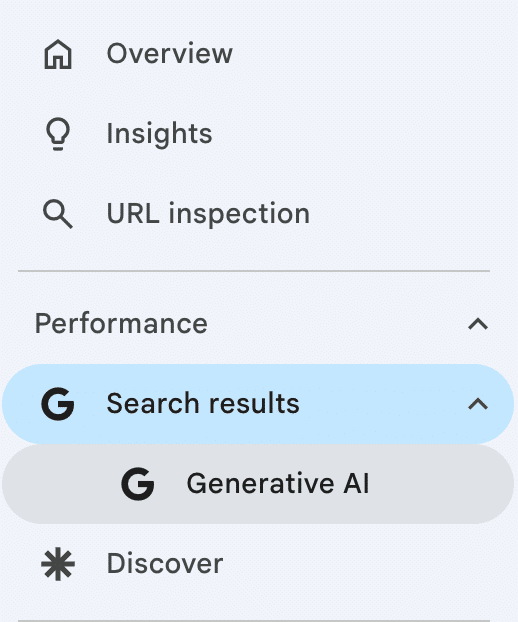
If you go looking and don't see it right away, check both locations before assuming your property hasn't gotten it yet.
True to form for a Google beta rollout, access is inconsistent right now. Across our client portfolio, some team members are seeing it on roughly half their accounts, others on fewer than half, and a few of us have it on almost none. There's no obvious pattern yet by industry, site size, or traffic volume. It genuinely looks like a staggered rollout rather than an eligibility-based one. If you or your clients don't have it, don't worry just yet. It's likely just a matter of time.
Before you get too excited about a new dashboard to obsess over, temper expectations on what it actually reports. Right now, the metric available is impressions only. This lines up with Google's own announcement of the report on the Search Central blog, and our team confirmed directly with Google that impressions are the only metric available for now — so it's not a bug or a data delay on our end.
That's a frustrating limitation. Impressions alone tell you that you're being surfaced, but not whether that visibility is translating into anything a client can act on or attribute value to. We'd expect (or at least hope) that Google expands this over time, but for now, treat it as a directional signal rather than a full performance metric.
We'll keep monitoring the rollout and report back as Google adds more to this feature. In the meantime, go check your Search Consoles, you might have new data waiting for you.
Remember when brand visibility mostly meant ranking on page one? This was back when readers had to click on pages to get the info they were after and AI was relegated to science fiction. It was a simpler time.
Not necessarily better… but certainly more straightforward.
Now your brand can show up in an AI-generated answer, get cited from a page you forgot existed, lose ground to a competitor in a recommendation list, or influence a buying decision without the user ever touching a traditional blue link. Search has become a kind of interpreter or paraphraser, applying artificial intelligence to pull information from pages and present it to the user in a (hopefully) clear and accurate way. The result is that more than half of online searches are zero-click. And when Google cuts out the middlebot, it changes what marketers need to be watching.
What I'm trying to say is that if you want to know how to track brand mentions in AI search results, you need to widen your gaze. SEO no longer begins and ends with ranking. It now extends to questions like "Does AI mention us?" "Does it cite us, and does AI talk about the brand in a positive or negative sentiment?" "Which pages does it pull from?" "How often do we appear compared to competitors?" And "Does any of this turn into actual traffic, leads, or revenue?"
Tracking brand mentions in AI search means monitoring when and how AI-driven platforms reference your brand in generated answers, recommendation lists, summaries, and cited sources.
But here’s the thing: AI search does not behave like classic search. Google’s AI features (for example) can generate overviews that summarize a topic and link users to a range of sources, while Bing now offers AI performance reporting tied to how sites are cited across Copilot and related experiences. Google also makes clear that AI Overviews and AI Mode still rely on essentially the same fundamental search requirements as the traditional approach.
So yes, rankings are still important. However with AI search, simply ranking for a keyword with one page is not the end goal, there’s more to it:
For example, a brand can show up in an AI answer even when it is not the top traditional ranking. Or a page can get cited because it answers a narrow question clearly. A competitor might get mentioned because information across multiple pages for things like reviews, product info, or comparisons are easier for AI systems to synthesize.
The point is that the future of search will remain search. It has just become more conversational, more layered, and a little more expansive.
This distinction is one of the biggest places marketers get tangled up. So let’s be direct:
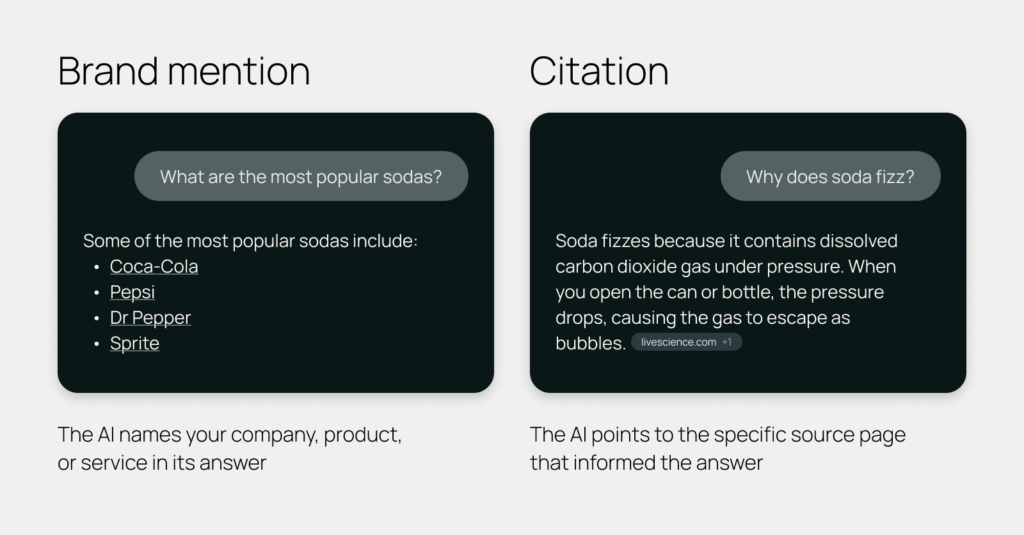
Which one do you want? Trick question, obviously; you want them both.
A mention can be flattering and still impossible to measure well. An owned citation can be less glamorous, but far more useful because it gives you something concrete to inspect. It's your page, and your site's analytics that can be measured and analyzed. Which page got referenced? How often? Did it receive traffic? Did users do anything useful after landing there? This is first-party data on the impact of AI search — which is more valuable than any AI search tracking tool, all of which are synthetic databases, or good guesses as to where and how you are showing up.
Or, think of it this way:
Google's documentation around AI features focuses heavily on how content becomes eligible for inclusion and how traffic from AI experiences is counted inside Search Console reporting. That suggests that source-level analysis should be part of the process.
OK. Let’s move beyond the academic: AI mentions, AI citations, cited URLs… does it all matter?
Yes. Unequivocally yes. Here’s why:
People are asking longer questions, more specific questions, and plenty of follow-up questions. Google has explicitly said AI search experiences are pushing usage in that direction, with users exploring more complex queries and broader source sets.
That means discovery is no longer confined to obvious high-volume keywords. Someone may find your brand while asking for the best agencies for AI SEO, the top platforms for generative engine optimization, tools similar to your product but better for mid-market teams with limited technical support and a weirdly aggressive CFO, etc., etc., etc...
The path from question to brand discovery is less clean and a lot less predictable. Measurement has to adjust to account for it.
AI assistants were built to assist, and that goes beyond just summarizing informational content. They can compare vendors, recommend providers, shortlist software, explain product categories, and shape buyer impressions before a click ever happens. As such, when a platform includes your brand in a recommendation set, you’ve already entered the buyer’s consideration stage — whether or not they ever visited your site.
And that’s great! It can also be unsettling.
If you’re going to let an opaque machine send potential customers to your virtual door, you’d better be paying close attention to how often it’s doing so, and on what terms. Otherwise, you’re letting the robot make your brand positioning decisions for you.
When your brand appears in AI-generated answers, it can function as a form of borrowed trust. Users are beginning to treat AI responses as synthesized expertise. But those answers are only as good as the sources underneath them.
The same qualities that make content useful for humans make it easier for AI to cite — one tactic leans into that more than any other. This short video breaks down the SEO move that Mike Witham and Blake Nielson from 97th Floor keep coming back to.
You should not confuse that with permanent authority. AI can be fickle, inconsistent, and occasionally wrong (and when it gets something wrong, it does so with supreme self confidence). Still, repeated inclusion shapes perception, and perception has a funny way of becoming influence.
If you’ve been in marketing for more than a few weeks, you’re probably already familiar with a tidy set of traditional metrics. You could follow rankings, traffic, click-through rates, and conversions, then build your strategy from there.
AI search adds some new layers to that picture by introducing answer inclusion, source citations, prompt visibility, and recommendation presence — all of which are signals worth tracking. That’s part of what makes AI search engine optimization a meaningful extension of the modern search strategy.

Brand visibility can show up in several kinds of AI-driven experiences. So, if you want to know where and how your brand is surfacing, you need to understand the environments in which those mentions appear:
Before you run off to buy seventeen subscriptions, start with the native data from the platforms (Google Search Console, GA4, Bing Webmaster Tools, etc.) themselves. That’s usually the best place to get a baseline view of how your site is appearing and performing.
Again, Google’s official guidance states that AI feature traffic, including AI Overviews and AI Mode, is included in Search Console’s Performance reporting for web search. It is not a perfect dedicated AI visibility dashboard, but it is still one of the best sources for understanding how your pages perform across Google search experiences.
Look at:
GA4 helps you connect visibility to behavior. Once users arrive on cited or AI-visible pages, what do they do? Do they engage? Bounce? Convert? Wander around aimlessly?
Even better, Google has added "AI Search" as a primary channel in GA4's default channel grouping. That means sessions arriving from AI search experiences can now be broken out and analyzed alongside your other acquisition channels — no custom regex gymnastics required.
Without that layer, you are measuring attention without taking outcome into account.
Bing’s AI Performance reporting adds a very useful angle. Microsoft says the report shows how your site’s content is used in AI-generated answers across Copilot and partner experiences, including cited pages and changes over time. This makes it one of the clearest native examples of AI citation tracking from a platform owner. Yeah, from Bing.
If you only track how often your brand name appears, you will end up with a very incomplete picture. AI visibility is bigger than that. Your measurement approach needs to be bigger as well.
So, in addition to the tried-and-true standards, what should you also be tracking?
Visibility without outcome is like getting dressed up to sit on the couch — you might look good, but you’re still not going anywhere. Tie cited or visible pages back to business performance by tracking sessions, engagement, leads, or conversions wherever possible. That kind of connection is what keeps AI visibility from turning into a vanity metric, and is increasingly central to evolving SEO strategies.
A practical tracking list might look like this:
The list of things worth tracking in AI search is longer than it used to be, but it's not unmanageable. Once you understand the difference between mentions and citations, know which environments your brand can surface in, and have a clear set of metrics tied to real business outcomes, you've built the foundation for a modern visibility strategy. Rankings still matter — they've just been joined by answer inclusion, citation sources, share of voice, and prompt visibility.
Of course, knowing what to track is only half the equation. The next step is actually doing it: building prompt libraries, running tests across platforms, monitoring citations, and optimizing the pages AI already trusts. (We cover all of that in our companion guide on how to track brand mentions and citations in AI search.)
And if you'd rather have a partner in your corner, 97th Floor can help you measure and improve your brand's presence in AI search. Contact us to see how we can help you strengthen your search visibility today… and as AI continues to revolutionize the landscape for years to come.
Every week it feels like something new is being pushed on LinkedIn or Reddit as the next must-have for AI Search Optimization. Schema, FAQs, key takeaways, Markdown, markup, EntityMap, and now llms.txt, and it's a lot. The pressure from leadership to produce results, combined with the fear of missing the one thing that unlocks perfect AEO/GEO, is keeping digital marketers up at night (myself included).
One I've heard a lot about recently is llms.txt. There's real misinformation circulating around it, and it's spread well beyond the SEO world to people who don't fully understand what it means or does. I've personally heard it pitched by a non-SEO consultant as the magic tool that would help their client dominate the competition in LLMs.
So let me be clear: llms.txt is not a magic SEO or GEO bullet. It is not a guaranteed citation or mention in AI.
It is, however, a useful tool and one worth understanding now, even if you're not ready to implement it yet.
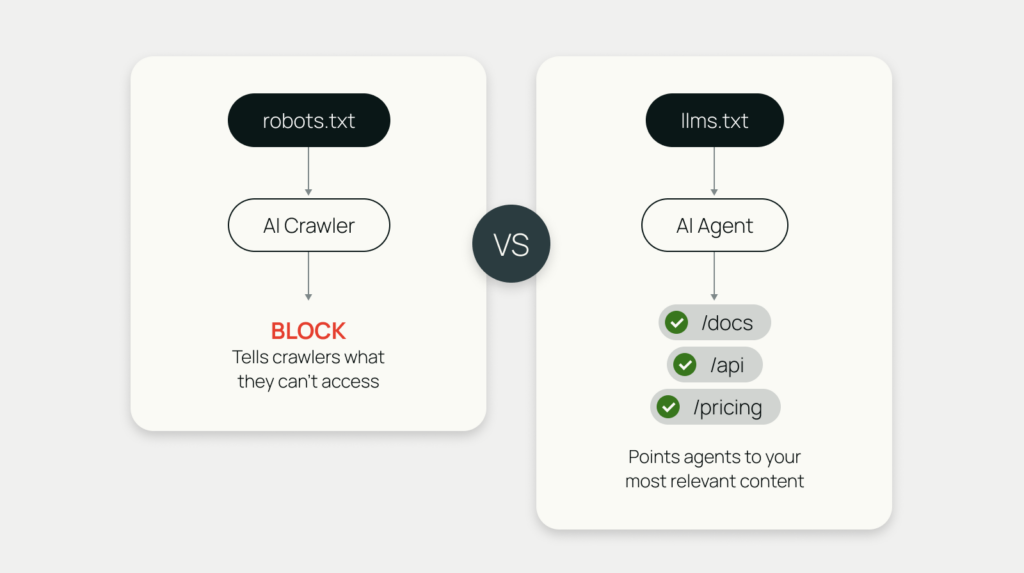
If you've seen llms.txt compared to robots.txt, that's not wrong and in fact it was directly inspired by it. Both are simple, standardized files that live at the root of your domain and give automated systems structured guidance about your site. But they work in opposite directions: robots.txt tells crawlers what they can't access, while llms.txt tells AI agents what they should go to. Same spirit, different job. There is one important caveat they both share, though: neither file physically forces compliance. Just as robots.txt is really just an instruction manual that bots can choose to ignore, llms.txt relies on AI agents actually choosing to use the map you've provided.
Think about it this way. When you were in school and needed to look up when a historic event occurred or the formula for a chemical reaction, would you flip through your textbook page by page? Absolutely not. That would've been a waste of time.
What you did ( hopefully) is use the table of contents or index to get right where you needed to go.
That's essentially what an llms.txt is. Per llmstxt.org, the standard's purpose is to provide a clean, structured entry point for LLMs and AI agents . It’s a simple markdown file that points to the most relevant, high-signal resources: documentation, APIs, structured data endpoints, key pages. Think of it as a directory that helps autonomous agents (like coding assistants or research bots) find what they need without burning tokens crawling an entire site.
And this is where a lot of the confusion creeps in: llms.txt is not a place to stuff marketing copy or brand messaging hoping LLMs will give it extra weight. That's not its purpose, and it's not how it works. Your website and the quality of the content on it still does that job.
The llmstxt.org spec is intentionally minimal. The only hard requirement is a title. From there, the file is meant to include brief descriptions of what your site or product does, and links — specifically links to documentation, APIs, or other machine-readable resources that an AI agent would actually need to take action.
The operative word there is agent. This standard was built with agentic browsing in mind: AI systems that don't just answer questions but actually do things — pull API data, complete tasks, navigate workflows. Google's own Chrome team has started acknowledging this explicitly. Their Lighthouse documentation for agentic browsing specifically calls out llms.txt as part of a forward-looking set of signals for helping AI agents interact with your site more efficiently.
Google Search's AI optimization guide echoes a similar principle: structured, accessible, high-signal content helps AI systems understand and surface your information. llms.txt is one expression of that — though notably, Google has not said it will treat llms.txt as a ranking signal. The value is functional, not algorithmic.
Here's the honest answer: for most sites right now, llms.txt is not urgent. Google is being vague about it. LLMs don't require it to crawl or cite your content. It won't single-handedly move your brand visibility in AI answers.
But we are moving fast toward a world where agentic AI is the norm, a world where users aren't just asking chatbots questions but deploying AI to complete tasks on their behalf. If your site has documentation, APIs, or structured resources, an llms.txt today is low-effort infrastructure for a future that's approaching quickly. If you're already building for agentic features, it's a meaningful signal of readiness.
The way I think about it: implementing llms.txt is less like installing a new engine and more like labeling your filing cabinet. It doesn't change what's inside. But when an agent shows up needing to find something fast, you'll be glad it's there.
Mike Witham and Rachel Bascom cut through the noise on what LLMs actually reward — and AI-generated filler isn't it. They break down what trustworthy content looks like to a model that's seen everything.
llms.txt is an emerging, evolving standard. It's not a shortcut to AI visibility. It's not a replacement for good content, clear site architecture, or authoritative expertise, and knowing your audience. But it is a reasonable, and fairly easy, low-cost step toward being ready for what's coming.
Keep an eye on it. Understand what it actually does. And when it makes sense for your site, implement it the right way.
A potential customer asks an AI tool for a recommendation. Your brand has the expertise, the service, the proof, and the answer they need. It seems like it’s a match made in search-marketing heaven. But then the AI response cites three competitors and leaves you out entirely.
That’s the kind of problem being faced by today’s marketers. Search visibility is no longer limited to rankings and clicks; it also depends on whether AI systems decide to highlight your contributions. And understanding how to encourage those systems to give you your shot means thinking beyond traditional search engine optimization (SEO).
Generative engine optimization (GEO) is a new frontier in search… one that requires not only a revised approach, but an updated marketing mindset.
OK. If you’re reading this post you’re probably familiar with the idea of AI search, so I’ll just do a quick recap: Instead of sorting through SERPs, users can now ask ChatGPT, Perplexity, Gemini, Copilot, Claude, or Google’s AI-powered results for direct responses to their search queries. The answer may include citations, brand mentions, summaries, comparisons, or recommendations — but in more and more searches, one thing it doesn’t include is a click.
This has led to a sometimes heated (for marketers, anyway) debate that centers on GEO vs. SEO and whether traditional search strategy is still enough on its own. The answer, inconveniently, is no. SEO still does the foundational work of helping content get discovered, indexed, ranked, and clicked. But GEO determines whether that same content is clear, credible, and structured enough to be used.
In the new AI-centric search environment, your brand needs to establish its presence in more than one place. Ideally, that means being mentioned in the AI Overview, cited as a source, present in organic results, visible through search ads (where appropriate), and supported by any SERP features that help the user make a decision.
Traditional search engines provide options. Answer engines provide synthesis. They collect information, interpret the query, and return something that feels more like a destination than a map. The AIs aren’t standing between you and the solution; they’re sorting through the available info and presenting the (hopefully) best parts to you in a way that is much more accessible.
That does not mean traditional SERPs are dead. People still search, compare, click, skim, abandon pages for no clear reason, and return three days later from a different device like nothing happened. But AI platforms are increasingly becoming central to that journey. Especially when users want fast answers or support. Search is becoming less of a single path and more of an intricate spiderweb of touchpoints, with SEO and GEO helping brands appear in the various places where people now go to get answers.
The kicker is that ranking well does not guarantee inclusion in AI-generated responses. AI systems tend to favor content that is unambiguous, current, authoritative, and easy to interpret. If a page has strong rankings but buries the answer under meandering language and an early-2000s obsession with keywords, it still may not be useful enough to cite.
And just so we’re clear, a lot of those elements I just mentioned that AI systems gravitate toward are the same things that have always helped content rank well. It’s just that AI search has less patience for content that makes the answer difficult to extract. Traditional SEO may reward a strong page even when the good stuff is buried; AI systems are more likely to move on and cite the source that says the useful thing clearly. As a writer, I hate this (I think language should be a journey). But as a marketer I can see the value in getting right to the point.
AI Search requires information to be complete, unique and delivered efficiently to bots and agents. And that means being visible to potential customers now comes with the prerequisite of being visible to AI.
Like I said, the two approaches overlap. That’s good news for marketers! It means you can focus on strategy without having to pick one over the other. GEO and SEO should be working together to support the same customer journey. Even so, there are a few major distinctions you need to be aware of.
SEO focuses on rankings, impressions, organic sessions, click-through rates, and conversions. By comparison, GEO prioritizes inclusion in AI answers, citations, mentions, and accuracy of representation. That means that, in addition to standard keyword coverage, optimizing content for generative AI requires direct answers, consistent terminology, credible support, and information that can hold its shape outside the original page.
The goal of SEO is usually to get a user to click through to a website. GEO often operates in zero-click environments, where the user may get enough information directly inside the AI interface and thus never needs to visit the website at all.
But wait, if there’s no click to be had, why are we bothering?
The answer is that the value is still there; it just shows up differently. A buyer may see your brand in an AI-generated comparison, search for you later, revisit through branded search, and finally convert after talking with your sales team. And when your brand appears across multiple search surfaces — AI Overview mentions, citations, organic listings, paid ads, and SERP features — you create more chances to reinforce trust before the user ever reaches your site. But if your reporting only cares about the first click, that potential influence remains untapped.
For SEO, teams should continue tracking:
For GEO, the measurement model should expand to include:
Taking this big-picture approach will help you answer the most important performance question in modern digital marketing. Namely, were you part of the answer that shaped the buyer’s next step?
The marketers who reach the C-suite aren't the ones who mastered a channel — they're the ones who could tie it to an outcome. This short video breaks down the specific gap that stalls talented marketers before they get there.
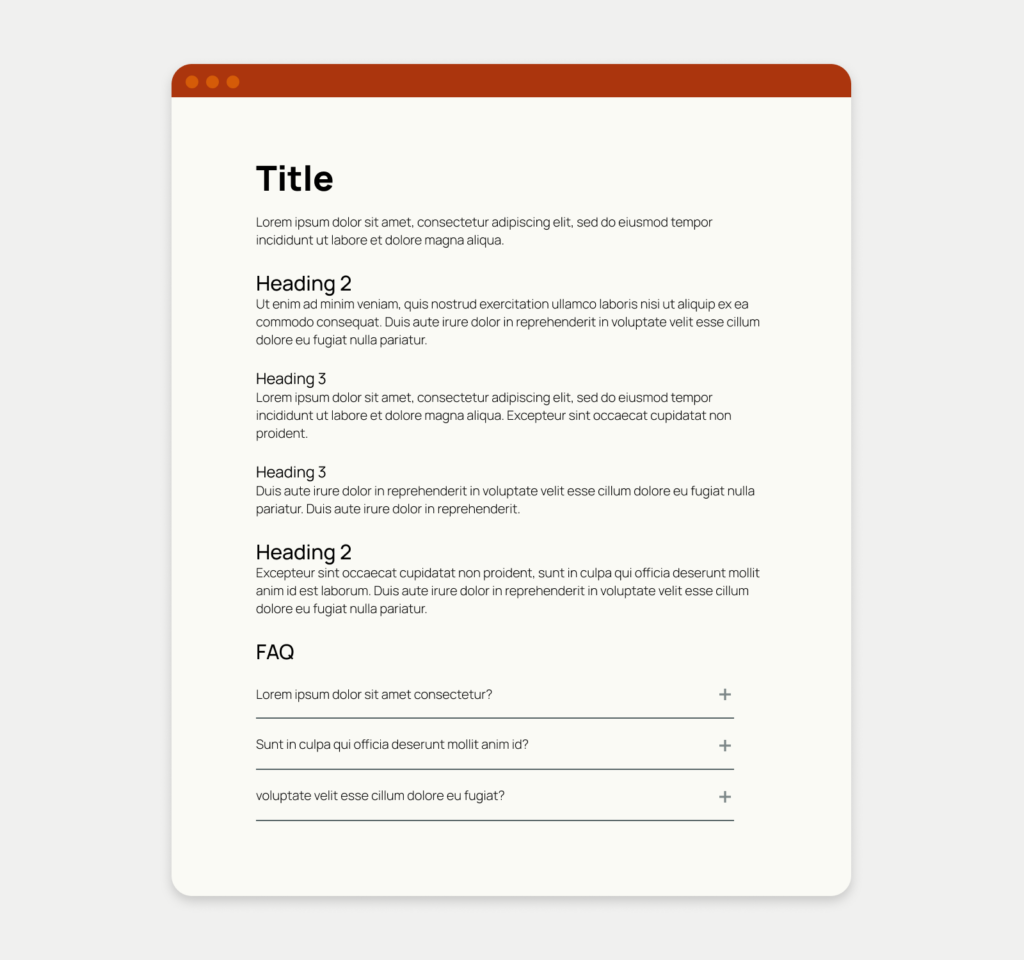
Content needs to be easy for AI systems to parse, summarize, and trust. But before you go draining your content of any semblance of personality, take a step back. Remember: The goal is to make the useful parts easier to find. There’s no reason you can’t do that while still creating something engaging, entertaining, and inspiring on a personal level.
So, if you’re asking how to optimize content for AI search, start here:
Weak SEO makes AI visibility harder. If your content is difficult to crawl, poorly organized, thin, slow, or disconnected from the rest of your site, you are asking AI systems to look someplace else for a source that knows how to cross its Ts. SEO helps build the technical foundation and broader web presence, while GEO helps that presence become clear enough to cite, mention, and reuse.
Just to reiterate this point as explicitly clear as possible: SEO shouldn’t be fighting against GEO. A modern hybrid approach to search engine optimization is about optimizing for all parts of the journey — one that can easily start with an AI overview before transitioning onto more traditional search paths that ultimately lead into a conversion.
If your current SEO program is doing well, then good. That gives you a stronger foundation. But prominent spots on the SERP do not automatically mean your content is ready for AI search. That sucks, but here we are.
So let’s get introspective. Use these questions to assess where you stand:
97th Floor approaches AI search as part of a larger search ecosystem for a truly hybrid digital-marketing strategy. The focus is on using SEO as the foundation of GEO and connecting the pieces that determine visibility:
We recognize that fragmented tactics create fragmented results. Strong rankings without AI readiness can mean your zero-click audience never sees what you have to offer. 97th Floor has the experience and innovative drive to connect the technical foundation of SEO with the answer-first demands of GEO, preserving your brand’s place in the conversation.
Contact 97th Floor today, and optimize your content for both search engines and AI.
1 billion users. That is the usage rate of AI mode reported by Google at Google I/O. It seemed for a while like Google was trying to slowly adapt traditional search by enhancing the “Featured Snippet” SERP feature by replacing it with the “AI overview” SERP feature. All while creating their own versions of ChatGPT like chat bot, in Gemini. However it is clear after Google I/O, that Google is seeking to transform the entire search experience. Transform it into an almost personal assistant, a chatbot on steroids. They are doing this by making search more conversational, using your search history as context to create custom, tailored to the user, search results. Using Search Agents, they will continuously scrape the web for updates, or new information on topics and products you are interested in, and provide summarized reports of its findings.
What are the strategic shifts that need to take place for GEO?
These changes have real implications for SEOs, content marketers, and anyone who cares about optimizing for search engines or generative engines. So, what should search marketers care about and watch out for in the coming months? Lets review a few strategic shifts that need to take place:
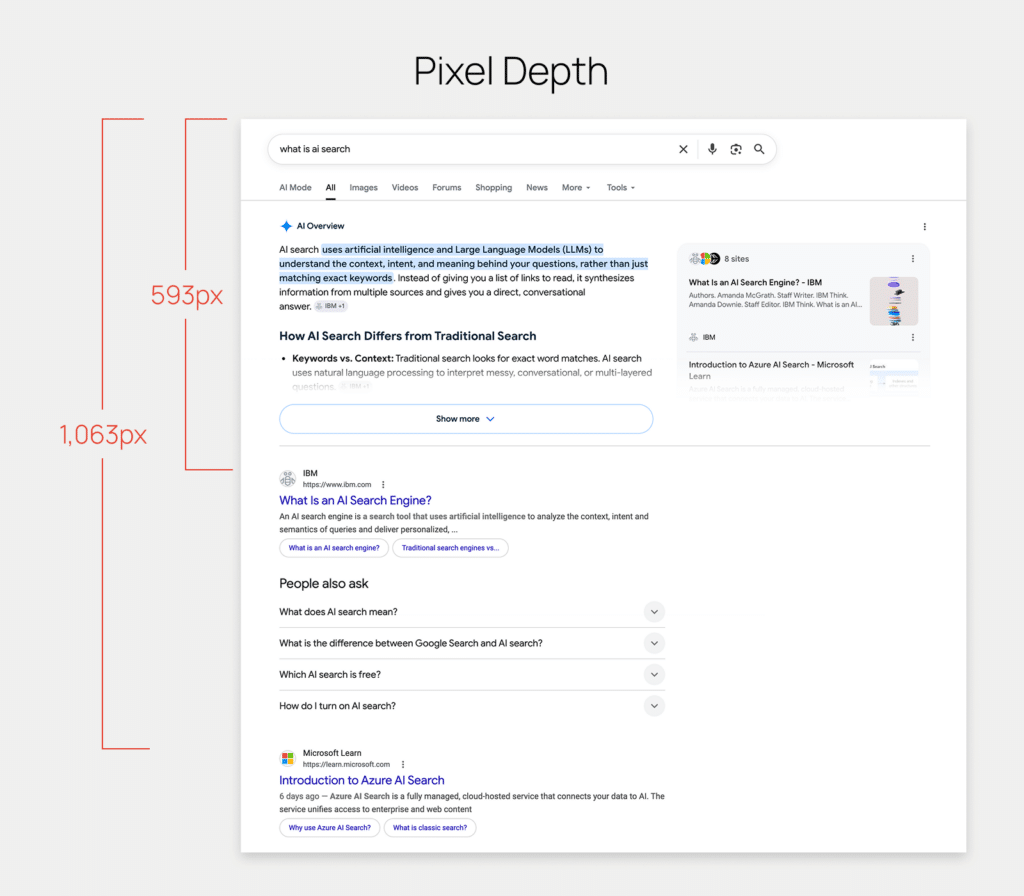
The shift from bots to agents is the real game changer.
Everything covered above, pixel depth, sentiment, brand mentions, crawl efficiency is going to be table stakes compared to where search is headed. The next 2-3 months will start to reveal something bigger: the difference between optimizing for a bot that crawls your content and optimizing for an agent that acts on it.
Google's Search Agents aren't just passively indexing. They are completing tasks, comparing products, summarizing findings, and delivering recommendations directly to users, often without the user ever visiting your site. That changes the goals of Search Marketers in a meaningful way — here's what that means for your conversion path.
So what should you be watching over the next 90 days?
First, watch how your brand gets used, not just mentioned. As agentic search matures, the question won't only be "does the LLM cite us?" it instead will be "does the agent choose us when it's acting on behalf of a user?" That means your content needs to be decision-ready. Structured data, clear pricing, availability signals, and unambiguous value propositions aren't just nice-to-haves anymore. They're ranking factors, inputs an agent evaluates when it's doing the shopping, researching, or comparing for someone.
Second, keep a close eye on how conversational context affects your citations. Because Google is now using search history to personalize results, the same brand mention or citation may appear for one user and not another. This makes aggregate tracking less reliable and user-journey-level thinking more important. Start mapping which prompts and queries at each stage of your funnel you want to own and measure accordingly.
Third, don't sleep on structured data for agents. Just like robots.txt told crawlers what to do, the next wave will likely include providing signals to agents on what we want them to do with your content. Stay close to what Google and other AI platforms announce around agent permissions and content licensing, this space is going to move fast.
The brands that win in GEO won't just be the ones writing helpful content. They'll be the ones making it impossible for an agent not to recommend them.
If you lead marketing at a mid-market or enterprise company, you've had some version of this meeting recently:
Then Google I/O 2026 happens.
At I/O, Google announced that AI Mode has surpassed 1 billion monthly active users, with queries more than doubling every quarter since launch. AI Overviews crossed 2.5 billion monthly users.
Google is calling the new AI-native Search box the biggest upgrade in over 25 years. Antigravity launched as the new agent layer. Multimodal queries now take in images, video, files, and whatever's open in your active Chrome tab. Agentic shopping and booking arrive later this summer.
Organic search (and SEO) just got its biggest expansion in a quarter century. Understanding that will decide which marketing leaders look prescient at next year's board meeting and which ones don't.
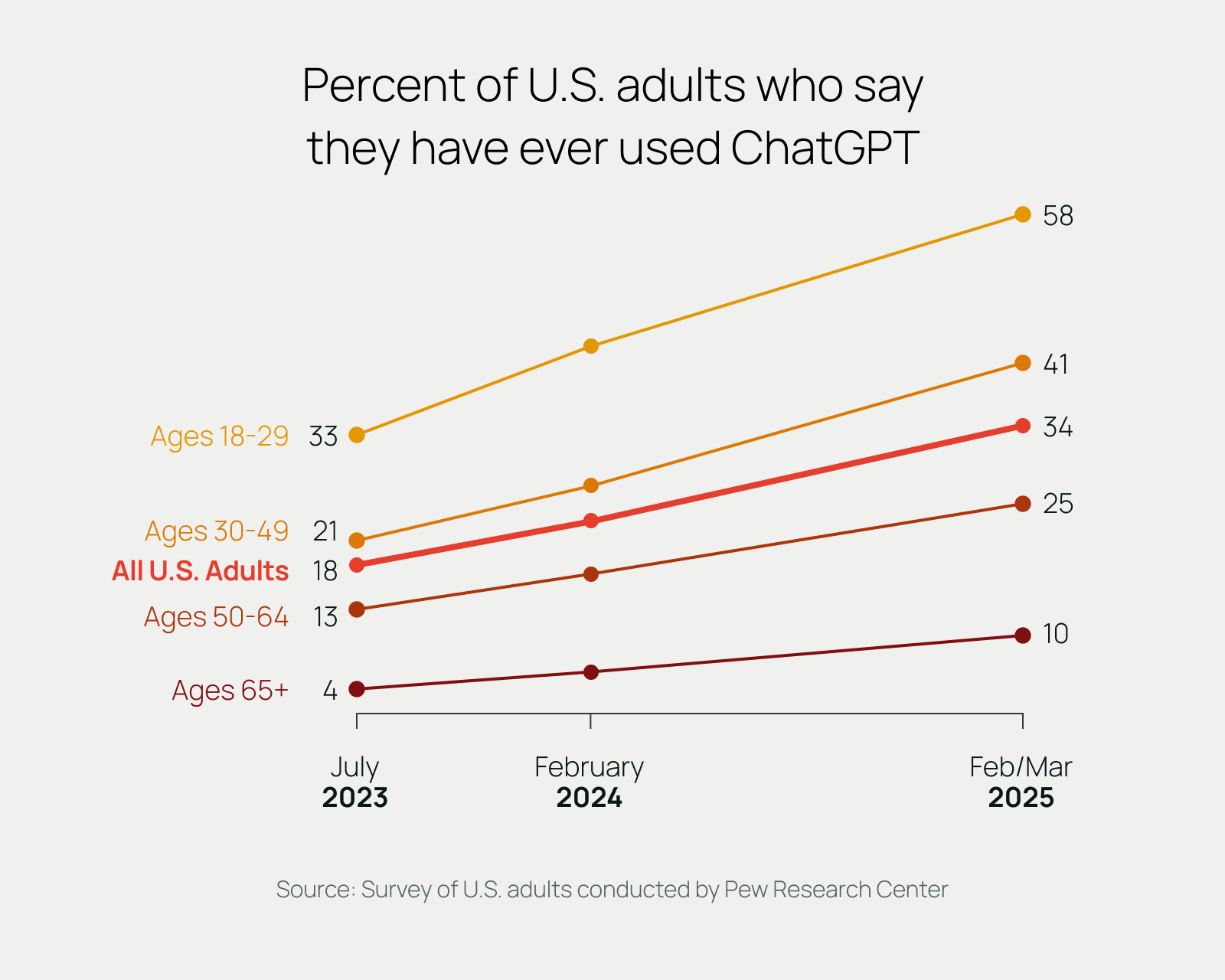
“How do we win back the click the AI Overview took?” It’s the question most marketing teams have been asking and is almost guaranteed to produce wasted effort. The click went to Google's own answer surface. The audience went with it. According to Pew Research, 34% of U.S. adults have now used ChatGPT (doubled since 2023) and 65% see AI summaries in their search results for most queries. Sixty percent have used AI to search for information, a number that climbs to 74% among people under 30.
You can't out-rank Google's AI Overview by writing a better article on the same topic! Google will just use your article to write the next Overview.
The right question is, “whose attention is in this query, what do they actually want to know, and what will make them choose us when they're ready to decide?”
If you built your last five years of organic strategy on ranking-first thinking (meaning picking a keyword, writing to whatever's at position 1, optimizing on-page, and repeating monthly), the playbook just stopped working because the SERP that playbook depended on no longer exists.
If you built those five years on audience-first thinking then the playbook works exactly the same way in an AI Overview, a Gemini response, a Perplexity citation, or a blue link. The same persona work, the same journey map, the same writing discipline produce the same outcome. Only the surface changed.
The Gartner 2026 CMO Spend Survey found that 56% of CMOs say their marketing organization lacks the budget required to deliver their 2026 strategy. Marketing budgets sit flat at 7.8% of revenue. Seventy percent of CMOs consider becoming an AI leader a critical 2026 goal but only 30% report mature AI readiness.
The C-suite expects AI-led marketing transformation, but the budget and operational readiness to deliver it both lag.
The wrong thing to spend the dwindling marketing budget on is chasing every new AI surface as if it were a distinct discipline. The right thing is to invest in the part of the work that compounds across every surface: 1) deep audience understanding, 2) content that earns citation, and 3) measurement that holds up at the board level.
For the past two years, every other LinkedIn post in the marketing world has been a version of "organic traffic is dying." If you only watch the “Sessions” chart in GA4, the trend lines on a lot of sites look bad. Click-through rates from AI Overviews are still lower than from the old blue-link SERP, even though early 2026 data suggests AIO CTRs are recovering as Google refines the experience.
But it's the wrong metric and the wrong frame.
The audience didn't go anywhere. They're searching more than they ever have. They're just doing inside Google (and other AI search platforms) what they used to do across five different tabs. When a user gets a satisfying answer from an AI Overview that cites your brand, then comes back later and goes directly to your site, GA4 sees a direct or branded organic visit. The GEO/AEO work that earned that visit is invisible in the dashboard.
The audience isn't gone. The measurement is just behind. The marketing teams that figure out how to help leadership understand AIO citation share, brand mentions across AI platforms, query coverage and sentiment, and downstream conversions from each of those surfaces are going to keep their budgets while everyone else fights to defend declining sessions.
The framework we run at 97th Floor is three words: Empathy, Innovation, Profitability. We call it P.I.E.
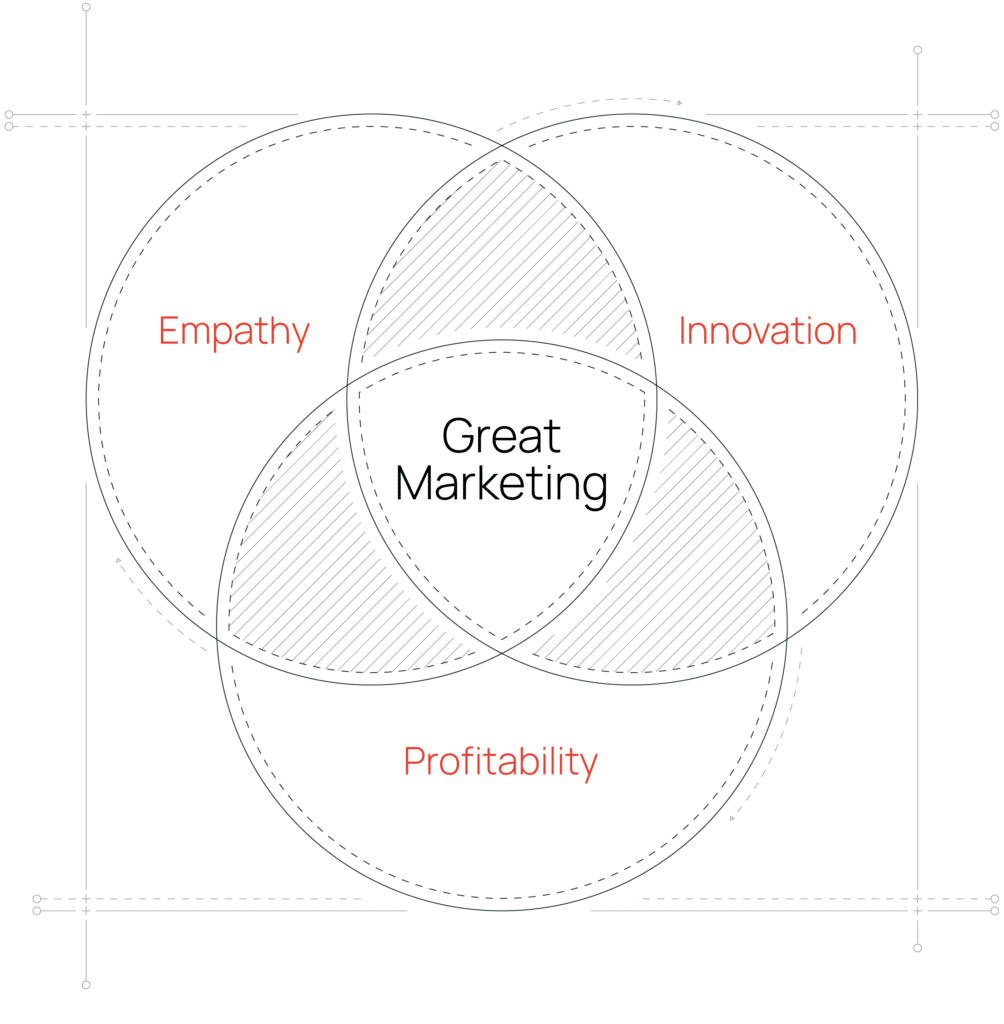
“Empathy” means obsessing over who our client's audience actually is, beyond their role as a buyer. What they're trying to do, what they already believe, what they're worried about, what they search the moment before they ever search.
“Innovation” means refusing to copy whatever is already ranking. The brand that produces the eleventh-best version of an existing SERP article is now going to get eaten by AI, fast. The brand that produces the actual answer to the question the audience is asking will get cited.
“Profitability” means tying every campaign back to revenue, not vanity metrics. AIO citations don't pay your bills. Brand mentions that lead to more branded search, more direct traffic, and more conversions do.
This framework was always a bet that algorithms and platforms would change but the principle wouldn't. From my POV, that bet just paid off.
Going into 2024, our client in B2C Finance was a SERP underdog in private student lending. The "student loans" category was dominated by federal sites and the giants of the private lending world:
- studentaid.gov: 11.8M monthly organic traffic, 3,118 pages
- consumerfinance.gov: 1.4M, 8,492 pages
- ed.gov: 1.2M, 93,208 pages
- salliemae.com: 380K, 406 pages
- earnest.com: 156K, 619 pages
- Our Client: 49.7K, 399 pages
That's the field our client was up against, right as AI Overviews started reshaping the SERP. From the outside, that looked like the wrong moment to invest in organic. They did it anyway, because the investment was in the audience, not in keyword positions.
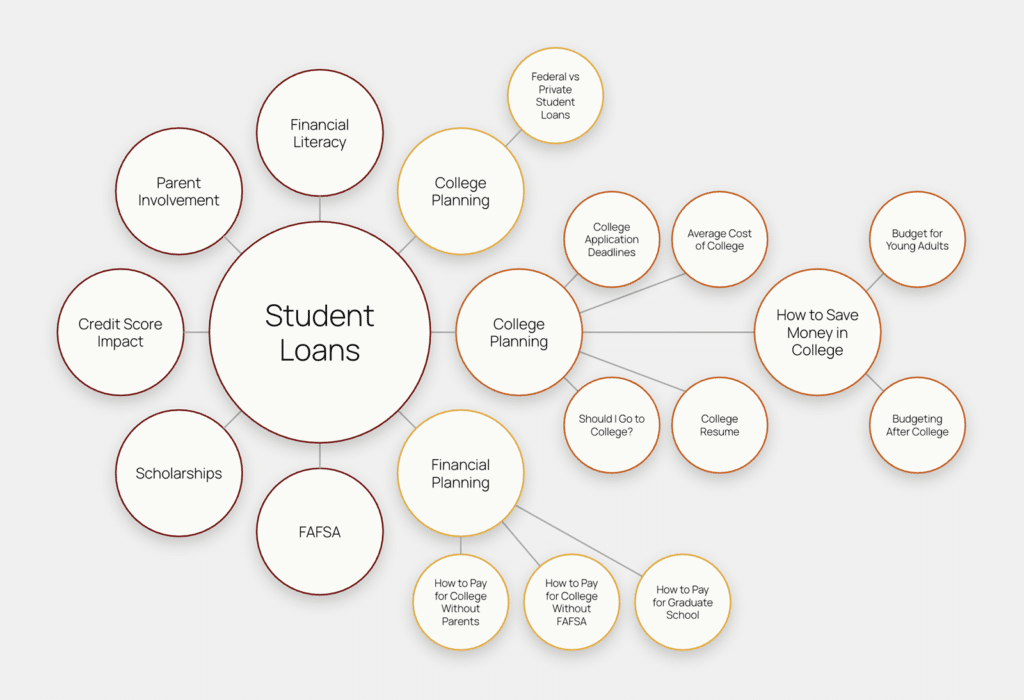
The work was deliberate. We built a hub-and-spoke topical authority structure around "Student Loans." Pillar page in the middle. Cluster pages for FAFSA, Scholarships, Types of Student Loans, and College Planning. High-funnel content for the parents of student borrowers like “Credit Score Impact,” “Parent Involvement,” “Financial Literacy,” “How to Pay for College Without FAFSA,” etc... All with internal linking that made clear to Google which page was the authoritative answer for which query.
The writing approach mattered more than the structure. Instead of producing content based on whatever was currently sitting in the top 10 SERP results for each keyword, we researched every question a student or parent might have at every stage of the loan application process, then answered those questions in depth. Transparency on rates and loan terms was deliberate. So was incorporating proprietary survey data from the client themselves, which gave the content real experience, expertise, authority, and trust, the E-E-A-T signals Google's own quality guidelines (and the LLMs reading from them) reward.
We produced:
- 162 new pieces of content
- 62 re-optimized pages
- 455+ strategic mentions across the web
The results:
- 1,275% increase in brand mentions across AI surfaces
- 400% increase in owned AI Overview citations** since AI surfaces started becoming prevalent
- 47.5% YoY increase in search impressions
- 14.11% YoY increase in organic traffic
- Private Student Loans page +113.6% YoY organic
- Homepage +46.08% YoY organic
- 100% of new content published in Q3 2025 is currently cited in Google's AI Overview
All in a year when most sites in the category were watching organic decline. (Read the full case study here)
The client was directly up against some incumbents with much larger budgets. They didn't beat them on sheer volume. They beat them by answering the questions the audience was actually asking, at depth, with transparency, using the brand's own data.
If you're leading marketing at a mid-market or enterprise company right now, I’d take a look at five moves are worth committing to:
1. Stop measuring organic by sessions alone. Build a richer story for your executive team and help them understand AIO citation share, brand mentions across AI platforms, query coverage/sentiment, and lagging indicators like direct traffic and branded searches. With 56% of CMOs telling Gartner they don't have the budget to deliver their 2026 strategy, the orgs that can demonstrate where the work is actually paying off will defend their resources through this transition.
2. Pick the topic. Then own it. Topical authority is what wins in AI search. Our B2C Finance Client didn't win because they outranked Sallie Mae on the exact-match keyword "student loans." They won because they owned the conversation around student lending for the audiences that mattered. Pick the conversation your audience actually cares about. Be the obvious answer in it.
3. Refuse to produce the eleventh-best version of what's already on the SERP. AI is going to compress that work into one summary, and that summary will not cite you. The content that gets cited adds something like proprietary research, the brand's actual point of view, or depth on the questions the rest of the SERP isn't bothering to answer.
4. Optimize for the agent that's about to start buying things. Google's agentic shopping and booking features launch this summer. The brands with clean product information, transparent pricing, and well-structured data will be the ones AI agents include when a user says "find me three options for X." Treat the agent like a buyer. Make the path easy.
5. Treat audience research as a defensible asset, not a tactic. Persona work, journey maps, and voice-of-customer data survive every Google update, every platform shift, every UI change. They're the only competitive moat a marketing org can build that compounds over time. If you don't have a real one, build it before you spend another dollar on tactics.
The marketing leaders who will win the next five years are the ones who will refuse to panic when the platform changes and who will, instead, keep the audience at the center of every decision.
