I spend a lot of time thinking about what separates a good agency from a great one.
Most agencies can deliver what they promise. They hit deadlines, ship the content calendar, show up to every call, and send a tidy report at the end of the month... Those things are important, and clients should absolutely expect them.
But the real value of an agency comes from what happens beyond those deliverables.
Are we paying attention to what's actually moving the business forward? Are we bringing ideas and recommendations that our clients haven't considered? When something isn't working, are we taking responsibility for figuring out why and what to do next?
As VP of Client Services at 97th Floor, I oversee the teams responsible for delivering results for our clients. And one of the things I care most about is building a team of marketers who take real ownership of those results.
That means having opinions, challenging assumptions, collaborating, and being willing to try something different when the current approach isn't working.
It's also what I believe makes an agency genuinely valuable to the businesses it serves. Here's what that looks like in practice at 97th Floor.
We own our influence on the outcome
At a recent company meeting, our CEO walked the whole team through a framework from The 7 Habits of Highly Effective People: the circles of concern, influence, and control.
- Concern is everything you care about but can't move.
- Influence is what you can shape but not dictate.
- Control is what's 100% yours.
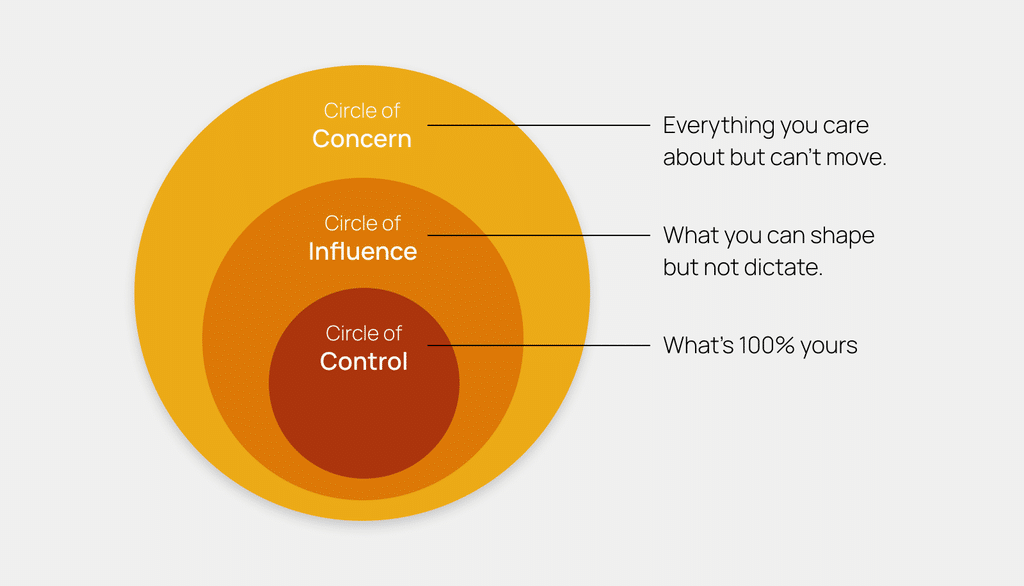
Then he asked the room a question: where do client results sit?
My perspective is that we have a tremendous amount of influence over client outcomes, and that influence starts with how we define success in the first place.
This is something I consistently advocate for with my team. Our responsibility isn't to blindly accept a goal and hope we can achieve it. It's to use our expertise to determine what's realistic, where the biggest opportunities exist, and what it will actually take to get there.
Think about how much time and money a business can waste pursuing a goal that was never realistic to begin with. Or investing in something simply because it was part of the original plan, when there are much better opportunities sitting right in front of them.
That's where I expect our team to step up. If we don't believe a goal is achievable, or we see a better use of the client's resources, we have a responsibility to say so. Bring the data, make the case, and recommend where we believe their investment will make the biggest difference. Even when that means challenging what the client originally asked us to do.
We can't guarantee every outcome, but we can take ownership of the goals we help establish, the strategies we recommend, and the decisions we make along the way. And when things aren't working, we have a responsibility to recognize it, understand why, and recommend what needs to change.
That's the value of hiring experts. You should be able to trust that they're helping you make the best decisions for your business, even when those decisions look different from what you originally had in mind.
The scope of work is the floor, not the finish line
97th Floor runs as a Results Only Work Environment (ROWE). Our team has the freedom to decide how they work. That freedom comes with a non-negotiable: you own the outcome.
A scope of work defines what we're responsible for delivering. It's an important guideline. But it is not the result. Our expertise decides how we approach the work and what we recommend to actually move traffic, conversions, and revenue.
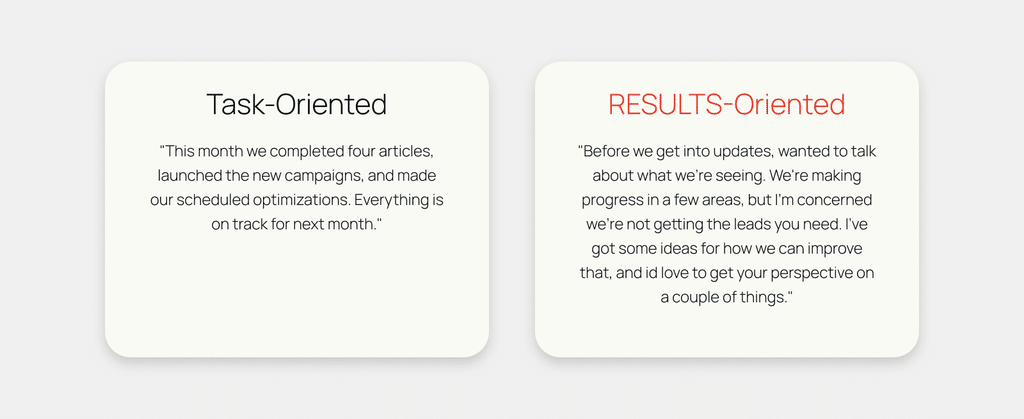
Ownership changes the questions we ask, the decisions we make, and ultimately, the value we bring to our clients. Here's what that looks like in practice:
| Task-oriented | Results-oriented |
| "Conversions are down, but we did everything we said we would. We're not sure what else to try." | "Conversions are down. I've dug in. Here's what I want to change, why I think it'll work, and how long until we know." |
| What's due this week? | What actually needs to happen? |
| What did the client ask for? | What does the client actually need from us? |
| Did I complete my work? | Where did my work make a difference, and where didn't it? |
| What should I tell the client today? | What does the client need to understand? |
The “Results-oriented” column is the expectation for every person on our team, from associate to senior. If your content isn't getting published or your optimizations stall in review, we don't shrug and point to the SOW. We ask why, and we fix the disconnect, whether that's education, prioritization, or showing more clearly what the work will return.
Ownership matters most when the results fall short
Taking ownership of results means being just as invested in figuring out what's not working as we are in celebrating what's going well. And some of the most valuable work we do for our clients happens when we have to rethink our approach, make adjustments, and find a better path forward.
A recent client experience is a great example of this.
One of our SaaS clients recently made a significant investment in paid media after being consulted on a growth opportunity that came with promising projections. Based on that guidance, they secured additional budget to pursue the strategy.
After ramping up the campaigns, results fell short of expectations. While the original recommendation hadn't come from our team, the investment had been made, and we weren't about to let that opportunity go to waste. We took ownership of understanding what wasn't working and finding a better path forward.
Our Senior Ads Manager kept everyone informed, proactively sharing what we were seeing, what we were testing, and what we recommended changing. Working alongside our creative team, we cut spend on underperforming campaigns, launched new comparison and demo video ads, built industry-specific targeting for sectors like hospitality, manufacturing, and energy, and moved budget to the ads driving the most sign-ups.
The following month, acquisition cost fell 23%, from $856 to $659 per new paying user, while volume held steady at 773 new paying users. Compared with July, the last month before the ramp-up, that’s 37% more new customers each month at an acquisition cost only about 6% higher.
Despite the initial setbacks, we earned even greater trust in our partnership. They had confidence in the decisions we were making, understood what we were learning, and were excited enough about the direction to pursue further investment and experimentation.
We won't get every recommendation right, and results won't always go according to plan. But our clients should never have to question whether we're paying attention, taking ownership, and doing everything we can to make their investment worthwhile.
We bring the ideas you didn't ask for
Our goal is to understand our clients' businesses so well that we're identifying opportunities they haven't considered and bringing recommendations that can make a meaningful difference.
For one of our healthcare software clients, our team recognized an opportunity to strengthen their visibility in AI search. Without being asked, we developed a full answer engine optimization (AEO) prompt strategy, identifying target personas, where they sit in the funnel, and the specific prompts worth tracking at each stage.
When we shared the strategy, they were thrilled. As it turned out, they'd already been investing in monthly AEO reporting through another partner but weren't seeing the value they'd hoped for. We had no idea. We'd simply recognized an opportunity that mattered to their business and took the initiative to do something about it.
That same mindset is driving how we're experimenting with new approaches to content. For years, search data has been one of the biggest drivers of content strategy, telling us what people are searching for and what we need to create to rank.
That data still matters, but as the way people discover information evolves, creating genuinely helpful, unique content for real people is more important than ever. We're looking beyond the usual blog-post playbook, using what we know about our clients' audiences to develop creative ideas, test new formats, and find better ways to deliver results.
- For a business texting platform, we identified a recurring challenge among their audience: how to send messages that feel personal at scale. We recommended an interactive message composer and industry-specific examples that would help businesses put those ideas into practice.
- For a premium pickleball brand, we recognized an opportunity to help shoppers navigate the overwhelming number of paddle options and feel more confident in their purchasing decisions. We developed concepts for an interactive calculator that recommends personalized upgrades based on individual playing needs, alongside videos that explain how paddle construction and materials affect performance, helping players understand which features actually matter to them.
We're also running controlled tests on what earns AI citations, like comparing identical articles with and without subject matter expert input. When we learn something, every client benefits.
What to look for in an agency today
The marketing industry has changed dramatically since 97th Floor started in 2005, and AI is accelerating that change. Work that once required significant time and specialized resources can now be accomplished faster and more efficiently.
That's an enormous opportunity for businesses, but it should also raise their expectations of what an agency can deliver.
If execution is becoming faster and more accessible, what additional value should you expect from the experts you're investing in?
I'd encourage businesses to pay close attention to how their agency thinks.
- Are they bringing new ideas to the table?
- Do they understand your audience and business well enough to challenge your assumptions?
- Are they helping you make better decisions about where to invest your resources?
- Are they experimenting, learning, and applying those insights to improve your results?
These are the things that will increasingly separate great agencies from the rest.
At 97th Floor, we're using AI to prototype interactive tools, explore new content formats, and streamline processes that previously consumed valuable time. That efficiency gives our team more opportunities to invest in strategy, understand audiences, and test ideas that might not have been feasible before.
But having access to better tools doesn't automatically make someone a better marketer. It still takes expertise and judgment to recognize which problems are worth solving, identify the right opportunities, and develop a strategy that will make a meaningful difference.
And that's ultimately what I'd encourage any business to look for in an agency: people who understand your business, have opinions about how to make it better, and take the initiative to turn those opinions into action.
What you can expect from us
Everything I've shared comes back to a few expectations I hold our team accountable for, and that you should be able to count on from your agency:
- We own the outcome. We work toward your traffic, pipeline, and revenue, not just the line items in a contract.
- We watch the work closely. No set-and-forget. We know what's working, what isn't, and why, and we tell you before you ask.
- We bring recommendations, not just updates. Every call should move your business forward.
- We learn out loud. When a test misses, you'll hear what we learned and what we're changing.
- We grow with you. We're not here to squeeze more budget out of you. We're here to find real opportunities, and when the value is clear, growth becomes a no-brainer for both of us.
One client said it simply when he renewed for another year:
“...the team had done "an absolutely stellar job," and every person on the account was on their A-game.”
That's what happens when people care about your results and know how to act on it.
If you're looking for a team that will treat your growth like its own, let's talk.