



A recent 97th Floor survey of SEOs revealed that "not enough leadership support" is the biggest challenge SEOs face in getting projects moving. The second biggest obstacle, "not enough budget", is often a bi-product of leadership support.

Getting leadership buy-in on the long game of SEO can be hard - especially when other channels are more quickly proven.
That same tension lives in every long-game strategy, and the challenge of getting buy-in goes beyond presenting better data. Bringing a skeptical team along before results are visible is one of the most underrated leadership skills, and most practitioners figure it out the hard way.
Daniel Nisan, startup founder and operator, shares the specific approach he's used to move teams from doubt to conviction — without waiting for results to do the convincing for him. This short video breaks down how to turn your most skeptical stakeholders into your most committed advocates.
Use these three tips to win the hearts of leadership and sell your SEO strategy.
You’ll be a whole person ahead if you have someone in leadership who believes in the massive potential of SEO. Which decision maker seems the most interested in SEO? Who can be a voice for SEO in decision-making meetings?
Identify this stakeholder and then involve them in your SEO work. Consider pitching this executive first, or otherwise involving them in your strategy development. Communicate with them often and be sincere in your efforts to collaborate with them.
This individual’s enthusiasm for SEO, strengthened by their invested time with you in strategy, can make all the difference in prioritizing SEO projects and getting you budget.
To increase the resources coming towards SEO efforts, you need to create urgency by showing the consequences of neglecting SEO—the opportunity cost.
Tom Capper, Senior Search Scientist at Moz, agrees that "when dealing with larger organizations, it's common practice to spell out and estimate the positive ROI of action. What's less common is to spell out the risks of inaction, but often large, established brands, who have a lot more to lose, find it easier to act on this kind of rationale."

Low priority SEO may not sink your company, but how can you show leadership the lost potential (read: revenue) of failing to start?
We have found that competitive comparison as quantified by market share is one of the most effective ways of demonstrating the opportunity cost of neglecting SEO—market analysis is one of the most important jobs of top-level leadership.
Sam Oh, VP of Marketing at Ahrefs, says, "One of the best ways for SEOs to show value to top-level leadership is through competitive analysis. It’s best when you can show it visually in graphs and then add context to educate leadership about what’s happening and why. It may be obvious that a competitor’s organic traffic is exploding, but help leadership see what tactics and strategies would be in play and how long it realistically takes to see results like this."

You may also want to demonstrate the opportunity cost in terms of savings.
Crystal Carter, Head of SEO Communications at Wix, puts it this way, "Leadership cares about revenue, but they also care about savings. Learning your customer’s journey can reveal content that can save the business time and energy. For example, if you learn that customers often contact customer service with the same question, create content that answers that question. This way, your customer service team is addressing real needs instead of sharing basic information.This saves time and energy, while also increasing value for your users."

SEO is a long game. If you want to minimize the irritating, “are we there yet,” conversations, consider handing leadership a map.
Based on your strategy, identify what immediate wins (or signals) leadership can expect, and how long it will take for SEO efforts to reach the bottom line. Set expectations for reporting frequency and metrics.
Perhaps most important, acknowledge to leadership that SEO is impacted by many things that are not in an SEOs control.
Ancestry’s John Crockett explains, “SEO is measured based on what’s going to work and what’s not going to work. We’re only one part of that. We have to worry about how Google’s going to interpret new initiatives. We also have to worry about what our industry competitors are doing. We have to worry about what our search competitors are doing.”

It is imperative that you clarify the difference between branded and non-branded keywords. Distinguishing between the two will help you explain variation in traffic that is unrelated to your SEO work. Branded keywords are heavily dependent on external factors like PR, TV and advertising. Non-branded keywords are in the scope of SEO, so try to delineate and report the traffic, keywords and revenue for non-branded keywords.
By keeping goals specific, timelines clear, and confidently pitching SEO as an important strategy supported by your SEO stakeholder champion, you can win leadership favor and a signed check for your great work.
Inevitably, you’ve discovered technical issues that are hampering your organic growth—and you need development to tackle these optimizations. But getting the ear and time of dev teams can be extremely challenging amongst all the non-SEO initiatives they’re tackling.
Frequently, SEOs will find themselves in these scenarios:
Josh Moody, 97th Floor Executive Director of Palomar, offers five tips for reducing the friction between SEO and development:
Instead of trying to bend development to your SEO-strategy, learn how your development team operates and consider how you can amend your SEO strategy to fit into their existing process.
Get curious about your dev team:
Adjusting your strategy cadence to be more development-friendly decreases frustration for both SEOs and developers.
Before sending over a long list of optimizations, consider how development thinks about implementation. To begin, they’re using a completely different vocabulary than you use. Why in the world are we talking to developers about “optimizations?” Let’s try “bug” instead. Submit tickets, not slide decks.
Ancestry’s Director of SEO John Crockett advises, “Understand a developer’s world enough to talk to them intelligently. I don’t get too much into the solution with them, but I do know enough coding and engineering to be prepared in those meetings with an idea of how we’d accomplish it. Doing the research has taken projects from being labeled as impossible to being done.”
Be respectful of the developer’s expertise. Don’t assume you know what a fix will require from them, but come speaking in their language to show you’re ready to collaborate.
Marketers are always trying to create a story for their target audience. For SEOs, developers are your audience and you should structure your story using the following three components: user description, functionality, and benefit.
Here’s the formula:
As a [description of user] I want [functionality] so that [benefit].
For example,
“As a new or existing website visitor, I want to ensure text remains visible during the page load, so that I can have a better user experience, especially if I’m on mobile devices with a slow network.”
This reads a lot better than “make text visible while the page is loading,” and helps a developer understand why your requests are worth their extremely-limited time.
Writing like a developer is a learnable skill, not a personality trait — Whitney Goldstein makes the case. This short video breaks down what it actually takes for a marketer to close that communication gap.
Get as clear as possible about the problem you are trying to solve and the role development will play in solving the problem.
There’s a huge difference between, “Could you add Google Analytics to the site?” and “Could you add the following JS tracking code to the site via each page’s header?”
A developer’s kryptonite is scope creep—changes made to the project push schedule, budgets, or resource allocation—and every time more clarification is needed, deadlines are at risk. Get clear by helping the developer know exactly what you need from start to finish—you’ll get more accurate estimates and preserve the relationship you’re working so hard to keep with them.
Need a change and want it a certain way?
Phrases like “Add some zing” or “make it more punchy” leave way too much room for interpretation. Whatever those phrases conjure up in your head are drastically different than what it may suggest to a developer. Obviously, you’d never use “zing” or “punchy”, but maybe you’re using other terms with subjective meaning.
Sharing examples side-steps this problem altogether. The best kinds of example you can share are:
Search around Dribbble and other sites to show development what you mean by “zing.”
Bonus Tip: Once a project is completed, share wins with the development team who helped you complete them. CC the boss. CC everyone. Get excited about the ways that SEO is improving customer experience and showcase how each person contributed.
SEOs, remember that your relationship with development is a partnership. Make dev your friends by understanding their world. Developers think literally. They are also extremely busy. Make their job as easy as possible, and your SEO implementations can happen faster and with greater precision.
Marketing leadership faces quite a predicament — organic is consistently a website’s highest-converting channel, while also being completely dependent on an ever-fluctuating search engine.
SEOs need a series of checks and protocols — a response plan — not just to weather the algorithm storms, but to proactively leverage them for growth. They need to quickly assess damages, discover opportunities in the shuffle, and lay out next steps whenever updates roll out.
Yes, Google’s search algorithm is constantly changing. By some estimates, minor updates happen up to six times every day — over 2,000 minor algorithm updates every year — to say nothing of the significant core updates Google pushes about five times every year.
In this algorithm emergency response guide, we outline six critical steps to take in the event of a suspected algorithm update:
An SEO’s job isn’t just to grow a website’s organic traffic, but to communicate to leadership the impact that organic is having on the bottom line. This guide will help you know what to do and what to communicate.
Let’s dig in.
With over 2,000 yearly updates to the algorithm, it’s very possible you won’t see a traffic-impacting update coming your way. It may also be difficult to decipher whether fluctuations are coming as a result of your optimization and backlinking efforts or if Google’s been tinkering again.
Luckily, there are brilliant SEOs with massive access to data and key connections within Google who are constantly reporting. As with any news source, there’s also a fair amount of speculation that can be difficult to sift through.
Here are a few trustworthy sources we immediately turn to when suspicion is running high:
Following these entities and/or setting up Google Alerts for them will ensure you’re aware when an update hits.
The key when assessing every algorithm update is to understand what Google appears to be “targeting” with its update: quality of content, page speeds, backlinks, etc.
Beyond looking for the specific targets, it’s also essential to step back and review Google’s high-level goals. Google makes money by providing the best possible information to users searching on its engine. Every update is made with that goal, so every reactive response we make to these updates should be in the pursuit of improving our end users’ experience.
You need to get your arms around this and it’s best to start with the bottom line. Your leaders’ first question will be: are we making money or losing money as a result of this update?
Using your analytics tools, measure the percentage of loss or gain in both traffic and organic-sourced revenue. Keep tracking this every day for at least two weeks as algorithms tend to roll out gradually.
Digging deeper, you need to know which keywords are shifting.
We use STAT for this because it keeps historical, daily data of Google Rank and Google Base Rank for any keywords you’re tracking, providing precise detail around when rankings change.
Historical ranking data in STAT

Examine how rankings have changed over time to pinpoint precisely when specific keywords could have been impacted by an algorithm update.
You’ll notice that if one keyword has shifted, often other keywords within the same topic will also have moved. This is why it’s best to analyze losses and gains on a page-level.
My favorite way to see this is by pulling up Google Analytics and creating a comparison that only shows you traffic coming from the “google/organic” session source/medium. This is done by going to Reports > Add comparison at the top next to All Users > Include Session source/medium > Dimension values: google/organic > Apply. You can deselect the All Users audience to only see the audience just created.
Building comparisons in GA4
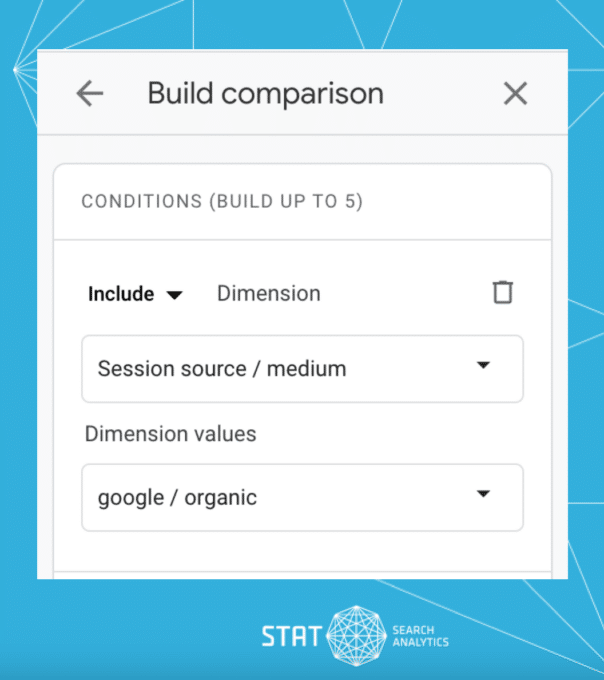
Simply set the conditions for your comparison as shown to isolate your organic traffic in Google Analytics 4.
Once you’ve created your comparison, head over to Reports > Engagement > Landing Page. You’ve now got a list of all your pages that are visited first as a result of an organic search. Start looking at before and after comparisons of the data to see which pages have fluctuated in traffic.
It is at this moment that you must decide whether the algorithm update is so impactful on your rankings, traffic, and revenue that you need to inform top-level leadership. You have the industry reports and you’ve captured the impact on your website — we advise over-communicating with leadership, letting them know that you’re aware of what’s going on and that you’re digging deeper.
Now that you know which of your pages and keywords are seeing fluctuations, it’s time to identify the “winners” and “losers” of the update. The best place to start, regardless of your specific rankings on the SERP, is to analyze the top 10 listings.
STAT’s Archived SERPs feature shows the top 10 listings for any date after which tracking was set up.
The Archived SERPs tab in STAT

Go back in time by selecting a date to see detailed listings of what was on the SERP that day.
First start by asking these questions:
Next, ask:
SEO execution is broadly thrown into three categories: on-page content, off-page authority, and technical — one page at a time, we need to evaluate how our page stacks up to the new standard of the update for each.
On-Page Content
One of the quickest ways to compare your content with the top 10 results is to compare H2s. Does your content address the same subtopics as Google’s favorite results?
You’ll also want to pay attention to characteristics like structure, length, metadata, and multimedia usage such as video and images.
Also consider how other listings are meeting E-E-A-T factors. Does the content have an updated or recent publish date that seems fresh? Is the content author reputable? What sources establish the author’s credibility?
Off-Page Authority
Next up, tune into the off-page authority of competing pages. Look at metrics such as:
Is your page stacking up against competitors well with backlinks or is the discrepancy in volume and/or quality tanking your ranking?
Technical
Finally, investigate the technical page-level components.
Start with the site map. Is this specific page in the site map? Check that the page is not excluded in robots.txt.
Remember to use canonical links to prevent duplicate pages from cannibalizing your page ranking.
Look at your page speed, compare structured page data with other ranking pages, and write alternate text for any images. This consideration for sight-impaired visitors isn’t about ranking, but compliance with ADA requirements improves user experience and may become relevant for ranking down the road.
You may have just discovered a series of important page-level factors that need to be addressed. However, we sometimes run this page-level analysis and find it to be a competitive wash — everyone in the top 10 can look nearly identical from an on-page, off-page, and technical perspective. So, what gives?
Google’s E-A-T guideline identifies Expertise/Experience, Authoritativeness, and Trustworthiness among its most important ranking factors in its algorithm.
This is not only demonstrated on a page level, but on a domain level. It’s the reason why a website could have a page that is arguably “better” than what’s found on the top 10, but not rank. Google needs to see that your domain — and your entire entity — demonstrates these values.
Domain-Level Content
If your domain-level content is suffering, you need to establish topical authority.
“Topical authority is a measure of authority built up through proven expertise and trust in your field. The more high-quality, informative pieces of content there are on your site, the more likely your website is to be perceived as a trusted source of information on a particular topic.” — Zoe Ashbridge, Senior SEO Strategist, Forank (How to earn topical authority in 2022 and beyond)
If your site is hurting here, do keyword research to find the related content keywords, organize your keywords into clusters or pillars, and get to work building and linking new authoritative content.
Domain-Level Authority
Your domain-level authority comes from backlinks. Zoom out and survey your site’s overall domain rating and your overall backlink profile compared to competitors. There are lots of helpful tools that can help you accomplish this — one example (that you can use for free) is Moz Link Explorer.
Domain-Level Technical
Finally, scan your site for glaring technical issues. Check in for these common failures:
With a much clearer picture of what has changed, how it is impacting your business, and what it will take to “win,” you’re ready to execute. More importantly, you also have the ammunition to communicate to key stakeholders.
It’s becoming increasingly rare that an SEO has the skills or access to make all necessary changes to their website. It’s time to communicate with developers, content writers, and top leadership.
Give them a brief that rolls together all of your findings:
And then give them their specific tasks. Do this and you’re on track to mitigate losses, seize opportunities, and prove why you’re an essential asset to the company when so much is dependent on Google.
97th Floor specializes in full-funnel marketing strategy combining SEO, paid media, content marketing and design services. We generate sustainable growth for well-funded startups up to the Fortune 500—including AT&T, LG, Google and Celebrity Cruises.
Operating from the intersection of creative and analytical work, we deliver the results our clients want and need, like...

The award-winning campaign (featuring sledge hammers) that won 100+ closed deals for Revver (formerly eFileCabinet) from one trade show, Increasing new users by 48% with a killer SEO strategy, cutting a 240-day sales cycle to 90 days,
A 371% increase in MoM digital sales for the Utah Jazz, and a 390% increase in referral traffic.

Our ability to generate sustainable growth for our clients is impressive, but the how is quite simple. The 97th Floor advantage all comes down to team structure.
When working with a marketing agency, you almost exclusively interface with an account manager who directs strategy.
We found that this approach leaves too much room for miscommunication and errors.
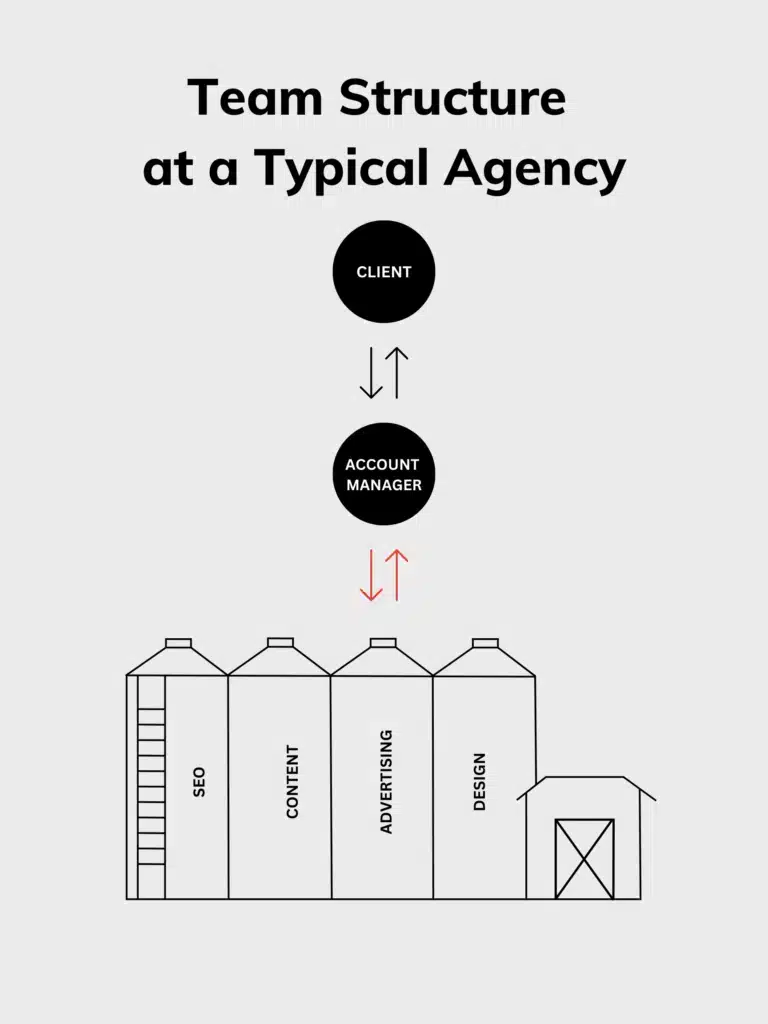
97th Floor’s approach is radically different, yet radically simple: The people who are working on an account are all on the same team, supported by off-team leadership.
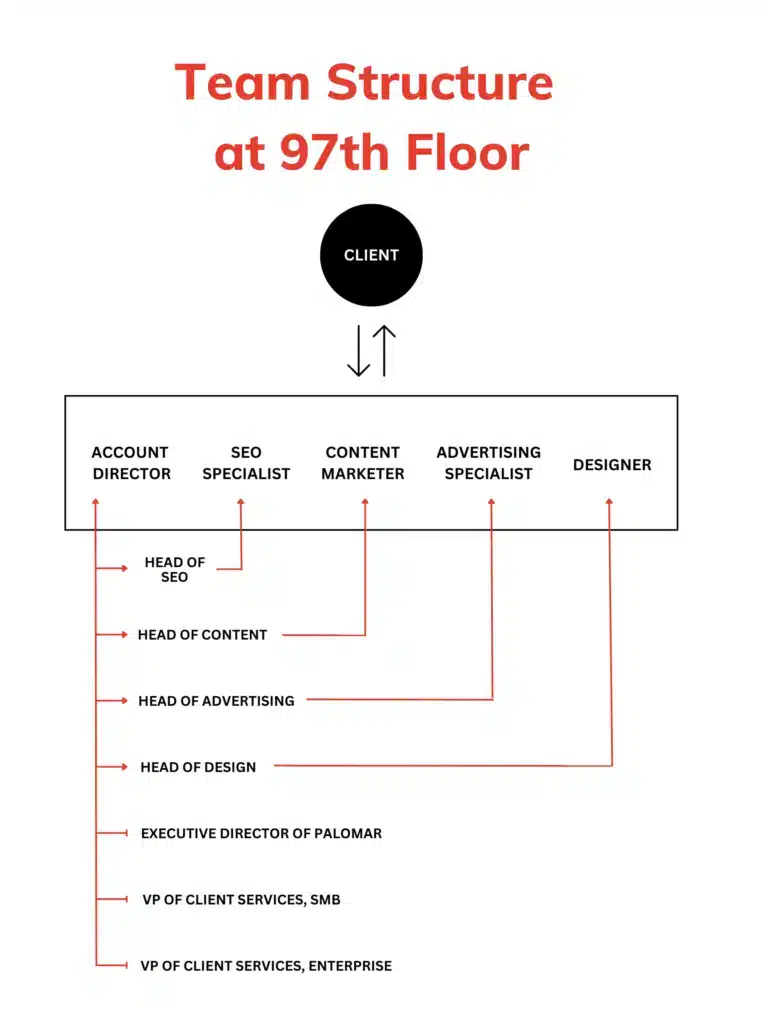
With us, there’s no relay between an account manager and the marketers executing strategy.
Our digital marketing experts have direct contact with our clients—the experts on their customers' needs—empowering our teams to deliver what our clients want and their businesses need.
What matters to you - meeting revenue goals, moving new leads into the pipeline, an upcoming site migration, proving ROI - is never repeated in a haphazard game of telephone throughout the agency.
So what do these teams actually look like? Here are the savvy experts that our clients interact with on each team:
An account director has chiefly three roles:
Because account directors oversee all of our disciplines, they work with their team members to ensure that execution is meeting strategy needs.
Most agencies use an account manager to manage a client-directed strategy. A key difference at 97th Floor is that the account director, leaning on their expertise and insights, forms a strategy and then connects with the client and the team to ensure communication and execution of the strategy is clear.
You’ve heard the phrase, “content is king,” before, right?
While certainly true, this phrase spurred thousands of organizations to produce drivel for over a decade, all to the demise of good user experience online.
Short-term thinking has ruined content marketing.
When every channel has its own specialist, no one owns the strategy. Watch this short clip on why that fragmentation is quietly costing brands more than they realize.
The role of a content marketer at 97th Floor is to help our clients escape this monotony by crafting content based on in-depth persona research and a customer journey.
The content marketer on each team is the “true north” when it comes to the customer’s experience and buyer journey, advocating for them and providing value across every stage.
Our content marketers bring value to our clients because they:
An SEO specialist is responsible for the client’s organic growth. Every initiative an SEO specialist takes on will fall under one of these three categories.
Everything an SEO does, be it an audit, backlink, or optimization, is tied to bottom-line results—brand awareness, traffic, and most importantly, revenue.
SEO specialists who cannot defend their tactics as revenue-generating do not have a place at 97th Floor.
Our advertising specialists are a true blend of creative and analytical, responsible for knowing:
As advertising is a huge investment for both ad creation and management, our promise is to find the best way to spend your money based on who your target audience is (or should be) and what your goals are.
Last year, we ran ads across 23 different platforms based on the custom campaign strategy we crafted for each client.
To name a few, our ad specialists have robust experience in the following areas:
Clear data coupled with responsive and creative optimizations make our advertising specialists ROI machines.
Every member of our client teams is given off-team support and training, all to our client’s benefit.
Head of Content - From buyer personas, semantic research, content production, and strategy development, Rachel Bascom ensures that each content marketer has the know-how and the tools to create winning content strategies for our clients.
Head of Advertising - Haley Riemenschneider helps our ad specialists drive client results with awareness continuums, B2B buyer journeys, and customer funnels to create cutting-edge marketing campaigns across multiple ad platforms.
Head of SEO - Trent Howard keeps our SEO specialists sharp, always exploring the best tools and techniques for uncovering the best practices to bring our clients sustainable organic growth.
Head of Design - Rian Kasner’s design team delivers beautiful and functional designs on time and in a variety of styles. The diversity of 97th Floor designers ensures that each execution team can provide a wide array of design formats and styles.
Executive Director of Palomar - Palomar is a patent-pending software suite for digital marketers developed by 97th Floor. The toolset inside Palomar analyzes large mountains of data in real-time to create a clear-cut digital strategy. Executive Director of Palomar Josh Moody monitors the latest trends in keyword research, SEO analysis, and content marketing to keep building tools that help our teams make the best decisions for our clients.
VP of Client Services - Samantha Brown fills this crucial support role for our marketing teams. She makes it possible for our teams to deliver excellent work by:
Our system follows a pattern of continuous improvement, but at its core, we believe that when our clients interface directly with a team of marketers that work together daily, both 97th Floor and our clients are better for it.
For experienced marketers, the clock is ticking for the day you'll be asked to leave the comfort of familiarity behind and jump into the role of Team Leader. This step requires new skills and perspectives, and can be challenging. Paxton Gray, CEO at 97th Floor, walks through key points on how to beat your obstacles, develop trust, and ultimately create a world-class marketing team.
If you saw photos of a bunch of marketers partying in early October, you got half the story.
97th Floor's Mastermind is an annual marketing leadership conference located in Park City, Utah. This year, from October 3-5, marketing leaders spent two days at The St. Regis Deer Valley participating in expert-led discussions on marketing strategy, listening to keynote speaker Ryan Holiday, and collaborating with peers.
There may or may not have also been a cooking challenge, some painting and hiking, and delicious food all against the stunning background of Park City’s colorful fall mountains.
We’ve pulled together 8 lessons from the bright minds of our attendees. Note that because each discussion leader took a different approach to their topic, each write-up will read a little differently. Here's what you're in for:
Brand-marketing-adverse leadership are armed with one argument: You can’t prove ROI. Sean Michael Colee-Addington and Tatiana Fabregas from NBCU dissolved this argument in their discussion on balancing brand and performance marketing.
But what about tracking? Tatiana is confident that the “data is getting there to give you the ROI" for brand marketing. Brand marketing can be measured; it’s just measured differently through awareness, education, values, introduction, and sustaining a competitive edge. Get creative and think about what other tangible metrics could be driven by brand marketing. You may not see any movement in revenue for the immediate next quarter, but you can see lift and trust that budget spent on brand marketing will pay out with increase in the future.
Asking someone to trust that a spend will pay out — without immediate proof — is exactly what every pitch comes down to. Whether it's a marketing budget conversation or a funding moment, the structure of the ask is the same: conviction, clarity, and a credible case for patience.
Daniel Nisan, startup founder with direct experience on both sides of the investor table, shares what he's learned about making that case when real money is on the line. This short video captures the mindset and mechanics behind a high-stakes pitch that actually lands.
Do This: Reevaluate what percentage of your marketing efforts are branded—if high-funnel, branded campaigns aren't receiving any budget, allocate a small portion of budget to test your ideas and establish a system for measuring value.
97th Floor’s unique team structure isn’t the only thing that makes us the best choice for our clients - it’s also the leadership values and style we practice in the company.
97th Floor CEO Paxton Gray led a discussion about how marketing leaders can develop a productive team. We’ve pulled key takeaways from those who participated.
- Carve out ownership for everyone on your team.
- Don’t take away an opportunity to learn or grow by just doing something yourself.
- When hiring, it's not about finding a culture fit, it's about finding a culture add.
- Embrace a diversity of approaches for the diversity in your team.
- When working with your team, be involved and mirror the passion of what excites them about the work.
Do this: Evaluate your team's feedback loops—how does each team member see and understand the impact they have on the company's bottom line? Build a system for more frequent and thorough feedback.
Sam Oh, Ahrefs' VP of Marketing, led a discussion about developing standard operating procedures that will:
Here's his team's internal process...for creating processes:

Keep in mind that there’s no such thing as a “perfect” system. Train your team to proactively notice blockers in your systems and propose optimizations.
A strong foundational systems that should free up individual contributors' time and attention to be more creative. Scaleable creativity comes from defined systems that get modified and improved on in documented, measurable ways.
Do this: Using Sam's flow and as a marketing team, take 15 minutes to create a documented system for one task your team performs regularly. Set a date for when you'll reevaluate and optimize that process.
Christina Garnett is Hubspot’s Principal Community Manager for Offline Community and Advocacy. Her discussion group benefited from learning Christina's 3 ingredients for turning customers into brand advocates.

Do this: Think about core memories you have with brands. What do these memories inspire you to do for your customers? Hold a brainstorm with your marketing team on how your brand can create core memories.
John Huntinghouse, VP of Marketing at TAB Bank, pulled from proprietary 2020 research to show the importance of thought leadership for decision-makers.
Here's some of the juice:

Put your content through these filters to determine if it will be valuable thought leadership for your space:
Do this: Use John's questions to evaluate your upcoming content calendar—it's not too late to pivot (or even scrap) content that doesn't meet standards.
97th Floor’s not-so-secret sauce for every campaign is an undying commitment to understand our client’s customers before we do anything else. Danny Allen, 97th Floor’s VP of Marketing, discussed how to use personas to create content. Consider this:
4 Lessons from The Internet's Giants
SEO’s never been a very simple game—there’s a reason most small-to-medium sized companies outsource the bulk of it. But what about the largest sites in the world? The ones with millions of pages and hundreds of developers. Simply put, these sites only get more complex with their size.
We’ve interviewed the SEO experts managing these behemoths to uncover the strategies specific to them. This is not your tips-n-tricks, “how to growth-hack your site” kind of article—let’s dive in.
Questions we’re answering:
"There are more people and constant change at a large organization, so we’re always educating and building our credibility. Just as you find things running well with one team, they’ll reorganize. Figuring out how to best work with other teams will always be part of the business."
- John Crockett, Director of SEO at Ancestry
Credibility with other departments will be the foundation for all future efforts—when working on large-scale websites, an SEO leader will often act more as a salesperson pitching SEO strategies internally, than a roll-up-your-sleeves practitioner. It’s no surprise that a large organization has frequent turnover, but don’t let that constant change deter you from building and rebuilding relationships with other teams.
As you have these conversations, consider the following:
Pro Tip: Always be on the lookout for contacts in other departments that champion your work. These are your evangelizers and will help immensely when you’re trying to get your projects prioritized.
Questions we’re answering:

A deep understanding of top leadership’s goals is critical. For many leaders, SEO by nature is not on their agenda, so it is your responsibility to connect how SEO supports the goals they already do have. Crockett says, “At the end of the day, we need to translate those metrics into what’s of greatest concern to those teams.”
Pro Tip: Take the goals of the executive team and articulate how you’ve aligned your SEO KPIs with those in language that’s meaningful to THEM. Educate them so SEO can become a common priority.
Kaleb Gilliland is the Director of Development at Pro Athlete. Pro Athlete manages 4 sporting goods websites that together have over 6.5 million pages to manage. Gilliland shares, “Sometimes SEO isn’t deemed valuable from a business standpoint because you can’t see tangible results immediately.” John Crockett adds that “SEO is measured bets on what’s going to work and what’s not going to work. We’re only one part of that. We have to worry about how Google’s going to interpret new initiatives. We also have to worry about what our industry competitors are doing. We have to worry about what our search competitors are doing. So sometimes it makes it harder to make the case that SEO should be prioritized from a resource standpoint.”
How can you prove the payoff? Crockett shares “Sometimes, you have to iterate your way into things. Don’t jump right into the huge thing that’s going to cost millions of dollars and take half our development resources for the year. You know that’s not going to be feasible. So it's finding ways to step into this until it proves itself, then you can open the floodgates because you’ve proven the value in smaller ways.”
Start with low-risk opportunities and work your way into bigger projects. Document successes and failures along the way. Use whatever analytics you’ve got because, with a website of massive scale, just a 5% increase in organic traffic can easily translate to massive revenue increases. These numbers will show that the ROI for SEO is worth the patience it takes to get to those results.
Pro Tip: Crockett shares, “Anybody can understand the value of getting free traffic, (free meaning there’s not a per-impression expense) and that this traffic has longevity. Show how traffic is leading to revenue.”
A tool like Ahrefs allows you to pull the traffic value for your website. That essentially takes what you are organically ranking for and compares it to how much you would have to spend via ads to show up in those same SERPs. Airbnb saved an estimated $4.8 million this last month. People.com saved an estimated $12.2 million this last month. These numbers are a powerful illustration of how SEO can translate into saving money and making money.
Questions we’re answering:
“SEO should create a partnership with development…It’s not just a business handoff of requirements. It’s not two separate teams. It’s one team doing different things to accomplish the same goal.”
-John Crockett, Director of SEO at Ancestry
If your SEO-development relationship feels strained, you’re not alone. Frequently SEOs will find themselves in these scenarios:
From the perspective of the development team, they may have had new SEO leaders every few years, each with a laundry list of “urgent” changes they need to be fixed. Alternatively, they could have the same SEO leaders consistently for years but due to algorithm/industry changes, the strategy changes frequently. It can be exhausting for them.
Building a partnership with development will require education. Developers may not know why duplicate content is a problem or how impactful mobile speed can be on a site’s ability to rank. Trent Howard, Head of SEO at 97th Floor, suggests, “Consider making a list of all the different areas development touches SEO, then educate your dev team on why they are important. This will help alleviate the pain point of development feeling like SEO comes to them with a new priority every week. This doesn’t replace the importance of ongoing education, but it does demonstrate how vast SEO’s responsibilities are.”

But SEOs need to get educated, too. Crockett advises, “Understand a developer’s world enough to talk to them intelligently.” Research possibilities and find examples to share. Crockett continues, “I don’t get too much into the solution with them, but I do know enough coding and engineering to be prepared in those meetings with an idea of how we’d accomplish it. Doing the research has taken projects from being labeled as impossible to being done.” Be respectful of the developer’s expertise. Don’t over solve it, but come speaking their language to collaborate about new ways to approach the problem.

Pro Athlete Inc has found major success in getting SEO projects prioritized because of its unique team structure. Kristina Kuska, Head of Organic Search at Pro Athlete, shares, “One of our major successes at Pro Athlete is having development on the marketing team. Having developers who understand SEO changes, agree with them, and implement quickly has been invaluable.” Pro Athlete’s structure is heavily influenced by one of their founders who was a big advocate for SEO. Now SEO is baked into everything they do. Gilliard shares, “Development prioritizes projects that are going to keep SEO at the forefront of what we do. If people can’t find us, we’re going to have a hard time no matter what we’re selling or doing.”
Pro Tip: Find creative ways to link the development team closely with the SEO team. Maybe you can’t restructure your org, but try for a monthly collaboration meeting with all the decision-makers present. Set goals that encourage partnership and that lead to mutual benefits.
Whether development is on your team or not, a true partnership can be made if you can learn to speak their language and invest time educating on the benefits of prioritizing SEO.
Questions we’re answering:

39% of people will stop engaging with a website if images won’t load or take too long to load (Hubspot), so don’t underestimate the power of chipping away at the mountain of SEO fixes you may find yourself with. Develop a system to be consistent with your SEO optimizations. John Crockett shares that he stays on top of SEO by considering three things:
Make sure SEO is considered for all future content creation. If SEO can be considered during creation, less of your time is eaten up going back and making fixes. Gilliland shares a counter point, “Don’t ignore the technical aspects of SEO with the sole focus on content. You can produce the greatest content in the world, but if someone can’t load it, what good is it?”
Pro Tip: For many large sites, pages are scaled programmatically, so in that process of automatically building pages, can SEO optimization be built in? Kuska shares that with their webpage generation “everything is structured to best SEO practices, but then we can also go in and optimize pages individually.” Pro Athlete was able to set up this structure to help them remove the chaos of needing bulk changes done to web pages.
When you have millions of pages on your website, it’s going to be impossible to rank for every page. Gilliland says, “You don’t have to have every page on your site ranking and Google crawling it all the time. You’ve got to define the things you want to rank for and make it clear what you want Google to choose for those keywords.” Rely on data to direct your decisions for what to prioritize. Then when you get the question of, “why aren’t we ranking for…[insert keyword]” you can confidently explain the strategy of targeting what’s most important.
Pro Tip: Remember that SEO is an ever-changing industry. Crockett shares, “What was best-practice in SEO 15, 10, even five years ago needs to be revamped, cleaned up, fixed, removed or redirected.” Don’t be afraid to go back and redo things, and to have the conversations explaining to other departments why it has to be fixed again.
You know what’s at stake—the potential for massive revenue, massive brand exposure, improved user experience…the list goes on. But it’s highly unlikely that your organization understands, and unfortunately, we see many enterprise-level SEOs bounce from company to company seeking that perfect landing spot. Take these lessons and proactively build a culture of SEO priority within your org—align your goals to theirs, build up your interpersonal relationships, explore the full impact of SEO on their workload, and ease into a cycle of organic success.
When things go wrong, we're not failing—we're just doing business. We're just in the middle of solving problems. In an exclusive sit-down at 97th Floor's client and partner Mastermind event, 97th Floor CEO Paxton Gray interviews Pixar Founder Ed Catmull about our relationship with the word "Failure" and what he learned from Steve Jobs.
Sell 60,000 tickets and you fill a stadium for an afternoon. Create 60,000 memories and you'll fill a stadium forever.
Experiences become memories, memories become traditions and experiential marketing is the way to create an emotional bond with customers that pulls them back to your brand over the competition again and again.
Pro sports teams live and die not by their teams’ records, but by their ability to create experiences that begin long before kickoff and continue way after the stadium has emptied. They create fans, not customers.
We’re here to say that experiential marketing is for every industry. While your marketing will be specific to your brand, we’ve pulled three principles from pro sports marketing to help you convert customers into loyal brand fans.
In this guide, we’ll break down experiential marketing in sports examples drawn from real teams and brands, then show how those same strategies can be applied across industries.
At its core, experiential marketing works because it creates emotion, not just awareness. And no industry understands that better than pro sports.
Sports teams don’t market products; they market moments. Every touchpoint in sports marketing is designed to make fans feel something and feel it together. The shared emotion is what turns a single experience into a lasting memory, and a memory into long-term loyalty.
The strongest experiential marketing examples in sports are immersive and interactive. They invite fans to get up out of their seats and participate. They reward attention, amplify momentum, and extend the experience far beyond the physical event through digital channels and social conversation.
This is why experiential marketing in sports examples translate so well to other industries. When brands focus on how people feel before, during, and after an interaction, they learn more about their audience to improve their experience the next time they interact. This is the advantage sports marketers have been playing for years.
What translates isn't the tactic — it's the principle underneath it. The medium you choose — the event, the touchpoint, the format — communicates something before your audience reads a single word. Udi Ledergor, former CMO at Gong, invokes Marshall McLuhan's idea with a sharp marketing application: most brands are obsessing over what to say while ignoring the signal their channel selection is already sending. This short video breaks down why the medium isn't a delivery vehicle — it's the message itself.
Here are seven experiential marketing examples in sports that show how experiences turn audiences into lifelong fans.
Before changing a single seat or concession stand, the Utah Jazz spent a year listening to what fans actually wanted. By grounding the experience in real fan insight, the team transformed the arena into a space designed for making lasting, brand-loyal memories.
After the Utah Jazz’s $125M arena renovation, Bart Sharp, CMO at the Utah Jazz, shared that his team spent an entire year researching what Jazz fans wanted beyond the court before making any renovation plans. Their research showed a strong desire among their fans for more premium options, ice cream (yes, Utahns love their ice cream), and Instagrammable photo opps. With these findings, the Jazz transformed their arena to provide fans unforgettable experiences.

Built Bar shows that experiential marketing can happen far beyond the venue. By placing customer service directly under marketing, the brand turns real-time feedback into responsive experiences that make customers feel heard and valued.
BuiltBar has a unique way of ensuring their customers are heard and that feedback gets injected directly into their marketing campaigns. “We’ve actually put the customer service team under marketing leadership. That way we can pivot and change quickly without going through multiple channels,” said Colleen Ferrier, VP of Marketing at Built Bar. “So we’re hearing as leaders directly what the customers love, what they don’t love, what they’re liking, what they’re not liking. And we as a team can shift and change quickly for them.”

By directly listening, learning, and responding to customers, Built Bar’s marketing team has the ammunition they need to generate more value for their customers.
As marketers, we must prioritize listening before campaign creation. We should never assume we know why someone came to our websites or their purposes for joining in the experience. Every time we make assumptions, we limit ourselves and miss opportunities for our customers, putting time and energy in the wrong places.
Do This: Customer feedback/research surveys always endear customers to you—show you care and learn from your most important audience. Also, consider moving Customer Service under Marketing to close the customer feedback loop.
When momentum strikes, great experiential marketing captures it instantly. The Suns turned a split-second, game-winning play into a physical product almost overnight, allowing fans to own a piece of the moment while the emotion was still fresh.
With only .9 on the clock, Deandre Ayton scored a game-winning alley-oop against the Clippers during the Suns’ 2020-2021 season. Being hyper-engaged on social media, the Suns’ social media team quickly recognized an opportunity to capitalize on the excitement surrounding the play. New “Valley-Oop” shirts were announced on their social channels that night and available for purchase the very next day. No one could have predicted the alley-oop, let alone prepare t-shirt designs. But the Suns were ready—they took an awesome on-court experience and memorialized it for the fans.

Marketing teams have to find ways to monitor momentum. Bart Sharp shares how this is a key principle they follow within their marketing strategy. “I’ve learned in this industry you’ve got to be very nimble because things can change very fast. In an instant, we have to shift our focus and find ways to capture that momentum.” Sometimes the team is playing really well and there’s a story there. Sometimes there’s not. In pro sports (and really in just about any industry) you can’t predict how the seasons will go. You can have an idea based on data you’ve gathered (players on the team, how we compare to competition, injury reports, etc.) and that informs direction. But if things get going and you notice momentum is building somewhere else, you’ve got to make that pivot.

Marketers may be the best planners in the world, but following the momentum inherently means that marketers must be ready to abandon their plans—which is frankly really hard to do! What if the Suns chose to just stick to their content calendar? They would’ve missed out on a huge opportunity for the brand to bond with fans.
Not all experiential marketing examples happen inside a stadium. Oreo’s now-famous “dunk in the dark” response during the Super Bowl blackout shows how brands can insert themselves into shared cultural experiences by acting quickly and understanding the moment.

We all remember the classic example of Oreo capitalizing on the power outage in the 2013 Superbowl with a tweet about “dunking in the dark.” The brand acted quickly around a current event, which was only possible because they were aware of what their audience was doing and how to appeal to them in that moment.
It doesn’t take a huge team or expensive software to interact with your audience. Plan all you want, but be ready to strike when the opportunities arrive.
Do This: Marketers can’t capitalize on momentum if they aren’t looking for it, if they don’t have a supportive infrastructure, or if they don’t have the green light from leadership.
Experiential marketing doesn’t always require large-scale activations. Real Salt Lake demonstrates how thoughtful, personal interactions on social media can become powerful micro-experiences that deepen fan loyalty.
Tyler Gibbons, VP of Marketing at Real Salt Lake (RSL), shares how seriously they take online interactions with their fans. “When someone shares wearing a team jersey and you respond back to them on social, you probably made that person's day. You're going to have a fan for life.” In their case, RSL is extremely careful about who on their team has the permission to dialogue with fans—they don’t underestimate the power of these micro-experiences.

Creating an experience doesn’t mean that you need a full event or production. Experiences can be small and individualized for your specific audience. Hubspot emphasizes that even when you give your audience a tangible experience, there must still be an online dialogue happening. Dialogue is especially crucial to industries where the experiences are largely digital. It’s those conversations that become a major part of audience-brand bonding.
Not every fan can sit courtside. Geography, cost, and capacity make that impossible. The Warriors decided to redesign that reality.
By experimenting with virtual reality, the Warriors created a way for fans to experience games from a courtside perspective without ever stepping foot in the arena. Using VR technology, fans could feel closer to the action, immersed in the sights and sounds of game day, even if they were watching from hundreds or thousands of miles away.
This is a strong example of experiential marketing because it expands access instead of limiting it. The experience isn’t just about watching basketball, but about giving fans a story to tell. Now, fans can feel like they were courtside, even if they technically weren’t.
The takeaway here isn’t that every brand needs VR. It’s that the best experiential marketing examples use technology to remove barriers and deepen emotional connection.

AT&T Stadium is massive. Iconic. And, it’s intentionally designed to be experienced even when no game is being played.
The Cowboys have turned their stadium into a year-round experiential marketing engine through immersive tours that give fans behind-the-scenes access. Visitors can walk the field, explore locker rooms, learn the architectural story of the venue, and see how one of the most recognizable franchises in sports operates from the inside.
This is a masterclass of storytelling at scale. The Dallas Cowboys’ stadium has become a physical brand expression, reinforcing the Cowboys’ identity as larger-than-life, premium, and deeply rooted in sports culture.
What makes this one of the strongest experiential marketing examples is its longevity. The experience doesn’t rely on a single event or even a game; it creates value every day, for fans who may not even attend a game, but still leave feeling closer to the brand.

Look at the interactions happening with your target audience. Is there a way to build an online element into a tangible experience? Are you keeping a dialogue going on and offline?
A major sign of marketing maturity in an organization is the level of experience they place in customer-facing roles (such as social media managers, customer experience, etc.). Unfortunately, many brands put their “greenest” people in these roles—preventing organizations from fully capturing their audience’s feedback and preventing audiences from an elevated experience.
There’s a reason why pro sports teams pull in top talent for game-day coverage. Inside the NBA, for example, features the beloved Charles Barkley and Shaq. College GameDay utilizes former athletes, coaches, and other experts to talk about the football games. Both shows have subject matter experts in charge of the dialogue, giving this dialogue the best people to engage audiences.

So don’t put your least experienced employees in charge of all the digital dialogue for your brand. Make sure that whoever is helping to create that dialogue knows and understands your company’s offering, your values, and how to interact with your audience in a way that is meaningful to them.
Do This: Don’t hire entry-level for audience-facing positions.
Pro sports marketers have an obvious edge in creating customer experiences—their product is literally an experience—but their playbook is written for every brand in every industry. A stronger focus on experiential marketing truly can turn your brand observers into lifetime, loyal fans.
If you’re ready to take inspiration from these experiential marketing in sports examples and apply them to your own brand, we’re here to help.
At 97th Floor, we partner with teams who want to create experiences people remember. If you’re ready to build experiential marketing that connects, converts, and lasts, let’s build together.
Want more expert marketing content sent right to your inbox?
Join our newsletter and never miss a beat.
The best metrics are the ones that matter to your business. But these may not be the standard set you see written about everywhere online.
The marketing metrics you choose determine the direction of your campaigns. Or put in other words. Good metrics must be in place before good marketing can happen.
In this article you’ll learn:
For a campaign to prove its viability, it needs data. It needs the right data. Data that is specific to its business’s purpose and goals. That data will depend on the business, the necessity of strategic data collection, and use remains constant.
And, if you’re going to learn from the data you capture once a campaign launches, the right metrics and KPIs need to be established in advance.
Metric: A metric is essentially any signal that can be tracked. It’s an objective system of measurement, which means that you might have an entire dashboard of metrics that you’ve set up to be tracked. But dashboards only serve as directionless numbers without goals and KPI.
KPI: KPIs (key performance indicators) are the metrics that you’ve decided to use in tracking how efficiently your business is meeting its objectives. It’s a little tricky to get down the difference, but just remember that while all KPIs are metrics, not all metrics are KPIs. KPIs are the metrics your business chooses to focus on in driving forward your goals.
Goal: A goal is a metric-driven objective, defined by a clear timetable and tactics, you are trying to reach. The best goals are SMART goals (specific, measurable, attainable, realistic, time-bound). Goals set a bar for the future of certain KPIs that you then strive to achieve. Goals should move your marketing department and business forward.
For example, you may decide that next quarter your business should work to earn more site conversions via organic traffic. Your KPI will be organic traffic, which is a marketing metric, but its level of importance and direct application to your objective makes it a KPI. There are a number of associated metrics that contribute to achieving this goal — metrics like, organic traffic, keyword rankings, and landing page conversion rates. Finally, using historical data you decide to set a goal next quarter to earn 100 conversions via organic traffic (a number just missed last quarter).
One way of thinking about marketing metrics is to categorize them as either macro or micro metrics.
Macro metrics are closely associated with business goals and therefore are typically tied to the bottom line, like revenue, or conversions. Micro metrics are the contributing signals like traffic and clicks that fall under those macro metrics.
Macro and micro metrics are always connected. Revenue only happens through conversions, and conversions only come when people make it to your site, and, of course, people only make it to your site when they click an ad or see your site through organic search rankings. You really have one without the other.
While both sets of metrics are important, only one set shows clearly how a business moves forward in driving sales.
So, when structuring the tracking of metrics for your own marketing campaigns, it’s best to begin with the metrics that sit most closely on the bottom line, and connect micro metrics to those macro metrics. Think of it as a tier:
The metrics that you choose for your own KPIs will determine what your business will achieve. Keep in mind that there’s no comprehensive list of metrics that you “must be tracking” that will work for every business.
The following is a list of metrics for you to consider as you develop your own individualized marketing strategy.
Revenue is something every marketing leader should have in their sight. Of course, tracking this is sometimes easier said than done. Good marketing leader will make every effort to get good data that associates revenue with your various efforts. If done correctly, all other metrics will fall under this single metric.
Conversions are the closest metric to revenue that you can track. What conversions look like varies based on the business — for an ecommerce site that could be a checkout, for a B2B site it could be a lead or closed deal.
Most importantly, however, marketers need to ensure that the conversions they track have monetary attachments. For ecommerce businesses that can be quite easy, however B2B companies that work through leads with a sales team will need to be intentional about gathering data and insight from marketing and sales to assign values to things like leads, MQLs, and SQLs.
While knowing the amount of conversions your site brings in is important, knowing the rate at which your site converts traffic to conversions is critical. Paying attention to historical and trending conversion rates will help you know where to focus your attention.
For example, if you see that one month shows a conversion rate that is only 50% of the month prior, you might dig further and see that was the month you launched a new ad campaign. This would tell you that this ad campaign likely wasn’t fruitful.
Be sure to compare your conversion rate and net conversion metrics, because there can be times when net conversions increase while conversion rate falls. If this is the case, it could uncover great insights into the health of specific campaigns, which is why good marketing leaders look at both metrics to determine future pivots.
The close rate is the rate at which leads are closed into actual business and revenue. This metric can be useful in judging both sales and marketing team performance. Lower close rates could mean that the sales team needs additional training, or that the marketing department isn’t providing quality leads. Tracking the close rate will help keep both sales and marketing professionals accountable.
This metric is exclusively for businesses that are running paid ads across the web. Most major advertising platforms (i.e. Google, Facebook, and LinkedIn) have snippets of code called pixels that you can put directly on your site that allows the ad platform and advertisers track the ad’s performance — including conversions that take place on your site.
When ad spend is coupled with conversion data (that has an assigned marketing value) you’ll be able to see the rate of return on your ad spend.
CPL is the total cost to acquire a lead. This is typically used as a long term benchmark, even though this number may change. For example, a business may find that it cost an average of $42 to acquire a lead over the past year. Assuming budgets have stayed the same, this business can assume that any figure under $42/per lead is a good investment.
As with any metric, however, further analysis is always required. Not all leads are created equal, and there may be opportunities to acquire leads for much less than the yearly average that would be a waste of company time and money. Be sure to be wise in your use of metrics, and look at the viability of the entire situation before making your decisions.
As its name implies, CLV is the expected return during the life of an average customer. Marketing leaders at SaaS organizations will benefit the most from this metric. It’s powerful because it can encompass smaller metrics like customer retention rate, customer add-ons, and average length of customer retention.
This metric is powerful when filtered across a qualifier. For example comparing average CLV of clients that were attracted from organic search might be higher than those brought in with Facebook ads. Indicating that SEO is a worthwhile business focus in the upcoming year.
Virtually all businesses utilize some kind of website for their marketing efforts. Knowing how many people visit the site in a given time period is essential to knowing the impact of your online marketing efforts. There are many metrics that could be even more specific than total traffic, such as page visits, sessions, and unique visitors. And, while total traffic might not be incredibly insightful by itself, it’s critical in keeping other traffic-related metrics in context.
Conversions from total traffic span a wide array. You’ll need to create a good dashboard that measures the performance of current initiatives taking place on the site — everything from newsletter sign ups, to demo requests, to purchases.
There are many traffic sources you can measure, such as ad channels, referrals, social, direct, and organic. Many businesses will benefit from measuring many of these channels. However, organic will make sense for virtually all businesses.
Organic search accounts for over 50% of all web traffic, and unlike other channels, SEO has the potential to attract customers at every stage of the funnel. This could include top funnel conversions like email capture or lead capture, or bottom funnel like demo requests or purchases.
You might have been able to get away with having search lower on your list even ten years ago, but today that’s not the case. With such great potential and reach, every business should be adopting an SEO strategy.
Blogging has proven its worth in the business world, as the most recent numbers say that businesses that blog regularly earn 67% more leads. It has pulled ahead as one of the best ways to participate in both SEO and content marketing. Content will draw users to your sights, and provide you with unique opportunities to meet their needs. Not to mention the tremendous work that a blog can have on your SEO strategy.
In addition to net blog traffic, consider tracking blog-specific conversions. Conversions on a blog are generally micro conversions such as newsletter subscriptions, lead magnet downloads, or landing page visits. However, these contacts often move farther along the funnel as they are delighted with your brand and content, and can often turn into leads.
Subscribers are the most top funnel contacts. They are the ones who know about your business and have opted in to hear more from you. Often this looks like signing up to be notified of new blog posts or receive a newsletter.
These contacts may or may not move farther down the funnel. But that’s okay — growing your subscribers means growing your audience which allows you to amplify your content and reach even more new contacts. Remember the saying, “everyone wants to buy, but no one wants to be sold.” These are your subscribers. Take time to create a content and nurture structure that allows subscribers to become leads at the right time.
Leads are contacts in your database that have indicated some signal that they are willing to learn more than surface level information about your company, and they’ve given you information to make that happen. Examples of this might come from a PDF lead magnet or a free trial signup.
Measuring leads is critical to success for any B2B organization as they are a good blanket indictor of general demand interest.
MQLs are leads that the marketing team has determined are more qualified than a standard lead based on their action. MQL structure might vary depending on the company, but generally they are defined as the contacts that have shown enough interest to qualify them as ready to talk to sales. Marketing determines readiness based on either lead scoring, or the contacts themselves requesting to talk with sales via a form on the marketing page.
An MQL becomes an SQL after the sales team has determined this lead’s qualifications. Many organizations have their own iterations on this, but SQLs are generally MQLs that are confirmed promising enough to be pursued by the sales team. Sales then takes the ropes in nurturing them and aiding them in their journey to becoming a customer.
Beyond SQL there are additional stages, like opportunities, and deals, however these are usually overseen by the head of sales. Accountable marketing leaders will take responsibility for their efforts by communicating with sales to ensure the MQLs that turn into SQLs continue to move down the funnel and eventually turn into closed business.
Email has one of the most positive ROIs of any channel. It’s believed to be as high as $42 for every $1 spent. It’s also one of the most used channels today, despite years of naysayers predicting its demise.
There are quite a few email marketing metrics, but the most fundamental one is open rate. Many marketers find this metric essential as it measures in real-time the effectiveness of their subject lines. However, this metric also tracks much deeper issues such as your company’s reputation. If you have a history of providing good content within your emails, you’ll have a higher open rate.
Email click through rates (and net clicks) measure the effectiveness of the content inside of your email. Having a contact open and read your email is great, but having them follow through on what you asked them to do is even more important. Emails lose much of their usefulness unless contacts take action, so measuring click through rate is worthwhile.
Social is actually a set of micro metrics (likes, shares, comments, social traffic, impressions, etc.) from which you can choose what makes sense to track for your company. Some businesses will choose not to intentionally track any of these metrics and put social media on the back burner. For some, social metrics will be a large part of their overall marketing strategy.
Which social channels businesses focus on will also largely depend on the company. A highly visual brand may be more concerned with Instagram engagements, while an enterprise consultancy might want to look more into LinkedIn engagements.
The inbound marketing methodology has captured the essence of digital marketing in today’s world with the three-part flywheel: attract > engage > delight.
Much of what has been discussed up to this point would fall under the attract section of the flywheel. But there has not been much discussed yet about metrics that engage and delight your audience. Today we operate in the experience economy. Or put differently, customer’s positive experience with a brand will lead to long-term engagement between that customer and the brand.
In truth, these metrics can be harder to quantify than others. But good marketing leaders will make these metrics a priority to ensure long term success.
When thinking about user-focused metrics, it’s helpful to think about problems you’re solving for your users, and then identifying signals underneath those problems. Those signals sometimes are metrics, like average time on page. Other times these signals lead to metrics like how performing customer surveys will introduce you to new engagement metrics.
Where are my users getting stuck?
What do my users think of the content we produce?
What do my users love and want more of?
The list of questions and indicating signals could go on, and you as the marketing leader are the only one who can make that call. As you can see, the qualitative nature of many of these metrics are more time intensive than a simple dashboard can produce.
With these metrics in your back pocket, you’re ready to design a marketing strategy backed by insight, choose marketing KPIs that make sense, and start making smart marketing decisions.
Just a reminder that you don’t need to focus on all of these metrics right now. Choose the ones that make the most sense for your business right now, and begin there. Focus on just a few from among the list, and you’ll be on your way.
It’s no secret that we are currently living through some uncertain times. With that in mind, I thought it would be good for me to explain to our clients our level of preparation and our status during all this. This isn’t our first recession. 97th Floor was three years old in 2008 and it turned out to be a very positive, pivotal year for us and really launched us into a steady growth mode. I often felt bad as other entrepreneurial friends would ask me if I was having to lay off people and what I was doing to survive and my message was, “I am swamped and can’t hire fast enough.” However, going through that showed me that uncertainty is certain and that we should always be prepared at 97th Floor.
97th Floor has no debt. We don’t have a board of investors that are looking to line their pockets no matter what is going on in the world. For many years now, we've operated our client fulfillment teams on a specific budget that is a percentage of what the client pays us. Most of the time our teams are able to spend a bit less than that percentage on their team payroll. Instead of the company taking that difference as additional profit over the years, we've saved and built up these "buffer budgets" to withstand sudden changes in our monthly revenue. This allows us to have "bad months" from a revenue standpoint and not have to immediately lay off team members. It gives us stability to weather small storms like a client not renewing as well as huge storms like the one the world is in right now.
Because of that, we have no plans of letting anyone go due to the economic slowdown; we have never had to “ramp up” for a big influx of new clients and we’ve never had to lay off during slower months. COVID-19 is no exception. If anything, I would say we are running better than ever because our employees feel safe and secure in their jobs which is going to have an impact on the work they are doing for you.
We have been a ROWE (Results Only Work Environment) company since 2015, so going 100% work from home was nothing more than us being sad we wouldn’t get the face-to-face interaction if we wanted to. But it’s caused no issues with workflow as we were ready and equipped. In fact, last week we issued a $250 bonus per employee (even interns) to help our teams purchase equipment to better their work from home setups and to encourage what turned out to be a $25,000 boost in the economy.
We have an extensive and proactive wellness program that includes memberships to SteadyMD, a telemedicine company, enabling our employees to have access to doctors and nurses from home to make sure their families are safe and can get prescriptions and answers to their health questions. We recently added Oura Ring to our wellness program which is now in a clinical trial to prove it can predict COVID-19 and other ailments before becoming symptomatic. These two things plus everything else is another layer of security for our employees. They are not stressed, they are weathering the storm and they feel the full support of 97th Floor behind them.
Lastly, I would like to say while I am generally an optimistic person (some would say too much), I know that these times are uncertain and things are happening which are out of your control. Rest assured that your team at 97th Floor is in full effect and will make weathering this a little more positive and optimistic by providing results for your business. I would also say I learned a lot from my clients in 2008 that saw uncertain times as an opportunity to finally pass up their competitor that always seemed out of reach. Double down on email, it’s free. SEO is very cost-effective and it will pay dividends when the searches come back. Don’t be afraid to make content; we need more positive messages that have substance. It seems like we either get doom and gloom or the family reenacting Pirates of the Caribbean ride content these days. We need more and it needs to be positive. A lot of companies were started during recessions a lot of people have figured out how to thrive during uncertain times and we need to be sharing and spreading that message.
Marketing matters more now than it ever has before. If you're curious about what to do with your marketing in this landscape, we’re here to talk. We’d love to set up some time with you and one of our team members to get some ideas going. They'll run a free audit for you and offer some guidance, no strings attached.
Over the years of building 97th Floor, the hardest decisions to make were often the ones that were best for the company but not so easy for me personally. Well, today is the hardest of those decisions in that I announced to the company in our January kick off meeting that I will be transitioning from CEO to Chairman of the Board, effective June 1, 2020.
The natural evolution of 97th Floor has brought us here. I am not the best person to take it from where it is to where I would like it to go. The funny thing is that as I started to have these thoughts about a year ago, I wasn’t nervous, I didn’t feel trepidation about it. It felt right. Of course I am sad that I won’t be as involved with the people of 97th Floor. I love them all dearly. Paxton Gray, our current EVP of Operations, will be taking my place as CEO.
Paxton is the reason I have zero hesitation or fear. He loves marketing as much as I do, and he has more than proven himself in being an invaluable leader over his 7 years as an employee at 97th Floor. Wayne Sleight, our current COO and 97th Floor’s first true employee, who will be joining me on the board in January 2021, shared a story today of Paxton’s first months at the company. Paxton was new sitting in the worst possible seat (right under the Nerf basketball hoop) as an entry level employee. He didn’t let the fact that he was new stop him from getting involved, but would hash things out with Wayne and go head to head, challenging systems, processes and expectations. He has demonstrated ownership since the first day of his career. Pax is ready, and I have 100% confidence in him that he will take 97th Floor to the next level (pun absolutely intended). He will grow the company by leaps and bounds, and he won’t do it at the expense of our clients, team members, or culture. He has already been doing it out in the open--and behind the scenes--for years.
97th Floor is so much more than a marketing company; it is a living breathing thing that marches to the beat of its own drum. It was built around one idea: always do what’s best for the client. If what we do isn’t working for the client, then what are we doing? This is at the center of everything, and it has always gauged us. It’s what drives us.
I may be wearing rose colored glasses, but I believe in the power of marketing. Marketing shapes the world, it steers our collective consciousness for better or worse, and I’ve always strived to be on the right side of that. Marketing has enabled our clients to create more jobs, open new offices, launch charities, and have give-back initiatives. Marketing affects every part of our lives--from your friend posting on Instagram about her new favorite shampoo to the billboards along the highway to politicians tweeting to justify their support of a cause--, and while that can be exhausting, it can also be exciting. I truly feel every day that 97th Floor is changing the world for the better by helping our clients and supporting our team members.
I am so blessed and so lucky to have the people I have had around me my whole life. My mother and father were the best: they always supported me in my crazy ideas that changed all the time until landing on 97th Floor. They never discouraged me. My siblings have been a huge inspiration as well. We are an annoying bunch, always analyzing products and ideas. My wife, my wife, my wife: in 2004 we had twins and we were struggling and by 2005 she supported and in fact encouraged me to take the leap: quit my job and go full-time on 97th Floor. I worked in our unfinished basement in the dead of winter with my jacket on and a little space heater. I would come up in-between naps when the boys were awake and I would head back down at night after everyone was asleep. It was like that for years before we got an office and more stability. She supported me when I had to buy diapers on a credit card because we didn’t have enough in the checking account, and she celebrated when we closed a big client. She has pushed me so hard, and she is the perfect partner as I am a hopeless optimist and she is the realist that steers me in the end. My twin boys, Cove and Braxton, who are literally my best friends: thank you for inspiring me and for thinking (or at least being good at pretending) your dad is cool. In business, no one has helped me, supported me, and challenged me more than Wayne Sleight. I started 97th Floor on my own, but we wouldn’t be a formidable business without Wayne. He is truly my business partner and best friend, and we have still got a lot left to do. Thank you for not being a “Yes Man.” There was nothing I needed more.
Over the last 15 years, 97th Floor has built the foundations of what will be a legacy. We empower our 97 team members (yes, we actually have exactly 97 employees right now. That feels like it should be a sign) through trust and autonomy; we encourage the scales to be tipped in favor of life compared to work. We launched a world class wellness program that has changed lives, and we give 1% of our gross to charities and organizations that our team members choose. We love getting to work every day, we love marketing, and most of all we love our clients. Without them, we would be nothing.
I am so excited about what the future will bring for 97th Floor. I’m excited about how this change will enable the company to grow, how it will help our employees to do amazing work, and how we will make our clients even more successful. The past fifteen years have been the best in my life, and I look forward to the next fifteen -- and even fifty -- to see 97th Floor absolutely change the world.
