



There's a version of the AI search conversation that treats all of this as a future problem. Someday buyers will research in ChatGPT. Someday AI answers will shape deals. Someday you'll need a strategy for it.
G2's research on B2B software buying says the someday already happened.
Per G2's report, The Answer Economy: How AI Search is Rewiring B2B Software Buying, 51% of B2B software buyers now start their research with an AI chatbot. Not "have tried one." Not "consult one at some point." Start there. The first touchpoint of the modern software deal — the moment a buyer goes from feeling a problem to naming it — is now, for the majority of buyers, a conversation with an AI.
We put this data in front of our entire company at our monthly meeting, because it reframes everything about how we think content earns pipeline. Here's why it stopped us in our tracks — and what we think it demands of every B2B marketing team.
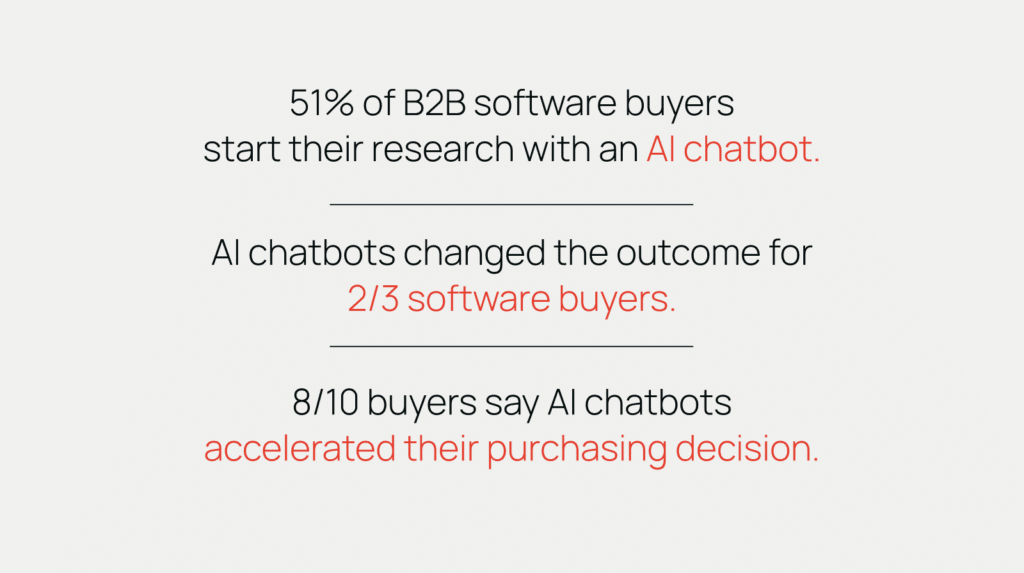
The adoption number gets the headlines, but it's actually the least interesting of G2's findings. Buyers moving to a new research channel is a distribution story — marketers have navigated those before. The next two stats are a different kind of story.
AI chatbots changed the outcome for two-thirds of software buyers.
Read that again. Not "informed their thinking." Changed the outcome. Two out of three buyers who used AI in their research ended up somewhere different than where they were headed — a different vendor, a different category of solution, a different shortlist entirely.
This is the part that should reorganize your marketing priorities. A traditional search engine handed your buyer ten links and let them assemble their own conclusion. An AI assistant hands them the conclusion — a synthesized recommendation, a comparison table, a "for a team your size, I'd look at these three." The AI isn't a new place buyers gather information. It's a new participant in the decision. It has opinions, and buyers are taking them.
Benchmark how AI sees your brand, build a strategy to strengthen it, and measure the impact.
And 8 out of 10 buyers say AI chatbots accelerated their purchasing decision.
Faster deals sound like good news, and for the vendors in the answer, they are. But think about what acceleration means mechanically: the research phase compresses. The weeks a buyer used to spend reading blog posts, downloading comparison guides, and sitting in your retargeting audience — the entire window where marketing traditionally worked on them — shrinks to a handful of AI conversations. Buyers are arriving at shortlists before most vendors' funnels even register that a deal exists.
Put the three numbers together and the picture is stark: the majority of buyers start in an AI, most of them are redirected by what it says, and nearly all of them move faster because of it. The buyer's journey didn't add a new step. It got a new gatekeeper.
Here's the mechanism underneath the "changed the outcome" stat, and it's worth understanding because it's genuinely different from how search shaped decisions.
In traditional search, the buyer did the synthesis. They'd search "best project management software," open six tabs, weigh the review sites against the vendor pages, and form a consideration set themselves. Your job was to be present at enough of those touchpoints that you made the list. Imperfect, but the buyer was the editor.
In AI-era research, the model is the editor. When a buyer asks, "We're a 40-person agency with clients in healthcare — what project management tools handle HIPAA compliance well?", the AI composes an answer from everything it knows and everything it retrieves — and the vendors named in that answer are the consideration set. There's no page two. There are no ten blue links to scroll past the answer. For a growing share of buyers, if you're not in the response, you were never in the deal.
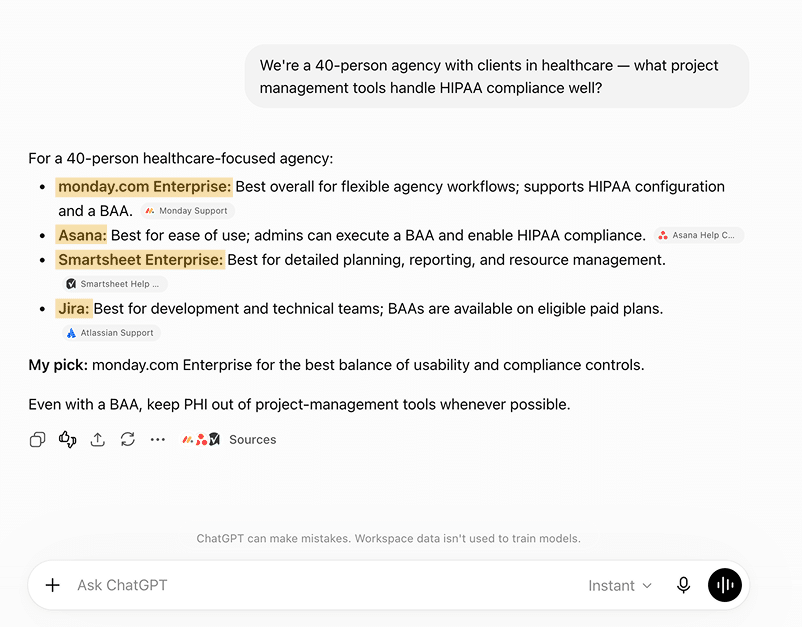
That's why buying outcomes are changing. The AI doesn't just reorder the same shortlist buyers would have built anyway — it builds a different one, weighted toward whichever brands are most legible to it: clearly explained, widely referenced, credibly reviewed, easy to cite. Brands that dominated the old game of rankings can be invisible in this one, and challengers with clearer, more citable material are showing up in answers next to incumbents ten times their size.
If your analytics look fine, that's not evidence this isn't happening to you. It's the nature of the shift.
Those AI research sessions happen off your properties, generate no impressions you can count, and mostly resolve without a click. The buyer who asked an AI four questions about your category, got steered toward a competitor, and never visited your site doesn't show up anywhere in your reporting. Neither does the one who was steered toward you — they arrive later as "direct" traffic, unusually educated, unusually far down the funnel, and your attribution model shrugs.
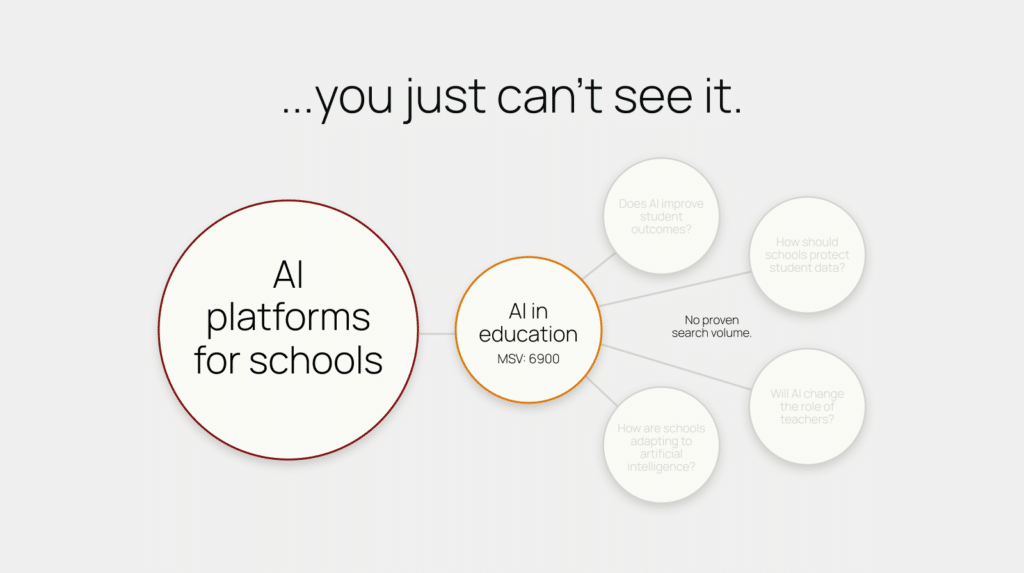
This is the same visibility problem we've written about across this series: the most important buyer activity in your category no longer produces trackable data. When we ran a keyword-free content exercise across our whole company, roughly 40% of the ideas our teams generated — the real questions real buyers ask — weren't covered anywhere on existing content calendars, because nothing in the keyword data ever pointed to them. The G2 numbers are the demand-side confirmation of the same story: the buyer conversation moved somewhere your dashboards can't follow.
Just because you can't see it doesn't mean it isn't happening.
The question every CMO should be asking isn't "should we respond to this?" The buyer already moved; that decision was made for you. The question is whether your brand is in the answers — and there's a concrete way to work on that.
Start by auditing your presence where buyers actually start. Ask the major AI assistants the questions your buyers ask — not your keywords, their questions. "What should a company like X consider when solving Y?" "Compare the top options for Z." Note who gets named, who gets recommended, what's said about you, and what sources the answers cite. This is the new SERP audit, and most teams have never run it. (If you want a head start, we run a free AI audit that measures exactly this.)
Then build for the questions, not the keywords. The prompts steering these deals — "I have $50,000 and a mandate; where's the highest-impact place to put it?" — have no trackable search volume and never will. They come from understanding your buyer: their fears, frustrations, objections, comparisons, and buying concerns at each stage of the journey. That's why we've stopped treating keyword research as step one and started from the audience instead, with keyword data brought back in later for validation and forecasting. Search volume is evidence of demand, not the boundary of demand.
Make your material easy to cite. AI assistants recommend what they can confidently parse and attribute: clear claims, specific comparisons, transparent pricing and capability information, third-party validation, structure a machine can lift an answer from. This is where E-E-A-T implementation for AI search stops being an abstract quality guideline and becomes a revenue lever. Vague thought leadership doesn't get cited. Direct answers to real questions do.
And measure the new funnel honestly. Sessions and rankings won't tell you whether you're winning in AI answers. Citation share, brand mentions across AI platforms, and the volume and behavior of branded and direct traffic will. This work compounds: one of our clients grew AI search results 261% with a topic cluster strategy built for exactly this environment. The teams that build this richer view of organic now are the ones who'll be able to show the work paying off — and keep investing in it — while everyone else argues with their attribution model.
Every stat in the G2 report will keep climbing. The 51% becomes 60%, then 70%; the buyers who haven't moved yet are the trailing edge, not the resistant core. Which means right now is the strange, brief period where the buyer behavior has already shifted but most vendors' strategies haven't.
That's not a threat. For any brand willing to move, it's the most asymmetric opportunity in B2B marketing: your competitors are still optimizing for a journey buyers are abandoning, while the new gatekeeper is still deciding whom to trust.
Half of your buyers are starting their next purchase in a chatbot. The only question left is what it says when they ask about you.
Want to know how your brand shows up in AI answers today? Get a free AI audit, or explore our GEO & AI Search services.
Platform properties are now available to everyone. Google announced this month that the feature has rolled out globally in Search Console, along with a new performance guide for social and video content. If you missed the original announcement, we covered it in full when the feature first launched — read that article here for a breakdown of what platform properties are and how to set them up. This article is about what to do next: how to actually use this data to your advantage.
First, a quick refresher on why this data is different. The data you get from Google Analytics is valuable primarily because it's your data. You own the domain, the tracking code fires on every user interaction, and you get to see how customers move through your content, which channels drive traffic, and where the journey breaks down. But your website is only one of many places your customers find your brand through search. Your YouTube channel appears in search results. So does your Pinterest profile, your TikTok account, even your Instagram posts. The difference: you don't own those platforms, so you've never had visibility into how people find your brand there.
Google Search Console has always been the exception, it shows data owned by Google, not dependent on a tag firing on your site, showing you exactly how your domain gets found organically. Platform properties extend that same visibility to the profiles you maintain on platforms you don't own. That's a genuinely new window into your brand's search footprint. Here's how we recommend using it to build effective content strategies.
Benchmark how AI sees your brand, build a strategy to strengthen it, and measure the impact.
When you connect a platform property and open the Performance report, you're looking at the actual search queries that led people to your Instagram posts, TikTok videos, X threads, or YouTube content. These are a direct read on what your audience is typing into Google when they're in the market for the kind of content you create. And because this data lives outside your website, it often captures demand that never shows up in your standard GSC property or GA4 at all.
Start by filtering the Performance report by query rather than by post. Look for terms generating consistent impressions across pieces of content across multiple platforms— that's your clearest signal of which topics Google associates with your brand. This is actionable whether Google has it right or wrong. If the association is right, you've confirmed your positioning. If it's wrong, you've found a disconnect between the content you're producing and the brand you're trying to build.
Pay close attention to the gap between impressions and clicks. A post sitting at thousands of impressions with a low click-through rate usually means one of two things: either the content isn't compelling in how it appears in search results, or the query intent is better served by something other than a social post. Say one of your TikToks is pulling 12,000 impressions on a "how to" query but converting under 1% of them to clicks, don’t mistake that for a failing video, that's a searcher who wants a step-by-step guide, not a 30-second clip. Cross-reference these queries against your domain's GSC property, and you have a prioritized list of content your site is missing for topics Google already associates with your brand.
The introduction of AI Overviews (AIO), along with Google making every SEO's life harder by making positions 1–100 nearly impossible to track, has injected a lot of unknowns into content planning. Keyword research is less accurate than it used to be, and the keyword datasets from SEO tools are no longer as reliable or actionable. Content strategy has started to feel like guesswork.
Platform property data gives you a faster, more grounded way to pressure-test topics before you commit significant resources to them. Here's the logic: if your social or video content on a topic is already generating impressions and clicks through Google Search, that isn't projected demand from a keyword tool. That's actual people looking for that content right now. It's the kind of validation that moves a topic from "we think this might work" to "we have evidence this works" in one report.
The practice is simple. Before greenlighting a major content investment such as a pillar page, a video series, a guide, first filter your platform property queries by the topic and look at the impression trend over the last 28 days. Growing impressions across multiple posts? Green light. Flat or nonexistent? Either the demand isn't there or Google doesn't yet see you as relevant to it, both of which are worth knowing before you spend the budget. This works in reverse, too: topics your team is convinced are winners but that show zero organic pickup across any platform deserve a hard look before the next quarter's calendar gets built.
Topic clusters have been a staple of SEO strategy for years: a pillar page supported by related content, interlinked to signal depth on a subject. Platform properties let you extend your topic clusters beyond your domain.
Think about how Google now sees your brand. It isn't just crawling your website, it's also crawling and indexing your YouTube explainers, your Instagram carousels, your TikTok tutorials, and your X threads, and platform properties show you which of those are earning search visibility. When your blog post, your video, and your social content all rank for queries within the same topic neighborhood, you're demonstrating authority on that subject across the entire search results page, not just in the ten blue links.
Use your platform property data to find the clusters that are already forming. Pull the top queries from each connected platform and group them by theme. Where you see the same topic surfacing across two or more platforms plus your domain, you have an emerging cluster, ready to be reinforced. Fill the format gaps: if the topic has a strong video and a strong blog post but nothing on social, that's your next carousel. Where a topic performs on social platforms but has no corresponding pillar on your site, that's your next long-form piece, and your existing social content becomes the distribution engine for it the day it publishes.
It is also essential to convey the same messaging and be consistent on unique value propositions, products and offerings, and overall voice of your brand across all platforms. You are trying to build an entity on the web that clearly tells Google who your brand is, what you do, and who you serve. That messaging needs to be consistent across all platforms that talk about your brand.
The goal is to stop treating your website content and your social content as separate strategies with separate teams and separate calendars. Google is evaluating your brand's expertise holistically. Your planning should work the same way.
The teams that get the most out of platform properties won't be the ones who check the report once out of curiosity. They'll be the ones who build it into their operating rhythm.
Add a platform property review to your monthly or quarterly content planning sessions, right alongside your standard GSC and GA4 reporting. Three questions worth asking every time:
This is also a report worth putting in front of stakeholders who don't live in Search Console. Social teams have historically had to justify their work with platform-native metrics such as likes, follows, engagement rate. These never quite connect to the pipeline. Platform properties give them something new: proof that social content is capturing organic search demand, in the same report and the same language the SEO team already uses. For agencies and in-house teams alike, that's a bridge between two functions that have been measured separately for too long.
Platform properties won't replace your keyword research or your analytics stack, but they close a visibility gap that's existed as long as brands have had social profiles. The brands that win with this feature will be the ones who treat it as a strategy input, not a vanity report. Connect your platform properties this week, and if you want help turning what you find into a content strategy, we can support. Let’s talk.
If you can't track where your traffic comes from, how do you prove your marketing works? It's the question keeping marketers awake right now as zero-click search dismantles the link between a question and a website visit. But here's the thing: We’ve been here before.
In 2013, a report existed that no marketer could produce today. It showed a client's organic keywords next to their monthly search volume — standard stuff. But the column next to it was the one worth staring at: exact visits, by keyword, down to the misspellings. Not a rounded estimate. Not a range. A number like 19 visits from "employee rewards program," 6 more from its singular form, and a dollar figure attached to each one specific enough to say, out loud, to a client: this keyword drove $13,750.30 in revenue last month. That kind of precision was normal.
Then, later that year, Google rolled out a Secure Search update. Overnight, that column went dark — just row after row of “(not provided)” — which became the tongue-in-cheek name for the event. Every marketer running paid or organic search lost the ability to tie a keyword to a visit, to a dollar. They were also left explaining to their bosses why half of what they were used to seeing in a report could no longer be found.
It read like an extinction event. If you can't prove which keyword paid for itself, how do you justify the budget behind it? How do you do the job at all?
Here's the part that's easy to forget more than a decade later: The data didn't come back, and the industry didn't collapse. SEO and content marketing kept absorbing bigger budgets, kept getting more competitive, kept becoming a default line item instead of a nice-to-have. One company’s own trajectory makes the point bluntly — the same business doing roughly $120,000 a month in total revenue when "(not provided)" hit was doing something like 8x that by the summer of 2026. That's not a story about one agency's growth engine. It's a data point inside a much bigger one: an entire industry kept expanding after losing the single metric everyone assumed it couldn't survive without.
The reason is simpler than it feels in the moment. Nobody had the data. Not your agency, not the client's last agency, not the biggest competitor in the space. When an entire industry loses the same piece of information at the same time, the businesses that pull back and the businesses that keep going are separated by something other than access to better numbers — because there is no better number to access. They're separated by whether they kept showing up for an audience that, "(not provided)" or not, was still searching, still buying, still there.
It also helps to be honest about how solid that lost data actually was. Search volume was never a hard count — it was a bucket. A keyword estimated at "10" a month might really be 7 or 13; Google just rounds it into the same tier. At real scale, the buckets get enormous: A keyword estimated at 246,000 monthly searches might genuinely be anywhere from roughly 190,000 to 300,000, and it still gets reported as one tidy number. Even today, research from Ahrefs puts their own keyword-volume accuracy at around 60%, and Google's own Keyword Planner is even lower than that. Their CMO's response to the criticism was blunt: directionally accurate is accurate enough. The precision the industry mourned in 2013 was, in large part, always a little bit of a story marketers told themselves.
Benchmark how AI sees your brand, build a strategy to strengthen it, and measure the impact.
Search is going through another one of these moments, and it has a name: zero-click search. AI Overviews, AI Mode, ChatGPT, and a growing list of assistants now answer the question directly, inside the search or chat interface, before a user ever lands on a website. The visit that used to generate a session, a pageview, a trackable event — the raw material attribution was built on — increasingly never happens at all. That's not a smaller version of the "(not provided)" problem. It's the same problem at a larger scale: the industry is once again losing the clean, attributable trail between a person's question and a business's website, only this time it's not one column in a report, it's the click itself.
And the audience isn't waiting for marketers to catch up. Google has said AI Mode now sees over a billion users a month, with query volume roughly doubling each quarter. ChatGPT is now among the five most-visited websites in the world. Research from G2 found that 51% of B2B software buyers now start their research inside an AI chat interface, that two-thirds say what the AI told them changed the direction of their decision, and that 80% say it made them buy faster than a traditional search journey would have. The audience is unmistakably there — it has simply moved to a place that's harder to measure.
The panic this produces is familiar, because it's the same panic. Brands are asking whether their traffic decline means their strategy failed, whether they picked the wrong platform, whether the whole channel is breaking down. Usually none of that is the actual problem. The problem is that the tidy, attributable version of the data that made everyone comfortable is gone, and comfort is not the same thing as evidence of demand.
Both moments — 2013 and now — reward the same instinct and punish the same mistake. The mistake is treating the loss of a metric as a signal to pull back, to wait for a new dashboard before doing anything differently. The instinct that wins is simpler and less comfortable: stop trying to measure the audience perfectly and start following it directly. In 2013, that meant investing in search and content even without a dollar figure attached to every keyword, because the audience was still searching whether or not anyone could prove it. Today it means showing up in AI Overviews, in chat answers, in zero-click results, because that's where the questions are being asked now — whether or not a session ever gets logged for it.
Search volume, keyword data, and attribution reports were always evidence of demand, never the boundary of it. Losing the cleanest version of that evidence hasn't shrunk this market once in its history. It has only ever separated the companies willing to adapt and go where their audience actually is from the ones waiting for the data to make that decision feel safe. The first group is the one that keeps growing.
Uncertainty is uncomfortable. But an industry that only invests when it's certain isn't managing risk — it's guaranteeing it'll be standing still when the data finally catches up to where the audience already went.
Have you ever been in a meeting where a client asks if [insert whatever trending GEO tactic of the week] will help them show up in AI search, and you have to take a deep breath before crushing their hopes?
We’ve all been there. The AI search landscape has everyone looking for a magic bullet, but the reality of what actually moves the needle is far more complex. And unfortunately there is such a massive disconnect right now between what we think drives AI search and what actually works that misinformation has taken root and spread faster than we can debunk it.
There is an organizational behavior theory from back in the day that I feel like can actually work really well in explaining why some strategies help you win at AI search and some don’t seem to make any difference, despite everyone claiming it will.
It’s called Two-Factor theory.
Benchmark how AI sees your brand, build a strategy to strengthen it, and measure the impact.
If you’ve never heard of two-factor theory, here’s the tl:dr
It was introduced in 1959 by Frederick Herzberg and posits that employee workplace satisfaction and dissatisfaction are driven by two different sets of factors, hygiene factors (or dissatisfiers) and motivators (satisfiers).
Hygiene factors are factors that when absent or not enough or done poorly, employees become dissatisfied (hence the name). But fixing and/or providing only prevents dissatisfaction, it doesn’t actually inspire and motivate employees to do better work. These are typically outside of the work of a job itself, and are things like working conditions, coworker relationships, good supervisors, and believe it or not, salary.
Motivators on the other hand, are typically intrinsic to the actual work and job. They're the things that drive people to perform their best, to innovate and be creative, to go the extra mile, and truly feel committed to their jobs. They’re less tangible typically too - stuff like opportunities for growth, doing meaningful work, a sense of accomplishment, being recognized and valued, being trusted and given responsibility.
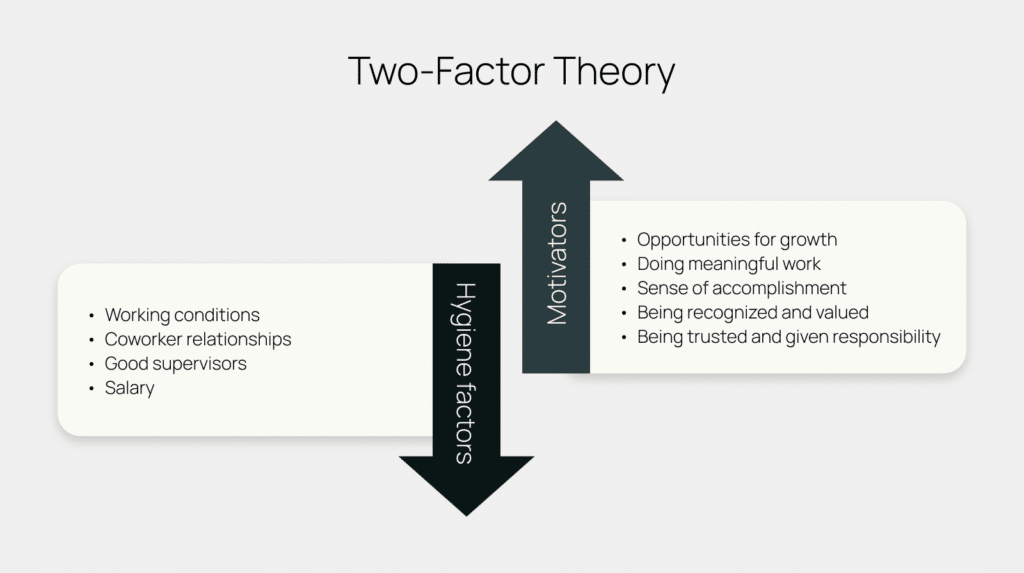
Herzberg theorized that both must be taken care of, eliminating dissatisfiers and focusing on creating satisfiers, in order to have motivated employees.
Whether you agree or disagree with the theory, it's a really interesting way of looking at things. The more I’ve thought about it, the more I’ve realized that it can be extended to contextualize things outside of human behavior.
In particular, I feel as if many AEO/GEO tactics become a lot clearer (and why you don't always get the results you want) when viewed through the lens of two-factor theory.
Now keep in mind that this is just an analogy. It's not a perfect one to one. Just like people who are more complex than two factors, so is search in today’s modern landscape.
So what are the hygiene factors for AI?
Think of them as the things that, if not present or done poorly, literally bottleneck an LLM's crawling behaviors and make it harder for AI to parse your site. Things like schema, llms.txt, ungated robots.txt, good heading structure, clear URL paths, optimized meta descriptions, and a solid technical site architecture. Basically, anything that establishes a clean semantic layer—the stuff that delivers your content clearly and cleanly so the machine can actually read it.
When people are searching for a magic bullet, often it feels like hygiene factors are the things that get recommended. Typically because they’re a lot easier to implement and feel more tangible. However, months later, after tests have been run, and we don’t see an uptick in traffic or mentions or citations, everyone throws their hands up and says well that clearly doesn't work, and moves on to the next shiny new magic bullet.
And well, yeah, of course it didn't work the way you wanted it to. It's a hygiene factor! You essentially just paid the entry fee to get parsed. It's only going to cause problems if it's not there (or done poorly), but it's not going to motivate the model to choose you.
The things that actually are going to get you cited, ranked, mentioned, whatever, are never going to be quick fixes. Just like with humans, they’re going to take a little more effort and time to cultivate.
An AI obviously doesn't feel brand loyalty; it relies on mathematical weights, entity recognition, and semantic relationships. So when we talk about motivators for AI, we're talking about authority, expertise, unique voice and insights, and brand recognition. Essentially, a holistic brand strategy.
It means actually having a product or service that's worth talking about and not just a copycat. If your content just regurgitates the exact same points as everyone else, an LLM has no mathematical incentive to cite you over the original sources. Unique insights create novel semantic connections, giving the model a reason to pull your specific perspective into a generated answer. These motivators are so much harder to replicate and cultivate. But truly, it's what's going to get you the win far more than any hack out there.
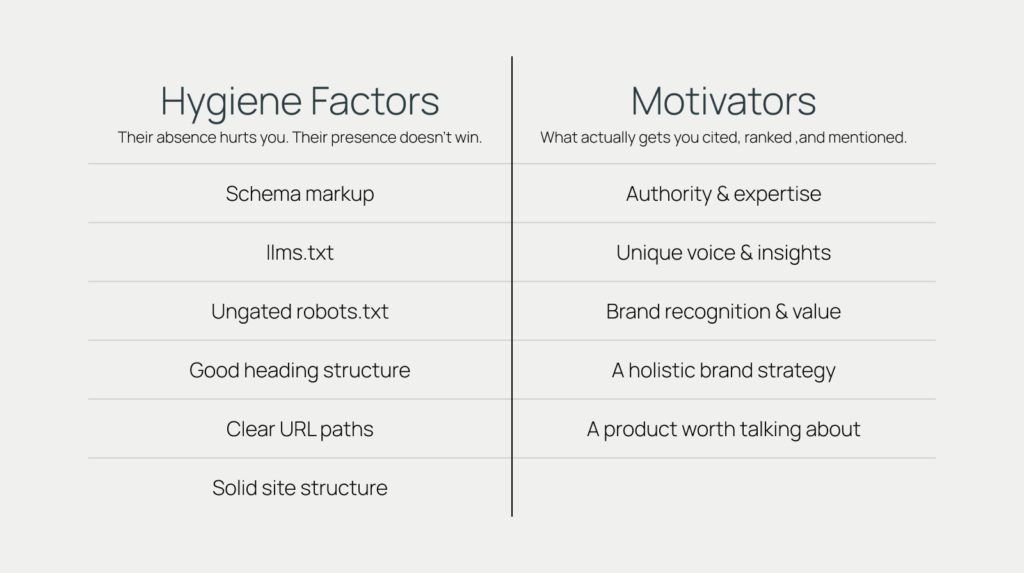
The next time you hear about a new GEO tactic , or a client asks if a specific tweak will guarantee them a spot in AI overviews, ask yourself: Is this just making it easier for the machine to read us, or is this giving the model a reason to actually care about us? Or essentially …is it just good hygiene or is it an actual strategy?
If it’s only the first, you’re just preventing dissatisfaction, not actually winning AI search.
If you pull a keyword report for the term “network segmentation” it will show you 2.9k searches a month. The old SEO model started by building a page optimized for the term, getting to the top spot, and letting the traffic role in. Mission accomplished. That was the prevalent model held for fifteen years, and many marketing teams still run on it.
Even though cumulative search volume is on the rise, that model just isn't working anymore for effective SEO all because the original “2.9k” wasn’t what it seemed. It was always 2.9k people who had all been trained to flatten what they actually wanted into the two or three words in order to get the results they were looking for. Now AI search lets people ask a question in their own words and now that single 2.9k number splits into 20 or 30 distinct intents. It may be a CISO asking how segmentation reduces ransomware blast radius, a mid-market IT lead asking whether they can segment without ripping out their existing firewalls, or a compliance manager asking which framework requires it all. And previously they all might have simply searched “network segmentation.”
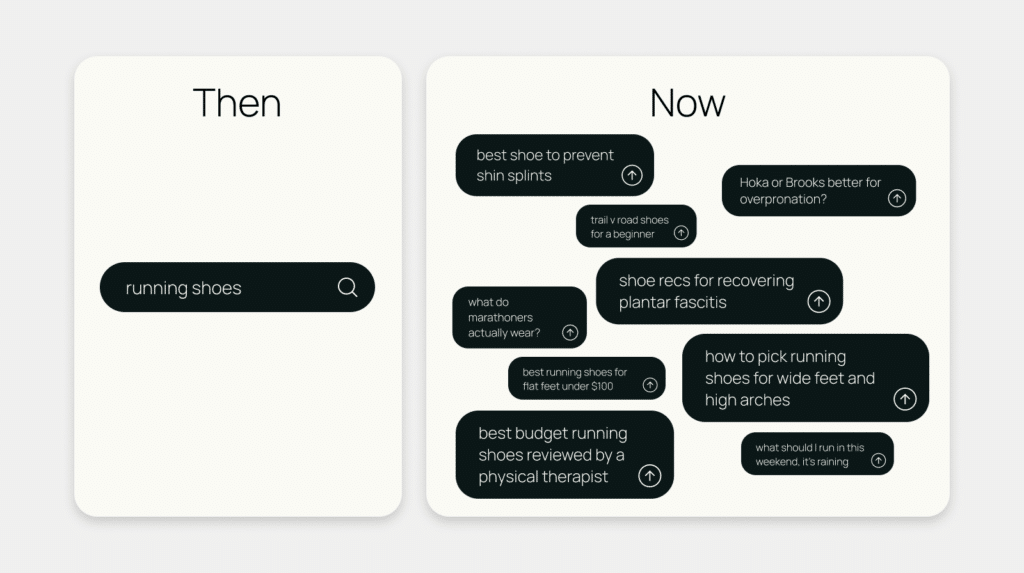
Keyword volume was always a proxy for demand, and it was never a great one at that. We tolerated the imperfect data because the search box forced everyone to round their question to the same handful of phrasings, so the proxy stayed roughly stable. AI search removed the rounding and added personalization to boot.
The search volume still tells you demand exists but it no longer tells you how anyone is actually asking.
If your target keyword is really 40 different intents, then “rank #1 for network segmentation” should stop being the primary objective (with the obvious caveat that a huge factor for showing up in AI search is showing up in SEO).
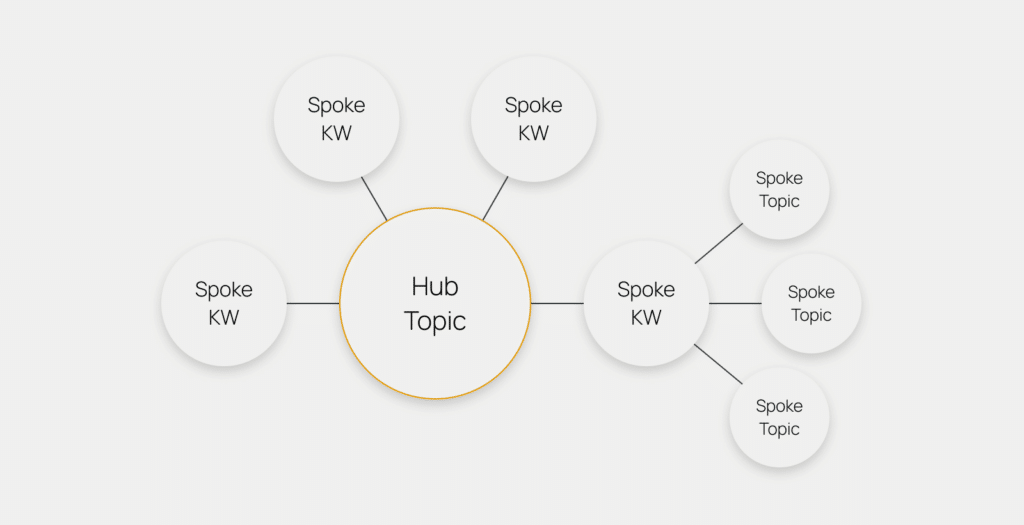
The goal should be to show up across a representative sample of the intents that volume is hiding. To cover the spread well enough that whichever way a real buyer asks, your brand is in the answer. That coverage can be achieved through larger, more comprehensive articles or guides, but we’re seeing more success with smaller and more direct content mapped to a hub and spoke model.
The big issue is that an AI answer is not stable like KW rankings typically are. Answers will vary with every search, every platform, and even between models on the same platform. If you track a single prompt and watch your “spot” in the response, you’re just measuring noise.
The current play seems to be to group related prompts into clusters (intent, funnel stage, product line) and read the aggregate over time across the most commonly used AI search platforms for your audience specifically. Then you should watch for changes over time, not focus too much on a single prompt.
If volume no longer tells you what people want, it becomes important to find other sources that do. Some areas we’re exploring and have found success include filtering search console queries, exploring forums and community threads like Reddit and Quora, customer interview, commonly asked questions or pain points from sales calls, expanding on concepts on the most visited and engaged with pages, and other internal data (support tickets, sales-call transcripts, site search, successful ad copy).
To be clear, I’m not advocating the industry stop using volume data and KW research entirely. We’ll continue to use it at 97th Floor. But we won’t treat KW research as a content calendar. It’s a market-validation signal and the work of deciding what to build comes from the real audience signals mentioned above.
Keywords aren't the only data worth rethinking, attribution is too.
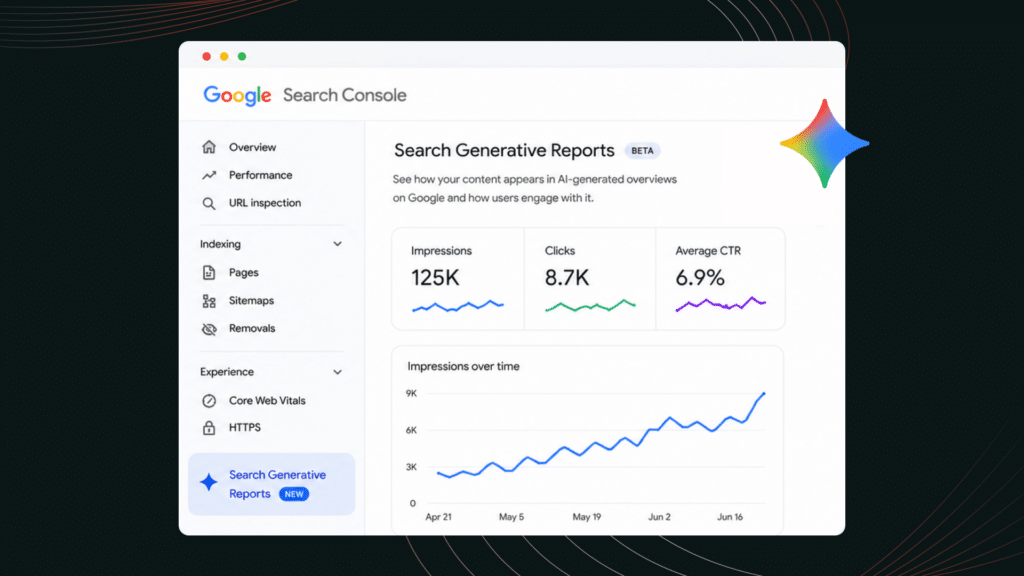
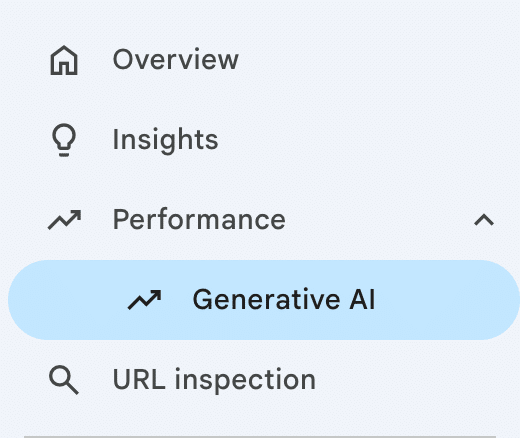
If you've logged into Google Search Console over the last couple of weeks and spotted a new "Generative AI" option, you're not imagining things. Google has started quietly rolling out a dedicated report that shows how your site shows up in its AI-powered search experiences (think AI Overviews and AI Mode). We caught wind of it internally and had our team dig through client accounts to see who has access, where it lives, and what it actually shows. Here's the rundown.
The new report lives inside the existing Performance section of Search Console and gives you visibility into impressions your site is generating specifically from Google's generative AI search surfaces — separate from traditional Search results and Discover.
For an industry that's spent the last year and a half asking "how do we even measure AI visibility?", this is a meaningful first step. It's the clearest signal yet that Google intends to treat generative surfaces as their own reportable channel, not just a footnote inside classic search results.
Here's where it gets a little messy: the report isn't showing up in the same place for every property. Our team found it living in two different spots depending on the account:
Some accounts have it as its own top-level report directly under Performance, sitting alongside Search results and Discover:
Other accounts have it nested a level deeper, tucked under Performance > Search results as a sub-report:
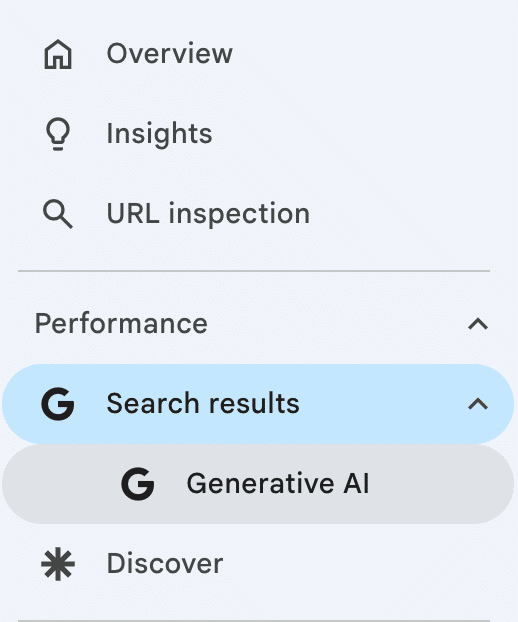
If you go looking and don't see it right away, check both locations before assuming your property hasn't gotten it yet.
True to form for a Google beta rollout, access is inconsistent right now. Across our client portfolio, some team members are seeing it on roughly half their accounts, others on fewer than half, and a few of us have it on almost none. There's no obvious pattern yet by industry, site size, or traffic volume. It genuinely looks like a staggered rollout rather than an eligibility-based one. If you or your clients don't have it, don't worry just yet. It's likely just a matter of time.
Before you get too excited about a new dashboard to obsess over, temper expectations on what it actually reports. Right now, the metric available is impressions only. This lines up with Google's own announcement of the report on the Search Central blog, and our team confirmed directly with Google that impressions are the only metric available for now — so it's not a bug or a data delay on our end.
That's a frustrating limitation. Impressions alone tell you that you're being surfaced, but not whether that visibility is translating into anything a client can act on or attribute value to. We'd expect (or at least hope) that Google expands this over time, but for now, treat it as a directional signal rather than a full performance metric.
We'll keep monitoring the rollout and report back as Google adds more to this feature. In the meantime, go check your Search Consoles, you might have new data waiting for you.
Remember when brand visibility mostly meant ranking on page one? This was back when readers had to click on pages to get the info they were after and AI was relegated to science fiction. It was a simpler time.
Not necessarily better… but certainly more straightforward.
Now your brand can show up in an AI-generated answer, get cited from a page you forgot existed, lose ground to a competitor in a recommendation list, or influence a buying decision without the user ever touching a traditional blue link. Search has become a kind of interpreter or paraphraser, applying artificial intelligence to pull information from pages and present it to the user in a (hopefully) clear and accurate way. The result is that more than half of online searches are zero-click. And when Google cuts out the middlebot, it changes what marketers need to be watching.
What I'm trying to say is that if you want to know how to track brand mentions in AI search results, you need to widen your gaze. SEO no longer begins and ends with ranking. It now extends to questions like "Does AI mention us?" "Does it cite us, and does AI talk about the brand in a positive or negative sentiment?" "Which pages does it pull from?" "How often do we appear compared to competitors?" And "Does any of this turn into actual traffic, leads, or revenue?"
Tracking brand mentions in AI search means monitoring when and how AI-driven platforms reference your brand in generated answers, recommendation lists, summaries, and cited sources.
But here’s the thing: AI search does not behave like classic search. Google’s AI features (for example) can generate overviews that summarize a topic and link users to a range of sources, while Bing now offers AI performance reporting tied to how sites are cited across Copilot and related experiences. Google also makes clear that AI Overviews and AI Mode still rely on essentially the same fundamental search requirements as the traditional approach.
So yes, rankings are still important. However with AI search, simply ranking for a keyword with one page is not the end goal, there’s more to it:
For example, a brand can show up in an AI answer even when it is not the top traditional ranking. Or a page can get cited because it answers a narrow question clearly. A competitor might get mentioned because information across multiple pages for things like reviews, product info, or comparisons are easier for AI systems to synthesize.
The point is that the future of search will remain search. It has just become more conversational, more layered, and a little more expansive.
This distinction is one of the biggest places marketers get tangled up. So let’s be direct:
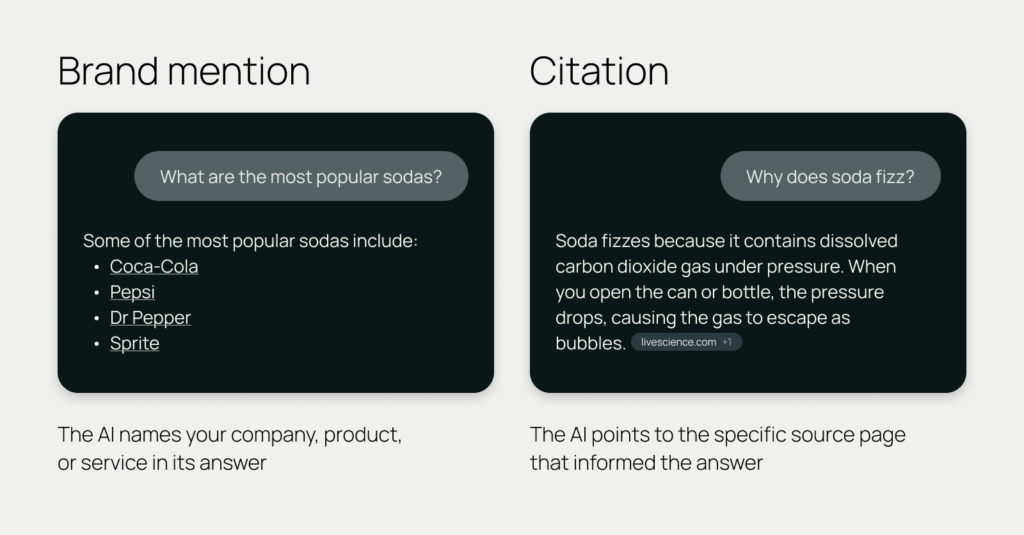
Which one do you want? Trick question, obviously; you want them both.
A mention can be flattering and still impossible to measure well. An owned citation can be less glamorous, but far more useful because it gives you something concrete to inspect. It's your page, and your site's analytics that can be measured and analyzed. Which page got referenced? How often? Did it receive traffic? Did users do anything useful after landing there? This is first-party data on the impact of AI search — which is more valuable than any AI search tracking tool, all of which are synthetic databases, or good guesses as to where and how you are showing up.
Or, think of it this way:
Google's documentation around AI features focuses heavily on how content becomes eligible for inclusion and how traffic from AI experiences is counted inside Search Console reporting. That suggests that source-level analysis should be part of the process.
OK. Let’s move beyond the academic: AI mentions, AI citations, cited URLs… does it all matter?
Yes. Unequivocally yes. Here’s why:
People are asking longer questions, more specific questions, and plenty of follow-up questions. Google has explicitly said AI search experiences are pushing usage in that direction, with users exploring more complex queries and broader source sets.
That means discovery is no longer confined to obvious high-volume keywords. Someone may find your brand while asking for the best agencies for AI SEO, the top platforms for generative engine optimization, tools similar to your product but better for mid-market teams with limited technical support and a weirdly aggressive CFO, etc., etc., etc...
The path from question to brand discovery is less clean and a lot less predictable. Measurement has to adjust to account for it.
AI assistants were built to assist, and that goes beyond just summarizing informational content. They can compare vendors, recommend providers, shortlist software, explain product categories, and shape buyer impressions before a click ever happens. As such, when a platform includes your brand in a recommendation set, you’ve already entered the buyer’s consideration stage — whether or not they ever visited your site.
And that’s great! It can also be unsettling.
If you’re going to let an opaque machine send potential customers to your virtual door, you’d better be paying close attention to how often it’s doing so, and on what terms. Otherwise, you’re letting the robot make your brand positioning decisions for you.
When your brand appears in AI-generated answers, it can function as a form of borrowed trust. Users are beginning to treat AI responses as synthesized expertise. But those answers are only as good as the sources underneath them.
The same qualities that make content useful for humans make it easier for AI to cite — one tactic leans into that more than any other. This short video breaks down the SEO move that Mike Witham and Blake Nielson from 97th Floor keep coming back to.
You should not confuse that with permanent authority. AI can be fickle, inconsistent, and occasionally wrong (and when it gets something wrong, it does so with supreme self confidence). Still, repeated inclusion shapes perception, and perception has a funny way of becoming influence.
If you’ve been in marketing for more than a few weeks, you’re probably already familiar with a tidy set of traditional metrics. You could follow rankings, traffic, click-through rates, and conversions, then build your strategy from there.
AI search adds some new layers to that picture by introducing answer inclusion, source citations, prompt visibility, and recommendation presence — all of which are signals worth tracking. That’s part of what makes AI search engine optimization a meaningful extension of the modern search strategy.

Brand visibility can show up in several kinds of AI-driven experiences. So, if you want to know where and how your brand is surfacing, you need to understand the environments in which those mentions appear:
Before you run off to buy seventeen subscriptions, start with the native data from the platforms (Google Search Console, GA4, Bing Webmaster Tools, etc.) themselves. That’s usually the best place to get a baseline view of how your site is appearing and performing.
Again, Google’s official guidance states that AI feature traffic, including AI Overviews and AI Mode, is included in Search Console’s Performance reporting for web search. It is not a perfect dedicated AI visibility dashboard, but it is still one of the best sources for understanding how your pages perform across Google search experiences.
Look at:
GA4 helps you connect visibility to behavior. Once users arrive on cited or AI-visible pages, what do they do? Do they engage? Bounce? Convert? Wander around aimlessly?
Even better, Google has added "AI Search" as a primary channel in GA4's default channel grouping. That means sessions arriving from AI search experiences can now be broken out and analyzed alongside your other acquisition channels — no custom regex gymnastics required.
Without that layer, you are measuring attention without taking outcome into account.
Bing’s AI Performance reporting adds a very useful angle. Microsoft says the report shows how your site’s content is used in AI-generated answers across Copilot and partner experiences, including cited pages and changes over time. This makes it one of the clearest native examples of AI citation tracking from a platform owner. Yeah, from Bing.
If you only track how often your brand name appears, you will end up with a very incomplete picture. AI visibility is bigger than that. Your measurement approach needs to be bigger as well.
So, in addition to the tried-and-true standards, what should you also be tracking?
Visibility without outcome is like getting dressed up to sit on the couch — you might look good, but you’re still not going anywhere. Tie cited or visible pages back to business performance by tracking sessions, engagement, leads, or conversions wherever possible. That kind of connection is what keeps AI visibility from turning into a vanity metric, and is increasingly central to evolving SEO strategies.
A practical tracking list might look like this:
The list of things worth tracking in AI search is longer than it used to be, but it's not unmanageable. Once you understand the difference between mentions and citations, know which environments your brand can surface in, and have a clear set of metrics tied to real business outcomes, you've built the foundation for a modern visibility strategy. Rankings still matter — they've just been joined by answer inclusion, citation sources, share of voice, and prompt visibility.
Of course, knowing what to track is only half the equation. The next step is actually doing it: building prompt libraries, running tests across platforms, monitoring citations, and optimizing the pages AI already trusts. (We cover all of that in our companion guide on how to track brand mentions and citations in AI search.)
And if you'd rather have a partner in your corner, 97th Floor can help you measure and improve your brand's presence in AI search. Contact us to see how we can help you strengthen your search visibility today… and as AI continues to revolutionize the landscape for years to come.
