



Paid media has grown up.
Does this mean it’s simpler, calmer, or easier to manage? Hahaha. No. Quite the opposite, in fact.
In 2026, paid media lives at the intersection of automation, creative strategy, data interpretation, and business accountability. Platforms move quickly. Interfaces change often. AI touches almost every layer of execution. And budgets feel heavier than they used to, because expectations are heavier too.This is where the role of a PPC agency starts to look very different from what it did even a few years ago. What used to be about keyword bids and ad copy now looks much more like systems thinking, forecasting, and cross-channel coordination. Which is exactly why businesses continue to turn to PPC agencies: for guidance.
At its most basic, a PPC agency manages paid advertising across platforms like Google, Microsoft, Meta, LinkedIn, and emerging discovery environments (such as AI-driven search and retail media networks). That part hasn’t changed.
What has changed is how success gets defined and how work gets organized around it. A modern PPC management agency centers on business outcomes: qualified demand, revenue contribution, and scalable growth. Traffic still matters; it’s just not the only voice in the conversation anymore.Today’s PPC agency operates as a strategic partner. Campaign execution is supported by planning, forecasting, testing frameworks, and measurement models that extend beyond individual platforms. Heading into 2026, PPC agency models reflect this shift. Strategy, interpretation, and optimization layers now carry as much weight as execution itself.
Maybe not a huge surprise in this new era of autonomous, intelligent machines, but the most visible change is automation.
Bidding, targeting, and creative testing increasingly rely on machine learning systems that operate faster than any human team could. That reality shapes how a modern PPC agency adds value. Manual campaign management alone doesn’t always hold up well anymore. The real leverage comes from setting the right guardrails for automation and evaluating its impact. As such, PPC agencies now spend more time interpreting data, defining testing priorities, and connecting performance signals back to business goals.
Data integration plays a major role here. Performance spans analytics tools, CRM systems, lifecycle data, and attribution models rather than living in a single dashboard. A capable PPC agency knows how to connect those inputs so optimization decisions reflect actual business conditions.
No two PPC agencies present their services in exactly the same way. Still, the strongest ones tend to share a common foundation. Each capability reinforces the next, forming an approach designed to work cohesively as campaigns grow and evolve.
The impact of working with a PPC agency is rarely expressed as a single metric. It reveals itself over time, in how efficiently teams operate, how confidently decisions get made, and how resilient paid programs become as complexity increases.
Most teams tend to notice the value of a PPC agency when they suddenly realize that they have a moment to catch their collective breath. Budgets start to feel intentional instead of reactive. Testing moves forward with a clearer sense of purpose. Performance reviews become less about chasing fluctuations and more about understanding patterns. And as campaigns expand across platforms and audiences, that steadiness creates room to scale thoughtfully, without the anxiety-inducing feeling that everything needs to be fixed at once.
Paid platforms are in a constant state of motion, and keeping up with that change is practically a job in itself. Policies update, automation behaves differently, targeting options come and go, and none of it waits for anyone. A PPC agency lives in that reality every day so you don’t have to, tracking changes, pressure-testing assumptions, and making adjustments before small issues turn into expensive ones. That buffer matters most when budgets increase and leadership expects stability along with performance.
For leadership teams, the real value often shows up in how conversations change. Performance stops feeling abstract and starts making sense in the context of revenue targets, pipeline health, and growth plans. A strong PPC agency helps translate what’s happening in the platforms into signals leaders can actually use, whether that’s deciding where to invest next, when to pull back, or how aggressive to be with growth goals. That shared understanding tends to ripple outward, making planning smoother and decisions easier to stand behind.
Competitive markets have a way of exposing weak strategy very quickly. Costs rise, attention fragments, and small inefficiencies stop being small. This is where a modern PPC agency earns trust by bringing discipline, judgment, and a long view to every decision:
In crowded spaces, broad targeting gets expensive fast. Strong PPC agencies spend real time understanding who’s actually worth reaching and what signals indicate readiness. That work goes beyond basic audience definitions and into intent modeling, behavior patterns, and demand quality. Clarity makes budget decisions easier. Spend gets directed toward people who are actually nearing a decision, keeping efficiency from eroding even when competition gets fierce.
Most buying journeys don’t move in a straight line, and competitive markets certainly don’t change that fact. Effective agencies account for that complexity from the start. Awareness, consideration, and conversion campaigns are designed to work together, each playing a role at the right moment instead of fighting for credit. Messaging shifts as people learn more, pause, compare options, and return when the timing feels right.
In competitive auctions, creative fatigue sets in quickly. Ads that worked last quarter start blending into the noise. Strong PPC agencies counter this by treating creative as an ongoing system. Clear messaging frameworks shape what gets tested and why, while performance data guides what gets refined next. Over time, patterns become visible — which ideas consistently resonate, which formats hold attention, and which angles stall out early. That ongoing rhythm keeps accounts healthy and responsive, without forcing teams into constant, exhausting reinvention.
Maybe it goes without saying, but forecasting works best when it reflects how businesses actually operate. The best PPC agencies approach projections by looking at what has happened, what’s changing in the market, and how leadership defines growth. That framing helps teams understand what different budget levels are likely to support and where expectations should sit. This approach makes it easier to have honest conversations about tradeoffs, timing, and risk.
Clicks don’t tell the whole story, especially in competitive markets. But knowing what comes after the click? That’s where things start to get interesting. Context-driven optimization pulls insight from sales feedback, lifecycle data, analytics, and post-click behavior to show how paid traffic actually performs once it leaves the ad platform. That broader view changes decision-making. Keywords get evaluated based on lead quality. Creative gets refined using downstream signals, budgets shift according to what converts, and optimization reflects the kinds of real outcomes that matter.
Now, be aware that at some point, every paid media program hits a crossroads. Performance plateaus, complexity increases, and what once felt manageable starts to feel harder to steer. Choosing a PPC agency at that stage becomes less about day-to-day execution and more about finding a partner who understands how paid media fits into a broader growth system — one that connects strategy, data, and long-term direction.With that in mind, a few criteria tend to separate agencies that simply manage campaigns from those that help businesses grow:
| Strategic depth | Look for teams that can explain why they’re making decisions, not just what they’re doing. Strong strategy shows up in how campaigns are structured, how tradeoffs are discussed, and how priorities get set over time. |
| Transparent, outcome-driven reporting | Clear reporting connects spend to performance in ways leadership can actually use. That means fewer vanity metrics and more insight into efficiency, demand quality, and business impact. |
| Experience across industries and growth stages | Markets behave differently at different scales. Agencies that have seen multiple growth phases tend to anticipate challenges instead of reacting to them. |
| Responsible use of AI and automation | Automation plays a role, but judgment still matters. The right PPC agency knows how to guide and evaluate automated systems so performance stays intentional rather than opaque. |
| Alignment with internal teams | Paid media works best when it doesn’t operate in a silo. Agencies that collaborate closely with analytics, CRO, SEO, and internal stakeholders tend to drive more consistent results and clearer accountability. |
There probably isn’t a single moment when a business suddenly “needs” a PPC advertising agency. It usually shows up as a pattern. A few small frictions pile up. Questions take longer to answer. Confidence in decisions starts to wobble. Often, this is precipitated by symptoms that are worth keeping an eye out for:
At 97th Floor, PPC advertising strategy starts with a simple acknowledgment: paid media lives inside a much bigger system than it once did. Revenue targets, pipeline realities, internal constraints — all of that shapes what paid media can and should do. We take the time to understand those inputs early, because everything downstream works better when the destination is clear.
Paid search and paid social operate within shared frameworks, not separate silos. Insights move between channels, and performance signals actually get used instead of parked in dashboards. AI and automation play their part, but always with human direction. Our teams set guardrails, interpret results, and test assumptions so optimization stays intentional and grounded in outcomes that matter.But let’s be clear about one thing: That work only holds up when collaboration is real. That’s why our PPC teams partner closely with analytics, SEO, and CRO specialists to reflect how users actually move through the journey. Consider our work with JK Moving, where reshaping paid media around demand quality and intent alignment led to more qualified leads and better efficiency in a crowded market. This is what happens when strategy, testing, and cross-team coordination pull in the same direction.
Planning a PPC investment in 2026 requires more than setting a budget and choosing platforms. It starts with understanding where you are today and where paid media fits within your broader growth plans. As you get started, be sure to:
For more than 20 years, 97th Floor has helped enterprise brands grow through constant shifts in how media works — by staying curious, experimental, and deeply invested in what’s changing next. Our PPC management approach blends strategy, data, and execution into systems designed for modern platforms, AI-driven optimization, and the realities of today’s paid media landscape.
So, if you’re ready to build a PPC strategy that supports long-term growth and adapts as paid media continues to evolve, we’re ready to help. After all, paid media has grown up. And with our help, your business can continue to grow right alongside it.
When’s the last time that Google sent you search results that weren’t at all what you were looking for? It’s rare, but it’s happened to all of us.
Maybe you searched for a recipe and ended up with a 1500-word blog post instead.
Perhaps you were looking for a list of the best blenders with product reviews but got an in-depth piece on “how to choose a blender” instead.
Maybe you were looking for broadcast details for a sporting event and landed on a product page for a streaming service.
Each of these are examples of a misalignment of page type when compared to user intent for each search query. And because of that frustration that you and countless other users feel in those situations, a main priority for Google’s algorithm is to correctly decipher user intent and align results and associated page types accordingly.
This is why page types matter so much in SEO strategy. Let’s dive into it, and how you can shore up your strategy to incorporate this key piece.
So, what do we mean when we say “page type”? Generally speaking, most written content online falls into a certain format based on user intent and where they are in the funnel. For example, some of the main page types include:
Depending on what a user is expecting to see, an appropriate page type can make all the difference to their experience — and by extension, your ability to capture their attention and prevent them from bouncing.
In the early days of SEO, less-sophisticated algorithms didn’t consider page type. It was not uncommon to see a bottom-of-the-funnel product page turned into a Frankenstein’s monster of a blog post in order to stuff in as many keywords as possible.
Today, user intent and experience are more important than ever, and that includes selecting the appropriate page type for each keyword and optimizing accordingly within that format.
You know that page type matters. And you know you need to match it to user intent. But how do you do that? Let’s break down the most common page types.
Users searching a specific brand or service name are typically looking to go directly to branded pages with essential information and straightforward navigation. This might include existing customers looking to log into their accounts, or those who are already familiar with the brand through other demand generation or nurture strategies.
If your keyword starts with “how,” “what,” or “why,” then your best bet is blog or similar informational content. Even if those words are not included, however, most higher-funnel keywords will also fall into this category—as well as a significant chunk of mid-funnel queries. If intent is not immediately obvious, it typically only takes a quick Google search to identify the main intent of users searching for these keywords.
When users are in the consideration or mid-funnel stage of the buyer’s journey, they are likely to be actively researching and comparing various solutions to their problem. As such, case studies and comparison-type content is most appropriate for these queries. Mid-funnel blog content or category pages may also be appropriate for some topics. Keywords including “best” or “reviews” are good candidates for this page type.
At the bottom of the funnel, when users are ready to buy, it only makes sense to serve them with landing or product pages. In these cases, conversion should be the priority, but there are still ways to optimize for the SERP.
Over the years, Google has attempted to prioritize user intent as much as possible. The type of page that shows up in a SERP is determined by what Google thinks the user is looking for.
Sometimes, Google will test different page types, or show a mix of page types in order to meet varying needs of different users searching for the same keyword. In these cases, SERPs may be broken up by page type and thus limit the quantity of that page type that will show on page one.
For example, only two of the spots on a certain SERP may be reserved for product pages. , If you have a product page that you want to rank for that SERP, you will have just two chances, rather than the full 10, to get it to rank. This makes understanding the correct page type for your strategy even more essential.
Do I Have the Right Page Type for my Keyword?
Ensuring that your page type matches the keyword for which you want to rank will be much easier if you start with a full understanding of your audience and customer journey. Audience insights should inform your keyword selection, help you group keywords into audience-focused topic clusters, and provide a check that you have keywords across every stage of the funnel.
From there, you can derive search intent through keyword and SERP analysis, identifying which page types dominate the top results in each case.
Building a Balanced Site Architecture
Customer journey insights are also essential in organizing your site content into a structure that is easy for both Google and users to understand. Each funnel stage should contain corresponding content, with internal linking between them, to craft the user journeys that make the most sense in order to nurture customers towards final conversion.
Now that we have established that not all pages are built for the same purpose, it should be clear why optimization must be tailored accordingly. Each page type has its own goals, layout, and optimization priorities, all designed to serve user intent while sending the right signals to search engines.
Homepage and Brand Pages
Focus: Discoverability and crawl depth.
These pages act as gateways, helping both users and search engines navigate related sets of products or topics.
Best practices: Ensure proper internal linking to and from subcategories or product pages. Use canonical tags and pagination control to avoid duplicate content.
Pro tips: Metadata should be optimized for clarity and click-through-rate (CTR). Site structure and navigation should match content topic clusters and optimal user experience.
KPIs:
Blog and Resource Articles
Focus: Education, authority, and shareability.
Blog content should build topical authority and provide genuine value to readers. These pages often target informational or mid-funnel queries and play a crucial role in internal linking and audience nurturing.
Best practices: Use clear heading hierarchies, optimized images, and schema markup for articles. Include strategic internal links to guide users (and crawlers) toward related content and next steps.
Pro tips: Blog keywords should fit into a cohesive topical authority strategy. Just because a blog article is not intended to convert right away, does not mean that you cannot guide the user to eventual conversion. Mapping out cohesive topic clusters and customer journeys with your content will not help Google and users understand your business
KPIs:
Landing and Product Pages
Focus: Conversions, minimal distractions.
Landing and product pages exist to drive a single action, such as a form fill, demo request or purchase. The key is to minimize friction and distraction on these pages so the user has a clear path to conversion.
Best practices: Keep navigation limited to maintain focus. Align target keywords with ad or campaign messaging for consistency and relevance. Prioritize mobile performance and fast load times to support both user experience and Quality Score.
Pro tips: Metadata can almost be thought of in the same way as you would a search ad at this stage — the goal is to capture as many of these high-intent users as possible, and click-through-rate optimization is essential.
KPIs:
Comparison and Case Study Pages
Focus: Clarity, rich product info, and trust signals.
These pages are built for decision-making. Users arriving here want to understand features, pricing, and proof points before they buy.
Best practices: Implement structured data and FAQs to enhance SERP and LLM visibility. Use unique, detailed descriptions and user reviews to strengthen credibility and avoid duplicate content issues.
Pro Tips: Proper content hierarchy will aid in ranking for research queries, as well as improving user experience and engagement metrics. Formatted elements such as lists, FAQ sections, and comparison tables will aid your chances of showing in AIO.
KPIs:
No matter how badly you may want to get a certain page ranking for a specific keyword, it won’t happen if Google does not believe it matches user intent correctly.
One of the most common mistakes is trying to force it anyways, attempting to rank a blog post for a transactional keyword, or using a product page to target an informational query. Google quickly identifies the mismatch, and users do too. This results in poor rankings, low engagement, and wasted investment on content that fits neither the user’s needs nor your own goals.
Page type dictates how both Google and users interpret your content. A balanced SEO strategy ensures you have the right mix of page types across the funnel — aligning intent and format throughout, and giving you the best chance of boosting both rankings and conversions.
Running an ecommerce business is a lot of work. You’re managing all your products, solving your customers’ problems with great services, and trying to grow in a competitive industry. With AI changes coming to SEO as well, it’s hard to know where to start with SEO and marketing. The good news is you don’t have to figure it out on your own.
This guide explores the current state of ecommerce SEO with AI optimization involved and where it’ll be going in the coming years. Read on to learn how to handle your SEO to keep your ecommerce brand thriving.
Ecommerce SEO is the process of optimizing your online store so that your product pages, category pages, and brand pages rank higher in search results. Unlike traditional SEO, which often focuses on blog content and service pages, ecommerce SEO also deals with thousands of SKUs, filtering options, navigation, and constantly changing inventory.
Executing an intentional ecommerce SEO strategy is essential because organic search is one of the strongest revenue channels for online retails. When shoppers search, they’re already showing intent to buy—so ranking higher gives you the chance to be the product they see. Effective ecommerce SEO makes sure the right products appear at the right time for the right customer, which can help both your immediate sales and long-term brand visibility.
Even the most advanced AI tools and content strategies won’t deliver results if your key ecommerce SEO fundamentals aren’t in place. Before scaling product content or experimenting with automation, your site needs a strong technical foundation that helps search engines and AI tools discover and trust your pages. These four essentials make your store findable, fully crawlable, and ready to compete in organic search.
Search engines need clean, discoverable paths to your product and category pages. Use robots.txt and XML sitemaps to guide crawl behavior and make sure the most valuable URLs are included. For very large catalogs, monitor crawl budget and prioritize high-converting or frequently searched products so that they’re indexed quickly and consistently.
Filters, sorting, and faceted navigation can create thousands of parameter-based URLs that look like duplicate pages to search engines. Instead of letting your best pages get lost to crawlers, use canonical tags, “noindex” rules, and URL structure. In addition, check that you don’t have any actual duplicate pages and that could be confusing both your users and the search engines and consolidate those.
Most ecommerce traffic now comes from mobile, so your site must be fast, responsive, and easy to navigate on a phone. Optimize Core Web Vitals at the template level so that your product and category pages load consistently and quickly on any device. Other ways to pick up your site speed include compressing product imagery and streamlining scripts.
Structured data helps search engines understand and display your products more effectively. A good way to help create structured data is to add products, reviews, pricing, and availability schema to your site. This provides your customers and search engines with rich results like star ratings and stock status in search listings. Keep your schema updated to reflect inventory changes so that shoppers receive accurate, up-to-date information before they even click.
AI and SEO go hand-in-hand. AI helps you scale what used to require hours of manual research, writing, and analysis. It can cluster thousands of keywords into logical product and category groups, personalize recommendations based on user behavior, and forecast demand by analyzing past performance and seasonality. AI search SEO allows you to build smarter navigation structures and target intent-based search opportunities more effectively.
AI can also automate repetitive tasks, such as generating product descriptions, meta tags, FAQs, and schema markup at scale. With the right prompts and review workflows, these outputs stay accurate to brand voice while freeing your teams to focus on higher priorities. AI-driven anomaly detection and performance monitoring tools can also surface issues—like sudden ranking drops, broken pages, or out-of-stock items—before they meaningfully impact your company.
However, AI should act as an assistant, not a replacement. Your team and your agency will provide the expert creative direction while AI speeds up the process.
A strong ecommerce SEO content strategy includes more than blog posts. The goal is to help shoppers make confident decisions while signaling relevance and authority to search engines. Here are a few ways to help build out your strategy.
Your blog should focus on topics that closely align with your products and the problems they solve. Target high-intent queries like comparisons, “best of” lists, and how-to content that moves potential customers toward purchasing.. Each article should support a product or category.
Evergreen content (like buying guides and care instructions) builds compounding search value over time. Seasonal or trend-driven content helps you stay relevant during peak shopping windows or product launches. Both matter—evergreen builds foundation and seasonal captures timely demand.
Long-tail content like “how to choose,” “best for,” and detailed FAQs helps potential customers confidently purchase. Some other content types you might want are comparison grids, sizing explanations, and care instructions.
Stack Overflow built a billion-dollar brand on the exact kind of Q&A content AI now answers in seconds — and paid the price. Jimmy Wales explains what the 90% collapse reveals about content strategies that won't survive the decade.
Every piece of content should strategically link to the right product and category pages. Internal linking helps search engines understand relationships between pages and distributes authority where it matters most. Use clear calls-to-view products, related collections, or comparison pages to guide both users and search engines toward your most valuable URLs.
Off-page SEO helps build the authority, trust, and credibility that search engines use to determine which brands deserve top rankings. For ecommerce sites, it’s about earning signals that show your products are valued by real customers. Here are a few strategies to boost your off-page SEO:
As you scale, SEO needs often evolve beyond basic optimizations. Deciding whether to manage SEO in-house or to partner with an agency depends on your specific needs and goals. Most ecommerce SEO agencies offer technical audits, on-page optimization, content strategy, link-building, and performance reporting. They often bring specialized experience with product feeds, schema markup, faceted navigation, and large catalog indexing—areas that can be difficult for generalist marketers to manage.
If rankings are flat or your internal teams are stretched thin, an agency can help. Other common signals it might be time for agency help include frequent site changes, large or rapidly growing product catalogs, and the need for structured testing to improve performance.
When you need agency help, 97th Floor takes a strategic, outcome-driven approach that can change the way your company handles SEO. Rather than applying surface-level fixes, we optimize information architecture, content ecosystems, and product discovery workflows to influence full-funnel performance. Our team combines expert strategy with AI-supported execution to scale insights, reduce manual lift, and align SEO outcomes with real results.
Search engines need clear signals about which version of each page is intended for each audience—otherwise, rankings can become diluted and customers may land on the wrong currency, language, or shipping region. International ecommerce SEO helps you make sure shoppers see the right page for their location. Here are a few tips to get you started:
While position improvements matter, the real SEO impact shows up in revenue, conversion rates, customer lifetime value, and product discoverability. The goal is not simply to rank—it’s to drive profitable, sustained growth from organic search. Below are a few ways to track how well your SEO strategy is working:
When SEO goals map directly to revenue and merchandising priorities, it becomes a scalable lever for long-term ecommerce growth.
Even experienced teams can run into challenges when scaling product catalogs and content. Recognizing and resolving them early can help you grow sustainably and reach your customers effectively. To up your SEO strategy, make sure you avoid:
Ecommerce SEO is shifting from static keyword targeting to dynamic, personalized experiences powered by AI and real-time intent signals. AI search engines are getting better at predicting what shoppers want before they explicitly say it. That means personalized recommendations, dynamic product rankings, and individualized search results will become standard—requiring ecommerce brands to optimize for user intent and behavior.
Another development on the horizon is voice commerce and conversational queries.
As voice assistants and conversational interfaces evolve, queries are becoming longer and more natural. You’ll want to be ready to handle question-based searches, comparisons, and instructional content to meet shoppers where they are.
Shoppers increasingly search using images, screenshots, and voice—often all in the same product search. Product pages in coming years will need rich visuals, clean metadata, and structured information to perform well in visual and AI-driven environments.
Expect search results to look more like curated guides than lists of blue links. AI-driven shopping assistants will become commonplace, pulling product data, reviews, inventory, and pricing from multiple sources at once. Brands that invest now in structured data, differentiated content, and flexible content pipelines will be positioned to lead the next era of ecommerce discovery.
Running an ecommerce brand in 2025 is like hauling feral cats out of a burning building — noble work, but try it alone and you’ll come out with more scars than survivors. That’s because ecommerce isn’t a single challenge; it’s dozens of moving, clawing parts that demand your attention all at once. Scaling an online store goes way beyond having great products. Visibility, customer experience, and platform mastery all play a role in turning browsers into buyers.
Ecommerce agencies step in as that extra set of hands. They handle the heavy lifting across SEO, paid ads, conversion rate optimization, design, and retention so you can focus on keeping your business upright and your capital from bleeding dry.
In this guide, we’ll cover what ecommerce agencies actually do, how to know if it’s time to hire one, what makes a ‘best’ agency stand out, and seven agencies in the U.S. worth your attention in 2025 — including ours (because, full disclosure, we’re really good at what we do).
If you’re reading this, you probably already have a sense of what an ecommerce agency does. Still, let’s not skip the basics.
An ecommerce agency is a specialized partner built to help online stores grow faster, smarter, and with fewer headaches. Unlike general digital agencies, ecommerce agencies focus specifically on the unique demands of online retail.
That means:
They’re measured by commerce-specific metrics like average order value (AOV), lifetime value (LTV), return on ad spend (ROAS), and retention — not just traffic or impressions. All of this is to say an ecommerce agency’s job isn’t finished once visitors land on your site. Their role is encouraging those visitors to stick around and actually buy something.
We’re not going to sugarcoat it: Hiring an ecommerce agency isn’t cheap. But the right one can more than pay for itself by uncovering growth opportunities you didn’t even know existed. It’s like figuring out which wire to cut on a ticking bomb after watching one YouTube tutorial. Technically possible, but maybe bringing in a professional would be safer?
In other words, the benefits go way beyond saving time (though that’s nice, too). Here’s why brands turn to ecommerce agencies in 2025:
Without checking any listings, we’re pretty confident in telling you that there are thousands of agencies out there ready to take your call. But what separates the good from the genuinely great? Flashy websites and slick pitch decks are nice, but results are what actually matter. The best ecommerce agencies prove their worth by showing exactly how they’ve helped brands move the needle.
Not every agency that slaps ‘ecommerce’ on its homepage is worth your budget. The best agencies share a few traits:
Statista projects that worldwide ecommerce sales will hit roughly $3.66tn by the end of 2025. And, if you’re like me and don’t immediately recognize ‘tn’ as a unit of measurement, it stands for trillion (12 zeroes). That’s a lot of potential growth; having a dependable agency by your side can help your business carve out its share instead of getting buried under everyone else’s.
You made it. This is the list you came here for. These seven agencies stand out in 2025 not only for their services, but for their ability to deliver measurable, platform-specific results. We’ll cover who they’re best for, what services they offer, and what makes them different in a crowded space.
Best for: Integrated growth across SEO, paid, and conversion optimization
Most agencies promise growth. 97th Floor has made a business of proving it. With deep roots in content, SEO, and analytics, 97th Floor doesn’t just help ecommerce brands ‘get more traffic’ — they work with you to align every marketing channel to generate more sales, more efficiently.
97th Floor is a full-service growth agency with a knack for turning ecommerce complexity into measurable outcomes. Their bread and butter includes:
If you want a partner that doesn’t just tweak one channel but instead pulls the whole system into alignment, 97th Floor is a top choice.
Best for: Content-driven ecommerce growth
Content is king, but only if it ranks — otherwise it’s just some obnoxious court jester that capers around the digital courtyard juggling outdated keywords (don’t mind me; just stress testing a metaphor). Siege Media built its reputation on creating research-backed, SEO-optimized content that ecommerce brands can use to win organic visibility. If you’re tired of writing blog posts that nobody reads, this is an agency that can change the story.
Strengths include:
If organic growth is your north star, Siege is the kind of agency that can help you outrank competitors without relying solely on ad spend.
Best for: Platform migrations and storefront optimization
Technology can be a brand’s biggest advantage — or its biggest bottleneck. 1Digital® Agency specializes in fixing that problem by making sure your storefront is fast, functional, and scalable, no matter which platform you’re on. Whether you’re moving from Magento to Shopify, need a WooCommerce overhaul, or want to unify your BigCommerce setup, they’ve been there.
They offer:
Overall, 1Digital® Agency is a good fit for brands with growing pains tied to their tech stack.
Best for: ecommerce SEO at scale
SEO may not be flashy, but it’s the backbone of sustainable ecommerce growth. WebFX has built a reputation on measurable outcomes, particularly around SEO. They’re a fit for ecommerce brands that want more organic traffic and are ready to invest in long-term visibility.
Services include:
They’ve worked with thousands of clients and have the scale to match complex ecommerce needs.
Best for: Amazon and marketplace strategy
For many brands, Amazon is both an opportunity and an obstacle — massive reach, sure, but also high fees, fierce competition, and limited control over the customer relationship. Nuanced Media helps navigate that complexity by giving you a strategy not only for your own storefront, but also for Amazon, Walmart, and other marketplaces where your customers are already shopping.
Highlights:
Great for brands that want to diversify beyond their own dot-com.
Best for: Conversion rate optimization and UX
If you’ve ever looked at your analytics and thought, Why aren’t more people buying? Inflow is the agency built to answer that question. They specialize in conversion rate optimization and user experience, making sure the traffic you already have does more heavy lifting.
Core strengths:
Traffic is great. Conversions are better. If your store has healthy traffic but underwhelming conversions, Inflow is a CRO partner to look at.
Best for: Performance marketing and paid growth
Growth often comes down to how well you spend your ad dollars. Upgrow focuses on performance marketing — paid search, paid social, and scaling strategies — so ecommerce brands can grow quickly without throwing money into the void.
They offer:
For ecommerce brands ready to put budget into scaling, Upgrow brings the paid expertise to do it properly and profitably.
This has been fun, hasn’t it? I mean who doesn’t love a good listicle. But it's worth recognizing that knowing who the top agencies are is only the first step. The real challenge is figuring out which one you actually want a long-term relationship with. You’re not swiping for a quick fling here — you’re looking for a partner who won’t ghost you when the budget conversation gets awkward.
Not every agency offers every service, but most ecommerce specialists fall into one or more of these categories. Think of it like a restaurant menu — you don’t have to order Ultimate Feast, but it’s good to know whether crab is available and if the lobster is fresh.
The service menu is broad, but most ecommerce agencies will cover some or all of these areas:
Do you need all of that? Maybe not. But if you’re building a working relationship with an ecommerce agency, then it might be a good idea to find one that can do everything in case your needs evolve somewhere down the line.
We sell ecommerce services, so maybe we’re not the most objective source to be asking. But we also get it: in an economy like this one, it doesn’t make sense to invest in something you might not need. If that’s you, and you’re wondering if ecommerce is the next step for your business, consider asking yourself the following questions:
In the ‘in-house vs. agency’ debate, the tipping point usually comes when you realize a single marketing hire can’t cover the breadth of expertise you need. Agencies provide a full team of specialists for the cost of one or two more employees.
At this point, you know what ecommerce agencies do, you know what makes a great one, and you know which names stand out in 2025. So why should you consider 97th Floor? The short answer: because we choose not to focus on optimizing channels and instead put our expertise to work optimizing outcomes.
97th Floor has helped ecommerce brands grow by aligning creative, technical, and analytical expertise into a single strategy. Our teams handle everything end-to-end:
At 97th Floor, the goal isn’t isolated channel wins. The goal is connecting those wins so they push the whole business forward (metaphorical cats and all).Ready to scale smarter? Let’s talk. Contact 97th Floor today to see how we can help your ecommerce brand grow in 2025 and beyond.
Do you think you have a good eye for design and user experience? Do you know what will move customers to act?
Prove it.
So…how did you do? We’re thinking not too great, and that’s okay.
We talked to Deborah O’Malley about all this. She is the founder of GuessTheTest, an A/B test case study resource focused on helping digital marketers increase conversions and get new ideas and insights from testing. She says, "In CRO testing, your chances of guessing the right test are about equal to guessing the correct side of a coin toss. Don’t make assumptions.”

Feel better? We all love our biases and assumptions, but we’re with Deborah. You need to rethink yours.
Most Conversion Rate Optimization (CRO) is done to increase the conversion rate of a SaaS sign-up form or an e-commerce product page. It involves taking a critical page or conversion point, creating 3-5 variants of that same page (each with one single tweak), using a tool like Google Optimize or Optimizely to run live traffic to each of those variants, and then discovering the "winner."
CRO - done right - enables marketers to step out of their biases and actually begin to understand their customers. Still, we’ve found that CRO is largely neglected. Econsultancy reports that 50% of companies value CRO as a crucial part of their marketing strategy, but that only 1% are very satisfied with their conversion rates.
Guess the Test shares, “The average conversion rate hovered around 3% in 2020. That means of 100 visitors coming to your website, only 3 out 100 are taking the desired action you hope they’ll perform, like purchasing your product.”
Ouch. Econsultancy also found that businesses that successfully boost conversion rates perform 50% more tests. This statistic speaks for itself. More tests, of the right tests, is better.
But still, companies spend just $1 on CRO for every $92 spent on customer acquisition. Samantha Brown, the VP of Enterprise Client Services at 97th Floor, explained, "There is a huge gap between what we’re willing to pay for traffic and what we’re willing to pay to turn that traffic into customers.

Seems off. CRO should be a higher priority, so we set out to discover the major roadblocks here and how to overcome them.
We’ve got some pointers.
CRO is a methodology, but we’ve probably all got it labeled as a tactic. Big misunderstanding.
As a manager, you focus on systems for acquisition, monetization, and retention. To improve all of these systems, you need to think of CRO as a method for innovation and not just a tactic. It’s not a phase - it’s a lifestyle, because the moment you stop testing, you’re saying “my customers aren’t living, breathing, changing humans,” or “I don’t care to keep learning from them.” Does that feel extreme? Yeah. So does not testing.
So, keep testing. Shiva Manjunath, Senior Strategist at Speero, is passionate about testing to learn. Whether or not your test is a “win” for conversion, the results are invaluable for understanding your customers. What you learn in each test should inform the next test you run. Shiva says, "The ripple effects and learnings of web testing are more impactful measurements of success than the individual metrics you move."

The CRO Shiva is talking about is more than changing the CTA button color or placing the CTA in a new location. He’s concerned about understanding his audience through the tests he runs. He’s more focused on experimentation —a mindset shift we all need to make.
Shiva Manjunath continues, “We need to unlearn CRO and relearn experimentation. We are running experiments on the website to optimize for the business KPIs and sometimes that’s conversion rate optimization. But sometimes we see CRO and think all it is is optimizing front end conversions when in reality you can run experiments on whatever you want.”
Want more expert marketing content sent right to your inbox?
Join our newsletter and never miss a beat.
Be careful to not let the title “Conversion Rate Optimization” limit your efforts. If the term “CRO” focuses marketers on optimizing for conversions as opposed to experimenting for better audience understanding, that’s a problem. Expand that definition. You’re a marketer, but you should also be a scientist. Ask questions. Create a hypothesis. Relearn experimentation, and realize that CRO is just one important facet of that.
CRO can’t be a checkbox hire. It can’t be a checkbox procedure, either. Building a culture of experimentation will pull in those amazing benefits of CRO we all hope for but don’t know how to get.
Do This: Incorporate experimentation into every aspect and role of your business. Make it clear to every team member that the questions they have about their audience can be answered.
CRO can feel scientific, but it is also an art. Ben Labay, Managing Director at Speero, explains: “There’s an art to the systems approach to CRO. If you get a big win on a landing page test for e-commerce and you get a 10% lift in transactions, that’s cool. What would happen if the sales team or the customer success team knew customer behavioral, psychological principles that went into that change in behavior? Then you could start standing on the shoulders of learnings and gain an unfair advantage.”
One definition of creativity is simply being aware of all the tools at your disposal and then knowing which tools to use and how to use them to solve your problem. One step further, it's taking all of the information and insights you gain across an organization and finding connections between them.
The best CRO isn't just a test — it's a perspective. Brandon Smithwrick explains why having and trusting your own point of view is the skill that separates analysts from strategists.
If CRO is limited to X% increase on Y page, no learnings are gathered and no connections are made. If CRO learnings stop after one single test or are held within one single department, connections can't be made across the organization.
Shiva agrees on this one: “There has to be a level of creativity when it comes to experimentation because you’re doing creative problem solving. You have a hypothesis that you need to test. The hypothesis can be tested in an infinite number of ways, the execution can be done in an infinite number of ways. So you have to guard rail it into specific pages and specific audiences. You have to understand how you are going to analyze a specific test. Then you have to work within the limitations of the site's ability to be modified.”
The art is also in what you do with the data. Are you finding the story in your test results? Are you really thinking with the intent to understand your customers? Is this story shared beyond you and your team? Take your learnings and share them widely. Democratize CRO and every test thereafter will compound.
Do This: Compound learnings, share insights, and get creative. Sometimes it’s the third test that gets you to the earnings. Sometimes, it’s the learnings from Sales and Customer Service experimentation that will reveal the best next step.
Here’s Shiva again: “You can’t get anywhere if you don’t have leaders who believe in experimentation.”
So, what do you do without leader buy-in? How can you create this culture within your company?
First, stay focused on data. It’s probably a lot easier to argue data-backed decisions than CRO-backed decisions. We know they’re the same, but maybe your team hasn’t caught the picture yet. So, focus on data and show how CRO is an extension of data—a research tool—actually, the best research tool.
Ben Labay explains that there are two types of data. The first type comes from existing analytics, machine learning data and other forms of big data. This data is old when you pick it up and start to make decisions based on it. Ben warns that when using this data, “you are ripe to trip on your own cognitive biases or on your own confirmation biases.” The second type of data comes from CRO and it will confront your biases.
Ben says, “CRO and experimentation is more about intervention. It’s about coming into a situation, changing something and measuring the effect of those changes. This is “just in time” data. It is a step higher in the causal ladder to understand the mechanism behind what caused the change that you see in the data. Objectively, it’s a better type of data. It gets closer to the mechanism of why something is the way it is. You learn more precisely and more accurately and at a faster rate.”
This second kind of data is so valuable because it is intentional, living and “just in time” for you to step into your customer’s journey and really think about how the change you are testing caused the data you end up with. You’re intervening in an ongoing process, always adapting in real-time based on multiple levels of creative testing. You’re engaged with data and your audience in a whole new way. Ben wraps it all up nice when he clarifies, "Analytics is data that you see. CRO is data that you do."

Pretty compelling stuff, so we recommend you just start. Not in a rebellious way. We do not want an office coup over CRO. But what’s your role? And where can you test? Start experimenting. Use your insights to create the next test. Then be vocal about how experimentation is changing the game for you, and other teams will hop on.
Finally—and especially in a leadership role—educate.
Shiva shares, "People see experimentation as something that slows down decision making. The reality is you need experimentation to make better decisions so you don’t crash."
Shiva continues, “You need to teach people. There’s a lack of education. There are some people that just don’t want to run tests because they don’t want to be proved wrong. But honestly it just needs to be reframed as a partnership. We’re not here to prove people wrong, we’re here to make you look better.”
The right education and persistence can tip leadership towards CRO, and once they’re there you’ve got them. Jeremy Epperson, Chief Growth Officer at ConversionAdvocates, says, “You don’t know how much ROI you will get on a brand new channel or campaign. Why would you hold CRO to a higher standard? There is no guarantee of results in life. You just need to make the case to get started with CRO.”
Do This: Make your case. You have a small window to prove the value of experimentation. Use low-hanging fruit opportunities to educate and prove the value of CRO quickly to get buy-in and high fives all around.
Listen, you’ve got this. Experimenting is exciting! And once you get started, the fire will catch and your organization can increase conversion and sales and everything else with this new “just in time” data.
And for your first experiment? Try dropping this article in your company’s slack channel. Start the conversation. Just see what happens.
Keyword research is a necessary step that you do to understand your market, and plan your SEO strategy. But what if you could use it to learn about user intent, restructure a whole site, and increase conversions as well as traffic? That’s exactly what we did with this client.
CBD American Shaman is a health company that sells CBD oils. While it’s a competitive market, their products have an edge on the competition because they’re water soluble. Despite this, they were struggling to capitalize on their great product with the kind of SEO traffic that it warrants.
Yet the potential was there: An audit revealed that the more specific SERPs previously targeted for the product had a pretty small search demand — but the right strategy could capture a large amount of traffic. Think “CBD oil” with 1 million searches versus “water soluble CBD oil” with only 1,300.
97th Floor was brought in with a clear business question to address: How do we capitalize on this great demand and become a breakout CBD shop?
Like much of SEO, the solution starts on the site-level. The CBD American Shaman site was hosted on a custom CMS (rather than WordPress, Shopify, or Hubspot, etc.), which always complicates technical SEO solutions. Their CMS was completely done by hand. The site organization was also done by hand, and more subject to human error.

They had a wide list of products, but their site wasn’t utilizing this wide variety to capture organic search. Their site’s architecture was flat, lacking the intuitive hierarchy that both Google and the user need to easily navigate and understand a site. In the beginning, there were only three categories on the CBD Shaman site: wellness, pets, and beauty. This organization made sense at the conception of the site, when the company offered few products. However, as their business scaled and expanded, that category structure no longer made sense, and in fact, felt difficult to navigate and drastically out of date.
It soon became clear that a total overhaul of the site’s organization was necessary. Any SEO tactics would yield mitigated returns unless the site was a complete, SEO-driven overhaul.
Just as a doctor treats a whole patient rather than a symptom, we chose to stop looking at each individual problem, and instead gather it all into one place and focus on the most essential and basic purpose of the site. In this process, keyword research and mapping were essential in understanding how to treat the site as a whole — curing all of its symptoms, rather than just hitting one at a time.
Keyword research is important, but like any data, it means nothing on its own. It’s what you do with the insights gleaned from research that matters. So — while sometimes all you need from your keyword research is a handful of new keywords to tackle — for CBD American Shaman, keyword research would go on to guide the entire reconstruction of their site.

We used our keyword mapping to guide the new site’s entire structure. By using keyword research as the foundation of the site, we captured more authority, and redistributed that authority back to the site’s most relevant and converting pages.
For example, the category page for /cbd-oils now houses all of the CBD oil products, allowing for more weight to target that high-volume keyword as well as an ease for the user in browsing the different oils available. In the previous version of the site, the following page was trying to rank for “CBD oil,” /vg-cloud-terpene-rich-cbd-oil-tincture. See the problem? Yes, it was a CBD oil product, but its strength was wasted in attempting to rank for “cbd oil” and it was poorly optimized for a user from coming form a Google SERP.
With the knowledge that these new category pages were much more likely to rank in Google SERPs, we followed our keyword research further. We used it to map and reorganize the entire site, categorically moving pages to align with relevant category pages rather than stand on their own. By connecting these further pages to those authoritative category pages, it allows us to pick up additional traffic from newly targeted keywords.
Evaluating the keyword landscape — which keywords ranked for which landing pages, and which keywords should be combined moving forward — was a BIG project. Pulling all of our ranking keywords, separating them by landing page, and creating new keyword groups took us a full month.
We had to determine what keywords should rank for a single landing page versus separate landing pages, which allowed us to find instances of keyword cannibalization. We also had to cross-reference each keyword within the designated SERP to identify whether a category page or an individual product page was needed to best fit the ranking criteria for that SERP. It was a lot of work, and a lot of detail, but it paid off.

Under the “shop” menu on the homepage, we added sixteen new categories, all based on newly selected high-potential keywords. It turned out that not only did search engine bots like this kind of layout, but users did too. Within weeks, CBD American Shaman saw a 13% increase in organic traffic, not only that, we saw an unexpected radical bump in conversion rates. Which makes sense when you consider how this also drastically improved navigation and the user experience.
CBD Shaman has an extensive product offering that is always being added to. With all of these choices, the shopping experience was previously overwhelming to users. Products were difficult to locate, and customers had no clear understanding of where to find certain products, or even what products were offered. Instead, the site was set up in such a way that they'd have to endlessly scroll through lists of product after product, without the ability to filter based on product type or use. It was hurting their sales, and alienating their customer base. So we knew it had to change.
They are constantly evolving their product catalog. With their previous strategy, a single product page may have built up a lot of authority over time, only to be taken down, and that authority would then be redirected to an unoptimized page or lost completely. With our new category-centric strategy, the business’s evolution is supported. No matter which products are added or taken away, the authority will remain in the category pages. These pages stay consistent in a constantly changing website, allowing users to always find their way.
The result is an SEO framework that not only worked on the onset, but it’s proven effective even a year later. This keyword mapping system has paved the way to double organic traffic for CBD American Shaman.
COVID-19 cancelled a lot of plans in 2020. Teachers. Doctors. CEOs. Politicians. Parents. Children. Travelers. They’ve all had to adapt to The New Normal. With Black Friday approaching, we’ll add retailers to that list.
Most retailers rely on Black Friday doorbusters to make their year profitable, and this year Black Friday is even more important to many retailers as they’ve suffered with shutdowns, lockdowns, and letdowns.
97th Floor has helped hundreds of brands find success during their holiday marketing push, but we’ve never done it in a year as unique as 2020. We wanted to know how shoppers would react to these changing times, so we commissioned an independent research study of 1,000 US shoppers to understand their hopes, fears, and behaviors when it comes to crowded malls, bustling stores, and online shopping this holiday season.
We’ve put together some of the most interesting insights in this article, but all the data can be seen in the PDF download attached to this article.


It’s true that this has been a difficult year for business. However, there are steps that you can take to safeguard your own sales as the holiday season approaches. Our advice? Focus your efforts online. 97th Floor will be releasing a small series of in-depth articles covering these topics deeper.
Sign up for our monthly newsletter to make sure you don’t miss one.
Some SEO tactics take months to see results, but the holiday shopping season is already upon us. So, this year we’d recommend finding that sweet spot between SEO that works for ecommerce sites and the SEO practices that yield results quickly. A few “quick wins” you should look at to increase the readability and user-friendliness of your site are product schema markup, proper rel=canonical for duplicate product pages (for holiday special prices for example), appropriate redirects, claim unlinked brand mentions, strategic internal links, and title tag adjustments.
Many brands can expect an influx of traffic during the next two months, so this could be a good time to roll out some testing in order to capture revenue from as much of that traffic as possible. Small changes can make a big difference on your site — one of our clients saw a 29% increase in revenue in just 18 days, without any increase in traffic at all. Imagine the possibilities as traffic does increase this holiday season. Our advice? Get started testing as quickly as you can. That way, when traffic really starts to peak, you know you’re getting that traffic to the most optimized versions of your pages.
It’s difficult to predict what will happen with ad auctions and CPCs during the holidays, but it’s certain prices will go up. Perhaps more this year than any other year since so many brands are hoping to make up for poor performance in previous quarters. Work to get more traffic right now, so that you can form remarketing campaigns later, which will be cheaper and more effective than cold ads. This might mean getting ads out the door earlier than you may have planned. Additionally, get all of the pixels you can active on your site. Even if you are only running Facebook Ads right now, still include pixels for Pinterest, LinkedIn, and Google if appropriate. Doing this will allow you to quickly pilot to new platforms if rising prices caused by holiday influxes on your platform of choice push you out. This will help you keep a steady ROAS.
Keep in mind that people are more likely to try a new product or business during the holidays, so if gaining new customers is a focus for your business, this is your time to shine. Monitor all of your channels closely, as well as CPM and CPC. Become hyper-aware so that you don’t end up paying more than you’d like per ad. Also, build your remarketing pool earlier and be ready to pivot.
Email is a channel that deserves more attention this holiday season. Work on more specific segmentation, increase your email frequency. A greater volume of emails is much more acceptable by most users this time of year, so it’s a great time to show them all the value you can), and be sure to keep it personal. There are little things you can do to add personalization to your emails, such as personalization in both copy and context, that make a big difference to those on the receiving end. Email your contacts based on their interactions with you, as well as the information you already know about them. When the situation is more specific, your emails are more likely to be effective.
There is no doubt that this holiday season will look different than any that has preceded it. Yet, even in 2020, there is still room for success when you plan strategically. Strive to work with the times rather than against them. The data collected in this study can be used to help tell a more accurate story this holiday season. And, taking to heart these suggestions, you can be armed to take this challenge head on — and hopefully see incredible results in the process. We’re going to be dropping more specific articles on our blog throughout this season, so be sure to follow us on social media and subscribe to our newsletter so you don’t miss a thing!
It’s no secret that conversion rate optimization (CRO), is an essential part of business strategy in this digital age. No matter your business model, your online presence is imperative to your success.
Marketers have known this for decades. But optimizing a site for the customer’s journey can’t just be intuited out of thin air. Every action a potential customer makes on the website is a part of their personal journey, and small changes can make a big difference when looking at the site holistically. The ease of a customer’s journey is essential in turning potential customers into active, happy customers.
CRO is the process of removing barriers to conversion, enticing action, and creating an overall positive page experience for your customers.
It’s easy to think there’s some kind of “magic bullet” when it comes to CRO-- a tried and true formula that produces immediate results for every industry and website. Unfortunately, there’s not. Instead, the true secret to CRO is knowing what to test and how to test it. You need intuition to know what to test, but sometimes the results of those tests will surprise you.
CRO testing is a quantifiable way to discover what is truly working on your site and what is not. It will save you money in the long term, with the potential to increase your revenue in the short term. Plus, you’ll learn things about your customers that you never imagined.
KOIO sells handcrafted Italian leather shoes. Their boots had hit a wall: they had consistent traffic viewing their product pages, however these users rarely added products to their cart. They were unsure what they could do to turn more visitors into customers, so they came to 97th Floor with the goal of capturing more users who were bouncing from their pages.

97th Floor knew KOIO’s situation and recommended a CRO campaign to provide actionable insight as to what site changes would produce the most dramatic results. They are a B2C business whose primary customer is a luxury audience willing to purchase products at a high price point. As a result of the average product price, revenue increases were closely tied to higher conversion rates. This made CRO an incredibly effective strategy in achieving their goals.
Audit: First, 97th Floor analyzed KOIO’s site and noted points of the customer’s journey with the highest potential for improvement. We worked to understand what bumps in the customer journey might cause potential customers to leave the purchase pages prematurely (and why). We did this by actively seeing things through the customer’s eyes. With the customer’s journey in mind, we identified areas where we could improve or modify KOIO’s current value propositions and CTAs.
Another site variation we were especially interested in was understanding the behaviors of their mobile and desktop users. Nearly 70% of users on KOIO’s site are on mobile devices, so we wanted to know: how effective was KOIO’s site for mobile users?
Using the findings from the audit, we made tactical hypotheses about what changes would best improve conversion rates. Then we designed a campaign to test which elements were the most potent forces for conversion.
Based on the specific situation and KOIO’s unique goals, we recommended multivariate testing-- a type of CRO in which several different variations are tested simultaneously and data is collected about each variation’s effectiveness.
Hypothesis: In order to optimize the testing process, we gave each of our hypotheses a score based on which ones we expected to perform the best. We thought about user experience, and the messaging they were exposed to on the product level. Then we scored them as to how likely the change was to increase the likelihood of sales. After our ranking evaluation, we placed each hypothesis on a priority road map to be sure that the majority of our resources focused on testing the highest potential variations.

Tests: After we’d formed our strategy, it was time to start testing. In order to be most efficient with our client’s budget, we set an appropriate timeframe for running tests, and determined to only continue running the tests that showed significant improvements. More traffic means faster results, and because our previous SEO strategy was already bringing in the traffic we needed, the results came quickly. For this test, getting significant results took about two weeks.
In addition, we ran two separate tests: one on the desktop site, and the other on mobile. For both tests, we kept the content nearly identical, but altered the placement of different elements as outlined above-- more on the importance of this strategy later.
As these tests were running, we monitored the results to evaluate trends and pivot as needed. For example, one of the tested variants (making “free shipping and returns” float) quickly showed that the results wouldn’t be helpful, so that variant was stopped.
Once the tests were in place, the results began rolling in.
If you remember, we started with five hypotheses and dropped one (that was clearly showing negative results). The four test variants that continued all resulted in positive lift percentages on the desktop test. The highest of these increases was a jaw-dropping 28.5%. Now, let’s emphasize that having several high performing variants is an unusual occurrence in CRO. Usually one variant pulls ahead as the clear leader. We were delighted to see that in this case, every variant was a positive one. This is a good reason to run multiple tests, so you get a clear picture of what is possible, rather than running the risk of missing something in testing a single hypothesis.
The highest individual increase was a 52% revenue increase for the variant in which we removed the financing option. This particular variant also brought us new information about KOIO’s customers-- their luxury audience did not respond as well to the product when asked if they’d like to choose a financing option. This is a valuable insight into how their customers want to be addressed and treated. However, if we had not run these tests it would have been easy to overlook a small detail like this, without which we would have lost both the 52% increase, and the valuable insight into our customer’s desires.

KOIO also gained valuable insight into their customers’ mobile experience as a result of CRO testing. A common misstep in any sort of multivariate testing is to run a desktop test, and blanket apply the findings to both the desktop and mobile versions of the site. Fortunately, 97th Floor knew better. We tested the mobile and desktop experiences separately, allowing us to see distinctions in desktop and mobile behavior. Our client was then able to take this information and create a plan for a separate mobile-optimized site.
With this information, we organized the product pages to better serve the customers, and the rest is history.
The total result for all of the variants combined was a 29% increase in revenue in 18 days. Those kinds of growth numbers are worth stopping for: CRO is no joke. Because of these higher conversion rates, our client experienced more than a quarter jump in sales and the bounce rate dropped significantly. Most importantly, KOIO now has a clear game plan based on solid data that they will use to maximize their revenue into the future.
KOIO is now bringing in more revenue than ever, because of the simple steps they took with us to optimize their site for their customers.
CRO has the potential to provide businesses with actionable insights that make a real impact — but it must be done right. Testing backs up intuition, and the two make an unstoppable CRO pair.
Lead-generation is a core component of a B2B marketing strategy. However, many businesses struggle to improve lead quality and quantity. Specifically, a survey from ActOn found 37% of SMBs struggle to convert web visitors into leads. While a low conversion rate can be caused by driving the wrong traffic to the site or by pursuing the wrong marketing strategy or having a poorly optimized page, many businesses will benefit most by building a more robust lead-gen strategy first.
Small businesses frequently start their lead generation by creating a core offer to garner interest in their product. These end-of-funnel offers-- free trial, free quote, free consultation, contact us-- are essential components to a lead-gen strategy. However, for businesses with longer marketing and sales cycles, having only these types of offers is a missed opportunity to capture and nurture leads.
In fact, if you have a robust top-of-funnel content marketing strategy in place with a low conversion rate, adding an offer of relevant mid-funnel content can significantly increase your conversion rate. For example, one 97th Floor client had a robust content marketing and SEO strategy driving qualified traffic to the site. Its “Free Trial” offer brought in a good number of leads, but overall, the conversion rate of the site was extremely low.
We decided to test creating an ebook and placing the offer in hyper-relevant locations on the website. Within the first two months the conversion rate for organic traffic increased 3x, and months later the site retained that conversion rate. After the success of the first ebook, we created another gated offer that was relevant to other high traffic content pieces. Organic conversions increased by 43% and were maintained long-term.
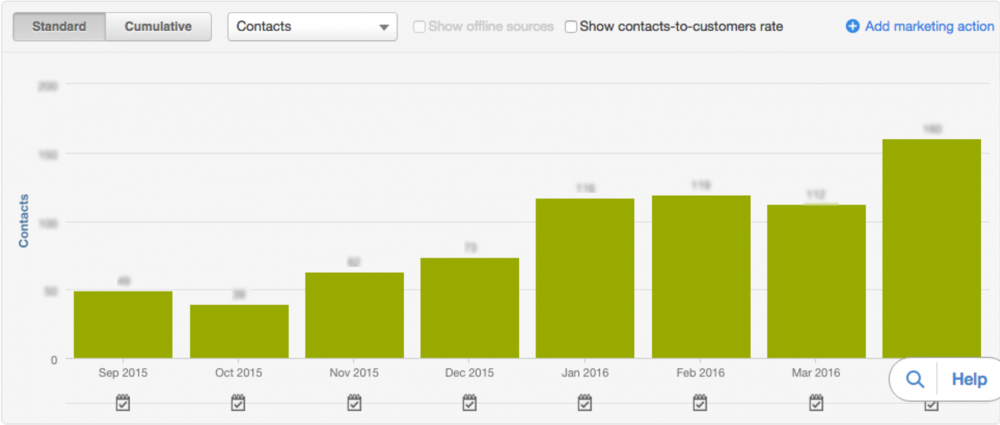
While having mid-funnel content was a key component to the campaign’s success, having effective content was the most critical component for driving quality leads. Many marketers would agree that content marketing is an extremely effective lead-gen tactic. However, it can also be the most difficult to execute well. After all, good content should be unique and insightful while nurturing potential customers all at the same time.
So what process can you follow to create effective lead-gen content?
In the case study cited above, we found there were 3 core questions a buyer needed to answer before making a purchase decision. The majority of that information was difficult to find, requiring visiting multiple websites and fitting pieces of information together while navigating a plethora of buzzwords. The ebook we created offered a comprehensive buyer’s guide that provided a framework for answering those questions and compiled all of the necessary information into a single location.
Content mapping is not a new concept, but many businesses fail to understand how crucial it is. Content should be mapped not just to the stage in the buyer’s journey, but also based on the information the visitor is consuming at the time.
For example, if a visitor comes to your website via a blog post titled “What is content marketing and why does it matter?” an ebook about “How to Optimize Title Tags” is not nearly as relevant as an ebook on “How to Develop Your First Content Marketing Strategy.”
In the case study above, the main CTA to the buyer’s guide was placed on a page with a competitor comparison matrix. Visitors who arrived on that page were already looking for information to help them make a purchase decision, so a comprehensive buyer’s guide was a compelling offer for those visitors. So compelling, in fact, that the click-to-submission rate ranged from 50-65%
Many traditional marketing activities- webinars, trade shows, purchased lists- are one-and-done activities. Once the event is over, it doesn’t continue to generate leads. If the business needs more leads, it has to attend another trade show or produce and promote a new webinar. Gated content, however, can produce a long-term conversion funnel if you create the content with that intention.
Content typically dies because it:
The secret, then, to creating a long-term conversion funnel is to create content that will still be useful to a buyer two years from now and is tied to organic traffic coming to your website. In the buyer’s guide case study, the conversion rate was maintained because SEO was the primary content promotion strategy with only a small percentage of leads coming from social or paid channels.
There is no one-size-fits-all solution in marketing, but by following the principles above you’ll be able to create effective lead-gen content and test whether mid-funnel conversions can have a significant impact on marketing ROI.
