



The buyer’s journey as we know it is changing again. Google’s latest product announcement that included agentic coding strikes another blow to marketer’s hopes of gaining that all-important website traffic and conversion.
But here’s the thing (at the risk of sounding like AI myself): Everything is changing, but really, nothing is.
While it’s sure to be a new challenge to track the updated journey (but then again, when isn’t attribution a challenge?), the actual reality is that your audience isn’t going anywhere, they’re just finding you differently. And our job as marketers remains largely the same, even if the details look different. What does that mean, exactly? Let’s get into it.
For a long time, SEO looked like this:
That made much of your optimization for steps 1 and 2 about getting traffic, and then step 3 was purely focused on site optimization.
But now, your audience converts in one of two ways:
So while we used to optimize for being found, then converting. We must now optimize for being recommended, and either converting warm visitors or converting off-site..
Both sides of this coin require the same foundation: genuine authority and frictionless user experience, which can only be achieved through a deep understanding of your audience’s real needs.
Not to toot our own horn (ok, that’s exactly what we’re doing) but 97th Floor has been talking about full funnel, audience-first marketing for quite some time. After all, you can optimize a landing page as much as you like, but if it’s not the right audience finding it, it’s not going to do anything.
We are going to see this more and more moving forward — a shift from CRO in isolation to full Conversion Path Optimization.
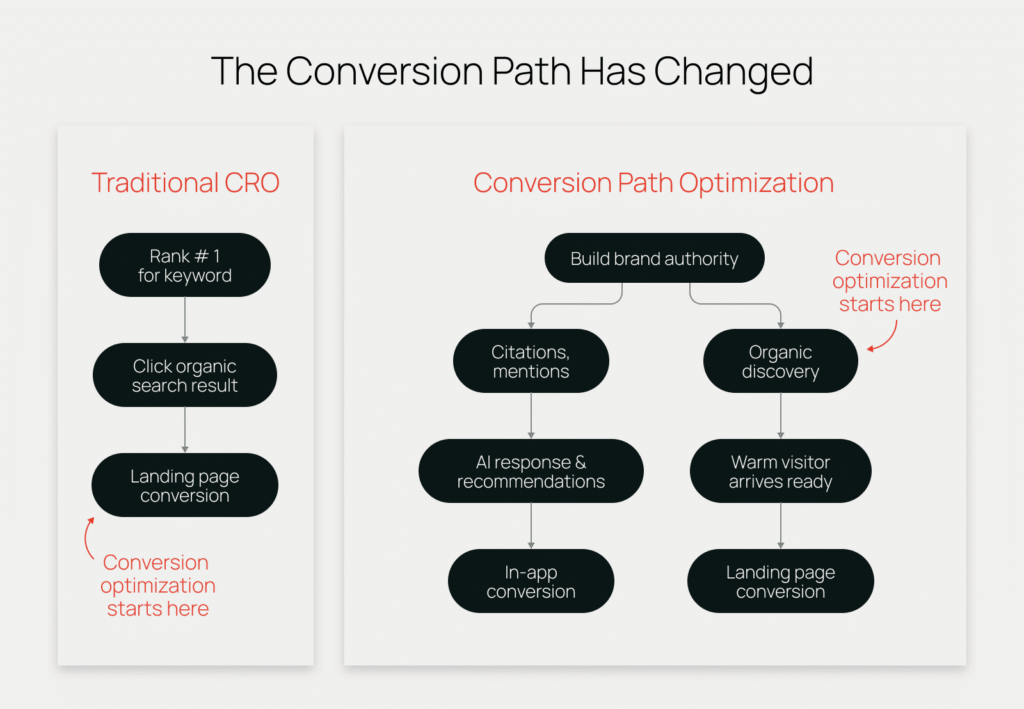
Here’s what we need to focus on:
AI agents having control over purchases might feel like marketers are losing control, but there is a lot that you can do to influence and optimize this process, even if it happens in an app instead of on your site. In fact, there are a few things we can focus on already in order to optimize that conversion path:
As agent recommendations will get increasingly more tailored, optimizing from discoverability right through to checkout will be have a huge impact on conversions.
Of course, not everyone is going to use an agent to make a purchase. If you look at in-app purchases on the social media side, adoption is significant, but not total (after all, there’s a whole generation that refuses to make “Big Purchases” on any device but a computer). That means that you still need to optimize for those visitors who, after completing all of their research with AI, will still arrive at your site to make their final purchase. Some places you can start:
This is a marketer’s bread and butter and, far from being redundant, it’s more important than ever.
Attribution models built on last-click or even session-based logic won't capture agent-assisted conversions. Conversion measurement will need to move past organic traffic/conversions and embrace new, mixed models that capture both visible conversions and agent-assisted ones.
At 97th Floor, we’ve long talked about high quality, audience-first content as the best weapon in a marketer’s arsenal in the AI era. That is holding more steadfast than ever with these latest Google updates. The following factors are more important to invest in than ever:
Audience insights
Who is your audience? What do they need? What are competitors missing?
Brand-building & authority signals
Yes, citations and mentions, but also things like thought leadership and media presence.
Innovative, unique content
Content should reflect unique insight, rather than just keyword optimization.
UX/checkout optimization
Frictionless transactions, whether by agent or human, will boost your conversion rates.
Full conversion path optimization is the way forward, and it starts right at the very beginning of your marketing strategy. A time where everything is changing so rapidly can be either scary or exhilarating for a marketer. If you embrace this chance to put the audience first and build your strategies around them, it’s all but guaranteed to be the latter. And hey, if that still sounds intimidating to you, give us a call!
Inevitably, you’ve discovered technical issues that are hampering your organic growth—and you need development to tackle these optimizations. But getting the ear and time of dev teams can be extremely challenging amongst all the non-SEO initiatives they’re tackling.
Frequently, SEOs will find themselves in these scenarios:
Josh Moody, 97th Floor Executive Director of Palomar, offers five tips for reducing the friction between SEO and development:
Instead of trying to bend development to your SEO-strategy, learn how your development team operates and consider how you can amend your SEO strategy to fit into their existing process.
Get curious about your dev team:
Adjusting your strategy cadence to be more development-friendly decreases frustration for both SEOs and developers.
Before sending over a long list of optimizations, consider how development thinks about implementation. To begin, they’re using a completely different vocabulary than you use. Why in the world are we talking to developers about “optimizations?” Let’s try “bug” instead. Submit tickets, not slide decks.
Ancestry’s Director of SEO John Crockett advises, “Understand a developer’s world enough to talk to them intelligently. I don’t get too much into the solution with them, but I do know enough coding and engineering to be prepared in those meetings with an idea of how we’d accomplish it. Doing the research has taken projects from being labeled as impossible to being done.”
Be respectful of the developer’s expertise. Don’t assume you know what a fix will require from them, but come speaking in their language to show you’re ready to collaborate.
Marketers are always trying to create a story for their target audience. For SEOs, developers are your audience and you should structure your story using the following three components: user description, functionality, and benefit.
Here’s the formula:
As a [description of user] I want [functionality] so that [benefit].
For example,
“As a new or existing website visitor, I want to ensure text remains visible during the page load, so that I can have a better user experience, especially if I’m on mobile devices with a slow network.”
This reads a lot better than “make text visible while the page is loading,” and helps a developer understand why your requests are worth their extremely-limited time.
Writing like a developer is a learnable skill, not a personality trait — Whitney Goldstein makes the case. This short video breaks down what it actually takes for a marketer to close that communication gap.
Get as clear as possible about the problem you are trying to solve and the role development will play in solving the problem.
There’s a huge difference between, “Could you add Google Analytics to the site?” and “Could you add the following JS tracking code to the site via each page’s header?”
A developer’s kryptonite is scope creep—changes made to the project push schedule, budgets, or resource allocation—and every time more clarification is needed, deadlines are at risk. Get clear by helping the developer know exactly what you need from start to finish—you’ll get more accurate estimates and preserve the relationship you’re working so hard to keep with them.
Need a change and want it a certain way?
Phrases like “Add some zing” or “make it more punchy” leave way too much room for interpretation. Whatever those phrases conjure up in your head are drastically different than what it may suggest to a developer. Obviously, you’d never use “zing” or “punchy”, but maybe you’re using other terms with subjective meaning.
Sharing examples side-steps this problem altogether. The best kinds of example you can share are:
Search around Dribbble and other sites to show development what you mean by “zing.”
Bonus Tip: Once a project is completed, share wins with the development team who helped you complete them. CC the boss. CC everyone. Get excited about the ways that SEO is improving customer experience and showcase how each person contributed.
SEOs, remember that your relationship with development is a partnership. Make dev your friends by understanding their world. Developers think literally. They are also extremely busy. Make their job as easy as possible, and your SEO implementations can happen faster and with greater precision.
We sat down with Eli Schwartz, Arpana Tiwari, and Todd Friesen to learn about the journey of an SEO through the past decade of search, the essential skills SEOs need to develop at the moment, and what the future of Search could look like.
Danny Allen: [00:00:00] I'm danny. I'm the VP of marketing at 97th floor. We're an enterprise digital marketing agency. We have Eli Schwartz with us, growth advisor and SEO strategic consultant, also author of Product Led SEO, the book. Uh, we have Arpana Tiwari, who is the director of organic growth at Eventbrite. Uh, used to be at Adobe, Google, Facebook, Walmart, Apple, everywhere. I'm sure I missed a couple others. And then we have Todd Friesen as well. Uh, at, uh, well, you're a free agent right now. Formerly at Vimeo and then previously at Salesforce for, for just about 10 years. Correct. Incredible to have all three of you. Thanks for jumping on. I actually gathered all of you together because, uh, we work with a lot of Like top notch SEOs, top notch digital marketing leaders, and a lot of them are kind of coming to us with these questions about the role of organic right now with so much influx.
They're kind of re evaluating where this fits, does it fit? Obviously it still fits, but to what degree? What they should be thinking [00:01:00] about? All that kind of stuff. I just attended MozCon, and there's just a lot of those questions floating around, like, you know, what should we be expecting of ourselves right now?
And, uh, with all the change coming, right? So, with each of you having Uh, over a decade of experience, plus, uh, working at the highest levels of SEO, I think you have a really important perspective that you can share, and I want to kind of pull that out of you. So, uh, just to kind of kick this off, though, maybe kind of for fun, I was thinking about, let's all think back a little about 10 years ago, 10 to 15 years ago, where, where you were, what you were facing, and we're going to bring it up to, to what we're dealing with right now.
But, for fun, I did a couple, like, searches on Google from back in like 2008, 2012. Trying to understand what people were searching for. This was kind of a funny one. Uh, I found a Search Engine Land article that said this. It was citing a study. It said, 64 percent of companies said finding an SEO specialist was more difficult than finding other skilled employees.
The whole point of this article was that there's like a shortage of SEO people. We need more SEO people. This thing is This thing is growing like crazy. Um, in the same study it says, companies with a significant SEM [00:02:00] spend, and then they put in parenthesis, over 25k a month. Which is kind of, which is kind of funny, right?
That 25k a month was a significant SEM spend. But it says, uh, those companies ranked, um, hiring skilled SEO staff on par with other technical or implementation based SEO challenges. Basically just finding people was, was the, the challenge. Another kind of funny nugget was a article from Moz in 2012. And it listed some of the top skills that SEOs needed.
It said, uh, number one, be the best person to work with at the office. Uh, number two, always talk about SEO from the perspective of people, not robots. Number three, don't rely on data to tell your story for you. Number four, help your colleagues meet their goals before asking them to support yours. Number five, go agile from a project management perspective.
I thought some of this stuff was funny, just thinking back, like, and I was really young in my career at that point, but I still remember this feeling of like, no one will give us The, the time of day. How do I get anyone to believe in SEO? And, and even though now SEO and organic as a channel is, is huge everywhere, I still [00:03:00] feel like some of these things still apply.
Some of these challenges are still felt. Everyone kind of still says the same thing. I can't get buy in. I can't. Anyway, I don't want to spend the majority of our time together talking about the past, but I do want to like ask you, feel free to speak when, you know, but what were, what were your, what are your memories from those days?
I don't know if you want to kick it off, Eli.
Eli Schwartz: So we go back like 10, 11, 12 years. There was those. I think that's an SEO change. That's when like smart SEO died because Google took away all the tricks like between Panda and penguin, like Panda was the algo update that got rid of all the thin content and it's, it's baked into the algo today.
So like the whole idea, like we're, it's Panda applies today when we talk about gen AI. So if you think about. There was a plugin, Todd and Arp and I remember this, it was called caffeinated content on WordPress. That was gen AI. What it did was you took RSS feeds and it from different sites and then it used like, I don't know, some sort of synonym matching, but it wasn't that smart because it operated in your own server and your own WordPress instance, [00:04:00] do synonym matching and just replaced words and merged all together and created other crap, like non readable crap, but it had keywords in it.
You even put your keyword in and it sprinkled your keyword in that's. Like 20, that's 2008 version of gen AI and we've gone today. So that whole concept stopped existing after Panda. When like Google looked at the value and quality and quantity of content and penalize sites. Now it doesn't penalize sites for Panda, just penalizes content.
So, you know, the whole gen AI question is like, Oh, can you get away with it? Well, if you figure out how to write a lot of good content at scale that readers like, then yes, but if you create crap, no. And then penguin. I guess in 2012 that like neutralized all the bad shady linking. So there's still a lot of shady linking, but it is, you have to put way more effort and you have to like plant the link and real content and you can't just use plugins and all that.
So that's what I think about like going back to that, like SEO used to be fun and creative and you come up with hacks and like. We had all these secrets and we were talking earlier about like going to conferences. That's when you shared all the secrets. Like someone, I probably learned about caffeinated content at a conference [00:05:00] and then like I couldn't wait to like install it.
I probably did in my hotel room and now you go to conference and like there aren't those secrets. Like there's nothing you'll learn at a conference that you wouldn't read on search engine land or search engine roundtable. So SEO was a lot more fun back then. Uh, I think it's better for users that it's, it's less fun.
More, not as much fun for us,
Danny Allen: not as fun for you on a day to day basis.
Todd Friesen: All right. Yeah, I fully agree with that. It became, you know, much more like, like we were talking earlier, like project management and coming up with the list of the things that need to be done. And then waiting your turn in line with all of the other engineering projects that needed to go to the front end team or to the backend team, if it was a deep enough technical problem.
And you just, and you, and you go, okay, well, let's move to agile and be part of engineering and get in sync with that, uh, and, and get into, and then measurement became a much bigger thing. Like, we actually became much more concerned with the whole funnel than we get with [00:06:00] being number one for the vanity set of key terms that the, that the CEO had.
I mean, when I, 10, you go back to 2012, for example, Eli, as you mentioned, that was, that was when I moved from agency to in house and started at Salesforce. And we spent an inordinate amount of time chasing the number one ranking for CRM, which, I mean, let's be honest, great keyword, tons of traffic, very much vanity.
Like it was, it was so far up the funnel that it produced very little in the way of going down the funnel. But that became a big thing, you know, of course, when, when Google took away the keyword level, uh, referral data. And you're like, so all of a sudden you're like, well. And even to this day, like how, how long ago was that?
Was that 2000, was that eight, eight, nine years? That was almost 10 years ago. Now they took away that referral data. And to this day we still deal with people going, well, Google gives you that. And like, no, they haven't for 10 years. And I think that's the bigger thing that we're still dealing with over the last 10 years is [00:07:00] outside of the SEO world.
It's still this weird black box and it's still this pile of misinformation. It seems to be about 10 years old that, you know, CEOs and CMOs and a lot of the leadership sort of have that, that it never evolved, I think, is where sort of where I'm sitting at this point.
Arpana Tiwari: Yeah, I think from my standpoint, similar to what Eli and Todd have shared, the simplicity is lost.
Uh, if I was to think about 10 or 15 years back, you walk in, you look at a site and immediately things pop out at you in terms of, you know, these are very clear ways you can serve the customer better, you can serve the business, you can bring the two together. And fast forward to today, it's become more of a business of managing SEO, especially at enterprises.
There's so much that comes along with it that is, I think, administrative from the standpoint of, uh, what kind of tools do you want to use? There's, uh, there were probably five really solid, good tools we used to be able to use in the past. And now, you know, every week somebody's [00:08:00] pitching a new tool. And so, like, how do you Can I keep that at bay?
And then, um, the team, um, then all of the work, no site is, I would say, untouched. Uh, and 10, 15 years back, you would come into a site where nobody had touched SEO on it. And now it's probably, you know, you're cycling through, maybe there's a lot of experts prior who've done it, who've tried it. Um, and you're going into a system where you have to pitch a lot more versus in the past, you'd try something, it would work.
Now there's. A lot of tech debt associated with things. Um, so I think all that additional complexity, um, has made it much more rigorous process, um, which takes out some of the creativity in my
Eli Schwartz: view. I think, I think it's good. I mean, I, I think the internet used to be like the wild west where, you know, Let's say, let's say, let's say something standard, like e commerce, you searched an e commerce query in 2005 on one thing, you'd see Amazon and another, you'd see eBay and another, you'd see Walmart, right?
And now [00:09:00] it's very, it's standardized. Like these are the e commerce, these are the commerce players. For apparel, for example, it's it's Macy's. It's Nordstrom. It's, you know, it's those brands. So those brands dominate search. And I know like people will complain. Oh, Google favors brands. And that's because users favor brands.
You don't go into the mall and go to the brand new store that you never heard of and spend all your money. You go to the brands and you trust the brands. We buy clothes that come from brands. So Google is a representation of that. And I think we're living in a world where the algo has figured out how to catch up to that and surface brands because that's what keeps people coming back to Google.
And I think that's where it. Bing maybe suffers a little bit because you don't see being, you see more random sites and that's maybe off putting users like, well, I was just searched like iPhone case and you're, you're showing me something I never heard before. I don't know if I could trust your results and go to Google and like this looks standard.
No matter what query I search, it's standard. These are the brands that trust, you know, some sometimes number one, sometimes number three, but like it looks, it looks the way I expect it to. So I think it's, it's a good industry
Todd Friesen: change. Well, [00:10:00] and that's, I mean, that's a piece that we used to talk about all the time is.
Everybody wants it to be this completely, um, like 100 percent unbiased ranking algorithm that you can tick the boxes and get to be number one or number two on the front page. And it completely leaves out that Google's user experience is a driving force for Google in its entirety. And just to echo exactly what you said, if people show up and they don't like the search results They're going to, you know, either not click an ad or like whatever they're going to not do.
They want to like those search results and that's, we can't as SEOs really approximate that level of user satisfaction with a site that doesn't meet that criteria. Like that, that's outside of what we can do as SEOs or as, as marketers to a large degree.
Arpana Tiwari: And I think what's exciting about now is that SEO seems to be going back full circle into marketing.
I think we started out [00:11:00] with, it's a channel to market where there's value, bring users and businesses together. And then it got into a lot of automation and scaling and you're trying to be everything to everybody. Uh, and you're trying to just maximize the traffic. And I think now it's coming back to where is the value.
And I think SEOs should really think beyond search and they should be thinking of any surface. Where people are looking, so it really goes back into organic. It could be organic search, because people are searching on almost every surface. So you really want to go back into organic. Where are your users, uh, and what are they looking for, versus one search engine.
Yes, it gets most of the traffic, but sometimes you lose the insights if you're just looking at that one. If you split it into more of the niche engines, you're going to start to see insights that can actually help you on the big one too.
Eli Schwartz: Yeah, well that,
Todd Friesen: I mean that was. And that and then things like when you talk about service like the app stores and things like that fall into that bucket.
I was uh, scrolling [00:12:00] job listings on LinkedIn the other day and just, you know, seeing what's out there. And, and I came across one that was a, it was SEO related and digital, I had all this stuff in it. And one of the criteria that it called out, which I hadn't seen in a job description in a long, long time was.
Um, expert knowledge in app stores and app deep linking and like it was very very like somebody had very specifically written out this part and it was a mobile related company, but it was very specific around apps and links to apps and deep linking from apps out to sites and vice versa and stuff like that, which is.
I mean, that's a very specialized part of SEO that very few SEOs have really gotten into.
Eli Schwartz: And I think there's one thing, and I always tell this to potential clients that people don't realize, which is a very, very high percentage of websites in the entire world don't do SEO because they don't know it exists.
I'd put that as high as 90%. Like whatever the IRS of some country, like there's 180 countries in the world. Most of those countries, the governments don't know how to do SEO. So Google [00:13:00] has to compensate for the fact. That 90 percent of the world is not doing SEO. So if you search for the IRS of Congo, how do you find that?
You're looking for the parliament of some small country. How do you find the parliament and make sure you're not finding like some fake website that represents parliament, or if again, like, like, um, if you're in. I don't know, Papua New Guinea and you're searching some health query. How do you find the right health site or like a correct health site in whatever language you need?
So Google has to compensate for all that. And that's what Google is doing. So they're not going to give that like extra advantage to some site that knows SEO and knows how to get links and knows how to optimize content. Google covers that. And I like, I like Arpana's point around other search engines. I always tell any potential client to really think of the user in search and that they're arriving from a search engine at some point in time.
Like I always, I predicted two years ago, I was like, Oh, we'll see another search engine. I didn't think it would be chat GPT, right? Chat GPT is kind of becoming that other search engine and it's rivaling Google, which is why Google is freaking out. But like. One day decide that they no longer want to send spotlight over to Google and they'll do [00:14:00] search.
Like, okay. Search is not that hard, like great search. Like Google is pretty hard, but like, okay. Enough search, like duck, duck, go does okay. Enough search. And like a lot of search engines. So Apple could do it. Facebook could do it. Amazon could do it. You know. There are other products that could just decide that they were Firefox could do it again.
They will not have a huge market share, but they could just do their own search and not send it to Google. So is, uh, is, you know, right now as SEO, we only think of Google with 95 percent plus market share, but there could be a world where like Google has 70 percent market share and you need to figure out that other 30%.
And you do that not by understanding the algo, but by understanding the
Todd Friesen: user. Well, and that's a, I mean, that starts to throw you back to the, you know, the really old days of. You know, Web Crawler, Excite, HotBot, InfoSeek, Lycos, InfoSearch, like just, and that was, I mean, that was a fun world. I would like to go back to that, to a certain extent, just to get some diversity in traffic, to have some opportunity where, if you're not on the first page of Google, it's so business impacting.
And I used to say all the time, like, when [00:15:00] Google would do the updates, back in the days of monthly updates, and you'd get these stories at conferences and stuff like that, or something like that, Google wiped out my entire business and I had to lay four people off because they, they updated and they kicked my site out and I wasn't doing anything black hat and so on and so forth.
And we used to always say, well, you're an absolute, it's foolish to base your entire business and to hire people based on where you rank on Google. But fast forward, you know, 15 years and we're, we're there. Like there is absolutely businesses that exist entirely based on search rankings. I might be overstating that a little bit.
I mean, The Amazons of the world and stuff, they get, you know, a boatload from that, but they're also destination sites. So you have to throw those out of that mix.
Danny Allen: Yeah. Well, and Google's coming for their lunch as well. Um, so yeah, I mean it's as an agency ourselves, right? We, we started an SEO, we started as an SEO agency 18 years ago and that's like, that's all we would think about.
But, but in the last 10 years or so, we had to [00:16:00] realize ourselves that. That's a rough train to hook yourself to, uh, if, if things change, right? And so that's where most of our clients now, we have, we, we try wherever possible to include advertising, to include other forms of content, to include all of it, because we didn't want to be, I think a lot of people are actually just Google specialists.
They're not even SEO specialists, right? They've become so attached to Google, and they're just like, I'm an expert in Google. Uh, and then what you're suggesting, it seems like, all of you, is you SEO specialist anymore. You've got to be. Um, and then you've got to be a marketer really, you've got to be thinking about every other aspect of, of, of how to reach somebody and no searches place in that, but it's not as big as it used to be, um, or at least that that's shifting, right?
So with, with, I know Eli, you've been posting a lot about SGE, about everything that's changing on the SERP and there's some things that would be very concerning to people who are like attached to Google and only Google. Uh, but I mean, I guess what, how are those conversations impacting your. How are those changes impacting your conversations with leadership right now?[00:17:00]
What are, what are you currently hearing? Are people freaking out? Are they kind of pretending it doesn't exist? How's that
Eli Schwartz: going? They're not aware. I mean, we live in, in SEO, we live in a bubble. And we think everyone knows everything. And, and like the word S G E, only we know it. You know, regular people don't watch Google I O.
Regular people don't read search blogs. Regular people don't look at SEO on Twitter. So they have no idea. And it's, it's whoever's looking at SEO. For a company or at an agency, they're the ones that are responsible to be telling leadership there is this nuclear bomb hiding in the corner and it could destroy everything.
And I think the big, a big problem right now in the SEO industry and to call out some people in the SEO industry is that they're trying to pretend it's nothing. And mostly because they're scared of their own jobs and it's, it's scary, but I don't think saying it's nothing is helpful to anybody because when it blows up, like.
Google is huge, right? Like Google could do things and mess everything up and then fix it six months later, not really impact their revenue, but it will mess everything up for SEO, mess everything up for the users there. And you know, [00:18:00] what are you going to do? So they may, I actually think Google is about to launch it very, very soon from what I hear.
The Google may not launch it till the beginning of the year. Whenever they launch it, it will cause a lot of chaos. So pretending it doesn't exist, or I heard someone say, Oh, it's a beta thing. Google's never going to launch it. I mean, you don't know that Google could, it could be a beta thing and they'll still launch it and still ruin everything.
So I think business leaders don't really know what's out there and it's our job to tell them it's out there. The second thing is just to, uh, you know, to anyone's horn that is looking for a job or that isn't consulting, this is going to be the greatest thing ever for the SEO industry because it's going to create so much turmoil.
And for everyone that has not been warned, they're one day going to just watch everything flip and they're going to be desperate. So turmoil is good for us. Uh, turmoil will make, you know, the phones ring off the hook. Let's say the range is, let's say even a company loses 5 percent of their traffic or 10 percent of the traffic.
It's a big deal. I mean, you go to wall street and you say, we lost 5 percent of revenue, 10 percent of revenue. Your stock goes down 30%. I think it's going to be for informational companies. It could be as [00:19:00] close to 50 percent of traffic. So when they lose that, they'll be really desperate to keep the 50 that's left.
I mean, I was at a company that lost 60 percent of the traffic the morning that Panda launched. And there were a lot of tears, right? So, like, this is going to be global, actually, maybe not global, right? I think Google is going to be restricted to launching SGE only in the U. S. first, because the E. U. is very litigious.
Uh, so they'll launch it in, like, the U. S. and Canada and, like, maybe Latin America. But they're not going to do E. U. Whatever it is, it's going to be hugely impactful. And, uh, I, my prediction will be that you will hear references to it in earnings updates from public companies within, you know,
Todd Friesen: three months of when they launch it.
Oh, 100%. Bing's already playing with something similar. Like, I, I, I've got, I've used the Edge browser just out of spite, you know. And, uh, and I, so I have built in Bing search, which for the most part, you know, it works fine. It gets me through anything I want to, I want to find, whether it's shopping or whatever.
Every now and again I'll actually go to Google to, [00:20:00] to get a more refined search. But over the last just couple weeks, I've noticed like I type in my search and I get this full Bing GPT and it's it's awful. It's completely unusable. The UX is terrible and and I can't figure out how to get out of it Which is sort of the biggest thing, but you're trapped You're you're just you're in it and you got a it sits there for a minute and you start scrolling and then eventually scrolls up But it's a full screen takeover And there's nothing there.
There's, there's no results to click on, there's just refinements to come. And, I mean, I find it super annoying, but there's gonna be a whole swath of the world that just rolls with it. And, and then they get those refinements and you wind up with one result at the end. It's gonna be really, really, really interesting to see what happens there.
Arpana Tiwari: I think compared to any other time, this is the time where the group mindset is going to really surface. Because when things change, it's going to go back to me. What do we do now? Like, where do we start? Um, and from the initial labs data that I'm seeing, [00:21:00] um, again, there may not be tools right out the gate where you can look at this at scale, so it is going to go back to the basics of, as a user, for my site, for, you know, the queries that my users are typing in, what am I seeing in, in real time?
So somebody who's willing to, you know, um, Get into the weeds, go and be in the trenches and start to look at the journeys for the users and like, start from scratch. Um, and you had initially brought up, how does that work with connections within the company? I think that credibility, if you've built that initially, which is not just based on tactics or tools, but you're actually thinking about the user and you've built those connections where you can go back now and say, This is what we need to do, and I think for all the teams out there, monitoring right now is going to be so key, because even if it's not live for everybody, there are a lot of signals that you can start seeing, uh, and for somebody who's been in search or has that training to know what to look for, you're going to start to pick up on things, which if you add to your roadmap, [00:22:00] um, can get you, like, will help you, set you up better than, um, others will come out of the gate and then be figuring
Danny Allen: out what to do now.
Yeah, it seems like this is the time to, we're going to see what everyone's really made of. And, and also, it's not to say that it's too late, but everything that you've done, all the goodwill that you've built, is going to be coming, coming to help you or hurt you, uh, depending on where you left off. So, Arpanay, you brought up a couple things that we can do, some, some, a lot more on the monitoring side, a lot more on, on gaining that credibility, and, and Eli, you also talked about bringing it up to leadership, being the ones to introduce it before the bomb drops, right?
Uh, kind of to close this up, what would you say are going to be the skills that SEOs need to be focusing on in the next, I mean, six months, but in the next couple years as well? What should they be, maybe they're listening and they're saying they're kind of freaking out because everyone's freaking out about a thing that could impact our job, right?
And it could take away from maybe our comfort or whatever we're settled into. Uh, so where should they be putting their time? [00:23:00] as far as their skill set.
Arpana Tiwari: I can go. I think, um, know your business, know your user, and then be confident in your search abilities because those are the three that are going to surface.
And don't worry about, you know, what has been taken away, but feel the confidence of where is it going? And if you know your user, and you're looking at the results, you can back into what, um, could be causing that. And I think the last thing is diversification. Uh, think growth and think overall marketing versus just search marketing.
And it's totally okay to be a team player and say for the short term, we might see a dent. And during that time, I want to give you a heads up to go invest in other channels till we can get back up. So it's okay to be, you know, everybody talks about like being vulnerable and being a team player, but this is the time also to do that.
Um, sharing that you don't know what exactly it is going to be because nobody knows [00:24:00] how it is going to impact different businesses. So, prepping the teams, I think, will also increase the credibility.
Todd Friesen: Yeah, I'd agree with that. I mean, it depends a little bit too on where you want to go as an SEO and what you want to do with your career.
Like, if you want to, like, I know some people that want to just, like, they're SEOs and they want to stay, they're happy to be pigeonholed as the SEO guy. Which Personally, I hate being pigeonholed as the SEO guy because they're like, I can do all these other things. They're like, yeah, but you're just, you're the SEO guy.
And they sort of leave you out of those, those higher level conversations. But I mean, if you, if you want to grow your career and you want to move up the ladder and add different titles to your name, director, senior director, VP, and those sorts of things, you have to do the other things. You have to know how to hire and run an engineering team, typically front end when, when it comes to SEO.
You have to understand UX. You have to know user research. You have to know analytics. If you're going to build out a proper SEO team itself, it needs to have engineering resources. It needs to have analytics resources. It needs to [00:25:00] have an operations person. It needs to have a program manager. Like, you need to be almost a mini company within a larger marketing organization to get done what you need to do across that.
So if you want to just stay in SEO, that's great. You're going to need to be You're going to need to know SGE. You're going to need to know all these things. You're going to need to be the clear expert. If you want to climb the ladder in the marketing world, you need to add these other disciplines to what you're doing.
And running an engineering team is a really, really interesting challenge that a lot of people aren't ready to take on. But that will put a massive, that one thing alone is a massive feather in your cap if you want to
Eli Schwartz: grow. And I completely agree with both Arvind and Todd. Those are definitely things you need.
And like Todd said, like, if you want to grow, you've got to learn other things. But I think you can't. Rest on your laurels and SEO anymore because I think the rules are about to change. So I, I think that links don't matter nearly as much as everyone thinks they do. And they're going to matter even less with SG because you don't see them really taken into account.
I think that keywords don't matter. Like keywords hardly matter now, but [00:26:00] they're going to matter so much less rankings of course go away. So the typical SEO skills now completely. Flip and they're gone. So the big thing I think anyone's needs to focus on, of course, like what Todd and Arpana said, really even beyond that to think big picture, like how do you move the ball forward in growing organic traffic?
What do you need to create? So really like some sort of product mindset. And the last thing that I think not enough SEO people really focus on and should learn and like take classes on it or take courses, you know, or get coached is communication. So there's always this natural thing, especially in agencies to do like CYA, like, and avoid the bad news and sell the good news.
Like who you CYA for your CYA for Google. Like you don't work for Google. So like dump on them, like say like Google is about to destroy us blame Google. Cause it's not you and over communicate. And, you know, if the hurricane doesn't happen, great, like at least you warned that it could happen. So I, I'd say like SEO needs to do a way better job of communicating what's happening, what could happen, what will happen, all of those things and learn those, those things.
Like I, [00:27:00] an example I always use on communication, which is like probably one of the best things ever happened in my career is I was being called into a meeting with the CEO. We were about to lose budget for SEO and because they wanted to prove it didn't work. And this CEO was like a huge sports fanatic.
And I explained what SEO was to the CEO. Why? Using a GIF on a PowerPoint of a basketball player doing an assist, like grab, like catching the ball, bouncing it, and then passing it over to someone who dunked. And it just does this one second GIF over and over and over again playing while I explained that SEO was an assist.
And when I walked out of that meeting, I had an extra head count. I was about to lose my team and I got more because. I communicated what I was doing. Like I was being judged like SEO doesn't make us any money. You're failing. There's no revenue. And I explained that I was not failing. I was doing better.
They just were looking in the wrong place. So SEO needs to communicate and over communicate and blame Google, blame whoever you want, but communicate and just say what's happening and like how you'll fix it.
Danny Allen: Wow. Incredible advice, right? We gotta look, we [00:28:00] gotta look at our leaders or those who we're answering to as our peers and say, here's my real advice, like, this is where I'm coming from.
I love what you said, Arpana, about being vulnerable and saying, here's what I don't know, here's what I do, and being really confident in what SEO does do, what organic does do, like you said, Eli. All of you, I feel like I just had an incredible, Out of body experience, no. Having all three of you though in the same room, hearing from your experiences is incredible.
Um, and, uh, I, you know, you can find all three of these incredible people on social media. Reach out to them, ask them questions. Uh, Todd is a catch. Uh, wherever he ends up, it's going to be an incredible, uh, you know, ad to their team. And, um, thank you all for jumping on today. It's been really great. Thank you for having
Eli Schwartz: us.
Arpana Tiwari: I appreciate it.
Eli Schwartz: Thanks.
The customer should be at the center of every marketer's strategy, but most marketers rely exclusively on quantitative data from the many tools at their disposal. Customer interviews expert, Ryan Paul Gibson, breaks down we need customer interview programs, how to build them, and how to share learnings across our organizations.
For experienced marketers, the clock is ticking for the day you'll be asked to leave the comfort of familiarity behind and jump into the role of Team Leader. This step requires new skills and perspectives, and can be challenging. Paxton Gray, CEO at 97th Floor, walks through key points on how to beat your obstacles, develop trust, and ultimately create a world-class marketing team.
Cybersecurity is a deeply competitive and complex industry for marketers. In this short webinar, we discuss some of the essential ways marketing leaders should approach their growth.
If you saw photos of a bunch of marketers partying in early October, you got half the story.
97th Floor's Mastermind is an annual marketing leadership conference located in Park City, Utah. This year, from October 3-5, marketing leaders spent two days at The St. Regis Deer Valley participating in expert-led discussions on marketing strategy, listening to keynote speaker Ryan Holiday, and collaborating with peers.
There may or may not have also been a cooking challenge, some painting and hiking, and delicious food all against the stunning background of Park City’s colorful fall mountains.
We’ve pulled together 8 lessons from the bright minds of our attendees. Note that because each discussion leader took a different approach to their topic, each write-up will read a little differently. Here's what you're in for:
Brand-marketing-adverse leadership are armed with one argument: You can’t prove ROI. Sean Michael Colee-Addington and Tatiana Fabregas from NBCU dissolved this argument in their discussion on balancing brand and performance marketing.
But what about tracking? Tatiana is confident that the “data is getting there to give you the ROI" for brand marketing. Brand marketing can be measured; it’s just measured differently through awareness, education, values, introduction, and sustaining a competitive edge. Get creative and think about what other tangible metrics could be driven by brand marketing. You may not see any movement in revenue for the immediate next quarter, but you can see lift and trust that budget spent on brand marketing will pay out with increase in the future.
Asking someone to trust that a spend will pay out — without immediate proof — is exactly what every pitch comes down to. Whether it's a marketing budget conversation or a funding moment, the structure of the ask is the same: conviction, clarity, and a credible case for patience.
Daniel Nisan, startup founder with direct experience on both sides of the investor table, shares what he's learned about making that case when real money is on the line. This short video captures the mindset and mechanics behind a high-stakes pitch that actually lands.
Do This: Reevaluate what percentage of your marketing efforts are branded—if high-funnel, branded campaigns aren't receiving any budget, allocate a small portion of budget to test your ideas and establish a system for measuring value.
97th Floor’s unique team structure isn’t the only thing that makes us the best choice for our clients - it’s also the leadership values and style we practice in the company.
97th Floor CEO Paxton Gray led a discussion about how marketing leaders can develop a productive team. We’ve pulled key takeaways from those who participated.
- Carve out ownership for everyone on your team.
- Don’t take away an opportunity to learn or grow by just doing something yourself.
- When hiring, it's not about finding a culture fit, it's about finding a culture add.
- Embrace a diversity of approaches for the diversity in your team.
- When working with your team, be involved and mirror the passion of what excites them about the work.
Do this: Evaluate your team's feedback loops—how does each team member see and understand the impact they have on the company's bottom line? Build a system for more frequent and thorough feedback.
Sam Oh, Ahrefs' VP of Marketing, led a discussion about developing standard operating procedures that will:
Here's his team's internal process...for creating processes:

Keep in mind that there’s no such thing as a “perfect” system. Train your team to proactively notice blockers in your systems and propose optimizations.
A strong foundational systems that should free up individual contributors' time and attention to be more creative. Scaleable creativity comes from defined systems that get modified and improved on in documented, measurable ways.
Do this: Using Sam's flow and as a marketing team, take 15 minutes to create a documented system for one task your team performs regularly. Set a date for when you'll reevaluate and optimize that process.
Christina Garnett is Hubspot’s Principal Community Manager for Offline Community and Advocacy. Her discussion group benefited from learning Christina's 3 ingredients for turning customers into brand advocates.

Do this: Think about core memories you have with brands. What do these memories inspire you to do for your customers? Hold a brainstorm with your marketing team on how your brand can create core memories.
John Huntinghouse, VP of Marketing at TAB Bank, pulled from proprietary 2020 research to show the importance of thought leadership for decision-makers.
Here's some of the juice:

Put your content through these filters to determine if it will be valuable thought leadership for your space:
Do this: Use John's questions to evaluate your upcoming content calendar—it's not too late to pivot (or even scrap) content that doesn't meet standards.
97th Floor’s not-so-secret sauce for every campaign is an undying commitment to understand our client’s customers before we do anything else. Danny Allen, 97th Floor’s VP of Marketing, discussed how to use personas to create content. Consider this:
Do you think you have a good eye for design and user experience? Do you know what will move customers to act?
Prove it.
So…how did you do? We’re thinking not too great, and that’s okay.
We talked to Deborah O’Malley about all this. She is the founder of GuessTheTest, an A/B test case study resource focused on helping digital marketers increase conversions and get new ideas and insights from testing. She says, "In CRO testing, your chances of guessing the right test are about equal to guessing the correct side of a coin toss. Don’t make assumptions.”

Feel better? We all love our biases and assumptions, but we’re with Deborah. You need to rethink yours.
Most Conversion Rate Optimization (CRO) is done to increase the conversion rate of a SaaS sign-up form or an e-commerce product page. It involves taking a critical page or conversion point, creating 3-5 variants of that same page (each with one single tweak), using a tool like Google Optimize or Optimizely to run live traffic to each of those variants, and then discovering the "winner."
CRO - done right - enables marketers to step out of their biases and actually begin to understand their customers. Still, we’ve found that CRO is largely neglected. Econsultancy reports that 50% of companies value CRO as a crucial part of their marketing strategy, but that only 1% are very satisfied with their conversion rates.
Guess the Test shares, “The average conversion rate hovered around 3% in 2020. That means of 100 visitors coming to your website, only 3 out 100 are taking the desired action you hope they’ll perform, like purchasing your product.”
Ouch. Econsultancy also found that businesses that successfully boost conversion rates perform 50% more tests. This statistic speaks for itself. More tests, of the right tests, is better.
But still, companies spend just $1 on CRO for every $92 spent on customer acquisition. Samantha Brown, the VP of Enterprise Client Services at 97th Floor, explained, "There is a huge gap between what we’re willing to pay for traffic and what we’re willing to pay to turn that traffic into customers.

Seems off. CRO should be a higher priority, so we set out to discover the major roadblocks here and how to overcome them.
We’ve got some pointers.
CRO is a methodology, but we’ve probably all got it labeled as a tactic. Big misunderstanding.
As a manager, you focus on systems for acquisition, monetization, and retention. To improve all of these systems, you need to think of CRO as a method for innovation and not just a tactic. It’s not a phase - it’s a lifestyle, because the moment you stop testing, you’re saying “my customers aren’t living, breathing, changing humans,” or “I don’t care to keep learning from them.” Does that feel extreme? Yeah. So does not testing.
So, keep testing. Shiva Manjunath, Senior Strategist at Speero, is passionate about testing to learn. Whether or not your test is a “win” for conversion, the results are invaluable for understanding your customers. What you learn in each test should inform the next test you run. Shiva says, "The ripple effects and learnings of web testing are more impactful measurements of success than the individual metrics you move."

The CRO Shiva is talking about is more than changing the CTA button color or placing the CTA in a new location. He’s concerned about understanding his audience through the tests he runs. He’s more focused on experimentation —a mindset shift we all need to make.
Shiva Manjunath continues, “We need to unlearn CRO and relearn experimentation. We are running experiments on the website to optimize for the business KPIs and sometimes that’s conversion rate optimization. But sometimes we see CRO and think all it is is optimizing front end conversions when in reality you can run experiments on whatever you want.”
Want more expert marketing content sent right to your inbox?
Join our newsletter and never miss a beat.
Be careful to not let the title “Conversion Rate Optimization” limit your efforts. If the term “CRO” focuses marketers on optimizing for conversions as opposed to experimenting for better audience understanding, that’s a problem. Expand that definition. You’re a marketer, but you should also be a scientist. Ask questions. Create a hypothesis. Relearn experimentation, and realize that CRO is just one important facet of that.
CRO can’t be a checkbox hire. It can’t be a checkbox procedure, either. Building a culture of experimentation will pull in those amazing benefits of CRO we all hope for but don’t know how to get.
Do This: Incorporate experimentation into every aspect and role of your business. Make it clear to every team member that the questions they have about their audience can be answered.
CRO can feel scientific, but it is also an art. Ben Labay, Managing Director at Speero, explains: “There’s an art to the systems approach to CRO. If you get a big win on a landing page test for e-commerce and you get a 10% lift in transactions, that’s cool. What would happen if the sales team or the customer success team knew customer behavioral, psychological principles that went into that change in behavior? Then you could start standing on the shoulders of learnings and gain an unfair advantage.”
One definition of creativity is simply being aware of all the tools at your disposal and then knowing which tools to use and how to use them to solve your problem. One step further, it's taking all of the information and insights you gain across an organization and finding connections between them.
The best CRO isn't just a test — it's a perspective. Brandon Smithwrick explains why having and trusting your own point of view is the skill that separates analysts from strategists.
If CRO is limited to X% increase on Y page, no learnings are gathered and no connections are made. If CRO learnings stop after one single test or are held within one single department, connections can't be made across the organization.
Shiva agrees on this one: “There has to be a level of creativity when it comes to experimentation because you’re doing creative problem solving. You have a hypothesis that you need to test. The hypothesis can be tested in an infinite number of ways, the execution can be done in an infinite number of ways. So you have to guard rail it into specific pages and specific audiences. You have to understand how you are going to analyze a specific test. Then you have to work within the limitations of the site's ability to be modified.”
The art is also in what you do with the data. Are you finding the story in your test results? Are you really thinking with the intent to understand your customers? Is this story shared beyond you and your team? Take your learnings and share them widely. Democratize CRO and every test thereafter will compound.
Do This: Compound learnings, share insights, and get creative. Sometimes it’s the third test that gets you to the earnings. Sometimes, it’s the learnings from Sales and Customer Service experimentation that will reveal the best next step.
Here’s Shiva again: “You can’t get anywhere if you don’t have leaders who believe in experimentation.”
So, what do you do without leader buy-in? How can you create this culture within your company?
First, stay focused on data. It’s probably a lot easier to argue data-backed decisions than CRO-backed decisions. We know they’re the same, but maybe your team hasn’t caught the picture yet. So, focus on data and show how CRO is an extension of data—a research tool—actually, the best research tool.
Ben Labay explains that there are two types of data. The first type comes from existing analytics, machine learning data and other forms of big data. This data is old when you pick it up and start to make decisions based on it. Ben warns that when using this data, “you are ripe to trip on your own cognitive biases or on your own confirmation biases.” The second type of data comes from CRO and it will confront your biases.
Ben says, “CRO and experimentation is more about intervention. It’s about coming into a situation, changing something and measuring the effect of those changes. This is “just in time” data. It is a step higher in the causal ladder to understand the mechanism behind what caused the change that you see in the data. Objectively, it’s a better type of data. It gets closer to the mechanism of why something is the way it is. You learn more precisely and more accurately and at a faster rate.”
This second kind of data is so valuable because it is intentional, living and “just in time” for you to step into your customer’s journey and really think about how the change you are testing caused the data you end up with. You’re intervening in an ongoing process, always adapting in real-time based on multiple levels of creative testing. You’re engaged with data and your audience in a whole new way. Ben wraps it all up nice when he clarifies, "Analytics is data that you see. CRO is data that you do."

Pretty compelling stuff, so we recommend you just start. Not in a rebellious way. We do not want an office coup over CRO. But what’s your role? And where can you test? Start experimenting. Use your insights to create the next test. Then be vocal about how experimentation is changing the game for you, and other teams will hop on.
Finally—and especially in a leadership role—educate.
Shiva shares, "People see experimentation as something that slows down decision making. The reality is you need experimentation to make better decisions so you don’t crash."
Shiva continues, “You need to teach people. There’s a lack of education. There are some people that just don’t want to run tests because they don’t want to be proved wrong. But honestly it just needs to be reframed as a partnership. We’re not here to prove people wrong, we’re here to make you look better.”
The right education and persistence can tip leadership towards CRO, and once they’re there you’ve got them. Jeremy Epperson, Chief Growth Officer at ConversionAdvocates, says, “You don’t know how much ROI you will get on a brand new channel or campaign. Why would you hold CRO to a higher standard? There is no guarantee of results in life. You just need to make the case to get started with CRO.”
Do This: Make your case. You have a small window to prove the value of experimentation. Use low-hanging fruit opportunities to educate and prove the value of CRO quickly to get buy-in and high fives all around.
Listen, you’ve got this. Experimenting is exciting! And once you get started, the fire will catch and your organization can increase conversion and sales and everything else with this new “just in time” data.
And for your first experiment? Try dropping this article in your company’s slack channel. Start the conversation. Just see what happens.
In 2022, artificial intelligence can drive cars, map the spread of infectious diseases, and recommend your next binge-worthy show. Some AI is even composing music and painting.
By some estimates, we could achieve “singularity”—or the point at which computers are proactively and exponentially improving themselves as the dominant intelligence on earth—by 2045.
Others don’t think this will ever happen. We think there’s no point worrying about it yet.
We’re wondering how it could impact marketing. Could certain marketing roles or responsibilities eventually be replaced by AI? Specifically, how will it impact content creation? With so much of a marketer’s work already living on digital platforms powered by AI (Google, social media platforms, marketing automation software, etc.), could AI-generated content ever replace human-generated content?
We wanted to know. Fortunately, our client Hiya wanted to know, too.
Hiya is a SaaS voice performance platform that reduces spam calls and provides extremely impactful caller ID services to enterprises. We fed various AI machines content prompts for Hiya and gave the exact same prompts to the content team at 97th Floor. Take the quiz to see if you can pick out the human-created content.
We took these results back to Hiya to see what they thought about the AI content. Jonah-Kai Hancock, Hiya's Vice President of Demand Generation, noted that "Any time you are asking someone to read a blog or engage in an email or watch a webinar you are asking for their time and I don’t think that the AI does a really good job explaining what I would get out of that time.”

Rachel Bascom, Head of Content Marketing at 97th Floor, was surprised by what the AI could do. She shared, “The blog article from AI may rank fairly well. We could use it for SEO and it might please an algorithm, but I don’t think it would sell anything anytime soon. A content marketer is thinking beyond an algorithm in a way that AI can’t do. Yes, the AI piece might rank well, but what happens when someone opens that link? Human writers can think about the content journey and create something engaging, educational and conversational.”
Rachel is also feeling assured that she, a living breathing content marketer, will get to keep her job after this experiment.
No surprise here—we all felt that the AI content lacked personality. Especially in Hiya’s industry where personal touch is central to their product, this AI content could never fly.
But honestly, that’s what we expected. Here’s the process most marketers face when trying AI out for the first time:
Maybe you’ve had similar experiences. AI is, most often, not where it needs to be for marketers, and many marketers feel that their existing, non-AI process for content creation is effective. To many, adding AI seems like an unnecessary disruption of that process.
Hancock shares, “It would be a lot more work for me to figure out how to make AI work. Unless my content team came to me and said ‘hey we really want this and here’s why,’ I don’t see this happening right now.”
Content-generating AI is still unproven, and marketers are justified in hesitating to invest.
But that hesitation has a compounding cost — and the gap between early movers and late adopters widens faster than most realize. Certainty is always one more data point away, and waiting for it is how capable people end up starting last. Daniel Nisan, startup founder and investor, makes the case that waiting for proof isn't caution — it's the most common reason people never begin. This short video breaks down the mental shift that separates those who start from those who wait indefinitely.
But is it possible we’re not giving AI a fair shot? It’s possible the marketing industry needs to invest more time and money into AI before it can help us to improve our content.
Realizing great AI-assisted content requires investing time into the tool.
Kate Bradley Chernis knows all about that. Chernis is the founder and CEO at Lately, an AI-based content generation platform creating dozens of pretested social posts to promote your brand’s longform content. Kate shared this with us: “If artificial intelligence was a human, it would be about three months old. It can’t sit up on its own, can’t feed itself, can’t do a lot of things. It requires human intervention to even exist. Without humans, it's just automation—we have to guide the AI along in the process.”

Laura Smous is the VP of Product Marketing at Verblio, a content creation marketplace and platform powered by human writers. We asked Laura about how writers should be using AI and she assures us that “There are a ton of places where AI can provide a really great assist, but it’s not replacing humans in the way that people fear.”
So, will AI take content marketers’ and copywriters’ jobs? Never. AI has major limitations. That said, there is no doubt it is quickly finding its way into the content production process. Marketers who don’t start experimenting and discovering the value AI can bring to their content could be disadvantaged.
Paul Roetzer, founder of the Artificial Intelligence Marketing Institute, forecasts that “A lot of marketers are going to sit back and in three years think ‘wow, this software is way better than it was.’ Then there’s going to be a segment of marketers who understand the potential of more intelligent software and they’re going to find those tools today and get a multi-year headstart on their peers who are still afraid of the topic.”

So where do marketers begin? How do marketing teams invite AI into their processes? We propose 3 key opportunities:
Market research is time-consuming and expensive—it’s also the least predictable aspect of content creation. It could take 2 hours or it could take 15 minutes. But it’s obviously crucial in providing content that resonates with your audience.
Laura Smous believes, “Content research can be assisted by AI, ensuring that some of the foundational ideas in content are not only backed by data but that they actually come from data as opposed to instinct. We can actually get some validation from AI research before anyone starts writing or looking at a brief.”

When Tomorrow Sleep appeared as a new startup in their market, their own high-quality content was pulling about 4,000 visitors per month. Anxious to scale up their content and connect with their audience, Tomorrow Sleep tapped into multiple AI-backed and non-AI-backed data content research tools. After discovering the topics their audience responded to and what their competitors were doing with these topics, Tomorrow Sleep was ready to launch new content that would rank and resonate with customers. The new AI-informed content resulted in 40,000 monthly site visitors - a 10,000% increase in less than a year.
Want more expert marketing content sent right to your inbox?
Join our newsletter and never miss a beat.
The AI didn’t write any of Tomorrow Sleep’s new content, but it propelled the marketing team in the right direction. Because of the new insights from AI, they could be completely confident in their content strategy, and their remarkable results further justified their research and content.
AI and even some of the newest data-backed tools can identify trends and keywords to focus on, generate topics, uncover what competitors are saying and identify high-value content for your audiences. It can analyze tremendous amounts of data - even open-ended data - with speed and efficiency, delivering key insights to decision makers before a decision is made.
Palomar is 97th Floor’s patent pending software for analyzing contextual, semantic data in real-time. Palomar’s SERP Intelligence crawls through all of the content on the web that competes with your content and after thorough analysis, it will not only tell you what to speak on and how to speak about it.
Another essential tool for marketers is SparkToro (founded by Rand Fishkin, original founder of Moz). SparkToro aggregates the most comprehensive overview of audience data on the internet revealing demographics, behavioral traits, topics discussed publicly online, and other key data points so that we can pick up on how our audience thinks, what they consume and ultimately how to help them purchase intelligently.
97th Floor recently took on a client facing unfounded public criticism and negative press, desperately in need of reputation management. We learned from Semantic Analysis in Palomar that a specific thought leader’s writing was negatively impacting public sentiment. We learned from SparkToro where specifically our audience was consuming this content. Our content teams knew that in order to rank on this issue and correct the misinformation, we had to debunk what was coming from these sources. Over the course of ten months, this research-backed content helped pull our client towards a positive public sentiment. Without this intelligence, our content could not have correctly identified and addressed the issues threatening our client.
AI or not, marketers are severely under-leveraging the tools and data available to them.
Do This: Let data-backed tools analyze data and deliver insights to you. Don’t shy away from this bias-free, super-efficient way to discover the seeds in your data that lead to golden content. Spend your time strategizing around reliable data, not finding it.
Tools to Try:
• SparkToro
• Palomar
• BuzzSumo
“Humans are bad at getting started. They’re bad at doing that first step towards that task.” That’s Laura Smous again and we’re all feeling quite seen by her comment. And maybe a little relieved that other humans are also like this.
Getting down an outline, a first draft, a content brief - going from nothing to something - can be daunting. But if an AI cranks out that first piece of writing for you, you can start acting as editor and creative, launching off of that writing into something more exciting without losing hours watching your cursor blink on an empty page.
The Associated Press was one of the first news organizations to use AI in reporting by integrating AI for news gathering, production and distribution beginning in 2014. By allowing AI to help draft content and amp up volume, AP reporters had more time to “experiment with new projects and establish thought leadership.”
Rachel Bascom shares, “In the past 9 years at 97th Floor, I’ve written a lot of content on a lot of different topics. Ten minutes can very quickly turn into thirty minutes or an hour when you’re just struggling to get started. Using AI-generated content as something to start with would make a huge difference.”

Where would you spend that 10 minutes? What about 30 minutes? An hour? What new projects would you start?
Do This: Add an AI draft to your workflow. Let a cold machine write something bad. Then turn that into something great.
Tools to Try:
• Frase
• Jasper
• StoryLab.ai
Yes, AI can speed up our processes—but we want more from it than efficiency. We want AI to help us create better content. There’s so much discussion about improving AI content, but could AI also teach us a few things? We posed this idea to Kate Bradley Chernis, and she shared two cases where Lately’s AI did just that.
One Lately client fed his blog into Lately’s AI and was horrified by the social posts he got back. Rather than condemning the machine for producing bad content, the client went to the Lately word cloud associated with his writing, examining which words resonate with his audiences across every timeframe, channel and campaign. He realized that his blog post was just bad. With new intel from Lately’s AI, this client rewrote a more focused blog post. The Lately social posts that came from this new content were spot on.
Gary Vaynerchuk, now one of Lately’s advisors, tested Lately by having his team create an entire Twitter channel (@garyveetv) with hours and hours of content they pumped into it. Initially, Lately’s content boosted the channel's engagement by 12,000%.
Vaynerchuk’s team also reported an 80% agreement between the quotes Lately pulled and what they would have pulled themselves. His team went back and forth with the AI, feeding Lately tons of content to learn from and then comparing their own content with whatever Lately produced for wildly successful results.
Both Lately clients consulted the AI to make sure their content was on track with their marketing goals, using each interaction as a data point to guide the content forward.
Some AI services like Grammarly can edit copy, checking for grammar, spelling and weak writing. Marketers should also consider AI that analyzes for consistency in style, tone, terminology and content goals.
Laura Smous admits that “Humans are very bad at consistency. Humans think if they have a script or a pitch that they use that they deliver it the same way every time, or that their follow-up is at the same intervals and we’re actually pretty bad at understanding if we’ve done that.”
AI can help solve this problem in your content, building coherence across all of your content so that your audience recognizes and trusts each piece you create.
Do This: Collaborate with AI. Consider the relationship symbiotic. Check back in while editing and before publishing to make sure your content is consistent, accurate and focused.
Tools to Try:
• Lately
• Acrolinx
• CrawlQ
AI models have not yet proven themselves to be a sure-fire investment of marketers’ time and money. Content AI isn’t quite where we want it to be now, but maybe that future dream of AI-assisted content collaboration is only realized by marketers who will put in a little more time and a little more money and a little more feedback. It is called machine learning, right?
Either way, marketers are not leveraging existing tools (AI and non-AI) nearly as much as they should be and the only way AI will ruin jobs is if marketers don’t begin learning how to collaborate with it.
4 Lessons from The Internet's Giants
SEO’s never been a very simple game—there’s a reason most small-to-medium sized companies outsource the bulk of it. But what about the largest sites in the world? The ones with millions of pages and hundreds of developers. Simply put, these sites only get more complex with their size.
We’ve interviewed the SEO experts managing these behemoths to uncover the strategies specific to them. This is not your tips-n-tricks, “how to growth-hack your site” kind of article—let’s dive in.
Questions we’re answering:
"There are more people and constant change at a large organization, so we’re always educating and building our credibility. Just as you find things running well with one team, they’ll reorganize. Figuring out how to best work with other teams will always be part of the business."
- John Crockett, Director of SEO at Ancestry
Credibility with other departments will be the foundation for all future efforts—when working on large-scale websites, an SEO leader will often act more as a salesperson pitching SEO strategies internally, than a roll-up-your-sleeves practitioner. It’s no surprise that a large organization has frequent turnover, but don’t let that constant change deter you from building and rebuilding relationships with other teams.
As you have these conversations, consider the following:
Pro Tip: Always be on the lookout for contacts in other departments that champion your work. These are your evangelizers and will help immensely when you’re trying to get your projects prioritized.
Questions we’re answering:

A deep understanding of top leadership’s goals is critical. For many leaders, SEO by nature is not on their agenda, so it is your responsibility to connect how SEO supports the goals they already do have. Crockett says, “At the end of the day, we need to translate those metrics into what’s of greatest concern to those teams.”
Pro Tip: Take the goals of the executive team and articulate how you’ve aligned your SEO KPIs with those in language that’s meaningful to THEM. Educate them so SEO can become a common priority.
Kaleb Gilliland is the Director of Development at Pro Athlete. Pro Athlete manages 4 sporting goods websites that together have over 6.5 million pages to manage. Gilliland shares, “Sometimes SEO isn’t deemed valuable from a business standpoint because you can’t see tangible results immediately.” John Crockett adds that “SEO is measured bets on what’s going to work and what’s not going to work. We’re only one part of that. We have to worry about how Google’s going to interpret new initiatives. We also have to worry about what our industry competitors are doing. We have to worry about what our search competitors are doing. So sometimes it makes it harder to make the case that SEO should be prioritized from a resource standpoint.”
How can you prove the payoff? Crockett shares “Sometimes, you have to iterate your way into things. Don’t jump right into the huge thing that’s going to cost millions of dollars and take half our development resources for the year. You know that’s not going to be feasible. So it's finding ways to step into this until it proves itself, then you can open the floodgates because you’ve proven the value in smaller ways.”
Start with low-risk opportunities and work your way into bigger projects. Document successes and failures along the way. Use whatever analytics you’ve got because, with a website of massive scale, just a 5% increase in organic traffic can easily translate to massive revenue increases. These numbers will show that the ROI for SEO is worth the patience it takes to get to those results.
Pro Tip: Crockett shares, “Anybody can understand the value of getting free traffic, (free meaning there’s not a per-impression expense) and that this traffic has longevity. Show how traffic is leading to revenue.”
A tool like Ahrefs allows you to pull the traffic value for your website. That essentially takes what you are organically ranking for and compares it to how much you would have to spend via ads to show up in those same SERPs. Airbnb saved an estimated $4.8 million this last month. People.com saved an estimated $12.2 million this last month. These numbers are a powerful illustration of how SEO can translate into saving money and making money.
Questions we’re answering:
“SEO should create a partnership with development…It’s not just a business handoff of requirements. It’s not two separate teams. It’s one team doing different things to accomplish the same goal.”
-John Crockett, Director of SEO at Ancestry
If your SEO-development relationship feels strained, you’re not alone. Frequently SEOs will find themselves in these scenarios:
From the perspective of the development team, they may have had new SEO leaders every few years, each with a laundry list of “urgent” changes they need to be fixed. Alternatively, they could have the same SEO leaders consistently for years but due to algorithm/industry changes, the strategy changes frequently. It can be exhausting for them.
Building a partnership with development will require education. Developers may not know why duplicate content is a problem or how impactful mobile speed can be on a site’s ability to rank. Trent Howard, Head of SEO at 97th Floor, suggests, “Consider making a list of all the different areas development touches SEO, then educate your dev team on why they are important. This will help alleviate the pain point of development feeling like SEO comes to them with a new priority every week. This doesn’t replace the importance of ongoing education, but it does demonstrate how vast SEO’s responsibilities are.”

But SEOs need to get educated, too. Crockett advises, “Understand a developer’s world enough to talk to them intelligently.” Research possibilities and find examples to share. Crockett continues, “I don’t get too much into the solution with them, but I do know enough coding and engineering to be prepared in those meetings with an idea of how we’d accomplish it. Doing the research has taken projects from being labeled as impossible to being done.” Be respectful of the developer’s expertise. Don’t over solve it, but come speaking their language to collaborate about new ways to approach the problem.

Pro Athlete Inc has found major success in getting SEO projects prioritized because of its unique team structure. Kristina Kuska, Head of Organic Search at Pro Athlete, shares, “One of our major successes at Pro Athlete is having development on the marketing team. Having developers who understand SEO changes, agree with them, and implement quickly has been invaluable.” Pro Athlete’s structure is heavily influenced by one of their founders who was a big advocate for SEO. Now SEO is baked into everything they do. Gilliard shares, “Development prioritizes projects that are going to keep SEO at the forefront of what we do. If people can’t find us, we’re going to have a hard time no matter what we’re selling or doing.”
Pro Tip: Find creative ways to link the development team closely with the SEO team. Maybe you can’t restructure your org, but try for a monthly collaboration meeting with all the decision-makers present. Set goals that encourage partnership and that lead to mutual benefits.
Whether development is on your team or not, a true partnership can be made if you can learn to speak their language and invest time educating on the benefits of prioritizing SEO.
Questions we’re answering:

39% of people will stop engaging with a website if images won’t load or take too long to load (Hubspot), so don’t underestimate the power of chipping away at the mountain of SEO fixes you may find yourself with. Develop a system to be consistent with your SEO optimizations. John Crockett shares that he stays on top of SEO by considering three things:
Make sure SEO is considered for all future content creation. If SEO can be considered during creation, less of your time is eaten up going back and making fixes. Gilliland shares a counter point, “Don’t ignore the technical aspects of SEO with the sole focus on content. You can produce the greatest content in the world, but if someone can’t load it, what good is it?”
Pro Tip: For many large sites, pages are scaled programmatically, so in that process of automatically building pages, can SEO optimization be built in? Kuska shares that with their webpage generation “everything is structured to best SEO practices, but then we can also go in and optimize pages individually.” Pro Athlete was able to set up this structure to help them remove the chaos of needing bulk changes done to web pages.
When you have millions of pages on your website, it’s going to be impossible to rank for every page. Gilliland says, “You don’t have to have every page on your site ranking and Google crawling it all the time. You’ve got to define the things you want to rank for and make it clear what you want Google to choose for those keywords.” Rely on data to direct your decisions for what to prioritize. Then when you get the question of, “why aren’t we ranking for…[insert keyword]” you can confidently explain the strategy of targeting what’s most important.
Pro Tip: Remember that SEO is an ever-changing industry. Crockett shares, “What was best-practice in SEO 15, 10, even five years ago needs to be revamped, cleaned up, fixed, removed or redirected.” Don’t be afraid to go back and redo things, and to have the conversations explaining to other departments why it has to be fixed again.
You know what’s at stake—the potential for massive revenue, massive brand exposure, improved user experience…the list goes on. But it’s highly unlikely that your organization understands, and unfortunately, we see many enterprise-level SEOs bounce from company to company seeking that perfect landing spot. Take these lessons and proactively build a culture of SEO priority within your org—align your goals to theirs, build up your interpersonal relationships, explore the full impact of SEO on their workload, and ease into a cycle of organic success.
When things go wrong, we're not failing—we're just doing business. We're just in the middle of solving problems. In an exclusive sit-down at 97th Floor's client and partner Mastermind event, 97th Floor CEO Paxton Gray interviews Pixar Founder Ed Catmull about our relationship with the word "Failure" and what he learned from Steve Jobs.
