



Paid media has grown up.
Does this mean it’s simpler, calmer, or easier to manage? Hahaha. No. Quite the opposite, in fact.
In 2026, paid media lives at the intersection of automation, creative strategy, data interpretation, and business accountability. Platforms move quickly. Interfaces change often. AI touches almost every layer of execution. And budgets feel heavier than they used to, because expectations are heavier too.This is where the role of a PPC agency starts to look very different from what it did even a few years ago. What used to be about keyword bids and ad copy now looks much more like systems thinking, forecasting, and cross-channel coordination. Which is exactly why businesses continue to turn to PPC agencies: for guidance.
At its most basic, a PPC agency manages paid advertising across platforms like Google, Microsoft, Meta, LinkedIn, and emerging discovery environments (such as AI-driven search and retail media networks). That part hasn’t changed.
What has changed is how success gets defined and how work gets organized around it. A modern PPC management agency centers on business outcomes: qualified demand, revenue contribution, and scalable growth. Traffic still matters; it’s just not the only voice in the conversation anymore.Today’s PPC agency operates as a strategic partner. Campaign execution is supported by planning, forecasting, testing frameworks, and measurement models that extend beyond individual platforms. Heading into 2026, PPC agency models reflect this shift. Strategy, interpretation, and optimization layers now carry as much weight as execution itself.
Maybe not a huge surprise in this new era of autonomous, intelligent machines, but the most visible change is automation.
Bidding, targeting, and creative testing increasingly rely on machine learning systems that operate faster than any human team could. That reality shapes how a modern PPC agency adds value. Manual campaign management alone doesn’t always hold up well anymore. The real leverage comes from setting the right guardrails for automation and evaluating its impact. As such, PPC agencies now spend more time interpreting data, defining testing priorities, and connecting performance signals back to business goals.
Data integration plays a major role here. Performance spans analytics tools, CRM systems, lifecycle data, and attribution models rather than living in a single dashboard. A capable PPC agency knows how to connect those inputs so optimization decisions reflect actual business conditions.
No two PPC agencies present their services in exactly the same way. Still, the strongest ones tend to share a common foundation. Each capability reinforces the next, forming an approach designed to work cohesively as campaigns grow and evolve.
The impact of working with a PPC agency is rarely expressed as a single metric. It reveals itself over time, in how efficiently teams operate, how confidently decisions get made, and how resilient paid programs become as complexity increases.
Most teams tend to notice the value of a PPC agency when they suddenly realize that they have a moment to catch their collective breath. Budgets start to feel intentional instead of reactive. Testing moves forward with a clearer sense of purpose. Performance reviews become less about chasing fluctuations and more about understanding patterns. And as campaigns expand across platforms and audiences, that steadiness creates room to scale thoughtfully, without the anxiety-inducing feeling that everything needs to be fixed at once.
Paid platforms are in a constant state of motion, and keeping up with that change is practically a job in itself. Policies update, automation behaves differently, targeting options come and go, and none of it waits for anyone. A PPC agency lives in that reality every day so you don’t have to, tracking changes, pressure-testing assumptions, and making adjustments before small issues turn into expensive ones. That buffer matters most when budgets increase and leadership expects stability along with performance.
For leadership teams, the real value often shows up in how conversations change. Performance stops feeling abstract and starts making sense in the context of revenue targets, pipeline health, and growth plans. A strong PPC agency helps translate what’s happening in the platforms into signals leaders can actually use, whether that’s deciding where to invest next, when to pull back, or how aggressive to be with growth goals. That shared understanding tends to ripple outward, making planning smoother and decisions easier to stand behind.
Competitive markets have a way of exposing weak strategy very quickly. Costs rise, attention fragments, and small inefficiencies stop being small. This is where a modern PPC agency earns trust by bringing discipline, judgment, and a long view to every decision:
In crowded spaces, broad targeting gets expensive fast. Strong PPC agencies spend real time understanding who’s actually worth reaching and what signals indicate readiness. That work goes beyond basic audience definitions and into intent modeling, behavior patterns, and demand quality. Clarity makes budget decisions easier. Spend gets directed toward people who are actually nearing a decision, keeping efficiency from eroding even when competition gets fierce.
Most buying journeys don’t move in a straight line, and competitive markets certainly don’t change that fact. Effective agencies account for that complexity from the start. Awareness, consideration, and conversion campaigns are designed to work together, each playing a role at the right moment instead of fighting for credit. Messaging shifts as people learn more, pause, compare options, and return when the timing feels right.
In competitive auctions, creative fatigue sets in quickly. Ads that worked last quarter start blending into the noise. Strong PPC agencies counter this by treating creative as an ongoing system. Clear messaging frameworks shape what gets tested and why, while performance data guides what gets refined next. Over time, patterns become visible — which ideas consistently resonate, which formats hold attention, and which angles stall out early. That ongoing rhythm keeps accounts healthy and responsive, without forcing teams into constant, exhausting reinvention.
Maybe it goes without saying, but forecasting works best when it reflects how businesses actually operate. The best PPC agencies approach projections by looking at what has happened, what’s changing in the market, and how leadership defines growth. That framing helps teams understand what different budget levels are likely to support and where expectations should sit. This approach makes it easier to have honest conversations about tradeoffs, timing, and risk.
Clicks don’t tell the whole story, especially in competitive markets. But knowing what comes after the click? That’s where things start to get interesting. Context-driven optimization pulls insight from sales feedback, lifecycle data, analytics, and post-click behavior to show how paid traffic actually performs once it leaves the ad platform. That broader view changes decision-making. Keywords get evaluated based on lead quality. Creative gets refined using downstream signals, budgets shift according to what converts, and optimization reflects the kinds of real outcomes that matter.
Now, be aware that at some point, every paid media program hits a crossroads. Performance plateaus, complexity increases, and what once felt manageable starts to feel harder to steer. Choosing a PPC agency at that stage becomes less about day-to-day execution and more about finding a partner who understands how paid media fits into a broader growth system — one that connects strategy, data, and long-term direction.With that in mind, a few criteria tend to separate agencies that simply manage campaigns from those that help businesses grow:
| Strategic depth | Look for teams that can explain why they’re making decisions, not just what they’re doing. Strong strategy shows up in how campaigns are structured, how tradeoffs are discussed, and how priorities get set over time. |
| Transparent, outcome-driven reporting | Clear reporting connects spend to performance in ways leadership can actually use. That means fewer vanity metrics and more insight into efficiency, demand quality, and business impact. |
| Experience across industries and growth stages | Markets behave differently at different scales. Agencies that have seen multiple growth phases tend to anticipate challenges instead of reacting to them. |
| Responsible use of AI and automation | Automation plays a role, but judgment still matters. The right PPC agency knows how to guide and evaluate automated systems so performance stays intentional rather than opaque. |
| Alignment with internal teams | Paid media works best when it doesn’t operate in a silo. Agencies that collaborate closely with analytics, CRO, SEO, and internal stakeholders tend to drive more consistent results and clearer accountability. |
There probably isn’t a single moment when a business suddenly “needs” a PPC advertising agency. It usually shows up as a pattern. A few small frictions pile up. Questions take longer to answer. Confidence in decisions starts to wobble. Often, this is precipitated by symptoms that are worth keeping an eye out for:
At 97th Floor, PPC advertising strategy starts with a simple acknowledgment: paid media lives inside a much bigger system than it once did. Revenue targets, pipeline realities, internal constraints — all of that shapes what paid media can and should do. We take the time to understand those inputs early, because everything downstream works better when the destination is clear.
Paid search and paid social operate within shared frameworks, not separate silos. Insights move between channels, and performance signals actually get used instead of parked in dashboards. AI and automation play their part, but always with human direction. Our teams set guardrails, interpret results, and test assumptions so optimization stays intentional and grounded in outcomes that matter.But let’s be clear about one thing: That work only holds up when collaboration is real. That’s why our PPC teams partner closely with analytics, SEO, and CRO specialists to reflect how users actually move through the journey. Consider our work with JK Moving, where reshaping paid media around demand quality and intent alignment led to more qualified leads and better efficiency in a crowded market. This is what happens when strategy, testing, and cross-team coordination pull in the same direction.
Planning a PPC investment in 2026 requires more than setting a budget and choosing platforms. It starts with understanding where you are today and where paid media fits within your broader growth plans. As you get started, be sure to:
For more than 20 years, 97th Floor has helped enterprise brands grow through constant shifts in how media works — by staying curious, experimental, and deeply invested in what’s changing next. Our PPC management approach blends strategy, data, and execution into systems designed for modern platforms, AI-driven optimization, and the realities of today’s paid media landscape.
So, if you’re ready to build a PPC strategy that supports long-term growth and adapts as paid media continues to evolve, we’re ready to help. After all, paid media has grown up. And with our help, your business can continue to grow right alongside it.
Google promises better results with just one click—“Apply All Recommendations.” But what if those recommendations aren’t actually in your best interest? At 97th Floor, we’ve seen firsthand how blindly following Google's automated suggestions can drain budgets and derail strategy. So we put it to the test. In a head-to-head experiment, we pitted Google’s recommended setup against our tailored, expert-built campaigns. The results were eye-opening—and could change the way you manage your ad spend.
We tested campaigns with three of our clients to compare the effectiveness of Google’s automated recommendations with the hands-on approach taken by our experienced advertising team at 97th Floor. Each campaign was structured to align with specific goals, but the key difference was in how they were managed:
| 97th Floor | ||
|---|---|---|
| Objective | Select one | Select one |
| Conversion actions | Auto-select | Manually select |
| Campaign type | Search | Search |
| How you reach goals | Visit website | Visit website |
| Bidding | Start with conversions | Start with clicks |
| Max CPC limit | Don’t start with one | Start with one depending on client; not too restrictive (e.g., under $10) |
| Networks | Allow Search partners and Google Display Network | Turn Google Display Network off; test Search partners if... |
| Location | Set a location as presence or interest | Set a location as presence only |
| Audience Segments | Observational targeting | Observational targeting |
| Broad match | On | Off |
| Automatically created assets | On | Off |
| Ad rotation | Optimize for best performance | Optimize for best performance |
| Ad schedule | None | Add if needed |
| Campaign creation | Go through Google's process | Go through 97th Floor's process |
| Ad copy | Use Google's suggestions | Written by expert content marketer |
| Budget | Equal budget | Equal budget |
| Optimizations | Turn on auto apply recommendations for this campaign | Optimize manually |
Here are the settings we kept the same between the control and test group. These are Google’s recommendations that we agree with.
| 97th Floor | ||
|---|---|---|
| Objective | Select one | Select one |
| Campaign type | Search | Search |
| How you reach goals | Visit website | Visit website |
| Audience Segments | Observational targeting | Observational targeting |
| Ad rotation | Optimize for best performance | Optimize for best performance |
| Budget | Equal budget | Equal budget |
When you feed a smart bidding system bad signals, you get bad results. We focus on signal quality to guide the algorithm toward actual business growth — not just form fills or button clicks that look good on paper.
| 97th Floor | ||
|---|---|---|
| Conversion actions | Auto-select | Manually select |
Smart bidding needs data to perform well. Jumping straight to "Maximize Conversions" without historical data is like trying to sprint before you've learned to walk. Our approach allows us to build a strong foundation — minimizing waste while setting the campaigns up for smarter automation later.
AI tools speed up the work — whether they're improving it is a different question. Whitney Goldstein draws the line, and this short video breaks down how to tell which one your workflow is actually delivering.
Without a CPC cap, Google can overspend on low-quality traffic. We applied reasonable limits to protect budget efficiency.
| 97th Floor | ||
|---|---|---|
| Bidding | Start with conversions | Start with clicks |
| Max CPC limit | Don’t start with one | Start with one depending on client; not too restrictive (e.g., under $10) |
The Display Network may offer more impressions, but not always better ones. Especially early on, we want every click to count — and that means keeping the focus tight on search intent, not expanding blindly into display.
Advertising to someone thinking about your market is not the same as advertising to someone in your market. Having your location set as presence or interest allows Google to waste your dollars on the wrong users.
Google's default runs ads 24/7. We customized schedules to align with peak engagement and business hours when necessary.
| 97th Floor | ||
|---|---|---|
| Networks | Allow Search partners and Google Display Network | Turn Google Display Network off; test Search partners if... |
| Location | Set a location as presence or interest | Set a location as presence only |
| Ad schedule | None | Add if needed |
Broad match can open the floodgates — sometimes usefully, sometimes recklessly. We prefer a controlled expansion. Typically, we prioritize stricter match types, like phrase or exact. We use broad match strategically, mostly on longer tailed terms since the intent is more spelled out. It’s important to test broader match types strategically—you don’t want to waste ad spend but you do want to take into account that 15% of searches every day are new. People could be in the market for your product or solution but type it in differently than your keywords. Broad match keywords are a good way to mine for new keyword ideas.
| 97th Floor | ||
|---|---|---|
| Broad match | On | Off |
Auto-generated ads often sound robotic and generic, or can state things that are outright wrong. We believe brand voice is too important to automate away — especially when you have just seconds to grab a user’s attention and build trust.
| 97th Floor | ||
|---|---|---|
| Automatically created assets | On | Off |
In every case, the campaigns managed by 97th Floor outperformed those set up using Google’s automated recommendations. Here's a breakdown of the results:
The data speaks for itself—relying solely on Google’s recommendations can leave performance on the table. While Google’s automation offers convenience, it lacks the precision and strategic insight required to maximize advertising budgets effectively. 97th Floor’s campaigns delivered better results, proving that expertise and human intervention are essential for optimal ad performance.
If you're relying entirely on Google’s automation, you could be spending more without seeing the results you deserve. At 97th Floor, we offer expert campaign management that outperforms Google’s one-size-fits-all approach. Contact us today to see how a professionally managed campaign can transform your advertising results.
See how an audience-first approach translates to bottom-line results.
It's almost time to kick off Mastermind 2024 and we're excited to see you all in Park City very soon! Below are event details, including travel info, a packing list, and agenda.
If you haven't already taken our 5-minute Mastermind Welcome Survey, please click here to fill that survey promptly.
We have prepared an in-depth agenda for Mastermind—check it out HERE. Everything kicks off with registration opening at 11am on Tuesday, November 19th and Lunch being served at 1pm.
Arrival: If you're flying in, you will be taking a Lyft ride from the Salt Lake City Airport up to Park City. Each attendee has one Lyft voucher to travel from the Salt Lake City Airport to Pendry in Park City. The Lyft pickup area is located in the middle traffic lane on the ground level outside of the terminal (follow signs as you exit the terminal). To use the voucher, make sure you have the Lyft app installed on your phone and an account created. Go to https://lyft.com/lp/97THRIDE and log in to your Lyft account to add the voucher using code 97THRIDE. You will then see a Lyft Pass called "Mastermind 2024" in your Payment section. This is only valid at the beginning of the event as people are arriving (11/18 or 11/19).
Otherwise, you can also select a ride from the airport to Park City and in they payment section, select "Add promo code" using "97THRIDE".
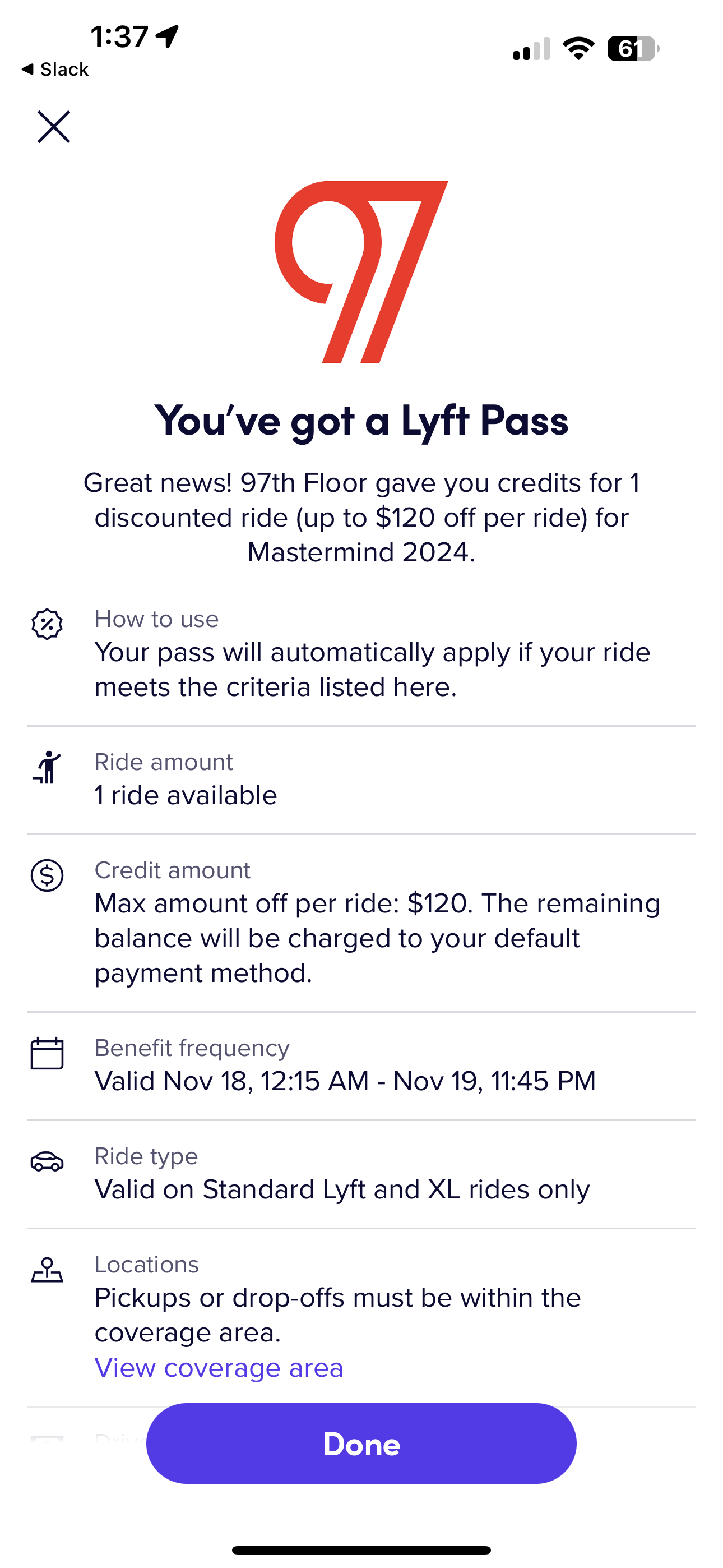
Departure: We have prepared shuttles to take all attendees from Park City back to the Salt Lake City Airport on the final day of Mastermind, Thursday November 21st. These shuttles will be leaving every few hours to make sure you're back to the airport in time for your flight.
Parking: If you're driving to Mastermind this year, please follow the signs to Pendry's guest parking underneath the resort.
Pendry Park City
Located in: Canyons Village at Park City
Address: 2417 W High Mountain Rd, Park City, UT 84098
When you arrive at the Pendry Resort, you should be dropped off on the west side of the resort. Members of the 97th Floor team will be roaming around and the Pendry staff will also direct you.
Each year, we create a Mastermind slack group where attendees can find all the information they need, introduce themselves, connect with other attendees, and share links to helpful resources.
We invite you to join the Slack group ahead of time by clicking here. Start by jumping into the #introductions channel to share a picture, your name, company, title, and maybe a fun fact or two!
Weather update: The forecast is looking like we might have fresh snow and the temperatures will be cold (high of 35° F), so be sure to pack a coat!
We want to make sure you’re comfortable during the event. Here’s a quick packing guide:
Indoor:
Outdoor:
Everything else should be taken care of in the way of food, lodging, materials, etc.
We're very excited to have Greg McKeown joining us as our Keynote this year—if you haven't picked up a copy of Essentialism, we highly recommend it! Here's a little more about him:

Author, Public Speaker, Leadership and Business Strategist
Greg McKeown has dedicated his professional life to uncovering counterintuitive ways to be very successful–without burning out. He has written two New York Times bestsellers, “Essentialism: The Disciplined Pursuit of Less”, which has sold over one million copies and “Effortless: Make It Easier to Do What Matters Most”.
McKeown has spoken to hundreds of audiences as he has traveled to 40 countries around the world, including Apple, Facebook, Google, Microsoft and Nike.
He’s the host of The Greg McKeown Podcast which has been ranked in the Top 5 of all Self Improvement podcasts (out of 11,000) and his work has been covered in print media including in The New Yorker, The New York Times, Time, Fast Company, Fortune, Politico, Inc., and Harvard Business Review.
Organizations, teams, and individuals have benefited from McKeown’s innovative perspective, which challenges conventional wisdom and defines how to break through to the next level of success and profitability. In a compelling way, Greg Mckeown’s Essentialism keynotes will ignite a conversation that revolutionizes the way your organizations think and work.
We're looking forward to meeting and learning from you at Mastermind this year!
Organic backlinks are links from other websites that point to your pages because your content earned their attention. These links come from genuine editorial interest, not payment, link schemes, or automated tactics.
This makes them especially valuable: each link signals that your content brings something new, relevant, or useful to the industry. Search engines use these signals to evaluate trust, relevance, and authority across your site.
Organic backlinks play a critical role in long-term SEO growth because they strengthen your entire domain, not just a single page. When reputable sites link to your content, search engines recognize your brand as a trustworthy source, which boosts domain-level authority and lifts keyword rankings across competitive categories. Beyond visibility, these links also enhance your brand’s credibility within the industry and create momentum for future content to perform even better. The more relevant and high-quality backlinks you earn, the more your entire site benefits.
Manual, one-off link building campaigns are essential for going after specific "money" pages and keywords, especially for long-tail keywords with less competition. Guest posting can help in these individual URL scenarios, but this won't boost overall domain authority.
Your best play for a massive website is to run large link-building campaigns. We’re recommending full-funnel brand awareness campaigns that will earn organic links as you pull tons of visibility. But these aren't simple:
There's no formula for making these campaigns happen, but these principles put you in the best place for success.
Be curious. Ask yourself question and go through the mental exercise of finding insights in data. These link building opportunities will not arrive pre-packaged. Be constantly exploring Ahrefs' Content Explorer, Google Analytics, or any other source of valuable data. We recommend scheduling time daily or weekly to do this.
Sam Oh, VP of Marketing at Ahrefs, has great advice for SEOs ready to get started with this practice: "SEOs should be regularly looking at really good data sources and asking themselves, what’s happening here? And why did it happen? You might not always have the right answer. You might not figure anything out for the first week. You just feel like you're looking at numbers and letters, but you are exercising that muscle of exploration and curiosity. Then all of a sudden connections start to make sense. We have everything in front of us and that data is painting a story that can inspire creative link building opportunities."

The heart of any successful marketing campaign is audience.
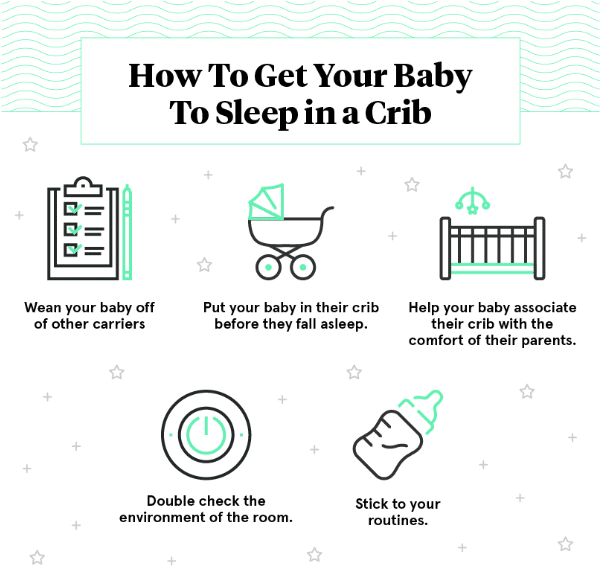
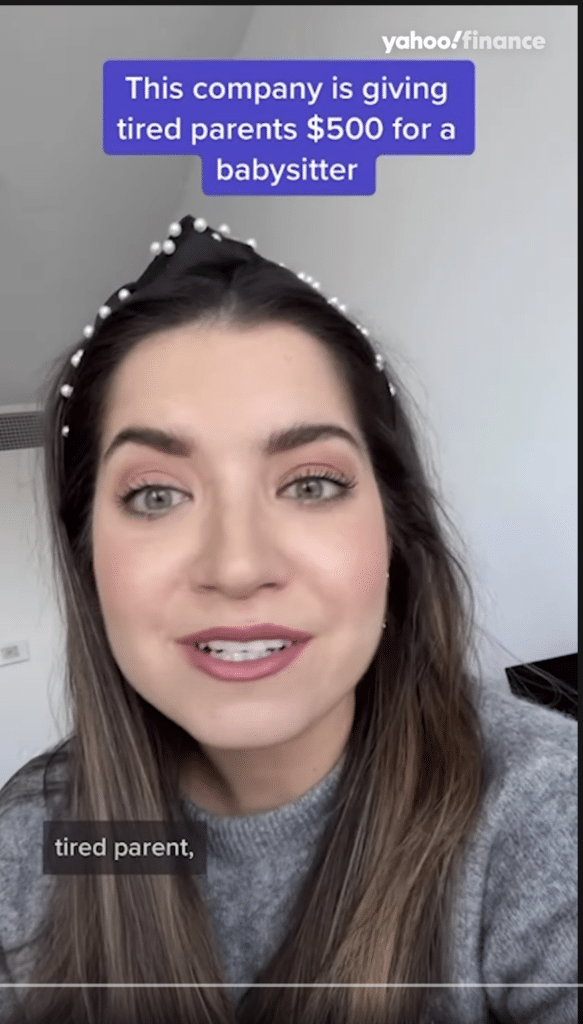
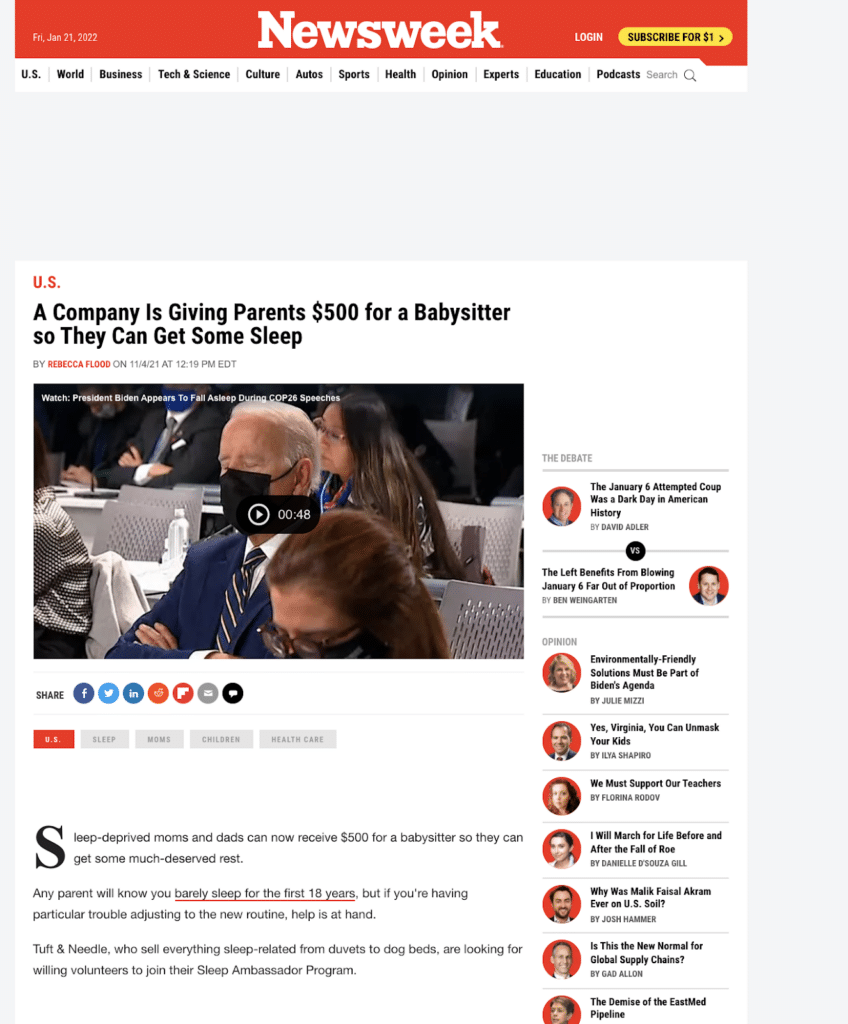
You need a pure and dedicated understanding of your audience so that you know what they care most about and can create link building campaigns combining this persona knowledge with current events and opportunities. This is where all of 97th Floor's strongest brand and linking campaigns have come from, including this one for sleep-deprived parents.
SITUATION
Our Mattress Industry Client (MIC) is an American mattress and bedding brand. At its launch in 2010, MIC was among the first online, bed-in-a-box companies to disrupt the brick-and-mortar industry.
MIC approached 97th Floor to increase organic reviews and organic market share for the online sleep space. While they do sell 3 main mattresses, they also sell bedding (blankets, pillows, duvets, etc) and other sleep-related products (furniture, noise-canceling machines).
MIC wanted their blog to generate more revenue from the high traffic numbers they were seeing. The sleep space is full of very competitive keywords which made this all the more challenging.
STRATEGY
"Sleep deprivation" is found in headlines everywhere. Large mattress companies pay lip-service to better sleep, but really only focus on getting you to upgrade your mattress.
Our teams decided to focus on possibly the most sleep-deprived group of all: parents.
With MIC, 97th Floor decided to shift the messaging by helping parents prioritize their rest and recovery so they can spend more time focusing on their family.
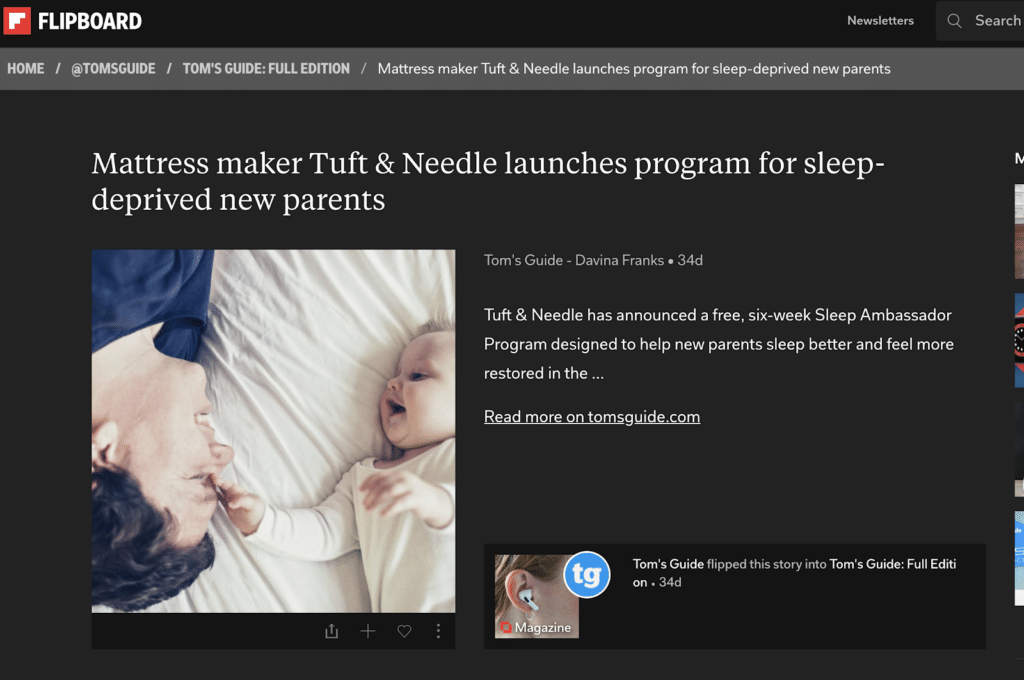
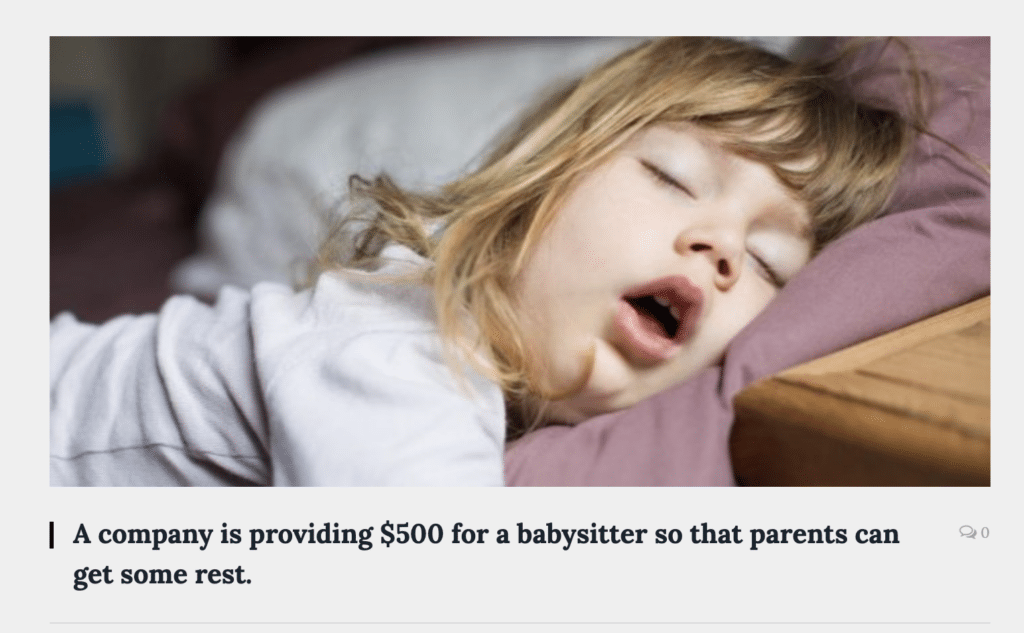
To accomplish this, we launched a Sleep Ambassador Program — a program where MIC would actually pay a select number of parents to improve their sleep health.
Of 331 applicants, 8 were selected. Aside from products to improve their sleep, each ambassador received a 1:1 sleep consultation with an expert and a personalized Sleep Course.

97th Floor teams then wrote 60+ newly researched, written, and designed blogs, infographics and micrographics to support parents in getting better sleep. Each piece of new content was informed by keyword research and optimized for maximum ranking and traffic potential.
Our teams created copy and design for 17 social media posts for MIC to use, and social media strategy and requirements for the ambassadors and influencers partnering with MIC for the campaign. Three separate email funnels and paid promotion and Linkedin and Meta boosted awareness and nurtured leads.
To increase the reach of this campaign, 97th Floor teams fulfilled outreach to a list of 2,000+ news media, websites, local media and blogs.
RESULTS
By taking an audience-centric approach and leaning into the power of earned media, this campaign won our client 100+ organic backlinks from authoritative and relevant websites.
And that's not all. MIC also benefited from:
You need a group who understands the value of SEO that you can bounce ideas off of. This may include SEOs, but you can also extend this group to your PPC counterpart, to someone in development, or to a highly-supportive leader.
Get everyone looking at the data and exploring opportunities.
Sam Oh says it's best to "Refine your backlink-generation ideas with a small team of people who understand the value of SEO. This process filters out less impactful ideas, and the buy-in from the individuals involved increases the likelihood that your best ideas will ultimately see execution."

SITUATION
eFileCabinet is a document management SAAS company that takes the pain out of complex filing and digitizing processes. Their software is cutting-edge and intuitive, but the document filing industry is stale.
eFileCabinet hired 97th Floor at a time when their stagnant market share was shrinking daily. Without a single marketing professional to manage the crisis, 97th Floor became the company's chief marketing force.
STRATEGY
After extensive customer research, 97th Floor teams built four target personas. We then synchronized all digital channels to target these personas, including intent-based keyword SEO campaigns; PPC on Facebook, LinkedIn and search; and content audits leading to new ebooks and blog posts. We built strong Hubspot workflows for the leads coming from this omni-channel strategy.
Our omni-channel campaigns were a success, but when eFileCabinet expressed that their trade show presence has been a little lackluster, we took that to challenge.
We dove back into personas to find out what would excite this audience. Our idea was simple: we would set up a room packed with old office equipment and a sledgehammer. Before handing these professionals the hammer, we would collect their information in Hubspot. Attendees were then unleashed to beat the ink out of printers, monitors, fax machines and copiers. In the background, Hubspot nurtured these new leads.

Our final deliverables for the campaign included:
RESULTS
The Rage Cage would go on to be an award winning campaign that would drive the highest influx in MQLs in a single month, which contributed to the following:
Not bad for one tradeshow, right?
97th Floor teams don't think in terms of tactics or services. What eFilecabinet needed was an omni-channel campaign supported by content, ads, creative, and SEO. By integrating all of these capabilities, SEO received a considerable lift as one component of this brand awareness campaign.
Organic search has continued to compound its success since we started with eFilecabinet. In the past year, leads brought in by organic traffic increased by 281%.
Want more? Here are seven link-building tips from our SEO experts.
Advanced Strategies for Scaling Backlink Acquisition
Still curious about backlink acquisition Here are seven advanced link-building tips from our SEO experts. These require a little more technical expertise to execute, but will yield great results.
Scaling your backlink strategy requires going beyond basic link-building techniques. To achieve substantial growth, you need to integrate multiple tactics and maintain a consistent focus on quality and relevance. Here, we’ll explore seven strategies for acquiring organic backlinks at scale, ensuring your website achieves a robust link profile.
By implementing these advanced strategies, you can scale your backlink acquisition efforts, ensuring your website benefits from a strong, diverse, and high-quality link profile. Consistency, creativity, and a focus on value are key to building sustainable organic backlinks that drive long-term SEO success.
Not all backlink tactics push your strategy forward. In fact, some can severely damage your long-term authority. Buying cheap backlink packages, overusing exact-match anchor text, or submitting your site to low-quality directories may seem like shortcuts, but they often trigger spam signals that weaken your domain. Link exchanges, private networks, and irrelevant guest posts can have the same effect, creating a backlink profile that looks manufactured rather than earned. Sustainable organic backlink growth happens when you prioritize consistency, relevance, and editorial value over quick fixes. By steering clear of risky tactics, you protect your authority and set the foundation for a strong, trustworthy link profile that compounds over time.
Building organic backlinks at scale takes creativity, insight, and a coordinated strategy that aligns content, PR, and audience behavior. When every channel works together, your brand earns the kind of editorial links that strengthen authority and drive long-term growth. If you’re ready to take your backlink strategy beyond the basics, 97th Floor brings the experience, data, and creative horsepower to help you make it happen. Let’s build something remarkable.
For seasonal business owners, demand rises and falls with the changing weather. While seasonality is a unique and perhaps daunting challenge, the predictable rhythm of demand means that those businesses who can sync their marketing with the mandates of sun or snow can have success year-round.
97th Floor is no stranger to seasonal marketing; we’ve executed winning strategies for businesses including pool maintenance, sports equipment, cruise lines, pest control, lawn care, solar, and moving services, just to name a few.
In this article, our resident experts in SEO, content, and advertising share five actionable tips for seasonable business marketers.
Search Engine Optimization (SEO) is a long-term game, and waiting until peak season to focus on it can be a costly mistake. It's essential to begin your SEO efforts well in advance, ideally during the off-season.
Head of SEO Mike Witham says, “You need consistent year round efforts to maintain and improve rankings. If your peak season is in March, you should be ensuring you have solid rankings for core pages by no later than December. Do not start working on it the month before your peak season!”
For businesses serving multiple states or a large region of the country, seasonal demand may be different across these various geographies.
Enterprise advertising specialist Spencer Martin uses Google Keyword Planner to anticipate search volume fluctuations in different areas.
He shares, “We launch campaigns early so that we have 2 to 4 weeks to ramp up and capture the full demand. Campaigns need time to scale and learn, so if we wait until the season starts to launch we lose out on potential profits for our clients.”
While digital marketing is crucial, seasonal businesses can see major wins by looking at more traditional advertising. Enterprise Account Executive Nathan Hooper suggests non-digital forms of advertising, such as mailers or community events to target local audiences. Advertising on community calendar pages or local business directories can put your business in front of potential customers who may be researching local services.
Understanding your buyer and their motives for buying is essential for capturing demand at the right time.
Brandon Smithwrick asks what happens to your marketing instincts when you let AI do all the thinking. He breaks down how cognitive offloading quietly erodes the skills great marketers are actually built on.
Senior Director of Campaigns Jon Hammond shares that his clients in the travel industry refer to December through February as “The Wave.” This three-month period is the biggest sales period for travel as people look forward to summer sun during the cold, dark winter months. His clients maximize their ad budget and run major deals and promotions during this time to capture the demand.
Content Marketing Specialist Kaylee Baker emphasizes the importance of targeting specific demographics, such as 18-30 or 25-40-year-old males, who are the main consumers of seasonal services. Consider the platforms they frequent, such as YouTube, to tailor your marketing efforts accordingly.
When reporting to leadership, especially in industries with high historical seasonality, like cruises, it's essential to use Year-over-Year (YoY) data rather than Month-over-Month (MoM) data. This approach provides a more accurate depiction of progress or decline in traffic or sales over the seasons. By analyzing YoY data, you can better understand trends and make informed decisions to optimize your marketing strategies.
In conclusion, marketing a seasonal business requires careful planning, adaptation, and understanding of your target audience. By implementing these five tips, you can maximize your marketing efforts and capitalize on seasonal fluctuations in demand.
Meta ads win or lose on creative. Your targeting and budget can be flawless, but if the creative falls flat, the campaign fails. Sharpening your ad creative is one of the highest-return moves you can make on Meta. Strong creative catches attention in a crowded feed, tells a story quickly, and drives action. Any brand can apply these practices to improve performance.
At 97th Floor, we build and test Meta ad campaigns that deliver measurable ROI. These are the Meta creative best practices we see work time and again, backed by real examples you can learn from.
Let’s get into it.
Because they compete on design and emotion, luxury brand ads are great examples for creative execution. As a matter of fact, Meta is basically the only place many luxury brands are putting their paid media dollars. A smattering of ad budget goes to display ads or YouTube, but well over 75% of luxury brands' advertising efforts happen on Facebook and Instagram.
We’ve pulled Meta ads from ten luxury home brands to see how they’re pairing copy and imagery to entice their buyers.
Use these ads and our analysis as inspiration for your own Meta ads; there’s lots to think about here.
You’ve got a second—maybe less. That’s how long your ad has to earn a pause in Meta’s feed. One way to stand out is to create depth in your visuals. It makes static imagery feel more alive and immersive, pulling the viewer in instead of letting them breeze past.
Nearly all of Arhaus’ product photography, including the images in these ads, uses light and shadow to create dimension. The effect is that we can’t help but imagine what the rest of the room must look like – what must be causing those shadows – and it’s breathtaking.
The ad copy further transports us; it’s hard not to feel a warm breeze and hear the chatter of friends and neighbors.
With both imagery and copy, Arhaus’ Meta ads have us daydreaming about the possibilities a new outdoor set can introduce.


Busy feeds are packed with loud colors and visual overload. Sometimes, the most effective creative is the quietest. Giving your product room to breathe with negative space draws the eye and signals confidence. It says, “This is the whole story, and it’s worth a look!”
Instead of staging the pieces as in a home, Maiden Home’s elegance and beauty is presented uncluttered and unadorned, inviting audiences to carefully inspect the shapes and colors at play.
In these examples, the chairs are intriguing enough that standing alone is the only way to do them justice. The pieces make us curious, and the simplicity of the ad compels a click.


Authenticity wins attention on Meta, and nothing says real like content from actual customers. Showcasing your product in real homes or hands builds credibility and sparks ideas for viewers imagining the product in their own lives.
Castlery proves their products’ versatility by featuring the homes of real buyers in their ads. By showing actual living rooms of delighted Castlery shoppers, the ads supply both social proof and styling inspiration for a wide range of homeowners and decorators.


Flat visuals blend in and get forgotten. Using layered colors, tactile textures, and bold materials makes your ad feel more dimensional, more physical, and more emotional. In a fast-scroll environment, that emotional hook matters more than polish.
Giorgetti’s ads feature rich colors and a mix of interesting materials. The spaces feel out of a biopic about a brilliant musician or a mysteriously wealthy young person. We’d love to know what the fabric and the walnut talk about; we’d love to pull those pieces right off the screen and into our front room. Girogetti’s photos and copy promise audiences a “unique and personal” experience that immediately feels natural and inviting.


Want instant relevance? Tie your creative to something your audience is already thinking about. Whether it’s a pop culture moment, a viral trend, or an awards show red carpet, aligning your product with the conversation earns quick attention and clicks.
In this Meta ad, Koket highlights the similarities between Lana del Ray’s Met Gala gown and Koket’s side table. The two are remarkably alike! Whether their Met Gala-inspired Meta ad was a stroke of luck or a careful analysis of the evening’s attire, we’ll never know. Is there an audience match here? Do Koket shoppers love Lana? Not so sure. But perhaps Koket’s audience is abuzz about fashion, design, and what the A-listers wear. Not too much of a stretch, is it?

Words shape perception. If your copy says “elegant,” your visuals better deliver on it. Great Meta ads use language that complements the look, feel, and energy of the product being shown, creating a seamless experience between what’s read and what’s seen. The words and images used in Rove Concept’s ads promise what luxury furniture should provide: sophistication – in your home office, on your balcony, and everywhere else.


Product specs are forgettable. Stories stick. When your copy hints at a journey, a person, or a place, your ad becomes more than just a sales pitch. It becomes an invitation into a narrative your audience wants to join, or better yet, buy into.By giving its audience a few examples of what these stories may be and referencing their globally-sourced products, Currey & Company promises eclectic and delightful pieces without all the tariffs and bubble wrapping that accompany a purchase, and without an online cart. The copy here brilliantly matches the unusual pieces shown in the photos, and we imagine most people are interested in a ceramic cow, truly.

Sometimes the best way to sell a product is not to sell it at all, at least not right away. Ads that offer help, tools, or personalized advice can win trust faster than a discount ever could. Especially in cluttered categories, utility becomes a real differentiator.
Lulu and Georgia Meta ads sell furniture by offering free design support. Clever, ehh? Their Meta ads offer custom floor plans and mood boards made by Lulu and Georgia designers, which we’re confident will be full of Lulu and Georgia rugs, end tables, couches, and decorations. The ad copy here could’ve gone a little farther to exaggerate the pain point: trying to curate a beautiful space is a lot of work. Especially if you’re working off of a Pinterest board on which half of the links to that dreamy chandelier or pinstripe curtain set are missing or broken. Lulu and Georgia could ramp up the language around their unique selling point to strengthen these ads, but we applaud the strategy here.


Your audience isn’t just buying a product; they’re solving a personal need. If what you offer can be tailored to fit them perfectly, lead with that. Customization on Meta is an opportunity to show that you really get your customers. Interior Define’s ads invite their audience to take the designer’s seat and build bespoke furniture, choosing from hundreds of materials, features, and finishes. Surprisingly, the ads don’t focus on the boast of owning one-of-a-kind pieces. Instead, their advertisements offer help and a solution for shoppers who feel they’re never satisfied. Interior Define says, “Don’t settle.” Well, except into your custom couch, I suppose.


The right backstory can instantly elevate your product. Whether you’re born from a famous collab, a niche community, or a cultural hotspot, tying your brand to its origin story builds instant trust and makes your product feel more worthwhile.
The Soho Houses are a collection of beautifully designed homes dotted across the globe as safe havens of inspiration for members-only creatives. Soho Home came to life when guests came begging to know where they could purchase the magnificent pieces curated for each unique House.
As a consequence of this opportunistic arrangement, Soho Home pieces seem bespoke and almost necessary for a creative and inspired space. Their pieces are automatically associated with exclusivity, travel, and the arts. We’d mention the Soho Houses in every one of our Meta ads, too.


Meta Creative Testing and Optimization
Creative fatigue means wasted spend. Even the strongest ad will lose its edge if shown too often. Testing your creative isn’t an optional thing; it’s the backbone of sustainable Meta ad performance.
Use A/B testing to compare different visuals, headlines, CTAs, and copy angles. Meta’s built-in tools like Experiments and A/B Tests make it easy to isolate variables and track results. Don’t just test once; keep testing on a rolling basis. The goal is to find what works now, not what worked last quarter.
Tip: Test early and often, but don’t test everything at once. Focus on one change at a time so you know what’s actually making a difference.
No matter how good your strategy is, the wrong creative can tank performance. Here are a few of the most common mistakes we see on Meta:
The simple fix is to think like your audience. Would you stop to read your ad?
At 97th Floor, our advertising specialists are committed to a thorough process of audience research and ad testing. We fine-tune copy, creative, and targeting until everything is just right and our clients are getting the maximum return on investment.
See how an audience-first approach translates to bottom-line results.
Cybersecurity buyers are hard to impress. Ranging from CISOs to security architects, your audience is deeply technical, highly skeptical, and usually immune to generic B2B marketing.
They don’t care about buzzwords or brand storytelling. They do care about substance: what your product actually does, how it solves real security problems, and why they should trust you over a dozen lookalike competitors. Smart, intentional marketing is a must-have skill in the cybersecurity space.
At 97th Floor, we build cybersecurity marketing strategies that reach decision-makers and influence every stakeholder in the buying committee. We’ll break down the best practices we’ve observed, backed by ad examples and persona insights.
Let’s get into it.
Cybersecurity marketing is the specialized practice of promoting cybersecurity products or services to highly technical, security-conscious audiences. It goes beyond traditional B2B marketing by focusing on decision-makers like CISOs, SOC analysts, and IT leadership, all personas who demand depth, clarity, and provable value.
Effective cybersecurity marketing combines SEO, content, advertising, and design to engage buyers throughout a long, complex sales cycle. This involves building credibility, addressing real threats, and positioning your brand as a trusted solution in an oversaturated market.
As you might have experienced, Cybersecurity is a high-stakes environment where mistakes can cost millions (and your audience knows it). The technical acumen of your buyers means any hint of fluff or oversimplification can tank your credibility.
Other challenges include:
To break through, cybersecurity marketing needs to be as intelligent as the people it’s trying to reach. That means aligning every campaign with how your audience thinks, what they’re solving for, and how they evaluate vendors.
Where traditional B2B campaigns can succeed with broad messaging, cybersecurity campaigns must go narrow. They need to:
Bottom line: If your marketing isn’t built for security buyers, it’s not built to perform.
Creating a high-performing cybersecurity marketing strategy means throwing out the one-size-fits-all B2B playbook. We’ve dug through our history as a cybersecurity marketing agency to identify six principles that drive success in cybersecurity marketing, each paired with a unique ad example. Use these tips to help you take your next cybersecurity campaign to a new level.
You’re not marketing to “security teams.” Remember your target, whether it’s marketing to a CISO who oversees a sprawling enterprise, or a SOC Analyst who lives in alerts. Specificity is non-negotiable in cybersecurity marketing, because vague messaging gets ignored.

Darktrace succeeds here by getting specific. Not only are they directly calling out CISOs, but they’re tackling only one facet of security: email. This approach self-eliminates some audiences, but ensures that those who do interact with the ad are likely higher-intent. The headline text could be helped by offering some specifics about what the whitepaper offers, but the ad maintains strong branding and a strong call-to-action.
Brainstorm: What’s the most specific piece of content you can offer to your audience? How can you write ad copy that hits on just one pain point and offers one precise solution?
Cybersecurity buyers are burned out on abstract “platform” talk. What do they actually want? Time back. Fewer compliance headaches. Less operational friction. When your value proposition addresses those second-order benefits, it lands harder.

Identity security company CyberArk’s ad pinpoints a problem experienced by their customers: losing so much time finding the right security solution and dealing with compliance, that important projects get deprioritized. Rather than focusing on CyberArk’s product offerings, the ad leans on a secondary benefit that prospective buyers are eager for. A simple design and minimal colors make the ad visually appealing, and the offering of a personalized audit and compliance call is a strong call-to-action.
Brainstorm: What is the most significant benefit that your solution provides to your audience?
If you’ve been recognized by Gartner or Forrester, or if your solution meets hard-to-hit compliance benchmarks, by all means say it. Security professionals are looking for signs that you actually know what you’re doing. A little proof goes a long way.

Crowdstrike leverages Gartner’s authority in this ad, highlighting their place on Gartner’s Magic Quadrant. Gartner is a trusted source on cybersecurity and IT solutions for CrowdStrike’s audience, and using this report for advertising is a brilliant and low-effort win.
Brainstorm: Have you won any awards or accolades that you can put on an advertisement? What about client testimonials?
Cybersecurity buyers are lifelong learners. They respond to content that teaches them something new, especially when it’s visual, data-driven, and skimmable. If your brand can help them stay sharp, you earn trust and attention.

A10 Networks’ use of data visualization is a great idea. People are more apt to engage with graphs, statistics and data than a chunk of text. This chart invites A10’s audience to see how they stack up against their peers concerning TLS/SSL inspections, and the ad’s call-to-action implies that there is more to learn about how technology leaders consider decryption solutions.
However, this chart isn’t the easiest thing to swallow. This ad would be stronger with just a single metric or with a more simple visual from their data. As is, the ad requires too much of its viewer and, by failing to supply any conclusions about this data, leaves too much ambiguity about where this information puts its audience in relation to A10 Networks.
Brainstorm: What data can you share with your audience that will make them want to learn more about you?
The best cybersecurity brands shape how the industry sees threats. Establishing thought leadership through bold, creative design and clear messaging makes your brand feel indispensable.

Palo Alto Networks’ ad stands out for cohesiveness between copy and design, strengthening the impact of the ad’s message. Pairing the idea of unknown threats with the impression of half-turned blinds evokes that eerie feeling of being watched by something unseen. This strengthens the ad’s promises of protection for “whatever, whenever, wherever.” Palo Alto Networks is positioning itself as an omniscient and omnipresent security solution, putting a certain 2006 babysitter receiving threatening phone calls customers at ease.
Brainstorm: What objects symbolize safety or privacy to your audience? How can you use those objects to create something visually interesting?
Let’s be honest, most cybersecurity ads look like they were built from the same uninspired template. But a little creativity goes a long way—especially when it surprises, entertains, or reframes a threat in a clever way.

All cybersecurity ads pretty much look the same, so we love it when a brand breaks out of the B2B monotony like Carbonite has. The visual analogy is straightforward and intriguing, demanding a pause and inviting a chuckle from its audience. With simple, unique ad creative, Carbonite establishes that its security solutions are so good that its customers can be completely unbothered about threats - even threats as sinister as prowling predators.
Brainstorm: What analogies does your brand or product lend itself to? How can you use that to surprise your audience?
To build a cybersecurity strategy that drives pipeline, you need to know who you’re talking to, what keeps them up at night, and how they influence the buying process. Each persona plays a different role, and each one needs a tailored message.
Below are four common groups we build campaigns around, with tips on how to reach them.
CISOs and Security Leaders
What they care about: Risk reduction, cost justification, strategic alignment
How to market to them: Be brief, credible, and focused on outcomes. CISOs aren’t deep in the weeds—they’re trying to evaluate whether your solution moves the needle on security posture or operational efficiency. Give them high-level proof points, ROI-driven messaging, and third-party validation like analyst reports or compliance frameworks.


Security Practitioners and Implementers
What they care about: Technical specs, real-world application, peer trust
How to market to them: These are the engineers and analysts who will poke holes in your claims. Your marketing needs to speak their language and show technical depth. Use product walkthroughs, architecture diagrams, feature comparisons, and use-case content that demonstrates exactly how your solution works in practice.
IT Decision Makers
What they care about: Integration, scalability, cost, security trade-offs
How to market to them: This group sits at the intersection of IT and security. They want solutions that won’t break their systems or their budget. Emphasize interoperability, performance, and ease of deployment. Case studies and pricing calculators can help them make a confident decision.


Boards and C-Suite
What they care about: Business risk, liability, brand protectionHow to market to them: You're not selling features—you’re selling peace of mind. Frame your messaging around financial impact, regulatory compliance, and business continuity. Use concise, high-trust formats like executive summaries, brief videos, or benchmarking data to support your case.
Marketing in cybersecurity is a high-stakes game. There’s less room for error, more skepticism in the room, and a shorter window to prove your credibility. Here are some do’s and don’ts that help keep cybersecurity campaigns focused, effective, and persona-aligned.
Do speak to specific personas.
Generic messaging gets ignored. Tailor every piece of content, ad, or landing page to one specific role and pain point.
Do lean on data and authority.
Use trusted sources like Gartner reports, industry benchmarks, and analyst quotes to back your claims. Show, don’t tell.
Do invest in content depth.
Your audience can sniff out fluff in a second. Write with substance. Collaborate with your SMEs. Make every piece worth your reader’s time.
Do prioritize technical accuracy.
One wrong detail can undermine the whole campaign. Double-check product specs, terminology, and claims, especially in visual assets.
Do align with the buyer journey.
CISOs don’t click “Buy Now.” Build layered campaigns that nurture interest across awareness, consideration, and validation stages.
Don’t overpromise.
"Total protection" or "unbreakable security" won't land and could backfire. Be confident, but stay grounded in reality.
Don’t assume they’ll connect the dots.
Spell out exactly how your product helps solve a specific problem. Don't rely on vague claims or industry jargon.
Don’t recycle general B2B creative.
Your cybersecurity audience has seen the same ad template 1,000 times. Differentiate with smarter, more persona-aware creative.
Don’t ignore design preferences.
Security audiences favor clarity and simplicity over flash. Avoid overly polished, “marketing-looking” assets that feel insincere.
Don’t skip the proof.
Your audience needs evidence before they trust your brand. If you don’t provide it, they’ll find a competitor who does.
Why Choose 97th Floor as Your Cybersecurity Marketing Partner?
We understand cybersecurity marketing because we’ve done it—successfully—for some of the top names in the industry. If you need to lower your CPA, hit revenue goals, or get in front of the right people, we can help. We build strategies based on research, data, and a deep understanding of how security buyers think. And we always respect your audience’s intelligence, time, and high standards.
Learn more about our cybersecurity marketing services, or get in touch to start your next campaign.
Ready to Grow? Get in touch to see what's possible for your brand.
At a high level, advertising on Reddit means placing paid, promoted content directly inside Reddit communities, where users are already talking about the topics you care about. Simple enough. The catch is that Reddit does not behave like other ad platforms, and neither do its users.
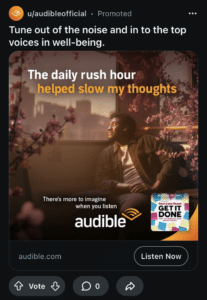
Reddit is built around communities first, ads second. People come to Reddit to learn, debate, vent, and swap opinions. They are not there to be “marketed to.” That’s why advertising on Reddit works best when it feels like a natural extension of the conversation.
Instead of targeting people based on who they are, Reddit lets you target them based on what they care about. Subreddits act as self-segmented audiences, organized around shared interests, roles, and problems. When your ads align with those conversations, advertising on Reddit can feel surprisingly organic.
This community-first structure is also where the advertising on Reddit pros and cons start to show up. Done right, ads blend in and build trust. Done poorly, they stand out fast, and not in a good way.
Before diving headfirst into advertising on Reddit, it helps to understand what you’re signing up for. Reddit can be incredibly effective. It can also be unforgiving. Sometimes even within the same campaign.
One of the biggest advantages of advertising on Reddit is audience intent. People don’t land in subreddits by accident. They join because they care deeply about a topic, role, or problem. That makes subreddit targeting one of the most powerful tools Reddit offers.
Another major pro is authenticity. When ads are written in a way that respects the community and adds value, Reddit users engage. They comment. They click. They remember the brand. In some cases, they even defend it in the comments, which is about as close to a marketing miracle as it gets.
Costs can also be favorable. Compared to other paid social platforms, advertising on Reddit often comes with lower CPMs, especially for niche or technical audiences. For brands that struggle to reach specific communities elsewhere, Reddit can punch well above its weight.
The same is true for any channel that's been overlooked long enough to forget it exists. Marketer Sterling Snow shares the story of a brand that put $1,000 into a newsletter that had never run a single advertisement — and walked away with hundreds of demo requests. The audience was already gathered. The channel just hadn't been claimed yet. This short video breaks down why the highest-ROI advertising placements are often hiding in exactly the corners no one else has bothered to look.
Now the flip side.
Reddit users are highly skeptical of ads. They can spot generic marketing language instantly, and they are not shy about calling it out. If your ad feels salesy, forced, or out of place, performance drops fast.
Another challenge is creative fit. What works on Facebook or LinkedIn rarely works here. Advertising on Reddit requires more testing, more iteration, and a stronger understanding of how each community communicates.
Finally, Reddit is not a set-it-and-forget-it platform. Successful campaigns require active monitoring, comment management, and optimization. That extra effort is part of the tradeoff.
If you’re hoping for one clean number, I regret to inform you that advertising platforms do not believe in peace. Advertising on Reddit is auction-based, which means costs change based on your targeting, competition, and objective.
Most advertisers report CPMs commonly landing somewhere in the low single digits up to the teens, depending on how broad or narrow your audience is. WordStream puts “typical” CPM ranges around $0.50–$15, while also noting outliers can go much higher for premium placements.
For clicks, many guides and advertiser reports land in a practical CPC range of roughly $0.50–$4, again depending on competition and targeting.
If you’re running video, Reddit also supports CPV (cost per view) pricing models in addition to CPM and CPC.
A few things move the needle fast:
You do not need some mythical five-figure monthly commitment to begin advertising on Reddit. Reddit for Business explicitly notes there’s no minimum spend to get started, and you control budgets at the ad group level with daily or lifetime options. You can start small, learn what works, then scale what earns its keep.
At some point, every marketer asks the same question: How does advertising on Reddit stack up against Facebook or Google? The answer is not “better” or “worse.” It’s different, and those differences matter a lot depending on your goals.
Facebook and Google are built for scale. Reddit is built for relevance. That distinction shows up quickly when you compare targeting, intent, and how audiences respond to ads.
Here’s a side-by-side look at how these platforms typically compare.
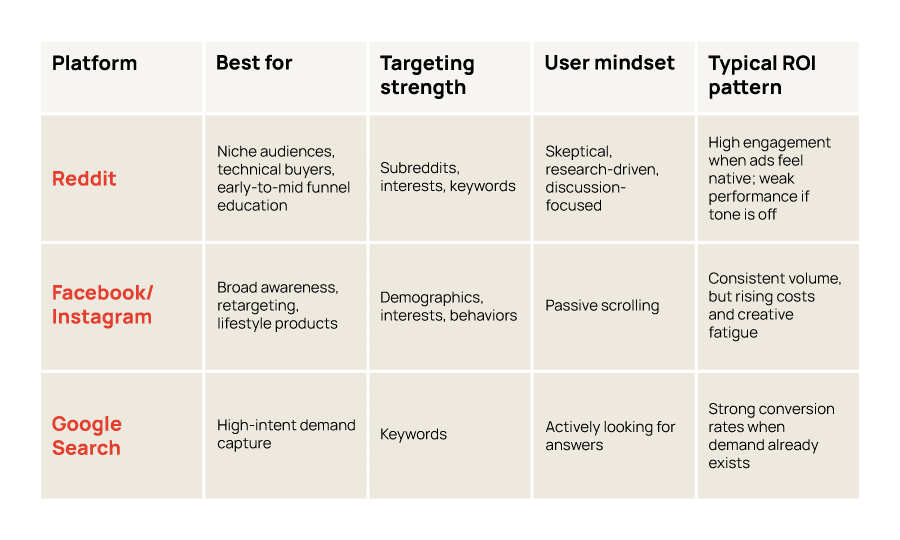
Advertising on Reddit works best when you need to reach people who are actively thinking about a problem, but not necessarily ready to buy yet. Subreddits function like built-in focus groups, where users self-select into conversations around their role or challenges.
Compared to Facebook, Reddit has less scale but far more context. Compared to Google, it reaches users earlier in the decision-making process. That makes advertising on Reddit especially useful for complex products, technical audiences, and brands that need to educate before they convert.
Reddit is not ideal for every use case. If you need immediate, high-volume conversions, Google Search wins. If your product relies heavily on impulse buying or visual appeal, Facebook and Instagram might perform better.
Reddit rewards relevance and authenticity. It punishes generic messaging and aggressive sales tactics.
Setting up advertising on Reddit is not complicated. The hard part is everything around the setup. So, we’ve made it easy with this quick guide.
Head to Reddit Ads (aka Reddit for Business) and set up an account. Basic stuff. Billing. Business details. The usual “confirm you are, in fact, a company” deal. Now, on to the good stuff.
Reddit will ask what you’re trying to do. Choose the goal that matches your actual intent, not your wishful thinking.
Common picks:
If you’re brand new to advertising on Reddit, traffic is often the cleanest starting point. It gives you a quick signal without requiring perfect tracking from day one.
This is an important step! It may determine the success of your campaign.
Start with subreddit targeting whenever you can. Pick the communities where your audience already spends time. Then layer in interest or keyword targeting if you need to expand reach or test angles. If you don’t understand a subreddit’s vibe, don’t target it yet. Lurk first, then target.
Reddit uses an auction model, so you’ll set a daily (or lifetime) budget and a bid strategy based on your objective.
Start simple:
This is where people can get impatient, but don’t. Advertising on Reddit rewards steady testing more than constant tinkering.
Now the fun part. Reddit users are ad-skeptical and very allergic to buzzwords. Write your ad like you’re joining their existing conversation.
Best practices for Reddit copywriting include:
Step 6: Launch, then monitor comments
Reddit is not a “launch and leave” platform. People may comment on your ads. Sometimes they ask smart questions. Sometimes they roast you. Either way, watching comments gives you copy insights, objection insights and product messaging insights.
Step 7: Test one variable at a time
When you start optimizing, change only one thing per test:
If you change everything at once, you won’t know what actually worked. You’ll just know you “did stuff.”
Advertising on Reddit is not for everyone, but that’s kind of the point.
Reddit rewards curiosity, relevance, and a willingness to actually understand the audience you’re trying to reach. It punishes shortcuts. If you treat it like just another paid social channel, performance will disappoint, and the comments will let you know exactly why.
When brands take the time to learn the platform and present something genuinely useful, advertising on Reddit can be incredibly effective. Especially for niche audiences, when trust really matters. Reddit is not a billboard, it’s a conversation. The brands that win on Reddit are the ones willing to listen before they speak.
If you’re ready to approach advertising on Reddit with strategy, intention, and a healthy respect for the platform, let’s build.
We know your audience. We know their interests and aversions, and we know how to talk to them so that they convert - on Reddit and everywhere else they hang out. Let us take the lead here. We’ve got you. Book a strategy call with us today.
Podcast advertising is a promising strategy for any marketing campaign, with 51% of podcast listeners agreeing that hearing a podcast ad made them more likely to make a purchase from that brand.
Cybersecurity marketers are in no drought for opportunities here, with dozens of long-running and far-loved shows capturing the ears of your audience.
We used Sparktoro and additional tools to find the top-listened podcasts from decision makers in cybersecurity; put a bug in their ear about you, yeah?
Note that this audience is extremely sales and advertising averse. They don’t appreciate self-promotion. While you can of course pay to sponsor the show and get a host-read ad in front of your audience, be extra thoughtful about your messaging and position as you do so.
Darknet Diaries has amassed a cult-like following for its deep-dive episodes exposing true, first-hand stories about “hackers, breaches, shadow government activity, hacktivism, [and] cybercrime.” Host Jack Rhysider, whose own background is in security operations, makes staggering stories accessible and captivating for both technical and non-technical audiences. The show brags over 90 millions downloads and received praise in The Guardian, Vulture and The New York Times.
Format: Guest Interviews
Update Frequency: Every first Tuesday of the month
On Air Since September 2017
Opportunities: If you happen to know someone or know someone who knows someone with an insane cybercrime story to tell, the connection may be worth making just to get your company’s name floating in Jack’s network. Otherwise, you can contact the team by emailing jack@darknetdiaries.com to inquire about sponsorship. See the complete list of active sponsors here. It includes a number of personal and professional security solutions and IT solutions.

Hosted by former NPR investigations correspondent Dina Temple-Raston, Click Here brings listeners audio stories from the “shadowy characters behind ransomware attacks, disinformation campaigns, and hacks and … the people trying to stop them.” Show topics range from “peek inside a North Korean malware lab” to “how hackers settle their disputes – think People’s Court without all the robes.”
Format: Guest Interviews mixed with investigative reporting and narration from the show host
Update Frequency: Every Tuesday and Friday
On Air Since August 2017
Opportunities: Click Here belongs to an ecosystem of cyber-related news produced by The Record from Recorded Future News. The publication sends a daily newsletter to its audience of “hundreds of thousands” via a mobile app.If you have a news tip, and perhaps an expert to lend, about cybersecurity startups, cybersecurity attacks, or policy surrounding privacy, disinformation or cybersecurity policy, you can pitch your story by reaching out to therecord@recordedfuture.com. The show also has in-show advertisements, maybe one per episode or so.
“2.5 Admins is a podcast featuring two sysadmins called Allan Jude and Jim Salter, and a producer/editor who can just about configure a Samba share called Joe Ressington.” The show covers tech news and answers listener-submitted admin-related questions.The show’s audience is well-educated high-earning IT professionals.
Format: Conversational
Update Frequency: Weekly
On Air Since April 2020
Opportunities: The show welcomes interested sponsors to get in touch at show@2.5admins.com.
Late Night Linux is a family of seven podcasts, including 2.5 Admins, all about "Linux, open source software, and systems administration.” Late Night Linux was the group’s first show, and covers all things free and open source software.
Note that the show contains explicit content.
Format: Conversational, doesn’t appear to host guests
Update Frequency: Weekly
On Air Since December 2016
Opportunities: To advertise on any of the Late Night Linux shows, contact joe@latenightlinux.com.
Hosted by Kurt Seifried and Josh Bressers, Open Source Security Podcast delivers weekly conversations on all things IoT, application security, operational security, cloud, devops, and security news.
Format: Two hosts
Update Frequency: Weekly
On Air Since September 2016
Opportunities: You can email the hosts from their website. Both Kurt and Josh are active on infosec.exchange, part of a decentralized social network powered by Mastodon. Sounds like a good place for some audience research, at the very least.

Hosted by cybersecurity veterans Graham Cluley and Carole Theriault, Smashing Security offers a “helpful and hilarious take on the week’s tech SNAFUs.” Winner of the "Best Cybersecurity Podcast" in 2018, 2019, and 2023, and the "Most Entertaining" in 2022 and 2023, Smashing Security has had over nine million downloads.
Note that the show contains explicit content.
Format: Two hosts, occasional guest interviews
Update Frequency: Weekly on Wednesdays
On Air Since December 2016
Opportunities: Smashing Security has generous options for sponsors, including opportunities “for sponsors to appear in 15-minute featured interviews included within the podcast.” To learn more about sponsorship, email studio@smashingsecurity.com. Smashing Security also conveniently features all past episode guests on a nice list. Pursue it and let ideas flow: who in your organization would fit here? Guest list.
Running for nearly twenty years, Security Now offers weekly conversations on security topics such as malware, ransomware, and hacks; digital identity, data privacy, and policies; hardware and IoT security concerns; software and plug-in security patches and updates; and many more. The show hosts are cybersecurity authority Steve Gibson and technology expert Leo Laporte, each bringing “their extensive and historical knowledge to explore digital security topics in depth.”
Format: Two hosts
Update Frequency: Weekly on Tuesdays
On Air Since August 2005
Opportunities: Security Now belongs to the TWiT faTmily of podcasts, a group that amasses a yearly audience of 25 million downloads. TWiT’s podcasts have built a relationship with listeners over several decades, which is great news for you; not only is 88% of TWiT’s audience tech or IT decision makers, but 88% of listeners have actually made a purchase based on a TWiT host-read ad. Get started by emailing advertise@twit.tv.
Risky Business Media was founded in 2007 by cybersecurity journalist Patrick Gray. A rotating group of hosts including Patrick and others publish multiple episodes each week for their audience of cybersecurity professionals.
Format: Host conversations
Update Frequency: Weekly
On Air Since February 2007
Opportunities: Risky Business’ audience is “top heavy,” meaning that a majority of their more than 25,000 weekly listeners are CISOs or information security decision-makers. View Risky Business’ media kit for more information about their audience, and contact sales@risky.biz for pricing. You can also reach out with editorial opportunities. Note that Risky Business Media also publishes two cybersecurity newsletters.
There are two ways to target your audience vis podcast advertising. The first is with baked-in or title-by-title targeting. Baked-in ads are added to the podcast audio file itself, making them permanent. This means that all listeners will hear the same ad when they listen to that episode of the show, regardless of their location, demographic or when they hit play. These ads can appear anytime in an episode and can be longer than thirty seconds.
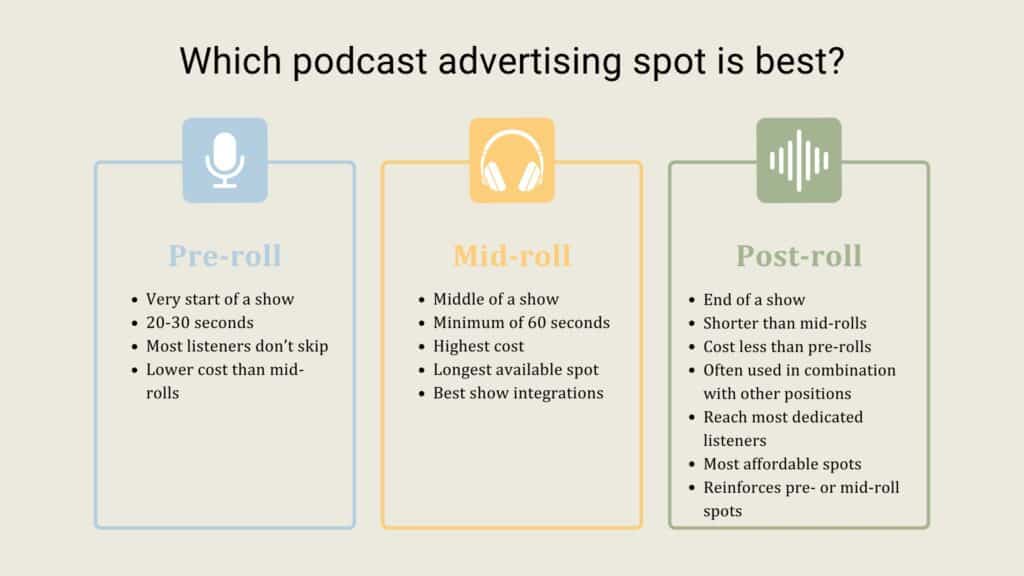
Dynamic insertion or audience network podcast advertising inserts ads into ad spots (pre, mid, or post-roll) which can be targeted to the person listening. This allows podcasters to keep the advertising on their shows fresh, and it allows advertisers to select contextual targeting and third-party segments. The ad is then inserted in whatever shows that audience is listening to.
Host-read ads are created and voiced by a show’s host, and are usually read in the style of the show. Because of the host’s narration, these ads seem like a personal endorsement to audiences.
Host-read ads are a great choice for most cybersecurity podcast ads because the target audience aligns closely with specific podcast shows, like those listed above. We can select a show or a few shows and have host-read ads for cyber solutions during those shows.
PRO TIP: For host-read ads, it’s best practice to give the host bullet points instead of an actual script. This way you can make sure that what you want covered gets said, but the host has the opportunity to make it seem more authentic to them.
PRO TIP: Make the host your advocate. Build a relationship with them. Let them experience your product as best they can so that they can speak authentically to their trusting audience.
Pre-recorded ads are scripted by an advertiser and then recorded by a voice talent before being added to the podcast pre, mid, or post-roll. This type of podcast ad is best if your podcast advertisements won’t be on one specific show.
For example, using a title-by-title approach doesn’t sense if your targeting requires a geographic restriction.
Here, we can pick contextual targeting so the podcast episode has to be about that topic. Then, we can also layer on third-party segments, such as the user interests or experiences. Finally, layer on location targeting..
A voice talent will read the pre-recorded ad that can then be dynamically inserted whenever a podcast listener meets all of those requirements.
It all depends on your budget, goals and even the length of your spot. Compare each spot below.
Podcast ads aren’t clickable in most cases, so they are definitely a top-of-funnel awareness play. However, you can drive action from a podcast ad by having a great offer. Most podcast ads have a very enticing offer such as saving a certain percent on a product or a first month free.
PRO TIP: Longer campaigns outperform short ones. Run ads on at least 5 episodes of a podcast to improve recall by 39%. Make each spot different to prevent audience tune-out.
While counting episodes downloads will tell you impressions, use these four tactics to get better success metrics from your podcast advertising.
Story-telling is essential for podcast ads. You don’t have a visual component to draw people in, so you’ve got to hook them with words.
And remember, the offer is so important. Podcast advertising isn’t the most straightforward journey. It’s not like clicking on a LinkedIn ad. We’re asking the user to go to our website manually, so we better offer them a good reason why they should!
See how an audience-first approach translates to bottom-line results.
Key Takeaways
A new marketing campaign is any initiative that sits outside of your always-on efforts. Unlike evergreen SEO, paid, or nurture programs, new campaigns are designed with a specific goal and a clear end date in mind.
This might mean spotlighting a product launch, rallying attention around a major industry event, or testing your messaging with a new audience segment. Sometimes it’s driven by leadership priorities, sometimes by seasonal opportunities, and sometimes by curiosity; the “let’s see what happens if we…” moments.
The point is: a new campaign should feel distinct from business as usual. It deserves its own planning, its own creative energy, and its own success criteria. Done well, a new marketing campaign can uncover insights that strengthen your always-on work for the long run.
In this article, we’ll walk through the full lifecycle of a new marketing campaign, from planning to launch to post-mortem, with practical tips you can apply right away. We’ll also share recent campaign wins worth learning from, along with a few cautionary tales of what not to do.
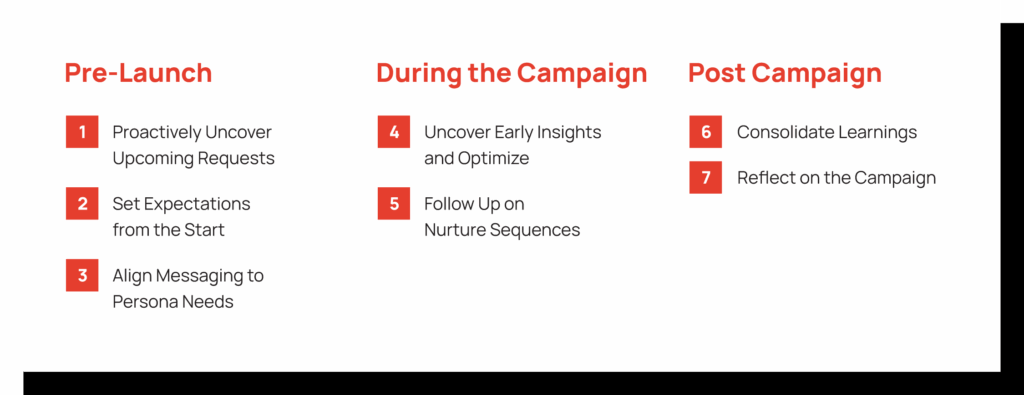
The biggest obstacle with new marketing campaigns is time. Get ahead of the curve by requesting a calendar of upcoming initiatives from key parties. Is your marketing team planning any events? Is the product team preparing for any new launches?
See if you can identify any patterns in past new marketing campaign requests. Do executive teams propose ideas in quarterly business reviews? Or do they follow up the week after the review with an idea that was sparked during the presentation?
Knowing what’s ahead will give you a significant advantage.
Because new marketing campaigns usually have different goals than always-on campaigns, ensure that everyone is on the same page about the campaign. Once a request comes your way, communicate timelines, required information, and what they can expect from you. Be clear about how long the platform will need to optimize the account and exit the learning period before you can report on concrete results.
Here are a few key pieces of information you should have documented in a campaign brief:
Pro tip: Keep your top-performing ads on instead of switching all spend to the new marketing campaign. Dramatically reducing budget or pausing ongoing efforts completely will halt conversions.
Companies often focus on products and features, while customers think in terms of pain points and benefits. Raise concerns early on and push back on messaging that contradicts what you’ve already learned about your audience. Bonus points if you have documented A/B test data that can back up your claims.
Consider workshopping campaign messaging and design concepts with key stakeholders before sending the copy over for final design. There are lots of eyes on the creative for one-off campaigns and you usually need approval for multiple individuals. There’s nothing worse than thinking you’ve wrapped a project up only to have three additional rounds of back-and-forth revisions.
The campaign is launched, but you’re not done yet! Dive into the performance data and see which ad creatives are resonating the best. Pause low-performing ads and make adjustments to improve performance. What learnings can you report on?
When you filled out the new campaign brief, you should have discussed how you were going to follow up with audiences from the one-off campaign. If a retargeting campaign isn’t already in action, it’s time to get that up and running. Don’t let too much time go by between audience interactions with your newly born marketing campaign and the next touchpoint.
After the campaign has ended, debrief and put all of your learnings into a single location for easy reporting and future reference.
A few things to include:
Since another new marketing campaign is likely to come your way again, take time to reflect on the campaign. Is there anything you would do differently? Loop in the person who requested the campaign. Did they get the information they hoped to gain? Were the results what they expected?
Finally, evaluate the overall effectiveness of the campaign. If similar initiatives arise in the future, would you expect them to succeed? Should you push back on this type of campaign moving forward or double down on your efforts?
Try out these seven steps the next time a campaign request comes your way. Instead of rushing to push something out the door, you’ll have a process in place that adds genuine value to your organization.
Every marketer’s been asked for “examples of campaigns that worked.” We won’t be the first to say it; success rarely comes from one magic trick. It comes from understanding your audience, telling a story they actually care about, and being willing to take risks when it counts.
Here are three recent campaigns that got it right, for very different reasons.
When American Eagle tapped Sydney Sweeney for their denim ads, they didn’t play it safe. The campaign headline “Sydney has great jeans” sparked immediate buzz, equal parts clever wordplay and eyebrow-raising innuendo.
Critics weighed in, competitors like Gap and Lucky Brand jumped into the conversation, and suddenly American Eagle was winning attention far outside their usual channels.

Our takeaway: Sometimes controversy is the strategy. But, pulling it off takes confidence in your brand voice, a readiness for backlash, and a clear plan to capture the upside of all that attention.
While most AI brands fight for attention with speed, disruption, and hype, Anthropic zagged. Their “Keep thinking” campaign positioned Claude as thoughtful, safe, and human-aligned.
It was quiet where others were loud, reflective where others were flashy, and it worked. Anthropic found white space between its competitors and used brand values as the creative hook.

Our takeaway: A campaign grounded in authenticity can be more disruptive than the most over-the-top creative. Values resonate, especially when the rest of the industry is running in the opposite direction.
Canva didn’t do a campaign telling people its tools are great to use; it showed them. Their billboard takeover at London’s busiest train station literally demonstrated product features: background removal, drag-and-drop edits, and clean design transformations.
Commuters stopped. Photos spread online. The product explained itself in 20 seconds flat, and people remembered Canva for it.
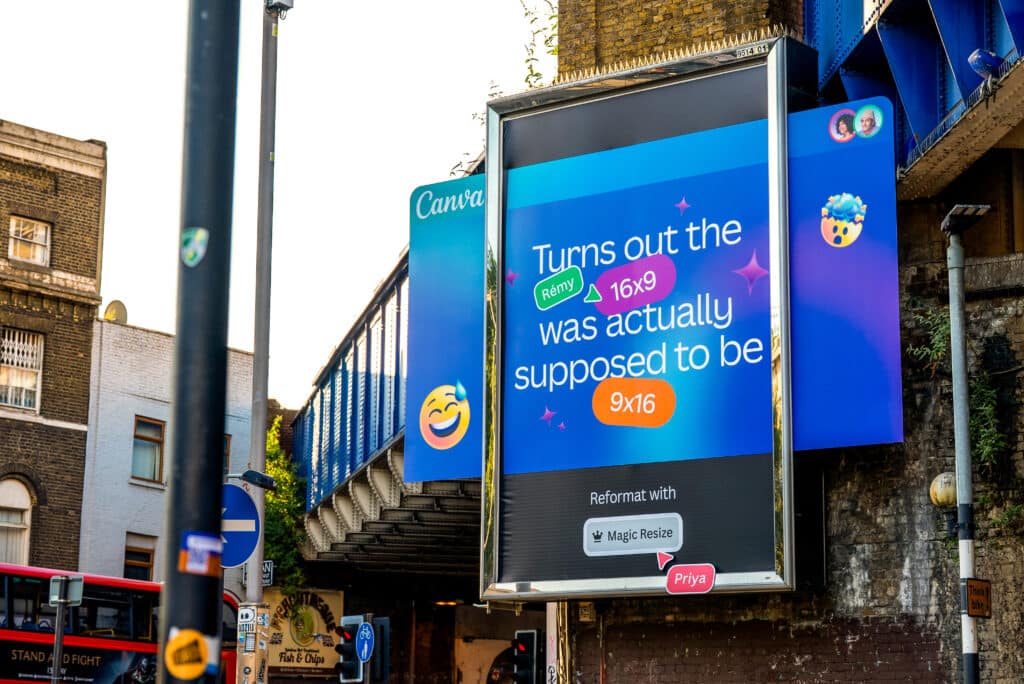
Our takeaway: The best campaigns make the product the star, not by listing features, but by proving value in a way that’s impossible to ignore.
Not every new campaign makes headlines for the right reasons. Some fall flat, some spark backlash, and some quietly get walked back before anyone notices. But even the flops have value. They remind us what not to do and why strategy matters as much as creativity.
Here are two recent examples that prove the point.
Cracker Barrel spent big to modernize its brand, all the way from its logo to the interior of its restaurants. The goal was to broaden appeal and refresh the experience for a new generation of diners.
The problem? Longtime customers didn’t want a new Cracker Barrel. They wanted the one they already loved. By removing nostalgic elements, the rebrand sparked anger among loyalists. Traffic dropped, sentiment soured, and within a month, the company had to backpedal.
Our takeaway: Brand equity is emotional equity. Before making sweeping changes, test your ideas, phase your rollout, and make sure you’re not alienating the very people who built your business.
Jaguar’s recent push into ultra-luxury electric vehicles was bold. New visuals, a “hot pink” launch campaign, and a decision to discontinue lower-end models made it clear the brand was chasing a different audience.
The reaction was mixed at best. Traditional customers felt alienated, critics mocked the visuals, and even fans admitted the pivot was jarring. Still, Jaguar has doubled down, betting the long-term payoff will outweigh the early backlash.

Our takeaway: Repositioning is sometimes necessary, but it’s a long game. If you’re going to risk alienating part of your base, you need crystal clarity on who you’re speaking to, why it matters, and how you’ll sustain momentum through the pushback.
Launching a new marketing campaign isn’t easy, but it doesn’t have to feel like starting from scratch every time. With the right foundation, clear messaging, smart use of data (and yes, AI), and a commitment to learning from every run, campaigns can do more than hit short-term goals. They can make your always-on marketing stronger, too.
Every campaign, big or small, is an opportunity to sharpen your strategy, experiment with creative, and uncover what your audience responds to. The wins matter. The misses matter too. The real advantage comes from teams who take the time to reflect and apply those lessons to what’s next.
At 97th Floor, we build marketing campaigns that create momentum and generate the results you're looking for. If you're ready to see what Great Marketing can do for your brand, lets build.
Feature Image photo by Markus Spiske on Unsplash.
B2B marketers know the importance of capturing their upper-funnel audience, but foggy attribution and the ease of spending for these non-search ads makes this endeavor feel risky.
To understand how cybersecurity companies are approaching this challenge, we analyzed the upper-funnel advertising strategies of 15 cyber companies.
In our analysis, we’ve identified 4 industry outliers whose distinct upper-funnel ad plays are worth study:

Founded in Romania in 2001, Bitdefender’s now global presence serves small and medium business, mid-market enterprises and consumers. Bitdender is proud of its over 440 patents for core technologies, “including machine-learning algorithms to detect malware and other threats and anomaly-based detection techniques vital to detect and prevent new and unknown threats.” Their guiding mission is to be the most trusted cybersecurity provider.
| Software Development | 1,001-5,000 Employees | $100M-$500M | Founded 2001 |
BitDefender is vastly outspending every other company in our sample, claiming 60% of both spend and impression share over a 12 month period.

They also outpace competitors in number of creatives, totaling 1,112 varieties in 12 months. The runner-up in this category ranks at only 554 unique creatives.

In late September 2022, Bitdefender announced a multi-year partnership with Scuderia Ferrari, the Formula One racing division of Ferrari. Bitdefender’s logo made an appearance on Ferrari cars, helmets, uniforms, and on the SF-23 single-seater days later on October 2nd at the F1 Singapore Airlines Singapore Grand Prix.
While the relationship may seem shallow at first, Co-founder and CEO of Bitdefneder Florin Talpes makes a clear connection between the two industries:
“When every second counts, only the most advanced cars win races on the track, and only the most advanced technology has the power to effectively prevent, defend and respond to cyberattacks."
By partnering with the powerhouse of racing, Bitdefender earns coverage and status as a powerhouse in cybersecurity.

FireEye - now Trellix - was founded in 2004 and quickly earned a reputation uncovering high-profile hacking groups. The company notably participated in taking down Ozdok, a botnet that at its strength accounted for 32% of spam worldwide; detected previously unknown vulnerabilities in Microsoft products; and traced nearly 50% of all 2022 state-sponsored hacking campaigns to China and Russia.
| Computer and Network Security | 1,001-5,000 Employees | $500M-$1B | Founded 2004 |
Trellix boasts the most diverse allocation of budget to different platforms and devices.
While most cyber companies heavily prioritize desktop display advertising, Trellix targets users via Facebook, Instagram, Twitter, YouTube, OTT, Desktop Video, Mobile Video, Desktop Display and Mobile Display.


Trellix also claims the largest OTT spend in our sample at 10% of their budget. We applaud this strategy, as our own strategic OTT spend for cyber clients has paid off big time.

One of Trellix’s top creatives is a video advertisement showing how shockingly calm a security operations team can be when relying on Trellix.
This footage also happens to resemble the internal marketing teams for those brands trusting 97th Floor with their ad spend… just a coincidence, then!
Cybereason is an endpoint protection platform. Their company page describes them as a “new kind of cyber security company -- one that delivers future-ready attack protection that ends cyber attacks on the endpoint, across the enterprise to everywhere the battle is being waged.”
| Computer and Network Security | 1,001-5,000 Employees | $20M-$50M | Founded 2012 |
Cybereason is the only company in our sample whose impression volume outpaces their spend. However, there is a simple explanation for this: 99% of Cybereason’s non-search ad spend is devoted to Desktop Display ads. Display ads always guarantee high impressions, but is this the best way for Cybereason to be spending their budget?
One possible interpretation of this strategy is that Cybereason is playing by the 95-5 rule. The rule supposes that at any given time, only 5% of buyers are in the market and looking to buy. Conversely, 95% of buyers are not looking to buy. However, buyers hold strong biases for companies they already know when preparing to make a purchase decision. Investing in the 95% of out-of-market “future buyers” with brand awareness advertising can yield large dividends down the road as the 95% eventually rotates into the buying stage.

Since its founding in 2012, an owl has been the center of Cybereason’s brand identity. When Cybereason began a rebranding process in 2020, conversations with stakeholders revealed that the owl would stay.
Chief Marketing Officer Meg O’Leary says, “The reality was that our customers and partners not only liked the owl as a part of our visual identity. They felt it reflected their own identity as cyber defenders. They too must be wise thinkers and shrewd hunters who adapt as they go, cutting through darkness and complexity to zero in on and neutralize their targets. The owl symbolized the best in all of us as defenders.”
Cybereason’s owl appears on all the creatives we pulled, featured on a black background to remind audiences that both owls and Cybereason see in darkness to detect and destroy threats. The ‘E’ in End found in the design seems to mimic an owl’s three talons slicing through enemies.
In 2020, the rebrand introduced the League of Defenders - a group of owls with distinct looks and abilities to encompass all of Cybereason’s abilities and services. You can meet the League here.
Cybereason stands out from competitors as a brand with strong visual identity, creating a mascot for the cybersecurity industry.
Founded in 1997 by Steven Thomas and his girlfriend Kristen Tally, Webroot’s first commercial product was a trace removal agent called Webroot Window Washer. Today, Webroot “secures businesses and individuals worldwide with threat intelligence and protection for endpoints and networks.”
| Computer and Network Security | 500-1,000 Employees | $100M-$500M | Founded 1997 |
In a drastic departure from the norm, Webroot spends a massive 88% of their budget on Meta. Perhaps they’ve got on that both B2B and B2C customers are real people who sometimes just love to scroll.

Campaign Highlight: Live a Better Digital Life with Webroot
Leaning heavily towards its consumer audience, Webroot's recent video ads focus on how Webroot protects everyday people from digital dangers like viruses and identity theft. The videos feel honest and relatable; one video features a mother whose daughter has just enabled a virus on their brand new computer. The scene is strewn with toys and other markings of a busy home. Each video is filmed in a set made mostly of Webroot's signature green, and a short jingle sums up the spot: "Live a better digital life with Webroot."
At 97th Floor, we're big believers that Extraordinary Marketing requires three things: deep audience understanding, bottom-line focus, and courageous disruption. Our analysis of these four bold cyber companies leaves us here:
Marketers work with data every day, but it can be easy to forget that there are real people behind every number—we set out to find one of those people and help them out this holiday season. Check out how we did it .
Marketers crave data. It informs our decisions, helps us solve problems, and runs the world around us. But marketing data is more than numbers in a spreadsheet, an analytics report, or a list in your CRM—behind every number is a person.
For our 2022 holiday campaign, we challenged ourselves to find the real people behind the data we analyze every day, see what we could learn from them, and find a way to lift them up. Our friends and clients at ProAthlete (a hugely successful sports equipment company that owns JustBats, JustBallGloves, JustPaddles and Routine) eagerly partnered with us to make this possible.
For weeks and with the help of the ProAthlete marketing team, we crawled through ProAthlete’s data, layering it with other data sources to find a real customer we could help. In our search we combed through:
Finally we discovered the perfect candidate for this year's campaign—Chris Evans and his non-profit, named the I AM KING Foundation in Kansas City, Missouri.
We invited Chris and a few of his players to tour ProAthlete’s facility telling them we would be donating $1000 dollars to the foundation, but we had something much bigger planned—a $30,000 donation to the foundation to cover the costs of new equipment and to help contribute to the I AM KING scholarship funds.
What is the I AM KING Foundation?
Chris Evans founded the I Am King Foundation, a 501(c)(3) non-profit, “to educate, inspire and empower young men to become community leaders.”
“When my son was in kindergarten, I literally had to beg parents to bring their kids out to play baseball because everyone wanted to do football and basketball. I brought them out there and they loved it. We had a great time and decided to see how far we could take it” - Chris Evans
Each baseball season Chris invests 20-30 hours of his time weekly coaching little league teams, planning educational field trips, and developing the young men he works with into leaders. The I Am King Foundation accepts donations in an effort to “level the playing field in little league baseball.”
What is Pledge 1%?
Pledge 1% is a movement founded by leaders of Salesforce and Atlassian that encourages and empowers companies to donate 1% of their revenue to charitable and community-based causes. For years, as part of 97th Floor’s Pledge 1% commitment, we have been fortunate enough to elevate brands and people just like Chris Evans that we believe in.
Want to learn more about how 97th Floor elevates people?
Check out last year's project CharityLabs—an engine to help you find charities that match your values and interests.
