



Podcast advertising is a promising strategy for any marketing campaign, with 51% of podcast listeners agreeing that hearing a podcast ad made them more likely to make a purchase from that brand.
Cybersecurity marketers are in no drought for opportunities here, with dozens of long-running and far-loved shows capturing the ears of your audience.
We used Sparktoro and additional tools to find the top-listened podcasts from decision makers in cybersecurity; put a bug in their ear about you, yeah?
Note that this audience is extremely sales and advertising averse. They don’t appreciate self-promotion. While you can of course pay to sponsor the show and get a host-read ad in front of your audience, be extra thoughtful about your messaging and position as you do so.

Darknet Diaries has amassed a cult-like following for its deep-dive episodes exposing true, first-hand stories about “hackers, breaches, shadow government activity, hacktivism, [and] cybercrime.” Host Jack Rhysider, whose own background is in security operations, makes staggering stories accessible and captivating for both technical and non-technical audiences. The show brags over 90 millions downloads and received praise in The Guardian, Vulture and The New York Times.
Format: Guest Interviews
Update Frequency: Every first Tuesday of the month
On Air Since September 2017
Opportunities: If you happen to know someone or know someone who knows someone with an insane cybercrime story to tell, the connection may be worth making just to get your company’s name floating in Jack’s network. Otherwise, you can contact the team by emailing jack@darknetdiaries.com to inquire about sponsorship. See the complete list of active sponsors here. It includes a number of personal and professional security solutions and IT solutions.

Hosted by former NPR investigations correspondent Dina Temple-Raston, Click Here brings listeners audio stories from the “shadowy characters behind ransomware attacks, disinformation campaigns, and hacks and … the people trying to stop them.” Show topics range from “peek inside a North Korean malware lab” to “how hackers settle their disputes – think People’s Court without all the robes.”
Format: Guest Interviews mixed with investigative reporting and narration from the show host
Update Frequency: Every Tuesday and Friday
On Air Since August 2017
Opportunities: Click Here belongs to an ecosystem of cyber-related news produced by The Record from Recorded Future News. The publication sends a daily newsletter to its audience of “hundreds of thousands” via a mobile app.If you have a news tip, and perhaps an expert to lend, about cybersecurity startups, cybersecurity attacks, or policy surrounding privacy, disinformation or cybersecurity policy, you can pitch your story by reaching out to therecord@recordedfuture.com. The show also has in-show advertisements, maybe one per episode or so.

“2.5 Admins is a podcast featuring two sysadmins called Allan Jude and Jim Salter, and a producer/editor who can just about configure a Samba share called Joe Ressington.” The show covers tech news and answers listener-submitted admin-related questions.The show’s audience is well-educated high-earning IT professionals.
Format: Conversational
Update Frequency: Weekly
On Air Since April 2020
Opportunities: The show welcomes interested sponsors to get in touch at show@2.5admins.com.

Late Night Linux is a family of seven podcasts, including 2.5 Admins, all about "Linux, open source software, and systems administration.” Late Night Linux was the group’s first show, and covers all things free and open source software.
Note that the show contains explicit content.
Format: Conversational, doesn’t appear to host guests
Update Frequency: Weekly
On Air Since December 2016
Opportunities: To advertise on any of the Late Night Linux shows, contact joe@latenightlinux.com.

Hosted by Kurt Seifried and Josh Bressers, Open Source Security Podcast delivers weekly conversations on all things IoT, application security, operational security, cloud, devops, and security news.
Format: Two hosts
Update Frequency: Weekly
On Air Since September 2016
Opportunities: You can email the hosts from their website. Both Kurt and Josh are active on infosec.exchange, part of a decentralized social network powered by Mastodon. Sounds like a good place for some audience research, at the very least.

Hosted by cybersecurity veterans Graham Cluley and Carole Theriault, Smashing Security offers a “helpful and hilarious take on the week’s tech SNAFUs.” Winner of the "Best Cybersecurity Podcast" in 2018, 2019, and 2023, and the "Most Entertaining" in 2022 and 2023, Smashing Security has had over nine million downloads.
Note that the show contains explicit content.
Format: Two hosts, occasional guest interviews
Update Frequency: Weekly on Wednesdays
On Air Since December 2016
Opportunities: Smashing Security has generous options for sponsors, including opportunities “for sponsors to appear in 15-minute featured interviews included within the podcast.” To learn more about sponsorship, email studio@smashingsecurity.com. Smashing Security also conveniently features all past episode guests on a nice list. Pursue it and let ideas flow: who in your organization would fit here? Guest list.
Running for nearly twenty years, Security Now offers weekly conversations on security topics such as malware, ransomware, and hacks; digital identity, data privacy, and policies; hardware and IoT security concerns; software and plug-in security patches and updates; and many more. The show hosts are cybersecurity authority Steve Gibson and technology expert Leo Laporte, each bringing “their extensive and historical knowledge to explore digital security topics in depth.”
Format: Two hosts
Update Frequency: Weekly on Tuesdays
On Air Since August 2005
Opportunities: Security Now belongs to the TWiT faTmily of podcasts, a group that amasses a yearly audience of 25 million downloads. TWiT’s podcasts have built a relationship with listeners over several decades, which is great news for you; not only is 88% of TWiT’s audience tech or IT decision makers, but 88% of listeners have actually made a purchase based on a TWiT host-read ad. Get started by emailing advertise@twit.tv.

Risky Business Media was founded in 2007 by cybersecurity journalist Patrick Gray. A rotating group of hosts including Patrick and others publish multiple episodes each week for their audience of cybersecurity professionals.
Format: Host conversations
Update Frequency: Weekly
On Air Since February 2007
Opportunities: Risky Business’ audience is “top heavy,” meaning that a majority of their more than 25,000 weekly listeners are CISOs or information security decision-makers. View Risky Business’ media kit for more information about their audience, and contact sales@risky.biz for pricing. You can also reach out with editorial opportunities. Note that Risky Business Media also publishes two cybersecurity newsletters.
There are two ways to target your audience vis podcast advertising. The first is with baked-in or title-by-title targeting. Baked-in ads are added to the podcast audio file itself, making them permanent. This means that all listeners will hear the same ad when they listen to that episode of the show, regardless of their location, demographic or when they hit play. These ads can appear anytime in an episode and can be longer than thirty seconds.
Dynamic insertion or audience network podcast advertising inserts ads into ad spots (pre, mid, or post-roll) which can be targeted to the person listening. This allows podcasters to keep the advertising on their shows fresh, and it allows advertisers to select contextual targeting and third-party segments. The ad is then inserted in whatever shows that audience is listening to.
Host-read ads are created and voiced by a show’s host, and are usually read in the style of the show. Because of the host’s narration, these ads seem like a personal endorsement to audiences.
Host-read ads are a great choice for most cybersecurity podcast ads because the target audience aligns closely with specific podcast shows, like those listed above. We can select a show or a few shows and have host-read ads for cyber solutions during those shows.
PRO TIP: For host-read ads, it’s best practice to give the host bullet points instead of an actual script. This way you can make sure that what you want covered gets said, but the host has the opportunity to make it seem more authentic to them.
PRO TIP: Make the host your advocate. Build a relationship with them. Let them experience your product as best they can so that they can speak authentically to their trusting audience.
Pre-recorded ads are scripted by an advertiser and then recorded by a voice talent before being added to the podcast pre, mid, or post-roll. This type of podcast ad is best if your podcast advertisements won’t be on one specific show.
For example, using a title-by-title approach doesn’t sense if your targeting requires a geographic restriction.
Here, we can pick contextual targeting so the podcast episode has to be about that topic. Then, we can also layer on third-party segments, such as the user interests or experiences. Finally, layer on location targeting..
A voice talent will read the pre-recorded ad that can then be dynamically inserted whenever a podcast listener meets all of those requirements.
It all depends on your budget, goals and even the length of your spot. Compare each spot below.
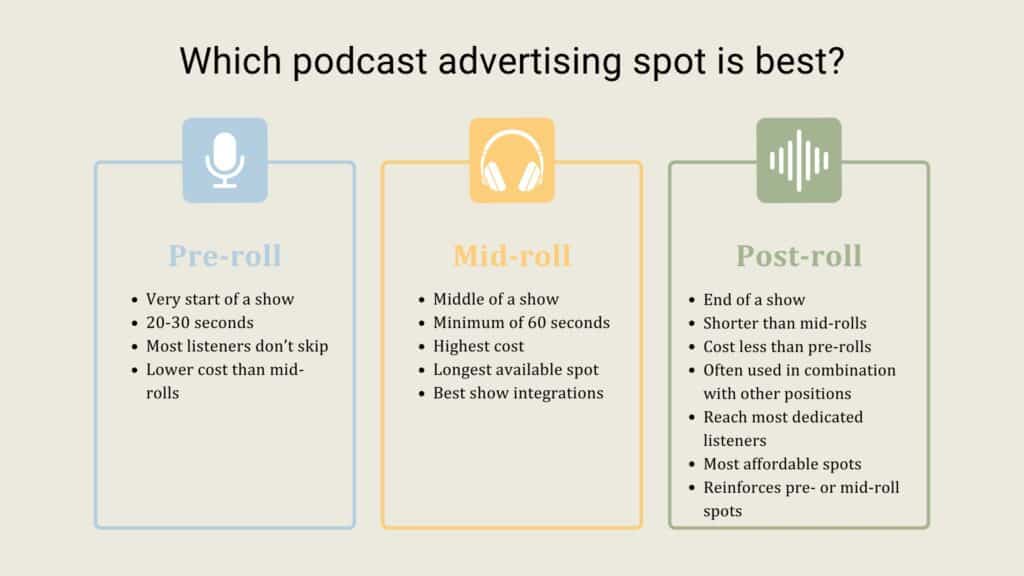
Podcast ads aren’t clickable in most cases, so they are definitely a top-of-funnel awareness play. However, you can drive action from a podcast ad by having a great offer. Most podcast ads have a very enticing offer such as saving a certain percent on a product or a first month free.
PRO TIP: Longer campaigns outperform short ones. Run ads on at least 5 episodes of a podcast to improve recall by 39%. Make each spot different to prevent audience tune-out.
While counting episodes downloads will tell you impressions, use these four tactics to get better success metrics from your podcast advertising.
Story-telling is essential for podcast ads. You don’t have a visual component to draw people in, so you’ve got to hook them with words.
And remember, the offer is so important. Podcast advertising isn’t the most straightforward journey. It’s not like clicking on a LinkedIn ad. We’re asking the user to go to our website manually, so we better offer them a good reason why they should!
See how an audience-first approach translates to bottom-line results.
Key Takeaways
A new marketing campaign is any initiative that sits outside of your always-on efforts. Unlike evergreen SEO, paid, or nurture programs, new campaigns are designed with a specific goal and a clear end date in mind.
This might mean spotlighting a product launch, rallying attention around a major industry event, or testing your messaging with a new audience segment. Sometimes it’s driven by leadership priorities, sometimes by seasonal opportunities, and sometimes by curiosity; the “let’s see what happens if we…” moments.
The point is: a new campaign should feel distinct from business as usual. It deserves its own planning, its own creative energy, and its own success criteria. Done well, a new marketing campaign can uncover insights that strengthen your always-on work for the long run.
In this article, we’ll walk through the full lifecycle of a new marketing campaign, from planning to launch to post-mortem, with practical tips you can apply right away. We’ll also share recent campaign wins worth learning from, along with a few cautionary tales of what not to do.
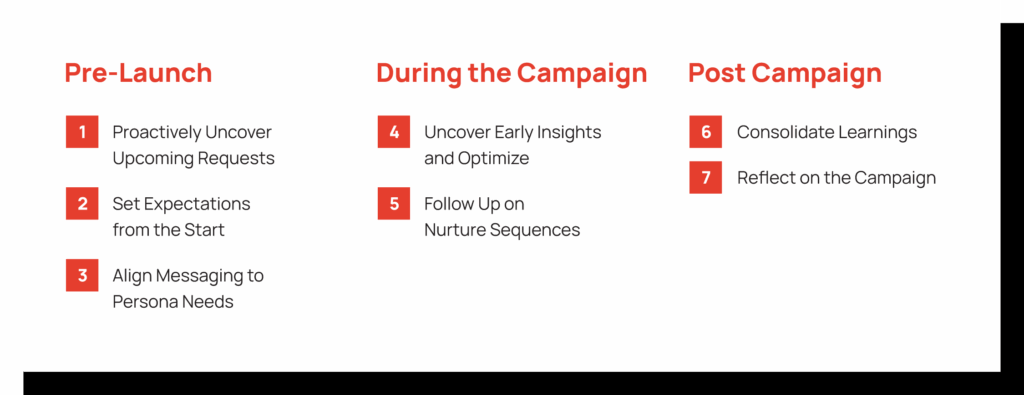
The biggest obstacle with new marketing campaigns is time. Get ahead of the curve by requesting a calendar of upcoming initiatives from key parties. Is your marketing team planning any events? Is the product team preparing for any new launches?
See if you can identify any patterns in past new marketing campaign requests. Do executive teams propose ideas in quarterly business reviews? Or do they follow up the week after the review with an idea that was sparked during the presentation?
Knowing what’s ahead will give you a significant advantage.
Because new marketing campaigns usually have different goals than always-on campaigns, ensure that everyone is on the same page about the campaign. Once a request comes your way, communicate timelines, required information, and what they can expect from you. Be clear about how long the platform will need to optimize the account and exit the learning period before you can report on concrete results.
Here are a few key pieces of information you should have documented in a campaign brief:
Pro tip: Keep your top-performing ads on instead of switching all spend to the new marketing campaign. Dramatically reducing budget or pausing ongoing efforts completely will halt conversions.
Companies often focus on products and features, while customers think in terms of pain points and benefits. Raise concerns early on and push back on messaging that contradicts what you’ve already learned about your audience. Bonus points if you have documented A/B test data that can back up your claims.
Consider workshopping campaign messaging and design concepts with key stakeholders before sending the copy over for final design. There are lots of eyes on the creative for one-off campaigns and you usually need approval for multiple individuals. There’s nothing worse than thinking you’ve wrapped a project up only to have three additional rounds of back-and-forth revisions.
The campaign is launched, but you’re not done yet! Dive into the performance data and see which ad creatives are resonating the best. Pause low-performing ads and make adjustments to improve performance. What learnings can you report on?
When you filled out the new campaign brief, you should have discussed how you were going to follow up with audiences from the one-off campaign. If a retargeting campaign isn’t already in action, it’s time to get that up and running. Don’t let too much time go by between audience interactions with your newly born marketing campaign and the next touchpoint.
After the campaign has ended, debrief and put all of your learnings into a single location for easy reporting and future reference.
A few things to include:
Since another new marketing campaign is likely to come your way again, take time to reflect on the campaign. Is there anything you would do differently? Loop in the person who requested the campaign. Did they get the information they hoped to gain? Were the results what they expected?
Finally, evaluate the overall effectiveness of the campaign. If similar initiatives arise in the future, would you expect them to succeed? Should you push back on this type of campaign moving forward or double down on your efforts?
Try out these seven steps the next time a campaign request comes your way. Instead of rushing to push something out the door, you’ll have a process in place that adds genuine value to your organization.
Every marketer’s been asked for “examples of campaigns that worked.” We won’t be the first to say it; success rarely comes from one magic trick. It comes from understanding your audience, telling a story they actually care about, and being willing to take risks when it counts.
Here are three recent campaigns that got it right, for very different reasons.
When American Eagle tapped Sydney Sweeney for their denim ads, they didn’t play it safe. The campaign headline “Sydney has great jeans” sparked immediate buzz, equal parts clever wordplay and eyebrow-raising innuendo.
Critics weighed in, competitors like Gap and Lucky Brand jumped into the conversation, and suddenly American Eagle was winning attention far outside their usual channels.

Our takeaway: Sometimes controversy is the strategy. But, pulling it off takes confidence in your brand voice, a readiness for backlash, and a clear plan to capture the upside of all that attention.
While most AI brands fight for attention with speed, disruption, and hype, Anthropic zagged. Their “Keep thinking” campaign positioned Claude as thoughtful, safe, and human-aligned.
It was quiet where others were loud, reflective where others were flashy, and it worked. Anthropic found white space between its competitors and used brand values as the creative hook.

Our takeaway: A campaign grounded in authenticity can be more disruptive than the most over-the-top creative. Values resonate, especially when the rest of the industry is running in the opposite direction.
Canva didn’t do a campaign telling people its tools are great to use; it showed them. Their billboard takeover at London’s busiest train station literally demonstrated product features: background removal, drag-and-drop edits, and clean design transformations.
Commuters stopped. Photos spread online. The product explained itself in 20 seconds flat, and people remembered Canva for it.
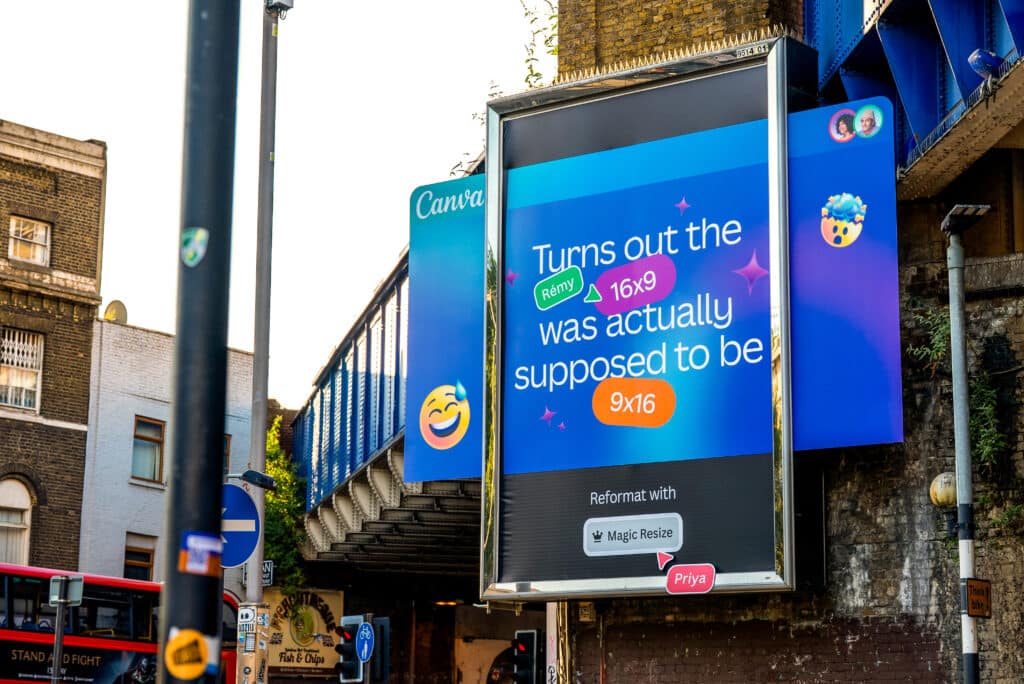
Our takeaway: The best campaigns make the product the star, not by listing features, but by proving value in a way that’s impossible to ignore.
Not every new campaign makes headlines for the right reasons. Some fall flat, some spark backlash, and some quietly get walked back before anyone notices. But even the flops have value. They remind us what not to do and why strategy matters as much as creativity.
Here are two recent examples that prove the point.
Cracker Barrel spent big to modernize its brand, all the way from its logo to the interior of its restaurants. The goal was to broaden appeal and refresh the experience for a new generation of diners.
The problem? Longtime customers didn’t want a new Cracker Barrel. They wanted the one they already loved. By removing nostalgic elements, the rebrand sparked anger among loyalists. Traffic dropped, sentiment soured, and within a month, the company had to backpedal.
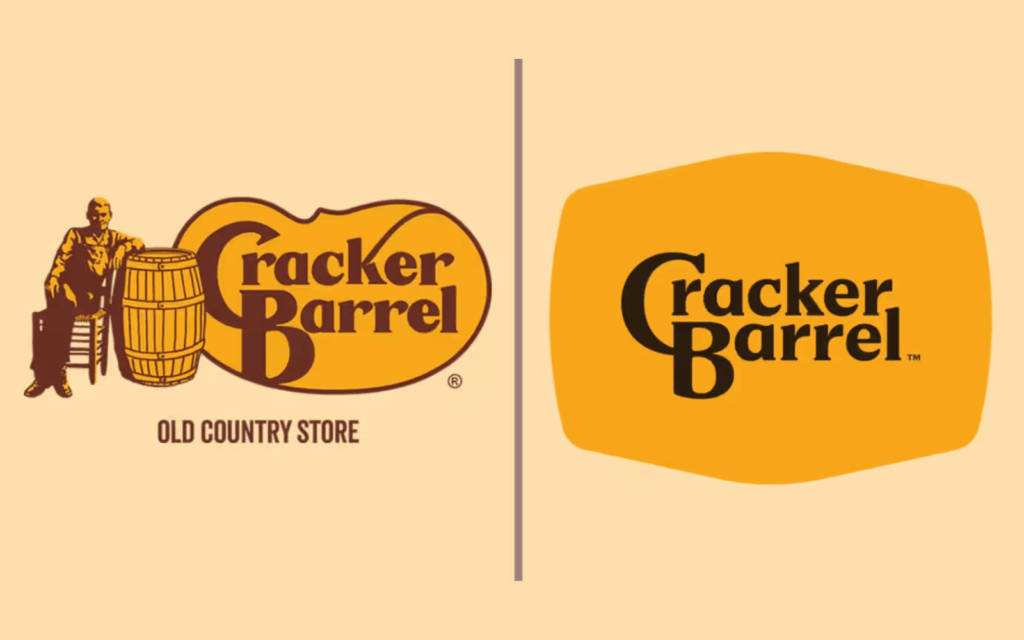
Our takeaway: Brand equity is emotional equity. Before making sweeping changes, test your ideas, phase your rollout, and make sure you’re not alienating the very people who built your business.
Jaguar’s recent push into ultra-luxury electric vehicles was bold. New visuals, a “hot pink” launch campaign, and a decision to discontinue lower-end models made it clear the brand was chasing a different audience.
The reaction was mixed at best. Traditional customers felt alienated, critics mocked the visuals, and even fans admitted the pivot was jarring. Still, Jaguar has doubled down, betting the long-term payoff will outweigh the early backlash.

Our takeaway: Repositioning is sometimes necessary, but it’s a long game. If you’re going to risk alienating part of your base, you need crystal clarity on who you’re speaking to, why it matters, and how you’ll sustain momentum through the pushback.
Launching a new marketing campaign isn’t easy, but it doesn’t have to feel like starting from scratch every time. With the right foundation, clear messaging, smart use of data (and yes, AI), and a commitment to learning from every run, campaigns can do more than hit short-term goals. They can make your always-on marketing stronger, too.
Every campaign, big or small, is an opportunity to sharpen your strategy, experiment with creative, and uncover what your audience responds to. The wins matter. The misses matter too. The real advantage comes from teams who take the time to reflect and apply those lessons to what’s next.
At 97th Floor, we build marketing campaigns that create momentum and generate the results you're looking for. If you're ready to see what Great Marketing can do for your brand, lets build.
Feature Image photo by Markus Spiske on Unsplash.
B2B marketers know the importance of capturing their upper-funnel audience, but foggy attribution and the ease of spending for these non-search ads makes this endeavor feel risky.
To understand how cybersecurity companies are approaching this challenge, we analyzed the upper-funnel advertising strategies of 15 cyber companies.
In our analysis, we’ve identified 4 industry outliers whose distinct upper-funnel ad plays are worth study:

Founded in Romania in 2001, Bitdefender’s now global presence serves small and medium business, mid-market enterprises and consumers. Bitdender is proud of its over 440 patents for core technologies, “including machine-learning algorithms to detect malware and other threats and anomaly-based detection techniques vital to detect and prevent new and unknown threats.” Their guiding mission is to be the most trusted cybersecurity provider.
| Software Development | 1,001-5,000 Employees | $100M-$500M | Founded 2001 |
BitDefender is vastly outspending every other company in our sample, claiming 60% of both spend and impression share over a 12 month period.

They also outpace competitors in number of creatives, totaling 1,112 varieties in 12 months. The runner-up in this category ranks at only 554 unique creatives.

In late September 2022, Bitdefender announced a multi-year partnership with Scuderia Ferrari, the Formula One racing division of Ferrari. Bitdefender’s logo made an appearance on Ferrari cars, helmets, uniforms, and on the SF-23 single-seater days later on October 2nd at the F1 Singapore Airlines Singapore Grand Prix.
While the relationship may seem shallow at first, Co-founder and CEO of Bitdefneder Florin Talpes makes a clear connection between the two industries:
“When every second counts, only the most advanced cars win races on the track, and only the most advanced technology has the power to effectively prevent, defend and respond to cyberattacks."
By partnering with the powerhouse of racing, Bitdefender earns coverage and status as a powerhouse in cybersecurity.

FireEye - now Trellix - was founded in 2004 and quickly earned a reputation uncovering high-profile hacking groups. The company notably participated in taking down Ozdok, a botnet that at its strength accounted for 32% of spam worldwide; detected previously unknown vulnerabilities in Microsoft products; and traced nearly 50% of all 2022 state-sponsored hacking campaigns to China and Russia.
| Computer and Network Security | 1,001-5,000 Employees | $500M-$1B | Founded 2004 |
Trellix boasts the most diverse allocation of budget to different platforms and devices.
While most cyber companies heavily prioritize desktop display advertising, Trellix targets users via Facebook, Instagram, Twitter, YouTube, OTT, Desktop Video, Mobile Video, Desktop Display and Mobile Display.


Trellix also claims the largest OTT spend in our sample at 10% of their budget. We applaud this strategy, as our own strategic OTT spend for cyber clients has paid off big time.

One of Trellix’s top creatives is a video advertisement showing how shockingly calm a security operations team can be when relying on Trellix.
This footage also happens to resemble the internal marketing teams for those brands trusting 97th Floor with their ad spend… just a coincidence, then!

Cybereason is an endpoint protection platform. Their company page describes them as a “new kind of cyber security company -- one that delivers future-ready attack protection that ends cyber attacks on the endpoint, across the enterprise to everywhere the battle is being waged.”
| Computer and Network Security | 1,001-5,000 Employees | $20M-$50M | Founded 2012 |
Cybereason is the only company in our sample whose impression volume outpaces their spend. However, there is a simple explanation for this: 99% of Cybereason’s non-search ad spend is devoted to Desktop Display ads. Display ads always guarantee high impressions, but is this the best way for Cybereason to be spending their budget?
One possible interpretation of this strategy is that Cybereason is playing by the 95-5 rule. The rule supposes that at any given time, only 5% of buyers are in the market and looking to buy. Conversely, 95% of buyers are not looking to buy. However, buyers hold strong biases for companies they already know when preparing to make a purchase decision. Investing in the 95% of out-of-market “future buyers” with brand awareness advertising can yield large dividends down the road as the 95% eventually rotates into the buying stage.

Since its founding in 2012, an owl has been the center of Cybereason’s brand identity. When Cybereason began a rebranding process in 2020, conversations with stakeholders revealed that the owl would stay.
Chief Marketing Officer Meg O’Leary says, “The reality was that our customers and partners not only liked the owl as a part of our visual identity. They felt it reflected their own identity as cyber defenders. They too must be wise thinkers and shrewd hunters who adapt as they go, cutting through darkness and complexity to zero in on and neutralize their targets. The owl symbolized the best in all of us as defenders.”
Cybereason’s owl appears on all the creatives we pulled, featured on a black background to remind audiences that both owls and Cybereason see in darkness to detect and destroy threats. The ‘E’ in End found in the design seems to mimic an owl’s three talons slicing through enemies.
In 2020, the rebrand introduced the League of Defenders - a group of owls with distinct looks and abilities to encompass all of Cybereason’s abilities and services. You can meet the League here.
Cybereason stands out from competitors as a brand with strong visual identity, creating a mascot for the cybersecurity industry.
Founded in 1997 by Steven Thomas and his girlfriend Kristen Tally, Webroot’s first commercial product was a trace removal agent called Webroot Window Washer. Today, Webroot “secures businesses and individuals worldwide with threat intelligence and protection for endpoints and networks.”
| Computer and Network Security | 500-1,000 Employees | $100M-$500M | Founded 1997 |
In a drastic departure from the norm, Webroot spends a massive 88% of their budget on Meta. Perhaps they’ve got on that both B2B and B2C customers are real people who sometimes just love to scroll.

Campaign Highlight: Live a Better Digital Life with Webroot
Leaning heavily towards its consumer audience, Webroot's recent video ads focus on how Webroot protects everyday people from digital dangers like viruses and identity theft. The videos feel honest and relatable; one video features a mother whose daughter has just enabled a virus on their brand new computer. The scene is strewn with toys and other markings of a busy home. Each video is filmed in a set made mostly of Webroot's signature green, and a short jingle sums up the spot: "Live a better digital life with Webroot."
At 97th Floor, we're big believers that Extraordinary Marketing requires three things: deep audience understanding, bottom-line focus, and courageous disruption. Our analysis of these four bold cyber companies leaves us here:
Many retailers use the holidays to end their fiscal year with a bang. This year, many marketers, especially retailers, are putting their hopes in the 2020 holiday season to capture revenue at the tail-end of what has been a hard year. 97th Floor’s latest study dove into all of the newest trends in Black Friday and holiday shopping to help marketers prepare, and in this post we’ll dive deeper into how these insights might affect your ad strategy this season.
COVID-19 has shifted every business’s strategy and planning in 2020. As cases continue to rise, holiday shopping trends are no exception. This season, 68% of shoppers say they plan to do most of their shopping online due to COVID, and 52% of shoppers say they expect they’ll never shop in person for the holidays ever again.

Things are changing, and marketers need to keep up. Especially this holiday season, it will be imperative that marketers make the most of the newest consumer trends. The changing market will likely mean many advertisers will be prioritizing ads for their holiday campaigns, so marketers need to look at what that will mean as far as higher costs in the ad platforms, etc. and need to be ready to traverse the new waters with skill.
Here are a few tips to make the most of your ads this 2020 season based on our recent data.
For two months in a row, Facebook’s CPMs have risen by 10% — reaching a record high for 2020. Higher costs might mean that your strategy needs to pivot. Be sure to place pixels from other platforms on your site so that you can hold onto your followers in case you decide to pivot to other ad platforms that may be less expensive.
With virtually every retailer trying to make up for lost ground earlier in the year, you can bet you’ll see more competitive bids, decreasing your ROAS. Facebook will likely become an incredibly competitive market, with costs continuing to rise. This season, be prepared to switch platforms and pivot to make the most of your budget.
This holiday season, your ad copy and creative needs to stand out, but you already knew that. What you might not know is that only 20% of shoppers say they're definitely in “a shopping mood” this holiday season. Advertisers need exceptional copy and creative to earn clicks and conversions from their audience this year.
Even stores that are used to pushing in-person sales will be moving online, and users will be inundated with ads. Advertisers need to be leaning into their established personas to create copy and creative that speaks to your audience. Even if you have high performing ads, they will likely need a refresh with a holiday angle to ensure they are speaking to your persona during the holiday season.

Savvy advertisers will have already built a deep retargeting pool months ago that they can lean into heavily during the holiday season. So while it might be too late to build a retargeting pool for this season’s retargeting efforts, the holidays could be a perfect time to build that pool for future efforts.
If you can gain a solid retargeting pool, it will give you the leg up in your future endeavors (like starting 2021 off with lower CPCs). Retargeted audiences are some of the most likely to convert, and that’s what ultimately matters over any kind of wide reach or visibility. Figure out ways to get qualified traffic to your site en mass, even if it’s not on a product page, and then use pixels to add them to your remarketing pool. And who knows, focusing on building that pool might just bring you conversions this season too.

This holiday season will be different than anything we’ve experienced before. Advertisers should prep their leadership with accurate numbers, as 73% of shoppers plan to spend either as much or less than they did last season.
Monitor your channels closely and be ready to pivot as needed. Don’t lose track of your CPM or CPC prices, and be strategic with your budget as costs rise. Stay hyper aware, or you’ll find yourself paying a lot more per ad. And look to the future (yes, there’s hope beyond the holiday season)! Build your remarketing pool, and prepare for an audience base that has the potential to stay largely online, even once the COVID crisis ends.
COVID-19 cancelled a lot of plans in 2020. Teachers. Doctors. CEOs. Politicians. Parents. Children. Travelers. They’ve all had to adapt to The New Normal. With Black Friday approaching, we’ll add retailers to that list.
Most retailers rely on Black Friday doorbusters to make their year profitable, and this year Black Friday is even more important to many retailers as they’ve suffered with shutdowns, lockdowns, and letdowns.
97th Floor has helped hundreds of brands find success during their holiday marketing push, but we’ve never done it in a year as unique as 2020. We wanted to know how shoppers would react to these changing times, so we commissioned an independent research study of 1,000 US shoppers to understand their hopes, fears, and behaviors when it comes to crowded malls, bustling stores, and online shopping this holiday season.
We’ve put together some of the most interesting insights in this article, but all the data can be seen in the PDF download attached to this article.


It’s true that this has been a difficult year for business. However, there are steps that you can take to safeguard your own sales as the holiday season approaches. Our advice? Focus your efforts online. 97th Floor will be releasing a small series of in-depth articles covering these topics deeper.
Sign up for our monthly newsletter to make sure you don’t miss one.
Some SEO tactics take months to see results, but the holiday shopping season is already upon us. So, this year we’d recommend finding that sweet spot between SEO that works for ecommerce sites and the SEO practices that yield results quickly. A few “quick wins” you should look at to increase the readability and user-friendliness of your site are product schema markup, proper rel=canonical for duplicate product pages (for holiday special prices for example), appropriate redirects, claim unlinked brand mentions, strategic internal links, and title tag adjustments.
Many brands can expect an influx of traffic during the next two months, so this could be a good time to roll out some testing in order to capture revenue from as much of that traffic as possible. Small changes can make a big difference on your site — one of our clients saw a 29% increase in revenue in just 18 days, without any increase in traffic at all. Imagine the possibilities as traffic does increase this holiday season. Our advice? Get started testing as quickly as you can. That way, when traffic really starts to peak, you know you’re getting that traffic to the most optimized versions of your pages.
It’s difficult to predict what will happen with ad auctions and CPCs during the holidays, but it’s certain prices will go up. Perhaps more this year than any other year since so many brands are hoping to make up for poor performance in previous quarters. Work to get more traffic right now, so that you can form remarketing campaigns later, which will be cheaper and more effective than cold ads. This might mean getting ads out the door earlier than you may have planned. Additionally, get all of the pixels you can active on your site. Even if you are only running Facebook Ads right now, still include pixels for Pinterest, LinkedIn, and Google if appropriate. Doing this will allow you to quickly pilot to new platforms if rising prices caused by holiday influxes on your platform of choice push you out. This will help you keep a steady ROAS.
Keep in mind that people are more likely to try a new product or business during the holidays, so if gaining new customers is a focus for your business, this is your time to shine. Monitor all of your channels closely, as well as CPM and CPC. Become hyper-aware so that you don’t end up paying more than you’d like per ad. Also, build your remarketing pool earlier and be ready to pivot.
Email is a channel that deserves more attention this holiday season. Work on more specific segmentation, increase your email frequency. A greater volume of emails is much more acceptable by most users this time of year, so it’s a great time to show them all the value you can), and be sure to keep it personal. There are little things you can do to add personalization to your emails, such as personalization in both copy and context, that make a big difference to those on the receiving end. Email your contacts based on their interactions with you, as well as the information you already know about them. When the situation is more specific, your emails are more likely to be effective.
There is no doubt that this holiday season will look different than any that has preceded it. Yet, even in 2020, there is still room for success when you plan strategically. Strive to work with the times rather than against them. The data collected in this study can be used to help tell a more accurate story this holiday season. And, taking to heart these suggestions, you can be armed to take this challenge head on — and hopefully see incredible results in the process. We’re going to be dropping more specific articles on our blog throughout this season, so be sure to follow us on social media and subscribe to our newsletter so you don’t miss a thing!
Many ecommerce businesses begin with a D2C model, selling quality products on their own site while dreaming of the days they’ll hit it big by getting serious traction in a major brick and mortar.
It’s a big step and an exciting achievement, but it also carries risk. As you push your product through bigger stores, you give up control over your brand and your ability to connect directly with your customers. It’s often a matter of trading control for (hopefully) greater volume.
This was Zhou — a nutrition brand thrilled to fulfill their longtime goal of seeing their product in 433 Target stores across the US, but worried about the new lack of control. They wanted to retain a hand in their own success, and see that their entrance to Target was a success in terms of actual foot traffic and revenue.

Zhou presented 97th Floor with a fixed budget for advertising in 433 specific locales. The task was one Zhou had never attempted before — drive foot traffic and sales with Facebook Ads to physical Target locations through geo-targeting, in addition to Target’s online landing page. Driving and tracking success via Facebook Ads to your own landing page is easy to track and control, but driving foot traffic to a secondary store is another story.
Ultimately, the strategy and results were so positive that after two weeks, Zhou found extra budget to push towards these ads.
It’s quite a triumph when longtime D2Cs enter big-time stores like Target. But success isn’t guaranteed. The D2C still has to do the work of getting their brand recognized in stores, and pushing foot traffic into those stores to actually buy the product.
In order to start off with a bang and keep the momentum going long term, Zhou allocated some budget to getting products moving in the locales they were entering. Pushing that traffic, especially in those first few weeks, would prove critical in making their transition into Target stores a success.

Zhou came to us with a moderate budget, but when split over 433 different markets even a sizable budget goes pretty fast. We began with a total budget of $30,000, which meant each store got only $4.62 in daily ad spend. This meant we had to be pretty picky and intentional about where we put our money. The tactics we used had to be effective and incredibly targeted. We also ran this project for just two weeks, so time was of the essence. After those first two weeks and initial $30,000, Zhou was so impressed with the results that they decided to push an extra $10,000 toward another five days of campaigning.
We decided that higher click through rates and lower cost per clicks would be the best markers for our success in this particular campaign. In addition to revenue information gathered from Target. This was because we weren’t trying to drive sales directly, but rather foot traffic to brick and mortar Target locations as well as their online landing pages.
The two products that Zhou placed in Targets were Collagen Peptides and Hairfluence supplements. The primary target for these products were women, so we catered our copy and ad images towards that demographic.

We built out a strategy with ads for 160 different geo-targeted markets, including up to 27 stores within each market. The Target logo was prominent in the ad visuals, highlighting that the product was now available at Target. That math adds up to thousands of different geo-targeted ads, each directed at their specific markets. And, to complicate things even further, we wanted all of them to go up within Zhou’s first few weeks inside Target.
With that great volume of ads to set up in such a short period of time, we knew we had to be careful how we approached their launch. If we put them all up at once there was a high likelihood that the Zhou account would be disabled. Which would throw a real wrench into the already time-sensitive campaign. So, we played it safe and uploaded them in batches, day by day.

This turned out to be a strategic advantage, because after the first week, we located the underperformers and pulled them, reallocating their budget to the highest performing ads and locales. This helped us make the very most of the budget, and see quicker and more substantial results from our efforts. It’s always a good feeling to put your money where the data is.
We also created a live dashboard with Google Data Studio so we could see the performance of our ad variants across all locations in real-time. We shared this with the executives at Zhou and their parent company (Nutraceutical) who then shared it with Target. Target was able to provide us with in-store conversion data, allowing us to truly see the impact of our efforts on the bottom line. At this point, Zhou, thrilled about the increasing conversion rates, sent that extra $10,0000 to continue the campaign.

Together, Zhou and 97th Floor truly revolutionized the process of entering brick and mortar stores as a D2C. Zhou kept control of their brand, and pushed customers toward their new Target locations. No longer do D2Cs just have to sit back and hope that greater volume will mean greater results. Instead, they can still have a hand in their own success.
And, it wasn’t just Zhou that profited. This strategy was a win-win for both Zhou and Target — Target gets customers in their doors, and Zhou gets revenue and product recognition. This ad strategy and real-time dashboard were so successful together that Zhou now uses this framework as a playbook when guiding new product lines to enter big retailers like Walmart, Sam’s Club, Costco, and more.
Ultimately, Zhou saw a 27.46% increase in in-store purchases in just one week of this campaign. Proving to themselves, and other curious D2Cs, that profitable partnerships with big-names like Target are not only possible, but probable, with the right ad strategies.

Often digital and brick and mortar marketing are seen as opposites rather than partners, but Zhou proved that it doesn’t have to be that way. Online shopping might be the new frontier, but there will always be a place for the convenience and experience of local brick and mortars. Zhou and 97th Floor’s partnership led to great results, revolutionary processes, and a successful start to Zhou’s product pushing in Target.
Zhou kept control, but was able to take advantage of Target’s wide reach. Now, Zhou is looking for even more products that they can push through this process and get inside of brick and mortar stores.
Political campaigns are some of the most visible, wide-reaching, and polarizing marketing campaigns. They operate off of enormous budgets with highly condensed timelines, and digital strategy has become an increasing priority as audiences shift online. But even Presidential marketing has its oversights and faux pas.
At 97th Floor, we were curious about how these two campaigns were tackling digital, so we decided to utilize our expertise in performing large-scale audits for both the Biden and Trump 2020 campaigns. We have the best specialists in all of these fields, and we asked our teams to treat these campaigns just as they would a client, auditing every inch that they could.
After pulling thousands of digital ads, reviewing millions of dollars in ad spend, pouring over scores of website pages, reading hundreds of emails, and scouring mobile apps and social media accounts, we found hoards of fascinating insights. It’s a drama-- massive oversights, well-timed reactions, wasted dollars-- but I’ll step aside and let the data tell the story.
After combing through both audits we cherry-picked and pulled the most engrossing snippets into the final version on GetThatVote.com. Read ahead here to see just a few of those highlights.

On a grand scale, the Trump campaign acts as one might expect: big budgets, pushy messaging, and dated tactics. But, while wasted budget is never a pro, the Trump campaign seems to understand its core audience. The campaign’s focus and budget, as well as messaging, are highly targeted to dyed in the wool, red “Patriots.” Team Trump’s digital tactics mirror that of the entire campaign — braggadocious — largely catering to those who are already his fans. Additionally, the Trump campaign presses much harder for donations, which could be one explanation for its ability to outspend the Biden campaign at every turn.
In contrast, Biden’s team hones in on the fringes and the undecided — those who have been historically election-determining, an obvious audience for this (and every) election. This showcases itself in a strong focus on swing states with budget, and a somewhat-humble focus on “togetherness” and “unity” in messaging. The Biden campaign also pushes for a professionalism and issue-based copy that Trump has largely overlooked. A little surprising is the consistently smaller budget from the Biden side, however it’s possible that Team Biden is holding back to increase spending when it matters most, that last month.
Overall, each site caters to the strengths of its candidate. The Biden site emphasizes unity in diversity, with photos of Biden with others rather than alone, and copy that includes words like “together.” Trump’s site leans into the fame of Trump himself. Mentions of specific goals or stances are overtaken by Trump-focused photos and messaging.

As far as general user experience and intuitive flow, Trump’s site takes the cake. Biden’s site overlooks clear messaging in conveying how to volunteer or get involved, and funneling every user into a narrow set of options. The Trump site uses very clear “get involved” messaging in their header, and gives various actions a user could take in order to show support for the campaign. Additionally, Biden’s website feels busy, and lacks an easily navigable hierarchical structure. Trump’s site is well structured, pushing users to either shop or donate.

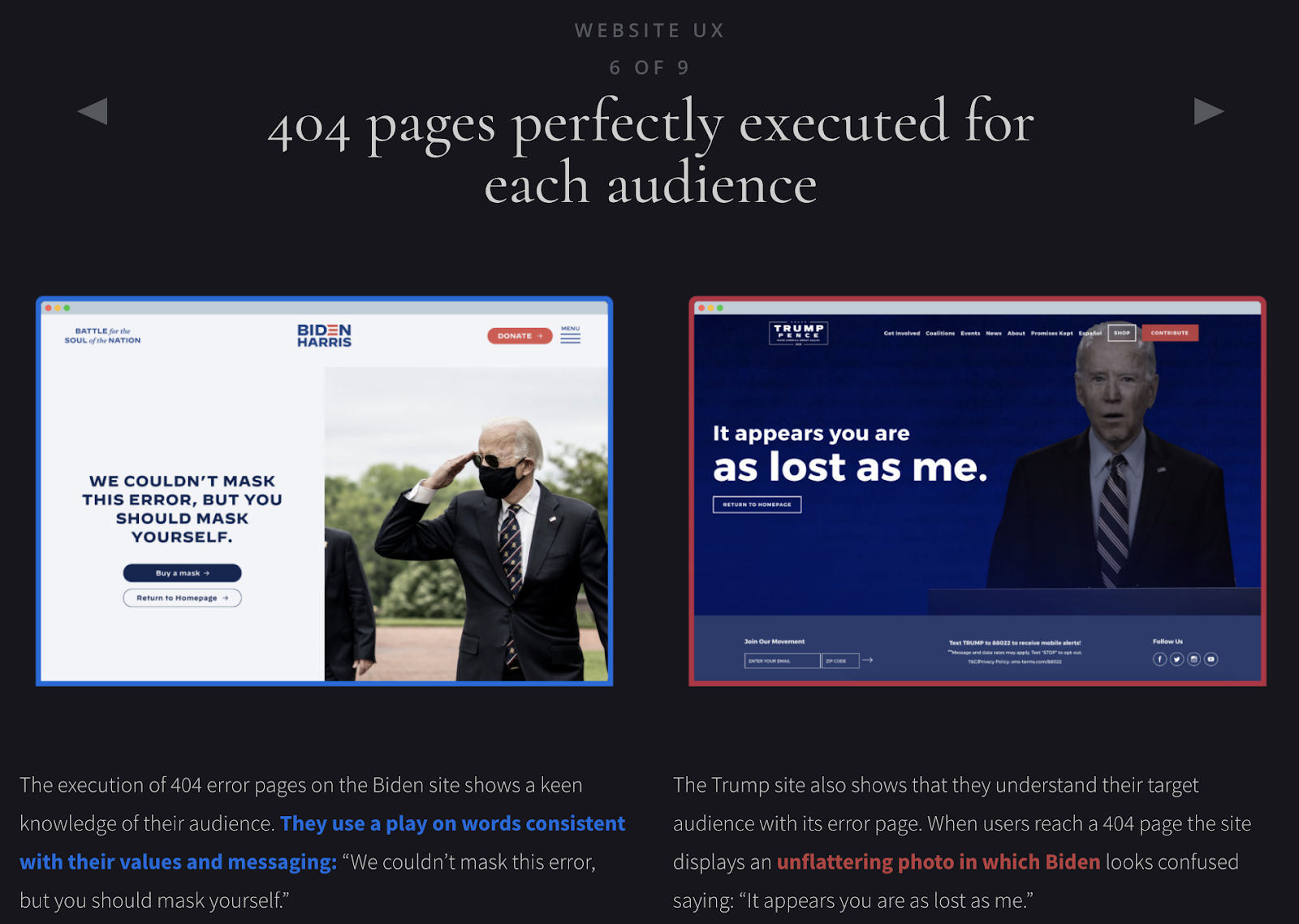
We also couldn’t help ourselves in looking at the 404 pages. Both perfectly represent their target audience: Biden’s responsible mask-wearers, and Trump’s anti-Bidens.
Neither campaign is leaning into search advertising heavily, with text-based search ads accounting for 11.48% and 10.09% of the Biden and Trump campaign’s Google Ad’s budgets respectively. They both make good use of the video elements of Google’s platforms, which may be based on the fact that video is a more immersive experience for the viewer, however it is unusual to see so little budget devoted to image ads given their ability for cheap, but effective remarketing.

The biggest misstep? The Trump campaign paid for the keyword “how to impeach trump.” One might think that this strategy is fascinating, and indeed it could have been, if paired with the right landing page. But when you look at other terms that received significant clicks, you’ll also find terms like, “speedo swim trunks,” “men’s xxl swim trunks,” “trump is a disaster,” and “trump fraud.” The Trump team was apparently not looking at their own search terms report. This oversight is easily fixable by adding negative search terms to their strategy.

Another key difference in strategy is that Biden’s team is using search to prioritize issues, while Trump’s team is here to sell hats (and other merch). Overall, team Biden is performing better in the Google Ads game. However, this is largely due to the fact that they’ve made fewer obvious blunders rather than their own strength on the platform.

I wasn’t impressed by the Trump campaign’s email strategy. The subject lines are flashy, even misleading, resorting to bait and switch tactics. Trump’s email team is pushing hard for donations. Ironically, however, the Trump campaign falters big time when it neglects to add emails entered into the footer of the website into any sort of followup email funnel.

With an average of 2.7 emails sent per day, one has to wonder about unsubscribe rates on the Trump campaign’s emails. The intended strategy may be to hit the audience hard to get recurring donations before they unsubscribe due to email fatigue.

The Biden campaign, on the other hand, seems to want to turn subscribers into advocates, only occasionally asking for donations. His campaign sends significantly fewer emails than Trump’s, with an average of one email every other day. The Biden campaign keeps the issues of their campaign central, and their subject lines helpful and professional. Overall, Biden’s email strategy has a clear advantage over Trump’s in its use of best practices.

Both candidates are running predictable and moderate social media campaigns. Biden is more active on Instagram than Trump, but it’s still surprising that neither candidate makes greater use of Instagram, considering the app’s large demographic of young, often swing voters.

The campaigns’ followers describe themselves in predictable ways: “she/her,” “feminist,” “activist,” and “liberal” for Biden and “KAG,” “patriot,” “conservative,” and “retired” for Trump. However, with only 1.3% of crossover between followers of these accounts, users are essentially tweeting into a political echochamber. It’s also interesting to note that in an analysis of how Biden and Trump advocates speak on social media found that Trump site visitors are twice as likely to talk about the opposing party compared to Biden site visitors.

The most creative social media push from either the campaigns is the Biden campaign’s podcast. This is new territory for presidential campaigns, and while its success has been mostly negligible (it seems Biden supporters are more likely to engage on other channels) it was a creative effort.

The Trump campaign uses divisive ads, intending to both sow distrust in leaders of the democratic party, and raising funds. These ads often include asking users to take a one-sided survey with titles such as: “Official Democrat Corruption Accountability Survey.” These tactics might be duplicitous, but we’d also give them some credit for stepping outside of the box. Both candidates ask for donations, just with a different focus. It seems likely that Trump is receiving more funds from his tactics, but Biden is likely creating more “ownership” from those who do support him by focusing on specific issues and local state battles.

Both campaigns run well-timed ad campaigns with a focus on state-driven ads, a smart strategy for their specific aims. The Trump team consistently spends more but the Biden team places a greater priority on swing states. The Biden campaign spends more in three of the five top contested states, while Florida gets the most attention from both budgets. And, while the Trump team consistently spends more, the Biden team is moving fast, increasing their spending quickly over the past three months.

Many know that SEO is renowned for its lengthy timeline to see results. So, with a fast-paced campaign like the presidential elections, SEO is, and really should be, a lower priority. However, both campaigns are making some pretty simple SEO mistakes that could be avoided with a simple two-hour audit. And, no matter the priority, easy fixes like that are always worth it.

Currently, the Trump team leads in gross organic searches. This is likely due to the fact that their top keyword “trump” has a 10X lead on the Biden team’s “joe biden.” However, the Biden site has the barebones of a non-branded strategy, with pages for terms like “gun safety” and “immigration.” They also make fewer elementary mistakes (homepage errors, missing H1 and H2 tags, the absence of canonical links, poor meta descriptions). While the Trump site carries more weight at the moment, if the campaign were to run for years rather than months, we’d put our money on the Biden site faring better over time.

A candidate’s logo is the centerpiece of the entire campaign. It reflects the values and strengths of a candidate. Logo design goes to Biden for its ability to be transferred to different colors and backgrounds, but Trump makes better use of logo variations for different subgroups. Their campaign colors match their demographic targets. The Biden team chose a bright navy and candy apple red, imbuing a lively, youthful energy, while the Trump team opts for a dark, rich navy and deep, crimson red to suggest seriousness, and an established foundation.

Looking to the campaign sites as a whole, the Trump site is more intuitively designed. Biden focuses on the human element, with copy like “chip in” and a casual, friendly lifestyle video. Trump’s site makes use of a full-screen design, maximizing on-page real estate and making mobile transition easier.

On the Biden site, the navigation is less intuitive, with a nearly overlapping “menu” title. Trump’s site navigation is more intuitive, and the white text allows for a nice eye flow. However, sometimes the white text runs into readability issues when photographs aren’t dark enough to create proper contrast.

The Trump app is a conversion machine, while the Biden app feels like a bit of an afterthought. Trump’s app holds the hand of the user throughout the entire app experience, with easy navigation, clear calls to action, and incentives for those who donate. Biden uses his app to share his vision, conveying a sense of togetherness and altruicity.

While not an essential part of a campaign, superfans will certainly download and use the campaign apps, so it’s definitely not an avenue to ignore. Both apps could definitely use some attention, but overall, the Trump app makes better use of the unique app format by giving benefits that are only available in the app.

Commercial strategy might be the greatest failing in the Trump team’s digital campaign. Their strategy is largely national, with little attention to specific state markets, including swing states. For example Florida, the state that has the most money going into it from both candidate’s Facebook and Google Ads, is being completely ignored by the Trump campaign. This is hardly strategic, seems more like an oversight.
It’s a situation many marketers are familiar with: a great product in a stagnant market. A brand deserving more recognition, fighting for a slice of market share.
This story was certainly relatable for eFileCabinet. But with big marketing goals and a team open to creative solutions, they were ready to implement a strategy that would cement their foothold in the market.
After implementing a multi-pronged campaign — holistic SEO, advertising, content, and email marketing, all wrapped around a creative and expertly executed conference — they were not just seeing results, they were seeing stars.

eFileCabinet makes the champion of document management software. They aim to take the pain out of complex filing and digitizing processes.
While their product was ahead of the curve, they woke up one day to find smaller competitors coming to steal their market share. eFileCabinet needed digital marketing expertise, they needed new approaches, and they needed a team that could ramp up and execute quickly. They found it all with their partnership with 97th Floor.
Our efforts culminated in a campaign so exciting that it not only won multiple awards (and the attention of the press), but also brought in the largest influx of leads eFileCabinet had ever seen.
While it’s fun to smash a few printers, the excitement and attention of a campaign fades, and without the foundation of a well-oiled lead machine, the true potential of that campaign won’t be realized.
In this article I’m covering the ins and outs of this campaign, but if you want to jump to a specific section, go for it!

If you’ve read any similar articles on our blog, highlighting real life marketing wins, you know the first step is typically customer research with the intent to create buyer personas. Audience insights, usually housed in buyer personas, are a critical element necessary before engaging in any campaign. But many marketers (even savvy marketers) underestimate the power of persona creation. Personas are especially crucial when working with an agency. Armed with the insight that only comes via detailed personas you can begin to create marvelous work.
eFileCabinet’s software could serve nearly any business (we all need to organize documents, don’t we?) but when we identified specific audiences that would benefit the most immediately, we were able to refine our customer personas to the most important ones.
The first step in creating personas is always basic market research. eFileCabinet already knew that many of their best customers worked jobs that needed constant document organization. We narrowed down the four most common fields to: HR, accountancy, insurance, and legal.

With four focus audiences in place, we took it one step further, delving deeper into what made these people tick. What were the biggest pain points they encountered in their jobs? Why would they come looking for eFileCabinet?
eFileCabinet introduced their team at 97th Floor to a handful of customers, thus giving us a direct line of communication with our target audience. These in-depth interviews helped shape the final touches on our persona development. Not to mention these interviews made for exceptional case studies down the line.
During the persona discovery process, it became clear to eFileCabinet as well as 97th Floor that our four audiences were not solely document filing drones, but people.
So, instead of marketing to people that live to digitize documents, eFileCabinet changed their strategy to market to humans.
We did a 38-point technical audit and discovered a number of things that were dragging down our rankings. The site was fine, but we were able to clean it up and really make it shine. After all, technical SEO really does lay a foundation for holistic SEO strategy. With a site humming along from a search engine perspective, SEOs could turn their attention to rankings.
Keyword research is an important piece of any SEO campaign, but without personas, keyword research will always be a weak final product. The personas guided the SEOs at 97th Floor in running the keyword research and keyword selection process. We had four different personas, which called for four specific rounds of keyword research. The strategy was to capture these audiences through awareness- and consideration-level keywords specific to their industries.

A collection of product- and market-focused keywords were selected to spearhead the campaign. Originally, eFileCabinet only ranked for about 10,000 keywords, but today they double that, and which contributes to nearly double increase in month over month organic traffic.
Today eFileCabinet ranks for a host of relative market keywords in varying stages of the buyer’s journey, from “going paperless,” to “office management systems,” to “wet signature,” to, “document manager,” to, “hr document filing.” Today, eFileCabinet has effectively transformed into an entirely new SEO force to be reckoned with, picking up 281% more organic leads than the previous year.
Digital advertising can capture an entirely different set of prospects than organic SEO. With our personas in mind, we created a segmented series of campaigns spanning across three platforms: Facebook, LinkedIn, and Google Ads.

Facebook Ads’ detailed demographic targeting gave us the freedom to launch ads that reached a wide but tailored audience. We created targeted ads to those who act like past purchasers, which attracted a new audience of people who behaved like our existing audience. Or in other words, they actually followed through on our CTAs. Facebook is also where we focused retargeting efforts, reminding those who had visited eFileCabinet before what they had left behind.

LinkedIn was instrumental in pinpointing audiences based on job position and industry, which was absolutely critical for our advertising campaign. This allowed us to pinpoint exactly who we wanted to market to, and align that with our constructed personas. Because the targeting was so precise, we were able to build unique ads, copy, landing pages, and lead magnets that were directly tied to any one of our audiences. For example, accountants would see ads about accounting document filing software, while legal assistants would see ads about legal document filing software.

Google Ads allowed us to market to an intent-based audience via keyword targeting. This let us reach people at their stage in the journey, including those with serious intent to buy. Google Ads also worked hand in hand with the SEO strategy. Together with eFileCabinet, we found high-converting keywords, we took that info to our SEO team members and — bringing in the benefits of paid through organic — saving a lot of money in the process.
Testing multiple ad variants was essential in ensuring the different campaigns were attracting the right audiences, and pivoting the ad copy if they were not. In total, hundreds of ad campaigns, with thousands of ad variants were created across the three platforms.

These campaigns brought extraordinary results. We had over 400 MQLs, increased conversion rates on Google Ads by 131% (.54% → 1.25%), with click through rates almost tripling (1.35% → 3.97%). All by simply focusing on the real people behind the job titles, rather than just the jobs themselves.
The secret to great email marketing is a good workflow and customer-centric logic in place. Again, it’s about the people. Email automation platforms, by themselves, lack logic and intelligence. It takes an experienced hand to turn a list of subscribers into leads, leads into customers, and, if you’re lucky, customers into raving fans. The first step, then, is to take full advantage of the email platform and create strategic workflows for each customer persona at each stage of the buyer journey.
Because eFileCabinet’s platform audit uncovered a series of misfiring workflows, overlapping data points, and repetitive offers, the first step in their email marketing strategy was to restructure the entire setup, including campaigns and workflows for each audience.
By creating a dedicated lead nurture experience that hinged on the user’s industry and stage in the customer journey, eFileCabinet could best meet the needs of their users within this channel.
Here’s the thing, everyone talks about the funnel as if it were actually a funnel. Even we are guilty of it. But today’s customers are so savvy that they don’t often progress down the funnel in the direct, linear fashion we want. So having built-in logic to your email campaigns that intelligently delivers what they want (which may not be the next step in the funnel) is imperative to properly nurturing a large and growing list. That’s what we accomplished with eFileCabinet.

I can be honest here, right? Document management software isn’t the most exciting industry in the world. Because of this fact, content needed to be fresh, unique, insightful, and just maybe, a little exciting too.
With the traditional content channels, our efforts encompassed a broad range including ad copy, articles, ebooks, case studies, and email copy. We created four different content campaigns, each pertaining to one of our buyer personas.
The following assets were produced to support the content journey of each of these campaigns:

Sounds like a lot right? It is. That’s the point. Shortcuts in content marketing don't exist. There is only efficiency and experience and, eventually, expertise.
These assets, executed well, and delivered at the right time have created a near-flawless content flywheel, which contributes to perfect adherence to lead nurture goals quarter after quarter.
Squeaky clean SEO, targeted PPC, segmented emails, and persona-driven content left eFileCabinet well on their way to becoming the leading figure in the industry. This would be the time when most brands would queue the fist pumps and pop open the champagne bottles to celebrate.
But eFileCabinet was only getting started. Now was time for the fun stuff.
Everything was humming along nicely digitally, but eFileCabinet had a long-time challenge they wanted to tackle next: Trade shows. Quite a different world than the digital marketing landscape they’d just conquered.
Trade show sponsorships had been lackluster in the past, but they believed there was opportunity still on the table. Together, we dreamed up many ways to get more out of upcoming trade shows. We did countless brainstorming sessions and built decks describing options. It was a battle royale of creativity. When the smoke cleared, one idea stood out as the clear winner: the Rage Cage.
Generic ad copy and keyword-stuffed blog posts won’t get you far. The key to effective marketing is intentionality. Every piece of your holistic marketing strategy should be fine-tuned to target the niche of people who are most likely to convert and provide business value. A holistic marketing strategy optimized with detail is marketing worth investing in.
So what does intentionality in a holistic marketing strategy mean?
Be specific about the goals, knowledgeable about the audience, and create every bit of content with the audience and specific goals in mind.
Algorithmia provides a machine learning infrastructure that allows enterprises to be more successful in their machine learning efforts. They came to us because they are in a competitive market, up against companies like Amazon and Microsoft in both SEO and digital advertising. As a relatively young company, they knew they would need to be intentional in their strategy in order to succeed in that competitive space.

With their goals for organic traffic and leads in mind, we performed thorough site, keyword, and content audits in order to better understand where Algorithmia’s SEO stood. They had been producing content, but not at scale, and were missing the opportunity to increase their domain authority by targeting top-of-funnel keywords with new and optimized articles.
This kind of content shows potential customers and Google that Algorithmia is an authority on all things machine learning.
We also conducted audits of their previous ad strategies and took a deep dive into our target audiences to determine the best way to get the right people to convert on our ads.
After gathering data on their audience and previous marketing strategies, we put a strategy into action. While we did add new top-of-funnel content to the SEO strategy, we didn’t forget about users further down the funnel. We continued to create content that serves the needs of more qualified audiences as well. A holistic approach is key to intentional marketing.

As for digital advertising, we honed in on very specific job titles, such as VP of Engineering, Senior Data Engineers, etc. We did days of research to truly understand who our audience personas are on a human level. This research included spending time on sites and social media pages that our audience spends time on and gaining a thorough understanding of their roles, responsibilities, pain points, and sense of humor. This information allows us to truly connect with users by mentioning familiar problems they face and other aspects of their daily lives, making our ads feel less like ads. Once we understood those target customers better, we created ad copy messaging and design that was tailored just for them.
We chose LinkedIn as our main ad platform, since it is where those ideal customers were most likely to be found and easiest to target. LinkedIn’s Lead Gen Forms allow users to convert directly on LinkedIn, which provides a more direct path to conversion and simplifies the user experience. We knew that our audiences were marketing-averse and sensitive to user experience, so we were pleased to see this ad feature more than double our conversion rate.
Tracking the right metrics is just as important as selecting the right strategy. For Algorithmia’s SEO, we created a dashboard of every piece of content published, and tracked performance metrics on a micro scale. Because Algorithmia’s goals were tied to the success of the content we were creating, it was important that their teams could see the results of each piece of content in real-time.

The content we produced for Algorithmia has proved itself to be an evergreen source of organic traffic to the site. We spent the first 4 months creating content, and an additional 4 months building links, and within that time our content earned over 10,000 organic visits from Google.
For digital advertising, understanding the quality of each lead, rather than just the quantity, was critical to understanding the ROI. So, we made a point to personally document the quality of every single lead that came in. We made sure we knew where the greatest number of high-quality leads were coming from, so that we could fine-tune our strategy even more as we got more performance data.
When we implemented the highly detailed ad targeting for our personas, we achieved a 48% increase in qualified leads month-over-month and a 187% increase in weekly percentage of quality leads over 9 weeks.

The final step in an intentional strategy is to consistently follow through. In marketing, you can’t just set it and forget it. You have to continually watch for changes in performance and reevaluate results.
We continuously track and monitor keyword rankings to keep up with Google’s ever-changing SERPs and continually optimize our ad targeting, always looking for new ways to connect with our audience. Another thing to keep in mind is that digital advertising audiences get fatigued quickly, requiring ad copy and creative to be refreshed often. This also allows for testing and refining the messaging and tone of the ads.
Holistic marketing strategy should have a singular goal, serving the customer. Staying on top of changes in performance will allow you to help your company shift and change with the tides of digital marketing and bring in the best results over time.
Every business serves real people, not algorithms. And people want to feel understood.
Sure, you could employ a cookie-cutter digital marketing strategy that works for a few months, call it a success, and move on. But cookie-cutter strategies won’t get you results. Stay customer focused, stay holistic, stay intentional.
You’ve seen it happen: a brand posts a clever hashtag or starts a striking thread, and suddenly it’s everywhere. But is trending on Twitter just a matter of luck? How do you create a campaign that actually sparks conversation and drives sales?
Twitter campaigns (or X campaigns, these days) are a way to bring intentionality to your social media growth. Tweets feel like a simple click when you post on Twitter, but there are all kinds of coordinated efforts behind the scenes that capture your audience and build a community.
Don’t let your efforts peter out as your brand gets lost in the scroll; let’s break down a realistic strategy for your tweets.
Twitter campaigns are a coordinated marketing effort to build awareness, conversations, or conversions. Instead of relying on a single tweet to catch fire, campaigns bring strategy and structure to how your brand shows up on the platform.
What makes them powerful is the way they combine creativity with direction. A strong campaign ties together:
Put those pieces together, and you have a campaign that can grab attention and keep it, strengthening brand recall and putting your business on the digital map.
Most Twitter campaigns fall into two buckets:
Both have value. When brands blend both approaches, that’s when campaigns really shine — organic posts build authenticity, and ads make sure the right people actually see them.
Campaigns on Twitter can serve very different purposes: some build awareness, others gather support, and some drive direct sales.
A hashtag can turn into a rallying point when it’s easy to remember and share. Simple, memorable, personal. Take Coca-Cola and its #ShareACoke campaign. Throwing names on bottles gave people a reason to personalize their posts and be playful, which made the hashtag succeed beyond the standard ad.
If you want your audience to care about what you post, you have to post about what they care about. It sounds obvious, but it’s an easily missed opportunity for people to really get your brand. And, purpose-driven campaigns help build momentum by connecting to shared values and real-world issues, like with the #MeToo movement. A single phrase unified millions of voices, which just goes to show how powerful a campaign can be when it sincerely resonates.
Want more engagement? Give your consumers something to do — or even better, something to gain. Incentivize them to vote during polls or share their experiences with your product. Audi’s #WantAnR8 is a great example of this. Fans who tweeted the hashtag were entered for a chance to test drive the car. This gamified campaign created so much online excitement, about the event, yes, but also about the memorable Audi brand.
You can create some urgency with a time-based campaign or get real-time engagement with a live event. Take Nike’s #Breaking2. They built anticipation by documenting every step of its marathon barrier attempt, which kept viewers engaged from start to finish — literally.
Instead of leaving your tweets up to chance, get really intentional. Here’s how to design a compelling and effective campaign for lucrative results.
Every campaign starts with a purpose. Do you want to build awareness, generate leads, or drive conversions? Making sure your end goal is crystal clear is the easiest way to choose the right campaign type and metrics to track.
The best ads or tweets will fall flat if they don’t reach the right people. Twitter’s built-in Interest Categories can help you zero in on who to reach and discuss what that audience actually cares about.
Categories
Twitter recommends that you do not have more than two interest categories per campaign or more than 10 sub-interests in one campaign. Interests are broken down into interest categories and sub-interests — some interest categories have up to 25 sub-interests.
When you select an interest category and run a campaign with many sub-interests, be sure to check it frequently and refine your sub-interest targeting to include only the best performers. It’s also recommended to combine related categories (e.g., “Golf” + “Men’s apparel”) so your campaign feels relevant and cohesive.
Once you know your audience and goals, the next step is matching them to the right campaign format. The type of campaign you choose should support your objectives and play to the way your audience engages on Twitter.
Choosing well keeps your strategy focused and avoids wasting budget or effort on campaigns that don’t fit the outcome you’re aiming for.
Okay, so you’ve launched the campaign…now what? Track results and make adjustments. Some of the best ways to do that are to:
The most effective campaigns share a few common traits. Here’s what’s working:
A hashtag should be short, clear, and easy to use. The fewer people who have to think about it, the more likely they are to join in. Always’ #LikeAGirl campaign flipped a tired (and stereotypical) phrase into a message of empowerment. It was surprising, but it was also really concise and easily recognizable, which is what made it spread so quickly.
The more visual, the better! People are scrolling through thousands of bits of content, but an iconic visual can make campaigns recognizable, even when messages are shared or remixed. Google Maps is a good example of a clean, consistent brand that is identifiable in a crowded feed.
Emotion also makes a campaign memorable and encourages sharing. Storytelling helps audiences connect with the message on a personal level. Look at Dove’s #SpeakBeautiful campaign, where Dove confronted negative comments about women and reframed the narrative around positivity and self-love. The universal and inclusive message is easy to relate to and easy to share.
When people create content for your campaign, they’re, yes, amplifying your voice, but they are also lending authenticity you just can’t recreate on your own. Calvin Klein’s #MyCalvins did this well when fans were invited to post photos of themselves in CK products. Suddenly, their audience was their marketers and filled feeds with user-generated content tied directly to the Calvin Klein brand.
Nothing is quite as powerful and attention-grabbing as humor. A lighthearted or funny bit cuts through the noise and makes your brand unforgettable. Charmin’s #TweetFromTheSeat leaned into the unconventional elements of their brand and made it something funny and real.
Here are the big metrics you can’t overlook if you want to put your data to work for future success:
For example, Nike’s #Breaking2 livestream generated millions of impressions, but the real value came from audience engagement — thousands of tweets and shares that extended the campaign far beyond the initial event.
The shift from Twitter to X brought a new name and new features, but the basics of successful campaigns haven’t changed. Brands still need clear goals, compelling content, and strong targeting.
What has changed are the tools:
In short, social media campaigns on X run on the same principles as before, but with new opportunities to experiment and engage.
Twitter campaigns still matter, and with the platform evolving into X, brands have more ways than ever to connect with their audience. But running campaigns that actually drive awareness and conversions is a big and ongoing task that takes testing and expertise to get right.
At 97th Floor, we’ve managed Twitter ads campaigns and organic strategies for brands across industries. We know how to target the right audiences, craft content that resonates, and track the KPIs that prove impact. More importantly (and what sets us apart), we help brands align campaigns with bigger marketing goals so that social efforts pay off across the board.
If you’re ready to go viral on purpose, work with a team that knows how to turn Twitter campaigns into measurable business results. Let’s talk.
Here are 5 things to create a killer Facebook ad with expert and PPC Specialist Cinthia Packard.
Article and tips here.
You finally took that leap and launched your own healthcare practice. It took grit and guts to get there, and it’ll take grit and guts to keep it going. Now that it’s open, you need to find a continuous flow of patients to fill your practice and keep your business above ground. Or, maybe you've been practicing for a while but are ready to scale and bring your practice to new heights. Regardless of the circumstance, there are some bulletproof healthcare marketing strategies that will get new patients flowing in your doors from a digital audience.
A healthcare marketing strategy defines how healthcare organizations attract patients, build trust, and drive engagement across digital channels while staying compliant.
Unlike general marketing, healthcare marketing prioritizes clarity, accuracy, and confidence at every touchpoint. Patients are not just comparing services. They are evaluating trust, expertise, and ease of access at every step of their customer journey.
A modern digital marketing strategy for healthcare brings together SEO, local visibility, content, and reputation management to support the full patient journey. When executed well, healthcare marketing functions as an extension of your patients’ experience.
Below I've distilled some healthcare marketing ideas and techniques you should be looking into in order to increase the relevance of your healthcare practice online.
Your site is likely the first interaction your potential clients will have with your healthcare brand online. A sloppy, buggy, or thrown-together website can give the impression that your practice is also sloppy, buggy, and thrown-together. In order to nail this first impression, be sure to invest in a well-crafted, visually appealing site that is easy to navigate, provides useful information, and demonstrates your practice’s expertise. A good site is the foundation of an influential online presence.
It should go without saying, but your site needs to look professional and inviting. In today’s digital age there are many avenues to building a website. Though it’s tempting, it’s worth investing in quality over budget when it comes to your site design. In addition to the fact that the average user sees quickly through cheap site design, a good site structure is essential to keep up with your healthcare business as your company scales. It’s important that your site reflects the top notch service and quality you provide.
The good news for you: many of the healthcare sites out there look quite outdated. By updating or creating a well designed site, you can stand out with relative ease.
When people get to your site, it’s for a specific purpose. In your case, people are looking for a healthcare provider that they can trust, with answers to questions only a doctor can answer. They have a specific problem, and they are looking for solutions.
If your website isn’t clear about the value each page brings (or worse, it promises value but doesn’t deliver) that confusion will reflect poorly on your practice. Be clear, be helpful, and put the user-- your potential patient-- first.
Facebook ads can be powerful for your healthcare marketing strategy, but you’ll need to put some thought and strategy into them. The FB ad platform isn’t one that typically brings results by blasting as many users as possible with your ads. The power comes instead from the very specific, granular targeting that can be done. Maybe you focus on sports medicine and want to run a campaign targeted to men and women, aged 20-40, with a particular interest in CrossFit. On Facebook, that’s easy. What if your practice caters to a higher-end clientele? No problem, you can target via income, net worth, home value, location, etc.
Paid social media marketing, such as with Facebook Ads, can be a powerful tool in an online strategy. The key is running tailored campaigns to specific personas. As you refine who you are targeting, you can lower your overall cost of running ads because you aren’t wasting money commercializing to people who will have little interest. To help get you thinking of what campaigns you should run on Facebook, here are some of the targeting options.
If you are embarking on running some social media ads yourself, be sure to read up on all the ins and outs of Facebook’s ad platform and how to use it. There are many options and it is easy to get overwhelmed on your first go. Adspresso has a great guide to get you jump started that can be found here.
Most industries have directories that list professionals within their industry. These directories often put in a lot of time and money in order to rank well for many profitable keywords, which means they are a resource you can use to increase the weight of your own domains. Use these healthcare directories to your benefit while you are getting your site ranked for your chosen keywords.
In most instances, directories will be free (or cheap) and have an easy to fill out form. You will use the form to submit information about your practice to be posted on the public directory.
For example, Healthgrades.com has a comprehensive directory that you should leverage to your advantage. It ranks for many healthcare-focused keywords.
You can create a free Healthgrades.com profile here. It will look something like this:
This is a great way to take advantage of all the hard work Healthgrades has put into their site and rankings. And, it’s mutually beneficial. Healthgrades relies on healthcare practices to add themselves to these lists, and you rely on them to aid your ranking positions and lead generation.
Here are a few more healthcare directories that you should be on:
All of the above directories rank for many “healthcare provider in...” type keywords. If this method works for you, don’t stop there! There are many more directories with online clout than the ones listed above. Do a quick search for “healthcare provider in” + “city” to see which directories show up for the city you want to rank for. Be sure to leverage the directories that rank for your target terms first.
Google My Business is incredibly important if you want to show up for local results in Google. I’m sure you’ve seen local results many times, but maybe you didn’t realize it was a part of the Google algorithm that you can leverage. Here’s what a local result looks like when you search “chiropractor SLC”:
The local box will show different businesses that fit what you are looking for. There are many factors that go into showing up for these, but Google tells us that it comes down to 3 core factors:
So what exactly does Google mean by these?
Relevance is pretty self-explanatory. It refers to how closely your local business listing matches the search someone types in. By doing a thorough job filling out Google My Business and optimizing it to match the queries you want to rank for, you’ll increase in relevance.
Another pretty easy one, distance illustrates how far a person is from your business. In a recent report from Hitwise, it is reported that nearly 60% of searches are now performed through a mobile device. Google will calculate where a user is through their device and use this distance as a factor when providing results.
This is the part where optimization comes in. Prominence tries to gauge how prominent your business is in the offline world and reflect that in local listings.
Many factors are taken into consideration here. Links, local citations, reviews, and your position in traditional SEO results all factor into how “prominent” you are.
You need to verify your business with Google My Business. This is a fairly easy process. After you set up your Google My Business page, Google will send you a postcard with a verification code. You will then enter the code into Google My Business to verify your business listing.
Next, make sure all of your details are up to date and add 3-5 pictures of your business.
After you’ve added some great photos of your business, double check the category that you’ve declared for your business within Google My Business. It is important that you have categorized your business properly.
Thoughtfully fill in your introduction and title of your business in Google My Business so that it represents your business well.
Reviews are very important in local search marketing. Read and thoughtfully respond to reviews about your business. Reviews can make a huge impact on your business for better or for worse. It is beneficial to keep them under control through responding and genuinely taking care of your customers.
Citations are your mentions on various directories on the web. These directories are sites such as Yelp, The Yellow Pages, dexknows.com, chirodirectory.com and more. Building these by hand can take a lot of time, so many companies hire out for citation building.
If you embark on building citations by yourself, make sure you keep all of your information consistent across all of the directories you submit to. Nothing is worse than getting a bunch of citations that have conflicting phone numbers or addresses that you need to go through and clean up.
Traditional SEO for a healthcare practice, sometimes searched online as healthcare SEO, can be immensely powerful. SEO for those who are unfamiliar stands for “search engine optimization.” It is the act of optimizing the elements of your site so that you rank better (closer to the top) within search engines. The idea is that if you are a healthcare provider in Las Vegas, then you want to show up when someone searches “healthcare Las Vegas” within Google or other search engines. And, you want to show up as closely to the top as possible, so more users will click to your site over your competitors’. Performing SEO for your healthcare practice will do more than just generate customers, it will help you build a brand. Here are some of the benefits to investing in SEO.
As a healthcare provider, you are highly skilled in an area where most other people are not. Furthermore, you invested good money in becoming an expert at your craft. Use that expertise to grow your brand through content marketing.
What do I mean by content marketing? You should be consistently publishing content that brings value to your potential patients in a way that only you, as the expert, can. If you’re wondering: “Well, what should I write about?” This is where the keyword research that I mentioned earlier comes in. Keyword research will teach you what people are searching for and how many people are searching for it. In many cases, these search terms represent the questions that your potential patients have for you.
For example, if someone is experiencing upper back pain, they may search “upper back pain” in Google in order to research what the causes could be. Here is a snapshot of what the traffic looks like for some keywords regarding upper back pain.
Quick notes -
As you can see in this example, there are many people searching for the keyword “upper back pain” or some variant of it. We also learn that these keywords have relatively low difficulty being in the 20-30 range (out of 100, 100 being the most difficult).
If you, as a healthcare provider, created a piece of content regarding “upper back pain” and optimized it for the above terms, you could begin generating quite a bit of online exposure.
As you begin to show up for searches in Google you will be seen as an authority. The more searches you rank for, the more people will associate you as an authority.
A great example of this is Dr. Josh Axe of Draxe.com. Dr. Axe began by founding the Exodus Health Center in Nashville, helping thousands of families reclaim their lives through improving their health. Furthermore, Josh helped his own mother reclaim her health and beat breast and lung cancer. Realizing that he has a special set of skills, he set out to help more people using the amplification of the internet.
When Dr. Axe started early on, he wrote many pieces of content and published them on his site. Dr. Axe began ranking for many keywords and has since grown to become the “second-most-visited natural health website in the world.”
Here is Dr. Axe’s current site:
Josh’s site currently ranks for over 1.6 million keywords and generates over 7.5 million monthly visitors (as per Ahrefs).
Dr. Axe is an inspiring case study of what can be done through the leverage of SEO to build a strong brand with immense authority.
Managing your reputation online is at the heart of retaining a good brand image. Google your brand frequently to see what people are saying about you. Better yet, create a Google Alert for your brand name and be notified each time you are mentioned. This way you can jump in and resolve concerns and strengthen your brand.
Patients often research providers across search results, review platforms, and third-party healthcare directories. Monitoring what appears in these spaces helps organizations understand how they are perceived and where gaps in trust may exist. A strong healthcare marketing strategy includes proactive brand monitoring.
Give thoughtful responses to reviews and mentions to show your accountability and reinforce credibility, which is especially valuable when patients are evaluating alternative care options. Over time, this consistency supports a more resilient healthcare marketing strategy by building confidence across digital touchpoints.
For many patients, the first interaction with a healthcare organization happens online. This is often referred to as the digital front door, and it plays a vital role in any healthcare marketing strategy.
A patient-centric digital experience removes friction. Websites should be easy to navigate, quick to load, and clear about services, providers, and next steps. Patients should be able to understand their options, find answers to common questions, and take action without confusion or unnecessary barriers.
A strong digital marketing strategy for healthcare treats the website as more than a brochure. It functions as an access point for care, guiding patients from research to an appointment with confidence. When the digital front door is built around patient needs, marketing efforts convert more effectively, and trust is established before care even begins.
Healthcare is evolving quickly, and patient expectations continue to rise. The organizations that succeed are those that invest in strategy and adapt their healthcare marketing strategy as technology, regulations, and behavior change.
97th Floor helps healthcare teams put their ideas into action and capture the biggest opportunities in the industry. If you’re ready to move beyond tactics and create a strategy designed for today’s healthcare landscape, let’s build it together.
See how an audience-first approach translates to bottom-line results.
