Remember when brand visibility mostly meant ranking on page one? This was back when readers had to click on pages to get the info they were after and AI was relegated to science fiction. It was a simpler time.
Not necessarily better… but certainly more straightforward.
Now your brand can show up in an AI-generated answer, get cited from a page you forgot existed, lose ground to a competitor in a recommendation list, or influence a buying decision without the user ever touching a traditional blue link. Search has become a kind of interpreter or paraphraser, applying artificial intelligence to pull information from pages and present it to the user in a (hopefully) clear and accurate way. The result is that more than half of online searches are zero-click. And when Google cuts out the middlebot, it changes what marketers need to be watching.
What I'm trying to say is that if you want to know how to track brand mentions in AI search results, you need to widen your gaze. SEO no longer begins and ends with ranking. It now extends to questions like "Does AI mention us?" "Does it cite us, and does AI talk about the brand in a positive or negative sentiment?" "Which pages does it pull from?" "How often do we appear compared to competitors?" And "Does any of this turn into actual traffic, leads, or revenue?"
Key Takeaways
- AI platforms like ChatGPT, Google AI Overviews, and Perplexity increasingly shape brand discovery — often before a single click.
- Mentions show you're in the conversation; owned citations show which of your pages inform AI answers, backed by first-party data.
- Start with native sources: Google Search Console, GA4, and Bing Webmaster Tools.
- Track more than mention frequency — citation sources, answer positioning, share of voice, and top cited pages all matter.
- Tie visibility to sessions, leads, and conversions so it doesn't become a vanity metric.
What Does It Mean to Track Brand Mentions in AI Search?
Tracking brand mentions in AI search means monitoring when and how AI-driven platforms reference your brand in generated answers, recommendation lists, summaries, and cited sources.
But here’s the thing: AI search does not behave like classic search. Google’s AI features (for example) can generate overviews that summarize a topic and link users to a range of sources, while Bing now offers AI performance reporting tied to how sites are cited across Copilot and related experiences. Google also makes clear that AI Overviews and AI Mode still rely on essentially the same fundamental search requirements as the traditional approach.
So yes, rankings are still important. However with AI search, simply ranking for a keyword with one page is not the end goal, there’s more to it:
For example, a brand can show up in an AI answer even when it is not the top traditional ranking. Or a page can get cited because it answers a narrow question clearly. A competitor might get mentioned because information across multiple pages for things like reviews, product info, or comparisons are easier for AI systems to synthesize.
The point is that the future of search will remain search. It has just become more conversational, more layered, and a little more expansive.
Brand Mentions vs. Citations in AI Search
This distinction is one of the biggest places marketers get tangled up. So let’s be direct:
- A brand mention is when the AI names your company, product, or service in its answer.
- An owned citation is when the AI points to a specific source page on your site that informs the answer.
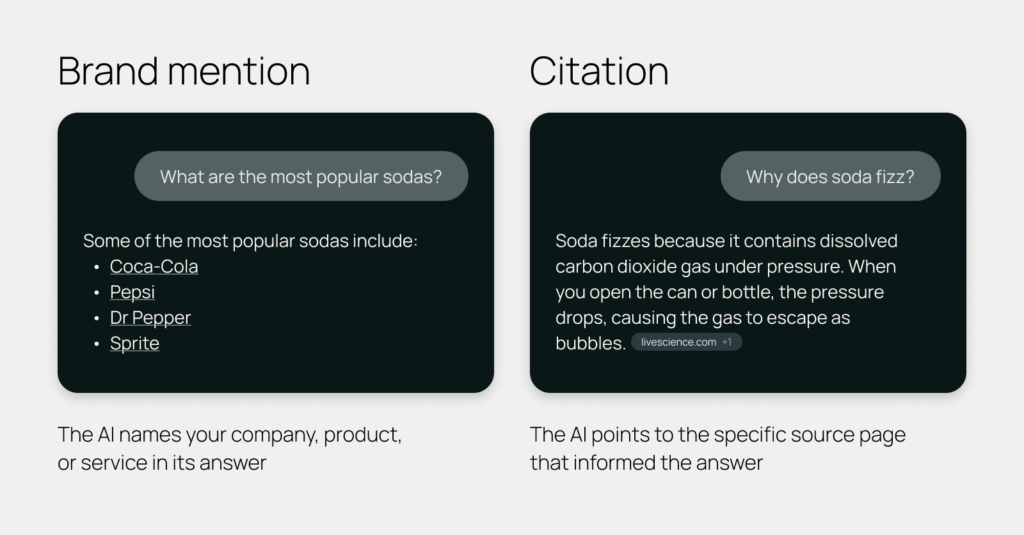
Which one do you want? Trick question, obviously; you want them both.
A mention can be flattering and still impossible to measure well. An owned citation can be less glamorous, but far more useful because it gives you something concrete to inspect. It's your page, and your site's analytics that can be measured and analyzed. Which page got referenced? How often? Did it receive traffic? Did users do anything useful after landing there? This is first-party data on the impact of AI search — which is more valuable than any AI search tracking tool, all of which are synthetic databases, or good guesses as to where and how you are showing up.
Or, think of it this way:
- Mentions tell you whether your brand is in the conversation
- Owned citations tell you where the conversation is getting its facts — from pages you control
- Cited URLs tell you which assets are pulling their weight
- Traffic and conversions tell you whether visibility is making a difference
Google's documentation around AI features focuses heavily on how content becomes eligible for inclusion and how traffic from AI experiences is counted inside Search Console reporting. That suggests that source-level analysis should be part of the process.
Why Tracking AI Brand Mentions Matters
OK. Let’s move beyond the academic: AI mentions, AI citations, cited URLs… does it all matter?
Yes. Unequivocally yes. Here’s why:
AI Search Is Changing Brand Discovery
People are asking longer questions, more specific questions, and plenty of follow-up questions. Google has explicitly said AI search experiences are pushing usage in that direction, with users exploring more complex queries and broader source sets.
That means discovery is no longer confined to obvious high-volume keywords. Someone may find your brand while asking for the best agencies for AI SEO, the top platforms for generative engine optimization, tools similar to your product but better for mid-market teams with limited technical support and a weirdly aggressive CFO, etc., etc., etc...
The path from question to brand discovery is less clean and a lot less predictable. Measurement has to adjust to account for it.
AI Platforms Influence Buying Decisions
AI assistants were built to assist, and that goes beyond just summarizing informational content. They can compare vendors, recommend providers, shortlist software, explain product categories, and shape buyer impressions before a click ever happens. As such, when a platform includes your brand in a recommendation set, you’ve already entered the buyer’s consideration stage — whether or not they ever visited your site.
And that’s great! It can also be unsettling.
If you’re going to let an opaque machine send potential customers to your virtual door, you’d better be paying close attention to how often it’s doing so, and on what terms. Otherwise, you’re letting the robot make your brand positioning decisions for you.
AI Mentions Can Drive Authority
When your brand appears in AI-generated answers, it can function as a form of borrowed trust. Users are beginning to treat AI responses as synthesized expertise. But those answers are only as good as the sources underneath them.
The same qualities that make content useful for humans make it easier for AI to cite — one tactic leans into that more than any other. This short video breaks down the SEO move that Mike Witham and Blake Nielson from 97th Floor keep coming back to.
You should not confuse that with permanent authority. AI can be fickle, inconsistent, and occasionally wrong (and when it gets something wrong, it does so with supreme self confidence). Still, repeated inclusion shapes perception, and perception has a funny way of becoming influence.
AI Visibility Is a New SEO Metric
If you’ve been in marketing for more than a few weeks, you’re probably already familiar with a tidy set of traditional metrics. You could follow rankings, traffic, click-through rates, and conversions, then build your strategy from there.
AI search adds some new layers to that picture by introducing answer inclusion, source citations, prompt visibility, and recommendation presence — all of which are signals worth tracking. That’s part of what makes AI search engine optimization a meaningful extension of the modern search strategy.
Where Brand Mentions Appear in AI Search
Brand visibility can show up in several kinds of AI-driven experiences. So, if you want to know where and how your brand is surfacing, you need to understand the environments in which those mentions appear:
- AI Overviews in Google Search
Google’s AI Overviews summarize information directly in the search results and link out to supporting sources. Google says AI traffic is counted within Search Console’s regular reporting rather than broken out into its own little silo, which means you need to interpret visibility through a combination of page, query, and performance analysis. - Conversational AI Platforms
ChatGPT, Perplexity, Gemini, Copilot, and similar tools can mention brands during conversational research. A user might ask for recommendations, comparisons, pricing context, or a shortlist of providers. Your brand can appear in that response, disappear from the next one, then come back wearing different clothes two days later. - AI Recommendation Engines
Some AI experiences behave like advisors, recommending products, agencies, tools, or vendors directly. That makes recommendation prompts especially valuable for tracking. - AI Citation Links
Some platforms provide source links alongside answers. Those citations are gold for analysis because they reveal which websites and pages are shaping the response.
Native Data Sources for Tracking AI Visibility
Before you run off to buy seventeen subscriptions, start with the native data from the platforms (Google Search Console, GA4, Bing Webmaster Tools, etc.) themselves. That’s usually the best place to get a baseline view of how your site is appearing and performing.
Google Search Console
Again, Google’s official guidance states that AI feature traffic, including AI Overviews and AI Mode, is included in Search Console’s Performance reporting for web search. It is not a perfect dedicated AI visibility dashboard, but it is still one of the best sources for understanding how your pages perform across Google search experiences.
Look at:
- Queries
- Landing pages
- Clicks
- Impressions
- Trends over time
- Branded and non-branded patterns
Google Analytics 4
GA4 helps you connect visibility to behavior. Once users arrive on cited or AI-visible pages, what do they do? Do they engage? Bounce? Convert? Wander around aimlessly?
Even better, Google has added "AI Search" as a primary channel in GA4's default channel grouping. That means sessions arriving from AI search experiences can now be broken out and analyzed alongside your other acquisition channels — no custom regex gymnastics required.
Without that layer, you are measuring attention without taking outcome into account.
Bing Webmaster Tools
Bing’s AI Performance reporting adds a very useful angle. Microsoft says the report shows how your site’s content is used in AI-generated answers across Copilot and partner experiences, including cited pages and changes over time. This makes it one of the clearest native examples of AI citation tracking from a platform owner. Yeah, from Bing.
Key Metrics for Measuring AI Search Visibility
If you only track how often your brand name appears, you will end up with a very incomplete picture. AI visibility is bigger than that. Your measurement approach needs to be bigger as well.
So, in addition to the tried-and-true standards, what should you also be tracking?
- Frequency of brand mentions
Start by looking at how often your brand appears across your target prompt set. This gives you a baseline sense of visibility, but it should be treated as the beginning of the story (rather than the full story). - Citation sources
Pay attention to which websites and pages AI systems cite when your brand, product category, or services come up. This can help you see not only whether you are being referenced, but also where AI platforms appear to be getting their information. Google Search Console's new Generative Search performance report is a good place to start here — it breaks out how your pages are surfacing in Google's generative search experiences, giving you platform-owner data on citations rather than third-party estimates. - AI answer positioning
Not all mentions carry the same weight. A brand that shows up early in an answer or is framed as a top recommendation is in a very different position than one that appears halfway down a list or as an afterthought. - Share of voice in AI search
Compare how often your brand appears against direct competitors, for specific topics or sets of prompts. This helps you understand whether you are leading the conversation, keeping pace, or getting elbowed out of the picture. - Most frequently cited pages
Look for the pages on your site that show up in citations over and over again. Those pages are already proving their value to AI systems, which makes them strong candidates for further improvement and optimization. - Branded vs. non-branded prompt visibility
It is good to appear when someone searches for your brand by name, but that’s the easy part. The more revealing signal is whether your brand shows up in broader discovery prompts where users are still comparing options or trying to decide whom to trust.
Engagement and Conversion Metrics
Visibility without outcome is like getting dressed up to sit on the couch — you might look good, but you’re still not going anywhere. Tie cited or visible pages back to business performance by tracking sessions, engagement, leads, or conversions wherever possible. That kind of connection is what keeps AI visibility from turning into a vanity metric, and is increasingly central to evolving SEO strategies.
A practical tracking list might look like this:
- Mention rate
- Citation rate
- Owned-domain citation rate
- Competitor share of voice
- Top cited landing pages
- Sessions to cited pages
- Engaged sessions
- Branded Traffic
- Direct Traffic
- Leads or conversions
Know What to Watch — Then Start Watching
The list of things worth tracking in AI search is longer than it used to be, but it's not unmanageable. Once you understand the difference between mentions and citations, know which environments your brand can surface in, and have a clear set of metrics tied to real business outcomes, you've built the foundation for a modern visibility strategy. Rankings still matter — they've just been joined by answer inclusion, citation sources, share of voice, and prompt visibility.
Of course, knowing what to track is only half the equation. The next step is actually doing it: building prompt libraries, running tests across platforms, monitoring citations, and optimizing the pages AI already trusts. (We cover all of that in our companion guide on how to track brand mentions and citations in AI search.)
And if you'd rather have a partner in your corner, 97th Floor can help you measure and improve your brand's presence in AI search. Contact us to see how we can help you strengthen your search visibility today… and as AI continues to revolutionize the landscape for years to come.