



Selling a home is a stressful and overwhelming experience, with more confusion, complexity, and choices than ever before. SOLD.com offers free services to home sellers, aiming to save time, reduce stress, and improve outcomes by delivering data-driven content and personalized recommendations.
The housing market faced significant challenges, in just 3 years, there was a 4.82% increase in interest rates and average house prices inflated by 31%. Additionally, Meta's revised advertising policies hindered SOLD.com's ability to target home buyers using phone numbers and zip codes. Faced with these hurdles, SOLD.com was compelled to adapt their strategy to sustain profitability in a decelerating market.
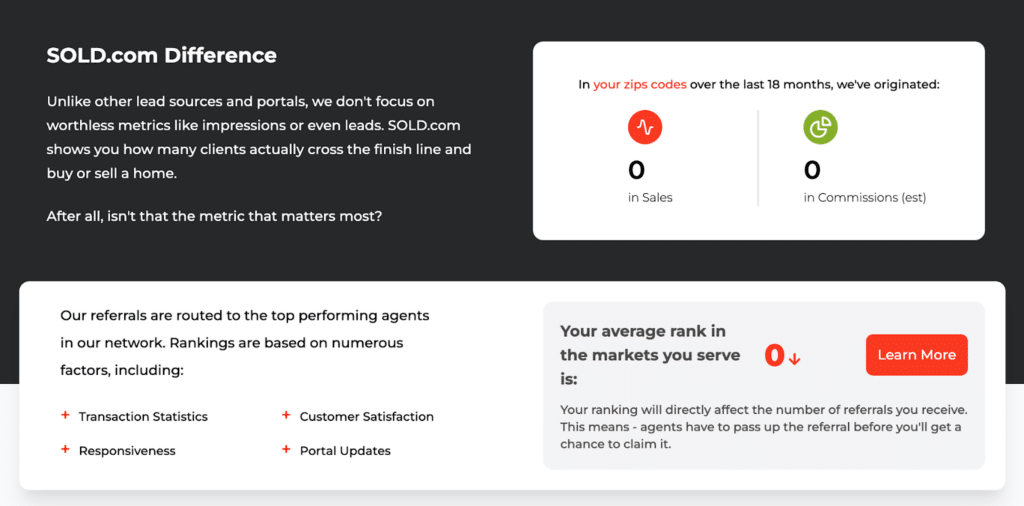
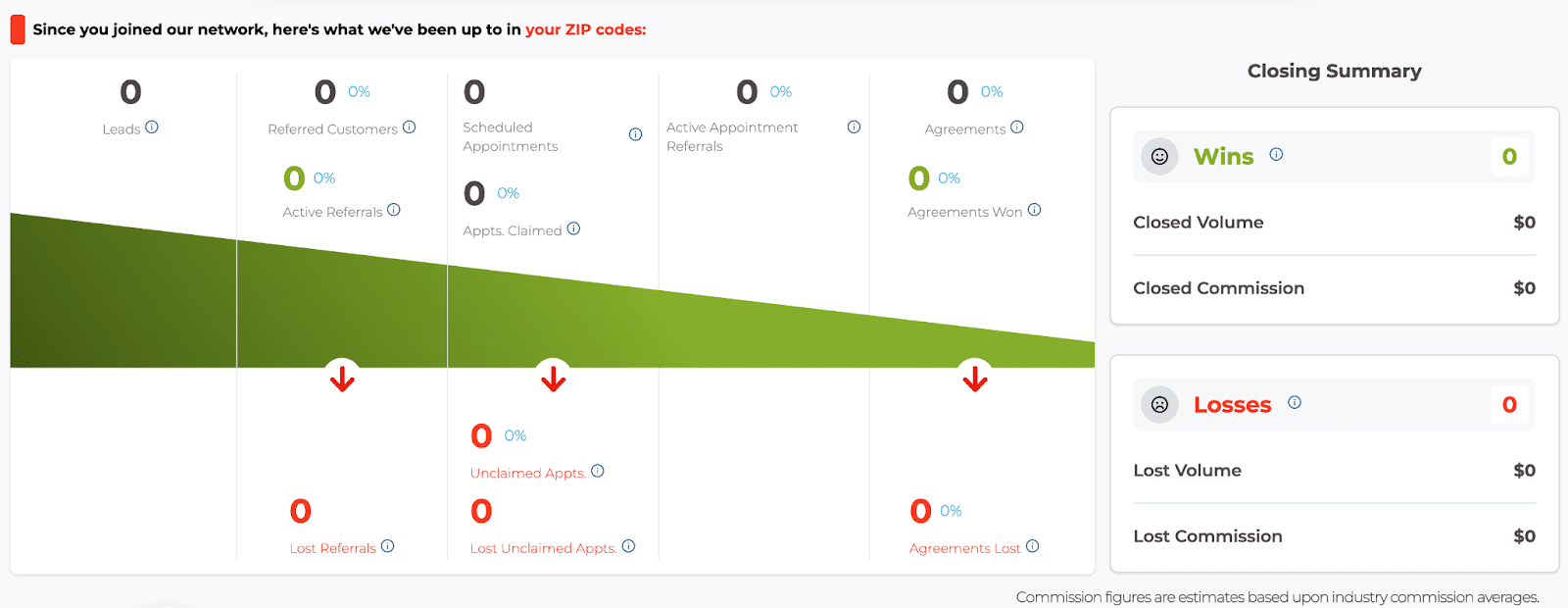
We refocused SOLD.com's strategy from buyers and sellers to real estate agents. By optimizing and gamifying their agent portal, we enhanced user engagement and experience. This approach showcased SOLD.com's lead generation effectiveness and incentivized agent participation.
Our targeted Facebook advertising, refined through A/B testing, efficiently attracted agents with clear, concise messaging.
This pivot successfully drove traffic to the newly enhanced agent portal.
Within the first two months of our new agent-focused campaign, SOLD.com's Facebook ads soared from a 40% ROI to 362%. The agent platform's conversion rate increased from 5.8% to 13.3%.
The campaign has remained profitable, helping SOLD.com thrive in a sluggish market. Its success led to the development of a new lender platform, even amid rising mortgage rates.
This blend of innovation and data-driven strategy has not only sustained the business in challenging times but also established a new benchmark for excellence.
Of course, it’s exciting to hire an agency; there’s a lot of hope and vision that goes into the process. However, sometimes there’s also the feeling of dread that comes with hiring an agency.
“What if they blow it, and what if I get blamed for it?”
You’re not alone. But you’d probably be surprised at just how much of your agency’s success or failure is actually in your court. We’ve made it easy for you to make your decision by putting everything you need to know about agency relationships here on one page. Use this collection of resources to guarantee results and a fruitful agency partnership.
Let’s take a quick step back and cover the bases. A marketing agency is a team of specialists who help businesses grow through strategy, creativity, and execution. Instead of handling every aspect of marketing in-house, companies partner with agencies to access a broader range of skills, including SEO, AI SEO, advertising, content creation, design, and more.
Working with marketing agencies gives you access to expertise, tools, and industry insights that may be difficult or costly to build internally. The right agency acts as an extension of your team, aligning with your goals, delivering measurable results, and helping you reach your audience more effectively.
The success of your future agency starts before you even hire them. When you have a concrete game plan in your research process, you will find the hiring and subsequent partnership going much more smoothly.
Set both parties up for success by making sure you have hit each item on this pre-vetting checklist.
Knowing the answers to each of these items will take time — and some of them may not be possible to complete in full — but careful thought about each item listed below is going to help your business earn greater results with your agency.
☑️ Benchmark relevant marketing numbers (traffic, CPA, closing rates, etc.)
☑️ Have a 12 month goal in mind for a handful of target KPIs.
☑️ Determine what sources of data are trusted sources, including web analytics, CRM data, and sales numbers.
☑️ Set, or seek out, a budget before talking to agencies; a range is appropriate.
☑️ Determine what success means for you in the next 12 months.
☑️ Determine exactly what an agency would need to accomplish for you to reach your 12 month success goal.
☑️ Act and speak for the final decision maker, not yourself (if you are not the final decision maker)
☑️ Do a post-mortem examination of your most recent agency relationship, including reading emails, regular reports, call agendas, and so on.
☑️ Additionally, read through the most recent agency SOW to determine what was actually asked at the onset of the relationship.
☑️ Create a scorecard of important factors for your organization to reference when hiring an agency (e.g. performance, reliability, cost, contract length, etc.)
A lot of folks may disagree about the idea of coming with a budget in mind. True, that number will inevitably change, but there’s little benefit in hiding that from a prospective agency. A few things to note about agencies setting budgets:
☑️ The right agency will press for the right budget
☑️ The right agency will give you the most value for your budget
☑️ The right agency will give more value when you offer more budget
And finally, don’t forget to come up with a list of questions for when you get to the sales process; we’ve got a great list on the next page.
When considering working with marketing agencies, you may find yourself talking with 3-6 agencies before making your hire. Good questions power good discussion and help you feel assured that you are making the right decision in the end. Know what you want, and relentlessly ask questions to learn more.
Use this list of questions during the sales process. These questions can and should be asked over the course of a few phone calls, not all out of the gate.
A little note on RFPs. These are one of the poorest means to understand whether an agency will be a good fit. If you are required to create an RFP, don’t neglect the questions above in your communication with the agencies you contact. Sending information back and forth exclusively through email is not a good way to do business.
More times than not, goal-based contracts are the way to go. However, there are certain situations where one prevails against the other.
Use this chart to determine which is right for your current situation.

There are some businesses out there that will be perpetually deliverable-based. These are usually enterprises with strict procurement processes. Even in situations like this, when working with an agency long-term, make an effort to set an underlying goal as the priority behind deliverables. This will inevitably increase the quality of work produced by your agency.
It’s appropriate to begin an agency engagement with deliverable-based contracts with the intent to turn it into a goal-based partnership. This transition usually takes 3-6 months.
Have you worked with multiple agencies and found yourself constantly underwhelmed and flustered with results? Trust, or lack of trust, may be the culprit. And believe it or not, trust is a two-way street with your agency. Take this quiz and find out if you’re giving your agency enough trust to have a healthy partnership. Download this list as a PDF

When you communicate effectively with your marketing agency, you can expect better results. And those positive results will inevitably power better communication. It’s a symbiotic system that perpetually feeds itself indefinitely.

Read up on what can help you enter or stay in this cycle with your agency, and what will kick you out of the cycle.
At first glance, comparing value is pretty easy. For example, take burgers. If one restaurant is offering a $13.00 burger and another has one for $7.00, then it doesn’t take an economist to see which is the better option.
But there's usually more to it than just price. Maybe the $13.00 burger comes with a drink and your choice of sides. Maybe it’s made from higher-quality beef. Maybe it’s assembled by a skilled chef, who puts their own unique artisan touch into every bite… and maybe the $7.00 burger fell on the floor.
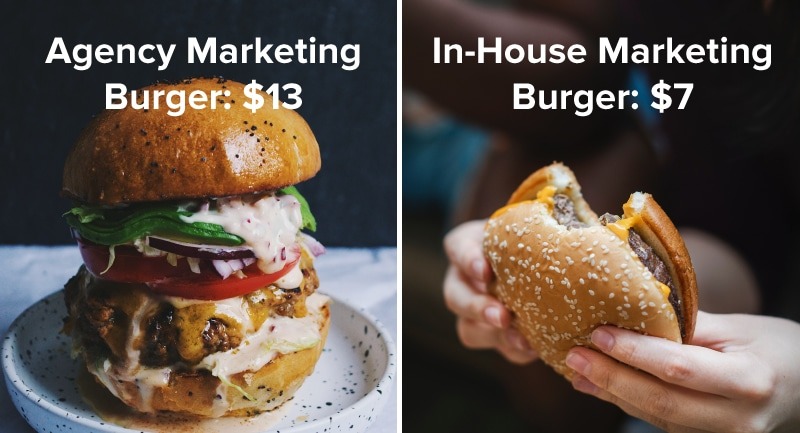
The point here is that there’s more to value than just the initial price tag. When figuring out a marketing strategy, a business usually has two options: building its own in-house marketing department or hiring an agency. And often the deciding factor is cost — which option will save the company more money right now? But like burgers, marketing options are made up of a lot of factors, and when it comes to value, initial cost is only the tip of the bun.
So, before you put in your order, let’s do a quick breakdown/comparison of the actual costs, and shine a heat lamp on the other ingredients that an effective marketing agency brings to the table.
Let’s be clear on one point before we dive into things: There are some advantages to keeping your marketing in-house. Your team probably won’t have to deal with as much of a learning curve regarding your products, services, and brand, and they’ll be able to focus all of their energies on marketing for a single client (i.e., you). What we’re trying to say is that the comparison to the less-than-appetizing $7.00 burger isn’t totally accurate.
However, at the same time, cost isn’t quite as clear-cut either. Sure, the hourly rates associated with marketing are generally lower when you keep everything in the family, but hourly rates don’t tell the whole story.
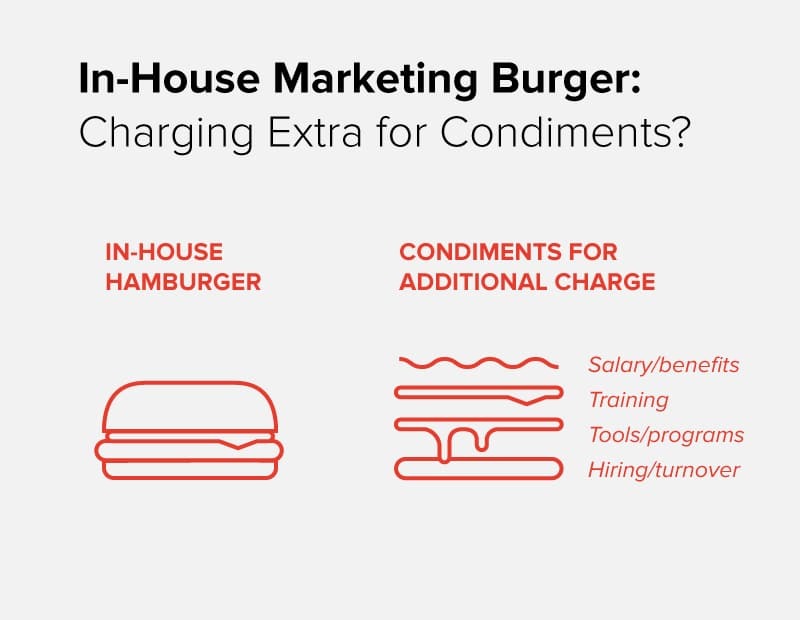
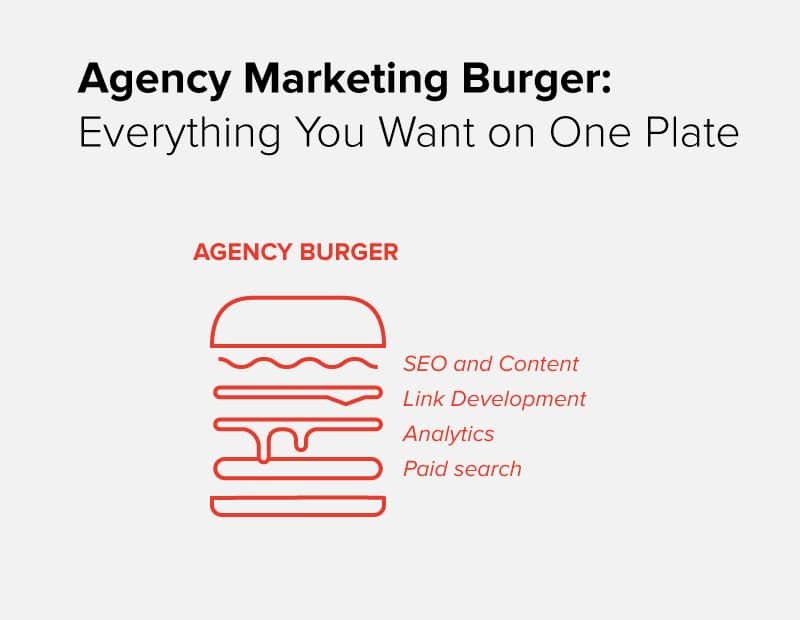
For every employee on your marketing team, you’ve got an entire host of associated costs. Salary and benefits are two obvious ones, but what about training expenses? What about expensive tools and analytics programs? What about the hiring costs, particularly when you’re trying to assemble a talented team from scratch? Don’t forget that “marketing” is an umbrella term that includes specializations in SEO, content and copywriting, analytics, design, link development, strategy, paid search and paid social ads; just finding the right people is going to cost you time and money, and keeping them up to date on best practices is going to cost you even more of both.
And once you’ve got your team assembled, there’s always the threat of turnover. Hey, just because you brought them on and trained them up, it doesn’t necessarily mean that they won’t leave and take their new skill sets with them. That means the possibility of recurring costs, and no clear idea of how much you’ll need to invest until the money is already leaving your pockets.
So maybe an in-house marketing department isn’t a floor burger, but it is a burger that costs an undefined heck of a lot to make, may end up costing you an undefined heck of a lot more as you go, and that still might not satisfy your marketing hunger.
So, how does that compare to the cost of hiring an agency?
Big companies looking for aggressive growth are usually allocating $25 – $40k/mo in digital marketing spend with agencies, while small and medium-sized businesses are investing between $5 – $15k/mo into digital marketing. That probably sounds like a lot, but what’s worth recognizing is that it’s all-inclusive.
With the right marketing agency, everything is so much more concrete, and that goes double for cost. The hourly rates are probably higher than what you’d be spending with an in-house marketing department, but the hidden costs are nonexistent. It’s a burger with everything on it, and you’re not going to get billed extra for your pickles somewhere down the line. Not to mention the sides, not just French fries—we have the premium sides, all-inclusive.
When working with marketing agencies, you don’t have to worry about hiring specialists or assembling a team, because the agency takes care of all of that on its end. The same goes for training and tools. All you have to do is pick from a menu of services, and you’ll always know exactly how much those services are going to impact your budget. And if contract-renewal time rolls around and you want to switch things up, scaling to meet your changing needs is just as easy. With agency marketing, you only pay for what you want.
To top it all off, let’s not forget the real value that comes from experienced digital marketing. As the co-founder of SEOmoz, co-founder of Sparktoro, and all-around marketing and SEO thought leader, Rand Fishkin enjoys a uniquely informed perspective on marketing agency services, and this is what he has to say:
“I think a lot of web marketing agencies are undervaluing their work, or perhaps competition is getting more cutthroat. Back when SEOmoz was an agency (2005-2009), we were generally charging in that $10-$25K/month bucket, and were by no means the most expensive group on the market.
The best agencies enjoy a time-tested, intimate understanding of the marketing universe — what’s come before, what’s happening right now, and what’s around the corner — so that they can tailor a marketing strategy to fit your business and your industry. And, with multiple clients, agencies also have nearly limitless opportunities to test and evaluate new ideas, advancing their capabilities with every new contract. In short, you end up getting back more than you give out.”
Clear-cut costs, proven expertise, and ever-expanding skill sets — now that's a burger you can sink your teeth into.
Sometimes the less expensive option isn’t really the less expensive option. So, when you’re looking over the marketing menu and trying to decide which option is the best fit for your business (and your budget), consider all the costs. After all, you probably wouldn’t want to buy a burger without knowing exactly how much it’s going to set you back, and working with marketing agencies like 97th Floor, you’ll always be getting the best brand exposure for your buck.
Picking an agency can feel risky; you’ve got a lot riding on it. The wrong partner can waste your time, budget, and even hurt your career. You’ve been burned before, so the stakes feel high.
You know your business and where you want to go, but great marketing takes more than passion. It requires empathy, innovation, and a drive for profitability. That’s where 97th Floor comes in.
Digital. Marketing. Elevated. It’s more than just a cute slogan. Your goals shape everything we do. We work with you to build a tailored strategy, with clear KPIs and budgets that match your needs. Our culture is built around results, not hours, not busywork. Every team member is accountable for delivering outcomes that matter. We’re your partner, working alongside you with full transparency, keeping you in the loop every step of the way.
Proven Expertise
Our team is stacked with certified, continually trained marketers. We’ve been recognized by Fortune, Inc., and Moz, and we consistently rank as one of the best places to work — meaning we retain top talent for our clients.
Leaders in the Industry
We host our own Mastermind conference featuring top voices like Seth Godin, Gaurav Agarwal, and Ryan Holiday, share advanced marketing insights, and speak at events worldwide. We’re here to push the industry forward, not follow the pack.
Giving Back
We pledge 1% of revenue to charity, support local causes, and serve on industry boards. We believe in improving more than just the bottom line.
An Elevated Experience
We aim to deliver results and an elevated experience. We make working with us something you’ll remember for all the right reasons. With 97th Floor, your vision is our vision — and we have the expertise, passion, and track record to get you there. Learn more about what sets us apart here.
Yes, if you choose the right partner. A good agency brings specialized skills, proven strategies, and the tools needed to get results faster than building everything in-house. They also provide an outside perspective that can help you spot opportunities and fix blind spots in your marketing.
Expect a collaborative relationship built around clear goals and measurable results. The agency should learn your business inside and out, create a tailored strategy, execute it with their team of specialists, and keep you updated through transparent communication and reporting.
Some of the pros of working with marketing agencies include:
– Access to a full team of experts across multiple disciplines.
– Established processes, tools, and industry connections.
– Ability to scale efforts up or down quickly.
– Fresh ideas and an outside perspective on your brand.
Some of the pros of doing marketing in-house include:
– Full-time focus on your brand and products.
– Deeper institutional knowledge of your company.
– Direct control over priorities, messaging, and workflows. No middleman.
There’s no one right answer; it depends on your brand. A good place to start is with your goals and KPIs. Then, look at the agency’s track record in achieving similar results for other clients. Consider the cost and the value together. Think about expertise, time savings, scalability, and quality of execution. The right ROI comparison factors in both tangible outcomes (like revenue growth) and intangible benefits (like stronger brand positioning).
2020 is an unusual year. Nothing can be assumed, and shopping trends are no exception. We at 97th Floor commissioned a study that dove into all of the newest trends in Black Friday and holiday shopping. Our objective: to help marketers prepare for this unusual season. In this post we’ll look more closely at some of the most interesting data points specifically around email, and how they might affect your marketing strategy.
This year, shoppers are getting a head start on their holiday lists. 54% of shoppers say they want to do their holiday shopping by early November to avoid crowds, and 68% of shoppers say they’ll be moving online. As marketers, we need to meet our customers where they are. This year, that means online and early.
Because shoppers want to get their shopping done earlier, you should consider emailing them earlier too. Don’t be afraid to email more consistently during the holiday season; shoppers expect to see more emails this time of year, so it’s a great time to take advantage of that as an opportunity to push your brand’s value and story.

Ultimately, the end goal of any email track is to lead your contacts on a journey. You can use email to tell your story, and to explain your value. Use your email marketing this holiday season to build a story for your products. Like J. Peterman’s famous catalog illustrates (pun intended), the way that you present your products must be more than an explanation: it needs to be a story. Best case scenario, even your presentation will be a kind of art. Don’t underestimate the importance of this. Email is a great way to control the way your product is positioned and presented.

Email marketing is the way you’ll be able to take people with casual interest in your products and turn them into true fans. This holiday season, treat all your email contacts like they are at least mild fans of the product (a safe assumption as they did give you their email) and turn them into mega-fans of your brand.
Our stats say that 81% of shoppers aren’t sure they’d head to brick and mortar locations even if the retailers offered great in-store experiences for the holidays. In fact, 88% of parents even say they won’t let their kids sit on Santa’s lap this year. Yet we know that experience is everything. So this holiday season marketers need to turn their attention to the digital sphere.

Be sure that all of the content you put out this season, including your email, provides an enjoyable experience for the user. This includes your website and landing pages. Take a look at the ease of use on your site — can users easily navigate your site to find what they need?
Get inventive with the way you use email as a part of an experience. Create amazing digital experiences and use email to share the opportunities with your audiences. For example, share social media campaigns your audiences can interact with, like zoom calls with Santa, an interactive about how your business works, or whatever the digital experience is that fits best with your business goals. Consider building out a multi-part, text-based experience for your email marketing, something that your audience will look forward to engaging with on day 1, but also day 3, 5, and 9. A story (see below) is one option, but any content that can be broken up in a linear fashion can be turned into an email experience.
Email is an effective way to spread the word about--and create--the experiences you have going on this holiday season; be sure you make the most of it.
Consider which metrics are most important for you, and then track them diligently. For brands just starting on their email marketing, your open rate might be your top priority. More mature email marketers will probably want to make their top priority either CTR (click through rate) or CToR (click to open rate).
The important thing is that you don’t just launch your emails out into the world like fledgling birds where they will either fly or die. Pay attention to performance, experiment, and continually tweak things to see how it affects outcomes. As an agency, we spend a lot of time measuring performance -- it’s our lifeblood. If we aren’t producing results, we lose your trust and your business. For you, in your business, you can afford nothing less.
The age of impersonal email is long behind us. There are many simple, easy ways to make your email copy individualized for your audiences, and they are common enough that they have become expected best practices, not only from savvy marketers, but the everyday consumer. When getting ready for a large-volume push with many different email tracks, it can be easy to want to cut corners, talk generally, and forget what your audiences really want to see.
Use your list’s first names in the email greetings, and choose the email track you put your contacts in based on their specific interests and issues. This will be a busy season, so everyone is about to get busy inboxes. If you want your emails to stand out, get personal. Put in the extra effort, use the research and data you have on your contacts and put it to good use.
It’s easy to fall into the trap of personalization-for-personalization’s-sake. We don’t personalize just because we can, but because it works. However this comes with a risk, too. If you’re not careful, personalization can come across as smarmy, too familiar without cause. This can turn off customers and lose business. The solution is simple: use personalization as a way to show respect for your customers, to demonstrate that you are thinking of them not as a patsy or a mark, but as a valued individual. Use personalization not to manipulate your audience, but to humanize them. Do it because you truly do value and respect them. It’ll show -- and it will help your bottom line.
If you’re not doing email marketing today, now is a great time to get started. Don’t wait until you have every single piece nailed down, even a moderate effort can be valuable. If you are doing email marketing already, now’s the time to ramp up your efforts and improve your process. Get personal, pay attention to your metrics, make it an experience, and build a story. Yes, it’s hard work, but it’s worth it (and we can help!).
May your holidays be bright with email marketing success.
Many retailers use the holidays to end their fiscal year with a bang. This year, many marketers, especially retailers, are putting their hopes in the 2020 holiday season to capture revenue at the tail-end of what has been a hard year. 97th Floor’s latest study dove into all of the newest trends in Black Friday and holiday shopping to help marketers prepare, and in this post we’ll dive deeper into how these insights might affect your ad strategy this season.
COVID-19 has shifted every business’s strategy and planning in 2020. As cases continue to rise, holiday shopping trends are no exception. This season, 68% of shoppers say they plan to do most of their shopping online due to COVID, and 52% of shoppers say they expect they’ll never shop in person for the holidays ever again.

Things are changing, and marketers need to keep up. Especially this holiday season, it will be imperative that marketers make the most of the newest consumer trends. The changing market will likely mean many advertisers will be prioritizing ads for their holiday campaigns, so marketers need to look at what that will mean as far as higher costs in the ad platforms, etc. and need to be ready to traverse the new waters with skill.
Here are a few tips to make the most of your ads this 2020 season based on our recent data.
For two months in a row, Facebook’s CPMs have risen by 10% — reaching a record high for 2020. Higher costs might mean that your strategy needs to pivot. Be sure to place pixels from other platforms on your site so that you can hold onto your followers in case you decide to pivot to other ad platforms that may be less expensive.
With virtually every retailer trying to make up for lost ground earlier in the year, you can bet you’ll see more competitive bids, decreasing your ROAS. Facebook will likely become an incredibly competitive market, with costs continuing to rise. This season, be prepared to switch platforms and pivot to make the most of your budget.
This holiday season, your ad copy and creative needs to stand out, but you already knew that. What you might not know is that only 20% of shoppers say they're definitely in “a shopping mood” this holiday season. Advertisers need exceptional copy and creative to earn clicks and conversions from their audience this year.
Even stores that are used to pushing in-person sales will be moving online, and users will be inundated with ads. Advertisers need to be leaning into their established personas to create copy and creative that speaks to your audience. Even if you have high performing ads, they will likely need a refresh with a holiday angle to ensure they are speaking to your persona during the holiday season.

Savvy advertisers will have already built a deep retargeting pool months ago that they can lean into heavily during the holiday season. So while it might be too late to build a retargeting pool for this season’s retargeting efforts, the holidays could be a perfect time to build that pool for future efforts.
If you can gain a solid retargeting pool, it will give you the leg up in your future endeavors (like starting 2021 off with lower CPCs). Retargeted audiences are some of the most likely to convert, and that’s what ultimately matters over any kind of wide reach or visibility. Figure out ways to get qualified traffic to your site en mass, even if it’s not on a product page, and then use pixels to add them to your remarketing pool. And who knows, focusing on building that pool might just bring you conversions this season too.

This holiday season will be different than anything we’ve experienced before. Advertisers should prep their leadership with accurate numbers, as 73% of shoppers plan to spend either as much or less than they did last season.
Monitor your channels closely and be ready to pivot as needed. Don’t lose track of your CPM or CPC prices, and be strategic with your budget as costs rise. Stay hyper aware, or you’ll find yourself paying a lot more per ad. And look to the future (yes, there’s hope beyond the holiday season)! Build your remarketing pool, and prepare for an audience base that has the potential to stay largely online, even once the COVID crisis ends.
COVID-19 cancelled a lot of plans in 2020. Teachers. Doctors. CEOs. Politicians. Parents. Children. Travelers. They’ve all had to adapt to The New Normal. With Black Friday approaching, we’ll add retailers to that list.
Most retailers rely on Black Friday doorbusters to make their year profitable, and this year Black Friday is even more important to many retailers as they’ve suffered with shutdowns, lockdowns, and letdowns.
97th Floor has helped hundreds of brands find success during their holiday marketing push, but we’ve never done it in a year as unique as 2020. We wanted to know how shoppers would react to these changing times, so we commissioned an independent research study of 1,000 US shoppers to understand their hopes, fears, and behaviors when it comes to crowded malls, bustling stores, and online shopping this holiday season.
We’ve put together some of the most interesting insights in this article, but all the data can be seen in the PDF download attached to this article.


It’s true that this has been a difficult year for business. However, there are steps that you can take to safeguard your own sales as the holiday season approaches. Our advice? Focus your efforts online. 97th Floor will be releasing a small series of in-depth articles covering these topics deeper.
Sign up for our monthly newsletter to make sure you don’t miss one.
Some SEO tactics take months to see results, but the holiday shopping season is already upon us. So, this year we’d recommend finding that sweet spot between SEO that works for ecommerce sites and the SEO practices that yield results quickly. A few “quick wins” you should look at to increase the readability and user-friendliness of your site are product schema markup, proper rel=canonical for duplicate product pages (for holiday special prices for example), appropriate redirects, claim unlinked brand mentions, strategic internal links, and title tag adjustments.
Many brands can expect an influx of traffic during the next two months, so this could be a good time to roll out some testing in order to capture revenue from as much of that traffic as possible. Small changes can make a big difference on your site — one of our clients saw a 29% increase in revenue in just 18 days, without any increase in traffic at all. Imagine the possibilities as traffic does increase this holiday season. Our advice? Get started testing as quickly as you can. That way, when traffic really starts to peak, you know you’re getting that traffic to the most optimized versions of your pages.
It’s difficult to predict what will happen with ad auctions and CPCs during the holidays, but it’s certain prices will go up. Perhaps more this year than any other year since so many brands are hoping to make up for poor performance in previous quarters. Work to get more traffic right now, so that you can form remarketing campaigns later, which will be cheaper and more effective than cold ads. This might mean getting ads out the door earlier than you may have planned. Additionally, get all of the pixels you can active on your site. Even if you are only running Facebook Ads right now, still include pixels for Pinterest, LinkedIn, and Google if appropriate. Doing this will allow you to quickly pilot to new platforms if rising prices caused by holiday influxes on your platform of choice push you out. This will help you keep a steady ROAS.
Keep in mind that people are more likely to try a new product or business during the holidays, so if gaining new customers is a focus for your business, this is your time to shine. Monitor all of your channels closely, as well as CPM and CPC. Become hyper-aware so that you don’t end up paying more than you’d like per ad. Also, build your remarketing pool earlier and be ready to pivot.
Email is a channel that deserves more attention this holiday season. Work on more specific segmentation, increase your email frequency. A greater volume of emails is much more acceptable by most users this time of year, so it’s a great time to show them all the value you can), and be sure to keep it personal. There are little things you can do to add personalization to your emails, such as personalization in both copy and context, that make a big difference to those on the receiving end. Email your contacts based on their interactions with you, as well as the information you already know about them. When the situation is more specific, your emails are more likely to be effective.
There is no doubt that this holiday season will look different than any that has preceded it. Yet, even in 2020, there is still room for success when you plan strategically. Strive to work with the times rather than against them. The data collected in this study can be used to help tell a more accurate story this holiday season. And, taking to heart these suggestions, you can be armed to take this challenge head on — and hopefully see incredible results in the process. We’re going to be dropping more specific articles on our blog throughout this season, so be sure to follow us on social media and subscribe to our newsletter so you don’t miss a thing!
Many ecommerce businesses begin with a D2C model, selling quality products on their own site while dreaming of the days they’ll hit it big by getting serious traction in a major brick and mortar.
It’s a big step and an exciting achievement, but it also carries risk. As you push your product through bigger stores, you give up control over your brand and your ability to connect directly with your customers. It’s often a matter of trading control for (hopefully) greater volume.
This was Zhou — a nutrition brand thrilled to fulfill their longtime goal of seeing their product in 433 Target stores across the US, but worried about the new lack of control. They wanted to retain a hand in their own success, and see that their entrance to Target was a success in terms of actual foot traffic and revenue.

Zhou presented 97th Floor with a fixed budget for advertising in 433 specific locales. The task was one Zhou had never attempted before — drive foot traffic and sales with Facebook Ads to physical Target locations through geo-targeting, in addition to Target’s online landing page. Driving and tracking success via Facebook Ads to your own landing page is easy to track and control, but driving foot traffic to a secondary store is another story.
Ultimately, the strategy and results were so positive that after two weeks, Zhou found extra budget to push towards these ads.
It’s quite a triumph when longtime D2Cs enter big-time stores like Target. But success isn’t guaranteed. The D2C still has to do the work of getting their brand recognized in stores, and pushing foot traffic into those stores to actually buy the product.
In order to start off with a bang and keep the momentum going long term, Zhou allocated some budget to getting products moving in the locales they were entering. Pushing that traffic, especially in those first few weeks, would prove critical in making their transition into Target stores a success.

Zhou came to us with a moderate budget, but when split over 433 different markets even a sizable budget goes pretty fast. We began with a total budget of $30,000, which meant each store got only $4.62 in daily ad spend. This meant we had to be pretty picky and intentional about where we put our money. The tactics we used had to be effective and incredibly targeted. We also ran this project for just two weeks, so time was of the essence. After those first two weeks and initial $30,000, Zhou was so impressed with the results that they decided to push an extra $10,000 toward another five days of campaigning.
We decided that higher click through rates and lower cost per clicks would be the best markers for our success in this particular campaign. In addition to revenue information gathered from Target. This was because we weren’t trying to drive sales directly, but rather foot traffic to brick and mortar Target locations as well as their online landing pages.
The two products that Zhou placed in Targets were Collagen Peptides and Hairfluence supplements. The primary target for these products were women, so we catered our copy and ad images towards that demographic.

We built out a strategy with ads for 160 different geo-targeted markets, including up to 27 stores within each market. The Target logo was prominent in the ad visuals, highlighting that the product was now available at Target. That math adds up to thousands of different geo-targeted ads, each directed at their specific markets. And, to complicate things even further, we wanted all of them to go up within Zhou’s first few weeks inside Target.
With that great volume of ads to set up in such a short period of time, we knew we had to be careful how we approached their launch. If we put them all up at once there was a high likelihood that the Zhou account would be disabled. Which would throw a real wrench into the already time-sensitive campaign. So, we played it safe and uploaded them in batches, day by day.

This turned out to be a strategic advantage, because after the first week, we located the underperformers and pulled them, reallocating their budget to the highest performing ads and locales. This helped us make the very most of the budget, and see quicker and more substantial results from our efforts. It’s always a good feeling to put your money where the data is.
We also created a live dashboard with Google Data Studio so we could see the performance of our ad variants across all locations in real-time. We shared this with the executives at Zhou and their parent company (Nutraceutical) who then shared it with Target. Target was able to provide us with in-store conversion data, allowing us to truly see the impact of our efforts on the bottom line. At this point, Zhou, thrilled about the increasing conversion rates, sent that extra $10,0000 to continue the campaign.

Together, Zhou and 97th Floor truly revolutionized the process of entering brick and mortar stores as a D2C. Zhou kept control of their brand, and pushed customers toward their new Target locations. No longer do D2Cs just have to sit back and hope that greater volume will mean greater results. Instead, they can still have a hand in their own success.
And, it wasn’t just Zhou that profited. This strategy was a win-win for both Zhou and Target — Target gets customers in their doors, and Zhou gets revenue and product recognition. This ad strategy and real-time dashboard were so successful together that Zhou now uses this framework as a playbook when guiding new product lines to enter big retailers like Walmart, Sam’s Club, Costco, and more.
Ultimately, Zhou saw a 27.46% increase in in-store purchases in just one week of this campaign. Proving to themselves, and other curious D2Cs, that profitable partnerships with big-names like Target are not only possible, but probable, with the right ad strategies.

Often digital and brick and mortar marketing are seen as opposites rather than partners, but Zhou proved that it doesn’t have to be that way. Online shopping might be the new frontier, but there will always be a place for the convenience and experience of local brick and mortars. Zhou and 97th Floor’s partnership led to great results, revolutionary processes, and a successful start to Zhou’s product pushing in Target.
Zhou kept control, but was able to take advantage of Target’s wide reach. Now, Zhou is looking for even more products that they can push through this process and get inside of brick and mortar stores.
Google wants to help people find the most accurate and relevant information possible, and with all the changes surrounding COVID-19 this is more true than ever. At 97th Floor, we want to ensure that SEO strategies are adjusting to the recent industry changes as well. Here’s a breakdown of some Google My Business tips, along with some suggestions for SEO strategy you can incorporate into your current digital marketing plan.
In Google My Business accounts, you will now see a new option to mark your business temporarily closed. Many businesses have been closed because of this pandemic sweeping the world, and many people are unsure of what is still operating at this time. This button is an easy way for businesses to communicate with Google (and by extension, their customers) about the current status of the operation.
The types of businesses that could benefit from this would be restaurants, event venues, theaters, or any other business that have to close its doors due to social distancing. If your business has temporarily adjusted hours and non-persistent closures, you can also use the Special Hours feature to keep your customers up to date.

Google just released the following statement regarding functionality limitations for Google My Business:
During the unprecedented COVID-19 situation, we are taking steps to protect the health of our team members and reduce the need for people to come into our offices. As a result, there may be some temporary limitations and delays in support as we prioritize critical services.
Our current focus is on the quality and reliability of information on Google Search and Maps. We want to ensure users and business owners have access to essential features like whether the business is open or has special hours. Learn about best practices for affected businesses, and what you can do to keep your customers informed.
Below is a summary of the limitations as well as what they mean for your brand:
It looks like Google is hoping to get things back to normal as soon as possible, but for now this will be the new normal.
Conferences, events, and other professional gatherings have also seen significant impacts because of COVID-19. As we try to flatten the curve, many events have changed plans to protect attendees from being infected. A new schema update allows publishers to share the status of their event with their users, without having to remove it from the event experience. Using the schema.org eventStatus property will allow you to mark events as canceled, postponed, rescheduled, or moved online. Likely those same businesses who are having to temporarily close their doors or adjust their hours should also look into using this markup for their events, where it applies. This is all outlined in greater detail on Google’s webmaster blog.
If your team can afford to invest in SEO, I’d recommend you still keep your foot on the gas pedal where possible. This is largely due to the fact that once this virus has been contained and the pandemic is over, the market/demand will return. Once that happens, you want to be sure your business is ready to take part (from an SEO perspective).
For example, if you are a niche ecommerce brand and sales are currently down, you’ll first want to take care of your people and customers. Once you’ve done that, you can pivot your organic strategy to focus more on building your brand’s topic dominance via new content. This content should address topics relevant not only to your brand, but also to the way your customers are being impacted by the pandemic. While all these pieces are gaining traction and organic strength, you can utilize internal linking. Linking from these posts to other focus pages on your site will ensure the organic momentum you’re building is being passed on to those key pages essential to your customer journey.
As an agency, we completely understand that running and maintaining an SEO campaign can be costly. And if your business has been negatively impacted by this pandemic, here are some free tools I’d recommend in order to help lessen the financial burden of continuing your SEO efforts:
Running an SEO strategy during a pandemic is challenging to say the least. We acknowledge all SEO practitioners out there who are rolling up their sleeves and getting to work even with the recent changes in the market. It’s safe to say that no one has gone through this situation before — we’re all pandemic SEO noobs. But as we all come together and make sharing information a priority, we’ll be able create a better search experience for users and our clients.
Talking about design, and giving feedback can be difficult. Sometimes it feels as though there’s a whole language you don’t know how to speak. And when you can’t find the words, it’s a challenge to get anything done the way you envisioned it in the first place. Here are a few pointers to help you communicate better with your designer so you can both end up in a place you’re proud of.
There’s nothing more frustrating for graphic designers than finishing a project and being notified of an issue that could have been addressed (and fixed) in the early stages. If you have concerns or feedback about something, voice them early and as they arise. Waiting until the end of a project to address the issue only makes things worse. Most often, it creates a domino effect of other changes that now must be made.
Don’t be afraid to give a free and honest critique. Graphic designers expect opinions, and yours are valid. Everything should be up for discussion. Remember, you know your brand/company/product the best. Your designer needs your voice on that front. While some feedback may seem obvious to you, it may not be obvious to your designer. Be sure to share your concerns. If you don’t tell your designer you think something needs to be revised, they won’t know there’s an issue. And when words are hard to find, gather examples. Show your designer what you like and/or what you don’t like. This will help carve a more guided path for the designer to take.

When it comes to graphic design, there are 5 main principles your feedback should live under.
When you give feedback, be specific to one of those principles. Instead of saying, “Make it pop.” Say, “I’d like to see brighter colors.” The field of interpretation to “make it pop” opens up a sea of possible solutions. But by being specific, the graphic designer can then ask more clarifying questions. Do you like the current color combination? Do you want brighter hues of what we have, or new colors? This will help pinpoint the root of the issue.
Poor: “Make it pop.”
Good: “I’d like to see brighter colors.”
Best: “I’d like to see brighter colors because it’ll show up more prominently. It also relates to our youthful audience.”
Telling your “why” helps the designer see from your perspective beyond your feelings or emotions (“I think” and “I feel” statements). Giving specific feedback is helpful, but explaining the “why” can really visualize your thought process. Opinions (“I think” and “I feel” statements) hold weight, but “why” statements can reveal more substantial underlying points worth talking about.
Design is subjective. While you may feel strongly one way about a design, your designer may feel the opposite way. State your case. This means you’re giving specific feedback and following your feedback with the “why” behind it. After you state your case, be sure to ask and listen for your designer’s reasoning. Design is full of decisions that you may not be aware of. Find out what the designer insists is necessary to the project, then compromise on what can be changed.
At first glance, comparing value is pretty easy. For example, if one restaurant is offering a $13.00 burger and another has one for $7.00, then it doesn’t take an economist to see which is the better option.
But there's usually more to it than just price. Maybe the $13.00 burger comes with a drink and your choice of sides. Maybe it’s made from higher quality beef. Maybe it’s assembled by a skilled chef, who puts their own unique artisan touch into every bite… and maybe the $7.00 burger fell on the floor.
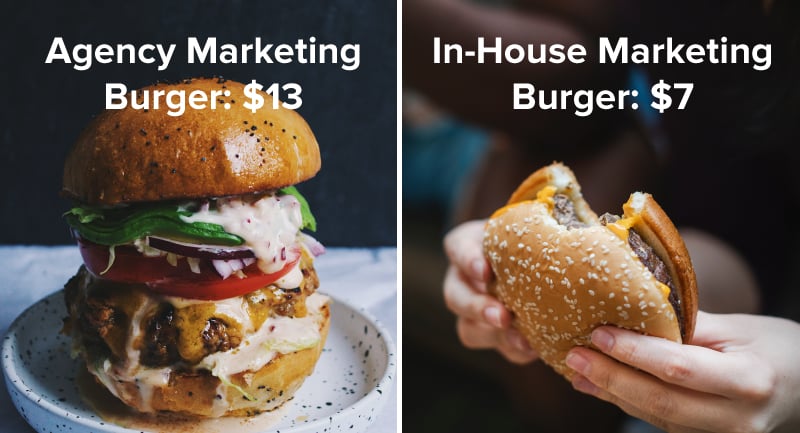
The point here is that there’s more to value than just the initial price tag.
When figuring out a marketing strategy, a business usually has two options: building their own in-house marketing department, or hiring an agency. And often the deciding factor is cost — which option will save the company more money right now? But like burgers, marketing options are made up of a lot of factors, and when it comes to value, initial cost is only the tip of the bun.
So, before you put in your order, let’s do a quick breakdown/comparison of the actual costs, and shine a heat lamp on the the other ingredients that an effective marketing agency brings to the table.
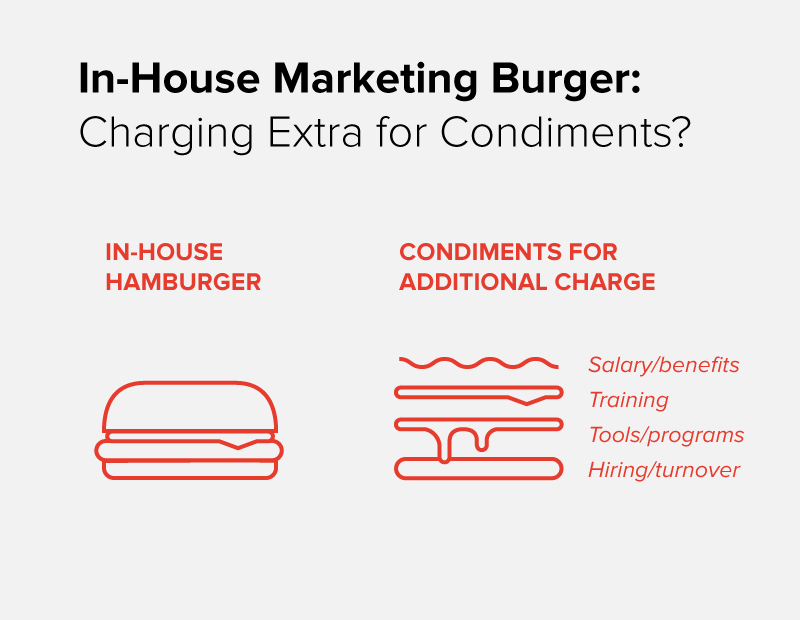
Let’s be clear on one point before we dive into things: There are some advantages to keeping your marketing in-house. Your team probably won’t have to deal with as much of a learning curve regarding your products, services, and brand, and they’ll be able to focus all of their energies on marketing for a single client (i.e. you). What we’re trying to say is that the comparison to the less-than-appetizing $7.00 burger isn’t totally accurate.
However, at the same time, cost isn’t quite as clear cut either. Sure, the hourly rates associated with marketing are generally lower when you keep everything in the family, but hourly rates don’t tell the whole story.
For every employee on your marketing team, you’ve got an entire host of associated costs. Salary and benefits are two obvious ones, but what about training expenses? What about expensive tools and analytics programs? What about the hiring costs, particularly when you’re trying to assemble a talented team from scratch? Don’t forget that “marketing” is an umbrella term that includes specializations in SEO, content and copywriting, analytics, design, link development, strategy, paid search and paid social ads; just finding the right people is going to cost you time and money, and keeping them up to date on best practices is going to cost you even more of both.
And once you’ve got your team assembled, there’s always the threat of turnover. Hey, just because you brought them on and trained them up, it doesn’t necessarily mean that they won’t leave and take their new skill sets with them. That means the possibility of recurring costs, and no clear idea of how much you’ll be needing to invest until the money is already leaving your pockets.
So maybe an in-house marketing department isn’t a floor burger, but it is a burger that costs an undefined heck of a lot to make, may end up costing you an undefined heck of a lot more as you go, and that still might not satisfy your marketing hunger.
So, how does that compare to the cost of hiring an agency?
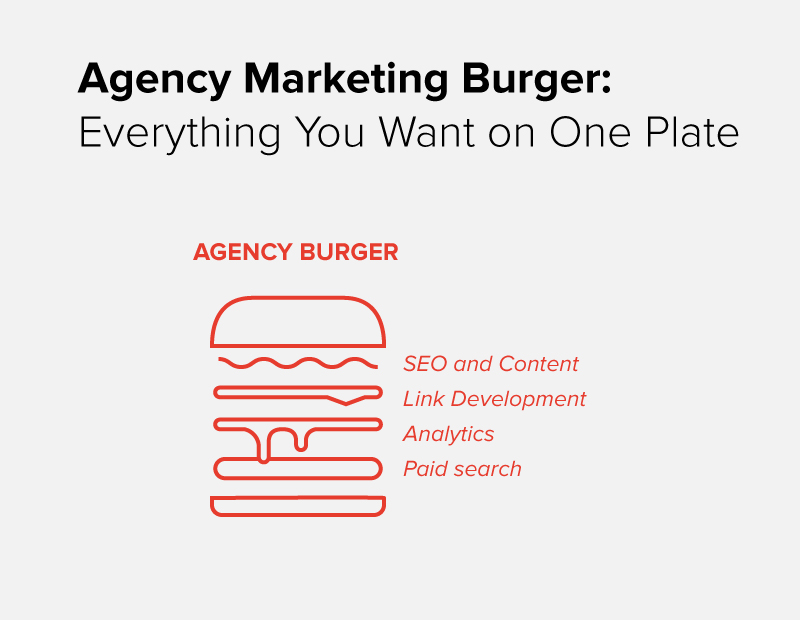
Big companies looking for aggressive growth are usually allocating $25 – $40k/mo in digital marketing spend with agencies, while small and medium sized businesses are investing between $5 – $15k/mo into digital marketing. That probably sounds like a lot, but what’s worth recognizing is that it’s all-inclusive.
With the right marketing agency, everything is so much more concrete, and that goes double for cost. The hourly rates are probably higher than what you’d be spending with an in-house marketing department, but the hidden costs are non existent. It’s a burger with everything on it, and you’re not going to get billed extra for your pickles somewhere down the line. No to mention the sides, not just french fries—we have the premium sides, all-inclusive.
You don’t have to worry about hiring specialists or assembling a team, because the agency takes care of all of that on their end. The same goes for training and tools. All you have to do is pick from a menu of services, and you’ll always know exactly how much those services are going to be impacting your budget. And if contract-renewal time rolls around and you want to switch things up, scaling to meet your changing needs is just as easy. With agency marketing, you only pay for what you want.
To top it all off, let’s not forget the real value that comes from experienced digital marketing. As the co-founder of SEOmoz, co-founder of Sparktoro, and all-around marketing and SEO thought leader, Rand Fishkin enjoys a uniquely informed perspective on marketing agency services, and this is what he has to say:
I think a lot of web marketing agencies are undervaluing their work, or perhaps competition is getting more cutthroat. Back when SEOmoz was an agency (2005-2009), we were generally charging in that $10-$25K/month bucket, and were by no means the most expensive group on the market.
The best agencies enjoy a time-tested, intimate understanding of the marketing universe — what’s come before, what’s happening right now, and what’s around the corner — so that they can tailor a marketing strategy to fit your business and your industry. And, with multiple clients, agencies also have nearly limitless opportunities to test and evaluate new ideas, advancing their capabilities with every new contract. In short, you end up getting back more than you give out.
Clear-cut costs, proven expertise, and ever-expanding skill sets — now that's a burger you can sink your teeth into.
Sometimes the less expensive option isn’t really the less expensive option. So, when you’re looking over the marketing menu and trying to decide which option is the best fit for your business (and your budget), consider all the costs. After all, you probably wouldn’t want to buy a burger without knowing exactly how much it’s going to set you back, and with a qualified marketing agency like 97th Floor, you’ll always be getting the best brand exposure for your buck.
Let us feed your business the results it craves; check out 97th Floor today, and see what we can cook up for you.
Here are 5 things to create a killer Facebook ad with expert and PPC Specialist Cinthia Packard.
Article and tips here.
Lead-generation is a core component of a B2B marketing strategy. However, many businesses struggle to improve lead quality and quantity. Specifically, a survey from ActOn found 37% of SMBs struggle to convert web visitors into leads. While a low conversion rate can be caused by driving the wrong traffic to the site or by pursuing the wrong marketing strategy or having a poorly optimized page, many businesses will benefit most by building a more robust lead-gen strategy first.
Small businesses frequently start their lead generation by creating a core offer to garner interest in their product. These end-of-funnel offers-- free trial, free quote, free consultation, contact us-- are essential components to a lead-gen strategy. However, for businesses with longer marketing and sales cycles, having only these types of offers is a missed opportunity to capture and nurture leads.
In fact, if you have a robust top-of-funnel content marketing strategy in place with a low conversion rate, adding an offer of relevant mid-funnel content can significantly increase your conversion rate. For example, one 97th Floor client had a robust content marketing and SEO strategy driving qualified traffic to the site. Its “Free Trial” offer brought in a good number of leads, but overall, the conversion rate of the site was extremely low.
We decided to test creating an ebook and placing the offer in hyper-relevant locations on the website. Within the first two months the conversion rate for organic traffic increased 3x, and months later the site retained that conversion rate. After the success of the first ebook, we created another gated offer that was relevant to other high traffic content pieces. Organic conversions increased by 43% and were maintained long-term.
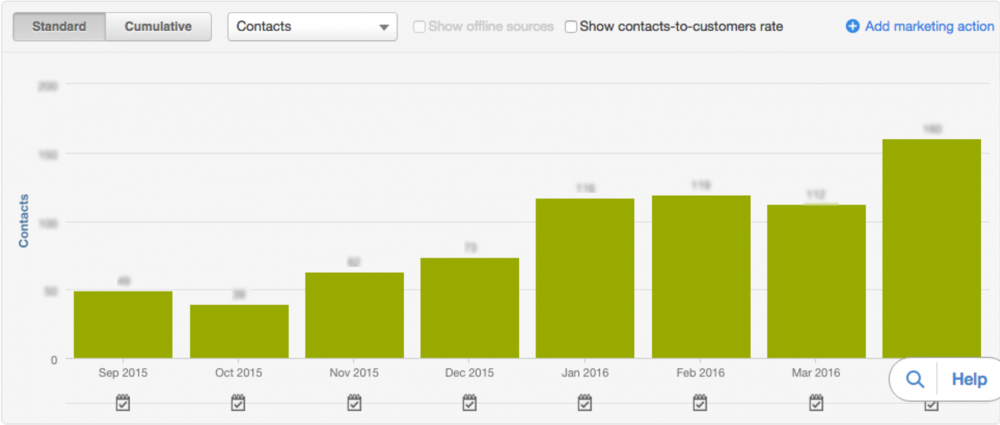
While having mid-funnel content was a key component to the campaign’s success, having effective content was the most critical component for driving quality leads. Many marketers would agree that content marketing is an extremely effective lead-gen tactic. However, it can also be the most difficult to execute well. After all, good content should be unique and insightful while nurturing potential customers all at the same time.
So what process can you follow to create effective lead-gen content?
In the case study cited above, we found there were 3 core questions a buyer needed to answer before making a purchase decision. The majority of that information was difficult to find, requiring visiting multiple websites and fitting pieces of information together while navigating a plethora of buzzwords. The ebook we created offered a comprehensive buyer’s guide that provided a framework for answering those questions and compiled all of the necessary information into a single location.
Content mapping is not a new concept, but many businesses fail to understand how crucial it is. Content should be mapped not just to the stage in the buyer’s journey, but also based on the information the visitor is consuming at the time.
For example, if a visitor comes to your website via a blog post titled “What is content marketing and why does it matter?” an ebook about “How to Optimize Title Tags” is not nearly as relevant as an ebook on “How to Develop Your First Content Marketing Strategy.”
In the case study above, the main CTA to the buyer’s guide was placed on a page with a competitor comparison matrix. Visitors who arrived on that page were already looking for information to help them make a purchase decision, so a comprehensive buyer’s guide was a compelling offer for those visitors. So compelling, in fact, that the click-to-submission rate ranged from 50-65%
Many traditional marketing activities- webinars, trade shows, purchased lists- are one-and-done activities. Once the event is over, it doesn’t continue to generate leads. If the business needs more leads, it has to attend another trade show or produce and promote a new webinar. Gated content, however, can produce a long-term conversion funnel if you create the content with that intention.
Content typically dies because it:
The secret, then, to creating a long-term conversion funnel is to create content that will still be useful to a buyer two years from now and is tied to organic traffic coming to your website. In the buyer’s guide case study, the conversion rate was maintained because SEO was the primary content promotion strategy with only a small percentage of leads coming from social or paid channels.
There is no one-size-fits-all solution in marketing, but by following the principles above you’ll be able to create effective lead-gen content and test whether mid-funnel conversions can have a significant impact on marketing ROI.
You finally took that leap and launched your own healthcare practice. It took grit and guts to get there, and it’ll take grit and guts to keep it going. Now that it’s open, you need to find a continuous flow of patients to fill your practice and keep your business above ground. Or, maybe you've been practicing for a while but are ready to scale and bring your practice to new heights. Regardless of the circumstance, there are some bulletproof healthcare marketing strategies that will get new patients flowing in your doors from a digital audience.
A healthcare marketing strategy defines how healthcare organizations attract patients, build trust, and drive engagement across digital channels while staying compliant.
Unlike general marketing, healthcare marketing prioritizes clarity, accuracy, and confidence at every touchpoint. Patients are not just comparing services. They are evaluating trust, expertise, and ease of access at every step of their customer journey.
A modern digital marketing strategy for healthcare brings together SEO, local visibility, content, and reputation management to support the full patient journey. When executed well, healthcare marketing functions as an extension of your patients’ experience.
Below I've distilled some healthcare marketing ideas and techniques you should be looking into in order to increase the relevance of your healthcare practice online.
Your site is likely the first interaction your potential clients will have with your healthcare brand online. A sloppy, buggy, or thrown-together website can give the impression that your practice is also sloppy, buggy, and thrown-together. In order to nail this first impression, be sure to invest in a well-crafted, visually appealing site that is easy to navigate, provides useful information, and demonstrates your practice’s expertise. A good site is the foundation of an influential online presence.
It should go without saying, but your site needs to look professional and inviting. In today’s digital age there are many avenues to building a website. Though it’s tempting, it’s worth investing in quality over budget when it comes to your site design. In addition to the fact that the average user sees quickly through cheap site design, a good site structure is essential to keep up with your healthcare business as your company scales. It’s important that your site reflects the top notch service and quality you provide.
The good news for you: many of the healthcare sites out there look quite outdated. By updating or creating a well designed site, you can stand out with relative ease.
When people get to your site, it’s for a specific purpose. In your case, people are looking for a healthcare provider that they can trust, with answers to questions only a doctor can answer. They have a specific problem, and they are looking for solutions.
If your website isn’t clear about the value each page brings (or worse, it promises value but doesn’t deliver) that confusion will reflect poorly on your practice. Be clear, be helpful, and put the user-- your potential patient-- first.
Facebook ads can be powerful for your healthcare marketing strategy, but you’ll need to put some thought and strategy into them. The FB ad platform isn’t one that typically brings results by blasting as many users as possible with your ads. The power comes instead from the very specific, granular targeting that can be done. Maybe you focus on sports medicine and want to run a campaign targeted to men and women, aged 20-40, with a particular interest in CrossFit. On Facebook, that’s easy. What if your practice caters to a higher-end clientele? No problem, you can target via income, net worth, home value, location, etc.
Paid social media marketing, such as with Facebook Ads, can be a powerful tool in an online strategy. The key is running tailored campaigns to specific personas. As you refine who you are targeting, you can lower your overall cost of running ads because you aren’t wasting money commercializing to people who will have little interest. To help get you thinking of what campaigns you should run on Facebook, here are some of the targeting options.
If you are embarking on running some social media ads yourself, be sure to read up on all the ins and outs of Facebook’s ad platform and how to use it. There are many options and it is easy to get overwhelmed on your first go. Adspresso has a great guide to get you jump started that can be found here.
Most industries have directories that list professionals within their industry. These directories often put in a lot of time and money in order to rank well for many profitable keywords, which means they are a resource you can use to increase the weight of your own domains. Use these healthcare directories to your benefit while you are getting your site ranked for your chosen keywords.
In most instances, directories will be free (or cheap) and have an easy to fill out form. You will use the form to submit information about your practice to be posted on the public directory.
For example, Healthgrades.com has a comprehensive directory that you should leverage to your advantage. It ranks for many healthcare-focused keywords.
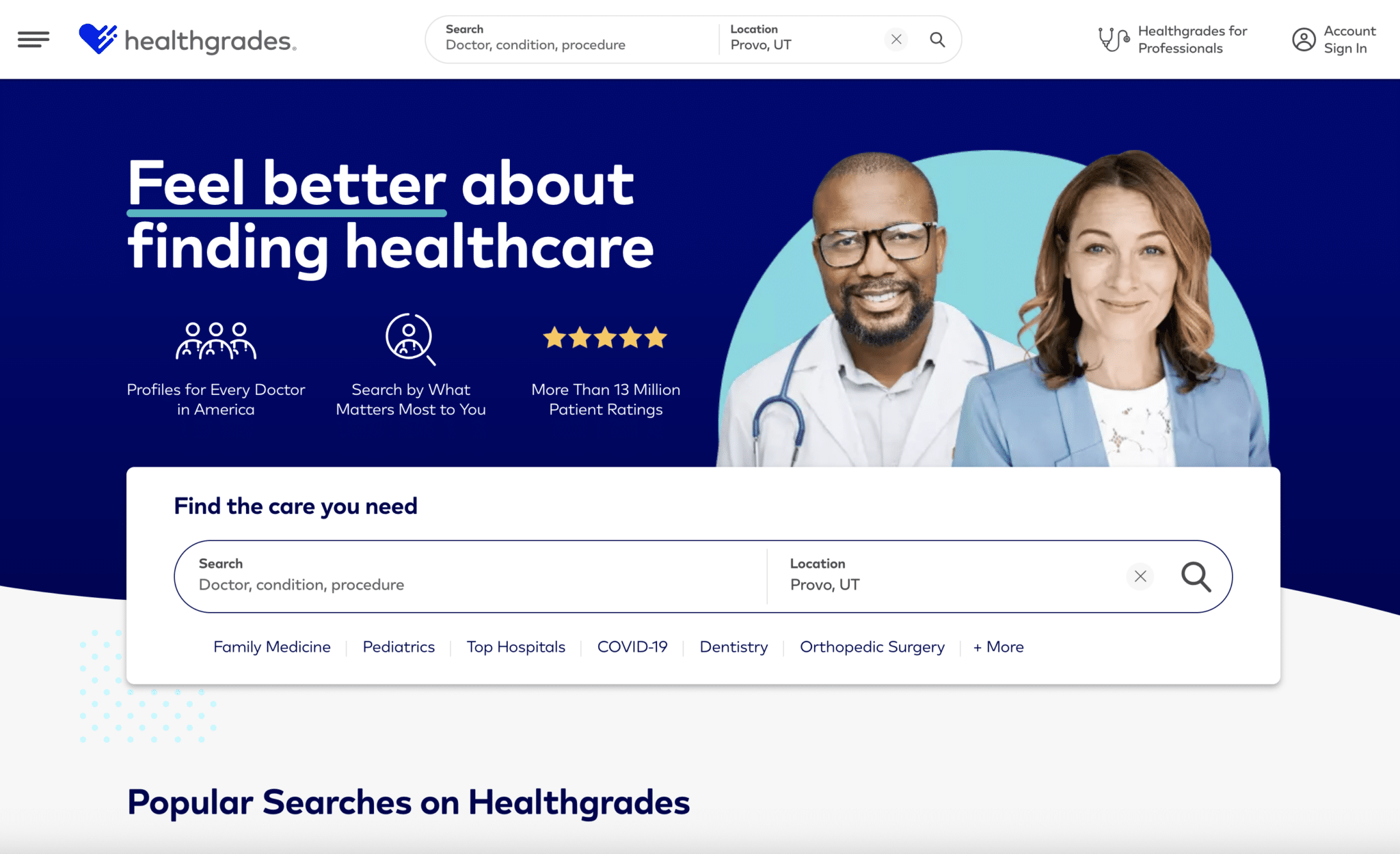
You can create a free Healthgrades.com profile here. It will look something like this:
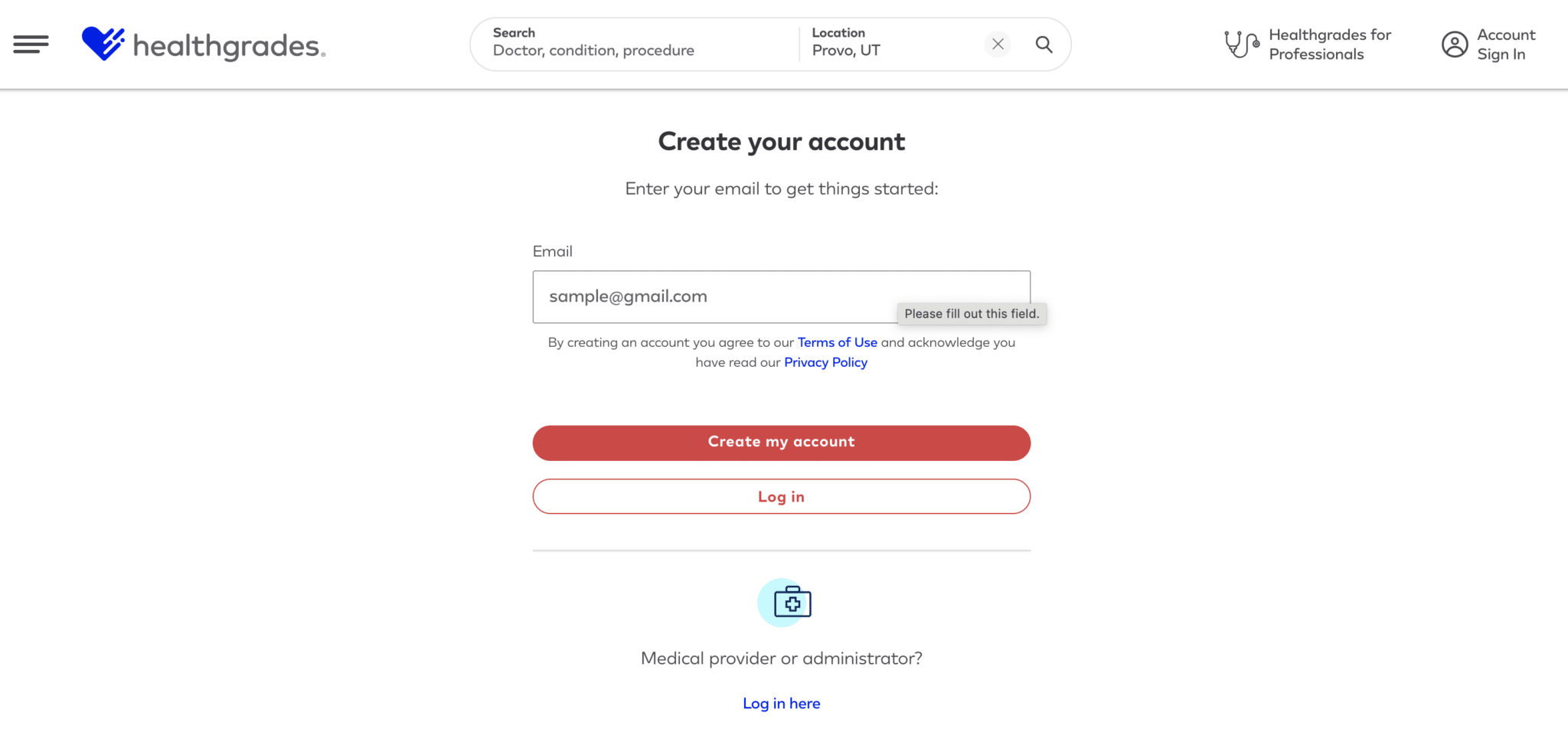
This is a great way to take advantage of all the hard work Healthgrades has put into their site and rankings. And, it’s mutually beneficial. Healthgrades relies on healthcare practices to add themselves to these lists, and you rely on them to aid your ranking positions and lead generation.
Here are a few more healthcare directories that you should be on:
All of the above directories rank for many “healthcare provider in...” type keywords. If this method works for you, don’t stop there! There are many more directories with online clout than the ones listed above. Do a quick search for “healthcare provider in” + “city” to see which directories show up for the city you want to rank for. Be sure to leverage the directories that rank for your target terms first.
Google My Business is incredibly important if you want to show up for local results in Google. I’m sure you’ve seen local results many times, but maybe you didn’t realize it was a part of the Google algorithm that you can leverage. Here’s what a local result looks like when you search “chiropractor SLC”:
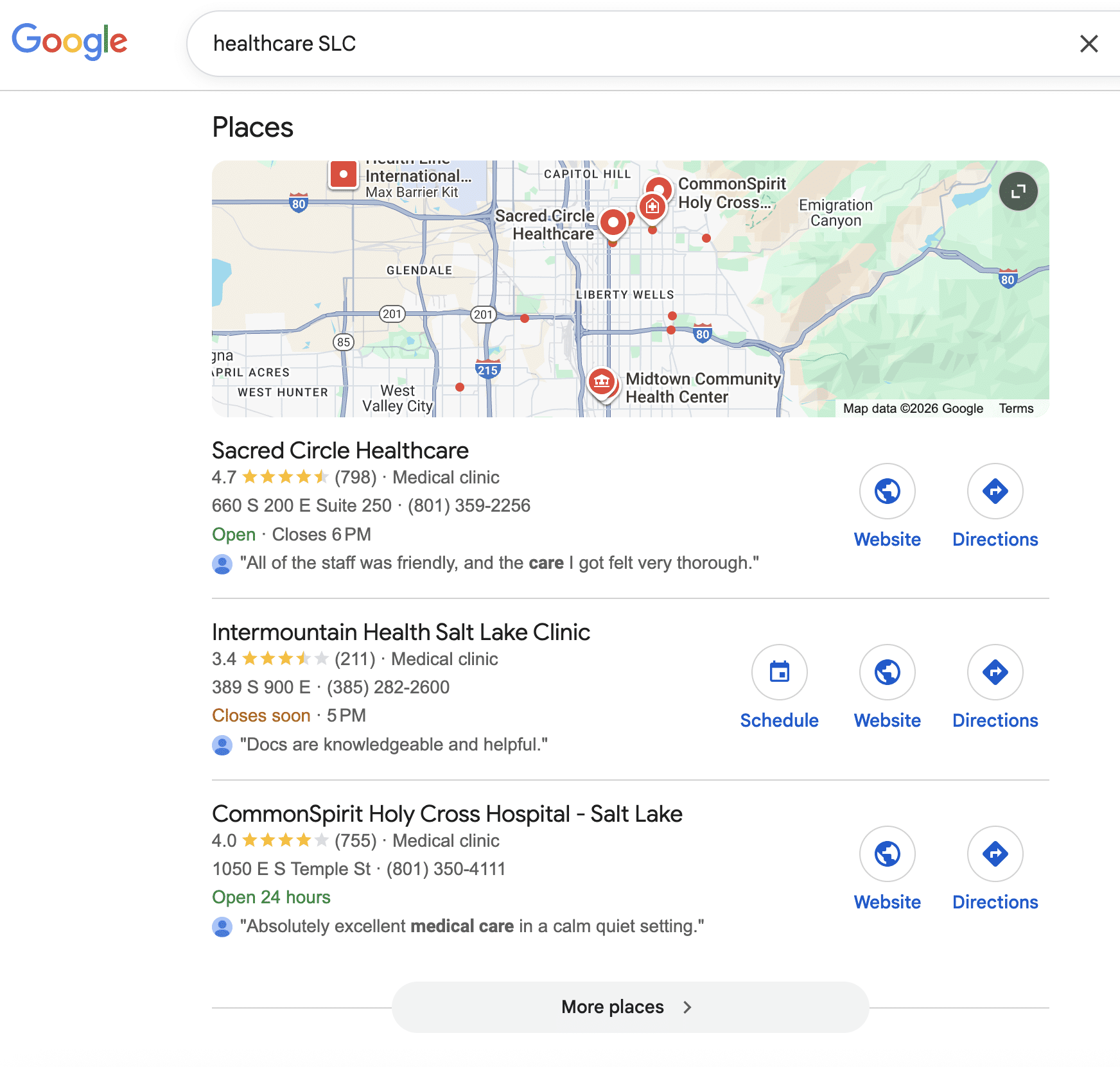
The local box will show different businesses that fit what you are looking for. There are many factors that go into showing up for these, but Google tells us that it comes down to 3 core factors:
So what exactly does Google mean by these?
Relevance is pretty self-explanatory. It refers to how closely your local business listing matches the search someone types in. By doing a thorough job filling out Google My Business and optimizing it to match the queries you want to rank for, you’ll increase in relevance.
Another pretty easy one, distance illustrates how far a person is from your business. In a recent report from Hitwise, it is reported that nearly 60% of searches are now performed through a mobile device. Google will calculate where a user is through their device and use this distance as a factor when providing results.
This is the part where optimization comes in. Prominence tries to gauge how prominent your business is in the offline world and reflect that in local listings.
Many factors are taken into consideration here. Links, local citations, reviews, and your position in traditional SEO results all factor into how “prominent” you are.
You need to verify your business with Google My Business. This is a fairly easy process. After you set up your Google My Business page, Google will send you a postcard with a verification code. You will then enter the code into Google My Business to verify your business listing.
Next, make sure all of your details are up to date and add 3-5 pictures of your business.
After you’ve added some great photos of your business, double check the category that you’ve declared for your business within Google My Business. It is important that you have categorized your business properly.
Thoughtfully fill in your introduction and title of your business in Google My Business so that it represents your business well.
Reviews are very important in local search marketing. Read and thoughtfully respond to reviews about your business. Reviews can make a huge impact on your business for better or for worse. It is beneficial to keep them under control through responding and genuinely taking care of your customers.
Citations are your mentions on various directories on the web. These directories are sites such as Yelp, The Yellow Pages, dexknows.com, chirodirectory.com and more. Building these by hand can take a lot of time, so many companies hire out for citation building.
If you embark on building citations by yourself, make sure you keep all of your information consistent across all of the directories you submit to. Nothing is worse than getting a bunch of citations that have conflicting phone numbers or addresses that you need to go through and clean up.
Traditional SEO for a healthcare practice, sometimes searched online as healthcare SEO, can be immensely powerful. SEO for those who are unfamiliar stands for “search engine optimization.” It is the act of optimizing the elements of your site so that you rank better (closer to the top) within search engines. The idea is that if you are a healthcare provider in Las Vegas, then you want to show up when someone searches “healthcare Las Vegas” within Google or other search engines. And, you want to show up as closely to the top as possible, so more users will click to your site over your competitors’. Performing SEO for your healthcare practice will do more than just generate customers, it will help you build a brand. Here are some of the benefits to investing in SEO.
As a healthcare provider, you are highly skilled in an area where most other people are not. Furthermore, you invested good money in becoming an expert at your craft. Use that expertise to grow your brand through content marketing.
What do I mean by content marketing? You should be consistently publishing content that brings value to your potential patients in a way that only you, as the expert, can. If you’re wondering: “Well, what should I write about?” This is where the keyword research that I mentioned earlier comes in. Keyword research will teach you what people are searching for and how many people are searching for it. In many cases, these search terms represent the questions that your potential patients have for you.
For example, if someone is experiencing upper back pain, they may search “upper back pain” in Google in order to research what the causes could be. Here is a snapshot of what the traffic looks like for some keywords regarding upper back pain.
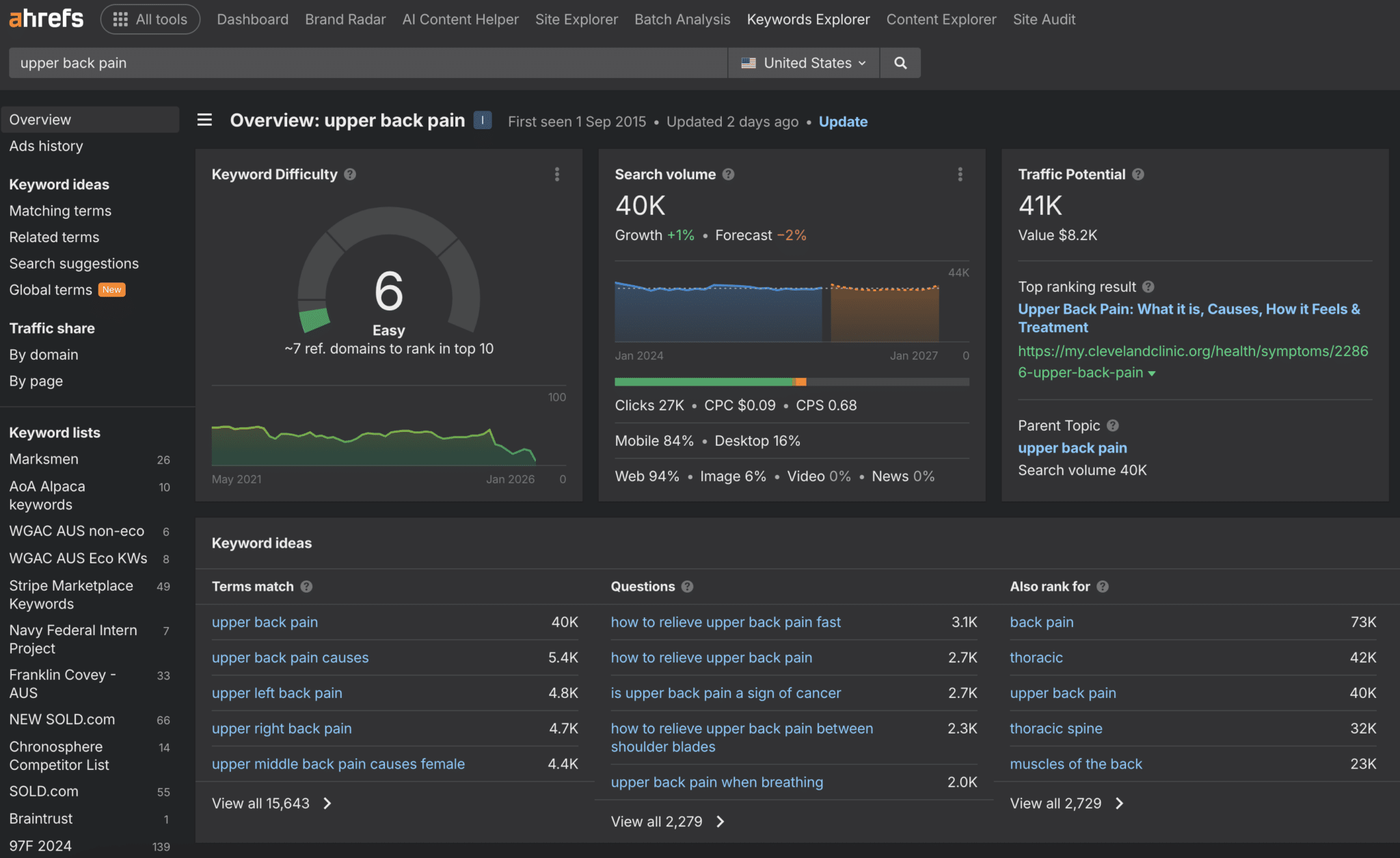
Quick notes -
As you can see in this example, there are many people searching for the keyword “upper back pain” or some variant of it. We also learn that these keywords have relatively low difficulty being in the 20-30 range (out of 100, 100 being the most difficult).
If you, as a healthcare provider, created a piece of content regarding “upper back pain” and optimized it for the above terms, you could begin generating quite a bit of online exposure.
As you begin to show up for searches in Google you will be seen as an authority. The more searches you rank for, the more people will associate you as an authority.
A great example of this is Dr. Josh Axe of Draxe.com. Dr. Axe began by founding the Exodus Health Center in Nashville, helping thousands of families reclaim their lives through improving their health. Furthermore, Josh helped his own mother reclaim her health and beat breast and lung cancer. Realizing that he has a special set of skills, he set out to help more people using the amplification of the internet.
When Dr. Axe started early on, he wrote many pieces of content and published them on his site. Dr. Axe began ranking for many keywords and has since grown to become the “second-most-visited natural health website in the world.”
Here is Dr. Axe’s current site:
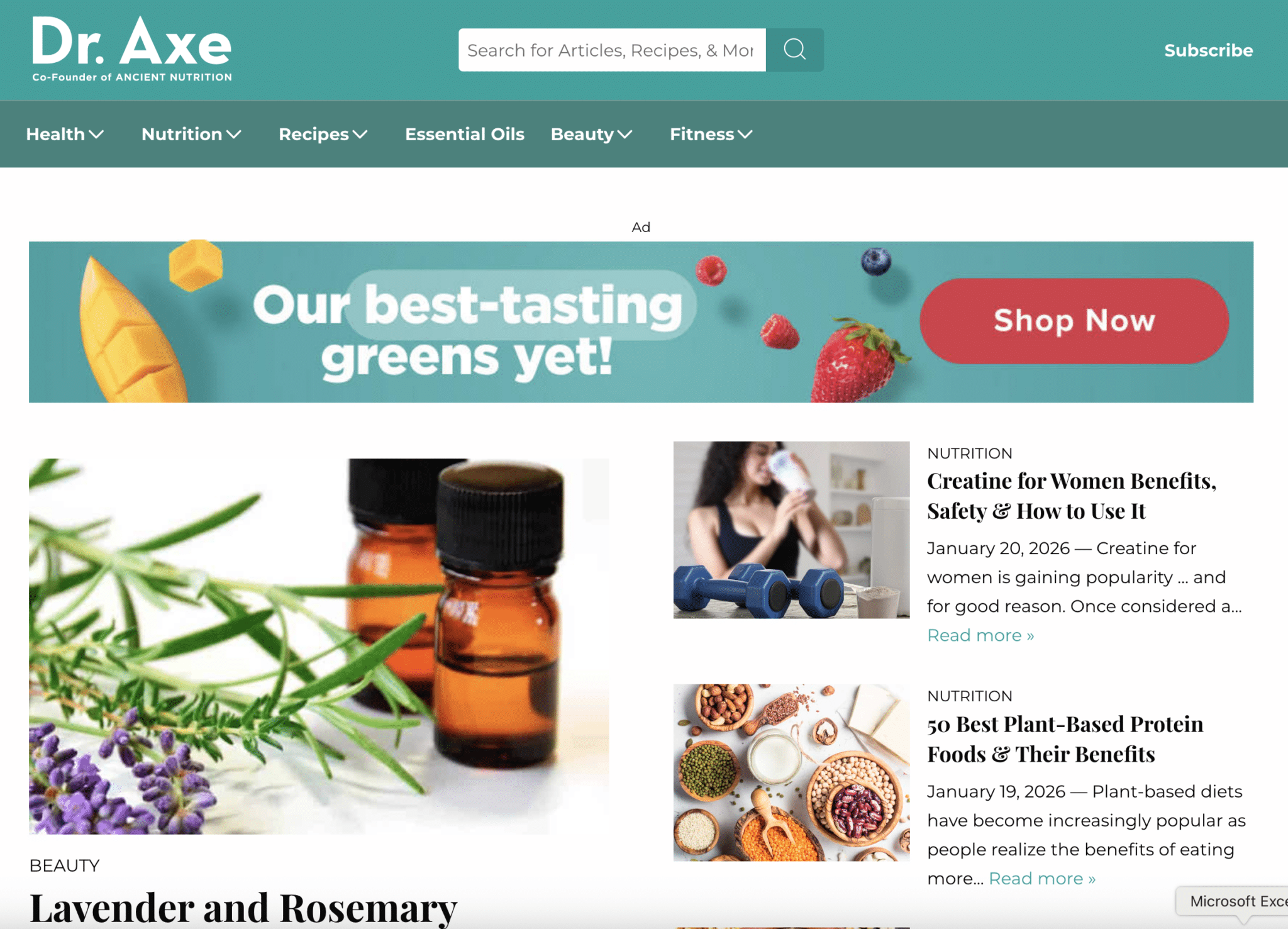
Josh’s site currently ranks for over 1.6 million keywords and generates over 7.5 million monthly visitors (as per Ahrefs).
Dr. Axe is an inspiring case study of what can be done through the leverage of SEO to build a strong brand with immense authority.
Managing your reputation online is at the heart of retaining a good brand image. Google your brand frequently to see what people are saying about you. Better yet, create a Google Alert for your brand name and be notified each time you are mentioned. This way you can jump in and resolve concerns and strengthen your brand.
Patients often research providers across search results, review platforms, and third-party healthcare directories. Monitoring what appears in these spaces helps organizations understand how they are perceived and where gaps in trust may exist. A strong healthcare marketing strategy includes proactive brand monitoring.
Give thoughtful responses to reviews and mentions to show your accountability and reinforce credibility, which is especially valuable when patients are evaluating alternative care options. Over time, this consistency supports a more resilient healthcare marketing strategy by building confidence across digital touchpoints.
For many patients, the first interaction with a healthcare organization happens online. This is often referred to as the digital front door, and it plays a vital role in any healthcare marketing strategy.
A patient-centric digital experience removes friction. Websites should be easy to navigate, quick to load, and clear about services, providers, and next steps. Patients should be able to understand their options, find answers to common questions, and take action without confusion or unnecessary barriers.
A strong digital marketing strategy for healthcare treats the website as more than a brochure. It functions as an access point for care, guiding patients from research to an appointment with confidence. When the digital front door is built around patient needs, marketing efforts convert more effectively, and trust is established before care even begins.
Healthcare is evolving quickly, and patient expectations continue to rise. The organizations that succeed are those that invest in strategy and adapt their healthcare marketing strategy as technology, regulations, and behavior change.
97th Floor helps healthcare teams put their ideas into action and capture the biggest opportunities in the industry. If you’re ready to move beyond tactics and create a strategy designed for today’s healthcare landscape, let’s build it together.
See how an audience-first approach translates to bottom-line results.
