



You’ve seen it happen: a brand posts a clever hashtag or starts a striking thread, and suddenly it’s everywhere. But is trending on Twitter just a matter of luck? How do you create a campaign that actually sparks conversation and drives sales?
Twitter campaigns (or X campaigns, these days) are a way to bring intentionality to your social media growth. Tweets feel like a simple click when you post on Twitter, but there are all kinds of coordinated efforts behind the scenes that capture your audience and build a community.
Don’t let your efforts peter out as your brand gets lost in the scroll; let’s break down a realistic strategy for your tweets.
Twitter campaigns are a coordinated marketing effort to build awareness, conversations, or conversions. Instead of relying on a single tweet to catch fire, campaigns bring strategy and structure to how your brand shows up on the platform.
What makes them powerful is the way they combine creativity with direction. A strong campaign ties together:
Put those pieces together, and you have a campaign that can grab attention and keep it, strengthening brand recall and putting your business on the digital map.
Most Twitter campaigns fall into two buckets:
Both have value. When brands blend both approaches, that’s when campaigns really shine — organic posts build authenticity, and ads make sure the right people actually see them.
Campaigns on Twitter can serve very different purposes: some build awareness, others gather support, and some drive direct sales.
A hashtag can turn into a rallying point when it’s easy to remember and share. Simple, memorable, personal. Take Coca-Cola and its #ShareACoke campaign. Throwing names on bottles gave people a reason to personalize their posts and be playful, which made the hashtag succeed beyond the standard ad.
If you want your audience to care about what you post, you have to post about what they care about. It sounds obvious, but it’s an easily missed opportunity for people to really get your brand. And, purpose-driven campaigns help build momentum by connecting to shared values and real-world issues, like with the #MeToo movement. A single phrase unified millions of voices, which just goes to show how powerful a campaign can be when it sincerely resonates.
Want more engagement? Give your consumers something to do — or even better, something to gain. Incentivize them to vote during polls or share their experiences with your product. Audi’s #WantAnR8 is a great example of this. Fans who tweeted the hashtag were entered for a chance to test drive the car. This gamified campaign created so much online excitement, about the event, yes, but also about the memorable Audi brand.
You can create some urgency with a time-based campaign or get real-time engagement with a live event. Take Nike’s #Breaking2. They built anticipation by documenting every step of its marathon barrier attempt, which kept viewers engaged from start to finish — literally.
Instead of leaving your tweets up to chance, get really intentional. Here’s how to design a compelling and effective campaign for lucrative results.
Every campaign starts with a purpose. Do you want to build awareness, generate leads, or drive conversions? Making sure your end goal is crystal clear is the easiest way to choose the right campaign type and metrics to track.
The best ads or tweets will fall flat if they don’t reach the right people. Twitter’s built-in Interest Categories can help you zero in on who to reach and discuss what that audience actually cares about.
Categories
Twitter recommends that you do not have more than two interest categories per campaign or more than 10 sub-interests in one campaign. Interests are broken down into interest categories and sub-interests — some interest categories have up to 25 sub-interests.
When you select an interest category and run a campaign with many sub-interests, be sure to check it frequently and refine your sub-interest targeting to include only the best performers. It’s also recommended to combine related categories (e.g., “Golf” + “Men’s apparel”) so your campaign feels relevant and cohesive.
Once you know your audience and goals, the next step is matching them to the right campaign format. The type of campaign you choose should support your objectives and play to the way your audience engages on Twitter.
Choosing well keeps your strategy focused and avoids wasting budget or effort on campaigns that don’t fit the outcome you’re aiming for.
Okay, so you’ve launched the campaign…now what? Track results and make adjustments. Some of the best ways to do that are to:
The most effective campaigns share a few common traits. Here’s what’s working:
A hashtag should be short, clear, and easy to use. The fewer people who have to think about it, the more likely they are to join in. Always’ #LikeAGirl campaign flipped a tired (and stereotypical) phrase into a message of empowerment. It was surprising, but it was also really concise and easily recognizable, which is what made it spread so quickly.
The more visual, the better! People are scrolling through thousands of bits of content, but an iconic visual can make campaigns recognizable, even when messages are shared or remixed. Google Maps is a good example of a clean, consistent brand that is identifiable in a crowded feed.
Emotion also makes a campaign memorable and encourages sharing. Storytelling helps audiences connect with the message on a personal level. Look at Dove’s #SpeakBeautiful campaign, where Dove confronted negative comments about women and reframed the narrative around positivity and self-love. The universal and inclusive message is easy to relate to and easy to share.
When people create content for your campaign, they’re, yes, amplifying your voice, but they are also lending authenticity you just can’t recreate on your own. Calvin Klein’s #MyCalvins did this well when fans were invited to post photos of themselves in CK products. Suddenly, their audience was their marketers and filled feeds with user-generated content tied directly to the Calvin Klein brand.
Nothing is quite as powerful and attention-grabbing as humor. A lighthearted or funny bit cuts through the noise and makes your brand unforgettable. Charmin’s #TweetFromTheSeat leaned into the unconventional elements of their brand and made it something funny and real.
Here are the big metrics you can’t overlook if you want to put your data to work for future success:
For example, Nike’s #Breaking2 livestream generated millions of impressions, but the real value came from audience engagement — thousands of tweets and shares that extended the campaign far beyond the initial event.
The shift from Twitter to X brought a new name and new features, but the basics of successful campaigns haven’t changed. Brands still need clear goals, compelling content, and strong targeting.
What has changed are the tools:
In short, social media campaigns on X run on the same principles as before, but with new opportunities to experiment and engage.
Twitter campaigns still matter, and with the platform evolving into X, brands have more ways than ever to connect with their audience. But running campaigns that actually drive awareness and conversions is a big and ongoing task that takes testing and expertise to get right.
At 97th Floor, we’ve managed Twitter ads campaigns and organic strategies for brands across industries. We know how to target the right audiences, craft content that resonates, and track the KPIs that prove impact. More importantly (and what sets us apart), we help brands align campaigns with bigger marketing goals so that social efforts pay off across the board.
If you’re ready to go viral on purpose, work with a team that knows how to turn Twitter campaigns into measurable business results. Let’s talk.
Depending on who you ask (or which result you click in Google), the years of birth to be considered a Millennial range somewhere between 1980 and 2000. So being a proud 1986er myself, I’m perfectly qualified to chime in on what Millennials expect from work.
When I first started hearing about Millennials and their stereotypes, I figured the term referred to people much younger than myself. Teenagers. The kids that had cell phones in elementary school. The kids on Snapchat. They couldn’t be talking about my age group. I used payphones in high school, after all! And of course I didn’t pay for the payphone...like anyone my age knows, I used the Collect Call trick. (My parents received and declined a lot of phone calls from “HeymomitsWayneI’mreadypickmeup!” and I always got picked up.) I had dial-up internet in high school. And no, we didn’t pay for it...like anyone in the economic situation like I was growing up knows, I kept taking the free AOL CDs from Walmart to use the free hours, and then once that was out we’d pop in a new one with a new email address.
I was wrong, though. I am in fact a Millennial, and those “kids” are part of a new generation called Generation Z.
To be honest, for these last seven or so years, I’ve been slightly ashamed of being a Millennial. Maybe embarrassed is a better word for how I felt. Everything I read, heard, and watched made Millennials seem pretty terrible. Especially in the workplace. What Millennials expected from work was bean bag chairs, video games, snacks and a keg. Oh and don’t forget about the ping pong table. For all of that time spent having a party at work, we wanted immediate raises and promotions.
Well, I didn’t feel like I fit this narrative. Sure, I came across a handful of Millennials that matched the profile, but I was somehow lucky enough to mostly surround myself with and know Millennials like me. They didn’t expect those types of things from work, either; nor did they/we necessarily want them.
I’ve come to find out in recent years that all of that was a myth. Click bait. Attention-grabbing consultants. There were a few studies that seemed to prove those stereotypes were facts, but the research was poor. They mainly tried to show the differences between generations. Academics have looked at these so-called studies and have concluded that there have been “gross generalizations based on weak survey research, and the speculations of profit-oriented consultants should be treated with extreme caution.” A group of researchers from George Washington University and the Department of Defense concluded that “meaningful differences among generations probably do not exist in the workplace.” While there are some differences, those have more to do with age and the stages of life people are experiencing. You can read more about how Millennials don’t differ much from other generations in this great article published on Harvard Business Review by Bruce N. Pfau.
Below are results from two studies that actually show Millennials to be pretty much the same as Baby Boomers and Gen Xers when it comes to what they want out of work. While all generations were very similar, it is interesting to see Millennials cared the least about having a fun place to work. If your company is spending more attention and/or money on video games and ice cream parties than it is on trainings and education, you have a problem.


I’m no longer embarrassed to be a Millennial. We’re not much different from other generations when it comes to the things that really matter, especially in our careers. We want to do great work. We want to continue to learn. We want to add value to our companies. We want to work with great colleagues. We want to grow and take on new challenges. We want our work to positively influence our lives outside of work and vice versa.
At 97th Floor, we’re mostly made up of Millennials. We do have some Gen Xers on board, and in the past there have been other Gen Xers and even Baby Boomers. When I heard those people describe the company culture at 97th Floor as the best they’ve ever been a part of, I figured they were just Millennials at heart and were finally at a company geared towards Millennials. But over the last couple of years, I’ve realized it’s because a great company culture like the one we have at 97th Floor doesn’t only appeal to one specific generation. I believe that, now that there is more transparency (the internet in general and specifically Glassdoor), companies need to focus on company culture to stay competitive. This is a good thing, of course, and all generations are benefiting from the change.
My dad used to tell me to be my own boss when I grew up. At a young age, I figured he said that because bosses are the ones that make a lot of money. As I became a teenager and young man, I started to realize that his advice didn’t really have much to do with making a lot of money. His advice was to stay away from the typical company that controlled their employees and created a labor force of disengaged employees. We still have plenty of these types of companies today.
At 97th Floor, we essentially want people to be their own bosses. We want them to receive the benefits of being their own boss without having to deal with the accompanying downsides. To me, it comes down to giving our employees five things that most companies don’t allow them to have. That lack often leads to disengaged employees or employees who leave for a company that provides those benefits, or even start their own company. Each of these points could be the basis for a whole article in itself, but for now, I’ll just share a couple thoughts on each.
1. Autonomy
As Dan Pink teaches in his book Drive, autonomy is one of the things that truly motivates people. Traditional company cultures strip autonomy away from people. Autonomy in the workplace encompasses the employee’s time, team, task, and technique. We try our best to give each employee at 97th Floor 100% autonomy over these things. We allow people to choose the teams they want to be a part of. It’s not uncommon for teams to make offers to one employee and the employee chooses which one they want to take. This is similar to the open market, except that it is happening within our company. We also are a ROWE organization, which really helps us give employees 100% autonomy. We just demand 100% accountability in return.
The ‘time’ part of autonomy seems to be a particularly important factor for Millennials, though it’s really important for everyone. A survey by Intelligence Group found that 74% of Millennials want flexible work schedules and 88% want “work-life integration.” If you’re your own boss, you work when you want to, so long as you can achieve the necessary results.
In the same survey by Intelligence Group, 87% of Millennials said professional development was an important part of their job. From my experience, most companies do a pretty good job with helping their employees develop their knowledge and skills. However, one thing few companies do a good job at is allowing employees to expand their knowledge and skills outside of their position. As a business owner, you learn and develop skills in pretty much every facet of business. While not every employee will care to learn a lot about every part of the business, it’s important for the company to provide those opportunities for their employees. It separates the person from the position, which is a good thing. The company pays the employee for the position they fill, and at the end of the day, the company judges the employee on how they perform in that position; but the employee needs to know that they are viewed and treated as an individual and not just a role.
As a business owner, your income is 100% tied to your work. As an employee, it sometimes doesn’t feel this way. Too often, you feel like you’re taking a lot more work and not seeing more income. While it’d have to be a very dumb company or manager to not recognize a star performer and then compensate them, there is a lot of room for improvement for most companies. At 97th Floor, we have a financial structure for almost all of our employees that rewards them for their productivity and efficiency. It’s not perfect, but it’s an attempt to make employees think like business owners, and it’s helped us a lot over the last few years. We allow employees to decide if they need to hire another person on the team or if they really need that new tool. If they can be more efficient and not hire that person or buy that tool, that money comes back to the team. However, if those type of decisions hurt their productivity, that will hurt their earnings potential. So it’s a constant balance of productivity and efficiency—just like a business owner has to do. While that’s a challenge, it does give control to the employees and allows them to feel that they have a say in their compensation.
As part of our ROWE certification, we were trained to call managers (or bosses) by a new name: “Results Coach”. While we’re not perfect and you’ll still hear “manager” and “boss” being used at 97th Floor, we do a pretty good job of acting like results coaches. The basic difference is that, as results coaches, we set the results we want our team to achieve and the timeframe to achieve them. From there, we get out of their way, help when needed, and give advice. There isn’t the stereotypical boss attitude of “my way or the highway.” In the previously-mentioned survey by Intelligence Group, 72% of Millennials would like to be their own boss, but if they have to work for a boss, 79% of them would want that boss to serve as more of a coach or mentor.
Most people care about more than just money. However, many companies focus almost entirely on revenue. So when you’re an employee, there’s a good chance you’ll end up at a company where your only purpose is to drive revenue. In the Intelligence Group survey, 64% of Millennials say that making the world a better place is a priority for them. If your employees don’t feel that they are accomplishing this, they’re going to leave and find a company where they can feel that purpose. Barring that option, they’ll start their own companies so that they can be their own boss and direct the purpose of the company themselves.
In a world where information moves faster than the speed of light and is produced almost as fast, it is important to stand out. The key to standing out is a well designed visual. Humans not only respond faster but also retain more information from images and graphics than from text alone. Visuals are also easily shared, which leads to more views, links, and better search engine optimization.
Studies have shown that humans process and respond to visual data better than any other type of data. The human brain is capable of processing images 60,000 times faster than text. Additionally, 90% of information transmitted to the brain is visual. Visuals capture and hold viewers’ attention.

Information is more likely to stay with you when presented visually.

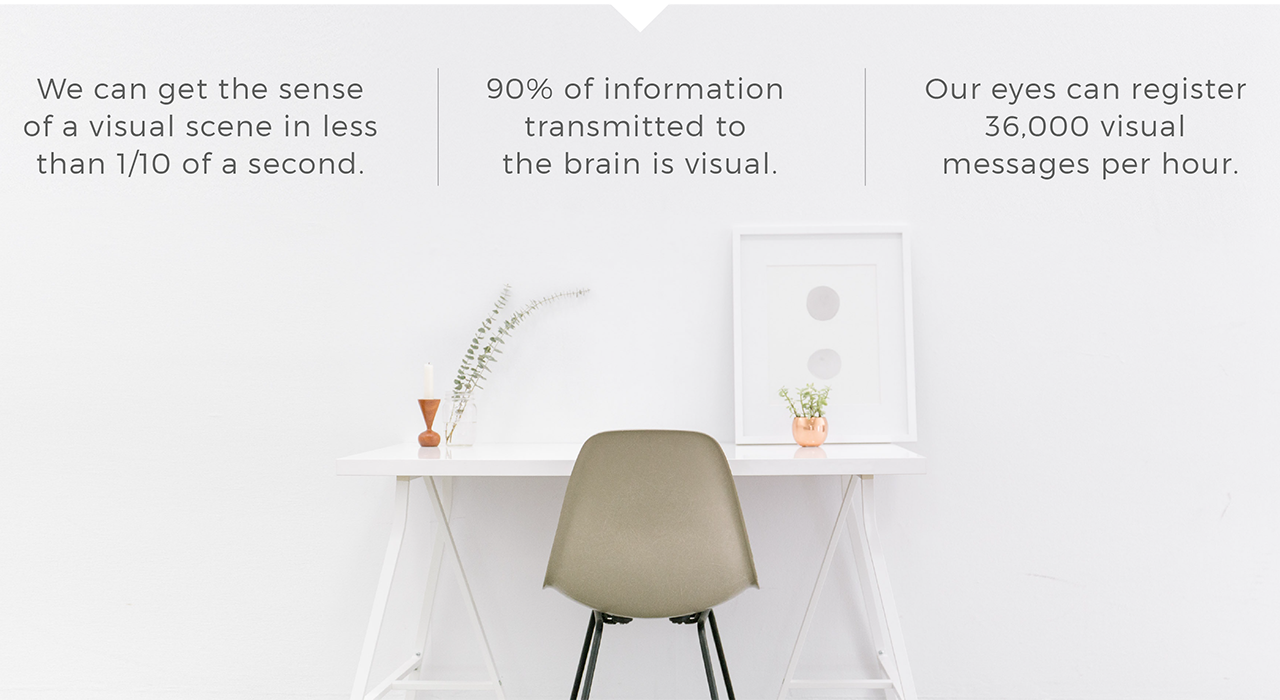
Eye-tracking studies show internet readers pay close attention to information-carrying images. In fact, when the images are relevant, readers spend more time looking at the images than they do reading text on the page.

Visuals help tell your brand’s story in a memorable way and demonstrate your brand as an authority in your industry, building brand awareness.

Visuals are easy to digest, and transmit data faster and easier, which means they stay with you longer than text. If a relevant image is paired with that same information, people retained 65% of the information three days later.
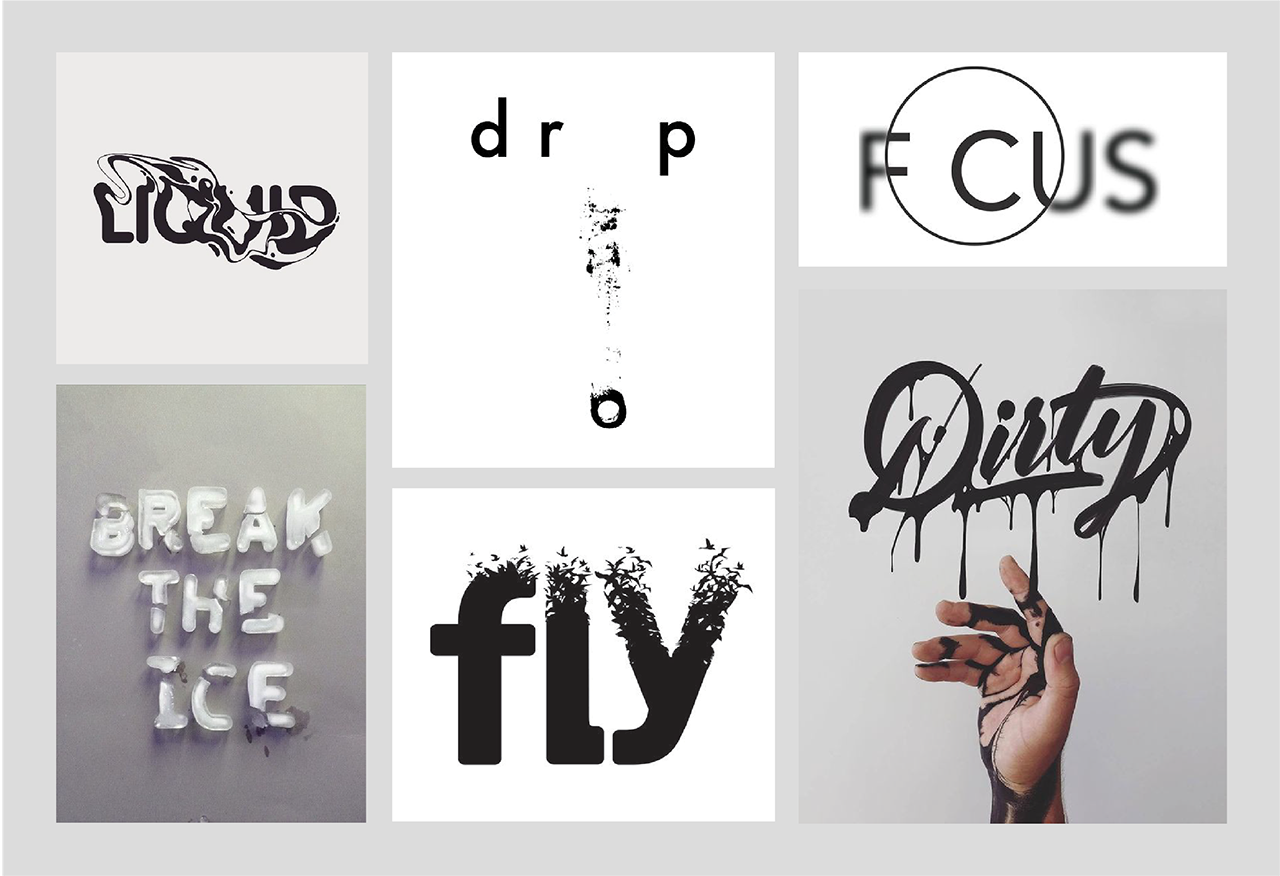
Graphics are more convincing and influencing. Visuals trigger emotions and motivate the audience. The emotional power comes from the ability to show you an idea, relationship, or how something works.
People that follow directions with text and illustrations do 323% better than people following directions without illustrations.

Visuals are easy to share and drive traffic. Visually appealing graphics are more likely to be shared on social networks and become viral compared to ordinary text content. Graphics create more opportunities for link-building, which also impacts your site’s search engine optimization.
Last year we were featured on Inc. Magazine’s first ever 50 Best Workplaces list (we recently found out that we made it onto this year's list too), and to celebrate the news, we put up a billboard near our office. Observe:

And while this is obviously a friendly jab at businesses that think a ping pong table equals an awesome work environment, it’s also become something of a mantra. The billboard was ultimately a statement that you can create an amazing culture and workplace without resorting to gimmicks.
Whenever the topic of workplace ping pong (and all it represents) comes up, I’m reminded of a personal experience. Prior to joining 97th Floor, I worked for a company that (you guessed it) had a ping pong table. You might be expecting me to say that the thing was little more than an expensive dust collector, but you’d be wrong — it was used constantly. My team had two set times each day during which we could use the ping pong table. As those times would approach, employees would stop what they were doing and rush over to play ping pong.
For me, the ping pong table came to represent flawed company culture. How so? Simple: Ping pong was the reward. It was the reason employees came in in the morning. It was what prevented them from sending out resumes to other employers. The drive for success and self improvement was replaced with ping pong tournaments and nerf wars, and an inspirational company purpose was as far from everyone’s mind as could be.
When I came to 97th Floor, I made a decision: I would never allow a ping pong table to find its way into our company workspace. Do I hate ping pong? Of course not; in my time with the aforementioned company, I was just as excited to play during work hours as anyone. But ping pong is not what 97th Floor culture is about.
Company perks are great. However, too often, they’re misused. Patty McCord, the former Chief Talent Officer at Netflix, suggests that perks should have a purpose. She says that many of the extravagant perks offered these days are a “race to the ridiculous.” Giving people more stuff won’t make them happier, but perks that support the company’s values, mission, and purpose will.
A 2014 survey by BlessingWhite demonstrated that engaged employees report that the top reason for staying at a job is that they like the work they do. The second most-reported reason for engaged employees to stay at a job is that they believe in the company’s mission and culture. You may notice that ping-pong (or whatever other fun attractions an employer might showcase) isn’t up there. So where is it? Quite a bit closer to the bottom, actually. Only 5% of engaged workers identified perks as a reason they stay at their job.
So few? What about the ping pong enthusiasts I mentioned from my own experience? Well, if you take a quick look at the wording of the survey, you’ll notice it’s talking about engaged employees. For disengaged employees, however, the numbers start to flip. Disengaged workers report perks as a much more important reason for staying at their job. The survey backs the saying that “the engaged stay for what they can give, the disengaged stay for what they can get."
Want to attract the wrong people? A ping pong table looks like the way to go. If, on the other hand, you want a workforce that can grow your business and make a positive impact on your industry and your community, then realign your focus to highlight your company values and mission. This is why at 97th Floor, we often shy away from discussing employee perks (of which we have many) with potential hires and interviewees — particularly when the purposes behind said perks aren’t obvious.
And what purpose should perks be filling? In my opinion, the best way to use perks is to reinforce the purpose, mission, and values of the company.
For example, we at 97th Floor value the thirst for knowledge. To promote that thirst, we instituted the 97th Floor Library program, in which the company will purchase any book an employee wants, with the caveat that the book ends up on the break-room bookshelf once they’re done with it. Books may not cost much, but they do cost something. We don’t want our employees hesitating when it comes to furthering their own knowledge, and with the book then available for any other employee to enjoy, we’re able to offer a fun perk that benefits everyone, while also reinforcing a key company value.
Now don’t get me wrong, not every perk we have at 97th Floor serves some higher purpose other than to provide a bit of entertainment. We have an Xbox One in the break room right next to the bookshelf, and when it’s time for company-wide rewards, we’ve been known to spring for the occasional massage or movie outing. I think this is perfectly fine, but I hesitate to call these examples ‘perks.’ These aren’t the things you should have on your job ads. These aren’t the things that everyone should talk about at the office. These aren’t the things that management should expect will retain the right employees. These are just diversions. The perks that promote your company’s mission and values are the ones that will have the greatest impact on employee success.
Too often I see companies attempting to use perks to fill a void that only satisfying work, a worthwhile mission, and an inspirational vision can satisfy. Want to see whom among your acquaintances works for a business that understand this? Here’s a simple test you can perform:
The next time you’re catching up with friends, ask around to see how everyone feels about their jobs. Of those who say that they like their jobs, ask them what it is about their jobs that they like most. If they start talking about the nap room, the free donuts every morning, and even the (dreaded) daily ping pong tournaments, then take note. There’s a good chance that these are the ones who’ll have a new job the next time you see them. On the other hand, identify those that tell you about the awesome work they are doing, the challenges they are overcoming, how their contributions move the company forward overall, and how their company is impacting the world, and you’ll have found employees of businesses that really understand the value of perks.
Perks come and go. In fact, perks are usually first to go during recessions or hard times for the business. So ask yourself, if you took away all of the perks in your company, would the employees stay? If not, you may have a serious problem on your hands. When all is said and done, team members should be willing to stay for the right reasons.
At 97th Floor, you’ll never see employees jockeying for a place in a ping pong tournament. You will see people that are doing fun, exciting, challenging, and purposeful work. You’ll see that work contribute to a company that is growing our client companies and helping those companies fulfill their missions. You’ll see people making an impact in the world through charity. You’ll see people controlling their lives and their work. You’ll see people mastering their crafts. You’ll see people growing in their careers. You’ll see people putting a ton of effort into helping others grow. You’ll see perks that are meant to help people with everything listed above. And while you may also see a few perks that are just for fun, you’ll notice that they mean almost nothing to the people when it really comes down to what truly matters in the workplace.
Now, all things considered, doesn’t that sound better than a round of ping pong?
Every interaction a user has with your company tells a story. And that story starts long before someone clicks a button or fills out a form. It begins with how easily they understand what you offer, how confident they feel moving through your experience, and how quickly they can get what they came for.
In other words, it starts the moment they begin to experience your brand.
A UX design strategy defines how user experience decisions are planned, prioritized, and connected to business outcomes. It ensures design choices are intentional, informed by research, and tied to real goals like growth, engagement, and revenue. Without strategy, design becomes reactive. With strategy, design becomes a tool for progress.
Psychology plays a central role here. Users bring expectations, habits, and emotions into every interaction. A strong UX design strategy accounts for how people think and how they decide to act as they move through an experience. When psychology and strategy work together, user experiences feel trustworthy and effective.
Here, I’m going to break down what UX design strategy is, why it matters, and how it impacts both users and businesses. I’ll cover the benefits of a strategic approach, the core components that make it work, and the psychological principles behind effective experiences (and how intentional UX design supports conversion, retention, and long-term growth). And, because this is a company blog and we’re proud of the work we do, I’ll also discuss how 97th Floor approaches UX strategy as a collaborative, research-driven process.
UX design strategy is the plan that guides how user experience decisions are made to support business goals and user needs. It connects research, design, and execution into a cohesive direction. While UX design focuses on individual interfaces and interactions, UX strategy defines the why, when, and priority behind those design choices.
At its core, a UX design strategy brings together research and usability principles, supported by psychological insight and organizational alignment. It creates a shared understanding of users and clarifies how the experience should support both them and the business.
A UX design strategy gives teams a clear framework for making decisions that serve both users and the business. Instead of relying on opinions or assumptions, strategy creates direction and consistency across the entire experience.
This matters because it:
A UX design strategy is made up of several connected parts that guide how experiences are planned, built, and improved. Each of these components plays a specific role in shaping how users move through an experience and how well that experience supports business goals.
Research sets the direction for every UX decision that follows. By studying user behavior and gathering stakeholder input, teams gain insight into needs, expectations, and obstacles. This groundwork helps reduce assumptions and ensures design decisions are based on real evidence rather than internal opinions.
Usability focuses on how easily users can navigate and complete tasks. Clear pathways and familiar patterns help users move through an experience without confusion. When usability is prioritized, frustration is reduced and progress feels natural.
Information architecture determines how content is structured and labeled. A thoughtful structure helps users understand where they are and where to go next. When information is organized in a way that feels intuitive, users can find what they need with less effort.
Interaction design defines how users engage with elements on a screen. Buttons, transitions, and feedback signals all influence how responsive an experience feels. Well-planned interactions guide attention and reinforce a sense of control.
Accessibility ensures experiences can be used by people with different abilities and needs. Designing with accessibility in mind improves usability for everyone and helps brands reach a wider audience. It also signals care and responsibility in how experiences are built.
UX copy supports users through clear and purposeful language. Labels, prompts, and instructions help users understand what actions are available and what will happen next. Good UX copy removes uncertainty and keeps experiences moving forward.
Testing and iteration allow teams to refine experiences over time. By observing how users interact with designs, teams can identify issues and make informed improvements. This ongoing process helps experiences stay effective as needs evolve.
Cross-functional alignment keeps UX efforts connected to broader business initiatives. When design, development, and marketing teams share the same goals, execution becomes more efficient. Alignment helps ensure the experience feels cohesive from start to finish.
We make daily decisions on what brands we choose to engage with, what brands have earned our trust, and what brands compel us to spend money. How do we make those decisions?
Psychology studies have shown that our feelings and instincts cause us to behave. It is said that emotions drive 80% of the choice we make. So the first visual impression a customer receives from your brand is crucial to a positive customer experience, or a customer experience at all.
Good design is more than just good looks, it’s the catalyst to trust and loyalty towards any brand or company.
Trust is often the first hurdle a brand needs to clear, and design is usually the deciding factor.
That’s because design is emotional. It evokes moods, attitudes, and personality. Together, these emotions create “gut feelings” and stir thoughts in our mind. And before even being exposed to actual content, visual queues have already shown us how to feel towards a brand.
So when we’re browsing the web and come across a ‘spammy’ looking website, the visual queues are telling us it’s untrustworthy. When junk emails pop up, poor design makes us question the legitimacy of the content. When we find a good deal on the web, but the checkout page to fill out credit card information looks sketchy, we back out. As a result, we don’t engage with the brand, we don’t subscribe to the service, and we don’t buy anything at all. And it all comes from gut feelings created by bad design.
And when trust breaks down at the visual level? Users rarely stick around long enough to reconsider.
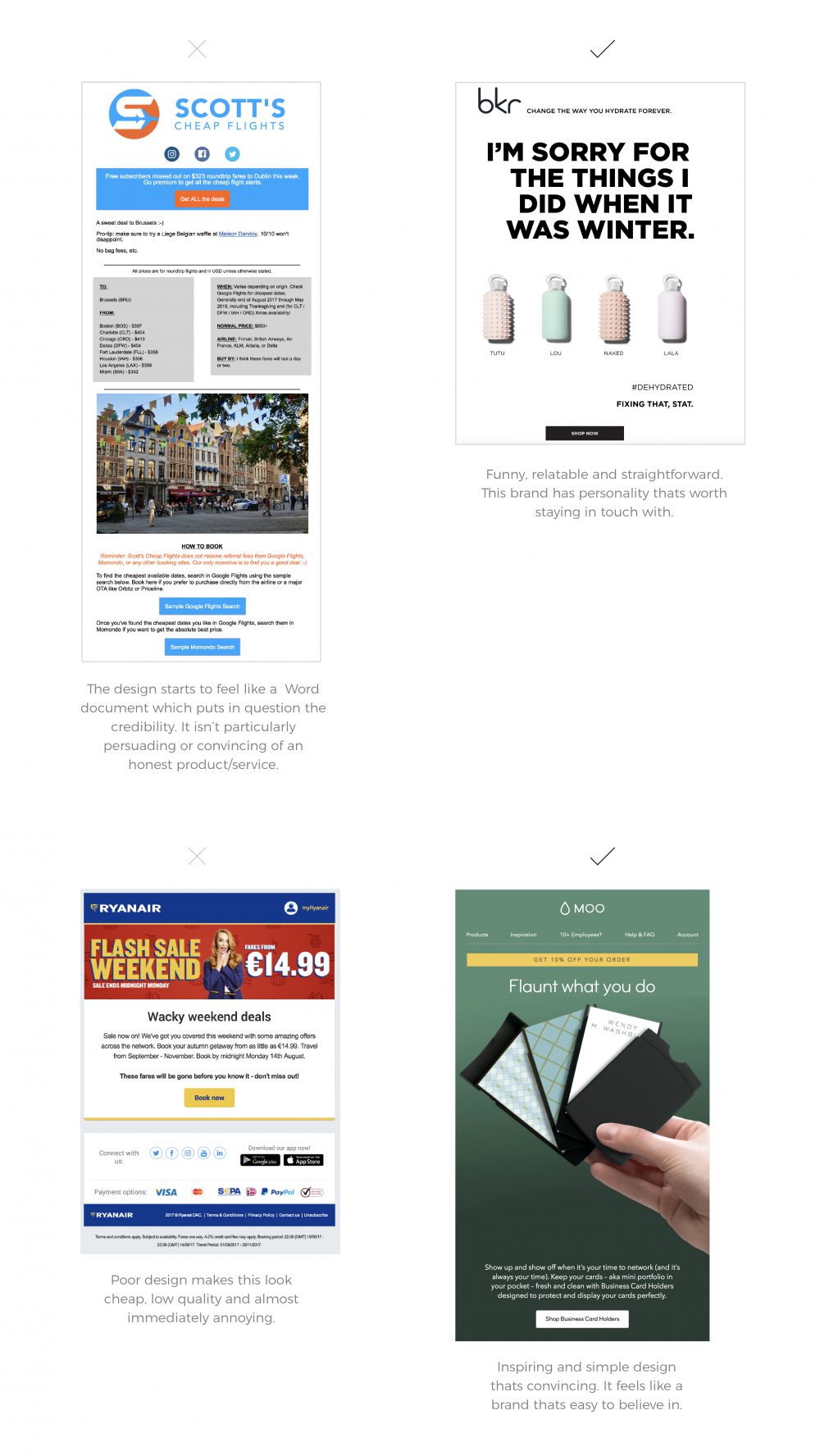
Belief is what bridges the gap between curiosity and commitment.
There’s a reason for the old adage don’t judge a book by it’s cover. It’s because we do! As consumers, we expect the quality of products/services to match their appearance. We don’t have time to be convinced that a certain brand/product/service is good, we should already be able to see that it is (or isn’t). A brand with good design is more convincing than a brand with bad design because we assume appearance reflects quality.
Have you ever found yourself wanting to purchase the organic or brand name cereal rather than the generic brand? We expect good packaging design to be the shell of a good product. Have you ever spent more money on a product just because it looks better than the cheaper version? By sole appearances, we assume more credibility with one brand than another, and we take one brand more seriously than another.
When design communicates quality clearly, customers are more willing to give you the benefit of the doubt.
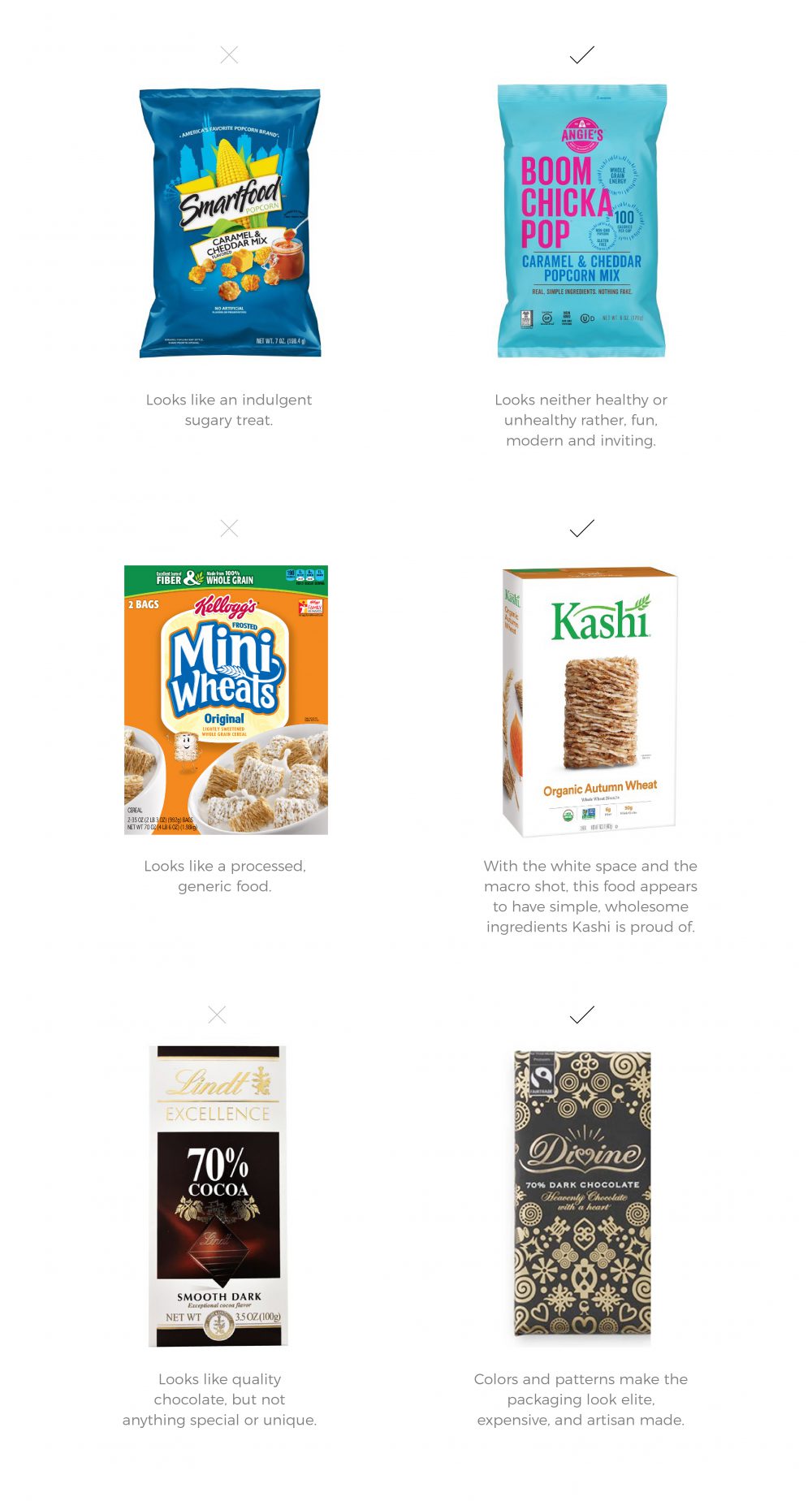
Brands with an up-to-date design make us feel like their product/service is likewise current and relevant..
Some brands stand out as cutting edge in their industry simply because they look the part. We’d be less likely to purchase a product from a website designed in the 90s, because we associate the outdated web design to the product/service. It’s as if we think, how can a product/service with a website from the 90s, serve the needs I have in 2026? There’s got to be another brand who is more current and fresh. With no progression in any aspect of design, it’s easy to assume there hasn’t been progression with the product/service either. A brand’s entire look and feel should show that it is leading the industry. Brands who look the part, convince their audience that they actually are.
Think of it like this: when design reflects forward momentum, audiences are more inclined to believe the brand can meet modern needs.
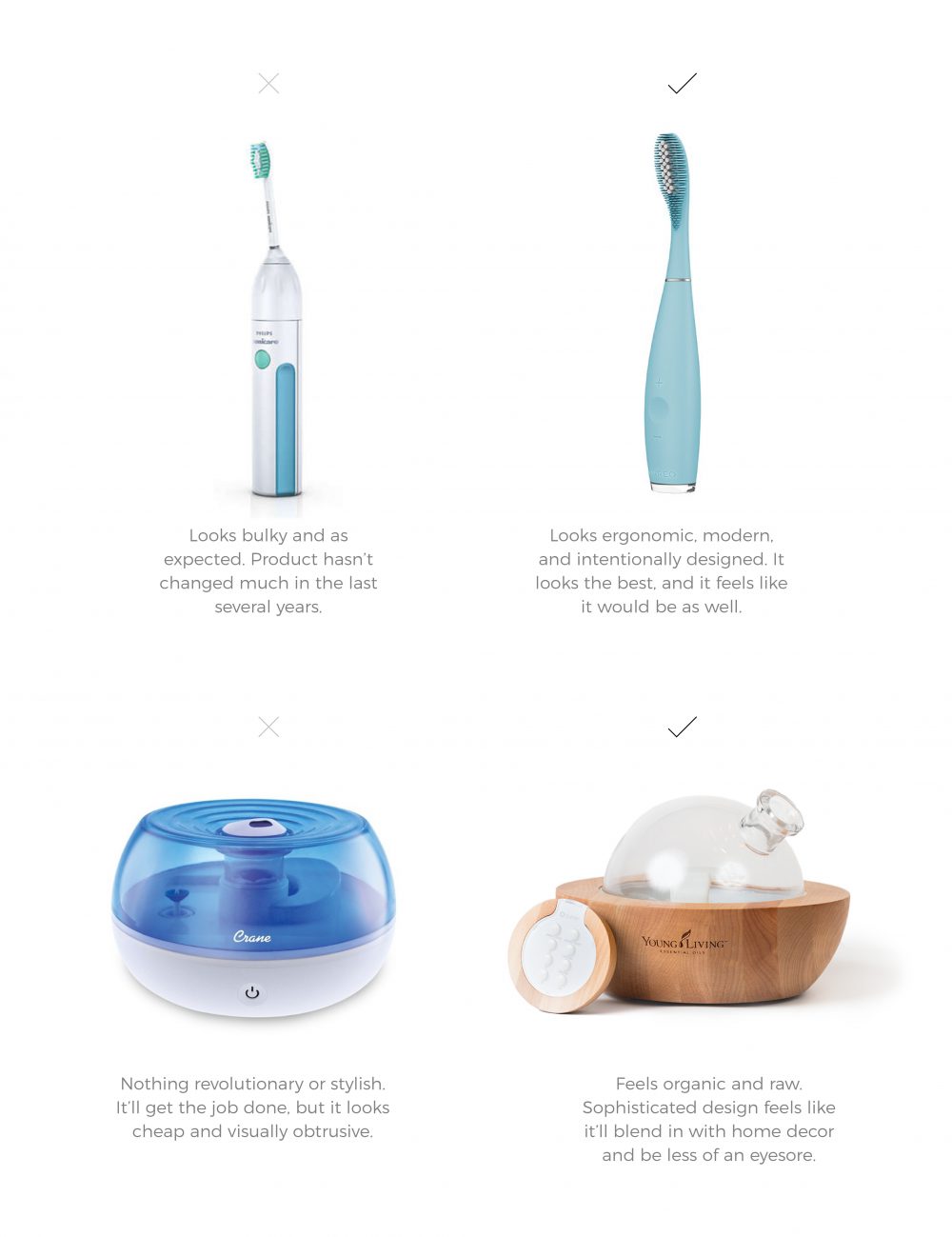
Design isn’t just how your brand looks; it’s how it feels. Feelings and instincts from good design cause positive behaviors. And the same goes for bad design causing negative behaviors.
Simply put, design dictates the user experience. So, take a second look at your brand. Does the design reflect the quality of your service/product? Is the design of your logo, website, flyer or whatever visual medium you’re using to communicate with your audience look like you’re a superior, dependable brand? Or do your visual mediums make viewers hesitate?
Visual design focuses on how an experience looks. UX design strategy focuses on how that experience works, why decisions are made, and how success is measured.
Psychology informs UX by explaining how people perceive information, form opinions, and make decisions. UX strategy uses that understanding to guide structure, flow, and priorities across the experience. Visual design then supports those decisions by expressing them clearly.
In terms of scope, UX design strategy is the broader of the two. It considers research, usability, business goals, and cross-functional needs. It is also measurable, with success defined through outcomes like engagement, conversion, and retention (rather than preference alone).
Building a UX design strategy requires intention, structure, and a willingness to learn from users. While every organization is different, most strategies follow a similar progression.
UX design strategy becomes clearer when viewed in context. Consider the following hypothetical scenarios:
These are, of course, only a few examples. The reality is when it comes to UX strategy, design must be adaptable to your product, your audience, and the specific situations where the two come into contact. A firm understanding of customer psychology, backed by reliable research, makes this possible.
UX design strategy matters because it shapes how users experience your brand and how confidently they move through it. When strategy is grounded in psychology and supported by research, design decisions become more justifiable and easier to scale. Teams gain clearer alignment, usability improves across touchpoints, and development effort is spent solving the right problems.
If you’re ready to build or refine your UX design strategy, 97th Floor partners with teams to create research-backed experiences that support both users and business goals.
Every company wants to be more innovative, more efficient, and more resilient in the face of change. The organizations that achieve this don’t rely on quick fixes. Their secret sauce is embracing continuous improvement in the workplace as part of their culture.
Continuous improvement in the workplace is the practice of making steady, ongoing progress in how an organization operates. Instead of waiting for major overhauls, it’s about finding small, meaningful ways to improve processes, skills, and outcomes every day. Over time, those small changes add up to major growth.
At its core, continuous improvement means asking, “How can we do this better?”, and then acting on the answer. It applies to everything from streamlining workflows and reducing errors to improving customer experiences and building a stronger team culture. There are two common types of continuous improvement:
Incremental improvement focuses on small, gradual changes made consistently over time. These shifts may feel minor in the moment, but together they build momentum and create lasting impact.
Breakthrough improvement targets bigger, more dramatic changes. These initiatives deliver rapid results and can transform processes quickly, but they require planning, resources, and strong leadership support to succeed.
Adopting continuous improvement in the workplace delivers value on every level: people, processes, and performance. Here are some of the most impactful benefits:
When teams consistently look for better ways to work, wasted time and effort disappear. Streamlined processes mean projects move faster, resources are used more effectively, and employees can focus on higher-value activities instead of routine bottlenecks. Over time, even small efficiency gains can transform productivity.
People thrive in environments where their ideas matter. Continuous improvement encourages employees to contribute suggestions and take ownership of change, which builds motivation and loyalty. An engaged workforce is more resilient and less likely to experience turnover.
Continuous improvement reduces errors and creates more reliable outcomes. Whether it’s fewer defects in a product, more consistent client communication, or smoother internal workflows, higher quality becomes the norm. This consistency strengthens trust with both employees and customers.
Small improvements often spark bigger ideas. A culture that rewards experimentation creates space for employees to test solutions, learn quickly, and share insights. Over time, this mindset drives breakthroughs that help organizations stay ahead of competitors and adapt to new challenges.
Customers notice when organizations are committed to getting better. Faster response times, smoother interactions, and higher-quality results all lead to stronger relationships and increased loyalty. Satisfied customers are more likely to return, refer others, and become advocates for the brand.
Markets shift quickly, and businesses that embrace continuous improvement adapt faster. Instead of scrambling to react, they already have the culture, systems, and skills in place to pivot with confidence. This long-term resilience helps organizations weather disruption and seize new opportunities.
Continuous improvement starts with leadership. When managers and executives demonstrate their own commitment to learning, adapting, and improving, it sets the standard for the rest of the organization. Employees notice when leaders share lessons learned, own mistakes, and celebrate progress (not perfection). This kind of transparency builds trust and signals that improvement is it’s a company-wide expectation.
Nothing derails improvement faster than vague expectations. Employees need a direct line of sight to what success looks like, and that’s why we need clear KPIs. Specific, measurable goals help teams visualize a roadmap for progress and motivate them to focus energy where it matters most. Instead of checking boxes or chasing vanity metrics, people know exactly how their efforts contribute to real outcomes, whether that’s customer satisfaction, faster project delivery, or higher quality work.
Of course, that’s not to say that the bottom line isn’t important. It absolutely is, but more than that, it can be a valuable measure of how effectively a business is promoting self-improvement.
When going ROWE (results-only work environment), we shifted from an environment that judged employee effectiveness by how long they clocked in or how well they obeyed the ever-important office rules to one that focuses exclusively on results. This is single-handedly the best way to foster an environment of self-improvement, as the employees are clear as to what they should work on. However, if the ‘results’ or KPIs that you have laid out for them are not clear, then this can be a disaster that will slowly kill the drive to improve.
I bring this up often, but years ago, when we had fewer than 10 employees, I was running the whole company in terms of payroll, insurance, etc., but I also directly oversaw one division, while my good friend Wayne Sleight, a then up-and-coming employee, was running another. He and I talked regularly, and he had pretty clear KPIs — not handed to him from me, but from his own awareness of his position. His department was humming; mine, on the other hand, was quite the opposite. The work we were putting out was top-notch, but we often missed deadlines and had terrible client communication. This was 100% on me, and with the benefit of hindsight, I’m able to see the biggest problems we were facing:
I was way too busy to be running the division. I should have clearly tasked someone to do it and provided them the same freedom and accountability I had given Wayne. I had asked several different people during this time to ‘run’ the division, but I often micromanaged and stepped in, but only sporadically, because I was being pulled in so many directions as the CEO. This created an unstable, inconsistent environment where I would be very present one day, and then totally gone or checked out in another. It also made it so I wasn’t very clear on my expectations with those running point, because I would often swoop in and take care of tasks that really didn’t require my involvement. One day, the person running point had all the keys to the kingdom, and then the next, I would come in and take them all away.
This was all done out of a desire to help my people out, but intentions aside, it watered down the KPIs, and it created a slow death of not knowing how to improve. Things became so lopsided that we often had to pull money from the other side of the company just to cover salaries.
If you want those around you to improve, give them a clear roadmap, both in terms of results and a career path.
Constructive criticism is the engine of growth. In workplaces where it’s scarce, improvement stalls. In workplaces where it flows freely, teams get better every day. Constructive, timely feedback allows employees to correct course, sharpen skills, and recognize strengths before they fade into the background. Leaders can model this by asking for feedback themselves, proving it’s a two-way street. When feedback becomes part of the rhythm of work, continuous improvement takes root.
I am very much a cheerleader — it comes from being very passionate about what I do. Often after going to a meeting with employees, they remark about the energy in the room and how well a meeting went, and that gives me a good opening to talk to them about how important it is to let the prospect or the client see your passion, and is a good way to set a precedent for my workforce and let them know that I expect them to be passionate about what they do.
After these meetings, or after speaking engagements where employees are present, I will ask my people how I can improve. This is because my employees can be my best critics, given their familiarity with the context. Did I make them feel uncomfortable by something I said? Did I say “um” too much? When requesting feedback from your employees, ask for honesty, and be sure to accept any criticism you receive graciously and with an open mind. Sure, at first, you will get ‘yes men’ answers from people who just want to get on your good side, but as you improve your relationship with your employees, those kinds of responses will drop away. Start by suggesting something you felt you need to improve on, and then invite your people to add anything else, and let them know that ‘yes man’ answers aren’t going to cut it. In my experience, our female employees are a lot more forthcoming and not as afraid to give criticism.
We are very fortunate at 97th Floor to have a healthy environment of self-improvement. We are all collectively working together to better ourselves, not just in our professions, but also in our lives. This focus has helped us build a company culture that extends well beyond the office walls and is gaining prominence throughout the business world.
As I said before, an environment of self-improvement should be every CEO’s dream, but dreams only take you so far. Turning that dream into reality, on the other hand, now that’s a goal worth striving for.
The best improvements often come from the people closest to the problems. A culture of continuous improvement depends on involving every employee, not just leadership or management. Encourage team members to share ideas, experiment with solutions, and celebrate small wins. Empowering employees creates ownership, and ownership creates momentum. When everyone feels responsible for progress, continuous improvement stops being an initiative and starts being the norm.
How to Implement Continuous Improvement in the Workplace
Continuous improvement in the workplace starts with leadership. Leaders must set the vision, explain why it matters, and model growth. When employees see leaders committed to improvement, they’re more likely to follow.
Next, set clear goals. Define what success looks like. It might be faster delivery, fewer errors, or happier customers; keep it specific to your team’s top priorities. Specific, measurable targets keep teams focused and moving in the same direction.
Employees also need a voice. The best ideas often come from those closest to the work, so invite input through surveys, workshops, or team discussions. Quick wins from frontline suggestions build momentum and prove the value of the process.
Finally, measure and celebrate! Track results with metrics like productivity, engagement, or cost savings. Share successes, expand what works, and keep the culture of improvement alive. When your team meets a goal, make sure they feel great about what they’ve accomplished.
Continuous improvement shows up in daily actions that drive lasting results. Here are some practical ways companies bring it to life:
Even small changes can save a large amount of time. When teams map their workflows, they spot redundancies and bottlenecks that slow things down. Cutting a few unnecessary approval steps can shave days off delivery timelines and free employees to focus on meaningful work.
Every time employees build new skills, the organization gains strength. Regular training, whether it’s new software, leadership development, or cross-training, keeps teams sharp, adaptable, and ready for whatever comes next.
Improvement doesn’t stop at internal processes. Businesses that listen to customers and act on feedback stand out in crowded markets. Shorter response times, personalized communication, and proactive service are simple shifts that build loyalty.
Continuous improvement also means taking care of the people behind the work. Encouraging employees to focus on health, wellness, and balance leads to higher energy, stronger engagement, and better long-term performance.
The best ideas often come from those closest to the work. When employees have clear channels to share insights, like suggestion systems, innovation days, or open feedback forums, organizations unlock creative solutions that leadership might miss.
The best organizations never stop improving. Whether it’s refining processes, empowering teams, or elevating customer experiences, continuous improvement keeps businesses moving forward. The same principle applies to marketing. Campaigns that evolve, adapt, and improve over time consistently outperform those that stand still.
At 97th Floor, we help brands embrace this mindset in their advertising and content strategies. From data-driven campaigns to creative storytelling, we partner with companies to build marketing that grows stronger with every iteration.
Ready to take the next step in improving your marketing performance? Let’s talk.
Backlinks have always played a central role in SEO. But as search evolves, the types of backlinks that truly move the needle have changed. Authority alone isn’t enough. Relevance alone isn’t enough. And shortcuts that once seemed harmless now come with real risks.
The best SEO backlinks today are the ones that demonstrate trust, expertise, and real value to users. They come from sites that operate with high editorial standards, have real audiences, and treat links as references instead of transactions.
In this guide, we’ll walk through the full landscape of what the best backlinks look like in today’s environment, how Google and AI systems evaluate link quality, and the practical steps teams can take to earn backlinks consistently. We’ll also break down strategies, examples, and pitfalls to help you build a backlink plan that’s safe, effective, and scalable.
The best SEO backlinks are links from reputable and contextually relevant websites that point to your content because they interpret it to serve a clear purpose. That purpose might be educating readers, providing a unique data point, offering a fresh perspective, or supporting a larger narrative. Regardless of the specific reason, high-value backlinks function as editorial endorsements. They signal that your content is useful to viewers.
Backlinks remain one of the strongest indicators search engines use to evaluate the overall quality and reliability of a page. Google wants to surface information that people can trust, and backlinks help demonstrate that trust at scale. When authoritative sites consistently link to your resources, it strengthens the case that your content:
Here are the specific areas high-value backlinks help shape:
A backlink from a credible site acts as a vote of confidence. The more reliable the linking site, the stronger the trust signal you earn.
Links from relevant domains help establish what your site is about. This strengthens your presence within a topic cluster and reinforces your authority in that specific area.
When respected publications or brands reference your work, it positions your organization as an authoritative voice in your field.
Links often appear when your content is genuinely helpful. Search engines notice this pattern. When real people rely on your content, algorithms tend to do the same.
These signals have a heavy influence on rankings. Backlinks strengthen your entity profile, help AI systems understand what your brand represents, and improve how your content appears across emerging search surfaces. A single high-value backlink from a relevant, authoritative source can outperform dozens of lower-quality links, which is why quality-driven link building is more important now than ever.
Search engines and users both rely on certain characteristics to determine whether a backlink is trustworthy. The more of these qualities a link possesses, the more value it’s likely to provide. Here are a few of the most important qualities to pay attention to when adding backlinks.
Relevance is the foundation of link quality. A backlink from a site that operates within your niche carries far more weight than a link from a topically unrelated domain. Relevance confirms that your content belongs in the conversation and reinforces your association with the subject matter.
Authoritative backlinks come from well-established organizations that demonstrate expertise, editorial oversight, and clear quality standards. This includes major publications, universities, nonprofits, reputable companies, and industry-leading blogs.
The best backlinks can drive real visitors. If a link sits on a page that attracts meaningful traffic, the value is compounded. Search engines can detect when humans interact with your content, and referral traffic is a powerful indicator that the link is genuinely helpful.
Where a link appears matters. Links integrated directly inside informative content carry significantly more weight than links placed in author bios, footers, or lists with no contextual relevance. Search engines understand this difference, and readers do too.
If the page linking to you isn’t indexed by Google, it cannot pass authority. This is an often-overlooked element of link evaluation, but it’s essential. Even the highest-quality link is ineffective if search engines can’t crawl the source page.
Search engines consider the broader “neighborhood” a link lives in. If the linking site is surrounded by low-quality outbound links, link-selling schemes, or spam-heavy patterns, its credibility declines. The company your link keeps matters.
Google’s link evaluation has evolved significantly. Now, it focuses heavily on signals that indicate whether a link genuinely benefits users. Backlinks created solely to manipulate PageRank or boost rankings artificially are considered violations of Google’s guidelines, and patterns of these links can trigger penalties, algorithmic or manual.
Google evaluates link quality based on several factors:
A link from a topical neighbor carries more weight than a link from an unrelated source. Topical mismatch often signals artificial behavior.
Links that appear on sites with strong editorial standards are treated as more trustworthy. Google looks for signs that content is reviewed, moderated, and held to quality expectations.
Contextual positioning within the main body of an article is preferred. Links buried in sidebars, footers, or author bios are treated as lower-value.
A healthy backlink profile includes a variety of unique domains. Hundreds of links from the same site rarely indicate popularity or usefulness — more often, they suggest manipulation.
If Google can’t index the linking page, it can’t evaluate or pass any authority from it.
Patterns like excessive guest posting, scaled link schemes, article farms, or bought placements are easy for Google to detect. These tactics erode trust and invite risk.
The takeaway: strategies built on shortcuts or rapid link accumulation tend to lose ground quickly. Quality-first link-building remains the most sustainable approach.
Understanding what makes the best seo backlinks high-value is one thing. Actually earning those links, at scale, is another challenge entirely. There are dozens of ways to build links, but only a handful consistently deliver relevant, trustworthy, and sustainable results.
Guest posting is one of them.
Guest posting isn’t perfect, and like all link acquisition methods, it has its risks. In May, Google released a statement regarding poor-quality links found in contributor posts. Google warns that when the main intent is to build links in a large-scale way back to the author’s site, these practices are in violation of Google’s Guidelines. However, Google does not officially discourage guest posting, stating, “Google does not discourage these types of articles in cases when they inform users, educate another site’s audience, or bring awareness to your cause or company.”
So what’s the best way to gain backlinks through guest posting? Here are a few tips that stay within Google’s guidelines, benefit site owners, and most of all, provide results for your SEO efforts.
It is crucial to find sites within your niche or industry. Nothing screams spam like getting backlinks from a completely irrelevant site. For example, if you sell barn doors, then you want to get backlinks from sites about home improvement, interior designers, DIY blogs, etc. You wouldn’t want backlinks from sites about video games or fitness. The more relevant the site linking back to your site is, the more natural it will appear to Google.
So, how do you find sites to post to? There are numerous paid tools you can use to find sites. However, simply using Google Search can produce excellent results. Use search parameters in Google to narrow your search. These are a couple of search parameters that you can use:
By replacing keyword with your keyword, you’ll start to find sites that accept contributors. Again, ensure that these sites are relevant to your niche or industry. There are a lot of spam sites that will accept anything. You want to avoid these sites.
It’s important to evaluate your outreach strategy and adapt as necessary. Vary your search parameters depending on what results you’re finding and the niche or industry that you’re outreaching for. Simply switching between “insite” to “inurl” will display different results. If you’re still not finding sites, then just try a good old-fashioned Google Search without any search parameters. This usually produces a broader range of sites, but that might be just right for your industry.
The first thing to look for on a site that accepts guest posts is the posting guidelines. This usually gives a good idea about what the site expects from you and what you can expect from them. In addition, most guidelines will say something about including backlinks in your post. Some sites will not accept any articles with links, while other sites will remove links if they appear to be spammy. Never reach out to sites that ask for money in exchange for backlinks. This is specifically against Google’s guidelines, and if done enough, the site could be penalized.
Next, check the domain authority (DA) of the site. As a rule of thumb, never reach out to sites with a DA below 20. You want to be looking for high-quality sites. Sites that have a DA below 20 typically will not be the quality that you're looking for, and will pass less authority to your site.
Check to make sure the links are followed and the blog posts are indexed. You can do this manually by checking the source code for nofollow or noindex tags. If the site has a decent DA but has nofollow links, you can still reach out and contribute to this site. Diversifying your backlink profile with follow and nofollow links will appear more natural to Google, and ultimately help your ranking strategy. However, there is essentially no value in a noindex blog post. Avoid these sites, as they will not help your strategy.
After you’ve thoroughly qualified the site, reach out to the website via email. This can usually be done through a contact form on the site. However, you’ll be more successful if you can find a contact email on the site. This can take some digging, but if you can contact an actual person, you’ll have a greater chance of getting a response back.
Try to be as personable and specific as possible when reaching out to new sites. There are a few things that you should include in each email. Let the contact know that you aim to provide free high-quality content to their site. Follow this up by adding some ideas for future articles. Also, provide the contact links to your previously published work so that they have a sample of your writing. If you don’t have any published work yet, you can post for free on Medium or Kinja and send them links to those pieces. Most importantly, display thorough knowledge and enthusiasm about their site. Webmasters like to know that their site is enjoyable to users.
This is perhaps the most important step. Poor quality content is the number one reason that content partnerships end. Ensuring that your content, as Google states, “informs users, educates another site’s audience or brings awareness to your cause or company,” will keep your partnership happy and be an ongoing resource for you to gain backlinks.
There are ways to acquire backlinks that might seem easier than guest posting. However, what you sacrifice for ease of use is typically quality of content and quality of backlinks, which isn’t worth the risk of getting penalized. Guest posting can be time-consuming, but when following these steps, it will provide the best and safest ROI.
Not every backlink is worth the effort. Some can actively harm your visibility and credibility, even when they look harmless on the surface. Most teams already know to avoid the obvious pitfalls (spam sites, link farms, paid placements, etc.), but risky link tactics often show up in more subtle ways. These patterns can gradually weaken your backlink profile and create signals that search engines interpret as manipulative.
One of the most common issues is buying backlinks from lists or marketplaces. If a site openly sells links, it’s already on Google’s radar. Even a single placement on a known link-selling domain can dilute the strength of your overall profile. Scaled guest posting can be equally harmful when it lacks editorial oversight. Google doesn’t penalize guest posting itself, but it does penalize repetitive, low-quality content spread across unrelated sites with identical anchor text patterns.
Anchor text misuse is another red flag. When links consistently use the same exact-match phrasing, it signals manipulation rather than natural citation. Low-quality directories fall into a similar category. A few reputable listings can help support local visibility, but hundreds of generic or irrelevant directories don’t provide meaningful value; they only clutter your profile.
Finally, reciprocal link schemes continue to cause issues for teams trying to grow quickly. “I’ll link to you if you link to me” might feel efficient in the moment, but it remains a clear violation of Google’s guidelines and is easy for algorithms to detect.
Sustainable backlink strategies are built on relevance, usefulness, and genuine connections between brands and audiences. When your link-building efforts prioritize value over volume, you gain stronger rankings, more defensible authority, and long-term momentum that lasts.
Strong backlink programs require expertise and a clear understanding of what actually works in today’s search environment. If your team is ready to earn backlinks that strengthen your authority, improve your visibility, and support long-term organic growth, we can help.
We’ve built backlink strategies for some of the world’s most ambitious brands, and we know what it takes to earn links that last. Let’s build something great together.
Key Takeaways
If you’re familiar with 97th Floor, you know that we practice an HR management strategy called ROWE, which stands for Results Only Work Environment. In fact, we’ve become a ROWE Certified Organization. While ROWE isn’t all that our culture is, it definitely is the first aspect of our culture that people think of.
That recognition is earned. Autonomy is one of our strongest differentiators, and it often sparks curiosity: What does results oriented, or results only, actually mean? Results oriented, put simply, is a professional environment where employees have complete control over how they accomplish their work, so long as the outcome meets expectations. Productivity replaces presence. Quality replaces hours. In exchange for freedom, employees give full accountability. A fitting results oriented synonym might be performance-driven, outcome-focused, or impact-first.
The autonomy a results oriented culture gives our employees is one of the things that really sets 97th Floor apart. That said, it feels like there might be some misconception about what the reality of ROWE really entails. I’ve heard non-97th Floor employees describe our results oriented culture as being all about working remotely from sun-soaked vacation spots, sipping icy drinks and brushing sand off of your keyboard while you tackle your tasks — or throwing decorum to the wind, and working from your couch while wrapped in an old blanket.
But while it’s true that all of us at 97th Floor have the freedom to do both of those (I know I have a few times with the former… and, yes, maybe a couple of times with the latter), that doesn’t mean that the perceived opposite (working 9–5 in the office) isn’t also ROWE. In fact, sometimes a standard 9–5 employee is more ROWE focused than the guy who’s working from the beach (or the living room).
You see, what ROWE is all about is allowing the individual employee to decide what works best for them. Productivity, efficiency, effectiveness — these are the considerations that drive a results oriented employee. Hours spent in the office, or hours not spent in the office, don’t even come into play. In essence, the workforce gets 100% autonomy, and in return gives 100% accountability. We can do whatever we want, whenever we want, wherever we want, as long as we get the work done.
Of course, it’s not hard to see how this perceived division between ROWE and standard 9–5 work environments came to be. In fact, just a couple of week ago a local business magazine picked 97th Floor as one of the best companies to work for in Utah County. Unfortunately, in the resultant article I was quoted as saying something that in retrospect I feel may have added to the misconception that ROWE (and therefore 97th Floor) is against the 9–5 schedule.
“Too often,” I posited, “mediocre employees hide behind a 9–5 environment. ROWE lets the work — not the punch clock — do the talking.” And while I stand by my assessment, the point I was trying to make may not have been as clear as I would have hoped. What I meant by this is that just putting in 40 hours (or even 50 or 60) per week doesn’t necessarily mean effective results.
The truth is that lackluster employees will likely be just as unengaged at 40 hours as they are at 20 hours, but it’s those same employees who are so quick to point out that because they’re putting in the hours, they must be ‘working.’ A results oriented company is one that recognizes that employees are paid to do more than just warm a seat in the office. Underperforming employees shouldn’t be able to hide behind perfect attendance, because attendance doesn’t generate profit. Where someone does their work or how many hours they are working simply doesn’t matter, as long as they’re getting the results.
And yes, it’s true that even in most traditional 9–5 workplaces, employees are still judged on results as well. But oftentimes the amount of hours put in can help keep an underperforming employee around for a bit longer. If your 9–5 based company doesn’t allow hours worked to be a factor in employee evaluations, then that’s great, but if that’s the case, then what’s the point enforcing a schedule in the first place?
For the record, 97th Floor doesn’t have a problem at all with people working Monday through Friday, 9am–5pm. In fact, based on my estimate (and obviously I can’t pull in actual numbers since we don’t track time), about 20% of our employees still work every day during the week at our office, showing up at 8 or 9am and staying for about 8 hours. These people are absolutely taking full advantage of ROWE. They are deciding that being at the office for 8 hours each day from Monday to Friday is the best for them.
I’d venture a guess that these people are more effective by choosing for themselves to work a traditional schedule than if they were forced to by their employer. I’d also estimate that another 20% of our employees work almost exclusively from home or elsewhere (only coming into the office for meetings) and the remaining 60% work a hybrid between the office, home, and elsewhere. Each of these work schedules are just as much a part of ROWE as the next.
One benefit that people often point at of having everyone in the office each day from 9–5 is that people need to collaborate and communicate with each other. With Slack, GoToMeeting, and other collaboration tools, that’s really not an argument anymore. For the times when an employee needs to meet in-person, they just schedule a meeting at the office, giving everyone involved enough notice. Again, this isn’t to say that working in an office everyday from 9–5 is bad. The bad part is not having a choice in the matter. People should choose for themselves where and when they work.
Building a results oriented workplace takes intention. Through our transition, we found that it comes down to changing four things.
First, get clear on what “done” actually means.
If the goal is fuzzy, effort becomes the measurement by default. We’ve all seen projects that took many hours or even days, yet no one can really say if progress was made. Setting clear, measurable targets gives people something concrete to run toward instead of just filling time.
Second, make accountability visible.
Accountability isn’t a threat; it’s a promise. When people know what they’re responsible for, and when results are reviewed openly, ownership becomes natural. Not because someone is watching, but because they care about delivering.
Results-only work already proved you don't need someone watching over every task. AI just made that argument impossible to ignore — watch how in this short video.
Third, give people room to figure out how they work best.
Autonomy is the magic ingredient of a results oriented model. Some of us think best at a desk. Some do our best work in a coffee shop, or at home with a dog on our lap. Let adults be adults. Give them space, trust, and the expectation that the work gets done.
Last, communicate like a team that’s rowing in the same direction.
Slack threads, quick meetings, shared timelines; none of that goes away. In fact, it matters even more. Freedom works because communication does. It keeps projects moving and prevents anyone from feeling like they’re building in a vacuum.
Put those four things together and you can get your team to stop watching the clock and start chasing outcomes. When you make the shift, it’s hard to imagine working any other way.
When measuring success, obviously, we’re really only talking about time and location here, and not everything that ROWE encompasses. Still, in regard to time and where we work, science is backing up the principles of ROWE. Recently, Nicholas Bloom, a professor at Stanford, gave a talk at TEDx about working from home. His study with one large company found that giving employees the choice to work from home resulted in a 50% drop in employee attrition, employee performance went up by 24%, and the company made an additional $2,000 in profit per employee. There was also a study by author and National Geographic Fellow, Dan Buettner, that showed cutting an hour-long commute each way from a person’s daily schedule gives that person the happiness equivalent of an extra $40,000 per year. At 97th Floor, we focused on tracking four metrics when we switched over to a results oriented culture: client retention rate, employee turnover rate, revenue per employee, and goal completion percentages of contracts. Over the lastC two years, all four have improved. Our clients and employees are staying longer, we are delivering better results, and we’re more efficient.
Our society is getting better and better at allowing people to be individuals. People are increasingly encouraged to do and be what makes them happy. Yet with work, the majority of companies still expect everyone to be the same. We need to change this mindset and let individuals manage themselves, while the company manages the work results. When that happens, success will come — whether that means working 8 hours a day in the office, or doing it all from the comfort of a well-worn couch.
As a company we commit to Pledge 1% - of revenue, resources and time to movements and missions that matter. The AF Canyon Run Against Cancer is close to COO Wayne Sleight's heart. See a bit of his story in the video.
We invite you to join us for this year's race, details here: http://afcanyonrun.com/
Run. Volunteer. Donate.
Here are 5 things to create a killer Facebook ad with expert and PPC Specialist Cinthia Packard.
Article and tips here.
Lead-generation is a core component of a B2B marketing strategy. However, many businesses struggle to improve lead quality and quantity. Specifically, a survey from ActOn found 37% of SMBs struggle to convert web visitors into leads. While a low conversion rate can be caused by driving the wrong traffic to the site or by pursuing the wrong marketing strategy or having a poorly optimized page, many businesses will benefit most by building a more robust lead-gen strategy first.
Small businesses frequently start their lead generation by creating a core offer to garner interest in their product. These end-of-funnel offers-- free trial, free quote, free consultation, contact us-- are essential components to a lead-gen strategy. However, for businesses with longer marketing and sales cycles, having only these types of offers is a missed opportunity to capture and nurture leads.
In fact, if you have a robust top-of-funnel content marketing strategy in place with a low conversion rate, adding an offer of relevant mid-funnel content can significantly increase your conversion rate. For example, one 97th Floor client had a robust content marketing and SEO strategy driving qualified traffic to the site. Its “Free Trial” offer brought in a good number of leads, but overall, the conversion rate of the site was extremely low.
We decided to test creating an ebook and placing the offer in hyper-relevant locations on the website. Within the first two months the conversion rate for organic traffic increased 3x, and months later the site retained that conversion rate. After the success of the first ebook, we created another gated offer that was relevant to other high traffic content pieces. Organic conversions increased by 43% and were maintained long-term.
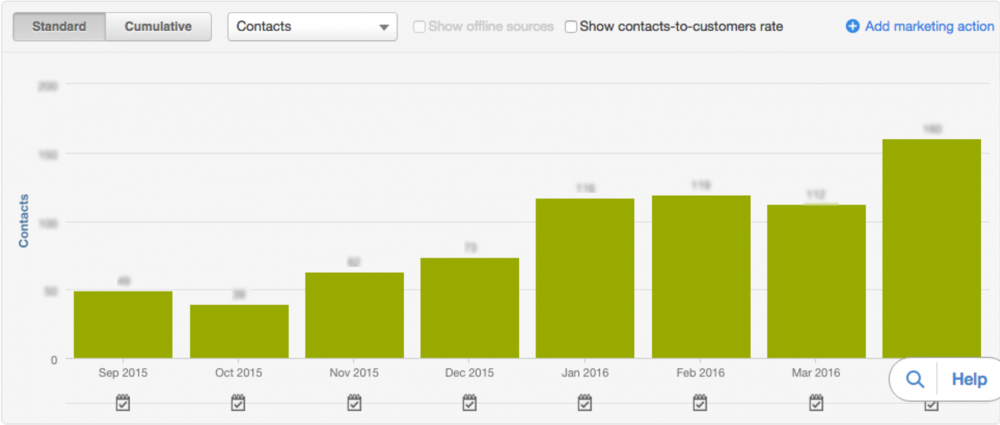
While having mid-funnel content was a key component to the campaign’s success, having effective content was the most critical component for driving quality leads. Many marketers would agree that content marketing is an extremely effective lead-gen tactic. However, it can also be the most difficult to execute well. After all, good content should be unique and insightful while nurturing potential customers all at the same time.
So what process can you follow to create effective lead-gen content?
In the case study cited above, we found there were 3 core questions a buyer needed to answer before making a purchase decision. The majority of that information was difficult to find, requiring visiting multiple websites and fitting pieces of information together while navigating a plethora of buzzwords. The ebook we created offered a comprehensive buyer’s guide that provided a framework for answering those questions and compiled all of the necessary information into a single location.
Content mapping is not a new concept, but many businesses fail to understand how crucial it is. Content should be mapped not just to the stage in the buyer’s journey, but also based on the information the visitor is consuming at the time.
For example, if a visitor comes to your website via a blog post titled “What is content marketing and why does it matter?” an ebook about “How to Optimize Title Tags” is not nearly as relevant as an ebook on “How to Develop Your First Content Marketing Strategy.”
In the case study above, the main CTA to the buyer’s guide was placed on a page with a competitor comparison matrix. Visitors who arrived on that page were already looking for information to help them make a purchase decision, so a comprehensive buyer’s guide was a compelling offer for those visitors. So compelling, in fact, that the click-to-submission rate ranged from 50-65%
Many traditional marketing activities- webinars, trade shows, purchased lists- are one-and-done activities. Once the event is over, it doesn’t continue to generate leads. If the business needs more leads, it has to attend another trade show or produce and promote a new webinar. Gated content, however, can produce a long-term conversion funnel if you create the content with that intention.
Content typically dies because it:
The secret, then, to creating a long-term conversion funnel is to create content that will still be useful to a buyer two years from now and is tied to organic traffic coming to your website. In the buyer’s guide case study, the conversion rate was maintained because SEO was the primary content promotion strategy with only a small percentage of leads coming from social or paid channels.
There is no one-size-fits-all solution in marketing, but by following the principles above you’ll be able to create effective lead-gen content and test whether mid-funnel conversions can have a significant impact on marketing ROI.
When I was just a young pup trying to make his way in the vast and often unforgiving wilderness of content marketing (yes, I’m talking about back in 2013), I often found myself assigned to write about topics that were, shall we say, not within my field of expertise. This was neither uncommon nor unexpected; after all, when your field of expertise consists of an encyclopedic knowledge of 90s-era animated superhero television shows and almost nothing else, then you should expect to work outside your comfort zone.
So, I learned the art of the 20-minute masters course. If I needed to write about tips to getting the most out of the Paleo diet, my first step would be to type “what is paleo diet” into my Google search bar, and my second and last step would be to create an 800 word article about how throwing out 10,000 years of agricultural science might actually be a healthy decision. If I was asked to highlight the benefits of solar energy, I’d learn the science while writing it and come away an hour later convinced that traditional utilities were the tools of the devil.
I learned a lot during those 20-minute, panic-fueled research sessions—taking in, metabolizing, and excreting knowledge back into the internet, like some virtual circle of life, except with trivia and statistics instead of whatever The Lion King was about. By the way, when Simba became leader of the pride, did he kill all of the other male cubs? Because I’ve heard that lions do that.
In any case, the end results were, if I may say so, decently informed content presented in a way that was at least mildly interesting. For example, take an article I wrote about food storage and different types of fictional apocalypses. I mean, when faced with a sea of emergency preparedness articles, it was nice to be able to create something unique, in that it was was both helpful and unflinchingly honest about your family’s chances of surviving a robot uprising. Of course, that’s not to say that I didn’t encounter the occasional snag. Research, particularly the kind that is motivated by imminent deadlines, isn’t always an exact science.
If you’re finding yourself in a similar situation—needing to produce factually-based content quickly—then I think I can help. The internet is a big place, and if you know where to look, whom to ask, and what ‘sponsored content’ is (hint: it’s not news), then there’s no reason why you shouldn’t be able to locate the information you need, and with enough time left over to turn it into something useful.
This may come as a shock to some readers, but just because it’s on the internet doesn’t necessarily mean that it’s trustworthy. Believe me when I say that it doesn’t take much in the way of credibility to get your words up on a website. Do you think that Buzzfeed is asking for credentials and references from the person who just wrote “15 Reasons why Cocoa Butter Is the Best Thing Ever”? Of course not. Why would they? Most internet users aren’t looking for peer-reviewed studies; they’re after some quick entertainment, and the thought of tracing sources or following up on bibliographies is about as far from “quick” or “entertaining” as you can get.
That doesn’t excuse your responsibility as a content creator. To put it bluntly, the internet is already well stocked with sensationalism and biased opinions masquerading as fact; don’t add to it. If you’re going to be presenting information, do everything in your power to ensure that it’s reliable information. Which, of course, means knowing where to find it.
Government and educational sites are generally held to a higher standard than others, although that’s not to say that they are always 100% accurate (or unbiased). Still, those that include data from relevant studies are usually trustworthy, and will not only provide you with relatively reliable information from which to craft your content, but may also give you interesting stats and data to link to to support any arguments you might be making.
News sites are also authoritative resources, but bear in mind that not every news site is created equal, nor is every site that identifies itself as a news site recognized as one. Some are just ideological outlets for particular interest groups (I’m not naming any names, Fox News and Huffington Post). There’s actually a lot of data that goes into which news sites are the most reliable and objective, and I’m not going to bother reproducing it here, but feel free to check it for yourself. Stick to the ones at the top of the list, and you should be OK.
On the bottom of the barrel, we’ve got blogs. Now, I’m not suggesting that blogs are incapable of unbiased reporting or producing accurate data, but I am going to point out that when a post is being written by a single author, for that author’s site, with no editorial or supervision failsafes in place, then there’s really nothing stopping them from making whatever claims they’d like. If, on the other hand, a blog includes links to its resource material, then feel free to track the truth down yourself, and if it looks promising, then link to the original source in your own article.
Finally, I’d like to set a few things straight with regard to Wikipedia. First, no, you should never link to Wikipedia. This is because Wikipedia is a collaborative encyclopedia, and you really don’t have any way of knowing whether the author was relaying reliable information. Perhaps even more importantly Wikipedia has a reputation for being a non-reliable source. A link to Wikipedia can end up doing more harm to the perceived authority of your article than whatever information you’re attempting to cite could hope to offset. Interestingly enough, I was once writing for an Australia-based client who wanted links from Government sites, and I discovered that the Australian .gov pages were not above linking directly to Wikipedia articles. I think I found where I’d like to retire.
This is because, in my personal experience, I’ve found Wikipedia to be one of the most accurate and complete internet resources available. When it comes to general information, I’m more likely to trust Wikipedia than any government or news site, because if there’s one thing that the kind of people who write and edit for wikipedia love, it’s correcting each other. No fallacy or inaccuracy is going to last long when you have thousands (or more) of potential editors looking over everyone’s shoulders, just aching for a chance to show off what they’ve got. It’s like misusing the word “whom” in a room full of English teachers—you’re going to be corrected, and it’s going to be swift.
So, should you use Wikipedia? Of course you should! It’s probably the most complete repository of human knowledge available. Just don’t link to it. Instead, use Wikipedia as a general research tool, and then if you need something to link to, check out the references section. You can evaluate the authoritativeness of specific resources, and if they look good, then you can link to them yourself. You should already be in the habit of tracing information back to its source, so in that respect, Wikipedia really isn’t any different.
Finally, as a general rule, if a site is actively trying to sell you something, then it may not be the best resource. On the other hand, if they support their claims by linking to relevant studies or including a bibliography section, then there’s no reason why you can’t take advantage of their hard work. Don’t worry, if you do a good enough job, you’ll be able to pay to forward to the next internet writer who comes to your site looking for usable information.
Pretty straightforward so far, right? Well, there’s one other thing to consider when researching your article: time. No, I’m not talking about the deadline; I know you haven’t forgotten that part. I’m talking about the date stamped on your source material. You see, usable information is three things—reliable, relevant, and recent. If you find the perfect stats to support your argument, but they’re from a report conducted three decades before the word ‘internet’ even existed, then they’re not the perfect stats. That said, the shelf life on some resources is longer than others.
As an example, let’s take a look at the two links I’ve included in this post. The first one is found all the way back up the page in paragraph #3 (the weird part about how much I dislike Lion King). Clicking that link will take you to a news report on the site Livescience.com. The article is everything you might want in a linkable resource—it’s authoritative, well researched, blah, blah, blah. But take a look at the year it was published. 2013. That means that the data is going on half a decade old. A discerning reader will make note of that, and might wonder why you haven’t been able to find anything newer to back up your arguments.
The second link is the one about which news sites are most widely trusted (about eight paragraphs up from this one). The page I’ve linked to was published less than two months ago, and that means the data is as fresh as a crispy head of lettuce.
But, like I said, the shelf life all depends on what you’re linking. The piece about the lions was published three to four years ago, sure, but how much could lions have changed in that time? On the other hand, the data about the reliability of news sites would likely be outdated much sooner. Can you think of any events, say, maybe far-reaching political events, that might have changed how readers view news-site reputability? In this case, even data that is only a year old might be too antiquated to use. It’s all about what information you’re citing.
Want an easy solution? Well, I’ve got one for you. When you do a Google search for reliable information, just click on the “settings” button underneath the search bar, and scroll down to “advanced search.” This will take you to a new page, where you can more clearly define what kinds of sites you’re looking for. About halfway down the page, you’ll see the “last update” option. Select it, and then select “past year,” before finalizing your search. This will return only pages that have been updated within the last twelve months, so you’ll have fewer outdated results to sift through. Trust me; this one’s a time saver.
It would certainly be nice to be able to contain all of our writing within our own areas of expertise, but it’s just not realistic. In fact, in the four years I’ve been writing at 97th Floor, I think I’ve only had one article published that made any sort of reference to Batman: The Animated Series, and it was subtle enough that the editors at Business.com didn’t notice. The reality is that in order to succeed as an internet content creator, you’ll probably have to take a few steps out of your comfort zone, and that’s actually a good thing.
You can be the expert that readers need, even if that expertise is built on nothing more than 20-minutes of Google search results. After all, content marketing is all about providing readers with content that is educational and informative, and if you can give it to them, then no one will care that you’d be more comfortable writing about cartoons.
Oh, and with that, it looks like I’ve now referenced Batman in two of my articles. I guess my expertise is worth something after all.
