



Revver, formerly known as eFileCabinet, is a cutting-edge document management and workflow automation solution provider. With a rich history in simplifying file organization and collaboration, Revver continues to empower businesses with innovative tools to enhance efficiency and streamline document processes.
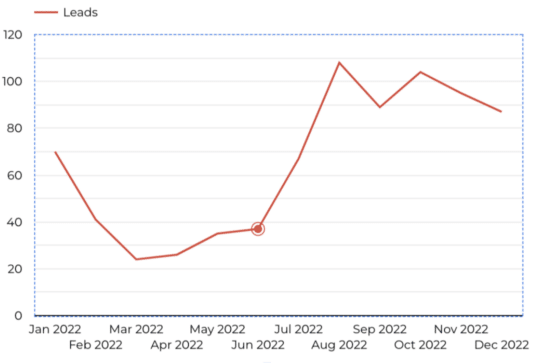
At the start of the year, Revver encountered a decline in the performance of its LinkedIn ads. Despite sporadically generating a significant volume of leads, the issue persisted as these leads never turned into qualified prospects.
At this time, Revver was undergoing an up-market shift, refocusing on larger organizations and adjusting their Unique Selling Proposition (USP), presenting an additional obstacle in the path to securing qualified leads.
In June, 97th Floor began collaborating with Revver to implement 6sense segments in their LinkedIn ads. This strategic move aimed to refine Revver’s target ICP's and effectively fill their pipeline with qualified leads.

By the end of the year, 97th Floor's revived LinkedIn campaigns were pulling leads that were qualified 22% of the time—a huge bump from the 1.5% qualification rate in 2021.
Alteryx is a data preparation platform that empowers organizations to efficiently clean, structure, and enrich their data for analytics and business intelligence. With a focus on user-friendly data wrangling and collaboration, Alteryx accelerates the data preparation process, enabling teams to drive informed decision-making.
Alteryx came to 97th Floor after initially partnering with an agency to boost organic results but left with nothing to show. After talking with 97th Floor, Alteryx believed that our expertise and strategy would get them where they wanted to be.
To kick off its SEO strategy, 97th Floor focused on creating new content and enhancing existing content. Because of Alteryx trust in 97th Floor's expertise, they immediately removed any unnecessary roadblocks that could have slowed the SEO process. This proactive approach guaranteed a seamless and efficient implementation of their SEO efforts.

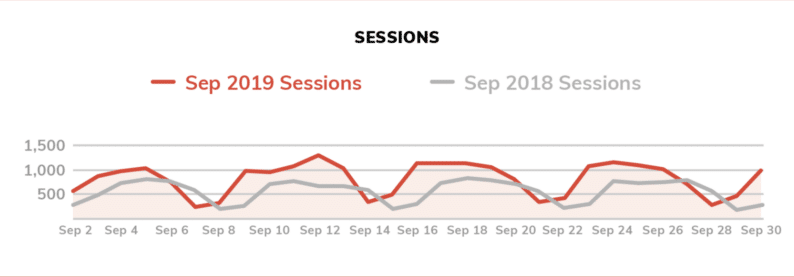
In just 1 month, 12 new content pieces were published as well as and scores of on-page optimizations. This led to astounding results within the first quarter, an anomaly in the SEO world—a 44% YoY increase in organic sessions.
Ilumio is a cybersecurity company known for its micro-segmentation solutions, offering network security against cyber threats. Their innovative technology helps organizations effectively secure their network infrastructure.
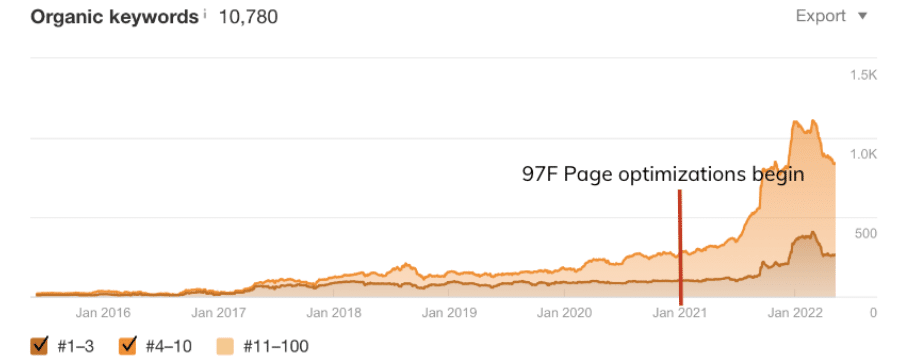
When ilumio came to 97th Floor, they ranking for less than 4,000 total keywords with only 264 of those keywords holding a first-page ranking. Addressing this limitation became a primary focus to enhance Illumio's online visibility and reach.
Audits identified keyword cannibalization issues on Illumio's site. 97th Floor's top priority was eliminating these competing pages to enhance organic traffic.
The next step involved optimizing pages targeting keywords with strong baseline rankings and high search volume. Additional audits and keyword research informed content re-optimization, internal linking, and site structure changes.
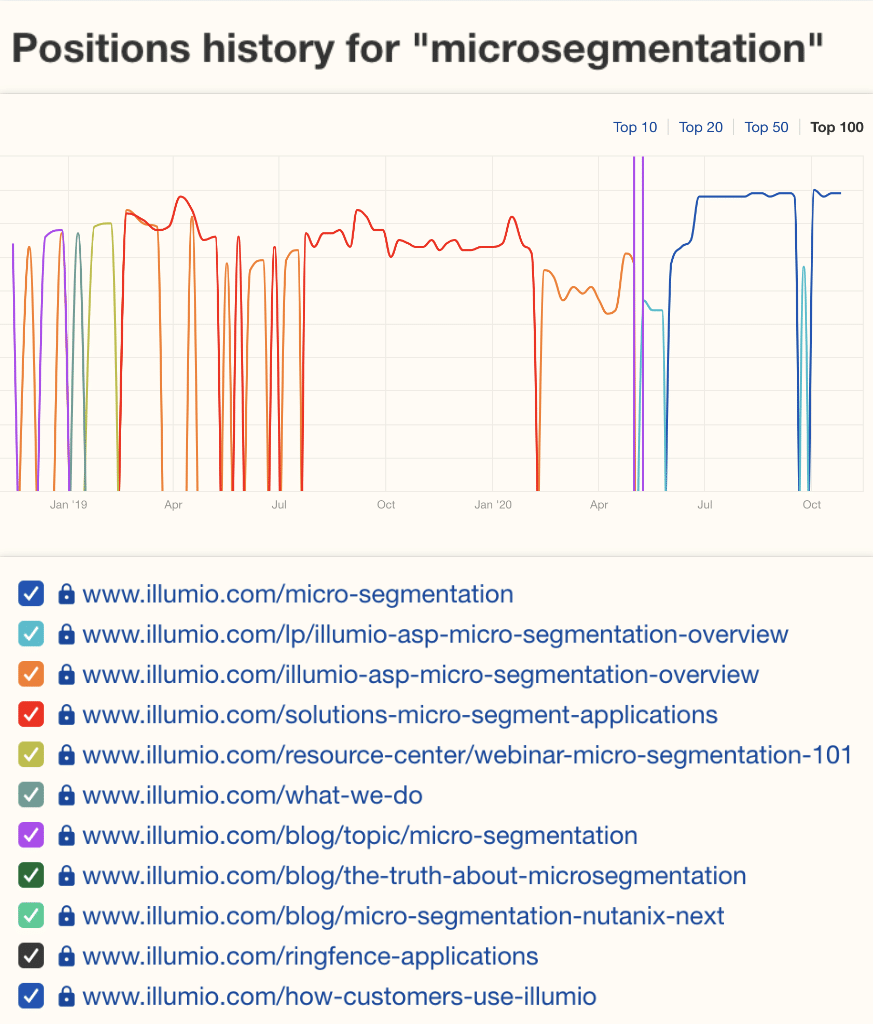
After only one year of working together, Illumio was ranking for 9,671 total keywords, with 812 keywords on the first page.
97th Floor specializes in full-funnel marketing strategy combining SEO, paid media, content marketing and design services. We generate sustainable growth for well-funded startups up to the Fortune 500—including AT&T, LG, Google and Celebrity Cruises.
Operating from the intersection of creative and analytical work, we deliver the results our clients want and need, like...

The award-winning campaign (featuring sledge hammers) that won 100+ closed deals for Revver (formerly eFileCabinet) from one trade show, Increasing new users by 48% with a killer SEO strategy, cutting a 240-day sales cycle to 90 days,
A 371% increase in MoM digital sales for the Utah Jazz, and a 390% increase in referral traffic.

Our ability to generate sustainable growth for our clients is impressive, but the how is quite simple. The 97th Floor advantage all comes down to team structure.
When working with a marketing agency, you almost exclusively interface with an account manager who directs strategy.
We found that this approach leaves too much room for miscommunication and errors.
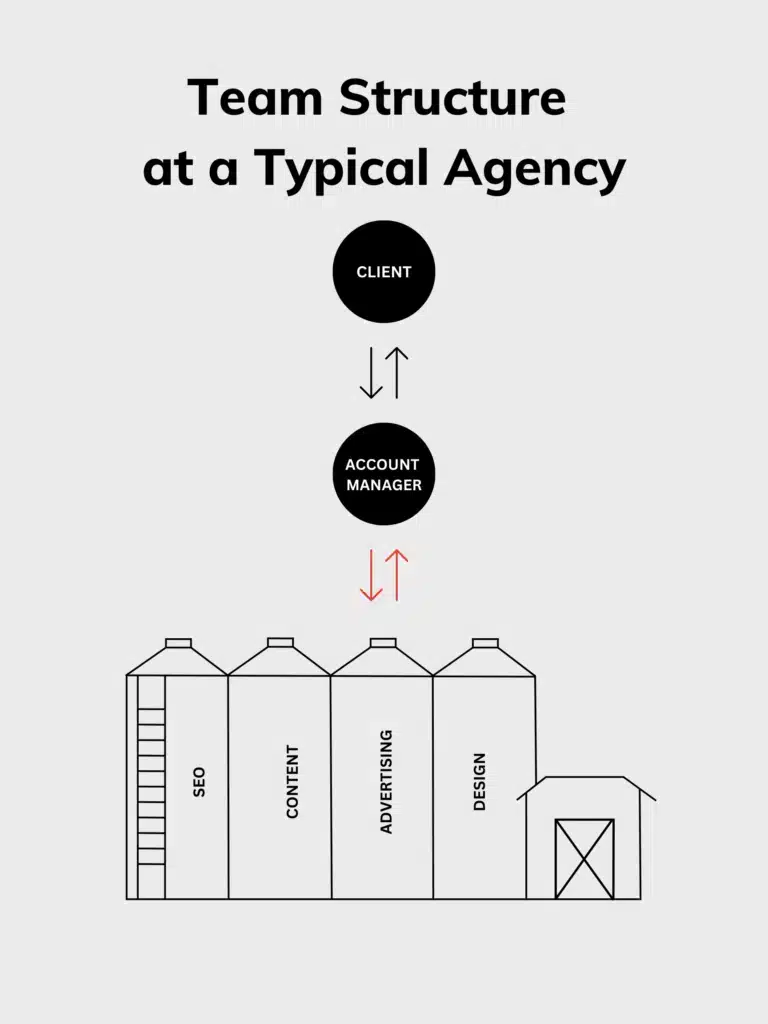
97th Floor’s approach is radically different, yet radically simple: The people who are working on an account are all on the same team, supported by off-team leadership.
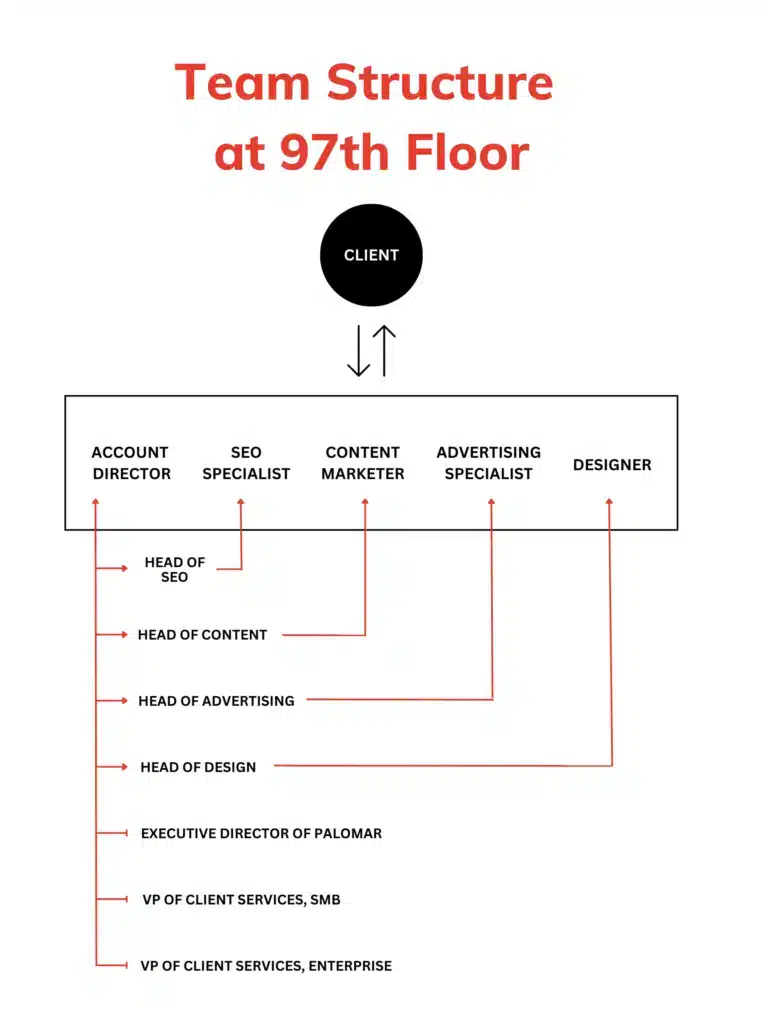
With us, there’s no relay between an account manager and the marketers executing strategy.
Our digital marketing experts have direct contact with our clients—the experts on their customers' needs—empowering our teams to deliver what our clients want and their businesses need.
What matters to you - meeting revenue goals, moving new leads into the pipeline, an upcoming site migration, proving ROI - is never repeated in a haphazard game of telephone throughout the agency.
So what do these teams actually look like? Here are the savvy experts that our clients interact with on each team:
An account director has chiefly three roles:
Because account directors oversee all of our disciplines, they work with their team members to ensure that execution is meeting strategy needs.
Most agencies use an account manager to manage a client-directed strategy. A key difference at 97th Floor is that the account director, leaning on their expertise and insights, forms a strategy and then connects with the client and the team to ensure communication and execution of the strategy is clear.
You’ve heard the phrase, “content is king,” before, right?
While certainly true, this phrase spurred thousands of organizations to produce drivel for over a decade, all to the demise of good user experience online.
Short-term thinking has ruined content marketing.
When every channel has its own specialist, no one owns the strategy. Watch this short clip on why that fragmentation is quietly costing brands more than they realize.
The role of a content marketer at 97th Floor is to help our clients escape this monotony by crafting content based on in-depth persona research and a customer journey.
The content marketer on each team is the “true north” when it comes to the customer’s experience and buyer journey, advocating for them and providing value across every stage.
Our content marketers bring value to our clients because they:
An SEO specialist is responsible for the client’s organic growth. Every initiative an SEO specialist takes on will fall under one of these three categories.
Everything an SEO does, be it an audit, backlink, or optimization, is tied to bottom-line results—brand awareness, traffic, and most importantly, revenue.
SEO specialists who cannot defend their tactics as revenue-generating do not have a place at 97th Floor.
Our advertising specialists are a true blend of creative and analytical, responsible for knowing:
As advertising is a huge investment for both ad creation and management, our promise is to find the best way to spend your money based on who your target audience is (or should be) and what your goals are.
Last year, we ran ads across 23 different platforms based on the custom campaign strategy we crafted for each client.
To name a few, our ad specialists have robust experience in the following areas:
Clear data coupled with responsive and creative optimizations make our advertising specialists ROI machines.
Every member of our client teams is given off-team support and training, all to our client’s benefit.
Head of Content - From buyer personas, semantic research, content production, and strategy development, Rachel Bascom ensures that each content marketer has the know-how and the tools to create winning content strategies for our clients.
Head of Advertising - Haley Riemenschneider helps our ad specialists drive client results with awareness continuums, B2B buyer journeys, and customer funnels to create cutting-edge marketing campaigns across multiple ad platforms.
Head of SEO - Trent Howard keeps our SEO specialists sharp, always exploring the best tools and techniques for uncovering the best practices to bring our clients sustainable organic growth.
Head of Design - Rian Kasner’s design team delivers beautiful and functional designs on time and in a variety of styles. The diversity of 97th Floor designers ensures that each execution team can provide a wide array of design formats and styles.
Executive Director of Palomar - Palomar is a patent-pending software suite for digital marketers developed by 97th Floor. The toolset inside Palomar analyzes large mountains of data in real-time to create a clear-cut digital strategy. Executive Director of Palomar Josh Moody monitors the latest trends in keyword research, SEO analysis, and content marketing to keep building tools that help our teams make the best decisions for our clients.
VP of Client Services - Samantha Brown fills this crucial support role for our marketing teams. She makes it possible for our teams to deliver excellent work by:
Our system follows a pattern of continuous improvement, but at its core, we believe that when our clients interface directly with a team of marketers that work together daily, both 97th Floor and our clients are better for it.
A canonical URL is the URL of the best representative page from a group of duplicate pages, according to Google. For example, if you have two URLs for the same page (such as example.com? dress=1234 and example.com/dresses/1234 ), Google chooses one as canonical.
Similarly, if you have multiple pages that are nearly identical, Google can group them together (for example, pages that differ only by the sorting or filtering of the contents, such as by price or item color) and choose one as canonical. Google can only index the canonical URL from a set of duplicate pages.” Source
Using canonical URLs is essential for several reasons, primarily related to SEO and content syndication. Here are some of the primary reasons:
Consolidating Link Signals for Similar or Duplicate Pages
Search engines often use the number and quality of backlinks a page has to determine its ranking. When multiple pages with similar content exist, the link signals can get diluted as different backlinks might point to different versions of the same content. By using a canonical URL, you consolidate these link signals, ensuring that the preferred version of the page gets the combined link signals of all its variants.
If you syndicate your content for publication on other websites, you can use canonical URLs to ensure that the search engines understand where the original version resides. This way, the syndicated content won't compete with your original content in search engine results.
Sometimes, you might have slight variations of a page for tracking or A/B testing purposes. By setting a canonical URL, you can specify which version of the page you want to appear in search results.
Using canonical tags correctly is crucial for ensuring that search engines understand your preferred version of a page. Here's a step-by-step guide on how to do it right:
Before implementing a canonical tag, you need to decide which URL is the "canonical" one. This should be the most authoritative version of the page. Consider factors like:
Different platforms have various methods for adding canonical tags. Here's a brief overview of how to do it on some popular platforms:
Magento 1
Product Page Canonicals
Category Canonicals
Magento 2
In Magento 2, the process is streamlined. Simply navigate to Stores > Configuration > Catalog > Catalog > Search Engine Optimization and enable the canonical options for both products and categories.
WordPress
Yoast SEO Plugin
Rank Math SEO Plugin
Wix
In Wix, you can set canonical URLs using the SEO settings for each page. Simply navigate to the page's settings, find the SEO section, and input your preferred canonical URL.
When implementing canonical tags, it's essential to follow best practices to ensure that search engines correctly interpret your intentions. Here are some key guidelines to keep in mind:
A thorough audit can help identify potential issues that might be affecting your site's SEO. Here's what to look for during your audit:
One of the primary reasons for using canonical tags is to address duplicate content issues. Start your audit by identifying pages with similar or identical content. Tools like Screaming Frog or SEMrush can help you spot these duplicates.
Having multiple canonical tags on a single page can confuse search engines. Ensure that each page on your site specifies only one canonical URL. SEO tools like Screaming Frog can help you identify such issues.
A canonical tag that points to a non-existent or broken URL is counterproductive. Ensure that all canonical URLs are accessible and return a 200 OK status. Tools like Ahrefs or Moz can help you identify and fix broken canonical links.
If your site uses Accelerated Mobile Pages (AMP), it's essential to have a canonical tag pointing from the AMP version to the standard version of the page. This ensures that search engines understand the relationship between the two and can consolidate ranking signals.
Auditing canonical tags might seem like a daunting task, but with the right tools and a systematic approach, it becomes manageable. Regular audits ensure that your canonical tags remain effective and continue to support your site's SEO efforts.
Canonical URLs help search engines understand which version of a page is the most authoritative, ensuring that your content gets the visibility it deserves. By following best practices and regularly auditing your canonical tags, you can avoid common pitfalls and ensure that your website remains in good standing with search engines.
A canonical URL is a way of telling search engines that a specific URL represents the master copy of a page. It helps search engines understand which version of a page to index and rank, preventing issues related to duplicate content.
Canonical URLs help prevent duplicate content issues, which can dilute the ranking power of a page. By specifying a canonical URL, you consolidate ranking signals to a single, authoritative version of the page, improving its chances of ranking higher in search results.
By consolidating ranking signals and preventing duplicate content issues, canonical URLs can help improve a page's search ranking. Higher rankings typically lead to increased organic traffic.
No, each page should have only one canonical URL. Having multiple canonical tags can confuse search engines and lead to unpredictable indexing and ranking results.
The canonical URL should be the most authoritative version of the page. Consider factors like user engagement, backlinks, alignment with site structure, and overall importance to your website's goals.
Not necessarily. Canonical URLs are primarily used for pages with duplicate or very similar content. If your website doesn't have such issues, you might not need to use canonical tags extensively.
Regular audits, at least annually or after significant website changes, are recommended. This ensures that your canonical tags remain effective and continue to support your site's SEO efforts.
If the duplicate page serves no SEO or user value on the site, it is best recommended to remove and 301 redirect to an active/similar page with value. In most other cases, a canonical tag will be the ideal choice.

Domain Authority (DA) is a metric pioneered by Moz, and since adapted by many other SEO tools, that estimates the chances of a website's ability to rank on search engine result pages (SERPs).
Domain Authority (also sometimes named Domain Rating) is a composite score, fluctuating between 0 and 100. The number represents the website’s relevance for a specific subject or industry. A higher score represents a stronger likelihood of clinching higher SERP rankings.
Websites boasting higher DA scores are generally perceived as more authoritative, reliable, and are statistically more likely to rank prominently on search engines like Google. Please note that DA is not a metric that Google has created or endorsed, but instead is a rough guide (provided by various SEO tools) to estimate the authority of a website. In fact, some SEOs believe that tracking and analyzing DA can even be detrimental to one’s strategy because it focuses too much on a metric that is not a Google ranking factor and focuses on only a portion of the SEO equation.
Moz didn’t conjure the DA score from thin air. The metric is the culmination of multiple indicators such as the number of linking root domains, the aggregate of inbound and outbound links, the MozRank, and MozTrust, among many others. With the integration of machine learning, Moz continually refines its model to ensure the DA score mirrors the evolving search ranking factors as closely as possible.
While a score north of 50 is generally perceived as robust and anything exceeding 70 is stellar, it's crucial to interpret DA in context. Instead of viewing it in isolation, juxtapose it against competitors or peers in the same industry.
Knowledge is power, especially when it pertains to Domain Authority. Keeping a close eye on your DA score can facilitate strategic decision-making to fine-tune your SEO blueprint.
The digital marketplace boasts a plethora of tools adept at gauging Domain Authority:
Given that DA doesn't experience tumultuous daily upheavals, it's pragmatic to assess it on a quarterly basis. This cadence ensures that one can spot and act upon any pivotal shifts triggered by SEO tactics or external dynamics, while also avoiding the overanalysis of a metric that only shows macro trajectories.
The symbiotic relationship between backlinks and DA is undeniable. Yet, the emphasis should be on quality over sheer volume. A handful of links from credible, high-authority sources outweigh countless subpar links. Quality backlinks come from websites that have a high DA themselves, but SEOs’ quality standards shouldn’t stop at the DA of linking websites. Authority isn’t something that marketers should “hack”. Instead, approach authority from a content, brand, PR, and backlinking perspective. As your brand grows, so will your domain authority.
It's crucial to distinguish between Domain Authority (an entire website's ranking potential) and Page Authority (the ranking potential of individual pages). While they share foundational similarities, they cater to different facets of a website's digital footprint.
In conclusion, Domain Authority stands as a testament to a website's credibility, strength, and ranking potential in the digital arena. It's more than just a metric; it's a compass directing stakeholders to strategic decisions that can enhance their online visibility and reputation.
While slight fluctuations can occur, significant changes in DA typically manifest over more extended periods. It's a compound metric influenced by many factors. Also of note, as a website becomes more authoritative, it enters new realms of competition. It’s possible that quicker fluctuations can take place from, for example, a website with a DA of 20 to a DA of 30. As the DA increases, changes will likely slow down.
Generally, a higher DA indicates better potential for ranking. However, it's crucial to view DA in the context of your niche and relative to competitors.
Directly? No. But by improving your site's overall SEO, creating quality content, and earning high-quality backlinks, you can positively influence your DA over time.
Domain Authority (DA) is a score developed by Moz that predicts how well a website will rank on search engine result pages (SERPs). It ranges from 0 to 100, with higher scores indicating greater potential to rank.
While Domain Authority gauges the ranking potential of an entire website, Page Authority focuses on the ranking potential of individual pages.
A higher DA suggests your website has a better chance of ranking higher on search engines, potentially leading to more traffic and business opportunities.
No, Google does not use Domain Authority in its algorithm. DA is a metric developed by Moz to predict ranking potential based on various factors.
Improving overall SEO practices, earning high-quality backlinks, producing quality content, and ensuring a mobile-responsive design can contribute to a higher DA.
Moz updates Domain Authority on a monthly basis, but individual scores might not change with every update.
While a higher DA is generally favorable, it's essential to compare your DA with competitors in your specific niche. A niche business might have a lower DA than a broader one but still be authoritative in its sector.
Yes, other SEO tools have their own versions of DA. For instance, Ahrefs uses Domain Rating (DR) and SEMrush employs Authority Score.
Typically, newer websites start with a lower DA. However, if they quickly earn high-quality backlinks and produce exceptional content, they can see growth in their DA score.
You can use Moz's Link Explorer or other SEO tools like SEMrush and Ahrefs to check your website's DA.
"97th Floor brings a lot of good ideas on how to refine what we’re doing." – Erick Frierberg, Chief Marketing Officer
Solo.io is an Application Networking Platform enabling companies to take the next step in their cloud journey.
When Solo.io came to 97th Floor we established that they were missing out on impressions due to budget constraints and outdated geo-targeting, so they doubled their Google spend. This move enhanced their brand visibility, a key performance indicator.
Their prime objective, however, remained boosting Marketing Qualified Leads (MQLs) where a lack of mid-funnel strategies in Solo.io’s existing campaigns hindered their conversion efficacy.
Using in-depth persona research, we developed and pitched a full-funnel LinkedIn campaign that would target personas for Solo’s two main products: Legacy API Gateway and Gloo Mesh.
The campaign included newly designed and written ads at the awareness, interest and conversion stage to meet Solo’s market where they are and move them through the funnel.
Solo.io would deem the campaign successful if we achieved a Cost Per Lead Under $200.
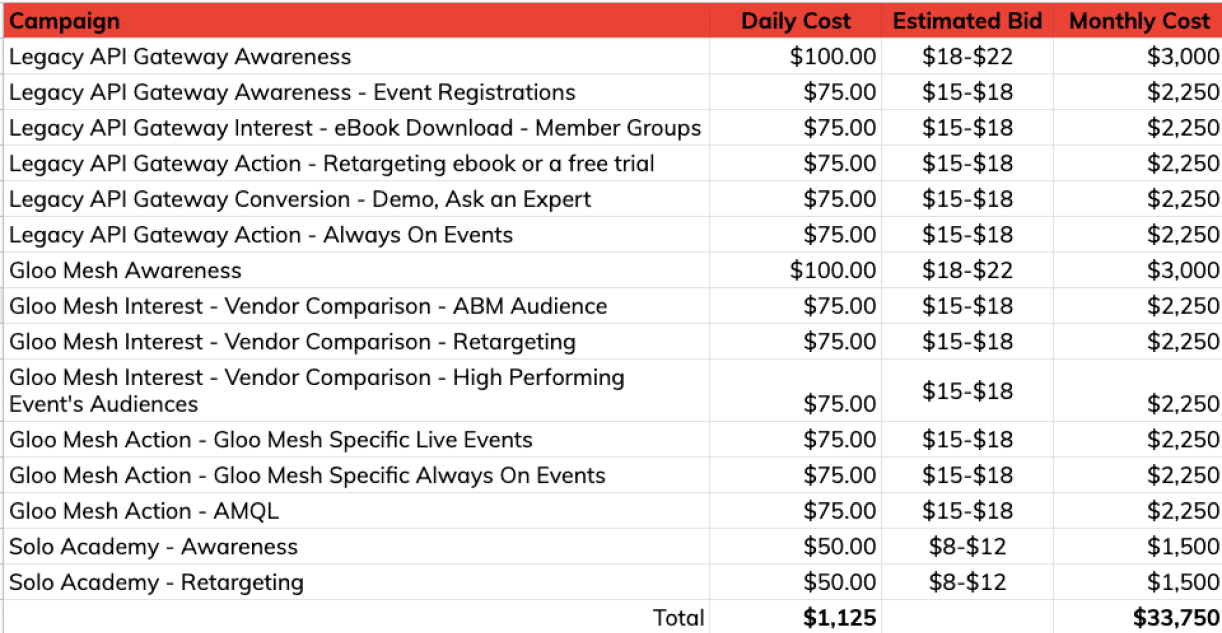
In just 4 months, the LinkedIn campaign generated 246 leads at a cost of $141/lead. This is a 26% increase in total leads and a 29% decrease in total cost per lead for Solo.

Keyword research is the process of identifying and analyzing the specific words and phrases (keywords) that people use when searching for information, products, or services on search engines like Google, Bing or Yahoo.
The main objective of this research is to optimize content, advertising campaigns, and overall website performance by aligning with the language and intent of your target audience. By understanding the most popular and relevant keywords related to your niche or industry, you can craft content that caters to the specific needs and inquiries of your audience.
Keyword research isn't just about boosting search engine rankings or website traffic. Here are some of its undeniable benefits:
Seed keywords are the foundational terms that define your niche or industry. They are broad and general, forming the base from which more specific keyword variations emerge. For example, if you run an online shoe store, your seed keywords might include "shoes," "footwear," or "sneakers." By establishing these primary terms, you can branch out to discover more detailed and long-tail keywords relevant to your business.
Observing your competitors can offer a wealth of knowledge. Competitor keyword analysis entails identifying the keywords your competitors rank well for and leveraging that information to find gaps in your own strategy. Tools like Semrush or Ahrefs can help you uncover these terms. This doesn't mean copying their strategy, but rather using their successes and failures as a learning opportunity.
There are various tools available that can help streamline your keyword research process:
Google Keyword Planner
Housed within the Google Ads interface, the Google Keyword Planner is a free tool that offers invaluable insights. Although initially designed for paid advertising campaigns, it provides data like search volume, competition level, and potential ad costs, making it a robust tool for organic search insights as well.
Semrush Keyword Tools
Semrush offers a suite of keyword research tools catering to the process's different aspects. Whether you want to dive deep into competitor keyword analysis with the Organic Research tool or explore new opportunities with the Keyword Magic Tool, Semrush has something for every stage of your keyword journey.
Ahrefs SEO Tools
Ahrefs, while known for its backlink analysis, also boasts a range of SEO tools. Its keyword research tools provide in-depth data on search volume, keyword difficulty, and even how many backlinks you might need to rank for a particular term. The insights gleaned from Ahrefs can significantly impact your SEO strategy.
To effectively select keywords, understanding various metrics is crucial:
Search Volume
This indicates how many times a particular keyword is searched for within a month. Higher search volume signifies higher demand.
Keyword Difficulty
It represents how tough it is to rank for a keyword considering the competition. A higher difficulty score suggests that it might be harder to rank for.
Primarily used for paid advertising, CPC denotes the average amount an advertiser pays for a click on their ad for a particular keyword. Although typically used in advertising, CPC data can provide insights into which keywords are most competitive and, by extension, potentially more valuable to rank for organically.
Identify the Primary Keyword
Your primary keyword is the central term or phrase around which your content is based. For example, if you're writing about "vegetarian pasta recipes," that entire phrase could be your primary keyword. This term should be highly relevant to the content, have a decent search volume, and preferably, lower competition. Once identified, this keyword should be incorporated into key areas like the title, meta description, and throughout the content.
In addition to the primary keyword, you should also identify supportive secondary keywords that are usually longer-tail, similarly-worded keywords to the primary keyword. The inclusion and analysis of these secondary keywords will help you more fully understand the topic and create content to support it.
Understand Search Intent
Search intent refers to the reason a user conducts a particular search. It's crucial to discern why someone might search for a particular keyword and ensure your content meets that need. There are typically four types of search intent:
By aligning your content with the right intent, you increase the likelihood of satisfying the user's query and, consequently, boost your rankings.
Analyze Trends and Seasonality
Using tools like Google Trends, you can track the popularity of keywords over time. This helps in identifying seasonal trends (like "Christmas gifts" spiking in December) and ensuring you're capitalizing on timely opportunities.
Leverage Long-Tail Keywords
Long-tail keywords are longer and more specific keyword phrases. They might have lower search volumes, but they often bring in more targeted traffic. An example would be "best leather boots for winter" instead of just "boots."
Consider Local and Industry-Specific Keywords
For businesses catering to a local audience or those in a specific industry niche, using localized or industry-specific terms can be invaluable. For instance, "dentist in Brooklyn" or "industrial cooling solutions."
By diligently tuning into the language, inquiries, and curiosities of your target audience, you set the stage for organic growth, increased visibility, and a heightened user experience.
However, as with many things in the digital world, keyword research isn't a static process. As trends shift, technologies evolve, and user behaviors change, the importance of regular and meticulous keyword research only grows. It serves as a continuous dialogue between creators and their audience, ensuring content remains relevant, engaging, and effective.
While the fundamentals of your niche might remain the same, online search trends change regularly. It's advisable to revisit keyword research at least quarterly, if not monthly, to stay current.
While it's possible, overusing the same keywords can lead to keyword cannibalization, where your content competes against itself in search rankings. It's better to focus each piece of content on a unique set of keywords while maintaining topical relevance.
Yes! While voice search has led to a rise in conversational queries, understanding and targeting keywords remains crucial. It's just that these keywords now often come in the form of natural language phrases.
No, keyword research applies to any search engine, including Bing, Yahoo, or platforms like YouTube or Amazon. While Google dominates the market, optimizing for other platforms can be beneficial depending on your target audience.
Not necessarily. While high search volume indicates demand, these keywords often have high competition. Sometimes, targeting lower-volume but more specific keywords can yield better results due to their relevance and lower competition.
Short-tail keywords are generally 1-2 words and are broad (e.g., "shoes"). Long-tail keywords are longer phrases that are more specific (e.g., "red leather boots for women").
While it helps, search engines have become smarter at understanding context. It's essential to maintain a natural flow and avoid keyword stuffing. Using synonyms or related terms can also be beneficial.
Keyword research should guide your content strategy. By understanding what your audience searches for, you can tailor your content to address those topics, ensuring it's relevant and valuable.
Yes. While high competition keywords indicate demand, they can be challenging to rank for, especially for newer websites. It's often advised to balance targeting these with low-competition keywords.
Keywords are the backbone of PPC campaigns. They determine when and where your ads appear. Proper keyword research ensures your ads reach the right audience and can lead to better click-through rates and conversions.
An XML Sitemap is a structured document that lists the URLs of a website, making it easier for search engines to discover and index its content.
Think of it as a roadmap for search engines, guiding them to the most important pages on your site. While it's not a guarantee that every page listed will be indexed, it does increase the chances of search engine bots finding them.
Having an XML Sitemap is crucial, especially for sites with a massive number of pages or frequently updated content. The XML sitemap ensures that search engines are aware of all the pages on your site, including those that might not be discovered through the regular crawling process. By providing search engines with this valuable information, you're taking a proactive step in improving your website's visibility and searchability.
Improved SEO Rankings
One of the primary reasons website owners use XML Sitemaps is to boost their SEO rankings. By providing search engines with a clear structure of your website's content, you're ensuring that they can index your pages more efficiently. This, in turn, can lead to higher visibility on search engine results pages (SERPs) and potentially more organic traffic to your site.
Enhanced Website Crawling
Search engines deploy bots to crawl and index the web. However, without a clear roadmap, these bots might miss out on some of your site's pages, especially if they're newly added or not linked from other parts of your website. An XML Sitemap acts as a guide for these bots, ensuring that they can find and index every page you deem important.
Better User Experience
While XML Sitemaps are primarily designed for search engines, they indirectly benefit users as well. When your site's pages are indexed correctly, users are more likely to find the content they're searching for on search engines. This leads to a better user experience, as they can access relevant information quickly and efficiently.
While the primary purpose of all XML Sitemaps is to list the URLs of a website, there are specialized sitemaps tailored for specific types of content. Understanding these can help you optimize your sitemap strategy based on the kind of content your website offers.
An XML Sitemap Index is like a directory of sitemaps. For websites with a vast number of pages or multiple types of content (like images, videos, and articles), managing a single sitemap can be cumbersome. In such cases, you can create multiple sitemaps and then list them all in a Sitemap Index. This way, you provide search engines with a single point of reference that leads them to all your other sitemaps.
If your website is rich in visual content, an XML Image Sitemap is essential. This sitemap lists all the image URLs on your site, ensuring that search engines index them. Properly indexed images can appear in image search results, driving additional traffic to your site.
For websites that host or embed videos, an XML Video Sitemap is a must-have. It provides search engines with metadata about your videos, such as the title, description, and thumbnail. This ensures that your videos are discoverable in video search results, enhancing your site's visibility.
Websites that frequently publish news articles can benefit from a Google News Sitemap. Tailored for the Google News platform, this sitemap ensures that your articles are quickly discovered and indexed by Google, making them available to users searching for the latest news.
Depending on your technical expertise and the specific needs of your website, there are several methods to generate a sitemap.
For those who aren't technically inclined or are looking for a quick solution, using an XML Sitemap generator is the way to go. These are online tools or software that automatically crawl your website and generate a sitemap for you. Here's how to use them:
Those who prefer a hands-on approach or have specific requirements can manually create an XML Sitemap. This method requires a basic understanding of XML syntax. Here's a simple step-by-step guide:
Remember, manually creating a sitemap can be time-consuming for large websites, but it offers the most control over the content you include.
Creating and submitting an XML Sitemap is just the beginning. To maximize its effectiveness, follow certain best practices.
Your XML Sitemap should prioritize pages that are most valuable from an SEO perspective. This means:
To submit your XML Sitemap effectively, follow these step-by-step instructions:
By following these steps, you'll ensure that your XML Sitemap is submitted accurately, helping search engines index and understand the structure of your website for optimal SEO performance.
To make the most of your sitemap, monitor its performance and address any issues:
By adhering to these best practices, you ensure that your XML Sitemap not only serves its primary purpose but also enhances your website's overall SEO strategy.
An XML Sitemap serves as a roadmap for search engines, guiding them to the important pages on your website, ensuring efficient indexing and better visibility in search results.
While not compulsory, it's highly recommended, especially for websites with numerous pages, frequent updates, or those that have pages not easily discoverable through regular site navigation. By providing search engines with a structured list of URLs, an XML Sitemap enhances the chances of your pages being indexed, leading to improved search rankings and organic traffic.
Update your sitemap whenever there are significant changes to your website, such as adding new pages, updating content, or removing outdated pages.
Yes, using the <priority> tag, you can indicate to search engines which pages you deem more important. However, this is just a suggestion, and search engines may not always adhere to it—in fact, Google has stated that they ignore the priority in a sitemap.
An XML Sitemap is designed for search engines, providing a structured list of URLs for indexing. An HTML sitemap, on the other hand, is designed for website visitors, offering a user-friendly overview of the site's content.
Tools like Google Search Console and Bing Webmaster Tools provide feedback on your sitemap's status, including which URLs have been indexed and any potential issues.
Yes, a single XML Sitemap can contain up to 50,000 URLs and be up to 50MB in size. If your website exceeds these limits, you'll need to create multiple sitemaps and list them in a Sitemap Index.
Demand Generation is an umbrella term for any marketing or sales activity intended to create awareness and interest in your company’s product or service.
Demand Generation is a long-term, education-based strategy that targets a broad, and likely out-of-market, audience. The ultimate goal of demand generation is to ensure a future sales pipeline by building a relationship and enhancing your brand reputation with potential buyers.
Demand generation is focused on increasing brand awareness and interest; lead generation identifies and attracts these potential customers. The two also differ in approach and metrics.
| Demand Gen | Lead Gen |
| Long-term, awareness focus | Short-term, sales focus |
| Demand generation strategies encompass a wide range of marketing activities, including content marketing, social media, advertising, public relations, events, and branding efforts. It's about creating a buzz around the brand and educating the market. | Lead generation strategies typically involve tactics like content marketing, email marketing, social media, SEO, pay-per-click advertising, and events. The focus is on capturing contact information, such as email addresses or phone numbers, to nurture and convert leads into customers. |
| Example metrics: brand awarenesswebsite trafficengagement metrics (likes, shares, comments) | Example metrics:number of leads generatedconversion ratecost per lead. |
Understanding the key elements of demand generation is essential for crafting a robust strategy that drives tangible results.
Content is the linchpin of demand generation. Through blog posts, videos, whitepapers, and other mediums, businesses can demonstrate their value proposition, address consumers' pain points, and answer pressing questions.
Creating high-quality, informative content that addresses user queries and is optimized for SEO, businesses can attract organic traffic, position themselves as industry experts, and guide users through the buyer's journey.
The omnipresence of social media platforms has given businesses unique avenues to reach their audience. Platforms like Instagram, LinkedIn, and X (Twitter) allow brands to engage users with interactive content.
Moreover, influencers, with their built-in audiences, can amplify a brand's message, granting access to a wider, yet targeted, demographic.
By collaborating with complementary businesses or influencers, companies can tap into new audiences, enhancing their demand generation efforts. Partner marketing offers mutual benefits, allowing both parties to leverage each other's strengths.
Demand generation can’t stop after one touchpoint. Brands should stay top-of-mind by executing a plan for nurturing and remarketing to their audience.
Remarketing ads target individuals who have previously interacted with a brand, serving them tailored ads to reignite their interest and push them toward conversion.
Email remains one of the most effective channels for personalized communication. By segmenting your email list and sending tailored content, businesses can nurture leads, providing them with relevant information and offers that inch them closer to making a purchase.
Webinars and live events provide a platform for brands to engage with their audience in real time. These platforms allow for direct interaction, answering questions, showcasing products, and building a deeper connection with potential customers.
Above all, businesses must focus on offering genuine value. Whether it's through informative content, responsive customer service, or high-quality products, delivering value fosters trust and loyalty.
In a saturated digital landscape, originality stands out. Crafting unique, engaging content captures attention and differentiates a brand from its competitors.
The digital realm is ever-evolving. For sustained success, businesses should adopt a mindset of continuous testing and optimization, adjusting their strategies based on performance data and emerging trends.
Harmonizing the efforts of sales and marketing teams ensures a seamless transition for leads as they move from awareness to consideration and finally, to the decision phase.
Software and tools designed for demand generation offer scalability, efficiency, and precision. Consider a combination of the following demand gen tools for the most effective execution of your strategies:
CRM Systems: Customer Relationship Management software, like Salesforce or HubSpot, helps businesses manage their interactions with current and potential customers. They offer an organized view of leads, prospects, and customer interactions, ensuring timely and personalized outreach.
Marketing Automation Platforms: Tools like Marketo or Pardot allow businesses to automate repetitive marketing tasks, such as email campaigns or social media postings. They also provide analytics and insights, enabling businesses to refine their strategies.
Analytics and Tracking Platforms: Google Analytics, SEMrush, and similar tools offer insights into website traffic, user behavior, and content performance. By understanding how users interact with their content, businesses can identify what's working and where improvements are needed.
Content Management Systems (CMS): Platforms like WordPress or Drupal assist businesses in creating, publishing, and managing digital content seamlessly, making it easier to keep websites updated with fresh and relevant content.
Engagement and Personalization Tools: Tools like Optimizely or Dynamic Yield allow for the customization of user experiences based on behavior, demographics, or previous interactions. Personalized experiences can significantly boost conversion rates.
Demand generation is a comprehensive marketing approach aimed at building and nurturing interest in a company's products or services. It involves a series of strategies and tactics designed to reach potential customers across different stages of the buyer's journey with a primary focus at the top of the funnel.
While both demand generation and lead generation aim to attract potential customers, there's a distinction. Demand generation focuses on building awareness and interest in a company's offerings without necessarily capturing contact details. Lead generation, on the other hand, specifically targets capturing the contact information of potential customers for future outreach.
Demand generation not only creates a consistent pipeline of potential customers but also positions your brand favorably in the market. By actively engaging with your target audience through various strategies, you enhance brand recognition, credibility, and trust, all of which are crucial for long-term business growth.
A successful demand generation strategy ensures that the sales team has a consistent stream of qualified leads. By aligning marketing efforts with sales objectives, businesses can ensure a seamless transition for leads from awareness to conversion, optimizing the overall customer acquisition process.
Absolutely! In fact, demand generation is particularly effective for B2B businesses. By targeting specific industry segments, creating tailored content, and focusing on long-term relationship building, B2B companies can benefit immensely from demand generation strategies.
Start by understanding your target audience's needs and preferences. Develop a content strategy, optimize your website for conversions, and leverage various channels like social media, email marketing, and paid advertising. Remember, continuous testing and optimization is key.
Focus on delivering consistent value, staying updated with industry trends, and continuously refining your strategies based on performance data. Building strong relationships with your audience and integrating feedback into your campaigns will also ensure sustained success.
Customer Lifetime Value, often referred to as CLV, is the average monetary value received per customer over their lifetime as a customer. It serves as a crucial metric for understanding a customer's long-term value to your business. At its core, CLV encapsulates the entire journey a customer embarks upon with your brand, shedding light on their financial contribution over time.
Customer Lifetime Value enables informed decision-making, judicious resource allocation, and the creation of experiences that resonate with the target audience.
By following these steps, you can calculate your Customer Lifetime Value and gain a deeper understanding of the value each customer brings to your business.
At 97th Floor, we understand that CLV isn't just a metric; it's a strategic compass that can steer your business towards success. Here's how it impacts your operations:
CLV directly affects your bottom line. By identifying high-value customers and nurturing those relationships, you can increase revenue and profitability. It's not just about acquiring new customers; it's about maximizing the value of your existing ones.
When you have a clear understanding of CLV, you can make more accurate forecasts and develop sound business strategies. This helps in resource allocation, product development, and marketing campaigns, ensuring that your efforts are aligned with long-term growth.
Loyal customers are the lifeblood of any business. CLV allows you to identify and appreciate these customers, helping you build stronger, lasting relationships. By recognizing and rewarding their loyalty, you can turn them into brand advocates who drive organic growth through word-of-mouth.
By embracing CLV, you not only boost your financial performance but also cultivate a customer-centric mindset that can be a game-changer for your business.
In the digital marketing realm, where we thrive, knowing the worth of each customer over their entire journey with your brand is invaluable. Here are some advantages of embracing CLV:
At 97th Floor, we're all about elevating your marketing strategies, and improving CLV is no exception. Here are some actionable ways to boost CLV:
Streamline the onboarding experience for new customers. Make it as smooth and delightful as possible. Provide clear guidance and support to help them get the most out of your products or services right from the start.
Leverage data and customer insights to deliver personalized experiences. Tailor your marketing messages, recommendations, and promotions to each customer's preferences and behavior.
Implement strategies to increase sales within your existing customer base. This might involve upselling or cross-selling complementary products or services. Encourage repeat purchases and loyalty.
By putting these strategies into action, you can not only enhance CLV but also create a stronger bond between your brand and your customers.
Understanding CLV is essential, but it's equally important to avoid pitfalls that can lead you astray. Here are some common mistakes to steer clear of:
One of the most prevalent errors is treating all customers as a homogeneous group. Without proper segmentation based on behavior, demographics, or other relevant factors, your CLV calculations may lack accuracy. Segment your customer base to gain deeper insights and tailor your strategies effectively.
While segmentation is crucial, choosing the wrong criteria can be just as detrimental. Using irrelevant or poorly defined segments can lead to misguided marketing efforts. It's essential to carefully select segmentation criteria that align with your business goals.
Setting unrealistic CLV targets can be counterproductive. Expecting all customers to have a high CLV may lead to overinvestment in low-value segments or overaggressive marketing tactics. Balance your expectations with the actual potential of each customer segment.
The market is dynamic, and customer behavior can change. Failing to adapt your CLV analysis and strategies accordingly can be a significant mistake. Keep your CLV models up-to-date and be prepared to pivot when necessary.
By avoiding these common pitfalls, you can ensure that your CLV analysis remains accurate and actionable.
The CLV formula is: CLV = Average Purchase Value x Purchase Frequency x Customer Lifespan.
Increasing CLV involves strategies like improving customer onboarding, personalizing experiences, and focusing on driving additional sales within your existing customer base. It's all about nurturing and retaining loyal customers.
High CLV customers tend to make frequent purchases, spend more per transaction, and stay engaged with your brand for an extended period. They are also more likely to refer others and become brand advocates.
No, CLV focuses on the long-term value of a customer, while ROI measures the profitability of a specific marketing campaign or investment. CLV provides insights into the overall value of a customer relationship.
It's advisable to recalculate CLV regularly, especially when significant changes occur in your business or customer behavior. Quarterly or annually is a good starting point, but more frequent updates may be necessary in dynamic industries.
No, CLV is applicable to a wide range of businesses, including brick-and-mortar stores, service providers, and subscription-based businesses. Any company with customers can benefit from understanding and improving CLV.
Absolutely, CLV is a powerful tool for customer segmentation. It helps you identify and categorize customers based on their value to your business, allowing for targeted marketing efforts.
Yes, CLV can account for customer referrals and word-of-mouth marketing when estimating the value of loyal customers. Loyal customers often bring in new business through recommendations.
CLV is at the core of effective customer retention strategies. It helps you identify which customers are most valuable and guides you in creating retention initiatives that focus on preserving and growing these valuable relationships.
CAC represents the total cost a business incurs to acquire a new customer. This includes all marketing and sales expenses over a specific period divided by the number of new customers gained during that time.
The significance of CAC is intertwined with a company's profitability and growth. If businesses aren't careful, they can end up spending more to acquire customers than those customers can ever bring in as revenue.
A sustainable CAC means a company is on a healthy path of profitability. It ensures that marketing and sales efforts are returning a favorable outcome, setting the stage for long-term growth and stability.
Begin by summing up the total costs associated with customer acquisition over a specific period. This includes marketing expenses, advertising, wages for sales and marketing teams, and any other related costs.
Next, divide this total by the number of new customers acquired during that same period.
The resulting value is your CAC.
CAC= NumberofNewCustomers/TotalAcquisitionCosts
For instance, if a company spends $10,000 on marketing in a month and acquires 100 customers as a result, the CAC would be $100.
The landscape of CAC isn't static. Various elements come into play, shaping and influencing this metric. Marketing strategies, for one, are pivotal. The channels chosen, the effectiveness of campaigns, and the alignment with target audiences can sway the CAC considerably. Additionally, broader industry trends can play a role. During industry booms, customer acquisition might be easier and cheaper, whereas during downtrends, the opposite could hold true.
Furthermore, the behavior and preferences of customers themselves mold the CAC. If a business's value proposition strongly resonates with the target market, the CAC can be much lower, thanks to organic word-of-mouth and referrals.
Improving the efficiency of your CAC is akin to getting more bang for your buck. The lower the CAC, the more profitable each new customer becomes. Here are some actionable strategies:
Optimize Marketing Channels: Not all marketing channels yield the same results. By analyzing which channels bring in the most customers for the least spend, businesses can reallocate resources effectively.
Improve Conversion Rates: The journey from a lead to a customer can often be optimized. By enhancing landing pages, refining sales pitches, or even simplifying the purchase process, the conversion rate can be boosted, thus reducing CAC.
Leverage Customer Referrals: A satisfied customer can be your best marketer. Encourage referrals through incentives or loyalty programs. This organic method of acquisition often has a much lower associated cost.
Retargeting Campaigns: Instead of always chasing new leads, focus on those who've shown interest in the past but haven't converted. Retargeting them can be more cost-effective than acquiring entirely new prospects.
Understanding CLV is important for placing CAC in perspective.
Imagine a scenario where a business has a high CAC. On the surface, it might seem like a red flag. However, if the CLV of the customers being acquired is substantially higher, then the high CAC is justified. Essentially, if the revenue derived from a customer over their lifetime (CLV) surpasses the cost of acquiring them (CAC), the business is on a profitable trajectory.
This underscores the importance of maximizing CLV. If businesses can increase the amount a customer spends, or the frequency of their purchases, the relative weight of the CAC decreases. Strategies like upselling, cross-selling, or loyalty programs come into play here.
By benchmarking CAC effectively, businesses gain a clearer picture of their performance, allowing for informed strategic decisions.
While a lower CAC is generally favorable as it means acquiring customers more efficiently, it's essential to balance it with the quality of acquisitions. If lowering CAC compromises customer quality, leading to decreased CLV, it might not be beneficial in the long run.
Strategies to reduce CAC include refining marketing campaigns, optimizing conversion rates, leveraging customer referrals, using retargeting campaigns, and selecting the most cost-effective marketing channels.
CLV is the projected revenue a customer will generate during their relationship with a business. Ideally, the CLV should be significantly higher than CAC, ensuring that the investment made in acquiring the customer is justified by the revenue they generate.
Multiple factors can affect CAC, including the effectiveness of marketing strategies, industry trends, competition levels, and overall customer behavior or preferences.
Regularly monitoring CAC is crucial. For businesses with rapidly changing marketing budgets or strategies, a monthly assessment might be suitable. For more stable businesses, a quarterly or half-yearly review could suffice.
Absolutely. High-touch industries or those with lengthy sales cycles (like real estate or enterprise software) might naturally have a higher CAC than low-touch, quick conversion industries (like e-commerce).
To benchmark your CAC, consider looking into industry reports, attending webinars or conferences, or consulting with experts in your field. While exact competitor numbers might not be available, industry averages can provide a clear picture of where you stand.
