A month ago, Google changed how Target CPA and Target ROAS bidding strategies behave when campaigns are constrained by budget.
At the time, I wrote about why I thought the change could ultimately be a good thing for advertisers. The short version: Google would start treating your target more like an actual target, rather than potentially outperforming it simply because a limited budget allowed the algorithm to be selective about which auctions it entered.
My advice then was simple: be intentional with your targets.
TL;DR
- Spend held steady and volume fell. Across 28 campaigns, median spend rose 3% while conversion volume fell 18%.
- Old targets are the biggest risk. Campaigns that kept their pre-update target lost 31% of their volume at the same spend.
- tCPA was hit harder than tROAS. Median conversions fell 32% for tCPA campaigns. tROAS conversion value stayed about flat.
- Removing the target helped some campaigns. 7 of 9 campaigns that switched from tCPA to Maximize Conversions improved CPA.
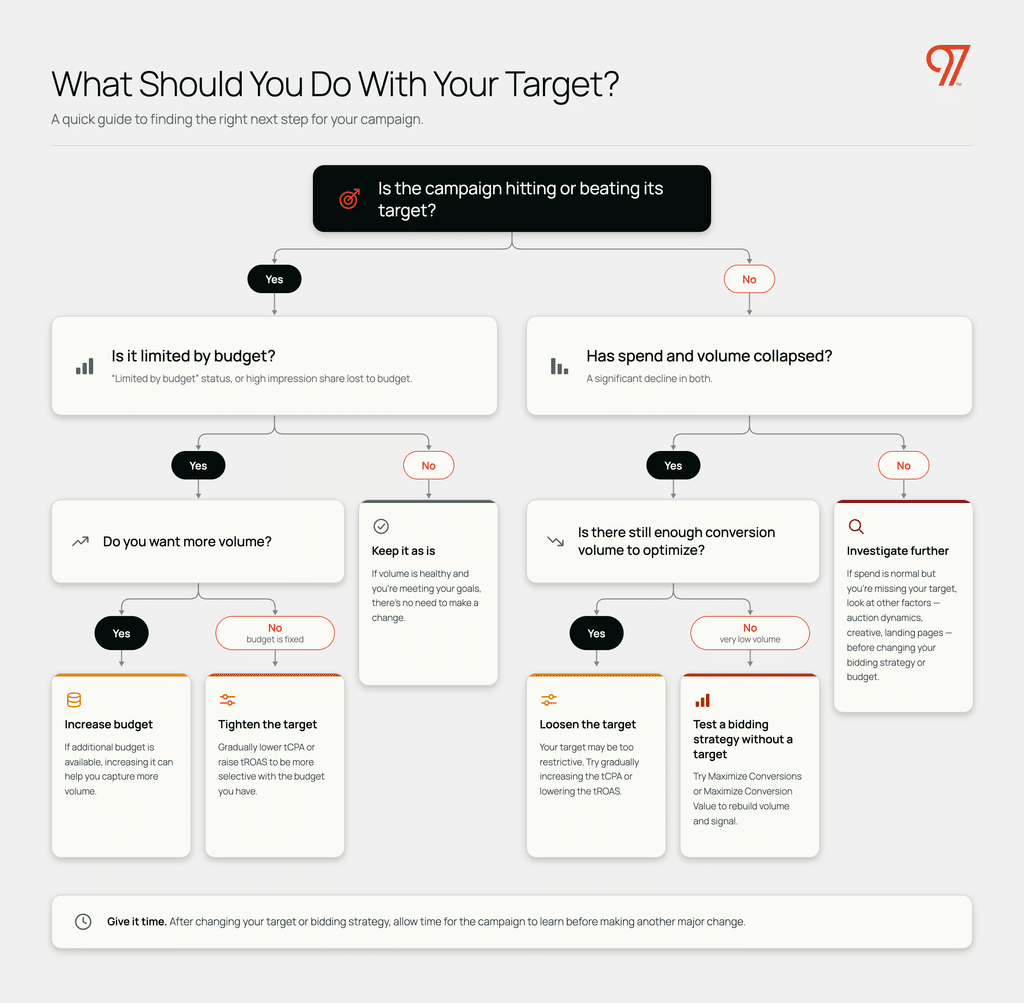
- Diagnose before you change anything. The right move depends on which of four situations your campaign is in.
Now we have some actual data.
We analyzed 28 campaigns across multiple advertisers, comparing performance before the August 17 update (July 14–August 16) with performance after it (August 18–September 20).
For Target CPA campaigns, we evaluated CPA and conversion volume. For Target ROAS campaigns, we evaluated ROAS and conversion value. We also looked at budget limitations, Search Impression Share lost to budget, target changes, and subsequent bidding-strategy tests.
This isn't a controlled experiment. Seasonality, auction conditions, account optimizations, and other variables are always changing. But after a month of data, some patterns are emerging.
Spend Held. Volume Didn't
Across the 28 campaigns, the median campaign saw:
| ↑ +3% Spend Stayed roughly flat | ↓ -18% Volume Meaningfully declined | ↓ -7% Efficiency Slightly worse |
| Median change across 28 campaigns |
The efficiency decline isn't the most interesting part.
It's that campaigns spent roughly the same amount of money while generating meaningfully less volume.
And that pattern became even stronger when we isolated campaigns where we intentionally kept the target unchanged.
There were 16 campaigns where we were comfortable with the existing efficiency target and didn't adjust it after August 17.
For those campaigns:
| ↑ +0.2% Spend Essentially flat | ↓ -31% Volume Significant decline | ↓ -17% Efficiency Meaningfully worse |
| Median change across 16 campaigns where the target was intentionally unchanged |
Same target. Essentially the same spend. Very different outcome.
That's a strong reason to revisit targets that worked before August 17 rather than assuming they'll continue producing the same balance of spend, volume, and efficiency.
tCPA Took the Bigger Hit
The effect also wasn't evenly distributed across bidding strategies.
Among the 16 Target CPA campaigns:
| ↓ -9% Lower spend | ↓ -32% Fewer conversions | ↑ +10% Higher CPA |
Among the 12 Target ROAS campaigns:
| ↑ +4% Steady spend | ↑ +2% Steady conversion value | ↓ -4% Slightly lower ROAS |
Our sample isn't large enough to conclude Target CPA is universally more affected. But within our data, tCPA campaigns showed a much more pronounced decline in volume.
Rethink What "Limited by Budget" Means
Historically, a budget-limited campaign could substantially outperform its target.
Imagine your tCPA was $100, but your daily budget only allowed Google to participate in a fraction of the available auctions. Google had to be selective. It might spend the full budget while averaging a $70 CPA simply because it prioritized the opportunities it liked most.
After the update, Google is more likely to treat the target you set as the number to aim for—even when budget constraints previously would have pushed it to outperform that target.
Among the budget-limited campaigns we analyzed, median Search Impression Share lost to budget increased from approximately 29% to 42%, while efficiency worsened 11%.
That doesn't mean every budget-limited campaign needs more money. Start by asking whether it's hitting its target.
- If you're beating your target and want more volume, adding budget may be the right call.
- If the budget is fixed, you may need to recreate on purpose what Google used to do on its own:
- Tighten the target gradually. Lower tCPA or raise tROAS in small steps. You're telling Google that since it can't enter every relevant auction anyway, it should be pickier with the budget it has.
- Watch spend as you go. If Google still spends the full budget while efficiency improves, you have room to keep tightening.
- Back off when spend drops. If Google starts struggling to spend the budget, you've gone too far. Loosen the target until you find the right balance of efficiency and volume..
What If the Target Is Too Restrictive?
We saw the opposite problem too.
Some campaigns experienced significant declines in spend and conversion volume. In those cases, making the target more aggressive would only make the problem worse.
So we tested removing the target entirely.
We reviewed nine campaigns with usable before-and-after data after moving away from Target CPA to Maximize Conversions.
| Campaign | Spend | Conversions | CPA |
| Campaign A | -20% | +7% | -26% |
| Campaign B | +25% | +208% | -60% |
| Campaign C | -28% | +27% | -43% |
| Campaign D | +27% | +121% | -43% |
| Campaign E | +11% | +86% | -40% |
| Campaign F | -4% | +13% | -15% |
| Campaign G | +6% | +4% | +1% |
| Campaign H | +6% | +71% | -38% |
| Campaign I | +7% | -7% | +15% |
Seven of the nine campaigns improved CPA. In most of them, conversions grew much faster than spend:
- Campaign B spent 25% more and got 208% more conversions.
- Campaign D spent 27% more and got 121% more conversions.
- Campaigns A and C spent less and still got more conversions.
Removing the target often resulted in more productive spend, not just more spend.
This doesn't mean tCPA is broken, or that everyone should switch to Maximize Conversions. It gives you another option when a target seems to be choking delivery.
So What Should You Do?
Start by figuring out which situation your campaign is in:
The Takeaway
My advice then was to be intentional with your targets. A month of data shows why that matters more than we expected.
Target CPA and Target ROAS still work. What changed is how your target, budget, and volume relate to each other, and that's enough to justify revisiting every target set before August 17.
Your target is something you adjust over time. Sometimes that means tightening it, sometimes loosening it, sometimes removing it, and sometimes leaving it alone. The key is knowing which problem you're solving before you change it.
Not sure whether your targets are working against you? Talk to our advertising team about a bidding strategy audit.