There’s a moment that shows up in nearly every account we scale. We push more budget into the campaigns that have been working, and efficiency starts to soften. Cost per lead ticks up. Blended ROAS slips.
It looks like something broke. Usually nothing did. The account has outgrown its best campaigns, and we’ve reached the edge of the demand those campaigns were built to capture.
Catching that moment early — before it turns up in a client’s dashboard looking like a problem — is a real part of the job. So is knowing what comes next, because the answer usually isn’t to fix evergreen. It’s to go build the next thing.
That’s the part that’s hard to explain in a monthly report, so let me put it plainly: efficient growth and incremental growth are not the same thing. Evergreen campaigns capture demand that already exists. Experimental campaigns unlock demand that doesn’t exist yet — at least not for you. They do different jobs, they should be measured differently, and you need both. Confusing the two is how good accounts stall out and how good tests get killed a month before they were about to work.
Our advertising team ran an internal training on this recently.
Evergreen Is Your Efficiency Engine
Evergreen campaigns are the proven ones. Core non-brand search. Brand. Retargeting. The campaign types and platforms you’ve already validated for this business, running against the audiences you already know convert.
They earn their keep because they’re pointed at high-intent demand — people actively looking for what your client sells, right now. That’s why they deliver stable CPA and ROAS, why performance is repeatable month over month, and why they’re the lowest-risk place to put a dollar.
So the first rule is simple, and it’s the one most likely to get skipped: if something is working and there’s room to spend more on it, that’s where the money goes first. Not the new channel. Not the shiny campaign type. Every expansion carries risk. Expanding what’s already proven carries the least.
Before anyone on my team pitches an experiment, I want to know that evergreen has actually been maxed out. That means asking:
- Is there high-intent demand we haven’t captured yet? Keywords or audiences that are core to this business but that we’ve never tested.
- Is impression share still available? On non-brand, we’re generally looking for something in the 60–70% range. If you’re sitting at 10%, you do not have an evergreen problem — you have an evergreen opportunity.
- Does CPA or ROAS hold when we increase spend? If efficiency is stable as budget goes up, there’s more juice to squeeze.
- Are there clear optimization opportunities left? Ad copy, landing pages, bid strategy, negatives, budget concentration.
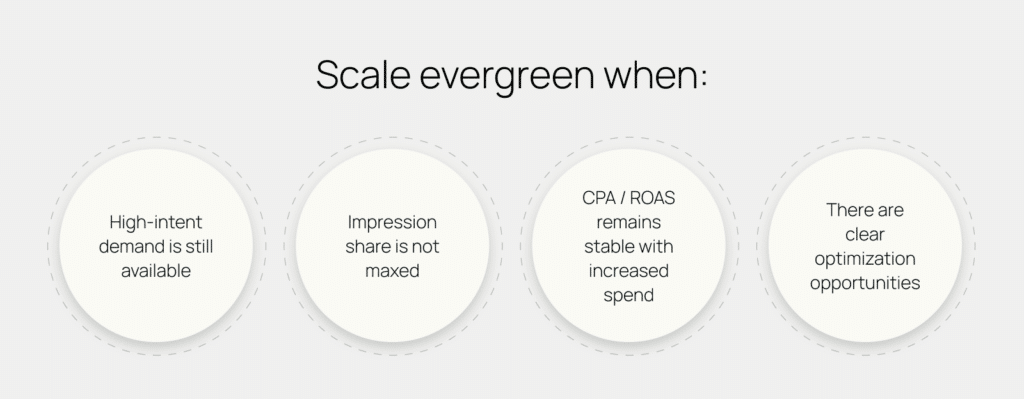
If the answer to any of those is yes, the conversation about experimentation can wait.
Why Evergreen Eventually Stops Scaling Efficiently
Here’s the catch: high-intent demand is finite.
There are only so many people searching for your solution this month. Once your evergreen campaigns have captured most of them, the only way to spend more is to reach further — broader targeting, looser match types, lower-intent search terms, colder audiences. The platform is happy to do it. It just costs more.
Evergreen performance alone cannot sustain long-term growth — it was never designed to. As targeting broadens, conversion rates decline and incremental conversions become more expensive. Efficiency peaks, and every dollar past that peak buys volume at a worse rate.
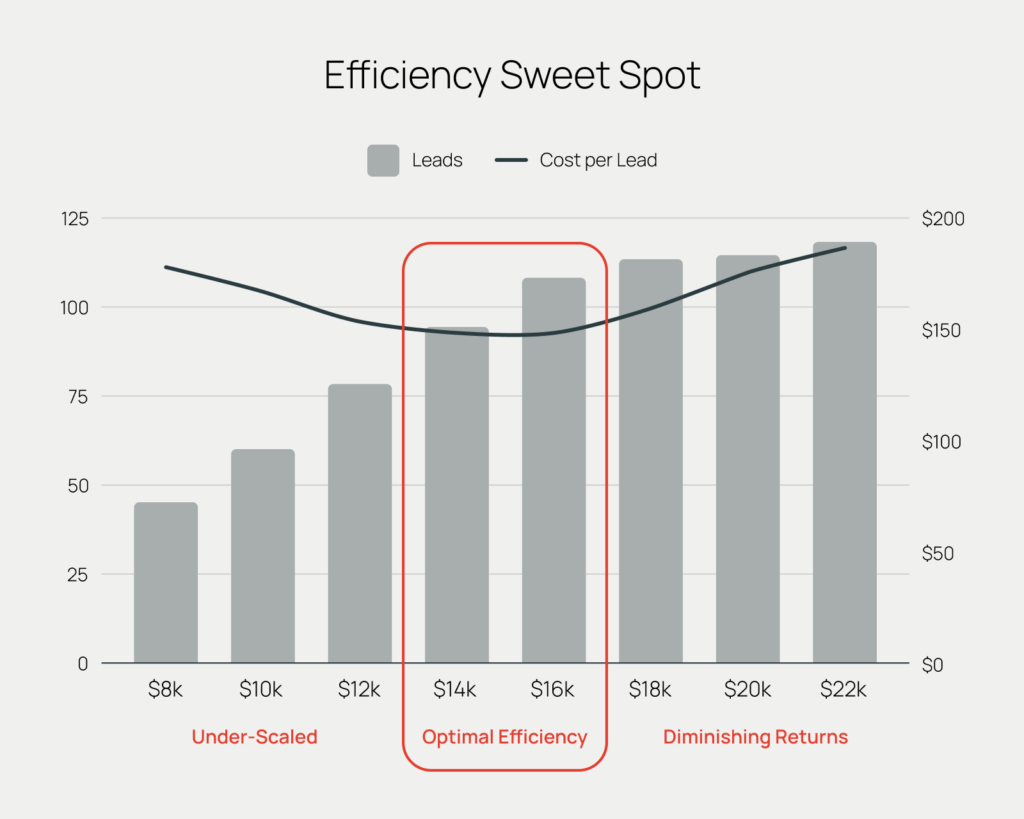
The practical question is how you find that peak without blowing past it. Nobody should be doubling budget month over month and hoping the efficiency holds. What I’d rather see is 10–20% increases at a time, a few weeks to let the system readjust, then another bump — watching CPA or ROAS the whole way. The right cadence flexes with the platform, the campaign’s maturity, and how much conversion volume you’re working with.
And there’s a nuance here that trips people up. Spending more will often push CPA up somewhat. That is not automatically a problem. The question isn’t “did CPA rise,” it’s “is CPA still inside the range this business can profitably pay?”
I think about an ecommerce client we worked with where we were defending a target ROAS with everything we had — nudging it from 4.0 to 5.0 to 6.0, protecting efficiency we were proud of. Then they told us, in effect: we don’t need a 6.0. We want as much revenue volume as we can get at a 4.0. We had been optimizing toward a number instead of toward their business.
That’s a bigger deal now than it used to be. Google’s change to how target-based bidding handles budget-limited campaigns means the target sitting in your account gets taken more literally — so a stale one does real damage while you’re scaling.
Keep an eye on lead quality alongside CPL, too. A stable CPL doesn’t mean much if those leads are becoming less qualified. As you scale, watch whether you’re still reaching the right people — not just what it costs to generate them.
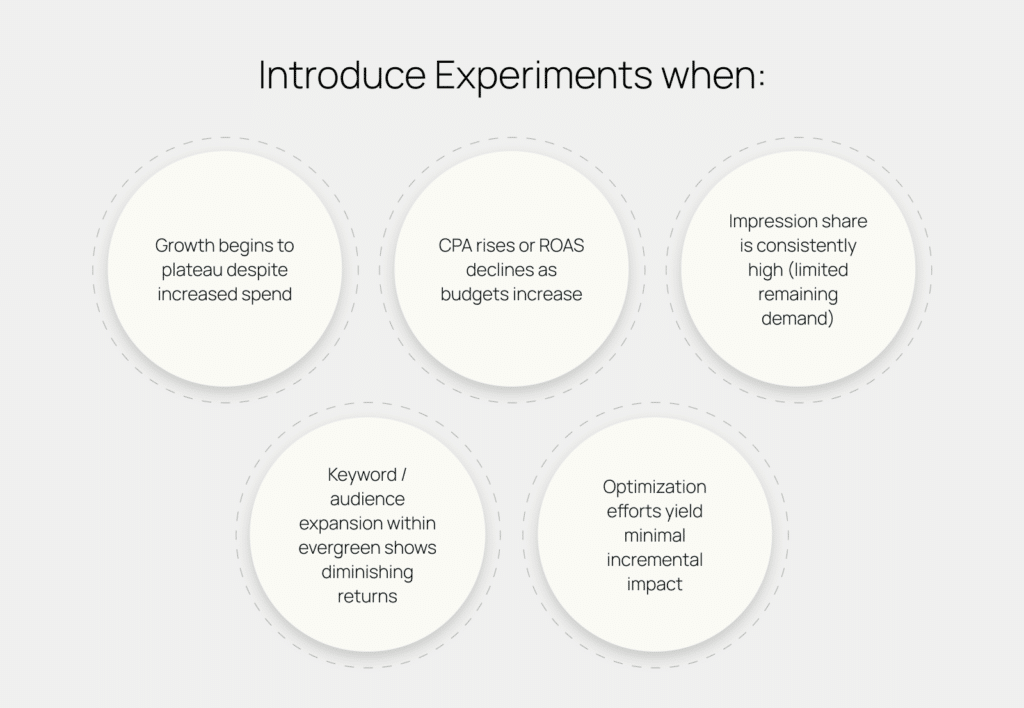
So know your threshold before you start scaling, then watch for the signals that you’ve reached it:
The Role of Experimentation
When those signals show up, the answer isn’t to keep forcing budget through a channel that’s tapped out. It’s to go find new demand.
That’s what experimentation is for: new audiences, new channels, new campaign types, new formats, new use cases. Experiments are not a replacement for evergreen and they’re not a hedge against it. Evergreen is your efficiency engine. Experimental is your growth engine.
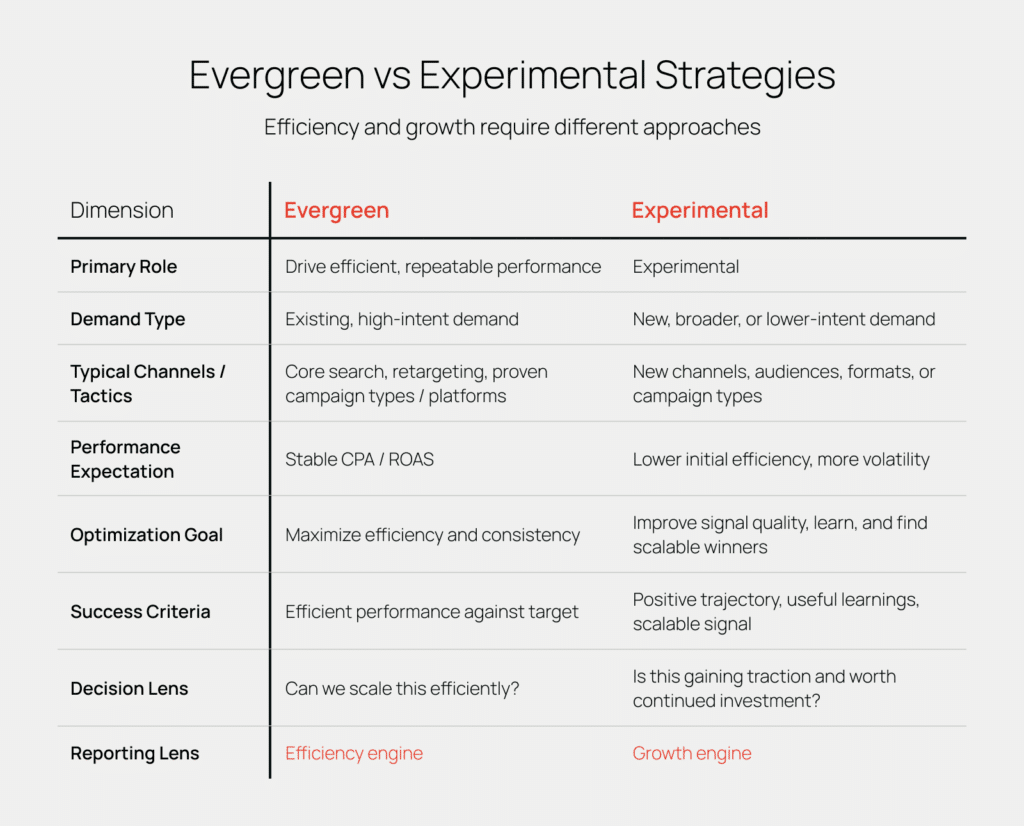
Here’s what that looked like on one account. Their evergreen campaigns had plateaued on the flagship product line, so we proposed expanding into their secondary lines — knowing full well those would be less efficient, but knowing the available growth was there.
We set that expectation before launch and split the budget goals: designated evergreen budget, designated experimental budget, reported separately. From day one the client understood these were two different jobs with two different sets of math. That framing is most of the battle.
Why Most Experiments Fail
Not every experiment will be a winner, and that’s expected. But many tests fail not because the idea was bad, but because of avoidable issues in how the experiment was planned or executed:
- 1. Insufficient signal. Too little budget, too few conversions, or too short a testing window to produce a clear answer. Without enough signal, the platform can’t learn—and neither can you.
- 2. Fragmented testing. Five small tests running at once, all competing for the same budget and attention. Fewer, better-funded experiments are more likely to produce meaningful results.
- 3. Premature optimization. Changing targeting, bids, budget, or creative before the test has had time to stabilize. Constant intervention makes it difficult to know what actually worked.
- 4. Unrealistic expectations. Holding a two-week-old campaign to the benchmarks of one that’s been optimized for eight months. A promising test can easily get killed before it has a fair chance to prove itself.
Why Experimental Campaigns Look Bad Before They Look Good
Experiments follow a predictable arc, and knowing it changes how you read the numbers.
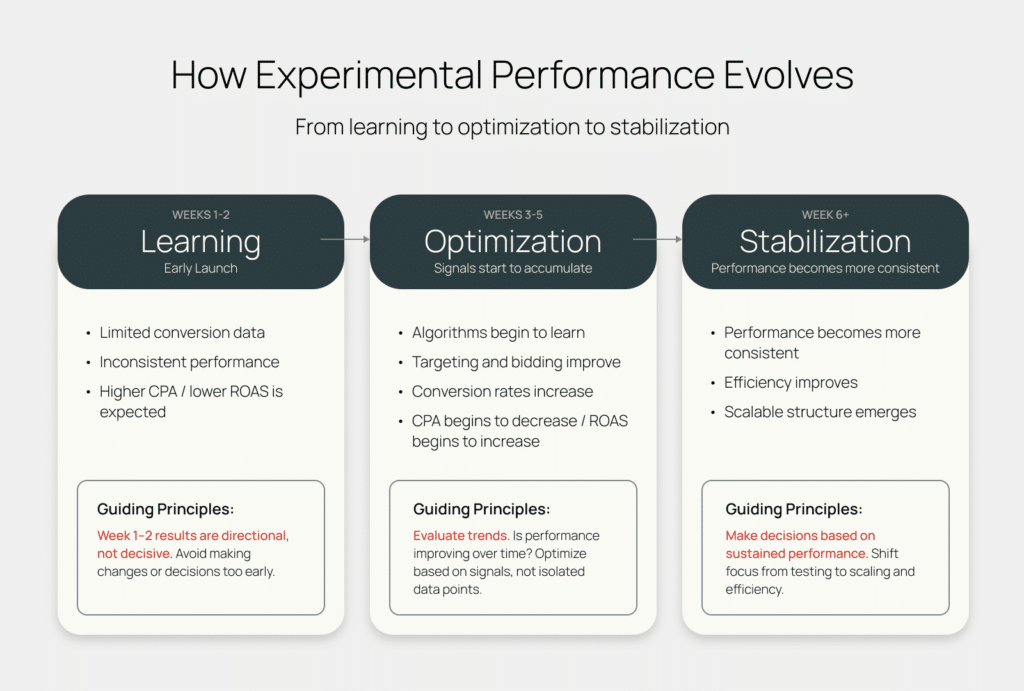
Weeks 1–2, learning. Conversion data is limited, performance is inconsistent, and CPA is high. This is expected. Week 1–2 results are directional, not decisive. Avoid making big changes or big decisions here.
Weeks 3–5, optimization. Algorithms start to learn. Targeting and bidding improve. Conversion rates come up. This is where you evaluate trends — is performance improving week over week? — rather than isolated data points. CPA is probably still off target, and that’s fine.
Weeks 6+, stabilization. Performance becomes more consistent, efficiency improves, and a scalable structure starts to emerge. Now you can make scale-or-cut decisions based on sustained performance and compare results against your targets with confidence.
Those windows flex with spend level and account data volume — a high-spend account gets there faster.
One important caveat, because “don’t react early” gets taken too far: there’s a difference between reacting to noise and fixing something that’s obviously broken. If you pull the search terms report in week one and all your budget is going to irrelevant queries, add the negatives. If your LinkedIn campaign is serving to entry-level titles when you’re selling to VPs, fix the targeting. Refining inputs is not the same as judging outcomes. Do the first constantly; hold off on the second.
When you do evaluate, ask better questions than “is it efficient yet”:
- Is performance improving over time?
- Are we learning which segments perform best?
- Is traffic becoming more qualified?
- Are we getting closer to target CPA/ROAS?
And if something looks off, diagnose before you react. Is the problem traffic quality, landing page friction, or just data volume? Is engagement strong but conversion weak? Are the search terms and audiences aligned with the use case you intended?
Every evaluation should land on one of three actions:
- Continue — performance is improving, conversion volume is increasing, traffic signals (CTR, CVR, query relevance) look healthy, and you can see the algorithm learning.
- Adjust — there’s promising signal but it isn’t efficient yet, traffic quality is uneven, or one variable is likely suppressing everything else. Refine targeting, creative, landing page, or budget concentration.
- Pause — no meaningful conversion signal, no improvement over time, persistently low-quality or irrelevant traffic, or insufficient data after a reasonable test period.
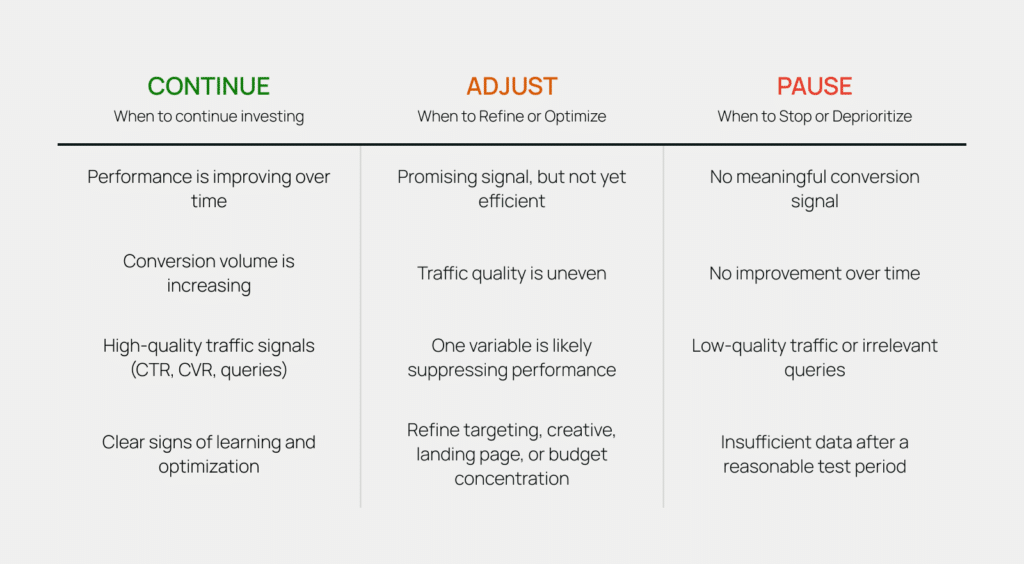
Most tests deserve a real shot at “adjust” before anyone reaches for “pause.”
Blended Reporting Needs Context
Now the reporting problem, which is where a lot of good experimentation quietly dies.
Blended numbers matter. A business cares about total profitability, not the performance of one campaign in isolation, and you should absolutely know what your blended CPA or ROAS is and what the business can afford. But blended reporting without segmentation produces misleading conclusions.
Here’s the arithmetic, with round numbers:
| Evergreen | Experimental | Blended | |
|---|---|---|---|
| Spend | $50,000 | $20,000 | $70,000 |
| Revenue | $250,000 | $60,000 | $310,000 |
| ROAS | 5.0x | 3.0x | 4.4x |
Blended ROAS fell from 5.0x to 4.4x. If the target was 5.0x, that report looks like a miss. But total revenue went up by $60,000, and if the business can profitably operate at 4.0x, everything here is working exactly as designed. Without segmentation, someone looks at 4.4x and pauses the growth investment.
A real example from one of our lead gen accounts makes the point even more sharply. Experimental campaigns there took 3% of budget at a $120.70 CPA, against a $44.24 evergreen CPA. In isolation, $120 leads look indefensible. But blended CPA landed at $45.07 — under a dollar higher than evergreen alone — and that 3% of budget produced roughly 260 incremental conversions per month that evergreen simply had no room left to generate.
That’s the whole argument in one line: 83 cents of blended CPA for 260 conversions a month. You cannot see that trade in a blended number alone.
So report both. Segment evergreen and experimental so the difference is visible, show volume alongside efficiency, and show the blended figure against the threshold the business can actually afford. The story isn’t “our CPA went up.” It’s “we added this much incremental volume and stayed inside your profitability guardrail.”
Balancing Evergreen & Experimental
There’s no universal split, and the right allocation depends on account maturity and growth goals. But if you want a starting point:
- 60–70% evergreen — efficiency
- 20–30% expansion — scaling within what’s proven
- 10–20% experimentation — learning
Lean more evergreen when demand is still uncaptured, impression share is available, and targets hold steady as spend increases. Lean more experimental when evergreen is saturated, incremental spend is getting less efficient, and the growth goal requires new demand. (The lead gen example above ran at 3% experimental and still moved the needle — these ranges are a rule of thumb, not a rule.)
The order of operations matters more than the exact percentages: protect efficiency first, then fund growth. Don’t pull budget out of evergreen to fund a test if it means leaving efficient demand on the table.
Then forecast before you launch. Two questions are worth answering on paper, in advance:
- What should performance look like in each phase? Expected CPA/ROAS ranges during learning, optimization, and stabilization — and when the data will be decision-ready rather than merely directional.
- What does blended CPA/ROAS need to be for this account to stay profitable while we fund experiments? A maximum blended CPA, a minimum blended ROAS, and an acceptable range of temporary softening in account efficiency.
I’ve found forecasting does two things at once. It gives the client a range instead of a surprise, which takes an enormous amount of anxiety out of the first six weeks. And it makes evaluation dramatically easier on your end, because you set a goal to evaluate against instead of squinting at a dashboard asking “is this good?”
It’s also worth tracking the secondary signals, especially for upper-funnel tests. Increases in direct traffic and branded search volume, and improvements in branded campaign CTR, CVR, conversions, and CPA. Nobody wakes up and randomly searches a brand name — if branded volume climbs after you launch CTV or TikTok, that’s the experiment showing up in a place your platform report can’t attribute.
The Bigger Picture
Successful experiments don’t stay experimental. That’s the point. A test that works becomes part of your evergreen foundation, gets evaluated like evergreen, and eventually hits its own ceiling — at which point you go looking for the next one. It’s a loop, not a line.
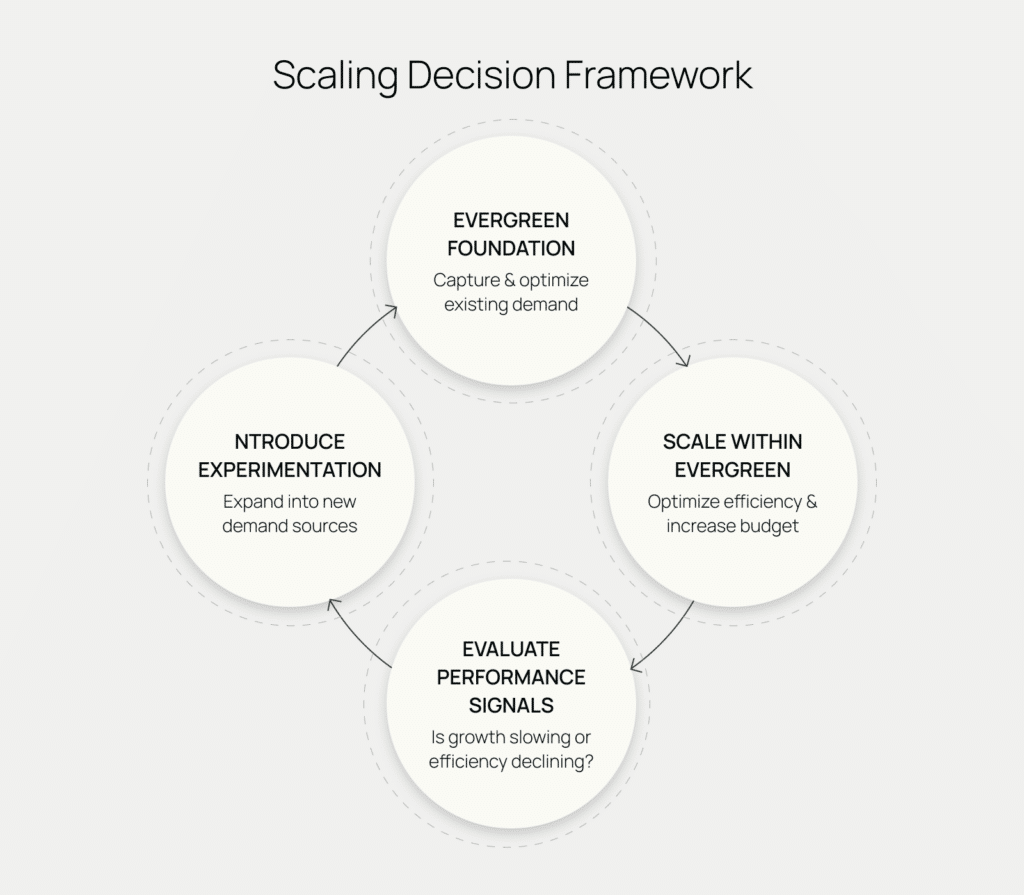
Which makes this a reasonable gut check for whoever runs your paid media, in-house or agency: Do they know where evergreen is maxed out and where it isn’t? Can they show you impression share and tell you what’s left to win? Is experimental budget designated and reported separately, or is everything blended into one number? Did they tell you what to expect in weeks 1–2 before the campaign launched, or are they explaining it now that you’ve asked?
Efficiency and growth pull against each other. That tension is normal, and it’s manageable — but only if somebody is deliberately managing both sides of it.
Ryan Nelsen, CMO at StackAdapt, walks through the same decision from the other side of the table — how his team decides a new channel has earned budget.