



Some search marketers have been declaring SEO dead for over a decade. Yet every year, search keeps driving brand discovery and revenue.
What has changed is how visibility works. Google’s AI Overviews summarize answers before users click, and generative engines talk about the brand inside responses. Search behavior now also spreads across YouTube, LinkedIn, marketplaces, and AI platforms.
Now, we aren’t gaslighting you—we are also seeing the declining click-through rates and unstable traffic that were so different just five years ago. When people ask, “Is SEO dead?” they’re reacting to something very real, and it’s affecting industries across the board.
But SEO is not dead or even dying. Like most things being affected by technology and digital initiatives, SEO is simply changing. Technical excellence, authoritative content, and visibility across systems is still essential. Now, you just need to optimize for AI systems and search platforms, too.
The biggest shift is the rise of AI-generated answers directly in search results. Google’s AI Overviews and generative engines can summarize information before a user ever clicks a page. In many cases, the search experience ends right there on the results page. When teams see traffic dip even though rankings remain strong, it naturally sparks concern about the long-term value of SEO.
At the same time, search itself is no longer confined to Google. People discover products on Amazon, research ideas on YouTube, ask questions inside AI tools, and follow recommendations from LinkedIn or Reddit threads. That fragmentation means visibility is happening across a wider ecosystem than traditional search analytics tools were built to track. For a lot of businesses, it can feel like you have no control over so many channels.
Those two forces together have created real volatility in organic traffic. If you have historically measured SEO success only through clicks and sessions, these changes can feel like the ground moving underneath your entire strategy.
For brands willing to adapt, the opportunity is still massive. Strong search visibility now depends on building authority, technical clarity, and content that AI systems trust as a source. That kind of SEO strategy sits at the center of modern search growth.
The phrase “is SEO dead” is what marketers are saying when they see declining organic clicks and evolving search interfaces that don’t seem as compatible with classic SEO. AI-generated summaries, knowledge panels, and expanded SERP features often deliver answers before users reach a website, so why should businesses bother with SEO?
But this evolution of search optimization has not necessarily lost its relevance. In fact, all it really means is that the role of SEO has expanded. Instead of focusing exclusively on ranking individual pages, your strategy should heavily focus on building authority and structured visibility across search and AI ecosystems.
A few patterns tend to fuel the idea that SEO is disappearing:
Remember that, ultimately, organic search remains one of the strongest discovery channels on the internet. High-intent queries flood search engines every day that drive your revenue. People still rely on search to solve problems and evaluate options, and your brand needs to show up in those results.
Enterprise organizations still invest heavily in search because it contributes directly to their pipeline growth. As you become an authority in your space (rather than focusing so heavily on ranking), and have technical, structured content performance, your visibility will increase.
For years, SEO success looked fairly straightforward, but there are a couple of other players on the field.
Traditional SEO says that success looks like top rankings and organic traffic. If your page appeared near the top of search results, the assumption was that clicks and engagement would follow.
Meanwhile, AI Overviews and generative systems increasingly pull answers from multiple sources. When that happens, business influence shows up through citations, summaries, and brand mentions inside those responses.
In other words, when AI search systems generate answers, they rely on sources they trust. If your content becomes one of those sources, your brand shows up in the answer itself—even when the user doesn’t click.
“SEO” is also one slice of a much larger pie, where AEO and GEO are a part of a well-rounded strategy.
Answer Engine Optimization, or AEO, focuses on structuring content so search systems can extract clear answers. Generative Engine Optimization, commonly referred to as GEO, looks at how AI platforms summarize and reference sources. Both ideas reflect the same larger trend: search engines are becoming answer engines.
Modern SEO strategies bring these concepts together. Instead of separating them, organizations combine traditional ranking strategies with content structures designed for AI summarization and entity clarity. This approach is how you can be at the top of your game with AI search and how to optimize for the future of search engines.
Another major change is where discovery happens. Search behavior no longer lives inside a single engine.
Someone researching a product might start with a Google query, watch comparison videos on YouTube, scan reviews on marketplaces, and read thought leadership on LinkedIn. Users also ask questions inside AI assistants before visiting a website.
Brands that want consistent visibility build authority across multiple ecosystems where search intent appears. So yes, you need to optimize for Google—that’s not going anywhere. But you also need to show up where people compare products or services and ask questions. That might mean:
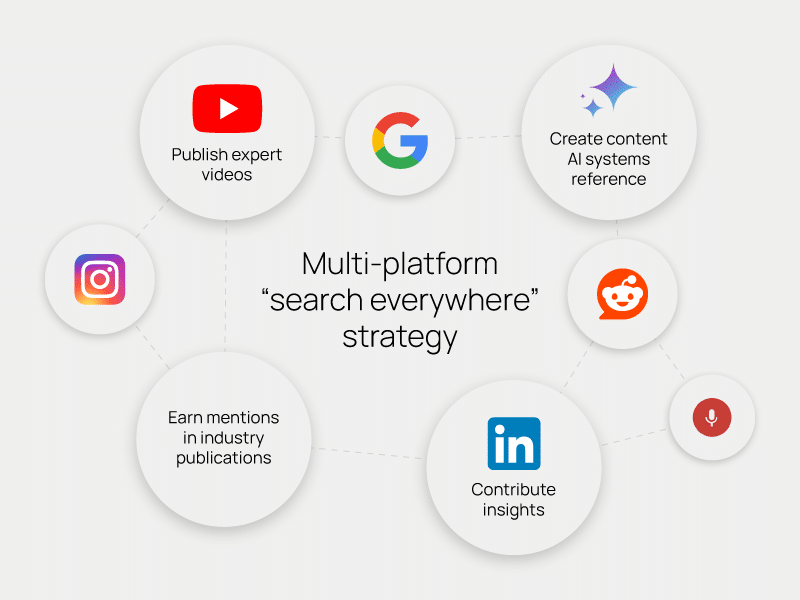
That broader presence strengthens the signals search engines and AI systems rely on when deciding which sources to surface. Over time, those signals reinforce brand authority in ways that pure keyword targeting never could.
Featured snippets started this trend years ago: search engines want to answer the question in the search bar without ever even visiting a website. Now, AI Overviews are taking it a step further.
Because more queries are answered directly in SERPs, AI Overviews have reduced the reliance on blue links for consumers—your audience.
So why are you pouring money into producing so much content for people to not even enter your website?
Because traffic declining does not necessarily mean your influence declines, too.
When your brand appears inside an AI Overview, a featured snippet, or a cited source within a generated answer, users still see your expertise. They may not click in that moment, but the exposure shapes awareness and credibility. Later, when they search again with a stronger intent, your brand is already familiar.
Instead of focusing exclusively on traffic, many organizations now look at a broader set of indicators:
The zero-click environment also forces some strategic decisions.
Chasing raw traffic can lead teams to prioritize high-volume informational queries that rarely convert. Meanwhile, focusing on authority and expertise often produces fewer visits but better downstream impact.
Enterprise organizations increasingly balance both sides of that equation. They invest in content that builds authority within a category while also strengthening owned channels like email, communities, and product education hubs.
Building authority earlier in the research process also helps teams connect search visibility to revenue attribution models, which track how organic discovery contributes to pipeline and closed deals.
We know that the technical side of SEO especially matters, but more than ever before, so does the human element of your content. Generic or recycled material just doesn’t quite cut it anymore. It’s your expertise and credibility that the AI models are going to trust.
Google describes these signals through E-E-A-T: experience, expertise, authority, and trust. This is exactly what it sounds like: search systems try to surface information that comes from knowledgeable sources.
AI-generated answers rely on the same signals. When models summarize content, they still look for sources that demonstrate real-world expertise and established authority within a topic area.
That’s why enterprise brands with recognizable subject matter experts, credible research, and original, real-world insights tend to perform well over time. They give search engines and AI systems a clear signal that their content is worth referencing.
Keywords do still matter, but even more important is writing for readers. Answer the search intent before you optimize for the algorithm to give yourself the best chance in AI search and future search strategies. This looks like having clearer explanations on the topic and practical solutions that actually help consumers make their decisions. Remember to:
Human-first content thrives when it’s supported by broader SEO principles. Successful organizations treat search visibility as a combination of these 6 disciplines of SEO working together.
If a site is difficult to crawl, poorly structured, or confusing to interpret, even great content struggles to appear consistently in search results. Think of it like building a library. You could fill it with incredible books, but if the shelves are disorganized and the catalog is missing, people will have a hard time finding anything.
Before a page can rank or appear inside an AI-generated answer, search engines have to find it and understand how it fits with the rest of your site.
That usually comes down to a few practical things:
When those fundamentals are in place, search engines have a clearer picture of what a site covers and which pages provide valuable answers.
Search engines are good at reading pages, but they still appreciate a little help.
Structured data acts like labels on a library shelf. It tells search systems exactly what they’re looking at. Product schema can identify price and availability. FAQ schema highlights clear question-and-answer sections. Review schema points to customer feedback.
Those labels help search engines surface the right information in rich results and AI-generated answers.
Entity relationships add another layer. When your brand consistently appears alongside certain topics across trusted sites, search engines begin to connect the dots. Over time, your brand becomes associated with that subject area, which makes it more likely to appear when people search for related information.
For enterprise organizations, technical SEO becomes even more interesting. Large websites often contain thousands or even millions of pages across different products, regions, and content hubs.
At that scale, small issues multiply quickly. Duplicate pages compete with each other. Important sections become buried several clicks deep. Old pages stick around long after they stop providing value.
That’s why enterprise SEO often requires governance systems and technical enterprise SEO playbooks that keep large sites organized. Without that structure, even strong content can struggle to gain traction in search.
You see a lot of the trending “SEO solutions” on your LinkedIn feed, but what is really going to move the needle? Let’s talk about it.
One of the biggest changes in modern SEO is the move away from pure volume. Today, that approach rarely produces lasting results. Search systems have become much better at identifying which sources actually demonstrate expertise within a topic.
That’s why many organizations now focus on building strong topic clusters around high-intent themes. Instead of publishing dozens of loosely related pages, they develop deeper resources that connect logically and answer related questions across the research journey.
The goal of these evolving SEO strategies is simple: become one of the sources search engines consistently associate with a category. That kind of authority tends to hold up far better than isolated rankings.
AI-generated answers have added another layer to modern AI SEO strategy.
Content now needs to be clear enough for AI systems to extract and summarize. Pages that explain ideas directly, use structured formatting, and answer questions clearly are more likely to appear in generated responses.
This often means writing in a more conversational, question-driven format. When a page mirrors the way people naturally ask questions, it becomes easier for AI systems to recognize and reference the information.
Ecommerce brands face a slightly different set of priorities.
Product pages need structured data that clearly communicates details like price, availability, reviews, and product attributes. Category pages often carry the responsibility of establishing topical authority for entire product groups.
At the same time, ecommerce SEO must compete within crowded SERPs filled with product listings, reviews, and comparison content. Brands that succeed often combine strong technical optimization with helpful buying guides, comparison pages, and educational resources that support the purchasing journey.
There are a lot of moving pieces to SEO now, and many organizations reach a point when their internal teams need help. This often happens when:
Working with a specialized team focused on AI-driven search can help organizations move faster while maintaining a clear strategic direction, which is why many brands explore working with an AI SEO agency.
By this point, one thing should be clear: modern SEO isn’t a checklist, but an entire system of connected strategies that all influence one another. When those elements operate in isolation, results tend to plateau. When they work together, search becomes a much more durable growth channel. 97th Floor is here to make sure every move you make is contributing to a healthy and modern SEO strategy.
97th Floor approaches SEO as a growth system rather than a content production engine. The strategy connects traditional search optimization with authority building, digital PR, and AI search visibility.
We can help you rank for keywords, but we also help your brand become a leading resource in your industry. Instead of chasing short-term ranking spikes, the focus moves toward durable visibility that supports sustained growth.
97th Floor focuses on building content systems and authority frameworks that continue performing even as search interfaces change. Search will keep evolving. How will your team keep up? Every algorithm update can work to your benefit as we help you master long-term authority and move beyond obsessive keyword ranking.
Let’s assess where your organization currently stands and see where you can start making changes for today’s SEO environment.
Start by looking at how your organization defines SEO success. The way performance is measured often shapes the entire strategy.
Next, take a close look at the technical foundation of your site:
Finally, consider how your brand appears compared to others in your category. Visibility gaps often become obvious when you look at where competitors show up in search and AI answers:
If these questions highlight opportunities for improvement, it may be time to revisit your SEO strategy. The search landscape is evolving quickly, and adapting early can make a significant difference in long-term visibility. Learn more about how our team approaches search strategy through our SEO services.
Is user confidence in online content at an all-time low? AI-generated content dominates many key topics, and users can easily find themselves frustrated when searching, finding articles they could have generated directly from a chatbot themselves. There is also an increasing volume of content that is becoming commonly known as “AI slop.”
And that’s without getting into the other struggle: LLMs are not only competing for eyeballs on regular search engines, but also stealing traffic directly. As a result, sometimes it can feel like the rest of us are left to fight over scraps.
If the current outrage over AI slop proves anything, however, it’s this: users still want good content. And marketers still want to give it to them. So — with the internet noisier and more crowded than ever — how can we complete the matchmaking experience and find each other?
At 97th Floor, we have cracked the code, and we can prove it.
A brief history lesson
The internet has always been noisy, overcrowded, and full of shoddy content churned out by marketers hoping to maximize their reach. While many of us like to think of marketing as a noble profession (we are helping people solve their problems!), there will always be those who act in bad faith, trying to game the system however they can. It’s the whole reason “black hat” marketing exists.
Luckily, Google is fighting the good fight, and every update they have made over the years is done so in an attempt to improve the experience of the user, and get them closer to the type of content they need. This means that those focusing more on gaming the system and less on quality content are the ones who are typically hit the hardest by algorithm updates.
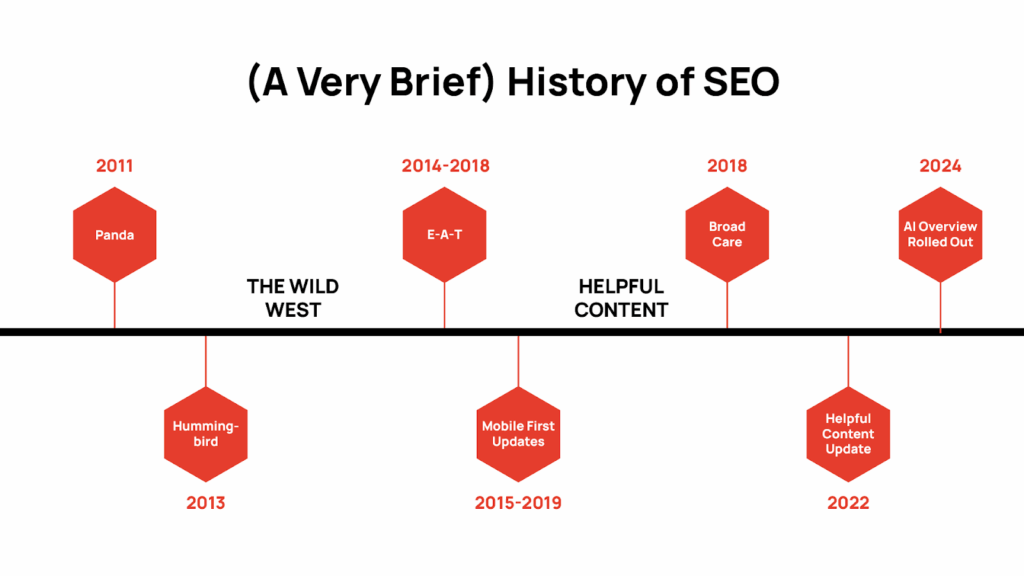
It’s the reason why, if you have been anywhere around content marketing, SEO, or even digital marketing in general for more than a few years, you will no doubt remember getting asked a question a million times, akin to “how do you balance SEO content and quality content.” Real ones know the truth: the best “SEO content” has always been high-quality content. And that kind of content is what has the power to withstand just about any algorithm update.
If that is not reason enough to focus on high-quality content, then let us also add this: The cost of bad content is steep. Analytics company CreativeX recently recently found that the average Fortune 500 company wastes approximately $25 million annually on content that fails to reach its intended audience or is not fully utilized.
It should come as no surprise, then, that the answer to combatting the current cacophony of AI slop is infuriatingly simple: produce high-quality content.
Ok, But…What Actually Is High-Quality Content?
I know, I know, that’s an incredibly unhelpful piece of advice. Because of course, anyone can claim to produce “quality content” but that means different things to different people. So, what do we mean when we say quality content? 97th Floor has a few principles that we have always lived by when it comes to both content and marketing in general.
1. High quality content is audience-focused
One of the main things that people get wrong about content marketing to this day is the how behind making the content itself audience-focused. As marketers, we can get caught up in how great we believe our solutions to be, that we get evangelical about the value that they bring — resulting in us pushing those solutions on our audience, rather than helping them. Quality content starts from a place of “what does my audience want or need?” rather than “what can we as a brand give our audience?”


| ❌ | ✅ |
2. High quality content is relevant to your brand
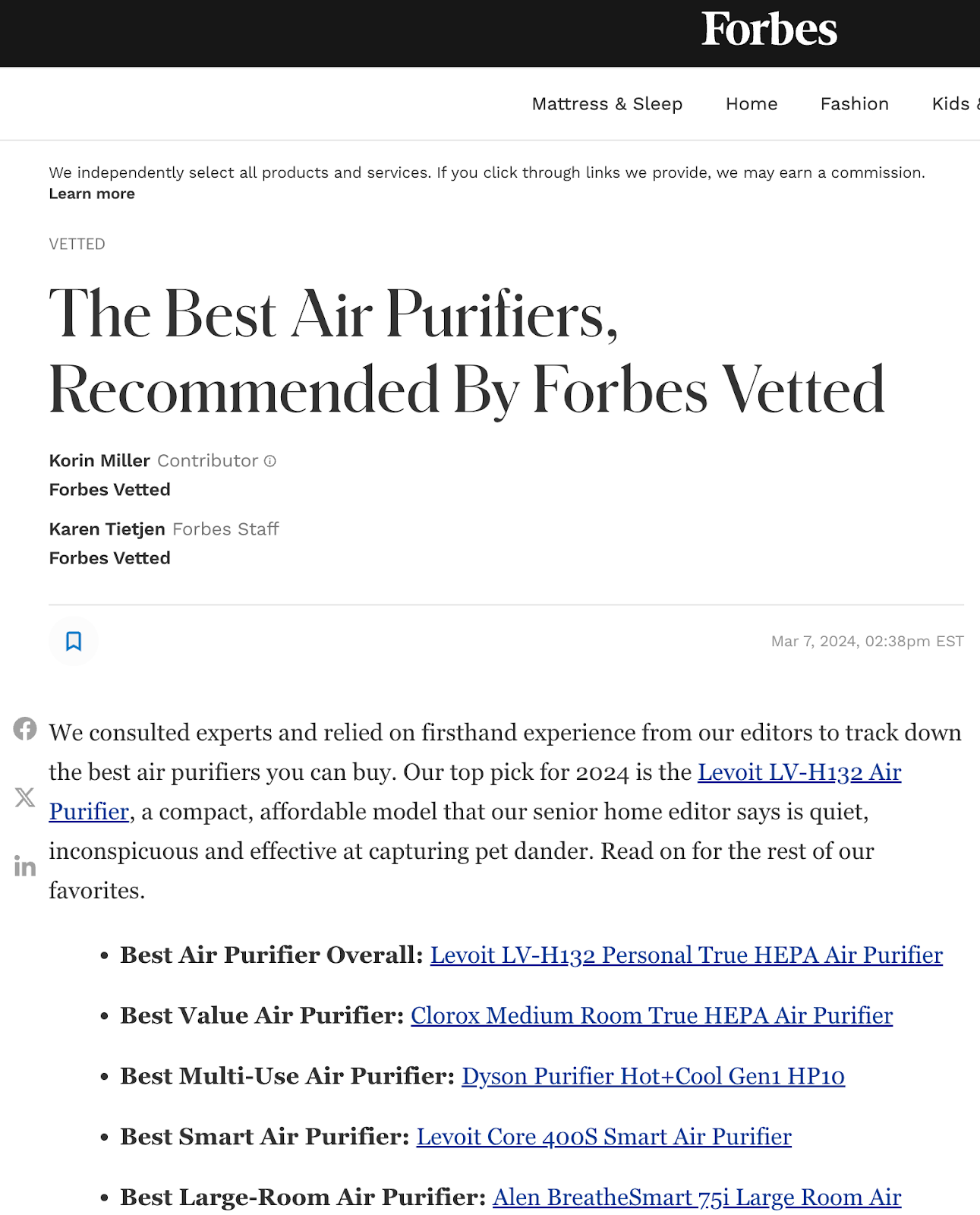
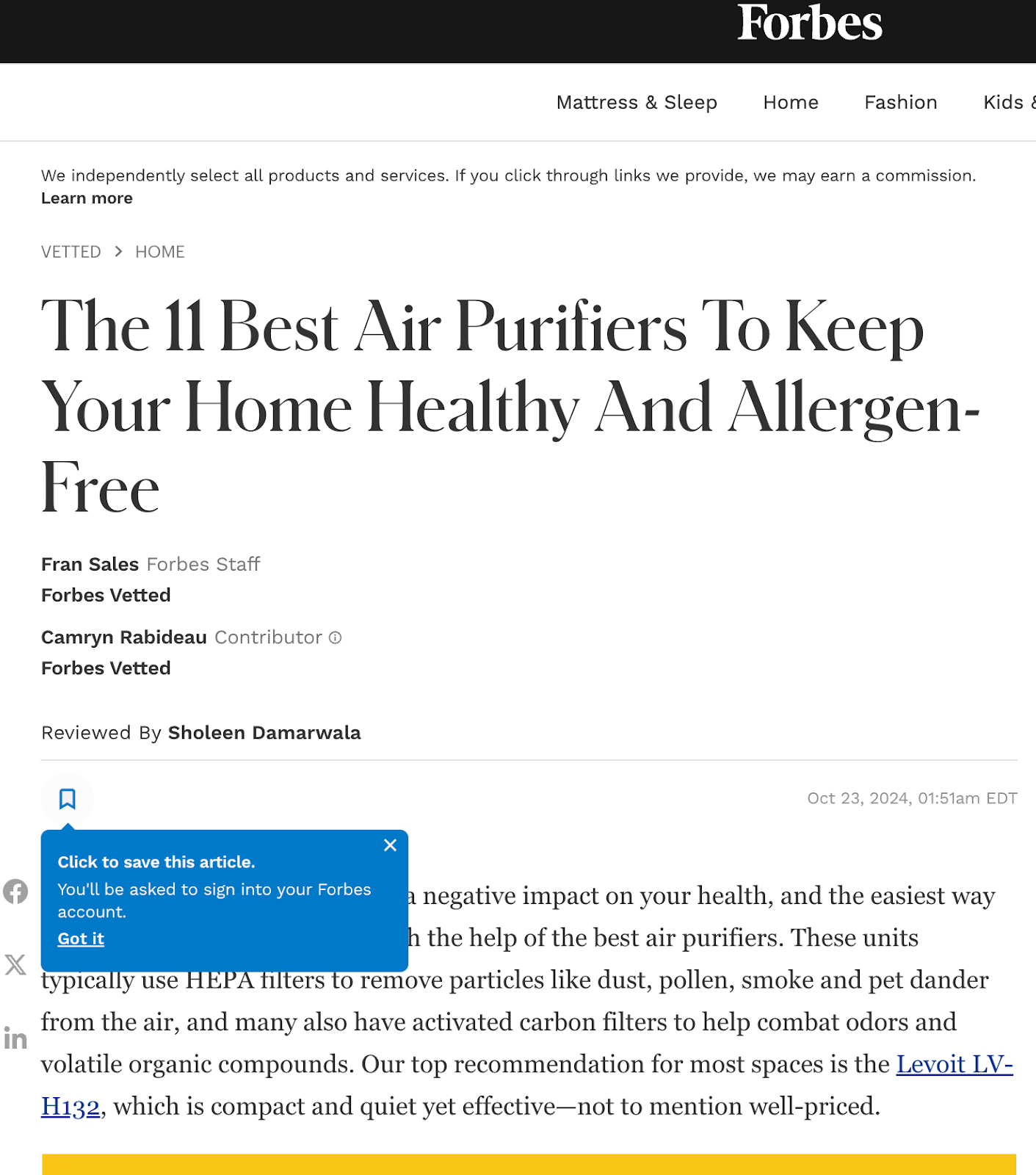
Ok, so you have figured out what the audience needs, and you have a ton of great content ideas. The next pitfall that marketers commonly fall into is trying to write everything. To illustrate: Take a quick moment to Google “best” anything and look at all of the sites that wrote about it, despite it being completely unrelated to their brand, product, or mission.
3. You are an expert and/or uniquely qualified to write this content
Authority matters. You might think this is the same as number two, but there’s a slight but significant difference. Something may be relevant to your brand, but you still have to prove yourself uniquely qualified to write it. This might come from expertise, experience, unique insights, or all three. This is also where the human element comes into play — even before AI, but especially now — users want content that they cannot simply generate by asking an LLM themselves. A unique and specialized point of view is more important than ever.
You may have noticed that our three quality content criteria and the use of AI are not mutually exclusive. On the contrary, we are not anti-AI evangelists. In fact, we use AI regularly to aid in efficiency and accuracy in the content creation process. However, it is rare (perhaps impossible) for a piece of content to match all three criteria without first passing by a human expert.
A survey conducted by consulting firm Baringa provides insight into opinions regarding AI-generated content by internet users. A majority of respondents identified at least one reason to value human-generated content above AI-generated content, with 81% citing “authenticity” as the key feature. However, users did not overwhelmingly state that they would avoid AI altogether — especially when it came to the younger demographics.
The fight for quality content is not a fight against AI, rather a delicate dance to make sure that it is used in the most effective way possible.
I Thought You Said You Could Prove It?
Ok, sounds like a nice theory, but does it actually work in practice? And can you prove it? In fact, we can. We have a proven history of this approach to content succeeding time and time again — surviving algorithm updates, changes in user behavior, and more. Here are a few examples.
Blendtec
Earlier, we made the claim that high-quality content will stand the test of time — and withstand algorithm updates. A perfect example of this is an article from way back in 2014 that we produced for Blendtec. A simple listicle of peanut butter smoothies, and accompanying recipes.
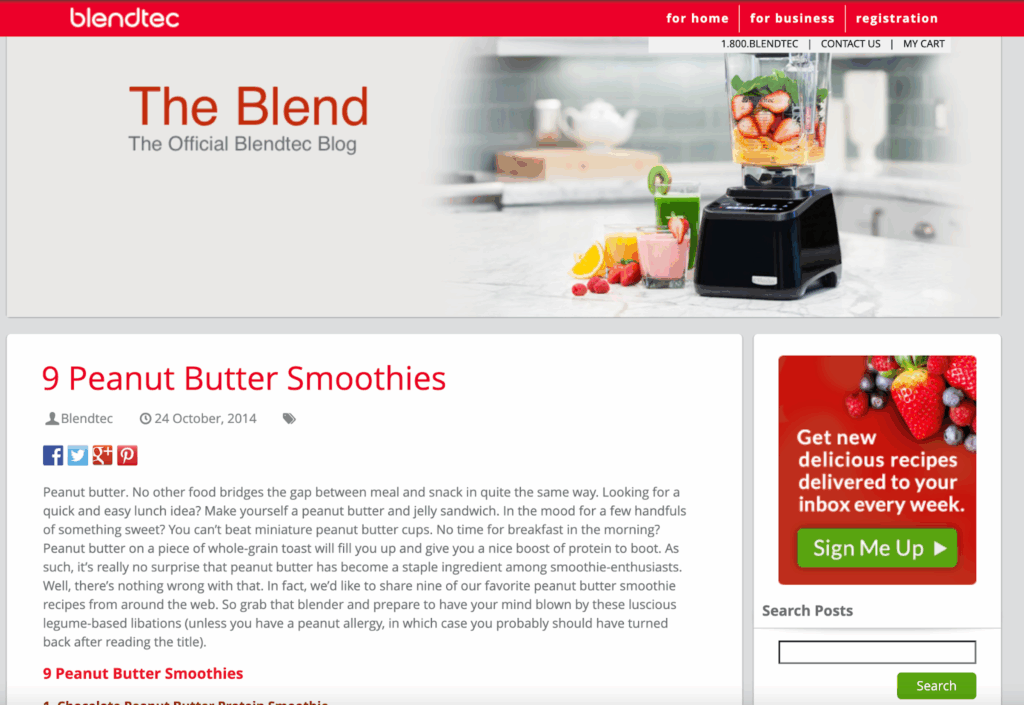
It meets our three criteria to a T and was incredibly successful when published. It continued to rank for several important keywords and survive several algorithm updates over the course of the next 10 years, to remain a top-three traffic driver for the site.
Dr Will Cole
Another example can be found in this guide on increasing progesterone levels for Dr Will Cole that we published and optimized in 2022.

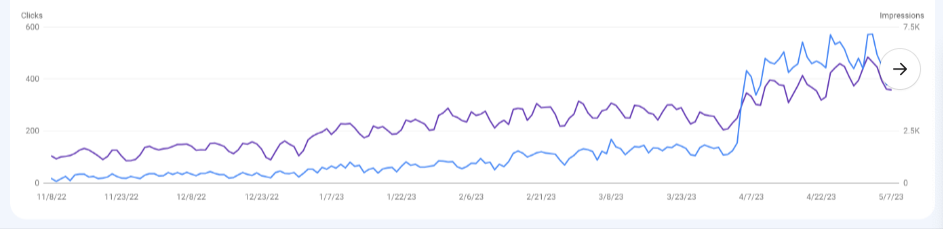
This article saw its biggest jump in traffic after an algorithm update in April 2023.
General Kinematics
But what about now? When AI is everywhere and AI Overview is stealing traffic from many pages. Well, we have countless examples of content that has survived the recent AI-pocalypse through following this simple formula for high-quality content. One such example this simple article for General Kinematics about uses for potash.
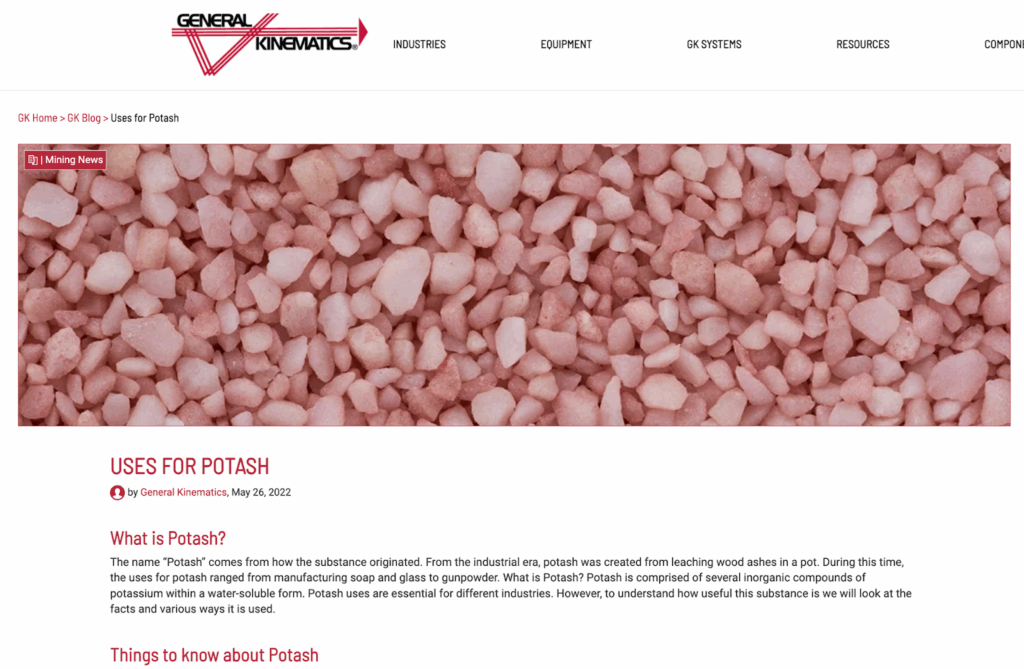
This content is audience-focused, brand-relevant, and something that General Kinematics — a producer of mining equipment — is uniquely qualified to write about. Published in 2022, it was automatically featured in AI Overview upon rollout of the feature in 2024, and has continued to do so since. What’s more: This page actually saw a 60.4% increase in traffic when you compare pre-AIO rollout to post-AIO rollout.
The bottom line: Google agrees with us. Every major and minor Google update in the past decade and change has been to get the search engine closer to prioritizing one of the three facets of quality content as identified by 97th Floor. For example:
1- Helpful content and other updates intended to prioritize user-first content.
2- Updates around brand authority, including recent updates that are deprioritizing irrelevant content for brands (or worse, brands that have spread themselves too thin and made it difficult for Google to assign authority).
3- This one goes beyond Google. Consider this: In a study of hundreds of thousands of citations, the most cited content type was product pages — by some margin. This means that this facet of quality content matters two-fold: Generic blog content is most likely to be directly replaced by LLMs, and product content — i.e. content that you are most uniquely qualified to write — is most likely to be cited. With optimizing both for and against LLMs becoming an increasing priority, this may be the most significant quality content guidepost of all.
I called out just three examples of this, but there are many more where that came from, and so will that continue.
The pattern across every one of those examples points to the same underlying truth. SEO expert Eli Schwartz makes the case that LLM visibility isn't a data or technical problem — it's a brand problem. This short video captures why the brands that consistently show up in AI-generated answers aren't winning on data. They're winning on authority.
Why It Matters Moving Forward
We talked about the ever-increasing noise of the internet. IBM predicts that AI will only continue to expand over the next decade, influencing more than content creation. High-quality content will continue to perform through both search engines and LLMs. The challenge or “noise” as marketers used to be different, but the solution is the same. If you put your audience first and prioritize quality content, the cream will rise to the top every single time.
Further Reading
Of course, that’s only part of the story. Sometimes you have to give even the cream of the crop the best chance to succeed. Next time, we’ll talk about how to get the most out of your content with an audience-first strategy.

If you're ready to future-proof your content and get in front of your audience—no matter how they search
We’ve all felt it. You pour time into high-quality content, only to see your organic clicks drop—despite impressions climbing. What gives?
Welcome to the era of AI-powered search.
Google’s AI Overviews (AIO) and other generative engines are changing how people discover and engage with content. The game isn’t over—it’s evolving. And if you want to keep winning, it’s time to optimize not just for traditional SEO, but for AI-powered results.
At 97th Floor, we’ve spent the last year testing and refining strategies that help our clients show up and stand out in AI results. This guide breaks down what we’ve learned and how you can use it to grow.
Here’s a fast-track checklist that we stand behind:
We’re seeing a clear trend since the advent of Google’s AI Overviews:
This shift in metrics is significant. Your content is still being seen, but it’s not driving as many clicks.
This is largely due to AI Overviews, which are providing answers directly in search results—without users even having to visit your site.
In fact, research from Ahrefs revealed that AI Overviews reduce clicks by 34.5%. They analyzed 300,000 keywords and found that the presence of an AI Overview in the search results correlated with a 34.5% lower average clickthrough rate (CTR) for the top-ranking page, compared to similar informational keywords without an AI Overview.
This doesn’t mean SEO is dead. It means that SEO needs to evolve.
With this change in how users interact with search results, it’s important to note that KPIs are shifting. While clicks may be down, impressions are up—and brand mentions and search visibility are becoming increasingly valuable metrics. It's no longer just about tracking clicks; it’s about how your brand is being mentioned and perceived in the broader conversation.
At 97th Floor, we’re helping brands adapt to this new search landscape. We’re testing what works—and what doesn’t. In this article, we’ll walk you through how to optimize for AI and stay ahead of the curve.
AEO (Answer Engine Optimization) – Structuring content to appear in AI-generated answers and summaries (like Google's AI Overviews).
GEO (Generative Engine Optimization) – A broader strategy to improve how your content appears in LLM-powered results, including chatbots and voice assistants.
Other helpful terms:
Yes. But traditional SEO on its own won’t cut it.
GEO and AEO prioritize intent, clarity, and usefulness over keyword stuffing or link volume. Search engines (and AI tools) want to deliver satisfying answers, not just keyword matches.
Good keyword research still matters—especially when it covers both primary and secondary search intents.
Unlike traditional SERPs that rank blue links, AI search engines pull and generate answers using two main data sources:
They look for:
Here’s the opportunity: content that works well in LLMs often also ranks well in traditional SERPs. Optimizing for both doesn’t require two strategies—it just requires a smarter one.
AI content optimization is the process of structuring, writing, and formatting your content to be more useful and accessible to AI tools, without losing sight of your human audience.
Let’s be clear: the goal is not to “hack” the algorithm. The goal is to help people. To provide persona-driven content that resonates.
Too often, we see content stuffed with keywords or unrelated FAQs just to rank. That’s not helpful. It’s not what AI wants, and it’s not what readers want either.
Before you go all-in on optimizing for models instead of humans, this quick video breaks down why that approach can actually hurt your content’s real-world performance.
Start with your audience. Understand who they are, what they care about, and how they search.
Consider using audience insights to build Custom GPTs that speak in your brand voice and match your customers' tone. (Here’s a screenshot of what it looks like in ChatGPT to configure a custom GPT.)
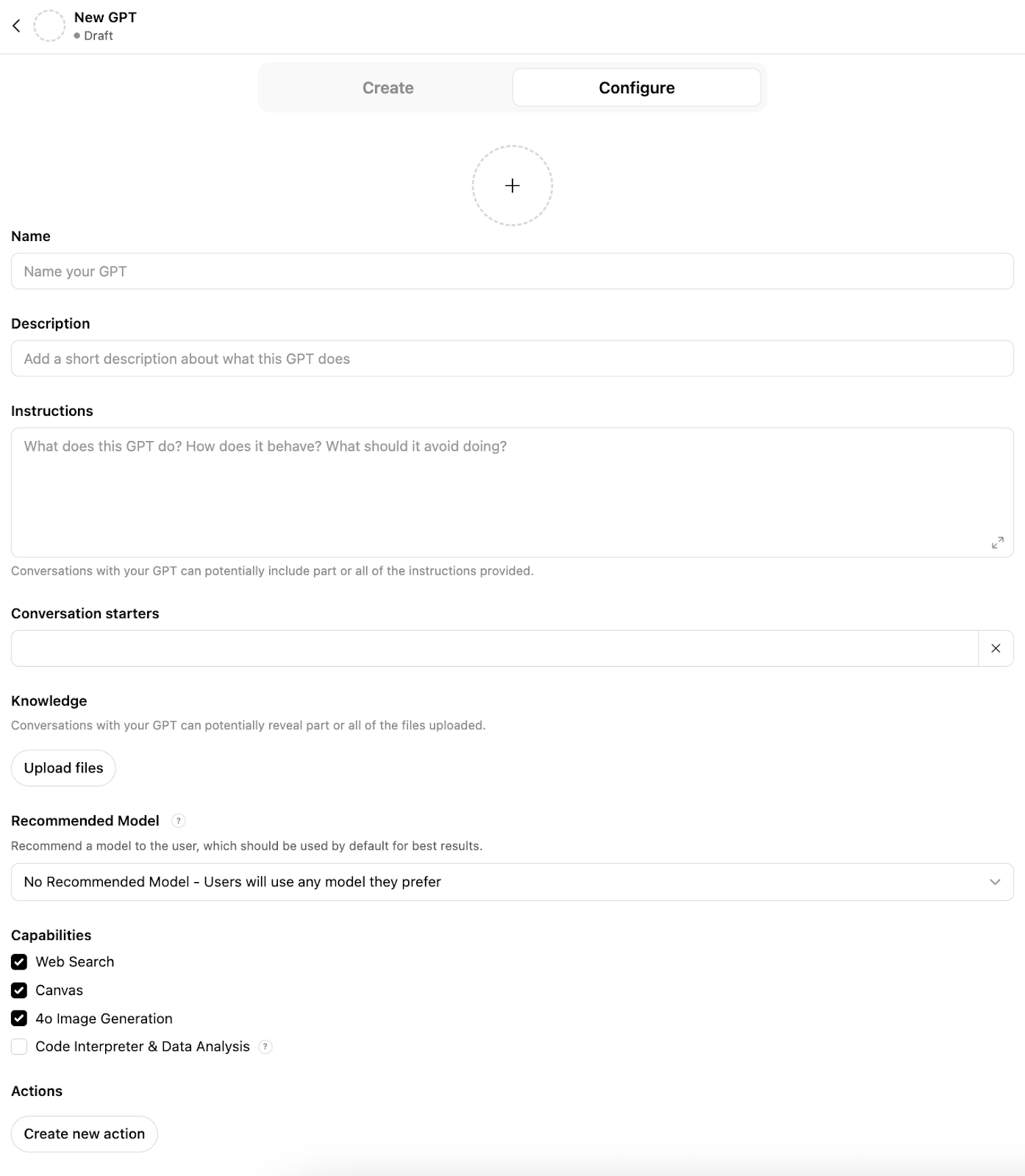
We also recommend:
Start with the answer, then explain it.
Example:
Q: How do I optimize for GEO?
A: Focus on clear, structured answers, semantic HTML, and direct responses to user queries.
Then go deeper.
Also:
AI favors content that’s easy to parse. That means:
97th Floor Test Results:
After adding bullet points and clear heading structure to a product page for a 97th Floor client, impressions and AIO rankings for an SEO-optimized article skyrocketed from ranking on the third page of the SERP to the first page (and ranking in Google’s AI Overview) in a short period of time. Here’s the results:
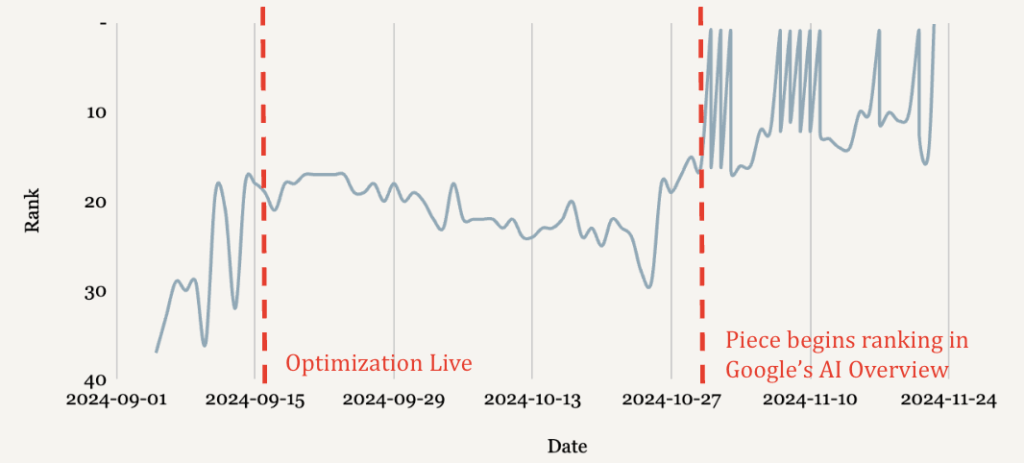
AI wants to serve trustworthy content. Show yours.
Ways to do that:
97th Floor Test Results:
By focusing on tightly-knit topic clusters, we were able to achieve topical authority for Princess Cruises:
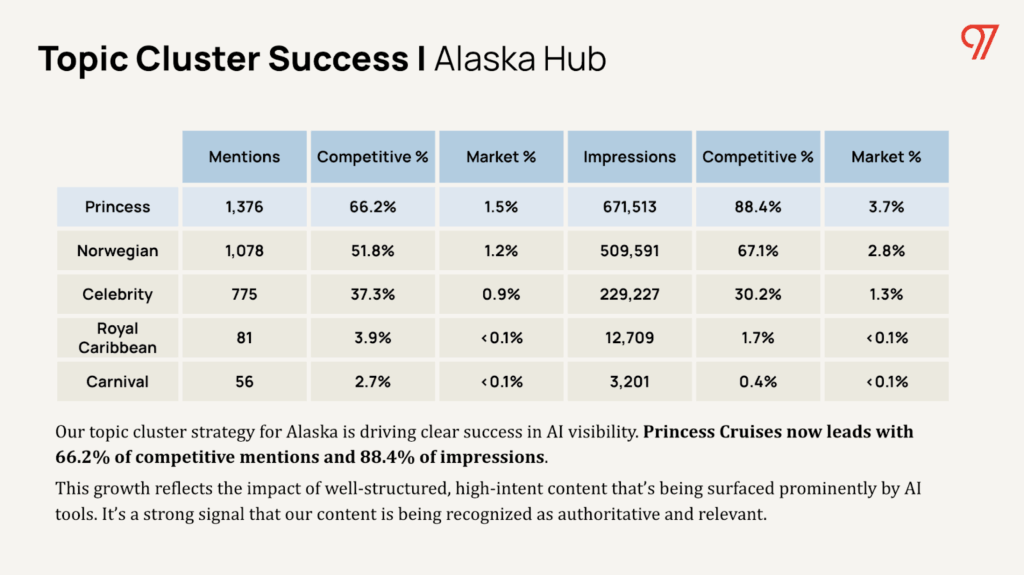
AI search engines increasingly value content from recognized, authoritative sources. This makes brand pages, like your About Us or Homepage, vital for building trust with both AI and human users. Additionally, third-party citations, such as mentions from reputable websites or reviews, are becoming more influential in how your content is perceived. Ensuring your brand is recognized across the web not only boosts authority but also increases your visibility in AI-driven search results.
AI is already reshaping how people find information—and how businesses earn attention.
At 97th Floor, we’ve helped our clients weather the shift from traditional SERPs to AI Overviews and GEO. Our strategies have earned AIO features early and consistently. And we’re continuing to test and refine what works as the landscape changes.
If you're ready to future-proof your content and get in front of your audience—no matter how they search
On all counts, the Oil and Gas market is more volatile than most. Globally, prices fluctuate, regulations evolve, and supply and demand shift. Regionally, each market has unique dynamics, all dependent on macroeconomic variables like rising material costs and high interest rates, not to mention unique location-specific changes in supply and demand. Being a marketer in this arena demands a solid foundation in industry trends to make the smartest marketing decisions. Maintaining a clear Oil and Gas marketing strategy is the blueprint that guides every touchpoint between your brand and your potential buyers. It outlines who you’re targeting, the channels you’ll use, the messaging that resonates strongest, and the tactics needed to generate meaningful revenue.
However, most brands in Oil and Gas haven’t refreshed their marketing strategies in years. This leaves an opportunity wide open for savvy digital marketers.
We've dug deep into the most recent industry data and our own two decades of experience to provide you with a how-to guide on how to take advantage of this exponentially growing market. We’ll walk through the core components of building that strategy — from segment analysis and target market selection to developing a strong brand position that resonates in this complex landscape. We’ll also break down how to build a comprehensive marketing plan and how to leverage digital channels that drive measurable growth for Oil and Gas companies. With the right foundation, your team can stand out in a market that’s more competitive and more opportunity-rich than ever. Let's get right into it.
The oil and gas market is broken down into segments. If you haven’t yet, a good first step is to analyze each to find where your brand best fits in the flow. This allows for targeted marketing, laser-focused on which part (or parts) of the market you’re planning to win. Whether you and your team choose to focus on:
You’ll need a full understanding of each segment's needs and challenges to build the marketing strategies that place your brand in an optimal position and maximize your ROI. Each market has specific advantages and drawbacks.
Evaluate the potential ROI and align your marketing goals with the most promising markets. Choosing the target can make or break your marketing efforts. Trust us, taking the time to do the research will be the difference between a major win or a budget-crushing fail.
Always know who you’re selling to. In the oil and gas industry, this could mean large corporations, smaller service providers, or even local governments. Carefully identify these key players and tailor your marketing efforts to meet their specific needs. It’s your job to connect as deeply as possible with your target audience. Potential customers are looking for personal connections with the brands they buy from, currently an uncommon occurrence in this market. This opens a window for you to step in and step up.
That window stays open only as long as your competitors remain comfortable. Marketer Sterling Snow calls this advantage "creating the channel" — and the brands that claim it first rarely give it up. When every player in your category is competing for the same keywords, the same trade media, and the same conference floors, the real leverage is in the channel nobody's thought to build yet. This short video captures why owning an uncrowded distribution channel — before your market wakes up — is one of the most durable advantages in B2B marketing.
Once you've identified your customers, the next step is to understand their behaviors. What drives their purchasing decisions? What are their pain points? What motivates them? What risks are they concerned about? Think about every step they’ll take on the buying journey, how they make decisions, and how you can meet their specific needs.
Once you’ve identified and worked to understand your audience, create a persona to represent your research. A clear, thought-out buyer persona will guide all your subsequent marketing efforts. Keep your persona in mind as you plan strategies and build campaigns. The more personalized and specific you are, the more likely your messaging will resonate with potential buyers. Here's an example Buyer Journey/Persona our team at 97th Floor recently created for General Kinematics.
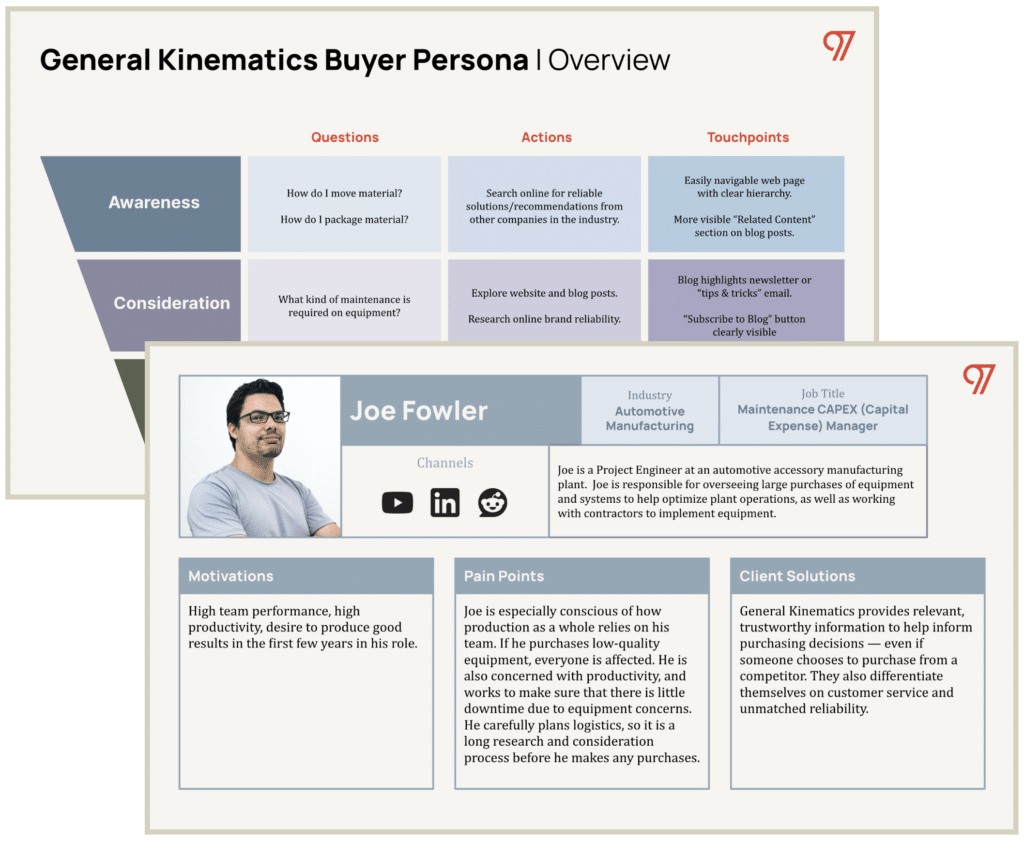
Your brand identity is what sets you apart. Think it through – what makes you different from other businesses in the industry? What are your specialized offering points? Focus on what makes your company unique, whether it's innovative technology, exceptional service, or a strong commitment to sustainability. If you’re looking for a place to start, begin by collecting reviews or interviewing previous customers for their opinions on what you do best.
With your identity in mind, work to position your brand in a way that highlights these strengths to appeal to your target audience. Clear, consistent messaging across all marketing channels is key. To pinpoint what messaging resonates best, you can give A/B testing a shot. Most importantly, always look for new opportunities to demonstrate your value through every medium. Case studies, visual data representations, and customer reviews are common ways to do this.
The battle’s not won yet, sustaining your hard-earned digital clout isn’t an easy process. Building a strong brand reputation takes time and effort. Maintain transparency, deliver on promises, and engage with your audience consistently to keep your brand's reputation positive. This needs to be an integral part of your marketing efforts.
Supported by your clear brand identity and ideal customer targeting, it’s time to build out a digital marketing strategy. First, define clear, achievable marketing objectives. Whether it's increasing brand awareness, generating leads, or boosting sales, having specific goals helps measure success. Keep track of your goals and efforts to achieve them to celebrate success and identify opportunities for improvement.
A well-developed marketing strategy, especially in Oil and Gas, involves sub-strategies including:
Marketers across the field agree, almost every part of digital marketing revolves around a well-optimized website. It's no different in Oil and Gas, your website is your digital storefront – the place all potential customers will navigate to on their path toward a purchase. It needs to be user-friendly, informative, and most of all, optimized for search engines to attract organic traffic. Use tools like Google Analytics, Search Console, and HubSpot CRM to track visitor behavior and optimize performance. Learn more about SEO strategies here.
Social media platforms offer a space to connect with your audience, share industry insights, and showcase your company’s culture. Regular, engaging content helps build a loyal following. Depending on your business, goals, and strategies, social media may or may not be a place to focus your budget and time.
Quality content drives traffic and builds trust. Create valuable content that addresses your audience's pain points and positions your company as an industry thought leader. Publishing content also drives your SEO. Learn more on how to set up a consistent content strategy here.
Regularly analyze your marketing efforts to measure ROI. Use analytics tools to track performance and adjust strategies as needed for continuous improvement. Keep in mind that metrics like impressions and leads can be a great start, but the end-goal of marketing is to generate conversions. Successful marketers make money. If ROI is stagnant, the marketing strategy is too.
By targeting the right segments, fine-tuning your strategies, and focusing on persona-specific messaging, you can position your brand as a leader in this digitally stagnant market. In Oil and Gas, staying ahead requires a laser focus on your goals and your audience's needs. Find ways to set yourself apart and continuously refine your strategies. With a well-crafted Oil and Gas marketing strategy, you’re ready to take advantage of the market and win contracts like never before. Good luck!
Want to kickstart your marketing dreams? We're here to help.
For seasonal business owners, demand rises and falls with the changing weather. While seasonality is a unique and perhaps daunting challenge, the predictable rhythm of demand means that those businesses who can sync their marketing with the mandates of sun or snow can have success year-round.
97th Floor is no stranger to seasonal marketing; we’ve executed winning strategies for businesses including pool maintenance, sports equipment, cruise lines, pest control, lawn care, solar, and moving services, just to name a few.
In this article, our resident experts in SEO, content, and advertising share five actionable tips for seasonable business marketers.
Search Engine Optimization (SEO) is a long-term game, and waiting until peak season to focus on it can be a costly mistake. It's essential to begin your SEO efforts well in advance, ideally during the off-season.
Head of SEO Mike Witham says, “You need consistent year round efforts to maintain and improve rankings. If your peak season is in March, you should be ensuring you have solid rankings for core pages by no later than December. Do not start working on it the month before your peak season!”
For businesses serving multiple states or a large region of the country, seasonal demand may be different across these various geographies.
Enterprise advertising specialist Spencer Martin uses Google Keyword Planner to anticipate search volume fluctuations in different areas.
He shares, “We launch campaigns early so that we have 2 to 4 weeks to ramp up and capture the full demand. Campaigns need time to scale and learn, so if we wait until the season starts to launch we lose out on potential profits for our clients.”
While digital marketing is crucial, seasonal businesses can see major wins by looking at more traditional advertising. Enterprise Account Executive Nathan Hooper suggests non-digital forms of advertising, such as mailers or community events to target local audiences. Advertising on community calendar pages or local business directories can put your business in front of potential customers who may be researching local services.
Understanding your buyer and their motives for buying is essential for capturing demand at the right time.
Senior Director of Campaigns Jon Hammond shares that his clients in the travel industry refer to December through February as “The Wave.” This three-month period is the biggest sales period for travel as people look forward to summer sun during the cold, dark winter months. His clients maximize their ad budget and run major deals and promotions during this time to capture the demand.
Content Marketing Specialist Kaylee Baker emphasizes the importance of targeting specific demographics, such as 18-30 or 25-40-year-old males, who are the main consumers of seasonal services. Consider the platforms they frequent, such as YouTube, to tailor your marketing efforts accordingly.
When reporting to leadership, especially in industries with high historical seasonality, like cruises, it's essential to use Year-over-Year (YoY) data rather than Month-over-Month (MoM) data. This approach provides a more accurate depiction of progress or decline in traffic or sales over the seasons. By analyzing YoY data, you can better understand trends and make informed decisions to optimize your marketing strategies.
In conclusion, marketing a seasonal business requires careful planning, adaptation, and understanding of your target audience. By implementing these five tips, you can maximize your marketing efforts and capitalize on seasonal fluctuations in demand.
Cybersecurity solutions buyers are worn out by the constant barrage of stale content flooding their search results, inboxes and social media.
Only brands that are willing to pause the content machine long enough to develop true empathy for their audience will be able to make any progress towards the mecca of trust and authority.
97th Floor believes that Empathy, paired with Innovation and Profitability, produces Great Marketing—marketing that fosters relationships and ultimately sales. We unlock empathy for our client’s customers through an exhaustive process of in-depth persona research and customer journey mapping.
Our customer journey maps reveal the questions, actions and touchpoints of an audience at each stage of the funnel: awareness, consideration and decision. Using these maps as a launching pad for every marketing campaign makes delivering "the right message at the right time" a reality.
The following are real persona customer journey maps created for our clients in and adjacent to the cybersecurity industry. They have been anonymized, but all other information is as-delivered to our clients.



The customer should be at the center of every marketer's strategy, but most marketers rely exclusively on quantitative data from the many tools at their disposal. Customer interviews expert, Ryan Paul Gibson, breaks down we need customer interview programs, how to build them, and how to share learnings across our organizations.
In 2022, artificial intelligence can drive cars, map the spread of infectious diseases, and recommend your next binge-worthy show. Some AI is even composing music and painting.
By some estimates, we could achieve “singularity”—or the point at which computers are proactively and exponentially improving themselves as the dominant intelligence on earth—by 2045.
Others don’t think this will ever happen. We think there’s no point worrying about it yet.
We’re wondering how it could impact marketing. Could certain marketing roles or responsibilities eventually be replaced by AI? Specifically, how will it impact content creation? With so much of a marketer’s work already living on digital platforms powered by AI (Google, social media platforms, marketing automation software, etc.), could AI-generated content ever replace human-generated content?
We wanted to know. Fortunately, our client Hiya wanted to know, too.
Hiya is a SaaS voice performance platform that reduces spam calls and provides extremely impactful caller ID services to enterprises. We fed various AI machines content prompts for Hiya and gave the exact same prompts to the content team at 97th Floor. Take the quiz to see if you can pick out the human-created content.
We took these results back to Hiya to see what they thought about the AI content. Jonah-Kai Hancock, Hiya's Vice President of Demand Generation, noted that "Any time you are asking someone to read a blog or engage in an email or watch a webinar you are asking for their time and I don’t think that the AI does a really good job explaining what I would get out of that time.”

Rachel Bascom, Head of Content Marketing at 97th Floor, was surprised by what the AI could do. She shared, “The blog article from AI may rank fairly well. We could use it for SEO and it might please an algorithm, but I don’t think it would sell anything anytime soon. A content marketer is thinking beyond an algorithm in a way that AI can’t do. Yes, the AI piece might rank well, but what happens when someone opens that link? Human writers can think about the content journey and create something engaging, educational and conversational.”
Rachel is also feeling assured that she, a living breathing content marketer, will get to keep her job after this experiment.
No surprise here—we all felt that the AI content lacked personality. Especially in Hiya’s industry where personal touch is central to their product, this AI content could never fly.
But honestly, that’s what we expected. Here’s the process most marketers face when trying AI out for the first time:
Maybe you’ve had similar experiences. AI is, most often, not where it needs to be for marketers, and many marketers feel that their existing, non-AI process for content creation is effective. To many, adding AI seems like an unnecessary disruption of that process.
Hancock shares, “It would be a lot more work for me to figure out how to make AI work. Unless my content team came to me and said ‘hey we really want this and here’s why,’ I don’t see this happening right now.”
Content-generating AI is still unproven, and marketers are justified in hesitating to invest.
But that hesitation has a compounding cost — and the gap between early movers and late adopters widens faster than most realize. Certainty is always one more data point away, and waiting for it is how capable people end up starting last. Daniel Nisan, startup founder and investor, makes the case that waiting for proof isn't caution — it's the most common reason people never begin. This short video breaks down the mental shift that separates those who start from those who wait indefinitely.
But is it possible we’re not giving AI a fair shot? It’s possible the marketing industry needs to invest more time and money into AI before it can help us to improve our content.
Realizing great AI-assisted content requires investing time into the tool.
Kate Bradley Chernis knows all about that. Chernis is the founder and CEO at Lately, an AI-based content generation platform creating dozens of pretested social posts to promote your brand’s longform content. Kate shared this with us: “If artificial intelligence was a human, it would be about three months old. It can’t sit up on its own, can’t feed itself, can’t do a lot of things. It requires human intervention to even exist. Without humans, it's just automation—we have to guide the AI along in the process.”

Laura Smous is the VP of Product Marketing at Verblio, a content creation marketplace and platform powered by human writers. We asked Laura about how writers should be using AI and she assures us that “There are a ton of places where AI can provide a really great assist, but it’s not replacing humans in the way that people fear.”
So, will AI take content marketers’ and copywriters’ jobs? Never. AI has major limitations. That said, there is no doubt it is quickly finding its way into the content production process. Marketers who don’t start experimenting and discovering the value AI can bring to their content could be disadvantaged.
Paul Roetzer, founder of the Artificial Intelligence Marketing Institute, forecasts that “A lot of marketers are going to sit back and in three years think ‘wow, this software is way better than it was.’ Then there’s going to be a segment of marketers who understand the potential of more intelligent software and they’re going to find those tools today and get a multi-year headstart on their peers who are still afraid of the topic.”

So where do marketers begin? How do marketing teams invite AI into their processes? We propose 3 key opportunities:
Market research is time-consuming and expensive—it’s also the least predictable aspect of content creation. It could take 2 hours or it could take 15 minutes. But it’s obviously crucial in providing content that resonates with your audience.
Laura Smous believes, “Content research can be assisted by AI, ensuring that some of the foundational ideas in content are not only backed by data but that they actually come from data as opposed to instinct. We can actually get some validation from AI research before anyone starts writing or looking at a brief.”

When Tomorrow Sleep appeared as a new startup in their market, their own high-quality content was pulling about 4,000 visitors per month. Anxious to scale up their content and connect with their audience, Tomorrow Sleep tapped into multiple AI-backed and non-AI-backed data content research tools. After discovering the topics their audience responded to and what their competitors were doing with these topics, Tomorrow Sleep was ready to launch new content that would rank and resonate with customers. The new AI-informed content resulted in 40,000 monthly site visitors - a 10,000% increase in less than a year.
Want more expert marketing content sent right to your inbox?
Join our newsletter and never miss a beat.
The AI didn’t write any of Tomorrow Sleep’s new content, but it propelled the marketing team in the right direction. Because of the new insights from AI, they could be completely confident in their content strategy, and their remarkable results further justified their research and content.
AI and even some of the newest data-backed tools can identify trends and keywords to focus on, generate topics, uncover what competitors are saying and identify high-value content for your audiences. It can analyze tremendous amounts of data - even open-ended data - with speed and efficiency, delivering key insights to decision makers before a decision is made.
Palomar is 97th Floor’s patent pending software for analyzing contextual, semantic data in real-time. Palomar’s SERP Intelligence crawls through all of the content on the web that competes with your content and after thorough analysis, it will not only tell you what to speak on and how to speak about it.
Another essential tool for marketers is SparkToro (founded by Rand Fishkin, original founder of Moz). SparkToro aggregates the most comprehensive overview of audience data on the internet revealing demographics, behavioral traits, topics discussed publicly online, and other key data points so that we can pick up on how our audience thinks, what they consume and ultimately how to help them purchase intelligently.
97th Floor recently took on a client facing unfounded public criticism and negative press, desperately in need of reputation management. We learned from Semantic Analysis in Palomar that a specific thought leader’s writing was negatively impacting public sentiment. We learned from SparkToro where specifically our audience was consuming this content. Our content teams knew that in order to rank on this issue and correct the misinformation, we had to debunk what was coming from these sources. Over the course of ten months, this research-backed content helped pull our client towards a positive public sentiment. Without this intelligence, our content could not have correctly identified and addressed the issues threatening our client.
AI or not, marketers are severely under-leveraging the tools and data available to them.
Do This: Let data-backed tools analyze data and deliver insights to you. Don’t shy away from this bias-free, super-efficient way to discover the seeds in your data that lead to golden content. Spend your time strategizing around reliable data, not finding it.
Tools to Try:
• SparkToro
• Palomar
• BuzzSumo
“Humans are bad at getting started. They’re bad at doing that first step towards that task.” That’s Laura Smous again and we’re all feeling quite seen by her comment. And maybe a little relieved that other humans are also like this.
Getting down an outline, a first draft, a content brief - going from nothing to something - can be daunting. But if an AI cranks out that first piece of writing for you, you can start acting as editor and creative, launching off of that writing into something more exciting without losing hours watching your cursor blink on an empty page.
The Associated Press was one of the first news organizations to use AI in reporting by integrating AI for news gathering, production and distribution beginning in 2014. By allowing AI to help draft content and amp up volume, AP reporters had more time to “experiment with new projects and establish thought leadership.”
Rachel Bascom shares, “In the past 9 years at 97th Floor, I’ve written a lot of content on a lot of different topics. Ten minutes can very quickly turn into thirty minutes or an hour when you’re just struggling to get started. Using AI-generated content as something to start with would make a huge difference.”

Where would you spend that 10 minutes? What about 30 minutes? An hour? What new projects would you start?
Do This: Add an AI draft to your workflow. Let a cold machine write something bad. Then turn that into something great.
Tools to Try:
• Frase
• Jasper
• StoryLab.ai
Yes, AI can speed up our processes—but we want more from it than efficiency. We want AI to help us create better content. There’s so much discussion about improving AI content, but could AI also teach us a few things? We posed this idea to Kate Bradley Chernis, and she shared two cases where Lately’s AI did just that.
One Lately client fed his blog into Lately’s AI and was horrified by the social posts he got back. Rather than condemning the machine for producing bad content, the client went to the Lately word cloud associated with his writing, examining which words resonate with his audiences across every timeframe, channel and campaign. He realized that his blog post was just bad. With new intel from Lately’s AI, this client rewrote a more focused blog post. The Lately social posts that came from this new content were spot on.
Gary Vaynerchuk, now one of Lately’s advisors, tested Lately by having his team create an entire Twitter channel (@garyveetv) with hours and hours of content they pumped into it. Initially, Lately’s content boosted the channel's engagement by 12,000%.
Vaynerchuk’s team also reported an 80% agreement between the quotes Lately pulled and what they would have pulled themselves. His team went back and forth with the AI, feeding Lately tons of content to learn from and then comparing their own content with whatever Lately produced for wildly successful results.
Both Lately clients consulted the AI to make sure their content was on track with their marketing goals, using each interaction as a data point to guide the content forward.
Some AI services like Grammarly can edit copy, checking for grammar, spelling and weak writing. Marketers should also consider AI that analyzes for consistency in style, tone, terminology and content goals.
Laura Smous admits that “Humans are very bad at consistency. Humans think if they have a script or a pitch that they use that they deliver it the same way every time, or that their follow-up is at the same intervals and we’re actually pretty bad at understanding if we’ve done that.”
AI can help solve this problem in your content, building coherence across all of your content so that your audience recognizes and trusts each piece you create.
Do This: Collaborate with AI. Consider the relationship symbiotic. Check back in while editing and before publishing to make sure your content is consistent, accurate and focused.
Tools to Try:
• Lately
• Acrolinx
• CrawlQ
AI models have not yet proven themselves to be a sure-fire investment of marketers’ time and money. Content AI isn’t quite where we want it to be now, but maybe that future dream of AI-assisted content collaboration is only realized by marketers who will put in a little more time and a little more money and a little more feedback. It is called machine learning, right?
Either way, marketers are not leveraging existing tools (AI and non-AI) nearly as much as they should be and the only way AI will ruin jobs is if marketers don’t begin learning how to collaborate with it.
Sell 60,000 tickets and you fill a stadium for an afternoon. Create 60,000 memories and you'll fill a stadium forever.
Experiences become memories, memories become traditions and experiential marketing is the way to create an emotional bond with customers that pulls them back to your brand over the competition again and again.
Pro sports teams live and die not by their teams’ records, but by their ability to create experiences that begin long before kickoff and continue way after the stadium has emptied. They create fans, not customers.
We’re here to say that experiential marketing is for every industry. While your marketing will be specific to your brand, we’ve pulled three principles from pro sports marketing to help you convert customers into loyal brand fans.
In this guide, we’ll break down experiential marketing in sports examples drawn from real teams and brands, then show how those same strategies can be applied across industries.
At its core, experiential marketing works because it creates emotion, not just awareness. And no industry understands that better than pro sports.
Sports teams don’t market products; they market moments. Every touchpoint in sports marketing is designed to make fans feel something and feel it together. The shared emotion is what turns a single experience into a lasting memory, and a memory into long-term loyalty.
The strongest experiential marketing examples in sports are immersive and interactive. They invite fans to get up out of their seats and participate. They reward attention, amplify momentum, and extend the experience far beyond the physical event through digital channels and social conversation.
This is why experiential marketing in sports examples translate so well to other industries. When brands focus on how people feel before, during, and after an interaction, they learn more about their audience to improve their experience the next time they interact. This is the advantage sports marketers have been playing for years.
What translates isn't the tactic — it's the principle underneath it. The medium you choose — the event, the touchpoint, the format — communicates something before your audience reads a single word. Udi Ledergor, former CMO at Gong, invokes Marshall McLuhan's idea with a sharp marketing application: most brands are obsessing over what to say while ignoring the signal their channel selection is already sending. This short video breaks down why the medium isn't a delivery vehicle — it's the message itself.
Here are seven experiential marketing examples in sports that show how experiences turn audiences into lifelong fans.
Before changing a single seat or concession stand, the Utah Jazz spent a year listening to what fans actually wanted. By grounding the experience in real fan insight, the team transformed the arena into a space designed for making lasting, brand-loyal memories.
After the Utah Jazz’s $125M arena renovation, Bart Sharp, CMO at the Utah Jazz, shared that his team spent an entire year researching what Jazz fans wanted beyond the court before making any renovation plans. Their research showed a strong desire among their fans for more premium options, ice cream (yes, Utahns love their ice cream), and Instagrammable photo opps. With these findings, the Jazz transformed their arena to provide fans unforgettable experiences.

Built Bar shows that experiential marketing can happen far beyond the venue. By placing customer service directly under marketing, the brand turns real-time feedback into responsive experiences that make customers feel heard and valued.
BuiltBar has a unique way of ensuring their customers are heard and that feedback gets injected directly into their marketing campaigns. “We’ve actually put the customer service team under marketing leadership. That way we can pivot and change quickly without going through multiple channels,” said Colleen Ferrier, VP of Marketing at Built Bar. “So we’re hearing as leaders directly what the customers love, what they don’t love, what they’re liking, what they’re not liking. And we as a team can shift and change quickly for them.”

By directly listening, learning, and responding to customers, Built Bar’s marketing team has the ammunition they need to generate more value for their customers.
As marketers, we must prioritize listening before campaign creation. We should never assume we know why someone came to our websites or their purposes for joining in the experience. Every time we make assumptions, we limit ourselves and miss opportunities for our customers, putting time and energy in the wrong places.
Do This: Customer feedback/research surveys always endear customers to you—show you care and learn from your most important audience. Also, consider moving Customer Service under Marketing to close the customer feedback loop.
When momentum strikes, great experiential marketing captures it instantly. The Suns turned a split-second, game-winning play into a physical product almost overnight, allowing fans to own a piece of the moment while the emotion was still fresh.
With only .9 on the clock, Deandre Ayton scored a game-winning alley-oop against the Clippers during the Suns’ 2020-2021 season. Being hyper-engaged on social media, the Suns’ social media team quickly recognized an opportunity to capitalize on the excitement surrounding the play. New “Valley-Oop” shirts were announced on their social channels that night and available for purchase the very next day. No one could have predicted the alley-oop, let alone prepare t-shirt designs. But the Suns were ready—they took an awesome on-court experience and memorialized it for the fans.

Marketing teams have to find ways to monitor momentum. Bart Sharp shares how this is a key principle they follow within their marketing strategy. “I’ve learned in this industry you’ve got to be very nimble because things can change very fast. In an instant, we have to shift our focus and find ways to capture that momentum.” Sometimes the team is playing really well and there’s a story there. Sometimes there’s not. In pro sports (and really in just about any industry) you can’t predict how the seasons will go. You can have an idea based on data you’ve gathered (players on the team, how we compare to competition, injury reports, etc.) and that informs direction. But if things get going and you notice momentum is building somewhere else, you’ve got to make that pivot.

Marketers may be the best planners in the world, but following the momentum inherently means that marketers must be ready to abandon their plans—which is frankly really hard to do! What if the Suns chose to just stick to their content calendar? They would’ve missed out on a huge opportunity for the brand to bond with fans.
Not all experiential marketing examples happen inside a stadium. Oreo’s now-famous “dunk in the dark” response during the Super Bowl blackout shows how brands can insert themselves into shared cultural experiences by acting quickly and understanding the moment.

We all remember the classic example of Oreo capitalizing on the power outage in the 2013 Superbowl with a tweet about “dunking in the dark.” The brand acted quickly around a current event, which was only possible because they were aware of what their audience was doing and how to appeal to them in that moment.
It doesn’t take a huge team or expensive software to interact with your audience. Plan all you want, but be ready to strike when the opportunities arrive.
Do This: Marketers can’t capitalize on momentum if they aren’t looking for it, if they don’t have a supportive infrastructure, or if they don’t have the green light from leadership.
Experiential marketing doesn’t always require large-scale activations. Real Salt Lake demonstrates how thoughtful, personal interactions on social media can become powerful micro-experiences that deepen fan loyalty.
Tyler Gibbons, VP of Marketing at Real Salt Lake (RSL), shares how seriously they take online interactions with their fans. “When someone shares wearing a team jersey and you respond back to them on social, you probably made that person's day. You're going to have a fan for life.” In their case, RSL is extremely careful about who on their team has the permission to dialogue with fans—they don’t underestimate the power of these micro-experiences.

Creating an experience doesn’t mean that you need a full event or production. Experiences can be small and individualized for your specific audience. Hubspot emphasizes that even when you give your audience a tangible experience, there must still be an online dialogue happening. Dialogue is especially crucial to industries where the experiences are largely digital. It’s those conversations that become a major part of audience-brand bonding.
Not every fan can sit courtside. Geography, cost, and capacity make that impossible. The Warriors decided to redesign that reality.
By experimenting with virtual reality, the Warriors created a way for fans to experience games from a courtside perspective without ever stepping foot in the arena. Using VR technology, fans could feel closer to the action, immersed in the sights and sounds of game day, even if they were watching from hundreds or thousands of miles away.
This is a strong example of experiential marketing because it expands access instead of limiting it. The experience isn’t just about watching basketball, but about giving fans a story to tell. Now, fans can feel like they were courtside, even if they technically weren’t.
The takeaway here isn’t that every brand needs VR. It’s that the best experiential marketing examples use technology to remove barriers and deepen emotional connection.

AT&T Stadium is massive. Iconic. And, it’s intentionally designed to be experienced even when no game is being played.
The Cowboys have turned their stadium into a year-round experiential marketing engine through immersive tours that give fans behind-the-scenes access. Visitors can walk the field, explore locker rooms, learn the architectural story of the venue, and see how one of the most recognizable franchises in sports operates from the inside.
This is a masterclass of storytelling at scale. The Dallas Cowboys’ stadium has become a physical brand expression, reinforcing the Cowboys’ identity as larger-than-life, premium, and deeply rooted in sports culture.
What makes this one of the strongest experiential marketing examples is its longevity. The experience doesn’t rely on a single event or even a game; it creates value every day, for fans who may not even attend a game, but still leave feeling closer to the brand.

Look at the interactions happening with your target audience. Is there a way to build an online element into a tangible experience? Are you keeping a dialogue going on and offline?
A major sign of marketing maturity in an organization is the level of experience they place in customer-facing roles (such as social media managers, customer experience, etc.). Unfortunately, many brands put their “greenest” people in these roles—preventing organizations from fully capturing their audience’s feedback and preventing audiences from an elevated experience.
There’s a reason why pro sports teams pull in top talent for game-day coverage. Inside the NBA, for example, features the beloved Charles Barkley and Shaq. College GameDay utilizes former athletes, coaches, and other experts to talk about the football games. Both shows have subject matter experts in charge of the dialogue, giving this dialogue the best people to engage audiences.

So don’t put your least experienced employees in charge of all the digital dialogue for your brand. Make sure that whoever is helping to create that dialogue knows and understands your company’s offering, your values, and how to interact with your audience in a way that is meaningful to them.
Do This: Don’t hire entry-level for audience-facing positions.
Pro sports marketers have an obvious edge in creating customer experiences—their product is literally an experience—but their playbook is written for every brand in every industry. A stronger focus on experiential marketing truly can turn your brand observers into lifetime, loyal fans.
If you’re ready to take inspiration from these experiential marketing in sports examples and apply them to your own brand, we’re here to help.
At 97th Floor, we partner with teams who want to create experiences people remember. If you’re ready to build experiential marketing that connects, converts, and lasts, let’s build together.
Want more expert marketing content sent right to your inbox?
Join our newsletter and never miss a beat.
Revolutionary branding can change how customers perceive an entire industry, but few companies are willing to take that step in the dark. Uncharted territory comes with a lack of data and research to back your efforts—it takes guts.
Moz said it best. “Playing it too safe is...a great way to remain somewhere in the middle. Almost everyone likes the middle. Nobody loses their job in the middle. Customers come and go at a steady rate in the middle. Nobody boycotts the middle.”
This article explores creative marketing tactics that can help you move beyond the middle. From purpose-driven messaging to playful brand voices, these tactics show how bold ideas inspire attention, spark loyalty, and fuel growth. Whether you’re a small challenger or a large enterprise, you’ll find practical tips you can apply to give your brand the refresh it needs.
Creative marketing tactics are unconventional strategies that brands use to capture attention, spark emotion, and differentiate themselves in crowded markets. Unlike traditional campaigns that rely on predictable playbooks, these approaches focus on being memorable and connecting with audiences on a deeper level.
Think of them as creative marketing ideas that shift perception. They can be bold visuals, unexpected partnerships, purpose-driven messages, or even playful responses to criticism. At their core, creative marketing tactics prove that playing it safe is rarely the way to stand out.
We’ve curated five tips to show you how to put these ideas into practice, along with real-world examples. #1 Be Unapologetically Interesting
“If you always just try to sell, then you’re predictable. You’re every other brand and company out there.” —Michael Lee, Oatly Creative Director. Oatly stands out—we all saw the controversial SuperBowl commercial. The alternative dairy brand embraces unapologetic fun while still communicating its core values.
Part of what makes Oatly so appealing is its contrast with other milk brands. Picture any other dairy brand—the homepage likely has a perfectly composed stock photo complete with a heartwarming description of the product. Swap the milk out with any other household item, like Windex or Clorox, and you don’t have to change a thing.

Oatly stands way, way out with a cartoony, playful, almost handmade aesthetic website. When photos are included, they’re messy and candid — almost like a friend took them. The copy has an unpolished, almost rambling feeling that is nothing like its competitors' carefully crafted, “clean” taglines.

Oatly doesn’t use industry competitors as models for what they should become. While other brands fill their website with recipes to sell more product, Oatly's recipes are only a fraction of the available content. The bulk of Oatly’s content is dedicated to being interesting. The brand even has a section dedicated entirely to "Things we do" that has unique content to make audiences smile.
Lee revealed the core of Oatly’s branding strategy: “Don’t try to sell anything — just be interesting. If you’re interesting, people will pay attention to you and they’ll be interested in what you do next.”
How do they do it though? Oatly takes an unstructured approach. The creative team chats about content that would be fun to create and then they make it a reality. Lee explains, “We produce our own work, and we prove our own work. There’s no filter, no checkpoint meetings with the sales guys, no half way meetings with marketing managers.” This method allows content to land with it’s full creative potential preventing leadership from watering it down. Creating without gatekeepers is a terrifying prospect for many companies, but Oatly doesn’t let this hold them back.
Do This: Trust in creative teams and whatever you do, don’t be content in the middle ground.
Is the strategy of simply being interesting paying off? Oatly is claimed to be the world’s largest oat milk company and 2020 saw a 106.5% increase in reported revenue. Oatly is Starbucks’ oat milk of choice, and there was even a time when people were selling their supply of Oatly for over $200 on Amazon.
Yep, being unapologetically interesting works.
SaaS companies are infamous for ambiguous copy and visuals that all look the same. When every solution looks the same, customers quickly lose interest and have a difficult time keeping track of the unique value each solution offers. Gong, a revenue intelligence software is...different.
The pressure to stand out just got more urgent. Former Slack CMO Bill Macaitis breaks down why lean AI-native startups are now achieving the same ARR with a fraction of the headcount — and what traditional SaaS companies need to do to stay competitive. This short video captures why the window to adapt is closing fast.
Let’s take a look at the websites of some other sales platforms. This industry is ruled by clean designs, cool colors, futuristic gradients, and flat illustrations.

Then there’s Gong with fun stock photos, bright colors, and a playful pooch as its chatbot representative. The smooth UX and attention to quality (albeit stock photo quality) allow the brand to take risks in an otherwise streamlined market.

While some may not enjoy the cheesy nature of its aesthetic, Gong doesn’t really care. CMO Udi Ledergor acknowledged, “If you’re pleasing everybody, you’re not exciting anybody.”

Ledger defines Gong’s brand as “whimsical and authoritative” — two adjectives you wouldn’t normally think go together. They’ve combined seemingly unrelated, opposing elements to craft a brand voice that fits perfectly.
Do this: Carve out your own identity and carry your voice throughout every piece of content.
Ledger continues “When you read our content, when you hear one of our amazing speakers at a conference, when you look at our website, when you go to our LinkedIn content, you see that whimsy coming through everything we do."
This commitment to a consistent voice allows Gong’s audience to instantly recognize every piece of content they create. More importantly, audiences can differentiate Gong from the sea of other software companies who are pushing the same message.

As of June 2021, Gong raised $250 million in funding and ranked top-50 in outstanding growth within SaaS companies—not bad for high-fives and fist pumps.
Billie was the first to push the boundaries in the women's razors market by using body hair in images and fighting against the pink tax. In an interview, Billie Cofounder Georgina Gooley shared the inspiration behind the brand’s identity. “We knew we couldn’t just sell a better product at a better price — we wanted to reinvent the category’s relationship with women.”

For decades, razor brands have depicted the ideal version of a woman. Women were told that their body hair was something to be ashamed of, something needing to be removed. “We've always wanted to put our audience ahead of our product, so emphasizing the importance of choice has always been core to what we believe.”

Billie’s competitors have quickly followed suit. As Gooley points out,“The fact that a new, challenger brand like Billie could change the way women are represented in a century-old category shows that even the newest players have the power to create change.”
Although Billie’s competitors have slightly adapted their imagery, their core branding has stuck closely to the refined, spa feeling we’re used to seeing from razor companies. Billie takes a bold approach to branding with bright colors, body-inclusive models, and 90s throwback styling.

Beyond bold visuals, sticking closely to strong values is what sets Billie apart from other brands.
While overthrowing the pink tax by charging less and offering rebates means smaller margins for Billie, audiences see the dedication to a cause and become lifelong fans. While other companies say they’re committed to women, Billie actually backs up their statements.
Do this: Permeate purpose-driven values at every level of the organization. Put your brand’s purpose before your product to attract customers and open up doors to other creative marketing tactics.
You’ve never met a more hardcore water brand than Liquid Death. The company’s energy-drink-inspired branding is a complete 180 from the peaceful, flowing springs used to market other water brands. The tagline “MURDER YOUR THIRST” seems a little contradictory when selling the most essential-to-life product on earth, but that contradiction is exactly what makes it unforgettable.

CEO and founder Mike Cessario explained that the core idea for the brand was inspired by the hilarious, random marketing in the junk food market. “Liquid Death was a way of taking the healthiest food you can drink and brand it and market it in a way where you can compete with all the crazy marketing of junk food.” Liquid Death is unique because it’s not really competing with other water brands.
And Liquid Death thrives on this bold persona. When social media trolls flood their comments with hate, the brand doesn’t hide or delete. Instead, they double down by turning those insults into music albums (punk tracks with screamed lyrics pulled straight from negative online comments).
Founder Mike Cessario summed it up best: “Hard work is a waste of time if your idea sucks. Figure out how you have a great idea first before you then start putting all the blood, sweat and tears into it.” Liquid Death has that great idea, and they’re not afraid to make it louder by amplifying even their harshest critics.

Do This: Don’t run from criticism. Use it. Turning negativity into content not only disarms haters but also strengthens loyalty among your core fans.
Of course, the irreverence goes beyond the jokes. Liquid Death pairs its over-the-top branding with real values, pledging “death to plastic” by offering a sustainable alternative to bottled water. That combination of humor and purpose has built them a cult following and fueled 126% growth last year.
Liquid Death proves that the boldest creative marketing tactic isn’t just to be different, it’s to take what others fear and flip it into your loudest megaphone.
3M isn’t just trying to stand out in its industry, it’s trying to stand out from itself. A quick look back at the 3M website reveals that its messaging has transformed from a focus on innovative technology to applied science and connecting with the people who use 3M products. Over the years, technology imagery has given way to people-centric visuals.

3M has countless products in various industries, but you probably know them best for their tape. Despite consumer business being the least profitable sector at 3M, this is an area that the brand focuses a lot of marketing effort on.

By focusing on individual consumers, 3M is able to focus on messaging that resonates with people. Because at the end of the day, B2B and B2G customers are just people.
Do this: See your audience as humans—market to them as humans.
Making science fun and accessible to all is at the heart of 3M’s marketing strategy. CMO Remi Kent explained, “We really wanted to show that creativity of how you might use our products in a nontraditional way, but in a way that could provide your family with an outlet for fun.”
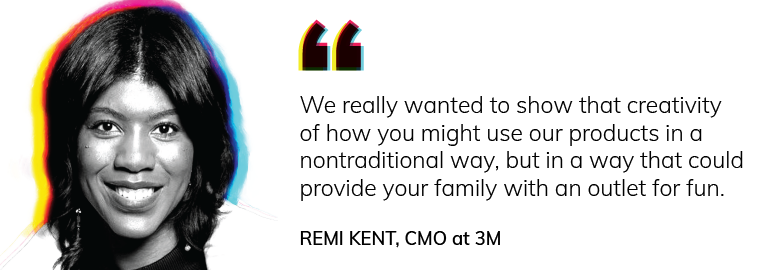
Bold marketing doesn’t always require a complete rebrand or a viral stunt. These creative marketing tactics can be tested quickly and scaled when they work.
Pairing up with a brand outside your category can stop audiences in their tracks. Think Taco Bell and Doritos, or Lego and IKEA. Unexpected pairings spark curiosity and open the door to new markets. The key is to choose a partner that shares your values, even if your products are worlds apart.
Guerrilla marketing is all about disrupting the ordinary. It could be sidewalk chalk art, a flash performance, or a surprising outdoor installation. When executed well, these activations feel more like cultural moments than ads. They generate buzz precisely because they break away from traditional formats.
Your audience often creates content that feels more authentic than polished brand campaigns. Starbucks’ #RedCupContest and Calvin Klein’s #MyCalvins are great examples of customers becoming co-creators. UGC lowers production costs and builds trust because real people represent the brand.
Nostalgia taps into emotions that go deeper than product features. Brands like Pokémon and Nintendo have built entire second lives by reimagining their classics for a new generation. A 90s throwback or retro design element instantly sparks connection because it reminds people of when they first loved your category.
Events, whether virtual or in-person, allow customers to experience your brand in a new way. Red Bull’s Flugtag competitions and Adobe’s creative conferences show how experiences can become brand-defining. Even smaller brands can use pop-ups, live streams, or interactive workshops to create memorable touchpoints.
When brands participate in cultural conversations, they show audiences they’re paying attention. Oreo’s “You Can Still Dunk in the Dark” tweet during the Super Bowl blackout is one of the most famous examples. These tie-ins succeed when they feel natural and timely, so monitor trends and move quickly when opportunities arise.
Supporting a meaningful cause is more than philanthropy; it’s strategy. Patagonia’s environmental stance and Billie’s fight against the pink tax show how brands can build lasting loyalty by aligning with movements their customers care about. The important step is following through with real action, not empty statements.
Sometimes creativity comes from changing how a product is packaged or presented. Heinz’s upside-down ketchup bottle and Reese’s seasonal shapes prove that even small tweaks can make a big impact when they surprise customers. These changes keep products fresh in categories that rarely evolve.
Digital marketing can go far beyond static ads. Interactive quizzes, AR filters, or gamified experiences turn audiences into participants. Spotify Wrapped is a perfect example: it celebrates users while transforming them into promoters who share their results with the world.
Many brands stand out because of how they speak. Wendy’s Twitter roasting competitors on Instagram or Duolingo’s cheeky TikTok presence are proof that tone can capture attention as much as visuals or products. An unexpected voice gives audiences a reason to pay attention in an endless feed of sameness.
Creative marketing ideas are exciting, but they only matter if you put them into motion. Start by defining clear goals for your campaign (ex., awareness, engagement, or loyalty). Choose one or two tactics that align with your brand values, and launch them on a small scale to see how your audience responds. Measure the results, refine your approach, and expand the campaigns that prove effective. The path to standing out begins with a bold step.

Barbara Walters said it best: Taylor Swift is the music industry. However, in celebrating the greatness of her artistry, we often forget to give her praise for her marketing intelligence, business acumen, and pure hard work. Work that placed her on Forbes’ 2021 list of America’s self-made women with an estimated net worth of $550 million.
What goes into it? She’s a business giant, there’s no doubt, but when you compare her to many of her peers, she doesn’t have many of the side hustles that you come to expect from the modern pop star. Take a glance at Forbes’ list of highest-paid musicians and you’ll find that most of them make the majority of their money through non-musical means — clothing lines, shoe deals, perfumes, movie and television show production credits, even streaming services and headphones. By comparison — and it might seem weird to say it — Taylor’s business ventures are relatively humble. And most of it comes back to, you guessed it, content marketing.
Taylor Swift is a powerful brand, and she is incredibly careful with how and where she uses her name. Corporate endorsements include Keds, Diet Coke, CoverGirl, Capital One, and Apple. But this brand didn’t just appear out of nowhere. Ask someone in 2005 who Taylor Swift was and they would likely give you some answer about semi-trucks. How she built this brand is a case study in content marketing itself.
Any customer-focused marketing strategy today is bound to include social media in some shape or form. But in 2005 it was all but unheard of. An early adopter of social media, Taylor Swift started a MySpace blog that would run for years, where she provided content for her growing fanbase that they couldn’t get anywhere else.

Taylor Swift (2006)
7x Platinum
5,750,000 copies sold
157 weeks in the Billboard 200 — longest of any album in the 2000s decade
This early approach to personalized marketing would set the tone for the rest of her career. The growing star would not only post intimate blogs that gave unique insider insights to her followers, but she would also engage with them and encouraged the growth of a community both inside and outside of the platform. In her acceptance speech for a CMT music award for Breakthrough Artist of the Year in 2008, Taylor dedicated it to her special club: “This is for my Myspace people and everybody who voted.” At this point, she had accumulated more than 650,000 “friends” on the platform, but each one of them could have felt she was talking directly to them.
Meeting fans where they are is something that Taylor herself has talked about. In an interview with BBC Radio 1, she mentioned the persistence required at the beginning of her career when it came to convincing her label and management that she needed to engage and use the internet — a strategy that paid off in the form of millions of streams of her music. She also talked of the importance of adapting to changing times. And time and again she’s done exactly that.
She meets fans where they are, and speaks their language
“You just never know what’s gonna happen...every new album release is different because there’s always a new platform, there’s always a new...way to have people experience your music. I just find it interesting, I’m not gonna sit here and ever be the person that’s like ‘it was only good the way it was when I started’...I like the fact that people can experience music in whatever way fits their life.”
Taylor Swift is on TikTok. A seemingly insignificant fact on the surface, but a single glance at Ahrefs’ content explorer shows just how big of a deal it was.

Witness the volume of shared and linked-to content featuring the words “Taylor Swift TikTok” on August 23rd, the day Taylor posted her first TikTok video (a search that yielded over 400 results), and consider that the dress that she was wearing sold out in minutes.
While it is not surprising for a public figure to join a social platform that boasts hundreds of millions of active users, it is yet more proof of Swift’s smart marketing acumen. Her fans are on TikTok, and so Taylor Swift is on TikTok.
The same logic applies to B2B marketing — but most companies still haven't made the shift. Former Slack and Zendesk CMO Bill Macaitis calls out why white papers and analyst relations aren't enough anymore, and where your buyers are actually waiting for you. This short video captures exactly why B2B marketers need to modernize their channel strategy now.
And for Taylor Swift, meeting fans where they are involves more than just being on a platform. Rather than falling into the trap of hiring a team to cross-post the same content on every platform, Taylor...well, tailors her content specifically to the audience on each one — and continues to add a level of authenticity carried over from her MySpace days.
This isn’t the first time she has done this, either — moving from MySpace to the likes of Twitter, Tumblr, Instagram, and now TikTok — Taylor continues to meet her fans where they are, and speak their language.
However, to reduce Taylor Swift’s content marketing brilliance down to social media would be doing a disservice. In fact, look at how she has used Twitter in recent years — a platform where engagement thrives off of large amounts of content:

According to SocialBlade’s record of the top 10 most followed users on Twitter, Taylor maintains an A++ engagement grade, despite a mere fraction of the tweets and despite following no one. How does she accomplish it? Well, it would be easy to say that once you have more than 88 million followers, engagement is pretty much a given. But one glance at her followers tells you that they are continuing to grow daily.
The Taylor Swift brand is thriving, and doesn’t look like slowing any time soon. So much so, that her presence continues to grow even on platforms like Twitter where she is not spending much time. Given, she did spend years building up a Twitter following, and still has a team tweeting regularly through her more corporate account; but to maintain such a prominent place at the top of the Twitter hierarchy indicates a great deal of lasting power and influence. How has she accomplished it?
In case you haven’t figured it out by now: Taylor Swift is the world’s best content marketer. Why? Because she produces some dang good content.

Whether you are a fan of her music or not, the proof of her songwriting caliber is evident in both her critical and commercial acclaim. She is the most awarded artist in AMAs history and is tied with only four other performers for the most Album of the Year Grammy Awards with four. She has also part of an elite group that has sold over 200 million albums, and just recently became the only artist to log 7 albums simultaneously in the Rolling Stone 200 a total of 20 times.
When your content is good, it can have the ability to promote itself. But Taylor Swift — being the world’s greatest content marketer — doesn’t rest on her laurels. And her promotion of her music is second to none. Taylor Swift’s album promotion cycles have been well documented over the years, from lucrative partnerships to exclusive merch deals and even secret listening parties at her own homes.
Yet even when 2020 hit and Taylor released a surprise album in a time of social distancing and isolation, her promotion remained top notch. Taylor’s key collaborator Aaron Dessner has described how her record label was only notified of the album’s existence mere hours before it was released. A true last-minute drop, she could easily be forgiven for forgoing promotion altogether. What we experienced instead was a masterclass in quick strategy. As soon as the announcement was made, her store was equipped with digital and physical copies of the album, available for pre-order — including 8 different versions of the vinyl copy, encouraging fans to collect them all.

Knowing when and where to ramp up promotion is a key skill, and it’s one that Taylor has mastered over the years. We have already discussed her social media prowess, and it’s no coincidence that Taylor’s fan engagement and the frequency of her social posts both increase around the time of a big announcement or new album release. She got to work liking and engaging with her excited followers’ posts, and a number of branded hashtags were also ready to go on Twitter.


The online store was also stocked, with new items cycled in and out as new songs were released. Taylor Swift is a master of employing the marketing tactic of scarcity — bonus songs are available only on physical albums, Target exclusives provide the opportunity to get a unique copy of each album, and fans well know that merch will only be available for a limited time before being replaced with something new.
For some, these kinds of techniques could seem like cash grabs and have the opposite effect to the one intended. But for Taylor, it comes across as added value to her vast fanbase. In short, all of this works because of the place where we started: Taylor Swift knows her audience. Back in 2014, on the release of 1989, she stated:
“I think that what we need to start doing is catering our release plans to our own career, to our own fans, and really get in tune with them. I've been on the internet for hours every single night figuring out what these people want from me. And when it came time to put out an album, I knew exactly what to do.”
In that instance, adding unique polaroids to physical albums was a way to connect with fans, and we have seen this process echoed time and again to this day. At the time of writing, Taylor is busy releasing new recordings of her past albums. And once again, she is exceeding expectations by promoting each one as though it’s brand new. This includes:
The albums also include a number of fresh tracks “From the Vault” including ones that have deep roots in fandom lore. By the time each album is released, you could be forgiven for forgetting that half of it has technically been heard before. Fearless (Taylor’s Version) shot to number one in just about every chart, and smashed a number of records in the process.
<table style="border-collapse: collapse; table-layout: fixed; margin-left: auto
2020 is an unusual year. Nothing can be assumed, and shopping trends are no exception. We at 97th Floor commissioned a study that dove into all of the newest trends in Black Friday and holiday shopping. Our objective: to help marketers prepare for this unusual season. In this post we’ll look more closely at some of the most interesting data points specifically around email, and how they might affect your marketing strategy.
This year, shoppers are getting a head start on their holiday lists. 54% of shoppers say they want to do their holiday shopping by early November to avoid crowds, and 68% of shoppers say they’ll be moving online. As marketers, we need to meet our customers where they are. This year, that means online and early.
Because shoppers want to get their shopping done earlier, you should consider emailing them earlier too. Don’t be afraid to email more consistently during the holiday season; shoppers expect to see more emails this time of year, so it’s a great time to take advantage of that as an opportunity to push your brand’s value and story.

Ultimately, the end goal of any email track is to lead your contacts on a journey. You can use email to tell your story, and to explain your value. Use your email marketing this holiday season to build a story for your products. Like J. Peterman’s famous catalog illustrates (pun intended), the way that you present your products must be more than an explanation: it needs to be a story. Best case scenario, even your presentation will be a kind of art. Don’t underestimate the importance of this. Email is a great way to control the way your product is positioned and presented.

Email marketing is the way you’ll be able to take people with casual interest in your products and turn them into true fans. This holiday season, treat all your email contacts like they are at least mild fans of the product (a safe assumption as they did give you their email) and turn them into mega-fans of your brand.
Our stats say that 81% of shoppers aren’t sure they’d head to brick and mortar locations even if the retailers offered great in-store experiences for the holidays. In fact, 88% of parents even say they won’t let their kids sit on Santa’s lap this year. Yet we know that experience is everything. So this holiday season marketers need to turn their attention to the digital sphere.

Be sure that all of the content you put out this season, including your email, provides an enjoyable experience for the user. This includes your website and landing pages. Take a look at the ease of use on your site — can users easily navigate your site to find what they need?
Get inventive with the way you use email as a part of an experience. Create amazing digital experiences and use email to share the opportunities with your audiences. For example, share social media campaigns your audiences can interact with, like zoom calls with Santa, an interactive about how your business works, or whatever the digital experience is that fits best with your business goals. Consider building out a multi-part, text-based experience for your email marketing, something that your audience will look forward to engaging with on day 1, but also day 3, 5, and 9. A story (see below) is one option, but any content that can be broken up in a linear fashion can be turned into an email experience.
Email is an effective way to spread the word about--and create--the experiences you have going on this holiday season; be sure you make the most of it.
Consider which metrics are most important for you, and then track them diligently. For brands just starting on their email marketing, your open rate might be your top priority. More mature email marketers will probably want to make their top priority either CTR (click through rate) or CToR (click to open rate).
The important thing is that you don’t just launch your emails out into the world like fledgling birds where they will either fly or die. Pay attention to performance, experiment, and continually tweak things to see how it affects outcomes. As an agency, we spend a lot of time measuring performance -- it’s our lifeblood. If we aren’t producing results, we lose your trust and your business. For you, in your business, you can afford nothing less.
The age of impersonal email is long behind us. There are many simple, easy ways to make your email copy individualized for your audiences, and they are common enough that they have become expected best practices, not only from savvy marketers, but the everyday consumer. When getting ready for a large-volume push with many different email tracks, it can be easy to want to cut corners, talk generally, and forget what your audiences really want to see.
Use your list’s first names in the email greetings, and choose the email track you put your contacts in based on their specific interests and issues. This will be a busy season, so everyone is about to get busy inboxes. If you want your emails to stand out, get personal. Put in the extra effort, use the research and data you have on your contacts and put it to good use.
It’s easy to fall into the trap of personalization-for-personalization’s-sake. We don’t personalize just because we can, but because it works. However this comes with a risk, too. If you’re not careful, personalization can come across as smarmy, too familiar without cause. This can turn off customers and lose business. The solution is simple: use personalization as a way to show respect for your customers, to demonstrate that you are thinking of them not as a patsy or a mark, but as a valued individual. Use personalization not to manipulate your audience, but to humanize them. Do it because you truly do value and respect them. It’ll show -- and it will help your bottom line.
If you’re not doing email marketing today, now is a great time to get started. Don’t wait until you have every single piece nailed down, even a moderate effort can be valuable. If you are doing email marketing already, now’s the time to ramp up your efforts and improve your process. Get personal, pay attention to your metrics, make it an experience, and build a story. Yes, it’s hard work, but it’s worth it (and we can help!).
May your holidays be bright with email marketing success.
