



Revolutionary branding can change how customers perceive an entire industry, but few companies are willing to take that step in the dark. Uncharted territory comes with a lack of data and research to back your efforts—it takes guts.
Moz said it best. “Playing it too safe is...a great way to remain somewhere in the middle. Almost everyone likes the middle. Nobody loses their job in the middle. Customers come and go at a steady rate in the middle. Nobody boycotts the middle.”
This article explores creative marketing tactics that can help you move beyond the middle. From purpose-driven messaging to playful brand voices, these tactics show how bold ideas inspire attention, spark loyalty, and fuel growth. Whether you’re a small challenger or a large enterprise, you’ll find practical tips you can apply to give your brand the refresh it needs.
Creative marketing tactics are unconventional strategies that brands use to capture attention, spark emotion, and differentiate themselves in crowded markets. Unlike traditional campaigns that rely on predictable playbooks, these approaches focus on being memorable and connecting with audiences on a deeper level.
Think of them as creative marketing ideas that shift perception. They can be bold visuals, unexpected partnerships, purpose-driven messages, or even playful responses to criticism. At their core, creative marketing tactics prove that playing it safe is rarely the way to stand out.
We’ve curated five tips to show you how to put these ideas into practice, along with real-world examples. #1 Be Unapologetically Interesting
“If you always just try to sell, then you’re predictable. You’re every other brand and company out there.” —Michael Lee, Oatly Creative Director. Oatly stands out—we all saw the controversial SuperBowl commercial. The alternative dairy brand embraces unapologetic fun while still communicating its core values.
Part of what makes Oatly so appealing is its contrast with other milk brands. Picture any other dairy brand—the homepage likely has a perfectly composed stock photo complete with a heartwarming description of the product. Swap the milk out with any other household item, like Windex or Clorox, and you don’t have to change a thing.

Oatly stands way, way out with a cartoony, playful, almost handmade aesthetic website. When photos are included, they’re messy and candid — almost like a friend took them. The copy has an unpolished, almost rambling feeling that is nothing like its competitors' carefully crafted, “clean” taglines.

Oatly doesn’t use industry competitors as models for what they should become. While other brands fill their website with recipes to sell more product, Oatly's recipes are only a fraction of the available content. The bulk of Oatly’s content is dedicated to being interesting. The brand even has a section dedicated entirely to "Things we do" that has unique content to make audiences smile.
Lee revealed the core of Oatly’s branding strategy: “Don’t try to sell anything — just be interesting. If you’re interesting, people will pay attention to you and they’ll be interested in what you do next.”
How do they do it though? Oatly takes an unstructured approach. The creative team chats about content that would be fun to create and then they make it a reality. Lee explains, “We produce our own work, and we prove our own work. There’s no filter, no checkpoint meetings with the sales guys, no half way meetings with marketing managers.” This method allows content to land with it’s full creative potential preventing leadership from watering it down. Creating without gatekeepers is a terrifying prospect for many companies, but Oatly doesn’t let this hold them back.
Do This: Trust in creative teams and whatever you do, don’t be content in the middle ground.
Is the strategy of simply being interesting paying off? Oatly is claimed to be the world’s largest oat milk company and 2020 saw a 106.5% increase in reported revenue. Oatly is Starbucks’ oat milk of choice, and there was even a time when people were selling their supply of Oatly for over $200 on Amazon.
Yep, being unapologetically interesting works.
SaaS companies are infamous for ambiguous copy and visuals that all look the same. When every solution looks the same, customers quickly lose interest and have a difficult time keeping track of the unique value each solution offers. Gong, a revenue intelligence software is...different.
The pressure to stand out just got more urgent. Former Slack CMO Bill Macaitis breaks down why lean AI-native startups are now achieving the same ARR with a fraction of the headcount — and what traditional SaaS companies need to do to stay competitive. This short video captures why the window to adapt is closing fast.
Let’s take a look at the websites of some other sales platforms. This industry is ruled by clean designs, cool colors, futuristic gradients, and flat illustrations.

Then there’s Gong with fun stock photos, bright colors, and a playful pooch as its chatbot representative. The smooth UX and attention to quality (albeit stock photo quality) allow the brand to take risks in an otherwise streamlined market.

While some may not enjoy the cheesy nature of its aesthetic, Gong doesn’t really care. CMO Udi Ledergor acknowledged, “If you’re pleasing everybody, you’re not exciting anybody.”

Ledger defines Gong’s brand as “whimsical and authoritative” — two adjectives you wouldn’t normally think go together. They’ve combined seemingly unrelated, opposing elements to craft a brand voice that fits perfectly.
Do this: Carve out your own identity and carry your voice throughout every piece of content.
Ledger continues “When you read our content, when you hear one of our amazing speakers at a conference, when you look at our website, when you go to our LinkedIn content, you see that whimsy coming through everything we do."
This commitment to a consistent voice allows Gong’s audience to instantly recognize every piece of content they create. More importantly, audiences can differentiate Gong from the sea of other software companies who are pushing the same message.

As of June 2021, Gong raised $250 million in funding and ranked top-50 in outstanding growth within SaaS companies—not bad for high-fives and fist pumps.
Billie was the first to push the boundaries in the women's razors market by using body hair in images and fighting against the pink tax. In an interview, Billie Cofounder Georgina Gooley shared the inspiration behind the brand’s identity. “We knew we couldn’t just sell a better product at a better price — we wanted to reinvent the category’s relationship with women.”

For decades, razor brands have depicted the ideal version of a woman. Women were told that their body hair was something to be ashamed of, something needing to be removed. “We've always wanted to put our audience ahead of our product, so emphasizing the importance of choice has always been core to what we believe.”

Billie’s competitors have quickly followed suit. As Gooley points out,“The fact that a new, challenger brand like Billie could change the way women are represented in a century-old category shows that even the newest players have the power to create change.”
Although Billie’s competitors have slightly adapted their imagery, their core branding has stuck closely to the refined, spa feeling we’re used to seeing from razor companies. Billie takes a bold approach to branding with bright colors, body-inclusive models, and 90s throwback styling.

Beyond bold visuals, sticking closely to strong values is what sets Billie apart from other brands.
While overthrowing the pink tax by charging less and offering rebates means smaller margins for Billie, audiences see the dedication to a cause and become lifelong fans. While other companies say they’re committed to women, Billie actually backs up their statements.
Do this: Permeate purpose-driven values at every level of the organization. Put your brand’s purpose before your product to attract customers and open up doors to other creative marketing tactics.
You’ve never met a more hardcore water brand than Liquid Death. The company’s energy-drink-inspired branding is a complete 180 from the peaceful, flowing springs used to market other water brands. The tagline “MURDER YOUR THIRST” seems a little contradictory when selling the most essential-to-life product on earth, but that contradiction is exactly what makes it unforgettable.

CEO and founder Mike Cessario explained that the core idea for the brand was inspired by the hilarious, random marketing in the junk food market. “Liquid Death was a way of taking the healthiest food you can drink and brand it and market it in a way where you can compete with all the crazy marketing of junk food.” Liquid Death is unique because it’s not really competing with other water brands.
And Liquid Death thrives on this bold persona. When social media trolls flood their comments with hate, the brand doesn’t hide or delete. Instead, they double down by turning those insults into music albums (punk tracks with screamed lyrics pulled straight from negative online comments).
Founder Mike Cessario summed it up best: “Hard work is a waste of time if your idea sucks. Figure out how you have a great idea first before you then start putting all the blood, sweat and tears into it.” Liquid Death has that great idea, and they’re not afraid to make it louder by amplifying even their harshest critics.

Do This: Don’t run from criticism. Use it. Turning negativity into content not only disarms haters but also strengthens loyalty among your core fans.
Of course, the irreverence goes beyond the jokes. Liquid Death pairs its over-the-top branding with real values, pledging “death to plastic” by offering a sustainable alternative to bottled water. That combination of humor and purpose has built them a cult following and fueled 126% growth last year.
Liquid Death proves that the boldest creative marketing tactic isn’t just to be different, it’s to take what others fear and flip it into your loudest megaphone.
3M isn’t just trying to stand out in its industry, it’s trying to stand out from itself. A quick look back at the 3M website reveals that its messaging has transformed from a focus on innovative technology to applied science and connecting with the people who use 3M products. Over the years, technology imagery has given way to people-centric visuals.

3M has countless products in various industries, but you probably know them best for their tape. Despite consumer business being the least profitable sector at 3M, this is an area that the brand focuses a lot of marketing effort on.

By focusing on individual consumers, 3M is able to focus on messaging that resonates with people. Because at the end of the day, B2B and B2G customers are just people.
Do this: See your audience as humans—market to them as humans.
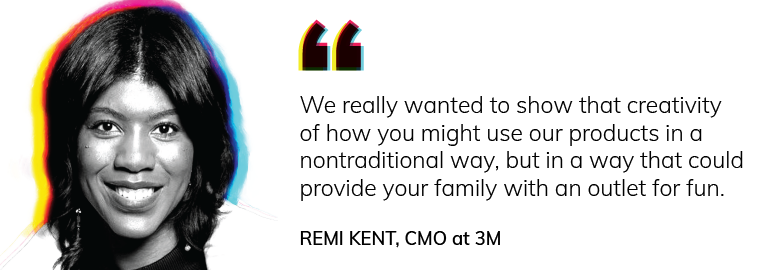
Making science fun and accessible to all is at the heart of 3M’s marketing strategy. CMO Remi Kent explained, “We really wanted to show that creativity of how you might use our products in a nontraditional way, but in a way that could provide your family with an outlet for fun.”
Bold marketing doesn’t always require a complete rebrand or a viral stunt. These creative marketing tactics can be tested quickly and scaled when they work.
Pairing up with a brand outside your category can stop audiences in their tracks. Think Taco Bell and Doritos, or Lego and IKEA. Unexpected pairings spark curiosity and open the door to new markets. The key is to choose a partner that shares your values, even if your products are worlds apart.
Guerrilla marketing is all about disrupting the ordinary. It could be sidewalk chalk art, a flash performance, or a surprising outdoor installation. When executed well, these activations feel more like cultural moments than ads. They generate buzz precisely because they break away from traditional formats.
Your audience often creates content that feels more authentic than polished brand campaigns. Starbucks’ #RedCupContest and Calvin Klein’s #MyCalvins are great examples of customers becoming co-creators. UGC lowers production costs and builds trust because real people represent the brand.
Nostalgia taps into emotions that go deeper than product features. Brands like Pokémon and Nintendo have built entire second lives by reimagining their classics for a new generation. A 90s throwback or retro design element instantly sparks connection because it reminds people of when they first loved your category.
Events, whether virtual or in-person, allow customers to experience your brand in a new way. Red Bull’s Flugtag competitions and Adobe’s creative conferences show how experiences can become brand-defining. Even smaller brands can use pop-ups, live streams, or interactive workshops to create memorable touchpoints.
When brands participate in cultural conversations, they show audiences they’re paying attention. Oreo’s “You Can Still Dunk in the Dark” tweet during the Super Bowl blackout is one of the most famous examples. These tie-ins succeed when they feel natural and timely, so monitor trends and move quickly when opportunities arise.
Supporting a meaningful cause is more than philanthropy; it’s strategy. Patagonia’s environmental stance and Billie’s fight against the pink tax show how brands can build lasting loyalty by aligning with movements their customers care about. The important step is following through with real action, not empty statements.
Sometimes creativity comes from changing how a product is packaged or presented. Heinz’s upside-down ketchup bottle and Reese’s seasonal shapes prove that even small tweaks can make a big impact when they surprise customers. These changes keep products fresh in categories that rarely evolve.
Digital marketing can go far beyond static ads. Interactive quizzes, AR filters, or gamified experiences turn audiences into participants. Spotify Wrapped is a perfect example: it celebrates users while transforming them into promoters who share their results with the world.
Many brands stand out because of how they speak. Wendy’s Twitter roasting competitors on Instagram or Duolingo’s cheeky TikTok presence are proof that tone can capture attention as much as visuals or products. An unexpected voice gives audiences a reason to pay attention in an endless feed of sameness.
Creative marketing ideas are exciting, but they only matter if you put them into motion. Start by defining clear goals for your campaign (ex., awareness, engagement, or loyalty). Choose one or two tactics that align with your brand values, and launch them on a small scale to see how your audience responds. Measure the results, refine your approach, and expand the campaigns that prove effective. The path to standing out begins with a bold step.
When you’re ready to push beyond safe strategies, 97th Floor brings the expertise and creativity to make it happen. Our team has helped brands break free from the middle ground by designing campaigns that capture attention, spark emotion, and deliver results. We’ll partner with you to find the tactics that set your brand apart.
See how an audience-first approach translates to bottom-line results.
Barbara Walters said it best: Taylor Swift is the music industry. However, in celebrating the greatness of her artistry, we often forget to give her praise for her marketing intelligence, business acumen, and pure hard work. Work that placed her on Forbes’ 2021 list of America’s self-made women with an estimated net worth of $550 million.
What goes into it? She’s a business giant, there’s no doubt, but when you compare her to many of her peers, she doesn’t have many of the side hustles that you come to expect from the modern pop star. Take a glance at Forbes’ list of highest-paid musicians and you’ll find that most of them make the majority of their money through non-musical means — clothing lines, shoe deals, perfumes, movie and television show production credits, even streaming services and headphones. By comparison — and it might seem weird to say it — Taylor’s business ventures are relatively humble. And most of it comes back to, you guessed it, content marketing.
Taylor Swift is a powerful brand, and she is incredibly careful with how and where she uses her name. Corporate endorsements include Keds, Diet Coke, CoverGirl, Capital One, and Apple. But this brand didn’t just appear out of nowhere. Ask someone in 2005 who Taylor Swift was and they would likely give you some answer about semi-trucks. How she built this brand is a case study in content marketing itself.
Any customer-focused marketing strategy today is bound to include social media in some shape or form. But in 2005 it was all but unheard of. An early adopter of social media, Taylor Swift started a MySpace blog that would run for years, where she provided content for her growing fanbase that they couldn’t get anywhere else.

Taylor Swift (2006)
7x Platinum
5,750,000 copies sold
157 weeks in the Billboard 200 — longest of any album in the 2000s decade
This early approach to personalized marketing would set the tone for the rest of her career. The growing star would not only post intimate blogs that gave unique insider insights to her followers, but she would also engage with them and encouraged the growth of a community both inside and outside of the platform. In her acceptance speech for a CMT music award for Breakthrough Artist of the Year in 2008, Taylor dedicated it to her special club: “This is for my Myspace people and everybody who voted.” At this point, she had accumulated more than 650,000 “friends” on the platform, but each one of them could have felt she was talking directly to them.
Meeting fans where they are is something that Taylor herself has talked about. In an interview with BBC Radio 1, she mentioned the persistence required at the beginning of her career when it came to convincing her label and management that she needed to engage and use the internet — a strategy that paid off in the form of millions of streams of her music. She also talked of the importance of adapting to changing times. And time and again she’s done exactly that.
She meets fans where they are, and speaks their language
“You just never know what’s gonna happen...every new album release is different because there’s always a new platform, there’s always a new...way to have people experience your music. I just find it interesting, I’m not gonna sit here and ever be the person that’s like ‘it was only good the way it was when I started’...I like the fact that people can experience music in whatever way fits their life.”
Taylor Swift is on TikTok. A seemingly insignificant fact on the surface, but a single glance at Ahrefs’ content explorer shows just how big of a deal it was.

Witness the volume of shared and linked-to content featuring the words “Taylor Swift TikTok” on August 23rd, the day Taylor posted her first TikTok video (a search that yielded over 400 results), and consider that the dress that she was wearing sold out in minutes.
While it is not surprising for a public figure to join a social platform that boasts hundreds of millions of active users, it is yet more proof of Swift’s smart marketing acumen. Her fans are on TikTok, and so Taylor Swift is on TikTok.
The same logic applies to B2B marketing — but most companies still haven't made the shift. Former Slack and Zendesk CMO Bill Macaitis calls out why white papers and analyst relations aren't enough anymore, and where your buyers are actually waiting for you. This short video captures exactly why B2B marketers need to modernize their channel strategy now.
And for Taylor Swift, meeting fans where they are involves more than just being on a platform. Rather than falling into the trap of hiring a team to cross-post the same content on every platform, Taylor...well, tailors her content specifically to the audience on each one — and continues to add a level of authenticity carried over from her MySpace days.
This isn’t the first time she has done this, either — moving from MySpace to the likes of Twitter, Tumblr, Instagram, and now TikTok — Taylor continues to meet her fans where they are, and speak their language.
However, to reduce Taylor Swift’s content marketing brilliance down to social media would be doing a disservice. In fact, look at how she has used Twitter in recent years — a platform where engagement thrives off of large amounts of content:

According to SocialBlade’s record of the top 10 most followed users on Twitter, Taylor maintains an A++ engagement grade, despite a mere fraction of the tweets and despite following no one. How does she accomplish it? Well, it would be easy to say that once you have more than 88 million followers, engagement is pretty much a given. But one glance at her followers tells you that they are continuing to grow daily.
The Taylor Swift brand is thriving, and doesn’t look like slowing any time soon. So much so, that her presence continues to grow even on platforms like Twitter where she is not spending much time. Given, she did spend years building up a Twitter following, and still has a team tweeting regularly through her more corporate account; but to maintain such a prominent place at the top of the Twitter hierarchy indicates a great deal of lasting power and influence. How has she accomplished it?
In case you haven’t figured it out by now: Taylor Swift is the world’s best content marketer. Why? Because she produces some dang good content.

Whether you are a fan of her music or not, the proof of her songwriting caliber is evident in both her critical and commercial acclaim. She is the most awarded artist in AMAs history and is tied with only four other performers for the most Album of the Year Grammy Awards with four. She has also part of an elite group that has sold over 200 million albums, and just recently became the only artist to log 7 albums simultaneously in the Rolling Stone 200 a total of 20 times.
When your content is good, it can have the ability to promote itself. But Taylor Swift — being the world’s greatest content marketer — doesn’t rest on her laurels. And her promotion of her music is second to none. Taylor Swift’s album promotion cycles have been well documented over the years, from lucrative partnerships to exclusive merch deals and even secret listening parties at her own homes.
Yet even when 2020 hit and Taylor released a surprise album in a time of social distancing and isolation, her promotion remained top notch. Taylor’s key collaborator Aaron Dessner has described how her record label was only notified of the album’s existence mere hours before it was released. A true last-minute drop, she could easily be forgiven for forgoing promotion altogether. What we experienced instead was a masterclass in quick strategy. As soon as the announcement was made, her store was equipped with digital and physical copies of the album, available for pre-order — including 8 different versions of the vinyl copy, encouraging fans to collect them all.

Knowing when and where to ramp up promotion is a key skill, and it’s one that Taylor has mastered over the years. We have already discussed her social media prowess, and it’s no coincidence that Taylor’s fan engagement and the frequency of her social posts both increase around the time of a big announcement or new album release. She got to work liking and engaging with her excited followers’ posts, and a number of branded hashtags were also ready to go on Twitter.


The online store was also stocked, with new items cycled in and out as new songs were released. Taylor Swift is a master of employing the marketing tactic of scarcity — bonus songs are available only on physical albums, Target exclusives provide the opportunity to get a unique copy of each album, and fans well know that merch will only be available for a limited time before being replaced with something new.
For some, these kinds of techniques could seem like cash grabs and have the opposite effect to the one intended. But for Taylor, it comes across as added value to her vast fanbase. In short, all of this works because of the place where we started: Taylor Swift knows her audience. Back in 2014, on the release of 1989, she stated:
“I think that what we need to start doing is catering our release plans to our own career, to our own fans, and really get in tune with them. I've been on the internet for hours every single night figuring out what these people want from me. And when it came time to put out an album, I knew exactly what to do.”
In that instance, adding unique polaroids to physical albums was a way to connect with fans, and we have seen this process echoed time and again to this day. At the time of writing, Taylor is busy releasing new recordings of her past albums. And once again, she is exceeding expectations by promoting each one as though it’s brand new. This includes:
The albums also include a number of fresh tracks “From the Vault” including ones that have deep roots in fandom lore. By the time each album is released, you could be forgiven for forgetting that half of it has technically been heard before. Fearless (Taylor’s Version) shot to number one in just about every chart, and smashed a number of records in the process.
<table style="border-collapse: collapse; table-layout: fixed; margin-left: auto
2020 is an unusual year. Nothing can be assumed, and shopping trends are no exception. We at 97th Floor commissioned a study that dove into all of the newest trends in Black Friday and holiday shopping. Our objective: to help marketers prepare for this unusual season. In this post we’ll look more closely at some of the most interesting data points specifically around email, and how they might affect your marketing strategy.
This year, shoppers are getting a head start on their holiday lists. 54% of shoppers say they want to do their holiday shopping by early November to avoid crowds, and 68% of shoppers say they’ll be moving online. As marketers, we need to meet our customers where they are. This year, that means online and early.
Because shoppers want to get their shopping done earlier, you should consider emailing them earlier too. Don’t be afraid to email more consistently during the holiday season; shoppers expect to see more emails this time of year, so it’s a great time to take advantage of that as an opportunity to push your brand’s value and story.

Ultimately, the end goal of any email track is to lead your contacts on a journey. You can use email to tell your story, and to explain your value. Use your email marketing this holiday season to build a story for your products. Like J. Peterman’s famous catalog illustrates (pun intended), the way that you present your products must be more than an explanation: it needs to be a story. Best case scenario, even your presentation will be a kind of art. Don’t underestimate the importance of this. Email is a great way to control the way your product is positioned and presented.

Email marketing is the way you’ll be able to take people with casual interest in your products and turn them into true fans. This holiday season, treat all your email contacts like they are at least mild fans of the product (a safe assumption as they did give you their email) and turn them into mega-fans of your brand.
Our stats say that 81% of shoppers aren’t sure they’d head to brick and mortar locations even if the retailers offered great in-store experiences for the holidays. In fact, 88% of parents even say they won’t let their kids sit on Santa’s lap this year. Yet we know that experience is everything. So this holiday season marketers need to turn their attention to the digital sphere.

Be sure that all of the content you put out this season, including your email, provides an enjoyable experience for the user. This includes your website and landing pages. Take a look at the ease of use on your site — can users easily navigate your site to find what they need?
Get inventive with the way you use email as a part of an experience. Create amazing digital experiences and use email to share the opportunities with your audiences. For example, share social media campaigns your audiences can interact with, like zoom calls with Santa, an interactive about how your business works, or whatever the digital experience is that fits best with your business goals. Consider building out a multi-part, text-based experience for your email marketing, something that your audience will look forward to engaging with on day 1, but also day 3, 5, and 9. A story (see below) is one option, but any content that can be broken up in a linear fashion can be turned into an email experience.
Email is an effective way to spread the word about--and create--the experiences you have going on this holiday season; be sure you make the most of it.
Consider which metrics are most important for you, and then track them diligently. For brands just starting on their email marketing, your open rate might be your top priority. More mature email marketers will probably want to make their top priority either CTR (click through rate) or CToR (click to open rate).
The important thing is that you don’t just launch your emails out into the world like fledgling birds where they will either fly or die. Pay attention to performance, experiment, and continually tweak things to see how it affects outcomes. As an agency, we spend a lot of time measuring performance -- it’s our lifeblood. If we aren’t producing results, we lose your trust and your business. For you, in your business, you can afford nothing less.
The age of impersonal email is long behind us. There are many simple, easy ways to make your email copy individualized for your audiences, and they are common enough that they have become expected best practices, not only from savvy marketers, but the everyday consumer. When getting ready for a large-volume push with many different email tracks, it can be easy to want to cut corners, talk generally, and forget what your audiences really want to see.
Use your list’s first names in the email greetings, and choose the email track you put your contacts in based on their specific interests and issues. This will be a busy season, so everyone is about to get busy inboxes. If you want your emails to stand out, get personal. Put in the extra effort, use the research and data you have on your contacts and put it to good use.
It’s easy to fall into the trap of personalization-for-personalization’s-sake. We don’t personalize just because we can, but because it works. However this comes with a risk, too. If you’re not careful, personalization can come across as smarmy, too familiar without cause. This can turn off customers and lose business. The solution is simple: use personalization as a way to show respect for your customers, to demonstrate that you are thinking of them not as a patsy or a mark, but as a valued individual. Use personalization not to manipulate your audience, but to humanize them. Do it because you truly do value and respect them. It’ll show -- and it will help your bottom line.
If you’re not doing email marketing today, now is a great time to get started. Don’t wait until you have every single piece nailed down, even a moderate effort can be valuable. If you are doing email marketing already, now’s the time to ramp up your efforts and improve your process. Get personal, pay attention to your metrics, make it an experience, and build a story. Yes, it’s hard work, but it’s worth it (and we can help!).
May your holidays be bright with email marketing success.
Many retailers use the holidays to end their fiscal year with a bang. This year, many marketers, especially retailers, are putting their hopes in the 2020 holiday season to capture revenue at the tail-end of what has been a hard year. 97th Floor’s latest study dove into all of the newest trends in Black Friday and holiday shopping to help marketers prepare, and in this post we’ll dive deeper into how these insights might affect your ad strategy this season.
COVID-19 has shifted every business’s strategy and planning in 2020. As cases continue to rise, holiday shopping trends are no exception. This season, 68% of shoppers say they plan to do most of their shopping online due to COVID, and 52% of shoppers say they expect they’ll never shop in person for the holidays ever again.

Things are changing, and marketers need to keep up. Especially this holiday season, it will be imperative that marketers make the most of the newest consumer trends. The changing market will likely mean many advertisers will be prioritizing ads for their holiday campaigns, so marketers need to look at what that will mean as far as higher costs in the ad platforms, etc. and need to be ready to traverse the new waters with skill.
Here are a few tips to make the most of your ads this 2020 season based on our recent data.
For two months in a row, Facebook’s CPMs have risen by 10% — reaching a record high for 2020. Higher costs might mean that your strategy needs to pivot. Be sure to place pixels from other platforms on your site so that you can hold onto your followers in case you decide to pivot to other ad platforms that may be less expensive.
With virtually every retailer trying to make up for lost ground earlier in the year, you can bet you’ll see more competitive bids, decreasing your ROAS. Facebook will likely become an incredibly competitive market, with costs continuing to rise. This season, be prepared to switch platforms and pivot to make the most of your budget.
This holiday season, your ad copy and creative needs to stand out, but you already knew that. What you might not know is that only 20% of shoppers say they're definitely in “a shopping mood” this holiday season. Advertisers need exceptional copy and creative to earn clicks and conversions from their audience this year.
Even stores that are used to pushing in-person sales will be moving online, and users will be inundated with ads. Advertisers need to be leaning into their established personas to create copy and creative that speaks to your audience. Even if you have high performing ads, they will likely need a refresh with a holiday angle to ensure they are speaking to your persona during the holiday season.

Savvy advertisers will have already built a deep retargeting pool months ago that they can lean into heavily during the holiday season. So while it might be too late to build a retargeting pool for this season’s retargeting efforts, the holidays could be a perfect time to build that pool for future efforts.
If you can gain a solid retargeting pool, it will give you the leg up in your future endeavors (like starting 2021 off with lower CPCs). Retargeted audiences are some of the most likely to convert, and that’s what ultimately matters over any kind of wide reach or visibility. Figure out ways to get qualified traffic to your site en mass, even if it’s not on a product page, and then use pixels to add them to your remarketing pool. And who knows, focusing on building that pool might just bring you conversions this season too.

This holiday season will be different than anything we’ve experienced before. Advertisers should prep their leadership with accurate numbers, as 73% of shoppers plan to spend either as much or less than they did last season.
Monitor your channels closely and be ready to pivot as needed. Don’t lose track of your CPM or CPC prices, and be strategic with your budget as costs rise. Stay hyper aware, or you’ll find yourself paying a lot more per ad. And look to the future (yes, there’s hope beyond the holiday season)! Build your remarketing pool, and prepare for an audience base that has the potential to stay largely online, even once the COVID crisis ends.
Many ecommerce businesses begin with a D2C model, selling quality products on their own site while dreaming of the days they’ll hit it big by getting serious traction in a major brick and mortar.
It’s a big step and an exciting achievement, but it also carries risk. As you push your product through bigger stores, you give up control over your brand and your ability to connect directly with your customers. It’s often a matter of trading control for (hopefully) greater volume.
This was Zhou — a nutrition brand thrilled to fulfill their longtime goal of seeing their product in 433 Target stores across the US, but worried about the new lack of control. They wanted to retain a hand in their own success, and see that their entrance to Target was a success in terms of actual foot traffic and revenue.

Zhou presented 97th Floor with a fixed budget for advertising in 433 specific locales. The task was one Zhou had never attempted before — drive foot traffic and sales with Facebook Ads to physical Target locations through geo-targeting, in addition to Target’s online landing page. Driving and tracking success via Facebook Ads to your own landing page is easy to track and control, but driving foot traffic to a secondary store is another story.
Ultimately, the strategy and results were so positive that after two weeks, Zhou found extra budget to push towards these ads.
It’s quite a triumph when longtime D2Cs enter big-time stores like Target. But success isn’t guaranteed. The D2C still has to do the work of getting their brand recognized in stores, and pushing foot traffic into those stores to actually buy the product.
In order to start off with a bang and keep the momentum going long term, Zhou allocated some budget to getting products moving in the locales they were entering. Pushing that traffic, especially in those first few weeks, would prove critical in making their transition into Target stores a success.

Zhou came to us with a moderate budget, but when split over 433 different markets even a sizable budget goes pretty fast. We began with a total budget of $30,000, which meant each store got only $4.62 in daily ad spend. This meant we had to be pretty picky and intentional about where we put our money. The tactics we used had to be effective and incredibly targeted. We also ran this project for just two weeks, so time was of the essence. After those first two weeks and initial $30,000, Zhou was so impressed with the results that they decided to push an extra $10,000 toward another five days of campaigning.
We decided that higher click through rates and lower cost per clicks would be the best markers for our success in this particular campaign. In addition to revenue information gathered from Target. This was because we weren’t trying to drive sales directly, but rather foot traffic to brick and mortar Target locations as well as their online landing pages.
The two products that Zhou placed in Targets were Collagen Peptides and Hairfluence supplements. The primary target for these products were women, so we catered our copy and ad images towards that demographic.

We built out a strategy with ads for 160 different geo-targeted markets, including up to 27 stores within each market. The Target logo was prominent in the ad visuals, highlighting that the product was now available at Target. That math adds up to thousands of different geo-targeted ads, each directed at their specific markets. And, to complicate things even further, we wanted all of them to go up within Zhou’s first few weeks inside Target.
With that great volume of ads to set up in such a short period of time, we knew we had to be careful how we approached their launch. If we put them all up at once there was a high likelihood that the Zhou account would be disabled. Which would throw a real wrench into the already time-sensitive campaign. So, we played it safe and uploaded them in batches, day by day.

This turned out to be a strategic advantage, because after the first week, we located the underperformers and pulled them, reallocating their budget to the highest performing ads and locales. This helped us make the very most of the budget, and see quicker and more substantial results from our efforts. It’s always a good feeling to put your money where the data is.
We also created a live dashboard with Google Data Studio so we could see the performance of our ad variants across all locations in real-time. We shared this with the executives at Zhou and their parent company (Nutraceutical) who then shared it with Target. Target was able to provide us with in-store conversion data, allowing us to truly see the impact of our efforts on the bottom line. At this point, Zhou, thrilled about the increasing conversion rates, sent that extra $10,0000 to continue the campaign.

Together, Zhou and 97th Floor truly revolutionized the process of entering brick and mortar stores as a D2C. Zhou kept control of their brand, and pushed customers toward their new Target locations. No longer do D2Cs just have to sit back and hope that greater volume will mean greater results. Instead, they can still have a hand in their own success.
And, it wasn’t just Zhou that profited. This strategy was a win-win for both Zhou and Target — Target gets customers in their doors, and Zhou gets revenue and product recognition. This ad strategy and real-time dashboard were so successful together that Zhou now uses this framework as a playbook when guiding new product lines to enter big retailers like Walmart, Sam’s Club, Costco, and more.
Ultimately, Zhou saw a 27.46% increase in in-store purchases in just one week of this campaign. Proving to themselves, and other curious D2Cs, that profitable partnerships with big-names like Target are not only possible, but probable, with the right ad strategies.

Often digital and brick and mortar marketing are seen as opposites rather than partners, but Zhou proved that it doesn’t have to be that way. Online shopping might be the new frontier, but there will always be a place for the convenience and experience of local brick and mortars. Zhou and 97th Floor’s partnership led to great results, revolutionary processes, and a successful start to Zhou’s product pushing in Target.
Zhou kept control, but was able to take advantage of Target’s wide reach. Now, Zhou is looking for even more products that they can push through this process and get inside of brick and mortar stores.
Political campaigns are some of the most visible, wide-reaching, and polarizing marketing campaigns. They operate off of enormous budgets with highly condensed timelines, and digital strategy has become an increasing priority as audiences shift online. But even Presidential marketing has its oversights and faux pas.
At 97th Floor, we were curious about how these two campaigns were tackling digital, so we decided to utilize our expertise in performing large-scale audits for both the Biden and Trump 2020 campaigns. We have the best specialists in all of these fields, and we asked our teams to treat these campaigns just as they would a client, auditing every inch that they could.
After pulling thousands of digital ads, reviewing millions of dollars in ad spend, pouring over scores of website pages, reading hundreds of emails, and scouring mobile apps and social media accounts, we found hoards of fascinating insights. It’s a drama-- massive oversights, well-timed reactions, wasted dollars-- but I’ll step aside and let the data tell the story.
After combing through both audits we cherry-picked and pulled the most engrossing snippets into the final version on GetThatVote.com. Read ahead here to see just a few of those highlights.

On a grand scale, the Trump campaign acts as one might expect: big budgets, pushy messaging, and dated tactics. But, while wasted budget is never a pro, the Trump campaign seems to understand its core audience. The campaign’s focus and budget, as well as messaging, are highly targeted to dyed in the wool, red “Patriots.” Team Trump’s digital tactics mirror that of the entire campaign — braggadocious — largely catering to those who are already his fans. Additionally, the Trump campaign presses much harder for donations, which could be one explanation for its ability to outspend the Biden campaign at every turn.
In contrast, Biden’s team hones in on the fringes and the undecided — those who have been historically election-determining, an obvious audience for this (and every) election. This showcases itself in a strong focus on swing states with budget, and a somewhat-humble focus on “togetherness” and “unity” in messaging. The Biden campaign also pushes for a professionalism and issue-based copy that Trump has largely overlooked. A little surprising is the consistently smaller budget from the Biden side, however it’s possible that Team Biden is holding back to increase spending when it matters most, that last month.
Overall, each site caters to the strengths of its candidate. The Biden site emphasizes unity in diversity, with photos of Biden with others rather than alone, and copy that includes words like “together.” Trump’s site leans into the fame of Trump himself. Mentions of specific goals or stances are overtaken by Trump-focused photos and messaging.

As far as general user experience and intuitive flow, Trump’s site takes the cake. Biden’s site overlooks clear messaging in conveying how to volunteer or get involved, and funneling every user into a narrow set of options. The Trump site uses very clear “get involved” messaging in their header, and gives various actions a user could take in order to show support for the campaign. Additionally, Biden’s website feels busy, and lacks an easily navigable hierarchical structure. Trump’s site is well structured, pushing users to either shop or donate.

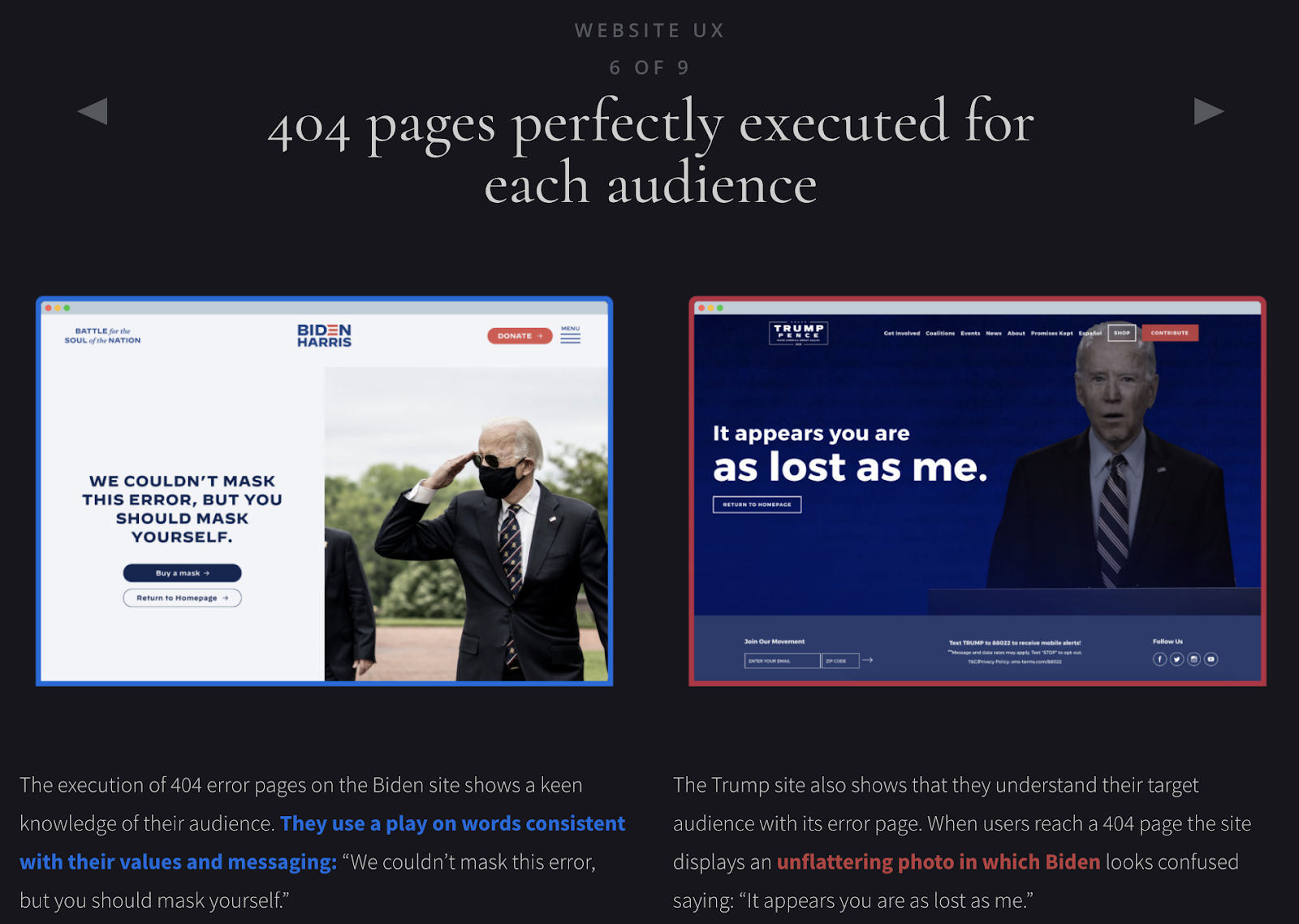
We also couldn’t help ourselves in looking at the 404 pages. Both perfectly represent their target audience: Biden’s responsible mask-wearers, and Trump’s anti-Bidens.
Neither campaign is leaning into search advertising heavily, with text-based search ads accounting for 11.48% and 10.09% of the Biden and Trump campaign’s Google Ad’s budgets respectively. They both make good use of the video elements of Google’s platforms, which may be based on the fact that video is a more immersive experience for the viewer, however it is unusual to see so little budget devoted to image ads given their ability for cheap, but effective remarketing.

The biggest misstep? The Trump campaign paid for the keyword “how to impeach trump.” One might think that this strategy is fascinating, and indeed it could have been, if paired with the right landing page. But when you look at other terms that received significant clicks, you’ll also find terms like, “speedo swim trunks,” “men’s xxl swim trunks,” “trump is a disaster,” and “trump fraud.” The Trump team was apparently not looking at their own search terms report. This oversight is easily fixable by adding negative search terms to their strategy.

Another key difference in strategy is that Biden’s team is using search to prioritize issues, while Trump’s team is here to sell hats (and other merch). Overall, team Biden is performing better in the Google Ads game. However, this is largely due to the fact that they’ve made fewer obvious blunders rather than their own strength on the platform.

I wasn’t impressed by the Trump campaign’s email strategy. The subject lines are flashy, even misleading, resorting to bait and switch tactics. Trump’s email team is pushing hard for donations. Ironically, however, the Trump campaign falters big time when it neglects to add emails entered into the footer of the website into any sort of followup email funnel.

With an average of 2.7 emails sent per day, one has to wonder about unsubscribe rates on the Trump campaign’s emails. The intended strategy may be to hit the audience hard to get recurring donations before they unsubscribe due to email fatigue.

The Biden campaign, on the other hand, seems to want to turn subscribers into advocates, only occasionally asking for donations. His campaign sends significantly fewer emails than Trump’s, with an average of one email every other day. The Biden campaign keeps the issues of their campaign central, and their subject lines helpful and professional. Overall, Biden’s email strategy has a clear advantage over Trump’s in its use of best practices.

Both candidates are running predictable and moderate social media campaigns. Biden is more active on Instagram than Trump, but it’s still surprising that neither candidate makes greater use of Instagram, considering the app’s large demographic of young, often swing voters.

The campaigns’ followers describe themselves in predictable ways: “she/her,” “feminist,” “activist,” and “liberal” for Biden and “KAG,” “patriot,” “conservative,” and “retired” for Trump. However, with only 1.3% of crossover between followers of these accounts, users are essentially tweeting into a political echochamber. It’s also interesting to note that in an analysis of how Biden and Trump advocates speak on social media found that Trump site visitors are twice as likely to talk about the opposing party compared to Biden site visitors.

The most creative social media push from either the campaigns is the Biden campaign’s podcast. This is new territory for presidential campaigns, and while its success has been mostly negligible (it seems Biden supporters are more likely to engage on other channels) it was a creative effort.

The Trump campaign uses divisive ads, intending to both sow distrust in leaders of the democratic party, and raising funds. These ads often include asking users to take a one-sided survey with titles such as: “Official Democrat Corruption Accountability Survey.” These tactics might be duplicitous, but we’d also give them some credit for stepping outside of the box. Both candidates ask for donations, just with a different focus. It seems likely that Trump is receiving more funds from his tactics, but Biden is likely creating more “ownership” from those who do support him by focusing on specific issues and local state battles.

Both campaigns run well-timed ad campaigns with a focus on state-driven ads, a smart strategy for their specific aims. The Trump team consistently spends more but the Biden team places a greater priority on swing states. The Biden campaign spends more in three of the five top contested states, while Florida gets the most attention from both budgets. And, while the Trump team consistently spends more, the Biden team is moving fast, increasing their spending quickly over the past three months.

Many know that SEO is renowned for its lengthy timeline to see results. So, with a fast-paced campaign like the presidential elections, SEO is, and really should be, a lower priority. However, both campaigns are making some pretty simple SEO mistakes that could be avoided with a simple two-hour audit. And, no matter the priority, easy fixes like that are always worth it.

Currently, the Trump team leads in gross organic searches. This is likely due to the fact that their top keyword “trump” has a 10X lead on the Biden team’s “joe biden.” However, the Biden site has the barebones of a non-branded strategy, with pages for terms like “gun safety” and “immigration.” They also make fewer elementary mistakes (homepage errors, missing H1 and H2 tags, the absence of canonical links, poor meta descriptions). While the Trump site carries more weight at the moment, if the campaign were to run for years rather than months, we’d put our money on the Biden site faring better over time.

A candidate’s logo is the centerpiece of the entire campaign. It reflects the values and strengths of a candidate. Logo design goes to Biden for its ability to be transferred to different colors and backgrounds, but Trump makes better use of logo variations for different subgroups. Their campaign colors match their demographic targets. The Biden team chose a bright navy and candy apple red, imbuing a lively, youthful energy, while the Trump team opts for a dark, rich navy and deep, crimson red to suggest seriousness, and an established foundation.

Looking to the campaign sites as a whole, the Trump site is more intuitively designed. Biden focuses on the human element, with copy like “chip in” and a casual, friendly lifestyle video. Trump’s site makes use of a full-screen design, maximizing on-page real estate and making mobile transition easier.

On the Biden site, the navigation is less intuitive, with a nearly overlapping “menu” title. Trump’s site navigation is more intuitive, and the white text allows for a nice eye flow. However, sometimes the white text runs into readability issues when photographs aren’t dark enough to create proper contrast.

The Trump app is a conversion machine, while the Biden app feels like a bit of an afterthought. Trump’s app holds the hand of the user throughout the entire app experience, with easy navigation, clear calls to action, and incentives for those who donate. Biden uses his app to share his vision, conveying a sense of togetherness and altruicity.

While not an essential part of a campaign, superfans will certainly download and use the campaign apps, so it’s definitely not an avenue to ignore. Both apps could definitely use some attention, but overall, the Trump app makes better use of the unique app format by giving benefits that are only available in the app.

Commercial strategy might be the greatest failing in the Trump team’s digital campaign. Their strategy is largely national, with little attention to specific state markets, including swing states. For example Florida, the state that has the most money going into it from both candidate’s Facebook and Google Ads, is being completely ignored by the Trump campaign. This is hardly strategic, seems more like an oversight.
It’s a situation many marketers are familiar with: a great product in a stagnant market. A brand deserving more recognition, fighting for a slice of market share.
This story was certainly relatable for eFileCabinet. But with big marketing goals and a team open to creative solutions, they were ready to implement a strategy that would cement their foothold in the market.
After implementing a multi-pronged campaign — holistic SEO, advertising, content, and email marketing, all wrapped around a creative and expertly executed conference — they were not just seeing results, they were seeing stars.

eFileCabinet makes the champion of document management software. They aim to take the pain out of complex filing and digitizing processes.
While their product was ahead of the curve, they woke up one day to find smaller competitors coming to steal their market share. eFileCabinet needed digital marketing expertise, they needed new approaches, and they needed a team that could ramp up and execute quickly. They found it all with their partnership with 97th Floor.
Our efforts culminated in a campaign so exciting that it not only won multiple awards (and the attention of the press), but also brought in the largest influx of leads eFileCabinet had ever seen.
While it’s fun to smash a few printers, the excitement and attention of a campaign fades, and without the foundation of a well-oiled lead machine, the true potential of that campaign won’t be realized.
In this article I’m covering the ins and outs of this campaign, but if you want to jump to a specific section, go for it!

If you’ve read any similar articles on our blog, highlighting real life marketing wins, you know the first step is typically customer research with the intent to create buyer personas. Audience insights, usually housed in buyer personas, are a critical element necessary before engaging in any campaign. But many marketers (even savvy marketers) underestimate the power of persona creation. Personas are especially crucial when working with an agency. Armed with the insight that only comes via detailed personas you can begin to create marvelous work.
eFileCabinet’s software could serve nearly any business (we all need to organize documents, don’t we?) but when we identified specific audiences that would benefit the most immediately, we were able to refine our customer personas to the most important ones.
The first step in creating personas is always basic market research. eFileCabinet already knew that many of their best customers worked jobs that needed constant document organization. We narrowed down the four most common fields to: HR, accountancy, insurance, and legal.

With four focus audiences in place, we took it one step further, delving deeper into what made these people tick. What were the biggest pain points they encountered in their jobs? Why would they come looking for eFileCabinet?
eFileCabinet introduced their team at 97th Floor to a handful of customers, thus giving us a direct line of communication with our target audience. These in-depth interviews helped shape the final touches on our persona development. Not to mention these interviews made for exceptional case studies down the line.
During the persona discovery process, it became clear to eFileCabinet as well as 97th Floor that our four audiences were not solely document filing drones, but people.
So, instead of marketing to people that live to digitize documents, eFileCabinet changed their strategy to market to humans.
We did a 38-point technical audit and discovered a number of things that were dragging down our rankings. The site was fine, but we were able to clean it up and really make it shine. After all, technical SEO really does lay a foundation for holistic SEO strategy. With a site humming along from a search engine perspective, SEOs could turn their attention to rankings.
Keyword research is an important piece of any SEO campaign, but without personas, keyword research will always be a weak final product. The personas guided the SEOs at 97th Floor in running the keyword research and keyword selection process. We had four different personas, which called for four specific rounds of keyword research. The strategy was to capture these audiences through awareness- and consideration-level keywords specific to their industries.

A collection of product- and market-focused keywords were selected to spearhead the campaign. Originally, eFileCabinet only ranked for about 10,000 keywords, but today they double that, and which contributes to nearly double increase in month over month organic traffic.
Today eFileCabinet ranks for a host of relative market keywords in varying stages of the buyer’s journey, from “going paperless,” to “office management systems,” to “wet signature,” to, “document manager,” to, “hr document filing.” Today, eFileCabinet has effectively transformed into an entirely new SEO force to be reckoned with, picking up 281% more organic leads than the previous year.
Digital advertising can capture an entirely different set of prospects than organic SEO. With our personas in mind, we created a segmented series of campaigns spanning across three platforms: Facebook, LinkedIn, and Google Ads.

Facebook Ads’ detailed demographic targeting gave us the freedom to launch ads that reached a wide but tailored audience. We created targeted ads to those who act like past purchasers, which attracted a new audience of people who behaved like our existing audience. Or in other words, they actually followed through on our CTAs. Facebook is also where we focused retargeting efforts, reminding those who had visited eFileCabinet before what they had left behind.

LinkedIn was instrumental in pinpointing audiences based on job position and industry, which was absolutely critical for our advertising campaign. This allowed us to pinpoint exactly who we wanted to market to, and align that with our constructed personas. Because the targeting was so precise, we were able to build unique ads, copy, landing pages, and lead magnets that were directly tied to any one of our audiences. For example, accountants would see ads about accounting document filing software, while legal assistants would see ads about legal document filing software.

Google Ads allowed us to market to an intent-based audience via keyword targeting. This let us reach people at their stage in the journey, including those with serious intent to buy. Google Ads also worked hand in hand with the SEO strategy. Together with eFileCabinet, we found high-converting keywords, we took that info to our SEO team members and — bringing in the benefits of paid through organic — saving a lot of money in the process.
Testing multiple ad variants was essential in ensuring the different campaigns were attracting the right audiences, and pivoting the ad copy if they were not. In total, hundreds of ad campaigns, with thousands of ad variants were created across the three platforms.

These campaigns brought extraordinary results. We had over 400 MQLs, increased conversion rates on Google Ads by 131% (.54% → 1.25%), with click through rates almost tripling (1.35% → 3.97%). All by simply focusing on the real people behind the job titles, rather than just the jobs themselves.
The secret to great email marketing is a good workflow and customer-centric logic in place. Again, it’s about the people. Email automation platforms, by themselves, lack logic and intelligence. It takes an experienced hand to turn a list of subscribers into leads, leads into customers, and, if you’re lucky, customers into raving fans. The first step, then, is to take full advantage of the email platform and create strategic workflows for each customer persona at each stage of the buyer journey.
Because eFileCabinet’s platform audit uncovered a series of misfiring workflows, overlapping data points, and repetitive offers, the first step in their email marketing strategy was to restructure the entire setup, including campaigns and workflows for each audience.
By creating a dedicated lead nurture experience that hinged on the user’s industry and stage in the customer journey, eFileCabinet could best meet the needs of their users within this channel.
Here’s the thing, everyone talks about the funnel as if it were actually a funnel. Even we are guilty of it. But today’s customers are so savvy that they don’t often progress down the funnel in the direct, linear fashion we want. So having built-in logic to your email campaigns that intelligently delivers what they want (which may not be the next step in the funnel) is imperative to properly nurturing a large and growing list. That’s what we accomplished with eFileCabinet.

I can be honest here, right? Document management software isn’t the most exciting industry in the world. Because of this fact, content needed to be fresh, unique, insightful, and just maybe, a little exciting too.
With the traditional content channels, our efforts encompassed a broad range including ad copy, articles, ebooks, case studies, and email copy. We created four different content campaigns, each pertaining to one of our buyer personas.
The following assets were produced to support the content journey of each of these campaigns:

Sounds like a lot right? It is. That’s the point. Shortcuts in content marketing don't exist. There is only efficiency and experience and, eventually, expertise.
These assets, executed well, and delivered at the right time have created a near-flawless content flywheel, which contributes to perfect adherence to lead nurture goals quarter after quarter.
Squeaky clean SEO, targeted PPC, segmented emails, and persona-driven content left eFileCabinet well on their way to becoming the leading figure in the industry. This would be the time when most brands would queue the fist pumps and pop open the champagne bottles to celebrate.
But eFileCabinet was only getting started. Now was time for the fun stuff.
Everything was humming along nicely digitally, but eFileCabinet had a long-time challenge they wanted to tackle next: Trade shows. Quite a different world than the digital marketing landscape they’d just conquered.
Trade show sponsorships had been lackluster in the past, but they believed there was opportunity still on the table. Together, we dreamed up many ways to get more out of upcoming trade shows. We did countless brainstorming sessions and built decks describing options. It was a battle royale of creativity. When the smoke cleared, one idea stood out as the clear winner: the Rage Cage.
As each year comes to an end, we all draw our minds to what’s next.
But in the twilight between today and 2020, we at 97th Floor kick off our annual #20Helps campaign. The campaign was launched five years ago with a simple challenge: Demonstrate the positive power of money by setting aside a $20 bill for good.
We love the #20Helps campaign because it allows us to fulfill our mission of giving back. Being a Pledge 1% organization gives us many opportunities to share with our local and global community. We love that we can add #20Helps to our list of charity doings!
On the fifth year anniversary of #20Helps, we thought to tackle one of the biggest problems in today’s day and age. We thought, how can we use this campaign to connect people together?
This year, #20Helps is an invitation to connect.
As the years pass us by a $20 dollar bill doesn’t go as far as it used to. But when gifted with the love and attention that only comes through a genuine human connection, $20 can impact lives.
Here are a few ideas we thought of to make the most out of #20Helps this year:
We’d love to see what you come up with! Share your story using the hashtag #20Helps and track your impact with the #20Helps app (iOS) (Android).
You’ve seen it happen: a brand posts a clever hashtag or starts a striking thread, and suddenly it’s everywhere. But is trending on Twitter just a matter of luck? How do you create a campaign that actually sparks conversation and drives sales?
Twitter campaigns (or X campaigns, these days) are a way to bring intentionality to your social media growth. Tweets feel like a simple click when you post on Twitter, but there are all kinds of coordinated efforts behind the scenes that capture your audience and build a community.
Don’t let your efforts peter out as your brand gets lost in the scroll; let’s break down a realistic strategy for your tweets.
Twitter campaigns are a coordinated marketing effort to build awareness, conversations, or conversions. Instead of relying on a single tweet to catch fire, campaigns bring strategy and structure to how your brand shows up on the platform.
What makes them powerful is the way they combine creativity with direction. A strong campaign ties together:
Put those pieces together, and you have a campaign that can grab attention and keep it, strengthening brand recall and putting your business on the digital map.
Most Twitter campaigns fall into two buckets:
Both have value. When brands blend both approaches, that’s when campaigns really shine — organic posts build authenticity, and ads make sure the right people actually see them.
Campaigns on Twitter can serve very different purposes: some build awareness, others gather support, and some drive direct sales.
A hashtag can turn into a rallying point when it’s easy to remember and share. Simple, memorable, personal. Take Coca-Cola and its #ShareACoke campaign. Throwing names on bottles gave people a reason to personalize their posts and be playful, which made the hashtag succeed beyond the standard ad.
If you want your audience to care about what you post, you have to post about what they care about. It sounds obvious, but it’s an easily missed opportunity for people to really get your brand. And, purpose-driven campaigns help build momentum by connecting to shared values and real-world issues, like with the #MeToo movement. A single phrase unified millions of voices, which just goes to show how powerful a campaign can be when it sincerely resonates.
Want more engagement? Give your consumers something to do — or even better, something to gain. Incentivize them to vote during polls or share their experiences with your product. Audi’s #WantAnR8 is a great example of this. Fans who tweeted the hashtag were entered for a chance to test drive the car. This gamified campaign created so much online excitement, about the event, yes, but also about the memorable Audi brand.
You can create some urgency with a time-based campaign or get real-time engagement with a live event. Take Nike’s #Breaking2. They built anticipation by documenting every step of its marathon barrier attempt, which kept viewers engaged from start to finish — literally.
Instead of leaving your tweets up to chance, get really intentional. Here’s how to design a compelling and effective campaign for lucrative results.
Every campaign starts with a purpose. Do you want to build awareness, generate leads, or drive conversions? Making sure your end goal is crystal clear is the easiest way to choose the right campaign type and metrics to track.
The best ads or tweets will fall flat if they don’t reach the right people. Twitter’s built-in Interest Categories can help you zero in on who to reach and discuss what that audience actually cares about.
Categories
Twitter recommends that you do not have more than two interest categories per campaign or more than 10 sub-interests in one campaign. Interests are broken down into interest categories and sub-interests — some interest categories have up to 25 sub-interests.
When you select an interest category and run a campaign with many sub-interests, be sure to check it frequently and refine your sub-interest targeting to include only the best performers. It’s also recommended to combine related categories (e.g., “Golf” + “Men’s apparel”) so your campaign feels relevant and cohesive.
Once you know your audience and goals, the next step is matching them to the right campaign format. The type of campaign you choose should support your objectives and play to the way your audience engages on Twitter.
Choosing well keeps your strategy focused and avoids wasting budget or effort on campaigns that don’t fit the outcome you’re aiming for.
Okay, so you’ve launched the campaign…now what? Track results and make adjustments. Some of the best ways to do that are to:
The most effective campaigns share a few common traits. Here’s what’s working:
A hashtag should be short, clear, and easy to use. The fewer people who have to think about it, the more likely they are to join in. Always’ #LikeAGirl campaign flipped a tired (and stereotypical) phrase into a message of empowerment. It was surprising, but it was also really concise and easily recognizable, which is what made it spread so quickly.
The more visual, the better! People are scrolling through thousands of bits of content, but an iconic visual can make campaigns recognizable, even when messages are shared or remixed. Google Maps is a good example of a clean, consistent brand that is identifiable in a crowded feed.
Emotion also makes a campaign memorable and encourages sharing. Storytelling helps audiences connect with the message on a personal level. Look at Dove’s #SpeakBeautiful campaign, where Dove confronted negative comments about women and reframed the narrative around positivity and self-love. The universal and inclusive message is easy to relate to and easy to share.
When people create content for your campaign, they’re, yes, amplifying your voice, but they are also lending authenticity you just can’t recreate on your own. Calvin Klein’s #MyCalvins did this well when fans were invited to post photos of themselves in CK products. Suddenly, their audience was their marketers and filled feeds with user-generated content tied directly to the Calvin Klein brand.
Nothing is quite as powerful and attention-grabbing as humor. A lighthearted or funny bit cuts through the noise and makes your brand unforgettable. Charmin’s #TweetFromTheSeat leaned into the unconventional elements of their brand and made it something funny and real.
Here are the big metrics you can’t overlook if you want to put your data to work for future success:
For example, Nike’s #Breaking2 livestream generated millions of impressions, but the real value came from audience engagement — thousands of tweets and shares that extended the campaign far beyond the initial event.
The shift from Twitter to X brought a new name and new features, but the basics of successful campaigns haven’t changed. Brands still need clear goals, compelling content, and strong targeting.
What has changed are the tools:
In short, social media campaigns on X run on the same principles as before, but with new opportunities to experiment and engage.
Twitter campaigns still matter, and with the platform evolving into X, brands have more ways than ever to connect with their audience. But running campaigns that actually drive awareness and conversions is a big and ongoing task that takes testing and expertise to get right.
At 97th Floor, we’ve managed Twitter ads campaigns and organic strategies for brands across industries. We know how to target the right audiences, craft content that resonates, and track the KPIs that prove impact. More importantly (and what sets us apart), we help brands align campaigns with bigger marketing goals so that social efforts pay off across the board.
If you’re ready to go viral on purpose, work with a team that knows how to turn Twitter campaigns into measurable business results. Let’s talk.
Here at 97th Floor, elevating brands we believe in is part of our culture. In light of this, I thought it would be fun to analyze the digital marketing of a brand whose product I like and am very familiar with and really enjoy. That brand is YNAB.
What Is YNAB?
YNAB stands for You Need a Budget and when answering the question, "what is YNAB?", it's important to understand what YNAB does. It is a computer program used for budgeting and tracking expenses. The software takes a different approach from tools like Mint, which focus on pulling all of your bank accounts and credit/debit card transactions into one place where you can categorize and review transactions after they happen. This reactive approach works for many people and was actually my tool of choice before I discovered YNAB.
YNAB takes an opposite, more proactive approach to finances. By educating users on how to properly plan where each dollar will go, while also providing the technology to track spending, YNAB puts people in charge of their finances. A couple of years ago, a colleague mentioned it to me in a conversation and I’ve used it ever since. It is incredible for keeping track of spending and overall being on top of your finances.
But this isn’t an advertisement. If you want to know more about the program, YNAB has an excellent intro to the finer details here. For now, I’d like to take a step back from what YNAB can do, and instead focus on the digital marketing side of things.
For a while, I’ve wanted to dig into YNAB’s online marketing efforts to see what gems I could offer them as a “here’s to YNAB” type toast. As I dug deeper, I realized that YNAB has done an incredible job in building a devout YNAB community online. It is a difficult task to create a cult-like following (which I mean in the most positive sense) around your product. YNAB has created thousands of YNAB ambassadors by leveraging communities on Reddit, Facebook, and other social media sites, and through effective email campaigns.
But while YNAB is doing great things in the community building space, I want to shift the focus to what they could be doing with organic digital marketing to reach even more people and add another channel to fuel their community. For this post, the focus will largely be on SEO-related potential.
To begin, let's take a look at where YNAB is at organically. YNAB ranks for 6,069 keywords in the top 50 results as per Ahrefs. Again, one thing that is immediately apparent is how great of a brand YNAB has built (I’ll probably echo this many times throughout the post). Its brand search for the keyword “YNAB” generates around 130,000 monthly searches alone. Add the rest of its branded keywords and you have a very substantial amount of branded organic traffic.
YNAB also ranks for many non-branded keywords, albeit not nearly as well. There are many opportunities to push up these peripheral keywords so that they bring in significantly more search volume. We’ll get into this in greater detail further down in the analysis.
Part of YNAB’s building such a strong brand is due to leveraging the passionate following that surrounds the online financial niche. Some of the biggest communities on Reddit, like r/financialindependence, are related to finances, such as the following:
Reddit.com/r/personalfinance - 10,235,956 subscribers
Reddit.com/r/frugal - 628,703 subscribers
Reddit.com/r/financialindependence - 183,573 subscribers
The YNAB online community has done an excellent job siphoning traffic from these various subreddits into their own YNAB Reddit community (Reddit.com/r/ynab). The YNAB Reddit community, or subreddit, has over 30k subscribers. Many subreddits are created and die before they ever get enough users to sustain growth—the Reddit.com/r/budgetfirst/ subreddit, which was created by a group of YNAB Reddit users after YNAB switched to a subscription-based model, is one such example.
Despite the challenge of creating a sustainable reddit community, YNAB has managed to create a community that not only wants to be more involved in the YNAB ecosystem, but also help others in their pursuit to financial freedom. Gotta say, 30k hungry brand ambassadors is never a bad thing to have.
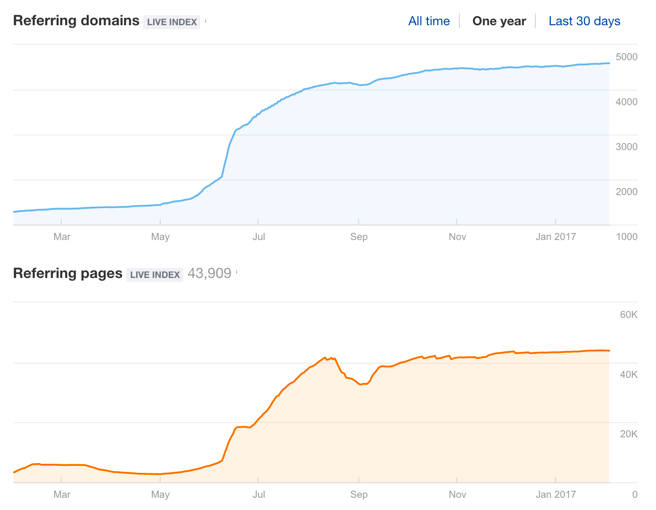
Ahrefs indicates that YNAB is increasing in referring domains quite healthily. The data below raises the question: where is YNAB getting their links from?
One thing I found right away, is that YNAB has some great links on what I like to call “feeder sites.” “Feeder sites” are sites that have content that is syndicated by many other large publications. Finding valuable feeder sites can be immensely powerful for SEO due to the amount and the quality of links that can be obtained.
Below is an example of what this feeder process looks like that YNAB has benefitted from.
An article was placed on the Reader’s Digest’s site, RD.com, entitled “34 Little Life Skills Everyone Needs to Be a Grown-Up.” RD.com is a feeder site to MSN.com as well as a handful of smaller sites. You can see that MSN.com syndicated the same article here. This means that for the effort of creating one very high-quality post, you can net a handful of links, sometimes from some large publications. This can be immensely powerful, and can lead to great jumps in increased rankings,
In the last few months, YNAB has received links like these:
And this is honestly only naming a few of the total links built recently.
YNAB is in a great position. It has the benefit of being able to target money-management communities with its methodology while at the same time targeting sites that focus on cell phone apps. This widens the targetable audience for the amount of websites YNAB can get links from. More links equal more authority, and when properly used, convert into better rankings and more traffic.
YNAB gets numerous mentions on both large and small publications. It is in the great position of garnering many mentions through its thousands of devoted fans. Typically, sites struggle with gaining more authority, therefore, they need a lot of high quality and well-targeted link building.
One note, however, is that many of the specific blog posts on YNAB’s site don’t get as much link love as the core YNAB pages (homepage, feature page, etc.). YNAB would benefit from additional links to their established blog posts, as well as to new posts as they are published. With the right content paired with YNAB’s community, this kind of link building should be cake.
YNAB has opportunities to generate much more organic traffic through their currently ranking pages. In order to diagnose how many opportunities there are, I pulled all ranking keywords (positions 1–50) from Ahrefs. Second, we needed to segment the data in order to see rankings in specific ranking buckets. I segmented rankings by keywords in the top 3 positions, positions 4–5, positions 6–10, page 2, position 21–50, and page 3+ rankings. I did this for every URL on the site in order to gain an understanding of each page and its rankings. The results looked something like this:

From a glance at the spreadsheet above, you can see a particular URL and what keyword positions that it ranks for. This makes it easy to determine which URLs simply need a bump in optimization and authority in order to generate traffic increases. This also allows you to forecast how big the traffic increases will be.
Let’s go through an example of how this data can enable us to take traffic-increasing action.
We see in the above screenshot that the blog post “How to Pay off $26k of Debt in 18 Months on a $35k per Year Income” ranks for 4 keywords in the top 1–3 ranking positions and 9 keywords in positions 4–5. The keywords in positions 4–5 represent around 520 monthly searches. This is what we see on the keyword level.

Looking at the average difficulty of these keywords, as well as taking into account that this post ranks as it does with not many links, YNAB could bump these 9 keywords up into the top 3 with only a handful of inbound links. This would increase the traffic of this page to somewhere between 100–150% with minimal effort. Sure, this is merely a couple hundred visits extra, but considering the minimal effort it would take, it would be worth it. Furthermore, you can see how this strategy can scale across the entire site. YNAB could increase overall traffic to the site by a large margin simply by taking advantage of this strategy applied too many of their blog posts.
The Google Featured Snippets box can be incredibly powerful to leverage. I want to show you how YNAB could leverage it to rank in a position essentially above position #1 (sometimes referred to as position #0). For context, the Google Featured Snippets box was debuted in Sept 2014, and was created as a vehicle for putting relevant answers in user’s hands much more quickly. For example, if you search “how to budget and save money” in Google, you will see something like this (highlights in red are mine):

You can see in the above screenshot that bettermoneyhabits.bankofamerica.com occupies the #0 position in Google’s featured snippet. This gives bankofamerica.com a strong advantage over americasaves.org in positions #1 and #2. Not only does bankofamerica.com have an augmented snippet, it also rank above position #1. This position can generate much more traffic than position #1.
Another value in ranking in the Google Featured Snippets box is that you can circumvent the climb to the top and be picked for a top page ranking, even if your site technically occupies a different rank land somewhere else on page 1. A detailed post on the specifics of how to do this can be found here.
YNAB already ranks on the first page for a handful of keywords that have the Featured Snippets box, but someone else shows up for the Featured Snippet. Because YNAB already ranks on the first page, it could implement some on-page changes and increase its chances of stealing the coveted Featured Snippets position. This would drastically increase the traffic YNAB receives from currently ranking keywords. For example, YNAB ranks in the 10th position for “how to pay off debt." This keyword generates around 5,400 searches per month. At the 10th position, YNAB doesn’t pull in that many of the 5,400 searches. However, if YNAB ranked in position #0, it would pull in a large percentage of that traffic.
Here are some of the keywords that have Featured Snippets YNAB could steal:

The process of optimize live posts is fairly simple, although it takes diligence. Cole Rieben, one of our Campaign Managers here at 97th, has a great post on what changes can be made in order to boost a site into the Featured Snippet spot (found here).
Without a doubt, creating new, high-quality, keyword-targeted content is one of the most rewarding actions YNAB could take. Content should be created for the user first, but in order for it to be valuable, it must also be findable. SEO done well is the perfect marriage between solid content and the ability to have that content found when users are asking questions. Keyword research can further help you understand exactly what kind of content people are looking for. It is an insight into their needs. Think about it, these people are asking questions already, we just need to meet their question with the best answer.
YNAB has created a lot of content. Most of it is fairly short and doesn’t rank for a ton of keywords. In addition, there are so many budgeting-related questions being asked daily. If YNAB can answer these questions with their grade-A philosophy and budgeting tool, it would be a huge win-win. Users get the answers they need, and YNAB grows.
To analyze what the market looks like in terms of budget/finance related keywords, I pulled a lot of data—like, over 111,000 unique keywords worth of data.
After researching the keyword level data, we needed to organize it to make it useful. The goal in leveraging all of this data is to understand a few things.
The first is keyword groupings of well-ranking URLs in the finance space. These URLs are from many other finance related sites. The data allow us to understand what keyword groups Google ranks these pages for. Secondly, I want to understand what it took for these sites to rank well
How many ways can “20” help? 20 isn’t a particularly large number, but in the right context, it can make a big difference in someone’s life.
Last year, 97th Floor sent holiday cards, along with a video, to clients, partners, and friends and encouraged them to set aside $20 to help someone around them. Each card included an additional $20 bill to help them jump start the giving. People could then use the #20helps hashtag to spread the message to others.

This year, in addition to the $20, we are taking it one step further. Instead of focusing specifically on money, we are encouraging everyone who sees this year’s card and video to look for any way in which “20 helps.”
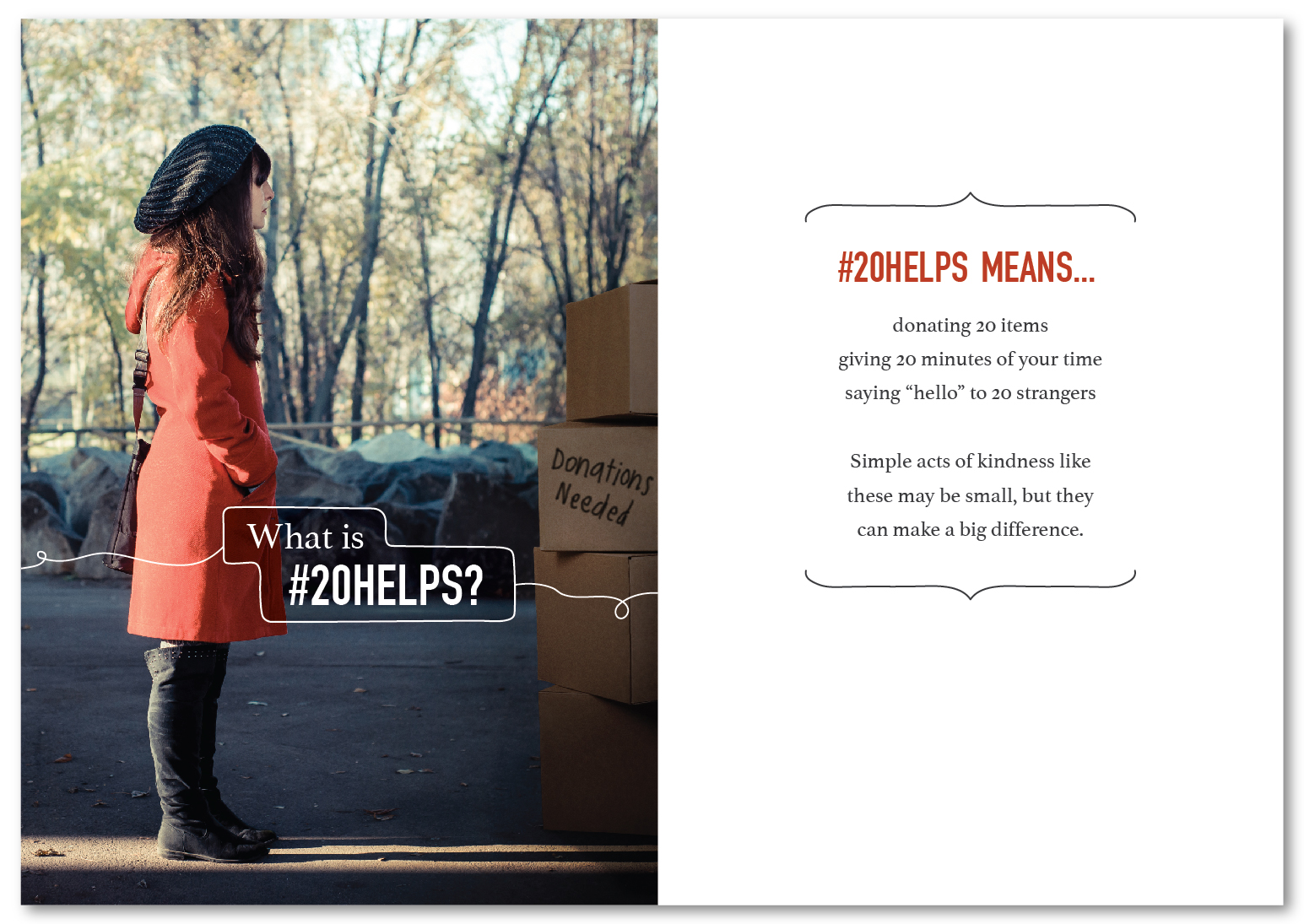
Here are a few ideas, just to get you started:
There are countless possibilities. Remember, 20 may not seem like much… but 20 helps.
 This year's card includes the same $20 as last year's, which recipients are asked to use to help someone else, plus two artisan chocolate bars from Taste in Provo, UT