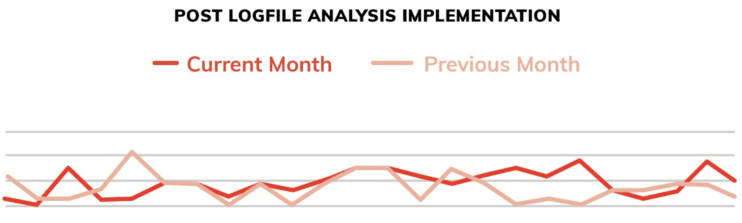
Marketing leadership faces quite a predicament — organic is consistently a website’s highest-converting channel, while also being completely dependent on an ever-fluctuating search engine.
SEOs need a series of checks and protocols — a response plan — not just to weather the algorithm storms, but to proactively leverage them for growth. They need to quickly assess damages, discover opportunities in the shuffle, and lay out next steps whenever updates roll out.
Yes, Google’s search algorithm is constantly changing. By some estimates, minor updates happen up to six times every day — over 2,000 minor algorithm updates every year — to say nothing of the significant core updates Google pushes about five times every year.
In this algorithm emergency response guide, we outline six critical steps to take in the event of a suspected algorithm update:
An SEO’s job isn’t just to grow a website’s organic traffic, but to communicate to leadership the impact that organic is having on the bottom line. This guide will help you know what to do and what to communicate.
Let’s dig in.
With over 2,000 yearly updates to the algorithm, it’s very possible you won’t see a traffic-impacting update coming your way. It may also be difficult to decipher whether fluctuations are coming as a result of your optimization and backlinking efforts or if Google’s been tinkering again.
Luckily, there are brilliant SEOs with massive access to data and key connections within Google who are constantly reporting. As with any news source, there’s also a fair amount of speculation that can be difficult to sift through.
Here are a few trustworthy sources we immediately turn to when suspicion is running high:
Following these entities and/or setting up Google Alerts for them will ensure you’re aware when an update hits.
The key when assessing every algorithm update is to understand what Google appears to be “targeting” with its update: quality of content, page speeds, backlinks, etc.
Beyond looking for the specific targets, it’s also essential to step back and review Google’s high-level goals. Google makes money by providing the best possible information to users searching on its engine. Every update is made with that goal, so every reactive response we make to these updates should be in the pursuit of improving our end users’ experience.
You need to get your arms around this and it’s best to start with the bottom line. Your leaders’ first question will be: are we making money or losing money as a result of this update?
Using your analytics tools, measure the percentage of loss or gain in both traffic and organic-sourced revenue. Keep tracking this every day for at least two weeks as algorithms tend to roll out gradually.
Digging deeper, you need to know which keywords are shifting.
We use STAT for this because it keeps historical, daily data of Google Rank and Google Base Rank for any keywords you’re tracking, providing precise detail around when rankings change.
Historical ranking data in STAT

Examine how rankings have changed over time to pinpoint precisely when specific keywords could have been impacted by an algorithm update.
You’ll notice that if one keyword has shifted, often other keywords within the same topic will also have moved. This is why it’s best to analyze losses and gains on a page-level.
My favorite way to see this is by pulling up Google Analytics and creating a comparison that only shows you traffic coming from the “google/organic” session source/medium. This is done by going to Reports > Add comparison at the top next to All Users > Include Session source/medium > Dimension values: google/organic > Apply. You can deselect the All Users audience to only see the audience just created.
Building comparisons in GA4
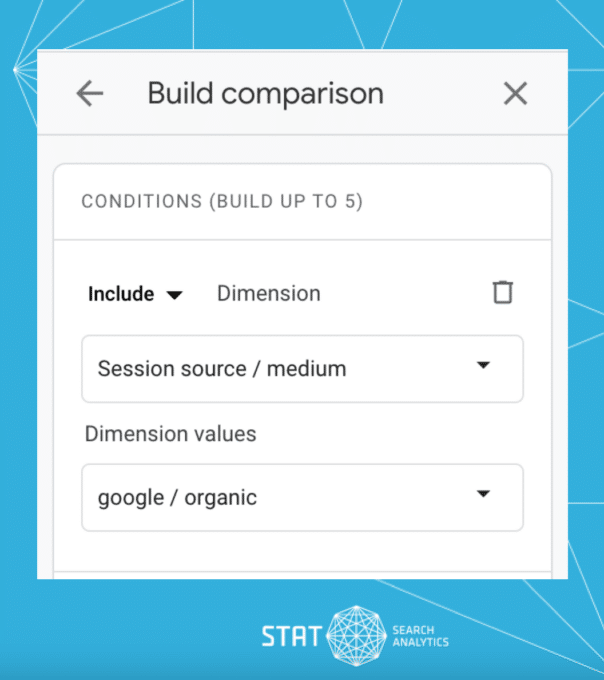
Simply set the conditions for your comparison as shown to isolate your organic traffic in Google Analytics 4.
Once you’ve created your comparison, head over to Reports > Engagement > Landing Page. You’ve now got a list of all your pages that are visited first as a result of an organic search. Start looking at before and after comparisons of the data to see which pages have fluctuated in traffic.
It is at this moment that you must decide whether the algorithm update is so impactful on your rankings, traffic, and revenue that you need to inform top-level leadership. You have the industry reports and you’ve captured the impact on your website — we advise over-communicating with leadership, letting them know that you’re aware of what’s going on and that you’re digging deeper.
Now that you know which of your pages and keywords are seeing fluctuations, it’s time to identify the “winners” and “losers” of the update. The best place to start, regardless of your specific rankings on the SERP, is to analyze the top 10 listings.
STAT’s Archived SERPs feature shows the top 10 listings for any date after which tracking was set up.
The Archived SERPs tab in STAT

Go back in time by selecting a date to see detailed listings of what was on the SERP that day.
First start by asking these questions:
Next, ask:
SEO execution is broadly thrown into three categories: on-page content, off-page authority, and technical — one page at a time, we need to evaluate how our page stacks up to the new standard of the update for each.
On-Page Content
One of the quickest ways to compare your content with the top 10 results is to compare H2s. Does your content address the same subtopics as Google’s favorite results?
You’ll also want to pay attention to characteristics like structure, length, metadata, and multimedia usage such as video and images.
Also consider how other listings are meeting E-E-A-T factors. Does the content have an updated or recent publish date that seems fresh? Is the content author reputable? What sources establish the author’s credibility?
Off-Page Authority
Next up, tune into the off-page authority of competing pages. Look at metrics such as:
Is your page stacking up against competitors well with backlinks or is the discrepancy in volume and/or quality tanking your ranking?
Technical
Finally, investigate the technical page-level components.
Start with the site map. Is this specific page in the site map? Check that the page is not excluded in robots.txt.
Remember to use canonical links to prevent duplicate pages from cannibalizing your page ranking.
Look at your page speed, compare structured page data with other ranking pages, and write alternate text for any images. This consideration for sight-impaired visitors isn’t about ranking, but compliance with ADA requirements improves user experience and may become relevant for ranking down the road.
You may have just discovered a series of important page-level factors that need to be addressed. However, we sometimes run this page-level analysis and find it to be a competitive wash — everyone in the top 10 can look nearly identical from an on-page, off-page, and technical perspective. So, what gives?
Google’s E-A-T guideline identifies Expertise/Experience, Authoritativeness, and Trustworthiness among its most important ranking factors in its algorithm.
This is not only demonstrated on a page level, but on a domain level. It’s the reason why a website could have a page that is arguably “better” than what’s found on the top 10, but not rank. Google needs to see that your domain — and your entire entity — demonstrates these values.
Domain-Level Content
If your domain-level content is suffering, you need to establish topical authority.
“Topical authority is a measure of authority built up through proven expertise and trust in your field. The more high-quality, informative pieces of content there are on your site, the more likely your website is to be perceived as a trusted source of information on a particular topic.” — Zoe Ashbridge, Senior SEO Strategist, Forank (How to earn topical authority in 2022 and beyond)
If your site is hurting here, do keyword research to find the related content keywords, organize your keywords into clusters or pillars, and get to work building and linking new authoritative content.
Domain-Level Authority
Your domain-level authority comes from backlinks. Zoom out and survey your site’s overall domain rating and your overall backlink profile compared to competitors. There are lots of helpful tools that can help you accomplish this — one example (that you can use for free) is Moz Link Explorer.
Domain-Level Technical
Finally, scan your site for glaring technical issues. Check in for these common failures:
With a much clearer picture of what has changed, how it is impacting your business, and what it will take to “win,” you’re ready to execute. More importantly, you also have the ammunition to communicate to key stakeholders.
It’s becoming increasingly rare that an SEO has the skills or access to make all necessary changes to their website. It’s time to communicate with developers, content writers, and top leadership.
Give them a brief that rolls together all of your findings:
And then give them their specific tasks. Do this and you’re on track to mitigate losses, seize opportunities, and prove why you’re an essential asset to the company when so much is dependent on Google.
Key Takeaways
A new marketing campaign is any initiative that sits outside of your always-on efforts. Unlike evergreen SEO, paid, or nurture programs, new campaigns are designed with a specific goal and a clear end date in mind.
This might mean spotlighting a product launch, rallying attention around a major industry event, or testing your messaging with a new audience segment. Sometimes it’s driven by leadership priorities, sometimes by seasonal opportunities, and sometimes by curiosity; the “let’s see what happens if we…” moments.
The point is: a new campaign should feel distinct from business as usual. It deserves its own planning, its own creative energy, and its own success criteria. Done well, a new marketing campaign can uncover insights that strengthen your always-on work for the long run.
In this article, we’ll walk through the full lifecycle of a new marketing campaign, from planning to launch to post-mortem, with practical tips you can apply right away. We’ll also share recent campaign wins worth learning from, along with a few cautionary tales of what not to do.
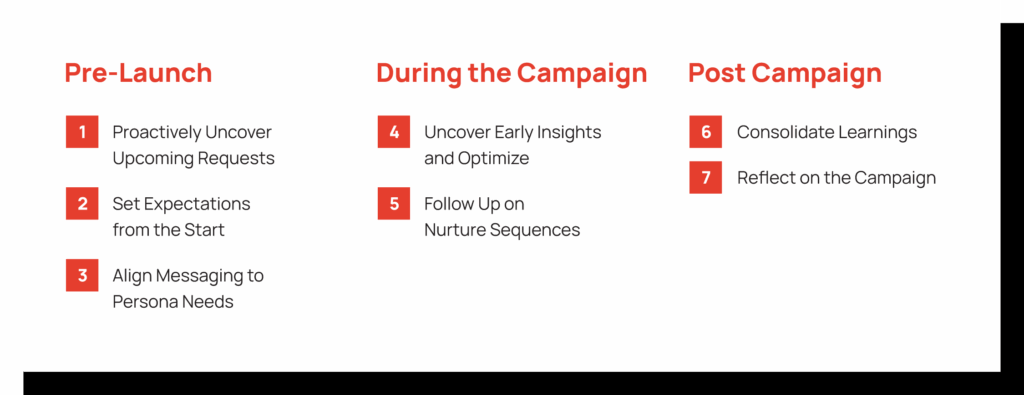
The biggest obstacle with new marketing campaigns is time. Get ahead of the curve by requesting a calendar of upcoming initiatives from key parties. Is your marketing team planning any events? Is the product team preparing for any new launches?
See if you can identify any patterns in past new marketing campaign requests. Do executive teams propose ideas in quarterly business reviews? Or do they follow up the week after the review with an idea that was sparked during the presentation?
Knowing what’s ahead will give you a significant advantage.
Because new marketing campaigns usually have different goals than always-on campaigns, ensure that everyone is on the same page about the campaign. Once a request comes your way, communicate timelines, required information, and what they can expect from you. Be clear about how long the platform will need to optimize the account and exit the learning period before you can report on concrete results.
Here are a few key pieces of information you should have documented in a campaign brief:
Pro tip: Keep your top-performing ads on instead of switching all spend to the new marketing campaign. Dramatically reducing budget or pausing ongoing efforts completely will halt conversions.
Companies often focus on products and features, while customers think in terms of pain points and benefits. Raise concerns early on and push back on messaging that contradicts what you’ve already learned about your audience. Bonus points if you have documented A/B test data that can back up your claims.
Consider workshopping campaign messaging and design concepts with key stakeholders before sending the copy over for final design. There are lots of eyes on the creative for one-off campaigns and you usually need approval for multiple individuals. There’s nothing worse than thinking you’ve wrapped a project up only to have three additional rounds of back-and-forth revisions.
The campaign is launched, but you’re not done yet! Dive into the performance data and see which ad creatives are resonating the best. Pause low-performing ads and make adjustments to improve performance. What learnings can you report on?
When you filled out the new campaign brief, you should have discussed how you were going to follow up with audiences from the one-off campaign. If a retargeting campaign isn’t already in action, it’s time to get that up and running. Don’t let too much time go by between audience interactions with your newly born marketing campaign and the next touchpoint.
After the campaign has ended, debrief and put all of your learnings into a single location for easy reporting and future reference.
A few things to include:
Since another new marketing campaign is likely to come your way again, take time to reflect on the campaign. Is there anything you would do differently? Loop in the person who requested the campaign. Did they get the information they hoped to gain? Were the results what they expected?
Finally, evaluate the overall effectiveness of the campaign. If similar initiatives arise in the future, would you expect them to succeed? Should you push back on this type of campaign moving forward or double down on your efforts?
Try out these seven steps the next time a campaign request comes your way. Instead of rushing to push something out the door, you’ll have a process in place that adds genuine value to your organization.
Every marketer’s been asked for “examples of campaigns that worked.” We won’t be the first to say it; success rarely comes from one magic trick. It comes from understanding your audience, telling a story they actually care about, and being willing to take risks when it counts.
Here are three recent campaigns that got it right, for very different reasons.
When American Eagle tapped Sydney Sweeney for their denim ads, they didn’t play it safe. The campaign headline “Sydney has great jeans” sparked immediate buzz, equal parts clever wordplay and eyebrow-raising innuendo.
Critics weighed in, competitors like Gap and Lucky Brand jumped into the conversation, and suddenly American Eagle was winning attention far outside their usual channels.

Our takeaway: Sometimes controversy is the strategy. But, pulling it off takes confidence in your brand voice, a readiness for backlash, and a clear plan to capture the upside of all that attention.
While most AI brands fight for attention with speed, disruption, and hype, Anthropic zagged. Their “Keep thinking” campaign positioned Claude as thoughtful, safe, and human-aligned.
It was quiet where others were loud, reflective where others were flashy, and it worked. Anthropic found white space between its competitors and used brand values as the creative hook.

Our takeaway: A campaign grounded in authenticity can be more disruptive than the most over-the-top creative. Values resonate, especially when the rest of the industry is running in the opposite direction.
Canva didn’t do a campaign telling people its tools are great to use; it showed them. Their billboard takeover at London’s busiest train station literally demonstrated product features: background removal, drag-and-drop edits, and clean design transformations.
Commuters stopped. Photos spread online. The product explained itself in 20 seconds flat, and people remembered Canva for it.
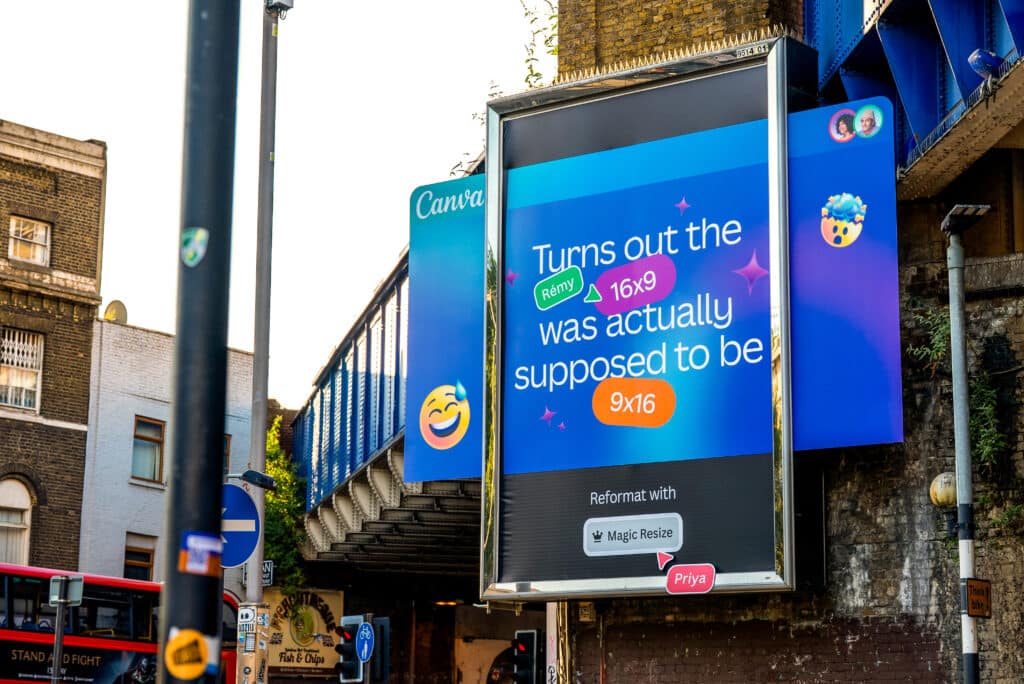
Our takeaway: The best campaigns make the product the star, not by listing features, but by proving value in a way that’s impossible to ignore.
Not every new campaign makes headlines for the right reasons. Some fall flat, some spark backlash, and some quietly get walked back before anyone notices. But even the flops have value. They remind us what not to do and why strategy matters as much as creativity.
Here are two recent examples that prove the point.
Cracker Barrel spent big to modernize its brand, all the way from its logo to the interior of its restaurants. The goal was to broaden appeal and refresh the experience for a new generation of diners.
The problem? Longtime customers didn’t want a new Cracker Barrel. They wanted the one they already loved. By removing nostalgic elements, the rebrand sparked anger among loyalists. Traffic dropped, sentiment soured, and within a month, the company had to backpedal.
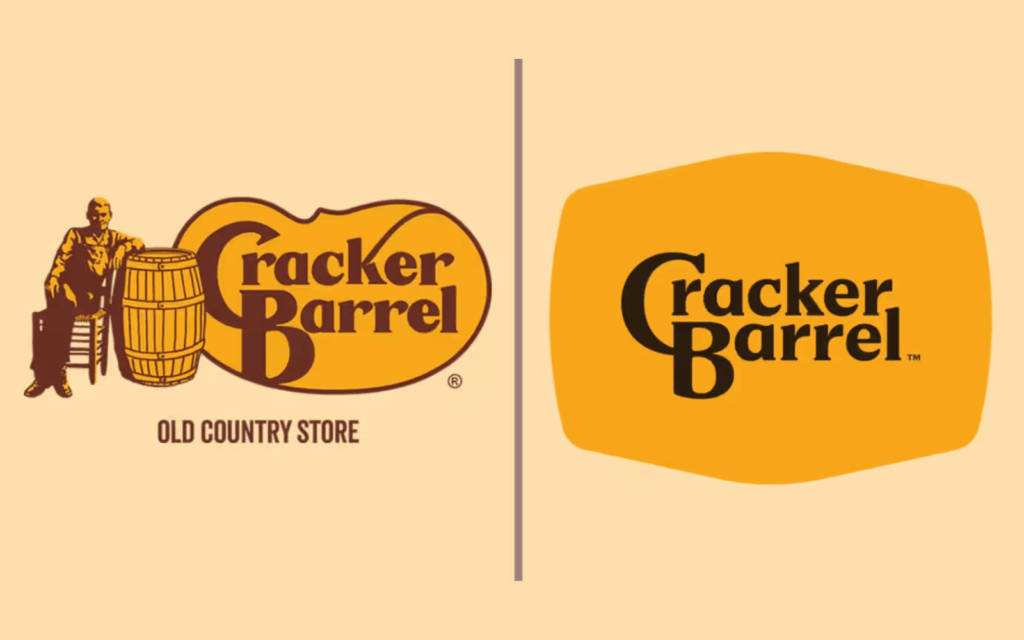
Our takeaway: Brand equity is emotional equity. Before making sweeping changes, test your ideas, phase your rollout, and make sure you’re not alienating the very people who built your business.
Jaguar’s recent push into ultra-luxury electric vehicles was bold. New visuals, a “hot pink” launch campaign, and a decision to discontinue lower-end models made it clear the brand was chasing a different audience.
The reaction was mixed at best. Traditional customers felt alienated, critics mocked the visuals, and even fans admitted the pivot was jarring. Still, Jaguar has doubled down, betting the long-term payoff will outweigh the early backlash.

Our takeaway: Repositioning is sometimes necessary, but it’s a long game. If you’re going to risk alienating part of your base, you need crystal clarity on who you’re speaking to, why it matters, and how you’ll sustain momentum through the pushback.
Launching a new marketing campaign isn’t easy, but it doesn’t have to feel like starting from scratch every time. With the right foundation, clear messaging, smart use of data (and yes, AI), and a commitment to learning from every run, campaigns can do more than hit short-term goals. They can make your always-on marketing stronger, too.
Every campaign, big or small, is an opportunity to sharpen your strategy, experiment with creative, and uncover what your audience responds to. The wins matter. The misses matter too. The real advantage comes from teams who take the time to reflect and apply those lessons to what’s next.
At 97th Floor, we build marketing campaigns that create momentum and generate the results you're looking for. If you're ready to see what Great Marketing can do for your brand, lets build.
Understanding the concept of an Ideal Customer Profile (ICP) is crucial for any marketing strategy's success. An ICP is not just a description of a potential customer; it's a comprehensive outline that encapsulates the characteristics of the companies or individuals who are most likely to benefit from your product or service. This profiling plays a pivotal role in guiding marketing efforts, enabling businesses to focus their resources on the most promising leads.
Ultimately, an ICP helps align various marketing activities, ensuring that all efforts are concentrated on attracting and retaining the most valuable customers.
While often used interchangeably, an Ideal Customer Profile (ICP) and a Buyer Persona are distinct concepts, and understanding their differences is key to leveraging each effectively. ICPs are used to filter down your Total Addressable Market (TAM) into actionable categories and segments that bring focus to marketing strategies and tactics.
ICPs are most commonly used by B2B companies and, in these cases, are more differentiated from Personas. However, B2C companies can still use an ICP framework to identify categories of their consumers, and the catered strategies that go with each one uniquely. Common criteria used for developing ICPs include:
On the other hand, Buyer Personas include detailed information about customer behavior, motivations, goals, pain points, and decision-making processes.
In essence, while an ICP identifies the attributes that make a perfect target business account or customer, Buyer personas delve into the factors that play a role in the 'how' and 'why' the individuals within your ICP make purchasing decisions. Both are integral to developing a comprehensive marketing strategy but serve different purposes in understanding and engaging your target audience.
Creating an effective ICP involves several key steps. By following this guide, you can develop comprehensive ICPs that will serve as a foundation for your marketing and sales strategies.
Identify Your Best Current Customers
The first step in creating your ICP is to identify the best customers among your full customer list. These are the customers who have gained the most value from your products or services and who have contributed significantly to your business. Each business will have different criteria for evaluating what makes an ideal customer—whether it involves average order value, average retention, easiest to work with, etc. Collaborating with the different functions of your business (sales, marketing, customer service, operations, etc.) is key to finding a shared understanding of what makes a customer great.
Research Common Attributes
Once you have identified your best customers, begin researching their common attributes. This includes demographic, firmographic, and psychographic characteristics. Demographic information might include age, gender, or location, while firmographic details could involve company size, revenue, or industry sector. Psychographic characteristics delve into the values, interests, and challenges of these customers. Group customers together based on these common attributes to narrow them down to the most impactful.
Outline Opportunities and Challenges
Next, seek to identify the specific problems your customers are looking to solve and the opportunities they are trying to seize. This understanding will enable you to align your product or service as a solution to these challenges, making your offering more relevant and appealing to the prospective customers you care about most.
Document Your ICP
Finally, document your Ideal Customer Profile. This documentation should be comprehensive, including all the insights you have gathered about your ideal customers. It should be a living document, regularly updated as you gain new insights and as market conditions change. This ICP document will serve as a reference for your marketing and sales teams, guiding them in their strategies and ensuring that they are always focused on attracting and engaging your most valuable customers.
Creating an Ideal Customer Profile (ICP) can be streamlined with the right tools and templates:
An Ideal Customer Profile (ICP) is a strategic asset that can be actively used to drive business growth, particularly in your marketing campaigns. When you apply your ICP to your marketing strategies, you align your efforts with the needs and preferences of your most valuable customers.
Firstly, an ICP allows for highly targeted advertising. By knowing exactly who your ideal customers are, you can more accurately target them on LinkedIn, Google Ads, Meta, and through programmatic and ABM platforms. You can expect a much higher ROI from your ads the more targeted you get with your messaging, imagery, and conversion offers.
Secondly, content marketing benefits greatly from an ICP. With a clear understanding of your ideal customers’ challenges, interests, and goals, you can create content that directly addresses these areas. Whether it's blog posts, videos, or social media content, tailoring your content to your ICP ensures that it resonates with your audience and establishes your brand as a solution to their needs.
Thirdly, an ICP aids in email marketing. Segmenting your email list according to your ICP and sending personalized messages increases the effectiveness of your campaigns. Personalized emails have higher open and click-through rates, as they are more relevant to the recipients. Your ICP guides the creation of these personalized messages, ensuring that they are aligned with the interests and needs of your audience.
ICPs also bring immense value to sales strategies. Effective sales always starts with a deeper understanding of one’s customer, their situation, and how the product or service being sold will benefit the customer.
More practically, ICPs go a long way in helping Sales Development Reps and Business Development Reps build prospect and customer lists, giving them specific criteria to narrow their focus. This targeted approach means that time and resources are not wasted on leads that are less likely to convert.
Sales pipeline management is also aided by a well-defined ICP because account executives can gain more traction as they repetitively focus on the shared needs of the customers within their ICPs, as opposed to shifting gears between various offerings, plays, and positions.
In conclusion, the strategic creation and implementation of an Ideal Customer Profile (ICP) are essential for any business looking to maximize its marketing and sales effectiveness. An ICP provides a clear and focused understanding of who your ideal customers are, allowing for more targeted and personalized marketing and sales strategies.
An ICP is a detailed description of a company or individual who would benefit the most from your product or service, encompassing various characteristics like industry, company size, and specific needs.
While an ICP identifies the ideal type of customer or company, a buyer persona delves into the detailed characteristics of an individual decision-maker within that customer or company, including behavioral and psychological traits.
An ICP guides digital marketing efforts, ensuring that strategies and content are tailored to the needs and preferences of the most valuable customers, leading to more effective campaigns and higher ROI.
Yes, an ICP can and should evolve as your business grows, market conditions change, and new insights about customers are discovered. Regular review and updates are important.
Use your ICP to guide the creation of content that addresses the specific interests, challenges, and goals of your ideal customers, making it more relevant and engaging for your target audience.
An ICP helps sales teams focus on the most promising leads and tailor their sales pitches to address the specific needs and pain points of these potential customers, increasing the chances of successful conversions.
Yes, by understanding and continuously meeting the needs of your ideal customers as outlined in your ICP, you can increase customer satisfaction and loyalty, leading to higher retention rates.
Regularly reviewing and updating your ICP is crucial, at least annually or when major shifts occur in your business or market.
Tools like CRM systems, analytics platforms, customer survey tools, and competitor analysis software can assist in gathering the necessary data to create a comprehensive ICP.
Your ICP should be as specific as possible, detailing not just demographic information but also behavioral, psychographic, and firmographic characteristics to effectively guide your marketing and sales efforts.
A content brief is a document that outlines the objectives, audience, message, and guidelines for a piece of content. This tool ensures that everyone involved in the content creation process, from writers to editors to marketing teams, shares a common understanding of what needs to be achieved. The purpose of a content brief is multifold: it aligns the content with the brand's goals and audience needs, provides clear direction to content creators, and helps in measuring the effectiveness of the content against its intended objectives.
Content briefs bridge the gap between strategy and execution. At the beginning of a content creation workflow, content briefs inform the planning stage, helping to identify topics that align with marketing goals and audience interests. During the creation phase, they guide writers and designers, ensuring that the content aligns with the initial strategy. Finally, in the analysis stage, the objectives outlined in the content brief serve as benchmarks to evaluate the content's performance.
The first step in crafting an effective content brief is to have a deep understanding of your audience and your content goals. Who are you writing for? What are their interests, pain points, and preferences? Knowing your audience helps tailor your content to speak directly to their needs and interests. Additionally, clearly defined goals guide the direction of your content. Are you aiming to educate, inform, persuade, or entertain?
Keyword research is crucial in optimizing your content for search engines and improving its online visibility. Identify keywords and phrases that your target audience uses when searching for information related to your content. This involves using tools like Ahrefs or SEMrush to find keywords with high search volume and low competition. Including these keywords in your content brief ensures that the content not only resonates with your audience but also performs well in search engine results.
Every piece of content should have a unique angle or perspective that makes it stand out. This could be an unusual viewpoint, a fresh take on a common topic, or an insightful analysis. The tone of your content should also be specified in the brief. Whether it’s formal, conversational, humorous, or authoritative, the tone should reflect your brand's voice and appeal to your target audience.
An effective content brief includes an outline of the structure and format of the content. This may involve specifying headings, subheadings, paragraph length, and the overall flow of information. Decide whether the content will be a blog post, an infographic, a video script, or another format. A well-structured content brief helps creators understand the expected format and organize their ideas coherently.
Include a list of relevant keywords along with their search volume in your content brief. This not only guides the SEO strategy but also helps writers understand the importance of certain keywords. Knowing the search volume helps in prioritizing keywords and incorporating them strategically within the content. Furthermore, Google is not only looking for relevant keywords, but also related terms that prove that the content contains Expertise, Experience, Authoritativeness, and Trustworthiness (E-E-A-T). Semantic analysis will help you identify the adjacent terms that your content needs to rank.
Competitor research is an integral part of a comprehensive content brief. It involves analyzing content from your competitors that ranks well for similar keywords. The aim is to understand what they are doing right and identify opportunities to differentiate your content. Look at their topics, formats, tone, and how they structure their content. This research helps in crafting content that not only stands out but also leverages successful strategies used by others in your industry.
A well-crafted content brief should also include recommendations for internal and external linking. Internal links connect your content to other relevant pages on your website, enhancing user experience and boosting SEO. External links, on the other hand, should point to authoritative sources, adding credibility and depth to your content. The brief should specify key pages or external sources to be linked, ensuring a coherent and resourceful content piece.
Visuals are crucial in making content engaging and easy to digest. Your content brief should specify the types of visuals needed, such as images, infographics, or videos. This guides the design team in creating visuals that complement and enhance the content. Additionally, including a call-to-action (CTA) is vital. Whether it’s to encourage the reader to subscribe, download a resource, or contact your business, CTAs guide your audience on what to do next, making your content more effective in achieving its goals.
When creating content briefs, having the right tools and templates can streamline the process and ensure consistency across all content pieces. Various tools are available, each offering unique features to suit different needs.
Each of these tools offers unique advantages, and the choice depends on the specific needs of your content strategy and team dynamics.
Content briefs are strategic tools that shape the direction and effectiveness of content marketing efforts. By clearly defining the audience, goals, structure, and SEO elements, a content brief ensures that each piece of content is purposeful, audience-aligned, and optimized for search engines. The benefits of using content briefs are evident in the consistency, relevancy, and efficiency they bring to the content creation process.
Whether it’s for a blog post, an SEO-focused article, or an eBook, a comprehensive content brief lays the foundation for content that not only resonates with the audience but also strengthens the brand's online presence.
A content brief is a document that outlines the key elements of a piece of content, including its purpose, target audience, tone, structure, and key messages. It serves as a guideline for content creators to ensure that the content aligns with marketing objectives.
Content briefs are important because they ensure that all content is strategically aligned with business goals and audience needs. They provide clarity and direction to content creators, leading to more effective and consistent content.
Typically, content briefs are created by content strategists, marketing managers, or anyone in charge of content planning and strategy. However, input from SEO specialists, writers, and designers is also valuable.
A content brief should include the content's purpose, target audience, desired tone and voice, structure, key messages, SEO keywords, and any specific requirements for visuals or formatting.
A content brief benefits SEO by identifying target keywords and phrases, which helps in optimizing the content for search engines and improving its visibility and ranking.
Yes, content briefs should be flexible and evolve based on content performance data, audience feedback, and changes in marketing strategy.
The level of detail in a content brief can vary depending on the complexity of the content and the experience of the content creators. It should be detailed enough to provide clear guidance but not so detailed that it stifles creativity.
No, content briefs are meant to guide creators, not restrict them. They provide a framework within which creators can innovate and experiment while still aligning with strategic goals.
Content briefs are a crucial component of the overall content strategy. They ensure that each piece of content serves a specific purpose and contributes to the broader marketing objectives.
Content briefs should be reviewed regularly to ensure they remain relevant and effective. This might be after each content piece is completed or at regular intervals within the content marketing cycle.
A Call to Action is a directive or prompt that encourages a website visitor or reader to take a specific action.
This action can range from signing up for a newsletter, downloading a resource, making a purchase, or even just clicking on a link to read more about a topic or visit a landing page.
CTAs are typically presented as clickable buttons, links, or highlighted text, strategically placed to stand out and capture the user's attention.
The primary goal of CTAs is to drive conversions, whether that means generating leads, increasing sales, or fostering engagement.
In marketing and advertising, the term "above-the-fold" refers to the area of a webpage or email that is visible without scrolling. This is prime real estate for capturing your target audience's attention; a CTA should always exist in this section.
To create visually appealing and attention-grabbing CTAs in this space, focus on clear, concise language that quickly conveys the action you want users to take. Use contrasting colors or striking imagery to make the CTA stand out within the context of your advertisement or webpage. The goal is to make the CTA so compelling that users feel prompted to click or engage immediately.
While above-the-fold placement can be highly effective, it's also important to consider the context of your CTA. Contextual placement involves integrating your call to action within the content in a way that feels natural and relevant to what the user is reading or experiencing. This strategy can be more subtle than the direct prompt of an above-the-fold CTA, and it's less about driving an immediate sale and more about guiding the user along their journey.
To optimize CTAs for contextual placement, align them with the user's current stage in the buyer's journey. For example, a blog post explaining the benefits of your product might include a CTA encouraging users to learn more, while a product page might have a CTA prompting an immediate purchase. Providing relevant context makes it more likely that users will respond to your CTAs, as they align with the user's current needs and interests. These types of higher-funnel CTAs will also help move the user down the funnel to eventually make a purchase.
A CTA should capture attention. Use contrasting colors, bold fonts, and strategic button or text placement to ensure your CTA doesn't get lost in your content. Remember: white space is not your enemy. Use whitespace (empty space) around the CTA to make it visually distinct.
Note that if a page has too many CTAs, it can confuse users and dilute the main action you want them to take. If everything is an important CTA, then nothing is an important CTA.
A strong CTA leaves no room for confusion or ambiguity. It clearly and concisely communicates the intended action to the audience. By using straightforward language and avoiding jargon or complex terms, a clear CTA ensures that users understand exactly what they are expected to do.
For instance, a CTA such as "Buy Now," "Download the eBook," or "Register for Free" conveys a direct message, leaving no doubt about the desired action. The clarity of the CTA empowers users to make informed decisions and facilitates their navigation through the marketing funnel.
Avoid vagueness in your messaging.CTA buttons such as "Click Here" or "Submit" don't provide enough context or incentive for users to take action.
Always check for and correct passive language. A CTA reading "Access will be granted” implies that users will gain access without specifying an action. "Subscriptions are available" suggests that users can subscribe without explicitly instructing them to do so.
An effective CTA often instills a sense of urgency, compelling users to take immediate action. By incorporating time-sensitive language or limited availability, businesses can create a fear of missing out (FOMO) that motivates users to act promptly. Phrases like "Limited Time Offer," "Don't Miss Out," or "Last Chance to Save" evoke a sense of urgency, encouraging users to seize the opportunity before it's too late. Urgency adds a persuasive element to the CTA, driving higher conversion rates and maximizing the impact of marketing efforts.
Other words that create a sense of urgency or scarcity include: "now", "today", "last chance", "don't miss", "hurry", "limited", "exclusive", "only", "few", or "sold out.”
A strong CTA aligns closely with the user's needs, desires, and interests. It should resonate with the target audience and address their pain points or aspirations.
For example, a fitness app may use a CTA like "Start Your Journey to a Healthier You," appealing to individuals seeking to improve their well-being.
Relevance establishes a personal connection with the users, making the CTA more compelling and increasing its effectiveness. Relevance is especially important when placing CTAs contextually within content.
Before crafting a CTA, it's essential to know your audience. What are their needs, preferences, and pain points? Do you have reviews, customer interviews, or other voices of customer research that reveal the way your audience speaks? Lean into that. Whenever possible, use language and phrasing that your customers use to increase connection and the likelihood that your audience will take action.
Keep CTAs congruent with your brand. What tone of voice do your customers expect from your brand? Is your brand formal, playful, or inspiring? Depending on your brand voice and the nature of your audience, different writing styles can affect results.
Also, consider the specific value that you offer to your audience. What is their need and how does your offering address that need? Using value-infused language in a CTA shows your audience the relevancy of your solution.
While crafting multiple CTAs for various needs, be aware of where in the buyer’s journey your audience is. A user at the awareness stage of the buyer's journey might respond better to a "Learn More" CTA, while someone at the decision stage might be more inclined to click on a "Buy Now" button. Pair the appropriate CTA and content accordingly.
Smart marketers will refine a call to action through A/B testing. This is the process of comparing two versions of a CTA to see which one performs better. Each variant is shown to a similar audience, and the one that prompts a larger percentage of users to take the specific action is considered more effective.
When conducting A/B tests, it's important to change only one element at a time to clearly identify what influences user behavior. This could be the CTA's color, wording, size, placement, or even the urgency of the message. The aim is to continue refining your CTAs until you find the most compelling combination that prompts users to take the desired action.
Once your CTAs are in place, it's important to track their performance to understand what's working and what's not. Analytics and tracking tools can provide valuable insights into how users interact with your CTAs, providing tangible evidence of what prompts users to take action.
Key metrics to monitor include click-through rates, conversion rates, and bounce rates, among others. Analyzing these metrics can help you understand if your CTA is effective or if it needs further optimization. Remember, the goal is to continuously improve your CTAs to maximize their potential to prompt users to take specific action.
With advancements in technology, there are now AI-driven tools that can help optimize your CTAs. These tools analyze user behavior and preferences to suggest CTA designs, placements, and wordings that are most likely to drive conversions.
With a significant portion of users accessing content on mobile devices, it's crucial to ensure that your CTAs are mobile-friendly. This means they should be easily clickable, visible, and well-optimized for smaller screens.
By adhering to these best practices, you can enhance the effectiveness of your CTAs and achieve better results in your digital marketing efforts.
CTAs serve as the bridge between user interest and desired outcomes, guiding visitors toward meaningful interactions. The creation, placement, and optimization of CTAs require a blend of creativity, analytic skill, and continuous testing.
A CTA's main goal is to prompt a user or reader to take a specific action, such as signing up for a newsletter, making a purchase, or engaging with content. It serves as a directive that guides users toward a desired outcome.
The effectiveness of a CTA can be measured using metrics like click-through rates, conversion rates, and user engagement levels. Regularly monitoring these metrics and comparing them against benchmarks or past performance can provide insights into a CTA's success.
Yes, you can. However, it's essential to ensure that each CTA has a clear purpose and doesn't overshadow or conflict with others. Too many CTAs can overwhelm or confuse users, so it's crucial to prioritize and strategically place them.
Very important! A CTA should stand out but still fit within the overall design of the page. Factors like color, size, font, and placement can significantly influence a user's decision to click.
Not necessarily. While it's common to place CTAs at the end of articles or pages, they can also be effective when positioned in the middle, especially if the content is long. The key is to place CTAs where they feel contextually relevant.
Ensure that CTAs are easily clickable on mobile devices, use larger fonts, and consider the thumb's natural position when deciding on placement. Also, ensure that the CTA loads quickly and is visible without excessive scrolling.
Absolutely! A/B testing is a recommended approach to determine which version of a CTA performs better. By comparing two or more variations, you can gain insights into preferences and optimize accordingly.
Words that evoke urgency (like "Now"), benefit (like "Free"), or action (like "Discover") often perform well. However, the best phrasing often depends on context and audience.
Retargeting is a form of online advertising with the purpose of re-engaging individuals who have previously interacted with your website. At its core, retargeting operates through cookies and other similar technologies. When a user visits your website, a small piece of code, often referred to as a pixel, places a cookie in their browser. This cookie then allows retargeting platforms to serve targeted advertisements to this user as they navigate other parts of the web. The beauty of this approach lies in its precision and relevance; ads are shown specifically to users who have already shown interest in your product or service, thereby significantly increasing the likelihood of conversion.
But retargeting isn't just about following potential customers around the web with ads. It's also about timing and relevance. These ads are tailored not only to the user's previous interactions with your website but also to where they are in the purchasing journey. For example, someone who abandoned a shopping cart on your site might see an ad for those very products, perhaps even with a special offer to entice them back. Similarly, if a user visited a specific solutions page, a proactive marketer will create retargeting campaigns with copy and design specific to each solution.
Retargeting’s effectiveness is not just in its ability to bring back potential customers but also in the way it enhances the overall marketing strategy. Let's delve into the key benefits of retargeting:
Retargeting is not just a tool for increasing sales; it's a strategy for building deeper connections with your audience. It's about delivering the right message, to the right person, at the right time—nurturing a relationship beyond a single transaction.
Remarketing is often used interchangeably with retargeting, but it goes beyond just serving ads to past website visitors; it's about creating a comprehensive approach to rekindle interest and maintain a connection with your potential and existing customers.
In one sense, retargeting can be considered a form of remarketing. However, there are slight differences between the two.
Remarketing operates on a principle similar to retargeting, yet it encompasses a broader scope. It involves identifying users who have previously interacted with your brand and targeting them with specific marketing messages. The key here is the data collected from these interactions, which can come from various sources like website visits, social media engagement, or email interactions.
The process typically starts when a user visits your website. Just like retargeting, a cookie is placed in their browser, allowing you to track their online behaviors and preferences. This information then feeds into your remarketing campaigns, enabling you to create personalized ad experiences that resonate with each individual.
However, remarketing's strength lies in its versatility. It's not limited to just displaying ads. For example, if a user has abandoned a shopping cart, an email can be sent to them reminding them of the items they left behind, perhaps with an added incentive like a discount code or free shipping offer. This approach is highly effective in nudging users further down the sales funnel.
By integrating different channels and touchpoints, remarketing creates a cohesive experience that keeps your brand top-of-mind and encourages users to take the final step in their purchasing journey.
While retargeting and remarketing are often used interchangeably in digital marketing, there are subtle but important differences between the two.
Understanding these differences is key to determining which strategy aligns best with your specific marketing goals.
Choosing between retargeting and remarketing depends on your objectives, the nature of your business, and where your customers are in the buying journey.
In many cases, a blend of both retargeting and remarketing can be the most effective strategy. This approach ensures you capture immediate sales opportunities and develop ongoing relationships with your customers for future growth.
Site retargeting targets users who have visited your website but left without taking a desired action, like making a purchase, filling out a demo form, or signing up for a newsletter. This type of retargeting is crucial for keeping your brand top-of-mind and encouraging these users to return and complete their transaction. It can be especially effective for e-commerce sites looking to reduce cart abandonment rates. Site retargeting is also effective in retargeting users in b2b lead gen strategy. Using site retargeting, users who have visited blogs, case studies, and other informative pages can be retargeted with lead gen offers like demos, trials, or meeting requests.
Search retargeting is a form of retargeting used to target users who have searched for specific keywords or phrases related to your business but haven't visited your website yet. It’s an excellent way to capture the attention of potential customers at the very beginning of their buying journey. By targeting ads based on their search behavior, you can introduce your brand to a highly relevant audience, increasing the likelihood of attracting new visitors to your site.
Email retargeting involves sending targeted emails to users based on their specific interactions with your website. This can include emails triggered by actions like visiting certain pages, spending time on specific content, or abandoning a shopping cart. Email retargeting is a powerful tool for personalization, allowing you to craft messages that speak directly to the user’s interests and behaviors.
Contextual retargeting involves targeting users based on the type of content they are viewing or have viewed on other websites. This strategy assumes that if a user is interested in certain content on one site, they might be interested in related products or services on another site. It’s a way to reach potential customers in a contextually relevant environment, enhancing the relevance and effectiveness of your ads. Dynamic retargeting takes it one step further. Especially relevant in Ecommerce, dynamic retargeting is the strategy of configuring your ads to dynamically generate content that matches the pages they have seen. An ecommerce marketer would export their product feed and import it into their ad platforms (Google Merchant or Meta, for example), allowing the platforms to match product page visits to the products found in your ads.
Engagement retargeting targets users based on their level of engagement with your content, such as videos, social media posts, or interactive tools on your site. This type of retargeting is particularly useful for identifying and focusing on users who have shown a high level of interest in your content, making them prime candidates for further nurturing and conversion. For example, you can retarget users who have watched more than 15 seconds of a specific video, or users who have spent more than 45 seconds reading a blog post.
Social retargeting focuses on users who have interacted with your brand on social media platforms. Whether they’ve engaged with your posts, visited your social media profiles, or mentioned your brand, social retargeting allows you to keep these users engaged with relevant content and offers on their preferred social platforms.
Each of these retargeting and remarketing types offers unique opportunities to connect with your audience in meaningful ways. By understanding and utilizing the right mix of these strategies, you can create a comprehensive approach that covers different stages of the customer journey and various user behaviors.
One of the most critical aspects of both retargeting and remarketing is identifying and targeting the right audience. This means segmenting your audience based on their behavior, interests, and stage in the buying cycle. While many marketers set up simple remarketing campaigns to retarget any users who have visited the website (on any page), tailoring your campaigns to different segments ensures that your messages are relevant and effective. For instance, targeting users who abandoned their shopping carts with personalized offers can significantly increase conversion rates.
The success of your retargeting and remarketing efforts largely depends on the appeal of your advertisements. Ads need to be visually engaging, with clear and compelling messaging that resonates with the target audience. Including strong calls-to-action (CTAs) and highlighting unique selling propositions (USPs) can make your ads stand out and encourage clicks. Remember, the users who will see these ads already have some experience with your brand. Don’t repeat the same messages or visuals they would have already seen at the top of the funnel—instead, give them mid-to-lower-funnel messaging.
As with all advertisements, ensuring that your landing pages are optimized for conversion is crucial. The landing page experience should be consistent with the ad in terms of messaging, design, and the offer presented. A seamless transition from ad to landing page increases the likelihood of conversion. The landing page should be user-friendly, with a clear path to conversion and minimal distractions.
Retargeting and remarketing campaigns provide excellent opportunities for cross-selling and upselling. By analyzing past purchases and browsing behavior, you can present customers with relevant recommendations and offers. This not only increases your value per customer but also enhances the customer experience by providing value-added suggestions.
Sequential engagement involves showing different ads to users based on their previous interactions with your ads or website. This strategy helps in guiding potential customers through the sales funnel by providing them with relevant information at each stage. It's about telling a story and building a narrative that keeps users engaged over time.
By adhering to these best practices, you can ensure that your retargeting and remarketing campaigns are not only effective in driving conversions but also in building lasting relationships with your customers.
Retargeting is exceptional for (re)capturing the attention of potential customers and guiding them back to complete a transaction. In addition, remarketing plays a pivotal role in nurturing long-term customer relationships and enhancing customer lifetime value.
Remember, the key to success in these strategies lies in personalization, relevance, and consistency. Everyone wants a catered experience and by keeping your messaging aligned with your customer's interests and behavior, you can create a more meaningful and impactful marketing experience.
While retargeting and remarketing overlap, retargeting primarily focuses on serving ads to past website visitors, using browser cookies. Remarketing is broader, often involving re-engagement through emails, social media, or ads based on past user interactions.
Retargeting ads use cookies to follow users across the web, displaying ads based on their past interactions with your site. This ensures your ads are shown to a highly targeted audience, increasing the likelihood of conversion.
Yes, email remarketing is highly effective, especially for personalized messages based on user behavior, like abandoned carts or previous purchases. It helps in maintaining customer engagement and encouraging repeat business.
Absolutely. Retargeting targets users already interested in your products, making them more likely to convert compared to new users. It’s especially effective for recovering abandoned carts and finalizing pending transactions.
Audience segmentation for remarketing can be based on user behavior, such as website interactions, purchase history, or engagement level. This allows for more personalized and relevant marketing messages. These audiences can be segmented through the ad platforms directly. Each platform has its own retargeting capabilities. It is encouraged to become familiar with these options and make informed decisions on what the best retargeting strategy is for every situation.
Retargeting ads should be visually appealing, with clear messaging and strong calls to action. They should also be relevant to the user’s previous interactions with your site for maximum effectiveness.
Regularly. Keep your campaigns fresh and relevant by updating ad creatives, offers, and messaging based on ongoing data analysis and changing user behavior.
Yes, privacy is a concern. It’s important to comply with data protection regulations like GDPR and ensure transparent communication with users about how their data is being used. While many ad and tech platforms (like Google, Meta, and Apple) are reducing the access marketers have to data, retargeting and remarketing campaigns continue to play a pivotal role in conversion.
Key metrics include click-through rate (CTR), conversion rate, cost per conversion, return on ad spend (ROAS), and customer lifetime value (CLV).
Yes, these strategies keep your brand visible to potential customers, enhancing brand recall and establishing trust over time. This ongoing presence is crucial for long-term brand awareness.
A landing page is a standalone web page designed specifically to receive and convert traffic from various marketing campaigns. Potential customers can “land” on this page when they click through an email, ad, or other digital location.
Unlike web pages, which encourage exploration and have many goals, landing pages are designed to move visitors towards only one action. Landing pages are optimized for conversions on this one goal.
Lead generation landing pages are designed to collect user data, like name and email address, in exchange for something valuable. This could be a free trial, an eBook, or a webinar registration. The key here is offering enough value to persuade visitors to part with their personal information.

Click-through landing pages, often used in eCommerce and B2B marketing, aim to warm up potential customers to a particular product or offer. They provide detailed information with a clear CTA, guiding visitors towards making a purchase or entering into a business relationship.

Improved Conversion Rates: By providing a relevant and focused experience, landing pages increase the likelihood of converting visitors into leads or customers.
Enhanced Tracking and Analytics: Landing pages allow for precise tracking of user behavior and campaign performance, enabling marketers to gather valuable insights and make data-driven decisions.
Better Lead Capture: Dedicated landing pages are highly effective at capturing leads, as they can be tailored to specific audience segments and offers, making the value proposition clearer and more enticing.
Increased Relevance for Ad Campaigns: By aligning the content of landing pages with specific ads, businesses ensure a cohesive and relevant user experience, thereby improving the effectiveness of their ad spend. Some ad platforms analyze and rank landing pages based on relevance to campaign targeting. This rank has a large impact on the likelihood ads will show in premium positions.
Segmentation and Targeting: Landing pages can be customized to target different segments of your audience, allowing for more personalized marketing strategies.
Brand Awareness and Consistency: A well-designed landing page that aligns with your brand's style and message can significantly boost brand recognition and ensure consistency across all marketing efforts.
Direct Support to Business Goals: Whether it's increasing sales, generating leads, or promoting a new product, landing pages can be specifically designed to support various business objectives directly.
1. Crafting a Compelling Headline and Subheading
The headline is the first thing visitors see - it needs to grab attention and clearly communicate value. It should be concise yet powerful, explaining what the visitor will get from the page. The subheading should complement the headline by providing additional details or reinforcing the main message.
2. Creating Engaging Supporting Copy
The supporting copy should be persuasive and focused on the benefits of the offer. Use concise language and address the audience’s pain points. The goal of this copy is to establish a connection with the reader, demonstrate empathy, and convince them that what you're offering can solve their problem.
3. Designing Relevant and Captivating Media
Visuals play a crucial role in landing pages. Use high-quality images, videos, or graphics that are relevant to your offer and help illustrate your message. Visuals should enhance the content, not distract from it, and should align with your brand's aesthetic.
4. Including a Clear and Prominent Call-to-Action
Your call-to-action (CTA) should stand out and make it clear what action you want the visitor to take. Whether it's "Sign Up," "Buy Now," or "Learn More," your CTA should be concise and use action-oriented language. Your CTA should be the most noticeable element on the page. Use contrasting colors and large, bold text to ensure it stands out. The placement of the CTA is also important; it should be in a prominent position and appear multiple times on the page.
5. Incorporating Trust Indicators
Trust indicators such as customer testimonials, trust badges, and guarantees can significantly increase conversions. They help to build credibility and reassure visitors that their decision to engage with your brand is a safe and beneficial one.
6. Minimize Navigation Options
Simplifying the navigation on your landing page helps keep visitors focused on the main message and CTA. Limit the number of links and options available to reduce distractions and guide users towards the desired action.
7. Focus on the Consumer
Understand your audience and craft messages that resonate with their needs and desires. Address their pain points and highlight how your offer provides a solution. Tailor your landing pages to specific market segments for a more personalized experience. Customizing content to address the unique needs and interests of different audiences can significantly increase engagement and conversions.
8. Place Important Content Above the Fold
Ensure that key information, including your main headline and CTA, is visible without scrolling. This "above the fold" content is what visitors see first, so it should clearly convey the value of your offer.
9. Ensure Mobile-Friendliness
With the increasing use of mobile devices, your landing page must be mobile-friendly. Ensure it loads quickly and looks great on all screen sizes, with easy-to-use forms and buttons.
10. Perform A/B Testing
A/B testing involves comparing two versions of a landing page to see which performs better. Test different elements like headlines, CTAs, images, and layouts to understand what resonates most with your audience.
Once your landing page is optimized and ready, the next step is driving targeted traffic to it. Here are some effective strategies to increase the visibility and reach of your landing pages.
Share engaging content that links back to your landing page and use targeted social media ads to reach specific audience segments. The interactive nature of social media also allows for sharing and word-of-mouth promotion among your customers.
Use segmented email lists to send targeted messages that encourage recipients to visit your landing page. Personalize the emails to increase relevance and engagement.
Optimize your landing page for search engines to attract organic traffic. Use relevant long-tail keywords, create high-quality content, and ensure your page is technically optimized for search engines.
Paid advertising, such as Google Ads or social media ads, can be highly effective in driving traffic to landing pages. These platforms offer advanced targeting options, allowing you to reach specific demographics, interests, and behaviors.
Examining successful landing pages can provide valuable insights into what works and why. Here are some notable examples:
Product Launch Pages: These pages are designed to create excitement and anticipation for a new product. They often feature a countdown timer, engaging visuals, and a clear CTA to sign up for updates or pre-order.
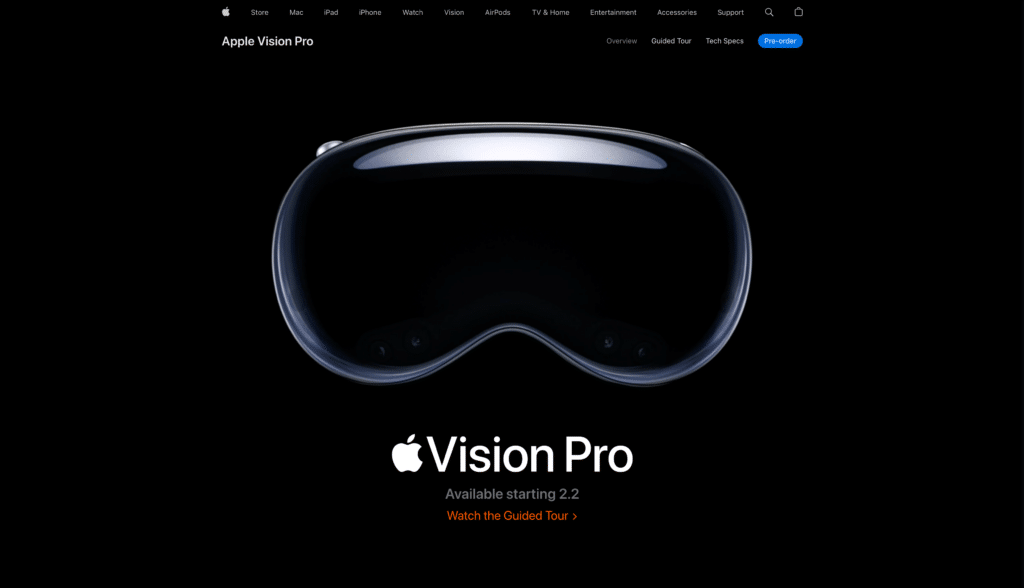
Event Registration Pages: Used for webinars, conferences, or workshops, these pages focus on the value of the event, featuring speaker bios, an agenda, and testimonials to encourage sign-ups.
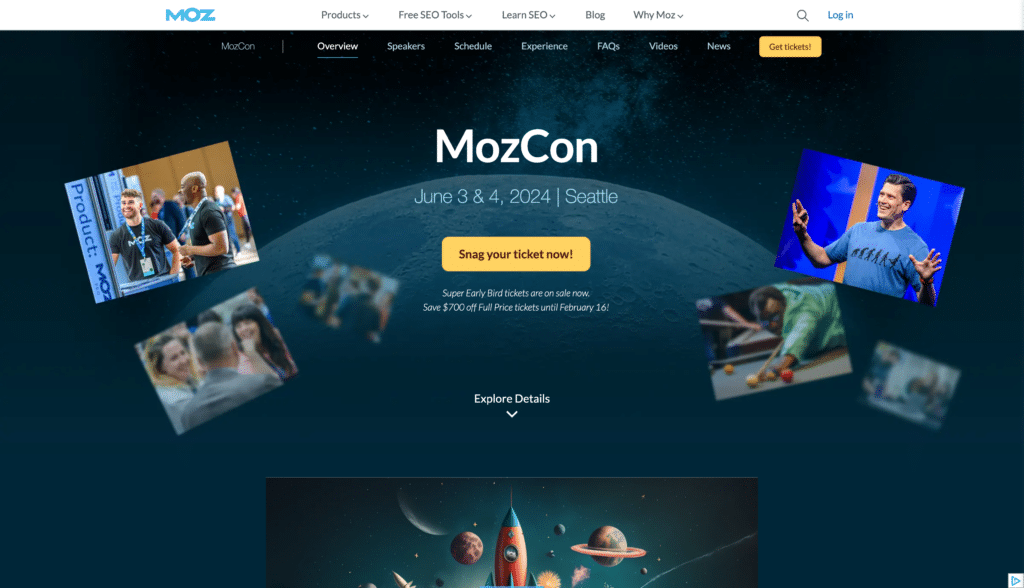
Free Trial/Demo/Book a Meeting Pages: For SaaS companies, free trial pages are critical. They typically highlight key features, benefits, and user testimonials to entice visitors to try the product.
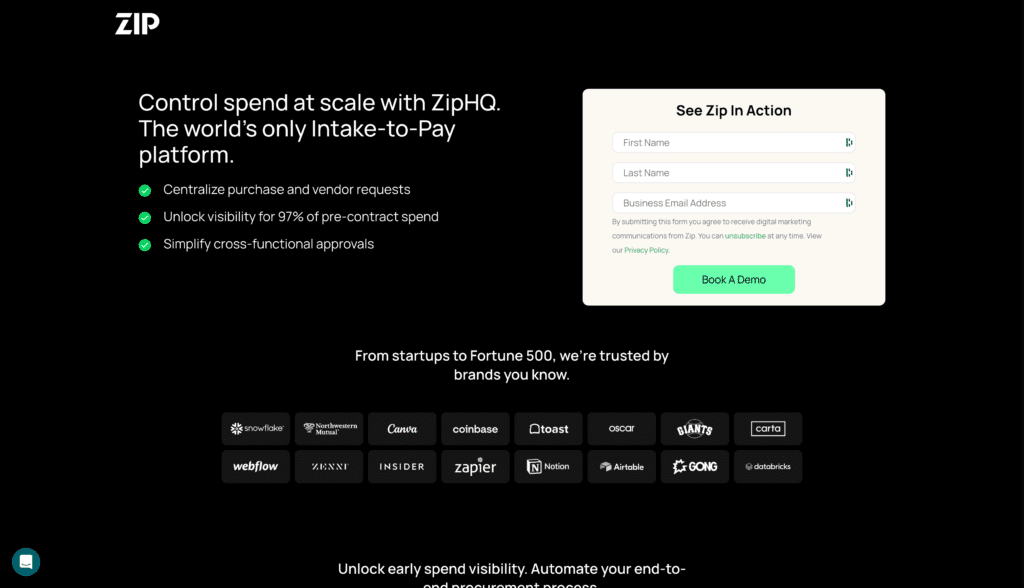
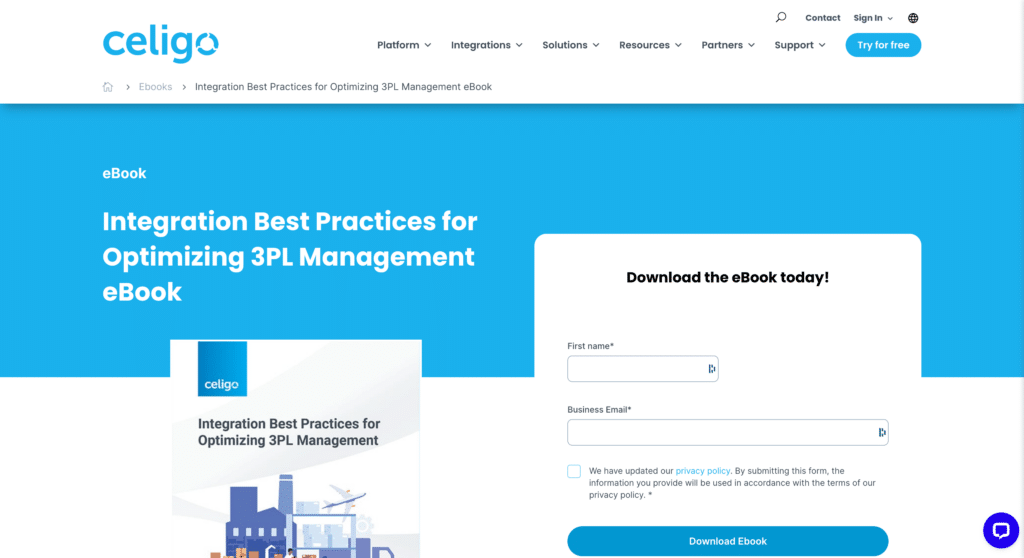
E-Book Download Pages: These pages are often minimalistic, focusing on the content of the e-book and using a simple form to capture leads in exchange for the download.
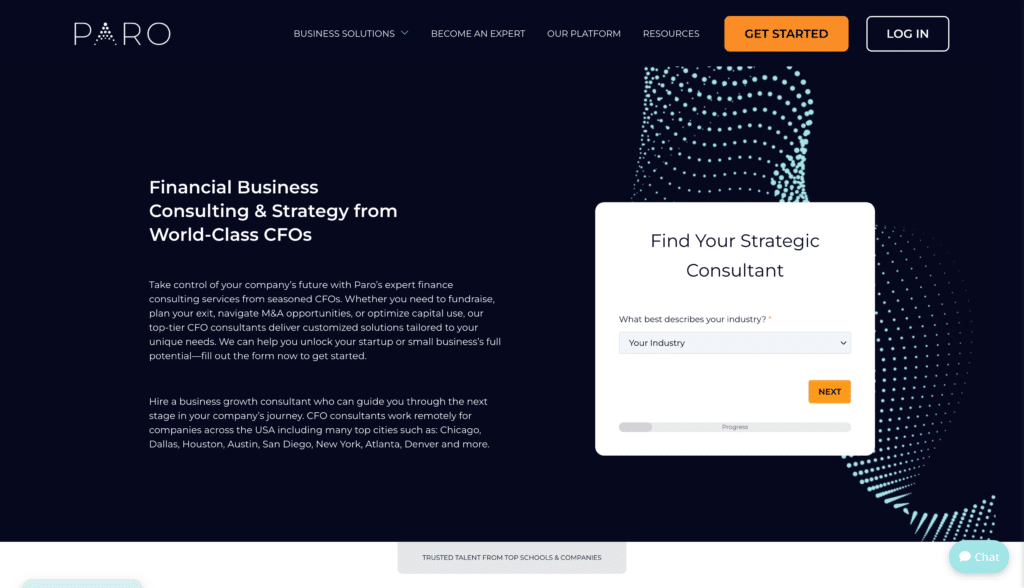
Consultation Services Pages: Aimed at booking appointments or consultations, these pages usually feature a form, trust indicators like client logos or testimonials, and a detailed explanation of the consultation process.
Each of these examples demonstrates the effectiveness of a well-designed landing page in achieving specific business goals. They showcase the importance of clarity, relevance, and a strong CTA, regardless of the industry or purpose.
An effective landing page is focused, clear, and persuasive. It has a compelling headline, relevant content, high-quality visuals, a clear call-to-action (CTA), and is optimized for conversions.
While landing pages are typically not the primary tool for SEO, they can contribute to your site's overall SEO strategy through targeted keywords, quality content, and improved user engagement metrics.
Success can be measured through conversion rates, the number of leads generated, click-through rates, and other analytics that align with your specific goals.
Ideally, a landing page should have one primary CTA to maintain focus and clarity. However, secondary CTAs can be included if they are relevant and do not distract from the main goal.
The length depends on your goal and audience. Some pages need more content to persuade visitors, while others may require a more straightforward approach. The key is to include enough information to convince visitors to take action.
A homepage serves as the main entry point and offers a general overview of what a company offers. In contrast, a landing page is designed for a specific marketing campaign, focusing on a single call to action.
Regular updates are necessary to ensure relevance and effectiveness. This includes updating content, design, and CTAs based on user feedback and performance data.
Yes, ideally. Tailoring landing pages to specific campaigns ensures a more personalized and relevant experience for visitors, which can significantly improve conversion rates. For keyword-based targeting platforms (Google Search, Microsoft Search), landing pages must relate directly to keywords to rank highly and to compete properly.
Cost Per Action represents the cost an advertiser pays for each desired action taken by a user. These actions can range from signing up for a newsletter, purchasing a product, downloading an app, or any other specific activity that aligns with the advertiser's goals.
CPA provides a clear measure of how much an advertiser is spending to achieve a specified outcome.
Unlike metrics such as Cost Per Click (CPC), where advertisers pay for each click regardless of the end result, CPA focuses squarely on the end game: the user's conversion.
CPA= {Total Ad Spend} / {Number of Actions}
Total Ad Spend
Sum up all the costs associated with a particular advertising campaign. This includes direct ad expenses, any fees related to advertising platforms, and other related costs.
Number of Actions
Count the number of desired actions achieved through the campaign. This could be the number of products sold, the number of sign-ups received, app downloads, or any other defined actions.
Example: Suppose you spent $5,000 on an advertising campaign and achieved 250 sign-ups.
CPA = {$5,000} / {250} = $20 This means for every sign-up, you spent $20.
Reducing the Cost Per Action (CPA) is an ongoing quest for advertisers. A lower CPA signifies more efficient ad spending and can lead to improved profitability. Here are some best practices to consider:
A proactive approach, combined with continuous monitoring and optimization, can significantly reduce CPA and lead to more successful advertising campaigns.
Understanding the industry benchmarks for Cost Per Acquisition (CPA) can provide advertisers with a clearer perspective on how their campaigns measure up against competitors. Here's a hypothetical snapshot of average CPAs across various industries:
These figures are illustrative and may vary based on factors like regional differences, advertising platforms used, and specific business models. However, having a general idea of industry averages can help businesses set realistic CPA goals and allocate budgets more effectively.
NOTE if you're looking for detailed and up-to-date CPA benchmarks for various industries, I would recommend checking websites like:
For those looking to continuously improve their advertising ROI, understanding and optimizing CPA is just the starting point. Regularly updating knowledge and skills, leveraging the right tools, and staying attuned to industry benchmarks are all key to ongoing success.
CPA measures the cost advertisers pay for each specific action taken, such as a sign-up, sale, or download. CPC, on the other hand, refers to the cost advertisers pay for each click on their ad, irrespective of the action taken post-click. While CPC focuses solely on generating clicks, CPA provides insight into the effectiveness of the advertising spend in achieving conversions.
A high CPA can result from several factors, including poorly optimized ad campaigns, targeting the wrong audience, non-compelling ad creatives, high competition in the ad space, or a landing page that doesn't effectively convert visitors.
Yes, CPA is a versatile metric and can be applied across various advertising platforms, whether it's search engines like Google, social media platforms like Facebook, or affiliate marketing campaigns. The key is to ensure you accurately track conversion actions and ad spending.
While CPA gives insights into the cost efficiency of acquiring one customer or conversion, ROAS measures the revenue generated from your advertising spend. Ideally, you'd want a low CPA and a high ROAS, indicating you're acquiring customers cost-effectively and seeing a good return on your ad investments.
Not necessarily. It depends on what you define and “action” to be. While a lower CPA indicates cost-effective ad spending, it's essential to balance CPA with the quality of actions. For instance, acquiring low-quality leads or customers unlikely to make repeat purchases might lower your CPA in the short term but won't benefit your business in the long run. If your definition of an “action” refers to the final acquisition of a customer, then a lower CPA is always what you’re pursuing.
CPA and CLV (or LTV) are both crucial metrics in assessing the financial health of a business's marketing efforts. While CPA focuses on the cost of acquiring a new customer, CLV represents the total revenue that a business can expect from a single customer throughout their relationship. An optimal scenario is having a low CPA in relation to a high CLV, indicating cost-effective acquisition and valuable long-term customer relationships.
Optimizing landing pages can significantly influence CPA. Key strategies include ensuring a clear and compelling call to action (CTA), making sure the landing page design is mobile-friendly, improving page loading times, A/B testing different page elements to identify what converts best, and ensuring the content on the landing page matches the promise of the ad to maintain consistency and trust.
Yes, however, CPA can vary widely depending on the industry. Some industries, like high-end luxury goods or specialized B2B services, may naturally have a higher CPA compared to industries with lower-value goods or broader audiences. It's essential to compare your CPA to benchmarks within your specific industry to get an accurate understanding of performance.
Seasonality, economic shifts, and other external factors can significantly influence CPA. For instance, e-commerce businesses might see a lower CPA during holiday sales seasons due to increased purchase intent. Conversely, economic downturns might result in a higher CPA as consumer spending tightens. Advertisers should be aware of these factors and adjust their strategies and expectations accordingly.
While a low CPA is generally a positive indicator of cost-effective advertising, it's possible for it to be too low in certain scenarios. For instance, if ad spending is too conservative, opportunities for scaling and reaching a broader audience might be missed. Furthermore, a CPA that seems too good to be true might indicate issues with tracking accuracy or the quality of leads that don't convert into valuable customers.
Out-of-Home (OOH) advertising (also known as Outdoor Advertising), is a category of advertising that encompasses a wide array of formats that engage audiences outside of their homes. These formats range from billboards to transit ads, offering unique opportunities for brands to make impactful visual statements in public spaces.
OOH advertising thrives on its ability to blend seamlessly into the everyday lives of consumers, capturing their attention in a non-intrusive manner. It stands out in today's digital-dominated world as a tangible and memorable form of marketing. By leveraging high-traffic locations, OOH advertising ensures maximum exposure, making it a vital tool in comprehensive marketing strategies. This article delves into the various facets of OOH advertising, outlining its types, benefits, effectiveness, and emerging trends, and equipping marketers and business leaders with insights to harness its full potential.
OOH advertising has long been synonymous with traditional formats that have stood the test of time. These include classic billboards, which offer high visibility on highways and cityscapes, transit ads on buses, trains, and taxis, and street furniture such as bus shelters and benches. Traditional OOH formats benefit from their physical permanence and widespread presence, creating lasting impressions on a diverse audience. Their large-scale nature ensures that ads are not only seen but remembered, making them a staple in outdoor advertising.
The advent of digital technology has revolutionized OOH advertising, giving rise to digital formats that offer flexibility and dynamic content delivery. Digital billboards and interactive kiosks, for example, provide the ability to change messages in real-time, allowing for more targeted and timely advertising. These digital displays can be found in high-traffic areas like shopping malls, airports, and urban centers, engaging consumers with vibrant and animated content.
OOH advertising's versatility is evident in the variety of creative examples seen around the world. From immersive billboard campaigns that turn heads in Times Square to interactive transit ads that engage commuters, the possibilities are endless. Some notable examples include 3D billboards that create stunning visual effects, environmental ads that integrate with surroundings for a natural feel, and experiential marketing campaigns that invite public participation. These examples highlight the innovative ways in which OOH advertising can be utilized to create memorable experiences and forge strong connections with audiences.
One of the key advantages of OOH advertising is its cost-effectiveness compared to other forms of media. The cost per thousand impressions (CPM) for OOH is often lower, making it an efficient option for reaching a wide audience. Additionally, the enduring presence of OOH formats like billboards can include continuous exposure over a longer period. This persistent visibility means that brands can achieve sustained awareness and recognition at a relatively lower investment, maximizing their advertising spend.
OOH advertising stands out for its creative potential, allowing brands to craft visually compelling and impactful messages. The physicality and scale of OOH formats lend themselves to high-impact designs that can captivate audiences. Creative OOH campaigns can transform ordinary spaces into extraordinary visual spectacles, generating buzz and social media shares. This creative flexibility not only enhances brand visibility but also strengthens the emotional connection with the audience, leaving a lasting impression.
Brands can now leverage real-time data in their OOH campaigns and content, enhancing relevance and engagement. Digital OOH (DOOH) allows for dynamic content that can respond to the time of day, weather conditions, or social trends, making ads more contextually relevant and memorable. This immediacy and relevance boost brand recall, as consumers are more likely to remember ads that resonate with their current environment or experiences. High recall rates are crucial in driving consumer decisions and fostering brand loyalty.
OOH advertising plays a significant role in influencing consumer behavior and encouraging purchases. Strategically placed near points of sale, like shopping centers or entertainment venues, OOH ads can effectively prompt immediate action or consideration. This proximity to purchase locations, combined with creative and persuasive messaging, can effectively sway consumer decisions, leading to increased sales and a tangible return on investment.
Measuring the effectiveness of OOH advertising has evolved with advancements in technology and data analytics. Modern attribution methods involve tracking consumer engagement and behavior following exposure to an OOH ad. Key metrics such as foot traffic, sales uplift, and digital engagement (like social media activity or online searches) are monitored to gauge the impact of OOH campaigns. Additionally, advancements in mobile location data have enabled more precise tracking of audience reach and frequency, providing valuable insights into campaign performance and audience demographics. This data-driven approach helps advertisers optimize their OOH strategies for maximum effectiveness.
Digital Out-of-Home (DOOH) advertising represents a significant leap forward in terms of targeting, personalization, and interactivity. DOOH leverages digital screens to deliver dynamic content that can be updated in real-time, allowing for more personalized and contextually relevant advertising. With capabilities such as dayparting (delivering different messages at different times of the day), audience targeting, and interactive features, DOOH offers a level of flexibility and engagement that traditional OOH cannot match. This digital transformation has made OOH advertising more adaptable, measurable, and impactful, aligning it with contemporary marketing needs and consumer expectations.
It is worth noting that while we have seen innovation in OOH attribution, it remains an upper-to-mid funnel strategy. Marketers need to educate their peers and stakeholders on the goals and expectations of upper-to-mid funnel strategies—to drive awareness and brand recall, leaving the most amount of high-quality impressions as possible. OOH campaigns launched with the expectations of directly-attributed conversions will likely not last.
To maximize the impact of Out-of-Home (OOH) advertising, it's essential to follow certain tips and best practices. These guidelines can help ensure that OOH campaigns are not only visually striking but also effective in reaching and engaging the target audience.
By adhering to these best practices, you can craft OOH campaigns that not only captivate your audience but also drive real-world results.
The landscape of OOH advertising is continuously shaped by emerging trends and innovations that redefine how brands connect with their audience. Understanding these trends is essential for marketers aiming to leverage OOH advertising effectively.
One significant trend is the integration of augmented reality (AR) and virtual reality (VR) technologies, creating immersive and interactive experiences. These technologies transform traditional OOH formats into engaging platforms, offering audiences a unique and memorable interaction with the brand.
Another trend is the increasing use of data-driven targeting and personalization in DOOH advertising. Advertisers are harnessing big data and AI to deliver more relevant and customized content, enhancing engagement and effectiveness.
Sustainability is also becoming a key consideration in OOH advertising. Eco-friendly practices, such as using renewable energy sources for digital displays or recyclable materials for billboards, reflect a growing commitment to environmental responsibility.
Finally, the fusion of OOH advertising with social media is a trend that amplifies brand messages. Creative OOH campaigns are designed to be share-worthy, encouraging viewers to post about them on social platforms, thus extending the reach and impact of the campaign. One example is Zendesk’s recent “Break Free” campaign in which they launched a drone show at the conference of one of their competitors. While hundreds saw the drone show live, hundreds of thousands saw the drone show on social media.
Out-of-Home (OOH) advertising stands as a powerful and enduring component of the marketing mix. In an age where digital media dominates, OOH advertising offers a tangible and impactful way to reach audiences in the real world. Its ability to adapt to new technologies and trends ensures its relevance and effectiveness in a rapidly evolving advertising landscape.
From traditional billboards to cutting-edge digital displays, OOH advertising provides a canvas for creativity and innovation. Its versatility allows for a wide range of strategies, from eye-catching visuals to interactive experiences that engage and resonate with consumers.
OOH advertising refers to any visual advertising media found outside of the home. This includes billboards, bus and bench ads, and digital signage in public spaces.
OOH advertising is highly effective due to its broad reach and high visibility. It's especially impactful for building brand awareness and reinforcing messages from other media channels.
Key benefits include high audience reach, cost-effectiveness, opportunities for creative and impactful designs, and the ability to target specific demographics and locations.
Success is measured using metrics like reach, frequency, audience engagement, and conversion rates. Advances in technology now allow for more precise tracking and attribution.
OOH advertising can be integrated with digital strategies through QR codes, social media hashtags, or by driving traffic to online platforms. It complements digital campaigns by extending the reach and reinforcing messages.
Current trends include the use of digital technology for dynamic content, data-driven targeting, sustainability in materials and energy use, and integration with AR/VR technologies for interactive experiences.
DOOH offers more flexibility with the ability to update content in real-time, target specific audiences at specific times, and provide interactive and engaging experiences.
Key considerations include clear and concise messaging, high-impact visuals, readability from a distance, understanding the audience, and choosing the right location for maximum impact.
Yes, OOH advertising can significantly influence consumer behavior, especially when placed near points of purchase or in areas with high foot traffic, encouraging immediate action or consideration.
Location is crucial in OOH advertising as it determines the ad's visibility and the audience it reaches. High-traffic areas, relevant to the target demographic, are typically the most effective.
Sword Health is a digital physical therapy platform that provides patients with access to physical therapy exercises and care from a remote physical therapist. The platform uses a combination of video, audio, and text to provide patients with personalized physical therapy exercises.
Sword Health was investing significant budget into its advertising programs with high click-through rates, but poor acquisition conversion rates. As we audited the existing buyer’s journey, it became clear that landing pages lacked critical information that would bring users the confidence they needed to take the next step.
Sword Health needed to significantly reduce the amount of wasted adspend on low-converting campaigns.
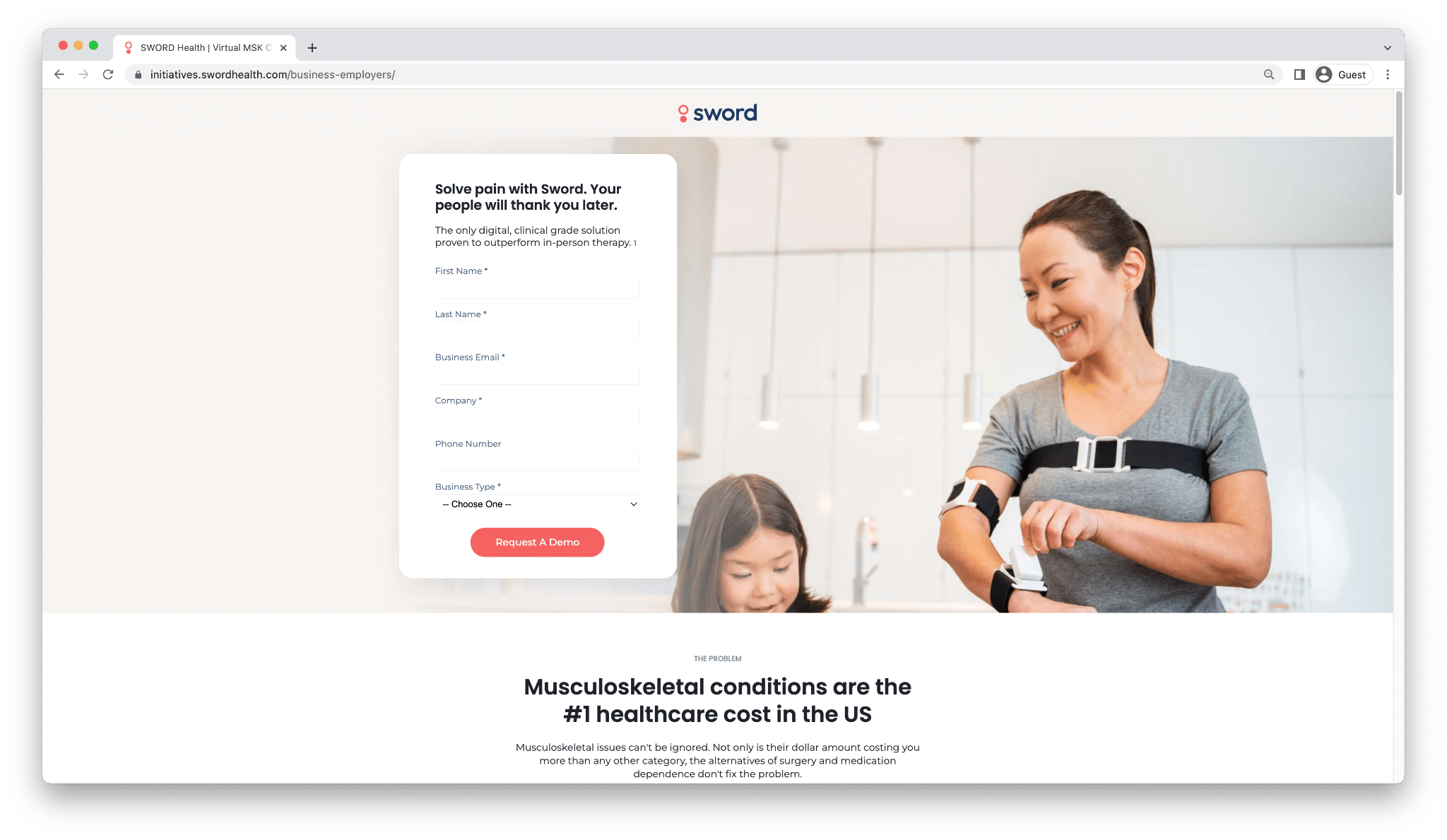
97th Floor began by performing the critical first step of enhancing Sword’s knowledge of its personas and buyer journeys, performing research into the process that patients with musculoskeletal pain dealt with as they sought solutions.
This informed a complete rebuild of Sword Health’s landing pages to explore the user challenge, demonstrate how Sword Health benefits address the challenge, and show proven results after implementation—all coinciding with a company rebrand.
After implementing the new strategy, Sword Health experienced remarkable improvements in their campaign performance. There was a significant 256% increase in leads, reflecting a jump from the previous period's figures. This was primarily due to a substantial 195% rise in the conversion rate, which soared to 1.8%.
These results were not just numbers; they represented a tangible shift in Sword Health’s approach to engaging and converting their target audience.
Vida Health is an online and virtual care platform that offers personalized health coaching and therapy programs tailored to each individual patient's’ needs and health goals, all through an easy-to-use mobile app and website.
Vida has two target audiences: a B2B target focusing on HR decision-makers who purchase Vida for their employees, and a B2B2C target focusing on driving up demand and engagement from the employees using Vida’s health programs. With these diverse targets and aggressive growth goals, Vida’s marketing team needed a marketing agency to partner with them in both advertising strategy and execution.
Vida knew how to reach their audiences but needed to discover the ideal combinations of messaging, content offerings, content types, and imagery that would resonate and drive growth—all tackling sensitive and regulated topics like obesity, mental health, and chronic disease.
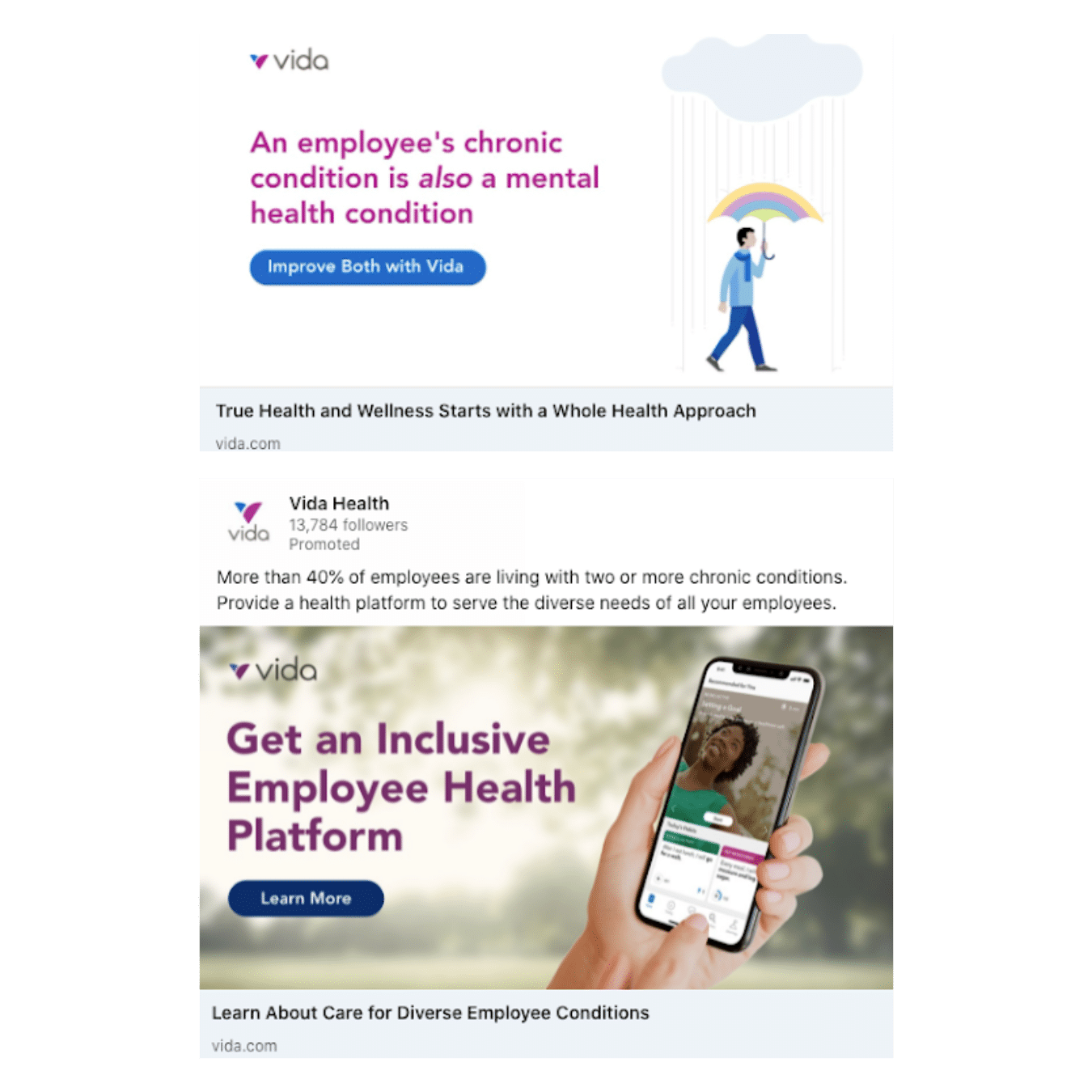
The first step was to explore Vida’s audience research and add to it with 97th Floor’s persona and buyer journey discovery process.
Next, we launched into a rigid experimentation phase, A/B testing every possible combination of message, image, and CTA—letting hard results drive each next step.
Finally, we created a series of infographics, illustrations, and content offerings to support our advertising campaigns.
Over the course of a 6-month period—thanks to our rigorous experimentation process—97th Floor’s ad campaigns helped Vida generate significant increases in leads (up 255 leads from previous period), while lowering the average cost-per lead by 22.56%, thanks to 25.79% increase in conversion rates.
Clean Origin is a third generation diamond jewelry company that specializes in lab grown diamonds that are ethically sourced. Its designs use only ethically created and conflict-free lab grown diamonds, which reduces water and energy use, land and mineral disturbance, and carbon emissions. Its mission is to keep diamond history on the right track.
Clean Origin is a unique eCommerce company in that each product page is completely unique to match the uniqueness of each of their diamonds. Thus, pages were created and deprecated on a frequent basis—making it extremely difficult to build page equity and avoid crawlability issues. We needed to build a process to more effectively manage the incoming and outgoing pages, as well as Google’s understanding of the website.
Audits uncovered indexation irregularities that typically signal a crawling issue. We ran a series of log file analyses to improve Google’s ability to recognize fixes and reward the site accordingly.
This ultimately revealed a series of additional technical challenges that once resolved, allowed the site to be crawled more frequently and more accurately.

In a remarkable 30-day period, Clean Origin witnessed astounding results from the technical SEO enhancements implemented. There was a significant 25% increase in organic eCommerce revenue, reflecting a stronger online market presence and sales performance. Their eCommerce conversion rate rose by 19%, and eCommerce transactions increased by 26%.