



With shrinking attention spans and endless digital content in 2025, it’s harder than ever to stand out. Enter the infographic! A well-structured infographic turns complicated or “boring” information into something clear, engaging, and easy to digest in seconds. If you’ve ever wondered what makes a good infographic, you’ve come to the right place. In this article, we’ll go over 7 tips for making your infographics picture-perfect. Done right, an infographic can make your content unforgettable.
In 2025, people want answers fast. Long reports and walls of text often go unread, but visuals cut through the noise. Infographics present data and insights in a format that’s quick to scan, easy to share, and simple to remember. Infographics double as pretty visuals and communication tools that help your audience grasp complex information at a glance. From social media to sales decks, a strong infographic can extend the reach and impact of your message.
An infographic distills complex data into a structured visual format that the brain can process faster than text alone. Studies in cognitive psychology confirm that people retain information more effectively when it is paired with visuals, because the human brain processes images up to 60,000 times faster than text. That means your audience can understand trends, relationships, and comparisons at a glance rather than working through pages of copy.
From a marketing perspective, infographics are also highly versatile. They can improve on-page engagement by breaking up content, drive backlinks as shareable assets, and perform well across platforms, from LinkedIn posts to conference presentations. When designed with accessibility and mobile in mind, they increase reach even further by ensuring clarity across devices.
So, what makes a good infographic stand out from the rest? The best designs share a few common elements: credible data, clarity, storytelling, smart visuals, simplicity, breathing room, and adherence to design standards. Together, these elements form the foundation of an infographic that catches readers’ attention. Let’s break down each one.
The key to a good infographic is using relevant, focused, and reliable data. Before you write or design, get to know your audience. Why are they interested in your topic? How much do they already know? Do they have preconceived ideas or opinions about your topic? Answering these questions will help form more relevant data and visuals. An infographic should be a visual presentation of evidence, with purpose and direction, not just an excuse to use pretty pictures. Don’t include facts just to up your word count. Make sure your facts and data support the overall story and have a purpose.
Especially when choosing a controversial topic to be thorough and speak to both sides of the story. Think through the topic’s possible arguments and counterarguments. Use facts, statistics, and authoritative quotes that are unbiased.

Use as little text as possible and let the visuals do the rest of the talking. Present the data in a visually pleasing way, stating hard evidence. Facts, statistics, and quotes from authorities should be used more than lengthy sections of text. Cite your sources. Always give credit where credit is due, and use reputable sources.
Thinking outside the box is great. Just make sure you are still making sense. Don’t use confusing comparisons or complicated visuals. Lead the audience through the infographic using both text and visuals.
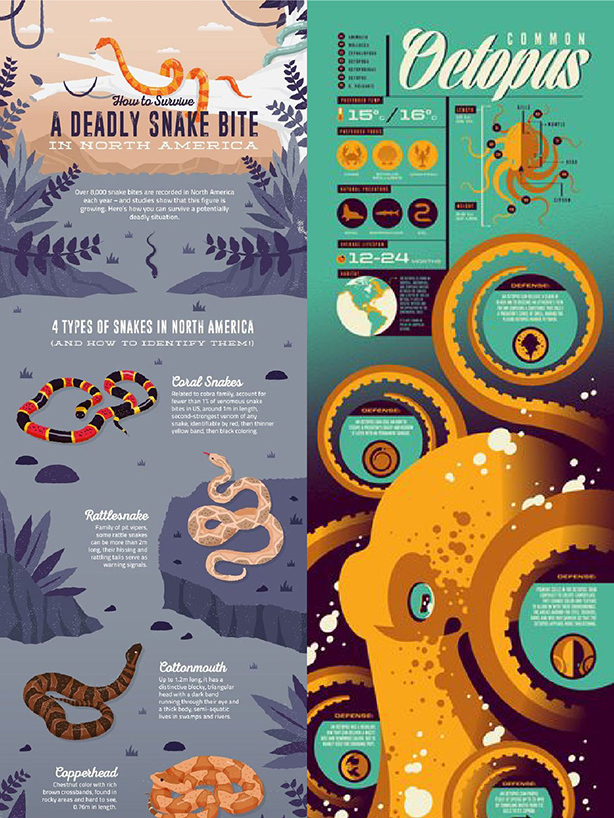
An infographic should not just make data interesting, but help the reader understand it better than text alone. Don’t rely on the reader to do the work. Guide them through the information as clearly and simply as possible. Data visualizations draw attention and give importance to seemingly boring facts. The right visuals can distill a difficult concept or lots of data into an easily digestible image that should only take 5 seconds to understand.
“An infographic is 30 times more likely to be read than a purely textual article.”

Display the data using a variety of charts and graphs. Make sure to choose the right graph or format for the data you are sharing. Always check that the graph makes sense visually, without the need for extensive knowledge on the subject or heavy reading. Below are a list of a few types of graphs and charts that can be used in creating an infographic.
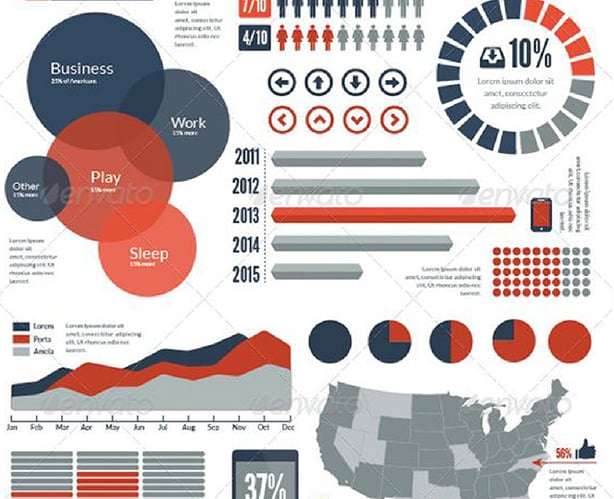
More doesn’t always mean better. In fact, clutter is the fastest way to lose your audience. A simplified infographic strips away distractions and highlights only the essentials. Stick to one main point per section. Use a limited color palette. Don’t let decorative elements compete with your data. Remember, an infographic is meant to clarify, not complicate. Consider color theory. Do the colors help tell the story? Why?

White space isn’t wasted space; it’s breathing room. It separates ideas, guides the eye, and makes complex information feel approachable. Imagine walking into a crowded room vs. one with open pathways; which feels easier to navigate? The same principle applies here. Use white space to group related visuals, emphasize hierarchy, and keep the design from overwhelming readers.
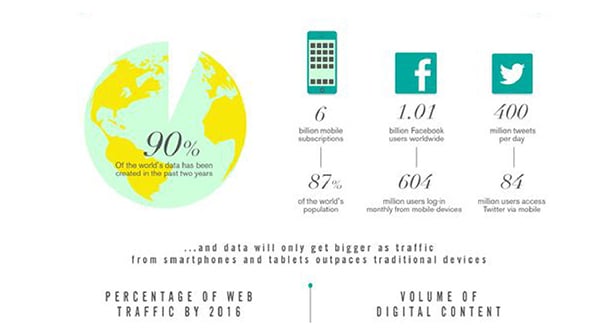
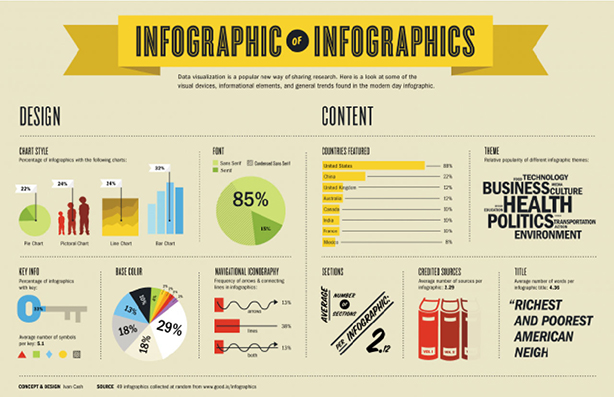
The typical infographic should be no more than 5000 pixels tall. This size allows for easy reading and sharing; anything longer will likely lose the audience's attention. Make sure the font is a healthy size and easy to read. An infographic is NOT an entire article with icons and images sprinkled in. As one marketer said,
“‘Infographics’ is one efficient way of combining the best of text, images, and design to represent complex data that tells a story that begs to be shared." - Jeff Bullas
Infographics, if created and used correctly, can communicate complex data in a visually pleasing way that can get you more clicks, views, and shares.
Infographics done right can transform complex information into stories people actually want to read and share. At 97th Floor, we’ve helped brands of every size turn data into designs that spark attention and drive results. Whether you need a one-off infographic or a full content strategy powered by design, our team can help.
See how an audience-first approach translates to bottom-line results.
You’ve seen it happen: a brand posts a clever hashtag or starts a striking thread, and suddenly it’s everywhere. But is trending on Twitter just a matter of luck? How do you create a campaign that actually sparks conversation and drives sales?
Twitter campaigns (or X campaigns, these days) are a way to bring intentionality to your social media growth. Tweets feel like a simple click when you post on Twitter, but there are all kinds of coordinated efforts behind the scenes that capture your audience and build a community.
Don’t let your efforts peter out as your brand gets lost in the scroll; let’s break down a realistic strategy for your tweets.
Twitter campaigns are a coordinated marketing effort to build awareness, conversations, or conversions. Instead of relying on a single tweet to catch fire, campaigns bring strategy and structure to how your brand shows up on the platform.
What makes them powerful is the way they combine creativity with direction. A strong campaign ties together:
Put those pieces together, and you have a campaign that can grab attention and keep it, strengthening brand recall and putting your business on the digital map.
Most Twitter campaigns fall into two buckets:
Both have value. When brands blend both approaches, that’s when campaigns really shine — organic posts build authenticity, and ads make sure the right people actually see them.
Campaigns on Twitter can serve very different purposes: some build awareness, others gather support, and some drive direct sales.
A hashtag can turn into a rallying point when it’s easy to remember and share. Simple, memorable, personal. Take Coca-Cola and its #ShareACoke campaign. Throwing names on bottles gave people a reason to personalize their posts and be playful, which made the hashtag succeed beyond the standard ad.
If you want your audience to care about what you post, you have to post about what they care about. It sounds obvious, but it’s an easily missed opportunity for people to really get your brand. And, purpose-driven campaigns help build momentum by connecting to shared values and real-world issues, like with the #MeToo movement. A single phrase unified millions of voices, which just goes to show how powerful a campaign can be when it sincerely resonates.
Want more engagement? Give your consumers something to do — or even better, something to gain. Incentivize them to vote during polls or share their experiences with your product. Audi’s #WantAnR8 is a great example of this. Fans who tweeted the hashtag were entered for a chance to test drive the car. This gamified campaign created so much online excitement, about the event, yes, but also about the memorable Audi brand.
You can create some urgency with a time-based campaign or get real-time engagement with a live event. Take Nike’s #Breaking2. They built anticipation by documenting every step of its marathon barrier attempt, which kept viewers engaged from start to finish — literally.
Instead of leaving your tweets up to chance, get really intentional. Here’s how to design a compelling and effective campaign for lucrative results.
Every campaign starts with a purpose. Do you want to build awareness, generate leads, or drive conversions? Making sure your end goal is crystal clear is the easiest way to choose the right campaign type and metrics to track.
The best ads or tweets will fall flat if they don’t reach the right people. Twitter’s built-in Interest Categories can help you zero in on who to reach and discuss what that audience actually cares about.
Categories
Twitter recommends that you do not have more than two interest categories per campaign or more than 10 sub-interests in one campaign. Interests are broken down into interest categories and sub-interests — some interest categories have up to 25 sub-interests.
When you select an interest category and run a campaign with many sub-interests, be sure to check it frequently and refine your sub-interest targeting to include only the best performers. It’s also recommended to combine related categories (e.g., “Golf” + “Men’s apparel”) so your campaign feels relevant and cohesive.
Once you know your audience and goals, the next step is matching them to the right campaign format. The type of campaign you choose should support your objectives and play to the way your audience engages on Twitter.
Choosing well keeps your strategy focused and avoids wasting budget or effort on campaigns that don’t fit the outcome you’re aiming for.
Okay, so you’ve launched the campaign…now what? Track results and make adjustments. Some of the best ways to do that are to:
The most effective campaigns share a few common traits. Here’s what’s working:
A hashtag should be short, clear, and easy to use. The fewer people who have to think about it, the more likely they are to join in. Always’ #LikeAGirl campaign flipped a tired (and stereotypical) phrase into a message of empowerment. It was surprising, but it was also really concise and easily recognizable, which is what made it spread so quickly.
The more visual, the better! People are scrolling through thousands of bits of content, but an iconic visual can make campaigns recognizable, even when messages are shared or remixed. Google Maps is a good example of a clean, consistent brand that is identifiable in a crowded feed.
Emotion also makes a campaign memorable and encourages sharing. Storytelling helps audiences connect with the message on a personal level. Look at Dove’s #SpeakBeautiful campaign, where Dove confronted negative comments about women and reframed the narrative around positivity and self-love. The universal and inclusive message is easy to relate to and easy to share.
When people create content for your campaign, they’re, yes, amplifying your voice, but they are also lending authenticity you just can’t recreate on your own. Calvin Klein’s #MyCalvins did this well when fans were invited to post photos of themselves in CK products. Suddenly, their audience was their marketers and filled feeds with user-generated content tied directly to the Calvin Klein brand.
Nothing is quite as powerful and attention-grabbing as humor. A lighthearted or funny bit cuts through the noise and makes your brand unforgettable. Charmin’s #TweetFromTheSeat leaned into the unconventional elements of their brand and made it something funny and real.
Here are the big metrics you can’t overlook if you want to put your data to work for future success:
For example, Nike’s #Breaking2 livestream generated millions of impressions, but the real value came from audience engagement — thousands of tweets and shares that extended the campaign far beyond the initial event.
The shift from Twitter to X brought a new name and new features, but the basics of successful campaigns haven’t changed. Brands still need clear goals, compelling content, and strong targeting.
What has changed are the tools:
In short, social media campaigns on X run on the same principles as before, but with new opportunities to experiment and engage.
Twitter campaigns still matter, and with the platform evolving into X, brands have more ways than ever to connect with their audience. But running campaigns that actually drive awareness and conversions is a big and ongoing task that takes testing and expertise to get right.
At 97th Floor, we’ve managed Twitter ads campaigns and organic strategies for brands across industries. We know how to target the right audiences, craft content that resonates, and track the KPIs that prove impact. More importantly (and what sets us apart), we help brands align campaigns with bigger marketing goals so that social efforts pay off across the board.
If you’re ready to go viral on purpose, work with a team that knows how to turn Twitter campaigns into measurable business results. Let’s talk.
In a world where information moves faster than the speed of light and is produced almost as fast, it is important to stand out. The key to standing out is a well designed visual. Humans not only respond faster but also retain more information from images and graphics than from text alone. Visuals are also easily shared, which leads to more views, links, and better search engine optimization.
Studies have shown that humans process and respond to visual data better than any other type of data. The human brain is capable of processing images 60,000 times faster than text. Additionally, 90% of information transmitted to the brain is visual. Visuals capture and hold viewers’ attention.

Information is more likely to stay with you when presented visually.


Eye-tracking studies show internet readers pay close attention to information-carrying images. In fact, when the images are relevant, readers spend more time looking at the images than they do reading text on the page.

Visuals help tell your brand’s story in a memorable way and demonstrate your brand as an authority in your industry, building brand awareness.

Visuals are easy to digest, and transmit data faster and easier, which means they stay with you longer than text. If a relevant image is paired with that same information, people retained 65% of the information three days later.

Graphics are more convincing and influencing. Visuals trigger emotions and motivate the audience. The emotional power comes from the ability to show you an idea, relationship, or how something works.
People that follow directions with text and illustrations do 323% better than people following directions without illustrations.

Visuals are easy to share and drive traffic. Visually appealing graphics are more likely to be shared on social networks and become viral compared to ordinary text content. Graphics create more opportunities for link-building, which also impacts your site’s search engine optimization.
Every interaction a user has with your company tells a story. And that story starts long before someone clicks a button or fills out a form. It begins with how easily they understand what you offer, how confident they feel moving through your experience, and how quickly they can get what they came for.
In other words, it starts the moment they begin to experience your brand.
A UX design strategy defines how user experience decisions are planned, prioritized, and connected to business outcomes. It ensures design choices are intentional, informed by research, and tied to real goals like growth, engagement, and revenue. Without strategy, design becomes reactive. With strategy, design becomes a tool for progress.
Psychology plays a central role here. Users bring expectations, habits, and emotions into every interaction. A strong UX design strategy accounts for how people think and how they decide to act as they move through an experience. When psychology and strategy work together, user experiences feel trustworthy and effective.
Here, I’m going to break down what UX design strategy is, why it matters, and how it impacts both users and businesses. I’ll cover the benefits of a strategic approach, the core components that make it work, and the psychological principles behind effective experiences (and how intentional UX design supports conversion, retention, and long-term growth). And, because this is a company blog and we’re proud of the work we do, I’ll also discuss how 97th Floor approaches UX strategy as a collaborative, research-driven process.
UX design strategy is the plan that guides how user experience decisions are made to support business goals and user needs. It connects research, design, and execution into a cohesive direction. While UX design focuses on individual interfaces and interactions, UX strategy defines the why, when, and priority behind those design choices.
At its core, a UX design strategy brings together research and usability principles, supported by psychological insight and organizational alignment. It creates a shared understanding of users and clarifies how the experience should support both them and the business.
A UX design strategy gives teams a clear framework for making decisions that serve both users and the business. Instead of relying on opinions or assumptions, strategy creates direction and consistency across the entire experience.
This matters because it:
A UX design strategy is made up of several connected parts that guide how experiences are planned, built, and improved. Each of these components plays a specific role in shaping how users move through an experience and how well that experience supports business goals.
Research sets the direction for every UX decision that follows. By studying user behavior and gathering stakeholder input, teams gain insight into needs, expectations, and obstacles. This groundwork helps reduce assumptions and ensures design decisions are based on real evidence rather than internal opinions.
Usability focuses on how easily users can navigate and complete tasks. Clear pathways and familiar patterns help users move through an experience without confusion. When usability is prioritized, frustration is reduced and progress feels natural.
Information architecture determines how content is structured and labeled. A thoughtful structure helps users understand where they are and where to go next. When information is organized in a way that feels intuitive, users can find what they need with less effort.
Interaction design defines how users engage with elements on a screen. Buttons, transitions, and feedback signals all influence how responsive an experience feels. Well-planned interactions guide attention and reinforce a sense of control.
Accessibility ensures experiences can be used by people with different abilities and needs. Designing with accessibility in mind improves usability for everyone and helps brands reach a wider audience. It also signals care and responsibility in how experiences are built.
UX copy supports users through clear and purposeful language. Labels, prompts, and instructions help users understand what actions are available and what will happen next. Good UX copy removes uncertainty and keeps experiences moving forward.
Testing and iteration allow teams to refine experiences over time. By observing how users interact with designs, teams can identify issues and make informed improvements. This ongoing process helps experiences stay effective as needs evolve.
Cross-functional alignment keeps UX efforts connected to broader business initiatives. When design, development, and marketing teams share the same goals, execution becomes more efficient. Alignment helps ensure the experience feels cohesive from start to finish.
We make daily decisions on what brands we choose to engage with, what brands have earned our trust, and what brands compel us to spend money. How do we make those decisions?
Psychology studies have shown that our feelings and instincts cause us to behave. It is said that emotions drive 80% of the choice we make. So the first visual impression a customer receives from your brand is crucial to a positive customer experience, or a customer experience at all.
Good design is more than just good looks, it’s the catalyst to trust and loyalty towards any brand or company.
Trust is often the first hurdle a brand needs to clear, and design is usually the deciding factor.
That’s because design is emotional. It evokes moods, attitudes, and personality. Together, these emotions create “gut feelings” and stir thoughts in our mind. And before even being exposed to actual content, visual queues have already shown us how to feel towards a brand.
So when we’re browsing the web and come across a ‘spammy’ looking website, the visual queues are telling us it’s untrustworthy. When junk emails pop up, poor design makes us question the legitimacy of the content. When we find a good deal on the web, but the checkout page to fill out credit card information looks sketchy, we back out. As a result, we don’t engage with the brand, we don’t subscribe to the service, and we don’t buy anything at all. And it all comes from gut feelings created by bad design.
And when trust breaks down at the visual level? Users rarely stick around long enough to reconsider.
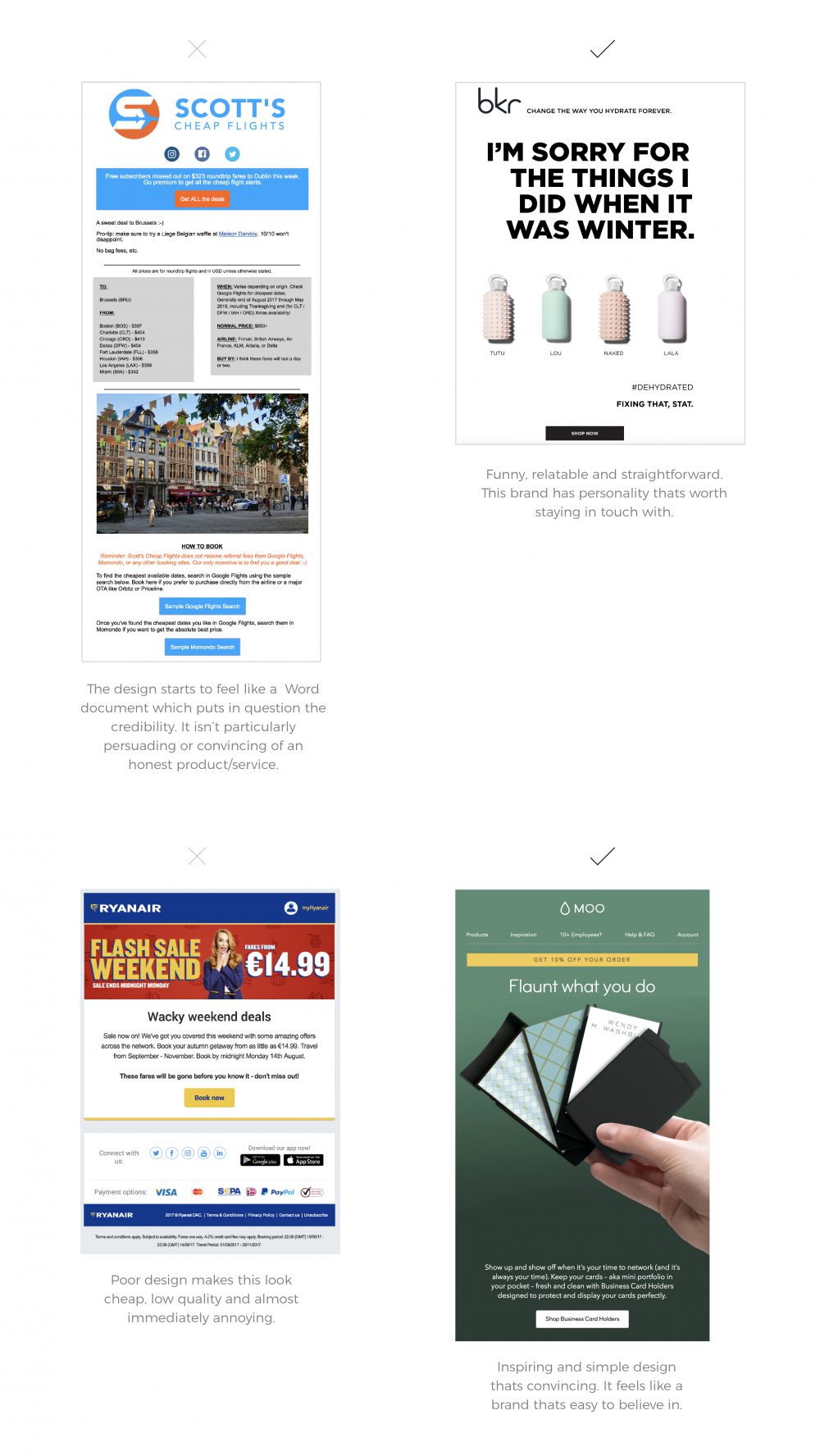
Belief is what bridges the gap between curiosity and commitment.
There’s a reason for the old adage don’t judge a book by it’s cover. It’s because we do! As consumers, we expect the quality of products/services to match their appearance. We don’t have time to be convinced that a certain brand/product/service is good, we should already be able to see that it is (or isn’t). A brand with good design is more convincing than a brand with bad design because we assume appearance reflects quality.
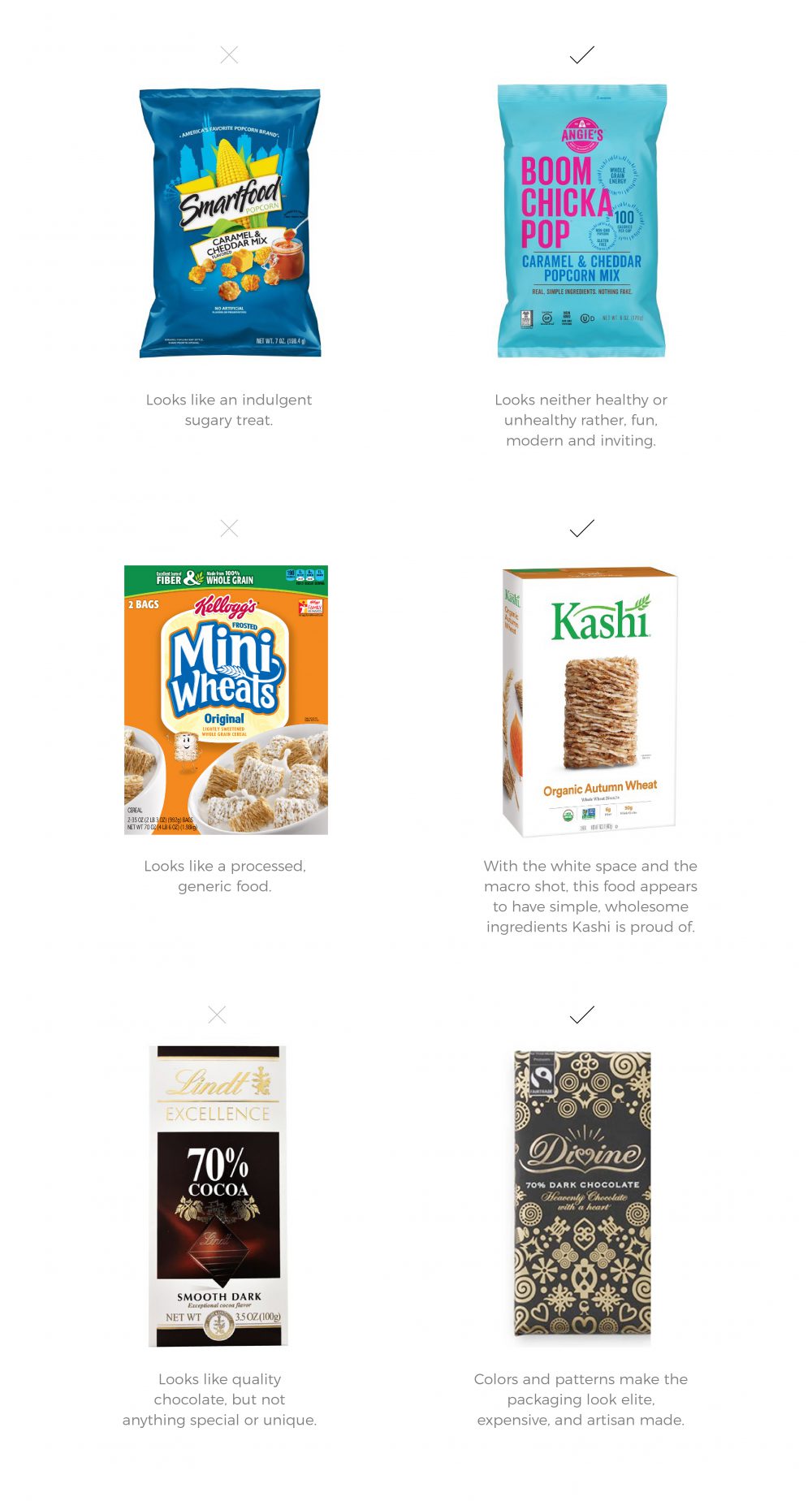
Have you ever found yourself wanting to purchase the organic or brand name cereal rather than the generic brand? We expect good packaging design to be the shell of a good product. Have you ever spent more money on a product just because it looks better than the cheaper version? By sole appearances, we assume more credibility with one brand than another, and we take one brand more seriously than another.
When design communicates quality clearly, customers are more willing to give you the benefit of the doubt.
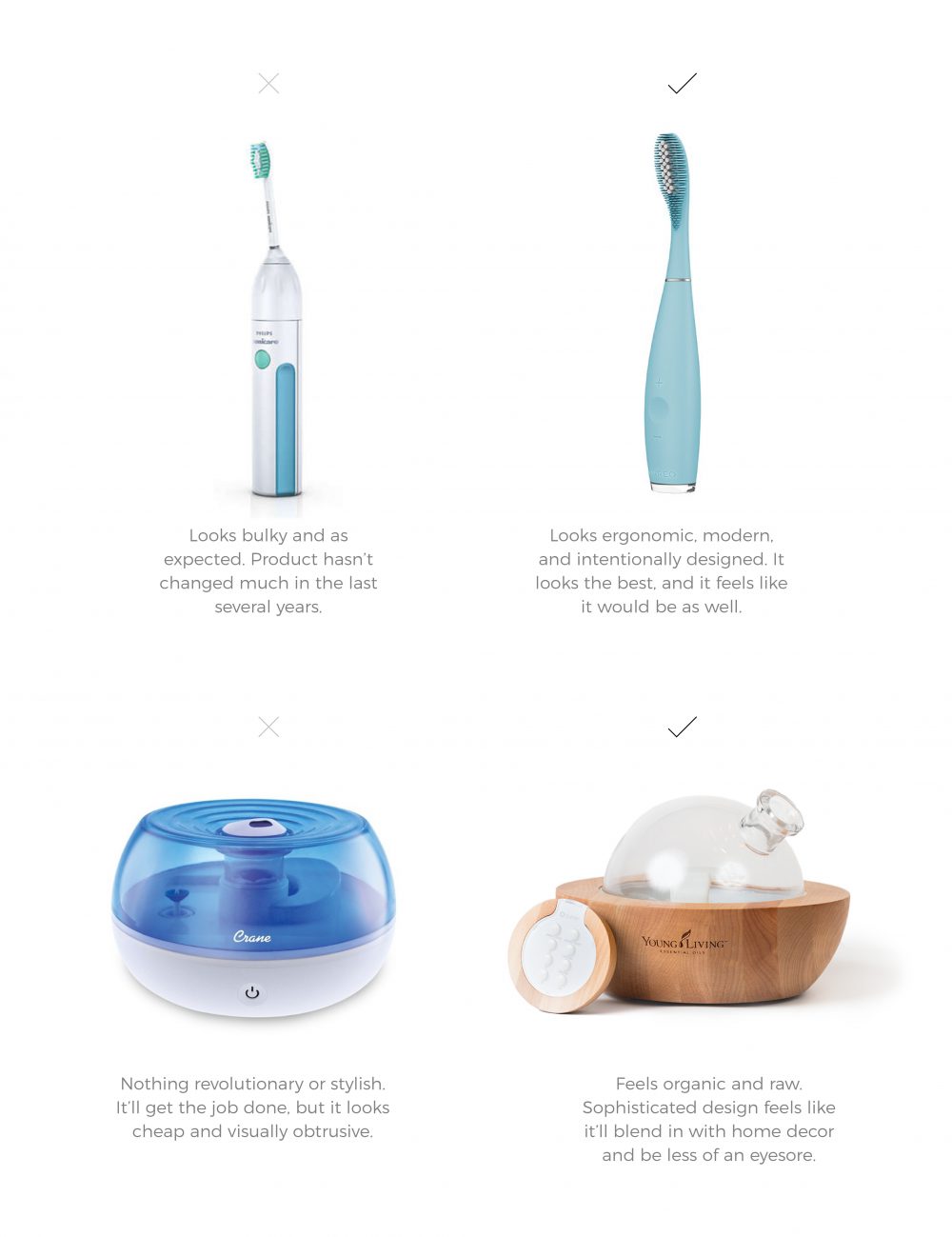
Brands with an up-to-date design make us feel like their product/service is likewise current and relevant..
Some brands stand out as cutting edge in their industry simply because they look the part. We’d be less likely to purchase a product from a website designed in the 90s, because we associate the outdated web design to the product/service. It’s as if we think, how can a product/service with a website from the 90s, serve the needs I have in 2026? There’s got to be another brand who is more current and fresh. With no progression in any aspect of design, it’s easy to assume there hasn’t been progression with the product/service either. A brand’s entire look and feel should show that it is leading the industry. Brands who look the part, convince their audience that they actually are.
Think of it like this: when design reflects forward momentum, audiences are more inclined to believe the brand can meet modern needs.
Design isn’t just how your brand looks; it’s how it feels. Feelings and instincts from good design cause positive behaviors. And the same goes for bad design causing negative behaviors.
Simply put, design dictates the user experience. So, take a second look at your brand. Does the design reflect the quality of your service/product? Is the design of your logo, website, flyer or whatever visual medium you’re using to communicate with your audience look like you’re a superior, dependable brand? Or do your visual mediums make viewers hesitate?
Visual design focuses on how an experience looks. UX design strategy focuses on how that experience works, why decisions are made, and how success is measured.
Psychology informs UX by explaining how people perceive information, form opinions, and make decisions. UX strategy uses that understanding to guide structure, flow, and priorities across the experience. Visual design then supports those decisions by expressing them clearly.
In terms of scope, UX design strategy is the broader of the two. It considers research, usability, business goals, and cross-functional needs. It is also measurable, with success defined through outcomes like engagement, conversion, and retention (rather than preference alone).
Building a UX design strategy requires intention, structure, and a willingness to learn from users. While every organization is different, most strategies follow a similar progression.
UX design strategy becomes clearer when viewed in context. Consider the following hypothetical scenarios:
These are, of course, only a few examples. The reality is when it comes to UX strategy, design must be adaptable to your product, your audience, and the specific situations where the two come into contact. A firm understanding of customer psychology, backed by reliable research, makes this possible.
UX design strategy matters because it shapes how users experience your brand and how confidently they move through it. When strategy is grounded in psychology and supported by research, design decisions become more justifiable and easier to scale. Teams gain clearer alignment, usability improves across touchpoints, and development effort is spent solving the right problems.
If you’re ready to build or refine your UX design strategy, 97th Floor partners with teams to create research-backed experiences that support both users and business goals.
Backlinks have always played a central role in SEO. But as search evolves, the types of backlinks that truly move the needle have changed. Authority alone isn’t enough. Relevance alone isn’t enough. And shortcuts that once seemed harmless now come with real risks.
The best SEO backlinks today are the ones that demonstrate trust, expertise, and real value to users. They come from sites that operate with high editorial standards, have real audiences, and treat links as references instead of transactions.
In this guide, we’ll walk through the full landscape of what the best backlinks look like in today’s environment, how Google and AI systems evaluate link quality, and the practical steps teams can take to earn backlinks consistently. We’ll also break down strategies, examples, and pitfalls to help you build a backlink plan that’s safe, effective, and scalable.
The best SEO backlinks are links from reputable and contextually relevant websites that point to your content because they interpret it to serve a clear purpose. That purpose might be educating readers, providing a unique data point, offering a fresh perspective, or supporting a larger narrative. Regardless of the specific reason, high-value backlinks function as editorial endorsements. They signal that your content is useful to viewers.
Backlinks remain one of the strongest indicators search engines use to evaluate the overall quality and reliability of a page. Google wants to surface information that people can trust, and backlinks help demonstrate that trust at scale. When authoritative sites consistently link to your resources, it strengthens the case that your content:
Here are the specific areas high-value backlinks help shape:
A backlink from a credible site acts as a vote of confidence. The more reliable the linking site, the stronger the trust signal you earn.
Links from relevant domains help establish what your site is about. This strengthens your presence within a topic cluster and reinforces your authority in that specific area.
When respected publications or brands reference your work, it positions your organization as an authoritative voice in your field.
Links often appear when your content is genuinely helpful. Search engines notice this pattern. When real people rely on your content, algorithms tend to do the same.
These signals have a heavy influence on rankings. Backlinks strengthen your entity profile, help AI systems understand what your brand represents, and improve how your content appears across emerging search surfaces. A single high-value backlink from a relevant, authoritative source can outperform dozens of lower-quality links, which is why quality-driven link building is more important now than ever.
Search engines and users both rely on certain characteristics to determine whether a backlink is trustworthy. The more of these qualities a link possesses, the more value it’s likely to provide. Here are a few of the most important qualities to pay attention to when adding backlinks.
Relevance is the foundation of link quality. A backlink from a site that operates within your niche carries far more weight than a link from a topically unrelated domain. Relevance confirms that your content belongs in the conversation and reinforces your association with the subject matter.
Authoritative backlinks come from well-established organizations that demonstrate expertise, editorial oversight, and clear quality standards. This includes major publications, universities, nonprofits, reputable companies, and industry-leading blogs.
The best backlinks can drive real visitors. If a link sits on a page that attracts meaningful traffic, the value is compounded. Search engines can detect when humans interact with your content, and referral traffic is a powerful indicator that the link is genuinely helpful.
Where a link appears matters. Links integrated directly inside informative content carry significantly more weight than links placed in author bios, footers, or lists with no contextual relevance. Search engines understand this difference, and readers do too.
If the page linking to you isn’t indexed by Google, it cannot pass authority. This is an often-overlooked element of link evaluation, but it’s essential. Even the highest-quality link is ineffective if search engines can’t crawl the source page.
Search engines consider the broader “neighborhood” a link lives in. If the linking site is surrounded by low-quality outbound links, link-selling schemes, or spam-heavy patterns, its credibility declines. The company your link keeps matters.
Google’s link evaluation has evolved significantly. Now, it focuses heavily on signals that indicate whether a link genuinely benefits users. Backlinks created solely to manipulate PageRank or boost rankings artificially are considered violations of Google’s guidelines, and patterns of these links can trigger penalties, algorithmic or manual.
Google evaluates link quality based on several factors:
A link from a topical neighbor carries more weight than a link from an unrelated source. Topical mismatch often signals artificial behavior.
Links that appear on sites with strong editorial standards are treated as more trustworthy. Google looks for signs that content is reviewed, moderated, and held to quality expectations.
Contextual positioning within the main body of an article is preferred. Links buried in sidebars, footers, or author bios are treated as lower-value.
A healthy backlink profile includes a variety of unique domains. Hundreds of links from the same site rarely indicate popularity or usefulness — more often, they suggest manipulation.
If Google can’t index the linking page, it can’t evaluate or pass any authority from it.
Patterns like excessive guest posting, scaled link schemes, article farms, or bought placements are easy for Google to detect. These tactics erode trust and invite risk.
The takeaway: strategies built on shortcuts or rapid link accumulation tend to lose ground quickly. Quality-first link-building remains the most sustainable approach.
Understanding what makes the best seo backlinks high-value is one thing. Actually earning those links, at scale, is another challenge entirely. There are dozens of ways to build links, but only a handful consistently deliver relevant, trustworthy, and sustainable results.
Guest posting is one of them.
Guest posting isn’t perfect, and like all link acquisition methods, it has its risks. In May, Google released a statement regarding poor-quality links found in contributor posts. Google warns that when the main intent is to build links in a large-scale way back to the author’s site, these practices are in violation of Google’s Guidelines. However, Google does not officially discourage guest posting, stating, “Google does not discourage these types of articles in cases when they inform users, educate another site’s audience, or bring awareness to your cause or company.”
So what’s the best way to gain backlinks through guest posting? Here are a few tips that stay within Google’s guidelines, benefit site owners, and most of all, provide results for your SEO efforts.
It is crucial to find sites within your niche or industry. Nothing screams spam like getting backlinks from a completely irrelevant site. For example, if you sell barn doors, then you want to get backlinks from sites about home improvement, interior designers, DIY blogs, etc. You wouldn’t want backlinks from sites about video games or fitness. The more relevant the site linking back to your site is, the more natural it will appear to Google.
So, how do you find sites to post to? There are numerous paid tools you can use to find sites. However, simply using Google Search can produce excellent results. Use search parameters in Google to narrow your search. These are a couple of search parameters that you can use:
By replacing keyword with your keyword, you’ll start to find sites that accept contributors. Again, ensure that these sites are relevant to your niche or industry. There are a lot of spam sites that will accept anything. You want to avoid these sites.
It’s important to evaluate your outreach strategy and adapt as necessary. Vary your search parameters depending on what results you’re finding and the niche or industry that you’re outreaching for. Simply switching between “insite” to “inurl” will display different results. If you’re still not finding sites, then just try a good old-fashioned Google Search without any search parameters. This usually produces a broader range of sites, but that might be just right for your industry.
The first thing to look for on a site that accepts guest posts is the posting guidelines. This usually gives a good idea about what the site expects from you and what you can expect from them. In addition, most guidelines will say something about including backlinks in your post. Some sites will not accept any articles with links, while other sites will remove links if they appear to be spammy. Never reach out to sites that ask for money in exchange for backlinks. This is specifically against Google’s guidelines, and if done enough, the site could be penalized.
Next, check the domain authority (DA) of the site. As a rule of thumb, never reach out to sites with a DA below 20. You want to be looking for high-quality sites. Sites that have a DA below 20 typically will not be the quality that you're looking for, and will pass less authority to your site.
Check to make sure the links are followed and the blog posts are indexed. You can do this manually by checking the source code for nofollow or noindex tags. If the site has a decent DA but has nofollow links, you can still reach out and contribute to this site. Diversifying your backlink profile with follow and nofollow links will appear more natural to Google, and ultimately help your ranking strategy. However, there is essentially no value in a noindex blog post. Avoid these sites, as they will not help your strategy.
After you’ve thoroughly qualified the site, reach out to the website via email. This can usually be done through a contact form on the site. However, you’ll be more successful if you can find a contact email on the site. This can take some digging, but if you can contact an actual person, you’ll have a greater chance of getting a response back.
Try to be as personable and specific as possible when reaching out to new sites. There are a few things that you should include in each email. Let the contact know that you aim to provide free high-quality content to their site. Follow this up by adding some ideas for future articles. Also, provide the contact links to your previously published work so that they have a sample of your writing. If you don’t have any published work yet, you can post for free on Medium or Kinja and send them links to those pieces. Most importantly, display thorough knowledge and enthusiasm about their site. Webmasters like to know that their site is enjoyable to users.
This is perhaps the most important step. Poor quality content is the number one reason that content partnerships end. Ensuring that your content, as Google states, “informs users, educates another site’s audience or brings awareness to your cause or company,” will keep your partnership happy and be an ongoing resource for you to gain backlinks.
There are ways to acquire backlinks that might seem easier than guest posting. However, what you sacrifice for ease of use is typically quality of content and quality of backlinks, which isn’t worth the risk of getting penalized. Guest posting can be time-consuming, but when following these steps, it will provide the best and safest ROI.
Not every backlink is worth the effort. Some can actively harm your visibility and credibility, even when they look harmless on the surface. Most teams already know to avoid the obvious pitfalls (spam sites, link farms, paid placements, etc.), but risky link tactics often show up in more subtle ways. These patterns can gradually weaken your backlink profile and create signals that search engines interpret as manipulative.
One of the most common issues is buying backlinks from lists or marketplaces. If a site openly sells links, it’s already on Google’s radar. Even a single placement on a known link-selling domain can dilute the strength of your overall profile. Scaled guest posting can be equally harmful when it lacks editorial oversight. Google doesn’t penalize guest posting itself, but it does penalize repetitive, low-quality content spread across unrelated sites with identical anchor text patterns.
Anchor text misuse is another red flag. When links consistently use the same exact-match phrasing, it signals manipulation rather than natural citation. Low-quality directories fall into a similar category. A few reputable listings can help support local visibility, but hundreds of generic or irrelevant directories don’t provide meaningful value; they only clutter your profile.
Finally, reciprocal link schemes continue to cause issues for teams trying to grow quickly. “I’ll link to you if you link to me” might feel efficient in the moment, but it remains a clear violation of Google’s guidelines and is easy for algorithms to detect.
Sustainable backlink strategies are built on relevance, usefulness, and genuine connections between brands and audiences. When your link-building efforts prioritize value over volume, you gain stronger rankings, more defensible authority, and long-term momentum that lasts.
Strong backlink programs require expertise and a clear understanding of what actually works in today’s search environment. If your team is ready to earn backlinks that strengthen your authority, improve your visibility, and support long-term organic growth, we can help.
We’ve built backlink strategies for some of the world’s most ambitious brands, and we know what it takes to earn links that last. Let’s build something great together.
Here are 5 things to create a killer Facebook ad with expert and PPC Specialist Cinthia Packard.
Article and tips here.
When I was just a young pup trying to make his way in the vast and often unforgiving wilderness of content marketing (yes, I’m talking about back in 2013), I often found myself assigned to write about topics that were, shall we say, not within my field of expertise. This was neither uncommon nor unexpected; after all, when your field of expertise consists of an encyclopedic knowledge of 90s-era animated superhero television shows and almost nothing else, then you should expect to work outside your comfort zone.
So, I learned the art of the 20-minute masters course. If I needed to write about tips to getting the most out of the Paleo diet, my first step would be to type “what is paleo diet” into my Google search bar, and my second and last step would be to create an 800 word article about how throwing out 10,000 years of agricultural science might actually be a healthy decision. If I was asked to highlight the benefits of solar energy, I’d learn the science while writing it and come away an hour later convinced that traditional utilities were the tools of the devil.
I learned a lot during those 20-minute, panic-fueled research sessions—taking in, metabolizing, and excreting knowledge back into the internet, like some virtual circle of life, except with trivia and statistics instead of whatever The Lion King was about. By the way, when Simba became leader of the pride, did he kill all of the other male cubs? Because I’ve heard that lions do that.
In any case, the end results were, if I may say so, decently informed content presented in a way that was at least mildly interesting. For example, take an article I wrote about food storage and different types of fictional apocalypses. I mean, when faced with a sea of emergency preparedness articles, it was nice to be able to create something unique, in that it was was both helpful and unflinchingly honest about your family’s chances of surviving a robot uprising. Of course, that’s not to say that I didn’t encounter the occasional snag. Research, particularly the kind that is motivated by imminent deadlines, isn’t always an exact science.
If you’re finding yourself in a similar situation—needing to produce factually-based content quickly—then I think I can help. The internet is a big place, and if you know where to look, whom to ask, and what ‘sponsored content’ is (hint: it’s not news), then there’s no reason why you shouldn’t be able to locate the information you need, and with enough time left over to turn it into something useful.
This may come as a shock to some readers, but just because it’s on the internet doesn’t necessarily mean that it’s trustworthy. Believe me when I say that it doesn’t take much in the way of credibility to get your words up on a website. Do you think that Buzzfeed is asking for credentials and references from the person who just wrote “15 Reasons why Cocoa Butter Is the Best Thing Ever”? Of course not. Why would they? Most internet users aren’t looking for peer-reviewed studies; they’re after some quick entertainment, and the thought of tracing sources or following up on bibliographies is about as far from “quick” or “entertaining” as you can get.
That doesn’t excuse your responsibility as a content creator. To put it bluntly, the internet is already well stocked with sensationalism and biased opinions masquerading as fact; don’t add to it. If you’re going to be presenting information, do everything in your power to ensure that it’s reliable information. Which, of course, means knowing where to find it.
Government and educational sites are generally held to a higher standard than others, although that’s not to say that they are always 100% accurate (or unbiased). Still, those that include data from relevant studies are usually trustworthy, and will not only provide you with relatively reliable information from which to craft your content, but may also give you interesting stats and data to link to to support any arguments you might be making.
News sites are also authoritative resources, but bear in mind that not every news site is created equal, nor is every site that identifies itself as a news site recognized as one. Some are just ideological outlets for particular interest groups (I’m not naming any names, Fox News and Huffington Post). There’s actually a lot of data that goes into which news sites are the most reliable and objective, and I’m not going to bother reproducing it here, but feel free to check it for yourself. Stick to the ones at the top of the list, and you should be OK.
On the bottom of the barrel, we’ve got blogs. Now, I’m not suggesting that blogs are incapable of unbiased reporting or producing accurate data, but I am going to point out that when a post is being written by a single author, for that author’s site, with no editorial or supervision failsafes in place, then there’s really nothing stopping them from making whatever claims they’d like. If, on the other hand, a blog includes links to its resource material, then feel free to track the truth down yourself, and if it looks promising, then link to the original source in your own article.
Finally, I’d like to set a few things straight with regard to Wikipedia. First, no, you should never link to Wikipedia. This is because Wikipedia is a collaborative encyclopedia, and you really don’t have any way of knowing whether the author was relaying reliable information. Perhaps even more importantly Wikipedia has a reputation for being a non-reliable source. A link to Wikipedia can end up doing more harm to the perceived authority of your article than whatever information you’re attempting to cite could hope to offset. Interestingly enough, I was once writing for an Australia-based client who wanted links from Government sites, and I discovered that the Australian .gov pages were not above linking directly to Wikipedia articles. I think I found where I’d like to retire.
This is because, in my personal experience, I’ve found Wikipedia to be one of the most accurate and complete internet resources available. When it comes to general information, I’m more likely to trust Wikipedia than any government or news site, because if there’s one thing that the kind of people who write and edit for wikipedia love, it’s correcting each other. No fallacy or inaccuracy is going to last long when you have thousands (or more) of potential editors looking over everyone’s shoulders, just aching for a chance to show off what they’ve got. It’s like misusing the word “whom” in a room full of English teachers—you’re going to be corrected, and it’s going to be swift.
So, should you use Wikipedia? Of course you should! It’s probably the most complete repository of human knowledge available. Just don’t link to it. Instead, use Wikipedia as a general research tool, and then if you need something to link to, check out the references section. You can evaluate the authoritativeness of specific resources, and if they look good, then you can link to them yourself. You should already be in the habit of tracing information back to its source, so in that respect, Wikipedia really isn’t any different.
Finally, as a general rule, if a site is actively trying to sell you something, then it may not be the best resource. On the other hand, if they support their claims by linking to relevant studies or including a bibliography section, then there’s no reason why you can’t take advantage of their hard work. Don’t worry, if you do a good enough job, you’ll be able to pay to forward to the next internet writer who comes to your site looking for usable information.
Pretty straightforward so far, right? Well, there’s one other thing to consider when researching your article: time. No, I’m not talking about the deadline; I know you haven’t forgotten that part. I’m talking about the date stamped on your source material. You see, usable information is three things—reliable, relevant, and recent. If you find the perfect stats to support your argument, but they’re from a report conducted three decades before the word ‘internet’ even existed, then they’re not the perfect stats. That said, the shelf life on some resources is longer than others.
As an example, let’s take a look at the two links I’ve included in this post. The first one is found all the way back up the page in paragraph #3 (the weird part about how much I dislike Lion King). Clicking that link will take you to a news report on the site Livescience.com. The article is everything you might want in a linkable resource—it’s authoritative, well researched, blah, blah, blah. But take a look at the year it was published. 2013. That means that the data is going on half a decade old. A discerning reader will make note of that, and might wonder why you haven’t been able to find anything newer to back up your arguments.
The second link is the one about which news sites are most widely trusted (about eight paragraphs up from this one). The page I’ve linked to was published less than two months ago, and that means the data is as fresh as a crispy head of lettuce.
But, like I said, the shelf life all depends on what you’re linking. The piece about the lions was published three to four years ago, sure, but how much could lions have changed in that time? On the other hand, the data about the reliability of news sites would likely be outdated much sooner. Can you think of any events, say, maybe far-reaching political events, that might have changed how readers view news-site reputability? In this case, even data that is only a year old might be too antiquated to use. It’s all about what information you’re citing.
Want an easy solution? Well, I’ve got one for you. When you do a Google search for reliable information, just click on the “settings” button underneath the search bar, and scroll down to “advanced search.” This will take you to a new page, where you can more clearly define what kinds of sites you’re looking for. About halfway down the page, you’ll see the “last update” option. Select it, and then select “past year,” before finalizing your search. This will return only pages that have been updated within the last twelve months, so you’ll have fewer outdated results to sift through. Trust me; this one’s a time saver.
It would certainly be nice to be able to contain all of our writing within our own areas of expertise, but it’s just not realistic. In fact, in the four years I’ve been writing at 97th Floor, I think I’ve only had one article published that made any sort of reference to Batman: The Animated Series, and it was subtle enough that the editors at Business.com didn’t notice. The reality is that in order to succeed as an internet content creator, you’ll probably have to take a few steps out of your comfort zone, and that’s actually a good thing.
You can be the expert that readers need, even if that expertise is built on nothing more than 20-minutes of Google search results. After all, content marketing is all about providing readers with content that is educational and informative, and if you can give it to them, then no one will care that you’d be more comfortable writing about cartoons.
Oh, and with that, it looks like I’ve now referenced Batman in two of my articles. I guess my expertise is worth something after all.
You finally took that leap and launched your own healthcare practice. It took grit and guts to get there, and it’ll take grit and guts to keep it going. Now that it’s open, you need to find a continuous flow of patients to fill your practice and keep your business above ground. Or, maybe you've been practicing for a while but are ready to scale and bring your practice to new heights. Regardless of the circumstance, there are some bulletproof healthcare marketing strategies that will get new patients flowing in your doors from a digital audience.
A healthcare marketing strategy defines how healthcare organizations attract patients, build trust, and drive engagement across digital channels while staying compliant.
Unlike general marketing, healthcare marketing prioritizes clarity, accuracy, and confidence at every touchpoint. Patients are not just comparing services. They are evaluating trust, expertise, and ease of access at every step of their customer journey.
A modern digital marketing strategy for healthcare brings together SEO, local visibility, content, and reputation management to support the full patient journey. When executed well, healthcare marketing functions as an extension of your patients’ experience.
Below I've distilled some healthcare marketing ideas and techniques you should be looking into in order to increase the relevance of your healthcare practice online.
Your site is likely the first interaction your potential clients will have with your healthcare brand online. A sloppy, buggy, or thrown-together website can give the impression that your practice is also sloppy, buggy, and thrown-together. In order to nail this first impression, be sure to invest in a well-crafted, visually appealing site that is easy to navigate, provides useful information, and demonstrates your practice’s expertise. A good site is the foundation of an influential online presence.
It should go without saying, but your site needs to look professional and inviting. In today’s digital age there are many avenues to building a website. Though it’s tempting, it’s worth investing in quality over budget when it comes to your site design. In addition to the fact that the average user sees quickly through cheap site design, a good site structure is essential to keep up with your healthcare business as your company scales. It’s important that your site reflects the top notch service and quality you provide.
The good news for you: many of the healthcare sites out there look quite outdated. By updating or creating a well designed site, you can stand out with relative ease.
When people get to your site, it’s for a specific purpose. In your case, people are looking for a healthcare provider that they can trust, with answers to questions only a doctor can answer. They have a specific problem, and they are looking for solutions.
If your website isn’t clear about the value each page brings (or worse, it promises value but doesn’t deliver) that confusion will reflect poorly on your practice. Be clear, be helpful, and put the user-- your potential patient-- first.
Facebook ads can be powerful for your healthcare marketing strategy, but you’ll need to put some thought and strategy into them. The FB ad platform isn’t one that typically brings results by blasting as many users as possible with your ads. The power comes instead from the very specific, granular targeting that can be done. Maybe you focus on sports medicine and want to run a campaign targeted to men and women, aged 20-40, with a particular interest in CrossFit. On Facebook, that’s easy. What if your practice caters to a higher-end clientele? No problem, you can target via income, net worth, home value, location, etc.
Paid social media marketing, such as with Facebook Ads, can be a powerful tool in an online strategy. The key is running tailored campaigns to specific personas. As you refine who you are targeting, you can lower your overall cost of running ads because you aren’t wasting money commercializing to people who will have little interest. To help get you thinking of what campaigns you should run on Facebook, here are some of the targeting options.
If you are embarking on running some social media ads yourself, be sure to read up on all the ins and outs of Facebook’s ad platform and how to use it. There are many options and it is easy to get overwhelmed on your first go. Adspresso has a great guide to get you jump started that can be found here.
Most industries have directories that list professionals within their industry. These directories often put in a lot of time and money in order to rank well for many profitable keywords, which means they are a resource you can use to increase the weight of your own domains. Use these healthcare directories to your benefit while you are getting your site ranked for your chosen keywords.
In most instances, directories will be free (or cheap) and have an easy to fill out form. You will use the form to submit information about your practice to be posted on the public directory.
For example, Healthgrades.com has a comprehensive directory that you should leverage to your advantage. It ranks for many healthcare-focused keywords.
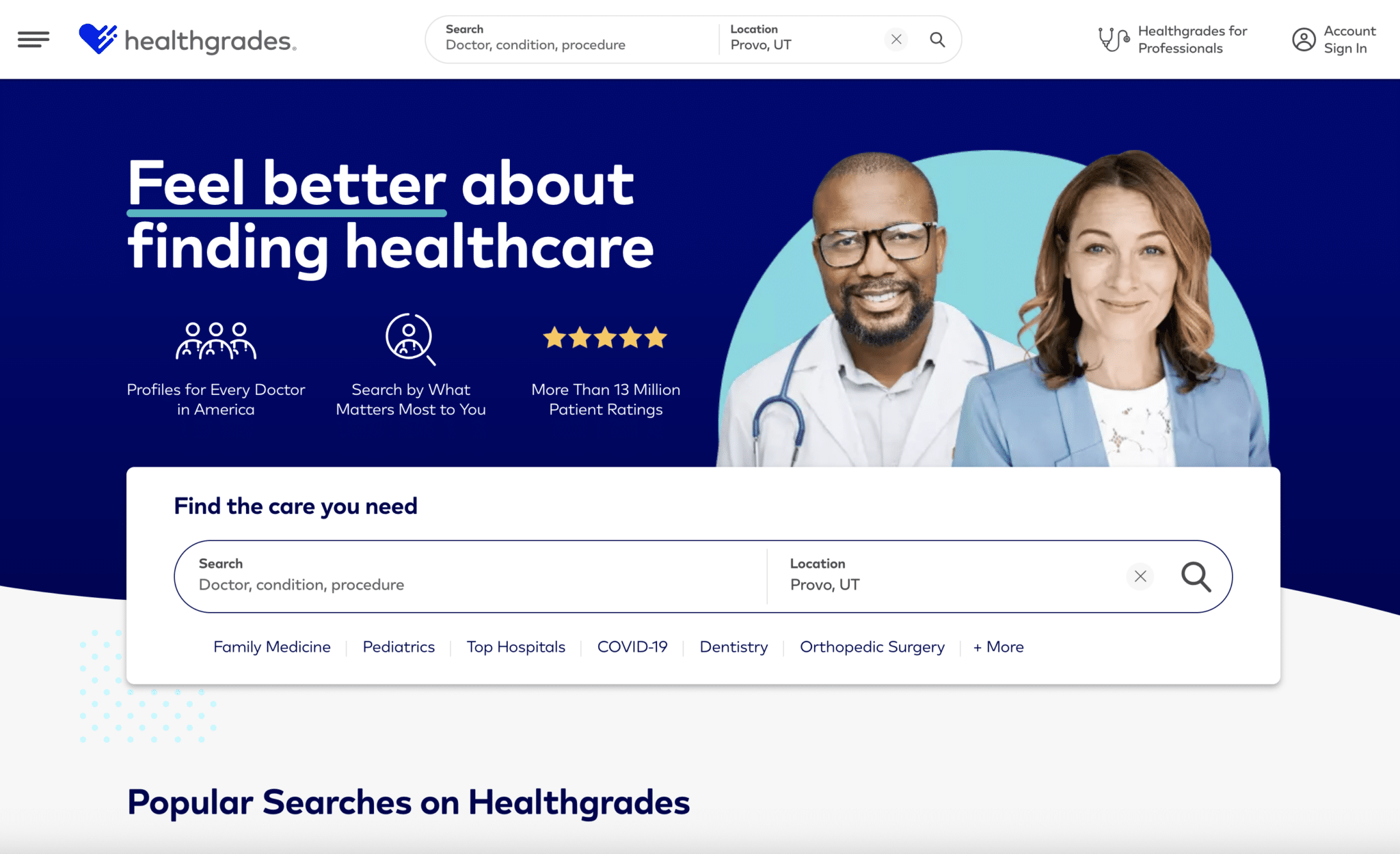
You can create a free Healthgrades.com profile here. It will look something like this:
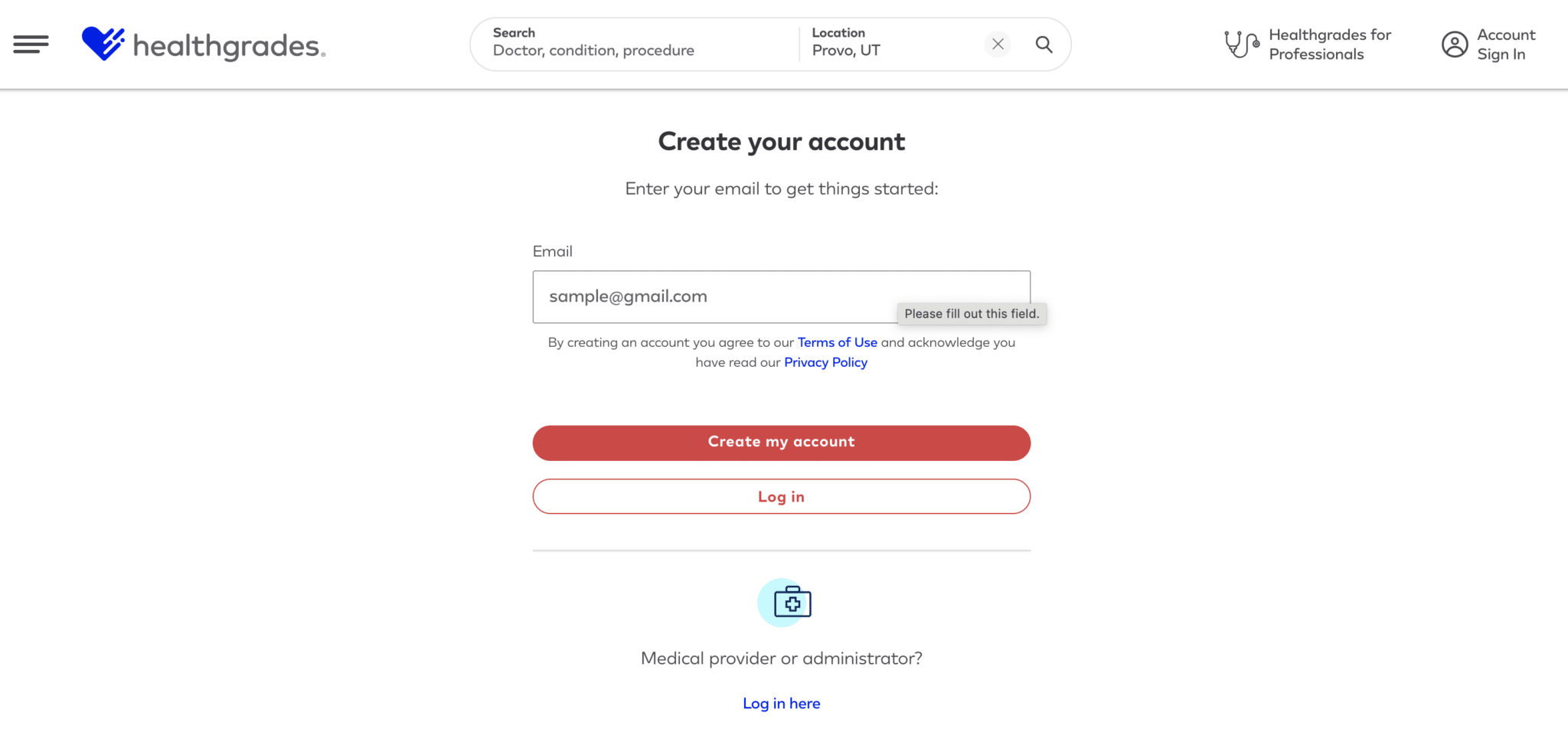
This is a great way to take advantage of all the hard work Healthgrades has put into their site and rankings. And, it’s mutually beneficial. Healthgrades relies on healthcare practices to add themselves to these lists, and you rely on them to aid your ranking positions and lead generation.
Here are a few more healthcare directories that you should be on:
All of the above directories rank for many “healthcare provider in...” type keywords. If this method works for you, don’t stop there! There are many more directories with online clout than the ones listed above. Do a quick search for “healthcare provider in” + “city” to see which directories show up for the city you want to rank for. Be sure to leverage the directories that rank for your target terms first.
Google My Business is incredibly important if you want to show up for local results in Google. I’m sure you’ve seen local results many times, but maybe you didn’t realize it was a part of the Google algorithm that you can leverage. Here’s what a local result looks like when you search “chiropractor SLC”:
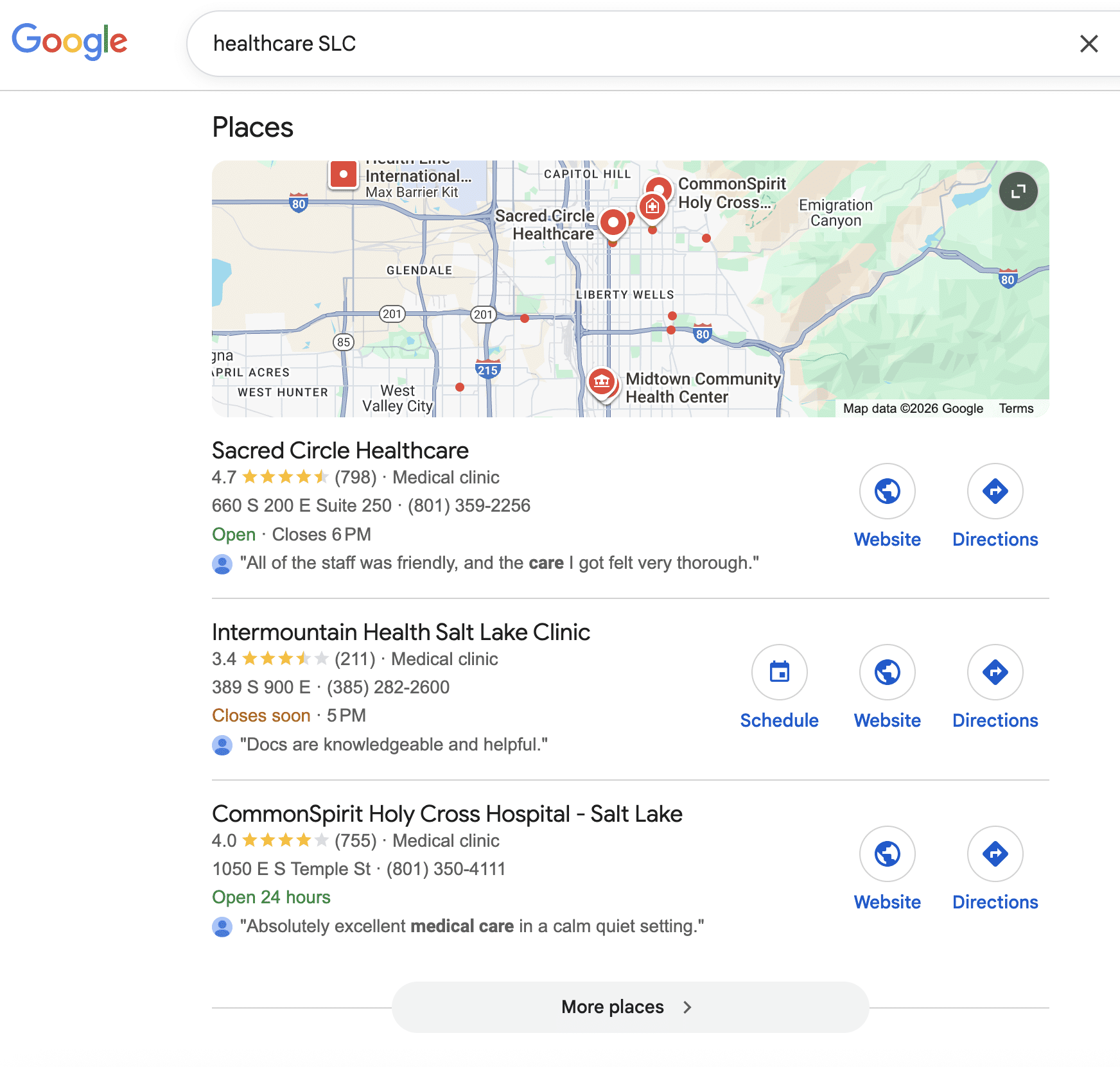
The local box will show different businesses that fit what you are looking for. There are many factors that go into showing up for these, but Google tells us that it comes down to 3 core factors:
So what exactly does Google mean by these?
Relevance is pretty self-explanatory. It refers to how closely your local business listing matches the search someone types in. By doing a thorough job filling out Google My Business and optimizing it to match the queries you want to rank for, you’ll increase in relevance.
Another pretty easy one, distance illustrates how far a person is from your business. In a recent report from Hitwise, it is reported that nearly 60% of searches are now performed through a mobile device. Google will calculate where a user is through their device and use this distance as a factor when providing results.
This is the part where optimization comes in. Prominence tries to gauge how prominent your business is in the offline world and reflect that in local listings.
Many factors are taken into consideration here. Links, local citations, reviews, and your position in traditional SEO results all factor into how “prominent” you are.
You need to verify your business with Google My Business. This is a fairly easy process. After you set up your Google My Business page, Google will send you a postcard with a verification code. You will then enter the code into Google My Business to verify your business listing.
Next, make sure all of your details are up to date and add 3-5 pictures of your business.
After you’ve added some great photos of your business, double check the category that you’ve declared for your business within Google My Business. It is important that you have categorized your business properly.
Thoughtfully fill in your introduction and title of your business in Google My Business so that it represents your business well.
Reviews are very important in local search marketing. Read and thoughtfully respond to reviews about your business. Reviews can make a huge impact on your business for better or for worse. It is beneficial to keep them under control through responding and genuinely taking care of your customers.
Citations are your mentions on various directories on the web. These directories are sites such as Yelp, The Yellow Pages, dexknows.com, chirodirectory.com and more. Building these by hand can take a lot of time, so many companies hire out for citation building.
If you embark on building citations by yourself, make sure you keep all of your information consistent across all of the directories you submit to. Nothing is worse than getting a bunch of citations that have conflicting phone numbers or addresses that you need to go through and clean up.
Traditional SEO for a healthcare practice, sometimes searched online as healthcare SEO, can be immensely powerful. SEO for those who are unfamiliar stands for “search engine optimization.” It is the act of optimizing the elements of your site so that you rank better (closer to the top) within search engines. The idea is that if you are a healthcare provider in Las Vegas, then you want to show up when someone searches “healthcare Las Vegas” within Google or other search engines. And, you want to show up as closely to the top as possible, so more users will click to your site over your competitors’. Performing SEO for your healthcare practice will do more than just generate customers, it will help you build a brand. Here are some of the benefits to investing in SEO.
As a healthcare provider, you are highly skilled in an area where most other people are not. Furthermore, you invested good money in becoming an expert at your craft. Use that expertise to grow your brand through content marketing.
What do I mean by content marketing? You should be consistently publishing content that brings value to your potential patients in a way that only you, as the expert, can. If you’re wondering: “Well, what should I write about?” This is where the keyword research that I mentioned earlier comes in. Keyword research will teach you what people are searching for and how many people are searching for it. In many cases, these search terms represent the questions that your potential patients have for you.
For example, if someone is experiencing upper back pain, they may search “upper back pain” in Google in order to research what the causes could be. Here is a snapshot of what the traffic looks like for some keywords regarding upper back pain.
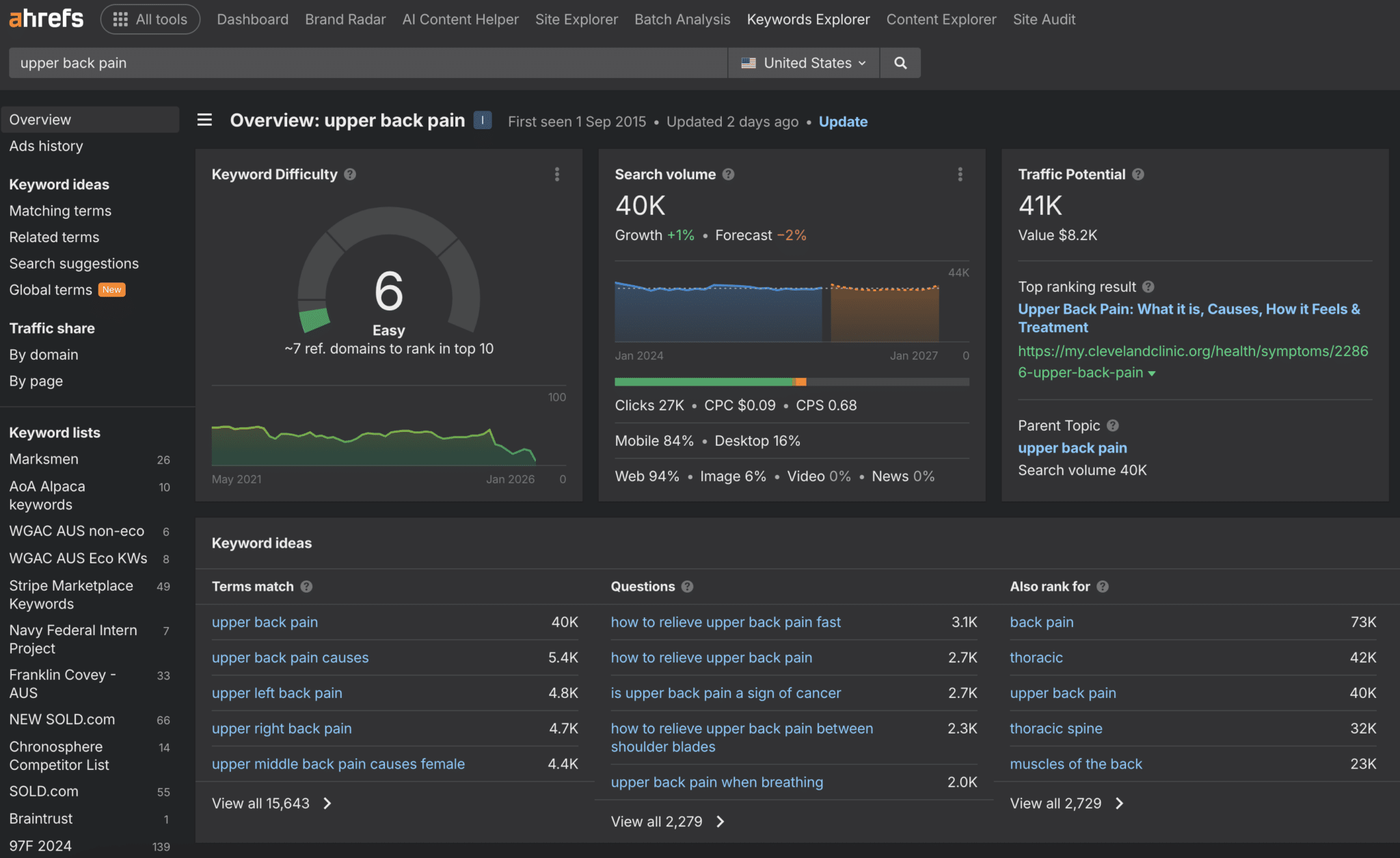
Quick notes -
As you can see in this example, there are many people searching for the keyword “upper back pain” or some variant of it. We also learn that these keywords have relatively low difficulty being in the 20-30 range (out of 100, 100 being the most difficult).
If you, as a healthcare provider, created a piece of content regarding “upper back pain” and optimized it for the above terms, you could begin generating quite a bit of online exposure.
As you begin to show up for searches in Google you will be seen as an authority. The more searches you rank for, the more people will associate you as an authority.
A great example of this is Dr. Josh Axe of Draxe.com. Dr. Axe began by founding the Exodus Health Center in Nashville, helping thousands of families reclaim their lives through improving their health. Furthermore, Josh helped his own mother reclaim her health and beat breast and lung cancer. Realizing that he has a special set of skills, he set out to help more people using the amplification of the internet.
When Dr. Axe started early on, he wrote many pieces of content and published them on his site. Dr. Axe began ranking for many keywords and has since grown to become the “second-most-visited natural health website in the world.”
Here is Dr. Axe’s current site:
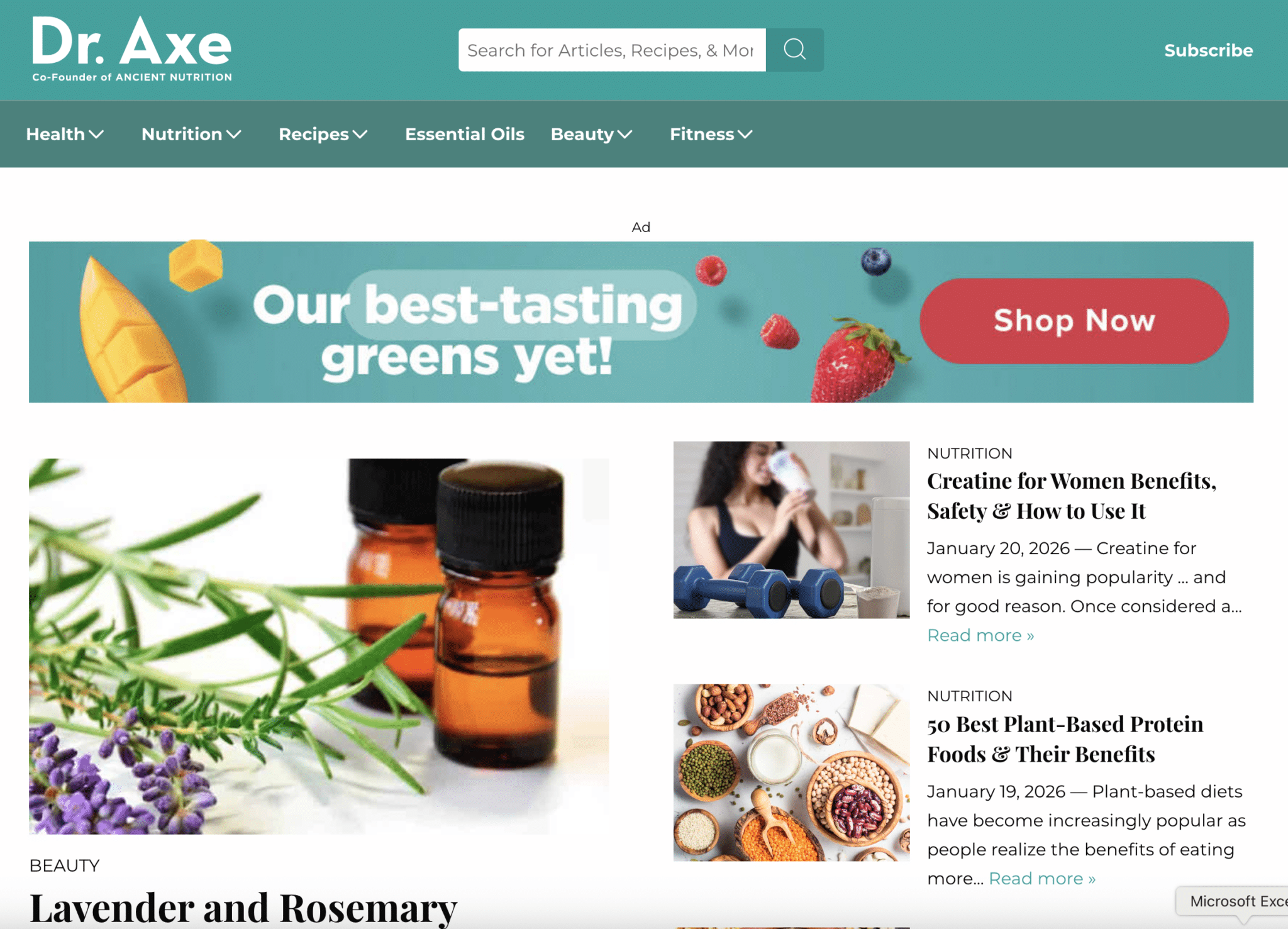
Josh’s site currently ranks for over 1.6 million keywords and generates over 7.5 million monthly visitors (as per Ahrefs).
Dr. Axe is an inspiring case study of what can be done through the leverage of SEO to build a strong brand with immense authority.
Managing your reputation online is at the heart of retaining a good brand image. Google your brand frequently to see what people are saying about you. Better yet, create a Google Alert for your brand name and be notified each time you are mentioned. This way you can jump in and resolve concerns and strengthen your brand.
Patients often research providers across search results, review platforms, and third-party healthcare directories. Monitoring what appears in these spaces helps organizations understand how they are perceived and where gaps in trust may exist. A strong healthcare marketing strategy includes proactive brand monitoring.
Give thoughtful responses to reviews and mentions to show your accountability and reinforce credibility, which is especially valuable when patients are evaluating alternative care options. Over time, this consistency supports a more resilient healthcare marketing strategy by building confidence across digital touchpoints.
For many patients, the first interaction with a healthcare organization happens online. This is often referred to as the digital front door, and it plays a vital role in any healthcare marketing strategy.
A patient-centric digital experience removes friction. Websites should be easy to navigate, quick to load, and clear about services, providers, and next steps. Patients should be able to understand their options, find answers to common questions, and take action without confusion or unnecessary barriers.
A strong digital marketing strategy for healthcare treats the website as more than a brochure. It functions as an access point for care, guiding patients from research to an appointment with confidence. When the digital front door is built around patient needs, marketing efforts convert more effectively, and trust is established before care even begins.
Healthcare is evolving quickly, and patient expectations continue to rise. The organizations that succeed are those that invest in strategy and adapt their healthcare marketing strategy as technology, regulations, and behavior change.
97th Floor helps healthcare teams put their ideas into action and capture the biggest opportunities in the industry. If you’re ready to move beyond tactics and create a strategy designed for today’s healthcare landscape, let’s build it together.
See how an audience-first approach translates to bottom-line results.
Keyword research is at the heart of all the work we do at 97th Floor. In this webinar Director of Marketing Operations Paxton Gray shares advanced keyword research techniques that provide the ground work for solid strategies that garner results, whether for high volume brand awareness or specific product conversions. Whether novice or a pro, you're sure to glean some remarkable and actionable insights.
Get the free downloadable Advanced Keyword Research Template below!
What You'll Find in this Webinar:
[1:28] Who we are
[1:33] Who we work with
[1:41] What we do
[2:10] What is a keyword? 15% of Google search has never been searched, everyday.
[2:45] The Search Demand Curve: Fat Head, Chunky Middle and Long Tail Keywords
[4:15] Google's #1 objective
[4:35] Google Micro-Moments: The consumer journey and you
[5:08] Advanced Keyword Research: What it is, What it's not
[6:07] Think strategy, not specifics.
[6:45] All about expert Paxton Gray
[8:40] Benefits of keyword research
[10:01] Keyword Research: Step 1 "Find Keywords"
[11:20] Keyword Research: Step 2 "Gather Data" and Pillars of Keyword Research Data
[13:23] Tools for pulling data (free and paid)
[15:21] Keyword Research: Step 3 "Analyze Data"
[16:01] Keyword Research: Step 4 "Group by Intent"
[17:00] DEMO and template overview
[36:00] Q&A
[47:00] Next Webinar "How to Get the Most Out of Google Analytics"
[48:24] Questions, comments, concerns? Hit us up at up@97thfloor.com.
Here at 97th Floor, elevating brands we believe in is part of our culture. In light of this, I thought it would be fun to analyze the digital marketing of a brand whose product I like and am very familiar with and really enjoy. That brand is YNAB.
What Is YNAB?
YNAB stands for You Need a Budget and when answering the question, "what is YNAB?", it's important to understand what YNAB does. It is a computer program used for budgeting and tracking expenses. The software takes a different approach from tools like Mint, which focus on pulling all of your bank accounts and credit/debit card transactions into one place where you can categorize and review transactions after they happen. This reactive approach works for many people and was actually my tool of choice before I discovered YNAB.
YNAB takes an opposite, more proactive approach to finances. By educating users on how to properly plan where each dollar will go, while also providing the technology to track spending, YNAB puts people in charge of their finances. A couple of years ago, a colleague mentioned it to me in a conversation and I’ve used it ever since. It is incredible for keeping track of spending and overall being on top of your finances.
But this isn’t an advertisement. If you want to know more about the program, YNAB has an excellent intro to the finer details here. For now, I’d like to take a step back from what YNAB can do, and instead focus on the digital marketing side of things.
For a while, I’ve wanted to dig into YNAB’s online marketing efforts to see what gems I could offer them as a “here’s to YNAB” type toast. As I dug deeper, I realized that YNAB has done an incredible job in building a devout YNAB community online. It is a difficult task to create a cult-like following (which I mean in the most positive sense) around your product. YNAB has created thousands of YNAB ambassadors by leveraging communities on Reddit, Facebook, and other social media sites, and through effective email campaigns.
But while YNAB is doing great things in the community building space, I want to shift the focus to what they could be doing with organic digital marketing to reach even more people and add another channel to fuel their community. For this post, the focus will largely be on SEO-related potential.
To begin, let's take a look at where YNAB is at organically. YNAB ranks for 6,069 keywords in the top 50 results as per Ahrefs. Again, one thing that is immediately apparent is how great of a brand YNAB has built (I’ll probably echo this many times throughout the post). Its brand search for the keyword “YNAB” generates around 130,000 monthly searches alone. Add the rest of its branded keywords and you have a very substantial amount of branded organic traffic.
YNAB also ranks for many non-branded keywords, albeit not nearly as well. There are many opportunities to push up these peripheral keywords so that they bring in significantly more search volume. We’ll get into this in greater detail further down in the analysis.
Part of YNAB’s building such a strong brand is due to leveraging the passionate following that surrounds the online financial niche. Some of the biggest communities on Reddit, like r/financialindependence, are related to finances, such as the following:
Reddit.com/r/personalfinance - 10,235,956 subscribers
Reddit.com/r/frugal - 628,703 subscribers
Reddit.com/r/financialindependence - 183,573 subscribers
The YNAB online community has done an excellent job siphoning traffic from these various subreddits into their own YNAB Reddit community (Reddit.com/r/ynab). The YNAB Reddit community, or subreddit, has over 30k subscribers. Many subreddits are created and die before they ever get enough users to sustain growth—the Reddit.com/r/budgetfirst/ subreddit, which was created by a group of YNAB Reddit users after YNAB switched to a subscription-based model, is one such example.
Despite the challenge of creating a sustainable reddit community, YNAB has managed to create a community that not only wants to be more involved in the YNAB ecosystem, but also help others in their pursuit to financial freedom. Gotta say, 30k hungry brand ambassadors is never a bad thing to have.
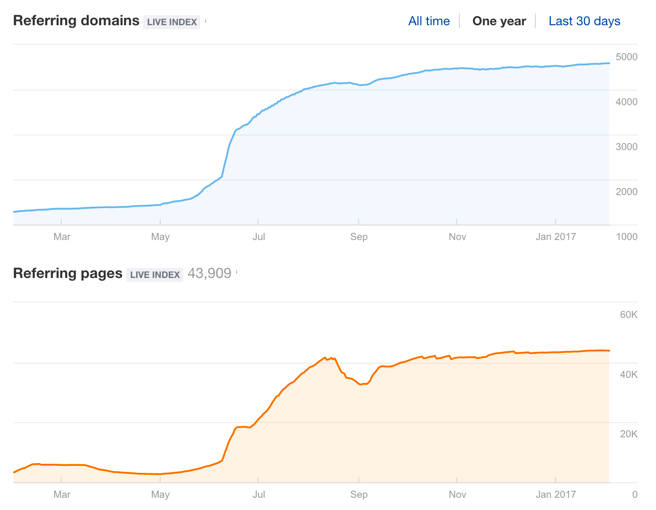
Ahrefs indicates that YNAB is increasing in referring domains quite healthily. The data below raises the question: where is YNAB getting their links from?
One thing I found right away, is that YNAB has some great links on what I like to call “feeder sites.” “Feeder sites” are sites that have content that is syndicated by many other large publications. Finding valuable feeder sites can be immensely powerful for SEO due to the amount and the quality of links that can be obtained.
Below is an example of what this feeder process looks like that YNAB has benefitted from.
An article was placed on the Reader’s Digest’s site, RD.com, entitled “34 Little Life Skills Everyone Needs to Be a Grown-Up.” RD.com is a feeder site to MSN.com as well as a handful of smaller sites. You can see that MSN.com syndicated the same article here. This means that for the effort of creating one very high-quality post, you can net a handful of links, sometimes from some large publications. This can be immensely powerful, and can lead to great jumps in increased rankings,
In the last few months, YNAB has received links like these:
And this is honestly only naming a few of the total links built recently.
YNAB is in a great position. It has the benefit of being able to target money-management communities with its methodology while at the same time targeting sites that focus on cell phone apps. This widens the targetable audience for the amount of websites YNAB can get links from. More links equal more authority, and when properly used, convert into better rankings and more traffic.
YNAB gets numerous mentions on both large and small publications. It is in the great position of garnering many mentions through its thousands of devoted fans. Typically, sites struggle with gaining more authority, therefore, they need a lot of high quality and well-targeted link building.
One note, however, is that many of the specific blog posts on YNAB’s site don’t get as much link love as the core YNAB pages (homepage, feature page, etc.). YNAB would benefit from additional links to their established blog posts, as well as to new posts as they are published. With the right content paired with YNAB’s community, this kind of link building should be cake.
YNAB has opportunities to generate much more organic traffic through their currently ranking pages. In order to diagnose how many opportunities there are, I pulled all ranking keywords (positions 1–50) from Ahrefs. Second, we needed to segment the data in order to see rankings in specific ranking buckets. I segmented rankings by keywords in the top 3 positions, positions 4–5, positions 6–10, page 2, position 21–50, and page 3+ rankings. I did this for every URL on the site in order to gain an understanding of each page and its rankings. The results looked something like this:

From a glance at the spreadsheet above, you can see a particular URL and what keyword positions that it ranks for. This makes it easy to determine which URLs simply need a bump in optimization and authority in order to generate traffic increases. This also allows you to forecast how big the traffic increases will be.
Let’s go through an example of how this data can enable us to take traffic-increasing action.
We see in the above screenshot that the blog post “How to Pay off $26k of Debt in 18 Months on a $35k per Year Income” ranks for 4 keywords in the top 1–3 ranking positions and 9 keywords in positions 4–5. The keywords in positions 4–5 represent around 520 monthly searches. This is what we see on the keyword level.

Looking at the average difficulty of these keywords, as well as taking into account that this post ranks as it does with not many links, YNAB could bump these 9 keywords up into the top 3 with only a handful of inbound links. This would increase the traffic of this page to somewhere between 100–150% with minimal effort. Sure, this is merely a couple hundred visits extra, but considering the minimal effort it would take, it would be worth it. Furthermore, you can see how this strategy can scale across the entire site. YNAB could increase overall traffic to the site by a large margin simply by taking advantage of this strategy applied too many of their blog posts.
The Google Featured Snippets box can be incredibly powerful to leverage. I want to show you how YNAB could leverage it to rank in a position essentially above position #1 (sometimes referred to as position #0). For context, the Google Featured Snippets box was debuted in Sept 2014, and was created as a vehicle for putting relevant answers in user’s hands much more quickly. For example, if you search “how to budget and save money” in Google, you will see something like this (highlights in red are mine):

You can see in the above screenshot that bettermoneyhabits.bankofamerica.com occupies the #0 position in Google’s featured snippet. This gives bankofamerica.com a strong advantage over americasaves.org in positions #1 and #2. Not only does bankofamerica.com have an augmented snippet, it also rank above position #1. This position can generate much more traffic than position #1.
Another value in ranking in the Google Featured Snippets box is that you can circumvent the climb to the top and be picked for a top page ranking, even if your site technically occupies a different rank land somewhere else on page 1. A detailed post on the specifics of how to do this can be found here.
YNAB already ranks on the first page for a handful of keywords that have the Featured Snippets box, but someone else shows up for the Featured Snippet. Because YNAB already ranks on the first page, it could implement some on-page changes and increase its chances of stealing the coveted Featured Snippets position. This would drastically increase the traffic YNAB receives from currently ranking keywords. For example, YNAB ranks in the 10th position for “how to pay off debt." This keyword generates around 5,400 searches per month. At the 10th position, YNAB doesn’t pull in that many of the 5,400 searches. However, if YNAB ranked in position #0, it would pull in a large percentage of that traffic.
Here are some of the keywords that have Featured Snippets YNAB could steal:

The process of optimize live posts is fairly simple, although it takes diligence. Cole Rieben, one of our Campaign Managers here at 97th, has a great post on what changes can be made in order to boost a site into the Featured Snippet spot (found here).
Without a doubt, creating new, high-quality, keyword-targeted content is one of the most rewarding actions YNAB could take. Content should be created for the user first, but in order for it to be valuable, it must also be findable. SEO done well is the perfect marriage between solid content and the ability to have that content found when users are asking questions. Keyword research can further help you understand exactly what kind of content people are looking for. It is an insight into their needs. Think about it, these people are asking questions already, we just need to meet their question with the best answer.
YNAB has created a lot of content. Most of it is fairly short and doesn’t rank for a ton of keywords. In addition, there are so many budgeting-related questions being asked daily. If YNAB can answer these questions with their grade-A philosophy and budgeting tool, it would be a huge win-win. Users get the answers they need, and YNAB grows.
To analyze what the market looks like in terms of budget/finance related keywords, I pulled a lot of data—like, over 111,000 unique keywords worth of data.
After researching the keyword level data, we needed to organize it to make it useful. The goal in leveraging all of this data is to understand a few things.
The first is keyword groupings of well-ranking URLs in the finance space. These URLs are from many other finance related sites. The data allow us to understand what keyword groups Google ranks these pages for. Secondly, I want to understand what it took for these sites to rank well
From Quick Answers to the People Also Ask section, featured snippets have been at the top of numerous result pages and top of mind for many digital marketers and online businesses. First position in Google search is no longer adequate, especially when almost any competitor on the first page could qualify and leap multiple positions to snag the prime real estate above the first organic result. The result pages that have featured snippets tend to have two important elements, an entity and an attribute related to that entity. Here is a diagram Google used to explain the concept in their patent for Inferring attributes from search queries:
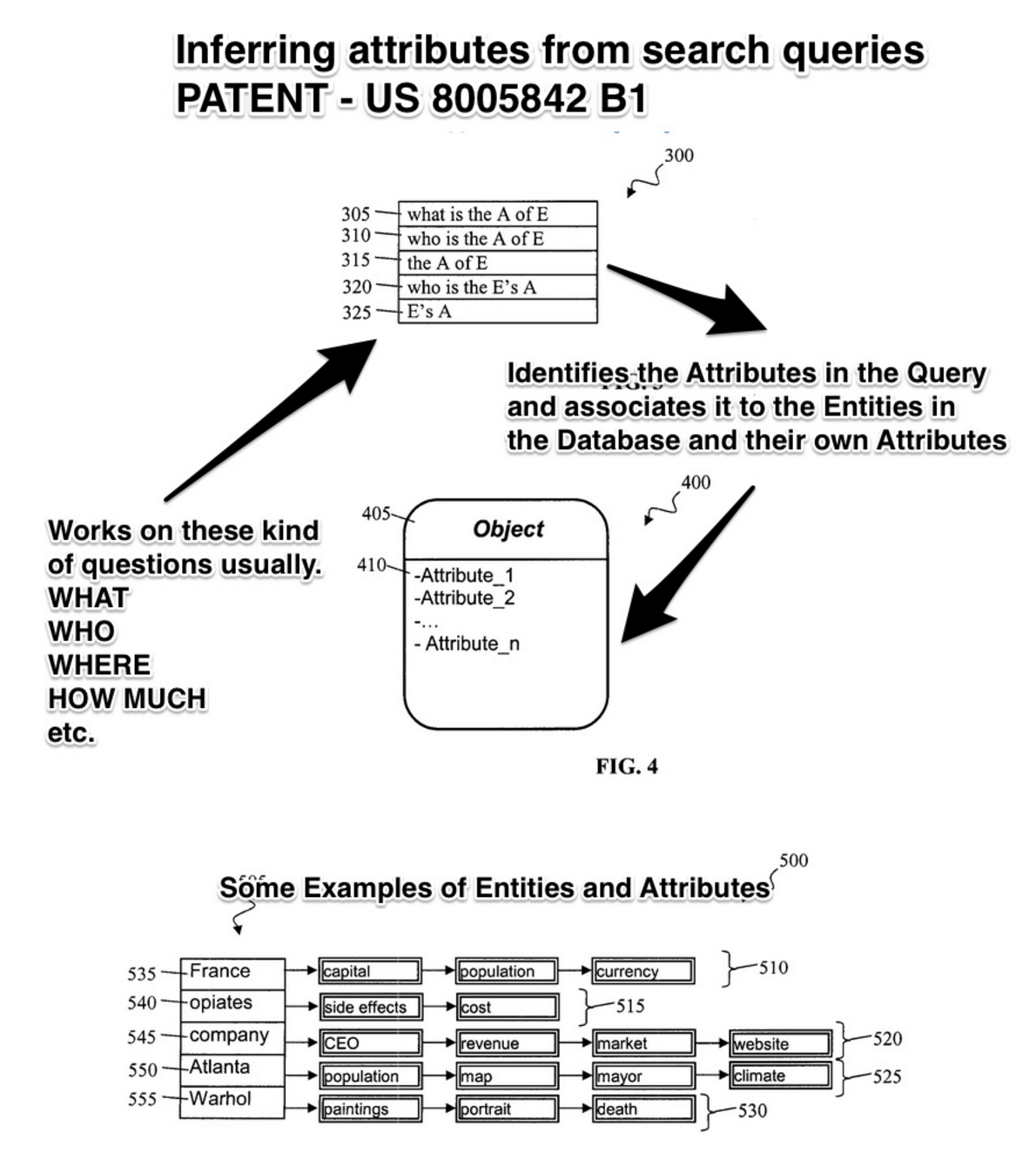
While these results are not new, there are still tons of opportunity to be had. For starters, they’re being rolled out to more international SERPs as time goes on. There are still plenty of US queries for which Google will eventually display a featured snippet. Below are the findings of three consecutive studies performed by Stone Temple Consulting whose data from 855k test queries support the assumption that there is still more growth to be had.
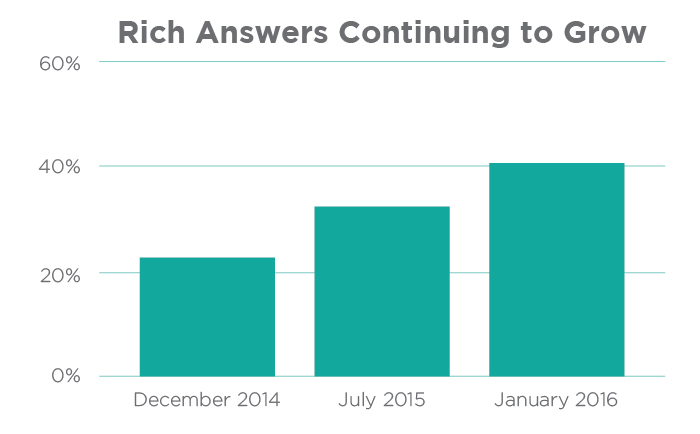
Is Optimizing for a Featured Snippet Worth the Time and Effort?
Before you go any further, and before I get into optimizations and prerequisites for showing up in a featured snippet, you should weigh the potential gains from your efforts. For some markets there aren’t currently any featured snippets present. Don’t forget that Google is still rolling this out to new areas and for more terms. So I would still encourage research and optimizing pages that rank high for potential featured positions. The payoff may not be immediate though.
In most cases where the opportunity currently exists, tests have shown an unexpected increase in click throughs. The assumption is that having a featured snippet on the result page for a query would reduce the clicks to the first position url and subsequent urls. Matthew Barby’s sample of Hubspot urls showed the opposite with an improved amount of click throughs to result #1 that followed the featured snippet. His analysis showed that the urls that displayed in a featured snippet saw a higher click-through-rate than ones that only displayed in regular first page results.
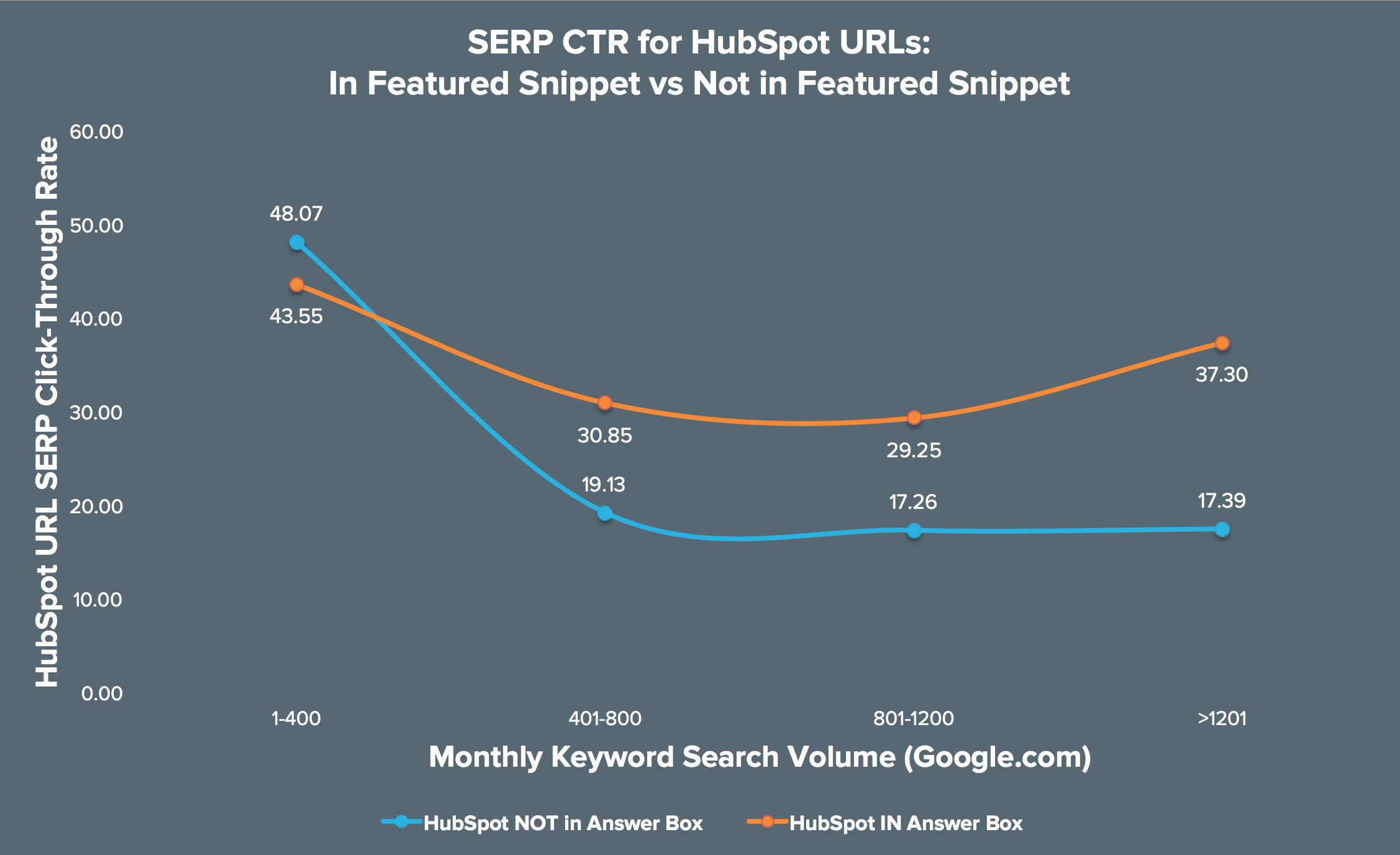
Where to Optimize
I would first start by digging through Google result pages where your site ranks #1. If there are featured snippets on any of those result pages that aren’t pulling from your site then there is great opportunity for some upgrades to your page. If your site ranks for a large amount of queries in position #1 then focus first on the higher volume terms. While it is very possible to grab a featured snippet position if you aren’t ranking #1, there are two separate studies showing that about 30% of featured snippets pull from the #1 result. The graph below was pulled from a study run by Moz on 10k keywords.
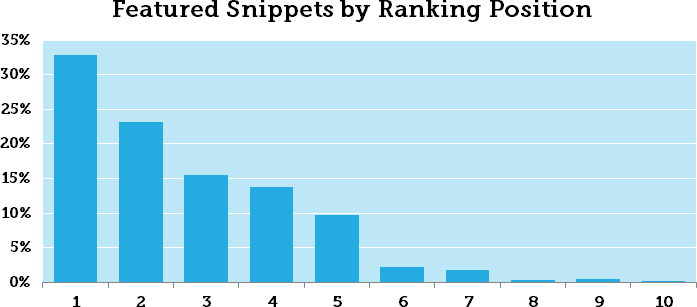
The second study was run by Stat with 1 million competitive keywords. While they found a similar result that about 30% of featured snippet results pulled from the #1 ranking page, they do call out that 70% of featured snippets came from results other than the first organic position. Even more interestingly, they found that a small percentage of queries sourced their featured snippet from positions beyond #10. I would recommend downloading their whitepaper that explains their findings from analyzing 1 million high-CPC terms.
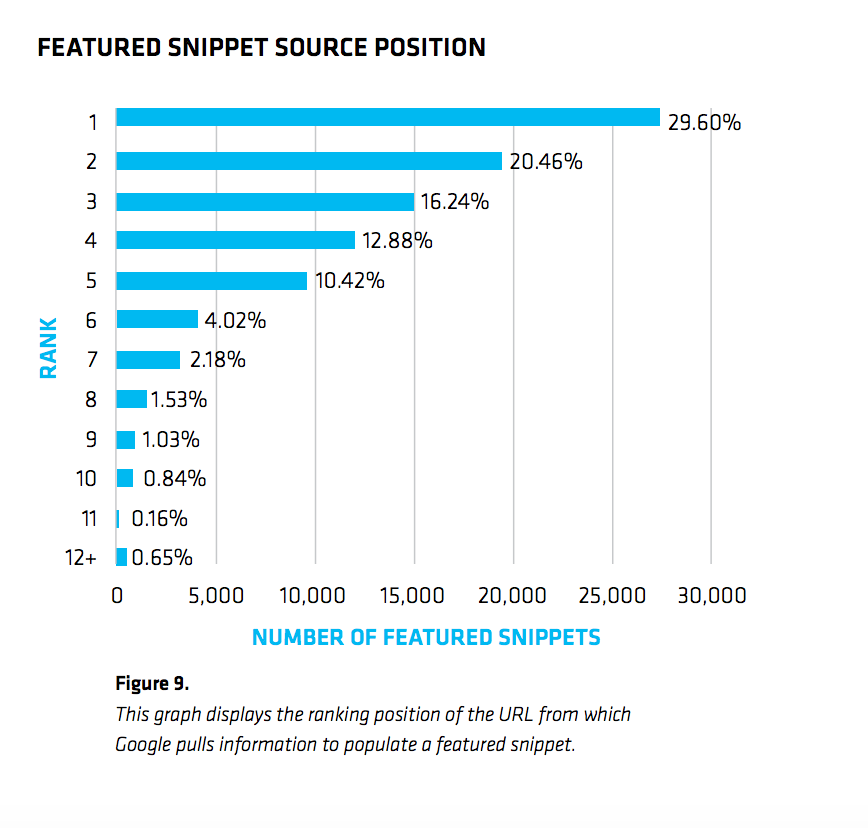
Dr. Peter J. Meyers illustrates this nicely as he proved this to work for Moz and the question phrase “What is page authority?.” Another site lept over Moz’s #1 result for the term to capture the featured snippet position.
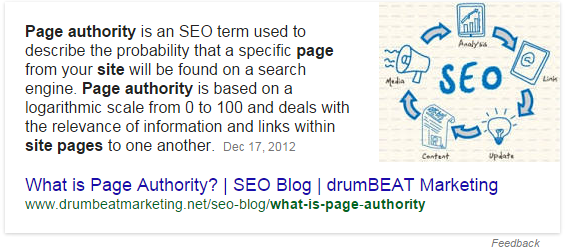
The Moz team noticed that Drumbeat Marketing did a great job of directly and promptly defining page authority and answering the question. Moz promptly upgraded their copy with the question in the header, and to read as follows:
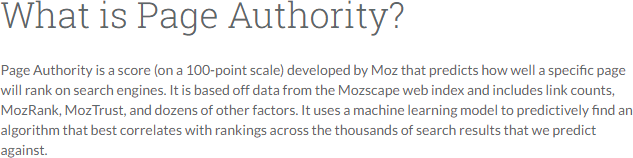
Not long after, they captured the prized featured snippet display for that query while maintaining rank in the first position.
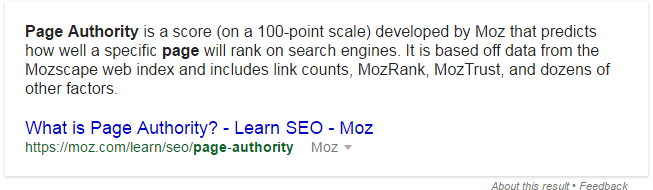
The next area of focus should be on any other keywords your site ranks for on the first page. You could waste a lot of time researching all the keywords you could potentially rank for but your time is most wisely spent on first page positions based on the data from industry tests.
How to Optimize
Now that you know which pages need your attention you can determine which type of featured snippet to rank for. Is it a list? Is it a paragraph answer? Is it a table with information? Google very plainly communicates in their explanation of featured snippets that page markup won’t be a factor in qualifying for these positions.
Where does the answer summary come from?
The summary is a snippet extracted programmatically from a webpage. What's different with a featured snippet is that it is enhanced to draw user attention on the results page. When we recognize that a query asks a question, we programmatically detect pages that answer the user's question, and display a snippet as a featured snippet in the search results.
How can I mark my page as a featured snippet?
You can't. Google programmatically determines that a page contains a likely answer to the user's question, and displays the result as a featured snippet.
So the best thing you can do is upgrade your content to fit the query's featured snippet. In Stat’s research they discovered that paragraph answers are the most common type of featured snippet and displayed that way for more than 80% of the million terms they tracked.

Optimize for Paragraphs
The paragraph featured snippet displays pages that have answer oriented copy as well as the question in a header. Google will only pull a few sentences, so make your answers brief but directed at the searcher. In most cases Google will pull the copy from text they deem most valuable to the user. As such, I have run into an interesting scenario where Google actually selected partial information from a list and displayed it in paragraph form. Below is the result page for “home protection plan”. You will notice that the answer is displayed in a paragraph form, but the page it pulls from actually has it listed out.

The same approach should be considered for the People Also Ask section. Once research is done on related questions, follow the same pattern of addressing the question and exclusively answering it below the header. In most cases you will be building out questions and answers on your landing page and not a designated FAQ page.
Optimize for Lists
The featured snippet that displays a list is one of the more recognizable types and usually occupies more real estate on a result page than paragraph answers. These types of answers tend to show up for how-to’s, cost breakdowns, as well as numbered and bulleted lists of all kinds. To rank for this type of featured snippet you may want to adjust some copy to introduce a list. Do your best to use the term or phrase in the heading of the list. It is important that it stays relevant and increases the value of the page. Another thing to keep in mind, especially if you win these positions, is that you leave the user wanting a little more. Give them a reason to go to your page. Recipes can be a great chance to do this as each step usually involves more details that can’t fit.
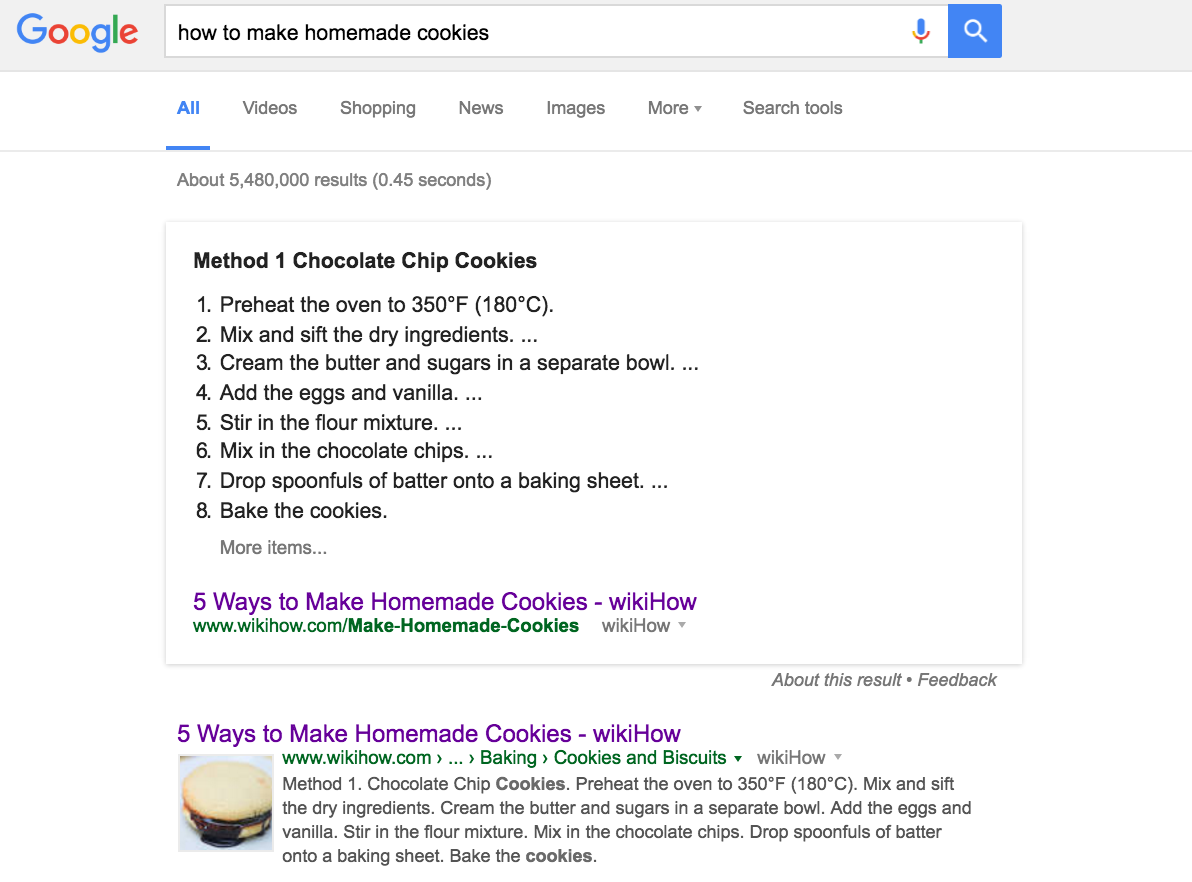
Stat’s research also found the use of <ol> tags on pages are 41.6% more common in featured snippets than in regular results. They saw the use of <table> tags nearly 22% more common in featured areas than in regular results. This brings me to the next type of featured snippet.
Optimizing for Tables
Optimizing for tables really comes down to displaying data or information that may already exist on your page a little differently. If you currently have a list on that page but there is an opportunity to grab a table snippet then find a way to compare the list to another list or just display multiple attributes at once. As mentioned above, it wouldn’t hurt to make sure that you are using <table> tags on your pages.
The most important area to focus on for optimizing your chances of being featured is your on page copy. Backlinks and other external factors for ranking become less important the closer your page is to the first position. Remember that before you optimize any pages you will need to research the Google result pages for keywords you rank for on the first page. The benefits of more clicks are definitely there, and you can always do more to direct the user to your page with enticing copy. This is definitely an area of optimization that you will want to return too often as Google expands to new markets and includes featured snippets in more result pages.
The most valuable metrics are the ones that impact the bottom line. The right numbers shape the future of your business by showing where to focus, how to improve, and when to adjust.
Choosing which metrics to track isn’t always easy. Marketing performance indicators must be set before meaningful progress can happen.
For a campaign to prove its viability, it needs data specific to its business’s purpose and goals. Clear measurement starts with understanding the language of performance. Metrics, KPIs, and goals may sound similar, but each plays a different role in shaping strategy.
Metric: A metric is essentially any signal that can be tracked. It’s an objective system of measurement, which means that you might have an entire dashboard of metrics that you’ve set up to be tracked. But dashboards only serve as directionless numbers without goals and KPI.
KPI: KPIs (key performance indicators; often called marketing performance indicators) are the metrics that you’ve decided to use in tracking how efficiently your business is meeting its objectives. It’s a little tricky to get down the difference, but just remember that while all KPIs are metrics, not all metrics are KPIs.
Goal: A goal is a metric-driven objective, defined by a clear timetable and tactics, that you are trying to reach. The best goals are SMART goals (specific, measurable, attainable, realistic, time-bound). Goals set a bar for the future of certain KPIs that you then strive to achieve. Goals should move your marketing department and business forward.
Let’s put them together. For example, you may decide that next quarter your business should work to earn more site conversions via organic traffic. Your KPI will be organic traffic. Supporting metrics might include keyword rankings and landing page conversion rates. Finally, your goal could be to reach 100 conversions via organic traffic.
The metrics that you choose for your KPIs will determine what your business will achieve. Keep in mind that there’s no comprehensive list of metrics that you “must be tracking” that will work for every business. The following is a list of metrics we’ve compiled from our own experience at 97th Floor for you to consider as you develop your individualized marketing strategy.
Revenue is something every marketing leader should have in their sight. Of course, tracking this is sometimes easier said than done. A good marketing leader will make every effort to get good data that associates revenue with your various efforts. If done correctly, all other metrics will fall under this single metric.
Conversions are the closest metric to revenue that you can track. What conversions look like varies based on the business. For an e-commerce site, that could be a checkout; for a B2B site, it could be a lead or closed deal. Marketers need to ensure that the conversions they track have monetary attachments. For e-commerce businesses, that can be quite easy; however, B2B companies that work through leads with a sales team will need to be intentional about gathering data and insight from marketing and sales to assign values to things like leads, MQLs, and SQLs.
While knowing the amount of conversions your site brings in is important, knowing the rate at which your site converts traffic to conversions is critical. Paying attention to historical and trending conversion rates will help you know where to focus your attention.
For example, if you see that one month shows a conversion rate that is only 50% of the month prior, you might dig further and see that was the month you launched a new ad campaign. This would tell you that this ad campaign likely wasn’t fruitful.
The close rate is the rate at which leads are closed into actual business and revenue. This metric can be useful in judging both sales and marketing team performance. Lower close rates could mean that the sales team needs additional training, or that the marketing department isn’t providing quality leads. Tracking the close rate will help keep both sales and marketing professionals accountable.
This metric is exclusively for businesses that are running paid ads across the web. Most major advertising platforms (i.e., Google, Facebook, and LinkedIn) have snippets of code called pixels that you can put directly on your site that allow the ad platform and advertisers to track the ad’s performance — including conversions that take place on your site. When ad spend is coupled with conversion data (that has an assigned marketing value) you’ll be able to see the rate of return on your ad spend.
CPL is the total cost to acquire a lead. This is typically used as a long-term benchmark, even though this number may change. For example, a business may find that it costs an average of $42 to acquire a lead over the past year. Assuming budgets have stayed the same, this business can assume that any figure under $42/per lead is a good investment.
As its name implies, CLV is the expected return during the life of an average customer. Marketing leaders at SaaS organizations will benefit the most from this metric. It’s powerful because it can encompass smaller metrics like customer retention rate, customer add-ons, and average length of customer retention. This metric is especially powerful when filtered across a qualifier.
Virtually all businesses utilize some kind of website for their marketing efforts. Knowing how many people visit the site in a given time is essential to knowing the impact of your online marketing efforts. Many metrics could be even more specific than total traffic, such as page visits, sessions, and unique visitors. And, while total traffic might not be incredibly insightful by itself, it’s critical in keeping other traffic-related metrics in context.
There are many traffic sources you can measure, likes ad channels, referrals, social, direct, and organic. Many businesses will benefit from measuring many of these channels. However, organic will make sense for virtually all businesses.
Organic search accounts for over 50% of all web traffic, and unlike other channels, SEO has the potential to attract customers at every stage of the funnel. This could include top funnel conversions like email capture or lead capture, or bottom funnel conversions like demo requests or purchases.
Blogging has proven its worth in the business world, as the most recent numbers say that businesses that blog regularly earn 67% more leads. It has pulled ahead as one of the best ways to participate in both SEO and content marketing. Content will draw users to your site and provide you with unique opportunities to meet their needs. Not to mention the tremendous work that a blog can have on your SEO strategy.
In addition to net blog traffic, consider tracking blog-specific conversions. Conversions on a blog are generally micro conversions, such as newsletter subscriptions, lead magnet downloads, or landing page visits. However, these contacts often move farther along the funnel as they are delighted with your brand and content, and can often turn into leads.
Subscribers are the highest top funnel contacts. They are the ones who know about your business and have opted in to hear more from you. Often, this looks like signing up to be notified of new blog posts or receive a newsletter. These contacts may or may not move farther down the funnel, but that’s okay. Growing your subscribers means growing your audience, which allows you to amplify your content and reach even more new contacts.
Leads are contacts in your database that have indicated some signal that they are willing to learn more than surface-level information about your company, and they’ve given you information to make that happen. Examples of this might come from a PDF lead magnet or a free trial signup.
Are you trying to increase trial sign-ups, improve customer retention, or get more traffic to your website? What are your targeted marketing performance indicators?
MQLs are leads that the marketing team has determined are more qualified than a standard lead based on their action. MQL structure might vary depending on the company, but generally, they are defined as the contacts that have shown enough interest to qualify them as ready to talk to sales. Marketing determines readiness based on either lead scoring or the contacts themselves requesting to talk with sales via a form on the marketing page.
An MQL becomes an SQL after the sales team has determined this lead’s qualifications. Many organizations have their own iterations on this, but SQLs are generally MQLs that are confirmed promising enough to be pursued by the sales team. Sales then takes the reins in nurturing them and aiding them in their journey to becoming a customer.
Email has one of the most positive ROIs of any channel. It’s believed to be as high as $42 for every $1 spent. It’s also one of the most used channels today, despite years of naysayers predicting its demise. This metric measures the effectiveness of subject lines in real-time. However, this metric also tracks much deeper issues, like a company’s reputation. If you have a history of providing good content within your emails, you’ll have a higher open rate.
Email click-through rates (and net clicks) measure the effectiveness of the content inside your email. Having a contact open and read your email is great, but having them follow through on what you asked them to do is even more important. Emails lose much of their usefulness unless contacts take action, so measuring click-through rate is worthwhile.
Social is a set of micro metrics (likes, shares, comments, social traffic, impressions, etc.) from which you can choose what makes sense to track for your company. Some businesses will choose not to intentionally track any of these metrics and put social media on the back burner. For some, social metrics will be a large part of their overall marketing strategy.
The social channels businesses focus on will also largely depend on the company.
Clients and managers may approach agencies and employees with incredibly bad KPIs in mind. KPIs like “increase rankings” or “get more followers” are bound to leave your site barren. Vanity metrics like followers, impressions, or raw traffic can be misleading if they don’t tie back to conversions or revenue.
Healthy KPIs are the ones that connect marketing activity to real business outcomes. Instead of tracking numbers for their own sake, make sure your chosen indicators tie back to revenue, growth, or long-term customer value. When KPIs are aligned with profit, they provide a clear picture of whether your marketing is moving the business forward.
That clarity gets even sharper when you remove the boundary between marketing and sales entirely. Marketer Sterling Snow argues that the highest-performing companies don't have a marketing team at all — they have a revenue team. When marketing owns outcomes alongside sales, both teams stop optimizing for metrics that feel good and start optimizing for the ones that actually drive the business. This short video breaks down why collapsing the line between marketing and sales is one of the most important structural shifts a B2B company can make.
The success of storytelling strategiescan be measured through marketing performance indicators like engagement rates, time spent on page, click-through rates, and conversions.
We’ll close out with a story. In the 1950s, the young biologist Allan Savory was working to set up natural parks in Zambia, Africa. National parks teeming with wildlife are much more appealing than parks devoid of animals; therefore, Savory’s first plan of action was to move the indigenous hunters from the land to boost the wildlife population.
Unfortunately, shortly after Savory removed the hunters, the terrain began to deteriorate and enter a period of desertification. The land was growing barren and becoming increasingly unable to support the growing herds of grazing animals.
As things began to get worse, Savory turned to the data. He discovered that the desertification problem stemmed mainly from the large number of elephants growing unchecked. According to Savory’s findings, the only way out was the extermination of thousands of elephants.

Convincing the Central African politicians to slaughter herds of elephants was no small task. The Zambian government called in a small task force to check and re-check Savory’s numbers. Finally, the team concluded that Savory was correct and his calculations were sound. Shortly thereafter, Savory (aided by the Zambian government) began shooting thousands of elephants, measuring their success based on how many elephants they killed. Fueled by the self-established metric of elephant population, Savory and his team killed over 40,000 elephants in an attempt to save the land. In the end, the land degradation intensified, and Savory had to live with what he still calls the “saddest and the greatest blunder of [his] life.”
The lesson for marketers? Choosing the wrong marketing key performance indicators can have devastating long-term consequences. Just like Savory’s faulty KPI (elephant population), selecting vanity or misaligned KPIs can lead businesses down destructive paths.
We use a combination of analytics tools and marketing performance indic ators (KPIs) to measure the success of your digital marketing campaigns.
Allan Savory’s tragic pursuit of an ineffective KPI has caused him to spend the rest of his life trying to correct his theory. When looking for success in digital marketing, let’s not make the mistake of pursuing unhealthy KPIs only to end up spending much more time cleaning up our mistakes.
With the right marketing performance indicators in place, you’re ready to design a marketing strategy backed by insight, select marketing KPIs that drive results, and make smarter decisions.
At 97th Floor, we help brands focus on the right marketing performance indicators so their strategies lead to real growth. Our team specializes in aligning KPIs with revenue goals, building dashboards that provide clarity, and creating campaigns that move the needle.
Every brand is unique. Success comes from identifying the signals that matter most to your business and using them to guide your marketing forward.
See how an audience-first approach translates to bottom-line results.
