



Revolutionary branding can change how customers perceive an entire industry, but few companies are willing to take that step in the dark. Uncharted territory comes with a lack of data and research to back your efforts—it takes guts.
Moz said it best. “Playing it too safe is...a great way to remain somewhere in the middle. Almost everyone likes the middle. Nobody loses their job in the middle. Customers come and go at a steady rate in the middle. Nobody boycotts the middle.”
This article explores creative marketing tactics that can help you move beyond the middle. From purpose-driven messaging to playful brand voices, these tactics show how bold ideas inspire attention, spark loyalty, and fuel growth. Whether you’re a small challenger or a large enterprise, you’ll find practical tips you can apply to give your brand the refresh it needs.
Creative marketing tactics are unconventional strategies that brands use to capture attention, spark emotion, and differentiate themselves in crowded markets. Unlike traditional campaigns that rely on predictable playbooks, these approaches focus on being memorable and connecting with audiences on a deeper level.
Think of them as creative marketing ideas that shift perception. They can be bold visuals, unexpected partnerships, purpose-driven messages, or even playful responses to criticism. At their core, creative marketing tactics prove that playing it safe is rarely the way to stand out.
We’ve curated five tips to show you how to put these ideas into practice, along with real-world examples. #1 Be Unapologetically Interesting
“If you always just try to sell, then you’re predictable. You’re every other brand and company out there.” —Michael Lee, Oatly Creative Director. Oatly stands out—we all saw the controversial SuperBowl commercial. The alternative dairy brand embraces unapologetic fun while still communicating its core values.
Part of what makes Oatly so appealing is its contrast with other milk brands. Picture any other dairy brand—the homepage likely has a perfectly composed stock photo complete with a heartwarming description of the product. Swap the milk out with any other household item, like Windex or Clorox, and you don’t have to change a thing.

Oatly stands way, way out with a cartoony, playful, almost handmade aesthetic website. When photos are included, they’re messy and candid — almost like a friend took them. The copy has an unpolished, almost rambling feeling that is nothing like its competitors' carefully crafted, “clean” taglines.

Oatly doesn’t use industry competitors as models for what they should become. While other brands fill their website with recipes to sell more product, Oatly's recipes are only a fraction of the available content. The bulk of Oatly’s content is dedicated to being interesting. The brand even has a section dedicated entirely to "Things we do" that has unique content to make audiences smile.
Lee revealed the core of Oatly’s branding strategy: “Don’t try to sell anything — just be interesting. If you’re interesting, people will pay attention to you and they’ll be interested in what you do next.”
How do they do it though? Oatly takes an unstructured approach. The creative team chats about content that would be fun to create and then they make it a reality. Lee explains, “We produce our own work, and we prove our own work. There’s no filter, no checkpoint meetings with the sales guys, no half way meetings with marketing managers.” This method allows content to land with it’s full creative potential preventing leadership from watering it down. Creating without gatekeepers is a terrifying prospect for many companies, but Oatly doesn’t let this hold them back.
Do This: Trust in creative teams and whatever you do, don’t be content in the middle ground.
Is the strategy of simply being interesting paying off? Oatly is claimed to be the world’s largest oat milk company and 2020 saw a 106.5% increase in reported revenue. Oatly is Starbucks’ oat milk of choice, and there was even a time when people were selling their supply of Oatly for over $200 on Amazon.
Yep, being unapologetically interesting works.
SaaS companies are infamous for ambiguous copy and visuals that all look the same. When every solution looks the same, customers quickly lose interest and have a difficult time keeping track of the unique value each solution offers. Gong, a revenue intelligence software is...different.
The pressure to stand out just got more urgent. Former Slack CMO Bill Macaitis breaks down why lean AI-native startups are now achieving the same ARR with a fraction of the headcount — and what traditional SaaS companies need to do to stay competitive. This short video captures why the window to adapt is closing fast.
Let’s take a look at the websites of some other sales platforms. This industry is ruled by clean designs, cool colors, futuristic gradients, and flat illustrations.

Then there’s Gong with fun stock photos, bright colors, and a playful pooch as its chatbot representative. The smooth UX and attention to quality (albeit stock photo quality) allow the brand to take risks in an otherwise streamlined market.

While some may not enjoy the cheesy nature of its aesthetic, Gong doesn’t really care. CMO Udi Ledergor acknowledged, “If you’re pleasing everybody, you’re not exciting anybody.”

Ledger defines Gong’s brand as “whimsical and authoritative” — two adjectives you wouldn’t normally think go together. They’ve combined seemingly unrelated, opposing elements to craft a brand voice that fits perfectly.
Do this: Carve out your own identity and carry your voice throughout every piece of content.
Ledger continues “When you read our content, when you hear one of our amazing speakers at a conference, when you look at our website, when you go to our LinkedIn content, you see that whimsy coming through everything we do."
This commitment to a consistent voice allows Gong’s audience to instantly recognize every piece of content they create. More importantly, audiences can differentiate Gong from the sea of other software companies who are pushing the same message.

As of June 2021, Gong raised $250 million in funding and ranked top-50 in outstanding growth within SaaS companies—not bad for high-fives and fist pumps.
Billie was the first to push the boundaries in the women's razors market by using body hair in images and fighting against the pink tax. In an interview, Billie Cofounder Georgina Gooley shared the inspiration behind the brand’s identity. “We knew we couldn’t just sell a better product at a better price — we wanted to reinvent the category’s relationship with women.”

For decades, razor brands have depicted the ideal version of a woman. Women were told that their body hair was something to be ashamed of, something needing to be removed. “We've always wanted to put our audience ahead of our product, so emphasizing the importance of choice has always been core to what we believe.”

Billie’s competitors have quickly followed suit. As Gooley points out,“The fact that a new, challenger brand like Billie could change the way women are represented in a century-old category shows that even the newest players have the power to create change.”
Although Billie’s competitors have slightly adapted their imagery, their core branding has stuck closely to the refined, spa feeling we’re used to seeing from razor companies. Billie takes a bold approach to branding with bright colors, body-inclusive models, and 90s throwback styling.

Beyond bold visuals, sticking closely to strong values is what sets Billie apart from other brands.
While overthrowing the pink tax by charging less and offering rebates means smaller margins for Billie, audiences see the dedication to a cause and become lifelong fans. While other companies say they’re committed to women, Billie actually backs up their statements.
Do this: Permeate purpose-driven values at every level of the organization. Put your brand’s purpose before your product to attract customers and open up doors to other creative marketing tactics.
You’ve never met a more hardcore water brand than Liquid Death. The company’s energy-drink-inspired branding is a complete 180 from the peaceful, flowing springs used to market other water brands. The tagline “MURDER YOUR THIRST” seems a little contradictory when selling the most essential-to-life product on earth, but that contradiction is exactly what makes it unforgettable.

CEO and founder Mike Cessario explained that the core idea for the brand was inspired by the hilarious, random marketing in the junk food market. “Liquid Death was a way of taking the healthiest food you can drink and brand it and market it in a way where you can compete with all the crazy marketing of junk food.” Liquid Death is unique because it’s not really competing with other water brands.
And Liquid Death thrives on this bold persona. When social media trolls flood their comments with hate, the brand doesn’t hide or delete. Instead, they double down by turning those insults into music albums (punk tracks with screamed lyrics pulled straight from negative online comments).
Founder Mike Cessario summed it up best: “Hard work is a waste of time if your idea sucks. Figure out how you have a great idea first before you then start putting all the blood, sweat and tears into it.” Liquid Death has that great idea, and they’re not afraid to make it louder by amplifying even their harshest critics.

Do This: Don’t run from criticism. Use it. Turning negativity into content not only disarms haters but also strengthens loyalty among your core fans.
Of course, the irreverence goes beyond the jokes. Liquid Death pairs its over-the-top branding with real values, pledging “death to plastic” by offering a sustainable alternative to bottled water. That combination of humor and purpose has built them a cult following and fueled 126% growth last year.
Liquid Death proves that the boldest creative marketing tactic isn’t just to be different, it’s to take what others fear and flip it into your loudest megaphone.
3M isn’t just trying to stand out in its industry, it’s trying to stand out from itself. A quick look back at the 3M website reveals that its messaging has transformed from a focus on innovative technology to applied science and connecting with the people who use 3M products. Over the years, technology imagery has given way to people-centric visuals.

3M has countless products in various industries, but you probably know them best for their tape. Despite consumer business being the least profitable sector at 3M, this is an area that the brand focuses a lot of marketing effort on.

By focusing on individual consumers, 3M is able to focus on messaging that resonates with people. Because at the end of the day, B2B and B2G customers are just people.
Do this: See your audience as humans—market to them as humans.
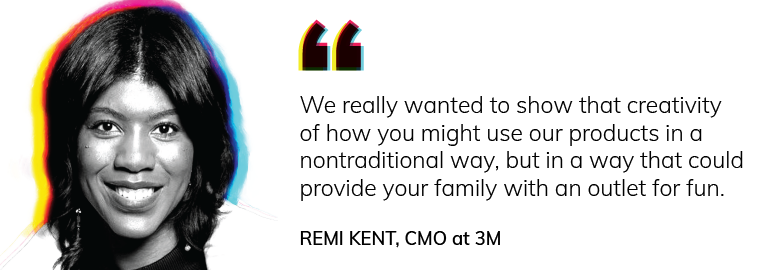
Making science fun and accessible to all is at the heart of 3M’s marketing strategy. CMO Remi Kent explained, “We really wanted to show that creativity of how you might use our products in a nontraditional way, but in a way that could provide your family with an outlet for fun.”
Bold marketing doesn’t always require a complete rebrand or a viral stunt. These creative marketing tactics can be tested quickly and scaled when they work.
Pairing up with a brand outside your category can stop audiences in their tracks. Think Taco Bell and Doritos, or Lego and IKEA. Unexpected pairings spark curiosity and open the door to new markets. The key is to choose a partner that shares your values, even if your products are worlds apart.
Guerrilla marketing is all about disrupting the ordinary. It could be sidewalk chalk art, a flash performance, or a surprising outdoor installation. When executed well, these activations feel more like cultural moments than ads. They generate buzz precisely because they break away from traditional formats.
Your audience often creates content that feels more authentic than polished brand campaigns. Starbucks’ #RedCupContest and Calvin Klein’s #MyCalvins are great examples of customers becoming co-creators. UGC lowers production costs and builds trust because real people represent the brand.
Nostalgia taps into emotions that go deeper than product features. Brands like Pokémon and Nintendo have built entire second lives by reimagining their classics for a new generation. A 90s throwback or retro design element instantly sparks connection because it reminds people of when they first loved your category.
Events, whether virtual or in-person, allow customers to experience your brand in a new way. Red Bull’s Flugtag competitions and Adobe’s creative conferences show how experiences can become brand-defining. Even smaller brands can use pop-ups, live streams, or interactive workshops to create memorable touchpoints.
When brands participate in cultural conversations, they show audiences they’re paying attention. Oreo’s “You Can Still Dunk in the Dark” tweet during the Super Bowl blackout is one of the most famous examples. These tie-ins succeed when they feel natural and timely, so monitor trends and move quickly when opportunities arise.
Supporting a meaningful cause is more than philanthropy; it’s strategy. Patagonia’s environmental stance and Billie’s fight against the pink tax show how brands can build lasting loyalty by aligning with movements their customers care about. The important step is following through with real action, not empty statements.
Sometimes creativity comes from changing how a product is packaged or presented. Heinz’s upside-down ketchup bottle and Reese’s seasonal shapes prove that even small tweaks can make a big impact when they surprise customers. These changes keep products fresh in categories that rarely evolve.
Digital marketing can go far beyond static ads. Interactive quizzes, AR filters, or gamified experiences turn audiences into participants. Spotify Wrapped is a perfect example: it celebrates users while transforming them into promoters who share their results with the world.
Many brands stand out because of how they speak. Wendy’s Twitter roasting competitors on Instagram or Duolingo’s cheeky TikTok presence are proof that tone can capture attention as much as visuals or products. An unexpected voice gives audiences a reason to pay attention in an endless feed of sameness.
Creative marketing ideas are exciting, but they only matter if you put them into motion. Start by defining clear goals for your campaign (ex., awareness, engagement, or loyalty). Choose one or two tactics that align with your brand values, and launch them on a small scale to see how your audience responds. Measure the results, refine your approach, and expand the campaigns that prove effective. The path to standing out begins with a bold step.
When you’re ready to push beyond safe strategies, 97th Floor brings the expertise and creativity to make it happen. Our team has helped brands break free from the middle ground by designing campaigns that capture attention, spark emotion, and deliver results. We’ll partner with you to find the tactics that set your brand apart.
See how an audience-first approach translates to bottom-line results.
Barbara Walters said it best: Taylor Swift is the music industry. However, in celebrating the greatness of her artistry, we often forget to give her praise for her marketing intelligence, business acumen, and pure hard work. Work that placed her on Forbes’ 2021 list of America’s self-made women with an estimated net worth of $550 million.
What goes into it? She’s a business giant, there’s no doubt, but when you compare her to many of her peers, she doesn’t have many of the side hustles that you come to expect from the modern pop star. Take a glance at Forbes’ list of highest-paid musicians and you’ll find that most of them make the majority of their money through non-musical means — clothing lines, shoe deals, perfumes, movie and television show production credits, even streaming services and headphones. By comparison — and it might seem weird to say it — Taylor’s business ventures are relatively humble. And most of it comes back to, you guessed it, content marketing.
Taylor Swift is a powerful brand, and she is incredibly careful with how and where she uses her name. Corporate endorsements include Keds, Diet Coke, CoverGirl, Capital One, and Apple. But this brand didn’t just appear out of nowhere. Ask someone in 2005 who Taylor Swift was and they would likely give you some answer about semi-trucks. How she built this brand is a case study in content marketing itself.
Any customer-focused marketing strategy today is bound to include social media in some shape or form. But in 2005 it was all but unheard of. An early adopter of social media, Taylor Swift started a MySpace blog that would run for years, where she provided content for her growing fanbase that they couldn’t get anywhere else.

Taylor Swift (2006)
7x Platinum
5,750,000 copies sold
157 weeks in the Billboard 200 — longest of any album in the 2000s decade
This early approach to personalized marketing would set the tone for the rest of her career. The growing star would not only post intimate blogs that gave unique insider insights to her followers, but she would also engage with them and encouraged the growth of a community both inside and outside of the platform. In her acceptance speech for a CMT music award for Breakthrough Artist of the Year in 2008, Taylor dedicated it to her special club: “This is for my Myspace people and everybody who voted.” At this point, she had accumulated more than 650,000 “friends” on the platform, but each one of them could have felt she was talking directly to them.
Meeting fans where they are is something that Taylor herself has talked about. In an interview with BBC Radio 1, she mentioned the persistence required at the beginning of her career when it came to convincing her label and management that she needed to engage and use the internet — a strategy that paid off in the form of millions of streams of her music. She also talked of the importance of adapting to changing times. And time and again she’s done exactly that.
She meets fans where they are, and speaks their language
“You just never know what’s gonna happen...every new album release is different because there’s always a new platform, there’s always a new...way to have people experience your music. I just find it interesting, I’m not gonna sit here and ever be the person that’s like ‘it was only good the way it was when I started’...I like the fact that people can experience music in whatever way fits their life.”
Taylor Swift is on TikTok. A seemingly insignificant fact on the surface, but a single glance at Ahrefs’ content explorer shows just how big of a deal it was.

Witness the volume of shared and linked-to content featuring the words “Taylor Swift TikTok” on August 23rd, the day Taylor posted her first TikTok video (a search that yielded over 400 results), and consider that the dress that she was wearing sold out in minutes.
While it is not surprising for a public figure to join a social platform that boasts hundreds of millions of active users, it is yet more proof of Swift’s smart marketing acumen. Her fans are on TikTok, and so Taylor Swift is on TikTok.
The same logic applies to B2B marketing — but most companies still haven't made the shift. Former Slack and Zendesk CMO Bill Macaitis calls out why white papers and analyst relations aren't enough anymore, and where your buyers are actually waiting for you. This short video captures exactly why B2B marketers need to modernize their channel strategy now.
And for Taylor Swift, meeting fans where they are involves more than just being on a platform. Rather than falling into the trap of hiring a team to cross-post the same content on every platform, Taylor...well, tailors her content specifically to the audience on each one — and continues to add a level of authenticity carried over from her MySpace days.
This isn’t the first time she has done this, either — moving from MySpace to the likes of Twitter, Tumblr, Instagram, and now TikTok — Taylor continues to meet her fans where they are, and speak their language.
However, to reduce Taylor Swift’s content marketing brilliance down to social media would be doing a disservice. In fact, look at how she has used Twitter in recent years — a platform where engagement thrives off of large amounts of content:

According to SocialBlade’s record of the top 10 most followed users on Twitter, Taylor maintains an A++ engagement grade, despite a mere fraction of the tweets and despite following no one. How does she accomplish it? Well, it would be easy to say that once you have more than 88 million followers, engagement is pretty much a given. But one glance at her followers tells you that they are continuing to grow daily.
The Taylor Swift brand is thriving, and doesn’t look like slowing any time soon. So much so, that her presence continues to grow even on platforms like Twitter where she is not spending much time. Given, she did spend years building up a Twitter following, and still has a team tweeting regularly through her more corporate account; but to maintain such a prominent place at the top of the Twitter hierarchy indicates a great deal of lasting power and influence. How has she accomplished it?
In case you haven’t figured it out by now: Taylor Swift is the world’s best content marketer. Why? Because she produces some dang good content.

Whether you are a fan of her music or not, the proof of her songwriting caliber is evident in both her critical and commercial acclaim. She is the most awarded artist in AMAs history and is tied with only four other performers for the most Album of the Year Grammy Awards with four. She has also part of an elite group that has sold over 200 million albums, and just recently became the only artist to log 7 albums simultaneously in the Rolling Stone 200 a total of 20 times.
When your content is good, it can have the ability to promote itself. But Taylor Swift — being the world’s greatest content marketer — doesn’t rest on her laurels. And her promotion of her music is second to none. Taylor Swift’s album promotion cycles have been well documented over the years, from lucrative partnerships to exclusive merch deals and even secret listening parties at her own homes.
Yet even when 2020 hit and Taylor released a surprise album in a time of social distancing and isolation, her promotion remained top notch. Taylor’s key collaborator Aaron Dessner has described how her record label was only notified of the album’s existence mere hours before it was released. A true last-minute drop, she could easily be forgiven for forgoing promotion altogether. What we experienced instead was a masterclass in quick strategy. As soon as the announcement was made, her store was equipped with digital and physical copies of the album, available for pre-order — including 8 different versions of the vinyl copy, encouraging fans to collect them all.

Knowing when and where to ramp up promotion is a key skill, and it’s one that Taylor has mastered over the years. We have already discussed her social media prowess, and it’s no coincidence that Taylor’s fan engagement and the frequency of her social posts both increase around the time of a big announcement or new album release. She got to work liking and engaging with her excited followers’ posts, and a number of branded hashtags were also ready to go on Twitter.


The online store was also stocked, with new items cycled in and out as new songs were released. Taylor Swift is a master of employing the marketing tactic of scarcity — bonus songs are available only on physical albums, Target exclusives provide the opportunity to get a unique copy of each album, and fans well know that merch will only be available for a limited time before being replaced with something new.
For some, these kinds of techniques could seem like cash grabs and have the opposite effect to the one intended. But for Taylor, it comes across as added value to her vast fanbase. In short, all of this works because of the place where we started: Taylor Swift knows her audience. Back in 2014, on the release of 1989, she stated:
“I think that what we need to start doing is catering our release plans to our own career, to our own fans, and really get in tune with them. I've been on the internet for hours every single night figuring out what these people want from me. And when it came time to put out an album, I knew exactly what to do.”
In that instance, adding unique polaroids to physical albums was a way to connect with fans, and we have seen this process echoed time and again to this day. At the time of writing, Taylor is busy releasing new recordings of her past albums. And once again, she is exceeding expectations by promoting each one as though it’s brand new. This includes:
The albums also include a number of fresh tracks “From the Vault” including ones that have deep roots in fandom lore. By the time each album is released, you could be forgiven for forgetting that half of it has technically been heard before. Fearless (Taylor’s Version) shot to number one in just about every chart, and smashed a number of records in the process.
<table style="border-collapse: collapse; table-layout: fixed; margin-left: auto
Vivint Solar is a brand that needs no introduction — mostly because they’ve been introducing themselves from our doorways for years. Of course, it doesn’t hurt that they are a multi-billion dollar, door knocking solar juggernaut, but it wasn’t always this way.
Their street presence had never been stronger, they came to 97th Floor with an online presence that was lackluster. Their success in the neighborhoods had left smaller shops eating their digital lunch. They’d seen the gap in their strategy and had a desire to translate their success from the streets to the internet — and in the process, open the door to the even wider audience to be found online.
At the start, we had hardly anything to go on. Vivint Solar hadn’t put a deep SEO plan in place before, and while they organically dominated branded searches, they hadn’t turned any attention to non-branded search terms. So, we began from square one. Not that we minded, we always love painting on a blank canvas.
{% video_player "embed_player" overrideable=False, type='scriptV4', hide_playlist=True, viral_sharing=False, embed_button=False, autoplay=False, hidden_controls=False, loop=False, muted=False, full_width=False, width='1920', height='1080', player_id='25873143908', style='' %}
Vivint Solar needed a clear, intentional SEO strategy. And, because all SEO measures take time to bring in results, it also needed to be enacted soon so that they could establish themselves. With that in mind, we got right to work.
We began as we always do, with market research to reveal the strengths and weaknesses in the strategies of Vivint Solar’s competitors. This kind of research is essential because it identifies gaps that our client can fill — as well as places where they can step up their game in order to keep up.
In Vivint Solar’s case, we discovered that many of their competitors’ ranking pages had great domain authority, and they had already targeted many non-branded terms. With this information, we were armed to take the next step and conduct informed keyword research.
Our keyword research revealed crystal-clear opportunities for optimization and new content. As Vivint Solar was already a known brand — and already bringing in traffic from branded searches — we focused all attention to increase our share of voice via non-branded terms. Our keyword research quickly uncovered non-branded keyword opportunities that would aid consumers along their buyer’s journey. We launched a comprehensive blogging strategy with the intent of attracting inbound traffic through these non-branded terms and increasing on-page conversion through compelling CTAs and copy.
As we mentioned, time was of the essence. We needed to get Vivint Solar’s new blog pages ranking quickly, and link building was an essential part of that race against time. Links build the authority of a page in little time, allowing the page to rank much more quickly than it would on its own.
Our strategy didn’t end there. While our ultimate goal was to increase Vivint Solar’s presence online so they would not be totally reliant on door-knocking, what if there was a way to take advantage of those prolific efforts? Using localized SEO, we launched pages for every locale where Vivint Solar is active, over 100 (but we’ll get to that later). This provided pages tailored to the needs and offers of various states and cities, connecting door-knockers and potential customers quickly and effectively.

With these strategies in place, and a thorough technical audit completed, we put our plans into action — starting with content creation. Together with the Vivint Solar team, we researched, outlined, and produced over 200 articles targeting our various non-branded keywords.
Once article creation was underway, we turned our focus to link building. Our competitive research informed this strategy from the beginning, including the frequency of our backlinks and their quality. After the first month of outreach, we were able to gain over 30 backlinks each month to the Vivint Solar site, each one obtained naturally on quality websites. Not to mention, each link was optimized for a specific page and corresponding keyword. This aided our content in ranking quickly for our intended keywords.
Additionally, we helped Vivint Solar build out robust versions of their local pages, which at the time included 23 states with additional locales within each state. By the time we were done, we had over 100. We built out and optimized local pages and search terms in each of these respective markets.

While the above components are critical to any digital transformation, we knew it was important to look even deeper into Vivint Solar’s funnel than simply awareness-level content. We analyzed the conversion path for Vivint Solar, and identified potential weaknesses or misalignment of message. We then added resources to optimize the user’s experience once they’d entered the funnel, and throughout their journey. We fully audited and optimized email messaging, and created valuable content by breaking down complex industry topics and making them more digestible through quality UX design.
Here at 97th Floor, we love working with remarkable partners like Vivint Solar. Together we moved quickly to not only meet, but exceed the goals we set at the onset of the project.

Before 97th Floor began working with Vivint Solar, only 5% of their organic traffic was non-branded, and today 33% of all visitors are coming from non-branded keywords. Additionally, total organic traffic has increased by an incredible 45% year over year. This was accompanied by a comparable rise in revenue, and a 40% increase in new users. This increase in traffic and conversions has manifested in hundreds of thousands of dollars in recurring revenue brought in from digital channels.
Today Vivint Solar has a shining reputation in residential solar on the streets and on the web — a true physical to digital transformation. Their prospective customers used to have to wait to be found. Now they are able to find Vivint Solar on their own. Through our combined efforts the two methods work together, making Vivint Solar an unstoppable force with a good reputation on the streets and online.
Of course, it’s exciting to hire an agency; there’s a lot of hope and vision that goes into the process. However, sometimes there’s also the feeling of dread that comes with hiring an agency.
“What if they blow it, and what if I get blamed for it?”
You’re not alone. But you’d probably be surprised at just how much of your agency’s success or failure is actually in your court. We’ve made it easy for you to make your decision by putting everything you need to know about agency relationships here on one page. Use this collection of resources to guarantee results and a fruitful agency partnership.
Let’s take a quick step back and cover the bases. A marketing agency is a team of specialists who help businesses grow through strategy, creativity, and execution. Instead of handling every aspect of marketing in-house, companies partner with agencies to access a broader range of skills, including SEO, AI SEO, advertising, content creation, design, and more.
Working with marketing agencies gives you access to expertise, tools, and industry insights that may be difficult or costly to build internally. The right agency acts as an extension of your team, aligning with your goals, delivering measurable results, and helping you reach your audience more effectively.
The success of your future agency starts before you even hire them. When you have a concrete game plan in your research process, you will find the hiring and subsequent partnership going much more smoothly.
Set both parties up for success by making sure you have hit each item on this pre-vetting checklist.
Knowing the answers to each of these items will take time — and some of them may not be possible to complete in full — but careful thought about each item listed below is going to help your business earn greater results with your agency.
☑️ Benchmark relevant marketing numbers (traffic, CPA, closing rates, etc.)
☑️ Have a 12 month goal in mind for a handful of target KPIs.
☑️ Determine what sources of data are trusted sources, including web analytics, CRM data, and sales numbers.
☑️ Set, or seek out, a budget before talking to agencies; a range is appropriate.
☑️ Determine what success means for you in the next 12 months.
☑️ Determine exactly what an agency would need to accomplish for you to reach your 12 month success goal.
☑️ Act and speak for the final decision maker, not yourself (if you are not the final decision maker)
☑️ Do a post-mortem examination of your most recent agency relationship, including reading emails, regular reports, call agendas, and so on.
☑️ Additionally, read through the most recent agency SOW to determine what was actually asked at the onset of the relationship.
☑️ Create a scorecard of important factors for your organization to reference when hiring an agency (e.g. performance, reliability, cost, contract length, etc.)
A lot of folks may disagree about the idea of coming with a budget in mind. True, that number will inevitably change, but there’s little benefit in hiding that from a prospective agency. A few things to note about agencies setting budgets:
☑️ The right agency will press for the right budget
☑️ The right agency will give you the most value for your budget
☑️ The right agency will give more value when you offer more budget
And finally, don’t forget to come up with a list of questions for when you get to the sales process; we’ve got a great list on the next page.
When considering working with marketing agencies, you may find yourself talking with 3-6 agencies before making your hire. Good questions power good discussion and help you feel assured that you are making the right decision in the end. Know what you want, and relentlessly ask questions to learn more.
Use this list of questions during the sales process. These questions can and should be asked over the course of a few phone calls, not all out of the gate.
A little note on RFPs. These are one of the poorest means to understand whether an agency will be a good fit. If you are required to create an RFP, don’t neglect the questions above in your communication with the agencies you contact. Sending information back and forth exclusively through email is not a good way to do business.
More times than not, goal-based contracts are the way to go. However, there are certain situations where one prevails against the other.
Use this chart to determine which is right for your current situation.

There are some businesses out there that will be perpetually deliverable-based. These are usually enterprises with strict procurement processes. Even in situations like this, when working with an agency long-term, make an effort to set an underlying goal as the priority behind deliverables. This will inevitably increase the quality of work produced by your agency.
It’s appropriate to begin an agency engagement with deliverable-based contracts with the intent to turn it into a goal-based partnership. This transition usually takes 3-6 months.
Have you worked with multiple agencies and found yourself constantly underwhelmed and flustered with results? Trust, or lack of trust, may be the culprit. And believe it or not, trust is a two-way street with your agency. Take this quiz and find out if you’re giving your agency enough trust to have a healthy partnership. Download this list as a PDF

When you communicate effectively with your marketing agency, you can expect better results. And those positive results will inevitably power better communication. It’s a symbiotic system that perpetually feeds itself indefinitely.

Read up on what can help you enter or stay in this cycle with your agency, and what will kick you out of the cycle.
At first glance, comparing value is pretty easy. For example, take burgers. If one restaurant is offering a $13.00 burger and another has one for $7.00, then it doesn’t take an economist to see which is the better option.
But there's usually more to it than just price. Maybe the $13.00 burger comes with a drink and your choice of sides. Maybe it’s made from higher-quality beef. Maybe it’s assembled by a skilled chef, who puts their own unique artisan touch into every bite… and maybe the $7.00 burger fell on the floor.
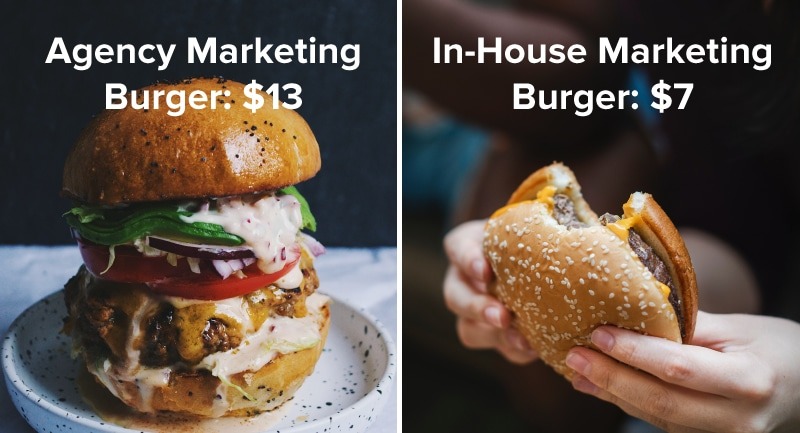
The point here is that there’s more to value than just the initial price tag. When figuring out a marketing strategy, a business usually has two options: building its own in-house marketing department or hiring an agency. And often the deciding factor is cost — which option will save the company more money right now? But like burgers, marketing options are made up of a lot of factors, and when it comes to value, initial cost is only the tip of the bun.
So, before you put in your order, let’s do a quick breakdown/comparison of the actual costs, and shine a heat lamp on the other ingredients that an effective marketing agency brings to the table.
Let’s be clear on one point before we dive into things: There are some advantages to keeping your marketing in-house. Your team probably won’t have to deal with as much of a learning curve regarding your products, services, and brand, and they’ll be able to focus all of their energies on marketing for a single client (i.e., you). What we’re trying to say is that the comparison to the less-than-appetizing $7.00 burger isn’t totally accurate.
However, at the same time, cost isn’t quite as clear-cut either. Sure, the hourly rates associated with marketing are generally lower when you keep everything in the family, but hourly rates don’t tell the whole story.
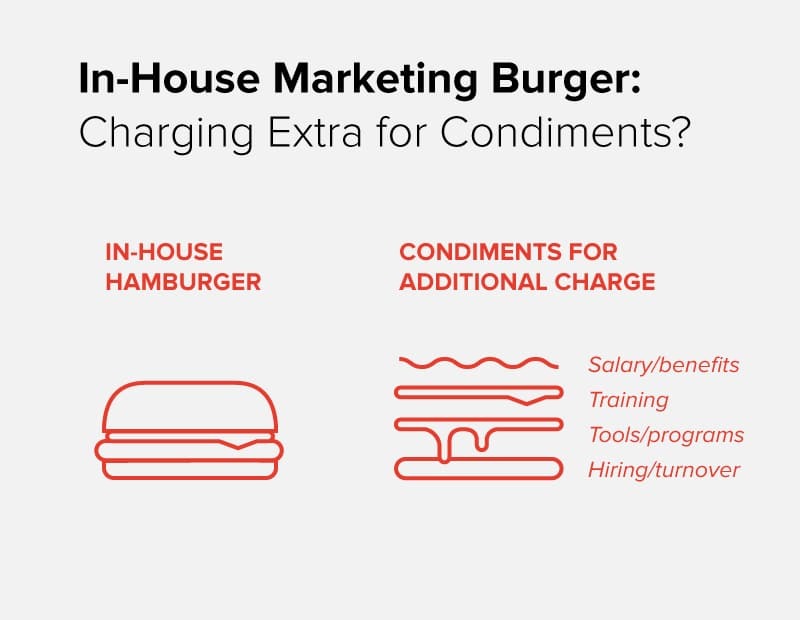
For every employee on your marketing team, you’ve got an entire host of associated costs. Salary and benefits are two obvious ones, but what about training expenses? What about expensive tools and analytics programs? What about the hiring costs, particularly when you’re trying to assemble a talented team from scratch? Don’t forget that “marketing” is an umbrella term that includes specializations in SEO, content and copywriting, analytics, design, link development, strategy, paid search and paid social ads; just finding the right people is going to cost you time and money, and keeping them up to date on best practices is going to cost you even more of both.
And once you’ve got your team assembled, there’s always the threat of turnover. Hey, just because you brought them on and trained them up, it doesn’t necessarily mean that they won’t leave and take their new skill sets with them. That means the possibility of recurring costs, and no clear idea of how much you’ll need to invest until the money is already leaving your pockets.
So maybe an in-house marketing department isn’t a floor burger, but it is a burger that costs an undefined heck of a lot to make, may end up costing you an undefined heck of a lot more as you go, and that still might not satisfy your marketing hunger.
So, how does that compare to the cost of hiring an agency?
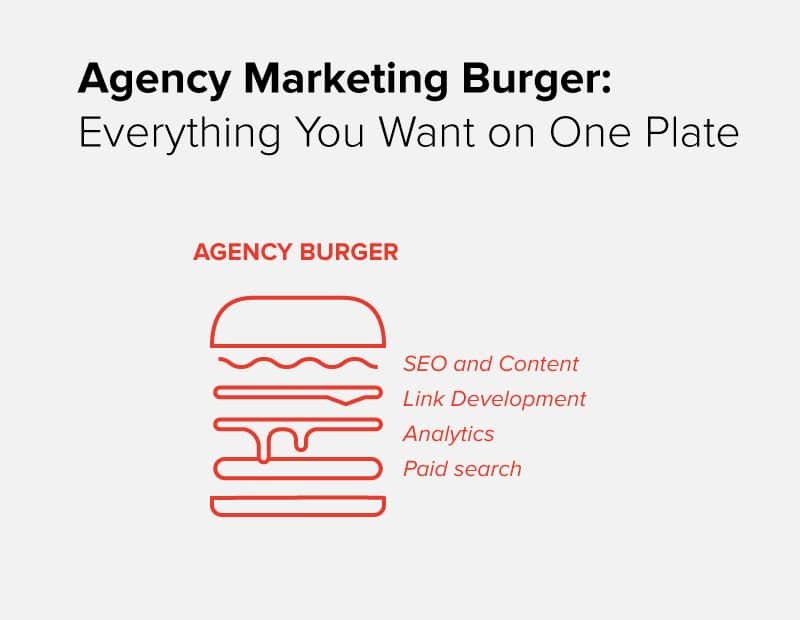
Big companies looking for aggressive growth are usually allocating $25 – $40k/mo in digital marketing spend with agencies, while small and medium-sized businesses are investing between $5 – $15k/mo into digital marketing. That probably sounds like a lot, but what’s worth recognizing is that it’s all-inclusive.
With the right marketing agency, everything is so much more concrete, and that goes double for cost. The hourly rates are probably higher than what you’d be spending with an in-house marketing department, but the hidden costs are nonexistent. It’s a burger with everything on it, and you’re not going to get billed extra for your pickles somewhere down the line. Not to mention the sides, not just French fries—we have the premium sides, all-inclusive.
When working with marketing agencies, you don’t have to worry about hiring specialists or assembling a team, because the agency takes care of all of that on its end. The same goes for training and tools. All you have to do is pick from a menu of services, and you’ll always know exactly how much those services are going to impact your budget. And if contract-renewal time rolls around and you want to switch things up, scaling to meet your changing needs is just as easy. With agency marketing, you only pay for what you want.
To top it all off, let’s not forget the real value that comes from experienced digital marketing. As the co-founder of SEOmoz, co-founder of Sparktoro, and all-around marketing and SEO thought leader, Rand Fishkin enjoys a uniquely informed perspective on marketing agency services, and this is what he has to say:
“I think a lot of web marketing agencies are undervaluing their work, or perhaps competition is getting more cutthroat. Back when SEOmoz was an agency (2005-2009), we were generally charging in that $10-$25K/month bucket, and were by no means the most expensive group on the market.
The best agencies enjoy a time-tested, intimate understanding of the marketing universe — what’s come before, what’s happening right now, and what’s around the corner — so that they can tailor a marketing strategy to fit your business and your industry. And, with multiple clients, agencies also have nearly limitless opportunities to test and evaluate new ideas, advancing their capabilities with every new contract. In short, you end up getting back more than you give out.”
Clear-cut costs, proven expertise, and ever-expanding skill sets — now that's a burger you can sink your teeth into.
Sometimes the less expensive option isn’t really the less expensive option. So, when you’re looking over the marketing menu and trying to decide which option is the best fit for your business (and your budget), consider all the costs. After all, you probably wouldn’t want to buy a burger without knowing exactly how much it’s going to set you back, and working with marketing agencies like 97th Floor, you’ll always be getting the best brand exposure for your buck.
Picking an agency can feel risky; you’ve got a lot riding on it. The wrong partner can waste your time, budget, and even hurt your career. You’ve been burned before, so the stakes feel high.
You know your business and where you want to go, but great marketing takes more than passion. It requires empathy, innovation, and a drive for profitability. That’s where 97th Floor comes in.
Digital. Marketing. Elevated. It’s more than just a cute slogan. Your goals shape everything we do. We work with you to build a tailored strategy, with clear KPIs and budgets that match your needs. Our culture is built around results, not hours, not busywork. Every team member is accountable for delivering outcomes that matter. We’re your partner, working alongside you with full transparency, keeping you in the loop every step of the way.
Proven Expertise
Our team is stacked with certified, continually trained marketers. We’ve been recognized by Fortune, Inc., and Moz, and we consistently rank as one of the best places to work — meaning we retain top talent for our clients.
Leaders in the Industry
We host our own Mastermind conference featuring top voices like Seth Godin, Gaurav Agarwal, and Ryan Holiday, share advanced marketing insights, and speak at events worldwide. We’re here to push the industry forward, not follow the pack.
Giving Back
We pledge 1% of revenue to charity, support local causes, and serve on industry boards. We believe in improving more than just the bottom line.
An Elevated Experience
We aim to deliver results and an elevated experience. We make working with us something you’ll remember for all the right reasons. With 97th Floor, your vision is our vision — and we have the expertise, passion, and track record to get you there. Learn more about what sets us apart here.
Yes, if you choose the right partner. A good agency brings specialized skills, proven strategies, and the tools needed to get results faster than building everything in-house. They also provide an outside perspective that can help you spot opportunities and fix blind spots in your marketing.
Expect a collaborative relationship built around clear goals and measurable results. The agency should learn your business inside and out, create a tailored strategy, execute it with their team of specialists, and keep you updated through transparent communication and reporting.
Some of the pros of working with marketing agencies include:
– Access to a full team of experts across multiple disciplines.
– Established processes, tools, and industry connections.
– Ability to scale efforts up or down quickly.
– Fresh ideas and an outside perspective on your brand.
Some of the pros of doing marketing in-house include:
– Full-time focus on your brand and products.
– Deeper institutional knowledge of your company.
– Direct control over priorities, messaging, and workflows. No middleman.
There’s no one right answer; it depends on your brand. A good place to start is with your goals and KPIs. Then, look at the agency’s track record in achieving similar results for other clients. Consider the cost and the value together. Think about expertise, time savings, scalability, and quality of execution. The right ROI comparison factors in both tangible outcomes (like revenue growth) and intangible benefits (like stronger brand positioning).
Keyword research is a necessary step that you do to understand your market, and plan your SEO strategy. But what if you could use it to learn about user intent, restructure a whole site, and increase conversions as well as traffic? That’s exactly what we did with this client.
CBD American Shaman is a health company that sells CBD oils. While it’s a competitive market, their products have an edge on the competition because they’re water soluble. Despite this, they were struggling to capitalize on their great product with the kind of SEO traffic that it warrants.
Yet the potential was there: An audit revealed that the more specific SERPs previously targeted for the product had a pretty small search demand — but the right strategy could capture a large amount of traffic. Think “CBD oil” with 1 million searches versus “water soluble CBD oil” with only 1,300.
97th Floor was brought in with a clear business question to address: How do we capitalize on this great demand and become a breakout CBD shop?
Like much of SEO, the solution starts on the site-level. The CBD American Shaman site was hosted on a custom CMS (rather than WordPress, Shopify, or Hubspot, etc.), which always complicates technical SEO solutions. Their CMS was completely done by hand. The site organization was also done by hand, and more subject to human error.

They had a wide list of products, but their site wasn’t utilizing this wide variety to capture organic search. Their site’s architecture was flat, lacking the intuitive hierarchy that both Google and the user need to easily navigate and understand a site. In the beginning, there were only three categories on the CBD Shaman site: wellness, pets, and beauty. This organization made sense at the conception of the site, when the company offered few products. However, as their business scaled and expanded, that category structure no longer made sense, and in fact, felt difficult to navigate and drastically out of date.
It soon became clear that a total overhaul of the site’s organization was necessary. Any SEO tactics would yield mitigated returns unless the site was a complete, SEO-driven overhaul.
Just as a doctor treats a whole patient rather than a symptom, we chose to stop looking at each individual problem, and instead gather it all into one place and focus on the most essential and basic purpose of the site. In this process, keyword research and mapping were essential in understanding how to treat the site as a whole — curing all of its symptoms, rather than just hitting one at a time.
Keyword research is important, but like any data, it means nothing on its own. It’s what you do with the insights gleaned from research that matters. So — while sometimes all you need from your keyword research is a handful of new keywords to tackle — for CBD American Shaman, keyword research would go on to guide the entire reconstruction of their site.

We used our keyword mapping to guide the new site’s entire structure. By using keyword research as the foundation of the site, we captured more authority, and redistributed that authority back to the site’s most relevant and converting pages.
For example, the category page for /cbd-oils now houses all of the CBD oil products, allowing for more weight to target that high-volume keyword as well as an ease for the user in browsing the different oils available. In the previous version of the site, the following page was trying to rank for “CBD oil,” /vg-cloud-terpene-rich-cbd-oil-tincture. See the problem? Yes, it was a CBD oil product, but its strength was wasted in attempting to rank for “cbd oil” and it was poorly optimized for a user from coming form a Google SERP.
With the knowledge that these new category pages were much more likely to rank in Google SERPs, we followed our keyword research further. We used it to map and reorganize the entire site, categorically moving pages to align with relevant category pages rather than stand on their own. By connecting these further pages to those authoritative category pages, it allows us to pick up additional traffic from newly targeted keywords.
Evaluating the keyword landscape — which keywords ranked for which landing pages, and which keywords should be combined moving forward — was a BIG project. Pulling all of our ranking keywords, separating them by landing page, and creating new keyword groups took us a full month.
We had to determine what keywords should rank for a single landing page versus separate landing pages, which allowed us to find instances of keyword cannibalization. We also had to cross-reference each keyword within the designated SERP to identify whether a category page or an individual product page was needed to best fit the ranking criteria for that SERP. It was a lot of work, and a lot of detail, but it paid off.

Under the “shop” menu on the homepage, we added sixteen new categories, all based on newly selected high-potential keywords. It turned out that not only did search engine bots like this kind of layout, but users did too. Within weeks, CBD American Shaman saw a 13% increase in organic traffic, not only that, we saw an unexpected radical bump in conversion rates. Which makes sense when you consider how this also drastically improved navigation and the user experience.
CBD Shaman has an extensive product offering that is always being added to. With all of these choices, the shopping experience was previously overwhelming to users. Products were difficult to locate, and customers had no clear understanding of where to find certain products, or even what products were offered. Instead, the site was set up in such a way that they'd have to endlessly scroll through lists of product after product, without the ability to filter based on product type or use. It was hurting their sales, and alienating their customer base. So we knew it had to change.
They are constantly evolving their product catalog. With their previous strategy, a single product page may have built up a lot of authority over time, only to be taken down, and that authority would then be redirected to an unoptimized page or lost completely. With our new category-centric strategy, the business’s evolution is supported. No matter which products are added or taken away, the authority will remain in the category pages. These pages stay consistent in a constantly changing website, allowing users to always find their way.
The result is an SEO framework that not only worked on the onset, but it’s proven effective even a year later. This keyword mapping system has paved the way to double organic traffic for CBD American Shaman.
We’re at the home stretch of 2020, and as much as we’d like to live these last few weeks in comfort, Google had other plans for SEOs. Say happy holidays to the December 2020 Core Update.
It seems like awkward timing. However it’s better than it happening one week earlier, possibly disrupting Black Friday and Cyber Monday online sales. So I suppose there was some level of kindness baked into this release.
The update appears to have begun rolling out on 1pm ET December 3rd (about two and a half hours after Google’s announcement), but it’s likely we’ll see the rollout affecting SERPs for the next week or two, as is typical with these core algorithm updates from Google. However many online, and within 97th Floor's clients have seen fluctuations happening earlier this week, possibly indicating a soft rollout earlier than the official announcement.
Granted it’s been only 24 hours since the results started rolling in, but even still, there are some trends to make note of.
First and foremost, E-A-T (expertise, authority, and trust) has come out as a prevailing set of metrics that determine a positive outcome for sites during this unforeseen update. It’s worth taking a second to remember the May 2020 Core Update, which was a larger than average update, negatively affecting many sites that were not prioritizing E-A-T. It seems that authoritative backlink profiles are a major factor, as they were in the May update.
When reading between the lines on all the forms online concerning the update, it’s possible to infer that many old-school (AKA blatant black-hat) SEOs are feeling the burn of decreased rankings and traffic right now. Much of the May 2020 Core Update also systematically penalized these kinds of sites as well, and it seems that sites that continued to avoid holistic SEO fixes are feeling the heat today.
Ever since the infamous Medic Update of August 2018, many are looking for specific industries hit by these updates, which hasn’t been the case in the same severe way the Medic update was. However, the auto industry seems to be taking more than its share of shake ups today. I would also note that legal sites (and heavily regulated industries in general) are seeing fluctuations.
As helpful as it is to hear Google say, “Our guidance about such updates remains as we’ve covered before,” I want to provide more specifics.
First and foremost, make E-A-T a priority for your site in every aspect, especially link acquisition. A number of big brands are gaining valuable ground on their SERPs, which in itself is very insightful. However, when looking at these brand’s backlink profiles, we’re seeing big link wins in the past 6 months. Double down on real link-building, the kind that passes authority, is indexed, and respected by Google. This can be done by leaning on things like guest post link building and branded link mention reclamation campaigns
Make sure you are accurately documenting your site's success or failure during this update. This update is terribly hard to diagnose with recent traffic, given that last week was a major holiday in the US. So when looking at your position, trust keyword positions over traffic for the time being.
As always, be sure to report this information to your team members and managers with a link and some screenshots from your own ranking and traffic numbers. Explain what E-A-T is and then devise an action plan of what E-A-T means for your site and brand, it will likely involve better content and links.
Reach out to me on Twitter @Joe_Robledo_ with any questions or updates.
2020 is an unusual year. Nothing can be assumed, and shopping trends are no exception. We at 97th Floor commissioned a study that dove into all of the newest trends in Black Friday and holiday shopping. Our objective: to help marketers prepare for this unusual season. In this post we’ll look more closely at some of the most interesting data points specifically around email, and how they might affect your marketing strategy.
This year, shoppers are getting a head start on their holiday lists. 54% of shoppers say they want to do their holiday shopping by early November to avoid crowds, and 68% of shoppers say they’ll be moving online. As marketers, we need to meet our customers where they are. This year, that means online and early.
Because shoppers want to get their shopping done earlier, you should consider emailing them earlier too. Don’t be afraid to email more consistently during the holiday season; shoppers expect to see more emails this time of year, so it’s a great time to take advantage of that as an opportunity to push your brand’s value and story.

Ultimately, the end goal of any email track is to lead your contacts on a journey. You can use email to tell your story, and to explain your value. Use your email marketing this holiday season to build a story for your products. Like J. Peterman’s famous catalog illustrates (pun intended), the way that you present your products must be more than an explanation: it needs to be a story. Best case scenario, even your presentation will be a kind of art. Don’t underestimate the importance of this. Email is a great way to control the way your product is positioned and presented.

Email marketing is the way you’ll be able to take people with casual interest in your products and turn them into true fans. This holiday season, treat all your email contacts like they are at least mild fans of the product (a safe assumption as they did give you their email) and turn them into mega-fans of your brand.
Our stats say that 81% of shoppers aren’t sure they’d head to brick and mortar locations even if the retailers offered great in-store experiences for the holidays. In fact, 88% of parents even say they won’t let their kids sit on Santa’s lap this year. Yet we know that experience is everything. So this holiday season marketers need to turn their attention to the digital sphere.

Be sure that all of the content you put out this season, including your email, provides an enjoyable experience for the user. This includes your website and landing pages. Take a look at the ease of use on your site — can users easily navigate your site to find what they need?
Get inventive with the way you use email as a part of an experience. Create amazing digital experiences and use email to share the opportunities with your audiences. For example, share social media campaigns your audiences can interact with, like zoom calls with Santa, an interactive about how your business works, or whatever the digital experience is that fits best with your business goals. Consider building out a multi-part, text-based experience for your email marketing, something that your audience will look forward to engaging with on day 1, but also day 3, 5, and 9. A story (see below) is one option, but any content that can be broken up in a linear fashion can be turned into an email experience.
Email is an effective way to spread the word about--and create--the experiences you have going on this holiday season; be sure you make the most of it.
Consider which metrics are most important for you, and then track them diligently. For brands just starting on their email marketing, your open rate might be your top priority. More mature email marketers will probably want to make their top priority either CTR (click through rate) or CToR (click to open rate).
The important thing is that you don’t just launch your emails out into the world like fledgling birds where they will either fly or die. Pay attention to performance, experiment, and continually tweak things to see how it affects outcomes. As an agency, we spend a lot of time measuring performance -- it’s our lifeblood. If we aren’t producing results, we lose your trust and your business. For you, in your business, you can afford nothing less.
The age of impersonal email is long behind us. There are many simple, easy ways to make your email copy individualized for your audiences, and they are common enough that they have become expected best practices, not only from savvy marketers, but the everyday consumer. When getting ready for a large-volume push with many different email tracks, it can be easy to want to cut corners, talk generally, and forget what your audiences really want to see.
Use your list’s first names in the email greetings, and choose the email track you put your contacts in based on their specific interests and issues. This will be a busy season, so everyone is about to get busy inboxes. If you want your emails to stand out, get personal. Put in the extra effort, use the research and data you have on your contacts and put it to good use.
It’s easy to fall into the trap of personalization-for-personalization’s-sake. We don’t personalize just because we can, but because it works. However this comes with a risk, too. If you’re not careful, personalization can come across as smarmy, too familiar without cause. This can turn off customers and lose business. The solution is simple: use personalization as a way to show respect for your customers, to demonstrate that you are thinking of them not as a patsy or a mark, but as a valued individual. Use personalization not to manipulate your audience, but to humanize them. Do it because you truly do value and respect them. It’ll show -- and it will help your bottom line.
If you’re not doing email marketing today, now is a great time to get started. Don’t wait until you have every single piece nailed down, even a moderate effort can be valuable. If you are doing email marketing already, now’s the time to ramp up your efforts and improve your process. Get personal, pay attention to your metrics, make it an experience, and build a story. Yes, it’s hard work, but it’s worth it (and we can help!).
May your holidays be bright with email marketing success.
Many retailers use the holidays to end their fiscal year with a bang. This year, many marketers, especially retailers, are putting their hopes in the 2020 holiday season to capture revenue at the tail-end of what has been a hard year. 97th Floor’s latest study dove into all of the newest trends in Black Friday and holiday shopping to help marketers prepare, and in this post we’ll dive deeper into how these insights might affect your ad strategy this season.
COVID-19 has shifted every business’s strategy and planning in 2020. As cases continue to rise, holiday shopping trends are no exception. This season, 68% of shoppers say they plan to do most of their shopping online due to COVID, and 52% of shoppers say they expect they’ll never shop in person for the holidays ever again.

Things are changing, and marketers need to keep up. Especially this holiday season, it will be imperative that marketers make the most of the newest consumer trends. The changing market will likely mean many advertisers will be prioritizing ads for their holiday campaigns, so marketers need to look at what that will mean as far as higher costs in the ad platforms, etc. and need to be ready to traverse the new waters with skill.
Here are a few tips to make the most of your ads this 2020 season based on our recent data.
For two months in a row, Facebook’s CPMs have risen by 10% — reaching a record high for 2020. Higher costs might mean that your strategy needs to pivot. Be sure to place pixels from other platforms on your site so that you can hold onto your followers in case you decide to pivot to other ad platforms that may be less expensive.
With virtually every retailer trying to make up for lost ground earlier in the year, you can bet you’ll see more competitive bids, decreasing your ROAS. Facebook will likely become an incredibly competitive market, with costs continuing to rise. This season, be prepared to switch platforms and pivot to make the most of your budget.
This holiday season, your ad copy and creative needs to stand out, but you already knew that. What you might not know is that only 20% of shoppers say they're definitely in “a shopping mood” this holiday season. Advertisers need exceptional copy and creative to earn clicks and conversions from their audience this year.
Even stores that are used to pushing in-person sales will be moving online, and users will be inundated with ads. Advertisers need to be leaning into their established personas to create copy and creative that speaks to your audience. Even if you have high performing ads, they will likely need a refresh with a holiday angle to ensure they are speaking to your persona during the holiday season.

Savvy advertisers will have already built a deep retargeting pool months ago that they can lean into heavily during the holiday season. So while it might be too late to build a retargeting pool for this season’s retargeting efforts, the holidays could be a perfect time to build that pool for future efforts.
If you can gain a solid retargeting pool, it will give you the leg up in your future endeavors (like starting 2021 off with lower CPCs). Retargeted audiences are some of the most likely to convert, and that’s what ultimately matters over any kind of wide reach or visibility. Figure out ways to get qualified traffic to your site en mass, even if it’s not on a product page, and then use pixels to add them to your remarketing pool. And who knows, focusing on building that pool might just bring you conversions this season too.

This holiday season will be different than anything we’ve experienced before. Advertisers should prep their leadership with accurate numbers, as 73% of shoppers plan to spend either as much or less than they did last season.
Monitor your channels closely and be ready to pivot as needed. Don’t lose track of your CPM or CPC prices, and be strategic with your budget as costs rise. Stay hyper aware, or you’ll find yourself paying a lot more per ad. And look to the future (yes, there’s hope beyond the holiday season)! Build your remarketing pool, and prepare for an audience base that has the potential to stay largely online, even once the COVID crisis ends.
COVID-19 cancelled a lot of plans in 2020. Teachers. Doctors. CEOs. Politicians. Parents. Children. Travelers. They’ve all had to adapt to The New Normal. With Black Friday approaching, we’ll add retailers to that list.
Most retailers rely on Black Friday doorbusters to make their year profitable, and this year Black Friday is even more important to many retailers as they’ve suffered with shutdowns, lockdowns, and letdowns.
97th Floor has helped hundreds of brands find success during their holiday marketing push, but we’ve never done it in a year as unique as 2020. We wanted to know how shoppers would react to these changing times, so we commissioned an independent research study of 1,000 US shoppers to understand their hopes, fears, and behaviors when it comes to crowded malls, bustling stores, and online shopping this holiday season.
We’ve put together some of the most interesting insights in this article, but all the data can be seen in the PDF download attached to this article.


It’s true that this has been a difficult year for business. However, there are steps that you can take to safeguard your own sales as the holiday season approaches. Our advice? Focus your efforts online. 97th Floor will be releasing a small series of in-depth articles covering these topics deeper.
Sign up for our monthly newsletter to make sure you don’t miss one.
Some SEO tactics take months to see results, but the holiday shopping season is already upon us. So, this year we’d recommend finding that sweet spot between SEO that works for ecommerce sites and the SEO practices that yield results quickly. A few “quick wins” you should look at to increase the readability and user-friendliness of your site are product schema markup, proper rel=canonical for duplicate product pages (for holiday special prices for example), appropriate redirects, claim unlinked brand mentions, strategic internal links, and title tag adjustments.
Many brands can expect an influx of traffic during the next two months, so this could be a good time to roll out some testing in order to capture revenue from as much of that traffic as possible. Small changes can make a big difference on your site — one of our clients saw a 29% increase in revenue in just 18 days, without any increase in traffic at all. Imagine the possibilities as traffic does increase this holiday season. Our advice? Get started testing as quickly as you can. That way, when traffic really starts to peak, you know you’re getting that traffic to the most optimized versions of your pages.
It’s difficult to predict what will happen with ad auctions and CPCs during the holidays, but it’s certain prices will go up. Perhaps more this year than any other year since so many brands are hoping to make up for poor performance in previous quarters. Work to get more traffic right now, so that you can form remarketing campaigns later, which will be cheaper and more effective than cold ads. This might mean getting ads out the door earlier than you may have planned. Additionally, get all of the pixels you can active on your site. Even if you are only running Facebook Ads right now, still include pixels for Pinterest, LinkedIn, and Google if appropriate. Doing this will allow you to quickly pilot to new platforms if rising prices caused by holiday influxes on your platform of choice push you out. This will help you keep a steady ROAS.
Keep in mind that people are more likely to try a new product or business during the holidays, so if gaining new customers is a focus for your business, this is your time to shine. Monitor all of your channels closely, as well as CPM and CPC. Become hyper-aware so that you don’t end up paying more than you’d like per ad. Also, build your remarketing pool earlier and be ready to pivot.
Email is a channel that deserves more attention this holiday season. Work on more specific segmentation, increase your email frequency. A greater volume of emails is much more acceptable by most users this time of year, so it’s a great time to show them all the value you can), and be sure to keep it personal. There are little things you can do to add personalization to your emails, such as personalization in both copy and context, that make a big difference to those on the receiving end. Email your contacts based on their interactions with you, as well as the information you already know about them. When the situation is more specific, your emails are more likely to be effective.
There is no doubt that this holiday season will look different than any that has preceded it. Yet, even in 2020, there is still room for success when you plan strategically. Strive to work with the times rather than against them. The data collected in this study can be used to help tell a more accurate story this holiday season. And, taking to heart these suggestions, you can be armed to take this challenge head on — and hopefully see incredible results in the process. We’re going to be dropping more specific articles on our blog throughout this season, so be sure to follow us on social media and subscribe to our newsletter so you don’t miss a thing!
Many ecommerce businesses begin with a D2C model, selling quality products on their own site while dreaming of the days they’ll hit it big by getting serious traction in a major brick and mortar.
It’s a big step and an exciting achievement, but it also carries risk. As you push your product through bigger stores, you give up control over your brand and your ability to connect directly with your customers. It’s often a matter of trading control for (hopefully) greater volume.
This was Zhou — a nutrition brand thrilled to fulfill their longtime goal of seeing their product in 433 Target stores across the US, but worried about the new lack of control. They wanted to retain a hand in their own success, and see that their entrance to Target was a success in terms of actual foot traffic and revenue.

Zhou presented 97th Floor with a fixed budget for advertising in 433 specific locales. The task was one Zhou had never attempted before — drive foot traffic and sales with Facebook Ads to physical Target locations through geo-targeting, in addition to Target’s online landing page. Driving and tracking success via Facebook Ads to your own landing page is easy to track and control, but driving foot traffic to a secondary store is another story.
Ultimately, the strategy and results were so positive that after two weeks, Zhou found extra budget to push towards these ads.
It’s quite a triumph when longtime D2Cs enter big-time stores like Target. But success isn’t guaranteed. The D2C still has to do the work of getting their brand recognized in stores, and pushing foot traffic into those stores to actually buy the product.
In order to start off with a bang and keep the momentum going long term, Zhou allocated some budget to getting products moving in the locales they were entering. Pushing that traffic, especially in those first few weeks, would prove critical in making their transition into Target stores a success.

Zhou came to us with a moderate budget, but when split over 433 different markets even a sizable budget goes pretty fast. We began with a total budget of $30,000, which meant each store got only $4.62 in daily ad spend. This meant we had to be pretty picky and intentional about where we put our money. The tactics we used had to be effective and incredibly targeted. We also ran this project for just two weeks, so time was of the essence. After those first two weeks and initial $30,000, Zhou was so impressed with the results that they decided to push an extra $10,000 toward another five days of campaigning.
We decided that higher click through rates and lower cost per clicks would be the best markers for our success in this particular campaign. In addition to revenue information gathered from Target. This was because we weren’t trying to drive sales directly, but rather foot traffic to brick and mortar Target locations as well as their online landing pages.
The two products that Zhou placed in Targets were Collagen Peptides and Hairfluence supplements. The primary target for these products were women, so we catered our copy and ad images towards that demographic.

We built out a strategy with ads for 160 different geo-targeted markets, including up to 27 stores within each market. The Target logo was prominent in the ad visuals, highlighting that the product was now available at Target. That math adds up to thousands of different geo-targeted ads, each directed at their specific markets. And, to complicate things even further, we wanted all of them to go up within Zhou’s first few weeks inside Target.
With that great volume of ads to set up in such a short period of time, we knew we had to be careful how we approached their launch. If we put them all up at once there was a high likelihood that the Zhou account would be disabled. Which would throw a real wrench into the already time-sensitive campaign. So, we played it safe and uploaded them in batches, day by day.

This turned out to be a strategic advantage, because after the first week, we located the underperformers and pulled them, reallocating their budget to the highest performing ads and locales. This helped us make the very most of the budget, and see quicker and more substantial results from our efforts. It’s always a good feeling to put your money where the data is.
We also created a live dashboard with Google Data Studio so we could see the performance of our ad variants across all locations in real-time. We shared this with the executives at Zhou and their parent company (Nutraceutical) who then shared it with Target. Target was able to provide us with in-store conversion data, allowing us to truly see the impact of our efforts on the bottom line. At this point, Zhou, thrilled about the increasing conversion rates, sent that extra $10,0000 to continue the campaign.

Together, Zhou and 97th Floor truly revolutionized the process of entering brick and mortar stores as a D2C. Zhou kept control of their brand, and pushed customers toward their new Target locations. No longer do D2Cs just have to sit back and hope that greater volume will mean greater results. Instead, they can still have a hand in their own success.
And, it wasn’t just Zhou that profited. This strategy was a win-win for both Zhou and Target — Target gets customers in their doors, and Zhou gets revenue and product recognition. This ad strategy and real-time dashboard were so successful together that Zhou now uses this framework as a playbook when guiding new product lines to enter big retailers like Walmart, Sam’s Club, Costco, and more.
Ultimately, Zhou saw a 27.46% increase in in-store purchases in just one week of this campaign. Proving to themselves, and other curious D2Cs, that profitable partnerships with big-names like Target are not only possible, but probable, with the right ad strategies.

Often digital and brick and mortar marketing are seen as opposites rather than partners, but Zhou proved that it doesn’t have to be that way. Online shopping might be the new frontier, but there will always be a place for the convenience and experience of local brick and mortars. Zhou and 97th Floor’s partnership led to great results, revolutionary processes, and a successful start to Zhou’s product pushing in Target.
Zhou kept control, but was able to take advantage of Target’s wide reach. Now, Zhou is looking for even more products that they can push through this process and get inside of brick and mortar stores.
Visual storytelling is a universal mode of communication that has been in use since the beginning of time. And, through the ages of cave art to silent movies, it has shown itself to be one of the most effective ways of catching not only human attention.
It’s no different in this day and age. From the humble blog article to the Times Square billboard, visual elements tell the story as importantly as copy. No marketing campaign is complete without striking visual elements, and more than likely, that’s what your potential customers will remember.
We’ve compiled 7 storytelling strategies to help elevate your brand:
It takes the average person just 50 milliseconds to form an opinion about a webpage, and 2.6 seconds for their eyes to settle on the most impactful spot. That’s not a lot of time for your brand to make a good impression.
You need to capture people’s attention quickly and slow their scroll down. Even the most avid readers skim webpages. And as people scroll, words get blurred together, losing their impact. If there is no imagery in your storytelling, it’s likely your readers will bounce from your page quickly.
Picture this: a web page advocating a new weight loss method that only includes text, OR a similar ad that includes a striking before-and-after image. Which one are you more likely to stop and look at?

When time is money, getting users to take time out of their day to stop and look at what you have to offer is essential to driving revenue.
Most people remember what they see far better than what they hear. According to some studies, there can be up to a 65% increase in retention if the information is obtained visually. And the best part: images require zero work for the user. Sifting through text is hard, but taking in imagery? That’s fun.
We cling to images in storytelling because they allow us to interpret the information for ourselves, rather than being told how to interpret it. Good images don’t require an explanation. Instead, they tell personal and applicable stories without using words.
Nike’s home page is a great example of this storytelling strategy. Their first fold is an eye-catching video, and their second fold looks like this:

They tell the story of each sport with both text and images, but, as you can see, the text is a very small portion of the story. The majority of the page is taken up by action imagery showing users what playing each sport looks like. And, it looks cool. Can’t you see yourself gearing up for football or playing soccer with the best of them? Most importantly, you could find exactly what you needed from this page without any text at all. And that’s how it should be.
You’ve probably put together an IKEA dresser without reading any of the written instructions. If the visual queues are clear and walk you through the process with baby steps, image-only instructions can be just as effective and a lot less stressful.
Think of the signs that we use in driving. A few have text, but the majority use color, shape, and image to portray their instructions. Similarly, it’s not uncommon to see images in the business world that give customers instructions using no text at all.

How much more enticing is this video on making cheesy potatoes rather than reading a blog post on how to do it? It’s approachable, entertaining, and makes it look easy. Visual instruction is on the rise.
While I wouldn’t recommend doing away with text entirely, I would encourage you to think about how using visuals more strategically could positively change your marketing efforts. Images have the power to instruct your users, which means you have the power to influence what actions they take next.
Take a look at this example from Upright Pose:

This image tells a story, and gives an obvious next step: you’ve been slouching a lot lately, you’re worried about your health, and the solution is to buy Upright Pose. Textual calls to action are important, but they’re also pretty obvious. Imagine the ability to influence a user’s next step without them even realizing they are responding to a call — well-planned and properly placed images have that potential.
Pretend you’re watching a video ad. The camera follows a man getting ready for the day in an average-looking home. Suddenly, he notices a brown paper lunch bag on the kitchen counter. He snatches it up and rushes outside to hand it to a little boy waving goodbye on his way to the bus stop.

Did you need a narrator to tell you that the man is in his own home? That the little is boy his son? Of course not. You followed the context of the story just fine. In fact, having that information spoken would seem silly because it’s so unnecessary.
Take advantage of the human ability to read context in a story. Don’t waste time spelling out information you could give your audience through your images. They’ll pick up the information faster and with more ease, leaving them with a better idea of what you have to offer them, and more energy to move closer towards conversion.
Take a look at this ad from Nikon:

They didn’t need words to let you know that, surrounded by mountains and wilderness, you might find a use for binoculars. Wouldn’t you still feel drawn to the binoculars and the adventure they promise without any words? That’s how the best images use context. They tell an entire story simply through what you see.
Humans are the center of our universe. When we see images, we want to be able to place ourselves within them. We want to know how what you are offering will help us do better or feel better.
So, it’s smart to focus on people when you plan your visual storytelling strategy. Whether that means you show people in your marketing, or whether the implication is implied, the focus needs to be on the humans in the story, not the product.
Look at this visual from Outdoor Voices:

Yes, Outdoor Voices’ products are showcased, but the focus is not on the people. They tell the story of how the product is used and how it makes human lives better. It is the people in the image that make the product notable, not the other way around.
Like we’ve talked about already, the best images tell stories, and the basis of any good story is conflict. So don’t shy away from it! When you can use an image to show potential customers the conflict that your product or service will solve — and not just the conflict, but the solution itself — that is a golden storytelling technique..
Take a look at this advertisement from Home Depot:

In the image, we see a common pain point that Home Depot’s business solves. The messy porch, the leaves on the cement, and the bucket that shares the solution: Home Depot can help you clean up this mess.
People understand conflict, and they crave solutions. Your images can bring out an emotional response from your potential customers that it would take pages of text to convey. Images can speak volumes in a story, so let your images share your conflicts and solutions.
You probably have different colors and styles that you like or don’t like, ones that make you feel good and others that drive you crazy. But designing images for your brand’s story goes beyond preference. Good design can make or break your website, your advertisements, and eventually hurt your revenue numbers.
It’s time to start thinking less like an artist and more like a designer. Artists make things that are beautiful, while designers have a purpose behind their products. Every color or pattern is there for a specific reason. Visually pleasing arrangements (put in place for a specific purpose) are more likely to put your potential customers at ease, tell them your story, assure them of your professionalism, and sell.
Take a look at these two cartons of chocolate milk:

One is a generic brand, the other is a Fairlife product. Fairlife understands that even if they want customers to believe their product is top-notch, their product’s design had better tell that story. The generic brand doesn’t look the part of an elegant, high-end chocolate milk. But it’s not trying to be something it’s not — it’s a generic brand for a reason. So while it may not look “pretty,” its design is telling its own story: run-of-the-mill chocolate milk is 20-40% cheaper and tastes just fine.
Here is another example, this time with websites:

These are both homepages of interior design companies. While both do great work in reality, Amber Interior’s website design intentionally shows users the quality of work they are able to do.
As you can see, the visual storytelling strategies and design of a website or brand truly have the potential to make or break your opinion of them.
It only takes a minute to look at your brand’s visuals with these tips in mind. Evaluate where your brand is succeeding, and where there might be room to improve. Then put a plan in place to optimize your visuals and bring your brand’s game to the next level — increasing your revenue and sales. Remember: a picture is worth a thousand words, so make sure your pictures are saying the right words.
Strong storytelling strategies make your brand stand out and stay memorable. By blending visuals, context, and emotion, you can create stories that connect deeply with your audience and drive measurable results. If you’re ready to elevate your brand through effective storytelling strategies, the team at 97th Floor is here to help.
See how an audience-first approach translates to bottom-line results.
It’s a situation many marketers are familiar with: a great product in a stagnant market. A brand deserving more recognition, fighting for a slice of market share.
This story was certainly relatable for eFileCabinet. But with big marketing goals and a team open to creative solutions, they were ready to implement a strategy that would cement their foothold in the market.
After implementing a multi-pronged campaign — holistic SEO, advertising, content, and email marketing, all wrapped around a creative and expertly executed conference — they were not just seeing results, they were seeing stars.

eFileCabinet makes the champion of document management software. They aim to take the pain out of complex filing and digitizing processes.
While their product was ahead of the curve, they woke up one day to find smaller competitors coming to steal their market share. eFileCabinet needed digital marketing expertise, they needed new approaches, and they needed a team that could ramp up and execute quickly. They found it all with their partnership with 97th Floor.
Our efforts culminated in a campaign so exciting that it not only won multiple awards (and the attention of the press), but also brought in the largest influx of leads eFileCabinet had ever seen.
While it’s fun to smash a few printers, the excitement and attention of a campaign fades, and without the foundation of a well-oiled lead machine, the true potential of that campaign won’t be realized.
In this article I’m covering the ins and outs of this campaign, but if you want to jump to a specific section, go for it!

If you’ve read any similar articles on our blog, highlighting real life marketing wins, you know the first step is typically customer research with the intent to create buyer personas. Audience insights, usually housed in buyer personas, are a critical element necessary before engaging in any campaign. But many marketers (even savvy marketers) underestimate the power of persona creation. Personas are especially crucial when working with an agency. Armed with the insight that only comes via detailed personas you can begin to create marvelous work.
eFileCabinet’s software could serve nearly any business (we all need to organize documents, don’t we?) but when we identified specific audiences that would benefit the most immediately, we were able to refine our customer personas to the most important ones.
The first step in creating personas is always basic market research. eFileCabinet already knew that many of their best customers worked jobs that needed constant document organization. We narrowed down the four most common fields to: HR, accountancy, insurance, and legal.

With four focus audiences in place, we took it one step further, delving deeper into what made these people tick. What were the biggest pain points they encountered in their jobs? Why would they come looking for eFileCabinet?
eFileCabinet introduced their team at 97th Floor to a handful of customers, thus giving us a direct line of communication with our target audience. These in-depth interviews helped shape the final touches on our persona development. Not to mention these interviews made for exceptional case studies down the line.
During the persona discovery process, it became clear to eFileCabinet as well as 97th Floor that our four audiences were not solely document filing drones, but people.
So, instead of marketing to people that live to digitize documents, eFileCabinet changed their strategy to market to humans.
We did a 38-point technical audit and discovered a number of things that were dragging down our rankings. The site was fine, but we were able to clean it up and really make it shine. After all, technical SEO really does lay a foundation for holistic SEO strategy. With a site humming along from a search engine perspective, SEOs could turn their attention to rankings.
Keyword research is an important piece of any SEO campaign, but without personas, keyword research will always be a weak final product. The personas guided the SEOs at 97th Floor in running the keyword research and keyword selection process. We had four different personas, which called for four specific rounds of keyword research. The strategy was to capture these audiences through awareness- and consideration-level keywords specific to their industries.

A collection of product- and market-focused keywords were selected to spearhead the campaign. Originally, eFileCabinet only ranked for about 10,000 keywords, but today they double that, and which contributes to nearly double increase in month over month organic traffic.
Today eFileCabinet ranks for a host of relative market keywords in varying stages of the buyer’s journey, from “going paperless,” to “office management systems,” to “wet signature,” to, “document manager,” to, “hr document filing.” Today, eFileCabinet has effectively transformed into an entirely new SEO force to be reckoned with, picking up 281% more organic leads than the previous year.
Digital advertising can capture an entirely different set of prospects than organic SEO. With our personas in mind, we created a segmented series of campaigns spanning across three platforms: Facebook, LinkedIn, and Google Ads.

Facebook Ads’ detailed demographic targeting gave us the freedom to launch ads that reached a wide but tailored audience. We created targeted ads to those who act like past purchasers, which attracted a new audience of people who behaved like our existing audience. Or in other words, they actually followed through on our CTAs. Facebook is also where we focused retargeting efforts, reminding those who had visited eFileCabinet before what they had left behind.

LinkedIn was instrumental in pinpointing audiences based on job position and industry, which was absolutely critical for our advertising campaign. This allowed us to pinpoint exactly who we wanted to market to, and align that with our constructed personas. Because the targeting was so precise, we were able to build unique ads, copy, landing pages, and lead magnets that were directly tied to any one of our audiences. For example, accountants would see ads about accounting document filing software, while legal assistants would see ads about legal document filing software.

Google Ads allowed us to market to an intent-based audience via keyword targeting. This let us reach people at their stage in the journey, including those with serious intent to buy. Google Ads also worked hand in hand with the SEO strategy. Together with eFileCabinet, we found high-converting keywords, we took that info to our SEO team members and — bringing in the benefits of paid through organic — saving a lot of money in the process.
Testing multiple ad variants was essential in ensuring the different campaigns were attracting the right audiences, and pivoting the ad copy if they were not. In total, hundreds of ad campaigns, with thousands of ad variants were created across the three platforms.

These campaigns brought extraordinary results. We had over 400 MQLs, increased conversion rates on Google Ads by 131% (.54% → 1.25%), with click through rates almost tripling (1.35% → 3.97%). All by simply focusing on the real people behind the job titles, rather than just the jobs themselves.
The secret to great email marketing is a good workflow and customer-centric logic in place. Again, it’s about the people. Email automation platforms, by themselves, lack logic and intelligence. It takes an experienced hand to turn a list of subscribers into leads, leads into customers, and, if you’re lucky, customers into raving fans. The first step, then, is to take full advantage of the email platform and create strategic workflows for each customer persona at each stage of the buyer journey.
Because eFileCabinet’s platform audit uncovered a series of misfiring workflows, overlapping data points, and repetitive offers, the first step in their email marketing strategy was to restructure the entire setup, including campaigns and workflows for each audience.
By creating a dedicated lead nurture experience that hinged on the user’s industry and stage in the customer journey, eFileCabinet could best meet the needs of their users within this channel.
Here’s the thing, everyone talks about the funnel as if it were actually a funnel. Even we are guilty of it. But today’s customers are so savvy that they don’t often progress down the funnel in the direct, linear fashion we want. So having built-in logic to your email campaigns that intelligently delivers what they want (which may not be the next step in the funnel) is imperative to properly nurturing a large and growing list. That’s what we accomplished with eFileCabinet.

I can be honest here, right? Document management software isn’t the most exciting industry in the world. Because of this fact, content needed to be fresh, unique, insightful, and just maybe, a little exciting too.
With the traditional content channels, our efforts encompassed a broad range including ad copy, articles, ebooks, case studies, and email copy. We created four different content campaigns, each pertaining to one of our buyer personas.
The following assets were produced to support the content journey of each of these campaigns:

Sounds like a lot right? It is. That’s the point. Shortcuts in content marketing don't exist. There is only efficiency and experience and, eventually, expertise.
These assets, executed well, and delivered at the right time have created a near-flawless content flywheel, which contributes to perfect adherence to lead nurture goals quarter after quarter.
Squeaky clean SEO, targeted PPC, segmented emails, and persona-driven content left eFileCabinet well on their way to becoming the leading figure in the industry. This would be the time when most brands would queue the fist pumps and pop open the champagne bottles to celebrate.
But eFileCabinet was only getting started. Now was time for the fun stuff.
Everything was humming along nicely digitally, but eFileCabinet had a long-time challenge they wanted to tackle next: Trade shows. Quite a different world than the digital marketing landscape they’d just conquered.
Trade show sponsorships had been lackluster in the past, but they believed there was opportunity still on the table. Together, we dreamed up many ways to get more out of upcoming trade shows. We did countless brainstorming sessions and built decks describing options. It was a battle royale of creativity. When the smoke cleared, one idea stood out as the clear winner: the Rage Cage.
