


Okay, I'm about to get a little nerdy. Stick with me, because I promise it's worth it.
Here's the TL;DR: AI doesn't understand your brand as a name. It understands it as a position on a map. And whether you show up in an AI answer depends on how close that position sits to the question someone is asking.
I always picture it like Jarvis from the Marvel movies.You know that glowing 3D web where everything is connected to everything else, and it shifts and rearranges as Tony works with it? Your brand lives somewhere in that web. And just like Jarvis’s map, it isn’t frozen. Where you show up, and what you show up next to, can shift depending on the question being asked. So the real question isn't "does AI know who we are?" It's "what is AI putting us next to (relative to the query)?"
There's an actual mathematical reason behind all of this. And once it clicks, it kind of changes how you think about every single thing your brand puts out into the world.
You shall know a word by the company it keeps
There's this idea in linguistics, from the linguist J.R. Firth, that gets summed up as: "You shall know a word by the company it keeps." It's part of what’s called the distributional hypothesis, and what it really means is that meaning comes from context. Words that show up in the same kinds of places or together tend to mean similar things. “Cat” and “dog” don’t always appear side by side, but they show up in the same kinds of sentences: pets, vets, food bowls. That shared context is what tells you they’re related..
And it's kind of crazy, because our brains do this automatically. We're constantly classifying things without thinking about it. Take clothing. Socks and shoes both go on your feet, so we group them together. But they're also both part of the bigger "clothes" category, right alongside shirts and jackets. We just know how all of those things relate to each other.
Humans have come up with tons of ways to classify things and figure out how they're connected. AI does the exact same thing. It just does it with math.
Encoding: how AI turns your brand into coordinates
There's a step in AI called encoding. It's when AI takes a concept, a piece of text, an image, whatever, and turns it into math. Specifically, it turns it into a long list of numbers called an embedding.
Going back to the map idea, those numbers work like coordinates. Except instead of just latitude and longitude, there are hundreds or even thousands of dimensions.
On that web, things that mean similar things land close together. So "cruise to Alaska" and "glacier sightseeing vacation" end up near each other, even though they barely share any words. That's because AI doesn't understand words one at a time. It understands meaning.
Here's a classic example that helped it click for me. Take "king," "queen," and "man." (I’m simplifying a bit here. Real embeddings don’t have a neatly labeled “royalty” dimension. Concepts like that are spread across lots of dimensions at once. But the idea holds for our illustrative purposes here.)
- King and queen are really close on a "royalty" dimension. They're both royals.
- King and man are really close on a "gender" dimension.
- But queen and man? Not so close on either.
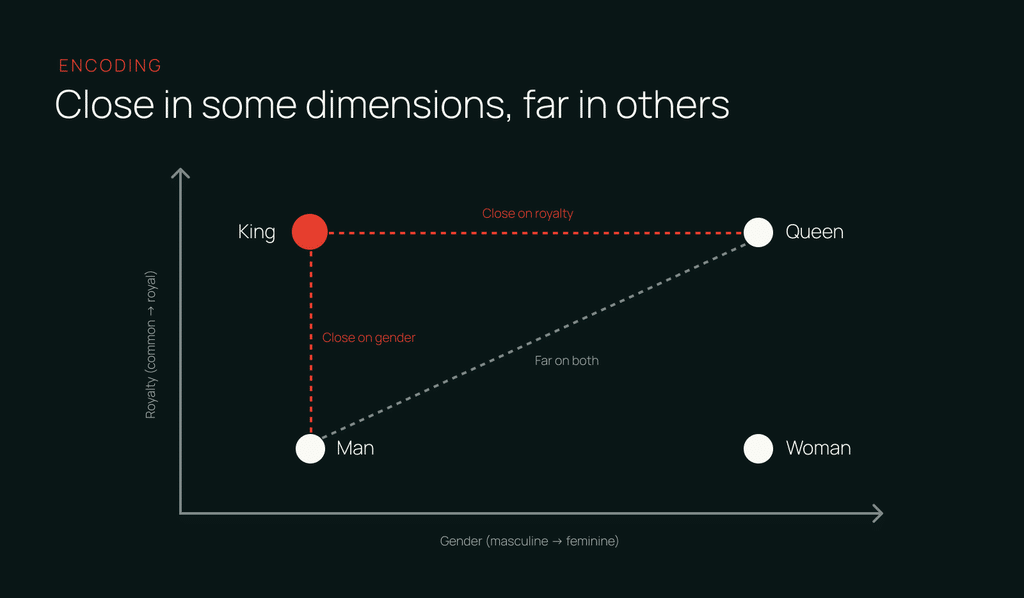
So two things can be close in some dimensions and far apart in others. Multiply that by thousands of dimensions and you start to see how detailed this map really is. This is the same idea behind one of the most famous findings from word2vec research: take the coordinates for “king,” subtract “man,” add “woman,” and you land almost right on “queen.” The map stores not just the words then, but also the relationship between them.
Everything about your brand gets encoded the exact same way.And it's not just your website or your About Us page shaping it. It's everything written about you: reviews, press, listicles, Reddit threads, random obscure forum conversations. All of it decides where your brand sits on the map and what sits right next to it.
Cosine similarity: measuring how close two ideas are
Okay, so once everything has its own coordinates on the map, AI needs a way to measure how related two things are. That's where cosine similarity comes in. (Yes, cosine, like from trig class. I know.)
Instead of measuring straight-line distance, cosine similarity measures the angle between two points, as seen from the center of the map. In other words, it cares about which direction two things point, not how far out they sit. That keeps things like a page being really long or really short from throwing off the comparison.
- A small angle means the two things point in the same direction. They're closely related, and the score lands near 1.
- A wide angle means they're not very related, or only loosely related. The score lands closer to 0. (Technically it can go negative, but with text that’s rare.)
- And then there's every combination in between
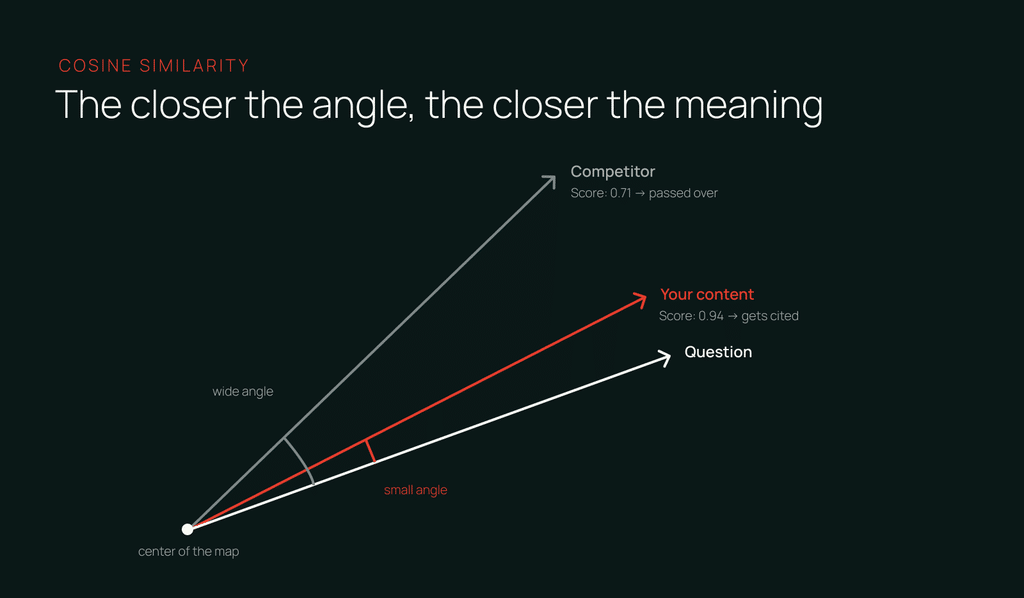
So here's how that plays out. When someone asks AI a question, the question gets encoded too. When the AI goes out to search the web for an answer, one of the main things it looks at is which content points the same way as that question.
If your content sits in the right spot on the map, it lines up with the questions people are asking, and you become a likely candidate to get cited. If it points off, a competitor that aligns better can get picked instead, even if your page is technically about the same topic.
One quick note for the more technical folks. When AI searches the web, semantic similarity (often measured with cosine similarity) is a big part of how it decides what’s relevant, but it isn’t the only factor. Most AI search tools still start from a traditional search index, then rerank the results, and things like authority and freshness still matter. And for what a model “remembers” from training, the map is a really accurate way to picture it, but the model isn’t running a cosine similarity check on your brand every time it answers. Either way, the takeaway is the same.
How associations get stronger: repetition
So how does AI actually learn these associations? Repetition.
Every time a pattern shows up again, that relationship gets a little stronger and the angle between those two points gets a little smaller. If your brand is consistently close to certain terms, that understanding gets fully embedded in AI. (One catch: what a model learned in training only updates when a new model gets trained. New content can start showing up in AI search results fairly quickly, but changing what the model “knows” about you takes longer.)
This is the part I think is really cool. It's not a brand-new idea. Linguists have studied something called collocation for decades: tracking which words keep showing up near each other across huge amounts of text. “Strong tea” sounds natural and “powerful tea” doesn’t, and the only reason is how often we’ve seen each pair. AI picks up those same patterns, just at a massive scale. Academia has a similar idea called co-citation, where two sources keep getting cited together and start to be seen as related.
In marketing, that's basically why listicles matter so much. When multiple people mention you in the same breath as certain competitors, attributes, and topics, that association gets reinforced over and over again. Eventually it just becomes what AI knows about you. It’s not just about volume, though. Where the mentions come from matters too. A handful of mentions in trusted, widely cited sources can do more than a pile of thin ones nobody reads (co-citation again!!)
This is also why the way AI sees your brand can be totally different from how you describe yourself. AI isn't only reading your website. It's reading everything, everywhere.
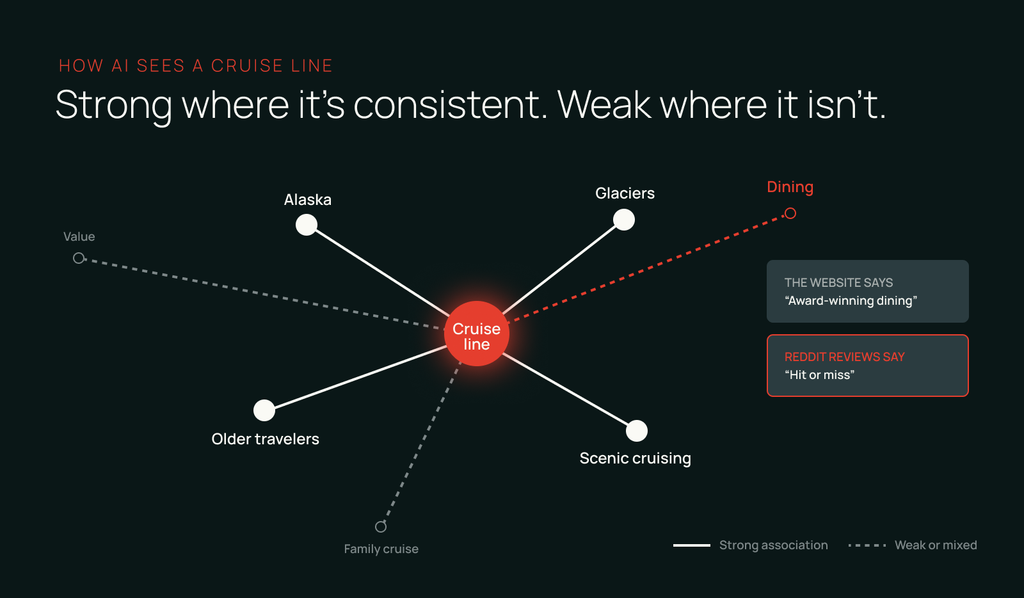
I've seen this firsthand with a cruise line. AI strongly associates them with Alaska and glaciers. Those associations are rock solid. But dining? Really mixed. Even though their website talks about award-winning restaurants and amazing craft drinks, what's out there in Reddit threads and reviews tells a different story. So the AI's encoding of their dining just isn't as strong as their brand guidelines would want it to be.
Association isn't the same as sentiment
That dining example brings up something my coworker Blake Nielson made a great point about. Pretty much every AI tracking tool out there measures sentiment. Way fewer people are talking about association, and they're not the same thing.
"Association: is your brand being associated correctly with your products, services, or offerings? If you're a cruise company, you might be showing up for destinations you don't sell to. That's incorrection association. That’s something we can correct. So association is more of an accuracy thing. Sentiment is the other side of that. Assuming everything is correct, is it being associated positively or negatively?"
— Blake Nielson, Head of Accounts, 97th Floor
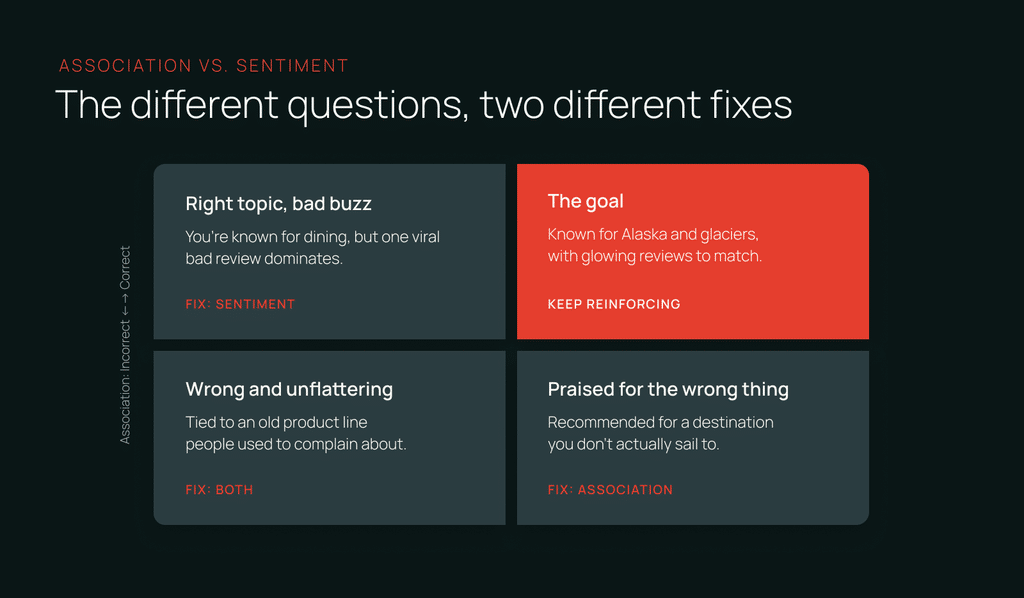
So association is correct vs. incorrect. Sentiment is positive vs. negative. And they get fixed in really different ways.
Fixing association takes time. Maybe your brand used to do something else and there's a ton of old content about it out there. As Blake put it, "It's not as easy as just saying, 'Hey, we do this, we don't do this.'" It might mean consolidating content and building topic clusters around the things you actually care about now.
Sentiment can be a little more targeted. "Maybe we have a negative Reddit thread that's skewing everything," Blake said. "Maybe we had one really bad review that went viral and we need to do something about that."
Going back to the map, these two are connected. If your brand keeps showing up next to words like "disappointing," that's an association too. So it's worth checking both: are we in the right spot, and is the stuff around us good?
So what do we actually do about it?
Be consistent. Like, everywhere. If you want your brand to keep showing up around the same ideas and the same meaning, you need a unified message. And I don't just mean your website, or even just digital. I mean everywhere: customer service, the in-person experience, all of it. If someone has a terrible time on a cruise and goes and writes a review about it, that creates an inconsistency on the map. AI isn't one channel. It's every channel.
Remember that third parties count, maybe even more. The hard part is that a lot of these channels aren't ones you control. Reviews, forums, listicles, roundups. That's why every action your brand takes has to line up, not just the content you publish.
Match intent, not keywords. Keywords still matter for getting found, since a lot of AI search starts from a traditional search index. But AI associates things based on the meaning behind them, and you can say the same thing in totally different words. . So repeating a phrase over and over won't necessarily get you closer on the map. Actually answering the question will. That's why answer-first content is so important. When your content, especially at the chunk level, answers the real intent behind a question, it lands right next to that question on the map.
The math is on your side (if you let it be)
My whole point is that there's a mathematical reason behind all of this. AI isn't randomly deciding who to recommend. It's reading where your brand sits on the map for a query, what's around you, and how strongly those connections have been reinforced.
So stop asking "does AI know about us?" and start asking "what does AI put us next to?" Then make sure everything your brand does, on every channel, is pulling you toward the right spot.
Curious where your brand sits on the map?
We help brands figure out what AI associates them with, then build the content and strategy to move them into the right spot.


