I expected technical SEO and fresh content to be what got HR tech brands named in AI answers. After scoring 115 brands on how often LLMs like ChatGPT and Google’s AI Overviews mention them, neither made much of a difference in our data. The strongest signal was how often other sites talk about the brand.
The short version:
- Off-page mentions mattered most. Web mentions (+0.64) and the number of referring-domain volume (+0.61) tracked AI visibility more closely than anything else we measured. Share of links from DR 50+ sites actually trended the other way (−0.45).
- "Best of" lists act like the shortlist. Each step down in list coverage cost brands about 20 points of AI visibility, and the 18 brands on zero lists sat near the bottom of their categories.
- Content wins on depth and structure, not freshness. Pages over 2,000 words were cited about 3x as often as pages under 1,000. A summary in the first 30% of the page doubled the citation rate.
- Technical SEO is table stakes. Technical factors did little to separate brands in our study, with one exception: the two brands blocking live-answer AI crawlers sat 18 to 20 points below peers their size.
Why we built an AI visibility leaderboard for HR tech
B2B buyers are already building vendor shortlists in AI tools. In a G2 survey of 1,076 B2B software buyers, 51% said they start research in an AI chatbot more often than in Google, and 69% picked a different vendor than planned because a chatbot recommended it.
And in HR tech, those AI shortlists are short. On average, the most visible brand in each category showed up in 55% of that category’s AI answers. More than half the brands we studied (52%) showed up in fewer than 5%.
I wanted a straight answer to two questions: what actually moves AI visibility in HR, and what sounds important but turns out to be noise? The result is the AI Search Report: 2026 HR Tech Edition, a Fortune 500-style leaderboard that shows who's #1, who's last, and where every brand stands against competitors of the same size and category.
How we ran the study
We scored 115 HR tech brands across 15 categories, from Core HR and payroll to background screening and L&D. Over 31 hours of research, we analyzed 1,000+ website pages, tracked brand mentions across YouTube and Reddit, pulled apart G2 profiles and checked whether LLMs could actually read each site, scoring every brand on 30 metrics in all.
Every brand received an AI Search Score from 0 to 100:
| Component | Weight | What it measures |
| AI Search Performance | 60% | Share of voice, mentions, impressions and citations in Google AI Overviews, AI Mode and ChatGPT, ranked within category |
| AI Readiness: Off-Page | 22% (55% of Readiness) | Link authority plus presence on "best of" lists, G2, Reddit, YouTube and Wikipedia |
| AI Readiness: Content | 14% (35% of Readiness) | Content quality across an 8-page sample, plus publishing pace |
| AI Readiness: Technical | 4% (10% of Readiness) | AI crawler access, raw-HTML text, Organization schema, mobile PageSpeed, server response |
Then we compared Readiness inputs against Performance to see which ones actually travel together. Data is US-only, pulled in late September 2026. Throughout this article, “AI Search Performance” is a 0 to 100 percentile within each category. A brand at 70 is more visible in AI answers than roughly 70% of its direct competitors; a brand at 13 is ahead of almost none of them.
Finding 1: Technical SEO mattered less than I expected
In our data, technical factors did little to separate the brands AI names most from the ones it skips. I went in expecting schema and JavaScript rendering to show up as major factors. In this study, they didn’t show a measurable effect.
Here’s how we checked. We audited each brand’s homepage for common technical issues, then compared the AI visibility of brands with each issue against peers of the same company size. The table shows how many brands had each issue and whether it lined up with lower visibility.
| Technical issue | Brands | Effect on AI visibility |
| Blocks live-answer AI bots in robots.txt | 2 | Yes: about 18 to 20 points below their size tier |
| Blocks training bots only | 6 | None visible |
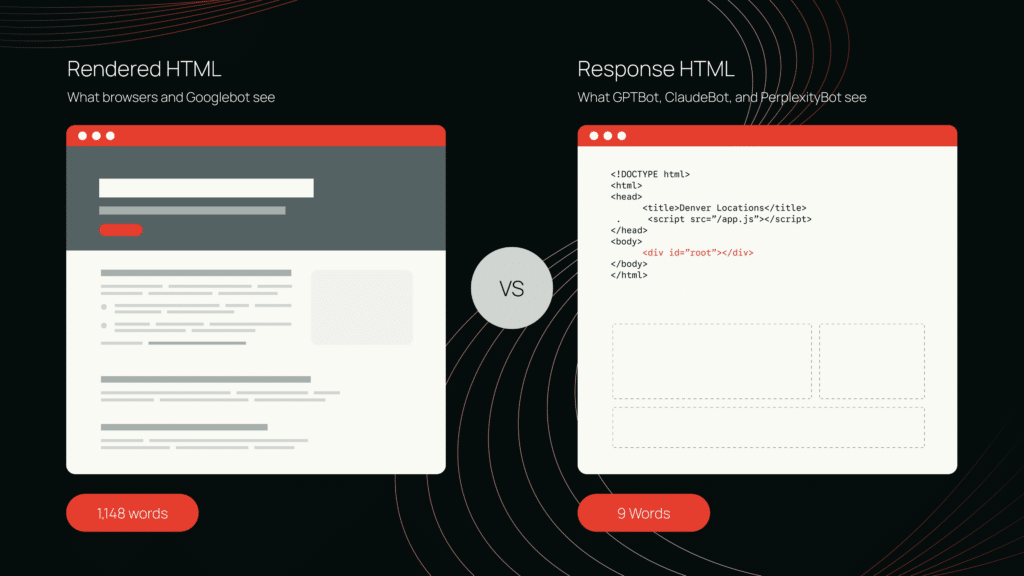
| Mostly-JavaScript homepage | 23 | None measurable |
| No Organization schema | 34 | No difference |
| Mobile PageSpeed under 40 | 49 | None. ADP ranks #1 overall with a mobile score of 32 |
That doesn’t make technical SEO optional. A crawlable, sound site is the price of entry. But in the results we saw, once a site cleared that bar, extra technical polish didn’t translate into more AI visibility.
The one rule you can't break: don't block the bots that fetch live answers. If ChatGPT or Perplexity can't read your site when a buyer asks a question, you're out of the conversation. Open your robots.txt today and check.
Finding 2: Depth, early summaries and fast answers get cited
Three page traits moved citations: length, a summary near the top, and answering the question right away. We audited 860 pages across the 115 brands, 8 per brand: three top-traffic pages, three random pages and the two most recent posts.
| Page trait | Cited share (has it) | Cited share (doesn't) | Verdict |
| 2,000+ words vs. under 1,000 | 27.3% | 8.3% | About 3x |
| Summary in the first 30% | 25.8% | 12.6% | About 2x |
| Answers the question first | 16.1% | 11.6% | +4.5 pts |
| Links to outside sources | 15.5% | 13.2% | Too small to call |
| Updated in the last 12 months | 13.9% | 14.3% | No difference |
| Original data | 12.8% | 14.4% | No difference |
| Credentialed author | 11.6% | 15.5% | No difference |
Freshness was my biggest surprise. I was sure it would be a top factor. It made no difference at all.
The median cited page runs about 1,700 words; the median uncited page, about 1,100. And the most-cited editorial pages in the study are comparison and explainer content: HiBob's guide to types of HRIS systems (101 AI citations), Workday's HCM software explainer (97) and Workable's types of HR software (56).
Quality beats volume
Publishing more, on its own, barely moved AI visibility. We split brands two ways: whether they publish faster or slower than peers their size, and whether their content quality scored above or below the median. Then we compared median AI Search Performance for each group.
- Slower pace, weaker content: 24. This is the baseline.
- Faster pace, weaker content: 29. Publishing more added just 5 points.
- Slower pace, stronger content: 51. Better content more than doubled the score without publishing more.
- Faster pace, stronger content: 59. Volume helps once the quality is there.
For mid-size companies (201 to 1,000 employees), the gap was even bigger. Among brands publishing at a faster pace, those with weaker content had a median of 21. Those with stronger content had a median of 70, more than 3x higher. If you’re deciding where next quarter’s content budget goes, our data points to making fewer pages better before making more of them.
Finding 3: Brand mentions are the biggest predictor of AI visibility
Off-page presence separated winners from everyone else more than any other pillar. The more places the internet talks about you, the more often AI names you.
Start with “best of” lists. For each brand, we checked the top-ranking “best [category] software” articles and counted how many included the brand. It was the strongest single signal we measured, and it held after adjusting for company size.
The more interesting part is how steady the drop-off is. Each step down in list coverage cost brands roughly 20 points of AI Search Performance:
- On 80% or more of their category’s lists (32 brands): median 70
- On 50 to 79% (34 brands): median 52
- On 1 to 49% (29 brands): median 31
- On none (18 brands): median 13
You don’t need to be on every list to compete, but every gap shows up. And 16% of the brands we studied weren’t on a single list we checked. In AI answers, those brands were ahead of almost none of their competitors.
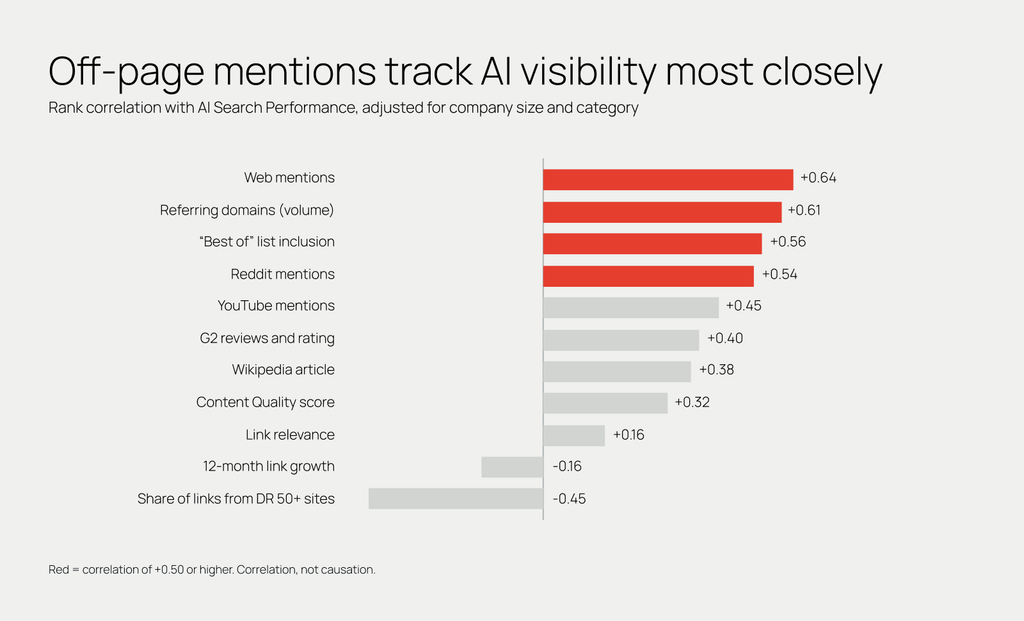
The link data surprised me. Volume of referring domains mattered almost as much as raw web mentions. But the share of links from high-authority (DR 50+) sites correlated negatively. AI tools seem to reward being everywhere over being on a few prestigious domains.
In plain terms: if you're not on the listicles and in the threads where your category gets discussed, you're not in the AI answer.
What HR tech marketers should do next
Here’s where I’d start, in order of how strongly each factor tied to AI visibility in our study:
- Get on the lists. Find every "best [your category] software" article AI tools cite for your buyers' questions. If you're missing, pitch the publisher, offer a demo or a data point, and make sure your G2 profile is complete and current.
- Earn mentions, not just links. Show up where your buyers talk: Reddit threads, YouTube reviews, industry roundups, podcasts, partner pages. Chase breadth of mentions over a few high-DR backlinks.
- Rebuild your best pages for citation. Go deep (aim past 1,700 words on core topics), put a clear summary in the first third, and answer the question in the first sentence. Comparison and "types of" explainers are the pages AI cites most.
- Choose quality over cadence. Fewer, stronger pieces beat a high-volume content calendar, especially for mid-size brands.
- Check your robots.txt. Make sure live-answer AI crawlers can reach your site. Then stop over-investing in technical polish that the data says doesn't move AI visibility.
See where your brand ranks
The full AI Search Report: 2026 HR Tech Edition has the complete 115-brand leaderboard, category breakdowns and brand-level scorecards.
Want to know which buyer questions name your competitors instead of you? Book an AI search audit and we'll map your gaps and build a prioritized 90-day plan.