Elevator Talk: Should You Optimize Content Differently for ChatGPT, Gemini, and Claude?

It started when JennyB asked the team a question in Slack: has anyone actually tested how ChatGPT, Gemini, and Claude cite content, and noticed where they differ? She'd been treating “optimize for AI” as a single bucket, but with client data showing some audiences skew heavily toward one assistant over another, she wondered whether that approach needed to change. What followed was a thread about shared fundamentals, assistant-specific quirks, and how to actually go test the difference instead of guessing at it. Here's how the conversation went.

One Bucket, Even When the Skew Is Obvious

Joe Morrow
Joe MorrowAssociate Content Specialist

Great question! I too have been treating them the same, despite some of my clients having massive skew towards a specific LLM. 100% worth digging into more!

Test the Experiment Before You Trust the Hunch

Rachel Bascom
Rachel BascomHead of Content Marketing

I would love to set up some tests/an experiment for those audiences that are over-indexing on a specific LLM. Maybe picking a topic for one of them and doing something like:

  • Analysis of what's getting cited on one and not another
  • Optimizing with the intention of showing up for the “priority” LLM
  • Tracking progress on all and seeing if there's a bigger lift on just the one, or if it impacts all

My gut is saying that optimizing for one will optimize for all, but it'd be cool to back that up with real data!

Same Fundamentals, Different Logic

Brinley Mills
Brinley MillsSenior Content Marketing Manager

Honestly, I've been treating them the same too. My hunch is there's probably real overlap in the fundamentals (clear structure, direct answers, credible sourcing, strong E-E-A-T signals), but each assistant likely has its own logic for what it chooses to surface and cite. Some things I've been thinking about:

  • When I'm optimizing a piece for “AI visibility,” am I actually optimizing for a specific assistant's behavior, or just a generic idea of “AI-friendly content”?
  • Are there signals I'm treating as universal that might actually only matter to one of them? If so, what?

Like Rachel mentioned, I think testing & sharing results will be super valuable in helping us answer some of these questions.

Same Fundamentals, Real Differences — The Data Says Both

JennyB Blackburn
JennyB BlackburnSenior Content Marketing Manager

I came across this article from Yext; they analyzed 17.2 million AI citations across ChatGPT, Perplexity, Gemini, and Claude, and it actually gets at exactly what we're talking about. Turns out each one retrieves differently: Gemini leans on Google's search index, Perplexity is pretty stable across industries, and ChatGPT's retrieval varies a lot by industry. Claude's the real outlier though; it cites user-generated content (reviews, forums) at 2–4x the rate of the others, which the piece ties back to its Constitutional AI framework.

The part that stood out to me: across all four, verified, structured data still makes up the majority of citations. So maybe both things are true; the fundamentals do carry weight everywhere, but each assistant is still weighting different signals on top of that.

Which makes me even more curious about testing this for an audience that skews toward one platform, especially if that platform is Claude; if reviews/UGC matter that much more there, our approach for that audience might need to look different from what we'd do for Gemini or ChatGPT.

The Search Engine Behind Claude's Citations

Blake Nielson
Blake NielsonHead of Accounts

One actionable insight when optimizing for specific LLMs is understanding where the LLMs are pulling their citations from. Claude pulls most of their information from Brave (alternative search engine). Profound did a study and found that 80% of Claude results track back to Brave's top 10 results.

So doing SERP Analysis on Brave and using that as a pillar to optimize should then help you get seen on Claude more.

And this tool is how you submit URLs into Brave's index.

Rachel Builds the Thing

Rachel Bascom
Rachel BascomHead of Content Marketing

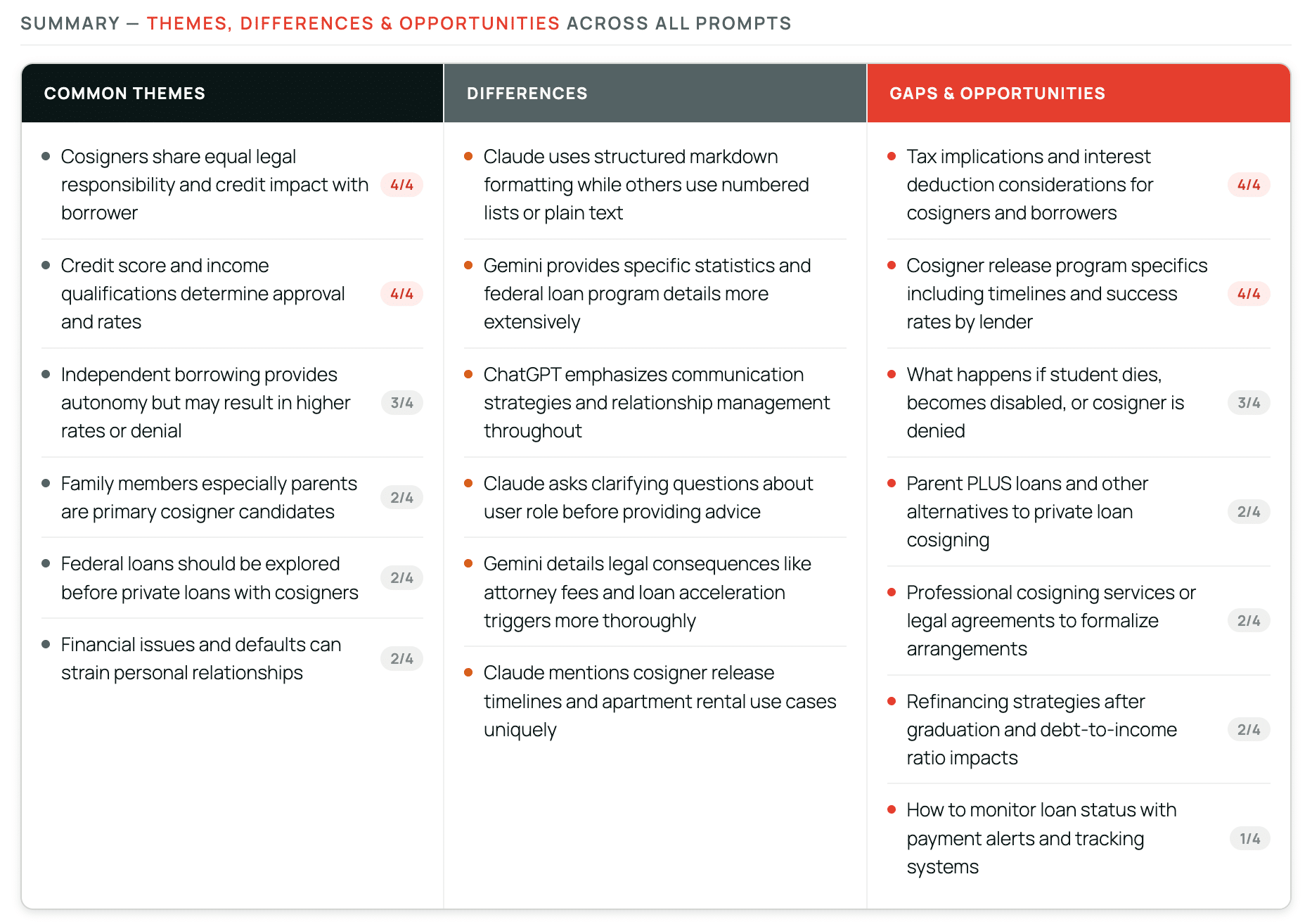
I created this tool that compares prompt responses across LLMs, differences, and gaps so we can always optimize accordingly.

Run against a test prompt, it buckets every response into three columns — common themes, differences, and gaps & opportunities — and scores each one by how many of the four assistants actually surfaced it. On a student-loan-cosigning prompt, for example, all four agreed that cosigners share equal legal responsibility and that credit score and income drive approval, but split on delivery: Claude leaned on structured markdown, Gemini went deeper on federal loan program specifics, ChatGPT spent more time on communication and relationship management between cosigner and borrower. And every single assistant missed the same things — tax implications for cosigners and cosigner release program specifics chief among them.

The Takeaway

Nobody on the thread had run the test, but outside data backs up the split verdict. Across 17.2 million citations, Yext found that verified, structured content is still the biggest driver for every assistant — but each one clearly weights different signals within that field. Gemini leans on Google's index, Perplexity stays stable across industries, ChatGPT shifts by industry, and Claude cites reviews and user-generated content at 2–4x the rate of the others. The fundamentals aren't a myth. Neither is assistant-specific logic.

So the plan is to test it: pick a topic for an audience that already skews toward one assistant — Claude, given how differently it weighs UGC, is the most interesting case — optimize deliberately for that assistant, then track citations across all three to see whether the lift stays isolated or spills over. Until that data exists, “optimize for one optimizes for all” stays a working hypothesis, not a rule to build strategy on.

There's already one concrete lever on the table, too: Blake's point that an estimated 80% of Claude's citations trace back to Brave's top 10 results (per a Profound study) means SERP analysis on Brave, not just Google, could be its own pillar for Claude-specific optimization — and it's worth folding into whatever test gets built.

And the infrastructure the thread was asking for on day one already exists: Rachel's comparison tool runs a prompt across every assistant and shows, side by side, what they agree on, where they diverge, and what all of them are missing. The hunch and the tooling are both in place now. What's left is pointing it at a real, platform-skewed audience and watching what happens.

You might also like

Elevator Talk: Does Domain Authority Even Matter for AI Visibility?

Elevator Talk: What Markup, Markdown, and Schema Are Really Doing for AI Search

You might also like

See More Resources
Red Arrow Icon