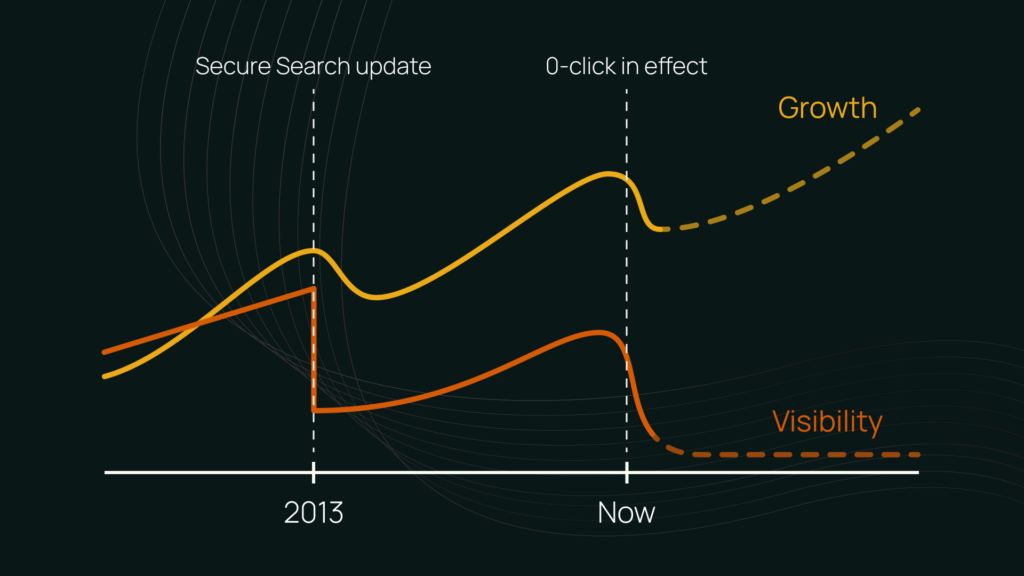
The buyer’s journey as we know it is changing again. Google’s latest product announcement that included agentic coding strikes another blow to marketer’s hopes of gaining that all-important website traffic and conversion.
But here’s the thing (at the risk of sounding like AI myself): Everything is changing, but really, nothing is.
While it’s sure to be a new challenge to track the updated journey (but then again, when isn’t attribution a challenge?), the actual reality is that your audience isn’t going anywhere, they’re just finding you differently. And our job as marketers remains largely the same, even if the details look different. What does that mean, exactly? Let’s get into it.
Traditional Conversion Paths Are Broken, But Audience-First Still Wins
For a long time, SEO looked like this:
- Rank # for a bottom-of-the-funnel keyword
- The user clicks your result
- Conversion
That made much of your optimization for steps 1 and 2 about getting traffic, and then step 3 was purely focused on site optimization.
But now, your audience converts in one of two ways:
- Agent recommends you directly, transaction happens without a site visit
- They arrive warm after agent research, ready to convert on your site
So while we used to optimize for being found, then converting. We must now optimize for being recommended, and either converting warm visitors or converting off-site..
Both sides of this coin require the same foundation: genuine authority and frictionless user experience, which can only be achieved through a deep understanding of your audience’s real needs.
What This Means For Your Strategy Right Now. Hint: It’s About Conversion Path Optimization
Not to toot our own horn (ok, that’s exactly what we’re doing) but 97th Floor has been talking about full funnel, audience-first marketing for quite some time. After all, you can optimize a landing page as much as you like, but if it’s not the right audience finding it, it’s not going to do anything.
We are going to see this more and more moving forward — a shift from CRO in isolation to full Conversion Path Optimization.
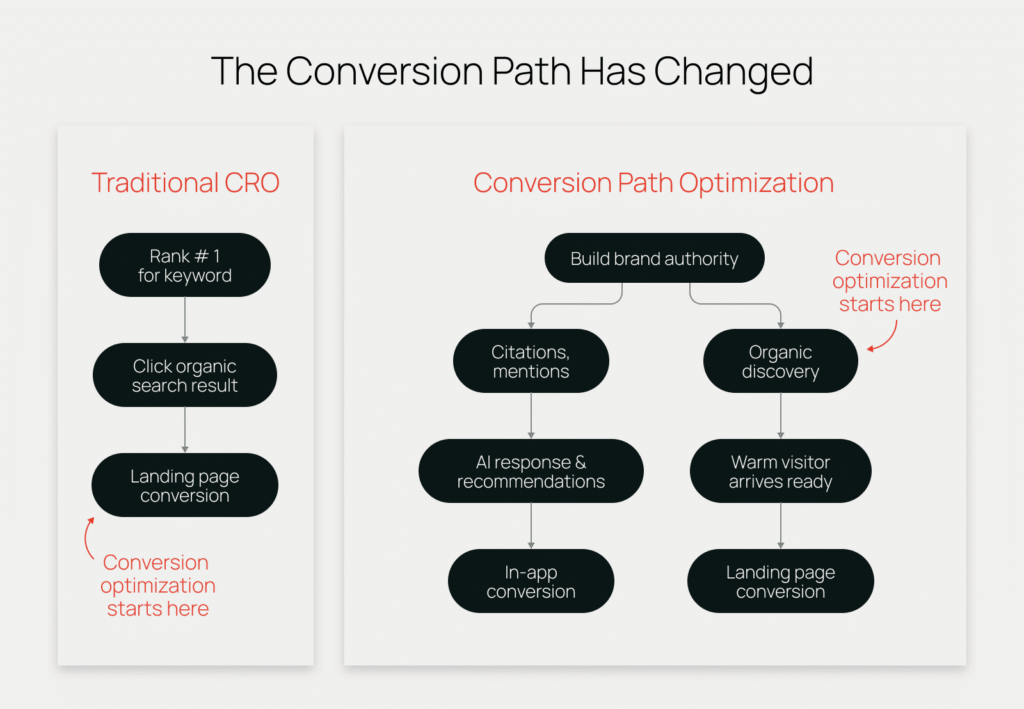
Here’s what we need to focus on:
- Optimize for Agent Discoverability
AI agents having control over purchases might feel like marketers are losing control, but there is a lot that you can do to influence and optimize this process, even if it happens in an app instead of on your site. In fact, there are a few things we can focus on already in order to optimize that conversion path:
- Build genuine authority with your audience's real needs, not just keyword rankings
- Create unique, helpful content that agents are easily able to crawl and recommend
- Keep building brand authority signals: citations, mentions, thought leadership
- Prioritize frinctionless checkout experience to ease conversions for both your customers and agents
As agent recommendations will get increasingly more tailored, optimizing from discoverability right through to checkout will be have a huge impact on conversions.
- Optimize for Warm Visitor Conversion
Of course, not everyone is going to use an agent to make a purchase. If you look at in-app purchases on the social media side, adoption is significant, but not total (after all, there’s a whole generation that refuses to make “Big Purchases” on any device but a computer). That means that you still need to optimize for those visitors who, after completing all of their research with AI, will still arrive at your site to make their final purchase. Some places you can start:
- Start mapping user journeys on your site: How do your audience segments actually arrive? Which surfaces? In what order?
- Streamline checkout and UX. Provide quick checkout options for those who are ready to buy immediately.
- Tailor your messaging at each stage of the journey. What context do they have? What CTA will push them over the line at each stage?
This is a marketer’s bread and butter and, far from being redundant, it’s more important than ever.
- Embrace New Attribution Models
Attribution models built on last-click or even session-based logic won't capture agent-assisted conversions. Conversion measurement will need to move past organic traffic/conversions and embrace new, mixed models that capture both visible conversions and agent-assisted ones.
- Invest Heavily In Audience-First Content & Strategy
At 97th Floor, we’ve long talked about high quality, audience-first content as the best weapon in a marketer’s arsenal in the AI era. That is holding more steadfast than ever with these latest Google updates. The following factors are more important to invest in than ever:
Audience insights
Who is your audience? What do they need? What are competitors missing?
Brand-building & authority signals
Yes, citations and mentions, but also things like thought leadership and media presence.
Innovative, unique content
Content should reflect unique insight, rather than just keyword optimization.
UX/checkout optimization
Frictionless transactions, whether by agent or human, will boost your conversion rates.
Full conversion path optimization is the way forward, and it starts right at the very beginning of your marketing strategy. A time where everything is changing so rapidly can be either scary or exhilarating for a marketer. If you embrace this chance to put the audience first and build your strategies around them, it’s all but guaranteed to be the latter. And hey, if that still sounds intimidating to you, give us a call!