1 billion users. That is the usage rate of AI mode reported by Google at Google I/O. It seemed for a while like Google was trying to slowly adapt traditional search by enhancing the “Featured Snippet” SERP feature by replacing it with the “AI overview” SERP feature. All while creating their own versions of ChatGPT like chat bot, in Gemini. However it is clear after Google I/O, that Google is seeking to transform the entire search experience. Transform it into an almost personal assistant, a chatbot on steroids. They are doing this by making search more conversational, using your search history as context to create custom, tailored to the user, search results. Using Search Agents, they will continuously scrape the web for updates, or new information on topics and products you are interested in, and provide summarized reports of its findings.
What are the strategic shifts that need to take place for GEO?
These changes have real implications for SEOs, content marketers, and anyone who cares about optimizing for search engines or generative engines. So, what should search marketers care about and watch out for in the coming months? Lets review a few strategic shifts that need to take place:
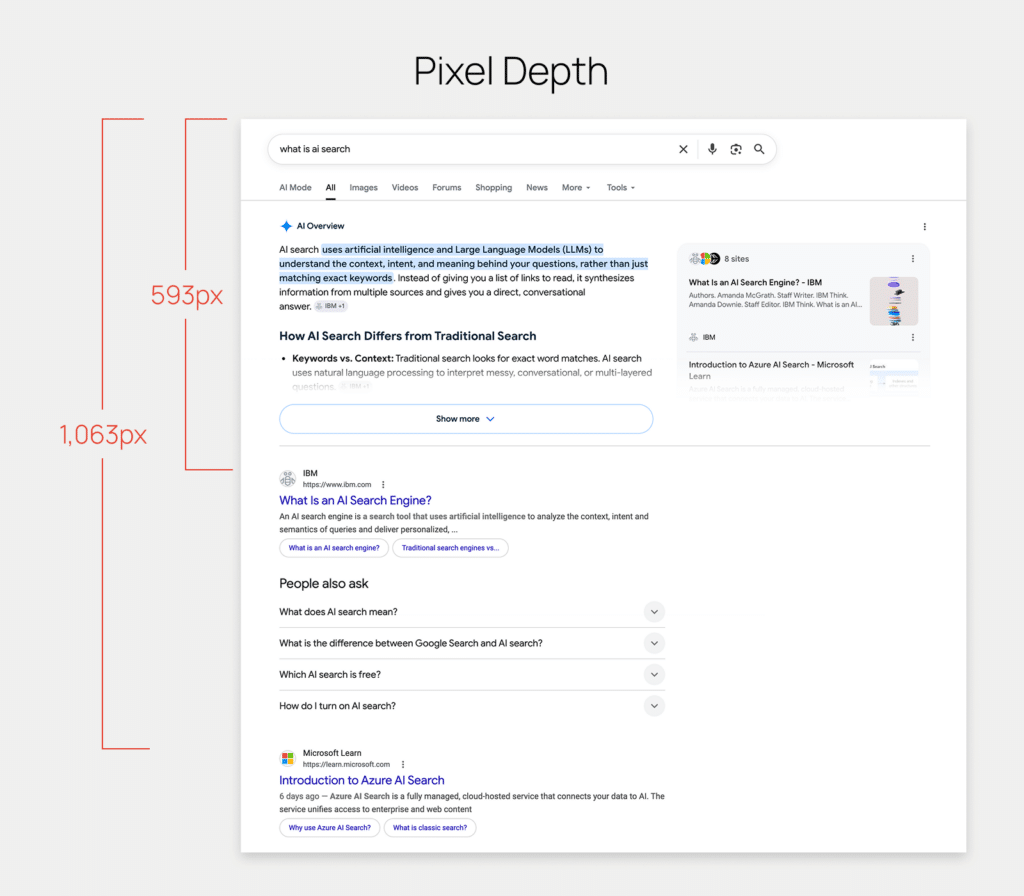
- Citations in Generative Responses: Citations and hyperlinked supporting articles in generative responses are the new keyword ranking position. Tracking citations in a generative response can seem a lot more complicated than keyword tracking. Keyword rankings seem simple and in theory, they are. You track where your URL shows up on a SERP, the closer to the top ten and then to the top three, and then the top position is how success is measured. But over the last decade, Google has been releasing SERP feature after SERP feature, adding more ads, shopping carousels, images, more ads and now AIO citations. Oh and did I mention more ads? So in reality, we have been prepping for this moment for years. if you haven’t been tracking your true position in SERPs for the last 5-8 years, you may already be behind the times. A new way to track position of a citation in GEO is Pixel Depth:
- Pixel Depth: instead of tracking the first time you have a traditional blue link and meta description show up in a SERP, track how far down the first instance is from the top of the page in pixels. On desktop, without ads and accounting for the search bar, the typical pixel depth for a traditional position 1 would be about 200-300 px.
- Sentiment Analysis: In traditional SEO, we have quite a bit of direct control over how our site was presented in search results. By dictating the title tag, meta description and utilizing Schema Markup, we had a pretty good idea of how our page would be presented. However LLMs present opinions of your brand based on a lot of factors. So tracking position only is no longer enough. Tracking and optimizing for positive sentiment and accurate positioning of your brand in the market is crucial.
- Brand Mentions: Word of mouth marketing historically is the most valuable channel for most brands. Organic search is typically the highest traffic driving channel to a website for a brand. GEO combines the two. We are now optimizing to ensure that the LLM recommends our brand as a valid solution to a problem or an answer to what the user is looking for. An increase in brand mentions for specific prompts that match integral parts of the customer journey, is a measurable goal to track success in GEO.
- Crawl Efficiency: Google loves to recommend to Search Marketers to “create helpful content” in order to have success in Search. Guess what they recommend for optimizing for AI? You got it, write helpful content. Don't get me wrong, absolutely you should write helpful content. If we aren't doing that, why are we even trying to get in front of our audience? But the reality is that the web is a massive place, with a mind blowing number of pages being submitted for indexing to Google every day. Googlebot runs off of efficiency out of a necessity, in order to find the best results for users queries. So our job as Search Marketers is to feed that helpful content to the bots in the most efficient way possible. A few ways we do that include, schema markup implementation, page structure, URL structure, and more.
The shift from bots to agents is the real game changer.
Everything covered above, pixel depth, sentiment, brand mentions, crawl efficiency is going to be table stakes compared to where search is headed. The next 2-3 months will start to reveal something bigger: the difference between optimizing for a bot that crawls your content and optimizing for an agent that acts on it.
Google's Search Agents aren't just passively indexing. They are completing tasks, comparing products, summarizing findings, and delivering recommendations directly to users, often without the user ever visiting your site. That changes the goals of Search Marketers in a meaningful way — here's what that means for your conversion path.
So what should you be watching over the next 90 days?
First, watch how your brand gets used, not just mentioned. As agentic search matures, the question won't only be "does the LLM cite us?" it instead will be "does the agent choose us when it's acting on behalf of a user?" That means your content needs to be decision-ready. Structured data, clear pricing, availability signals, and unambiguous value propositions aren't just nice-to-haves anymore. They're ranking factors, inputs an agent evaluates when it's doing the shopping, researching, or comparing for someone.
Second, keep a close eye on how conversational context affects your citations. Because Google is now using search history to personalize results, the same brand mention or citation may appear for one user and not another. This makes aggregate tracking less reliable and user-journey-level thinking more important. Start mapping which prompts and queries at each stage of your funnel you want to own and measure accordingly.
Third, don't sleep on structured data for agents. Just like robots.txt told crawlers what to do, the next wave will likely include providing signals to agents on what we want them to do with your content. Stay close to what Google and other AI platforms announce around agent permissions and content licensing, this space is going to move fast.
The brands that win in GEO won't just be the ones writing helpful content. They'll be the ones making it impossible for an agent not to recommend them.