




97th Floor was presented with a Gold Stevie® Award for Marketing or Advertising Agency of the Year in the 12th Annual American Business Awards in Chicago on June 13th. They also received Silver Stevie® Awards in the Viral Marketing Campaign of the Year category and Brand Experience of the Year -- Business-to-Business category.
97th Floor is a finalist at the new products & tech awards for Best Home/Welcome Page.
More than 3,300 nominations from organizations of all sizes and in virtually every industry were submitted this year for consideration in a wide range of categories, including Most Innovative Company of the Year, Management Team of the Year, Best New Product or Service of the Year, Corporate Social Responsibility Program of the Year, and Executive of the Year, among others. Stevie Award winners were selected by more than 240 executives worldwide who participated in the judging process this year.
“It’s an honor for us to recognize and celebrate such an outstanding class of organizations and individuals,” said Michael Gallagher, president and founder of the Stevie Awards. “The judges were especially discerning this year. All of this year’s Gold, Silver and Bronze Stevie winners should be proud that the judges recognized their achievements and their ability to express those achievements in a way that captured the judges’ hearts and imaginations.”
Details about The American Business Awards and the lists of Stevie winners who were announced on June 13 are available at www.StevieAwards.com/ABA.
Found below is the video of Chris Bennett accepting the Gold Stevie Award for Agency of the Year.
The most valuable metrics are the ones that impact the bottom line. The right numbers shape the future of your business by showing where to focus, how to improve, and when to adjust.
Choosing which metrics to track isn’t always easy. Marketing performance indicators must be set before meaningful progress can happen.
For a campaign to prove its viability, it needs data specific to its business’s purpose and goals. Clear measurement starts with understanding the language of performance. Metrics, KPIs, and goals may sound similar, but each plays a different role in shaping strategy.
Metric: A metric is essentially any signal that can be tracked. It’s an objective system of measurement, which means that you might have an entire dashboard of metrics that you’ve set up to be tracked. But dashboards only serve as directionless numbers without goals and KPI.
KPI: KPIs (key performance indicators; often called marketing performance indicators) are the metrics that you’ve decided to use in tracking how efficiently your business is meeting its objectives. It’s a little tricky to get down the difference, but just remember that while all KPIs are metrics, not all metrics are KPIs.
Goal: A goal is a metric-driven objective, defined by a clear timetable and tactics, that you are trying to reach. The best goals are SMART goals (specific, measurable, attainable, realistic, time-bound). Goals set a bar for the future of certain KPIs that you then strive to achieve. Goals should move your marketing department and business forward.
Let’s put them together. For example, you may decide that next quarter your business should work to earn more site conversions via organic traffic. Your KPI will be organic traffic. Supporting metrics might include keyword rankings and landing page conversion rates. Finally, your goal could be to reach 100 conversions via organic traffic.
The metrics that you choose for your KPIs will determine what your business will achieve. Keep in mind that there’s no comprehensive list of metrics that you “must be tracking” that will work for every business. The following is a list of metrics we’ve compiled from our own experience at 97th Floor for you to consider as you develop your individualized marketing strategy.
Revenue is something every marketing leader should have in their sight. Of course, tracking this is sometimes easier said than done. A good marketing leader will make every effort to get good data that associates revenue with your various efforts. If done correctly, all other metrics will fall under this single metric.
Conversions are the closest metric to revenue that you can track. What conversions look like varies based on the business. For an e-commerce site, that could be a checkout; for a B2B site, it could be a lead or closed deal. Marketers need to ensure that the conversions they track have monetary attachments. For e-commerce businesses, that can be quite easy; however, B2B companies that work through leads with a sales team will need to be intentional about gathering data and insight from marketing and sales to assign values to things like leads, MQLs, and SQLs.
While knowing the amount of conversions your site brings in is important, knowing the rate at which your site converts traffic to conversions is critical. Paying attention to historical and trending conversion rates will help you know where to focus your attention.
For example, if you see that one month shows a conversion rate that is only 50% of the month prior, you might dig further and see that was the month you launched a new ad campaign. This would tell you that this ad campaign likely wasn’t fruitful.
The close rate is the rate at which leads are closed into actual business and revenue. This metric can be useful in judging both sales and marketing team performance. Lower close rates could mean that the sales team needs additional training, or that the marketing department isn’t providing quality leads. Tracking the close rate will help keep both sales and marketing professionals accountable.
This metric is exclusively for businesses that are running paid ads across the web. Most major advertising platforms (i.e., Google, Facebook, and LinkedIn) have snippets of code called pixels that you can put directly on your site that allow the ad platform and advertisers to track the ad’s performance — including conversions that take place on your site. When ad spend is coupled with conversion data (that has an assigned marketing value) you’ll be able to see the rate of return on your ad spend.
CPL is the total cost to acquire a lead. This is typically used as a long-term benchmark, even though this number may change. For example, a business may find that it costs an average of $42 to acquire a lead over the past year. Assuming budgets have stayed the same, this business can assume that any figure under $42/per lead is a good investment.
As its name implies, CLV is the expected return during the life of an average customer. Marketing leaders at SaaS organizations will benefit the most from this metric. It’s powerful because it can encompass smaller metrics like customer retention rate, customer add-ons, and average length of customer retention. This metric is especially powerful when filtered across a qualifier.
Virtually all businesses utilize some kind of website for their marketing efforts. Knowing how many people visit the site in a given time is essential to knowing the impact of your online marketing efforts. Many metrics could be even more specific than total traffic, such as page visits, sessions, and unique visitors. And, while total traffic might not be incredibly insightful by itself, it’s critical in keeping other traffic-related metrics in context.
There are many traffic sources you can measure, likes ad channels, referrals, social, direct, and organic. Many businesses will benefit from measuring many of these channels. However, organic will make sense for virtually all businesses.
Organic search accounts for over 50% of all web traffic, and unlike other channels, SEO has the potential to attract customers at every stage of the funnel. This could include top funnel conversions like email capture or lead capture, or bottom funnel conversions like demo requests or purchases.
Blogging has proven its worth in the business world, as the most recent numbers say that businesses that blog regularly earn 67% more leads. It has pulled ahead as one of the best ways to participate in both SEO and content marketing. Content will draw users to your site and provide you with unique opportunities to meet their needs. Not to mention the tremendous work that a blog can have on your SEO strategy.
In addition to net blog traffic, consider tracking blog-specific conversions. Conversions on a blog are generally micro conversions, such as newsletter subscriptions, lead magnet downloads, or landing page visits. However, these contacts often move farther along the funnel as they are delighted with your brand and content, and can often turn into leads.
Subscribers are the highest top funnel contacts. They are the ones who know about your business and have opted in to hear more from you. Often, this looks like signing up to be notified of new blog posts or receive a newsletter. These contacts may or may not move farther down the funnel, but that’s okay. Growing your subscribers means growing your audience, which allows you to amplify your content and reach even more new contacts.
Leads are contacts in your database that have indicated some signal that they are willing to learn more than surface-level information about your company, and they’ve given you information to make that happen. Examples of this might come from a PDF lead magnet or a free trial signup.
Are you trying to increase trial sign-ups, improve customer retention, or get more traffic to your website? What are your targeted marketing performance indicators?
MQLs are leads that the marketing team has determined are more qualified than a standard lead based on their action. MQL structure might vary depending on the company, but generally, they are defined as the contacts that have shown enough interest to qualify them as ready to talk to sales. Marketing determines readiness based on either lead scoring or the contacts themselves requesting to talk with sales via a form on the marketing page.
An MQL becomes an SQL after the sales team has determined this lead’s qualifications. Many organizations have their own iterations on this, but SQLs are generally MQLs that are confirmed promising enough to be pursued by the sales team. Sales then takes the reins in nurturing them and aiding them in their journey to becoming a customer.
Email has one of the most positive ROIs of any channel. It’s believed to be as high as $42 for every $1 spent. It’s also one of the most used channels today, despite years of naysayers predicting its demise. This metric measures the effectiveness of subject lines in real-time. However, this metric also tracks much deeper issues, like a company’s reputation. If you have a history of providing good content within your emails, you’ll have a higher open rate.
Email click-through rates (and net clicks) measure the effectiveness of the content inside your email. Having a contact open and read your email is great, but having them follow through on what you asked them to do is even more important. Emails lose much of their usefulness unless contacts take action, so measuring click-through rate is worthwhile.
Social is a set of micro metrics (likes, shares, comments, social traffic, impressions, etc.) from which you can choose what makes sense to track for your company. Some businesses will choose not to intentionally track any of these metrics and put social media on the back burner. For some, social metrics will be a large part of their overall marketing strategy.
The social channels businesses focus on will also largely depend on the company.
Clients and managers may approach agencies and employees with incredibly bad KPIs in mind. KPIs like “increase rankings” or “get more followers” are bound to leave your site barren. Vanity metrics like followers, impressions, or raw traffic can be misleading if they don’t tie back to conversions or revenue.
Healthy KPIs are the ones that connect marketing activity to real business outcomes. Instead of tracking numbers for their own sake, make sure your chosen indicators tie back to revenue, growth, or long-term customer value. When KPIs are aligned with profit, they provide a clear picture of whether your marketing is moving the business forward.
That clarity gets even sharper when you remove the boundary between marketing and sales entirely. Marketer Sterling Snow argues that the highest-performing companies don't have a marketing team at all — they have a revenue team. When marketing owns outcomes alongside sales, both teams stop optimizing for metrics that feel good and start optimizing for the ones that actually drive the business. This short video breaks down why collapsing the line between marketing and sales is one of the most important structural shifts a B2B company can make.
The success of storytelling strategiescan be measured through marketing performance indicators like engagement rates, time spent on page, click-through rates, and conversions.
We’ll close out with a story. In the 1950s, the young biologist Allan Savory was working to set up natural parks in Zambia, Africa. National parks teeming with wildlife are much more appealing than parks devoid of animals; therefore, Savory’s first plan of action was to move the indigenous hunters from the land to boost the wildlife population.
Unfortunately, shortly after Savory removed the hunters, the terrain began to deteriorate and enter a period of desertification. The land was growing barren and becoming increasingly unable to support the growing herds of grazing animals.
As things began to get worse, Savory turned to the data. He discovered that the desertification problem stemmed mainly from the large number of elephants growing unchecked. According to Savory’s findings, the only way out was the extermination of thousands of elephants.

Convincing the Central African politicians to slaughter herds of elephants was no small task. The Zambian government called in a small task force to check and re-check Savory’s numbers. Finally, the team concluded that Savory was correct and his calculations were sound. Shortly thereafter, Savory (aided by the Zambian government) began shooting thousands of elephants, measuring their success based on how many elephants they killed. Fueled by the self-established metric of elephant population, Savory and his team killed over 40,000 elephants in an attempt to save the land. In the end, the land degradation intensified, and Savory had to live with what he still calls the “saddest and the greatest blunder of [his] life.”
The lesson for marketers? Choosing the wrong marketing key performance indicators can have devastating long-term consequences. Just like Savory’s faulty KPI (elephant population), selecting vanity or misaligned KPIs can lead businesses down destructive paths.
We use a combination of analytics tools and marketing performance indic ators (KPIs) to measure the success of your digital marketing campaigns.
Allan Savory’s tragic pursuit of an ineffective KPI has caused him to spend the rest of his life trying to correct his theory. When looking for success in digital marketing, let’s not make the mistake of pursuing unhealthy KPIs only to end up spending much more time cleaning up our mistakes.
With the right marketing performance indicators in place, you’re ready to design a marketing strategy backed by insight, select marketing KPIs that drive results, and make smarter decisions.
At 97th Floor, we help brands focus on the right marketing performance indicators so their strategies lead to real growth. Our team specializes in aligning KPIs with revenue goals, building dashboards that provide clarity, and creating campaigns that move the needle.
Every brand is unique. Success comes from identifying the signals that matter most to your business and using them to guide your marketing forward.
See how an audience-first approach translates to bottom-line results.
97th Floor was named a finalist in four categories in The 2014 American Business Awards, and will ultimately be a Gold, Silver, or Bronze Stevie Award winner in each category.
The American Business Awards are the nation’s premier business awards program. Past winners include Proctor & Gamble, Sony, American Express, Tropicana, Wynn Las Vegas, AT&T, Domino’s and Aflac.
97th Floor is proud to be honored for the following awards:
Gold, Silver, and Bronze Stevie Awards will be announced at the 2014 awards banquet in Chicago on June 13th.
Click here to see a list of all the finalist in each category.
97th Floor also recently received an Honorable Mention Webby Award for the www.pixartheory.com
O.K. before you keep reading I have to apologize, I hate case studies and examples of sites that don't show the sites involved. One of the things that I try to do to set us apart from a lot of blogs is to give specific ideas on how to do things, but in the case study below I can't. We are growing and have a lot of clientele that just won't let us share their info, or even mention them as a client. That is fine, I guess if I was a 100 million a year plus company with very intelligent competitors I wouldn't want our service providers giving away our secrets either.
With that said this will still be really cool to share and I will show you (doctored) screen shots from their analytics.
We helped a friend/client launch a blog in October and it has been some of the most successful blog marketing we have done to date in the realms of blog optimization and social media saturation to a brand new domain and website.
The blog is general and covers a lot of different topics mostly internet and advertising related, which helps. If you have a niche blog you can still have tremendous success in blog promotion, especially in terms of links and subscribers which is the most import aspect of a blogs success in my opinion.
The Stats: The blog is exactly 39 days old it has a total of 21 pages, it has received over 165,000 uniques, over 3,000 links and over 1,117 subscribers. The subscribers and the amount of branding we have seen (see below) are what we are most exited about.
We have had campaigns that generate more traffic and links then this blog (I am working on another case study where I will actually show you an example of an article that had over 150k visits in one day, and has had over 3k links just to the article), but what is different about this site is the vast amount of subscribers and the consistent traffic. Barely any of this traffic is from Digg, the blog is receiving thousands of visitors a day on a consistent basis. So it has been a combined effort on behalf of the posts instead of one home run submitted to Digg with one traffic spike and virtually no traffic a week later. The lowest day so far as been over 1,600 visitors and the highest has been 14,922 with several days over 10k.
Graph screen shot of the blogs entire life so far: 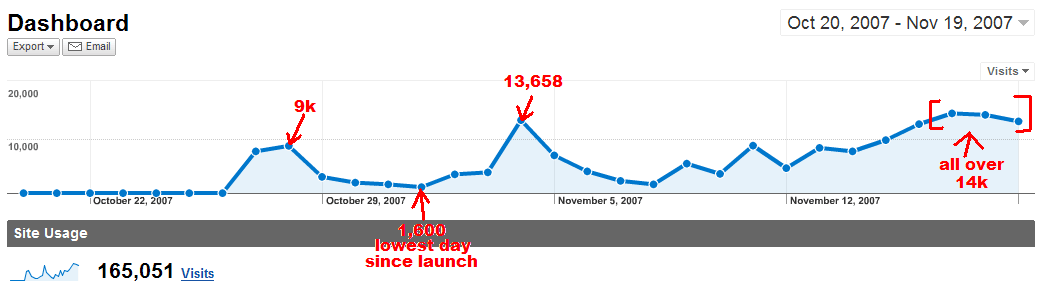
Page Views to some of the URL's: 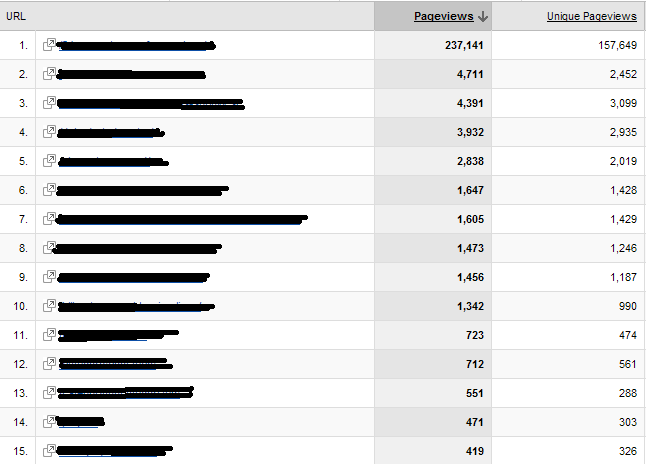
Traffic Sources: (what is best about this is Direct Traffic to the domain, is over 14% which is over 24,000 visitors. Remember this blog is only 39 days, that is some sweet branding) 
The majority of the initial traffic came from StumbleUpon, I think that is why the subscriber rate has been so good. We also get a tremendous amount of traffic from other hub sites picking up our stories and linking to them.
How to do it: I would credit a handful of things the the sites success.
1.) The site owner has fallen in love with marketing and has done a great job with generating outstanding content. He has engulfed himself in Social Media and in his competing blogs and really understands how to generate good content for his audience.
2.) We mapped out and understood our audience prior to launch. We actually had a good amount of posts ready before launch so that we wouldn't lose steam. After the first few pages being submitted to social sites we let the sites subscribers and community promote the rest of our content as it was created.
3.) The Domain is easy to remember, easy to spell and all that. By watching the direct traffic to the homepage and branded search terms in Google we are really seeing that a good domain can go a long way.
Again I apologize for not being able to give away more. I'm working on about 3 posts that all give away the farm with specific examples. Also remember this site/company did not exist before the last week in October, there wasn't a huge brand name to piggy back off of or any prior marketing or advertising to build off of. This was brand new, raw straight out of the gates marketing.
