



User-Generated Content (UGC) is any form of content—text, videos, images, reviews, etc.—created in support of a brand by individuals rather than brand themselves. This content is shared publicly, often on social media platforms or dedicated sections of a website. UGC is pivotal for brands, as it serves as a raw, authentic testament of customer experiences and perceptions. It's the digital equivalent of word-of-mouth, which has been a cornerstone of trust-building in marketing for ages.
The significance of UGC lies in its authenticity and ability to resonate with other consumers. When people see real users engaging with a product or service, it fosters a sense of trust and reliability. This authentic portrayal often influences purchasing decisions more effectively than traditional advertising, as consumers tend to trust fellow consumers over corporate messaging.
Moreover, UGC provides invaluable insights into customer preferences and behaviors, aiding brands in tailoring their offerings and communication strategies.
There are many benefits to deploying a UGC strategy for your brand—here are just a few:
Visual content, such as photos and videos, is among the most engaging forms of UGC. It's visually appealing and can convey a message more effectively than text alone. Brands can leverage user-generated photos and videos in numerous ways, such as showcasing real-life applications of their products, highlighting customer satisfaction, or simply adding a human touch to their marketing materials. This type of UGC is particularly impactful in B2C on visual platforms like Instagram, Pinterest, and YouTube.
Testimonials and reviews are powerful forms of UGC that offer firsthand accounts of customers’ experiences with a brand's products or services. They play a crucial role in the decision-making process of potential customers. Positive testimonials and reviews build trust and credibility, while negative ones, though seemingly undesirable, provide brands with honest feedback that can be used to improve products or services.
Testimonials and reviews are also beneficial for SEO, as they often contain relevant keywords and phrases used by consumers. This can help improve a brand’s search rankings and visibility online.
Social media posts and shares are another vital type of UGC. When customers share their experiences, opinions, or content related to a brand on social media, it amplifies the brand's reach and can attract new audiences. These posts can be in the form of status updates, tweets, stories, or even live videos.
This type of UGC is particularly effective because it's organic and appears in a consumer's natural social media environment, making it feel more genuine and less intrusive than traditional advertising. Moreover, when these posts are shared or liked by others, they gain an additional layer of endorsement.
The key to acquiring high-quality UGC is to actively engage and motivate your audience. It may sound simple, but asking for UGC is the best way to get it. Encourage them to share their experiences and thoughts about your brand. To increase the likelihood of success, it's crucial to create a community atmosphere where users feel valued and heard. Responding to UGC, highlighting exceptional contributions, and maintaining an active and responsive social media presence are effective ways to foster this community spirit.
Offering rewards or incentives is a highly effective method to encourage UGC. These rewards could range from discounts, featured spots on your website or social media, to entries in contests with attractive prizes. The key is to provide value that resonates with your audience.
This approach not only motivates your current customers to participate but also attracts potential customers who see the benefits of engaging with your brand.
Creating experiences and events that are inherently shareable can naturally prompt UGC. This could be anything from an exclusive product launch event to an online challenge or hashtag campaign. These experiences should be unique, engaging, and aligned with your brand identity to encourage maximum participation and sharing. Remember, the goal is to create moments that your audience wants to be a part of and, more importantly, share with their own networks.
Each of these strategies plays a crucial role in acquiring UGC. They not only encourage content creation but also deepen your engagement with your audience, creating a loyal community around your brand.
Determine what you aim to achieve with UGC—whether it's increasing brand awareness, driving sales, or improving customer engagement. Once your objectives are clear, plan how UGC will be integrated into your overall marketing strategy. This includes deciding on the platforms where UGC will be showcased, the type of content you wish to encourage, and how it aligns with your other marketing initiatives.
Different social media platforms and marketing channels have distinct audiences and formats, and UGC should be tailored accordingly. For instance, Instagram is visually driven, making it ideal for photo and video content, while LinkedIn might be more suited for professional testimonials and thought leadership. Consider the strengths and user behavior on each platform to maximize the impact of UGC.
It's crucial to obtain explicit permission from users before repurposing their content for marketing purposes. This not only shows respect for their intellectual property but also builds trust within your community. Always credit the original creator, which not only adheres to ethical standards but also encourages others to contribute, knowing they’ll be acknowledged.
While positive UGC is invaluable for promoting your brand, negative UGC should not be ignored. Use it as a learning tool to understand customer pain points and improve your offerings. Address negative feedback promptly and constructively to demonstrate your brand's commitment to customer satisfaction.
Implementing these best practices ensures that your use of UGC is respectful, effective, and aligns with your marketing goals, ultimately leading to a more engaged and loyal customer base.
Coca-Cola's "Share a Coke" campaign is a stellar example of UGC done right. The campaign featured bottles with popular names and encouraged people to share a Coke with someone they knew with that name. This simple yet personalized approach led to a surge in customer engagement, with people sharing pictures and stories on social media of themselves and their friends enjoying a Coke. The campaign successfully created a sense of community and personal connection, driving both online engagement and sales.
Burberry’s “Art of the Trench” campaign revolutionized the use of UGC in luxury fashion marketing. The campaign invited customers to upload photos of themselves wearing Burberry trench coats. These images were then showcased on a dedicated website and social media. This approach not only celebrated the brand’s heritage but also allowed customers to become part of Burberry's story, creating an emotional bond with the brand.
Lululemon’s #thesweatlife campaign encouraged customers to share their fitness journeys and how Lululemon products were a part of that journey. By focusing on real-life experiences and stories, the campaign resonated deeply with the brand’s target audience, creating a community of fitness and wellness enthusiasts bonded by their love for the brand.
T-Mobile’s unique campaign invited users to share their “break-up letters” with their previous mobile carriers. This humorous and relatable approach allowed customers to vent their frustrations in a creative way, while also promoting T-Mobile’s services as a better alternative. The campaign was highly successful in driving engagement and highlighting customer satisfaction with T-Mobile's services.
Each of these campaigns demonstrates the power of UGC in creating authentic, engaging, and customer-centric marketing strategies.
Building a strong community of users is essential for generating consistent and quality UGC. Encourage the formation of user groups, online forums, or social media communities where customers can share experiences and engage with each other. These communities can become hotbeds for UGC, providing a platform for your most loyal customers to become brand advocates. Engaging with these communities, highlighting their content, and showing appreciation can further motivate users to generate UGC.
Social media campaigns are perfect for encouraging UGC. Create campaigns that are easy for users to participate in and share. These could include challenges, hashtags, or contests that prompt users to create content related to your brand. Make sure these campaigns are fun, engaging, and aligned with your brand's values. Showcasing the best submissions on your social media channels can also encourage more users to participate.
Contests and challenges are highly effective in encouraging UGC. They can create excitement and a sense of competition, prompting more users to participate. Ensure that the rules are simple and the rewards are attractive. Contests can range from photo or video challenges to writing testimonials or creating art. The key is to make it relevant to your brand and accessible to your target audience.
Incorporating UGC into your product design or packaging can be a powerful strategy. This could mean featuring customer photos or quotes on your packaging or creating products based on customer suggestions and feedback. This not only generates UGC but also makes customers feel like an integral part of the brand’s journey.
While UGC can be highly beneficial, it's essential to ensure that the content aligns with your brand's standards and values. Implement a moderation process to review UGC before it's featured on your platforms. This process should assess the quality, relevance, and appropriateness of the content. It's crucial to maintain a balance between encouraging creativity and expression while ensuring that the UGC upholds your brand's image and ethos.
When using UGC, it’s important to navigate legal and ethical considerations. Always obtain explicit permission from the original creators before using their content, especially for commercial purposes. Be transparent about how the content will be used. Additionally, respect privacy and intellectual property rights. This not only avoids legal complications but also builds trust and respect with your audience.
Developing and implementing best practices for UGC moderation is key to maintaining a positive and safe environment for your community. This includes establishing clear guidelines for what constitutes acceptable content, training your team on these guidelines, and using tools to help manage and moderate content efficiently. Regularly review and update your moderation practices to adapt to changing trends and community feedback.
Integrating UGC directly onto your website and product pages can significantly enhance the user experience. Featuring customer photos, videos, or reviews next to your products can provide a more authentic and relatable perspective, aiding potential customers in their decision-making process. This not only enriches the content on your site but also improves SEO by updating your site with fresh, relevant content.
Transform UGC into a shoppable experience by linking user-generated images or videos directly to products. This approach bridges the gap between inspiration and purchase, allowing customers to easily buy products featured in UGC. It’s a powerful way to leverage social proof while simplifying the customer journey from discovery to purchase.
Utilize UGC in live or virtual events and on digital signage to create a dynamic and engaging atmosphere. Showcasing real customer stories and experiences can add a personal touch to your events, making them more relatable and memorable. This also encourages attendees to create and share their own content during the event, further amplifying your reach.
Reposting UGC on your social media channels can significantly boost your content strategy. It shows appreciation for your customers and provides diverse and authentic content for your followers. Always credit the original creator and ensure the content aligns with your overall social media strategy and brand voice.
Incorporating UGC into email campaigns can make your communications more engaging and personalized. Featuring customer stories, reviews, or images in your emails can add a level of authenticity that resonates with recipients, potentially increasing open rates and engagement.
By strategically incorporating UGC across various channels, you can create a cohesive and engaging brand narrative that leverages the power of your community’s voice.
The power of User-Generated Content (UGC)lies in its authenticity and the genuine connection it fosters between brands and their audiences. By embracing UGC, brands not only enhance their marketing strategies with content that resonates deeply with consumers, but they also build a community rooted in trust and mutual respect.
UGC will undoubtedly continue to play a crucial role in shaping brand narratives and driving consumer engagement. It's not just about showcasing products or services anymore; it's about weaving the customer's voice into the very fabric of a brand's identity. UGC, therefore, is not just a tool in the marketer's arsenal—it's the cornerstone of a brand's relationship with its customers.
UGC refers to any content created and shared by consumers or end-users about a brand or product. It's important because it serves to increase authentic social proof, enhance brand credibility and trust, and can significantly influence consumer behavior and decision-making.
UGC can improve SEO by generating fresh, relevant content for your website. This includes customer reviews, comments, and social media posts, which can increase your site's visibility in search results and drive organic traffic.
The most effective types of UGC include customer reviews and testimonials, social media posts, user-generated photos and videos, and blog posts. The effectiveness can vary based on your industry and target audience.
You can encourage UGC by creating engaging campaigns, offering incentives, hosting contests, and actively interacting with your audience on social media. Providing excellent products and customer service also naturally prompts users to share their positive experiences.
Best practices include setting clear guidelines for acceptable content, regularly monitoring submissions, respecting users’ privacy and copyright, and obtaining permission before using UGC for commercial purposes.
Measure UGC impact by tracking metrics such as impressions, engagement rates, conversion rates, website traffic from UGC sources, and the sentiment of the UGC. Also, monitor changes in brand perception and customer loyalty.
While UGC can complement traditional marketing, it shouldn't completely replace it. A balanced approach that includes both UGC and professionally created content is often the most effective strategy.
Verify the authenticity of UGC by checking the source, engaging with the user, and using tools to detect fraudulent or manipulated content. Authenticity is key to maintaining trust in your brand.
Be aware of copyright and intellectual property laws, and always get explicit consent from content creators before using their UGC. Also, be mindful of privacy concerns and data protection regulations.
Integrate UGC by featuring it on your website, social media channels, email campaigns, and advertising. Align UGC with your brand goals, and use it to complement other marketing efforts for a cohesive strategy.
For experienced marketers, the clock is ticking for the day you'll be asked to leave the comfort of familiarity behind and jump into the role of Team Leader. This step requires new skills and perspectives, and can be challenging. Paxton Gray, CEO at 97th Floor, walks through key points on how to beat your obstacles, develop trust, and ultimately create a world-class marketing team.
Marketers work with data every day, but it can be easy to forget that there are real people behind every number—we set out to find one of those people and help them out this holiday season. Check out how we did it .
Marketers crave data. It informs our decisions, helps us solve problems, and runs the world around us. But marketing data is more than numbers in a spreadsheet, an analytics report, or a list in your CRM—behind every number is a person.
For our 2022 holiday campaign, we challenged ourselves to find the real people behind the data we analyze every day, see what we could learn from them, and find a way to lift them up. Our friends and clients at ProAthlete (a hugely successful sports equipment company that owns JustBats, JustBallGloves, JustPaddles and Routine) eagerly partnered with us to make this possible.
For weeks and with the help of the ProAthlete marketing team, we crawled through ProAthlete’s data, layering it with other data sources to find a real customer we could help. In our search we combed through:
Finally we discovered the perfect candidate for this year's campaign—Chris Evans and his non-profit, named the I AM KING Foundation in Kansas City, Missouri.
We invited Chris and a few of his players to tour ProAthlete’s facility telling them we would be donating $1000 dollars to the foundation, but we had something much bigger planned—a $30,000 donation to the foundation to cover the costs of new equipment and to help contribute to the I AM KING scholarship funds.
What is the I AM KING Foundation?
Chris Evans founded the I Am King Foundation, a 501(c)(3) non-profit, “to educate, inspire and empower young men to become community leaders.”
“When my son was in kindergarten, I literally had to beg parents to bring their kids out to play baseball because everyone wanted to do football and basketball. I brought them out there and they loved it. We had a great time and decided to see how far we could take it” - Chris Evans
Each baseball season Chris invests 20-30 hours of his time weekly coaching little league teams, planning educational field trips, and developing the young men he works with into leaders. The I Am King Foundation accepts donations in an effort to “level the playing field in little league baseball.”
What is Pledge 1%?
Pledge 1% is a movement founded by leaders of Salesforce and Atlassian that encourages and empowers companies to donate 1% of their revenue to charitable and community-based causes. For years, as part of 97th Floor’s Pledge 1% commitment, we have been fortunate enough to elevate brands and people just like Chris Evans that we believe in.
Want to learn more about how 97th Floor elevates people?
Check out last year's project CharityLabs—an engine to help you find charities that match your values and interests.
If you saw photos of a bunch of marketers partying in early October, you got half the story.
97th Floor's Mastermind is an annual marketing leadership conference located in Park City, Utah. This year, from October 3-5, marketing leaders spent two days at The St. Regis Deer Valley participating in expert-led discussions on marketing strategy, listening to keynote speaker Ryan Holiday, and collaborating with peers.
There may or may not have also been a cooking challenge, some painting and hiking, and delicious food all against the stunning background of Park City’s colorful fall mountains.
We’ve pulled together 8 lessons from the bright minds of our attendees. Note that because each discussion leader took a different approach to their topic, each write-up will read a little differently. Here's what you're in for:
Brand-marketing-adverse leadership are armed with one argument: You can’t prove ROI. Sean Michael Colee-Addington and Tatiana Fabregas from NBCU dissolved this argument in their discussion on balancing brand and performance marketing.
But what about tracking? Tatiana is confident that the “data is getting there to give you the ROI" for brand marketing. Brand marketing can be measured; it’s just measured differently through awareness, education, values, introduction, and sustaining a competitive edge. Get creative and think about what other tangible metrics could be driven by brand marketing. You may not see any movement in revenue for the immediate next quarter, but you can see lift and trust that budget spent on brand marketing will pay out with increase in the future.
Asking someone to trust that a spend will pay out — without immediate proof — is exactly what every pitch comes down to. Whether it's a marketing budget conversation or a funding moment, the structure of the ask is the same: conviction, clarity, and a credible case for patience.
Daniel Nisan, startup founder with direct experience on both sides of the investor table, shares what he's learned about making that case when real money is on the line. This short video captures the mindset and mechanics behind a high-stakes pitch that actually lands.
Do This: Reevaluate what percentage of your marketing efforts are branded—if high-funnel, branded campaigns aren't receiving any budget, allocate a small portion of budget to test your ideas and establish a system for measuring value.
97th Floor’s unique team structure isn’t the only thing that makes us the best choice for our clients - it’s also the leadership values and style we practice in the company.
97th Floor CEO Paxton Gray led a discussion about how marketing leaders can develop a productive team. We’ve pulled key takeaways from those who participated.
- Carve out ownership for everyone on your team.
- Don’t take away an opportunity to learn or grow by just doing something yourself.
- When hiring, it's not about finding a culture fit, it's about finding a culture add.
- Embrace a diversity of approaches for the diversity in your team.
- When working with your team, be involved and mirror the passion of what excites them about the work.
Do this: Evaluate your team's feedback loops—how does each team member see and understand the impact they have on the company's bottom line? Build a system for more frequent and thorough feedback.
Sam Oh, Ahrefs' VP of Marketing, led a discussion about developing standard operating procedures that will:
Here's his team's internal process...for creating processes:

Keep in mind that there’s no such thing as a “perfect” system. Train your team to proactively notice blockers in your systems and propose optimizations.
A strong foundational systems that should free up individual contributors' time and attention to be more creative. Scaleable creativity comes from defined systems that get modified and improved on in documented, measurable ways.
Do this: Using Sam's flow and as a marketing team, take 15 minutes to create a documented system for one task your team performs regularly. Set a date for when you'll reevaluate and optimize that process.
Christina Garnett is Hubspot’s Principal Community Manager for Offline Community and Advocacy. Her discussion group benefited from learning Christina's 3 ingredients for turning customers into brand advocates.

Do this: Think about core memories you have with brands. What do these memories inspire you to do for your customers? Hold a brainstorm with your marketing team on how your brand can create core memories.
John Huntinghouse, VP of Marketing at TAB Bank, pulled from proprietary 2020 research to show the importance of thought leadership for decision-makers.
Here's some of the juice:

Put your content through these filters to determine if it will be valuable thought leadership for your space:
Do this: Use John's questions to evaluate your upcoming content calendar—it's not too late to pivot (or even scrap) content that doesn't meet standards.
97th Floor’s not-so-secret sauce for every campaign is an undying commitment to understand our client’s customers before we do anything else. Danny Allen, 97th Floor’s VP of Marketing, discussed how to use personas to create content. Consider this:
Do you think you have a good eye for design and user experience? Do you know what will move customers to act?
Prove it.
So…how did you do? We’re thinking not too great, and that’s okay.
We talked to Deborah O’Malley about all this. She is the founder of GuessTheTest, an A/B test case study resource focused on helping digital marketers increase conversions and get new ideas and insights from testing. She says, "In CRO testing, your chances of guessing the right test are about equal to guessing the correct side of a coin toss. Don’t make assumptions.”

Feel better? We all love our biases and assumptions, but we’re with Deborah. You need to rethink yours.
Most Conversion Rate Optimization (CRO) is done to increase the conversion rate of a SaaS sign-up form or an e-commerce product page. It involves taking a critical page or conversion point, creating 3-5 variants of that same page (each with one single tweak), using a tool like Google Optimize or Optimizely to run live traffic to each of those variants, and then discovering the "winner."
CRO - done right - enables marketers to step out of their biases and actually begin to understand their customers. Still, we’ve found that CRO is largely neglected. Econsultancy reports that 50% of companies value CRO as a crucial part of their marketing strategy, but that only 1% are very satisfied with their conversion rates.
Guess the Test shares, “The average conversion rate hovered around 3% in 2020. That means of 100 visitors coming to your website, only 3 out 100 are taking the desired action you hope they’ll perform, like purchasing your product.”
Ouch. Econsultancy also found that businesses that successfully boost conversion rates perform 50% more tests. This statistic speaks for itself. More tests, of the right tests, is better.
But still, companies spend just $1 on CRO for every $92 spent on customer acquisition. Samantha Brown, the VP of Enterprise Client Services at 97th Floor, explained, "There is a huge gap between what we’re willing to pay for traffic and what we’re willing to pay to turn that traffic into customers.

Seems off. CRO should be a higher priority, so we set out to discover the major roadblocks here and how to overcome them.
We’ve got some pointers.
CRO is a methodology, but we’ve probably all got it labeled as a tactic. Big misunderstanding.
As a manager, you focus on systems for acquisition, monetization, and retention. To improve all of these systems, you need to think of CRO as a method for innovation and not just a tactic. It’s not a phase - it’s a lifestyle, because the moment you stop testing, you’re saying “my customers aren’t living, breathing, changing humans,” or “I don’t care to keep learning from them.” Does that feel extreme? Yeah. So does not testing.
So, keep testing. Shiva Manjunath, Senior Strategist at Speero, is passionate about testing to learn. Whether or not your test is a “win” for conversion, the results are invaluable for understanding your customers. What you learn in each test should inform the next test you run. Shiva says, "The ripple effects and learnings of web testing are more impactful measurements of success than the individual metrics you move."

The CRO Shiva is talking about is more than changing the CTA button color or placing the CTA in a new location. He’s concerned about understanding his audience through the tests he runs. He’s more focused on experimentation —a mindset shift we all need to make.
Shiva Manjunath continues, “We need to unlearn CRO and relearn experimentation. We are running experiments on the website to optimize for the business KPIs and sometimes that’s conversion rate optimization. But sometimes we see CRO and think all it is is optimizing front end conversions when in reality you can run experiments on whatever you want.”
Want more expert marketing content sent right to your inbox?
Join our newsletter and never miss a beat.
Be careful to not let the title “Conversion Rate Optimization” limit your efforts. If the term “CRO” focuses marketers on optimizing for conversions as opposed to experimenting for better audience understanding, that’s a problem. Expand that definition. You’re a marketer, but you should also be a scientist. Ask questions. Create a hypothesis. Relearn experimentation, and realize that CRO is just one important facet of that.
CRO can’t be a checkbox hire. It can’t be a checkbox procedure, either. Building a culture of experimentation will pull in those amazing benefits of CRO we all hope for but don’t know how to get.
Do This: Incorporate experimentation into every aspect and role of your business. Make it clear to every team member that the questions they have about their audience can be answered.
CRO can feel scientific, but it is also an art. Ben Labay, Managing Director at Speero, explains: “There’s an art to the systems approach to CRO. If you get a big win on a landing page test for e-commerce and you get a 10% lift in transactions, that’s cool. What would happen if the sales team or the customer success team knew customer behavioral, psychological principles that went into that change in behavior? Then you could start standing on the shoulders of learnings and gain an unfair advantage.”
One definition of creativity is simply being aware of all the tools at your disposal and then knowing which tools to use and how to use them to solve your problem. One step further, it's taking all of the information and insights you gain across an organization and finding connections between them.
The best CRO isn't just a test — it's a perspective. Brandon Smithwrick explains why having and trusting your own point of view is the skill that separates analysts from strategists.
If CRO is limited to X% increase on Y page, no learnings are gathered and no connections are made. If CRO learnings stop after one single test or are held within one single department, connections can't be made across the organization.
Shiva agrees on this one: “There has to be a level of creativity when it comes to experimentation because you’re doing creative problem solving. You have a hypothesis that you need to test. The hypothesis can be tested in an infinite number of ways, the execution can be done in an infinite number of ways. So you have to guard rail it into specific pages and specific audiences. You have to understand how you are going to analyze a specific test. Then you have to work within the limitations of the site's ability to be modified.”
The art is also in what you do with the data. Are you finding the story in your test results? Are you really thinking with the intent to understand your customers? Is this story shared beyond you and your team? Take your learnings and share them widely. Democratize CRO and every test thereafter will compound.
Do This: Compound learnings, share insights, and get creative. Sometimes it’s the third test that gets you to the earnings. Sometimes, it’s the learnings from Sales and Customer Service experimentation that will reveal the best next step.
Here’s Shiva again: “You can’t get anywhere if you don’t have leaders who believe in experimentation.”
So, what do you do without leader buy-in? How can you create this culture within your company?
First, stay focused on data. It’s probably a lot easier to argue data-backed decisions than CRO-backed decisions. We know they’re the same, but maybe your team hasn’t caught the picture yet. So, focus on data and show how CRO is an extension of data—a research tool—actually, the best research tool.
Ben Labay explains that there are two types of data. The first type comes from existing analytics, machine learning data and other forms of big data. This data is old when you pick it up and start to make decisions based on it. Ben warns that when using this data, “you are ripe to trip on your own cognitive biases or on your own confirmation biases.” The second type of data comes from CRO and it will confront your biases.
Ben says, “CRO and experimentation is more about intervention. It’s about coming into a situation, changing something and measuring the effect of those changes. This is “just in time” data. It is a step higher in the causal ladder to understand the mechanism behind what caused the change that you see in the data. Objectively, it’s a better type of data. It gets closer to the mechanism of why something is the way it is. You learn more precisely and more accurately and at a faster rate.”
This second kind of data is so valuable because it is intentional, living and “just in time” for you to step into your customer’s journey and really think about how the change you are testing caused the data you end up with. You’re intervening in an ongoing process, always adapting in real-time based on multiple levels of creative testing. You’re engaged with data and your audience in a whole new way. Ben wraps it all up nice when he clarifies, "Analytics is data that you see. CRO is data that you do."

Pretty compelling stuff, so we recommend you just start. Not in a rebellious way. We do not want an office coup over CRO. But what’s your role? And where can you test? Start experimenting. Use your insights to create the next test. Then be vocal about how experimentation is changing the game for you, and other teams will hop on.
Finally—and especially in a leadership role—educate.
Shiva shares, "People see experimentation as something that slows down decision making. The reality is you need experimentation to make better decisions so you don’t crash."
Shiva continues, “You need to teach people. There’s a lack of education. There are some people that just don’t want to run tests because they don’t want to be proved wrong. But honestly it just needs to be reframed as a partnership. We’re not here to prove people wrong, we’re here to make you look better.”
The right education and persistence can tip leadership towards CRO, and once they’re there you’ve got them. Jeremy Epperson, Chief Growth Officer at ConversionAdvocates, says, “You don’t know how much ROI you will get on a brand new channel or campaign. Why would you hold CRO to a higher standard? There is no guarantee of results in life. You just need to make the case to get started with CRO.”
Do This: Make your case. You have a small window to prove the value of experimentation. Use low-hanging fruit opportunities to educate and prove the value of CRO quickly to get buy-in and high fives all around.
Listen, you’ve got this. Experimenting is exciting! And once you get started, the fire will catch and your organization can increase conversion and sales and everything else with this new “just in time” data.
And for your first experiment? Try dropping this article in your company’s slack channel. Start the conversation. Just see what happens.
In 2022, artificial intelligence can drive cars, map the spread of infectious diseases, and recommend your next binge-worthy show. Some AI is even composing music and painting.
By some estimates, we could achieve “singularity”—or the point at which computers are proactively and exponentially improving themselves as the dominant intelligence on earth—by 2045.
Others don’t think this will ever happen. We think there’s no point worrying about it yet.
We’re wondering how it could impact marketing. Could certain marketing roles or responsibilities eventually be replaced by AI? Specifically, how will it impact content creation? With so much of a marketer’s work already living on digital platforms powered by AI (Google, social media platforms, marketing automation software, etc.), could AI-generated content ever replace human-generated content?
We wanted to know. Fortunately, our client Hiya wanted to know, too.
Hiya is a SaaS voice performance platform that reduces spam calls and provides extremely impactful caller ID services to enterprises. We fed various AI machines content prompts for Hiya and gave the exact same prompts to the content team at 97th Floor. Take the quiz to see if you can pick out the human-created content.
We took these results back to Hiya to see what they thought about the AI content. Jonah-Kai Hancock, Hiya's Vice President of Demand Generation, noted that "Any time you are asking someone to read a blog or engage in an email or watch a webinar you are asking for their time and I don’t think that the AI does a really good job explaining what I would get out of that time.”

Rachel Bascom, Head of Content Marketing at 97th Floor, was surprised by what the AI could do. She shared, “The blog article from AI may rank fairly well. We could use it for SEO and it might please an algorithm, but I don’t think it would sell anything anytime soon. A content marketer is thinking beyond an algorithm in a way that AI can’t do. Yes, the AI piece might rank well, but what happens when someone opens that link? Human writers can think about the content journey and create something engaging, educational and conversational.”
Rachel is also feeling assured that she, a living breathing content marketer, will get to keep her job after this experiment.
No surprise here—we all felt that the AI content lacked personality. Especially in Hiya’s industry where personal touch is central to their product, this AI content could never fly.
But honestly, that’s what we expected. Here’s the process most marketers face when trying AI out for the first time:
Maybe you’ve had similar experiences. AI is, most often, not where it needs to be for marketers, and many marketers feel that their existing, non-AI process for content creation is effective. To many, adding AI seems like an unnecessary disruption of that process.
Hancock shares, “It would be a lot more work for me to figure out how to make AI work. Unless my content team came to me and said ‘hey we really want this and here’s why,’ I don’t see this happening right now.”
Content-generating AI is still unproven, and marketers are justified in hesitating to invest.
But that hesitation has a compounding cost — and the gap between early movers and late adopters widens faster than most realize. Certainty is always one more data point away, and waiting for it is how capable people end up starting last. Daniel Nisan, startup founder and investor, makes the case that waiting for proof isn't caution — it's the most common reason people never begin. This short video breaks down the mental shift that separates those who start from those who wait indefinitely.
But is it possible we’re not giving AI a fair shot? It’s possible the marketing industry needs to invest more time and money into AI before it can help us to improve our content.
Realizing great AI-assisted content requires investing time into the tool.
Kate Bradley Chernis knows all about that. Chernis is the founder and CEO at Lately, an AI-based content generation platform creating dozens of pretested social posts to promote your brand’s longform content. Kate shared this with us: “If artificial intelligence was a human, it would be about three months old. It can’t sit up on its own, can’t feed itself, can’t do a lot of things. It requires human intervention to even exist. Without humans, it's just automation—we have to guide the AI along in the process.”

Laura Smous is the VP of Product Marketing at Verblio, a content creation marketplace and platform powered by human writers. We asked Laura about how writers should be using AI and she assures us that “There are a ton of places where AI can provide a really great assist, but it’s not replacing humans in the way that people fear.”
So, will AI take content marketers’ and copywriters’ jobs? Never. AI has major limitations. That said, there is no doubt it is quickly finding its way into the content production process. Marketers who don’t start experimenting and discovering the value AI can bring to their content could be disadvantaged.
Paul Roetzer, founder of the Artificial Intelligence Marketing Institute, forecasts that “A lot of marketers are going to sit back and in three years think ‘wow, this software is way better than it was.’ Then there’s going to be a segment of marketers who understand the potential of more intelligent software and they’re going to find those tools today and get a multi-year headstart on their peers who are still afraid of the topic.”

So where do marketers begin? How do marketing teams invite AI into their processes? We propose 3 key opportunities:
Market research is time-consuming and expensive—it’s also the least predictable aspect of content creation. It could take 2 hours or it could take 15 minutes. But it’s obviously crucial in providing content that resonates with your audience.
Laura Smous believes, “Content research can be assisted by AI, ensuring that some of the foundational ideas in content are not only backed by data but that they actually come from data as opposed to instinct. We can actually get some validation from AI research before anyone starts writing or looking at a brief.”

When Tomorrow Sleep appeared as a new startup in their market, their own high-quality content was pulling about 4,000 visitors per month. Anxious to scale up their content and connect with their audience, Tomorrow Sleep tapped into multiple AI-backed and non-AI-backed data content research tools. After discovering the topics their audience responded to and what their competitors were doing with these topics, Tomorrow Sleep was ready to launch new content that would rank and resonate with customers. The new AI-informed content resulted in 40,000 monthly site visitors - a 10,000% increase in less than a year.
Want more expert marketing content sent right to your inbox?
Join our newsletter and never miss a beat.
The AI didn’t write any of Tomorrow Sleep’s new content, but it propelled the marketing team in the right direction. Because of the new insights from AI, they could be completely confident in their content strategy, and their remarkable results further justified their research and content.
AI and even some of the newest data-backed tools can identify trends and keywords to focus on, generate topics, uncover what competitors are saying and identify high-value content for your audiences. It can analyze tremendous amounts of data - even open-ended data - with speed and efficiency, delivering key insights to decision makers before a decision is made.
Palomar is 97th Floor’s patent pending software for analyzing contextual, semantic data in real-time. Palomar’s SERP Intelligence crawls through all of the content on the web that competes with your content and after thorough analysis, it will not only tell you what to speak on and how to speak about it.
Another essential tool for marketers is SparkToro (founded by Rand Fishkin, original founder of Moz). SparkToro aggregates the most comprehensive overview of audience data on the internet revealing demographics, behavioral traits, topics discussed publicly online, and other key data points so that we can pick up on how our audience thinks, what they consume and ultimately how to help them purchase intelligently.
97th Floor recently took on a client facing unfounded public criticism and negative press, desperately in need of reputation management. We learned from Semantic Analysis in Palomar that a specific thought leader’s writing was negatively impacting public sentiment. We learned from SparkToro where specifically our audience was consuming this content. Our content teams knew that in order to rank on this issue and correct the misinformation, we had to debunk what was coming from these sources. Over the course of ten months, this research-backed content helped pull our client towards a positive public sentiment. Without this intelligence, our content could not have correctly identified and addressed the issues threatening our client.
AI or not, marketers are severely under-leveraging the tools and data available to them.
Do This: Let data-backed tools analyze data and deliver insights to you. Don’t shy away from this bias-free, super-efficient way to discover the seeds in your data that lead to golden content. Spend your time strategizing around reliable data, not finding it.
Tools to Try:
• SparkToro
• Palomar
• BuzzSumo
“Humans are bad at getting started. They’re bad at doing that first step towards that task.” That’s Laura Smous again and we’re all feeling quite seen by her comment. And maybe a little relieved that other humans are also like this.
Getting down an outline, a first draft, a content brief - going from nothing to something - can be daunting. But if an AI cranks out that first piece of writing for you, you can start acting as editor and creative, launching off of that writing into something more exciting without losing hours watching your cursor blink on an empty page.
The Associated Press was one of the first news organizations to use AI in reporting by integrating AI for news gathering, production and distribution beginning in 2014. By allowing AI to help draft content and amp up volume, AP reporters had more time to “experiment with new projects and establish thought leadership.”
Rachel Bascom shares, “In the past 9 years at 97th Floor, I’ve written a lot of content on a lot of different topics. Ten minutes can very quickly turn into thirty minutes or an hour when you’re just struggling to get started. Using AI-generated content as something to start with would make a huge difference.”

Where would you spend that 10 minutes? What about 30 minutes? An hour? What new projects would you start?
Do This: Add an AI draft to your workflow. Let a cold machine write something bad. Then turn that into something great.
Tools to Try:
• Frase
• Jasper
• StoryLab.ai
Yes, AI can speed up our processes—but we want more from it than efficiency. We want AI to help us create better content. There’s so much discussion about improving AI content, but could AI also teach us a few things? We posed this idea to Kate Bradley Chernis, and she shared two cases where Lately’s AI did just that.
One Lately client fed his blog into Lately’s AI and was horrified by the social posts he got back. Rather than condemning the machine for producing bad content, the client went to the Lately word cloud associated with his writing, examining which words resonate with his audiences across every timeframe, channel and campaign. He realized that his blog post was just bad. With new intel from Lately’s AI, this client rewrote a more focused blog post. The Lately social posts that came from this new content were spot on.
Gary Vaynerchuk, now one of Lately’s advisors, tested Lately by having his team create an entire Twitter channel (@garyveetv) with hours and hours of content they pumped into it. Initially, Lately’s content boosted the channel's engagement by 12,000%.
Vaynerchuk’s team also reported an 80% agreement between the quotes Lately pulled and what they would have pulled themselves. His team went back and forth with the AI, feeding Lately tons of content to learn from and then comparing their own content with whatever Lately produced for wildly successful results.
Both Lately clients consulted the AI to make sure their content was on track with their marketing goals, using each interaction as a data point to guide the content forward.
Some AI services like Grammarly can edit copy, checking for grammar, spelling and weak writing. Marketers should also consider AI that analyzes for consistency in style, tone, terminology and content goals.
Laura Smous admits that “Humans are very bad at consistency. Humans think if they have a script or a pitch that they use that they deliver it the same way every time, or that their follow-up is at the same intervals and we’re actually pretty bad at understanding if we’ve done that.”
AI can help solve this problem in your content, building coherence across all of your content so that your audience recognizes and trusts each piece you create.
Do This: Collaborate with AI. Consider the relationship symbiotic. Check back in while editing and before publishing to make sure your content is consistent, accurate and focused.
Tools to Try:
• Lately
• Acrolinx
• CrawlQ
AI models have not yet proven themselves to be a sure-fire investment of marketers’ time and money. Content AI isn’t quite where we want it to be now, but maybe that future dream of AI-assisted content collaboration is only realized by marketers who will put in a little more time and a little more money and a little more feedback. It is called machine learning, right?
Either way, marketers are not leveraging existing tools (AI and non-AI) nearly as much as they should be and the only way AI will ruin jobs is if marketers don’t begin learning how to collaborate with it.
When things go wrong, we're not failing—we're just doing business. We're just in the middle of solving problems. In an exclusive sit-down at 97th Floor's client and partner Mastermind event, 97th Floor CEO Paxton Gray interviews Pixar Founder Ed Catmull about our relationship with the word "Failure" and what he learned from Steve Jobs.
In this no-fluff Prezi video, Paxton Gray, CEO of 97th Floor walks you through his step-by-step process to creating consistent and quality content marketing that works for virtually any budget. If you’ve felt that content marketing hasn’t been producing the results you’ve wanted, this video is for you.
Paxton explains one of the reasons why Buzzfeed content marketing can draw you in — even when you know it’s just clickbait — is because it taps into the “human algorithm.” It's the power of appealing to a person’s curiosity, especially in a content marketing context. Curiosity alone is not enough, though. Paxton explains how to also use data to create content that’s more personal, targeted, and relevant. After all, content marketing made for everybody means it doesn’t really appeal to anybody.
Barbara Walters said it best: Taylor Swift is the music industry. However, in celebrating the greatness of her artistry, we often forget to give her praise for her marketing intelligence, business acumen, and pure hard work. Work that placed her on Forbes’ 2021 list of America’s self-made women with an estimated net worth of $550 million.
What goes into it? She’s a business giant, there’s no doubt, but when you compare her to many of her peers, she doesn’t have many of the side hustles that you come to expect from the modern pop star. Take a glance at Forbes’ list of highest-paid musicians and you’ll find that most of them make the majority of their money through non-musical means — clothing lines, shoe deals, perfumes, movie and television show production credits, even streaming services and headphones. By comparison — and it might seem weird to say it — Taylor’s business ventures are relatively humble. And most of it comes back to, you guessed it, content marketing.
Taylor Swift is a powerful brand, and she is incredibly careful with how and where she uses her name. Corporate endorsements include Keds, Diet Coke, CoverGirl, Capital One, and Apple. But this brand didn’t just appear out of nowhere. Ask someone in 2005 who Taylor Swift was and they would likely give you some answer about semi-trucks. How she built this brand is a case study in content marketing itself.
Any customer-focused marketing strategy today is bound to include social media in some shape or form. But in 2005 it was all but unheard of. An early adopter of social media, Taylor Swift started a MySpace blog that would run for years, where she provided content for her growing fanbase that they couldn’t get anywhere else.

Taylor Swift (2006)
7x Platinum
5,750,000 copies sold
157 weeks in the Billboard 200 — longest of any album in the 2000s decade
This early approach to personalized marketing would set the tone for the rest of her career. The growing star would not only post intimate blogs that gave unique insider insights to her followers, but she would also engage with them and encouraged the growth of a community both inside and outside of the platform. In her acceptance speech for a CMT music award for Breakthrough Artist of the Year in 2008, Taylor dedicated it to her special club: “This is for my Myspace people and everybody who voted.” At this point, she had accumulated more than 650,000 “friends” on the platform, but each one of them could have felt she was talking directly to them.
Meeting fans where they are is something that Taylor herself has talked about. In an interview with BBC Radio 1, she mentioned the persistence required at the beginning of her career when it came to convincing her label and management that she needed to engage and use the internet — a strategy that paid off in the form of millions of streams of her music. She also talked of the importance of adapting to changing times. And time and again she’s done exactly that.
She meets fans where they are, and speaks their language
“You just never know what’s gonna happen...every new album release is different because there’s always a new platform, there’s always a new...way to have people experience your music. I just find it interesting, I’m not gonna sit here and ever be the person that’s like ‘it was only good the way it was when I started’...I like the fact that people can experience music in whatever way fits their life.”
Taylor Swift is on TikTok. A seemingly insignificant fact on the surface, but a single glance at Ahrefs’ content explorer shows just how big of a deal it was.

Witness the volume of shared and linked-to content featuring the words “Taylor Swift TikTok” on August 23rd, the day Taylor posted her first TikTok video (a search that yielded over 400 results), and consider that the dress that she was wearing sold out in minutes.
While it is not surprising for a public figure to join a social platform that boasts hundreds of millions of active users, it is yet more proof of Swift’s smart marketing acumen. Her fans are on TikTok, and so Taylor Swift is on TikTok.
The same logic applies to B2B marketing — but most companies still haven't made the shift. Former Slack and Zendesk CMO Bill Macaitis calls out why white papers and analyst relations aren't enough anymore, and where your buyers are actually waiting for you. This short video captures exactly why B2B marketers need to modernize their channel strategy now.
And for Taylor Swift, meeting fans where they are involves more than just being on a platform. Rather than falling into the trap of hiring a team to cross-post the same content on every platform, Taylor...well, tailors her content specifically to the audience on each one — and continues to add a level of authenticity carried over from her MySpace days.
This isn’t the first time she has done this, either — moving from MySpace to the likes of Twitter, Tumblr, Instagram, and now TikTok — Taylor continues to meet her fans where they are, and speak their language.
However, to reduce Taylor Swift’s content marketing brilliance down to social media would be doing a disservice. In fact, look at how she has used Twitter in recent years — a platform where engagement thrives off of large amounts of content:

According to SocialBlade’s record of the top 10 most followed users on Twitter, Taylor maintains an A++ engagement grade, despite a mere fraction of the tweets and despite following no one. How does she accomplish it? Well, it would be easy to say that once you have more than 88 million followers, engagement is pretty much a given. But one glance at her followers tells you that they are continuing to grow daily.
The Taylor Swift brand is thriving, and doesn’t look like slowing any time soon. So much so, that her presence continues to grow even on platforms like Twitter where she is not spending much time. Given, she did spend years building up a Twitter following, and still has a team tweeting regularly through her more corporate account; but to maintain such a prominent place at the top of the Twitter hierarchy indicates a great deal of lasting power and influence. How has she accomplished it?
In case you haven’t figured it out by now: Taylor Swift is the world’s best content marketer. Why? Because she produces some dang good content.

Whether you are a fan of her music or not, the proof of her songwriting caliber is evident in both her critical and commercial acclaim. She is the most awarded artist in AMAs history and is tied with only four other performers for the most Album of the Year Grammy Awards with four. She has also part of an elite group that has sold over 200 million albums, and just recently became the only artist to log 7 albums simultaneously in the Rolling Stone 200 a total of 20 times.
When your content is good, it can have the ability to promote itself. But Taylor Swift — being the world’s greatest content marketer — doesn’t rest on her laurels. And her promotion of her music is second to none. Taylor Swift’s album promotion cycles have been well documented over the years, from lucrative partnerships to exclusive merch deals and even secret listening parties at her own homes.
Yet even when 2020 hit and Taylor released a surprise album in a time of social distancing and isolation, her promotion remained top notch. Taylor’s key collaborator Aaron Dessner has described how her record label was only notified of the album’s existence mere hours before it was released. A true last-minute drop, she could easily be forgiven for forgoing promotion altogether. What we experienced instead was a masterclass in quick strategy. As soon as the announcement was made, her store was equipped with digital and physical copies of the album, available for pre-order — including 8 different versions of the vinyl copy, encouraging fans to collect them all.

Knowing when and where to ramp up promotion is a key skill, and it’s one that Taylor has mastered over the years. We have already discussed her social media prowess, and it’s no coincidence that Taylor’s fan engagement and the frequency of her social posts both increase around the time of a big announcement or new album release. She got to work liking and engaging with her excited followers’ posts, and a number of branded hashtags were also ready to go on Twitter.


The online store was also stocked, with new items cycled in and out as new songs were released. Taylor Swift is a master of employing the marketing tactic of scarcity — bonus songs are available only on physical albums, Target exclusives provide the opportunity to get a unique copy of each album, and fans well know that merch will only be available for a limited time before being replaced with something new.
For some, these kinds of techniques could seem like cash grabs and have the opposite effect to the one intended. But for Taylor, it comes across as added value to her vast fanbase. In short, all of this works because of the place where we started: Taylor Swift knows her audience. Back in 2014, on the release of 1989, she stated:
“I think that what we need to start doing is catering our release plans to our own career, to our own fans, and really get in tune with them. I've been on the internet for hours every single night figuring out what these people want from me. And when it came time to put out an album, I knew exactly what to do.”
In that instance, adding unique polaroids to physical albums was a way to connect with fans, and we have seen this process echoed time and again to this day. At the time of writing, Taylor is busy releasing new recordings of her past albums. And once again, she is exceeding expectations by promoting each one as though it’s brand new. This includes:
The albums also include a number of fresh tracks “From the Vault” including ones that have deep roots in fandom lore. By the time each album is released, you could be forgiven for forgetting that half of it has technically been heard before. Fearless (Taylor’s Version) shot to number one in just about every chart, and smashed a number of records in the process.
<table style="border-collapse: collapse; table-layout: fixed; margin-left: auto
We’re at the home stretch of 2020, and as much as we’d like to live these last few weeks in comfort, Google had other plans for SEOs. Say happy holidays to the December 2020 Core Update.
It seems like awkward timing. However it’s better than it happening one week earlier, possibly disrupting Black Friday and Cyber Monday online sales. So I suppose there was some level of kindness baked into this release.
The update appears to have begun rolling out on 1pm ET December 3rd (about two and a half hours after Google’s announcement), but it’s likely we’ll see the rollout affecting SERPs for the next week or two, as is typical with these core algorithm updates from Google. However many online, and within 97th Floor's clients have seen fluctuations happening earlier this week, possibly indicating a soft rollout earlier than the official announcement.
Granted it’s been only 24 hours since the results started rolling in, but even still, there are some trends to make note of.
First and foremost, E-A-T (expertise, authority, and trust) has come out as a prevailing set of metrics that determine a positive outcome for sites during this unforeseen update. It’s worth taking a second to remember the May 2020 Core Update, which was a larger than average update, negatively affecting many sites that were not prioritizing E-A-T. It seems that authoritative backlink profiles are a major factor, as they were in the May update.
When reading between the lines on all the forms online concerning the update, it’s possible to infer that many old-school (AKA blatant black-hat) SEOs are feeling the burn of decreased rankings and traffic right now. Much of the May 2020 Core Update also systematically penalized these kinds of sites as well, and it seems that sites that continued to avoid holistic SEO fixes are feeling the heat today.
Ever since the infamous Medic Update of August 2018, many are looking for specific industries hit by these updates, which hasn’t been the case in the same severe way the Medic update was. However, the auto industry seems to be taking more than its share of shake ups today. I would also note that legal sites (and heavily regulated industries in general) are seeing fluctuations.
As helpful as it is to hear Google say, “Our guidance about such updates remains as we’ve covered before,” I want to provide more specifics.
First and foremost, make E-A-T a priority for your site in every aspect, especially link acquisition. A number of big brands are gaining valuable ground on their SERPs, which in itself is very insightful. However, when looking at these brand’s backlink profiles, we’re seeing big link wins in the past 6 months. Double down on real link-building, the kind that passes authority, is indexed, and respected by Google. This can be done by leaning on things like guest post link building and branded link mention reclamation campaigns
Make sure you are accurately documenting your site's success or failure during this update. This update is terribly hard to diagnose with recent traffic, given that last week was a major holiday in the US. So when looking at your position, trust keyword positions over traffic for the time being.
As always, be sure to report this information to your team members and managers with a link and some screenshots from your own ranking and traffic numbers. Explain what E-A-T is and then devise an action plan of what E-A-T means for your site and brand, it will likely involve better content and links.
Reach out to me on Twitter @Joe_Robledo_ with any questions or updates.
Political campaigns are some of the most visible, wide-reaching, and polarizing marketing campaigns. They operate off of enormous budgets with highly condensed timelines, and digital strategy has become an increasing priority as audiences shift online. But even Presidential marketing has its oversights and faux pas.
At 97th Floor, we were curious about how these two campaigns were tackling digital, so we decided to utilize our expertise in performing large-scale audits for both the Biden and Trump 2020 campaigns. We have the best specialists in all of these fields, and we asked our teams to treat these campaigns just as they would a client, auditing every inch that they could.
After pulling thousands of digital ads, reviewing millions of dollars in ad spend, pouring over scores of website pages, reading hundreds of emails, and scouring mobile apps and social media accounts, we found hoards of fascinating insights. It’s a drama-- massive oversights, well-timed reactions, wasted dollars-- but I’ll step aside and let the data tell the story.
After combing through both audits we cherry-picked and pulled the most engrossing snippets into the final version on GetThatVote.com. Read ahead here to see just a few of those highlights.

On a grand scale, the Trump campaign acts as one might expect: big budgets, pushy messaging, and dated tactics. But, while wasted budget is never a pro, the Trump campaign seems to understand its core audience. The campaign’s focus and budget, as well as messaging, are highly targeted to dyed in the wool, red “Patriots.” Team Trump’s digital tactics mirror that of the entire campaign — braggadocious — largely catering to those who are already his fans. Additionally, the Trump campaign presses much harder for donations, which could be one explanation for its ability to outspend the Biden campaign at every turn.
In contrast, Biden’s team hones in on the fringes and the undecided — those who have been historically election-determining, an obvious audience for this (and every) election. This showcases itself in a strong focus on swing states with budget, and a somewhat-humble focus on “togetherness” and “unity” in messaging. The Biden campaign also pushes for a professionalism and issue-based copy that Trump has largely overlooked. A little surprising is the consistently smaller budget from the Biden side, however it’s possible that Team Biden is holding back to increase spending when it matters most, that last month.
Overall, each site caters to the strengths of its candidate. The Biden site emphasizes unity in diversity, with photos of Biden with others rather than alone, and copy that includes words like “together.” Trump’s site leans into the fame of Trump himself. Mentions of specific goals or stances are overtaken by Trump-focused photos and messaging.

As far as general user experience and intuitive flow, Trump’s site takes the cake. Biden’s site overlooks clear messaging in conveying how to volunteer or get involved, and funneling every user into a narrow set of options. The Trump site uses very clear “get involved” messaging in their header, and gives various actions a user could take in order to show support for the campaign. Additionally, Biden’s website feels busy, and lacks an easily navigable hierarchical structure. Trump’s site is well structured, pushing users to either shop or donate.

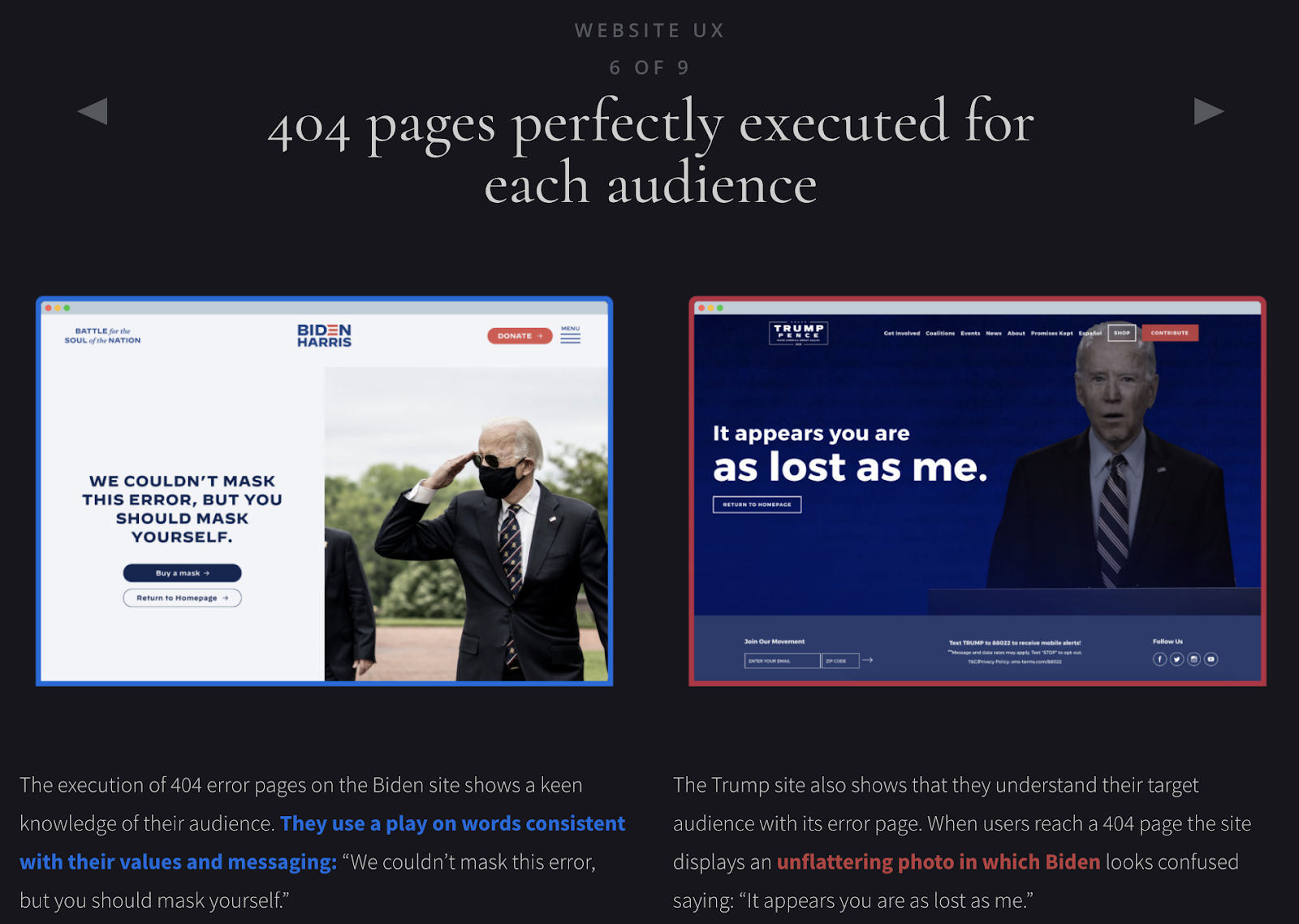
We also couldn’t help ourselves in looking at the 404 pages. Both perfectly represent their target audience: Biden’s responsible mask-wearers, and Trump’s anti-Bidens.
Neither campaign is leaning into search advertising heavily, with text-based search ads accounting for 11.48% and 10.09% of the Biden and Trump campaign’s Google Ad’s budgets respectively. They both make good use of the video elements of Google’s platforms, which may be based on the fact that video is a more immersive experience for the viewer, however it is unusual to see so little budget devoted to image ads given their ability for cheap, but effective remarketing.

The biggest misstep? The Trump campaign paid for the keyword “how to impeach trump.” One might think that this strategy is fascinating, and indeed it could have been, if paired with the right landing page. But when you look at other terms that received significant clicks, you’ll also find terms like, “speedo swim trunks,” “men’s xxl swim trunks,” “trump is a disaster,” and “trump fraud.” The Trump team was apparently not looking at their own search terms report. This oversight is easily fixable by adding negative search terms to their strategy.

Another key difference in strategy is that Biden’s team is using search to prioritize issues, while Trump’s team is here to sell hats (and other merch). Overall, team Biden is performing better in the Google Ads game. However, this is largely due to the fact that they’ve made fewer obvious blunders rather than their own strength on the platform.

I wasn’t impressed by the Trump campaign’s email strategy. The subject lines are flashy, even misleading, resorting to bait and switch tactics. Trump’s email team is pushing hard for donations. Ironically, however, the Trump campaign falters big time when it neglects to add emails entered into the footer of the website into any sort of followup email funnel.

With an average of 2.7 emails sent per day, one has to wonder about unsubscribe rates on the Trump campaign’s emails. The intended strategy may be to hit the audience hard to get recurring donations before they unsubscribe due to email fatigue.

The Biden campaign, on the other hand, seems to want to turn subscribers into advocates, only occasionally asking for donations. His campaign sends significantly fewer emails than Trump’s, with an average of one email every other day. The Biden campaign keeps the issues of their campaign central, and their subject lines helpful and professional. Overall, Biden’s email strategy has a clear advantage over Trump’s in its use of best practices.

Both candidates are running predictable and moderate social media campaigns. Biden is more active on Instagram than Trump, but it’s still surprising that neither candidate makes greater use of Instagram, considering the app’s large demographic of young, often swing voters.

The campaigns’ followers describe themselves in predictable ways: “she/her,” “feminist,” “activist,” and “liberal” for Biden and “KAG,” “patriot,” “conservative,” and “retired” for Trump. However, with only 1.3% of crossover between followers of these accounts, users are essentially tweeting into a political echochamber. It’s also interesting to note that in an analysis of how Biden and Trump advocates speak on social media found that Trump site visitors are twice as likely to talk about the opposing party compared to Biden site visitors.

The most creative social media push from either the campaigns is the Biden campaign’s podcast. This is new territory for presidential campaigns, and while its success has been mostly negligible (it seems Biden supporters are more likely to engage on other channels) it was a creative effort.

The Trump campaign uses divisive ads, intending to both sow distrust in leaders of the democratic party, and raising funds. These ads often include asking users to take a one-sided survey with titles such as: “Official Democrat Corruption Accountability Survey.” These tactics might be duplicitous, but we’d also give them some credit for stepping outside of the box. Both candidates ask for donations, just with a different focus. It seems likely that Trump is receiving more funds from his tactics, but Biden is likely creating more “ownership” from those who do support him by focusing on specific issues and local state battles.

Both campaigns run well-timed ad campaigns with a focus on state-driven ads, a smart strategy for their specific aims. The Trump team consistently spends more but the Biden team places a greater priority on swing states. The Biden campaign spends more in three of the five top contested states, while Florida gets the most attention from both budgets. And, while the Trump team consistently spends more, the Biden team is moving fast, increasing their spending quickly over the past three months.

Many know that SEO is renowned for its lengthy timeline to see results. So, with a fast-paced campaign like the presidential elections, SEO is, and really should be, a lower priority. However, both campaigns are making some pretty simple SEO mistakes that could be avoided with a simple two-hour audit. And, no matter the priority, easy fixes like that are always worth it.

Currently, the Trump team leads in gross organic searches. This is likely due to the fact that their top keyword “trump” has a 10X lead on the Biden team’s “joe biden.” However, the Biden site has the barebones of a non-branded strategy, with pages for terms like “gun safety” and “immigration.” They also make fewer elementary mistakes (homepage errors, missing H1 and H2 tags, the absence of canonical links, poor meta descriptions). While the Trump site carries more weight at the moment, if the campaign were to run for years rather than months, we’d put our money on the Biden site faring better over time.

A candidate’s logo is the centerpiece of the entire campaign. It reflects the values and strengths of a candidate. Logo design goes to Biden for its ability to be transferred to different colors and backgrounds, but Trump makes better use of logo variations for different subgroups. Their campaign colors match their demographic targets. The Biden team chose a bright navy and candy apple red, imbuing a lively, youthful energy, while the Trump team opts for a dark, rich navy and deep, crimson red to suggest seriousness, and an established foundation.

Looking to the campaign sites as a whole, the Trump site is more intuitively designed. Biden focuses on the human element, with copy like “chip in” and a casual, friendly lifestyle video. Trump’s site makes use of a full-screen design, maximizing on-page real estate and making mobile transition easier.

On the Biden site, the navigation is less intuitive, with a nearly overlapping “menu” title. Trump’s site navigation is more intuitive, and the white text allows for a nice eye flow. However, sometimes the white text runs into readability issues when photographs aren’t dark enough to create proper contrast.

The Trump app is a conversion machine, while the Biden app feels like a bit of an afterthought. Trump’s app holds the hand of the user throughout the entire app experience, with easy navigation, clear calls to action, and incentives for those who donate. Biden uses his app to share his vision, conveying a sense of togetherness and altruicity.

While not an essential part of a campaign, superfans will certainly download and use the campaign apps, so it’s definitely not an avenue to ignore. Both apps could definitely use some attention, but overall, the Trump app makes better use of the unique app format by giving benefits that are only available in the app.

Commercial strategy might be the greatest failing in the Trump team’s digital campaign. Their strategy is largely national, with little attention to specific state markets, including swing states. For example Florida, the state that has the most money going into it from both candidate’s Facebook and Google Ads, is being completely ignored by the Trump campaign. This is hardly strategic, seems more like an oversight.
It’s a situation many marketers are familiar with: a great product in a stagnant market. A brand deserving more recognition, fighting for a slice of market share.
This story was certainly relatable for eFileCabinet. But with big marketing goals and a team open to creative solutions, they were ready to implement a strategy that would cement their foothold in the market.
After implementing a multi-pronged campaign — holistic SEO, advertising, content, and email marketing, all wrapped around a creative and expertly executed conference — they were not just seeing results, they were seeing stars.

eFileCabinet makes the champion of document management software. They aim to take the pain out of complex filing and digitizing processes.
While their product was ahead of the curve, they woke up one day to find smaller competitors coming to steal their market share. eFileCabinet needed digital marketing expertise, they needed new approaches, and they needed a team that could ramp up and execute quickly. They found it all with their partnership with 97th Floor.
Our efforts culminated in a campaign so exciting that it not only won multiple awards (and the attention of the press), but also brought in the largest influx of leads eFileCabinet had ever seen.
While it’s fun to smash a few printers, the excitement and attention of a campaign fades, and without the foundation of a well-oiled lead machine, the true potential of that campaign won’t be realized.
In this article I’m covering the ins and outs of this campaign, but if you want to jump to a specific section, go for it!

If you’ve read any similar articles on our blog, highlighting real life marketing wins, you know the first step is typically customer research with the intent to create buyer personas. Audience insights, usually housed in buyer personas, are a critical element necessary before engaging in any campaign. But many marketers (even savvy marketers) underestimate the power of persona creation. Personas are especially crucial when working with an agency. Armed with the insight that only comes via detailed personas you can begin to create marvelous work.
eFileCabinet’s software could serve nearly any business (we all need to organize documents, don’t we?) but when we identified specific audiences that would benefit the most immediately, we were able to refine our customer personas to the most important ones.
The first step in creating personas is always basic market research. eFileCabinet already knew that many of their best customers worked jobs that needed constant document organization. We narrowed down the four most common fields to: HR, accountancy, insurance, and legal.

With four focus audiences in place, we took it one step further, delving deeper into what made these people tick. What were the biggest pain points they encountered in their jobs? Why would they come looking for eFileCabinet?
eFileCabinet introduced their team at 97th Floor to a handful of customers, thus giving us a direct line of communication with our target audience. These in-depth interviews helped shape the final touches on our persona development. Not to mention these interviews made for exceptional case studies down the line.
During the persona discovery process, it became clear to eFileCabinet as well as 97th Floor that our four audiences were not solely document filing drones, but people.
So, instead of marketing to people that live to digitize documents, eFileCabinet changed their strategy to market to humans.
We did a 38-point technical audit and discovered a number of things that were dragging down our rankings. The site was fine, but we were able to clean it up and really make it shine. After all, technical SEO really does lay a foundation for holistic SEO strategy. With a site humming along from a search engine perspective, SEOs could turn their attention to rankings.
Keyword research is an important piece of any SEO campaign, but without personas, keyword research will always be a weak final product. The personas guided the SEOs at 97th Floor in running the keyword research and keyword selection process. We had four different personas, which called for four specific rounds of keyword research. The strategy was to capture these audiences through awareness- and consideration-level keywords specific to their industries.

A collection of product- and market-focused keywords were selected to spearhead the campaign. Originally, eFileCabinet only ranked for about 10,000 keywords, but today they double that, and which contributes to nearly double increase in month over month organic traffic.
Today eFileCabinet ranks for a host of relative market keywords in varying stages of the buyer’s journey, from “going paperless,” to “office management systems,” to “wet signature,” to, “document manager,” to, “hr document filing.” Today, eFileCabinet has effectively transformed into an entirely new SEO force to be reckoned with, picking up 281% more organic leads than the previous year.
Digital advertising can capture an entirely different set of prospects than organic SEO. With our personas in mind, we created a segmented series of campaigns spanning across three platforms: Facebook, LinkedIn, and Google Ads.

Facebook Ads’ detailed demographic targeting gave us the freedom to launch ads that reached a wide but tailored audience. We created targeted ads to those who act like past purchasers, which attracted a new audience of people who behaved like our existing audience. Or in other words, they actually followed through on our CTAs. Facebook is also where we focused retargeting efforts, reminding those who had visited eFileCabinet before what they had left behind.

LinkedIn was instrumental in pinpointing audiences based on job position and industry, which was absolutely critical for our advertising campaign. This allowed us to pinpoint exactly who we wanted to market to, and align that with our constructed personas. Because the targeting was so precise, we were able to build unique ads, copy, landing pages, and lead magnets that were directly tied to any one of our audiences. For example, accountants would see ads about accounting document filing software, while legal assistants would see ads about legal document filing software.

Google Ads allowed us to market to an intent-based audience via keyword targeting. This let us reach people at their stage in the journey, including those with serious intent to buy. Google Ads also worked hand in hand with the SEO strategy. Together with eFileCabinet, we found high-converting keywords, we took that info to our SEO team members and — bringing in the benefits of paid through organic — saving a lot of money in the process.
Testing multiple ad variants was essential in ensuring the different campaigns were attracting the right audiences, and pivoting the ad copy if they were not. In total, hundreds of ad campaigns, with thousands of ad variants were created across the three platforms.

These campaigns brought extraordinary results. We had over 400 MQLs, increased conversion rates on Google Ads by 131% (.54% → 1.25%), with click through rates almost tripling (1.35% → 3.97%). All by simply focusing on the real people behind the job titles, rather than just the jobs themselves.
The secret to great email marketing is a good workflow and customer-centric logic in place. Again, it’s about the people. Email automation platforms, by themselves, lack logic and intelligence. It takes an experienced hand to turn a list of subscribers into leads, leads into customers, and, if you’re lucky, customers into raving fans. The first step, then, is to take full advantage of the email platform and create strategic workflows for each customer persona at each stage of the buyer journey.
Because eFileCabinet’s platform audit uncovered a series of misfiring workflows, overlapping data points, and repetitive offers, the first step in their email marketing strategy was to restructure the entire setup, including campaigns and workflows for each audience.
By creating a dedicated lead nurture experience that hinged on the user’s industry and stage in the customer journey, eFileCabinet could best meet the needs of their users within this channel.
Here’s the thing, everyone talks about the funnel as if it were actually a funnel. Even we are guilty of it. But today’s customers are so savvy that they don’t often progress down the funnel in the direct, linear fashion we want. So having built-in logic to your email campaigns that intelligently delivers what they want (which may not be the next step in the funnel) is imperative to properly nurturing a large and growing list. That’s what we accomplished with eFileCabinet.

I can be honest here, right? Document management software isn’t the most exciting industry in the world. Because of this fact, content needed to be fresh, unique, insightful, and just maybe, a little exciting too.
With the traditional content channels, our efforts encompassed a broad range including ad copy, articles, ebooks, case studies, and email copy. We created four different content campaigns, each pertaining to one of our buyer personas.
The following assets were produced to support the content journey of each of these campaigns:

Sounds like a lot right? It is. That’s the point. Shortcuts in content marketing don't exist. There is only efficiency and experience and, eventually, expertise.
These assets, executed well, and delivered at the right time have created a near-flawless content flywheel, which contributes to perfect adherence to lead nurture goals quarter after quarter.
Squeaky clean SEO, targeted PPC, segmented emails, and persona-driven content left eFileCabinet well on their way to becoming the leading figure in the industry. This would be the time when most brands would queue the fist pumps and pop open the champagne bottles to celebrate.
But eFileCabinet was only getting started. Now was time for the fun stuff.
Everything was humming along nicely digitally, but eFileCabinet had a long-time challenge they wanted to tackle next: Trade shows. Quite a different world than the digital marketing landscape they’d just conquered.
Trade show sponsorships had been lackluster in the past, but they believed there was opportunity still on the table. Together, we dreamed up many ways to get more out of upcoming trade shows. We did countless brainstorming sessions and built decks describing options. It was a battle royale of creativity. When the smoke cleared, one idea stood out as the clear winner: the Rage Cage.
