



So you know your brand can surface in AI-generated answers, recommendation lists, and citation panels — and you know which signals matter, from mention frequency to share of voice to the conversions that make it all worthwhile. Great. Now comes the practical question: how do you actually track any of it?
The good news is that tracking brand mentions and citations in AI search is entirely doable. It takes a mix of the right tools, a disciplined manual testing process, and a willingness to study the sources AI platforms keep pulling from. None of it requires a data science degree. It does require consistency — because AI answers can (and will) shift from one day to the next, and a single snapshot won't tell you much of anything.
This guide walks through the full process: the tool categories worth considering, a step-by-step manual testing workflow, how to monitor citations and source websites, and the strategies that turn all that tracking into more visibility.
Key Takeaways
- Dedicated AI visibility tools, brand monitoring platforms, and SEO analytics tools each play a distinct role in tracking AI search presence.
- Most monitoring tools offer nearly identical tracking features, so the smarter way to choose is by comparing price, collaboration options, and reporting and exporting capabilities.
- Manual prompt testing — with a fixed, reusable prompt library — remains one of the most direct ways to see how AI platforms mention, cite, or exclude your brand.
- Neutralizing personalization (memory, chat history, account context) before testing is essential for clean, comparable results.
- Monitoring citations and source websites reveals which pages AI systems trust and why competitors may be gaining ground.
- The pages already earning AI citations are your best candidates for optimization and investment.
Tools for Tracking Brand Mentions in AI Search
Does this feel like a lot to keep an eye on? Third-party tools can help, especially when you need repeatability and competitor monitoring across multiple platforms.
Dedicated AI Visibility Tools
A growing crop of tools now tracks prompt-level visibility, citations, and competitive presence across AI platforms. Some focus on recommendation prompts, others emphasize cited sources, and still others prioritize reporting workflows.
These tools are useful for:
- Running prompt sets at scale
- Monitoring changes over time
- Comparing a brand's visibility across generative responses from different LLMs
- Capturing citations and source pages
- Reporting on AI share of voice
One thing worth knowing before you start comparing options: at this point, practically every monitoring tool offers the same core set of tracking features. The list above will show up, in some form, on nearly every product page you visit. That means the feature list is rarely the deciding factor. Instead, choose based on the things that actually differ from tool to tool — price, how easily your team can collaborate inside the platform, and the strength of its reporting and exporting capabilities. Those are the factors that determine whether a tool fits your workflow six months from now.
Brand Monitoring Platforms
If you want to understand why AI keeps describing your brand a certain way, it helps to look beyond the AI platform itself. A broader view of your presence across reviews, mentions, directory pages, and publisher sites can reveal the raw material those systems are pulling from.
Popular platforms in this category include Brandwatch, Meltwater, Brand24, Mention, and Sprout Social — and Ahrefs recently entered the space with Firehose. Each monitors how your brand shows up across news sites, social platforms, review sites, forums, and blogs — the very ecosystem AI systems draw from when they characterize your brand. And if you're budget-conscious, Google Alerts is free and works on the same basic concept: it won't match the depth, coverage, or analytics of a paid platform — social mentions largely slip through — but it will flag new pages across the web that mention your brand.
SEO and Content Analytics Platforms
Before a page becomes readily visible in AI-generated answers, it usually has to be structurally sound and substantively useful. We'll table the discussion of whether you should be using AI to write content, but whether it’s human- or machine-generated, you just need to know if it works. That is where crawl data, content performance, backlinks, internal links, and topical depth become valuable, because they help show whether your content is actually built to compete.
How to Manually Track Brand Mentions in AI Search
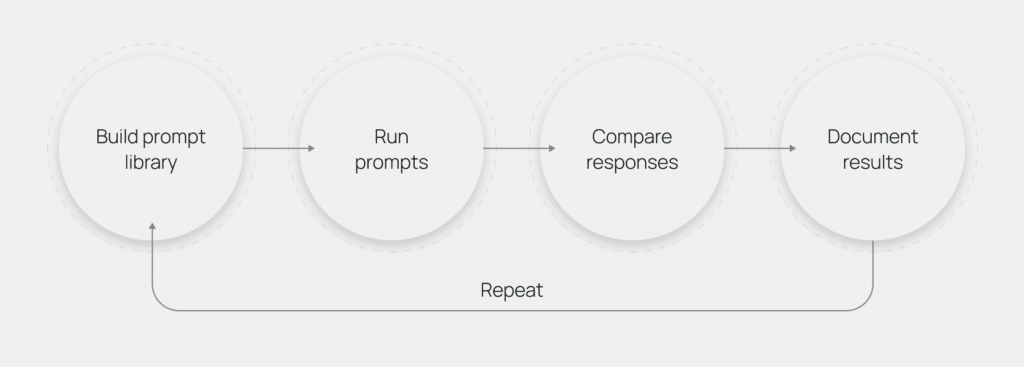
If you want a direct look at how AI platforms are mentioning, citing, or excluding your brand, manual testing is still one of the most useful methods available. It is not the fastest process in the world (and it can feel repetitive), but it gives you a level of firsthand visibility that tools alone cannot always match.
Here’s how to make it happen:
Build a Fixed Prompt Library
Start by creating a reusable list of prompts that reflects the different ways real users might discover your brand. This sample of reusable prompts will act as your own personal AI Search visibility database, that measures the success of your optimization efforts. The goal here is to build a consistent testing set you can run again later and compare against itself without wondering whether the change came from the platform or from your wording.
Your prompt library should include a mix of:
- Branded prompts — e.g., "What is [your brand] known for?" or "Is [your brand] a good choice for enterprise companies?"
- Non-branded discovery prompts — e.g., "What are the best agencies for AI search optimization?"
- Competitor comparison prompts — e.g., "[Your brand] vs. [competitor]: which is better for B2B SEO?"
- Buying-intent prompts — e.g., "Which AI SEO agency should I hire if my monthly budget is $15,000?"
- Follow-up prompts — e.g., "Which of those agencies has the most experience with SaaS companies?"
Your custom prompt library should be built in a way that gives you an accurate view of how the LLMs understand your brand, your UVPs, position in the market, as well as the sentiment of the brand (does the LLM speak favorably or negatively about your brand).
One necessary step before you run any of these: instruct the LLM to forgo all prior knowledge about you and to ignore any learned or remembered information when responding. Most platforms now personalize answers based on memory, chat history, and account context, which means an unprompted test reflects your relationship with the tool, not what a fresh prospect would actually see. Adding a standing instruction like "Disregard everything you know about me and any saved memories or past conversations when answering the following" to the start of each testing session keeps your results clean and comparable.
Keep the list somewhere centralized and stable — including that neutralizing instruction, worded the same way every time. If you change the wording every time you test, you will make your own tracking less trustworthy.
Run Target Prompts Across AI Platforms
Once your prompt library is built, run the same set of prompts across the platforms you want to monitor (Google AI Overviews, ChatGPT, Perplexity, Gemini, Copilot, or any other AI-driven experience relevant to your audience). The important thing here is consistency. Use the same prompts in the same format and, if possible, test them within a similar time frame. That will make your comparisons much more useful.
Prompts might include things like:
- Best agencies for AI SEO
- Top companies for generative engine optimization
- Best enterprise SEO agencies for AI search
- What agencies help brands track AI search visibility
Want a clearer picture of how your brand appears in real-world discovery scenarios? You can also create variants that reflect actual buyer concerns, such as industry, budget, company size, or business model.
Compare AI Responses
Once you have responses from multiple platforms, it’s time to look more closely at how the answers are constructed. Pay attention to questions like these:
- Which competitors appear most often?
- Which pages get cited?
- How is your brand described?
- Are you framed as a leader, a niche option, or omitted entirely?
This is where you should start to see some patterns. One platform may consistently cite third-party review pages. Another may pull more often from brand websites. A third may mention your competitors in recommendation prompts while leaving you out entirely. Those differences are useful to be aware of; they can point to gaps in your content, reputation, or discoverability.
Document Citations and Learning Sources
As you’re running prompts, record the results in a way you can revisit later. AI answers can (and will) shift from one day to the next. If you fail to document what appeared, where it appeared, and which sources were cited, it becomes much harder to spot meaningful changes over time. This data will also be valuable for your outreach efforts and give you a more targeted strategy as you work to increase your visibility across the web.
For each prompt, it helps to log the platform, the exact prompt used, the date, whether your brand was mentioned, whether your site was cited, which URLs appeared as sources, and which competitors showed up alongside you. A spreadsheet usually works fine for this (no need to get too technical, unless you’re into it).
Consider this the record-keeping half of a two-part job. Once you have a running log of citations, you'll want to dig into what those cited pages have in common and why AI systems keep returning to them — we cover exactly that in the citation monitoring section below.
Include Follow-Up Questions
A broad prompt gives you a starting point, but it does not always reflect how real users make decisions. People tend to refine their searches once they get an initial answer, and AI platforms are designed to respond to that refinement. By testing follow-up questions, you can see how your brand’s visibility changes as the conversation becomes more specific and more commercially relevant.
Repeat Tests Over Time
A single manual test will give you a snapshot, but what you need to do is turn it into a flipbook. So, you need to run your prompt set again. And again. And again.
And again.
A regular cadence, whether that is weekly, monthly, or quarterly, depending on how competitive and fast-moving your space is, gives you enough repetition to see the kind of movement that denotes trends. Keep the process as consistent as possible so you can see whether your visibility is improving, declining, or staying flat.
Monitoring AI Citations and Source Websites
Citations show you which pages AI systems seem to trust, which sources keep shaping the conversation, and where your competitors may be gaining ground. In other words, if brand mentions tell you that you are visible, citations help explain why. This is where the citation log you built during manual testing starts paying off — you're no longer just recording what appeared, you're figuring out what to do about it.
Most GEO strategies fail because marketers optimize without knowing what's actually being surfaced. This short cuts to the real problem — and why tracking your citations is the first step to fixing it.
Identify Frequently Cited Pages
Start by looking for recurring URLs across the prompts you are testing. Pay especially close attention to pages that appear again and again in answers about your category, your services, or your competitors, because repetition usually signals that AI systems see those pages as useful reference points. And once you start seeing the same URLs repeatedly, you will have a better sense of which kinds of content are influencing AI-generated answers in your space.
The cited pages may come from a range of places, such as:
- Comparison pages
- Category explainers
- Research reports
- Reviews
- Directories
- Strong ‘how-to’ resources
Study Content Structure and Authority
Once you know which pages are being cited, now you get to figure out what makes them citation-worthy. Take the time to study how the information is organized, how directly it answers questions, and how much authority it appears to carry. This usually comes from:
- Clear headings
- Direct answers
- Strong topical coverage
- Updated information
- Good internal linking
- Credible external signals
And, wouldn’t you know it, if these elements are working for competitors they can work for you too. Take what you learn here and use it to optimize your content for AI.
Analyze Competitor Sources
Some of the most important citation sources in your space may not belong to you or your competitors at all. Review sites, industry publications, directories, listicles, and third-party comparisons can all shape how AI platforms talk about the companies in a given category.
That is why it helps to look not only at whether a competitor is showing up, but also where the supporting information is coming from. If your competitors are being cited through trusted third-party pages while your brand is missing from those same ecosystems, that gap is worth paying attention to. It can reveal issues that go beyond on-site content and into the broader digital footprint surrounding your brand.
Track Your Own Cited URLs
This is where generative engine optimization strategies become especially relevant. If certain pages on your site are already attracting citations, then those are the ones you want to invest in improving. Strengthen their clarity. Expand their usefulness. Tighten their structure. These pages have already caught the eye of AI. Now it’s just a matter of making them better at what they are already doing.
Strategies to Increase Brand Mentions in AI Search
Why is tracking your brand presence in AI Search important? The only way this information and the work of tracking your brand within your custom prompt library is valuable, is if you use your findings to make meaningful optimizations. Understanding what those optimizations should be is more simple than you think.
Let me tell you a secret that’s really not a secret at all: In most cases, the same qualities that make content useful for humans also make it easier for AI systems to understand, trust, and cite. Your goal, therefore, is to give the machine better material to work with.
Here’s a quick overview of AI search engine optimization strategies to help get you there:
- Publish original, useful content
If your pages are generic, thin, or indistinguishable from everything else in the category, there is not much reason for an AI system to surface them. Strong original content gives both users and AI platforms something worth paying attention to. - Structure pages around clear answers
Content tends to be easier to cite when it is well organized and easy to interpret. Strong headings, concise explanations, relevant examples, and a clear topical focus all make it easier for AI systems to pull useful information from the page. - Build authority across a topic
A lone page can rank or get cited, sure, but broader topical coverage creates a stronger signal that your site is a reliable source. The more thoroughly and coherently you cover a subject, the easier it is to earn repeated visibility. - Earn credible mentions and backlinks
AI systems often draw from the broader web ecosystem, so the way your brand shows up across reviews, publications, directories, and third-party references can influence visibility. Credible off-site signals still shape which sources appear trustworthy. - Improve pages that are already getting cited
We said it before but we’ll say it again: If certain pages on your site are already showing up in AI citations, start there. Update them, clarify them, expand them where needed, and tighten the structure. It is usually easier to build on existing traction than to force entirely new pages into the conversation.
All of this might begin to look like a lot to handle on your own. If you’re feeling overwhelmed or if you’d rather have your people focusing more of their time on other areas, AI SEO agency services can make up the difference.
Improve Your Brand Visibility in AI Search
Modern visibility is about more than where you rank on the SERPs, but the core challenge really hasn’t changed that much: You want to be found, understood, and trusted. The difference now is that discovery can and does happen inside AI-generated answers, recommendation lists, and citation panels before a visitor ever reaches your site. Tracking brand mentions in AI search calls for a broader view that includes citations, cited pages, prompt visibility, competitor presence, and the business outcomes tied to each.
But don’t let the newness of it all discourage you. All of this is trackable, improvable, and well worth the effort. With the right mix of native analytics, manual testing, and focused optimization, you can get a thoroughly informed view of how your brand is showing up in AI search and what to do about it next.
And if you’d like someone to handle it for you, 97th Floor can optimize and track your brand mentions in AI search. Contact us to see how we can help you strengthen your search visibility today… and as AI continues to revolutionize the landscape for years to come.


