AI Max is Google’s answer to a real problem: search behavior has outgrown traditional keyword matching.
But AI Max doesn’t just find new demand. It also accelerates and amplifies whatever is already in your account, including:
- Weak conversion signals
- Poor account hygiene
- Bad landing pages
- Unclear targeting
- Messy conversion systems
When AI Max underperforms, the problem usually isn’t AI Max itself. It’s that most accounts aren’t operationally mature enough to support it.
Our advertising team recently dug into AI Max as a department, looking at how it works, what the industry is seeing and what Google reps are telling advertisers. Here’s what we learned, and what we recommend doing before you flip the switch.
What Is AI Max?
AI Max is an enhancement layer for Google Search campaigns that uses Google AI to expand reach, adapt ad copy and route traffic to landing pages. Google launched it in May 2025 as a “one-click upgrade” inside existing Search campaign settings. It’s not a new campaign type.
It combines three capabilities:
- Search term matching: Broad match plus page understanding finds relevant queries beyond your explicit keyword list.
- Text customization: A rebrand of automatically created assets. Google writes headlines and descriptions dynamically, mixing your existing assets with content from your website.
- Final URL expansion: Google matches each query to the page it thinks is most relevant, even if it isn’t the landing page you chose.
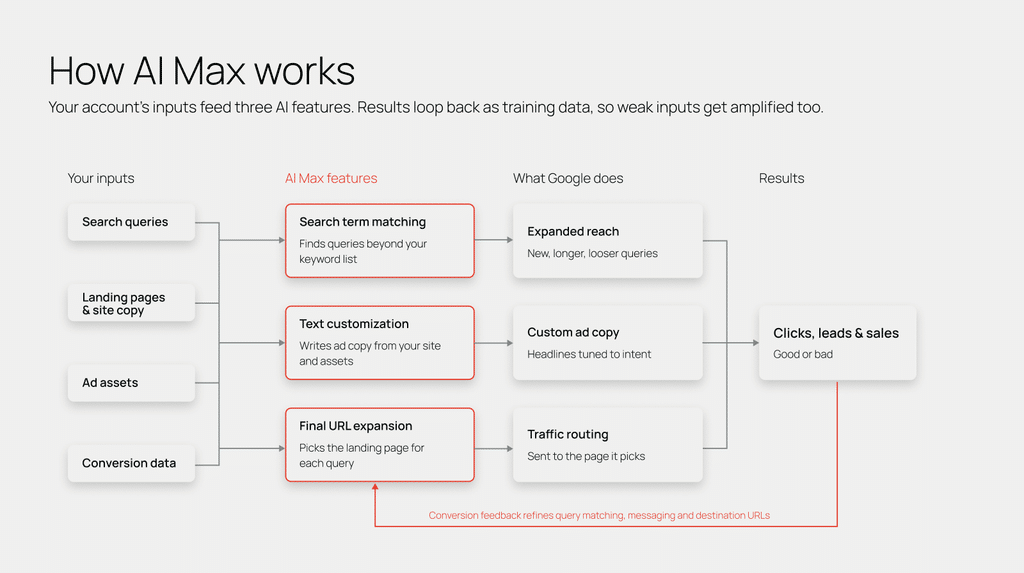
The core idea is a shift from keyword-only matching to intent and content matching. AI Max pulls signals from queries, landing pages, ad assets and conversion data, then uses conversion feedback to keep refining which queries it matches, what it says and where it sends people.
Many advertisers see AI Max as just another automation push, another loss of control or another “trust the algorithm” feature. That reaction is understandable. But AI Max is part of a much larger evolution in search behavior and machine learning, and it helps to see how we got here.
The Slow Evolution of Match Types
AI Max didn’t come out of nowhere. For years, Google has steadily loosened keyword targeting:
| Match type | What it started as | What it evolved into | What it is now |
| Exact match | The exact words, in order, with nothing added | Close variants: misspellings, plurals, and reordered words | Same meaning or intent, even with different wording |
| Phrase match | The exact phrase, with words allowed before or after | The phrase or close variants, with words before or after | The keyword’s meaning, without requiring the literal phrase |
| Broad match | The keyword’s words in any order, plus additional words | Synonyms, related searches, and other variations | Searches Google considers related—even without the keyword’s words or direct meaning |
In practice, exact can feel like the old phrase match, phrase can feel like the old broad match, and broad can feel like the wild west.
That evolution shifts control from literal keywords toward Google’s interpretation of intent. AI Max takes it further, using your landing pages and assets to find relevant searches beyond your keyword list.
Why Google Had to Change
Search behavior changed faster than keyword lists could keep up:
- Queries became longer.
- Searches became more conversational, especially as people got used to AI tools and AI Overviews.
- Intent became harder to capture through rigid keyword matching alone.
Google has repeatedly stated that 15% of the searches it sees every day are entirely new. No advertiser can build a keyword list for queries nobody has typed yet. AI Max is Google’s attempt to solve that problem.
It also opens new inventory: AI Max is one of the ways ads can serve in AI Overviews and AI Mode, alongside broad match and Performance Max.
So the strategic logic is sound. The trouble starts when that logic meets a real account.
Why AI Max Often Underperforms
Google’s early testing claimed advertisers saw an average 14% more conversions or conversion value at a similar CPA or ROAS. Independent results have been more mixed. Industry consensus is still split, and the negative patterns show up again and again.
Higher CPCs. AI Max puts you into more auctions, including competitive ones you weren’t in before. Media buyers told Digiday that clients’ average CPCs rose 10–15% over AI Max’s first year, with some as high as 25%.
Lower CTRs. Expanded queries are, by definition, looser matches. Auto-generated headlines can also read awkwardly. Both pull click-through rate down.
Weaker conversion performance. CPA spikes early are common. One analysis of roughly 30,000 search terms matched through AI Max found 99% of impressions had zero conversions, and fewer than half of the terms were matched to a keyword at all.
Irrelevant search term expansion. If AI Max reads your blog, careers or support pages, it can match queries from students, job seekers and existing customers. That spend looks like reach but isn’t demand.
Branded conversion inflation. AI Max often picks up branded queries that would have converted anyway. Results look strong, but the conversions aren’t incremental. Google has since started rolling out a branded search control for AI Max, a sign of how common the problem is.
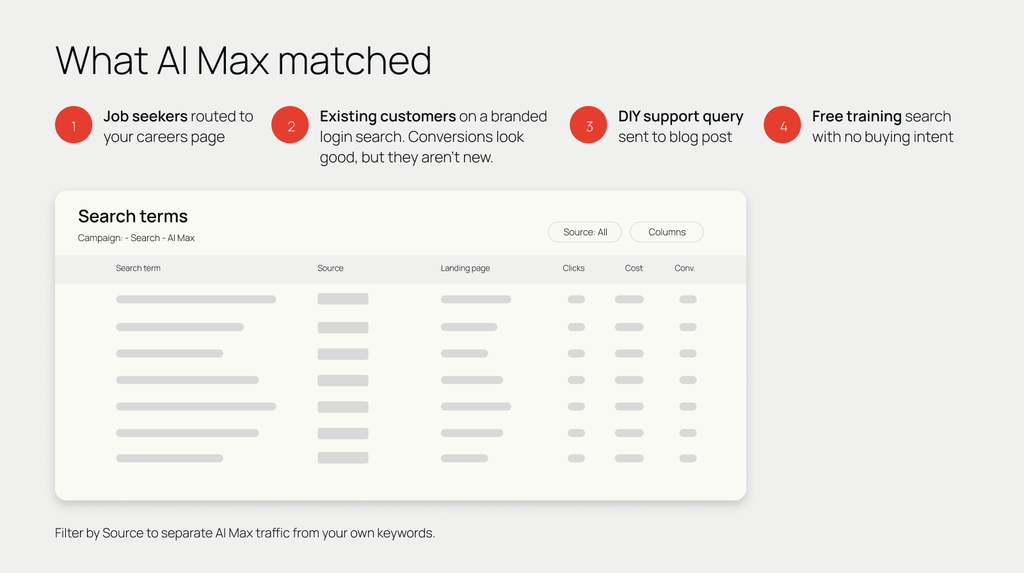
The pattern underneath all five: AI Max learns from whatever signals you give it. If those signals are weak, it expands noise faster. Even Google reps have been cautious. Some advised our team to wait a month or two before testing, and one said AI Max isn’t recommended for B2B for the time being.
What to Do Before Turning On AI Max
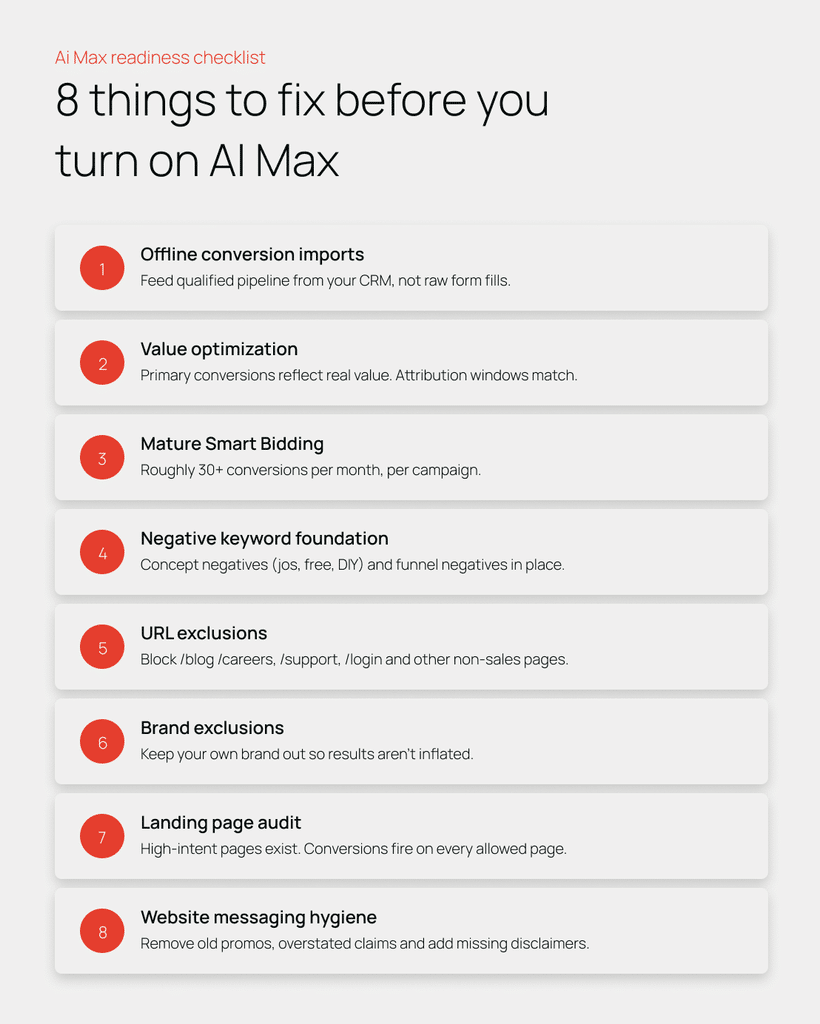
AI Max works best in accounts with mature Smart Bidding, strong landing pages, qualified conversion data and a real need for incremental reach. It’s a riskier fit for new accounts, low conversion volume, messy tracking, weak site content or regulated messaging. Before you launch, work through these eight foundations.
1. Offline conversion imports
For lead gen, AI Max needs to know which leads actually became customers. Set up offline conversion imports or a direct CRM integration so Google learns from qualified pipeline, not raw form fills.
2. Value optimization
Optimize for value over volume. Confirm your primary conversions reflect real business value, values are assigned correctly and attribution windows are consistent across conversion actions.
3. Mature Smart Bidding
AI Max leans heavily on Smart Bidding signals. A good rule of thumb is about 30+ conversions per month per campaign. Below that, the algorithm doesn’t have enough data to separate good expansion from bad.
4. Negative keyword foundations
AI Max expands queries faster, so negatives matter more. Before launch, add:
- Concept negatives: free, jobs, training, DIY, definition, student, salary, certification, support, login
- Funnel negatives: research-only queries and low-intent modifiers
5. URL exclusions
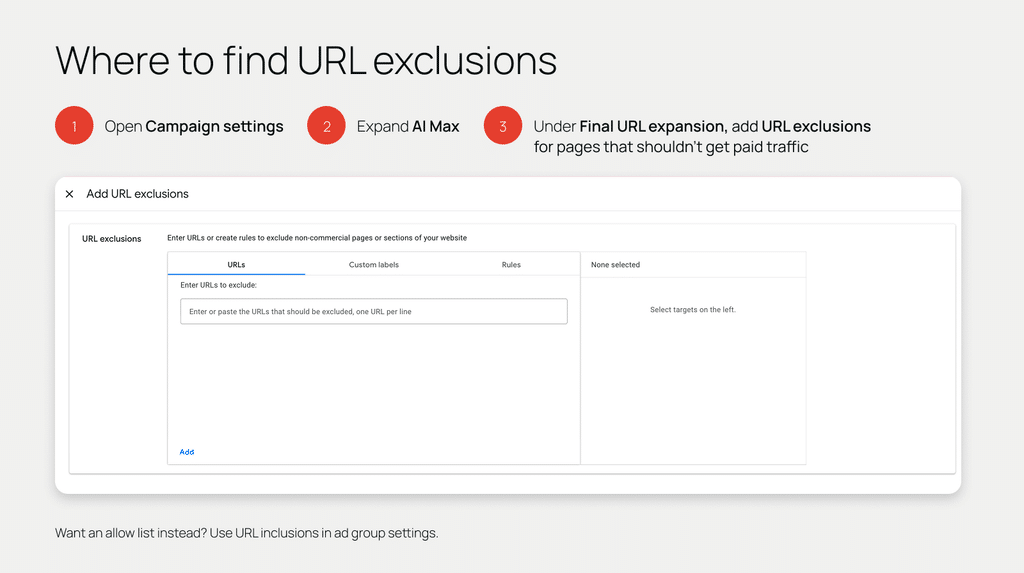
Final URL expansion can send paid traffic to any page on your site. To retain some control, either:
- Build an allow list of pages that are safe for paid traffic, such as pricing, demo, solution, comparison and high-intent landing pages, or
- Exclude URLs containing paths like /blog, /careers, /support, /login, /privacy and /press. Consider /resources, /events and /webinar case by case.
6. Brand exclusions
Add your own brand, and possibly competitor or partner brands, as brand exclusions at the campaign level. Brand exclusions block entire brand entities and scale better under AI-driven expansion. Negative keywords block specific queries more precisely. Use both.
7. Landing page audits
Your website now influences matching, messaging and routing. Check that:
- High-intent pages exist (pricing, demo, compare).
- Solution pages map clearly to personas and use cases.
- Forms are consistent across pages.
- Conversions fire on every page AI Max is allowed to use.
8. Website messaging hygiene
With text customization on, Google writes ad copy from your site. Anything on the page can end up in an ad. Remove or fix:
- Old promos and temporary offers
- Overstated or experimental claims
- Region-specific claims and service areas you don’t cover
- Missing disclaimers or compliance language
What to Monitor After Turning On AI Max
AI Max requires more monitoring than Google implies. Google’s newer reporting helps: the Search Terms report now has a Sources column that separates AI Max expanded matches and expanded landing pages from your original keywords. Use it to compare expanded traffic against your legacy match types. Review these seven areas weekly:
What to watch | What to look for |
| Query quality | New search themes, irrelevant matches and fresh negative keyword opportunities |
| Funnel mix shifts | Whether spend is drifting toward research-stage or low-intent queries |
| Branded percentage | How much AI Max traffic is your own brand, and whether it overlaps your brand campaign |
| Landing page routing | New pages receiving spend, conversion rate by page and funnel mismatches |
| Auto-generated asset quality | Weird headlines, unsafe claims and CTR compared with lead quality |
| Lead quality | Whether AI Max leads progress through the pipeline like your other leads |
| Incremental conversion quality | Net-new conversions, new themes, less impression share lost to rank and pipeline lift beyond brand |
Then read volume and quality together
- Volume up / quality flat: potentially positive. AI Max is finding real incremental demand.
- Volume up / quality down: guardrails needed. Tighten negatives, URL rules and brand controls, or turn off URL expansion.
An early CPA spike can be normal learning. A spike that persists after the learning period is a signal problem, not a patience problem.
AI Max Is a Preview of Where Google Ads Is Going
Whether or not you turn on AI Max this quarter, the direction is clear. Google Ads is becoming increasingly:
- Intent-driven
- Machine-learning-driven
- Semantic
- Predictive
The advertisers who succeed won’t necessarily be the ones with the most keywords, the most segmentation or the most manual controls.
They’ll be the ones with:
- Strong signals
- Mature conversion systems
- Strategic guardrails
- Operational discipline
- Value-based optimization
That’s the real takeaway. AI Max isn’t something to fear or blindly trust. It’s a stress test for your account. Build the foundation first, and AI Max becomes a growth lever instead of an expensive amplifier of your weakest signals.