



Every interaction a user has with your company tells a story. And that story starts long before someone clicks a button or fills out a form. It begins with how easily they understand what you offer, how confident they feel moving through your experience, and how quickly they can get what they came for.
In other words, it starts the moment they begin to experience your brand.
A UX design strategy defines how user experience decisions are planned, prioritized, and connected to business outcomes. It ensures design choices are intentional, informed by research, and tied to real goals like growth, engagement, and revenue. Without strategy, design becomes reactive. With strategy, design becomes a tool for progress.
Psychology plays a central role here. Users bring expectations, habits, and emotions into every interaction. A strong UX design strategy accounts for how people think and how they decide to act as they move through an experience. When psychology and strategy work together, user experiences feel trustworthy and effective.
Here, I’m going to break down what UX design strategy is, why it matters, and how it impacts both users and businesses. I’ll cover the benefits of a strategic approach, the core components that make it work, and the psychological principles behind effective experiences (and how intentional UX design supports conversion, retention, and long-term growth). And, because this is a company blog and we’re proud of the work we do, I’ll also discuss how 97th Floor approaches UX strategy as a collaborative, research-driven process.
UX design strategy is the plan that guides how user experience decisions are made to support business goals and user needs. It connects research, design, and execution into a cohesive direction. While UX design focuses on individual interfaces and interactions, UX strategy defines the why, when, and priority behind those design choices.
At its core, a UX design strategy brings together research and usability principles, supported by psychological insight and organizational alignment. It creates a shared understanding of users and clarifies how the experience should support both them and the business.
A UX design strategy gives teams a clear framework for making decisions that serve both users and the business. Instead of relying on opinions or assumptions, strategy creates direction and consistency across the entire experience.
This matters because it:
A UX design strategy is made up of several connected parts that guide how experiences are planned, built, and improved. Each of these components plays a specific role in shaping how users move through an experience and how well that experience supports business goals.
Research sets the direction for every UX decision that follows. By studying user behavior and gathering stakeholder input, teams gain insight into needs, expectations, and obstacles. This groundwork helps reduce assumptions and ensures design decisions are based on real evidence rather than internal opinions.
Usability focuses on how easily users can navigate and complete tasks. Clear pathways and familiar patterns help users move through an experience without confusion. When usability is prioritized, frustration is reduced and progress feels natural.
Information architecture determines how content is structured and labeled. A thoughtful structure helps users understand where they are and where to go next. When information is organized in a way that feels intuitive, users can find what they need with less effort.
Interaction design defines how users engage with elements on a screen. Buttons, transitions, and feedback signals all influence how responsive an experience feels. Well-planned interactions guide attention and reinforce a sense of control.
Accessibility ensures experiences can be used by people with different abilities and needs. Designing with accessibility in mind improves usability for everyone and helps brands reach a wider audience. It also signals care and responsibility in how experiences are built.
UX copy supports users through clear and purposeful language. Labels, prompts, and instructions help users understand what actions are available and what will happen next. Good UX copy removes uncertainty and keeps experiences moving forward.
Testing and iteration allow teams to refine experiences over time. By observing how users interact with designs, teams can identify issues and make informed improvements. This ongoing process helps experiences stay effective as needs evolve.
Cross-functional alignment keeps UX efforts connected to broader business initiatives. When design, development, and marketing teams share the same goals, execution becomes more efficient. Alignment helps ensure the experience feels cohesive from start to finish.
We make daily decisions on what brands we choose to engage with, what brands have earned our trust, and what brands compel us to spend money. How do we make those decisions?
Psychology studies have shown that our feelings and instincts cause us to behave. It is said that emotions drive 80% of the choice we make. So the first visual impression a customer receives from your brand is crucial to a positive customer experience, or a customer experience at all.
Good design is more than just good looks, it’s the catalyst to trust and loyalty towards any brand or company.
Trust is often the first hurdle a brand needs to clear, and design is usually the deciding factor.
That’s because design is emotional. It evokes moods, attitudes, and personality. Together, these emotions create “gut feelings” and stir thoughts in our mind. And before even being exposed to actual content, visual queues have already shown us how to feel towards a brand.
So when we’re browsing the web and come across a ‘spammy’ looking website, the visual queues are telling us it’s untrustworthy. When junk emails pop up, poor design makes us question the legitimacy of the content. When we find a good deal on the web, but the checkout page to fill out credit card information looks sketchy, we back out. As a result, we don’t engage with the brand, we don’t subscribe to the service, and we don’t buy anything at all. And it all comes from gut feelings created by bad design.
And when trust breaks down at the visual level? Users rarely stick around long enough to reconsider.
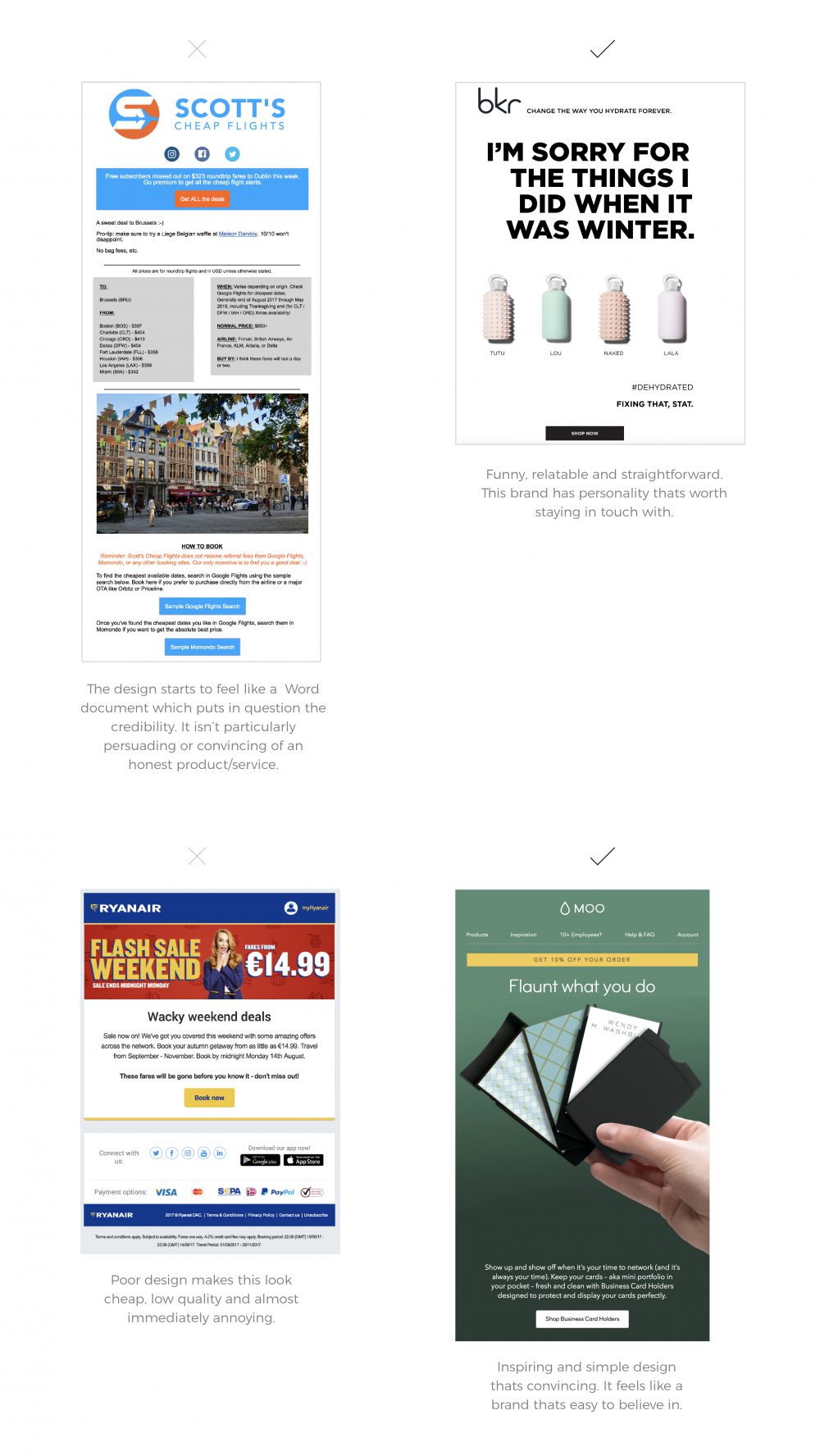
Belief is what bridges the gap between curiosity and commitment.
There’s a reason for the old adage don’t judge a book by it’s cover. It’s because we do! As consumers, we expect the quality of products/services to match their appearance. We don’t have time to be convinced that a certain brand/product/service is good, we should already be able to see that it is (or isn’t). A brand with good design is more convincing than a brand with bad design because we assume appearance reflects quality.
Have you ever found yourself wanting to purchase the organic or brand name cereal rather than the generic brand? We expect good packaging design to be the shell of a good product. Have you ever spent more money on a product just because it looks better than the cheaper version? By sole appearances, we assume more credibility with one brand than another, and we take one brand more seriously than another.
When design communicates quality clearly, customers are more willing to give you the benefit of the doubt.
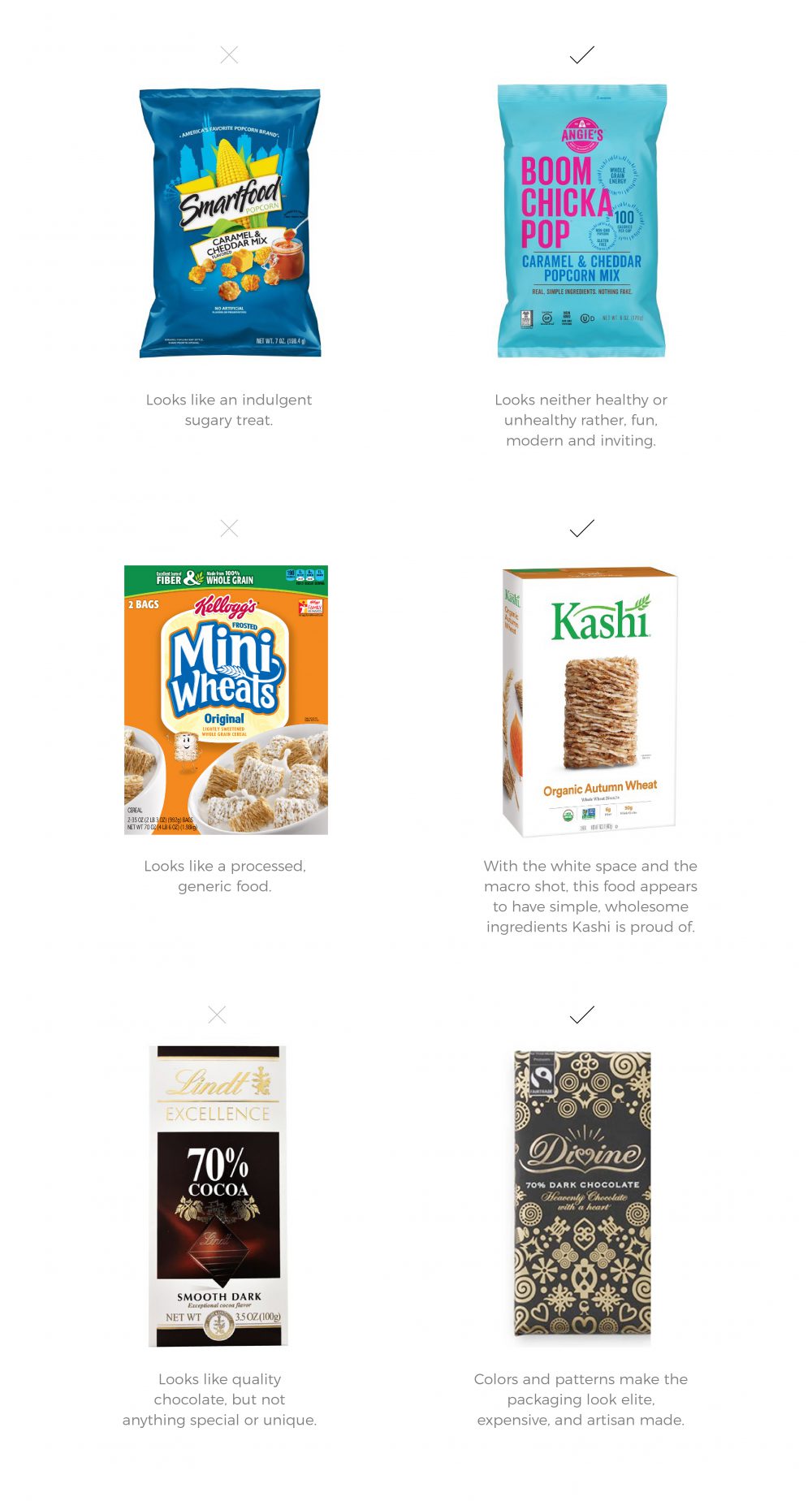
Brands with an up-to-date design make us feel like their product/service is likewise current and relevant..
Some brands stand out as cutting edge in their industry simply because they look the part. We’d be less likely to purchase a product from a website designed in the 90s, because we associate the outdated web design to the product/service. It’s as if we think, how can a product/service with a website from the 90s, serve the needs I have in 2026? There’s got to be another brand who is more current and fresh. With no progression in any aspect of design, it’s easy to assume there hasn’t been progression with the product/service either. A brand’s entire look and feel should show that it is leading the industry. Brands who look the part, convince their audience that they actually are.
Think of it like this: when design reflects forward momentum, audiences are more inclined to believe the brand can meet modern needs.
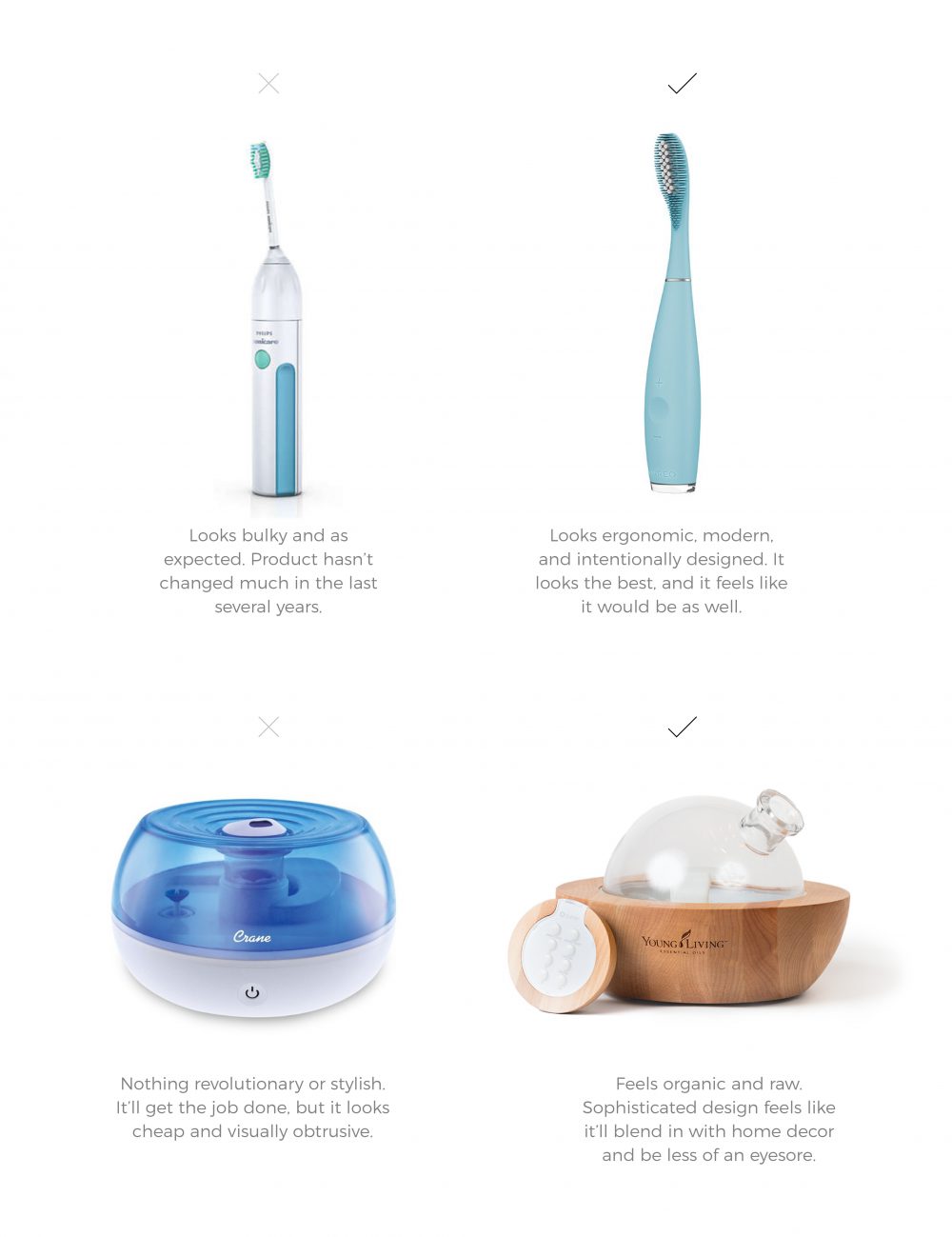
Design isn’t just how your brand looks; it’s how it feels. Feelings and instincts from good design cause positive behaviors. And the same goes for bad design causing negative behaviors.
Simply put, design dictates the user experience. So, take a second look at your brand. Does the design reflect the quality of your service/product? Is the design of your logo, website, flyer or whatever visual medium you’re using to communicate with your audience look like you’re a superior, dependable brand? Or do your visual mediums make viewers hesitate?
Visual design focuses on how an experience looks. UX design strategy focuses on how that experience works, why decisions are made, and how success is measured.
Psychology informs UX by explaining how people perceive information, form opinions, and make decisions. UX strategy uses that understanding to guide structure, flow, and priorities across the experience. Visual design then supports those decisions by expressing them clearly.
In terms of scope, UX design strategy is the broader of the two. It considers research, usability, business goals, and cross-functional needs. It is also measurable, with success defined through outcomes like engagement, conversion, and retention (rather than preference alone).
Building a UX design strategy requires intention, structure, and a willingness to learn from users. While every organization is different, most strategies follow a similar progression.
UX design strategy becomes clearer when viewed in context. Consider the following hypothetical scenarios:
These are, of course, only a few examples. The reality is when it comes to UX strategy, design must be adaptable to your product, your audience, and the specific situations where the two come into contact. A firm understanding of customer psychology, backed by reliable research, makes this possible.
UX design strategy matters because it shapes how users experience your brand and how confidently they move through it. When strategy is grounded in psychology and supported by research, design decisions become more justifiable and easier to scale. Teams gain clearer alignment, usability improves across touchpoints, and development effort is spent solving the right problems.
If you’re ready to build or refine your UX design strategy, 97th Floor partners with teams to create research-backed experiences that support both users and business goals.
Lead-generation is a core component of a B2B marketing strategy. However, many businesses struggle to improve lead quality and quantity. Specifically, a survey from ActOn found 37% of SMBs struggle to convert web visitors into leads. While a low conversion rate can be caused by driving the wrong traffic to the site or by pursuing the wrong marketing strategy or having a poorly optimized page, many businesses will benefit most by building a more robust lead-gen strategy first.
Small businesses frequently start their lead generation by creating a core offer to garner interest in their product. These end-of-funnel offers-- free trial, free quote, free consultation, contact us-- are essential components to a lead-gen strategy. However, for businesses with longer marketing and sales cycles, having only these types of offers is a missed opportunity to capture and nurture leads.
In fact, if you have a robust top-of-funnel content marketing strategy in place with a low conversion rate, adding an offer of relevant mid-funnel content can significantly increase your conversion rate. For example, one 97th Floor client had a robust content marketing and SEO strategy driving qualified traffic to the site. Its “Free Trial” offer brought in a good number of leads, but overall, the conversion rate of the site was extremely low.
We decided to test creating an ebook and placing the offer in hyper-relevant locations on the website. Within the first two months the conversion rate for organic traffic increased 3x, and months later the site retained that conversion rate. After the success of the first ebook, we created another gated offer that was relevant to other high traffic content pieces. Organic conversions increased by 43% and were maintained long-term.
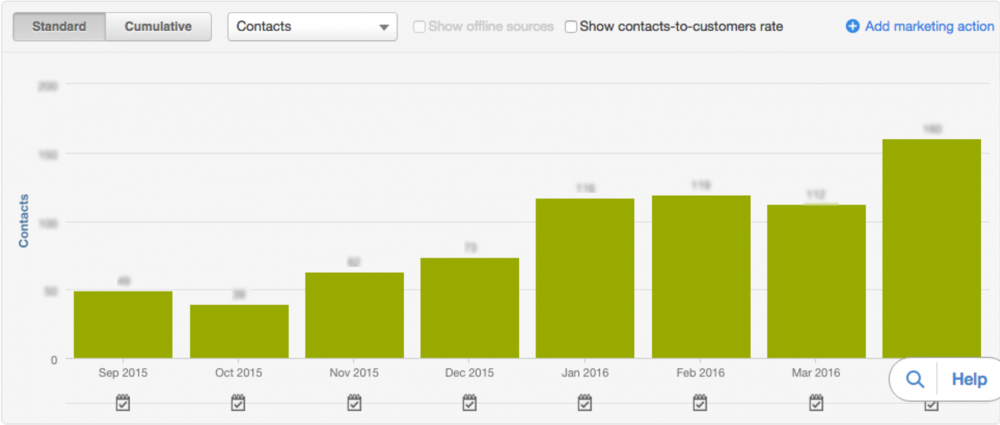
While having mid-funnel content was a key component to the campaign’s success, having effective content was the most critical component for driving quality leads. Many marketers would agree that content marketing is an extremely effective lead-gen tactic. However, it can also be the most difficult to execute well. After all, good content should be unique and insightful while nurturing potential customers all at the same time.
So what process can you follow to create effective lead-gen content?
In the case study cited above, we found there were 3 core questions a buyer needed to answer before making a purchase decision. The majority of that information was difficult to find, requiring visiting multiple websites and fitting pieces of information together while navigating a plethora of buzzwords. The ebook we created offered a comprehensive buyer’s guide that provided a framework for answering those questions and compiled all of the necessary information into a single location.
Content mapping is not a new concept, but many businesses fail to understand how crucial it is. Content should be mapped not just to the stage in the buyer’s journey, but also based on the information the visitor is consuming at the time.
For example, if a visitor comes to your website via a blog post titled “What is content marketing and why does it matter?” an ebook about “How to Optimize Title Tags” is not nearly as relevant as an ebook on “How to Develop Your First Content Marketing Strategy.”
In the case study above, the main CTA to the buyer’s guide was placed on a page with a competitor comparison matrix. Visitors who arrived on that page were already looking for information to help them make a purchase decision, so a comprehensive buyer’s guide was a compelling offer for those visitors. So compelling, in fact, that the click-to-submission rate ranged from 50-65%
Many traditional marketing activities- webinars, trade shows, purchased lists- are one-and-done activities. Once the event is over, it doesn’t continue to generate leads. If the business needs more leads, it has to attend another trade show or produce and promote a new webinar. Gated content, however, can produce a long-term conversion funnel if you create the content with that intention.
Content typically dies because it:
The secret, then, to creating a long-term conversion funnel is to create content that will still be useful to a buyer two years from now and is tied to organic traffic coming to your website. In the buyer’s guide case study, the conversion rate was maintained because SEO was the primary content promotion strategy with only a small percentage of leads coming from social or paid channels.
There is no one-size-fits-all solution in marketing, but by following the principles above you’ll be able to create effective lead-gen content and test whether mid-funnel conversions can have a significant impact on marketing ROI.
You finally took that leap and launched your own healthcare practice. It took grit and guts to get there, and it’ll take grit and guts to keep it going. Now that it’s open, you need to find a continuous flow of patients to fill your practice and keep your business above ground. Or, maybe you've been practicing for a while but are ready to scale and bring your practice to new heights. Regardless of the circumstance, there are some bulletproof healthcare marketing strategies that will get new patients flowing in your doors from a digital audience.
A healthcare marketing strategy defines how healthcare organizations attract patients, build trust, and drive engagement across digital channels while staying compliant.
Unlike general marketing, healthcare marketing prioritizes clarity, accuracy, and confidence at every touchpoint. Patients are not just comparing services. They are evaluating trust, expertise, and ease of access at every step of their customer journey.
A modern digital marketing strategy for healthcare brings together SEO, local visibility, content, and reputation management to support the full patient journey. When executed well, healthcare marketing functions as an extension of your patients’ experience.
Below I've distilled some healthcare marketing ideas and techniques you should be looking into in order to increase the relevance of your healthcare practice online.
Your site is likely the first interaction your potential clients will have with your healthcare brand online. A sloppy, buggy, or thrown-together website can give the impression that your practice is also sloppy, buggy, and thrown-together. In order to nail this first impression, be sure to invest in a well-crafted, visually appealing site that is easy to navigate, provides useful information, and demonstrates your practice’s expertise. A good site is the foundation of an influential online presence.
It should go without saying, but your site needs to look professional and inviting. In today’s digital age there are many avenues to building a website. Though it’s tempting, it’s worth investing in quality over budget when it comes to your site design. In addition to the fact that the average user sees quickly through cheap site design, a good site structure is essential to keep up with your healthcare business as your company scales. It’s important that your site reflects the top notch service and quality you provide.
The good news for you: many of the healthcare sites out there look quite outdated. By updating or creating a well designed site, you can stand out with relative ease.
When people get to your site, it’s for a specific purpose. In your case, people are looking for a healthcare provider that they can trust, with answers to questions only a doctor can answer. They have a specific problem, and they are looking for solutions.
If your website isn’t clear about the value each page brings (or worse, it promises value but doesn’t deliver) that confusion will reflect poorly on your practice. Be clear, be helpful, and put the user-- your potential patient-- first.
Facebook ads can be powerful for your healthcare marketing strategy, but you’ll need to put some thought and strategy into them. The FB ad platform isn’t one that typically brings results by blasting as many users as possible with your ads. The power comes instead from the very specific, granular targeting that can be done. Maybe you focus on sports medicine and want to run a campaign targeted to men and women, aged 20-40, with a particular interest in CrossFit. On Facebook, that’s easy. What if your practice caters to a higher-end clientele? No problem, you can target via income, net worth, home value, location, etc.
Paid social media marketing, such as with Facebook Ads, can be a powerful tool in an online strategy. The key is running tailored campaigns to specific personas. As you refine who you are targeting, you can lower your overall cost of running ads because you aren’t wasting money commercializing to people who will have little interest. To help get you thinking of what campaigns you should run on Facebook, here are some of the targeting options.
If you are embarking on running some social media ads yourself, be sure to read up on all the ins and outs of Facebook’s ad platform and how to use it. There are many options and it is easy to get overwhelmed on your first go. Adspresso has a great guide to get you jump started that can be found here.
Most industries have directories that list professionals within their industry. These directories often put in a lot of time and money in order to rank well for many profitable keywords, which means they are a resource you can use to increase the weight of your own domains. Use these healthcare directories to your benefit while you are getting your site ranked for your chosen keywords.
In most instances, directories will be free (or cheap) and have an easy to fill out form. You will use the form to submit information about your practice to be posted on the public directory.
For example, Healthgrades.com has a comprehensive directory that you should leverage to your advantage. It ranks for many healthcare-focused keywords.
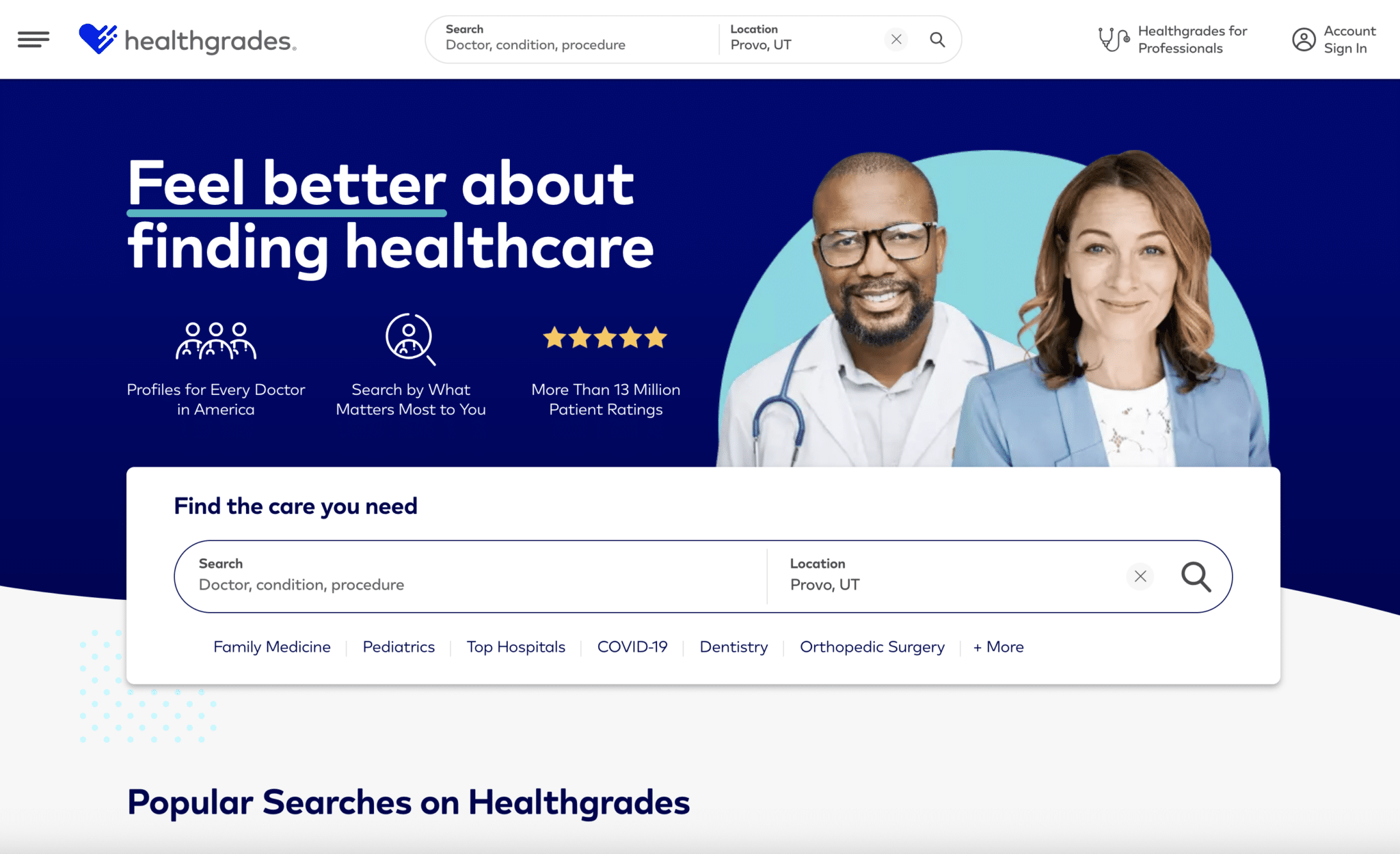
You can create a free Healthgrades.com profile here. It will look something like this:
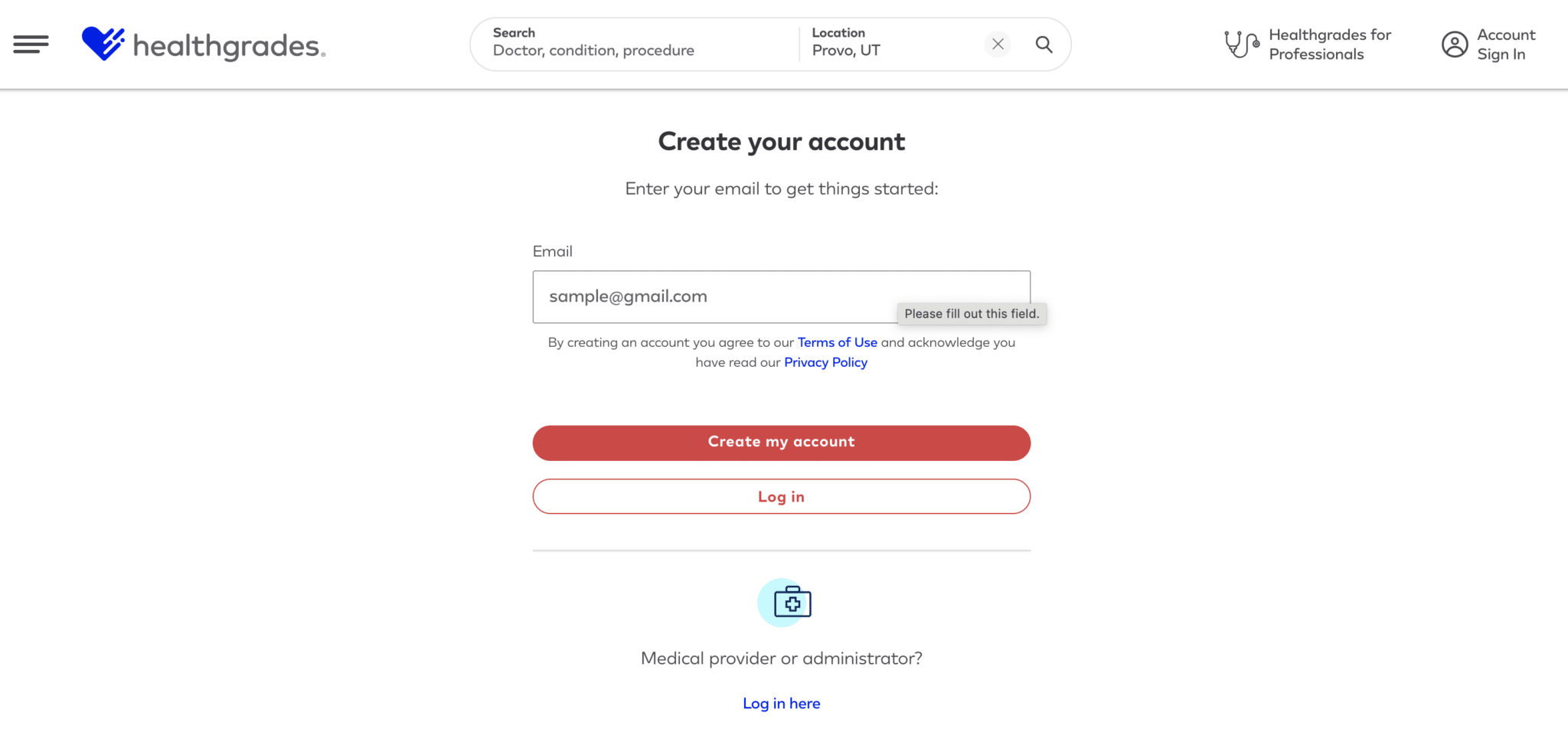
This is a great way to take advantage of all the hard work Healthgrades has put into their site and rankings. And, it’s mutually beneficial. Healthgrades relies on healthcare practices to add themselves to these lists, and you rely on them to aid your ranking positions and lead generation.
Here are a few more healthcare directories that you should be on:
All of the above directories rank for many “healthcare provider in...” type keywords. If this method works for you, don’t stop there! There are many more directories with online clout than the ones listed above. Do a quick search for “healthcare provider in” + “city” to see which directories show up for the city you want to rank for. Be sure to leverage the directories that rank for your target terms first.
Google My Business is incredibly important if you want to show up for local results in Google. I’m sure you’ve seen local results many times, but maybe you didn’t realize it was a part of the Google algorithm that you can leverage. Here’s what a local result looks like when you search “chiropractor SLC”:
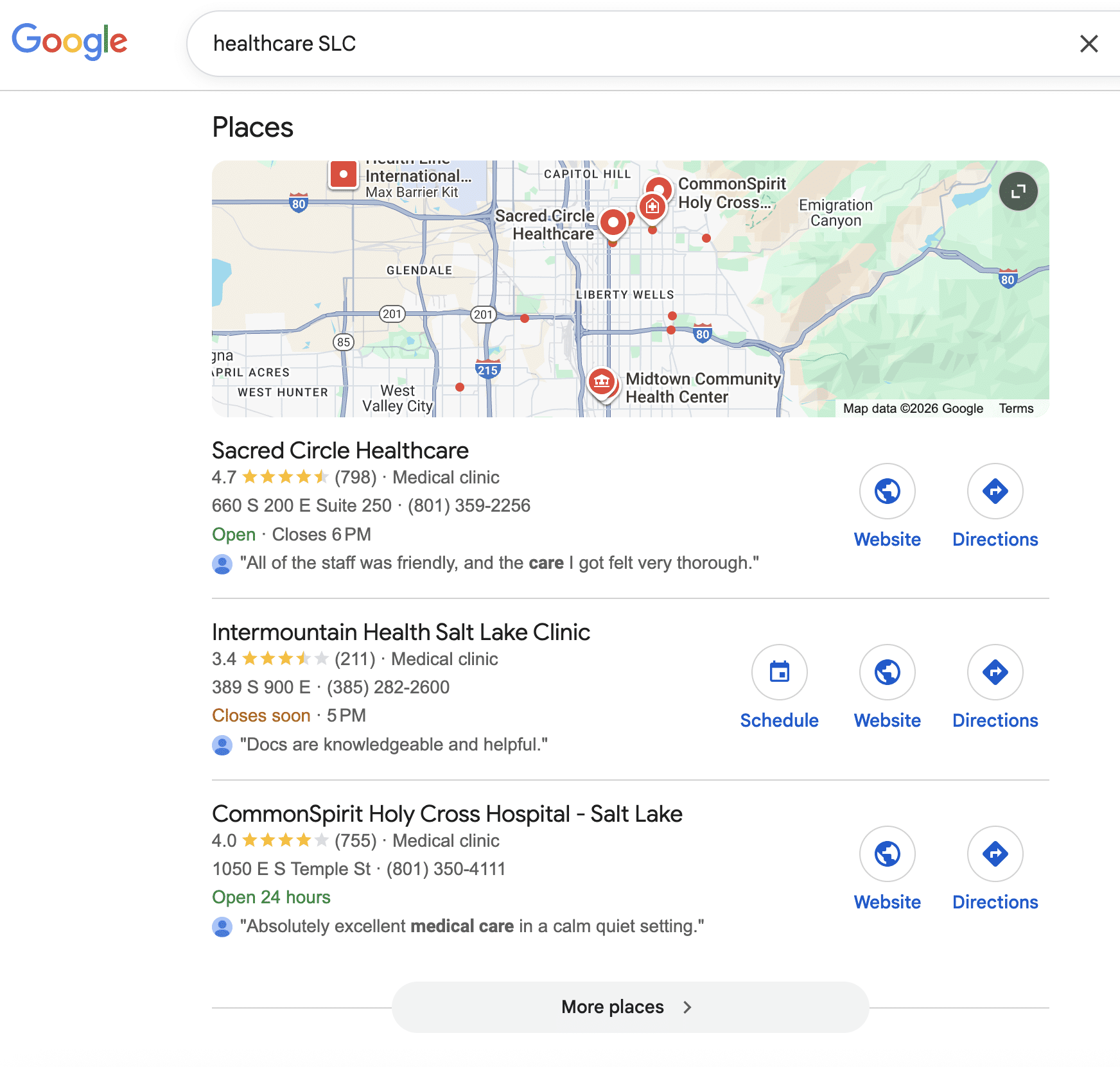
The local box will show different businesses that fit what you are looking for. There are many factors that go into showing up for these, but Google tells us that it comes down to 3 core factors:
So what exactly does Google mean by these?
Relevance is pretty self-explanatory. It refers to how closely your local business listing matches the search someone types in. By doing a thorough job filling out Google My Business and optimizing it to match the queries you want to rank for, you’ll increase in relevance.
Another pretty easy one, distance illustrates how far a person is from your business. In a recent report from Hitwise, it is reported that nearly 60% of searches are now performed through a mobile device. Google will calculate where a user is through their device and use this distance as a factor when providing results.
This is the part where optimization comes in. Prominence tries to gauge how prominent your business is in the offline world and reflect that in local listings.
Many factors are taken into consideration here. Links, local citations, reviews, and your position in traditional SEO results all factor into how “prominent” you are.
You need to verify your business with Google My Business. This is a fairly easy process. After you set up your Google My Business page, Google will send you a postcard with a verification code. You will then enter the code into Google My Business to verify your business listing.
Next, make sure all of your details are up to date and add 3-5 pictures of your business.
After you’ve added some great photos of your business, double check the category that you’ve declared for your business within Google My Business. It is important that you have categorized your business properly.
Thoughtfully fill in your introduction and title of your business in Google My Business so that it represents your business well.
Reviews are very important in local search marketing. Read and thoughtfully respond to reviews about your business. Reviews can make a huge impact on your business for better or for worse. It is beneficial to keep them under control through responding and genuinely taking care of your customers.
Citations are your mentions on various directories on the web. These directories are sites such as Yelp, The Yellow Pages, dexknows.com, chirodirectory.com and more. Building these by hand can take a lot of time, so many companies hire out for citation building.
If you embark on building citations by yourself, make sure you keep all of your information consistent across all of the directories you submit to. Nothing is worse than getting a bunch of citations that have conflicting phone numbers or addresses that you need to go through and clean up.
Traditional SEO for a healthcare practice, sometimes searched online as healthcare SEO, can be immensely powerful. SEO for those who are unfamiliar stands for “search engine optimization.” It is the act of optimizing the elements of your site so that you rank better (closer to the top) within search engines. The idea is that if you are a healthcare provider in Las Vegas, then you want to show up when someone searches “healthcare Las Vegas” within Google or other search engines. And, you want to show up as closely to the top as possible, so more users will click to your site over your competitors’. Performing SEO for your healthcare practice will do more than just generate customers, it will help you build a brand. Here are some of the benefits to investing in SEO.
As a healthcare provider, you are highly skilled in an area where most other people are not. Furthermore, you invested good money in becoming an expert at your craft. Use that expertise to grow your brand through content marketing.
What do I mean by content marketing? You should be consistently publishing content that brings value to your potential patients in a way that only you, as the expert, can. If you’re wondering: “Well, what should I write about?” This is where the keyword research that I mentioned earlier comes in. Keyword research will teach you what people are searching for and how many people are searching for it. In many cases, these search terms represent the questions that your potential patients have for you.
For example, if someone is experiencing upper back pain, they may search “upper back pain” in Google in order to research what the causes could be. Here is a snapshot of what the traffic looks like for some keywords regarding upper back pain.

Quick notes -
As you can see in this example, there are many people searching for the keyword “upper back pain” or some variant of it. We also learn that these keywords have relatively low difficulty being in the 20-30 range (out of 100, 100 being the most difficult).
If you, as a healthcare provider, created a piece of content regarding “upper back pain” and optimized it for the above terms, you could begin generating quite a bit of online exposure.
As you begin to show up for searches in Google you will be seen as an authority. The more searches you rank for, the more people will associate you as an authority.
A great example of this is Dr. Josh Axe of Draxe.com. Dr. Axe began by founding the Exodus Health Center in Nashville, helping thousands of families reclaim their lives through improving their health. Furthermore, Josh helped his own mother reclaim her health and beat breast and lung cancer. Realizing that he has a special set of skills, he set out to help more people using the amplification of the internet.
When Dr. Axe started early on, he wrote many pieces of content and published them on his site. Dr. Axe began ranking for many keywords and has since grown to become the “second-most-visited natural health website in the world.”
Here is Dr. Axe’s current site:
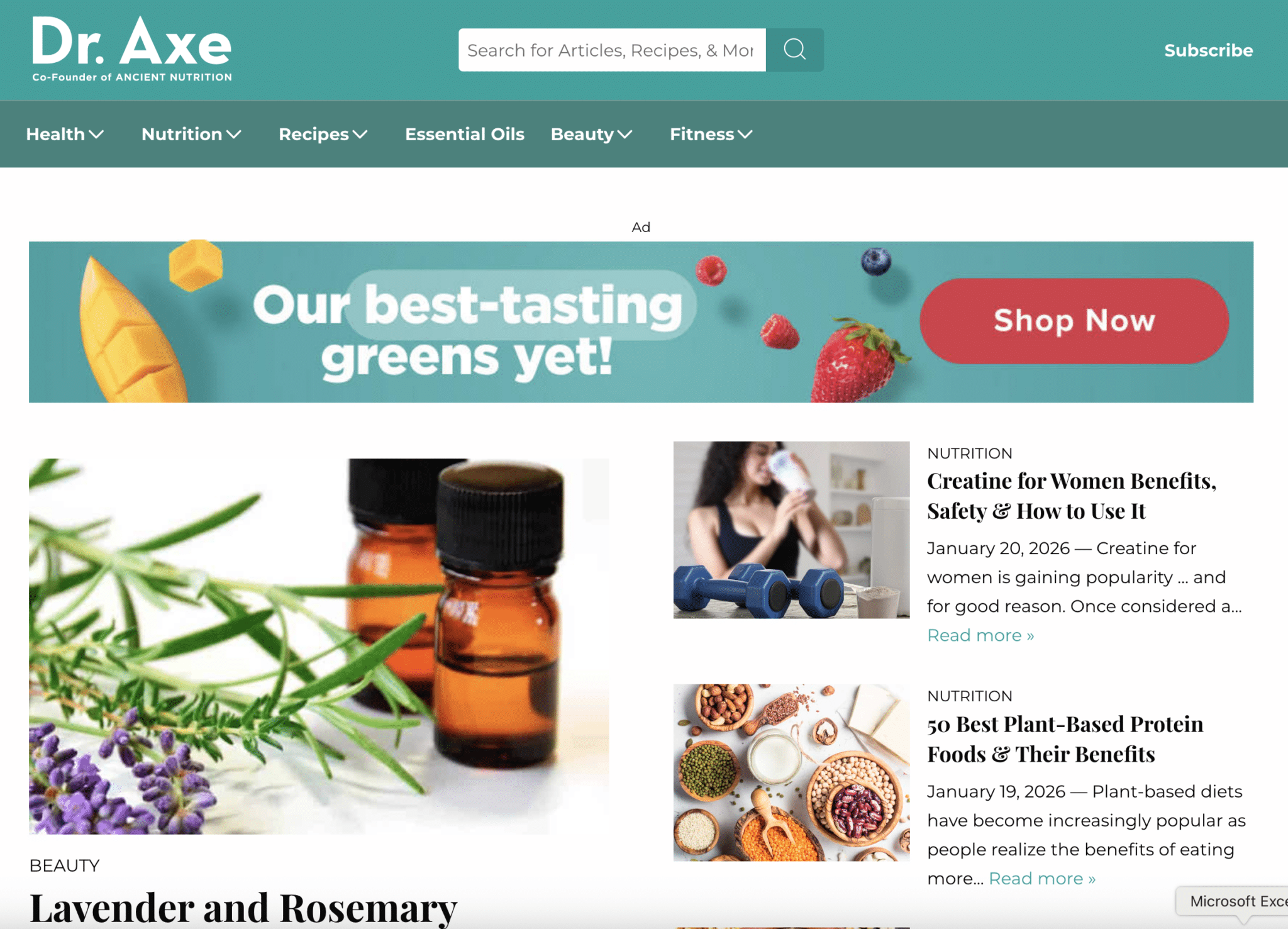
Josh’s site currently ranks for over 1.6 million keywords and generates over 7.5 million monthly visitors (as per Ahrefs).
Dr. Axe is an inspiring case study of what can be done through the leverage of SEO to build a strong brand with immense authority.
Managing your reputation online is at the heart of retaining a good brand image. Google your brand frequently to see what people are saying about you. Better yet, create a Google Alert for your brand name and be notified each time you are mentioned. This way you can jump in and resolve concerns and strengthen your brand.
Patients often research providers across search results, review platforms, and third-party healthcare directories. Monitoring what appears in these spaces helps organizations understand how they are perceived and where gaps in trust may exist. A strong healthcare marketing strategy includes proactive brand monitoring.
Give thoughtful responses to reviews and mentions to show your accountability and reinforce credibility, which is especially valuable when patients are evaluating alternative care options. Over time, this consistency supports a more resilient healthcare marketing strategy by building confidence across digital touchpoints.
For many patients, the first interaction with a healthcare organization happens online. This is often referred to as the digital front door, and it plays a vital role in any healthcare marketing strategy.
A patient-centric digital experience removes friction. Websites should be easy to navigate, quick to load, and clear about services, providers, and next steps. Patients should be able to understand their options, find answers to common questions, and take action without confusion or unnecessary barriers.
A strong digital marketing strategy for healthcare treats the website as more than a brochure. It functions as an access point for care, guiding patients from research to an appointment with confidence. When the digital front door is built around patient needs, marketing efforts convert more effectively, and trust is established before care even begins.
Healthcare is evolving quickly, and patient expectations continue to rise. The organizations that succeed are those that invest in strategy and adapt their healthcare marketing strategy as technology, regulations, and behavior change.
97th Floor helps healthcare teams put their ideas into action and capture the biggest opportunities in the industry. If you’re ready to move beyond tactics and create a strategy designed for today’s healthcare landscape, let’s build it together.
See how an audience-first approach translates to bottom-line results.
Here at 97th Floor, elevating brands we believe in is part of our culture. In light of this, I thought it would be fun to analyze the digital marketing of a brand whose product I like and am very familiar with and really enjoy. That brand is YNAB.
What Is YNAB?
YNAB stands for You Need a Budget and when answering the question, "what is YNAB?", it's important to understand what YNAB does. It is a computer program used for budgeting and tracking expenses. The software takes a different approach from tools like Mint, which focus on pulling all of your bank accounts and credit/debit card transactions into one place where you can categorize and review transactions after they happen. This reactive approach works for many people and was actually my tool of choice before I discovered YNAB.
YNAB takes an opposite, more proactive approach to finances. By educating users on how to properly plan where each dollar will go, while also providing the technology to track spending, YNAB puts people in charge of their finances. A couple of years ago, a colleague mentioned it to me in a conversation and I’ve used it ever since. It is incredible for keeping track of spending and overall being on top of your finances.
But this isn’t an advertisement. If you want to know more about the program, YNAB has an excellent intro to the finer details here. For now, I’d like to take a step back from what YNAB can do, and instead focus on the digital marketing side of things.
For a while, I’ve wanted to dig into YNAB’s online marketing efforts to see what gems I could offer them as a “here’s to YNAB” type toast. As I dug deeper, I realized that YNAB has done an incredible job in building a devout YNAB community online. It is a difficult task to create a cult-like following (which I mean in the most positive sense) around your product. YNAB has created thousands of YNAB ambassadors by leveraging communities on Reddit, Facebook, and other social media sites, and through effective email campaigns.
But while YNAB is doing great things in the community building space, I want to shift the focus to what they could be doing with organic digital marketing to reach even more people and add another channel to fuel their community. For this post, the focus will largely be on SEO-related potential.
To begin, let's take a look at where YNAB is at organically. YNAB ranks for 6,069 keywords in the top 50 results as per Ahrefs. Again, one thing that is immediately apparent is how great of a brand YNAB has built (I’ll probably echo this many times throughout the post). Its brand search for the keyword “YNAB” generates around 130,000 monthly searches alone. Add the rest of its branded keywords and you have a very substantial amount of branded organic traffic.
YNAB also ranks for many non-branded keywords, albeit not nearly as well. There are many opportunities to push up these peripheral keywords so that they bring in significantly more search volume. We’ll get into this in greater detail further down in the analysis.
Part of YNAB’s building such a strong brand is due to leveraging the passionate following that surrounds the online financial niche. Some of the biggest communities on Reddit, like r/financialindependence, are related to finances, such as the following:
Reddit.com/r/personalfinance - 10,235,956 subscribers
Reddit.com/r/frugal - 628,703 subscribers
Reddit.com/r/financialindependence - 183,573 subscribers
The YNAB online community has done an excellent job siphoning traffic from these various subreddits into their own YNAB Reddit community (Reddit.com/r/ynab). The YNAB Reddit community, or subreddit, has over 30k subscribers. Many subreddits are created and die before they ever get enough users to sustain growth—the Reddit.com/r/budgetfirst/ subreddit, which was created by a group of YNAB Reddit users after YNAB switched to a subscription-based model, is one such example.
Despite the challenge of creating a sustainable reddit community, YNAB has managed to create a community that not only wants to be more involved in the YNAB ecosystem, but also help others in their pursuit to financial freedom. Gotta say, 30k hungry brand ambassadors is never a bad thing to have.
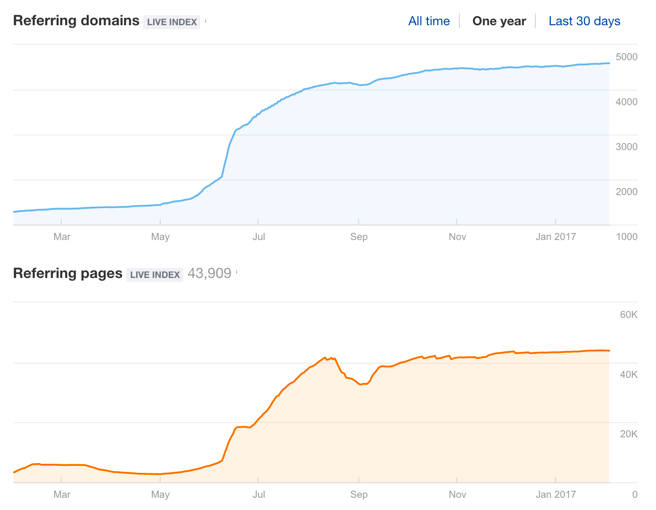
Ahrefs indicates that YNAB is increasing in referring domains quite healthily. The data below raises the question: where is YNAB getting their links from?
One thing I found right away, is that YNAB has some great links on what I like to call “feeder sites.” “Feeder sites” are sites that have content that is syndicated by many other large publications. Finding valuable feeder sites can be immensely powerful for SEO due to the amount and the quality of links that can be obtained.
Below is an example of what this feeder process looks like that YNAB has benefitted from.
An article was placed on the Reader’s Digest’s site, RD.com, entitled “34 Little Life Skills Everyone Needs to Be a Grown-Up.” RD.com is a feeder site to MSN.com as well as a handful of smaller sites. You can see that MSN.com syndicated the same article here. This means that for the effort of creating one very high-quality post, you can net a handful of links, sometimes from some large publications. This can be immensely powerful, and can lead to great jumps in increased rankings,
In the last few months, YNAB has received links like these:
And this is honestly only naming a few of the total links built recently.
YNAB is in a great position. It has the benefit of being able to target money-management communities with its methodology while at the same time targeting sites that focus on cell phone apps. This widens the targetable audience for the amount of websites YNAB can get links from. More links equal more authority, and when properly used, convert into better rankings and more traffic.
YNAB gets numerous mentions on both large and small publications. It is in the great position of garnering many mentions through its thousands of devoted fans. Typically, sites struggle with gaining more authority, therefore, they need a lot of high quality and well-targeted link building.
One note, however, is that many of the specific blog posts on YNAB’s site don’t get as much link love as the core YNAB pages (homepage, feature page, etc.). YNAB would benefit from additional links to their established blog posts, as well as to new posts as they are published. With the right content paired with YNAB’s community, this kind of link building should be cake.
YNAB has opportunities to generate much more organic traffic through their currently ranking pages. In order to diagnose how many opportunities there are, I pulled all ranking keywords (positions 1–50) from Ahrefs. Second, we needed to segment the data in order to see rankings in specific ranking buckets. I segmented rankings by keywords in the top 3 positions, positions 4–5, positions 6–10, page 2, position 21–50, and page 3+ rankings. I did this for every URL on the site in order to gain an understanding of each page and its rankings. The results looked something like this:

From a glance at the spreadsheet above, you can see a particular URL and what keyword positions that it ranks for. This makes it easy to determine which URLs simply need a bump in optimization and authority in order to generate traffic increases. This also allows you to forecast how big the traffic increases will be.
Let’s go through an example of how this data can enable us to take traffic-increasing action.
We see in the above screenshot that the blog post “How to Pay off $26k of Debt in 18 Months on a $35k per Year Income” ranks for 4 keywords in the top 1–3 ranking positions and 9 keywords in positions 4–5. The keywords in positions 4–5 represent around 520 monthly searches. This is what we see on the keyword level.

Looking at the average difficulty of these keywords, as well as taking into account that this post ranks as it does with not many links, YNAB could bump these 9 keywords up into the top 3 with only a handful of inbound links. This would increase the traffic of this page to somewhere between 100–150% with minimal effort. Sure, this is merely a couple hundred visits extra, but considering the minimal effort it would take, it would be worth it. Furthermore, you can see how this strategy can scale across the entire site. YNAB could increase overall traffic to the site by a large margin simply by taking advantage of this strategy applied too many of their blog posts.
The Google Featured Snippets box can be incredibly powerful to leverage. I want to show you how YNAB could leverage it to rank in a position essentially above position #1 (sometimes referred to as position #0). For context, the Google Featured Snippets box was debuted in Sept 2014, and was created as a vehicle for putting relevant answers in user’s hands much more quickly. For example, if you search “how to budget and save money” in Google, you will see something like this (highlights in red are mine):

You can see in the above screenshot that bettermoneyhabits.bankofamerica.com occupies the #0 position in Google’s featured snippet. This gives bankofamerica.com a strong advantage over americasaves.org in positions #1 and #2. Not only does bankofamerica.com have an augmented snippet, it also rank above position #1. This position can generate much more traffic than position #1.
Another value in ranking in the Google Featured Snippets box is that you can circumvent the climb to the top and be picked for a top page ranking, even if your site technically occupies a different rank land somewhere else on page 1. A detailed post on the specifics of how to do this can be found here.
YNAB already ranks on the first page for a handful of keywords that have the Featured Snippets box, but someone else shows up for the Featured Snippet. Because YNAB already ranks on the first page, it could implement some on-page changes and increase its chances of stealing the coveted Featured Snippets position. This would drastically increase the traffic YNAB receives from currently ranking keywords. For example, YNAB ranks in the 10th position for “how to pay off debt." This keyword generates around 5,400 searches per month. At the 10th position, YNAB doesn’t pull in that many of the 5,400 searches. However, if YNAB ranked in position #0, it would pull in a large percentage of that traffic.
Here are some of the keywords that have Featured Snippets YNAB could steal:

The process of optimize live posts is fairly simple, although it takes diligence. Cole Rieben, one of our Campaign Managers here at 97th, has a great post on what changes can be made in order to boost a site into the Featured Snippet spot (found here).
Without a doubt, creating new, high-quality, keyword-targeted content is one of the most rewarding actions YNAB could take. Content should be created for the user first, but in order for it to be valuable, it must also be findable. SEO done well is the perfect marriage between solid content and the ability to have that content found when users are asking questions. Keyword research can further help you understand exactly what kind of content people are looking for. It is an insight into their needs. Think about it, these people are asking questions already, we just need to meet their question with the best answer.
YNAB has created a lot of content. Most of it is fairly short and doesn’t rank for a ton of keywords. In addition, there are so many budgeting-related questions being asked daily. If YNAB can answer these questions with their grade-A philosophy and budgeting tool, it would be a huge win-win. Users get the answers they need, and YNAB grows.
To analyze what the market looks like in terms of budget/finance related keywords, I pulled a lot of data—like, over 111,000 unique keywords worth of data.
After researching the keyword level data, we needed to organize it to make it useful. The goal in leveraging all of this data is to understand a few things.
The first is keyword groupings of well-ranking URLs in the finance space. These URLs are from many other finance related sites. The data allow us to understand what keyword groups Google ranks these pages for. Secondly, I want to understand what it took for these sites to rank well
The most valuable metrics are the ones that impact the bottom line. The right numbers shape the future of your business by showing where to focus, how to improve, and when to adjust.
Choosing which metrics to track isn’t always easy. Marketing performance indicators must be set before meaningful progress can happen.
For a campaign to prove its viability, it needs data specific to its business’s purpose and goals. Clear measurement starts with understanding the language of performance. Metrics, KPIs, and goals may sound similar, but each plays a different role in shaping strategy.
Metric: A metric is essentially any signal that can be tracked. It’s an objective system of measurement, which means that you might have an entire dashboard of metrics that you’ve set up to be tracked. But dashboards only serve as directionless numbers without goals and KPI.
KPI: KPIs (key performance indicators; often called marketing performance indicators) are the metrics that you’ve decided to use in tracking how efficiently your business is meeting its objectives. It’s a little tricky to get down the difference, but just remember that while all KPIs are metrics, not all metrics are KPIs.
Goal: A goal is a metric-driven objective, defined by a clear timetable and tactics, that you are trying to reach. The best goals are SMART goals (specific, measurable, attainable, realistic, time-bound). Goals set a bar for the future of certain KPIs that you then strive to achieve. Goals should move your marketing department and business forward.
Let’s put them together. For example, you may decide that next quarter your business should work to earn more site conversions via organic traffic. Your KPI will be organic traffic. Supporting metrics might include keyword rankings and landing page conversion rates. Finally, your goal could be to reach 100 conversions via organic traffic.
The metrics that you choose for your KPIs will determine what your business will achieve. Keep in mind that there’s no comprehensive list of metrics that you “must be tracking” that will work for every business. The following is a list of metrics we’ve compiled from our own experience at 97th Floor for you to consider as you develop your individualized marketing strategy.
Revenue is something every marketing leader should have in their sight. Of course, tracking this is sometimes easier said than done. A good marketing leader will make every effort to get good data that associates revenue with your various efforts. If done correctly, all other metrics will fall under this single metric.
Conversions are the closest metric to revenue that you can track. What conversions look like varies based on the business. For an e-commerce site, that could be a checkout; for a B2B site, it could be a lead or closed deal. Marketers need to ensure that the conversions they track have monetary attachments. For e-commerce businesses, that can be quite easy; however, B2B companies that work through leads with a sales team will need to be intentional about gathering data and insight from marketing and sales to assign values to things like leads, MQLs, and SQLs.
While knowing the amount of conversions your site brings in is important, knowing the rate at which your site converts traffic to conversions is critical. Paying attention to historical and trending conversion rates will help you know where to focus your attention.
For example, if you see that one month shows a conversion rate that is only 50% of the month prior, you might dig further and see that was the month you launched a new ad campaign. This would tell you that this ad campaign likely wasn’t fruitful.
The close rate is the rate at which leads are closed into actual business and revenue. This metric can be useful in judging both sales and marketing team performance. Lower close rates could mean that the sales team needs additional training, or that the marketing department isn’t providing quality leads. Tracking the close rate will help keep both sales and marketing professionals accountable.
This metric is exclusively for businesses that are running paid ads across the web. Most major advertising platforms (i.e., Google, Facebook, and LinkedIn) have snippets of code called pixels that you can put directly on your site that allow the ad platform and advertisers to track the ad’s performance — including conversions that take place on your site. When ad spend is coupled with conversion data (that has an assigned marketing value) you’ll be able to see the rate of return on your ad spend.
CPL is the total cost to acquire a lead. This is typically used as a long-term benchmark, even though this number may change. For example, a business may find that it costs an average of $42 to acquire a lead over the past year. Assuming budgets have stayed the same, this business can assume that any figure under $42/per lead is a good investment.
As its name implies, CLV is the expected return during the life of an average customer. Marketing leaders at SaaS organizations will benefit the most from this metric. It’s powerful because it can encompass smaller metrics like customer retention rate, customer add-ons, and average length of customer retention. This metric is especially powerful when filtered across a qualifier.
Virtually all businesses utilize some kind of website for their marketing efforts. Knowing how many people visit the site in a given time is essential to knowing the impact of your online marketing efforts. Many metrics could be even more specific than total traffic, such as page visits, sessions, and unique visitors. And, while total traffic might not be incredibly insightful by itself, it’s critical in keeping other traffic-related metrics in context.
There are many traffic sources you can measure, likes ad channels, referrals, social, direct, and organic. Many businesses will benefit from measuring many of these channels. However, organic will make sense for virtually all businesses.
Organic search accounts for over 50% of all web traffic, and unlike other channels, SEO has the potential to attract customers at every stage of the funnel. This could include top funnel conversions like email capture or lead capture, or bottom funnel conversions like demo requests or purchases.
Blogging has proven its worth in the business world, as the most recent numbers say that businesses that blog regularly earn 67% more leads. It has pulled ahead as one of the best ways to participate in both SEO and content marketing. Content will draw users to your site and provide you with unique opportunities to meet their needs. Not to mention the tremendous work that a blog can have on your SEO strategy.
In addition to net blog traffic, consider tracking blog-specific conversions. Conversions on a blog are generally micro conversions, such as newsletter subscriptions, lead magnet downloads, or landing page visits. However, these contacts often move farther along the funnel as they are delighted with your brand and content, and can often turn into leads.
Subscribers are the highest top funnel contacts. They are the ones who know about your business and have opted in to hear more from you. Often, this looks like signing up to be notified of new blog posts or receive a newsletter. These contacts may or may not move farther down the funnel, but that’s okay. Growing your subscribers means growing your audience, which allows you to amplify your content and reach even more new contacts.
Leads are contacts in your database that have indicated some signal that they are willing to learn more than surface-level information about your company, and they’ve given you information to make that happen. Examples of this might come from a PDF lead magnet or a free trial signup.
Are you trying to increase trial sign-ups, improve customer retention, or get more traffic to your website? What are your targeted marketing performance indicators?
MQLs are leads that the marketing team has determined are more qualified than a standard lead based on their action. MQL structure might vary depending on the company, but generally, they are defined as the contacts that have shown enough interest to qualify them as ready to talk to sales. Marketing determines readiness based on either lead scoring or the contacts themselves requesting to talk with sales via a form on the marketing page.
An MQL becomes an SQL after the sales team has determined this lead’s qualifications. Many organizations have their own iterations on this, but SQLs are generally MQLs that are confirmed promising enough to be pursued by the sales team. Sales then takes the reins in nurturing them and aiding them in their journey to becoming a customer.
Email has one of the most positive ROIs of any channel. It’s believed to be as high as $42 for every $1 spent. It’s also one of the most used channels today, despite years of naysayers predicting its demise. This metric measures the effectiveness of subject lines in real-time. However, this metric also tracks much deeper issues, like a company’s reputation. If you have a history of providing good content within your emails, you’ll have a higher open rate.
Email click-through rates (and net clicks) measure the effectiveness of the content inside your email. Having a contact open and read your email is great, but having them follow through on what you asked them to do is even more important. Emails lose much of their usefulness unless contacts take action, so measuring click-through rate is worthwhile.
Social is a set of micro metrics (likes, shares, comments, social traffic, impressions, etc.) from which you can choose what makes sense to track for your company. Some businesses will choose not to intentionally track any of these metrics and put social media on the back burner. For some, social metrics will be a large part of their overall marketing strategy.
The social channels businesses focus on will also largely depend on the company.
Clients and managers may approach agencies and employees with incredibly bad KPIs in mind. KPIs like “increase rankings” or “get more followers” are bound to leave your site barren. Vanity metrics like followers, impressions, or raw traffic can be misleading if they don’t tie back to conversions or revenue.
Healthy KPIs are the ones that connect marketing activity to real business outcomes. Instead of tracking numbers for their own sake, make sure your chosen indicators tie back to revenue, growth, or long-term customer value. When KPIs are aligned with profit, they provide a clear picture of whether your marketing is moving the business forward.
That clarity gets even sharper when you remove the boundary between marketing and sales entirely. Marketer Sterling Snow argues that the highest-performing companies don't have a marketing team at all — they have a revenue team. When marketing owns outcomes alongside sales, both teams stop optimizing for metrics that feel good and start optimizing for the ones that actually drive the business. This short video breaks down why collapsing the line between marketing and sales is one of the most important structural shifts a B2B company can make.
The success of storytelling strategiescan be measured through marketing performance indicators like engagement rates, time spent on page, click-through rates, and conversions.
We’ll close out with a story. In the 1950s, the young biologist Allan Savory was working to set up natural parks in Zambia, Africa. National parks teeming with wildlife are much more appealing than parks devoid of animals; therefore, Savory’s first plan of action was to move the indigenous hunters from the land to boost the wildlife population.
Unfortunately, shortly after Savory removed the hunters, the terrain began to deteriorate and enter a period of desertification. The land was growing barren and becoming increasingly unable to support the growing herds of grazing animals.
As things began to get worse, Savory turned to the data. He discovered that the desertification problem stemmed mainly from the large number of elephants growing unchecked. According to Savory’s findings, the only way out was the extermination of thousands of elephants.

Convincing the Central African politicians to slaughter herds of elephants was no small task. The Zambian government called in a small task force to check and re-check Savory’s numbers. Finally, the team concluded that Savory was correct and his calculations were sound. Shortly thereafter, Savory (aided by the Zambian government) began shooting thousands of elephants, measuring their success based on how many elephants they killed. Fueled by the self-established metric of elephant population, Savory and his team killed over 40,000 elephants in an attempt to save the land. In the end, the land degradation intensified, and Savory had to live with what he still calls the “saddest and the greatest blunder of [his] life.”
The lesson for marketers? Choosing the wrong marketing key performance indicators can have devastating long-term consequences. Just like Savory’s faulty KPI (elephant population), selecting vanity or misaligned KPIs can lead businesses down destructive paths.
We use a combination of analytics tools and marketing performance indic ators (KPIs) to measure the success of your digital marketing campaigns.
Allan Savory’s tragic pursuit of an ineffective KPI has caused him to spend the rest of his life trying to correct his theory. When looking for success in digital marketing, let’s not make the mistake of pursuing unhealthy KPIs only to end up spending much more time cleaning up our mistakes.
With the right marketing performance indicators in place, you’re ready to design a marketing strategy backed by insight, select marketing KPIs that drive results, and make smarter decisions.
At 97th Floor, we help brands focus on the right marketing performance indicators so their strategies lead to real growth. Our team specializes in aligning KPIs with revenue goals, building dashboards that provide clarity, and creating campaigns that move the needle.
Every brand is unique. Success comes from identifying the signals that matter most to your business and using them to guide your marketing forward.
See how an audience-first approach translates to bottom-line results.
