



1 billion users. That is the usage rate of AI mode reported by Google at Google I/O. It seemed for a while like Google was trying to slowly adapt traditional search by enhancing the “Featured Snippet” SERP feature by replacing it with the “AI overview” SERP feature. All while creating their own versions of ChatGPT like chat bot, in Gemini. However it is clear after Google I/O, that Google is seeking to transform the entire search experience. Transform it into an almost personal assistant, a chatbot on steroids. They are doing this by making search more conversational, using your search history as context to create custom, tailored to the user, search results. Using Search Agents, they will continuously scrape the web for updates, or new information on topics and products you are interested in, and provide summarized reports of its findings.
What are the strategic shifts that need to take place for GEO?
These changes have real implications for SEOs, content marketers, and anyone who cares about optimizing for search engines or generative engines. So, what should search marketers care about and watch out for in the coming months? Lets review a few strategic shifts that need to take place:
The shift from bots to agents is the real game changer.
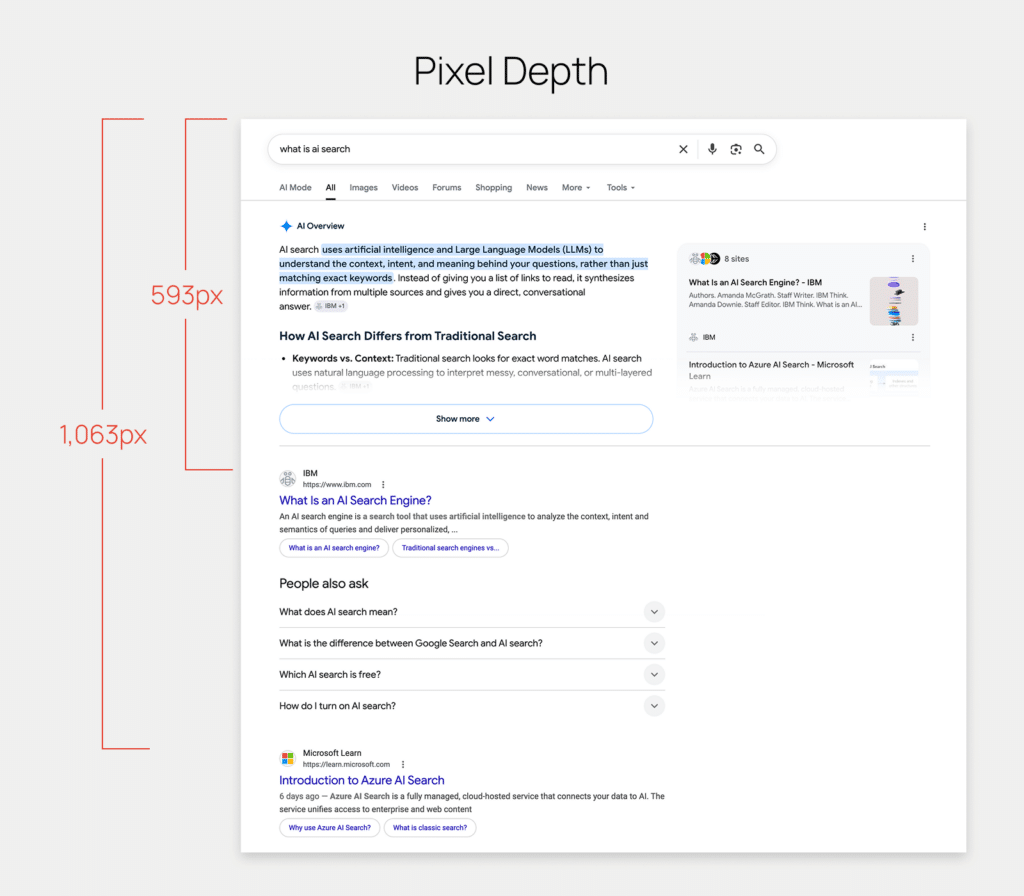
Everything covered above, pixel depth, sentiment, brand mentions, crawl efficiency is going to be table stakes compared to where search is headed. The next 2-3 months will start to reveal something bigger: the difference between optimizing for a bot that crawls your content and optimizing for an agent that acts on it.
Google's Search Agents aren't just passively indexing. They are completing tasks, comparing products, summarizing findings, and delivering recommendations directly to users, often without the user ever visiting your site. That changes the goals of Search Marketers in a meaningful way — here's what that means for your conversion path.
So what should you be watching over the next 90 days?
First, watch how your brand gets used, not just mentioned. As agentic search matures, the question won't only be "does the LLM cite us?" it instead will be "does the agent choose us when it's acting on behalf of a user?" That means your content needs to be decision-ready. Structured data, clear pricing, availability signals, and unambiguous value propositions aren't just nice-to-haves anymore. They're ranking factors, inputs an agent evaluates when it's doing the shopping, researching, or comparing for someone.
Second, keep a close eye on how conversational context affects your citations. Because Google is now using search history to personalize results, the same brand mention or citation may appear for one user and not another. This makes aggregate tracking less reliable and user-journey-level thinking more important. Start mapping which prompts and queries at each stage of your funnel you want to own and measure accordingly.
Third, don't sleep on structured data for agents. Just like robots.txt told crawlers what to do, the next wave will likely include providing signals to agents on what we want them to do with your content. Stay close to what Google and other AI platforms announce around agent permissions and content licensing, this space is going to move fast.
The brands that win in GEO won't just be the ones writing helpful content. They'll be the ones making it impossible for an agent not to recommend them.
Do you think you have a good eye for design and user experience? Do you know what will move customers to act?
Prove it.
So…how did you do? We’re thinking not too great, and that’s okay.
We talked to Deborah O’Malley about all this. She is the founder of GuessTheTest, an A/B test case study resource focused on helping digital marketers increase conversions and get new ideas and insights from testing. She says, "In CRO testing, your chances of guessing the right test are about equal to guessing the correct side of a coin toss. Don’t make assumptions.”

Feel better? We all love our biases and assumptions, but we’re with Deborah. You need to rethink yours.
Most Conversion Rate Optimization (CRO) is done to increase the conversion rate of a SaaS sign-up form or an e-commerce product page. It involves taking a critical page or conversion point, creating 3-5 variants of that same page (each with one single tweak), using a tool like Google Optimize or Optimizely to run live traffic to each of those variants, and then discovering the "winner."
CRO - done right - enables marketers to step out of their biases and actually begin to understand their customers. Still, we’ve found that CRO is largely neglected. Econsultancy reports that 50% of companies value CRO as a crucial part of their marketing strategy, but that only 1% are very satisfied with their conversion rates.
Guess the Test shares, “The average conversion rate hovered around 3% in 2020. That means of 100 visitors coming to your website, only 3 out 100 are taking the desired action you hope they’ll perform, like purchasing your product.”
Ouch. Econsultancy also found that businesses that successfully boost conversion rates perform 50% more tests. This statistic speaks for itself. More tests, of the right tests, is better.
But still, companies spend just $1 on CRO for every $92 spent on customer acquisition. Samantha Brown, the VP of Enterprise Client Services at 97th Floor, explained, "There is a huge gap between what we’re willing to pay for traffic and what we’re willing to pay to turn that traffic into customers.

Seems off. CRO should be a higher priority, so we set out to discover the major roadblocks here and how to overcome them.
We’ve got some pointers.
CRO is a methodology, but we’ve probably all got it labeled as a tactic. Big misunderstanding.
As a manager, you focus on systems for acquisition, monetization, and retention. To improve all of these systems, you need to think of CRO as a method for innovation and not just a tactic. It’s not a phase - it’s a lifestyle, because the moment you stop testing, you’re saying “my customers aren’t living, breathing, changing humans,” or “I don’t care to keep learning from them.” Does that feel extreme? Yeah. So does not testing.
So, keep testing. Shiva Manjunath, Senior Strategist at Speero, is passionate about testing to learn. Whether or not your test is a “win” for conversion, the results are invaluable for understanding your customers. What you learn in each test should inform the next test you run. Shiva says, "The ripple effects and learnings of web testing are more impactful measurements of success than the individual metrics you move."

The CRO Shiva is talking about is more than changing the CTA button color or placing the CTA in a new location. He’s concerned about understanding his audience through the tests he runs. He’s more focused on experimentation —a mindset shift we all need to make.
Shiva Manjunath continues, “We need to unlearn CRO and relearn experimentation. We are running experiments on the website to optimize for the business KPIs and sometimes that’s conversion rate optimization. But sometimes we see CRO and think all it is is optimizing front end conversions when in reality you can run experiments on whatever you want.”
Want more expert marketing content sent right to your inbox?
Join our newsletter and never miss a beat.
Be careful to not let the title “Conversion Rate Optimization” limit your efforts. If the term “CRO” focuses marketers on optimizing for conversions as opposed to experimenting for better audience understanding, that’s a problem. Expand that definition. You’re a marketer, but you should also be a scientist. Ask questions. Create a hypothesis. Relearn experimentation, and realize that CRO is just one important facet of that.
CRO can’t be a checkbox hire. It can’t be a checkbox procedure, either. Building a culture of experimentation will pull in those amazing benefits of CRO we all hope for but don’t know how to get.
Do This: Incorporate experimentation into every aspect and role of your business. Make it clear to every team member that the questions they have about their audience can be answered.
CRO can feel scientific, but it is also an art. Ben Labay, Managing Director at Speero, explains: “There’s an art to the systems approach to CRO. If you get a big win on a landing page test for e-commerce and you get a 10% lift in transactions, that’s cool. What would happen if the sales team or the customer success team knew customer behavioral, psychological principles that went into that change in behavior? Then you could start standing on the shoulders of learnings and gain an unfair advantage.”
One definition of creativity is simply being aware of all the tools at your disposal and then knowing which tools to use and how to use them to solve your problem. One step further, it's taking all of the information and insights you gain across an organization and finding connections between them.
The best CRO isn't just a test — it's a perspective. Brandon Smithwrick explains why having and trusting your own point of view is the skill that separates analysts from strategists.
If CRO is limited to X% increase on Y page, no learnings are gathered and no connections are made. If CRO learnings stop after one single test or are held within one single department, connections can't be made across the organization.
Shiva agrees on this one: “There has to be a level of creativity when it comes to experimentation because you’re doing creative problem solving. You have a hypothesis that you need to test. The hypothesis can be tested in an infinite number of ways, the execution can be done in an infinite number of ways. So you have to guard rail it into specific pages and specific audiences. You have to understand how you are going to analyze a specific test. Then you have to work within the limitations of the site's ability to be modified.”
The art is also in what you do with the data. Are you finding the story in your test results? Are you really thinking with the intent to understand your customers? Is this story shared beyond you and your team? Take your learnings and share them widely. Democratize CRO and every test thereafter will compound.
Do This: Compound learnings, share insights, and get creative. Sometimes it’s the third test that gets you to the earnings. Sometimes, it’s the learnings from Sales and Customer Service experimentation that will reveal the best next step.
Here’s Shiva again: “You can’t get anywhere if you don’t have leaders who believe in experimentation.”
So, what do you do without leader buy-in? How can you create this culture within your company?
First, stay focused on data. It’s probably a lot easier to argue data-backed decisions than CRO-backed decisions. We know they’re the same, but maybe your team hasn’t caught the picture yet. So, focus on data and show how CRO is an extension of data—a research tool—actually, the best research tool.
Ben Labay explains that there are two types of data. The first type comes from existing analytics, machine learning data and other forms of big data. This data is old when you pick it up and start to make decisions based on it. Ben warns that when using this data, “you are ripe to trip on your own cognitive biases or on your own confirmation biases.” The second type of data comes from CRO and it will confront your biases.
Ben says, “CRO and experimentation is more about intervention. It’s about coming into a situation, changing something and measuring the effect of those changes. This is “just in time” data. It is a step higher in the causal ladder to understand the mechanism behind what caused the change that you see in the data. Objectively, it’s a better type of data. It gets closer to the mechanism of why something is the way it is. You learn more precisely and more accurately and at a faster rate.”
This second kind of data is so valuable because it is intentional, living and “just in time” for you to step into your customer’s journey and really think about how the change you are testing caused the data you end up with. You’re intervening in an ongoing process, always adapting in real-time based on multiple levels of creative testing. You’re engaged with data and your audience in a whole new way. Ben wraps it all up nice when he clarifies, "Analytics is data that you see. CRO is data that you do."

Pretty compelling stuff, so we recommend you just start. Not in a rebellious way. We do not want an office coup over CRO. But what’s your role? And where can you test? Start experimenting. Use your insights to create the next test. Then be vocal about how experimentation is changing the game for you, and other teams will hop on.
Finally—and especially in a leadership role—educate.
Shiva shares, "People see experimentation as something that slows down decision making. The reality is you need experimentation to make better decisions so you don’t crash."
Shiva continues, “You need to teach people. There’s a lack of education. There are some people that just don’t want to run tests because they don’t want to be proved wrong. But honestly it just needs to be reframed as a partnership. We’re not here to prove people wrong, we’re here to make you look better.”
The right education and persistence can tip leadership towards CRO, and once they’re there you’ve got them. Jeremy Epperson, Chief Growth Officer at ConversionAdvocates, says, “You don’t know how much ROI you will get on a brand new channel or campaign. Why would you hold CRO to a higher standard? There is no guarantee of results in life. You just need to make the case to get started with CRO.”
Do This: Make your case. You have a small window to prove the value of experimentation. Use low-hanging fruit opportunities to educate and prove the value of CRO quickly to get buy-in and high fives all around.
Listen, you’ve got this. Experimenting is exciting! And once you get started, the fire will catch and your organization can increase conversion and sales and everything else with this new “just in time” data.
And for your first experiment? Try dropping this article in your company’s slack channel. Start the conversation. Just see what happens.
Keyword research is a necessary step that you do to understand your market, and plan your SEO strategy. But what if you could use it to learn about user intent, restructure a whole site, and increase conversions as well as traffic? That’s exactly what we did with this client.
CBD American Shaman is a health company that sells CBD oils. While it’s a competitive market, their products have an edge on the competition because they’re water soluble. Despite this, they were struggling to capitalize on their great product with the kind of SEO traffic that it warrants.
Yet the potential was there: An audit revealed that the more specific SERPs previously targeted for the product had a pretty small search demand — but the right strategy could capture a large amount of traffic. Think “CBD oil” with 1 million searches versus “water soluble CBD oil” with only 1,300.
97th Floor was brought in with a clear business question to address: How do we capitalize on this great demand and become a breakout CBD shop?
Like much of SEO, the solution starts on the site-level. The CBD American Shaman site was hosted on a custom CMS (rather than WordPress, Shopify, or Hubspot, etc.), which always complicates technical SEO solutions. Their CMS was completely done by hand. The site organization was also done by hand, and more subject to human error.

They had a wide list of products, but their site wasn’t utilizing this wide variety to capture organic search. Their site’s architecture was flat, lacking the intuitive hierarchy that both Google and the user need to easily navigate and understand a site. In the beginning, there were only three categories on the CBD Shaman site: wellness, pets, and beauty. This organization made sense at the conception of the site, when the company offered few products. However, as their business scaled and expanded, that category structure no longer made sense, and in fact, felt difficult to navigate and drastically out of date.
It soon became clear that a total overhaul of the site’s organization was necessary. Any SEO tactics would yield mitigated returns unless the site was a complete, SEO-driven overhaul.
Just as a doctor treats a whole patient rather than a symptom, we chose to stop looking at each individual problem, and instead gather it all into one place and focus on the most essential and basic purpose of the site. In this process, keyword research and mapping were essential in understanding how to treat the site as a whole — curing all of its symptoms, rather than just hitting one at a time.
Keyword research is important, but like any data, it means nothing on its own. It’s what you do with the insights gleaned from research that matters. So — while sometimes all you need from your keyword research is a handful of new keywords to tackle — for CBD American Shaman, keyword research would go on to guide the entire reconstruction of their site.

We used our keyword mapping to guide the new site’s entire structure. By using keyword research as the foundation of the site, we captured more authority, and redistributed that authority back to the site’s most relevant and converting pages.
For example, the category page for /cbd-oils now houses all of the CBD oil products, allowing for more weight to target that high-volume keyword as well as an ease for the user in browsing the different oils available. In the previous version of the site, the following page was trying to rank for “CBD oil,” /vg-cloud-terpene-rich-cbd-oil-tincture. See the problem? Yes, it was a CBD oil product, but its strength was wasted in attempting to rank for “cbd oil” and it was poorly optimized for a user from coming form a Google SERP.
With the knowledge that these new category pages were much more likely to rank in Google SERPs, we followed our keyword research further. We used it to map and reorganize the entire site, categorically moving pages to align with relevant category pages rather than stand on their own. By connecting these further pages to those authoritative category pages, it allows us to pick up additional traffic from newly targeted keywords.
Evaluating the keyword landscape — which keywords ranked for which landing pages, and which keywords should be combined moving forward — was a BIG project. Pulling all of our ranking keywords, separating them by landing page, and creating new keyword groups took us a full month.
We had to determine what keywords should rank for a single landing page versus separate landing pages, which allowed us to find instances of keyword cannibalization. We also had to cross-reference each keyword within the designated SERP to identify whether a category page or an individual product page was needed to best fit the ranking criteria for that SERP. It was a lot of work, and a lot of detail, but it paid off.

Under the “shop” menu on the homepage, we added sixteen new categories, all based on newly selected high-potential keywords. It turned out that not only did search engine bots like this kind of layout, but users did too. Within weeks, CBD American Shaman saw a 13% increase in organic traffic, not only that, we saw an unexpected radical bump in conversion rates. Which makes sense when you consider how this also drastically improved navigation and the user experience.
CBD Shaman has an extensive product offering that is always being added to. With all of these choices, the shopping experience was previously overwhelming to users. Products were difficult to locate, and customers had no clear understanding of where to find certain products, or even what products were offered. Instead, the site was set up in such a way that they'd have to endlessly scroll through lists of product after product, without the ability to filter based on product type or use. It was hurting their sales, and alienating their customer base. So we knew it had to change.
They are constantly evolving their product catalog. With their previous strategy, a single product page may have built up a lot of authority over time, only to be taken down, and that authority would then be redirected to an unoptimized page or lost completely. With our new category-centric strategy, the business’s evolution is supported. No matter which products are added or taken away, the authority will remain in the category pages. These pages stay consistent in a constantly changing website, allowing users to always find their way.
The result is an SEO framework that not only worked on the onset, but it’s proven effective even a year later. This keyword mapping system has paved the way to double organic traffic for CBD American Shaman.
