



Sell 60,000 tickets and you fill a stadium for an afternoon. Create 60,000 memories and you'll fill a stadium forever.
Experiences become memories, memories become traditions and experiential marketing is the way to create an emotional bond with customers that pulls them back to your brand over the competition again and again.
Pro sports teams live and die not by their teams’ records, but by their ability to create experiences that begin long before kickoff and continue way after the stadium has emptied. They create fans, not customers.
We’re here to say that experiential marketing is for every industry. While your marketing will be specific to your brand, we’ve pulled three principles from pro sports marketing to help you convert customers into loyal brand fans.
In this guide, we’ll break down experiential marketing in sports examples drawn from real teams and brands, then show how those same strategies can be applied across industries.
At its core, experiential marketing works because it creates emotion, not just awareness. And no industry understands that better than pro sports.
Sports teams don’t market products; they market moments. Every touchpoint in sports marketing is designed to make fans feel something and feel it together. The shared emotion is what turns a single experience into a lasting memory, and a memory into long-term loyalty.
The strongest experiential marketing examples in sports are immersive and interactive. They invite fans to get up out of their seats and participate. They reward attention, amplify momentum, and extend the experience far beyond the physical event through digital channels and social conversation.
This is why experiential marketing in sports examples translate so well to other industries. When brands focus on how people feel before, during, and after an interaction, they learn more about their audience to improve their experience the next time they interact. This is the advantage sports marketers have been playing for years.
What translates isn't the tactic — it's the principle underneath it. The medium you choose — the event, the touchpoint, the format — communicates something before your audience reads a single word. Udi Ledergor, former CMO at Gong, invokes Marshall McLuhan's idea with a sharp marketing application: most brands are obsessing over what to say while ignoring the signal their channel selection is already sending. This short video breaks down why the medium isn't a delivery vehicle — it's the message itself.
Here are seven experiential marketing examples in sports that show how experiences turn audiences into lifelong fans.
Before changing a single seat or concession stand, the Utah Jazz spent a year listening to what fans actually wanted. By grounding the experience in real fan insight, the team transformed the arena into a space designed for making lasting, brand-loyal memories.
After the Utah Jazz’s $125M arena renovation, Bart Sharp, CMO at the Utah Jazz, shared that his team spent an entire year researching what Jazz fans wanted beyond the court before making any renovation plans. Their research showed a strong desire among their fans for more premium options, ice cream (yes, Utahns love their ice cream), and Instagrammable photo opps. With these findings, the Jazz transformed their arena to provide fans unforgettable experiences.

Built Bar shows that experiential marketing can happen far beyond the venue. By placing customer service directly under marketing, the brand turns real-time feedback into responsive experiences that make customers feel heard and valued.
BuiltBar has a unique way of ensuring their customers are heard and that feedback gets injected directly into their marketing campaigns. “We’ve actually put the customer service team under marketing leadership. That way we can pivot and change quickly without going through multiple channels,” said Colleen Ferrier, VP of Marketing at Built Bar. “So we’re hearing as leaders directly what the customers love, what they don’t love, what they’re liking, what they’re not liking. And we as a team can shift and change quickly for them.”

By directly listening, learning, and responding to customers, Built Bar’s marketing team has the ammunition they need to generate more value for their customers.
As marketers, we must prioritize listening before campaign creation. We should never assume we know why someone came to our websites or their purposes for joining in the experience. Every time we make assumptions, we limit ourselves and miss opportunities for our customers, putting time and energy in the wrong places.
Do This: Customer feedback/research surveys always endear customers to you—show you care and learn from your most important audience. Also, consider moving Customer Service under Marketing to close the customer feedback loop.
When momentum strikes, great experiential marketing captures it instantly. The Suns turned a split-second, game-winning play into a physical product almost overnight, allowing fans to own a piece of the moment while the emotion was still fresh.
With only .9 on the clock, Deandre Ayton scored a game-winning alley-oop against the Clippers during the Suns’ 2020-2021 season. Being hyper-engaged on social media, the Suns’ social media team quickly recognized an opportunity to capitalize on the excitement surrounding the play. New “Valley-Oop” shirts were announced on their social channels that night and available for purchase the very next day. No one could have predicted the alley-oop, let alone prepare t-shirt designs. But the Suns were ready—they took an awesome on-court experience and memorialized it for the fans.

Marketing teams have to find ways to monitor momentum. Bart Sharp shares how this is a key principle they follow within their marketing strategy. “I’ve learned in this industry you’ve got to be very nimble because things can change very fast. In an instant, we have to shift our focus and find ways to capture that momentum.” Sometimes the team is playing really well and there’s a story there. Sometimes there’s not. In pro sports (and really in just about any industry) you can’t predict how the seasons will go. You can have an idea based on data you’ve gathered (players on the team, how we compare to competition, injury reports, etc.) and that informs direction. But if things get going and you notice momentum is building somewhere else, you’ve got to make that pivot.

Marketers may be the best planners in the world, but following the momentum inherently means that marketers must be ready to abandon their plans—which is frankly really hard to do! What if the Suns chose to just stick to their content calendar? They would’ve missed out on a huge opportunity for the brand to bond with fans.
Not all experiential marketing examples happen inside a stadium. Oreo’s now-famous “dunk in the dark” response during the Super Bowl blackout shows how brands can insert themselves into shared cultural experiences by acting quickly and understanding the moment.

We all remember the classic example of Oreo capitalizing on the power outage in the 2013 Superbowl with a tweet about “dunking in the dark.” The brand acted quickly around a current event, which was only possible because they were aware of what their audience was doing and how to appeal to them in that moment.
It doesn’t take a huge team or expensive software to interact with your audience. Plan all you want, but be ready to strike when the opportunities arrive.
Do This: Marketers can’t capitalize on momentum if they aren’t looking for it, if they don’t have a supportive infrastructure, or if they don’t have the green light from leadership.
Experiential marketing doesn’t always require large-scale activations. Real Salt Lake demonstrates how thoughtful, personal interactions on social media can become powerful micro-experiences that deepen fan loyalty.
Tyler Gibbons, VP of Marketing at Real Salt Lake (RSL), shares how seriously they take online interactions with their fans. “When someone shares wearing a team jersey and you respond back to them on social, you probably made that person's day. You're going to have a fan for life.” In their case, RSL is extremely careful about who on their team has the permission to dialogue with fans—they don’t underestimate the power of these micro-experiences.

Creating an experience doesn’t mean that you need a full event or production. Experiences can be small and individualized for your specific audience. Hubspot emphasizes that even when you give your audience a tangible experience, there must still be an online dialogue happening. Dialogue is especially crucial to industries where the experiences are largely digital. It’s those conversations that become a major part of audience-brand bonding.
Not every fan can sit courtside. Geography, cost, and capacity make that impossible. The Warriors decided to redesign that reality.
By experimenting with virtual reality, the Warriors created a way for fans to experience games from a courtside perspective without ever stepping foot in the arena. Using VR technology, fans could feel closer to the action, immersed in the sights and sounds of game day, even if they were watching from hundreds or thousands of miles away.
This is a strong example of experiential marketing because it expands access instead of limiting it. The experience isn’t just about watching basketball, but about giving fans a story to tell. Now, fans can feel like they were courtside, even if they technically weren’t.
The takeaway here isn’t that every brand needs VR. It’s that the best experiential marketing examples use technology to remove barriers and deepen emotional connection.

AT&T Stadium is massive. Iconic. And, it’s intentionally designed to be experienced even when no game is being played.
The Cowboys have turned their stadium into a year-round experiential marketing engine through immersive tours that give fans behind-the-scenes access. Visitors can walk the field, explore locker rooms, learn the architectural story of the venue, and see how one of the most recognizable franchises in sports operates from the inside.
This is a masterclass of storytelling at scale. The Dallas Cowboys’ stadium has become a physical brand expression, reinforcing the Cowboys’ identity as larger-than-life, premium, and deeply rooted in sports culture.
What makes this one of the strongest experiential marketing examples is its longevity. The experience doesn’t rely on a single event or even a game; it creates value every day, for fans who may not even attend a game, but still leave feeling closer to the brand.

Look at the interactions happening with your target audience. Is there a way to build an online element into a tangible experience? Are you keeping a dialogue going on and offline?
A major sign of marketing maturity in an organization is the level of experience they place in customer-facing roles (such as social media managers, customer experience, etc.). Unfortunately, many brands put their “greenest” people in these roles—preventing organizations from fully capturing their audience’s feedback and preventing audiences from an elevated experience.
There’s a reason why pro sports teams pull in top talent for game-day coverage. Inside the NBA, for example, features the beloved Charles Barkley and Shaq. College GameDay utilizes former athletes, coaches, and other experts to talk about the football games. Both shows have subject matter experts in charge of the dialogue, giving this dialogue the best people to engage audiences.

So don’t put your least experienced employees in charge of all the digital dialogue for your brand. Make sure that whoever is helping to create that dialogue knows and understands your company’s offering, your values, and how to interact with your audience in a way that is meaningful to them.
Do This: Don’t hire entry-level for audience-facing positions.
Pro sports marketers have an obvious edge in creating customer experiences—their product is literally an experience—but their playbook is written for every brand in every industry. A stronger focus on experiential marketing truly can turn your brand observers into lifetime, loyal fans.
If you’re ready to take inspiration from these experiential marketing in sports examples and apply them to your own brand, we’re here to help.
At 97th Floor, we partner with teams who want to create experiences people remember. If you’re ready to build experiential marketing that connects, converts, and lasts, let’s build together.
Want more expert marketing content sent right to your inbox?
Join our newsletter and never miss a beat.
In this no-fluff Prezi video, Paxton Gray, CEO of 97th Floor walks you through his step-by-step process to creating consistent and quality content marketing that works for virtually any budget. If you’ve felt that content marketing hasn’t been producing the results you’ve wanted, this video is for you.
Paxton explains one of the reasons why Buzzfeed content marketing can draw you in — even when you know it’s just clickbait — is because it taps into the “human algorithm.” It's the power of appealing to a person’s curiosity, especially in a content marketing context. Curiosity alone is not enough, though. Paxton explains how to also use data to create content that’s more personal, targeted, and relevant. After all, content marketing made for everybody means it doesn’t really appeal to anybody.
Revolutionary branding can change how customers perceive an entire industry, but few companies are willing to take that step in the dark. Uncharted territory comes with a lack of data and research to back your efforts—it takes guts.
Moz said it best. “Playing it too safe is...a great way to remain somewhere in the middle. Almost everyone likes the middle. Nobody loses their job in the middle. Customers come and go at a steady rate in the middle. Nobody boycotts the middle.”
This article explores creative marketing tactics that can help you move beyond the middle. From purpose-driven messaging to playful brand voices, these tactics show how bold ideas inspire attention, spark loyalty, and fuel growth. Whether you’re a small challenger or a large enterprise, you’ll find practical tips you can apply to give your brand the refresh it needs.
Creative marketing tactics are unconventional strategies that brands use to capture attention, spark emotion, and differentiate themselves in crowded markets. Unlike traditional campaigns that rely on predictable playbooks, these approaches focus on being memorable and connecting with audiences on a deeper level.
Think of them as creative marketing ideas that shift perception. They can be bold visuals, unexpected partnerships, purpose-driven messages, or even playful responses to criticism. At their core, creative marketing tactics prove that playing it safe is rarely the way to stand out.
We’ve curated five tips to show you how to put these ideas into practice, along with real-world examples. #1 Be Unapologetically Interesting
“If you always just try to sell, then you’re predictable. You’re every other brand and company out there.” —Michael Lee, Oatly Creative Director. Oatly stands out—we all saw the controversial SuperBowl commercial. The alternative dairy brand embraces unapologetic fun while still communicating its core values.
Part of what makes Oatly so appealing is its contrast with other milk brands. Picture any other dairy brand—the homepage likely has a perfectly composed stock photo complete with a heartwarming description of the product. Swap the milk out with any other household item, like Windex or Clorox, and you don’t have to change a thing.

Oatly stands way, way out with a cartoony, playful, almost handmade aesthetic website. When photos are included, they’re messy and candid — almost like a friend took them. The copy has an unpolished, almost rambling feeling that is nothing like its competitors' carefully crafted, “clean” taglines.

Oatly doesn’t use industry competitors as models for what they should become. While other brands fill their website with recipes to sell more product, Oatly's recipes are only a fraction of the available content. The bulk of Oatly’s content is dedicated to being interesting. The brand even has a section dedicated entirely to "Things we do" that has unique content to make audiences smile.
Lee revealed the core of Oatly’s branding strategy: “Don’t try to sell anything — just be interesting. If you’re interesting, people will pay attention to you and they’ll be interested in what you do next.”
How do they do it though? Oatly takes an unstructured approach. The creative team chats about content that would be fun to create and then they make it a reality. Lee explains, “We produce our own work, and we prove our own work. There’s no filter, no checkpoint meetings with the sales guys, no half way meetings with marketing managers.” This method allows content to land with it’s full creative potential preventing leadership from watering it down. Creating without gatekeepers is a terrifying prospect for many companies, but Oatly doesn’t let this hold them back.
Do This: Trust in creative teams and whatever you do, don’t be content in the middle ground.
Is the strategy of simply being interesting paying off? Oatly is claimed to be the world’s largest oat milk company and 2020 saw a 106.5% increase in reported revenue. Oatly is Starbucks’ oat milk of choice, and there was even a time when people were selling their supply of Oatly for over $200 on Amazon.
Yep, being unapologetically interesting works.
SaaS companies are infamous for ambiguous copy and visuals that all look the same. When every solution looks the same, customers quickly lose interest and have a difficult time keeping track of the unique value each solution offers. Gong, a revenue intelligence software is...different.
The pressure to stand out just got more urgent. Former Slack CMO Bill Macaitis breaks down why lean AI-native startups are now achieving the same ARR with a fraction of the headcount — and what traditional SaaS companies need to do to stay competitive. This short video captures why the window to adapt is closing fast.
Let’s take a look at the websites of some other sales platforms. This industry is ruled by clean designs, cool colors, futuristic gradients, and flat illustrations.

Then there’s Gong with fun stock photos, bright colors, and a playful pooch as its chatbot representative. The smooth UX and attention to quality (albeit stock photo quality) allow the brand to take risks in an otherwise streamlined market.

While some may not enjoy the cheesy nature of its aesthetic, Gong doesn’t really care. CMO Udi Ledergor acknowledged, “If you’re pleasing everybody, you’re not exciting anybody.”

Ledger defines Gong’s brand as “whimsical and authoritative” — two adjectives you wouldn’t normally think go together. They’ve combined seemingly unrelated, opposing elements to craft a brand voice that fits perfectly.
Do this: Carve out your own identity and carry your voice throughout every piece of content.
Ledger continues “When you read our content, when you hear one of our amazing speakers at a conference, when you look at our website, when you go to our LinkedIn content, you see that whimsy coming through everything we do."
This commitment to a consistent voice allows Gong’s audience to instantly recognize every piece of content they create. More importantly, audiences can differentiate Gong from the sea of other software companies who are pushing the same message.

As of June 2021, Gong raised $250 million in funding and ranked top-50 in outstanding growth within SaaS companies—not bad for high-fives and fist pumps.
Billie was the first to push the boundaries in the women's razors market by using body hair in images and fighting against the pink tax. In an interview, Billie Cofounder Georgina Gooley shared the inspiration behind the brand’s identity. “We knew we couldn’t just sell a better product at a better price — we wanted to reinvent the category’s relationship with women.”

For decades, razor brands have depicted the ideal version of a woman. Women were told that their body hair was something to be ashamed of, something needing to be removed. “We've always wanted to put our audience ahead of our product, so emphasizing the importance of choice has always been core to what we believe.”

Billie’s competitors have quickly followed suit. As Gooley points out,“The fact that a new, challenger brand like Billie could change the way women are represented in a century-old category shows that even the newest players have the power to create change.”
Although Billie’s competitors have slightly adapted their imagery, their core branding has stuck closely to the refined, spa feeling we’re used to seeing from razor companies. Billie takes a bold approach to branding with bright colors, body-inclusive models, and 90s throwback styling.

Beyond bold visuals, sticking closely to strong values is what sets Billie apart from other brands.
While overthrowing the pink tax by charging less and offering rebates means smaller margins for Billie, audiences see the dedication to a cause and become lifelong fans. While other companies say they’re committed to women, Billie actually backs up their statements.
Do this: Permeate purpose-driven values at every level of the organization. Put your brand’s purpose before your product to attract customers and open up doors to other creative marketing tactics.
You’ve never met a more hardcore water brand than Liquid Death. The company’s energy-drink-inspired branding is a complete 180 from the peaceful, flowing springs used to market other water brands. The tagline “MURDER YOUR THIRST” seems a little contradictory when selling the most essential-to-life product on earth, but that contradiction is exactly what makes it unforgettable.

CEO and founder Mike Cessario explained that the core idea for the brand was inspired by the hilarious, random marketing in the junk food market. “Liquid Death was a way of taking the healthiest food you can drink and brand it and market it in a way where you can compete with all the crazy marketing of junk food.” Liquid Death is unique because it’s not really competing with other water brands.
And Liquid Death thrives on this bold persona. When social media trolls flood their comments with hate, the brand doesn’t hide or delete. Instead, they double down by turning those insults into music albums (punk tracks with screamed lyrics pulled straight from negative online comments).
Founder Mike Cessario summed it up best: “Hard work is a waste of time if your idea sucks. Figure out how you have a great idea first before you then start putting all the blood, sweat and tears into it.” Liquid Death has that great idea, and they’re not afraid to make it louder by amplifying even their harshest critics.

Do This: Don’t run from criticism. Use it. Turning negativity into content not only disarms haters but also strengthens loyalty among your core fans.
Of course, the irreverence goes beyond the jokes. Liquid Death pairs its over-the-top branding with real values, pledging “death to plastic” by offering a sustainable alternative to bottled water. That combination of humor and purpose has built them a cult following and fueled 126% growth last year.
Liquid Death proves that the boldest creative marketing tactic isn’t just to be different, it’s to take what others fear and flip it into your loudest megaphone.
3M isn’t just trying to stand out in its industry, it’s trying to stand out from itself. A quick look back at the 3M website reveals that its messaging has transformed from a focus on innovative technology to applied science and connecting with the people who use 3M products. Over the years, technology imagery has given way to people-centric visuals.

3M has countless products in various industries, but you probably know them best for their tape. Despite consumer business being the least profitable sector at 3M, this is an area that the brand focuses a lot of marketing effort on.

By focusing on individual consumers, 3M is able to focus on messaging that resonates with people. Because at the end of the day, B2B and B2G customers are just people.
Do this: See your audience as humans—market to them as humans.
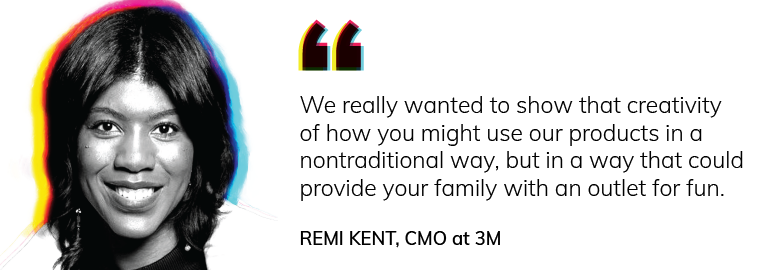
Making science fun and accessible to all is at the heart of 3M’s marketing strategy. CMO Remi Kent explained, “We really wanted to show that creativity of how you might use our products in a nontraditional way, but in a way that could provide your family with an outlet for fun.”
Bold marketing doesn’t always require a complete rebrand or a viral stunt. These creative marketing tactics can be tested quickly and scaled when they work.
Pairing up with a brand outside your category can stop audiences in their tracks. Think Taco Bell and Doritos, or Lego and IKEA. Unexpected pairings spark curiosity and open the door to new markets. The key is to choose a partner that shares your values, even if your products are worlds apart.
Guerrilla marketing is all about disrupting the ordinary. It could be sidewalk chalk art, a flash performance, or a surprising outdoor installation. When executed well, these activations feel more like cultural moments than ads. They generate buzz precisely because they break away from traditional formats.
Your audience often creates content that feels more authentic than polished brand campaigns. Starbucks’ #RedCupContest and Calvin Klein’s #MyCalvins are great examples of customers becoming co-creators. UGC lowers production costs and builds trust because real people represent the brand.
Nostalgia taps into emotions that go deeper than product features. Brands like Pokémon and Nintendo have built entire second lives by reimagining their classics for a new generation. A 90s throwback or retro design element instantly sparks connection because it reminds people of when they first loved your category.
Events, whether virtual or in-person, allow customers to experience your brand in a new way. Red Bull’s Flugtag competitions and Adobe’s creative conferences show how experiences can become brand-defining. Even smaller brands can use pop-ups, live streams, or interactive workshops to create memorable touchpoints.
When brands participate in cultural conversations, they show audiences they’re paying attention. Oreo’s “You Can Still Dunk in the Dark” tweet during the Super Bowl blackout is one of the most famous examples. These tie-ins succeed when they feel natural and timely, so monitor trends and move quickly when opportunities arise.
Supporting a meaningful cause is more than philanthropy; it’s strategy. Patagonia’s environmental stance and Billie’s fight against the pink tax show how brands can build lasting loyalty by aligning with movements their customers care about. The important step is following through with real action, not empty statements.
Sometimes creativity comes from changing how a product is packaged or presented. Heinz’s upside-down ketchup bottle and Reese’s seasonal shapes prove that even small tweaks can make a big impact when they surprise customers. These changes keep products fresh in categories that rarely evolve.
Digital marketing can go far beyond static ads. Interactive quizzes, AR filters, or gamified experiences turn audiences into participants. Spotify Wrapped is a perfect example: it celebrates users while transforming them into promoters who share their results with the world.
Many brands stand out because of how they speak. Wendy’s Twitter roasting competitors on Instagram or Duolingo’s cheeky TikTok presence are proof that tone can capture attention as much as visuals or products. An unexpected voice gives audiences a reason to pay attention in an endless feed of sameness.
Creative marketing ideas are exciting, but they only matter if you put them into motion. Start by defining clear goals for your campaign (ex., awareness, engagement, or loyalty). Choose one or two tactics that align with your brand values, and launch them on a small scale to see how your audience responds. Measure the results, refine your approach, and expand the campaigns that prove effective. The path to standing out begins with a bold step.
When you’re ready to push beyond safe strategies, 97th Floor brings the expertise and creativity to make it happen. Our team has helped brands break free from the middle ground by designing campaigns that capture attention, spark emotion, and deliver results. We’ll partner with you to find the tactics that set your brand apart.
See how an audience-first approach translates to bottom-line results.
Barbara Walters said it best: Taylor Swift is the music industry. However, in celebrating the greatness of her artistry, we often forget to give her praise for her marketing intelligence, business acumen, and pure hard work. Work that placed her on Forbes’ 2021 list of America’s self-made women with an estimated net worth of $550 million.
What goes into it? She’s a business giant, there’s no doubt, but when you compare her to many of her peers, she doesn’t have many of the side hustles that you come to expect from the modern pop star. Take a glance at Forbes’ list of highest-paid musicians and you’ll find that most of them make the majority of their money through non-musical means — clothing lines, shoe deals, perfumes, movie and television show production credits, even streaming services and headphones. By comparison — and it might seem weird to say it — Taylor’s business ventures are relatively humble. And most of it comes back to, you guessed it, content marketing.
Taylor Swift is a powerful brand, and she is incredibly careful with how and where she uses her name. Corporate endorsements include Keds, Diet Coke, CoverGirl, Capital One, and Apple. But this brand didn’t just appear out of nowhere. Ask someone in 2005 who Taylor Swift was and they would likely give you some answer about semi-trucks. How she built this brand is a case study in content marketing itself.
Any customer-focused marketing strategy today is bound to include social media in some shape or form. But in 2005 it was all but unheard of. An early adopter of social media, Taylor Swift started a MySpace blog that would run for years, where she provided content for her growing fanbase that they couldn’t get anywhere else.

Taylor Swift (2006)
7x Platinum
5,750,000 copies sold
157 weeks in the Billboard 200 — longest of any album in the 2000s decade
This early approach to personalized marketing would set the tone for the rest of her career. The growing star would not only post intimate blogs that gave unique insider insights to her followers, but she would also engage with them and encouraged the growth of a community both inside and outside of the platform. In her acceptance speech for a CMT music award for Breakthrough Artist of the Year in 2008, Taylor dedicated it to her special club: “This is for my Myspace people and everybody who voted.” At this point, she had accumulated more than 650,000 “friends” on the platform, but each one of them could have felt she was talking directly to them.
Meeting fans where they are is something that Taylor herself has talked about. In an interview with BBC Radio 1, she mentioned the persistence required at the beginning of her career when it came to convincing her label and management that she needed to engage and use the internet — a strategy that paid off in the form of millions of streams of her music. She also talked of the importance of adapting to changing times. And time and again she’s done exactly that.
She meets fans where they are, and speaks their language
“You just never know what’s gonna happen...every new album release is different because there’s always a new platform, there’s always a new...way to have people experience your music. I just find it interesting, I’m not gonna sit here and ever be the person that’s like ‘it was only good the way it was when I started’...I like the fact that people can experience music in whatever way fits their life.”
Taylor Swift is on TikTok. A seemingly insignificant fact on the surface, but a single glance at Ahrefs’ content explorer shows just how big of a deal it was.

Witness the volume of shared and linked-to content featuring the words “Taylor Swift TikTok” on August 23rd, the day Taylor posted her first TikTok video (a search that yielded over 400 results), and consider that the dress that she was wearing sold out in minutes.
While it is not surprising for a public figure to join a social platform that boasts hundreds of millions of active users, it is yet more proof of Swift’s smart marketing acumen. Her fans are on TikTok, and so Taylor Swift is on TikTok.
The same logic applies to B2B marketing — but most companies still haven't made the shift. Former Slack and Zendesk CMO Bill Macaitis calls out why white papers and analyst relations aren't enough anymore, and where your buyers are actually waiting for you. This short video captures exactly why B2B marketers need to modernize their channel strategy now.
And for Taylor Swift, meeting fans where they are involves more than just being on a platform. Rather than falling into the trap of hiring a team to cross-post the same content on every platform, Taylor...well, tailors her content specifically to the audience on each one — and continues to add a level of authenticity carried over from her MySpace days.
This isn’t the first time she has done this, either — moving from MySpace to the likes of Twitter, Tumblr, Instagram, and now TikTok — Taylor continues to meet her fans where they are, and speak their language.
However, to reduce Taylor Swift’s content marketing brilliance down to social media would be doing a disservice. In fact, look at how she has used Twitter in recent years — a platform where engagement thrives off of large amounts of content:

According to SocialBlade’s record of the top 10 most followed users on Twitter, Taylor maintains an A++ engagement grade, despite a mere fraction of the tweets and despite following no one. How does she accomplish it? Well, it would be easy to say that once you have more than 88 million followers, engagement is pretty much a given. But one glance at her followers tells you that they are continuing to grow daily.
The Taylor Swift brand is thriving, and doesn’t look like slowing any time soon. So much so, that her presence continues to grow even on platforms like Twitter where she is not spending much time. Given, she did spend years building up a Twitter following, and still has a team tweeting regularly through her more corporate account; but to maintain such a prominent place at the top of the Twitter hierarchy indicates a great deal of lasting power and influence. How has she accomplished it?
In case you haven’t figured it out by now: Taylor Swift is the world’s best content marketer. Why? Because she produces some dang good content.

Whether you are a fan of her music or not, the proof of her songwriting caliber is evident in both her critical and commercial acclaim. She is the most awarded artist in AMAs history and is tied with only four other performers for the most Album of the Year Grammy Awards with four. She has also part of an elite group that has sold over 200 million albums, and just recently became the only artist to log 7 albums simultaneously in the Rolling Stone 200 a total of 20 times.
When your content is good, it can have the ability to promote itself. But Taylor Swift — being the world’s greatest content marketer — doesn’t rest on her laurels. And her promotion of her music is second to none. Taylor Swift’s album promotion cycles have been well documented over the years, from lucrative partnerships to exclusive merch deals and even secret listening parties at her own homes.
Yet even when 2020 hit and Taylor released a surprise album in a time of social distancing and isolation, her promotion remained top notch. Taylor’s key collaborator Aaron Dessner has described how her record label was only notified of the album’s existence mere hours before it was released. A true last-minute drop, she could easily be forgiven for forgoing promotion altogether. What we experienced instead was a masterclass in quick strategy. As soon as the announcement was made, her store was equipped with digital and physical copies of the album, available for pre-order — including 8 different versions of the vinyl copy, encouraging fans to collect them all.

Knowing when and where to ramp up promotion is a key skill, and it’s one that Taylor has mastered over the years. We have already discussed her social media prowess, and it’s no coincidence that Taylor’s fan engagement and the frequency of her social posts both increase around the time of a big announcement or new album release. She got to work liking and engaging with her excited followers’ posts, and a number of branded hashtags were also ready to go on Twitter.


The online store was also stocked, with new items cycled in and out as new songs were released. Taylor Swift is a master of employing the marketing tactic of scarcity — bonus songs are available only on physical albums, Target exclusives provide the opportunity to get a unique copy of each album, and fans well know that merch will only be available for a limited time before being replaced with something new.
For some, these kinds of techniques could seem like cash grabs and have the opposite effect to the one intended. But for Taylor, it comes across as added value to her vast fanbase. In short, all of this works because of the place where we started: Taylor Swift knows her audience. Back in 2014, on the release of 1989, she stated:
“I think that what we need to start doing is catering our release plans to our own career, to our own fans, and really get in tune with them. I've been on the internet for hours every single night figuring out what these people want from me. And when it came time to put out an album, I knew exactly what to do.”
In that instance, adding unique polaroids to physical albums was a way to connect with fans, and we have seen this process echoed time and again to this day. At the time of writing, Taylor is busy releasing new recordings of her past albums. And once again, she is exceeding expectations by promoting each one as though it’s brand new. This includes:
The albums also include a number of fresh tracks “From the Vault” including ones that have deep roots in fandom lore. By the time each album is released, you could be forgiven for forgetting that half of it has technically been heard before. Fearless (Taylor’s Version) shot to number one in just about every chart, and smashed a number of records in the process.
<table style="border-collapse: collapse; table-layout: fixed; margin-left: auto
Vivint Solar is a brand that needs no introduction — mostly because they’ve been introducing themselves from our doorways for years. Of course, it doesn’t hurt that they are a multi-billion dollar, door knocking solar juggernaut, but it wasn’t always this way.
Their street presence had never been stronger, they came to 97th Floor with an online presence that was lackluster. Their success in the neighborhoods had left smaller shops eating their digital lunch. They’d seen the gap in their strategy and had a desire to translate their success from the streets to the internet — and in the process, open the door to the even wider audience to be found online.
At the start, we had hardly anything to go on. Vivint Solar hadn’t put a deep SEO plan in place before, and while they organically dominated branded searches, they hadn’t turned any attention to non-branded search terms. So, we began from square one. Not that we minded, we always love painting on a blank canvas.
{% video_player "embed_player" overrideable=False, type='scriptV4', hide_playlist=True, viral_sharing=False, embed_button=False, autoplay=False, hidden_controls=False, loop=False, muted=False, full_width=False, width='1920', height='1080', player_id='25873143908', style='' %}
Vivint Solar needed a clear, intentional SEO strategy. And, because all SEO measures take time to bring in results, it also needed to be enacted soon so that they could establish themselves. With that in mind, we got right to work.
We began as we always do, with market research to reveal the strengths and weaknesses in the strategies of Vivint Solar’s competitors. This kind of research is essential because it identifies gaps that our client can fill — as well as places where they can step up their game in order to keep up.
In Vivint Solar’s case, we discovered that many of their competitors’ ranking pages had great domain authority, and they had already targeted many non-branded terms. With this information, we were armed to take the next step and conduct informed keyword research.
Our keyword research revealed crystal-clear opportunities for optimization and new content. As Vivint Solar was already a known brand — and already bringing in traffic from branded searches — we focused all attention to increase our share of voice via non-branded terms. Our keyword research quickly uncovered non-branded keyword opportunities that would aid consumers along their buyer’s journey. We launched a comprehensive blogging strategy with the intent of attracting inbound traffic through these non-branded terms and increasing on-page conversion through compelling CTAs and copy.
As we mentioned, time was of the essence. We needed to get Vivint Solar’s new blog pages ranking quickly, and link building was an essential part of that race against time. Links build the authority of a page in little time, allowing the page to rank much more quickly than it would on its own.
Our strategy didn’t end there. While our ultimate goal was to increase Vivint Solar’s presence online so they would not be totally reliant on door-knocking, what if there was a way to take advantage of those prolific efforts? Using localized SEO, we launched pages for every locale where Vivint Solar is active, over 100 (but we’ll get to that later). This provided pages tailored to the needs and offers of various states and cities, connecting door-knockers and potential customers quickly and effectively.

With these strategies in place, and a thorough technical audit completed, we put our plans into action — starting with content creation. Together with the Vivint Solar team, we researched, outlined, and produced over 200 articles targeting our various non-branded keywords.
Once article creation was underway, we turned our focus to link building. Our competitive research informed this strategy from the beginning, including the frequency of our backlinks and their quality. After the first month of outreach, we were able to gain over 30 backlinks each month to the Vivint Solar site, each one obtained naturally on quality websites. Not to mention, each link was optimized for a specific page and corresponding keyword. This aided our content in ranking quickly for our intended keywords.
Additionally, we helped Vivint Solar build out robust versions of their local pages, which at the time included 23 states with additional locales within each state. By the time we were done, we had over 100. We built out and optimized local pages and search terms in each of these respective markets.

While the above components are critical to any digital transformation, we knew it was important to look even deeper into Vivint Solar’s funnel than simply awareness-level content. We analyzed the conversion path for Vivint Solar, and identified potential weaknesses or misalignment of message. We then added resources to optimize the user’s experience once they’d entered the funnel, and throughout their journey. We fully audited and optimized email messaging, and created valuable content by breaking down complex industry topics and making them more digestible through quality UX design.
Here at 97th Floor, we love working with remarkable partners like Vivint Solar. Together we moved quickly to not only meet, but exceed the goals we set at the onset of the project.

Before 97th Floor began working with Vivint Solar, only 5% of their organic traffic was non-branded, and today 33% of all visitors are coming from non-branded keywords. Additionally, total organic traffic has increased by an incredible 45% year over year. This was accompanied by a comparable rise in revenue, and a 40% increase in new users. This increase in traffic and conversions has manifested in hundreds of thousands of dollars in recurring revenue brought in from digital channels.
Today Vivint Solar has a shining reputation in residential solar on the streets and on the web — a true physical to digital transformation. Their prospective customers used to have to wait to be found. Now they are able to find Vivint Solar on their own. Through our combined efforts the two methods work together, making Vivint Solar an unstoppable force with a good reputation on the streets and online.
2020 is an unusual year. Nothing can be assumed, and shopping trends are no exception. We at 97th Floor commissioned a study that dove into all of the newest trends in Black Friday and holiday shopping. Our objective: to help marketers prepare for this unusual season. In this post we’ll look more closely at some of the most interesting data points specifically around email, and how they might affect your marketing strategy.
This year, shoppers are getting a head start on their holiday lists. 54% of shoppers say they want to do their holiday shopping by early November to avoid crowds, and 68% of shoppers say they’ll be moving online. As marketers, we need to meet our customers where they are. This year, that means online and early.
Because shoppers want to get their shopping done earlier, you should consider emailing them earlier too. Don’t be afraid to email more consistently during the holiday season; shoppers expect to see more emails this time of year, so it’s a great time to take advantage of that as an opportunity to push your brand’s value and story.

Ultimately, the end goal of any email track is to lead your contacts on a journey. You can use email to tell your story, and to explain your value. Use your email marketing this holiday season to build a story for your products. Like J. Peterman’s famous catalog illustrates (pun intended), the way that you present your products must be more than an explanation: it needs to be a story. Best case scenario, even your presentation will be a kind of art. Don’t underestimate the importance of this. Email is a great way to control the way your product is positioned and presented.

Email marketing is the way you’ll be able to take people with casual interest in your products and turn them into true fans. This holiday season, treat all your email contacts like they are at least mild fans of the product (a safe assumption as they did give you their email) and turn them into mega-fans of your brand.
Our stats say that 81% of shoppers aren’t sure they’d head to brick and mortar locations even if the retailers offered great in-store experiences for the holidays. In fact, 88% of parents even say they won’t let their kids sit on Santa’s lap this year. Yet we know that experience is everything. So this holiday season marketers need to turn their attention to the digital sphere.

Be sure that all of the content you put out this season, including your email, provides an enjoyable experience for the user. This includes your website and landing pages. Take a look at the ease of use on your site — can users easily navigate your site to find what they need?
Get inventive with the way you use email as a part of an experience. Create amazing digital experiences and use email to share the opportunities with your audiences. For example, share social media campaigns your audiences can interact with, like zoom calls with Santa, an interactive about how your business works, or whatever the digital experience is that fits best with your business goals. Consider building out a multi-part, text-based experience for your email marketing, something that your audience will look forward to engaging with on day 1, but also day 3, 5, and 9. A story (see below) is one option, but any content that can be broken up in a linear fashion can be turned into an email experience.
Email is an effective way to spread the word about--and create--the experiences you have going on this holiday season; be sure you make the most of it.
Consider which metrics are most important for you, and then track them diligently. For brands just starting on their email marketing, your open rate might be your top priority. More mature email marketers will probably want to make their top priority either CTR (click through rate) or CToR (click to open rate).
The important thing is that you don’t just launch your emails out into the world like fledgling birds where they will either fly or die. Pay attention to performance, experiment, and continually tweak things to see how it affects outcomes. As an agency, we spend a lot of time measuring performance -- it’s our lifeblood. If we aren’t producing results, we lose your trust and your business. For you, in your business, you can afford nothing less.
The age of impersonal email is long behind us. There are many simple, easy ways to make your email copy individualized for your audiences, and they are common enough that they have become expected best practices, not only from savvy marketers, but the everyday consumer. When getting ready for a large-volume push with many different email tracks, it can be easy to want to cut corners, talk generally, and forget what your audiences really want to see.
Use your list’s first names in the email greetings, and choose the email track you put your contacts in based on their specific interests and issues. This will be a busy season, so everyone is about to get busy inboxes. If you want your emails to stand out, get personal. Put in the extra effort, use the research and data you have on your contacts and put it to good use.
It’s easy to fall into the trap of personalization-for-personalization’s-sake. We don’t personalize just because we can, but because it works. However this comes with a risk, too. If you’re not careful, personalization can come across as smarmy, too familiar without cause. This can turn off customers and lose business. The solution is simple: use personalization as a way to show respect for your customers, to demonstrate that you are thinking of them not as a patsy or a mark, but as a valued individual. Use personalization not to manipulate your audience, but to humanize them. Do it because you truly do value and respect them. It’ll show -- and it will help your bottom line.
If you’re not doing email marketing today, now is a great time to get started. Don’t wait until you have every single piece nailed down, even a moderate effort can be valuable. If you are doing email marketing already, now’s the time to ramp up your efforts and improve your process. Get personal, pay attention to your metrics, make it an experience, and build a story. Yes, it’s hard work, but it’s worth it (and we can help!).
May your holidays be bright with email marketing success.
Visual storytelling is a universal mode of communication that has been in use since the beginning of time. And, through the ages of cave art to silent movies, it has shown itself to be one of the most effective ways of catching not only human attention.
It’s no different in this day and age. From the humble blog article to the Times Square billboard, visual elements tell the story as importantly as copy. No marketing campaign is complete without striking visual elements, and more than likely, that’s what your potential customers will remember.
We’ve compiled 7 storytelling strategies to help elevate your brand:
It takes the average person just 50 milliseconds to form an opinion about a webpage, and 2.6 seconds for their eyes to settle on the most impactful spot. That’s not a lot of time for your brand to make a good impression.
You need to capture people’s attention quickly and slow their scroll down. Even the most avid readers skim webpages. And as people scroll, words get blurred together, losing their impact. If there is no imagery in your storytelling, it’s likely your readers will bounce from your page quickly.
Picture this: a web page advocating a new weight loss method that only includes text, OR a similar ad that includes a striking before-and-after image. Which one are you more likely to stop and look at?

When time is money, getting users to take time out of their day to stop and look at what you have to offer is essential to driving revenue.
Most people remember what they see far better than what they hear. According to some studies, there can be up to a 65% increase in retention if the information is obtained visually. And the best part: images require zero work for the user. Sifting through text is hard, but taking in imagery? That’s fun.
We cling to images in storytelling because they allow us to interpret the information for ourselves, rather than being told how to interpret it. Good images don’t require an explanation. Instead, they tell personal and applicable stories without using words.
Nike’s home page is a great example of this storytelling strategy. Their first fold is an eye-catching video, and their second fold looks like this:

They tell the story of each sport with both text and images, but, as you can see, the text is a very small portion of the story. The majority of the page is taken up by action imagery showing users what playing each sport looks like. And, it looks cool. Can’t you see yourself gearing up for football or playing soccer with the best of them? Most importantly, you could find exactly what you needed from this page without any text at all. And that’s how it should be.
You’ve probably put together an IKEA dresser without reading any of the written instructions. If the visual queues are clear and walk you through the process with baby steps, image-only instructions can be just as effective and a lot less stressful.
Think of the signs that we use in driving. A few have text, but the majority use color, shape, and image to portray their instructions. Similarly, it’s not uncommon to see images in the business world that give customers instructions using no text at all.

How much more enticing is this video on making cheesy potatoes rather than reading a blog post on how to do it? It’s approachable, entertaining, and makes it look easy. Visual instruction is on the rise.
While I wouldn’t recommend doing away with text entirely, I would encourage you to think about how using visuals more strategically could positively change your marketing efforts. Images have the power to instruct your users, which means you have the power to influence what actions they take next.
Take a look at this example from Upright Pose:

This image tells a story, and gives an obvious next step: you’ve been slouching a lot lately, you’re worried about your health, and the solution is to buy Upright Pose. Textual calls to action are important, but they’re also pretty obvious. Imagine the ability to influence a user’s next step without them even realizing they are responding to a call — well-planned and properly placed images have that potential.
Pretend you’re watching a video ad. The camera follows a man getting ready for the day in an average-looking home. Suddenly, he notices a brown paper lunch bag on the kitchen counter. He snatches it up and rushes outside to hand it to a little boy waving goodbye on his way to the bus stop.

Did you need a narrator to tell you that the man is in his own home? That the little is boy his son? Of course not. You followed the context of the story just fine. In fact, having that information spoken would seem silly because it’s so unnecessary.
Take advantage of the human ability to read context in a story. Don’t waste time spelling out information you could give your audience through your images. They’ll pick up the information faster and with more ease, leaving them with a better idea of what you have to offer them, and more energy to move closer towards conversion.
Take a look at this ad from Nikon:

They didn’t need words to let you know that, surrounded by mountains and wilderness, you might find a use for binoculars. Wouldn’t you still feel drawn to the binoculars and the adventure they promise without any words? That’s how the best images use context. They tell an entire story simply through what you see.
Humans are the center of our universe. When we see images, we want to be able to place ourselves within them. We want to know how what you are offering will help us do better or feel better.
So, it’s smart to focus on people when you plan your visual storytelling strategy. Whether that means you show people in your marketing, or whether the implication is implied, the focus needs to be on the humans in the story, not the product.
Look at this visual from Outdoor Voices:

Yes, Outdoor Voices’ products are showcased, but the focus is not on the people. They tell the story of how the product is used and how it makes human lives better. It is the people in the image that make the product notable, not the other way around.
Like we’ve talked about already, the best images tell stories, and the basis of any good story is conflict. So don’t shy away from it! When you can use an image to show potential customers the conflict that your product or service will solve — and not just the conflict, but the solution itself — that is a golden storytelling technique..
Take a look at this advertisement from Home Depot:

In the image, we see a common pain point that Home Depot’s business solves. The messy porch, the leaves on the cement, and the bucket that shares the solution: Home Depot can help you clean up this mess.
People understand conflict, and they crave solutions. Your images can bring out an emotional response from your potential customers that it would take pages of text to convey. Images can speak volumes in a story, so let your images share your conflicts and solutions.
You probably have different colors and styles that you like or don’t like, ones that make you feel good and others that drive you crazy. But designing images for your brand’s story goes beyond preference. Good design can make or break your website, your advertisements, and eventually hurt your revenue numbers.
It’s time to start thinking less like an artist and more like a designer. Artists make things that are beautiful, while designers have a purpose behind their products. Every color or pattern is there for a specific reason. Visually pleasing arrangements (put in place for a specific purpose) are more likely to put your potential customers at ease, tell them your story, assure them of your professionalism, and sell.
Take a look at these two cartons of chocolate milk:

One is a generic brand, the other is a Fairlife product. Fairlife understands that even if they want customers to believe their product is top-notch, their product’s design had better tell that story. The generic brand doesn’t look the part of an elegant, high-end chocolate milk. But it’s not trying to be something it’s not — it’s a generic brand for a reason. So while it may not look “pretty,” its design is telling its own story: run-of-the-mill chocolate milk is 20-40% cheaper and tastes just fine.
Here is another example, this time with websites:

These are both homepages of interior design companies. While both do great work in reality, Amber Interior’s website design intentionally shows users the quality of work they are able to do.
As you can see, the visual storytelling strategies and design of a website or brand truly have the potential to make or break your opinion of them.
It only takes a minute to look at your brand’s visuals with these tips in mind. Evaluate where your brand is succeeding, and where there might be room to improve. Then put a plan in place to optimize your visuals and bring your brand’s game to the next level — increasing your revenue and sales. Remember: a picture is worth a thousand words, so make sure your pictures are saying the right words.
Strong storytelling strategies make your brand stand out and stay memorable. By blending visuals, context, and emotion, you can create stories that connect deeply with your audience and drive measurable results. If you’re ready to elevate your brand through effective storytelling strategies, the team at 97th Floor is here to help.
See how an audience-first approach translates to bottom-line results.
MozCon 2020 is a wrap.
We heard from many speakers covering many industries, but even more compelling than the voices we heard, was the common themes between them.
I worked with my fellow attendees from 97th Floor to pull together the common themes and action items from MozCon 2020. In no particular order, here's the themes we saw, and what marketers and brands should be doing next.

As always Moz leads by example when discussing difficult, but necessary, topics. Like addressing the current economic, social, and civil situations. Sarah Bird kicked the conference off by acknowledging the current environment, and Dr. Pete gave a heartfelt opening to his address on keyword research. Immediately Dr. Pete had my heart and attention as he drew the connection between today's circumstances and how these factor into the fundamentals of SEO. Specifically topical research.
Of course today's economic climate is affecting each of the businesses we work for. Wil Reynolds closed the conference by introducing us to the new CMO, or rather, the lack thereof. We were all given stark evidence that our careers and success as marketers hinge on being able to effectively communicate in the language of the board.

The Takeaway: I think I speak for everyone when I say I’m sick of hearing “unprecedented times” in brand messaging. Let’s skip getting things back to normal and instead make things better. No doubt, the past few months have changed some foundational elements of everyone’s lives, but as marketers let’s make sure this change is for good, and is long lasting.
Look at your current marketing efforts and ask, "Are we trying to get back to "normal"? Or are we using this as an opportunity to get better?
I think I speak for all the attendees when I say that day 2 of MozCon 2020 was filled with equal parts intrigue and trepidation. Of course we've all known for a long time 97th Floor has already believed in the power of unconventional data sets for practical SEO use. (We're so close to launching something big around this, stay tuned!)
I think most SEOs understand and respect the different methods of deep technical SEO, but many don't know what's possible, or how to begin. Enter Moz's Senior SEO Scientist Britney Muller, who walk gave every attendee the chance to dip their toes into machine learning and automaton.

Britney continued on with examples and uses cases, but perhaps none was more interesting than entities from Google. Essentially it's a score that indicates Google's topical associations with a given URL. I'm excited to dig deeper into this later.
Of course every attendee this year remembers Michael King's one of a kind theatrical experience showcasing the many use cases of data scraping, machine learning, big data crunching, and artificial intelligence.

This address was maybe the heaviest conference address I've ever heard, but the format of a ~30 minute film and story made it actually digestible. In the traditional setting, my eyes may have glazed, but today, they were glued. Today, we witnessed a new medium for virtual conference addresses. Well done Michael!

The Takeaway: The technical inspiration shared today could come across as fiercely intimidating. But you can take it for a fact that these advanced scripts, and machine learning setups aren't conceived out of nothing (even for the pros). If you are enthralled by the idea to get busy with scripts, machine learning, and automations start slow and be patient with yourself. It's a brave new world! Also rewatch those sessions when the recordings come out.
Stay glued to the 97th Floor social accounts and newsletter to be of the first to know when we drop our own software that accomplishes a lot of the technical crunching we've seen seen at MozCon.
How can you get customers if you don't know them? Even before Coronavirus, the industry has been seeing subtle shifts to growth-driven marketing. Or in other words, measurable marketing.
Quickly Wil Reynolds had the audience's attention with the line, "The less you understand your customer, the more you spend to acquire them."

If we really care about bottom line budgets, we should start acting like it. Wil went on to call out mistakes he's seen of advertisers spending inefficiently because they didn't have their customer map dialed in. He made the case that saving money comes when you understand the customer journey and all marketing facets work in unison to perfect the customer journey experience.

Branding expert Flavilla Fongang uncovered timeless branding expertise with many notable tactics like:

But perhaps none was more resounding to me than her declaration that customer engagement is a company-wide effort. Innovation must be built into the company culture to retain and delight customers.
The Takeaway: The customer journey is not only knowing your audience, it's anticipating their next move. The customer journey is crucial to bottom-line success. There are too many options in your space for you to just meet needs, we need to exceed customer expectations. And that only comes when we know our audience.
Invest in a real customer journey map (not just audience insights), paired with your published content. Hopefully you find gaps in the journey, filling those gaps with customer-focused content is your next homework assignment.
A great place to start on this a guide we put together on building a bullet-proof buyer persona.
I love transparency, but even more I love the vulnerability that took place at MozCon 2020. Speakers were eager to share what didn’t work for them. Phil Nottingham shared a story of setting three different budgets for a set video ads, $1,000, $10,000, and $100,000.
Obviously this would mean huge differences in the production value of these campaigns, and you might think that a better video ad would lead to better traffic.

Crazy right?
But we learned that spending more doesn’t mean it’ll produce proportionally more results.
Shannon McGuirk also spared no punches in reviewing her past work in link acquisition. I love this honesty, because this is how we (as a community) go further. Link acquisition is something that most are shy to share, so I was especially glad to see Shannon’s blunt honesty about what didn’t work (and what did).

The above graphic from Shannon shows what our marketing efforts tend to look like. You can see that majority of the activity is bringing in steady results. We can all see this is a healthy balance of activity, yet too often marketers only focus on the "huge wins" and consider everything else a fail. Embrace the steady performing campaigns and learn from your fails.
The Takeaway: None of us have ever marketed through a global pandemic before (unless someone at MozCon 2020 was marketing during the Spanish Flu 100 years ago). Let’s grant ourselves a little leeway and break a few eggs while we make a marketing omelet in this new world.
So don't shy away from getting after something our of your comfort zone. Whether you win or lose, the world keeps spinning. So get after that crazy idea you've been pushing off.
You know that building and selling to an audience isn’t cheap. You didn’t need to pay for a MozCon ticket to hear that, but it’s important to be reminded that people aren’t waiting around online for a brand to win their loyalty. Phil Nottingham encapsulated this feeling when he said, “The number of impressions is not the number of people impressed.”

A number of speakers today expressed renewed focus on audience building, especially through the lens of the unique health, economic, social, and civil circumstances everyone is facing today.
The Takeaway: Be empathetic and understanding with your audience. Rerun your keyword research because volumes and interests have changed dramatically in the past few months. Being quick on an SEO/paid media/content strategy for up and coming keywords in your space will be rewarded with more traffic. Now comes the fun part of turning that traffic into an audience, which was discussed today by many presenters.
Get fresh keyword and audience data, then restructure your traffic and audience source.
This isn’t a new topic for MozCon, or any digital conference for that matter, but today it matters more than it did in the past. Just within the past several months, spending and consuming habits have changed dramatically. If SEOs are working purely off keyword data that is 6-12 months old, they are missing out on huge opportunities.
Utilizing Google Trends at this time is a great place to start, and Dr. Pete took us on a journey of just how to grab that data. Who else was excited to learn about Pinterest Trends?

Many others at MozCon shared truly cool ways to collect and crunch data that give you deep and actionable understanding your audience, for example...

And don't write off knowing your own business. Heather Physioc laid down the foundational truth that before any significant marketing can be conducted, we need to understand the brand we are marketing for. Including our values and competitive edge. A good tip for defining your competitive edge is finding the collection of words that describe your businesses that end in "est" (i.e. quickest, cheapest, etc.).

The Takeaway: Your audience, along with their wants and needs, has likely drastically shifted over the last six months. If you aren't on top of those new insights, you are bleeding money. Lucky for you, there’s data out there to inform your audience strategy. Of course there’s some readily available data sources from traditional tools, but through custom scrapers and unique data pulls/crunches you can get clean data that actually informs strategy.
Make every effort to obtain audience data, build real personas, and then use those personas throughout your marketing team.
Another way to say this is to invest in your brand.
This is another trend that isn’t exclusive to this MozCon, but we’ve been saying the same thing for years. However, I think most brands are feeling this exaggerated effect given the economic hardships associated with the Coronavirus pandemic.
It was mentioned multiple times by many speakers; Capture and delight your audience, and then nurture them on your own platforms. Be it your copy, website, videos, or email.
Phil Nottingham gave a great example of this such as Uber creating Uber Presents, or Mailchimp creating Mailchimp Presents, or Wistia creating Brandwagon, a late night style talk show for marketers.

All of these projects are great examples of companies creating content for their audience. They become the media their users seek, rather than spending a ton of money to annoy users on other media platforms.
When Brian Dean started by dropping some Star Wars themed slides, he had me. But the data kept me! For example he confirmed what many have already assumed, but not with the hard data behind it. Your email subscribers are more likely to get to your content than your social followers.
 Not to mention Brian's presentation also discussed specifics of how to invest in your brand. He asserts (and I agree) that marketers need to spend more time on the promotion of their content, especially when compared to how much time we spend creating it. He called for an end to the "
Generic ad copy and keyword-stuffed blog posts won’t get you far. The key to effective marketing is intentionality. Every piece of your holistic marketing strategy should be fine-tuned to target the niche of people who are most likely to convert and provide business value. A holistic marketing strategy optimized with detail is marketing worth investing in.
So what does intentionality in a holistic marketing strategy mean?
Be specific about the goals, knowledgeable about the audience, and create every bit of content with the audience and specific goals in mind.
Algorithmia provides a machine learning infrastructure that allows enterprises to be more successful in their machine learning efforts. They came to us because they are in a competitive market, up against companies like Amazon and Microsoft in both SEO and digital advertising. As a relatively young company, they knew they would need to be intentional in their strategy in order to succeed in that competitive space.

With their goals for organic traffic and leads in mind, we performed thorough site, keyword, and content audits in order to better understand where Algorithmia’s SEO stood. They had been producing content, but not at scale, and were missing the opportunity to increase their domain authority by targeting top-of-funnel keywords with new and optimized articles.
This kind of content shows potential customers and Google that Algorithmia is an authority on all things machine learning.
We also conducted audits of their previous ad strategies and took a deep dive into our target audiences to determine the best way to get the right people to convert on our ads.
After gathering data on their audience and previous marketing strategies, we put a strategy into action. While we did add new top-of-funnel content to the SEO strategy, we didn’t forget about users further down the funnel. We continued to create content that serves the needs of more qualified audiences as well. A holistic approach is key to intentional marketing.

As for digital advertising, we honed in on very specific job titles, such as VP of Engineering, Senior Data Engineers, etc. We did days of research to truly understand who our audience personas are on a human level. This research included spending time on sites and social media pages that our audience spends time on and gaining a thorough understanding of their roles, responsibilities, pain points, and sense of humor. This information allows us to truly connect with users by mentioning familiar problems they face and other aspects of their daily lives, making our ads feel less like ads. Once we understood those target customers better, we created ad copy messaging and design that was tailored just for them.
We chose LinkedIn as our main ad platform, since it is where those ideal customers were most likely to be found and easiest to target. LinkedIn’s Lead Gen Forms allow users to convert directly on LinkedIn, which provides a more direct path to conversion and simplifies the user experience. We knew that our audiences were marketing-averse and sensitive to user experience, so we were pleased to see this ad feature more than double our conversion rate.
Tracking the right metrics is just as important as selecting the right strategy. For Algorithmia’s SEO, we created a dashboard of every piece of content published, and tracked performance metrics on a micro scale. Because Algorithmia’s goals were tied to the success of the content we were creating, it was important that their teams could see the results of each piece of content in real-time.

The content we produced for Algorithmia has proved itself to be an evergreen source of organic traffic to the site. We spent the first 4 months creating content, and an additional 4 months building links, and within that time our content earned over 10,000 organic visits from Google.
For digital advertising, understanding the quality of each lead, rather than just the quantity, was critical to understanding the ROI. So, we made a point to personally document the quality of every single lead that came in. We made sure we knew where the greatest number of high-quality leads were coming from, so that we could fine-tune our strategy even more as we got more performance data.
When we implemented the highly detailed ad targeting for our personas, we achieved a 48% increase in qualified leads month-over-month and a 187% increase in weekly percentage of quality leads over 9 weeks.

The final step in an intentional strategy is to consistently follow through. In marketing, you can’t just set it and forget it. You have to continually watch for changes in performance and reevaluate results.
We continuously track and monitor keyword rankings to keep up with Google’s ever-changing SERPs and continually optimize our ad targeting, always looking for new ways to connect with our audience. Another thing to keep in mind is that digital advertising audiences get fatigued quickly, requiring ad copy and creative to be refreshed often. This also allows for testing and refining the messaging and tone of the ads.
Holistic marketing strategy should have a singular goal, serving the customer. Staying on top of changes in performance will allow you to help your company shift and change with the tides of digital marketing and bring in the best results over time.
Every business serves real people, not algorithms. And people want to feel understood.
Sure, you could employ a cookie-cutter digital marketing strategy that works for a few months, call it a success, and move on. But cookie-cutter strategies won’t get you results. Stay customer focused, stay holistic, stay intentional.
One of the not-so-secret secrets to successful marketing is knowing your audience. Arguably the best way to do this is to create buyer personas.
When we onboard new clients at 97th Floor we always ask for their existing personas, and they often shrug their shoulders and rifle aimlessly through some papers. “I think we had some made about a year or two ago,” they say. But in this age of smart digital marketing, that just won’t fly. The world needs more personas-- and better personas. We at 97th Floor have the expertise, and we’re here to make the internet a better place. So we put this guide together to help you build personas for your business that will bring in consumer insights that will elevate all of your marketing efforts and increase your revenue.
Having a good buyer persona is like having your ideal customer sit next to you while you planned their content campaign. They could remind you of what’s going on in their lives and how that might affect their connection with your ads, blog posts, social media efforts, and emails.
A buyer persona is a fictional depiction of an ideal, individual customer. Creating and applying a buyer persona helps marketers craft campaigns that feel more true and have more impact. A good buyer persona can turbocharge the understanding of your customers, leading to more traffic, higher conversions, and eventually, bigger revenue figures. Who doesn’t want that? So here’s how to make it happen.
The ingredients are simple, and the process is not rocket science. Like baking bread, you already own most ingredients—flour, water, yeast, salt—and the things you don’t already have in your cupboard are easily accessible.

Begin with a little market research. What data do you already have about your customers? What are their current job titles, responsibilities, interests? If you can, use a tool like SparkToro to find out more about what your customers care about. Ask: why would they benefit from your brand? What are their pain points and how does your offer solve them? The more research you can do, the better.
Then add a little speculation. If your persona loves running, you can assume they’ll care about running form or proper running shoes. If they’re a busy mom, you can assume they’re looking for ways to relax and save time. Some assumptions are okay, and even needed, but be sure you don’t get off track.
Once you flesh out your customer with a few assumptions, mix your research and speculation together with a knowledge of the user journey for your product or service. For instance, how do they come in contact with your brand? Will they be eager to buy or will they need a little persuasion? What appeals to them on your site?
Finally, sprinkle a little creativity on top. This is the fun part: make it a story. Be as specific as you possibly can. What is their name? What do they look like? How does an average day in their life flow? Don’t be shy, write it out. Use your imagination. The end result should be fun, spunky, realistic, and easy to remember.
In baking bread, you simply put the dough in an oven. For personas, however, you need something much more rare: objectivity. A good persona requires you to set aside what you think you know about your customers and to see what the data tells you. This is very, very difficult for most businesses, which is why it makes sense to ask someone else to do it for you. When it comes to paying someone to create a customer persona for you, the greater the objectivity, the more you will pay. Spend less, and you will have a few assumptions mixed in with your objective assessments.
However, assumptions, especially when used in the less-critical and less-controversial parts of the buyer persona, are likely a good trade off for many businesses. Not everyone needs to spend $50,000 to get something truly useful.
The personas that we build for our clients at 97th Floor are a mix of strategic assumption and objective research. We are intentional in our approach choosing where we can assume and where to use data. It might not be the right approach for every business, but it’s appropriate for most businesses most of the time.
There are three major parts to buyer personas:
As you might presume, demographic information tells us the external details about the persona. This describes the age, gender, racial identity, socio-economic details, family status, occupation, and such. We glean it from a number of sources: existing customer profiles, analytics data, competitive analyses, etc. We use whatever we can get our hands on.
When we build our personas we use a balance of assumption and evidence. Our stance is that in this area, the information that we infer is good enough for the purpose and the potential mistakes are low-impact ones. But don’t get me wrong, you shouldn’t go wild with assumptions here.
There isn’t much value in knowing that your average age customer is 37 rather than 39 or 40. But there is a significant difference in an average age of 30 instead of 45. Be careful that you have enough evidence for the correct ballpark. But don’t waste resources digging into teeny specifics if they aren’t likely to be impactful.
Remember that a buyer persona is different from a target audience. This is not a broad composite, but a fictionalized specific individual. There is value in having a target audience in mind--in knowing a range that describes the whole of your customers--but the value of a buyer persona is to clearly envision one perfect client.
The demographic information describes the external details of the individual, while the psychographic information describes her internal life. We want to know what she likes and dislikes, what makes her excited or nervous, what she reads and who she follows. This is the information that a savvy marketer will prize.
We obtain this through research into tens of thousands of individuals’ web habits. With this information, we can better predict the specific behaviors and biases of a likely customer, but also general principles that describe a lot of people. There are tools out there that will help you to accomplish this task with some confidence--just don’t forget the critical role of objectivity here. We’ve seen clients with personas that only really describe the client themselves. It’s an awkward conversation, “Since you’re just launching Bob’s Widgets, is it realistic that your persona is already a member of the Bob’s Widgets Fan Club?”
When you get the psychographic profile right, it’s almost magic. For example, our research might uncover that people who like your brand also are fans of the Chicago Bulls or the Los Angeles Dodgers. It is probably too specific to know which particular team that they root for, but it is useful to know that your audience are sports fans (as opposed to, say, fans of quilting or politics or tattoos).
Many clients we onboard don’t have personas (or have only target audience information). Others have spent tens of thousands of dollars from specialists to get personas built. These expensive ones are often very slick, visually stunning, but a little impractical. While there is a lot of good stuff in these large personas, the mental strain to use them—and to tell what is most important—is too much. So we developed a convenient method that uses our inherent human neurological strengths to make it memorable.
We tell a story.
Maybe our stories aren’t on par with Shakespeare, but we are not doing this to scratch a creative itch. We are doing this because as humans we remember stories. We also remember songs, but that seemed like a little too much. So we’ve chosen to always tell a story about our persona.
There is no new information in the story. All the data we use for the story is already covered in the demographic and psychographic sections. But when we craft it into a couple of clear, easy-to-read paragraphs to describe the character succinctly, suddenly she is easier to understand and easier to remember. Because of that memorable image, it is easier to keep clearly in mind, and thus easier to create campaigns just for her.
Critically, when we tell a story we have more of the facts in easily accessible memory. Without personas, marketers will create campaigns crafted for one or two of the most obvious customer characteristics, and they generally fall pretty flat. They’re not much better than target audience descriptions. But a good story to anchor our memory allows us to retain a fuller picture of the individual. In turn, our campaigns therefore have more depth, fullness, and richness.They are, simply, more effective campaigns.
Perhaps an illustration would be useful here. Below is a story from a buyer persona that 97th Floor made for a fitness company with unique offering for choosing your goal weight:
Sharon just had her 45th birthday and it wasn’t the happiest day. She felt like everyone there was staring at her thinking of how much weight she’d gained since her second baby was born ten years ago.
She tried to diet and exercise, but her goal seemed so distant. Plus, was it even realistic for her to lose 50 pounds when she barely had time to pee alone before one of her hungry kids found her? She wanted more direction, maybe from a personal trainer or dietician, about what her goal weight should be. But they were so expensive.
She’d tried doing her own research about her BMI and ideal weight. But those gave her wide ranges or goal weights that seemed impossible.
Do you see how this little clip from Sharon’s life makes her a tangible woman? We feel her discomfort at the party. We understand why she is the perfect customer for this fitness company. We even get excited to find marketing strategies that will help Sharon find our client’s company and feel empowered on her next birthday.
Personas that hang around in a company’s back pocket unused aren’t doing anyone any good. A successful buyer persona is one that gets frequently referenced and utilized. The team has read it, talked about it, and knows it. They know that fictionalized individual as well as they know each other. She feels real to them.
Not only should these personas feel real to your team. You should lean on them during planning and writing content. For instance, as you're sitting down to plan out Q2’s content, turn to your personas. Mention, “Taylor (your persona) has young children. During Q2 those children will start summer break. How might that affect the kind of content she wants to access during that time? How might it affect how much time she has to engage?” Use the persona’s name. There’s power in shared vocabulary. Of course “Taylor” won't mean much to those outside this team, but your marketing team should be using your persona’s names. Use the personas to tap into the daily life of your content consumers, and they will feel a more realistic connection to your company.
All of this work might seem like the buyer persona is creating extra work: compressing data into a single point, and then it has to be expanded again when doing the actual marketing. The magic of the buyer persona is that it enables, and even encourages, the marketer to work at an individual level but to have that function at a broad scope. The compress-decompress that the buyer persona facilitates will hone the edge of the campaign. In practice, if it’s done right, it can feel like a superpower.
We create personas for clients as a service, or we upgrade existing ones, but personas are only the launching pad into the deep pool of consumer-facing work. Here are a few examples of great client work powered by a marketing team that understands its audience using the processes we describe above.
eFileCabinet came to us with a goal of increasing their brand visibility. In a fairly stagnant industry, their cutting-edge technology had a hard time gaining the excitement it deserved. Our team came together to define who eFileCabinet’s customers were. Like most businesses, they required multiple personas, but one particularly useful buyer persona portrayed an accountant who was frustrated with endless paper filing and tedious office chores.
Sure, this persona is an accountant, but he was far from boring.
We looked closely at what human emotions and pain points he faced, as well as ways he might enjoy letting off steam. The answer: taking a hammer to the often-frustrating office equipment he sits in front of every day. Enter: the Rage Cage.
So they could live the Office Space dream, our team crafted an experience for an accounting conference that would give them what they really wanted — the chance to smash old office equipment. Then we connected with these individuals to introduce them to the benefits of eFileCabinet’s problem-solving, headache-reducing software. This became an award-winning campaign that brought eFileCabinet the highest influx of MQLs in a single month and 100+ closed deals. None of this would have been possible without concrete, memorable, human buyer personas.
One 97th Floor client, a data service company called Qubole, was facing a long sales cycle that they were eager to tighten. We knew that buyer personas would undoubtedly help Qubole target the most promising potential customers. So we took a closer look at Qubole’s ideal buyers and got to work.
We created a persona who was a data scientist at a growing tech business that needed to scale quickly. We got to know his pain points with bringing on a data company—including security and IT complications. Knowing this information we created a hyper-focused content strategy that was built with him in mind.
With the help of this persona sitting in the driver’s seat of our newly targeted content strategy, Qubole’s traffic and conversions skyrocketed. In fact, 97th Floor's strategy led to a 600% increase in organic traffic and a 300% increase in qualified organic leads. In addition to chopping their buyer’s cycle from 240 days to only 90 days.
As with most NBA teams, the Utah Jazz found themselves struggling to sell their summer season ticket. They came to us with a desire to increase their summer ticket sales and maybe, just maybe, they’d be able to do something never done before: sell out the entire lower bowl for the summer season. As always, we began with the audience and personas.
Because we are from Utah, we knew what a typical Utah Jazz fan looks like, and so we had a good understanding of the audience to begin with. The final version of our persona consisted partially of what we knew from the standard Jazz fan and was merged with the data we had collected about folks who buy low-cost items (like summer season tickets) via Facebook Ads. Once we had our more specific persona, building the campaigns in Facebook Ads came very naturally.
First, we fanned out our ads’ reach to a wide audience of Jazz fans on Facebook. Then, we conducted tests to see which ads were the most effective at increasing sales (this information even informed our personas to make them better for the next round). We found that segmentation, even to a non-Utah Jazz audience, and sales-focused ad copy brought in a positive ROAS, a great achievement for the low budget of their summer season marketing. Our knowledge of the buyer personas of these summer customers gave the Utah Jazz an increase in ticket sales by over 300% MoM.
As these examples show, personas are not reserved for folks in content marketing roles. Entire teams from SEOs to paid media specialists to well, everyone, should be well versed in your buyer personas because a good persona will have insights that influence every decision from every member of a marketing team.
Too often marketers rely on instinct to create content. As a result, content is less engaging and we have to produce more of it to make up for that lack of performance. In this clip from the 2019 ContentTECH Summit, Paxton Gray - VP of Operations at 97th Floor - shares how marketers can access hidden treasure troves of data, which will help them to create content their audience will love.
At 97th Floor we love to talk shop. We also love to talk about pop culture, and you better believe that television tropes are frequent points of discussion. You may have heard of the classic trope known as, A.I. is a crapshoot. It’s the scenario where a supposed perfectly created artificial intelligence rises up, and ultimately leads to humanity's demise — or at the very least ruins someone’s day.
This isn’t a new concept. In fact, it features (in varying degrees) in some of the worlds most well known movies and television franchises: Terminator, The Matrix, Avengers: Age of Ultron, 2001: A Space Odyssey, TRON, Logan’s Run, Battlestar Galactica, Dr. Who, and the list continues on until you get to the genteel Pixar classic, WALL-E (I am of course referring to the evil co-pilot robot, not the cute one that saves the world).
If pop culture is any indication, it’s pretty clear that we, as a collective whole, have trust issues when it comes to cold, soulless data. But if that’s the case, then why are marketers so keen on putting the numbers in charge?
Now, don’t get me wrong; I love data. But I have to love data. A digital marketer literally cannot function without data. So when I see “data-driven” on a resume or across an agency’s site, it’s almost like they’re saying nothing at all.
It’s like seeing a pizzeria advertising that they use dough on all of their pizzas. I mean, sure, it’s better than the alternative (although dough-less pizza would be a big hit with the keto crowd). It’s probably just not something that needs to be advertised. It’s a pizzeria; even without being told, we’re already pretty sure that dough is part of the equation.Data and modern marketing are inseparable. So stop bragging about it.
Additionally, I believe there’s a growing flaw in the data-driven mindset, namely that data becomes a dictator in the strategy. But handing over the reigns to analytics programs is exactly how LA got cremated inTerminator, and doing the same thing with marketing strategies is only slightly less careless.
If you’ve ever read a terribly unhelpful blog post, you could probably trace it back to some SEO who saw a valuable long-tail keyword, and then threw together some heavily optimized (but ultimately worthless) dumpster fire of content designed to capture it. Or, if you’ve ever been accosted over email relentlessly asking for a purchase with varying price discounts, it’s probably because the data said that users make purchase after 14.2 emails, which led a marketing automation specialist to believe that hitting you up on a daily basis would make you convert faster.
And yes, obviously analytical insights are invaluable. And strategies built exclusively on data can even work sometimes. But the returns will seldom stack up to what you can get with a flesh-and-blood marketer calling the shots. The point is that data doesn’t run marketing strategy for humans. Humans make campaigns for humans, and we need to keep it that way.
In other words, you never put the robot in charge of the nukes, and you don’t let a spreadsheet do your marketing for you.
The same logic applies to every marketing convention that gets codified as "best practice." Once something earns that label, it belongs to everyone — which means it belongs to no one's advantage. Udi Ledergor, former CMO at Gong and B2B marketing strategist, makes the case that the marketers who win aren't following the consensus — they're the ones who acted before it formed. This short video captures why arriving at a best practice on time is usually arriving too late.
But PJ, you’re in digital marketing. Are you saying you ‘don’t use data?’
No. I’m not saying that I don’t use data. Quite the contrary, we need data. We rely on it — always have, and always will. In fact, let me tell you a story:
In the first version of competitive research I ran at 97th Floor, we collected 43 metrics for each result on the first page of Google, plus the page we were trying to rank.
Don’t worry, I’ll do the math for you: That’s 473 different cells being manually populated. And when I say manually, I really do mean manually. We used 10 different tools to get everything we needed. Metrics ranged from word count, to load time, to followed backlinks, to Google+ shares (do you feel old yet?). A single SERP would take someone 1.5 – 3 hours. Let’s just say I got through a lot of podcasts during this method of competitive research.
And while time consuming, this method of data mining was therapeutic, restful, even invigorating. The process of gathering data by hand was lengthy, but every hour in the trenches saved weeks of bad strategy.
A lot has changed since then at 97th Floor, we’ve scaled that research process into our suite of proprietary software. Now of course we have our competitive research tool (more on that to come later), which lifts all the metrics we need through the glorious use of APIs and some custom formulas. But the core truth, that our data helped us do a better job, remains.
So yeah, we like data. We respect data. We use it and abuse it. But data, all by itself, does not move the needle — like at all. It’s the action you take based on the data that makes all the difference.
I’d be lying if I said that we’re not proud of our new set of proprietary tools that have essentially taken our drawn out processes, and condensed them into something simple, effective, and efficient. But the reason we love these tools so much is because of the time they save us on the front end of a campaign. If we can condense the first week’s worth of data gathering into an afternoon of well coordinated data pulls and analysis, we’re that much further ahead. But we’re certainly not done.
Not all robots are bad. Heck, R2D2 certainly picked up more than his share of the slack. And sure, most of the time data does the heavy lifting.
I remember a relatively recent situation where a newly onboarded client approached us with a keyword they had been struggling with for years. They had a well optimized page for it, the page had many links going to it. On paper they should have been doing better for this keyword.
Once upon a time, that page had been in an above-the-fold position for its SERP. Then it had begun to drop. The client added more copy to the page to counter the dropping ranking. But more copy caused it to drop even further, which suggested to the client that they had to add even more copy. This game of cat and mouse went on until they were off the first page entirely. And that’s where they were when 97th Floor was brought in.
After assessing the situation, we threw the page into our proprietary competitive research tool. Once the data was finished crunching, the answer was obvious. They had vastly over-optimized the page!
When looking at the top 10 results on the front page of Google, the SERP was seeing an average word count of 1,983. But the page our client has built had… any guesses?
17,744 words.
Not characters, words. Oh and the page was using the exact-match keyword more than twice the amount of the average on the SERP.

The data called out a problem. It helped save the day. But the data didn’t come up with the solution.
We got to work crafting a strategy involving everything from keyword usage, to semantic analysis, strategic internal links to alleviate cross page cannibalization, and strategically cutting and reworking sections of the page. Essentially, we deoptimized the page. After the above plan was executed with the client, we saw fruit — jumping from page 2, to spot 2 in less than a week.
I love this story because:
1) The tool saved us a bunch of time upfront on research and on the backend by ensuring we weren’t wasting time reoptimizing what was already too optimized.
2) The SERP data lead us deeper down a very productive rabbit hole; cannibalization, which upon more research, yielded some very actionable tactics.
3) Possibly my favorite, we didn’t have to waste any time and energy on backlinks.
The above story and hundreds before it have happened at 97th Floor. While we can’t function without data, we certainly can’t function with numbers alone. That’s why it’s called digital marketing, not digital analyzing.
That’s why I love this industry. We’re a fun breed of humans that crave and cultivate good data, and then create something bold and beautiful — with or without the data’s support.
I cringe a little when I hear people say, “well, this is what the data says we should do.” I’m sorry did I hear you just imply that this spreadsheet told you to increase your bid strategy? Of course not. What you meant to say was, “I believe we should increase our bid strategy.”
Own that strategy, don’t let data own you.
Don’t be handcuffed by data; have the courage to look beyond surface-level data inferences, and use your own intelligent, problem solving, human brain to figure out the rest. Because, when all is said and done, your clients aren’t interested in hiring a spreadsheet (or even R2D2).
