



Third-party data is a type of data collected by an entity that doesn't have a direct relationship with the users the data is about. Unlike first-party data (gathered directly by companies through customer interactions), third-party data is gathered by specialized firms and technology. This data is collected from various sources and compiled, offering a broader view beyond what a single company could accumulate. Ultimately, it gives marketers insights into consumer behavior, preferences, and trends that are not immediately apparent through first-party data alone.
Third-party data offers businesses a more comprehensive understanding of their market and consumers. With third-party data, companies can enhance their customer profiles, improve targeting precision, and personalize marketing strategies more effectively. This data type is particularly crucial for companies looking to expand their reach or enter new markets, as it provides insights into audiences beyond their existing customer base.
With the growing emphasis on data privacy and the implementation of regulations like GDPR and CCPA, handling third-party data has become a complex task. The misuse or mishandling of data can lead to legal repercussions and damage to a company's reputation. Businesses need to be transparent about their use of third-party data, ensuring compliance with privacy laws and maintaining consumer trust.
Responsible use of this data involves understanding the source of the data, the consent obtained for its use, and the implications of privacy regulations in different regions.
Third-party data is typically collected from a variety of sources, each offering unique insights and types of information. Common sources include public records, social media platforms, subscription-based services, and data aggregators. These sources gather vast amounts of data ranging from demographic information to consumer behavior and preferences. The methods of collection vary, with some relying on user consent and others on publicly available information. Advanced technologies like web scraping, data mining, and machine learning are often employed to collect and process this data efficiently..
Selecting the right third-party data provider helps marketers ensure the quality and reliability of their data. Factors to consider include the provider's reputation, the transparency of their data collection methods, and the relevance of their data to your business needs. It’s important to assess the accuracy and freshness of the data, as outdated or incorrect information can lead to misguided business decisions. Moreover, businesses must ensure that the data providers comply with data privacy laws and ethical standards, minimizing risks associated with data breaches or non-compliance. Partnering with reputable and reliable data providers ensures that the third-party data a business utilizes is both valuable and trustworthy.
By merging third-party data with first-party data, companies can create a more comprehensive view of their customers. This enriched data allows for a deeper understanding of customer behaviors, preferences, and needs. Businesses can identify patterns and trends that were not visible with only first-party data. This leads to more accurate customer segmentation, improved product development, and tailored marketing strategies, ultimately enhancing customer engagement and satisfaction.
One of the strategic advantages of third-party data is its ability to aid marketers in identifying and targeting competitors' customers. This information can be used to create targeted marketing campaigns aimed at attracting these customers. Such strategies might include offering competitive pricing, promotions, or highlighting unique selling propositions that resonate with these specific audiences.
Third-party data enables highly personalized marketing campaigns. With access to detailed consumer profiles, businesses can tailor their messaging and offers to meet the specific needs and preferences of different audience segments. Personalization, driven by deep data insights, can significantly increase the effectiveness of marketing efforts, leading to higher engagement rates, improved customer loyalty, and increased conversion rates.
The use of third-party data in advanced data modeling allows businesses to make predictive analyses and informed decisions. By integrating third-party data into machine learning models, companies can forecast market trends, customer behavior, and potential business outcomes with greater accuracy. This predictive capability is invaluable for strategic planning, risk management, and optimizing resource allocation.
Navigating the use of third-party data comes with its own set of challenges and ethical considerations. The primary concerns revolve around data privacy, accuracy, and the potential misuse of information.
Data privacy is the foremost challenge in the realm of third-party data. With stringent laws like GDPR in Europe and CCPA in California, businesses must ensure that their data practices are compliant with global data protection regulations. This involves understanding the origin of the data, the consent obtained for its use, and the rights of individuals whose data is being processed. Non-compliance not only risks legal repercussions but can also damage a company's reputation and consumer trust.
The accuracy and quality of third-party data is critical for making informed business decisions. Inaccurate or outdated data can lead to misguided strategies and ineffective marketing efforts. It's crucial for businesses to vet their data sources thoroughly and to continuously evaluate the relevance and accuracy of the data they use.
The ethical use of third-party data extends beyond legal compliance. It involves respecting consumer privacy and being transparent about data practices. Businesses must consider how their use of data is perceived by consumers and the broader public. Misuse or perceived overreach in data utilization can lead to consumer backlash and negatively impact brand image.
Balancing the benefits of third-party data with the potential risks requires a strategic approach. Businesses must weigh the insights and advantages gained from this data against the ethical implications and privacy concerns involved. Developing a robust data governance framework is key to managing these challenges effectively.
To effectively harness the power of third-party data while navigating its complexities, businesses should adhere to a set of best practices. These guidelines ensure responsible, ethical, and efficient use of third-party data.
Ensuring compliance with data privacy laws is non-negotiable. Businesses should be familiar with regulations like GDPR, CCPA, and others that apply to their operations. This means obtaining data from reputable sources that comply with these laws and being transparent with customers about how their data is used. Implement privacy-by-design principles in all data-related activities.
Before acquiring third-party data, thoroughly vet the sources. This includes assessing the credibility of the data provider, understanding their data collection methods, and confirming the legitimacy and ethical acquisition of the data. Ensure the data provider has a good track record in terms of accuracy and reliability.
To maximize the value of third-party data, integrate it with first-party data. This combination provides a more holistic view of customers and markets. It's important to have a robust data integration system in place that can merge various data sources accurately.
Responsible data usage is key to maintaining consumer trust and brand integrity. This means not only adhering to legal standards but also considering the ethical implications of data use. Businesses should be transparent with their customers about how data is used and offer them control over their data preferences.
The digital landscape and data regulations are constantly evolving. Businesses must continuously monitor these changes and update their data practices accordingly. This involves regular audits of data sources, compliance checks, and adapting to new technologies and methodologies in data management.
Creating a culture of data literacy within the organization is essential. Employees at all levels should understand the importance of data privacy and the ethical use of data. Training and regular updates on data-related policies and practices are necessary to maintain a responsible approach to data use.
Third-party data is information collected by an entity that does not have a direct relationship with which the users the data pertains. It's typically used to gain additional insights beyond what first-party data provides.
It offers a broader perspective on consumer behavior and market trends, helping businesses enhance customer insights, personalize marketing efforts, and make informed strategic decisions.
It's gathered from various sources like public records, social media, subscription services, and data aggregators, often using advanced methods like web scraping and data mining.
Compliance with data protection laws like GDPR and CCPA, ensuring data accuracy, and maintaining consumer trust are paramount.
By being transparent about their data practices, ensuring data accuracy, and respecting consumer privacy and preferences.
Navigating data privacy laws, ensuring data accuracy, and balancing the ethical implications of using consumer data are major challenges.
Prioritizing data privacy, vetting data sources, integrating with first-party data, and fostering a culture of data literacy is essential.
Yes, it can provide insights into competitors' customer bases, allowing businesses to create targeted marketing strategies.
By providing additional information on consumer behaviors and preferences, it helps in creating more comprehensive customer profiles.
With evolving technology and regulations, the future involves more sophisticated data integration, enhanced privacy measures, and a continued focus on ethical data practices.
Understanding the concept of 'reach' is crucial for marketers. Reach refers to the total number of unique individuals who see your content or advertisement over a specific period. This metric helps assess the spread or exposure of your marketing message. The significance of reach lies in its ability to measure audience size. It's an indicator of your campaign's potential to penetrate new markets and demographics. By analyzing reach, marketers can evaluate how well they're introducing their brand or product to new segments and gauge the effectiveness of their visibility strategies.
Impressions, on the other hand, help marketers analyze the frequency of content being displayed on a screen. This metric counts the number of times your content is displayed, regardless of whether or not it was clicked. Impressions are indicative of how often your message is being served to an audience, providing insight into the exposure level of your campaign. Impressions reveal the intensity and saturation of your marketing efforts. They help marketers understand how pervasive their message is and the likelihood of it being seen by a large audience.
On Facebook, the distinction between reach and impressions is particularly significant. Reach on Facebook refers to the number of unique users who see your content. It's a measure of the spread of your message across diverse user bases. In contrast, impressions on Facebook track how often your content appears on someone's screen. This includes multiple views by the same users. Understanding this difference is key for marketers, as it impacts the strategy for content creation and distribution. A high reach on Facebook suggests your content is engaging with a wider audience, while a high number of impressions might indicate repeated exposure to a more targeted group.
Instagram's algorithm and user behavior also differentiate the impact of reach and impressions. Like Facebook, reach on Instagram measures the unique users who see your post or story. It's crucial for gauging how effectively you're capturing new audiences or penetrating new market segments. Impressions, meanwhile, tally the total number of times your content is displayed on a screen, regardless of whether or not a user interacted with it., This also includes repeated views by the same user. This metric can be particularly useful for understanding how engaging your content is to your existing audience. On Instagram, a balanced approach that optimizes both reach and impressions can lead to more successful engagement and brand presence.
Twitter's fast-paced nature makes understanding reach and impressions even more critical. Reach on Twitter refers to the unique viewers of your tweet or campaign, highlighting your potential audience size. It's essential for measuring how far your message travels beyond your immediate followers. Impressions on Twitter count the total number of times a tweet is seen, which can be significantly higher than reach due to the platform's retweeting dynamics. This metric is useful for understanding the overall exposure and frequency of your message. Strategies on Twitter should focus on creating content that not only reaches a wider audience but also encourages repeated views and interactions for maximum visibility.
For a comprehensive analysis, marketers often turn to platform-specific analytics tools like Facebook Insights, Instagram Analytics, or Twitter Analytics. These tools provide detailed data on how many users have seen your content (reach) and how many times it has been displayed (impressions). Additionally, third-party tools like Google Analytics, Hootsuite, and Sprout Social offer more in-depth analysis across multiple platforms. These tools not only measure reach and impressions but also provide context, helping marketers understand the effectiveness of their content and how it resonates with different audience segments.
Interpreting these metrics effectively is crucial for refining marketing strategies. Reach can inform marketers about their success in penetrating new markets and how well they're targeting their intended audience. A low reach may indicate a need to broaden the audience or adjust targeting parameters. On the other hand, impressions provide insight into the frequency and relevance of content. High impressions relative to reach might suggest that content is engaging and encourages repeat views, but it could also signal overexposure. By analyzing both metrics in tandem, marketers can strike the right balance between expanding their audience and maintaining engagement levels, ensuring their message is both widespread and impactful.
To leverage reach in your marketing strategy, it's essential to focus on targeting and engaging the right audience. Reach is about connecting with the right individuals who are most likely to be interested in your brand or product. This involves careful audience segmentation, understanding demographic details, and tailoring content to resonate with different groups. By enhancing the precision of your targeting, you can increase the relevance of your content, thereby improving the quality of your reach. This approach ensures that your marketing efforts aren't just casting a wide net, but are strategically aiming to attract and engage those who are most valuable to your brand.
In contrast, utilizing impressions is about creating brand awareness and reinforcing your message. High impressions indicate that your content is being seen frequently, which is vital for building brand recognition and recall. To maximize the impact of impressions, your content should be memorable, appealing, and aligned with your brand identity. Consistent messaging across various platforms also helps in reinforcing your brand presence. While reach puts your brand in front of new eyes, impressions help keep it at the forefront of your audience's minds. The goal here is to create brand awareness and pave the way for deeper engagement and conversion.
Reach and impressions, though distinct, are complementary metrics that together provide a comprehensive picture of your campaign's effectiveness.
Reach is instrumental in expanding your audience and introducing your brand to new segments. It's a measure of how far and wide your message is traveling, crucial for penetrating new markets. On the other hand, impressions are key to reinforcing your brand message and building awareness. They indicate the frequency of your content's exposure, essential for establishing a strong brand presence and recall.
Different platforms offer unique challenges and opportunities for maximizing reach and impressions. On platforms like Facebook, Instagram, and Twitter, understanding the nuances of these metrics can significantly enhance the effectiveness of your marketing strategies.
Ultimately, the goal is to balance both reach and impressions in a harmonious strategy that targets the right audience, engages them effectively, and builds a lasting brand presence. By doing so, marketers can create impactful campaigns that not only capture attention but also drive engagement and conversion.
Reach refers to the total number of unique individuals who see your content, indicating how far your message travels. Impressions count how many times your content is displayed, showing the frequency of exposure.
Reach is crucial for targeting and engaging new audiences, while impressions are key for creating brand awareness and reinforcing your message. Together, they provide a holistic view of a campaign's effectiveness.
Increase your social media reach by understanding your audience, using targeted hashtags, engaging with users, and creating shareable, high-quality content.
High impressions indicate frequent content exposure, which can be positive for brand awareness. However, it's important to balance this with relevant content to avoid overexposure or audience fatigue.
While reach and impressions provide insight into visibility and engagement, they are not direct predictors of sales. They should be combined with other metrics like engagement rates and conversion analytics for a complete picture.
Social media algorithms prioritize content based on user engagement, relevance, and recency. Understanding these algorithms can help optimize content for better reach and impressions.
The focus should be balanced. For new products or markets, increasing reach might be more important, whereas for established brands, enhancing impressions could be key for reinforcing brand presence.
Metrics provided by social platforms are generally accurate for their respective environments. However, it's beneficial to use third-party tools for cross-platform analysis and a more comprehensive view.
The importance of reach and impressions varies across platforms due to different user behaviors and content types. Tailoring your strategy to each platform's unique characteristics is crucial.
Regular analysis is key for adapting and refining your strategy. Monthly reviews can provide insights for long-term strategy, while more frequent checks can help with immediate content adjustments.
Ad frequency refers to the number of times an advertisement is presented to members of a specific audience within a given time frame. It acts as a gauge for how often, on average, individual consumers are exposed to a brand's message. By understanding and manipulating ad frequency, advertisers can optimize their campaigns for maximum effectiveness and ROI.
Regulating ad frequency is a balancing act: too low of frequency might mean your message gets lost in the noise, while too high of frequency can lead to ad fatigue, where the audience becomes desensitized to or annoyed by the repeated exposure. Proper Management of ad frequency ensures that the target audience receives the message enough times to remember it, but not so often that it becomes a nuisance.
The calculation of ad frequency involves a straightforward formula:
Ad Frequency = Total Impressions / Reach.
Here, 'Total Impressions' refers to the total number of times an ad is displayed, and 'Reach' is the number of unique users who have seen the ad. This formula provides a clear picture of how often, on average, an individual within your target audience is seeing your advertisement.
Setting an optimal ad frequency cap involves determining the maximum number of times your target audience should see your ad. An effective cap not only prevents ad fatigue but also ensures efficient use of your advertising budget. The ideal frequency cap varies depending on factors like campaign goals, audience behavior, and the advertising platform.
Many advertising platforms offer built-in tools that allow for precise control over ad frequency. These tools often provide valuable insights and analytics, enabling advertisers to make data-driven decisions.
Other advertising platforms like LinkedIn, X (Twitter), and programmatic ad technology also provide options for frequency capping, often found in the campaign or ad set settings. The process generally involves:
It's important to note that the exact navigation paths and options may vary slightly depending on updates to these platforms. Regularly reviewing the platforms' help resources or updates can be beneficial for staying informed on the latest features and best practices.
Testing different ad frequencies is a vital practice in determining what works best for your audience and objectives. Conducting A/B testing or employing different ad frequency strategies across various segments of your audience can provide actionable data. This experimentation helps in understanding how different frequency levels impact campaign performance, ad engagement, and audience sentiment.
Ad frequency varies significantly across different advertising channels like TV, radio, and digital platforms. Each medium has its unique characteristics and audience engagement patterns, requiring distinct frequency strategies.
Striking the right frequency balance is an important step in your campaign’s success. Too low a frequency might fail to make an impression on the target audience, leading to underwhelming campaign results. Conversely, too high a frequency can lead to ad fatigue, causing annoyance among the audience and potentially damaging the brand's reputation.
Effective ad frequency management ensures that the audience is exposed to the advertisement enough times to encourage action, whether that's brand recall, click-throughs, or purchases, without causing negative sentiments. It's a fine line to walk that depends on understanding the audience's tolerance and engagement levels.
Ad fatigue occurs when the audience becomes overly familiar with an ad, leading to diminished attention, engagement, and response rates. This phenomenon not only reduces the effectiveness of the ad campaign but can also harm the audience’s perception of your brand.
To combat ad fatigue, monitor campaign metrics closely for signs of audience disengagement, such as declining click-through rates or increased negative feedback. Once identified, there are several strategies to solve the issue:
In conclusion, optimal ad frequency is crucial for ensuring that a campaign resonates effectively with its target audience. From understanding its definition to implementing best practices for optimization, managing ad frequency is a nuanced process that requires careful consideration and continual adjustment. The goal is to strike a perfect balance—enough exposure to make an impact, but not so much that it leads to ad fatigue.
By considering the unique aspects of different advertising channels and regularly testing and refining strategies, marketers can leverage ad frequency best practices to enhance campaign effectiveness. With the right approach, ad frequency becomes not just a metric to monitor, but a powerful tool to drive successful advertising outcomes.
The ideal ad frequency varies based on campaign objectives, target audience, and content type. However, a general guideline is to aim for a frequency that maximizes recall and action without annoying the target audience.
Correctly managed, ad frequency can enhance brand recall and favorability. However, excessive frequency can lead to ad fatigue, potentially harming brand perception and reducing campaign effectiveness.
Yes, if the frequency is too low, the ad may fail to make a sufficient impression, leading to poor campaign performance and low brand recall.
In digital marketing, ad frequency is typically calculated by dividing the total number of ad impressions by the reach (the number of unique viewers).
Strategies include refreshing creative content, segmenting and rotating audiences, optimizing frequency caps, and diversifying ad formats and channels.
The frequency of creative changes depends on campaign performance metrics and audience feedback. There's no one-size-fits-all answer, but monitoring key metrics can guide the decision.
Yes, B2B and B2C campaigns often have different audience engagement patterns and decision-making cycles, which can affect the optimal ad frequency.
Each social media platform has a unique user behavior and content consumption pattern, requiring tailored frequency strategies for each.
Effective audience targeting allows for more precise frequency control, ensuring the ad reaches the right people with an appropriate frequency.
Yes, many digital advertising platforms offer tools and algorithms to help automate and optimize ad frequency based on campaign performance data.
Search advertising is part of pay-per-click (PPC) marketing, a model where advertisers pay a fee each time one of their ads is clicked. It's a way of buying visits to your site, rather than attempting to “earn” those visits organically through SEO efforts. Search advertising is primarily focused on text-based ads within search engine results.
This form of advertising is uniquely powerful due to its direct approach. When potential customers search for products or services online, search advertising ensures your business appears at the top of the page, right at the moment of their expressed need or interest. This immediacy and relevance are what set search advertising apart from other advertising forms.
Search advertising is part of the broader PPC umbrella, but it's distinct in its delivery and impact. While PPC can include various ad formats across different platforms, search advertising is exclusively tied to search engine queries, offering a targeted approach to reach potential customers actively seeking specific products or services.
The power of search advertising lies in its ability to place a business directly in the path of potential customers at the exact moment they express a need. This strategic positioning is why search advertising is such an important component of marketing strategy.
Unlike other forms of advertising, search advertising targets users actively seeking specific information, products, or services. This ensures that the ads are highly relevant to the audience, leading to increased engagement and higher conversion rates.
With its pay-per-click model, search advertising offers a cost-effective solution for businesses. You only pay when a user clicks on your ad, which means your budget is spent on genuine prospects, not just impressions. However, each click may be expensive. Brands must find what are willing to pay per click to get optimal results and stay within budget.
The success of search advertising campaigns is easily measurable. You can track everything from the number of clicks, impressions, click-through rates, and conversion rates, to the cost per conversion. This data-driven approach allows for refined strategies and better allocation of advertising budgets.
Search advertising levels the playing field, allowing small and medium-sized businesses to compete with larger competitors. With a well-optimized campaign, even smaller players can achieve top visibility in search engine results.
As your business grows, your search advertising campaigns can scale accordingly. This flexibility allows for increased visibility and traffic without the linear increase in costs that traditional advertising methods might require.
Search advertising operates on a relatively straightforward principle, but involves several key components working in harmony.
The foundation of search advertising is keyword targeting. Advertisers select keywords relevant to their business, products, or services. When users search for these keywords, the advertiser’s ad may appear in the search results. This process requires thorough research to identify the most effective keywords that potential customers are likely to use.
Each time a user performs a search that includes keywords relevant to multiple advertisers, a real-time auction is triggered. Advertisers bid on keywords, but the highest bidder doesn’t always win. Search engines use a combination of factors, including bid amount and the quality of the ad (relevance, click-through rate, landing page quality) to determine which ads appear and in what order.
Winning ads are placed at the top of search engine results or on partner websites, depending on the network. Placement is critical as it influences visibility and, by extension, the likelihood of user engagement.
This is a metric used by search engines to determine the relevance and quality of your ads, keywords, and landing pages. Higher quality scores can lead to lower costs and better ad positions. It reflects the overall user experience that your ads and landing pages provide when users search for your keyword.
In search advertising, you typically pay for each click your ad receives. CPC is determined by the advertiser’s bid, the quality score, and the competitive landscape. It’s a dynamic metric that requires continuous monitoring and adjustment for optimal performance.
These are additional pieces of information about your business, like a phone number, or more links to your website. They enhance your ad and usually improve its click-through rate by offering more value to users.
In essence, search advertising is a mix of keyword relevance, bidding strategies, quality scores, and user experience. Mastering these elements leads businesses to connect with their target audience, offering solutions exactly when and where they’re needed.
There are several types of search advertising ads, each with unique features and benefits. Understanding these varieties is key to selecting the right approach for your marketing objectives.
Each type of ad offers different advantages and is suited to various marketing strategies. For instance, text ads are versatile for most campaigns, while shopping ads are specifically tailored for e-commerce businesses. Understanding these differences enables advertisers to craft more effective search advertising campaigns.
A successful search advertising strategy requires more than just setting up ads and waiting for clicks. It involves a comprehensive approach, encompassing several critical elements:
Integrating these elements into your search advertising strategy creates a solid foundation for achieving your marketing objectives. By continuously refining each component, you can effectively connect with your target audience, drive traffic, and increase conversions.
The choice of which platform you decide to use can significantly impact the success of your advertising campaigns. Here are a few of our top picks.
Google Ads is the frontrunner in search advertising. Its expansive reach, sophisticated targeting options, and comprehensive tools make it a go-to platform for advertisers. Google Ads allows you to create various types of search ads, including text, responsive, and shopping ads. With its vast network, detailed analytics, and user-friendly interface, Google Ads is a great tool for any search advertising strategy.
While often overshadowed by Google, Bing Ads (now part of Microsoft Advertising) offers valuable opportunities, particularly in reaching audiences that may not be as heavily targeted on Google. Bing’s user base tends to have different demographics, often yielding lower competition and cost-per-click rates.
For e-commerce businesses, Amazon Advertising is a perfect platform. It allows sellers to advertise their products directly on Amazon, a platform where the intent to purchase is exceedingly high. Amazon’s search ads are particularly effective for driving sales and increasing product visibility.
While primarily known for their display and video ad formats, platforms like Facebook, LinkedIn, and Twitter also offer search advertising options. These can be particularly effective for brand awareness and reaching specific audience segments based on social media behaviors and preferences.
These platforms use AI and machine learning to buy and place ads in real time. They are increasingly incorporating search advertising elements into their array of services, offering another avenue for reaching potential customers.
Each of these platforms has unique strengths and caters to different audiences and objectives. A well-rounded search advertising strategy often involves leveraging multiple platforms to maximize reach and impact.
Starting your journey in search advertising can seem daunting, but with the right approach, it can return great rewards Here’s a guide to help you start down this path:
Growing your search advertising skill set requires commitment and continuous learning, but the potential rewards in terms of business growth and customer engagement make it well worth the effort.
Search advertising is a dynamic and powerful digital marketing strategy that empowers businesses to connect with their target audience effectively.
Whether you're a newcomer or an experienced marketer, search advertising offers endless opportunities for growth and engagement. By staying informed, embracing best practices, and continuously optimizing your campaigns, you can harness the full potential of search advertising to propel your business to new heights.
As you dive into search advertising, remember that clarity is paramount. Concise communication, omitting unnecessary jargon, and a focus on relevance will ensure that your search advertising efforts resonate with your target audience, ultimately leading to success in this ever-evolving field.
Search advertising is a digital marketing strategy where ads appear on search engine results pages. Advertisers bid on keywords relevant to their target audience, paying each time a user clicks on their ad.
In PPC, advertisers pay a fee each time their ad is clicked. The cost per click (CPC) is determined by the advertiser's bid, the ad's quality score, and the competition for the keyword.
Search advertising offers targeted reach, measurable results, cost-effectiveness, and immediate traffic. It allows businesses to appear at the top of search results, reaching potential customers at the moment of their interest.
Keyword research is critical as it determines which searches your ads appear for. Targeting the right keywords ensures your ads reach a relevant and interested audience.
Quality Score is a metric used by search engines to assess the relevance and quality of your ads and keywords. A higher Quality Score can lead to lower CPC and better ad placement.
Yes, search advertising levels the playing field, allowing small businesses to compete with larger ones. Effective keyword selection, ad copy, and targeting can enable smaller businesses to achieve significant visibility.
Key metrics include click-through rate (CTR), conversion rate, cost per conversion, and return on ad spend (ROAS). These metrics help assess the effectiveness and ROI of your campaigns.
Ad extensions enhance your ads with additional information, such as contact details, links to specific parts of your website, or product features. They can improve your ad’s visibility and CTR.
Regular optimization is crucial. Continuous monitoring and adjustments based on performance data should be made to refine keywords, ad copy, and bidding strategies.
Numerous resources are available, including official platform guides, online courses, industry blogs, webinars, and forums. Staying informed and educated is key to successful search advertising.
Quick look at the Marketing/Sales Funnel:
MOFU Marketing
Elements:
Goal: Educate and entice users to think more seriously about your brand’s product/service/solution
MOFU is one of the trickiest areas of the customer journey funnel. As prospects journey from the broad Top-of-Funnel (TOFU) awareness stage to the decisive action Bottom-of-Funnel (BOFU) phase, MOFU plays a central role in shaping perceptions, fostering engagements, and nurturing trust. By leveraging strategic content tailored for this stage, brands can effectively guide prospects closer to conversion. This guide will walk you through the importance, impact, and best practices of MOFU marketing.
The Middle-of-Funnel represents potential customers who’ve already developed some interest in what your company has to offer. They've interacted with your brand, maybe read a blog or two, or even downloaded a resource. From the TOFU stage, they’ve found your brand to be a potential solution to their problem or question, and are ready for more. MOFU is the connecting stage that leads them from initial interest to the final decision to purchase.
At this point, potential customers are looking for more than just surface-level information. They need clarification to help them evaluate if your brand is the right fit for their needs. Here, they will weigh options, seek answers to specific queries, and anticipate the value they'll receive from the chosen solution. It’s the marketer’s job to identify how to nurture interest, cultivate relationships, and emphasize how their product or service aligns with the buyer’s needs.
In the middle of the funnel, marketing should educate and entice users to think more seriously about your product/service/solution. Answer your user's questions and then get them interested in diving in deeper.
So how can you do this?
One of the trickiest things to navigate in MOFU marketing is timing. It can be difficult to know when users are ready to be in the middle of the funnel and how much nurturing they need before they're ready for the next step. Understanding the variety of MOFU content formats can empower marketers to design a multifaceted approach tailored to the unique needs of their audience. We’ll explore some of these diverse formats, including:
Middle-of-Funnel (MOFU) is all about nurturing. At this stage, potential customers are aware of their problems and are actively seeking solutions. This presents an opportune moment for brands to offer in-depth insights through detailed blog posts and articles.
Unlike top-of-the-funnel (TOFU) content, which often skims the surface, MOFU blogs and articles need to dive deeper. Here’s what sets them apart:
Once you’ve established your MOFU blog, here are some tips to make it stand out and increase effectiveness:
A webinar can act as a platform to address pain points, showcase expertise, and interact in real-time with potential customers. Prospects can voice their concerns, ask questions, and get instant answers, creating a two-way dialogue. This fosters trust and credibility—key ingredients in nurturing leads.
But the power of webinars doesn't end there. They also allow for:
Video content has risen to prominence as one of the most engaging mediums available. As users progress down the funnel, their interest in more specific and detailed information grows. This is where video content for the Middle-of-Funnel (MOFU) steps in, offering a dynamic blend of entertainment and information.
Video content, with its unique blend of visuals and sound, offers an unrivaled opportunity to connect and engage with potential customers in the MOFU stage. By addressing their pain points and offering clear solutions in an engaging format, brands can pave the way for deeper relationships and, ultimately, conversions.
Diving into the Details: Segmentation and Personalization
Within the MOFU stage, customer journeys can vary widely. Users are connecting with a variety of marketing messages from the same brand, but the order in which they receive those messages isn’t guaranteed. Segmentation allows marketers to categorize and speak to a specific collection of their audience based on specific behaviors, preferences, or past interactions, ensuring that the content resonates with those it reaches.
Narrating Value-Driven Tales
Emails at this stage shouldn't come across as pushy sales pitches. Instead, think of them as chapters of a book, each offering value, insights, or solutions. The content could be educational, addressing common questions or challenges, or even showing how others navigated similar paths.
Guiding the Journey with CTAs
Every good story has a purpose and a direction. In email marketing, this is embodied by Calls-To-Action (CTAs). They're like signposts guiding readers on what to do next. Whether it's exploring a new article, registering for a webinar, or simply reaching out for a chat, CTAs guide the narrative.
Feedback Mechanisms
Incorporating elements like surveys or polls within emails can provide invaluable insights, ensuring the narrative evolves based on the readers' feedback and needs. The data from these mechanisms allows you to continuously develop and improve your strategy.
Ensuring Emails Are Opened
Even the best stories remain untold if they're never read. In the crowded inbox of today, pay close attention to how engaging your subject line is, and the timing of when the email arrives in a buyer’s inbox. By optimizing these elements, you can increase the chances of your narrative being seen and absorbed.
Done right, email marketing can transform passive readers into engaged participants in the brand's unfolding story.
Far from being just arenas for snappy updates or chasing 'likes', social media is an important tool to use during the MOFU stage. Reels, posts, stories, and other social media content help potential buyers feel more connected to the brand and the solution, getting them more interested and ready to purchase.
Crafting the Right Story for Every Marketplace
Every social media platform hosts distinct audiences and ambiance. For example, a viral post on TikTok might fail to reach the same people on LinkedIn. Marketers must select platforms intentionally and craft tales that resonate with the unique audiences and groups within each platform.
Retargeting Ads
On virtually every advertising platform (LinkedIn, Facebook, Instagram, YouTube, etc.) retargeting ads subtly remind potential customers of what caught their eye but perhaps got overshadowed in the chaos of the web. It's about rekindling interest and re-engaging.
Building Communities
Establishing communities (think growing your Instagram or Facebook following, or creating a discussion group) on social media platforms helps facilitate meaningful discussions, address inquiries, and showcase expertise. Through these interactions, a brand transforms from a faceless entity into a trusted guide, creating a sense of connection and trust.
Eliciting Engagement
Elements like polls, quizzes, and live videos help potential buyers interact and engage with your brand. They offer glimpses into the audience's world—what intrigues them, what concerns them, what they aspire for.
Active Listening
Being attentive to every comment, feedback, or mention will open up doors for your brand. Brands that lean in to listen, acknowledge, and converse with their audience show that they’re actively engaged in their audience’s best interests.
User-Generated Content (UGC)
User-generated content (UGC) is a collection of stories, experiences, and moments contributed by the audience of a brand (think reviews, comments, and customer testimonials). It adds authenticity and trust, signaling that the narrative your brand tells is co-authored by real people who have firsthand experience with the brand.
During the MOFU (Middle of the Funnel) stage, social media is all about creating stories, shaping experiences, and having real conversations. With effective social media strategies, brands can align with their audience, guiding them toward a smooth transition to conversion.
In the MOFU journey, case studies and testimonials provide authenticity and credibility. They serve as real-world endorsements to illustrate a brand's potential and its ability to fulfill promises.
Demonstrating Success
Case studies are a great way to showcase how your brand performs in the field. A good case study walks through the details of how a particular problem was tackled and overcome through the brand’s solution. The key lies in presenting real metrics, authentic testimonials, and an honest account of the journey.
Building Trust
Platforms like G2, Capterra, Trustpilot, and Google Reviews act as modern repositories for customer experiences. Encouraging happy customers to share their stories here not only gathers genuine testimonials (that you can repurpose) but add to your brand’s credibility.
Case studies and testimonials give potential buyers a sample of how a brand interacts with its customers. When carefully crafted, optimized for discovery, and authentic, they become guiding tools to lead potential customers closer to a brand's offerings.
When it comes to valuable, in-depth content, there's a decision to be made: to gate or not to gate? Gated content requires the user to take action (often providing contact information) before accessing it. Whitepapers, being comprehensive and research-heavy documents, often find themselves behind these gates. The role of gated content, especially whitepapers, in the MOFU stage is twofold:
However, it's vital to strike a balance. Over-relying on gated content can alienate potential leads who aren't ready to provide their details. On the other hand, offering all content freely might miss capturing interested parties. The key is to determine which content holds enough value to warrant a gate, ensuring the perceived value matches the 'price' of personal details. In most cases, gating content doesn’t hold as much value as it used to 5-10 years ago—providing content, even longform content, for “free” is often perceived as more endearing and customer-first.
Keeping an audience engaged during their MOFU phase can sometimes be a balancing act. With a myriad of content types available, how do you ensure they remain interested, informed, and on the path to a decision?
Remember, the MOFU stage is about nurturing and guiding. The right balance of content can make this journey enlightening and enjoyable for potential customers, leading them closer to a decision.
With so many metrics available, which ones truly gauge MOFU's success?
By keeping a close eye on these metrics, businesses can refine their MOFU strategies, ensuring they remain effective and relevant.
MOFU is the bridge that connects initial awareness with the final decision. And like any bridge, it needs to be robust, engaging, and guiding. With the right content, balance, and measurement tools, MOFU marketing can support and engage potential customers on their path to conversion.
MOFU stands for Middle-of-Funnel. It refers to the stage in the buyer's journey where potential customers are aware of a product or service but need more information and nurturing before making a purchase decision.
MOFU represents the phase where potential customers evaluate different solutions, compare offerings, and seek deeper insights. It's the bridge between awareness and making a decision, offering businesses the opportunity to further establish trust and guide prospects.
Engaging and informative content such as webinars, case studies, whitepapers, and interactive quizzes can be highly effective. The goal is to offer deeper insights, answer specific questions, and address hesitations.
Gated content, like whitepapers or detailed guides, can be beneficial in capturing leads as it usually requires visitors to provide contact details to access. However, ensure that the content's value matches the 'ask' of personal information.
Key metrics include engagement rates, lead conversion rates, content sharing frequency, and progression to the bottom of the funnel (BOFU). Monitoring feedback and queries can also provide qualitative insights.
All stages of the funnel have their significance. While TOFU focuses on awareness and BOFU on conversion, MOFU is essential for nurturing, educating, and building deeper relationships with potential customers.
Consistent messaging, addressing potential concerns through content, and offering clear calls to action can guide prospects from the evaluation phase to the decision-making phase.
Make sure to know your audience. It's essential to regularly review and adjust. Seek feedback, analyze metrics, and consider diversifying your content types or refining your messaging. If the audience isn’t resonating, it may be necessary to do some more persona/customer journey research.
Yes, marketing automation tools, analytics platforms, and CRM systems can offer insights, automate nurturing campaigns, and help tailor content to specific audience segments.
Regularly! Digital landscapes and customer behaviors change. It's a good practice to monitor performance weekly to look for informative trends in the data. Each month, review performance and make small adjustments. At the end of each quarter, or whenever there are significant changes in your industry, product offerings, or target audience, be sure to review MOFU strategies once again to make larger adjustments.
Search Engine Optimization (SEO) is used to enhance a website's visibility in search engine results. It uses a wide range of tactics and is designed to attract more visitors to a website by achieving higher rankings in search engine result pages (SERPs). Effective SEO campaigns help brands stay on top of their game and navigate search engines’ ever-changing algorithms.
SEO helps businesses and content creators ensure that their websites are discoverable, relevant, and appealing to their target audience. Simply put, SEO optimizes websites to appeal to search engines like Google, which in turn can increase the likelihood that the website will be seen by the target audience. By optimizing a website for search engines, one can significantly increase the quality and quantity of traffic to the site, thereby enhancing the website's overall effectiveness.
SEO, Search Engine Marketing (SEM), and Pay-Per-Click (PPC) are often mentioned in the same breath, but each holds a distinct role.
Understanding how search engines work is key to mastering SEO. Search engines like Google, Bing, and others use complex algorithms to determine the relevance and authority of web pages. The algorithms are designed to understand and mimic human preferences and behaviors. These algorithms take into account hundreds of factors, known as ranking signals, to decide which pages are most relevant to a user’s query.
These factors include keywords, website structure, user experience, page speed, mobile-friendliness, and many others. The ultimate goal of these algorithms is to provide users with the most relevant and high-quality results for their search queries. Here are a few other important aspects of search engines to understand.
Understanding these algorithms' basics will help you optimize content and website structure to align with what search engines value most.
The effectiveness of SEO lies in understanding and implementing its core elements. These are broadly classified into two categories: On-Page Optimization Techniques and Off-Page Optimization Strategies.
On-page optimization refers to all measures that can be taken directly within the website to improve its position in search rankings. This includes optimizing both the content and HTML source code of a page. Below are some key aspects of on-page SEO:
Keywords are the cornerstone of on-page SEO. They are the terms and phrases that searchers enter into search engines. Effective keyword research and selection involve understanding your target audience's language and how they search for your products, services, or information. It's about finding the right balance between keyword popularity (search volume) and competitiveness (how hard it is to rank for those keywords).
Quality content is central to SEO success. Content should be engaging, informative, and tailored to your audience's needs and interests. Optimizing content for SEO involves ensuring that it is rich in relevant keywords, provides value to the reader, and is structured and formatted in a way that search engines can easily understand and index.
Optimizing the HTML on web pages is also crucial. This includes using title tags, meta descriptions, and header tags effectively. These elements not only help search engines understand the content of your pages but also play a key role in how your pages appear in search results.
Off-page SEO refers to actions taken outside of your own website to impact your rankings within search engine results pages. This primarily involves building the site’s reputation and authority.
Inbound links from other websites are a major factor in how search engines determine the authority and relevance of your site. The focus should be on earning high-quality backlinks from reputable sites that already have high SEO rankings. This can be achieved through various tactics like content marketing, public relations, and partnerships.
While social media signals do not directly impact search rankings, they can indirectly affect your SEO efforts. Social media engagement can drive traffic to your website and increase your brand's visibility, which can lead to more backlinks and improved SEO.
A crucial addition to the core elements of SEO is the concept of E-E-A-T, which stands for Experience, Expertise, Authoritativeness, and Trustworthiness. Here’s a broken-down explanation of how E-E-A-T can increase your content quality and credibility in SEO.
Technical SEO refers to the process of optimizing the infrastructure of a website to enable search engines to crawl and index its content efficiently. It involves a range of backend optimizations that contribute to improved search engine visibility.
A well-structured website enables search engines to understand and rank the site’s content effectively. Good site architecture includes a logical hierarchy, clean URLs, and a sitemap that guides search engines through the site. Page speed is another important element, as faster loading times significantly improve user experience and are favored by search engines.
With the increasing prevalence of mobile internet usage, having a mobile-friendly website is essential. Responsive design ensures that your site looks and performs well on all devices, from desktops to smartphones. While mobile friendliness alone won’t help your website rank in SEO, it falls under the umbrella of quality page experience, which is something that search engines, like Google, prioritize. Therefore, ensuring mobile-friendliness is a great way to provide a good page experience for the user and ultimately improve your SEO
User experience (UX) plays an important role in SEO. Search engines prefer websites that provide a positive user experience, characterized by easy navigation, fast loading times, and engaging content. Improving usability not only helps retain visitors but also signals to search engines that your site is a valuable resource.
Effective technical SEO lays the foundation for a website to be easily discoverable, indexable, and navigable, both for search engines and users.
To optimize your SEO, it’s important to keep track of the effectiveness of your efforts. Various metrics and tools are available to measure SEO success, each offering insights into different aspects of SEO performance.
The most direct measure of SEO success is the improvement in search engine rankings and the resulting organic traffic. Regularly monitoring where your pages appear in SERPs for targeted keywords helps assess the effectiveness of your SEO efforts. Increased organic traffic, as tracked through tools like Google Analytics, indicates that more users are finding your website through search engines.
While traffic is important, what matters more is how that traffic converts into desired actions, such as sales, sign-ups, or downloads. Conversion rate optimization (CRO) helps you measure SEO success. Setting and tracking specific goals in analytics tools can provide insights into how well your website meets its objectives and contributes to the business’s bottom line.
Comprehensive SEO reporting involves analyzing various metrics, such as click-through rates (CTR), bounce rates, and time spent on site. These metrics provide a deeper understanding of user engagement and content effectiveness. Tools like Google Search Console offer valuable data on website performance in search results, including impressions, clicks, and CTR for various queries.
Regular analysis of these metrics helps in identifying strengths and areas for improvement in your SEO strategy, enabling continuous optimization and better alignment with business goals.
To achieve and maintain high search rankings, it's important to follow SEO best practices and stay updated with evolving strategies. This includes adhering to ethical guidelines and adapting to search engine algorithm changes.
The SEO world is broadly divided into 'White Hat' and 'Black Hat' techniques. White Hat SEO refers to practices that comply with search engine guidelines and focus on providing value to users. This includes creating high-quality content, optimizing website speed, and earning organic backlinks.
Black Hat SEO, on the other hand, involves deceptive practices that attempt to trick search engines into ranking a site higher. These practices, such as keyword stuffing, cloaking, and using private link networks, can lead to a website being penalized or even banned from search results.
Search engines constantly update their algorithms to provide better search results and combat spammy practices. Staying on top of these updates and trends is crucial for maintaining an effective SEO strategy. This involves regularly reading SEO news sources, following thought leaders in the industry, and being adaptable to changes.
Whether you're a beginner or an experienced marketer looking to enhance your SEO knowledge, there are numerous resources available. From comprehensive courses to insightful blogs, the following resources can help you stay on top of the latest trends and best practices in SEO.
For structured learning, many online courses and learning centers offer in-depth SEO education. Platforms like Coursera, Udemy, and LinkedIn Learning provide courses ranging from beginner to advanced levels. Many industry experts and organizations also offer specialized training programs and certifications that can be immensely beneficial for deepening your SEO knowledge.
Stay updated with SEO blogs and industry publications. Renowned blogs like Moz, Search Engine Journal, and Search Engine Land offer a wealth of information, including industry news, guides, case studies, and expert insights. Subscribing to these can provide ongoing learning and keep you informed about the latest developments in SEO.
Utilize SEO tools and platforms. Tools like Google Analytics, Google Search Console, Ahrefs, SEMrush, and Moz offer functionalities for keyword research, site audits, backlink analysis, and performance tracking. These tools provide valuable data and insights that can guide your SEO strategies and help you measure their effectiveness.
By leveraging these resources, marketers and business leaders can comprehensively understand SEO, stay updated with industry best practices, and effectively apply SEO strategies to enhance online visibility and performance.
SEO can seriously increase website visibility and success in search engine results. To create a great SEO campaign, remember to create a comprehensive approach, including keyword optimization, content enhancement, technical SEO, and link building. Stay updated on trends, algorithm changes, and best practices through resources like online courses and industry blogs. Utilize powerful SEO tools that can provide you with valuable insights.
The ultimate goal is to create a user-friendly, informative online environment that caters to both search engines and users, and to drive conversion! SEO isn’t a one-time fix, but rather an ongoing process of improvement and adaptation. Stick with your optimized strategy, be willing to learn, and results will follow.
While no single factor can be deemed the most important, high-quality, relevant content consistently ranks as a top priority. Google's algorithms are increasingly sophisticated in recognizing valuable, user-focused content.
SEO is a long-term strategy. Generally, it can take several months to a year to see significant results, depending on the competitiveness of your industry and the effectiveness of your SEO strategy.
Yes, keywords remain a fundamental aspect of SEO. However, the focus has shifted from keyword stuffing to using keywords in a way that naturally aligns with user intent and content quality.
With the increasing use of mobile devices for internet browsing, mobile optimization is crucial. Google predominantly uses mobile-first indexing, meaning it primarily uses the mobile version of content for indexing and ranking.
On-page SEO involves optimizing elements on your website, like content and HTML source code, while off-page SEO refers to actions taken outside of your website, like link building and social media marketing.
Backlinks are vital for SEO as they signal to search engines that other websites consider your content valuable and authoritative. Quality and relevance of backlinks are more important than quantity.
Common mistakes include neglecting mobile optimization, using outdated keyword practices, ignoring meta tags and descriptions, and creating low-quality, irrelevant content.
Social media doesn't directly impact SEO rankings, but it can indirectly influence factors that do, such as driving traffic, increasing brand awareness, and potentially earning backlinks.
Search engine algorithm updates can significantly impact SEO strategies. Staying informed and adapting to these changes is crucial for maintaining and improving search rankings.
UX plays an increasingly important role in SEO. Search engines favor sites that provide a positive user experience, including fast load times, easy navigation, and engaging high-quality content.
On-page SEO can add a high level of value to your digital marketing efforts. Simply explained, it’s the optimization of individual web pages to rank higher and earn more relevant traffic in search engines. It mainly involves aligning page-specific elements like content, title tags, and URLs with targeted keywords.
But why is On-Page SEO so critical? In the competitive digital arena, the visibility of your website in search engine results can be a game-changer. On-page SEO ensures that your site's content is relevant to your audience and compelling to search engines.
To begin your On-Page SEO optimization, start with keyword research. This process involves identifying the terms and phrases your target audience uses when searching for products or services like yours. It’s more than just guessing popular search terms; it requires understanding the nuances of your audience's language and behavior. Tools like Google Keyword Planner and Ahrefs provide insights into search volumes, competition levels, and trends, enabling you to pinpoint relevant and attainable keywords.
Search intent refers to the purpose behind a search query – whether users are looking to buy, learn, or find a specific website. By comprehending this intent, you can tailor your content to meet these needs, ensuring that your site not only attracts traffic but also delivers value, resulting in a higher chance of conversion.
The adage “content is king” holds true in On-Page SEO. High-quality, unique content is what sets your site apart. This content needs to be original, valuable, and great at audience engagement. It should answer questions, solve problems, or provide insights, establishing your site as an authority in your field.
The right formatting can give your On-Page SEO extra leverage. For example, headings should include relevant keywords and accurately reflect the content below them. Similarly, paragraphs should be concise, focused, and interwoven with targeted keywords without compromising natural readability.
User experience and engagement include factors like site navigation, readability, and visual appeal. Engaging multimedia elements like images, videos, and infographics can keep visitors on your page longer and reduce bounce rates.
Optimizing URLs means making them concise, readable, and keyword-rich. A well-structured URL provides both users and search engines with a clear indication of what the page is about. Similarly, a logical site structure helps search engines crawl your site more effectively and helps users find information quickly.
Page loading speed and mobile-friendliness are critical to user experience. Be sure to pay attention to your page’s loading speed and compatibility with mobile devices! Slow-loading pages can lead to high bounce rates, and mobile-friendly design has become more and more essential as more users access the internet via mobile devices. Tools like Google’s PageSpeed Insights can help identify and rectify issues that may be slowing down your site.
Schema markup is a form of microdata that helps search engines understand the content of your pages and provide richer search results. Implementing schema markup can enhance the way your pages are displayed in search results with rich snippets, which can improve click-through rates.
An On-Page SEO checklist is a handy tool to ensure that each page on your site is optimized. This checklist can include items like keyword placement, meta descriptions, image alt texts, and URL structure, ensuring a comprehensive approach to page optimization.
SEO templates for title tags, meta descriptions, and URLs help standardize optimization across your website. These templates ensure that key elements are optimized for search engines and compelling for users, blending SEO best practices with persuasive marketing language.
Optimizing for featured snippets and rich snippets is an advanced On-Page SEO strategy that significantly increases your visibility in search results. Featured snippets are short excerpts from your web page that appear at the top of Google's search results, often answering a specific question. To optimize for these, your content should be structured in a way that Google can easily extract and display the information. This includes using clear, concise answers to common questions, and logically organizing content with headings and lists.
Rich snippets, on the other hand, enhance your search listings with additional information like ratings, prices, or author details. This is achieved through structured data markup, which helps search engines understand specific details about your content. By optimizing for these snippets, you can make your listings more attractive and informative, potentially increasing click-through rates.
A robust internal and external linking strategy is vital for On-Page SEO. Internal linking helps search engines understand the structure of your site and distribute page authority throughout your pages, while also keeping users engaged and navigating through your site. It's important to use descriptive anchor text that indicates what the linked page is about.
External linking, when done well, can lend authority and relevance to your content. Linking to reputable, authoritative sites can enhance the credibility of your content. Conversely, receiving high-quality external links from other authoritative sources can significantly boost your site's SEO performance.
Utilizing monitoring and analysis tools like Google Analytics and Google Search Console can provide insights into how users are finding and interacting with your site. These tools can help you understand which pages are performing well, which keywords are driving traffic, and where there might be issues to address. Regular analysis allows you to refine and adjust your SEO strategy, ensuring that your efforts align with changing search trends and user behaviors.
On-page SEO has the potential to give your website a significant boost. By understanding and implementing the techniques and best practices discussed, from keyword research to technical optimization, you can significantly enhance your site's visibility and quality of user experience. Remember, SEO is not a one-time task but an ongoing process of refinement and adjustment. Staying informed and adaptable in the face of evolving search engine algorithms and user expectations is key to maintaining and improving your site's search engine performance.
On-page SEO involves optimizing elements on your website (like content, HTML, and site architecture) for search engines. It differs from Off-Page SEO, which focuses on external signals like backlinks and social media presence.
Keyword research helps you understand the terms your target audience uses in search engines. It's essential for aligning your content with the queries that drive traffic to your site.
Content quality is paramount in On-Page SEO. High-quality, relevant content not only satisfies search engine algorithms but also engages and retains users, increasing the likelihood of conversions.
Absolutely. On-page SEO involves optimizing site navigation, pagespeed, and content readability, all of which enhance the overall user experience.
Meta descriptions provide a summary of a page's content in search results. While they don't directly affect rankings, compelling meta descriptions can improve click-through rates.
With the increasing prevalence of mobile browsing, mobile-friendliness is crucial. It affects not only user experience but also rankings, especially since Google's move to mobile-first indexing.
Schema markup is a form of microdata that helps search engines better understand and represent your content in search results, potentially enhancing visibility and click-through rates.
SEO is dynamic, so regularly reviewing and updating your strategy is vital. This includes staying abreast of algorithm updates and evolving user behaviors. Each website is different, so use your data to identify how frequently your updates need to occur.
Yes, by enhancing the relevance and quality of your content and improving the user experience, On-Page SEO can lead to higher engagement and conversion rates.
Use tools like Google Analytics and Search Console to track metrics like organic traffic, bounce rate, and conversion rates. Regular monitoring allows you to gauge the effectiveness of your SEO strategies and make data-driven adjustments.
A robots.txt file tells search engine crawlers which parts of a site should or should not be crawled. robots.txt files contain directives that instruct search engines on how to crawl a site using the Robots Exclusion Standard, a set of rules that search engines adhere to when crawling a site.
Robots.txt is essentially a set of instructions that marketers can give directly to Google and other search engines. Search engines have a ‘crawl budget’ (a certain amount of pages that they will crawl at a time). Using robots.txt, you can instruct Google not to crawl unimportant or non-public pages and to spend more time crawling the pages that matter.
A robots.txt file helps search engines prioritize important content, ensuring that valuable website pages are crawled and indexed efficiently. This file also plays a role in preventing search engines from accessing sensitive or irrelevant areas of a website, such as admin pages or duplicate content. By managing crawler access, robots.txt helps improve website loading times and conserves server resources, contributing to a better user experience and potentially enhancing search rankings. Robots.txt files are not the appropriate tool for keeping a web page out of Google. To prevent a page from appearing in Google, block indexing or password-protect the page.
Crawl directives in a robots.txt file manage how search engines navigate through a website. These directives specify which areas of the site should be crawled and which should be left out, enabling site owners to control crawling traffic and ensure that search engines focus on the most relevant and important content.
The robots.txt file must be placed in the root directory of a website. This placement is crucial because search engine crawlers look for the robots.txt file in this specific location. If placed incorrectly, crawlers might ignore the directives, leading to unintended crawling and indexing issues.
For websites with multiple subdomains, it's important to have a separate robots.txt file for each subdomain. Each subdomain is treated as a separate entity by search engines, and therefore, requires its unique set of directives to manage crawler access effectively.
Understanding the syntax and structure of robots.txt files is key to creating effective directives.
The User-Agent directive is used to target specific search engine crawlers. It defines which crawler the subsequent rules apply to. A wildcard (*) can be used to apply rules to all crawlers, or specific crawler names can be specified for more targeted directives.
Caching directives in a robots.txt file influences how search engines store and retrieve cached versions of a website's pages. These directives can be used to indicate which pages should not be cached, ensuring that users always access the most current content and that sensitive information remains protected.
The Disallow directive tells crawlers which URLs or paths should not be visited. This directive is essential for preventing search engines from accessing certain parts of a website, such as admin areas or pages with sensitive information.
The Allow directive is used to specify which pages or sections of a website should be crawled, particularly useful when dealing with more complex URL structures or when needing to override a broader Disallow directive.
The Crawl-Delay directive instructs search engine crawlers to wait a specific amount of time between requests. This can be useful for sites that experience high server load, ensuring that the site's performance is not impacted by crawler activity.
Including a Sitemap directive in the robots.txt file is a best practice as it directly points search engines to the website's sitemap. This makes it easier for crawlers to discover and index all the important pages on a site.
Beyond the basics, there are advanced techniques and considerations for managing robots.txt files to optimize a website's SEO performance.
Ensuring that CSS and JavaScript files are crawlable is essential for modern SEO. These files contribute to the rendering of webpages, and blocking them can prevent search engines from properly understanding and indexing a site's content.
Using tools like Google's Search Console to test and validate robots.txt files is critical. These tools can identify issues with the file, ensuring that it effectively guides search engines without unintended consequences.
Gaining insight into the inner workings of search engine crawlers' parsing of robots.txt files is invaluable for creating effective SEO strategies. In 2019, Google took a significant step by making their robots.txt parser open source. This move has opened up opportunities for SEO professionals and webmasters to understand precisely how Google interprets robots.txt directives.
By examining Google's parser, one can gain a deeper understanding of the nuances of crafting a robots.txt file. This knowledge is instrumental in troubleshooting potential issues and refining the file for optimal SEO impact. To delve deeper into Google's approach to parsing robots.txt files, you can explore their documentation and even contribute or utilize their code for your needs. This resource serves as a comprehensive guide, offering a glimpse into the intricate process of how search engines interpret robots.txt directives.
It instructs search engine crawlers about which parts of a website should or should not be crawled.
It helps search engines prioritize important content, prevents crawling of sensitive or duplicate content, and can improve website loading times.
While the robots.txt is a set of instructions for crawlers to follow, not all crawlers will obey. Most crawlers will respect the robots.txt, however, it is not a foolproof method for hiding information from all crawlers.
Not all websites need a robots.txt file, but it is beneficial for larger sites or those with specific areas that should not be crawled.
Common mistakes include placing the file in the wrong directory, using incorrect syntax, and inadvertently blocking important content.
Tools like Google's Search Console offer functionalities to test and validate robots.txt files.
No, it only affects how search engines crawl and index the site, not its appearance to users.
Changes may take some time to be reflected in search results as search engines need to recrawl the site.
While not immediately crucial, it's good practice to implement a robots.txt file from the start to establish good SEO habits.
In digital marketing, understanding SEO is crucial for success. However, one concept that often eludes even seasoned professionals is keyword cannibalization. This phenomenon, while not immediately evident, can significantly hamper a website's SEO performance. Understanding keyword cannibalization shapes how we approach content strategy and keyword optimization.
Keyword cannibalization occurs when multiple pages on a website compete for the same or similar keywords. This internal competition can lead to a host of issues, diluting the efficacy of your SEO efforts. Instead of consolidating authority in one comprehensive page, search engines are left to choose between several weaker pages. This can result in lowered rankings, reduced traffic, and a less optimal user experience.
Addressing keyword cannibalization requires a blend of strategic planning and technical SEO knowledge. By identifying and resolving these issues, we can streamline our SEO efforts, ensuring that our website speaks with a unified voice to both users and search engines. In this article, we'll explore the intricacies of keyword cannibalization, its impact on SEO, and practical strategies for detection, resolution, and prevention.
Keyword cannibalization refers to a situation where multiple pages on a single website inadvertently compete against each other for the same or similar keywords. This internal competition can lead to a myriad of issues impacting a website's search engine performance.
Imagine a scenario where a website has several articles or pages targeting the keyword "best digital marketing strategies." Instead of reinforcing each other, these pages clash, vying for attention from search engines like Google. This confuses search engines trying to determine which page is the most relevant for the given search query. Consequently, rather than boosting the website's visibility, it causes a dilution of its SEO efforts.
Keyword cannibalization is not always obvious. It often lurks in the shadows of a website's content strategy, unnoticed until its effects become pronounced. It can manifest in various forms, such as multiple blog posts covering similar topics, product pages with overlapping descriptions, or landing pages that target the same audience, but with slightly different angles.
Understanding the intricacies of keyword cannibalization can help you find the right balance in content creation and keyword targeting to ensure that each page on your website serves a unique and distinct purpose in your overall SEO strategy.
Let's dive into why keyword cannibalization can be so detrimental, and why addressing it is paramount for maintaining a healthy and effective SEO strategy.
Understanding these negative impacts isn’t just about cleaning up a few web pages; it's about refining the overall content strategy to ensure that every page on the website works harmoniously towards the same SEO goals.
Detecting keyword cannibalization involves identifying which pages are competing against each other for the same keywords. Recognizing these issues early can save a website from the pitfalls of diluted rankings and wasted SEO efforts. Here are some techniques and tools to uncover keyword cannibalization:
By regularly monitoring and analyzing your SEO data, you can identify and address these issues promptly, ensuring that your website’s pages are optimized for maximum visibility and effectiveness.
Once keyword cannibalization is detected, the next step is to resolve it. This process involves making strategic decisions about your website’s content and structure to ensure that each page serves a unique purpose and targets distinct keywords. Here are some effective fix-it strategies:
By implementing these strategies, you can effectively resolve keyword cannibalization issues. This not only improves your website’s SEO performance but also enhances the user experience by providing more focused and relevant content.
Now that you know how to detect and resolve keyword cannibalization, let’s discuss how to best prevent it. This requires foresight and regular maintenance of your website’s SEO strategy. Here are some tips and strategies to avoid the pitfalls of internal competition among your pages:
By adhering to these practices, you can effectively prevent keyword cannibalization, ensuring that your website's content strategy remains robust and your SEO efforts are not undermined. Regular monitoring, strategic planning, and a focus on quality, comprehensive content will keep your website healthy and competitive in the search rankings.
Understanding these aspects of keyword cannibalization can help in developing more effective SEO strategies and in maintaining the health and competitiveness of your website. Regular monitoring, strategic planning, and adaptability are key in navigating the challenges of keyword cannibalization.
This concludes our comprehensive guide on understanding, detecting, resolving, and preventing keyword cannibalization. If you have any further questions or need assistance with your SEO strategy, feel free to reach out to our team at 97th Floor.
Look for fluctuations in page rankings for similar keywords, a decrease in organic traffic for certain pages, and instances where the wrong page ranks higher for a specific keyword.
In paid campaigns, keyword cannibalization can lead to competing ads from the same website, potentially increasing the cost-per-click and diluting the effectiveness of ad spend.
Yes, it can lead to a confusing user experience if multiple similar pages appear in search results, making it difficult for users to find the most relevant content.
Content teams should collaborate closely, maintain a comprehensive content calendar, and regularly review and update keyword strategies to ensure alignment and prevent overlap.
A well-structured site architecture, with clear categories and subcategories, helps search engines and users navigate the site and understand the context and relevance of each page.
The frequency depends on the size and dynamics of your website. For most sites, a quarterly SEO audit is sufficient to catch and address any cannibalization issues.
If multiple pages compete for the same keywords, it can lead to lower-quality traffic and diluted conversion pathways, impacting overall conversion rates.
SEO tools like Ahrefs, SEMrush, and Google Search Console are effective in identifying keyword overlaps and tracking the performance of specific keywords.
Yes, if old content is updated without considering current keyword strategies, it can inadvertently compete with newer content for the same keywords.
For businesses with multiple locations, keyword cannibalization can lead to confusion in local search results, where the wrong location page ranks for location-specific searches.
Website migrations are when websites undergo significant changes in their setup or infrastructure. This can encompass various elements such as the site's platform, structure, content, design, or location.
At its core, a website migration is akin to relocating a physical store. Just as in a physical move, the goal is to transport everything valuable to a new location while aiming to improve or maintain visibility and accessibility to customers. Any time a website undergoes such a change, Google’s crawl of the website is no longer accurate. If not well planned and executed, migrations can lead to issues like broken links, lost content, and a decline in search engine rankings, which can have a significant impact on a website's visibility and traffic. Thus, the goal of a site migration is to ensure that search engines can effectively find, crawl, index, and rank the new site structure. A successful migration mitigates these expected losses in traffic as much as possible.
Site migrations come in various forms, each with its unique challenges and requirements. Understanding these types helps in planning and executing a migration strategy that aligns with your specific goals. Here are some common types of site migrations:
Each type of migration demands a tailored approach. For example, platform migrations require thorough testing of the new platform's capabilities, while domain migrations need meticulous planning to ensure that the new domain maintains the legacy domain's authority. Similarly, structural changes demand a deep understanding of user behavior and SEO principles to ensure that the new structure enhances the user experience and search engine visibility.
Before embarking on a site migration, it's crucial to define clear, measurable goals. These goals will guide the entire migration process, informing decisions and strategies. Goals typically fall into categories like improving site performance, enhancing user experience, increasing security, or aligning the site with a rebranding initiative.
For example, if the goal is to improve site performance, you might focus on platform migration to a faster, more reliable hosting environment. If enhancing user experience is the priority, the migration could involve a redesign for better navigation and mobile responsiveness. Defining these goals helps in creating a focused migration plan that targets specific outcomes, reducing the risk of scope creep and ensuring that the migration delivers tangible benefits.
A detailed migration plan is the blueprint for success. This plan should outline every step of the process, from initial audits to the final launch and post-launch activities. Key elements include:
A comprehensive plan ensures that everyone involved understands their roles and responsibilities, which is crucial for coordinating efforts and minimizing disruptions during the migration.
Site migrations typically involve the transition of hundreds, thousands, or even millions of pages. While it would be ideal to evaluate each of these URLs and their content one by one, it will be impossible to do so.
To prioritize your focus, identify the pages that currently bring in the most amount of traffic. In addition, identify the pages that have the greatest current traffic potential—pages that rank for high-intent keywords (regardless of how high they’re currently ranked) to make sure you can customize the transition of these pages.
In addition to evaluating rankings and traffic, it's crucial to consider the pages with the most backlinks directed toward them. By examining these three key factors—rankings, traffic, and backlinks—we can effectively pinpoint focus pages for site migrations. While assessing rankings helps identify pages currently performing well in search engine results, analyzing traffic highlights those bringing in the most visitors. However, backlinks serve as a valuable indicator of a page's authority and importance within the digital ecosystem. Pages with a significant number of backlinks often possess inherent value in terms of SEO and online visibility. Therefore, incorporating backlink analysis alongside traffic and ranking evaluations ensures a comprehensive understanding of which pages warrant priority attention during the migration process.
Content and URL mapping involves taking an inventory of all existing website content and URLs and determining how they will be transferred to the new site. This step is crucial for maintaining SEO value and ensuring a seamless user experience.
Effective content and URL mapping prevents broken links, preserves SEO value, and ensures that valuable content is not lost during the migration.
Technical preparation and thorough testing are vital to mitigate risks. This involves:
Site migrations, while offering significant benefits, can be fraught with potential pitfalls. Being aware of these and taking proactive measures to avoid them is crucial for a successful migration. Here are key pitfalls to watch out for:
One of the most common fears during a site migration is the loss of search engine rankings. This can occur due to improper redirection, loss of content, or changes in site structure that search engines don't favor. To mitigate this, ensure that 301 redirects are correctly implemented, and the new site structure is SEO-friendly. Aim to minimize or eliminate redirect chains as they can impact authority, crawl budget, and page speed.
Extended downtime during migration can negatively impact user experience and search engine rankings. Planning the migration during low-traffic periods and having a contingency plan for unexpected issues are essential steps to minimize downtime.
Failing to map old URLs to new ones properly can lead to broken links, resulting in a poor user experience and loss of SEO value. A thorough audit of the website content and structure, along with meticulous mapping of URLs, is vital to prevent these issues.
Site migrations can be more complex and time-consuming than anticipated. It's important to allocate adequate resources and time and have a buffer for unexpected challenges.
The work doesn't end with the migration. Post-migration activities like monitoring the site for issues, analyzing traffic data, and making adjustments based on user feedback are crucial for the long-term success of the migrated site.
Keeping all stakeholders, including team members and website users, informed about the migration process helps in managing expectations and reducing confusion.
By being aware of and actively planning to avoid these pitfalls, businesses can ensure a smoother, more successful site migration process.
Website migrations are pivotal events in the lifecycle of a digital presence, requiring careful planning, execution, and follow-up. When done correctly, they can significantly enhance site performance, user experience, and alignment with business objectives. The key lies in understanding the different types of migrations, clearly defining goals, crafting a detailed plan, and being mindful of potential pitfalls.
It's essential to approach site migrations not just as technical challenges, but as opportunities for growth and improvement. By leveraging best practices, staying informed about the latest trends in SEO and website management, and learning from successful case studies, businesses can navigate the complexities of site migrations with confidence.
A well-executed site migration can lead to improved search engine rankings, better user engagement, and, ultimately, a stronger online presence. It's a strategic investment in the future of a website, and by extension, the business it represents.
The most crucial factor is thorough planning. This includes understanding the scope of the migration, setting clear goals, meticulous mapping of content and URLs, and preparing for potential challenges.
To protect your SEO rankings, focus on implementing proper 301 redirects for all old URLs, maintaining the quality and structure of your content, and ensuring that the new site is fully optimized for search engines.
The duration varies widely depending on the complexity of the website and the type of migration. It can range from a few weeks to several months. It's important to establish a realistic timeline with allowances for unforeseen issues.
Common mistakes include failing to redirect URLs properly, underestimating the resources and time required, neglecting SEO considerations, and not thoroughly testing the new site before going live.
A slight drop in traffic immediately following the migration is normal. However, if proper SEO practices are followed, this should be temporary, and traffic should rebound and potentially improve over time.
Content plays a critical role. It's important to audit and map your content, ensuring that valuable, high-performing content is retained and correctly transferred to the new site.
Yes, one of the main goals of site migration is often to improve site performance, such as loading speed, mobile responsiveness, and user experience, which in turn can positively impact SEO and user engagement.
Use tools to monitor backlinks and ensure redirects are correctly pointing to the new URLs. You may consider reaching out to the administrators of external sites linking to your content and requesting them to update the links. We recommend utilizing redirects, as results may vary when working with administrators on external sites.
Post-migration, monitor the site for technical issues, track SEO performance, and gather user feedback. Be prepared to make immediate adjustments to resolve any problems that arise.
A title tag is a fancy name for the title of a web page. These tags are displayed on search engine results pages (SERPs) as the clickable headline for a given result and are important for usability, SEO, and social sharing. The title tag of a webpage is meant to be an accurate and concise description of a page's content. Here's an example from Google:
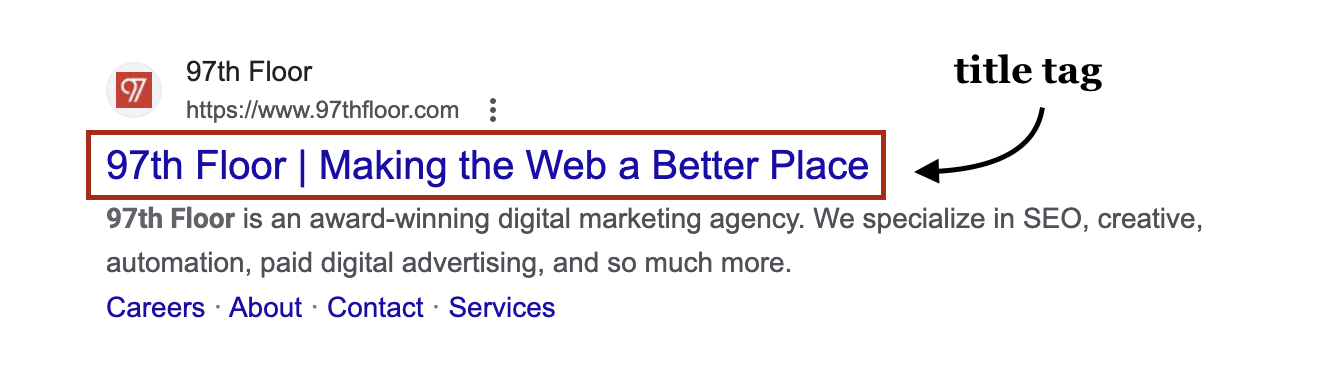
Title tags’s main job is to help search engines understand what your page is about. When the search engines are given the right information, they’re more likely to show your content to the right audience. For example, when a user performs a search, search engines use the title tag as a primary source to determine the relevance of your page to the user's query.
What’s more, title tags are the first impression users have of your site on the SERPs (search engine results pages). A well-crafted title tag has a lot of influence on whether users decide to click on your link, or a competitor’s. Where competition for attention on the SERP is fierce, a compelling title tag can be the difference between a user visiting your site or scrolling past it.
The goal is to create a title tag that is both interesting to users and optimized for search engines. Here are the key elements to consider:
To better understand effective title tag creation, let's examine some real-life examples:
These examples demonstrate how a well-crafted title tag can succinctly convey the general idea of the page's content while integrating keywords and branding effectively. However, it’s important to analyze your competition—the top 10 results of Google—to know what will truly make you stand out from the rest.
Here’s a quick dive into the HTML coding of title tags. The title tag is a part of the head section of an HTML document and is defined as follows:
<head>
<title>Your Page Title Here</title>
</head>
Here's a breakdown of this structure:
Here are some common pitfalls to be aware of when crafting title tags:
By steering clear of these common errors, you can craft title tags that are both SEO-friendly and appealing to your audience.
The following tools can help in researching keywords, analyzing the effectiveness of your title tags, and ensuring they are appropriately optimized for search engines and users:
Tracking and measuring the impact of your title tag optimization efforts is essential for understanding their effectiveness and making informed adjustments. Here’s why it’s important and how to go about it:
By effectively tracking and measuring, you can fine-tune your title tags to better meet your SEO objectives and cater to your audience’s preferences.
Title tags are a critical component of your website's SEO and user experience. An effective title tag can significantly improve your site's visibility on search engines, attract more clicks, and provide a clear and concise summary of your page's content. By understanding the importance of title tags, following best practices for creating them, avoiding common mistakes, utilizing the right tools, and regularly tracking their performance, you can enhance your website's overall effectiveness and reach your digital marketing goals.
Aim for 50-60 characters to ensure it displays properly on SERPs without being cut off.
No, each page should have a unique title tag to accurately represent its content and avoid confusion for search engines.
Keywords are vital for SEO, but they should be used naturally and relevantly.
Including the brand name can be beneficial, especially for brand recognition, but it's not mandatory, especially if space is limited.
Yes, they're a key factor in how search engines understand and rank your pages.
Review and update them as needed, especially if there are changes in your content or SEO strategy.
The title tag is the clickable headline in SERPs, while the meta description provides a brief summary of the page’s content.
Absolutely. An engaging and relevant title tag can significantly increase CTR.
No. Title tags are designed to lead potential buyers onto a landing page, not to invite action.
Monitor metrics like CTR and page ranking, and use tools like Google Search Console for insights.
A meta description is a succinct summary appearing under the title of a webpage in search engine results. They serve as brief overviews, providing searchers with insight into the content of the page. While not a direct ranking factor, meta descriptions play an important role in influencing user behavior.
Meta descriptions are instrumental in boosting click-through rates (CTRs), as they offer the first impression of your page's content to potential visitors. A well-crafted meta description can entice users to click on your link, thereby increasing the organic traffic to your website. This increased engagement signals search engines that your content is relevant and valuable, indirectly benefiting your page's ranking.
A meta description must be concise yet comprehensive. Generally, the optimal length is about 155-160 characters. This range ensures that your description is long enough to provide essential information, yet short enough to prevent truncation in search results.
Creating a compelling meta description requires a blend of creativity and strategy. Here are key tips:
While keywords in meta descriptions don't directly influence rankings, they are often highlighted in search results when they match the search query. This highlighting can draw the searcher's eye and increase the likelihood of a click. Remember, the use of keywords should feel natural and contextually appropriate.
Good Example:
Title: “Foundry & Metal Casting”
Meta Description: “Find top-quality foundry supplies & metal casting equipment to improve your foundry flow and productivity. Get started with General Kinematics.”
Title: "Ultimate Guide to Mediterranean Diet Recipes"
Meta Description: "Explore our comprehensive guide to Mediterranean diet recipes. Discover delicious, heart-healthy options and start your journey to wellness today!"
Why It Works:
Bad Example:
Title: “Foundry & Metal Casting”
Meta Description: “From the scrap yard to shipping, General Kinematics foundry equipment has a solution to improve your foundry flow and productivity. With the largest selection of vibratory and rotary foundry machinery equipment available in the industry, GK can create process flow improvements that will show real value to your throughput.”
Title: "Best Fitness Tips"
Meta Description: "Fitness, health, exercise, tips, gym, workouts, weight loss, muscle gain, fitness tips, health advice."
Why It Doesn't Work:
The good example works well because it clearly communicates what the user can expect from the page, uses relevant keywords naturally, and includes an engaging call to action. On the other hand, the bad example fails as it prioritizes keyword stuffing over delivering a meaningful summary, resulting in a lack of clarity and engagement.
Meta descriptions should serve as a window to your content, enticing users to visit your page for more. They must balance SEO with user experience, offering clear, engaging, and relevant information.
Each type of page demands a tailored approach to its meta description. The key is to align the description with the page's primary goal and content, ensuring it's an accurate and enticing preview of what's to come.
Search engines constantly evolve their algorithms, and staying ahead of these changes is crucial for SEO success. For instance, recent updates have seen search engines like Google using machine learning to better understand and match search queries with relevant meta descriptions, emphasizing the need for clarity and relevance in your meta descriptions.
Looking ahead, the trend is moving towards even more personalized and contextually relevant search results. This evolution means that meta descriptions will need to be more targeted and finely tuned to meet the specific needs and intents of different search queries. As voice search and AI technology continue to advance, the way meta descriptions are interpreted and valued by search engines might also change, necessitating a flexible approach to SEO.
Meta descriptions themselves don't directly impact SEO rankings. However, they are crucial for click-through rates (CTRs). A well-written meta description can entice users to click on your website link, leading to higher organic traffic and potentially improving your page's perceived relevance and value to search engines.
The effectiveness of meta descriptions can be gauged through click-through rates (CTRs) in tools like Google Search Console. A higher CTR generally indicates a more compelling meta description.
All websites can benefit from optimized meta descriptions, but they are particularly crucial for e-commerce sites, blogs, and websites in competitive industries where a compelling description can be a differentiator in search results.
Revision should be based on performance and changes in content strategy. If CTRs are low or if there’s a significant change in your page content or SEO strategy, it’s wise to update the meta description.
Yes, misleading or irrelevant meta descriptions can lead to higher bounce rates as visitors may not find what they expected based on the description.
Avoid overusing keywords (keyword stuffing), being too vague, duplicating descriptions across multiple pages, and exceeding the character limit that leads to truncation in search results.
Meta descriptions complement title tags and headers by providing a concise summary of the page’s content. Together, they give search engines and users a clear idea of what the page is about, enhancing overall SEO effectiveness.
While the core principles remain the same, for mobile users, brevity and clarity become even more crucial due to smaller screen sizes.
Reflect your brand's tone and personality in your meta descriptions. Whether it's professional, witty, or friendly, consistent use of your brand voice can enhance brand recognition and appeal to your target audience.
Meta descriptions are a part of your content marketing and SEO strategies. They contribute to brand messaging, help improve organic search visibility, and can influence the success of your digital marketing efforts by attracting more clicks from potential customers.
